2 Days in Valencia: The Perfect Itinerary for First-Time Visitors
People often ask me why I keep sending friends to Valencia when Barcelona gets all the attention. The answer is simple: Valencia is the Spain people picture in their heads, without the crowds fighting them for it. It is a city that still runs on local time — long lunches, late evenings, neighbours who actually live in the old town — and it happens to be the birthplace of paella, which alone would justify the trip.
If this is your first visit, two days is the honest sweet spot. One day for the old town, with its cathedral, silk exchange and glorious food market. One day for the future — the gleaming City of Arts and Sciences, a ride through the Turia Gardens, and paella the proper way, at lunch, by the sea.
This itinerary is how I would plan it for a friend who has never been. The days are grouped so you are not crossing the city back and forth, the book-ahead warnings are where they genuinely matter, and the food stops are the ones I would be annoyed to miss. Follow it loosely, leave room for a slow coffee, and Valencia will quietly win you over.
Where to Stay in Valencia
All three picks sit in or beside the old town, which is exactly where a first-time visitor wants to be — everything on day one is walkable, and the bus or a short taxi gets you to the City of Arts and Sciences and the beach on day two.
Luxury pick — Only YOU Hotel Valencia
The city’s smartest address, right on Calle de la Paz, a couple of minutes from the cathedral. Only YOU is a five-star that feels more like a beautifully designed private club than a big hotel — playful interiors and a serious cocktail bar downstairs. Book a street-facing room if you can; watching the old town wake up from that balcony is half the pleasure.
Boutique pick — Vincci Palace Valencia
Also on Calle de la Paz, in a handsome old palace building a short stroll from Plaza de la Virgen. The Vincci Palace does the boutique thing properly: calm, elegant rooms, marble and warm wood, and none of the stuffiness that sometimes comes with palace hotels. It is the pick I make for travellers who want old-town atmosphere with everything quietly polished, at a step below five-star prices.
Budget pick — Hostal Antigua Morellana
Do not let the word “hostal” put you off — in Spain it means a small, family-run guesthouse, not a dormitory. Antigua Morellana occupies an 18th-century building on a quiet lane two minutes from the Central Market, with a pretty tiled courtyard, spotless simple rooms and prices that leave your budget intact for paella. It books up fast precisely because it is this good, so reserve early.
Table of Contents
- Where to Stay in Valencia
- Day 1: The Old Town — Cathedral, La Lonja and the Central Market
- Morning: Valencia Cathedral, the Miguelete and Plaza de la Virgen
- Afternoon: La Lonja de la Seda and Grazing Through the Central Market
- Evening: Torres de Serranos and Dinner in El Carmen
- Day 2: The Future and the Sea — City of Arts and Sciences, Turia Gardens and the Beach
- Morning: The City of Arts and Sciences and the Oceanogràfic
- Afternoon: Turia Gardens and Paella at Malvarrosa Beach
- Evening: Coffee, Horchata and a Ruzafa Night
- Final Thoughts
Day 1: The Old Town — Cathedral, La Lonja and the Central Market

Day one is the historic Valencia: a compact, flat, wonderfully walkable centre where Roman, Moorish and Gothic centuries sit on top of each other and every lane smells faintly of orange blossom and coffee. Nothing today is far from anything else, so the plan is to wander well, not fast.
Morning: Valencia Cathedral, the Miguelete and Plaza de la Virgen
Start in Plaza de la Virgen, the city’s oldest and loveliest square, with a coffee on a terrace while the fountain runs and the pigeons do their rounds. On one side sits Valencia Cathedral, a layer cake of Romanesque, Gothic and Baroque built over the city’s old mosque — and home to the chapel displaying the chalice Valencia believes to be the Holy Grail. Believe or not, the little chapel itself is genuinely moving.
Then climb the Miguelete, the cathedral’s octagonal bell tower: 207 steps up a spiral staircase for the best rooftop view in the city — old town tiles in every direction, the Turia Gardens curving away, the sea on the horizon. Go early, before the midday tour groups and the heat both arrive.
Tip: The tower staircase is one-way in spirit only. It is narrow, and everyone squeezes. Early morning is not just prettier, it is physically easier.
Afternoon: La Lonja de la Seda and Grazing Through the Central Market
A few lanes away stands La Lonja de la Seda, the old silk exchange and one of the finest Gothic civic buildings in Europe — a main hall of twisting stone columns that spiral up like palm trees, built when Valencia’s silk money ran half the Mediterranean. It is a UNESCO site, it rarely feels crowded, and it takes under an hour. Do not skip it; visitors who rush Valencia always do, and they are always wrong.

Cross the square and you are at the Mercado Central, one of the largest and most beautiful food markets in Europe, all iron, glass and Valencian tiles under a great dome. This is not a museum — it is where the city actually shops, so graze the way locals graze: a few slices of jamón, olives and cheese from whichever stall has a queue of grandmothers, fresh orange juice (you are in Valencia; it would be rude not to), and a sit-down tapa or two at one of the little bars inside. Market hours lean morning-to-early-afternoon, so do La Lonja first and graze after, not the other way round.
Evening: Torres de Serranos and Dinner in El Carmen
As the light softens, walk up to the Torres de Serranos, the great Gothic gate towers that once guarded the city’s northern entrance. You can climb them for a small fee, but honestly the evening move is simpler: cross the old riverbed, look back at the towers glowing in the low sun, and then drift back into El Carmen, the old town’s liveliest quarter.
El Carmen is where Valencia eats and drinks after dark — a tangle of lanes around Plaza del Tossal and Calle de Quart full of small restaurants, vermouth bars and terraces that fill up from about 9pm, because dinner here runs late and nobody minds. Order a glass of Agua de Valencia (cava, orange juice, and a kick) exactly once, then settle into proper tapas. You have earned it.
Day 2: The Future and the Sea — City of Arts and Sciences, Turia Gardens and the Beach

Day two swaps the 15th century for the 21st. Valencia’s second half runs along the old riverbed — a flood-diverted river turned into kilometres of gardens — down to a complex of white, bone-like buildings that look like they landed from a kinder future. End the day where every Valencian Sunday ends: at the beach, over paella.
Morning: The City of Arts and Sciences and the Oceanogràfic
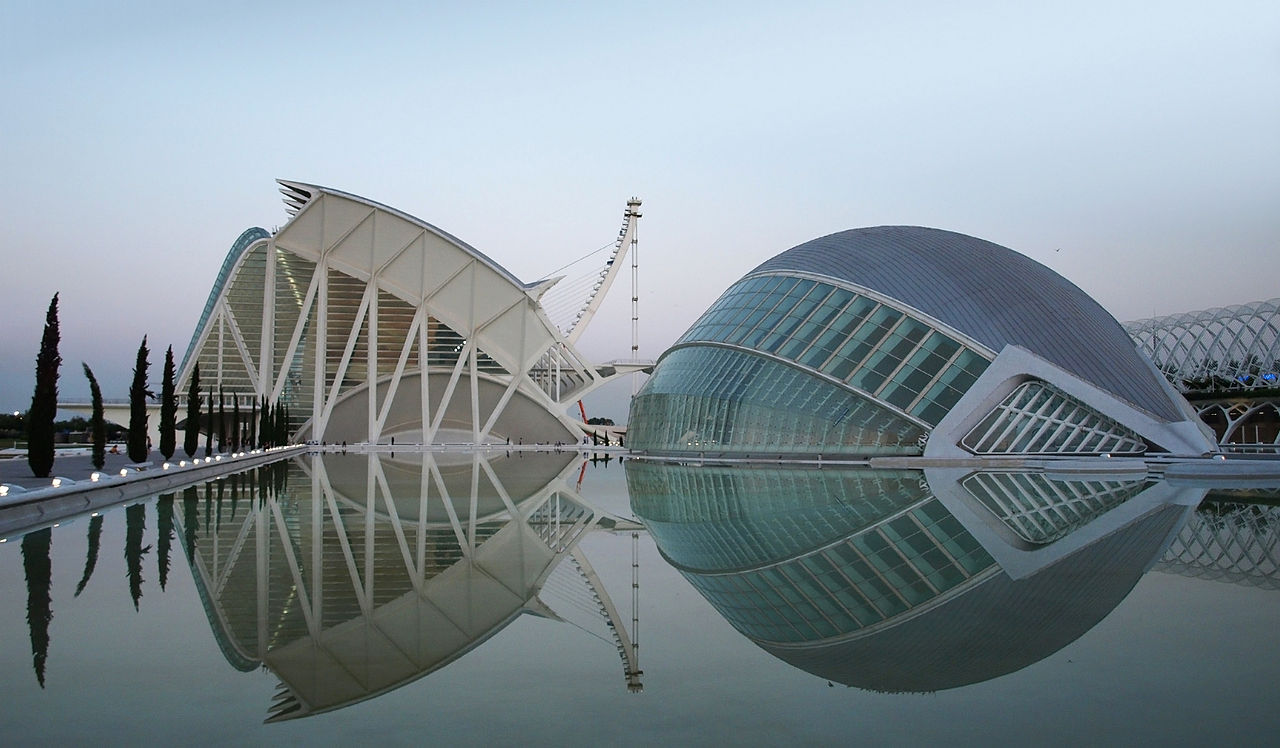
Start early at the City of Arts and Sciences, Santiago Calatrava’s extraordinary complex at the eastern end of the Turia Gardens. Even if you go inside nothing at all, walk the full length of it first: the Hemisfèric like a great glass eye opening on its reflecting pool, the science museum like the skeleton of some huge, friendly whale, the opera house rearing above them both. It is the most photographed view in modern Spain for a reason.
Then give your morning to the Oceanogràfic, the largest aquarium in Europe, set in the same complex. The underwater tunnel through the shark tank alone justifies the ticket, and the dolphinarium, the Arctic belugas and the Mediterranean halls are all superb. Two honest warnings: it is big — allow at least three hours — and it is popular, so book your entry online in advance, especially for weekends and holidays. If you have energy and curiosity left, pair it with a film at the Hemisfèric’s IMAX dome afterwards; a combined ticket usually works out cheaper than buying both on the day.
Getting there: Buses run from the old town straight to the complex, or take a taxi — it is a short, cheap ride. Do not walk it in summer heat; save your legs for the gardens later, when the day cools.
Afternoon: Turia Gardens and Paella at Malvarrosa Beach
Here is the local way to cross the city. When the river Turia flooded catastrophically in 1957, Valencia diverted it — and turned the empty riverbed into the Turia Gardens, nine kilometres of park running through the city: pine groves, football pitches, orange trees and the giant Gulliver playground locals grow up on. Rent a bike near the City of Arts and Sciences end and ride the gardens at an easy pace, or simply walk the prettiest stretch — from the Serranos towers down under the old bridges. It is the green spine of the city and the single best free thing in Valencia.

From the gardens, head to Malvarrosa, the city’s main beach, with its promenade of paella restaurants. Now the rules, because paella here is a serious matter:
- Paella is lunch, never dinner. Valencians eat it between about 1:30pm and 3:30pm; restaurants serving it at night are serving tourists.
- Real paella Valenciana contains chicken, rabbit, green beans and garrofó beans — not seafood, not chorizo, never both meat and shellfish mixed.
- It is cooked to order and takes at least 20–25 minutes. If it arrives instantly, it was not made for you.
- The socarrat is the prize — the thin, crispy, caramelised crust of rice at the bottom of the pan. When it arrives, everyone at the table wants it. Share fairly.
Book a beachfront table for about 2pm, order the paella for a minimum of two, and take the long way through lunch — a salad, the paella, a coffee, the sea doing its thing in front of you. This is not a meal on the itinerary. This is the itinerary.
Evening: Coffee, Horchata and a Ruzafa Night

For your last evening, cross to Ruzafa, the neighbourhood just south of the old town where Valencia’s young, creative crowd actually lives. It is the city’s café quarter — coffee shops, bakeries, galleries and the remodelled Ruzafa Market — and it is at its best from late afternoon onwards, when the terraces fill and nobody is in a hurry.
Do one very Valencian thing before dinner: order a horchata at a classic horchatería — the original is Horchatería Santa Catalina in the old town, pouring it since the 19th century, but every neighbourhood has its own beloved spot. Horchata here is not the rice drink from Mexico; it is made from tiger nuts (chufa), served ice-cold and slightly sweet, with a long, soft pastry called a fartón for dunking.
Finish with dinner in Ruzafa itself: small plates, natural wine bars, a couple of streets where you could pick a place at random and eat well. Tomorrow you will tell people the aquarium was incredible and the old town was beautiful, and then you will spend longer talking about the food. That is Valencia working as intended.
Final Thoughts
Two days in Valencia will not make you an expert, but it will do something better: it will show you the two cities in one — the old silk-rich town of towers and markets, and the calm, green, futuristic city that grew along an empty river. And it will feed you the real paella, in the place that invented it, eaten the way it is meant to be eaten. Most visitors leave saying the same thing: why did nobody tell me about Valencia sooner?
If you are staying longer — and this city has a way of stretching trips — keep exploring our Valencia guides. We have deeper dives on the best areas to stay, the food markets and tapas bars, and easy day trips down the coast. Give Valencia your two days, and do not be surprised when it quietly becomes the stop you compare everywhere else against.
¡Buen viaje!
Photo credits: Photo: Elemaki / Alvaro qc, CC BY-SA 3.0, via Wikimedia Commons; Photo: José Luis Filpo Cabana, CC BY 3.0, via Wikimedia Commons; Photo: Diego Delso, CC BY-SA 3.0, via Wikimedia Commons; Photo: Esniom, CC BY-SA 4.0, via Wikimedia Commons; Photo: Javier Vte Rejas, CC BY 2.0, via Wikimedia Commons; Photo: Joanbanjo, CC BY-SA 4.0, via Wikimedia Commons.