Iglesia de San Luis de los Franceses: The Complete Guide to Seville’s Baroque Jewel
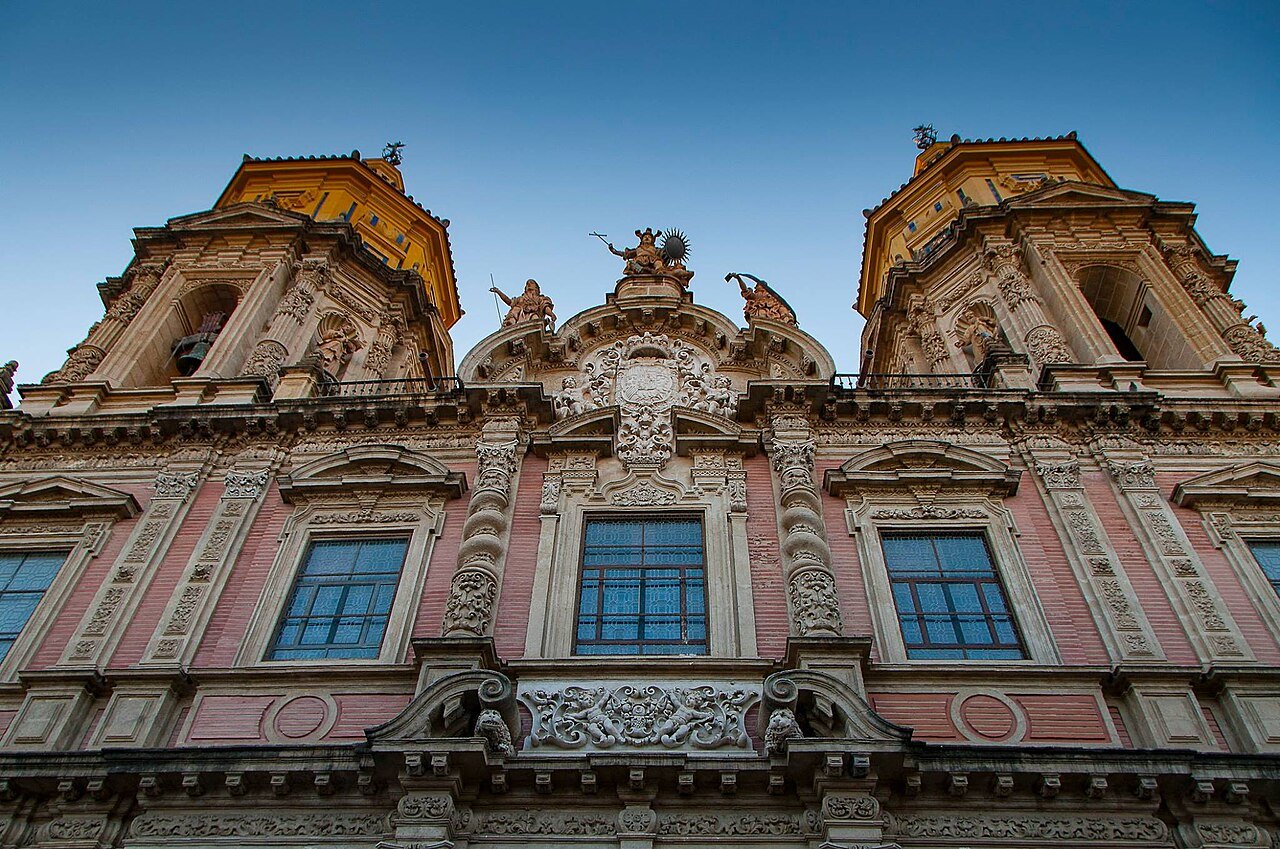
Twenty minutes north of the cathedral, on a working street in the Macarena district, stands the most beautiful room in Seville that most visitors never see. From outside it is a tall brick-and-stone façade wedged into Calle San Luis, carved like an altarpiece and flanked by two octagonal towers. Step through the door and the street noise stops: a circular blaze of gold, mirrors and fresco opens around you, sixteen twisted columns carry a painted dome, and every surface argues for the glory of God and the Society of Jesus.
This is the church of the old Jesuit novitiate, built between 1699 and 1730 to designs by Leonardo de Figueroa — a teaching machine as much as a church, its walls covered in symbols its teenage novices were meant to read daily. The Jesuits were expelled, the building spent two centuries as a seminary, a factory, a hospice and a theatre, and the church sat closed for decades — precisely why its original decoration survives so completely. Restored by the Diputación de Sevilla and reopened in 2016, it is now the city’s great rediscovered interior.
This guide explains what the novitiate was, walks you through the façade, the dome, the main altarpiece and the novices’ private chapel, and covers tickets, hours and how to build a morning around Seville’s northern old town.
Short Answer
The Iglesia de San Luis de los Franceses stands at Calle San Luis 37, in the Macarena district at the old town’s northern edge. Built 1699–1730 for the Jesuit novitiate and designed by Leonardo de Figueroa, it is a Greek-cross church that feels circular: sixteen Solomonic columns, a frescoed dome by Lucas Valdés, and altarpieces by Pedro Duque Cornejo, including a main altarpiece crowned by an enormous gilded crown. Entry costs around €4 (reduced €2), the visit takes 45–90 minutes including the domestic chapel and crypt, and the church is closed on Mondays.
There is no advance-booking drama here: the church’s own ticket is bought at the door. The bookable option is a guide — the San Luis de los Franceses guided tour (“Hidden Gems in Seville in English”) walks the whole northern old town — the Setas, Calle Feria, the Macarena basilica — and takes you inside San Luis with the symbolism explained, which in a building this dense with meaning is worth a great deal. Confirm current prices and hours on the Diputación de Sevilla website before you go.
Table of Contents
- The Short Version: Is San Luis de los Franceses Worth It?
- A Novitiate on Calle San Luis: The Jesuits’ School for Saints
- Leonardo de Figueroa and a Church Thirty Years in the Building
- The Façade: A Retablo Turned to Face the Street
- Inside: A Greek Cross That Feels Like a Circle
- The Dome: Light, Frescoes and Lessons for Novices
- The Main Altarpiece: Gold, Mirrors and a King’s Crown
- The Side Altars and the Relics in the Gold
- The Domestic Chapel: The Novices’ Private World
- The Crypt and the Patios
- Expelled, Closed, Reborn: The Church’s Second Life
- Pair It with the Northern Old Town
- Practical Info
- Tips That Will Improve Your Visit
- Final Thoughts
The Short Version: Is San Luis de los Franceses Worth It?
Yes — for many visitors this becomes the single most memorable interior in Seville after the cathedral. It is small, complete and overwhelming: one room in which architecture, sculpture, painting, light and mirrors were composed together by masters at the top of their powers, then — by historical accident — preserved almost exactly as they left it.
It belongs high on any list of things to do in Seville. The honest caveats are three: it is a 20-minute walk north of the cathedral; it is deconsecrated, so you visit a monument and concert hall, not a working church; and if gilded Baroque leaves you cold, no single room will convert you. Everyone else: go, and go in the morning.
A Novitiate on Calle San Luis: The Jesuits’ School for Saints
The Society of Jesus arrived in Seville in 1554 and built a church, a professed house and a novitiate near the centre. Within fifty years they had outgrown it. In the early 1600s a wealthy widow, Lucía de Medina, donated land in the north of the city for a larger novitiate on two conditions: that she be buried in its chapel, and that its church be dedicated to her patron, Saint Louis.
Saint Louis is Louis IX of France, the crusader king — and the dedication was shrewd. Louis was elder brother of Ferdinand III, the saint-king who reconquered Seville; and from 1700 Spain had a French-born Bourbon king, Philip V, whose dynasty the Jesuits courted openly with the crowns and fleurs-de-lis scattered through the decoration. The novitiate moved to the site by 1609, and the complex took shape around today’s Calle San Luis.
Understand what a novitiate was and the building makes sense. Novices lived enclosed, cut off from the outside world, on a regime of prayer, study and self-examination built around Ignatius of Loyola’s Spiritual Exercises. Their church was a permanent visual lesson — hence the readable symbols, repeated motifs and paintings that argue, defend and teach.
Leonardo de Figueroa and a Church Thirty Years in the Building
The church was begun in 1699, to designs by Leonardo de Figueroa, the dominant architect of the Sevillian Baroque — the same hand behind the church of the Hospital de la Caridad, the Hospital de los Venerables and much of the Palacio de San Telmo. San Luis is his most concentrated work: a single, centrally planned space where he could control every view, every shaft of light and every reflection.
Building took three decades. The church was finished in 1730 and inaugurated in 1731 by Archbishop Luis de Salcedo y Azcona. The decoration came from the great Sevillian workshops: altarpieces by Pedro Duque Cornejo, grandson of Pedro Roldán; dome frescoes by Lucas Valdés, son of Valdés Leal; entrance murals, finished around 1743, by Domingo Martínez.
The tragedy folded into the story is that the Jesuits barely got to use it. The church had been open thirty-six years when, in 1767, Charles III expelled the Society from Spain — the Bourbon courtship had failed. They returned in 1817, but the confiscations of 1835 expelled them for good.
The Façade: A Retablo Turned to Face the Street
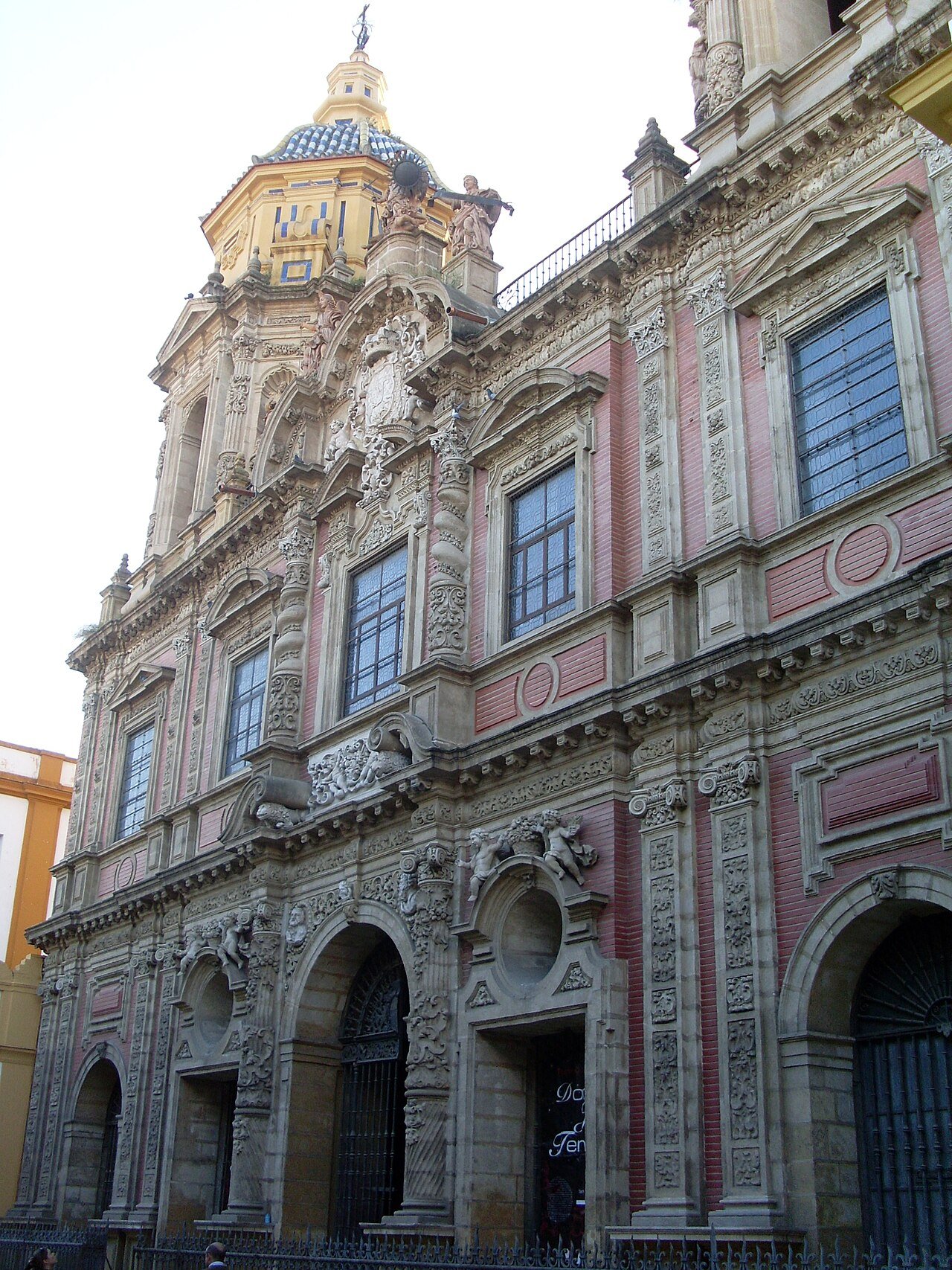
Figueroa designed the front of San Luis the way Sevillian sculptors designed altarpieces: as a two-storey retablo of niches, columns and carving, in alternating bands of warm brick and pale stone. The central upper window is framed by Solomonic — barley-sugar twisted — columns, and above it the Spanish coat of arms is crowned by three archangels.
What you cannot do is step back and admire it whole. The Jesuits planned a plaza before the church, as the Salvador has; it was never built, and Calle San Luis remains a working street of ordinary width. The great front looms over you at close range, all detail and no panorama — bring a wide lens, or accept the towers in pieces. Above the door, an inscription sets the terms of entry: “This is the door of God; the righteous shall enter through it” — a novitiate’s threshold, and the building still keeps its hush.

Inside: A Greek Cross That Feels Like a Circle
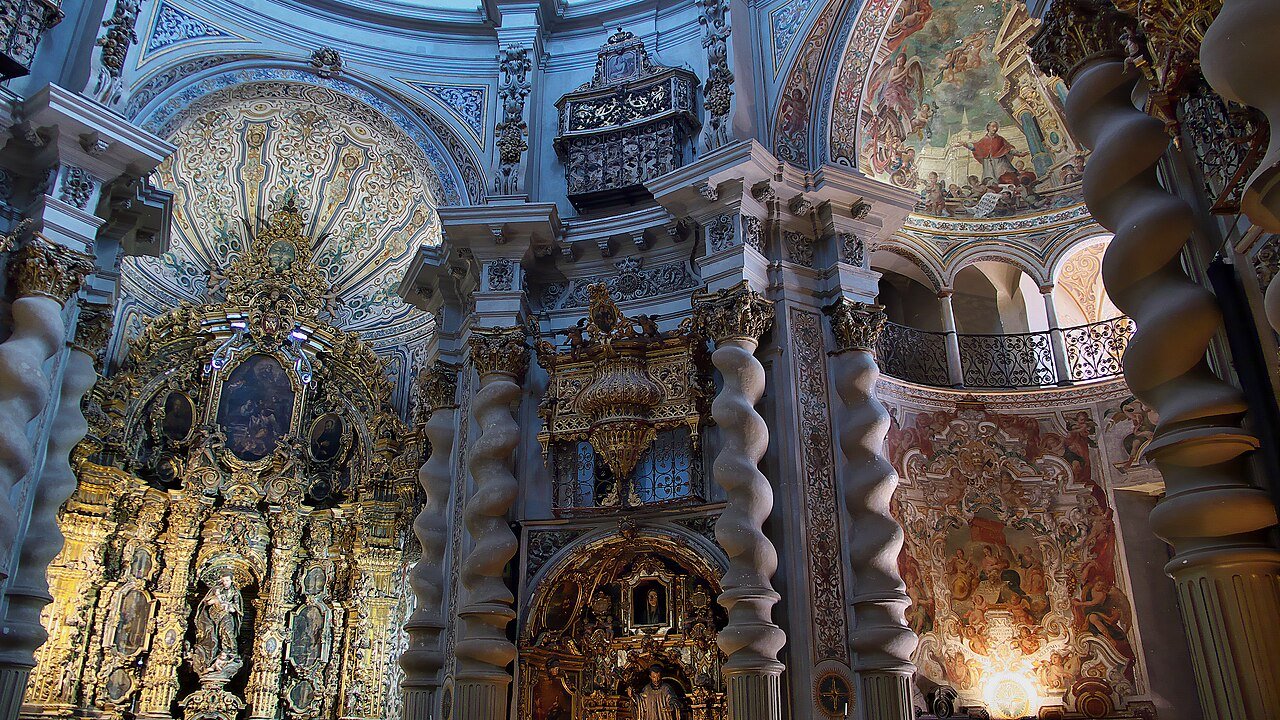
The plan is a Greek cross — four equal arms around a central space — but the corners are filled with chapels and the whole ringed with columns, so the room reads as a circle: the visitor stands in a rotunda of gold. Sixteen Solomonic columns, eight full and eight half, appear to carry the great dome on their twisted shafts.
Appear is the operative word. The dome actually stands on four massive stone pillars, recessed and disguised: each is hidden behind a small altarpiece, a balcony and a lattice screen, so the structure vanishes and the columns seem to do impossible work — a conjuring trick in stone, and a characteristically Jesuit one. Most of the sixteen columns are faithful reconstructions from the 2016 restoration; only the two half-columns of the main altar are Figueroa-era originals, a fact the guides state openly, and which changes nothing about the room’s impact.
Around the upper level run balconies with wooden lattices, celosías, from which the novices could follow the liturgy unseen — the enclosure made architectural. Stand in the centre, turn slowly, and the room performs its argument in the round.
The Dome: Light, Frescoes and Lessons for Novices
Look up — or better, use the angled floor mirror the attendants provide, a small mercy that saves every neck in the building. The dome is frescoed by Lucas Valdés with a programme built for teaching. At its centre, opposite the entrance, sits Religio, Religion herself, flanked by a cross and a palm. Around her, Valdés set the furniture of the Old Covenant beside the New: the Ark of the Covenant, the seven-branched candlestick, the Altar of Incense, and the Eucharist.
The dome’s eight pillars carry eight virtues, each paired with a Beatitude — Charity toward one’s neighbour with “Blessed are the merciful”, Poverty with “Blessed are the poor in spirit”, plus Prayer, Humility, Chastity, Obedience, Mortification and the Love of God. A novice looking up at morning prayer was looking at his syllabus.
The light is choreographed too. The church is aligned with the analemma, the sun’s figure-of-eight path: the main altar, to the west, floods with light especially in spring, while the altars of Saint Stanislaus Kostka (north) and Saint Francis Borgia (south) catch the sun on their feast days. The building is a calendar as well as a church.

The Main Altarpiece: Gold, Mirrors and a King’s Crown
The main altarpiece, carved by Pedro Duque Cornejo, is the church’s thunderclap: a towering construction of gilded wood filling the western arm, presided over by a large canvas of Saint Louis in the school of Zurbarán — the king in armour, contemplative, beneath an enormous crown carried on a canopy above the whole composition. The crown is the dedication made sculpture: kingship offered to heaven, and — nobody in 1730 missed this — heaven’s favour courted for kings.
Work your eyes over the carving and stranger things appear. The altarpieces are studded with convex Venetian mirrors, tin and mercury, which catch the light and fling it around the room, enlarging and warping what they reflect — the interior flickers as you move. Among the gold, too, are eight skulls: the memento mori the novices were never allowed to forget, sitting in the middle of the glory.
This is the place to slow down. The San Luis de los Franceses guided tour earns its fee in front of this altarpiece alone, decoding the crown, the mirrors and the skulls in the order they were meant to be read.
Free Seville travel guide
Planning a trip to Seville? Get our free one-page Seville checklist: what to book ahead, what to skip, and the tapas bars we actually eat in.

The Side Altars and the Relics in the Gold
At right angles to the main altar stand two more giant altarpieces, near-twins, for the Jesuit saints Stanislaus Kostka and Francis Borgia — the boy novice who died at eighteen, patron of every teenager in the house, and the duke who renounced a court to join the Society. Four smaller altarpieces fill the diagonal chapels. All are heavily gilded, and all share the church’s most macabre distinction.
Look closely at the frames and pedestals: set into the gold, in glass-fronted cases, are relics — the dressed and flower-decked bones of saints and martyrs. Reliquary altarpieces of this density are rare survivors in Spain: death not hidden but ornamented, worn like jewellery by the building. Visitors divide sharply — some find them moving, some the most unsettling thing in Seville — but nobody walks past twice without stopping.
Beneath the choir, the entrance wall completes the argument with paint. Domingo Martínez’s murals of around 1743 show Saint Ignatius raised above the Temple of Divine Wisdom, holding the book of the Spiritual Exercises; flanking allegories defend the Society against its critics using the very papal bulls that founded it, with the three Graces pressed into service as an image of liberality: giving, accepting and returning. Even the doorway is a debating chamber.


The Domestic Chapel: The Novices’ Private World
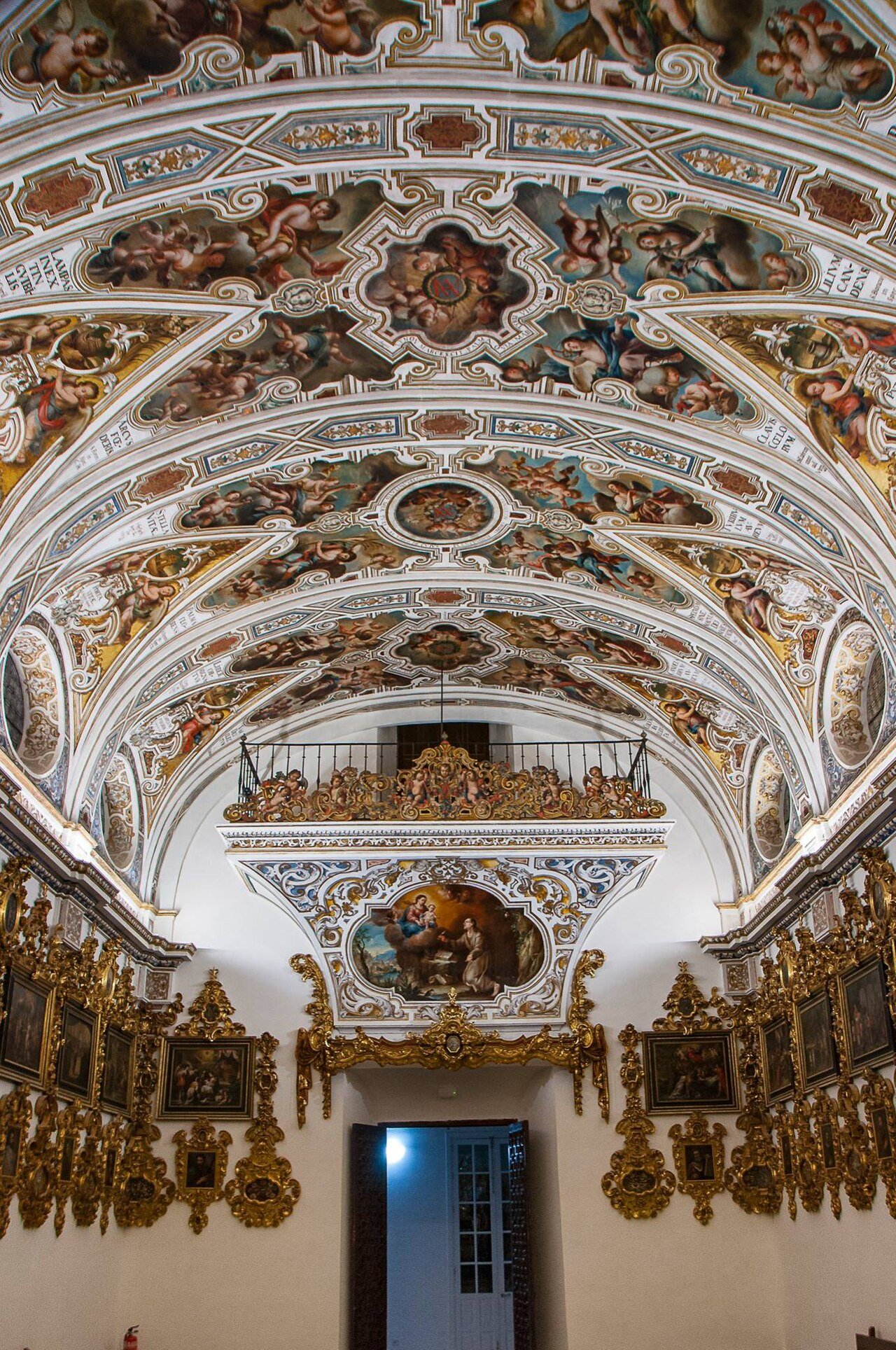
Passages behind the main altar lead to the capilla doméstica, the domestic chapel — the novices’ own private church, invisible from the street and the emotional opposite of the great room: lower, warmer, intimate, its ceiling frescoed with cherubs by Lucas Valdés and Domingo Martínez, its altarpiece another Duque Cornejo confection with its own little dome. This was the enclosure’s inner room, where the community prayed away from the public gaze.
Its fame, though, is a painting that is no longer there. In 1619 a twenty-year-old Diego Velázquez — Seville-born, newly master of his craft — painted the Adoration of the Magi for this chapel. It hung here through the building’s whole Jesuit life; today it is a treasure of the Prado in Madrid. Standing in the small room it was painted for is one of those quiet thrills Spanish travel occasionally hands you for €4.
The chapel and its sacristy keep the complex’s second great collection of relics — ranks of reliquaries and saints’ bones in glass cases, displayed with an unembarrassed directness the modern museum world has largely tidied away. The restoration lit them theatrically, and the effect is part treasury, part beautiful nightmare.

The Crypt and the Patios
Below the church lies the crypt, a low vaulted undercroft that served for generations as the community’s burial place. Today it is empty of its dead, and the bare brick vaults, cool and echoing, are a palate cleanser after so much gold.
The visit route also takes in the two small patios of the old novitiate. From the former cloister garden you get the complex’s only good exterior view of the dome, rising over the rooftops of the Macarena — the view the unbuilt plaza was supposed to give the façade.


Expelled, Closed, Reborn: The Church’s Second Life
The complex’s afterlife reads like a summary of modern Spain. After the 1835 confiscation the novitiate became, in turn, a seminary, a Franciscan convent, a hospital for aged priests, a factory and a hospice; the church was deconsecrated, used for everything from storage to theatre, and for long stretches simply locked. When Seville’s churches burned in 1936, San Luis survived precisely because nobody thought of it as a church — the disuse that erased so many Spanish interiors preserved its altarpieces, frescoes and relics almost entire.
The Diputación de Sevilla, the provincial council, owns the complex and has funded its restoration since 1984. The final campaign — a decade of work on structure, frescoes, altarpieces and artistic lighting — was inaugurated on 6 September 2016, and San Luis opened to the public as a monument. It has since become one of the city’s loved cultural venues: early-music concerts under the dome, exhibitions in the chapel and crypt, and sessions of the Bienal de Flamenco have all used the rooms. Check the Diputación’s listings — an evening concert here is the building experienced as it was designed to be, full of music and lamplight.

Pair It with the Northern Old Town
San Luis is the anchor sight of the old town’s north. Make a morning of it. Five minutes away stands the Basílica de la Macarena, home of Seville’s most beloved Virgin, beside the surviving city walls and the medieval Arco de la Macarena. Calle Feria, running south, holds the city’s oldest street market — Thursday’s famous El Jueves flea market spreads along it weekly — and the Mudéjar churches of Santa Marina, San Marcos and Omnium Sanctorum line the walk back.
Continue south and in fifteen minutes you reach the Seville Cathedral and La Giralda crowds with a clear conscience, or turn west to the Alameda de Hércules for lunch. Museum lovers can pair the church with the serene painting galleries of the Museo de Bellas Artes de Sevilla; garden lovers can end the day in the María Luisa Park.
Practical Info
At a Glance
| Detail | Info |
|---|---|
| Address | Calle San Luis 37, Macarena district, Seville (41003) |
| Nearest stop | Buses along Calle San Luis and Resolana; Macarena basilica and walls a 5-minute walk |
| Tickets | Around €4 general; €2 reduced (under-16s, over-65s, students); Seville residents €1; audioguide around €3; partial entry €2 when rooms are closed |
| Free entry | Sunday afternoons, at the time of research — confirm on the Diputación de Sevilla site |
| Opening hours | Tuesday–Sunday 10:00–14:00 and 16:00–20:00 (July–August evenings 18:00–22:00); closed Mondays |
| Time needed | 45–90 minutes for church, domestic chapel, crypt and patios |
| Official site | Diputación de Sevilla (dipusevilla.es) — Conjunto Monumental San Luis de los Franceses |
Tickets and Booking
Tickets are sold at the door; advance booking is neither needed nor, for ordinary entry, possible. Guided visits run at set times and are included with the entry ticket when available; the audioguide (around €3) covers the church, chapel and crypt well. If you would rather have the whole northern quarter interpreted for you, the San Luis de los Franceses guided tour is bookable online and includes the church visit within its walking route. Concerts and events occasionally close parts of the complex, in which case a reduced partial-entry ticket applies.
Getting There
From the cathedral, walk 20 minutes north — up through the shopping streets to the Setas, then along Calle Feria into Calle San Luis; the façade is unmissable on your right. There is no metro or tram station nearby; city buses run along Calle San Luis and the parallel Resolana, and taxis can drop you at the door.
When to Go
Weekday mornings at opening time are quietest. Sunday afternoons are free but busiest. Avoid the midday closure, 14:00–16:00 (in high summer the evening session runs 18:00–22:00).
How Long You Need
Forty-five minutes covers the church alone with attention. Ninety minutes lets the audioguide lead you through the domestic chapel, the crypt and the patios as well — the complete surviving novitiate.
Tips That Will Improve Your Visit
- Use the floor mirror. It exists so you can read the dome’s frescoes — Religio, the Ark, the candlestick — without cricking your neck. Everyone forgets it is there; the attendants will point it out if you ask.
- Stand in the exact centre and turn slowly. The room was composed in the round: altarpieces answer each other across the space, mirrors flash, and the four hidden pillars only make sense once you have walked the full circle.
- Find the eight skulls. The memento mori count is the church’s favourite game. Then find the relics in the altarpiece frames — the bones in the gold are the detail visitors talk about afterwards.
- Don’t skip the domestic chapel. It is smaller and quieter than the church, holds the great reliquaries, and comes with a genuine Velázquez story. Many visitors leave without seeing it; it is included in your ticket.
- Check for concerts. An evening of early music under that dome is one of Seville’s great experiences, and tickets are separate from daytime entry — the Diputación’s cultural listings carry the programme.
Travel insurance, sorted
Whether it is a two-week holiday or a longer move, travel insurance is not the most glamorous part of a trip — but it is the one booking you want to have in place before a trip, and while you are already away.
Final Thoughts
Seville does Baroque grandeur at monumental scale in its cathedral, and Baroque grief at the Caridad. San Luis de los Franceses is the third term: Baroque delight — a whole church built as a joyful, ingenious piece of persuasion, gold and mirrors and painted heavens marshalled to thrill teenage novices into their vocation. That it survived expulsion, confiscation, factory use and civil war intact is close to miraculous; that it now sits open on a Macarena side street for the price of a coffee is a gift. Walk north. It is the room in Seville you will describe to people when you get home.
¡Buen viaje!
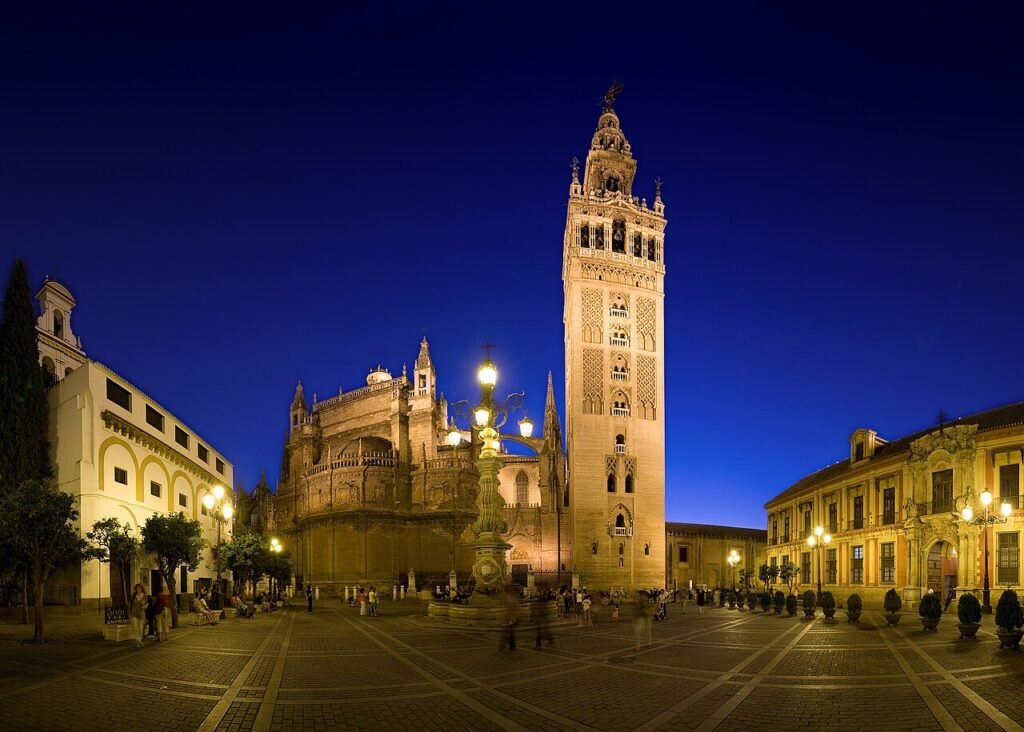
Photo credits: Wikimedia Commons contributors Francisco de Asís Alfaro Fernández, José Luis Filpo Cabana, Benjamin Smith, Thomas Dahlstrøm Nielsen and Pirado, via Wikimedia Commons (CC BY / CC BY-SA / public domain).


One Comment