Iglesia de San Esteban Valencia: The Complete Guide to the Baptism Church of Two Saints
Short Answer
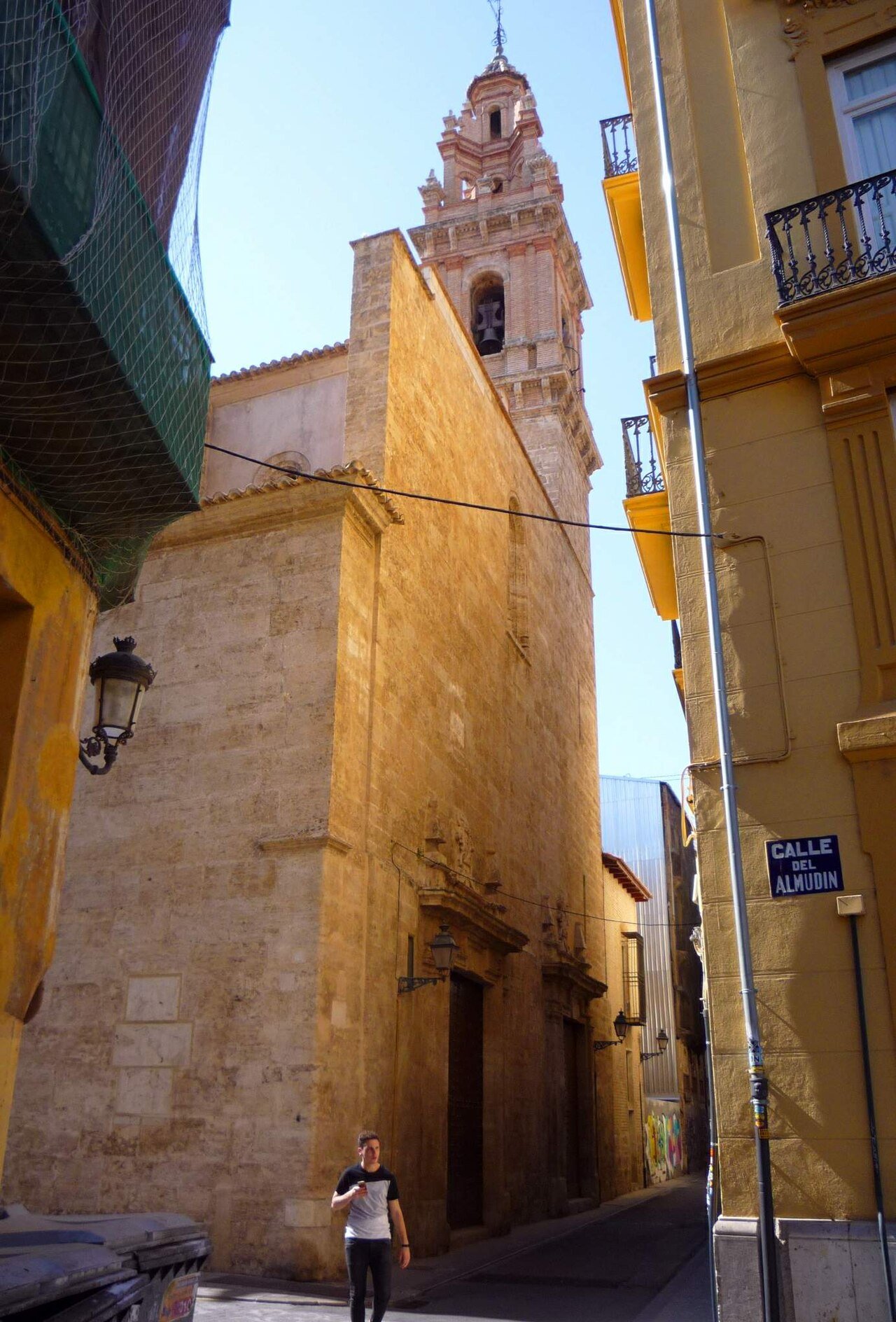
The Iglesia de San Esteban Protomártir — St Stephen the Protomartyr, the first Christian martyr — is a small parish church on the Plaza de San Esteban, in the La Xerea quarter of Valencia’s old town, a few minutes north-east of the Cathedral. Some historians, the parish itself notes, consider it the oldest parish in Valencia: a church stood here, over a mosque, from the Christian conquest of 1238, and the Gothic building raised on the site was wrapped, in the 17th century, in one of the most joyful Baroque interiors in the city — white sgraffito scrolling across walls and vaults painted the blue of Valencian ceramic. But San Esteban’s real fame is a font. Tradition holds that two of Valencia’s greatest saints were baptised at this church’s font: San Vicente Ferrer, the city’s patron, in 1350, and the Dominican missionary San Luis Bertrán in 1526 — both sons of notaries, in what was the notaries’ own church. The baptistery chapel built for the font in 1682, with its gilded altarpiece and life-size images of the two saints, is still the devotional heart of the building, and Valencian families still choose this church for baptisms above almost any other. Entry is free — a working parish, not a ticketed monument — but it opens mainly around worship, so timing is everything: the parish lists weekday Mass at 19:30, and cultural visits are arranged through the parish office. Allow 30 to 45 minutes inside, plus time for the plaza and the ceramic panel by the door that tells the whole story in tiles.
Table of Contents
- The Short Version
- The Oldest Parish in Valencia: El Cid, the Mosque and 1238
- The Notaries’ Church: A Gothic Shell Rebuilt Three Times
- Blue and White: The Baroque Interior and Its Sgraffito Vaults
- The Baptistery: The Font of San Vicente Ferrer and San Luis Bertrán
- The Bultos de Sant Esteve: A Baptism Re-enacted Every January
- The Lost Altarpiece: Juan de Juanes and the Prado Panels
- The Neoclassical High Altar: Espinosa, Vicente López and the Two Saints Above
- The Communion Chapel and the Cristo del Rescate
- Practical Info
- Tickets and Booking
- Opening Hours
- Getting There
- When to Go
- How Long You Need
- Tips for Visiting
- What to See Nearby
- Final Thoughts
The Short Version
San Esteban is the Valencia church that visitors miss and Valencians keep for themselves. It makes none of the noise of the Cathedral or San Nicolás — no ticket desk, no audioguide, no queue — because it is not really a monument at all, but a parish that happens to be nearly eight centuries old and to hold the city’s most charged baptismal tradition. What you get, if you catch it open, is a complete small masterpiece of the Valencian Baroque: a Gothic single nave whose every wall dissolves into blue-and-white sgraffito, a Neoclassical high altar watched over by the two saints the church baptised, and, at the foot, a domed baptistery chapel built by the notaries around the font of their patron saints. It earns its place among the best things to do in Valencia for travellers who have done the headline sights and want the layer underneath — the Valencia of guilds, parishes and family ceremonies, where a baby is still carried to the font in the same ritual geography as in 1350. Go in the early evening, before Mass, when the doors are open and the blue vaults catch the last of the light.
The Oldest Parish in Valencia: El Cid, the Mosque and 1238
The parish’s own history page opens with a large claim, carefully hedged: in the opinion of historians, it says, this is the oldest parish in Valencia. Local tradition — repeated by the city’s own Saint Vincent route — holds that a church stood here in the age of El Cid: his daughters are said to have awaited their marriages here, and his body to have rested here after his death in 1099, before its translation to Burgos; the parish adds that El Cid himself, taking Valencia in the 1090s, ordered the mosque on this site blessed as a church of the Virgen de las Virtudes, and an even older legend puts a Roman temple of Hercules on the plot. Treat all of that as what it is — tradition, layered proudly by a parish that has had centuries to accumulate it — and hold on to the documented spine, which is impressive enough without help.
What is firm is 1238. When Jaume I conquered Valencia that year, the mosque here was consecrated again, to San Esteban Protomártir, by Pedro de Albalat, Archbishop of Tarragona, on 12 October 1238 — days after the city’s surrender. San Esteban was thus among the very first parishes of Christian Valencia, planted in La Xerea, inside the old Islamic walls. By 1276 the original Gothic church was recorded as a new building in the Cathedral archive: a single nave under a wooden roof on diaphragm arches, at a date when — the archive note boasts — almost no other Valencian church had yet shed the physiognomy of a mosque. In that plain church, three generations later, the notary Guillem Ferrer would bring his newborn son to the font.
The Notaries’ Church: A Gothic Shell Rebuilt Three Times
San Esteban was, from early on, the notaries’ church — the parish of the men who drew up Valencia’s contracts, wills and marriage settlements, and whose college would shape the building’s destiny. The Ferrer family home lay within its boundaries, and the link was more than geographical: when Guillem Ferrer’s son was baptised here in 1350, the city itself stood sponsor, and the baptistery’s inscription lists saint after saint as hijos de notarios — notaries’ sons. Keep that guild thread in mind; it explains the church’s most famous room.
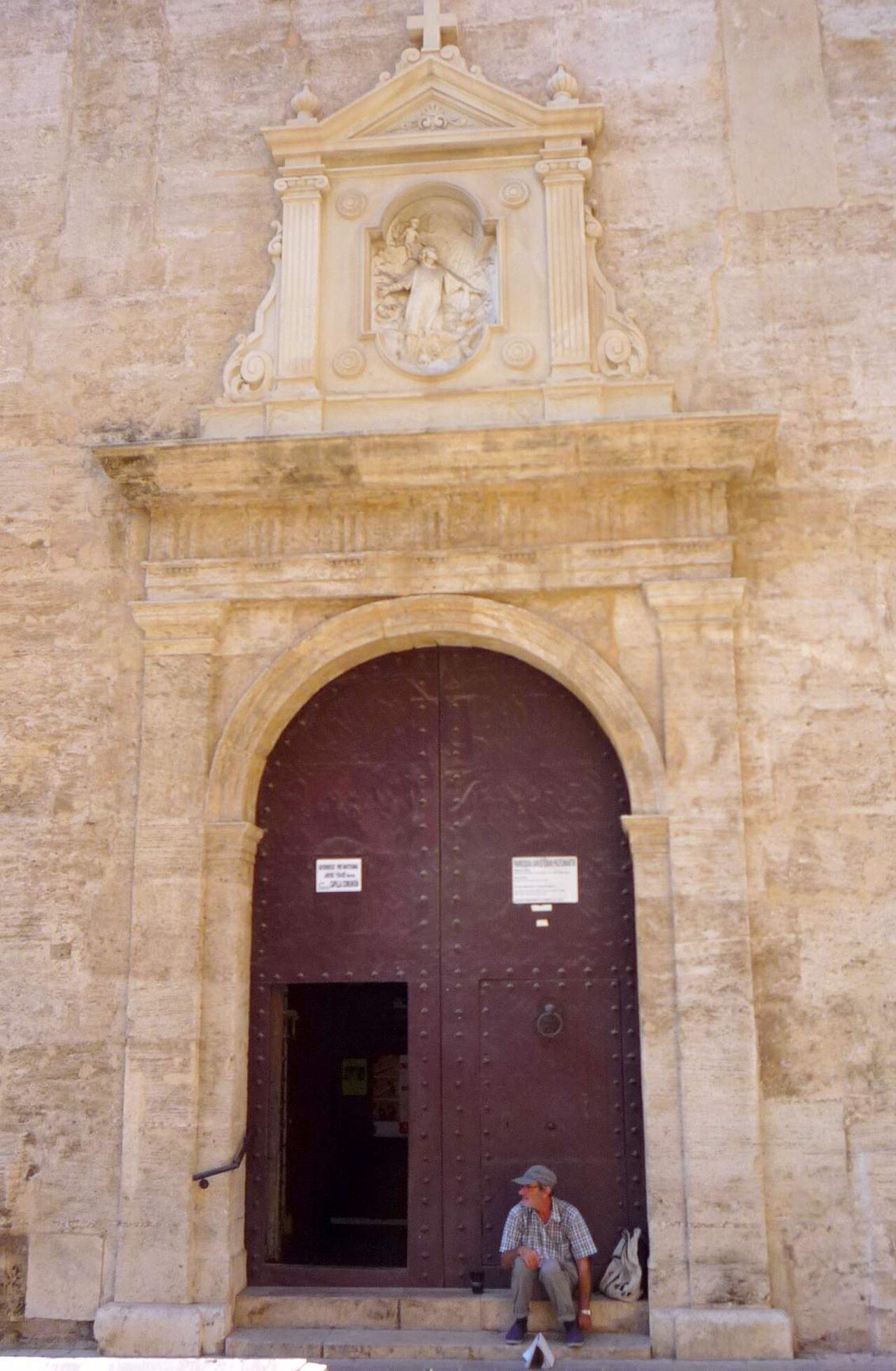
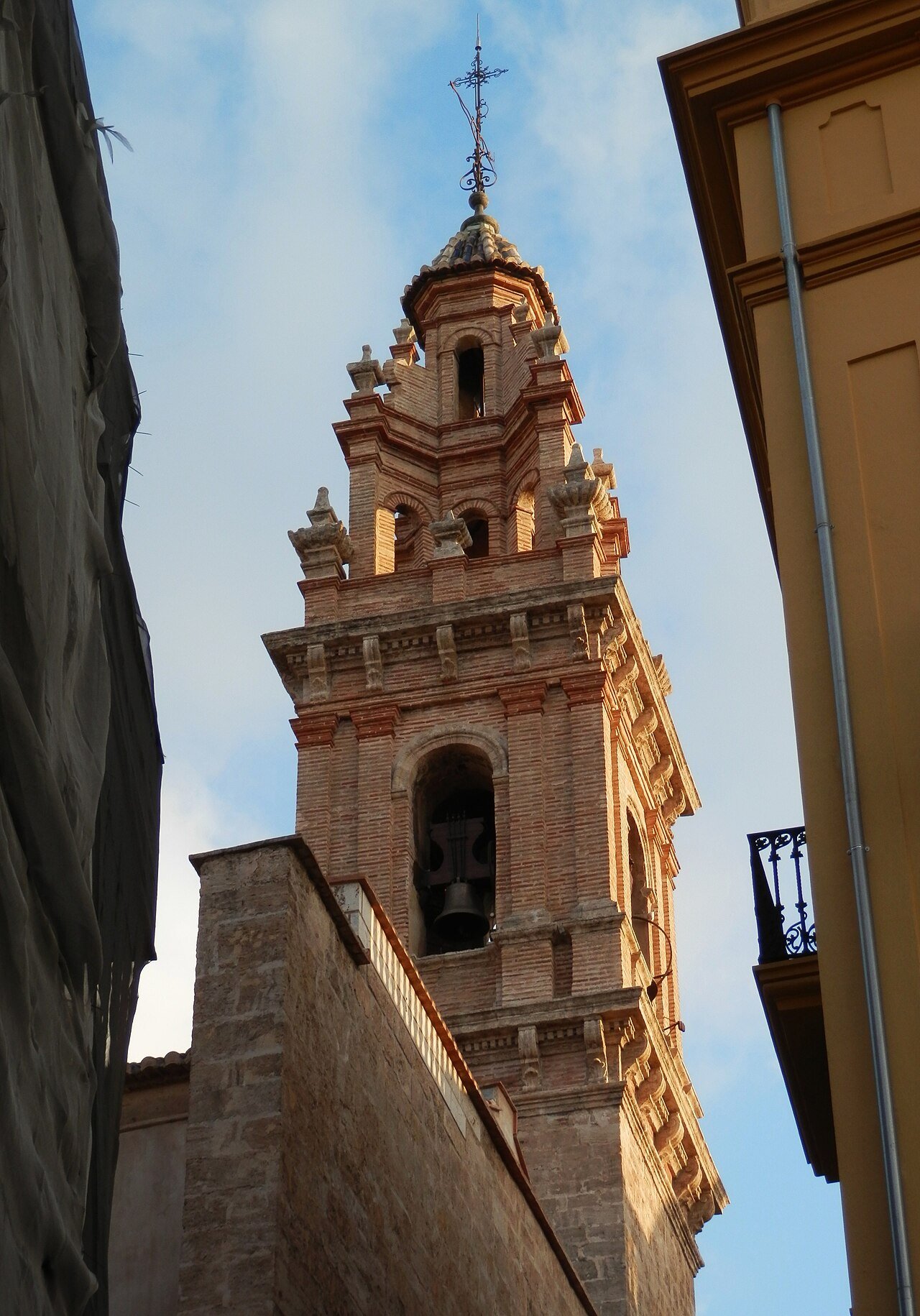
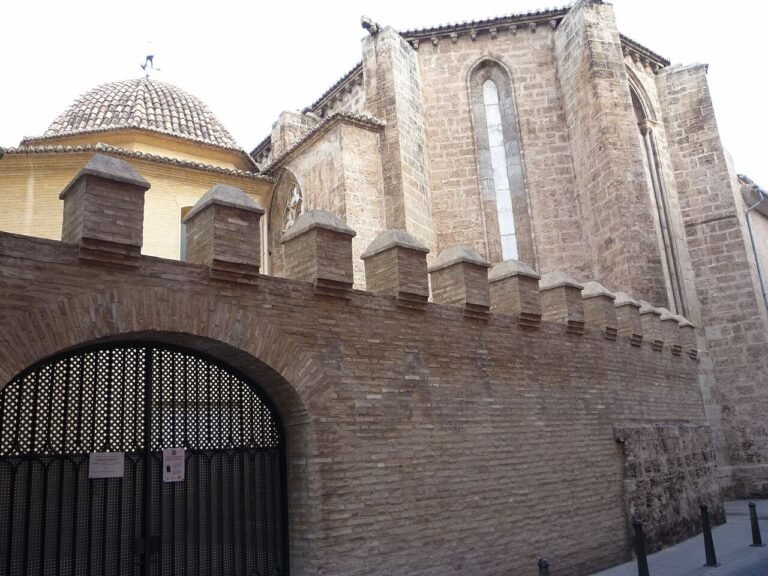
The Gothic shell you see from the plaza is largely not the 1276 church but its successor. On 26 January 1472 the first stone was laid of the rebuilding that gave the temple its present form: the chevet was extended first, Joan Corbera reworked the presbytery in 1504, and in 1514–1515 a new nave rose under Fernando de León — the classic Valencian Gothic parish plan, one nave with chapels between the buttresses, on a grander scale. Then the 17th century took it apart again: the presbytery was rebuilt in 1608 with a polygonal plan, and between 1613 and 1618 the rest was reconstructed to Francesc Anton’s project, with Jerónimo Negret and Guillem Roca as master builders. The church that emerged — six bays, round transverse arches, rib vaults with brick webs — is in its bones the church of 1618. Outside, none of its three façades shouts. The main portal onto the plaza is a simple 16th-century Renaissance doorway, with a small modern niche above it holding a relief of San Esteban where an image of the Virgin and Child stood before; at the foot, a late-17th-century front on a narrow lane carries twin lintelled portals with Doric pilasters, today permanently closed. The bell tower at the foot — four bodies, its brick bell stage pierced by a round arch on each face — was finished in the late 18th century, its upper body remodelled in 1754–1755 with a little Baroque dome for the third centenary of San Vicente Ferrer’s canonisation; two new bells were hung in it on 26 March 1761.
Blue and White: The Baroque Interior and Its Sgraffito Vaults
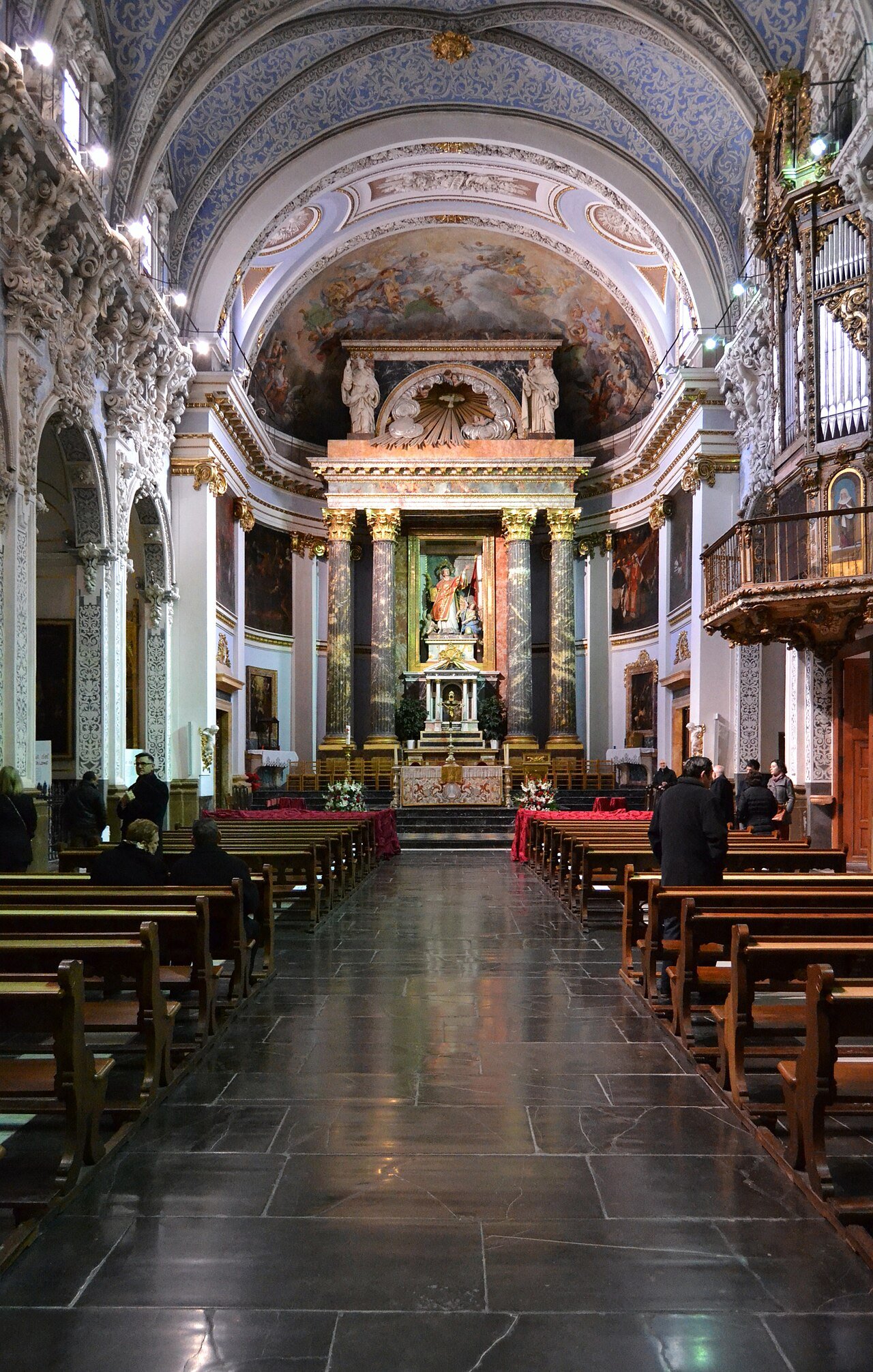
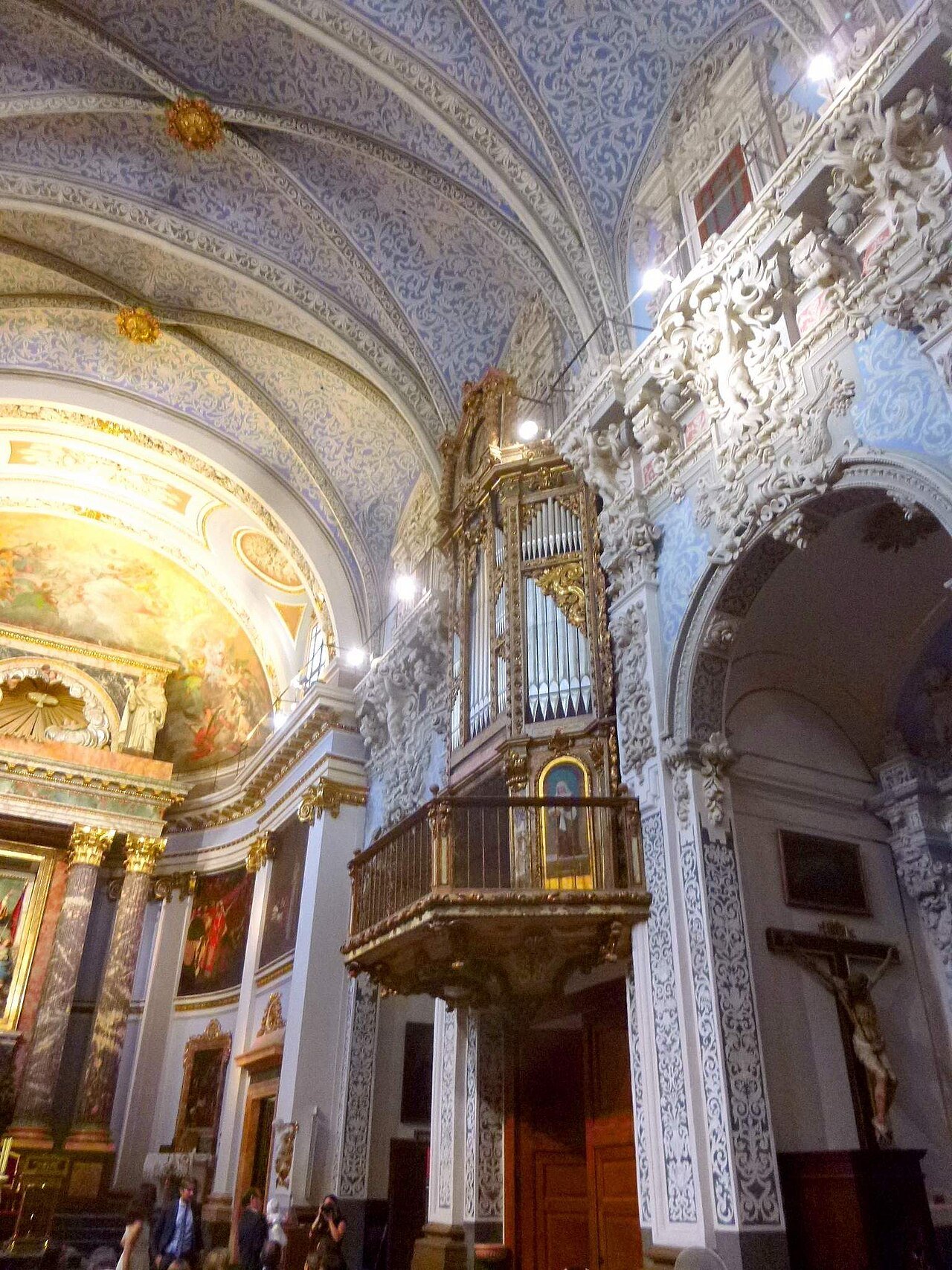
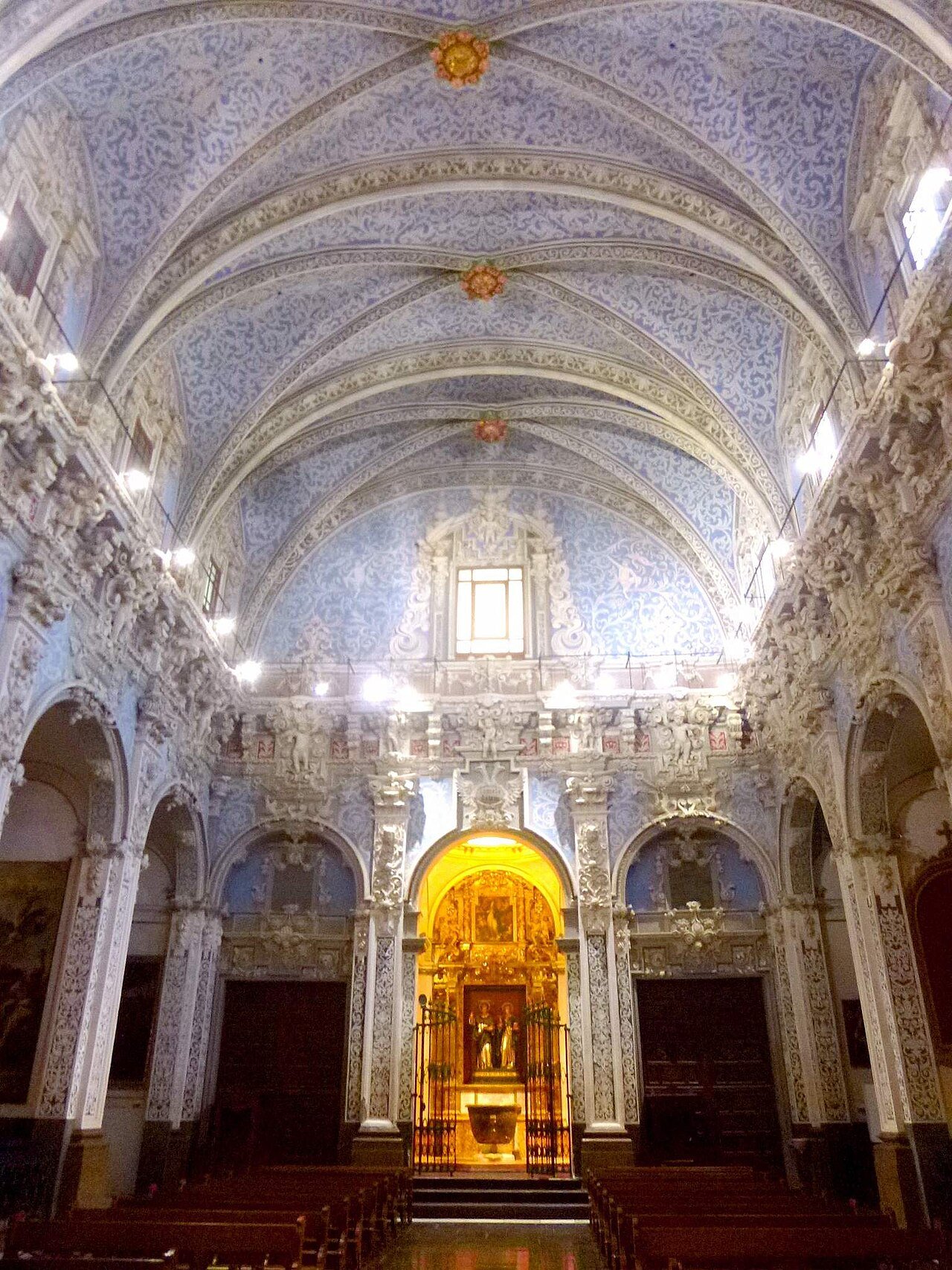
Step inside and the sober stone box detonates into colour. Between 1679 and 1682 Juan Bautista Pérez Castiel — the great decorator of the Valencian Baroque — renewed the whole interior in the taste of the moment, a Baroque already softening towards Rococo. Plaster pilasters divide the bays and carry a full entablature; every surface between them is covered in plasterwork and sgraffito — the scratched white decoration is credited to José Gomar and a carver named Díez — with vegetal forms, cartouches, rosettes and plump cherubs over grounds painted in colour, above all a luminous blue. Crucially, San Esteban kept its Gothic skeleton visible: unlike other Valencian Baroque churches, its rib vaults were not boarded over but rebuilt between the round arches, so medieval structure and Baroque skin occupy the same space — ribs, webs and all, picked out in blue and grey-white.
The effect — the comparison the parish itself uses — is of the blue-and-white of Valencian ceramic ware turned into architecture. It nearly faded: for generations the church was dim and darkened, until the restoration mounted for La Gloria del Barroco — the Fundación La Luz de las Imágenes exhibition opened in December 2009, which spread more than 300 Baroque works across San Esteban, San Martín and San Juan de la Cruz — cleaned the vaults and brought the blues back towards their 1682 freshness. San Esteban hosted the painting section. Do the obvious thing inside: walk to the middle of the nave, stop, and look up for a full minute. The vault is the artwork; everything else is arranged beneath it.

The Baptistery: The Font of San Vicente Ferrer and San Luis Bertrán
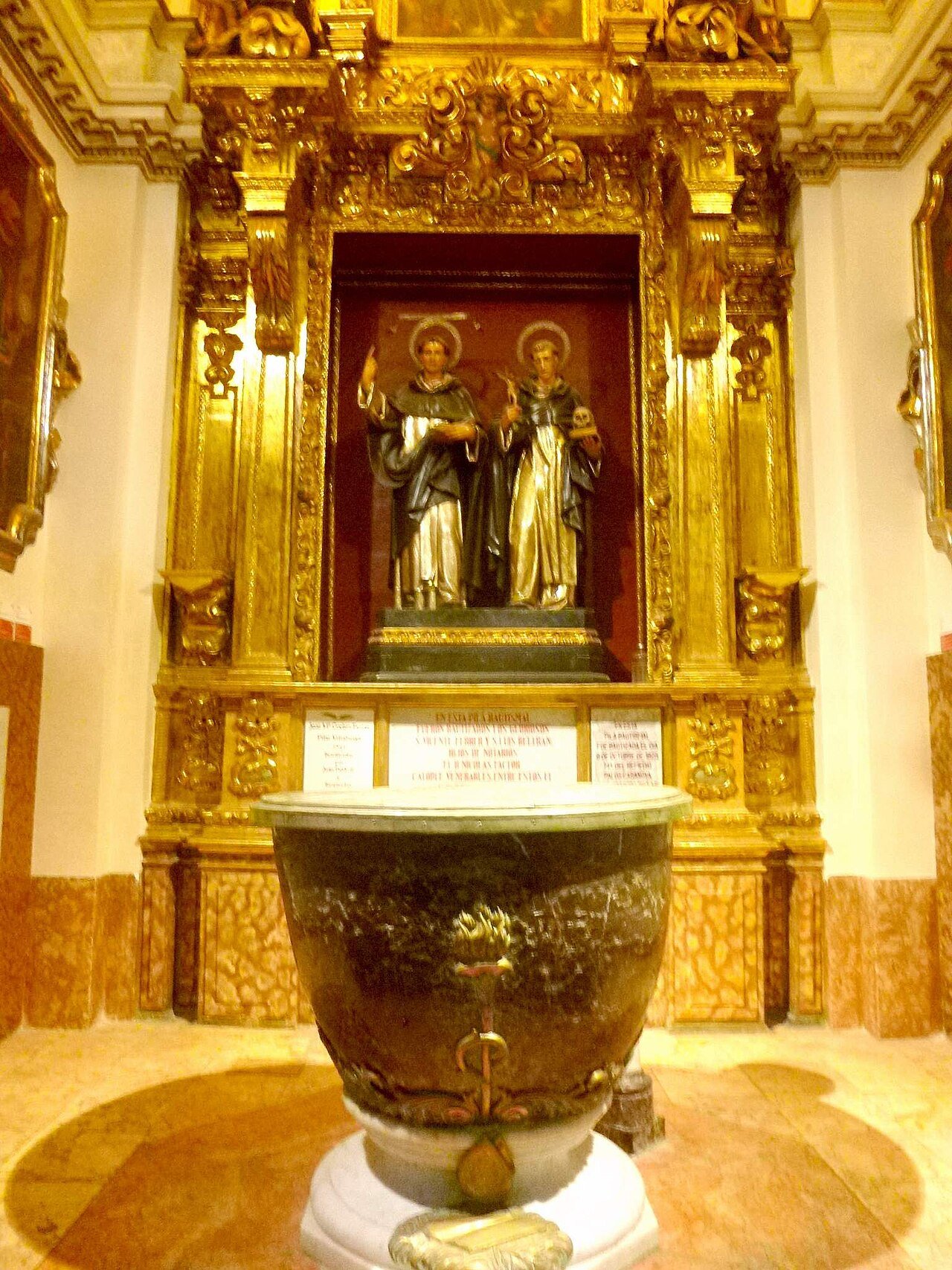
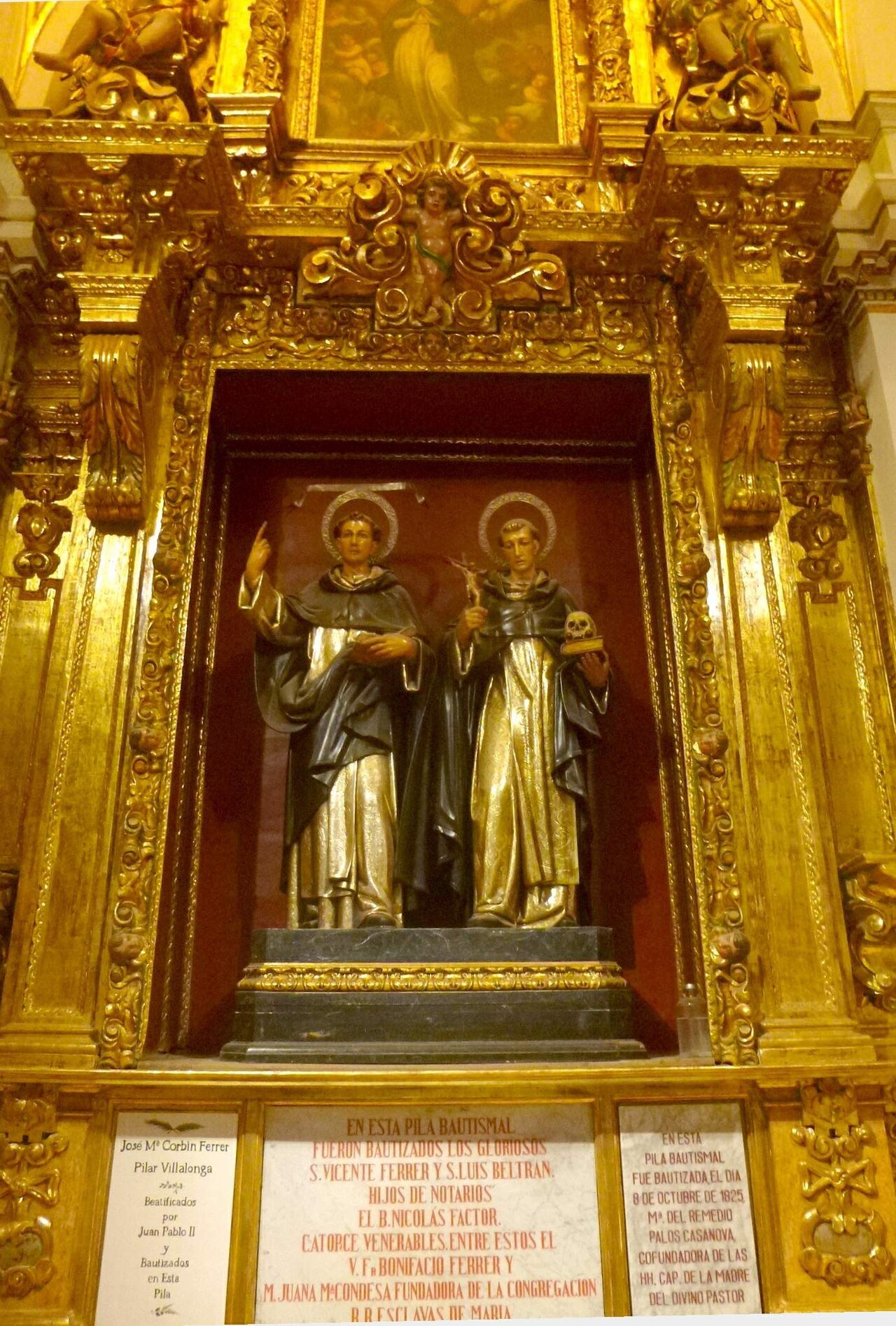
At the foot of the church, in the centre of three chapels, sits the room the whole parish exists around. In 1682 the Colegio de Notarios — exercising a patronage it guards to this day — built the three chapels at the foot, and gave the middle one a dome and lantern, top-lit through tall slit windows, to house the font. Into it the font was moved that year from its old place under the arch where the main door now stands — the transfer recorded, as you would expect from notaries, by formal written deliberation with the diocesan licence — and the chapel was renovated again in 1873. At its centre stands the font; behind it, a gilded Baroque altarpiece holds life-size polychrome images of San Vicente Ferrer and San Luis Bertrán by Carmelo Vicent, with a 17th-century Valencian-school Inmaculada on its base. On the side walls hang José Vergara’s twin canvases in Rococo frames: one shows San Vicente and San Bruno appearing to Juan Luis Bertrán — Luis Bertrán’s widowed father — to turn him back from the Charterhouse of Portaceli and send him home to remarry, because his son would be a saint; the other, the dream in which Guillem Ferrer saw a Dominican announce that his unborn son would be one (the city’s route leaflet tells the dream as the mother’s; the parish gives it to the father). Above them, medallion canvases record the font’s administration, founded by the Venerable Anadón in 1595.
Now the honest part, and San Esteban deserves credit for stating it itself. The tradition is that Vicente Ferrer was baptised here in January 1350 — born, local accounts say, on 23 January, the day after the feast of San Vicente Mártir, and named Vicente for the martyr after the priest, Mossén Perot de Pertusa, settled the family’s dispute over the name, with the city’s Jurats as sponsors. Luis Bertrán, a kinsman and fervent devotee of Vicente, followed in 1526; the inscriptions add the Blessed Nicolás Factor, the Blessed Juana María Condesa Lluch, Vicente’s brother the Venerable Bonifacio Ferrer — fourteen venerables in all — and, on a later tablet, María del Remedio Palos Casanova, baptised here on 8 October 1825. But the physical font you are looking at is not the vessel of 1350 or 1526. The parish’s baptistery page says so in plain words: when people speak of “la Pila”, they mean San Esteban’s font as an institution — the parish’s font, in this church, in unbroken use — not the physical font known today, “which is of a much later date”. (The parish history page elsewhere calls the font a simple 13th-century marble work; the two pages do not agree, and the baptistery page is the one describing what you see.) What you see is a cup of jaspered stone from the quarries of Benaguasil, inlaid with cast-bronze emblems of San Vicente Ferrer — the flaming trumpet of the Apocalypse, for his gift of tongues, and the mitre he refused at Avignon — under an embossed metal lid 110 centimetres across: the successor, in the same consecrated place, of the font of the saints. Tradition adds, with a smile the parish also records, that those baptised in this font will not die a violent accidental death. Outside, by the door, Jaime de Scals’s 1955 ceramic panel in the socarrat style states the tradition in tiles: “El año 1350 fue bautizado en esta Iglesia parroquial de San Esteban… un niño que había de ser San Vicente Ferrer.”
The Bultos de Sant Esteve: A Baptism Re-enacted Every January
Once a year the baptistery’s story walks out into the street and processes through the old town in costume. The Bultos de Sant Esteve — in Valencian Els Bults, from the Latin vultus, a face or effigy — began as figures: in 1597 the notary Joseph Benet Medina commissioned effigies of the nineteen people who, by tradition, attended Vicente Ferrer’s baptism — the rector Pertusa, the chief jurat, the godmother, the saint’s father Guillem, the vicereine Germana de Foix, the midwife, the sacristan and the rest. Over the centuries the effigies became people. Today, organised by the Real Asociación de la Pila Bautismal de San Vicente Ferrer, the re-enactment is held on 22 January, the feast of San Vicente Mártir, and it recreates the baptism of 1350 by baptising a real child at San Esteban’s font.
The cavalcade forms at the saint’s birthplace — the Casa Natalicia with its little well, El Pouet, in the Calle del Mar — and processes in 14th-century dress through the old town, sweets raining from the carriages, the living bultos in their roles: priest, sacristan, jurats, viceroy and vicereine — the vicereine is traditionally played by the previous year’s Fallera Mayor of Valencia — father, godmother, and the comadre, the midwife, carrying the child. It reaches the Plaza de San Esteban around one in the afternoon, the baptism is celebrated, and the child is then carried to the Plaza de la Virgen and presented to the Virgen de los Desamparados. If you can only see San Esteban once, see it then: the one day when the church’s whole meaning — parish, guild, font and city acting out its own foundation story — is performed in public, exactly where it happened.
The Lost Altarpiece: Juan de Juanes and the Prado Panels
The high altar you see today is not the church’s first glory — that one hangs in Madrid. Around 1562 Vicente Juan Masip, known as Juan de Juanes, the supreme painter of the Valencian Renaissance, painted for San Esteban’s main altarpiece a cycle on the Passion of Christ and the life and martyrdom of its patron: the Última Cena, the Martirio de San Esteban and their companion scenes. The panels stayed in their church for nearly two and a half centuries, until around 1800 they were acquired by Carlos IV — sold, in plain terms, to the king — and today they are among the Museo del Prado’s Juan de Juanes holdings, the Last Supper one of its signature Spanish Renaissance images: Christ calm at the centre of the table, raising the host at the moment of institution. The money was not wasted: it paid for the rebuilding of the presbytery, which is why a church stripped of its Renaissance crown wears a Neoclassical one. Stand in the nave and perform the act of imagination every San Esteban visit requires — Juan de Juanes’ gold and colour where the marble columns now stand — then see the originals in the Prado on your next Madrid trip, and read their labels: painted for this room.


The Neoclassical High Altar: Espinosa, Vicente López and the Two Saints Above
What the sale of the Juan de Juanes bought, around 1800, was a presbytery rebuilt in the new classical taste to the project of Cristóbal Sales. The polygonal Gothic apse became semicircular, the Baroque plaster skin was stripped from this one part of the church, and Manuel Blasco designed a high altar of fluted Corinthian columns carrying a deep entablature, its upper section the work of Pedro Arnal. In the central niche stands an image of San Esteban attributed to José Esteve Bonet, the leading Valencian sculptor of his age — at the saint’s feet, an angel holding a banner and a boy carrying the stones of his martyrdom. In the attic above preside the two figures who give this guide its shape: San Vicente Ferrer and San Luis Bertrán, in sculpture over the altar of the church that baptised them — the closest thing San Esteban has to a façade programme, placed not on the plain street front but here, facing the font at the far end of the nave. In the apse semi-dome, Vicente López painted in 1802 the Glorificación de San Esteban, the saint received into glory above his own altar.
The presbytery walls carry the church’s second painting cycle: four large canvases dated 1650 by Jerónimo Jacinto de Espinosa, the master of the Valencian Baroque, telling the posthumous story of St Stephen’s relics — Gamaliel appearing in a dream to the priest Lucian to ask for the body’s transfer, Lucian recounting the vision to John, Bishop of Jerusalem, the discovery of the body, and its translation to Constantinople; in the last, Espinosa painted his own self-portrait, in black, hands folded, looking straight out at you. The older descriptions add the detail that completes the circle: these canvases once formed the closing doors of Juan de Juanes’ altarpiece itself. Beneath them hang two 17th-century paintings by Pedro Orrente, the Visión de Santa Teresa de Jesús and the Martirio de San Lorenzo. Read together with the baptistery, the presbytery completes the church’s argument: Stephen the first martyr above the altar, his relics’ story around the walls, and at the far end of the nave the font that made two more saints.

The Communion Chapel and the Cristo del Rescate
Two smaller rooms complete the visit. The Capilla de la Comunión, attached to the church’s exterior in 1696 — the date carved in a cartouche over its door onto the plaza, two neighbouring houses bought up to make room — is a little Baroque church in itself: three bays by the parishioner Francisco Padilla, the central one covered by a dome on pendentives with a lantern, its decoration the most profuse in the building. Built for the reservation of the Sacrament, it still keeps that hushed, separate atmosphere. At the other end of the church, in the last chapel on the Gospel side at the foot, look for the Cristo del Rescate, brought here from the vanished convent of San José y Santa Tecla; its chapel vault preserves frescoes of Eucharistic symbols dated 1677 — older than the Baroque redecoration around them, probably a survival of the earlier communion chapel. Between the communion chapel’s dome and the Cristo’s dark corner, you have the full range of the Valencian Baroque in about ninety paces.

Practical Info
Address: Plaza de San Esteban 2, 46003 Valencia — on its own small plaza in La Xerea, Ciutat Vella, a few minutes north-east of the Cathedral. The square is pedestrian, with level, step-free access and three parking spaces reserved for people with reduced mobility.
What it is: a working Gothic-Baroque parish church — one of the first parishes of Christian Valencia, the notaries’ church, and the baptism church, by tradition, of San Vicente Ferrer and San Luis Bertrán. Protected as a Bien de Interés Cultural. There is no museum or ticket desk: you are a guest in a parish, and the parish office is the point of contact for arranged visits.
| Best for | Baroque interiors, Valencian saints and baptism tradition — and travellers who like their sights still in everyday use |
| Entry | Free — a working parish church, open around worship; cultural visits arranged through the parish office |
| Time needed | 30–45 minutes inside, plus the plaza, ceramic panel and bell tower outside |
| Nearest metro | Colón and Alameda (lines 3, 5, 7 and 9), each about 10 minutes on foot |
| Don’t miss | The baptistery chapel and font, the blue sgraffito vaults, and Jaime de Scals’s 1955 ceramic panel by the door |
Tickets and Booking
There is nothing to book and nothing to buy, and any website implying otherwise should be ignored. San Esteban sells no tickets and has no online booking: it is a parish church, entered free whenever it is open. What the parish offers, through its official site, is arrangement: its visits page instructs anyone wanting a cultural visit to contact the parish office — the despacho parroquial — to agree a date and time, the correct route for groups and special trips. The parish telephone number published in visitor listings is +34 963 91 82 76. For everyone else, the practical “booking” is the Mass timetable in the next section: arrive a little before a service, look quietly first, and stay for as much of the liturgy as you wish. A donation in the box by the door is the traditional — and entirely sufficient — contribution.
Opening Hours
Be honest with yourself about this church: it is famous among reviewers for being closed when you want it open, and the parish’s arrangements explain why. San Esteban publishes no tourist opening hours: its visits page gives no timetable — only the instruction to contact the parish office to arrange a visit — and its worship timetable is an evening one. At the time of writing the parish lists Masses on Monday, Tuesday, Wednesday, Friday and Saturday at 19:30, on Thursday at 19:00, and on Sunday at 13:00 and 21:15. The dependable sightseeing window is therefore the run-up to those services — roughly the half-hour before Mass, and the service itself, sat through respectfully. Third-party listings showing longer or morning opening (one widely copied listing gives weekday evenings 18:30–20:30 and weekend mornings) are at best approximations of the same worship-centred pattern, and Sunday mornings catch many visitors out: there is no morning Mass on the parish list before 13:00. Two exceptions transform the odds: weekends, when baptisms keep the church busy and open around family ceremonies, and 22 January, when the Bultos procession guarantees a full, open church at midday. Check sanestebanprotomartir.es before a special journey, and treat any hour inside as the parish’s hospitality, not a right.
Getting There
You will walk. From the Cathedral and the Plaça de l’Almoina it is three or four minutes north-east; from the Plaça de la Reina, about six minutes; from the Mercado Central, twelve minutes across the old town. The plaza is your landmark — a quiet, enclosed square that feels a world away from the cathedral crowds. By metro, Colón and Alameda are each about ten minutes’ walk (lines 3, 5, 7 and 9 serve both); city buses serve the Plaça de la Reina and Plaça de la Mare de Déu stops a few minutes away. Driving is pointless — La Xerea is a knot of narrow, largely pedestrian streets; use the public car parks around the Glorieta or the Plaça de la Reina and walk the last stretch, as everyone does.
When to Go
The classic slot is a weekday evening: arrive around 19:00 for the 19:30 Mass (19:00 on Thursdays), take the empty-church half-hour to walk the nave, baptistery and communion chapel in quiet, and let the building return to its purpose around you. The year’s great date is 22 January, when the Bultos cavalcade reaches the plaza at about one o’clock and a child is baptised at the font in re-enactment of 1350 — combine it with the morning’s cathedral celebrations for San Vicente Mártir, whose feast fills the same streets. Weekends are the sociable option: baptism parties in their finery, the church open and warm. Whenever you go, the sgraffito blues photograph best in soft late-afternoon light.
How Long You Need
Thirty to forty-five minutes is the honest allowance inside: ten for the nave and vaults, ten for the baptistery and its inscriptions, five each for the presbytery paintings, the communion chapel and the Cristo del Rescate, and a pause at the ceramic panel on your way out. Add the plaza and the bell tower from outside and call it an hour at most. San Esteban pairs naturally into a La Xerea church walk — Cathedral, San Esteban, San Juan del Hospital and the Patriarca make one unhurried morning of four utterly different interiors.
Free Valencia travel guide
Planning a trip to Valencia? Get our free one-page Valencia checklist: what to book ahead, what to skip, and the paella places we actually eat in.
Tips for Visiting
- Time your visit to a Mass. The parish publishes no sightseeing hours; the half-hour before the weekday 19:30 Mass (19:00 Thursdays, Sunday 13:00 and 21:15) is the reliable window. Check sanestebanprotomartir.es before you go.
- Arrange groups through the parish office. The official visits page asks cultural visitors to contact the despacho parroquial to fix a date and time — do this rather than turning up in a crowd.
- Read the tiles before you go in. Jaime de Scals’s 1955 ceramic panel, on the wall left of the entrance, is the church’s story in one frame — Vicente’s baptism of 1350, under the city’s patronage.
- Be honest about the font — as the parish is. The present jaspered-stone font is a later successor, not the 1350 vessel; what is continuous is the place, the parish and the rite. The chapel around it is the real 1682 survival.
- Expect baptisms, and welcome them. This is still Valencia’s baptism church of choice; on a Saturday you may share the nave with three family celebrations. Stand back, smile, and let them have their church.
- Look up first, photograph second. The blue sgraffito vault fills the frame from the centre of the nave; the baptistery rewards the opposite approach — get close and read the inscriptions.
What to See Nearby
San Esteban stands at the quiet north-eastern corner of the old town’s church country. Five minutes south-west, the Cathedral fills the Plaça de la Mare de Déu and the Plaça de la Reina with the Miguelete, the Holy Grail chapel and the Thursday Water Tribunal — the grand public face of the same 1238 city that made San Esteban a parish. A few minutes east stands San Juan del Hospital, founded the same conquest year by the Knights Hospitaller: all Romanesque-Gothic stone austerity, the perfect counterpoint to San Esteban’s blue Baroque warmth. Ten minutes south, the Iglesia del Patriarca offers the third term of the comparison — a Counter-Reformation seminary church frescoed top to bottom, with its own San Vicente chapel and its own famous animal in the vestibule. Between them, do not miss the small things in San Esteban’s own orbit: the Centre Arqueològic de l’Almoina, where Roman and Islamic Valencia lie under glass two streets away, and, in the Calle del Mar, El Pouet — San Vicente Ferrer’s birthplace house, with the little well that gives it its name, from which the Bultos procession sets out every 22 January.

Travel insurance, sorted
Whether it is a two-week holiday or a longer move, travel insurance is not the most glamorous part of a trip — but it is the one booking you want to have in place before a trip, and while you are already away. Get a quote from SafetyWing
Final Thoughts
San Esteban is not the biggest or most famous church in Valencia, and it likes it that way. It is a parish that has been baptising its neighbours for nearly eight centuries, that was adopted by the city’s notaries and decorated by its greatest Baroque master, that sold its Renaissance altarpiece to a king and replaced it with classical dignity, and that still, every January, dresses up its own history and walks it through the streets to baptise a child where it baptised a saint. Come for the blue vaults and the two saints over the altar; stay for the baptistery, where the parish will tell you, more honestly than many grander places, exactly what is tradition and what is stone. ¡Buen viaje!
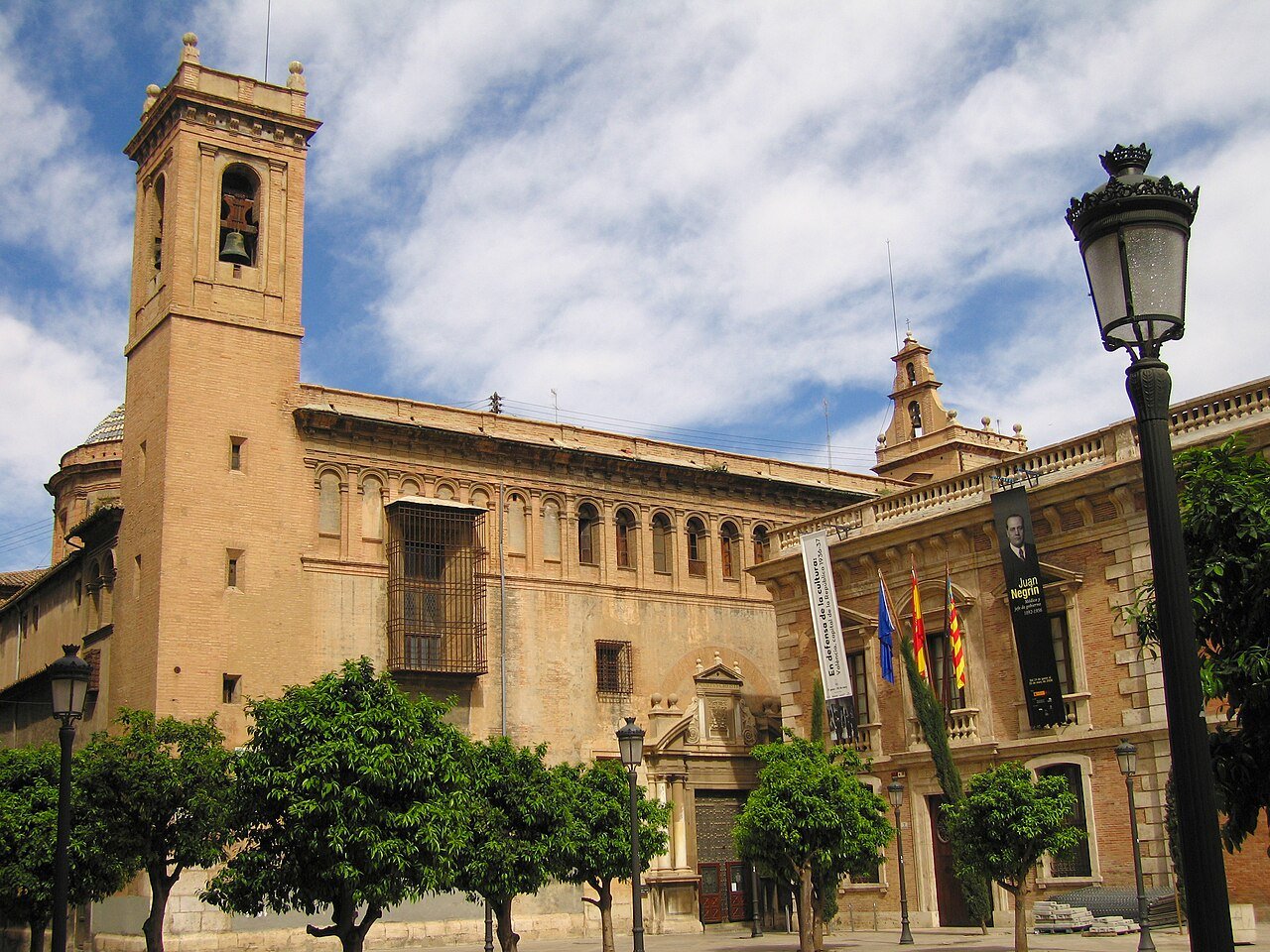
Photo credits: Zarateman (CC0); Joanbanjo (CC BY-SA 3.0, CC BY-SA 4.0); Juan de Juanes (public domain), via Wikimedia Commons.


One Comment