Valencia Cathedral: The Holy Grail, the Miguelete and Everything Inside
Most visitors find Valencia Cathedral by accident. They are crossing the old town between the two great squares — the Plaça de la Reina on one side, the Plaça de la Mare de Déu on the other — and they look up at a lacy octagonal tower, or through a doorway into cool shadow, and wonder what exactly this building is. It is, I would argue, the most quietly extraordinary church in Spain. La Seu, as Valencians call it, holds the Santo Cáliz, the agate cup that tradition identifies as the Holy Grail itself. It has a Renaissance masterpiece hidden above its altar for more than three centuries. It has a bell tower you can climb for the best view in the city, a martyr’s arm in a glass case, and — every Thursday at noon, just outside its oldest Gothic door — a thousand-year-old water court still settling farmers’ disputes out loud, in Valencian, in about ten minutes flat.
This guide is everything I tell friends before they go in: what the building is made of, what to look for and in what order, the honest story behind the Grail, how the tower climb works, and how to time your visit so you catch the Water Tribunal as a bonus. It belongs near the top of our Best Things to Do in Valencia list — not because it is the city’s biggest sight, but because no other single building tells you so much of Valencia’s story in one visit.

The Short Answer
Yes, Valencia Cathedral is absolutely worth visiting — allow an hour and a half to two hours, including the tower climb, and take the ticket with the audio guide. The ticket (around ten euros at the time of writing) covers the church, the Cathedral Museum and the climb up the Miguelete, and the audio guide genuinely earns its keep in a building with this many layers — booked ahead Valencia Cathedral and Holy Grail ticket, it saves you the queue at the little ticket desk inside the door. Go in the morning for the quietest church and the clearest tower views, and if you can, make it a Thursday: finish inside by noon and step out of the Door of the Apostles to watch the Water Tribunal sit, exactly as it has for centuries.
Table of Contents
- The Short Answer
- The Building in Brief
- The Holy Grail Chapel
- The Miguelete Tower
- What Else to See Inside
- Practical Info
- When to Go
- Final Thoughts
The Building in Brief
Valencia Cathedral is a layer cake, and reading the layers is half the fun. The site itself is the oldest part of the story. A Roman temple stood here, then a Visigothic church; under Muslim rule the city’s main mosque occupied the plot, and when Jaume I took Valencia in 1238 the mosque was consecrated as the cathedral on the spot. The Gothic church you visit today was begun in 1262 and rose over the following two centuries, broadly in the sober Valencian Gothic style — wide, calm, stone-built — before every later age left its fingerprints on it.
The quickest way to learn the building is to walk its three great doors. The oldest is the Puerta de la Almoina, the round-arched Romanesque doorway on the east side, facing the little Plaça de l’Almoina: all concentric arches and carved capitals, from the first decades of the church. The finest is the Puerta de los Apóstoles, the Gothic door of the 1300s on the Plaça de la Mare de Déu, watched over by statues of the twelve apostles and a great rose window whose tracery forms a six-pointed star. And the showiest is the main entrance on the Plaça de la Reina, the Puerta de los Hierros — a curvaceous Baroque facade begun in 1703, all waves and sculpture, which has no business harmonising with a Gothic church and somehow absolutely does.

Inside, the same mixing continues. Above the crossing rises the cimborio, a two-storey octagonal lantern whose windows are glazed with thin sheets of alabaster, so the light that falls into the church is honey-coloured. In the 1700s the interior was given a fashionable Neoclassical restyle that hid much of the Gothic stonework; from the 1970s onwards restorers stripped that casing away, which is why the church you see now feels medieval again — plain stone, pointed arches, and space. Keep that idea of concealment and rediscovery in mind. It is about to matter twice.
The Holy Grail Chapel
Off the north side of the church, up a short passage, is the room most people have come for. The Chapel of the Holy Chalice — the Capella del Sant Calze — began life in 1356 as the cathedral’s chapter house, the canons’ meeting room, built by the master builder Andreu Julià. It is a small, tall, square chamber of bare stone, roofed with one of the most beautiful star-ribbed vaults in Spain and hung with great grisaille canvases. And in an alabaster altarpiece in the wall, behind glass, lit like a jewel, sits the cup.
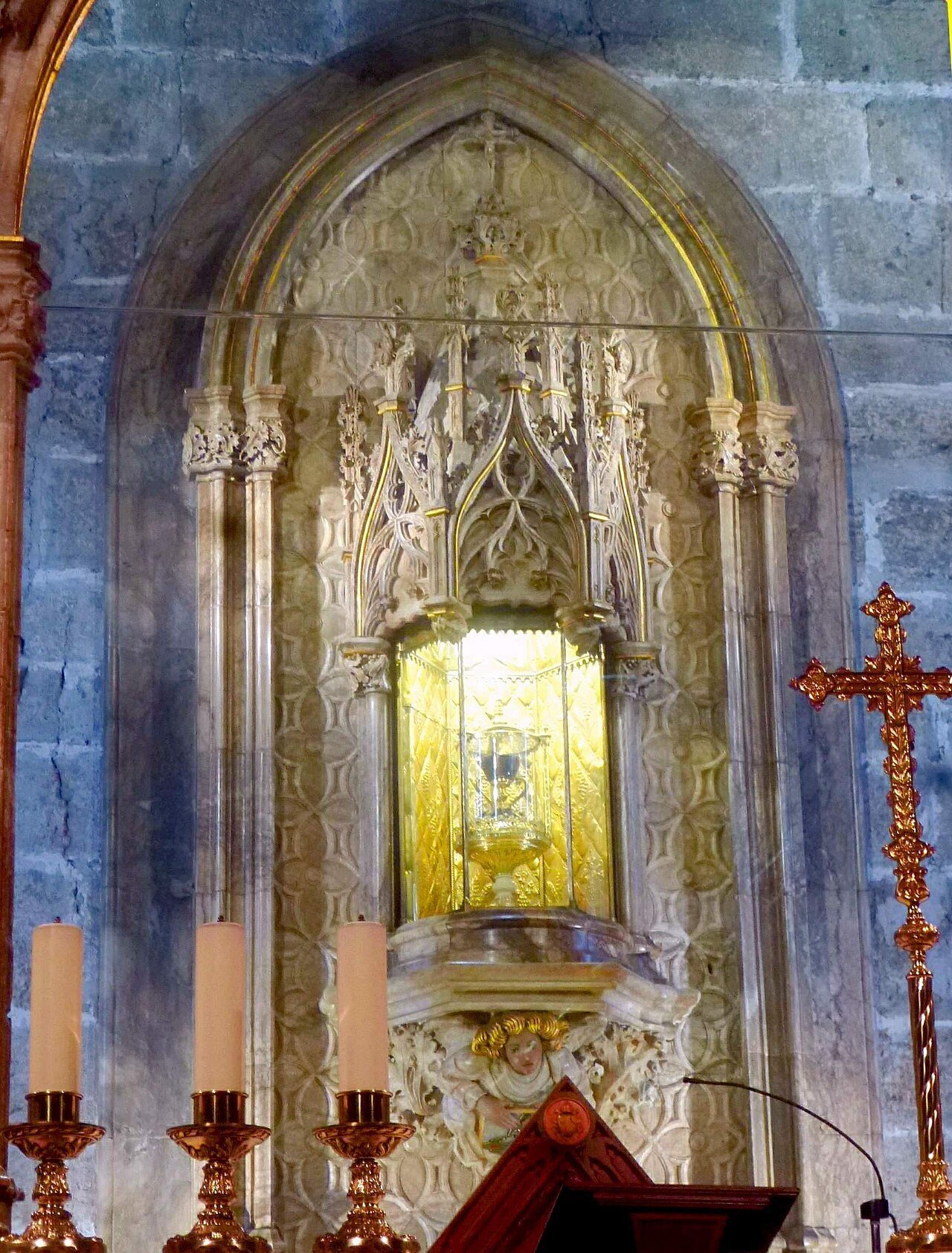
Look closely, because the Santo Cáliz is really three objects in one. The cup itself, the part that matters, is a bowl of dark red-brown agate, smooth and simple, which archaeologists date to the centuries around the birth of Christ and attribute to a Near Eastern workshop. Below it, medieval goldsmiths added the stem and handles, set with pearls and precious stones; and the whole thing stands on a foot made from an upturned boat-shaped vessel of a later age, engraved with an inscription in Arabic script. It is small — you could hold the cup in two hands — and it is genuinely, quietly beautiful.
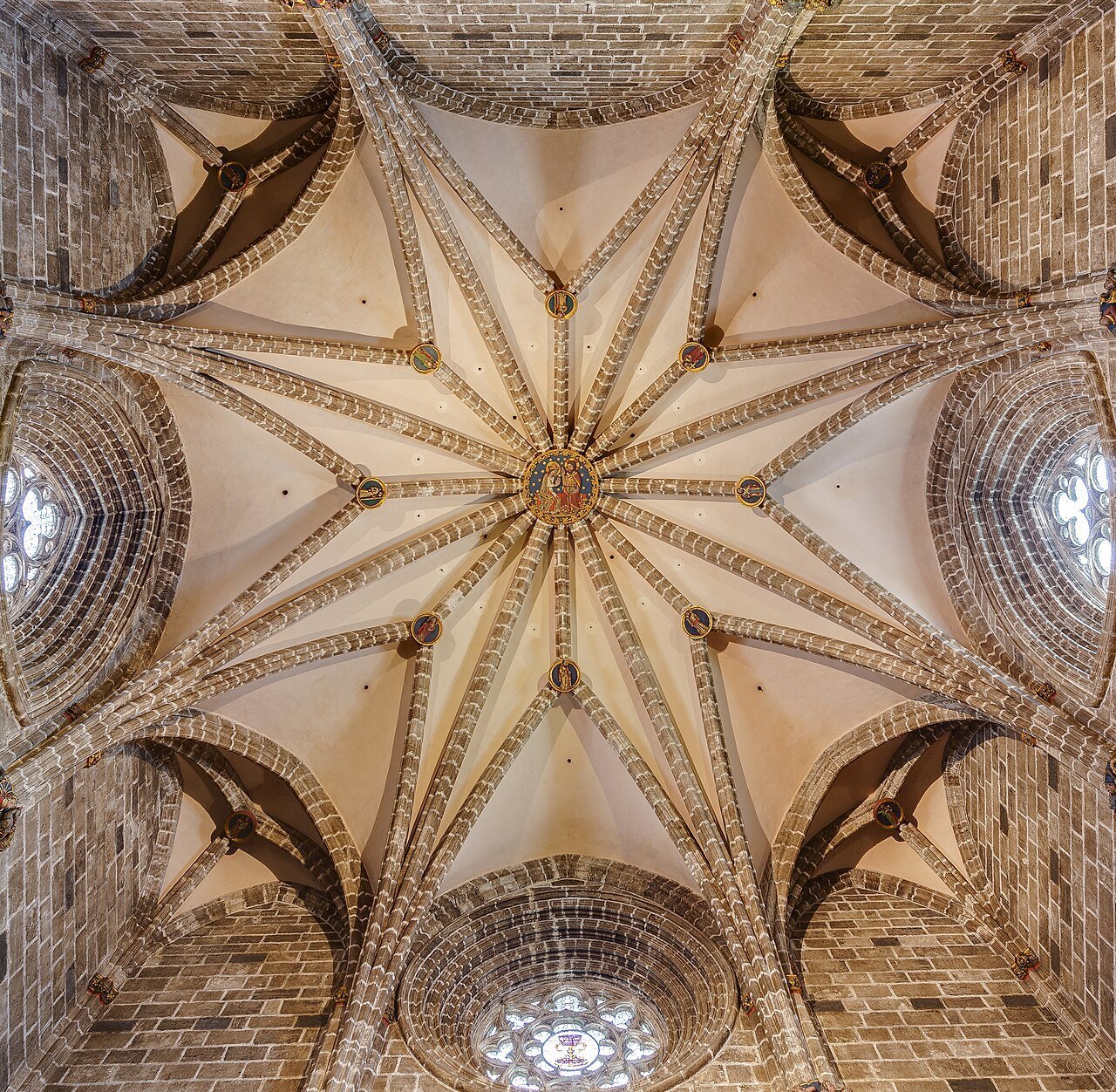
Now, the honest bit, because this is where guides usually start winking. The cathedral’s tradition holds that this is the cup of the Last Supper: carried to Rome, sent to Spain for safety in the third century during the persecution of Valerian — by Saint Lawrence, who came from Huesca — and hidden for centuries in the Pyrenean monastery of San Juan de la Peña. The documented history is shorter but still remarkable: the monks gave the chalice to King Martín the Humane in 1399, and in 1437 Alfonso the Magnanimous deposited it in Valencia Cathedral, where it has remained ever since. What can be said without any faith at all is that the cup is a real, ancient, correctly-dated object with a plausible chain of custody — which is more than any rival Grail in Europe can claim — and that the Church takes it seriously: John Paul II celebrated Mass with it in 1982, Benedict XVI did the same in 2006, and Valencia keeps a Holy Year of the Chalice every five years. Whether you leave believing is up to you; nobody I’ve taken has left unimpressed. Before you go, notice the great chains hanging on the chapel wall — said to be the harbour chains of Marseille, carried home by Alfonso’s fleet. Valencia has always liked a trophy.
The Miguelete Tower
The Cathedral’s other headline act is its bell tower, and Valencians love it with a possessiveness they usually reserve for paella. El Miguelete — El Micalet in Valencian — is the octagonal tower you see from everywhere in the old town: begun in 1381, again under Andreu Julià, finished in 1424, just under 51 metres tall, and built, the old boast goes, so that its height exactly equals the distance around its base. It takes its name not from an architect but from its biggest bell, the Micalet, blessed on Saint Michael’s day in 1418. The tower holds eleven bells in all; the Micalet itself weighs over seven tonnes and is still rung by hand on great occasions by the city’s guild of bell-ringers.


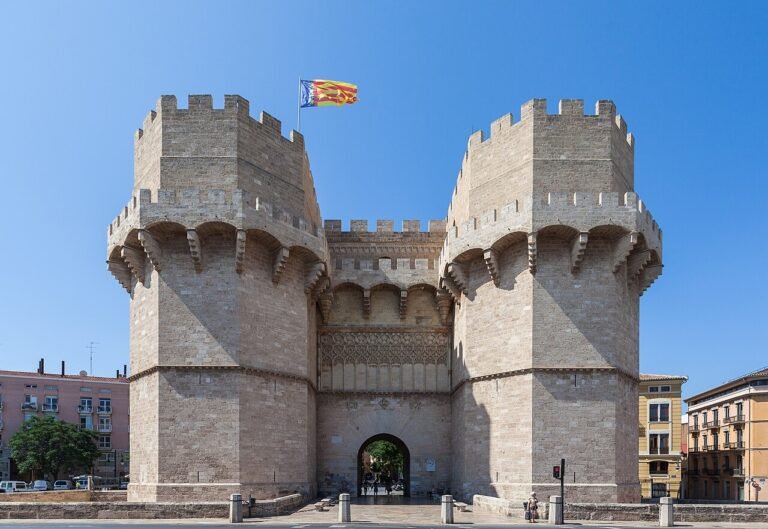
The climb is 207 steps up a tight spiral staircase — broad by bell-tower standards, but a proper workout, and the traffic is two-way, so expect a couple of polite squeezes on the landings. It is worth every step. From the terrace the whole city explains itself: the old town’s rooftops and church domes at your feet, the Torres de Serranos gate to the north, the green ribbon of the Turia gardens curving away, the white sails of the City of Arts and Sciences downstream, and on a clear day the Mediterranean closing the view to the east. Time it for the hour, if you can, and stand back from the bells — eleven of them, with a seven-tonne tenor, is a lot of noon.

Free Valencia travel guide
Planning a trip to Valencia? Get our free one-page Valencia checklist: what to book ahead, what to skip, and where to find the best paella.
What Else to See Inside
The Grail and the tower get the headlines, but don’t rush the church itself — it rewards a slow circuit.
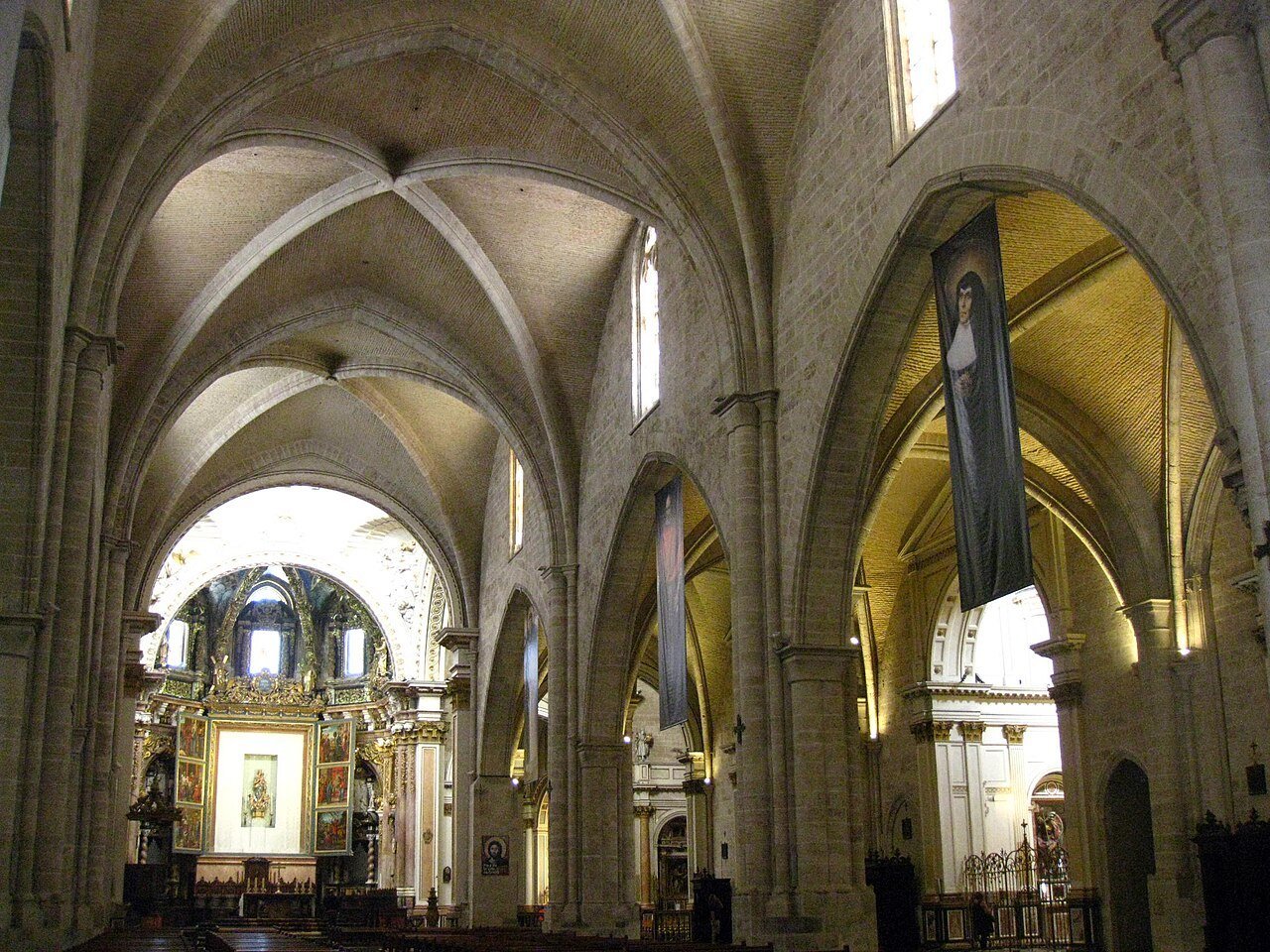
Start by standing in the nave and simply looking. This is Gothic with the volume turned down: wide pointed arcades, stone the colour of honey, none of the soaring drama of the French cathedrals and all the better for it. Then walk to the main altar and look up. Above the altar, on the vault of the apse, twelve angels are making music — playing lutes, viols, trumpets and portative organs against a deep blue sky scattered with gold stars. These frescoes were painted in the 1470s by two Italian masters, Paolo da San Leocadio and Francesco Pagano, brought to Valencia in the orbit of Cardinal Rodrigo Borja — the Valencian who became Pope Alexander VI. In the 1600s a new Baroque ceiling was built beneath them and the angels were sealed away in the dark. They stayed there, forgotten, for over 300 years, until restorers rediscovered them in 2004. They are, quite simply, one of the great Renaissance survivals in Spain, and most visitors walk under them without ever knowing.

Behind the altar, in the ambulatory, is the Chapel of the Resurrection, and in it the cathedral’s strangest treasure: a mummified left arm, resting in a bronze and glass reliquary before an alabaster relief of the Resurrection. This is the arm of Saint Vincent, the young deacon martyred in Valencia around the year 304, and the city’s beloved patron. The cathedral’s own account — set out on a plaque beside it — tells how a bishop of Valencia carried the arm off on pilgrimage around 1104, died on the road at Bari in Italy, and left it there; and how, after this extraordinary 900-year detour, the arm was finally given back to Valencia in 1970 by its last Italian owner and brought home. Treat it as you find it: an object of real devotion for Valencians, whatever you make of the story, and one of the most peculiar homecomings in Spanish church history.

Finally, don’t skip the Cathedral Museum, included in your ticket, which gathers the treasures too fragile or too valuable for the open church: two brooding early paintings by Goya of Saint Francis Borgia, serene panels by Joan de Joanes, the great silver-gilt processional monstrance that is carried through the streets every Corpus Christi, and a small forest of medieval reliquaries. It is compact — twenty minutes does it justice — and it puts faces and objects to the names you’ve been reading on the walls.
Practical Info
Tickets and entry. Tourist entry is through the Puerta de los Hierros on the Plaça de la Reina. The ticket — around ten euros at the time of writing — includes the church, the museum, the audio guide and the Miguelete climb. Worshippers enter free for services, but sightseeing pauses during Mass, and parts of the church are roped off; if you arrive mid-Mass, take a seat, enjoy it, and tour afterwards. Tourist visiting generally runs from 10:00 through the afternoon Monday to Saturday, with Sundays given over to worship in the morning — check the board by the door, as hours shift with the seasons and the church calendar. If you’re basing yourself in the old town — and for a first trip you should — our Where to Stay in Valencia guide covers the best streets within a few minutes’ walk of the cathedral doors.
Dress code. This is a working cathedral, not a ruin: cover shoulders and avoid beachwear and very short shorts, or you may be turned away at the door. A light scarf in your bag solves most problems in summer.
The tower. The Miguelete climb is included in the ticket and can be done at any point in your visit — but numbers on the staircase are controlled at busy times, so on a crowded day, climb first. There is no lift, and the 207 steps, the low doorways and the open bell chamber make it unsuitable for anyone with serious mobility or vertigo issues.
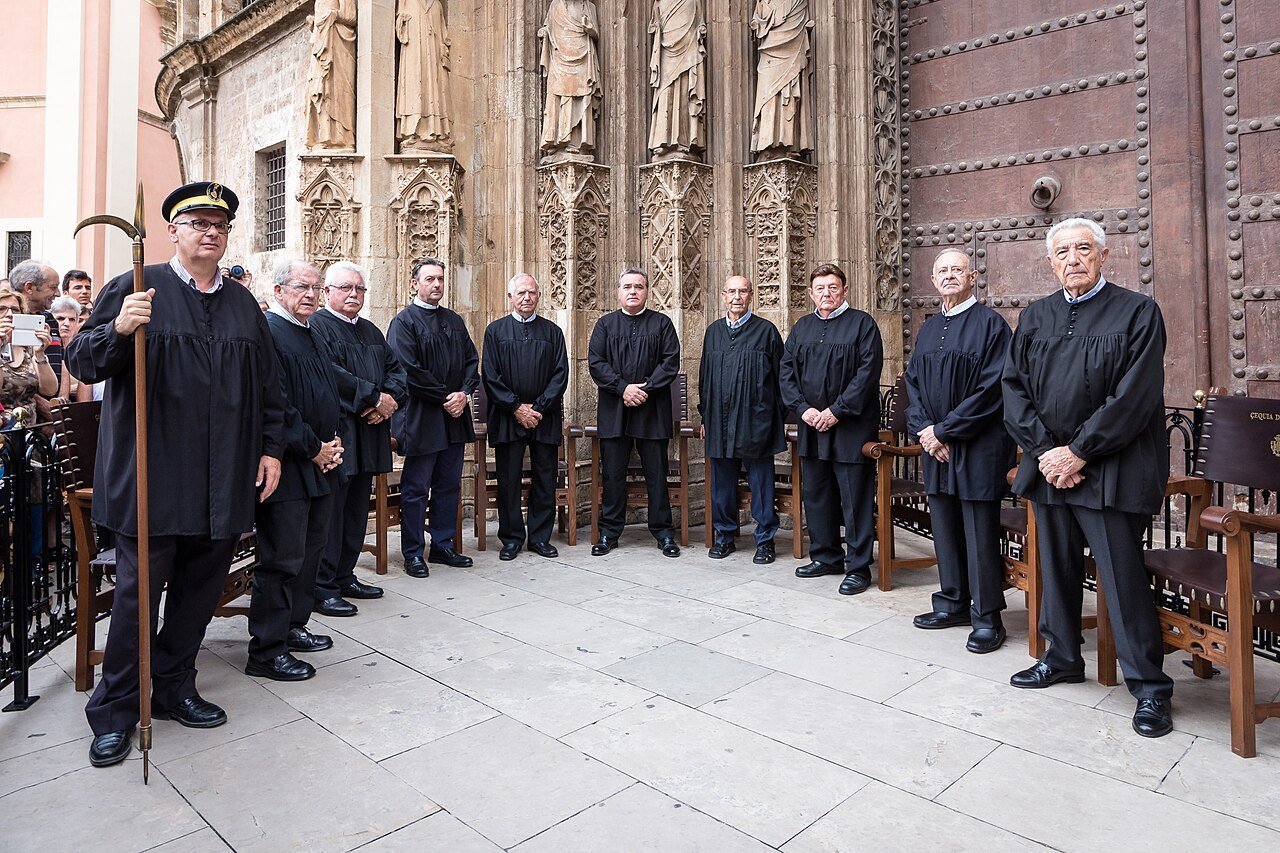
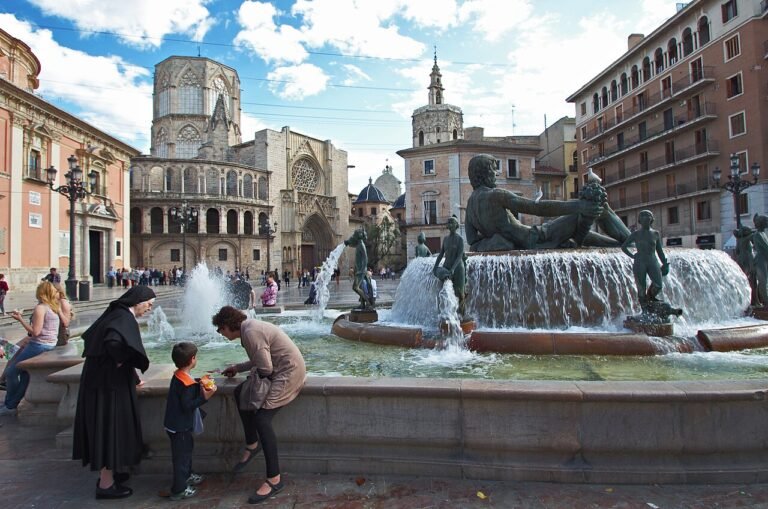
The Water Tribunal. Now the bonus, and plan your whole visit around it if you can. Every Thursday at 12 noon, the Tribunal de les Aigües — the Water Court — sits on the steps of the Door of the Apostles, on the Plaça de la Mare de Déu side of the cathedral. Eight farmers, the síndicos of the eight great irrigation channels of Valencia’s huerta, take their seats in a semicircle of high-backed chairs while the court’s officer, his long staff in hand, calls for anyone with a complaint about water to speak. Cases are argued out loud, in Valencian, with no lawyers, no paperwork and no appeal — and most are settled in minutes. The court claims over a thousand years of history and is recognised by UNESCO as Intangible Cultural Heritage. Arrive by 11:45 to get a decent spot behind the railings; if Thursday is a public holiday, the court sits on Wednesday instead.

When to Go
The cathedral is at its best first thing in the morning, when the tourist doors open at ten and the light through the alabaster windows of the cimborio is at its warmest — and the Miguelete staircase is still empty. Late afternoon is the other sweet spot, especially for the tower, when the low sun turns the old town’s rooftops gold. Thursday is the day to aim for, for the Water Tribunal at noon. Avoid Sunday mornings (worship only), expect crowds and closures around Fallas in March, and in high summer climb the tower early before the heat builds on those 207 steps. For the wider picture of seasons and festivals, see our Best Time to Visit Valencia guide.
Travel insurance, sorted
Whether it is a two-week holiday or a longer move, travel insurance is the one booking not to skip. We point readers to SafetyWing’s Nomad Insurance — cover built for travellers, remote workers and longer stays abroad, on a flexible monthly subscription you can start before a trip or while you are already away. Get a quote from SafetyWing
Final Thoughts
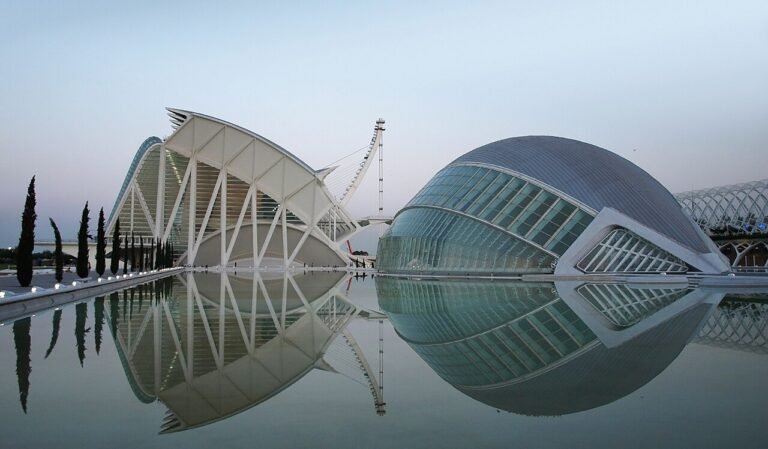
Valencia Cathedral does not shout. From the outside it can look like three churches from three different centuries stacked awkwardly together — which, more or less, it is. But give it two hours and it unfolds into the single best introduction to this city I know: Roman stones and a Romanesque door, a Gothic tower and a star-vaulted chapel, a cup that might just be the most famous drinking vessel in the world, a choir of painted angels hidden above the altar for three centuries, and a farmers’ court still doing thousand-year-old justice on the church steps every Thursday noon. Do the Grail chapel slowly, climb the Miguelete, look up at the altar — and then walk out into the Plaça de la Mare de Déu for a coffee and feel thoroughly, properly Valencian. If you have a day to spare afterwards, the cathedral pairs beautifully with the futuristic end of the city — an afternoon at the Oceanogràfic Oceanogràfic entry ticket is the perfect modern counterweight — and our Day Trips from Valencia guide has ideas for anything longer.
¡Buen viaje!

Photo credits: Enric — the Miguelete and Cathedral from the Plaça de la Reina, CC BY-SA 4.0; Ymblanter — Puerta de la Almoina, CC BY-SA 4.0; Zarateman — the Santo Cáliz in its altarpiece, CC0; Diego Delso — star vault of the Holy Grail Chapel, CC BY-SA 3.0; Diego Delso — the Miguelete tower, CC BY-SA 3.0; PiotrMig — the great bell of the Micalet, CC BY-SA 4.0; Carlos Teixidor Cadenas — Torres de Serranos from the Miguelete, CC BY-SA 3.0; Enfo — the central nave, CC BY-SA 3.0; Joanbanjo — the musician-angel frescoes, CC BY-SA 3.0; Joanbanjo — the arm of Saint Vincent, CC BY-SA 3.0; Ymblanter — Door of the Apostles, CC BY-SA 4.0; Rafa Esteve — the Water Tribunal in session, CC BY-SA 4.0. All via Wikimedia Commons.

7 Comments