Mercado de Colón: The Complete Guide to Valencia’s Modernista Market Hall
Some market halls you shop in; this one you simply stand in, looking up. The Mercado de Colón is Valencia’s great modernista set piece: a basilica of brick, iron and coloured ceramic raised in 1916 to sell fish and oranges to a new bourgeois suburb — and so beautiful that when the shopping moved out, the city could not bear to change a line of it. Today its three glass-roofed naves hold cafés, gourmet stalls, flower sellers and one of the city’s beloved horchaterías, and entry costs exactly nothing: it is a public living room with a cathedral’s roof.
This guide reads the building the way it deserves: the story of the Ensanche suburb that demanded it and the Christmas Eve it opened, a slow tour of its two great facades and the engineering between them, what the hall actually contains today — and where it sits against its famous sibling, the Mercado Central. It is the elegant pause on the modernista route our Best Things to Do in Valencia guide walks across the city, and the easiest great building in Valencia to enjoy: no ticket, no queue, just walk in.
The Short Answer
Yes — the Mercado de Colón is worth it, and it is the lowest-effort great sight in Valencia. Entry is free, it is open long hours every day, and inside one of Europe’s most beautiful market halls you can drink horchata, graze the gourmet stalls and sit on a terrace under an 18-metre iron vault — all in the middle of the city’s best shopping district. Be clear about what it is now: a gourmet and café hall, not a working provisions market — for the full theatre of Valencian food shopping, the Mercado Central is the main event and this is its elegant sibling. Come for the building, stay for an hour of Valencian café life at its most civilised, and time it for the warm late-afternoon light through the glass.
Table of Contents
- The Short Answer
- The Story in Brief: A Market for the New Valencia
- Reading the Building: Two Facades and Three Naves
- Inside Today: Cafés, Horchata and Gourmet Stalls
- Colón or Central? Valencia’s Two Great Markets
- The Perfect Pairing: A Modernista Morning
- The Honest Verdict: Who Should Go, Who Should Skip
- Practical Info
- Tips for Visiting
- Final Thoughts
The Story in Brief: A Market for the New Valencia
The market exists because Valencia grew a new self. In the late 19th century the city burst its old walls into the Ensanche — the Eixample — a grid of wide streets and handsome blocks for the prosperous classes, who found themselves inconveniently far from the old town’s markets and pestered the council for one of their own. The site chosen had been a gas factory; the architect chosen was Francisco Mora Berenguer, municipal architect and the leading hand of Valencian modernismo, who had trained in Barcelona and absorbed the Catalan school of Gaudí, Puig i Cadafalch and Domènech i Montaner at first hand. He designed the project in 1913, and building ran from 1914 to 1916, with the engineer-architect Demetrio Ribes — then raising Valencia’s great Estación del Norte — overseeing the daring iron structure.
Mora matters beyond this building. Valencian modernismo was the local dialect of the movement that gave Barcelona its Gaudí and Domènech i Montaner landmarks, and Mora — who had studied in Barcelona and worked in the Catalan masters’ orbit — was its most fluent Valencian speaker: he would go on to shape much of the Ensanche’s face. The market was his manifesto in a single commission. Where a purely functional architect would have built a shed, Mora built a civic monument with a shed’s plan, arguing in brick and tile that the everyday errands of a new suburb deserved architecture as serious as a church or a station. The suburb agreed — the market became the Ensanche’s emblem within a generation, and it has never stopped being it.
The city opened its market like a festival. On Christmas Eve 1916 a cavalcade wound through Valencia — mounted police, trumpets, floats advertising the wares of the city’s markets — and a young “Queen of the Market,” Elena Durá, in the dress of a Valencian farm girl, cut the ribbon. The building she opened measured a full city block, roughly 100 by 47 metres: two monumental brick facades like triumphal arches, three open naves between them under iron and glass, ringed by a wrought-iron fence with eight gates so the shopping could flow.
The 20th century used it hard, then outgrew it. By the 1990s the old market was decayed and its trade dwindling; the building was closed and, rather than demolished, reimagined — restored and reopened in 2003 as the gourmet and leisure hall you see today, its structure and ornament returned to glory. In 2007 it was declared a national monument — a Bien de Interés Cultural — which, for a building younger than the motor car, says everything about what Valencia thinks of it.
Reading the Building: Two Facades and Three Naves
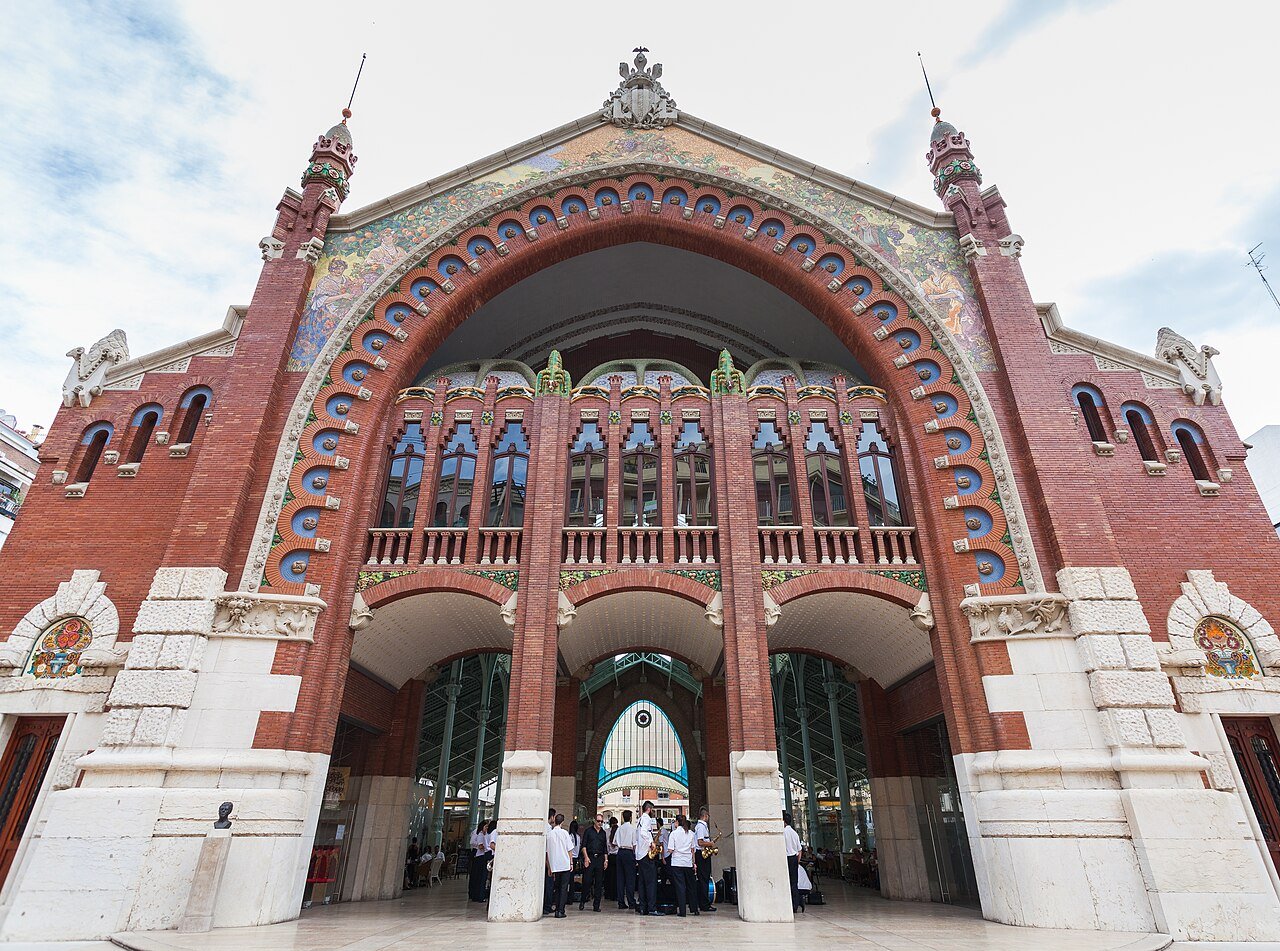
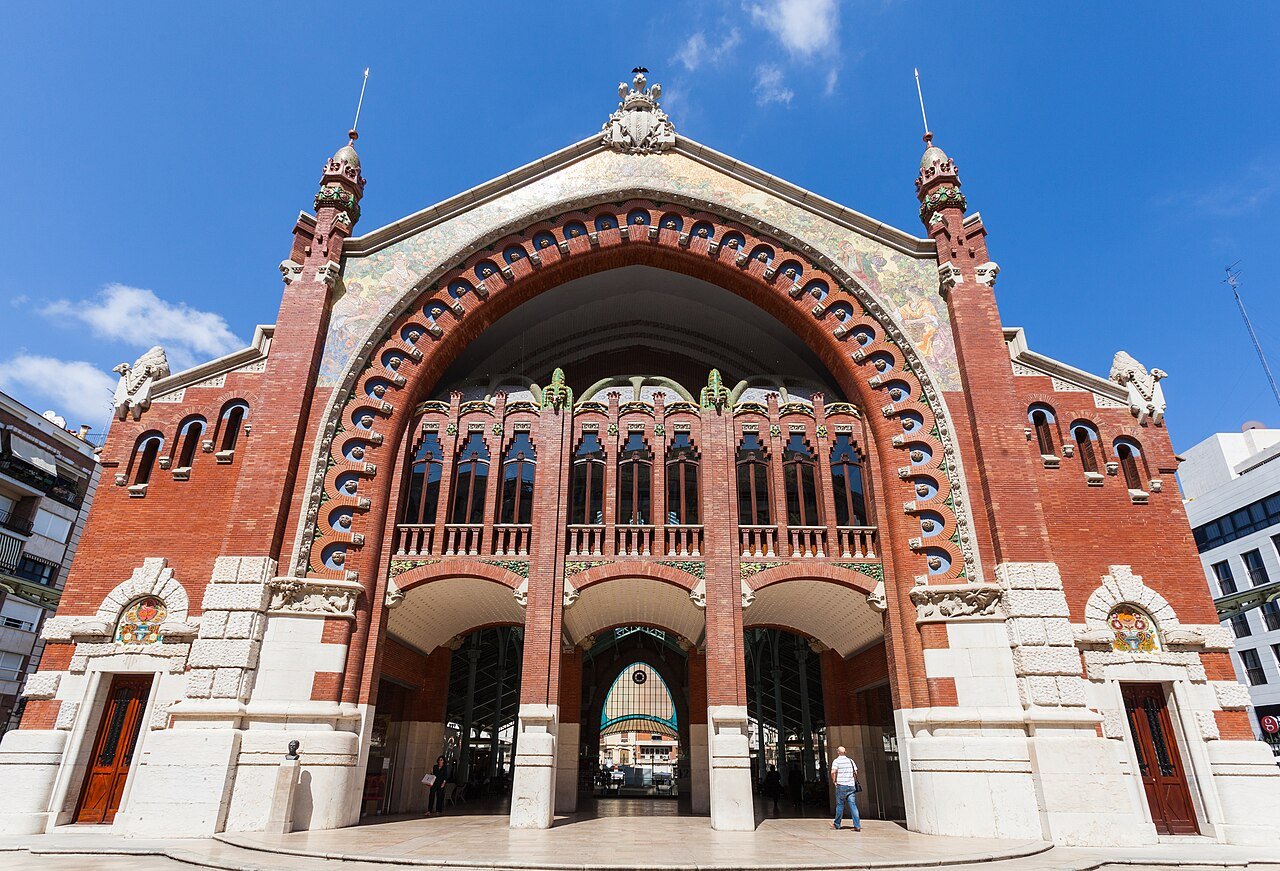
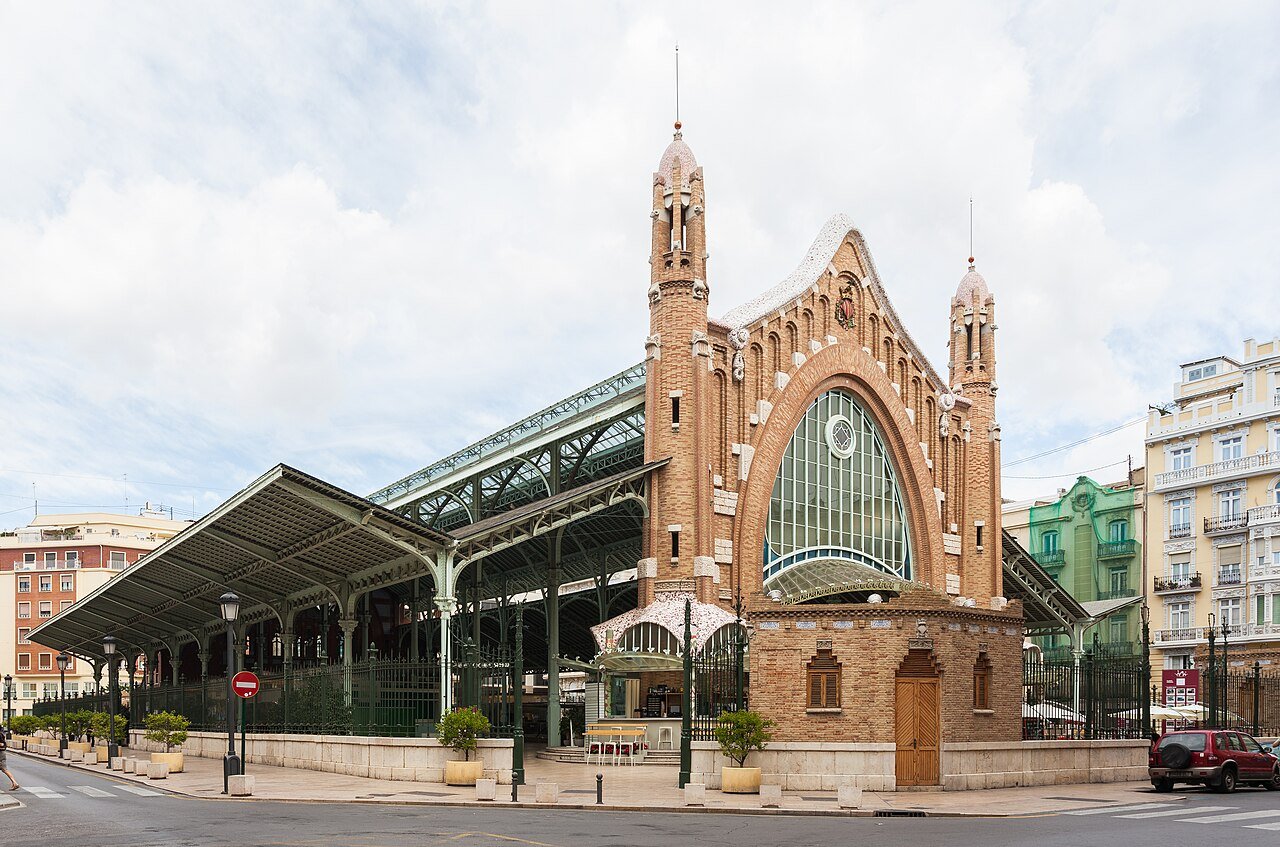
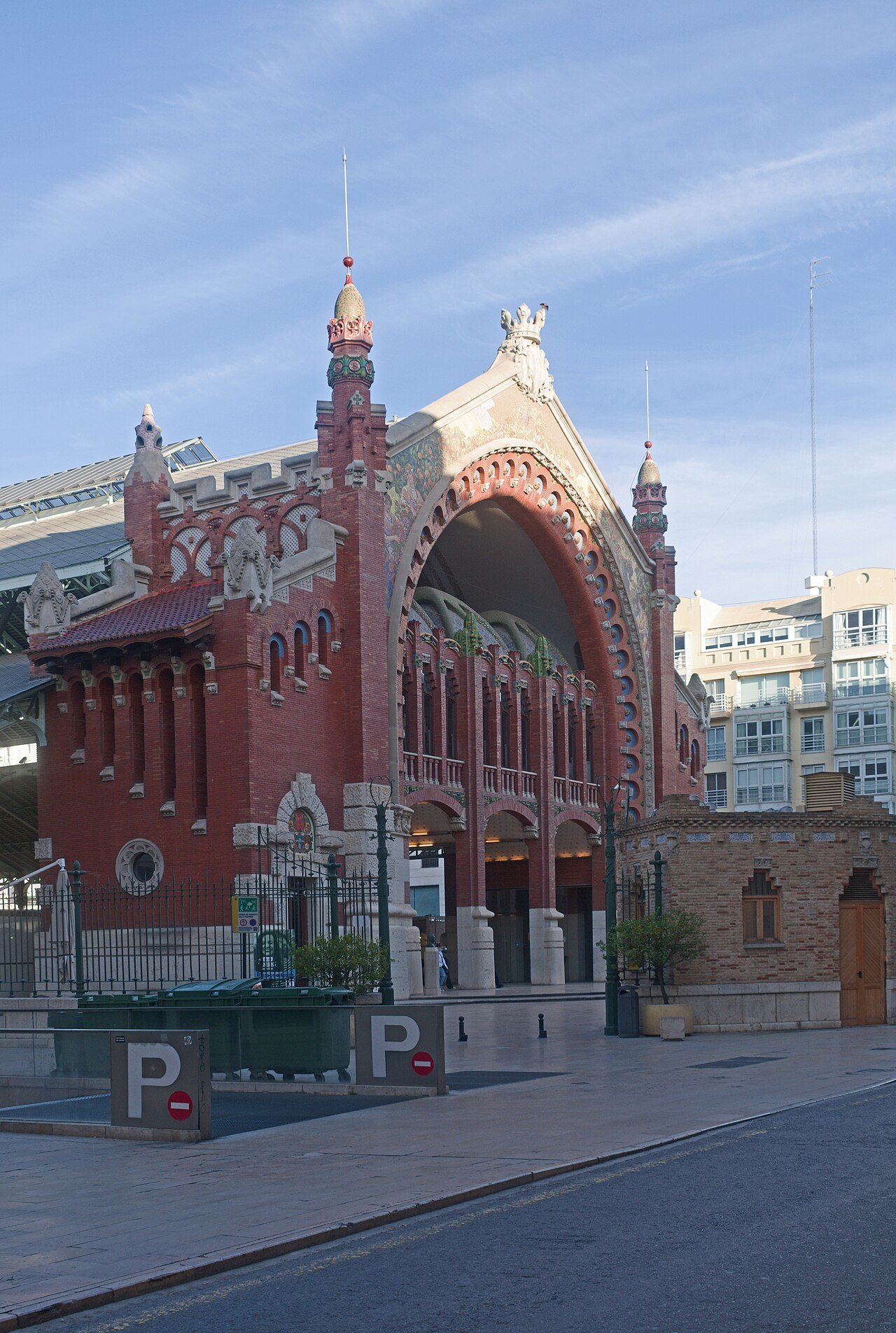
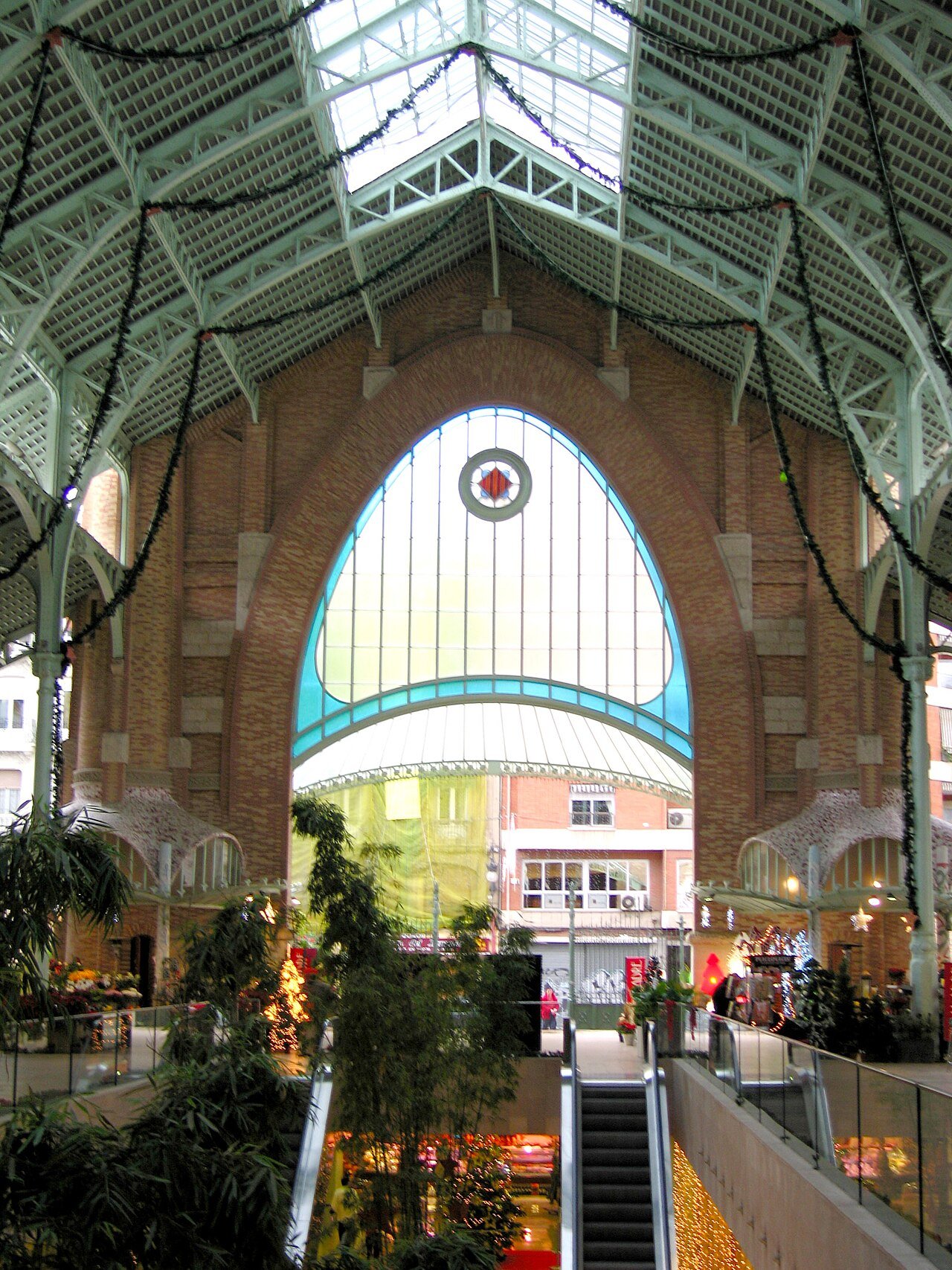
Walk the block once before you enter; the market explains itself from the street. Its two short ends are the architecture’s glory — a pair of triumphal-arch facades in warm red brick, stone and polychrome ceramic, each centred on a vast arch that frames the glazed gable of the central nave. The Jorge Juan front is the showpiece: the arch’s brickwork patterned like lace, ceramic panels blooming with the fruits and produce the hall was built to sell, ironwork gates below. The Conde Salvatierra end answers in kind, its great glass gable rising over a smaller brick pavilion front. Mora’s modernismo is all here — the Catalan lesson translated into Valencian materials: brick for structure, ceramic for joy, iron for daring, and not a plain surface where an ornament could live.
Look closer at the ornament, because it is a programme, not decoration. The ceramic work — glazed panels and broken-tile trencadís in the Valencian tradition — parades the market’s own merchandise across its walls: oranges and produce, flowers and fish, the abundance of the huerta rendered in the region’s oldest craft. The brick does double duty, structure and pattern at once, laid in rings and lattices that lighten as they climb; the stone is reserved for the feet of the arches, where the building meets the street and the weather. Even the perimeter fence joins in, its wrought iron worked to the same standard as the facades it guards. Nothing here is applied that could have been built-in, and nothing built-in escaped being made beautiful — the modernista creed, executed by a municipal architect on a market budget.
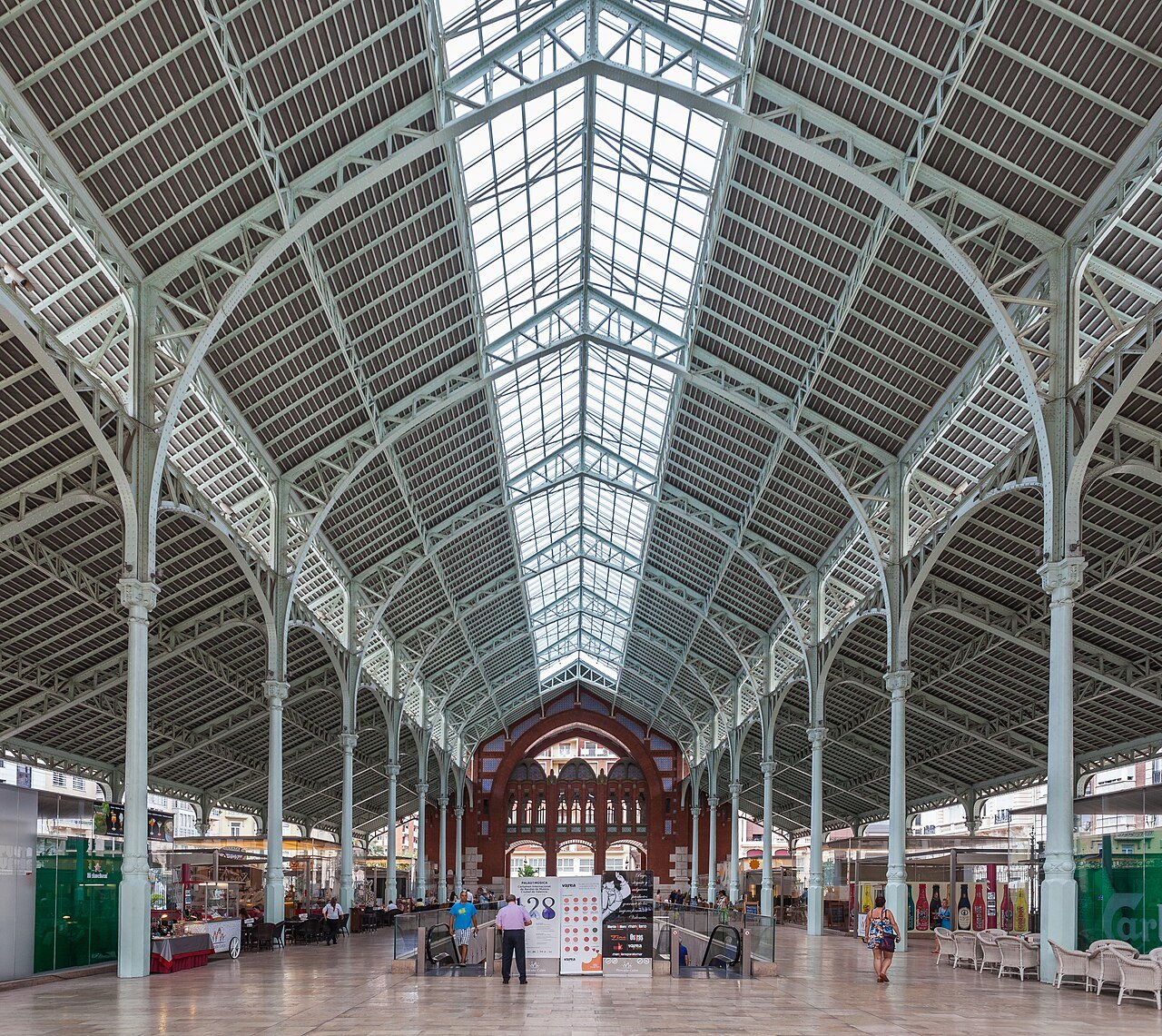
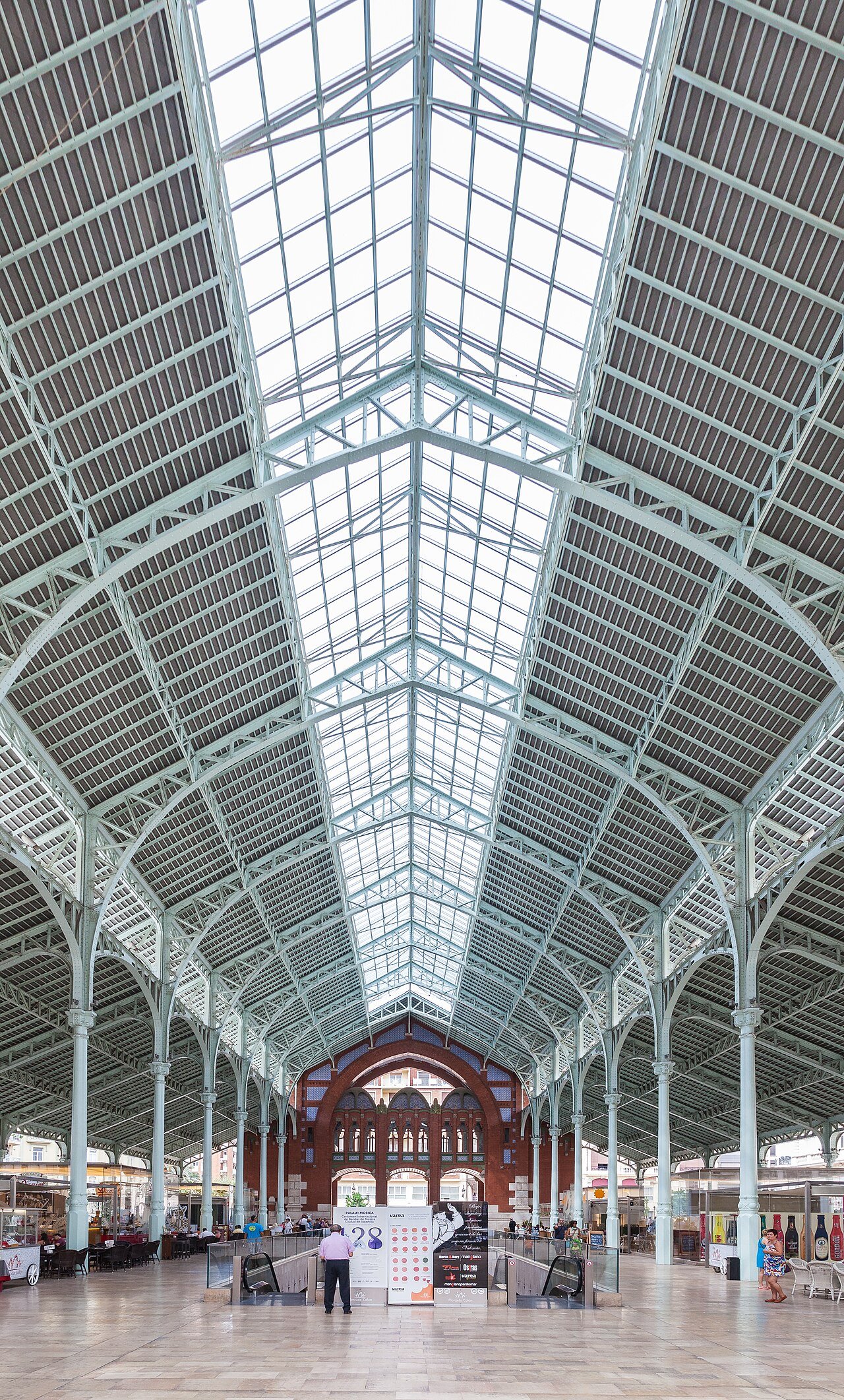
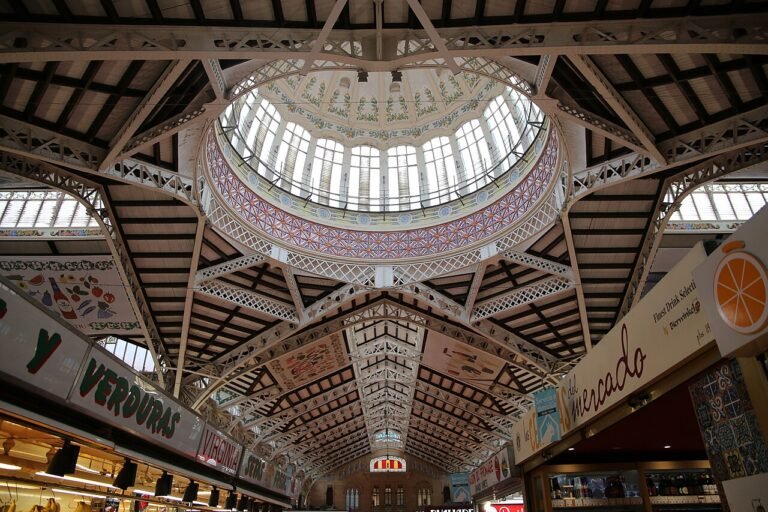
Between the facades, the engineering takes over. Three naves run the block’s length, walled by nothing at the sides — the original design was a hygienist’s dream of light and moving air — and roofed in iron and glass: the central vessel rises some 18 metres, carried on slender parabolic arches, with lower Y-shaped canopies sheltering the aisles. Stand in the middle and the comparison builds itself: this is a railway station crossed with a church, built for cabbages. That collision — industrial structure, devotional ornament, everyday purpose — is exactly what modernismo was for, and Valencia keeps few purer examples.

Inside Today: Cafés, Horchata and Gourmet Stalls
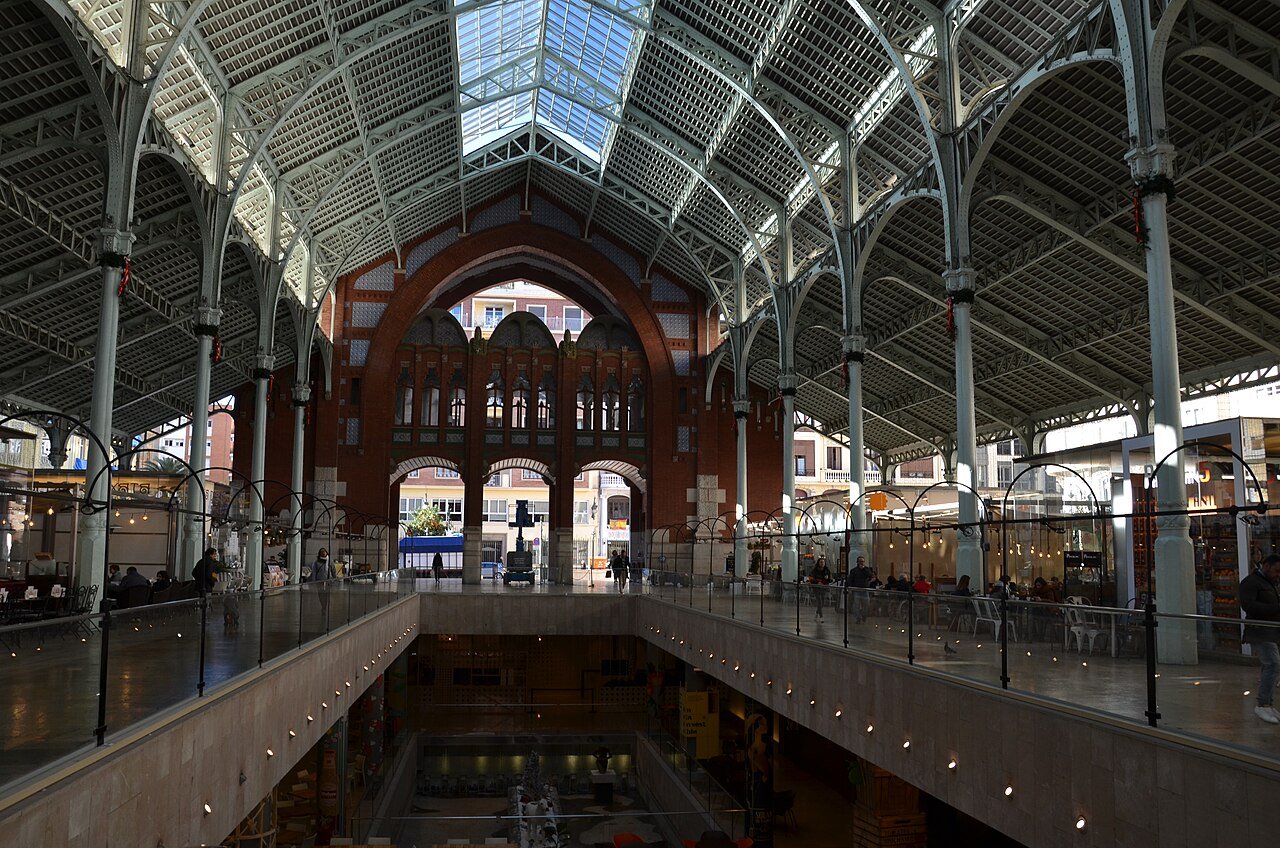
The 2003 restoration kept the shell sacred and changed the life inside. Where fishwives once shouted, the ground floor now holds a curated Valencia in miniature: gourmet food stalls and delicatessens, bakeries and wine sellers, florists at the gates, cafés and small restaurants with terraces spreading across the marble floor, and a lower level of further bars and eateries reached by escalators beneath the great glazed gable. It is deliberately, unapologetically a place to linger rather than to provision — the neighbourhood’s drawing room, with better architecture than most cathedrals offer.
The layout repays a slow circuit. The ground floor’s stalls and cafés occupy the great nave like furniture in a hall — from above, on the gallery, you see the whole arrangement at once: the flower stalls bright at the entrances, the delicatessens and bakeries along the aisles, café terraces pooling wherever the light is best. The lower level, the 2003 addition’s bold stroke, tucks further restaurants and bars beneath the floor without touching the silhouette, and hosts the market’s second life of exhibitions, concerts and seasonal events — the hall is a cultural venue as well as a food hall, and something is programmed in most weeks of the year. None of it fights the architecture; the restoration’s discipline was to let every new use sit lightly inside Mora’s shell, and a century-old market building now works, frictionlessly, as the neighbourhood’s all-day room.
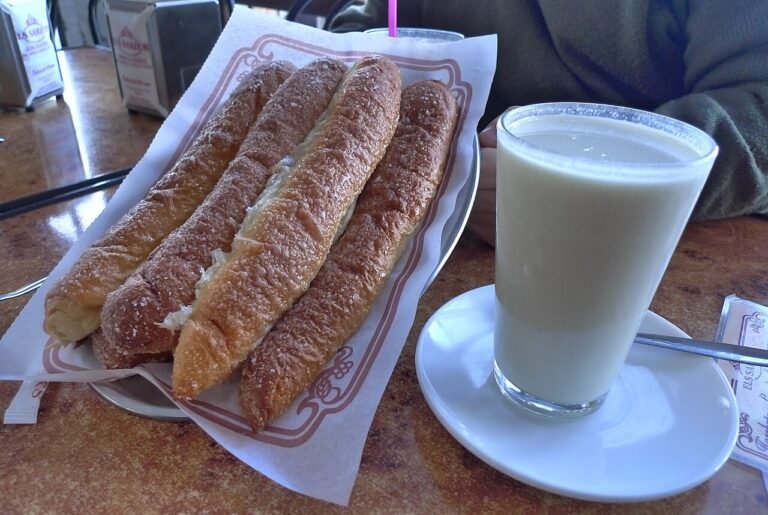
Do what the Valencians do. Order a horchata — the city’s milky, cinnamon-cool drink of tiger nuts — at the market’s beloved horchatería and drink it under the vault; graze a tapa or two from the stalls; and if the hour is right, join the early-evening crowd as the low sun comes through the west glass and the whole nave turns the colour of the brick. A guided wander makes the building legible — the Mercado de Colón food tour format suits it well, because the hall’s stories (the gasworks site, the ribbon-cutting queen, the iron skeleton) are invisible until someone points. But it gives up its pleasures perfectly happily to anyone who simply walks in hungry.


Free Valencia travel guide
Planning a trip to Valencia? Get our free one-page Valencia checklist: what to book ahead, what to skip, and the paella places we actually eat in.
Colón or Central? Valencia’s Two Great Markets
Every visitor asks, so here is the honest division of labour. The Mercado Central — the vast working food market by La Lonja, in our Mercado Central Valencia guide — is where Valencia actually shops: a thousand stalls of fish, meat, produce and noise under another glorious modernista roof, best in the full roar of a morning. The Mercado de Colón is where Valencia relaxes: fewer stalls, better coffee, architecture at least as fine, and not a fish scale in sight. You do not choose between them so much as sequence them — the Central for the spectacle of appetite in the morning, Colón for the ceremony of digestion later. If your time allows only one and food is the point, take the Central; if architecture and atmosphere are the point, take Colón — and know that the locals, who love both, will tell you exactly that.
Their hours tell the same story. The Central runs on market time — doors up early, the best of it over by mid-afternoon, the roof dark by evening. Colón runs on city time: it wakes early, idles beautifully through the afternoon, and peaks when the working day ends and the terraces fill. A traveller with a single Valencia day can honestly do both without hurry — Central at nine for the theatre of the stalls and a bar breakfast standing up, Colón at six for the horchata, the low sun through the west glass and a seat. Two markets, two centuries of the same civic idea, one appetite.
The Perfect Pairing: A Modernista Morning
Colón anchors Valencia’s other modernista constellation. From its gates, the Ensanche streets run west to the old town and the Carmen quarter in our El Carmen guide, and the city’s modernista thread continues through the Estación del Norte and the Plaza del Ayuntamiento’s facades. Set against the city’s other extreme — the white 22nd-century forms of the complex in our City of Arts and Sciences guide, a bus ride east — the market completes a single-exhibition argument Valencia makes better than any city in Spain: a hundred years of daring architecture, from Mora’s brick and ceramic of 1916 to Calatrava’s bone-white concrete, with a horchata waiting at the start of it.
The Honest Verdict: Who Should Go, Who Should Skip
Go if you love buildings, café culture, or free masterpieces — which is to say, go. It costs nothing, asks nothing, sits amid the best shopping streets in the city, and delivers one of Europe’s great interiors to anyone who walks through its gates. Food travellers should come too, but with the right expectation: this is grazing and sipping in a monument, not market shopping.
Skip the disappointment, not the market, by knowing its one honest limitation: if you arrive dreaming of a working provisions market — stalls of fish on ice, farmers shouting prices — the Colón will read as a beautiful food court, and the Central is your market. And on a tight one-day itinerary where the City of Arts and the old town are still unseen, this is a glorious optional extra rather than a headline. But as the pause inside a Valencia day — the horchata stop, the architecture breath — almost nothing in the city beats it per minute spent.
Practical Info
Getting there. The market fills its block at Calle Jorge Juan 19, in the Ensanche, between Jorge Juan, Conde Salvatierra, Cirilo Amorós and Martínez Ferrando. Metro stations Colón and Xàtiva are both a short walk; from the Plaza del Ayuntamiento it is an easy ten-minute stroll through the city’s smartest shopping streets. You cannot miss it: the brick arch fills the end of the street.
Tickets and cost. There are none — entry to the building is free, and always has been; you pay only for what you eat and drink. Guided visits exist for those who want the architecture decoded (the Mercado de Colón food tour is the tastiest route into its stories), but the hall asks no permission of anyone.
Hours and time needed. The building opens early and closes late, daily — broadly from around 7:30–8:00 in the morning until 22:00 or later — but individual cafés and stalls keep their own hours inside that envelope, so check the market’s official site for the day’s detail. As a sight it needs only 30–45 minutes; as a café stop it will happily keep you for two hours.
Tips for Visiting
- Come twice if you can. Morning for the architecture in clean light and quiet; early evening for the atmosphere, when the terraces fill and the glass glows.
- Do the circuit outside first. Both facades deserve their viewing; the Jorge Juan front is the portrait, the Salvatierra end the profile.
- Horchata is the house ritual. The market’s horchatería is a Valencian institution — order yours with fartons for dunking, as the locals do.
- Pair it with the Central, don’t confuse them. Working market in the morning at the Central; Colón for the elegant recovery. They are a fifteen-minute walk apart.
- Look up in the middle of the nave. The 18-metre vault, the parabolic arches and the ceramic-crested gable are the building’s whole argument, visible in one upward glance.
- Use it as your Ensanche base. The city’s best shopping streets radiate from its gates — plan the district around a café table inside.
Travel insurance, sorted
Whether it is a two-week holiday or a longer move, travel insurance is not the most glamorous part of a trip — but it is the one booking you want to have in place before a trip, and while you are already away.
Final Thoughts
Cities usually make you choose between the monument and the café — queue for one, recover in the other. The Mercado de Colón abolished the distinction in 1916 and again in 2003: a triumphal arch you can drink horchata under, a cathedral of iron that serves lunch. Valencia built it to sell oranges to a new suburb and ended up building its own living room, then loved it enough to declare it a national monument while it was still serving coffee. Walk in off Jorge Juan, order something cold, and look up: some buildings are sights, and some are how a city would like to be seen living. This is both.
¡Buen viaje!
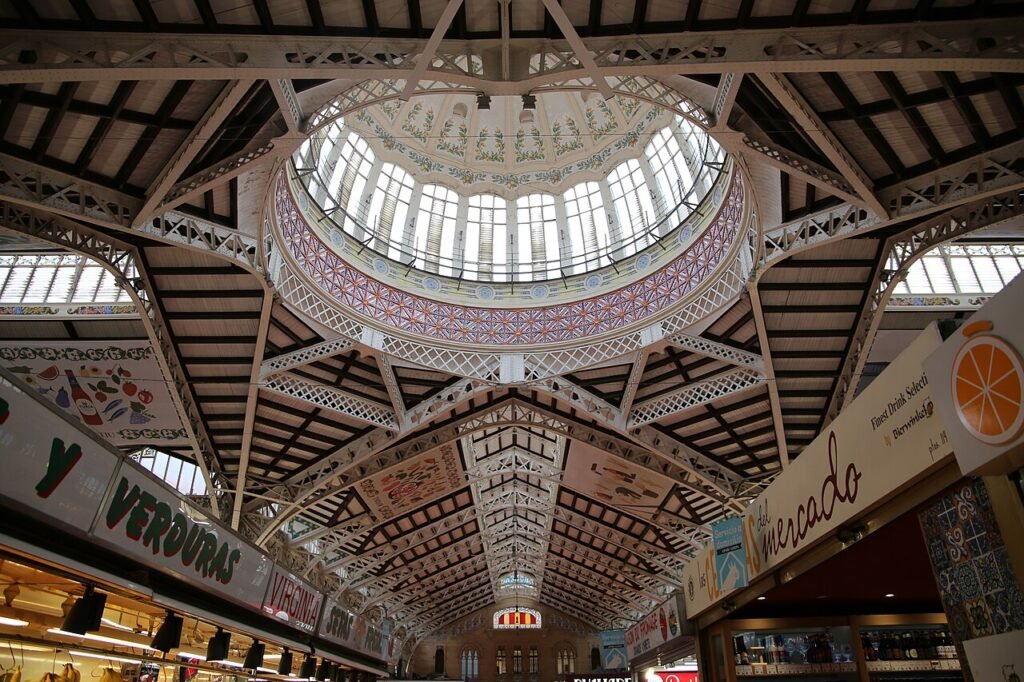
Photo credits: The Jorge Juan facade, its head-on portrait and the Conde Salvatierra end — Diego Delso, CC BY-SA 3.0 · Facade detail and the restored atrium interior — Steven Lek, CC BY-SA 4.0 · The corner from the northwest — Ymblanter, CC BY-SA 4.0 · The central nave and under the glass — Diego Delso, CC BY-SA 3.0 · The glazed gable from inside — Felivet, public domain · Stalls under the side nave — Joanbanjo, public domain · Terrace, ground floor and gallery views — 19Tarrestnom65, CC BY-SA 4.0. All via Wikimedia Commons.


One Comment