Iglesia de San Juan de la Cruz Valencia: The Complete Guide to the Rococo Church That Was San Andrés
Short Answer
The Iglesia de San Juan de la Cruz, at Calle del Poeta Querol 6 in La Xerea, Valencia’s old town, is one of the twelve founding parishes of Christian Valencia — consecrated, tradition and one local history agree, on 10 October 1238, the day after Jaume I entered the city, over a mosque, and dedicated then to San Andrés. The building you see today is its 17th-century successor: a wide single nave built between 1602 and 1615 (some accounts run the works to about 1620), begun with a first stone laid by San Juan de Ribera, the Patriarch Archbishop. Outside it is all restraint — a smooth brick façade whose entire decorative budget is spent on one extravagant late-Baroque portal of twisted Solomonic columns. Inside it is the opposite: in the mid-18th century the sculptor Luis Domingo, working to designs attributed to Hipólito Rovira — the artist of the Marqués de Dos Aguas façade around the corner — covered every wall and vault in white-and-gold Rococo stucco, angels, draperies and vegetation climbing over a polychrome tile wainscot, in what Valencia’s own architecture guide calls a Rococo revestment unique in the city. The parish lost its altarpieces and its six bells in the Civil War, stood closed, by the usual account, for some fifty years, and reopened in 2009 as a star of La Gloria del Barroco, the great La Luz de las Imágenes exhibition, where it hosted the section on devotion to the Virgin Mary. Today it is a working parish again — Mass is in the evening — and, on selected evenings, the stage of El oro de San Juan, an immersive light-and-music visit built around its vast counter-façade relief. Allow 30 to 45 minutes, and read the practical sections carefully: this is not a church with a ticket desk and all-day hours.
Table of Contents
- The Short Version
- San Andrés in 1238: A Mosque, a Conquest and One of Twelve Founding Parishes
- Rebuilt Stone by Stone: Ribera’s First Stone and the Seventeenth Century
- One Extravagant Door: The Late-Baroque Portal and the Lost San Andrés
- The Bell Tower and the Bells That Came Back
- White and Gold: The Rococo Interior of Rovira and Domingo
- Tiles, Paintings and Silver: The Zócalos, Camarón and the Frontal
- The Fishermen’s Chapel: The Capilla de la Comunión
- War, Silence and Fifty Closed Years
- La Gloria del Barroco: The Church Reopens as the House of the Virgin
- El Oro de San Juan: The Church by Light, Today
- Practical Info
- Tickets and Booking
- Opening Hours
- Getting There
- When to Go
- How Long You Need
- Tips for Visiting
- What to See Nearby
- Final Thoughts
The Short Version
San Juan de la Cruz is the Valencia church that hides in plain sight. It stands on one of the old town’s smartest shopping streets, a minute from the ceramic-and-alabaster fireworks of the Marqués de Dos Aguas palace, and most visitors walk straight past its sober brick front on their way somewhere louder. That is a mistake — or rather, it is the church’s whole strategy, learned over four centuries: save everything for the interior. Behind the plain wall is one of the great decorative interiors of the Valencian 18th century, a single broad nave where Rococo stucco runs like foam over Gothic-descended rib vaults, where the chapels sit above glowing skirts of painted tile, and where the wall over the entrance rises into an 18-metre sculpted relief of the virtues of San Andrés. It earns its place among the best things to do in Valencia precisely because it is not organised for you: no standard ticket, no fixed sightseeing day, a parish timetable and, lately, a beautiful ticketed evening experience that turns the stucco to gold with light. Go in the early evening, when the doors open for Mass or for El oro de San Juan, and let the plain street door do its trick one more time.
San Andrés in 1238: A Mosque, a Conquest and One of Twelve Founding Parishes
Begin with the name, because the name is the first puzzle. Every official source introduces this church the same way: the Iglesia de San Juan de la Cruz, antiguamente — formerly — the parish church of San Andrés. The parish is one of the twelve founded in Valencia after the Christian conquest: the Generalitat’s 2025 restoration notice calls it “one of the twelve foundational parishes of València”, and the Cathedral archive’s list of those twelve, preserved in the diocesan press, includes San Andrés by name. One Valencian history of Islamic Balansiya dates the consecration precisely: 10 October 1238, the day after Jaume I’s formal entry into the surrendered city, when the mosque on this site was blessed as a church of San Andrés. Like its sister parishes, the new parish was planted over a mosque, inside the Islamic walls, in the quarter that became La Xerea — and like them it organised the Christian city around itself, a parish that was also a district, a tax unit and a community.
Of that first church, almost nothing stands. The Generalitat’s heritage file says the mosque-site church probably followed the standard early model — a single nave with chapels between buttresses — and records that the bell tower is the only element surviving from the primitive building, its medieval core later reclad. Everything else is the product of the great rebuilding described in the next section. What the 13th century does still explain is the dedication puzzle. San Andrés — St Andrew, the apostle, patron of fishermen among others — was this parish’s saint for centuries: his statue stood in the portal’s upper niche, his cross still marks the façade, and the church’s grandest interior artwork, the counter-façade relief, celebrates his virtues. At some point the parish took the name of San Juan de la Cruz, St John of the Cross, the Carmelite mystic. Here honesty is required: the standard sources — Wikipedia, the heritage file, the architecture guide — all record the change and none of them dates it or explains it. No reliable account found for this guide says when San Andrés became San Juan de la Cruz, or why. Rather than invent a Carmelite story to fill the gap, this guide leaves it open, as the sources do — and points out that the building itself never quite let go of its first patron, as you will see on the portal and the west wall.
Rebuilt Stone by Stone: Ribera’s First Stone and the Seventeenth Century
The church you enter is, in its bones, a building of the Spanish Counter-Reformation, and it had a saint for a godfather. San Juan de Ribera — Archbishop of Valencia, Patriarch of Antioch, founder of the Patriarca college a few streets away, and the driving force of Catholic reform in the city — laid its first stone in 1602. Even the dates need care, because the sources do not fully agree: the heritage file gives construction between 1601 and 1615, in phases — first the presbytery and its dependencies, then two bays of the nave, then three more; Wikipedia gives 1602 to 1615; but the CTAV Guía de Arquitectura de Valencia says the present temple was begun by the master Alonso Orts in 1608 and probably not finished until about 1620. Read together, the likeliest story is a long, phased campaign across the first two decades of the century, and this guide gives you all three datings rather than pretending they are one.
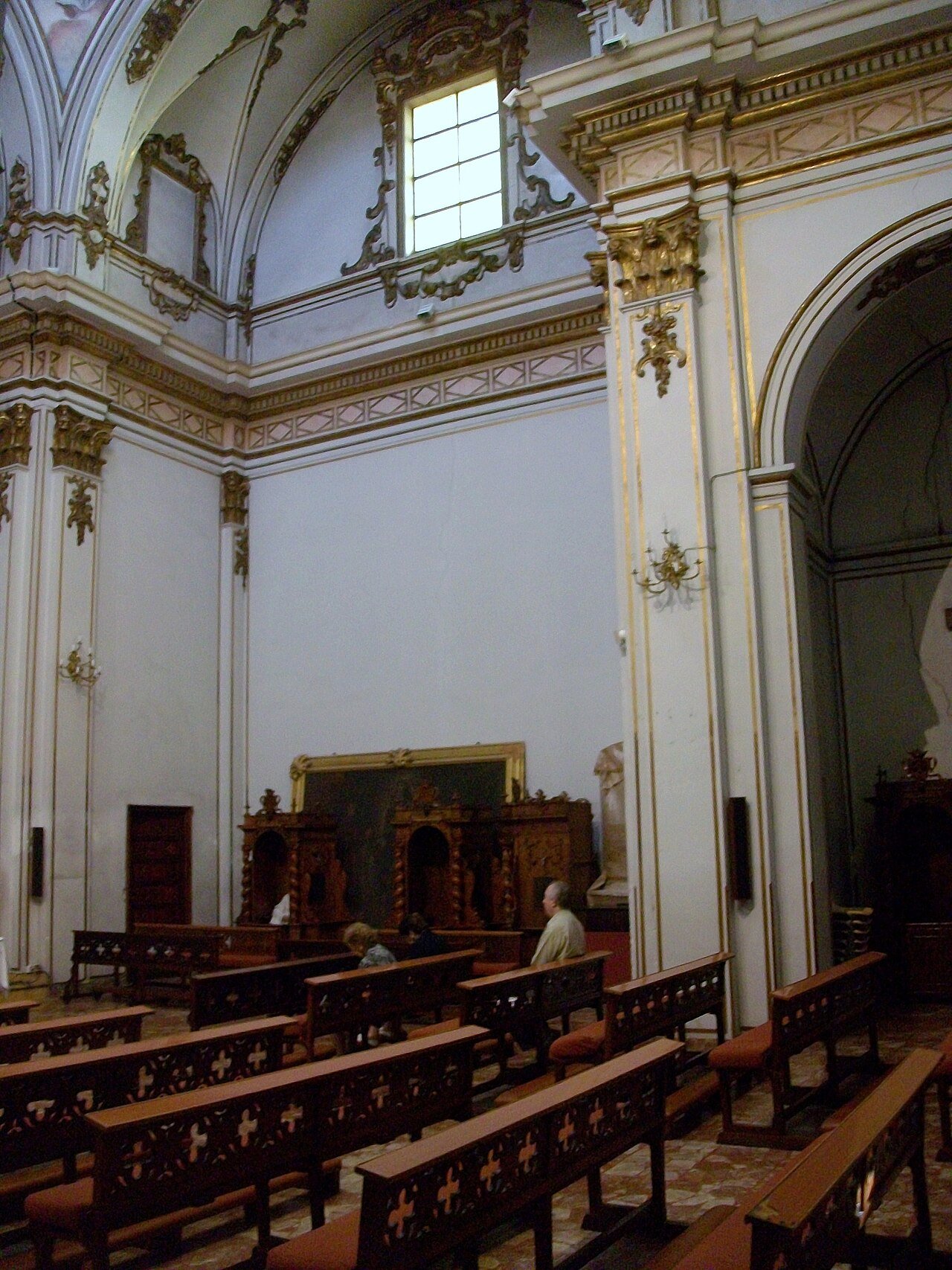
What rose was the classic Valencian parish plan, executed with unusual breadth: a single, strikingly wide nave of five bays, chapels tucked between the buttresses, and a polygonal apse. Inside, the order is sober and classical — Doric pilasters on pedestals carry a stone entablature of metopes and triglyphs — and the covering looks backwards as much as forwards: rib vaults with brick webs over the nave, a star vault over the apse, a Gothic skeleton in a classicising skin. The 17th century then furnished the skeleton in stages. At mid-century came a trasagrario — the little chamber behind the altar for reserving the Sacrament — rectangular in plan and decorated with sgraffito. Towards 1703 a new sacristy was built at the left of the presbytery. And at the century’s end the church received the two elements that define it from the street: the bell stage of the tower and the main portal, the subject of the next section. Stand on the east side, on Calle Vilaragut, and you can still read that phased growth in the plain brick massing — apse, nave and tower accumulated, not designed in one gesture.
One Extravagant Door: The Late-Baroque Portal and the Lost San Andrés
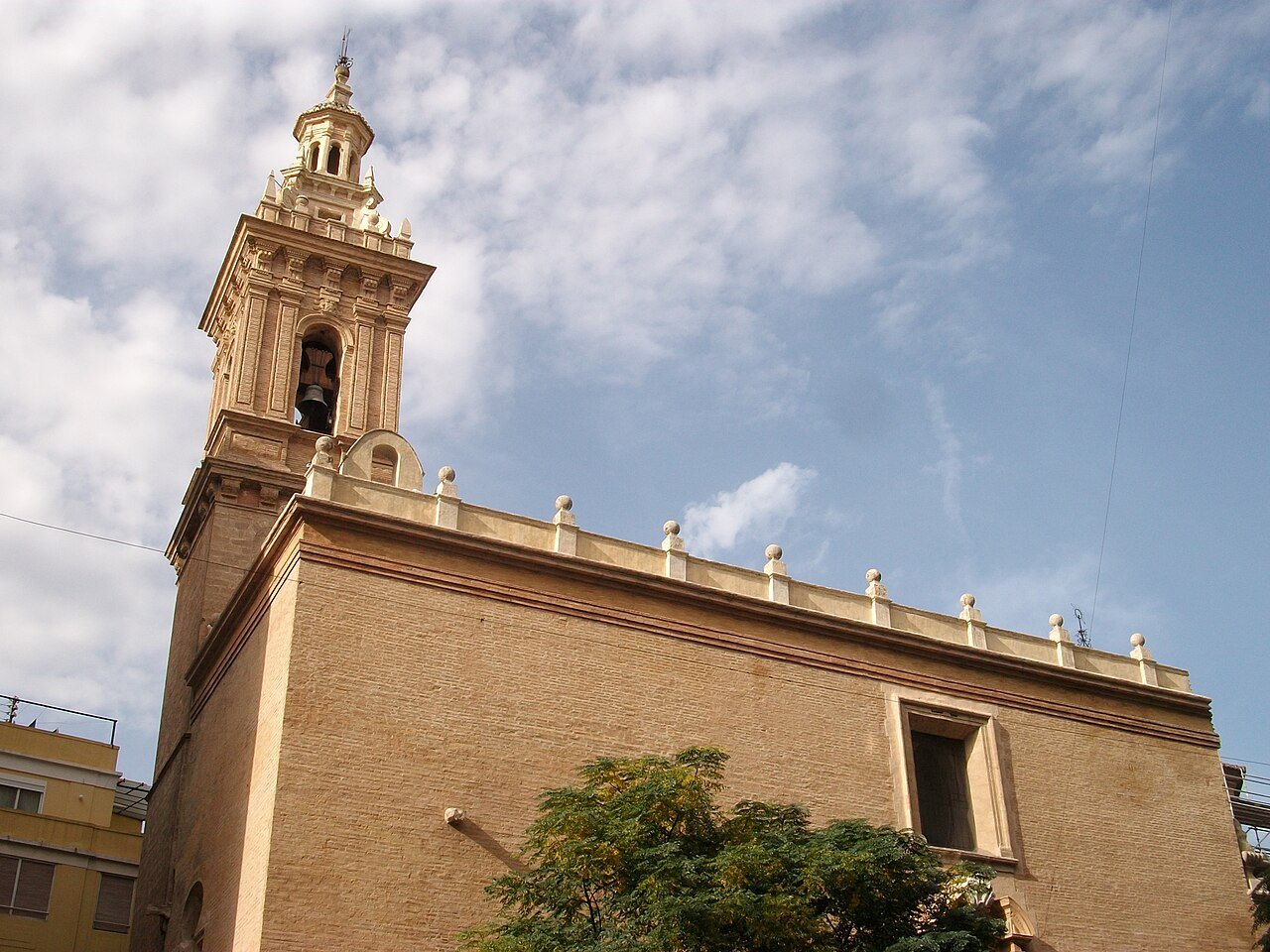
The façade is a lesson in Valencian understatement. The front is a smooth wall of exposed brick on a stone socle, finished at the top with a Tuscan entablature and a parapet balustrade punctuated by stone balls; a single rectangular window opens above the door. Every decorative resource the parish had was concentrated into one object: the portal, dated by the architecture guide to between 1683 and 1696 and attributed there to two collaborators of Juan Bautista Pérez Castiel, the great master of the Valencian Baroque — no firmer architect’s name survives in the sources, and this guide will not invent one.
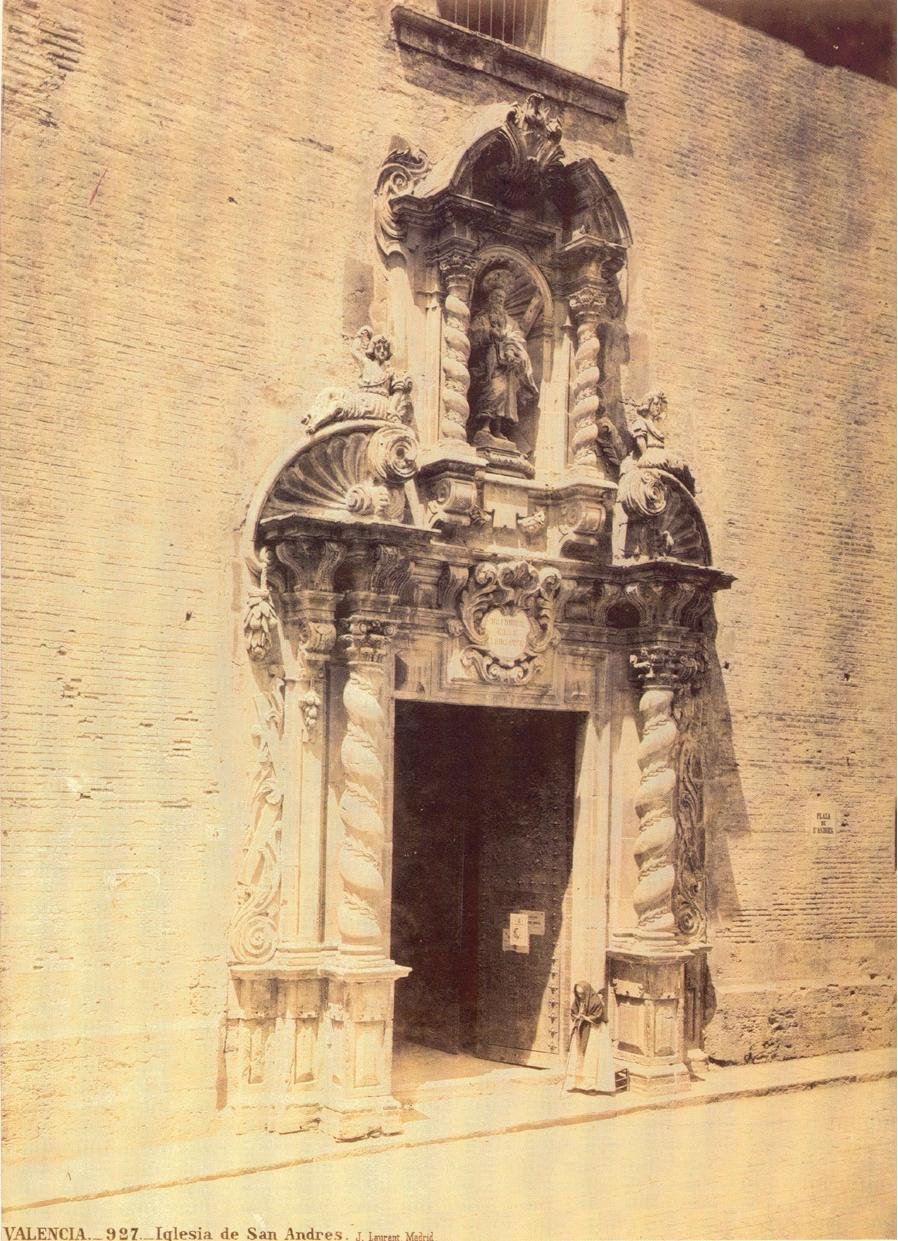
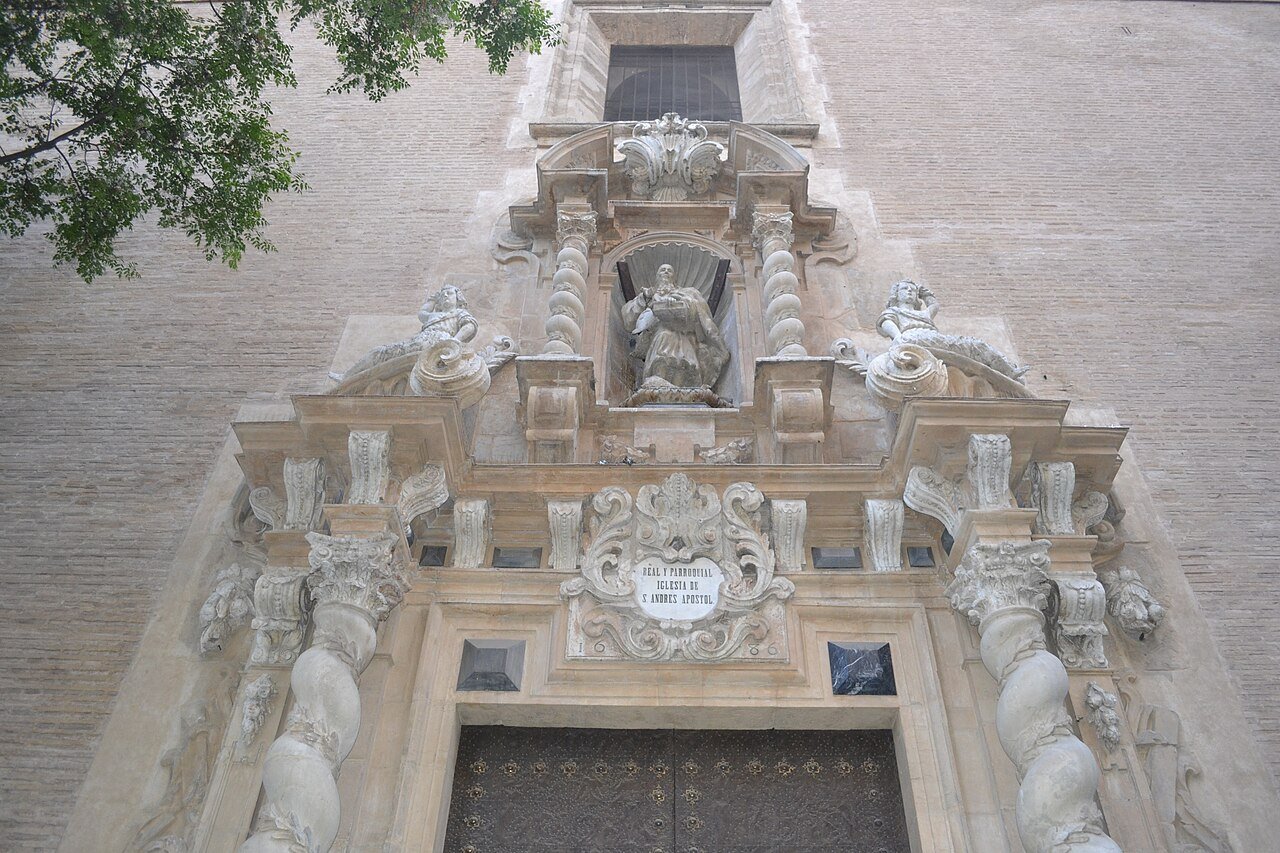
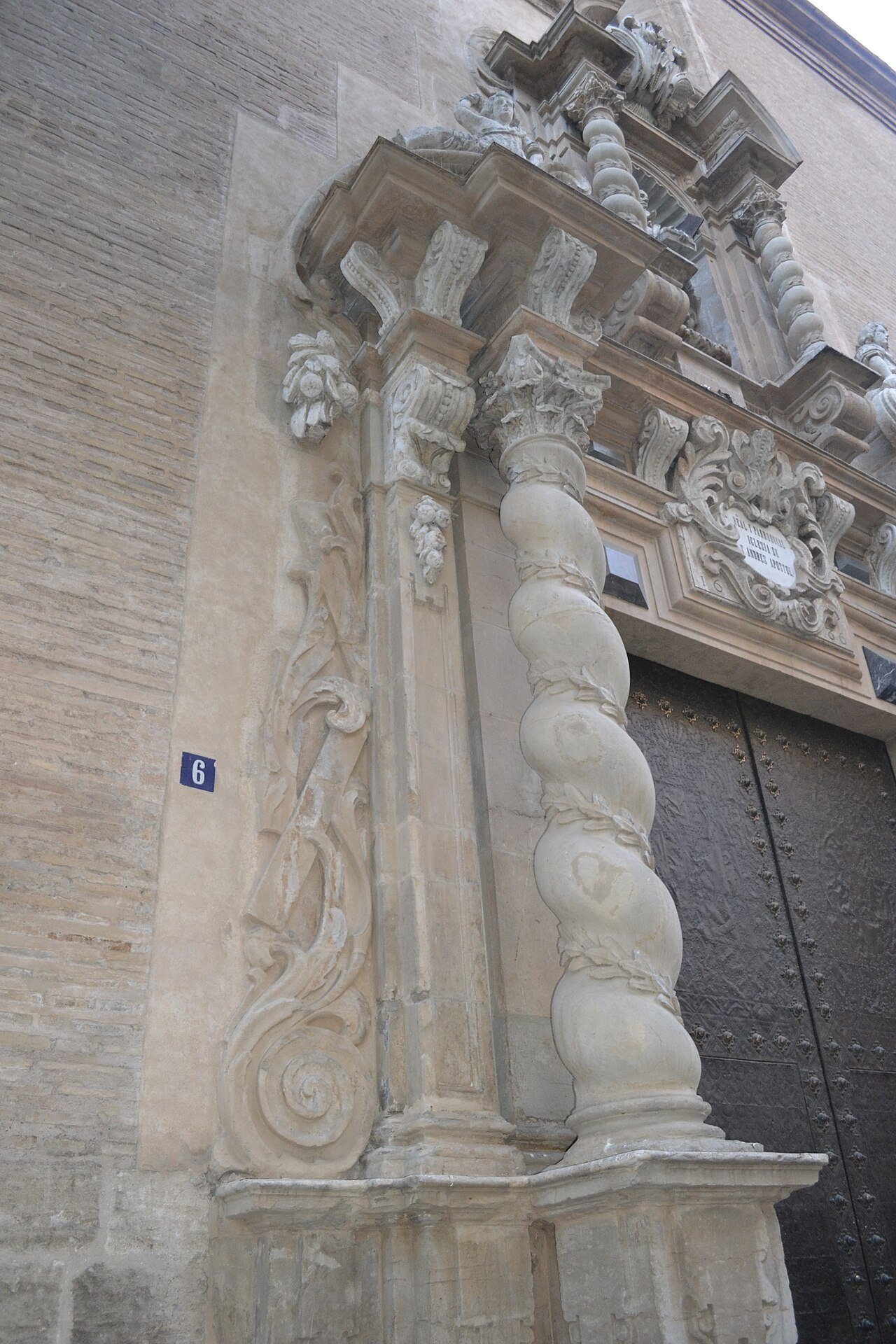
The portal is in two bodies. Below, a lintelled doorway is flanked by Solomonic columns — the twisted, barley-sugar columns of the high Baroque — with Corinthian capitals, backed by pilasters. Above the entablature, decorated with corbels, a split curved pediment frames the upper body: a shell-headed niche, again flanked by Solomonic columns, under its own curved pediment. The detail everyone remembers is on the corbels at the sides, where two female figures appear to slide down the architecture, drapery and all — the heritage file’s own description says they seem to slip along the ménsulas, and in person the effect is pure Baroque theatre, stone pretending to be in motion. The niche once held a statue of San Andrés. The statue is gone — the 1870 photograph in this guide shows it still in place — and what remains, the heritage file notes, is the trace of his cross: the great X, the aspa of St Andrew’s martyrdom, still readable in the upper façade, the old patron’s signature left on a church that no longer bears his name. There is also a side portal, in the opposite taste: a calm classicist doorway of Doric pilasters and a round arch, its upper niche framed by Ionic pilasters under a triangular pediment finished with pyramids and balls. Two doors, two centuries of taste, one plain brick wall.
The Bell Tower and the Bells That Came Back
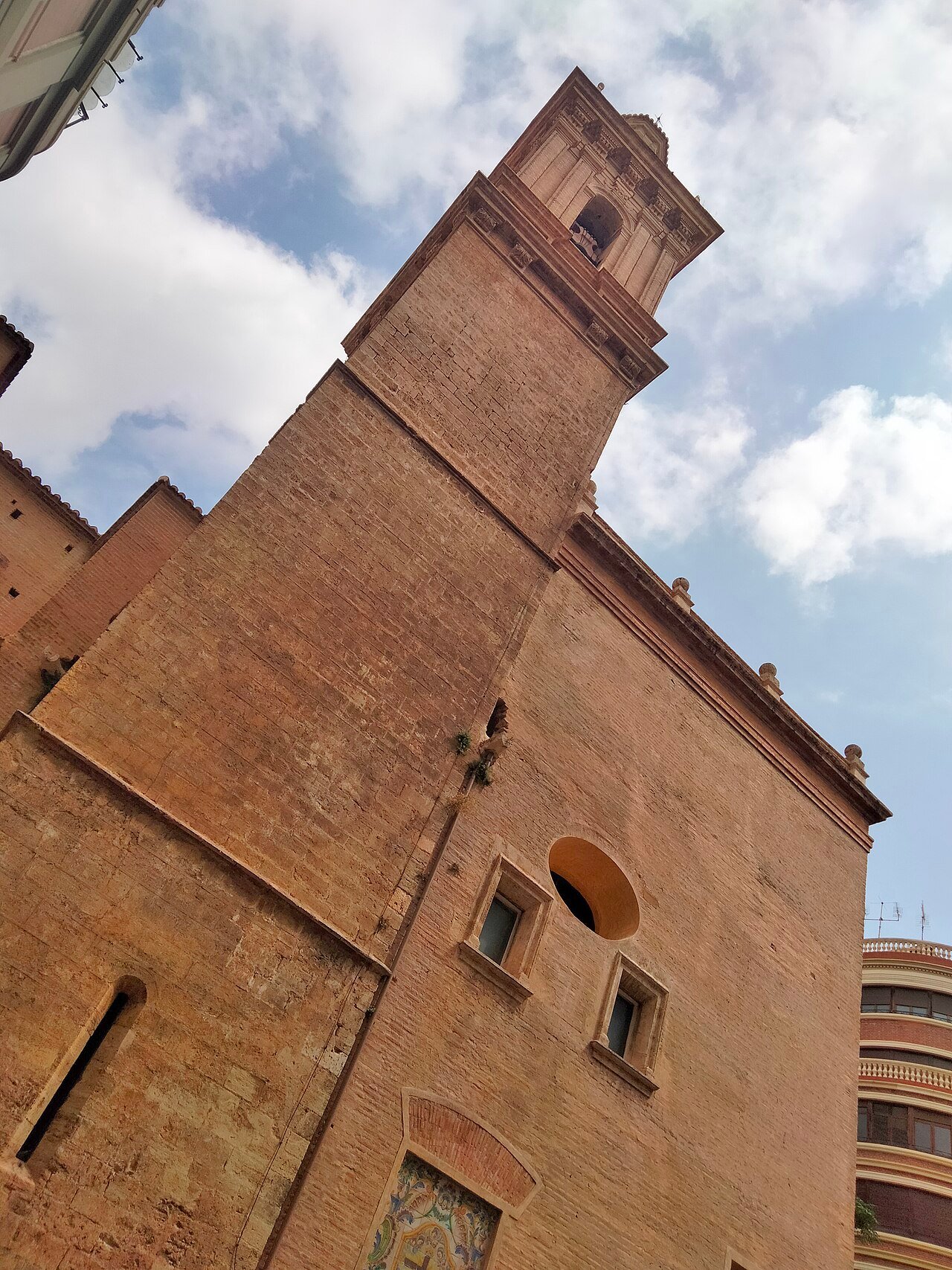
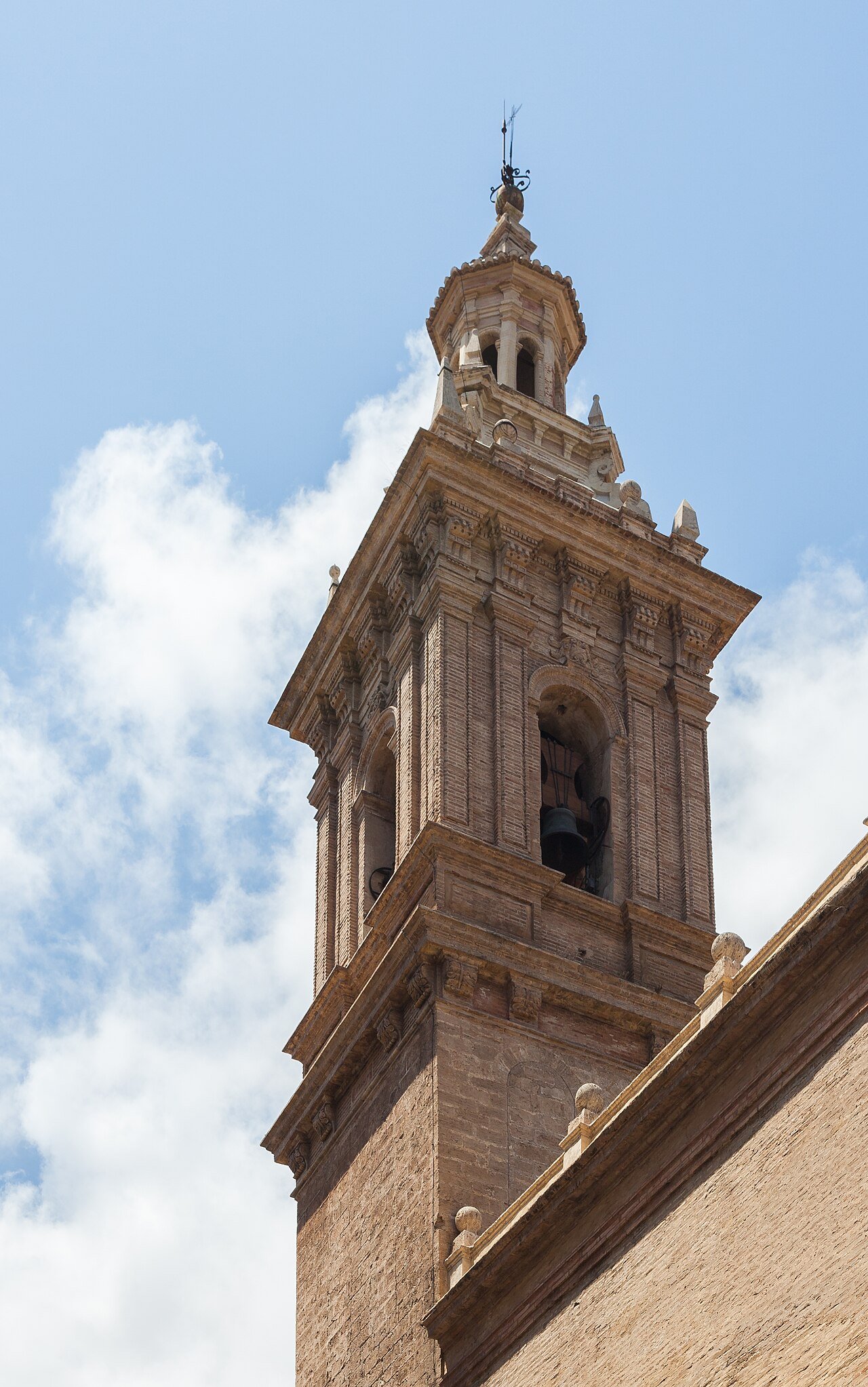
The tower rewards a second look precisely because it is two towers in one. The heritage file calls the campanile the only surviving element of the primitive church — a medieval core — while its bell stage is a work of the late 17th century (the architecture guide dates the brick tower over the old one to 1669–1672): brick, with double Tuscan pilasters flanking round-arched openings on each face, a projecting cornice forming a terrace, and a little temple-like top, a templete with a small dome. The tower was restored in 2005 by Rafael Soler Verdú. From the street it reads as the church’s exclamation mark — the one vertical accent on a horizontal, reticent building — and from the Ateneo terrace across the quarter it is a favourite silhouette against the sky.
Its bells have their own resurrection story. Originally the tower held six; all six disappeared in the religious persecution of 1936 — one of them, called El Pere, reputed in its day the best-sounding bell in the Valencian Community. For the rest of the century the bell stage stood empty. The two larger bells were replaced by donation in 2003, and two more — named Ignasi and Pere, reviving the lost bell’s name — were cast in Palencia and donated later. When the four were rung together, by hand, by the Cathedral’s bell-ringers, it was the first full ringing from this tower since 1936. Listen for them from Poeta Querol: four voices where for decades there were none.
White and Gold: The Rococo Interior of Rovira and Domingo
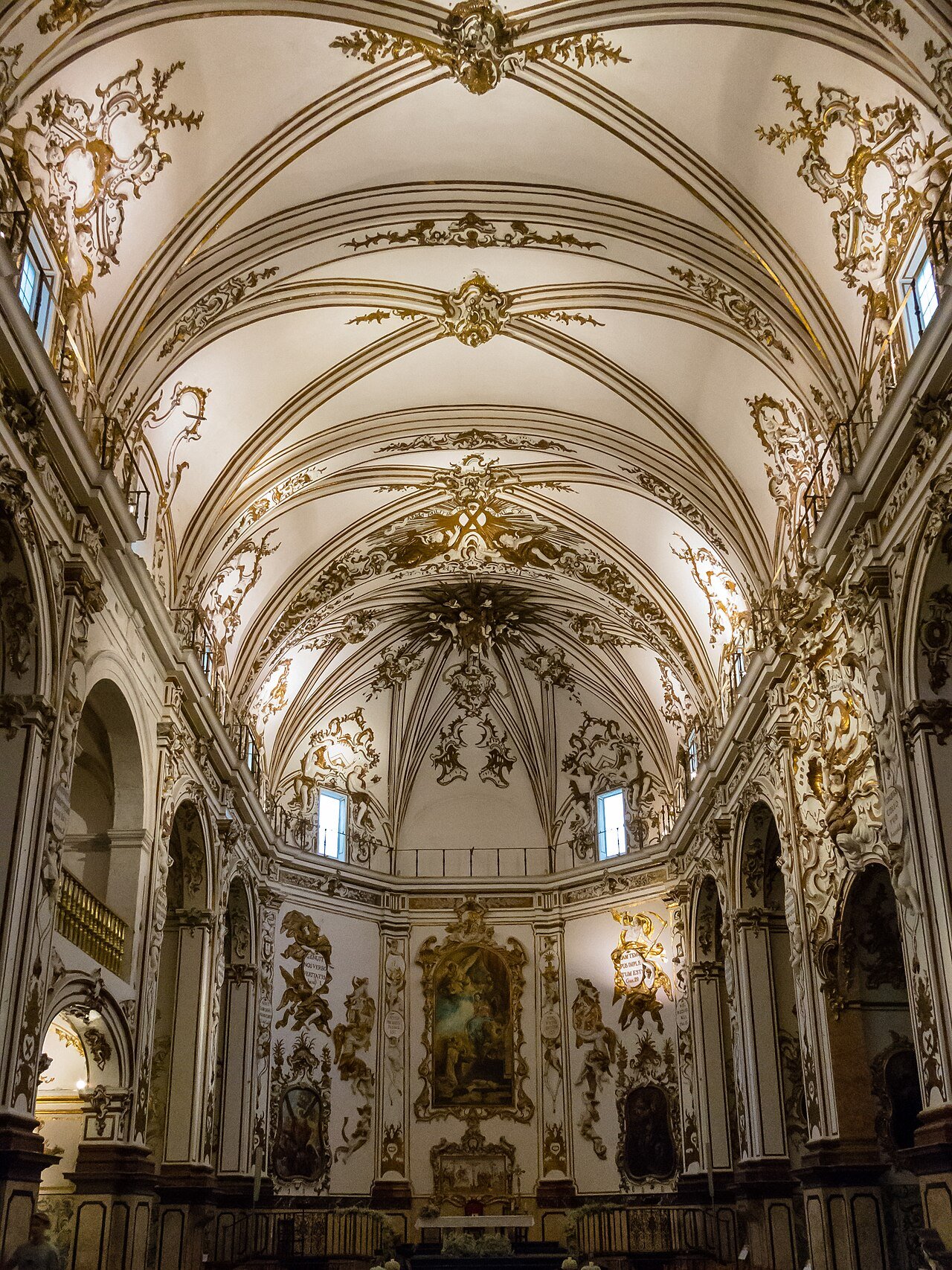
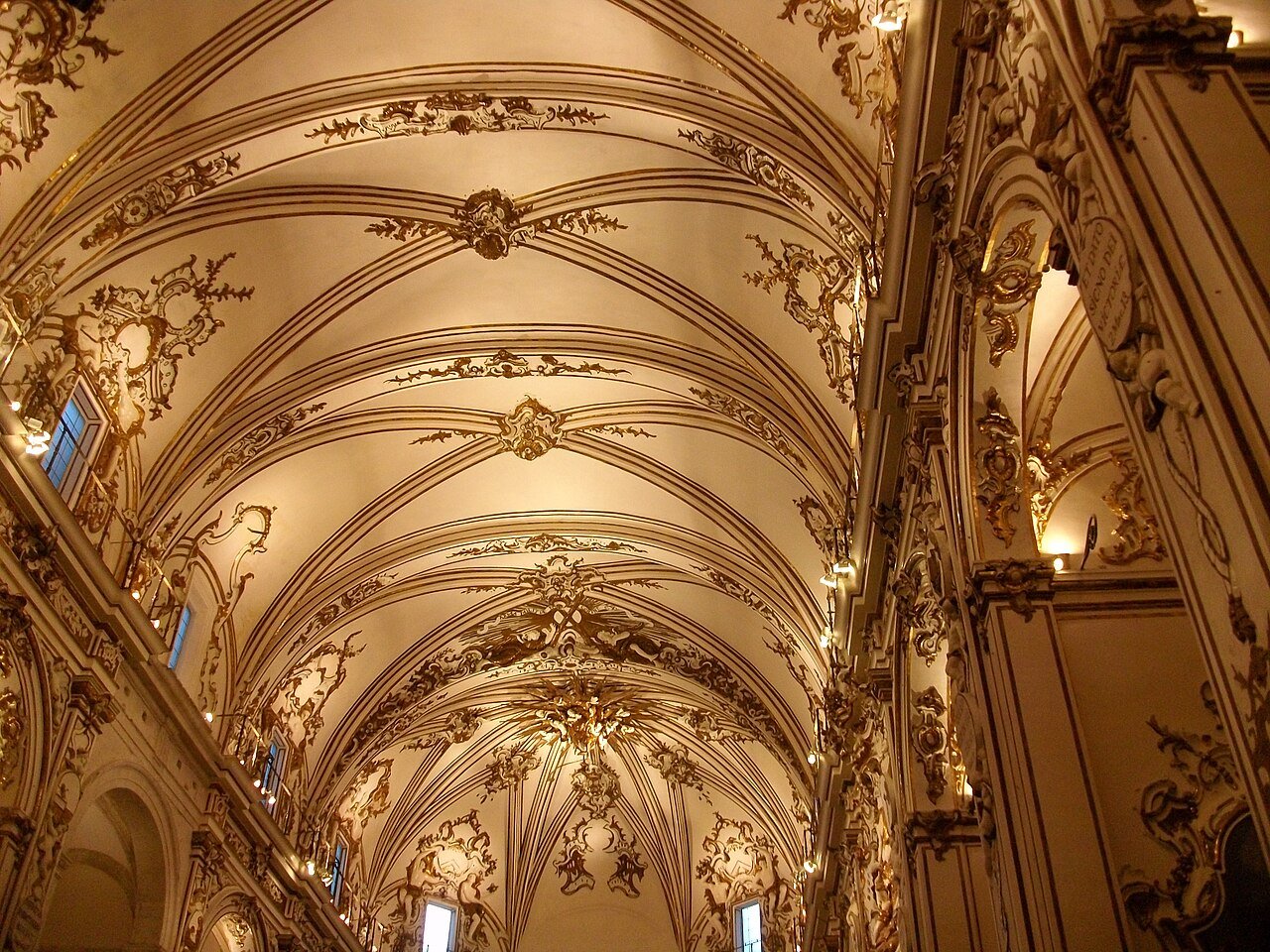
If the façade is the church keeping a straight face, the interior is the punchline it has been saving for two and a half centuries. In the mid-18th century the sober classicist nave was given a complete Rococo revestment in stucco — attributed by the heritage file to Hipólito Rovira and executed by the sculptor Luis Domingo; Wikipedia describes Domingo as Rovira’s disciple, and the two names are the same ones attached to Valencia’s other great Rococo façade, the palace of the Marqués de Dos Aguas, which Rovira designed. Here the decoration does not sit on the architecture; it invades it — the heritage file’s verb — climbing the pillars, the arches, the cornice, the vaults and the frames of the lunette windows, in forms the sources describe as angels, draperies and vegetation worked in stucco with exceptional quality, white and gold against the surviving ribbed structure.
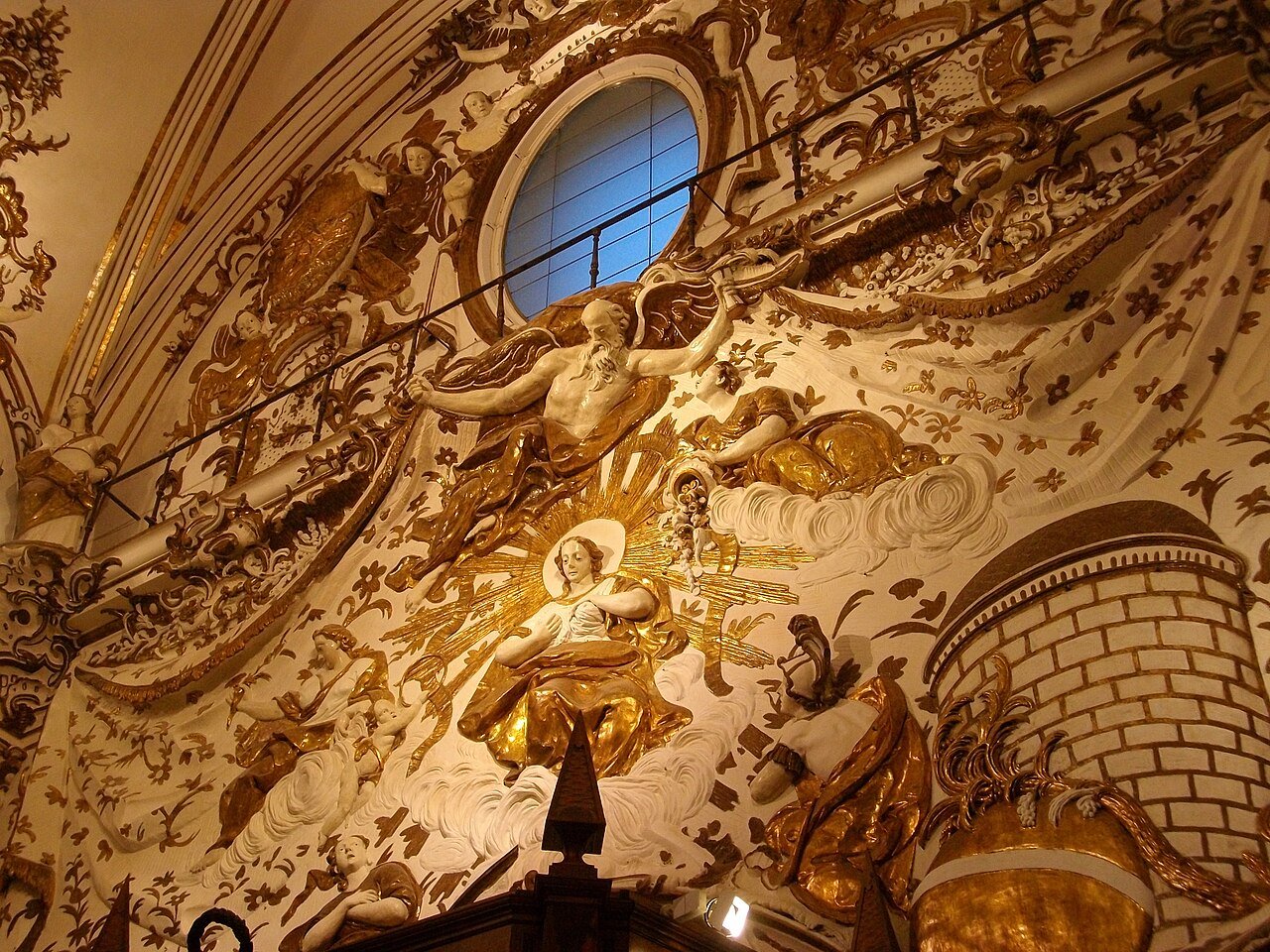
It intensifies in two places. In the presbytery, where the star vault closes over the high altar, and — above all — at the foot of the church, on the counter-façade, the imafronte. There the stucco gathers into the church’s single most extraordinary object: a vast sculpted relief, 18 metres high, which the Ars Magna team calls La Benignidad, the Benignity, representing the virtues of San Andrés. Read that again: the grandest artwork inside the church of San Juan de la Cruz is a monument to the virtues of St Andrew, the patron it replaced. The relief is the centrepiece of the modern immersive visit, lit and video-mapped to Handel and his contemporaries — but it needs no technology to work. Stand at the high altar, turn around, and take in the whole west wall at once: a vertical world of gilded stucco figures rising from floor to vault, the Rococo imagination at full stretch, in a room that from the street promised you nothing at all. The architecture guide’s verdict is the one to carry in: a rich Rococo revestment, unique in Valencia, of great dynamism, with affinities to the Central European Baroque.
Tiles, Paintings and Silver: The Zócalos, Camarón and the Frontal
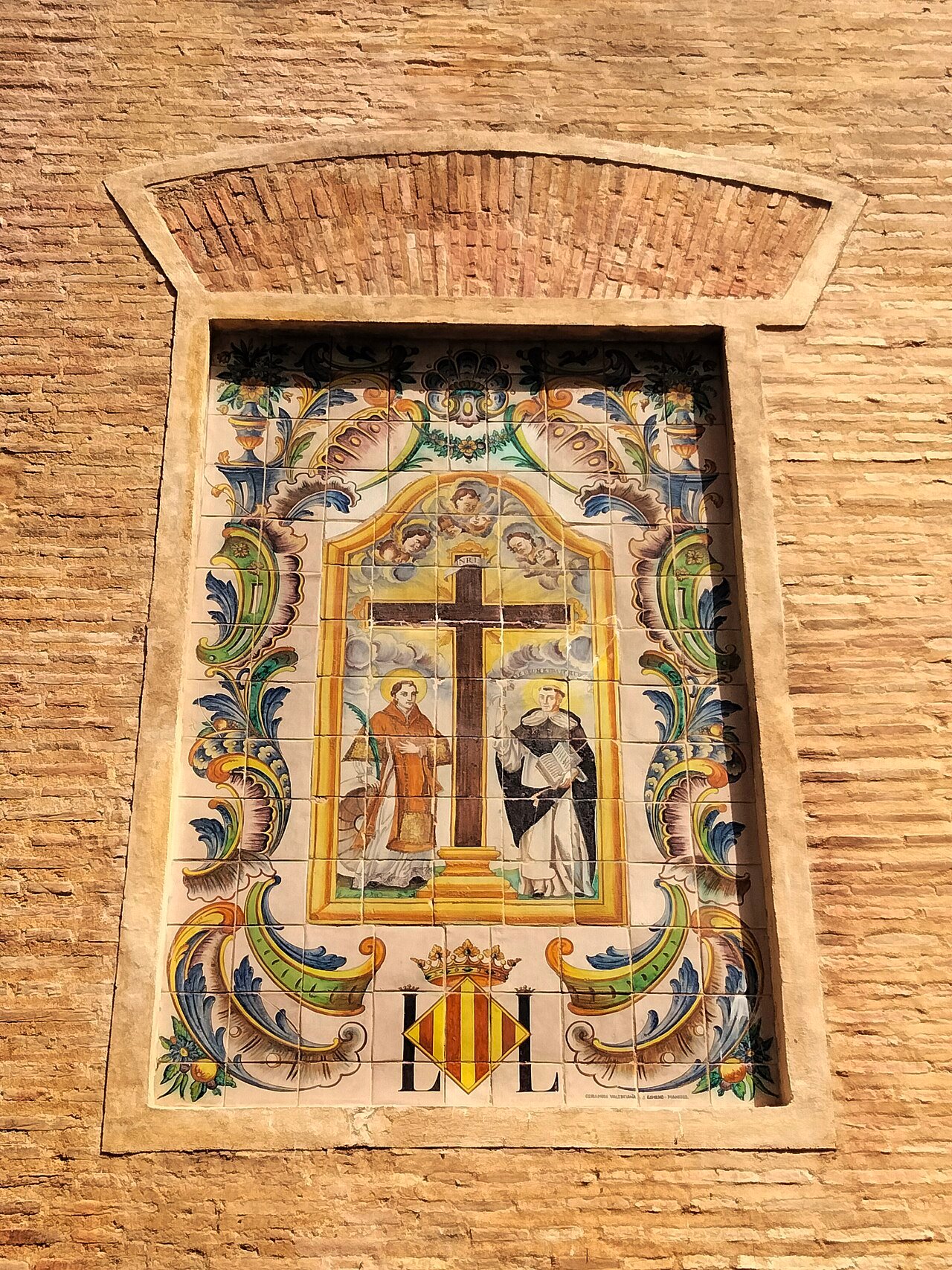
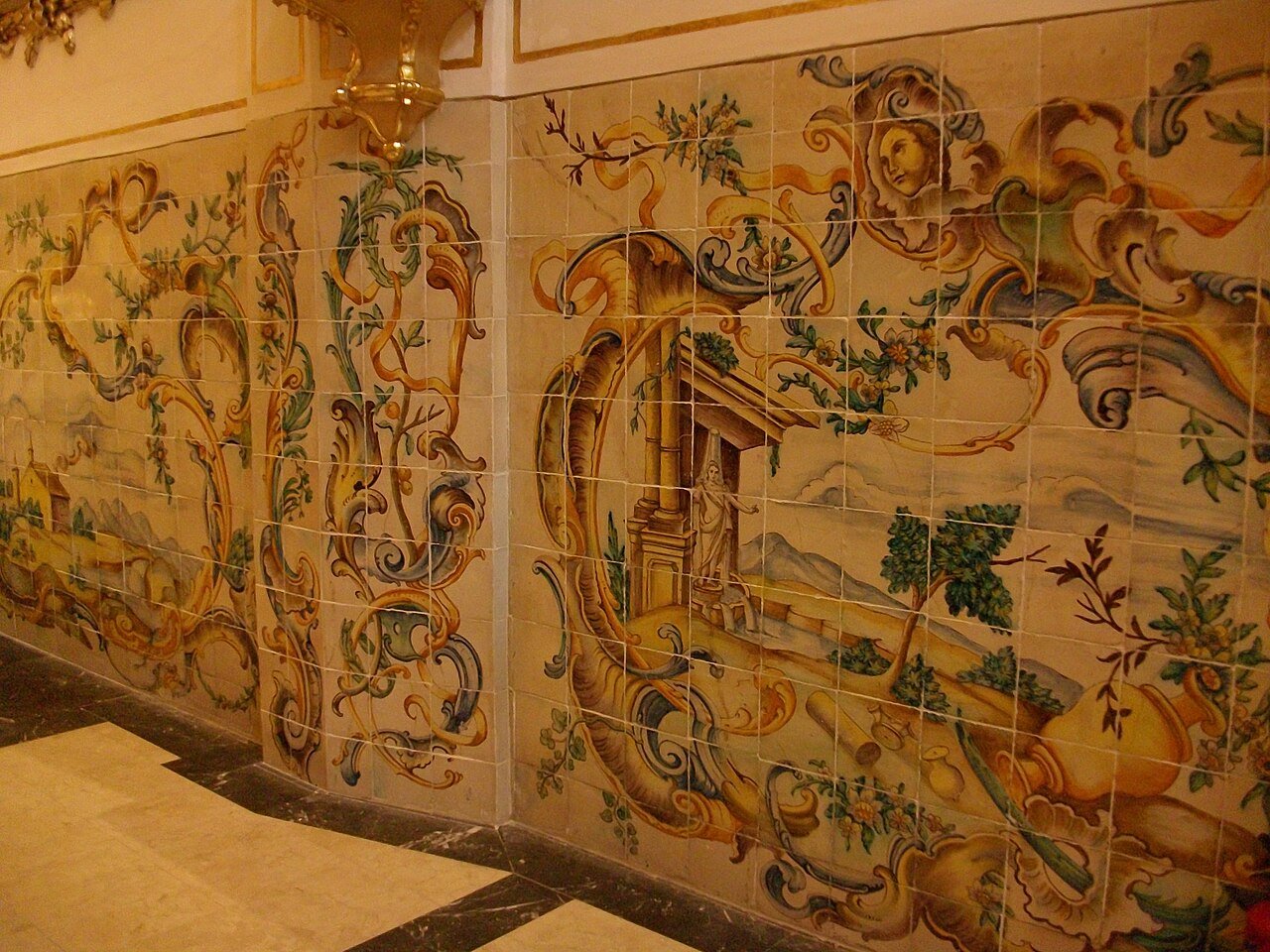
Run your eye along the base of the walls and you find the interior’s second material: tile. The whole church is skirted by a zócalo of polychrome ceramic — a wainscot of Valencian azulejos — and the chapels’ tile socles are singled out by the architecture guide as among the building’s notable features. The painted panels mix landscape, foliage and figure in the loose, bright manner of 18th-century Valencian tilework, and they do practical as well as decorative work, armouring the plaster where generations of chairs, candles and processions would otherwise have scuffed it away. Ceramics follow you outside, too: set into the side wall is a tiled panel of the cross flanked by the two Saints Vincent — Ferrer and the Martyr, Valencia’s two great Vincentian patrons — above the arms of the city.
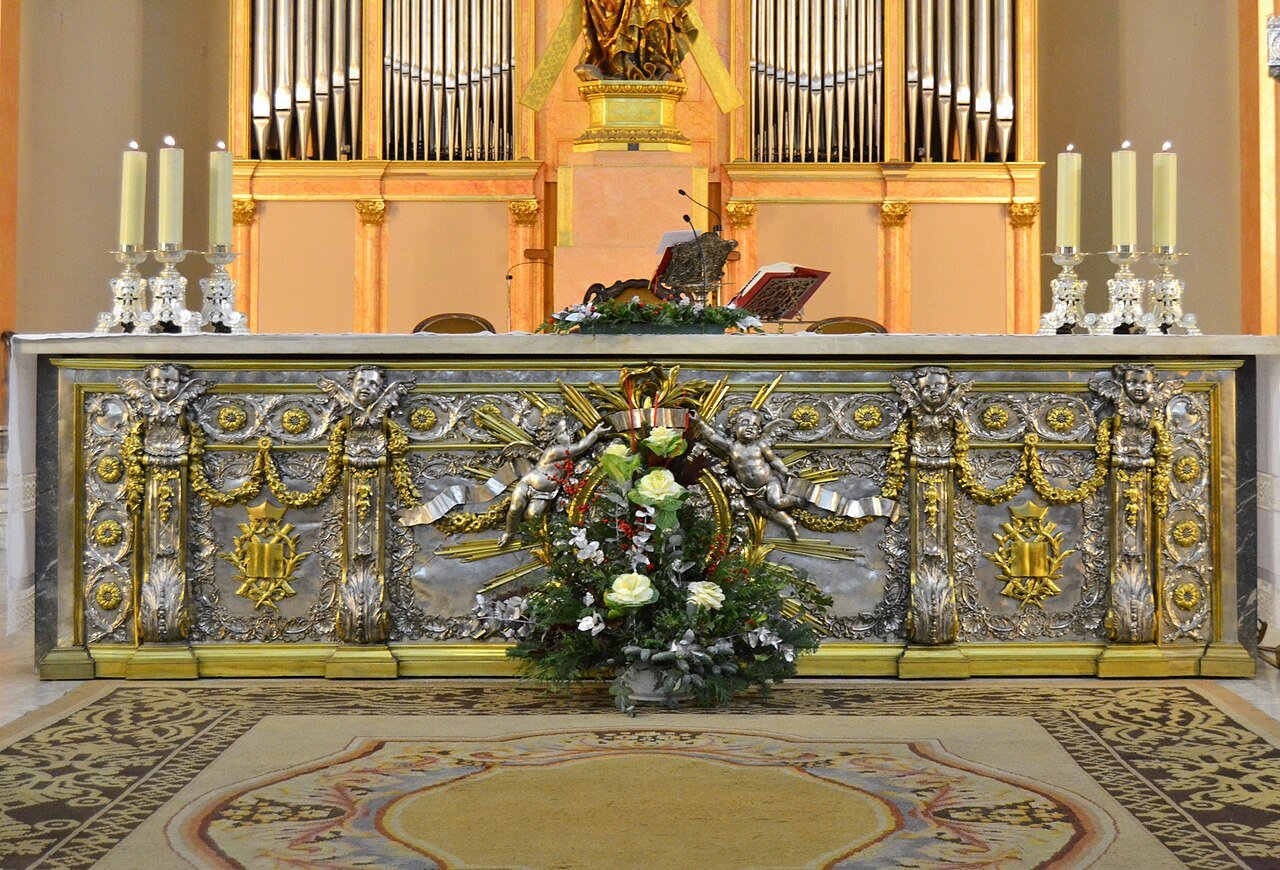
The chapels hold the painting. Their side walls carry 18th-century canvases in rich Rococo frames, above the tilework — the ensemble a detailed recent visitor account describes chapel by chapel. The pair with a name and a story hangs in the chapel of San José: two canvases by José Camarón, the Valencian painter of the Rococo, showing the Desposorios de San José y la Virgen — the Marriage of St Joseph and the Virgin, Joseph in his traditional purple tunic and yellow mantle, carrying the flowering rod — and El Sueño de San José, the Dream of St Joseph, in which the angel Gabriel appears to the sleeping saint to announce the divine conception. The Archdiocese singles the pair out as “two precious paintings”, and both were restored for the 2009 exhibition, when so much of this church’s 18th-century painting was recovered. And on the high altar itself, photographed in place between its candlesticks, look for the church’s silver altar frontal — a broad, chased and gilded frontal de plata across the altar’s face, a survivor of the age of Valencian silversmithing in a church that lost so much else.
The Fishermen’s Chapel: The Capilla de la Comunión
The church has a second church attached to it, and it belongs to the sea. Between 1737 and 1741 the fishermen’s guild — the gremio de pescadores — built the Capilla de la Comunión, the Communion Chapel, a substantial annexe with its own door at Calle del Poeta Querol 4, immediately beside the main entrance at number 6, as well as an internal entrance from the first bay of the nave. Think of it as the next-door chapel, not a side chapel: a cruciform space of its own, its crossing covered by a dome on an octagonal drum, its polygonal apse closed by a quarter-sphere vault with painted decoration.
Inside, the temperature changes. The great chapel is less densely worked in Rococo stucco than the nave — the detailed visitor accounts and the heritage file agree on that — but what it lacks in stucco it returns in paint: the apse and the pendentives of the dome are covered with frescoes, all soft colour above white walls, and the whole room has the hushed, separate atmosphere of a place built for one purpose, the reservation and adoration of the Sacrament. The fishermen’s patronage explains the dedication history humming under this whole building — remember that San Andrés, the church’s first patron, was himself a fisherman, called from the nets on the Sea of Galilee — and it gives landlocked Ciutat Vella, ten minutes from any water, a working link to the maritime Valencia of the Cabanyal and the Grao. The chapel’s dome, blue-tiled outside, is also part of the 2025 restoration campaign: the Generalitat’s works include the re-roofing of its dome covering, along with the roofs of the side chapels on Calle Prócida and conservation work on the interior decoration.
War, Silence and Fifty Closed Years
The 20th century was cruel to this parish, and the record should be stated plainly. In the Civil War the church lost the things a church is made of: the architecture guide records that its altarpieces and its pulpit disappeared in the war; the bell-ringers’ account records the six bells gone in the persecution of 1936; and modern visitors still notice, as one recent reviewer put it, that the imagery is modern and some canvases contemporary — replacements in a room whose original furnishings were swept away. The stucco, the tiles and the structure survived; the dressed, furnished church did not.
Then came the silence. Wikipedia’s summary, repeated across the guide literature, is that the church stood closed for some fifty years before reopening in 2009 — a half-century in which one of Valencia’s great interiors simply ceased to be part of the city’s life, behind a door on a shopping street that generations of Valencians learned to walk past. The sources are thinner here than a historian would like — no detailed account of those decades was found for this guide — but the fact of the long closure is consistent across them, and its end is precisely documented. What broke the silence was not the parish alone but a foundation with a mission to restore exactly this kind of forgotten splendour, and an exhibition that turned three closed or quiet Baroque churches into the cultural event of the Valencian year.
La Gloria del Barroco: The Church Reopens as the House of the Virgin
The Fundación La Luz de las Imágenes — the Valencian foundation that restores historic churches by exhibiting them — chose San Juan de la Cruz as one of the three venues of La Gloria del Barroco, its tenth-anniversary exhibition, opened on 15 December 2009 and running until September 2010. The concept was architectural as much as artistic: 307 works of Baroque art installed not in a museum but in the three restored Baroque churches themselves, with the Almudín as the introductory venue. Each church carried a theme. At the Iglesia de San Esteban, Valencian Baroque painting; at San Martín, Valencian sculpture and goldsmith work from the Middle Ages to the 20th century; and at San Juan de la Cruz, devotion to the Virgin Mary — la devoción a la Virgen María — the Marian thread of the Baroque, staged in the city’s most Rococo room. Tickets for the exhibition, for the record, cost €3 at the time.
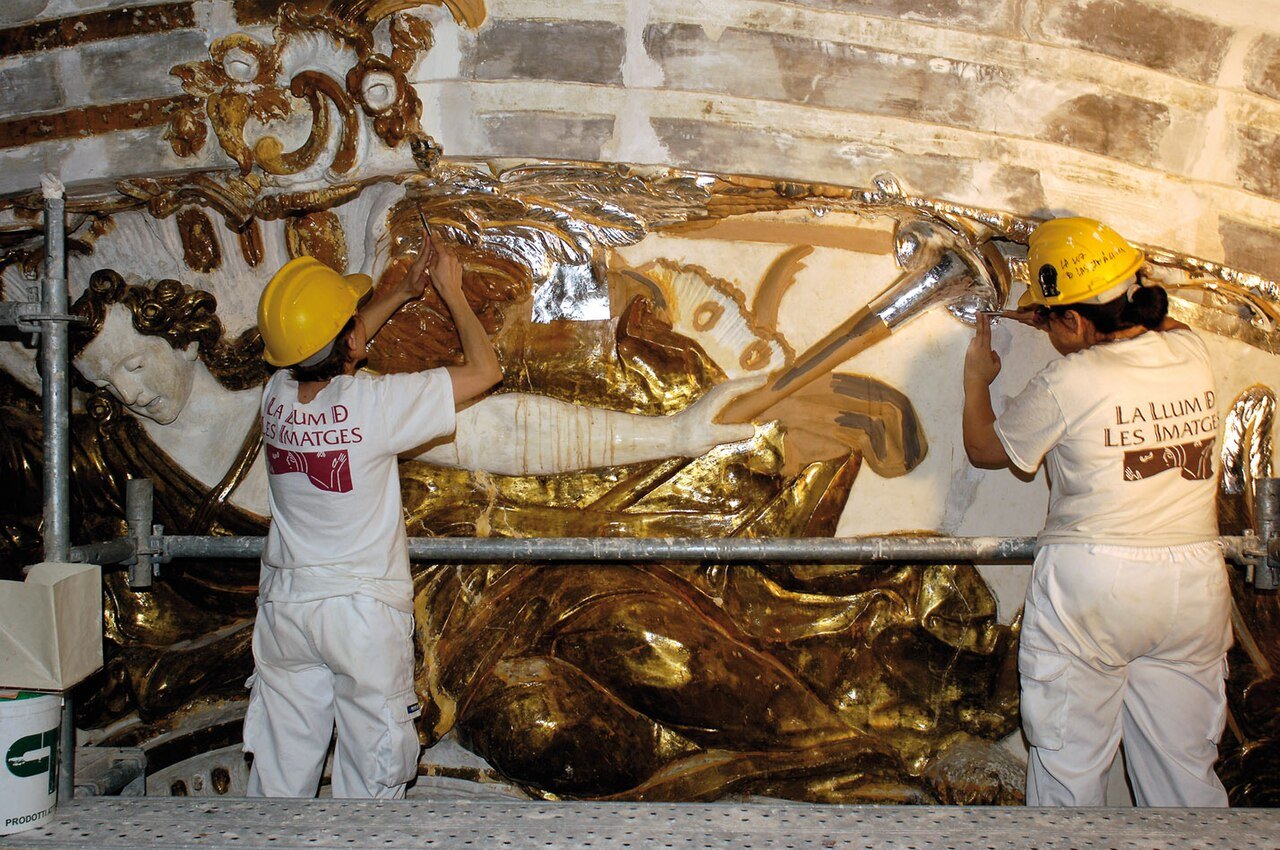
For this church the exhibition was also the restoration. La Luz de las Imágenes restored the building for the show — its works included the imafronte — and when the doors opened in December 2009, visitors who had known the church only as a locked façade met the white-and-gold interior cleaned, consolidated and lit, Camarón’s San José canvases among the paintings restored for the occasion. The three-church circuit was widely judged unrepeatable, and for San Juan de la Cruz it was a resurrection with a date on it: fifty closed years, ended. The work has not stopped: in April 2025 the Generalitat began the campaign to complete the restoration — side-chapel roofs, interior decoration conservation, façade cleaning on the Vilaragut side, and the Communion Chapel’s dome — with a subsidy of more than €118,000.
El Oro de San Juan: The Church by Light, Today
The exhibition left the church with a question every restored parish has to answer: how does a working church stay open to visitors without becoming a museum? San Juan de la Cruz’s current answer is El oro de San Juan — The Gold of St John — an immersive visit created by Ars Magna, which first ran on selected dates from February 2025 and returned for a season from 11 September to 30 December, on Thursday and Friday afternoons, with limited capacity adapted to the church’s religious life. It is not a conventional tour, and Ars Magna insists it is not a spectacle: it is a visit-discovery of the building in which evolving stage light, video-mapping and artificial intelligence play across the reliefs, the tilework and the paintings, synchronised with Baroque music, each hour emulating the changing colours of sunlight.
Its climax is the counter-façade relief, La Benignidad: under projection, the 18-metre stucco world comes alive piece by piece, and when Handel’s Eternal Source of Light Divine accompanies the passage devoted to the virtues of San Andrés, the room achieves something close to what the Rococo sculptors intended — doctrine as emotion, gold as light. You can take the visit free-form or guided, and every ticket contributes directly to the church’s conservation. It is, at the time of writing, the most reliable way to guarantee yourself time inside: book ahead, because capacity is limited, and treat the season dates as perishable. The church that was closed for fifty years now opens by turning its own gold back on.
Practical Info
Address: Calle del Poeta Querol 6, 46002 Valencia — on the smart shopping street of the same name in La Xerea, Ciutat Vella, immediately beside the Palacio del Marqués de Dos Aguas. The Capilla de la Comunión has its own entrance at number 4, next door to the main door.
What it is: a working parish church — one of Valencia’s twelve founding parishes of 1238, founded as San Andrés and now dedicated to San Juan de la Cruz — with a 17th-century structure, a late-Baroque portal and one of Spain’s most exuberant Rococo interiors. Protected as a Bien de Interés Cultural since 1942. It is a parish first and a sight second: there is no permanent museum desk, and its cultural opening runs through announced Mass times and the ticketed El oro de San Juan immersive visit.
| Best for | Rococo decoration, Valencian Baroque, tilework — and travellers who like a headline interior hidden behind a plain door |
| Entry | Free around worship; the El oro de San Juan immersive visit is ticketed (book via Ars Magna) and each ticket funds the church’s conservation |
| Time needed | 30–45 minutes inside; about an hour with the portal, the Communion Chapel and the street |
| Nearest metro | Colón (lines 3, 5, 7 and 9), about 5 minutes on foot |
| Don’t miss | The counter-façade relief, the Solomonic portal with its sliding figures, and the fishermen’s Communion Chapel |
Tickets and Booking
There are two doors into this church, and only one of them sells tickets. For worship and quiet looking, entry is free whenever the church is open, in the pattern set out in the next section — no ticket, no booking, and any third-party website implying it sells standard admission to San Juan de la Cruz should be treated with suspicion. For a guaranteed, unhurried cultural visit, the ticket is El oro de San Juan, the Ars Magna immersive experience: in its most recent season it ran on Thursday and Friday afternoons from 11 September to 30 December, in free-form or guided versions, with limited capacity, advance booking through Ars Magna’s own site, and box-office sales at the church on opening days. This guide does not print a price, because Ars Magna’s published pages for the current season do not state one consistently — check the live listing before you go, and expect the season dates themselves to change. The parish telephone number published in the city’s visitor documentation is +34 963 52 41 57.
Opening Hours
Be as honest about this church as it is about itself: San Juan de la Cruz publishes no tourist opening hours, because it is not run as a tourist attraction. Its dependable pattern is worship. The city’s visitor documentation gives Mass on weekdays, eves of feasts and feast days at 19:30, all year; a Sunday midday Mass (12:30, preceded by adoration) is documented in recent years, and the church also hosts concerts and events — a Manos Unidas charity concert, for instance, filled it on a December Sunday afternoon. The second pattern is El oro de San Juan: on its announced season dates the church opens in the afternoon and evening for ticket-holders, box office from around 17:00. Outside those two patterns, expect the door to be shut — reviewers regularly report finding it closed, and the fifty-year closure of the last century has left the parish cautious with its masterpiece. The practical rule: aim for the run-up to the 19:30 Mass for a free look, or book the immersive visit for a guaranteed one, and always check the current Ars Magna season and parish notices before a special journey across town.
Getting There
You will walk, and not far. The church stands in the heart of Ciutat Vella: about five minutes from the Plaça de l’Ajuntament, seven from the Cathedral, twelve from the Mercado Central — and about sixty seconds from the Palacio del Marqués de Dos Aguas, whose façade crowds photograph from the same street. By metro, Colón (lines 3, 5, 7 and 9) is roughly five minutes on foot. City buses 6, 26 and 31 stop at Marqués de Dos Aguas and Poeta Querol; buses 19, 62 and 67 serve the Plaça de l’Ajuntament stops a few minutes away. Driving into La Xerea is a mug’s game of narrow streets and restricted access; use a central car park and walk the last stretch, as everyone does.
When to Go
For the free visit, a weekday evening: arrive ahead of the 19:30 Mass, take the quiet minutes to walk the nave, read the counter-façade and slip into the Communion Chapel, then let the building return to its purpose around you. For the full effect, an El oro de San Juan evening in season — Thursday or Friday — when the light show is built for the room and the relief earns its name; book it, because capacity is limited. Daytime passers-by should still stop: the portal, the ceramic panel of the two Saints Vincent and the tower are all street sights, and Poeta Querol in the morning, before the shops fill, is the calmest time to study the façade. Avoid assuming Sunday morning access — the documented Sunday pattern is midday, not early.
How Long You Need
Thirty to forty-five minutes inside is the honest allowance: ten for the nave and the vaults, ten standing at the altar rail looking back at the counter-façade relief, five each for the chapels and their tilework, the Camarón pair in San José’s chapel, and the Communion Chapel next door. The immersive visit sets its own pace and runs longer. Add the portal and the street and call it an hour. San Juan de la Cruz pairs naturally with its two fellow Gloria del Barroco churches — San Esteban and San Martín are each about ten minutes away — for a single morning or evening of three utterly different Baroque interiors: sgraffito blue, sculptural stone, and this one’s white-and-gold Rococo.
Free Valencia travel guide
Planning a trip to Valencia? Get our free one-page Valencia checklist: what to book ahead, what to skip, and the paella places we actually eat in.
Tips for Visiting
- Do not rely on walking up in the daytime. The church publishes no sightseeing hours. Your two reliable keys are the 19:30 evening Mass pattern and a booked El oro de San Juan session in season — plan around one of them.
- Book the immersive visit ahead. Capacity is limited, seasons are short (most recently Thursday and Friday afternoons, September to December), and dates change: check Ars Magna’s current listing before you plan an evening around it.
- Turn around. The masterpiece is behind you: the 18-metre counter-façade relief of the virtues of San Andrés covers the wall above the entrance. The best view is from the altar end, looking back.
- Give the portal its minute. Solomonic columns, a split pediment, two female figures sliding down the corbels, and the X-shaped cross of San Andrés where his statue stood — the whole story of the church is carved on its one decorated surface.
- Don’t miss the next-door chapel. The Capilla de la Comunión, built by the fishermen’s guild in 1737–1741, has its own door at Poeta Querol 4 and the church’s frescoes in its apse and dome pendentives.
- Respect the parish. This is a working church that was closed for decades and is still completing its restoration — dress and behave as a guest, keep voices down, and let worshippers have the room during services.
What to See Nearby
San Juan de la Cruz stands in the densest few hundred metres of monumental Valencia. Immediately around the corner is the Palacio del Marqués de Dos Aguas, the National Ceramics Museum, whose alabaster portal Hipólito Rovira designed — the same hand behind this church’s Rococo interior, so the two buildings are best read as a pair, secular and sacred essays by one imagination. Ten minutes north-west, San Martín Obispo y San Antonio Abad, this church’s partner in La Gloria del Barroco, offers the sculptural counterpoint, all stone and bronze where San Juan is stucco and tile; ten minutes north-east, San Esteban keeps the third term of the comparison in blue sgraffito. Between them, do not miss the small things in this church’s own orbit: the Real Colegio del Patriarca, founded by the same San Juan de Ribera who laid this church’s first stone in 1602; the Plaça de l’Ajuntament and its flower stalls, five minutes south; and the Ateneo Mercantil’s terrace, from which the bell tower of San Juan de la Cruz makes one of the old town’s favourite silhouettes.
Travel insurance, sorted
Whether it is a two-week holiday or a longer move, travel insurance is not the most glamorous part of a trip — but it is the one booking you want to have in place before a trip, and while you are already away. Get a quote from SafetyWing
Final Thoughts
San Juan de la Cruz is a church of second chances. Founded in the first flush of 1238 as San Andrés, rebuilt by a saint-archbishop, dressed by the Rococo until its plain walls disappeared under gold, stripped by war, silenced for fifty years — and then, in a single December of 2009, lit up again as the house of the Virgin for the whole city to walk through. It still keeps its old patron carved over its door and painted across its west wall, still rings bells that were recast within living memory, and still opens on its own terms: an evening Mass, a ticketed hour of light and Handel, a fishermen’s chapel keeping its frescoed quiet next door. Come for the contrast — the plainest façade in Valencia against one of its most extravagant rooms — and stay for the relief, where the virtues of San Andrés rise eighteen metres in white and gold above the door you came in by. ¡Buen viaje!
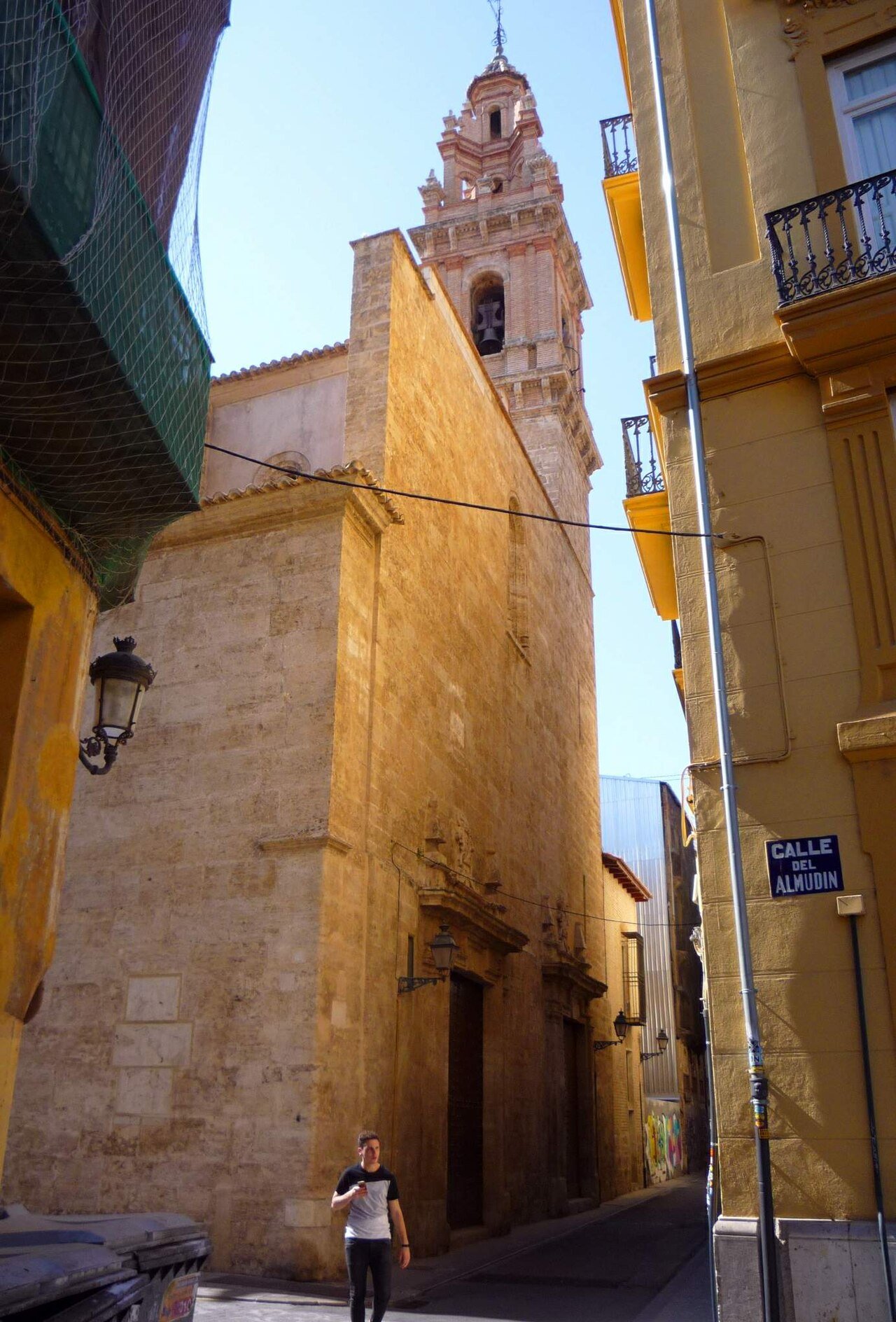
Photo credits: Joanbanjo, Rafa Esteve, Jean Laurent, Enric, Dorieo, Diego Delso and Mateo Gamón, via Wikimedia Commons.