Basílica de la Mercè Barcelona: The Complete Guide to the Patroness, the Dome and the Festival
Short Answer
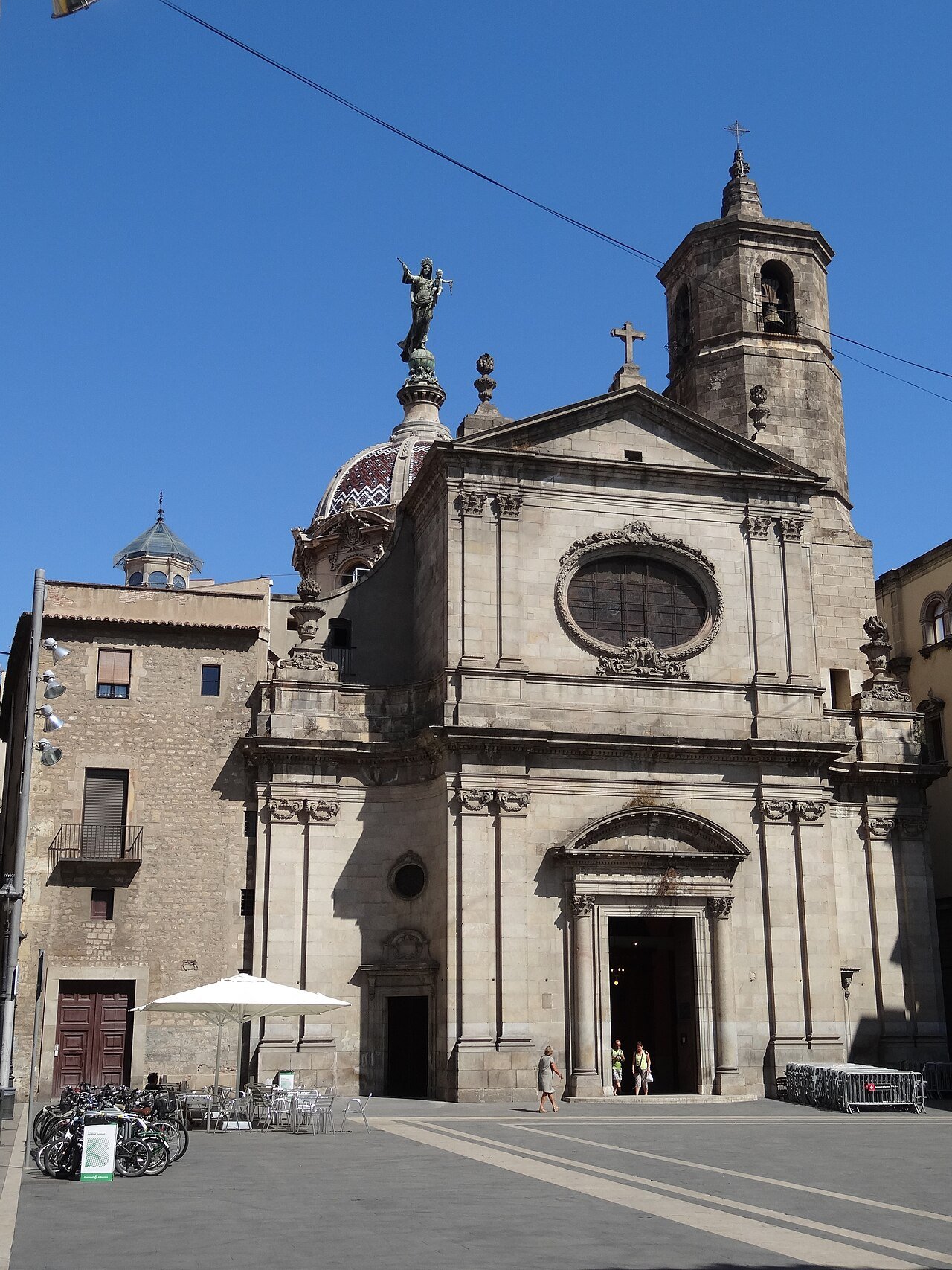
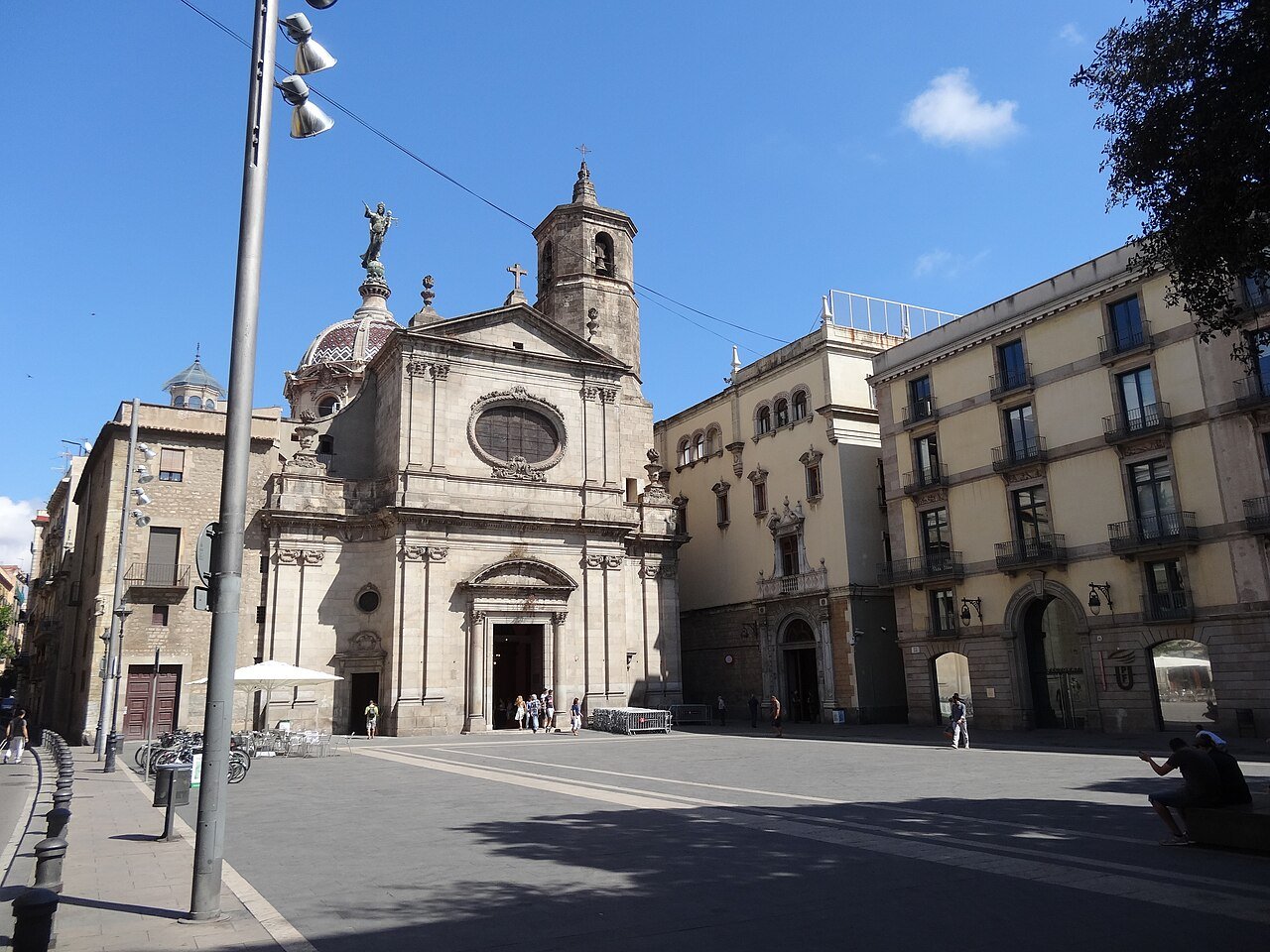
The Basílica de la Mercè is the church of Our Lady of Mercy — the Mare de Déu de la Mercè, patroness of Barcelona since 1687 — standing on Plaça de la Mercè at Carrer de la Mercè 1, in the southern Gothic Quarter, minutes from La Rambla and the port. An order founded here in 1218 to ransom Christian captives built its first church on this site in 1249–1267; the building you enter today is the Baroque replacement of 1765–1775, designed by Josep Mas i Dordal, its single nave lined with chapels, its sanctuary watched over by a Gothic statue of the Virgin carved in 1361. A century later the church grew its signature: a tiled dome, added in 1888 by Joan Martorell and crowned with a colossal bronze Virgin guarding the harbour — the figure you see today is the Oslé brothers’ larger replacement of 1959 for the original destroyed in the Civil War. In 1918 Benedict XV made it a minor basilica, only the second in Barcelona after the Cathedral. Entry is free — it is a working parish church, officially La Mercè i Sant Miquel, the second dedication from the 15th-century Gothic portal transplanted onto its Carrer Ample side in 1870. Come in the morning or late afternoon, climb to the camarín to meet the Virgin face to face, and if you can, come back at night: the one paid ticket this church needs is the evening concert of Vivaldi, Mozart and Bach in the basilica, when the nave becomes a concert hall. Allow 30–45 minutes; allow a week if you come for her festival, La Mercè, around 24 September.
Table of Contents
- The Short Version
- The Night of 1218: Pere Nolasc and the Order of Mercy
- Two Patronesses: La Mercè and Santa Eulàlia
- A Baroque Church in Ten Years: Mas i Dordal’s Basilica
- The Dome and the Virgin Over the Port
- Inside: A Single Nave of Marble, Stucco and Gold
- The Camarín: Face to Face with the Virgin
- Chapels, Saints and Founders
- La Mercè: The Festival of 24 September
- Music in the Basilica: The Organ and the Night Concerts
- Practical Info
- Tickets and Booking
- Opening Hours
- Getting There
- When to Go
- How Long You Need
- Tips for Visiting
- What to See Nearby
- Final Thoughts
The Short Version
Barcelona has grander, older and far more famous churches, but it has only one patroness, and this is her house. That is the key to La Mercè: not primarily an art monument but a civic shrine — the church of the Virgin who, in the city’s own telling, founded an order here in 1218, saved Barcelona from a plague of locusts in 1687 and was proclaimed its patroness in return, lent her name to the biggest festival in the Catalan calendar, and still looks out over the port from a dome built specially to carry her. The Baroque interior is genuinely beautiful — marble, stucco, gilded galleries, and a camarín where you stand an arm’s length from a 14th-century statue — but the building’s real exhibit is the devotion itself, unbroken on this plot for eight centuries. It earns its place among the best things to do in Barcelona as the old town’s quiet counterweight: five minutes from the Rambla crowds, free to enter, and usually peaceful enough to hear your own footsteps.
The Night of 1218: Pere Nolasc and the Order of Mercy
The story begins, as Barcelona likes its stories to begin, with an apparition. Tradition holds that on the night of 24 September 1218 the Virgin Mary appeared simultaneously to three men: King Jaume I, the young conqueror-king of Aragon; Ramon de Penyafort, the great Dominican canon lawyer; and Pere Nolasc — Peter Nolasco — a merchant troubled by the fate of Christian captives held in Muslim lands. Her request, in the telling, was an order dedicated to their redemption. The Order of Our Lady of Mercy — the Mercedarians — was born in Barcelona that year, and the night of the apparition fixed the Virgin’s feast, and eventually the city’s festival, to 24 September.
Strip away the legend and the documented order is remarkable enough. Nolasco’s brotherhood first worked from the Hospital de Santa Eulàlia near the Cathedral, raising alms and sailing south to buy captives back — Mercedarian friars famously offered themselves as hostages when the money ran short, the order’s distinctive fourth vow. Gregory IX recognised the order in 1235, and in 1232–1234 the community established itself between the old city wall and the sea — this plot, where a church dedicated to the Virgin rose between 1249 and 1267, the order’s first, and the devotional headquarters of a Mediterranean-wide enterprise of mercy.
The medieval church grew with the devotion. Enlarged in Gothic style through the 14th and 15th centuries, it received in the 1360s the object around which everything since has turned: a carved image of the Virgin and Child, dated by the basilica’s own history plaque to 1361 and attributed to Pere Moragues, the leading Catalan sculptor of his day — 1.5 metres of painted, sceptred majesty, with the Child added in the following century. A chamber was built into the altarpiece to house her, the ancestor of today’s camarín, and ransomed captives came home to lay their chains at her feet. When you climb up to see her, you complete a journey freed prisoners were making six hundred and fifty years ago.

Two Patronesses: La Mercè and Santa Eulàlia
Barcelona, characteristically, could not settle for one patroness, and the rivalry between its two is written into the calendar. The elder is Santa Eulàlia, the teenage martyr of Roman Barcino, patroness since the 7th century, whose feast falls on 12 February and whose remains rest in the crypt of the Cathedral — her church, her quarter, her thirteen geese in the cloister. La Mercè is the challenger who arrived by popular acclaim. In 1687 a plague of locusts devastated the countryside; the Consell de Cent, Barcelona’s governing council, vowed the Virgin of Mercy the patronage of the city if she delivered it — she did, the council proclaimed her patroness, a silver throne was made for her statue, and the devotion turned civic. The basilica’s own plaque recites the longer charge sheet of rescues — 1420, 1616, 1650, 1680, 1687, 1697 and on through sieges and epidemics — a city keeping receipts.
Her darkest hour of glory came in September 1714, in the last days of the siege of Barcelona, when the city’s authorities named the Virgin of Mercy commander-in-chief of its armies — defiance rather than strategy, as Bourbon troops closed in; her statue was carried into the Cathedral for safety, and did not come home until 1775. Rome regularised the arrangement in stages: Pius IX confirmed her patronage canonically in 1868, and on 21 October 1888, in the name of Leo XIII, she was canonically crowned — the coronation that prompted the dome built to celebrate it. Today’s settlement is a co-patronage: Eulàlia keeps February and the Cathedral, La Mercè keeps September and the whole city, and Barcelonans will tell you, entirely seriously, that if it rains during the Mercè festival — as it suspiciously often does — those are the tears of Santa Eulàlia, crying over her rival’s party. Some say from sadness. Some say on purpose.
A Baroque Church in Ten Years: Mas i Dordal’s Basilica
By the 1760s the old Gothic church was too small and too shabby for the patroness of Barcelona, and the Mercedarians chose the radical option: demolish it and build new. The first stone was laid on 25 April 1765, and in ten years — fast work for the 18th century — Josep Mas i Dordal raised one of the finest Baroque churches in Catalonia. He worked from the Counter-Reformation pattern book, and the model, as Barcelona Turisme notes, is the Gesù in Rome: a single preaching nave, side chapels between the buttresses, and a façade composed like a classical altarpiece in stone — two storeys of Corinthian pilasters, sculptural ornament by Carles Grau, a semicircular pediment over the main door, and above it the feature everyone remembers, a huge oval window, garlanded and voluted, lying on its side like an eye half open. The main altar was designed by the Valencian architect Vicente Marro. The temple was consecrated on 9 September 1775, and that year the Virgin’s statue returned in procession from the Cathedral, sixty-one years after she had left for safekeeping.
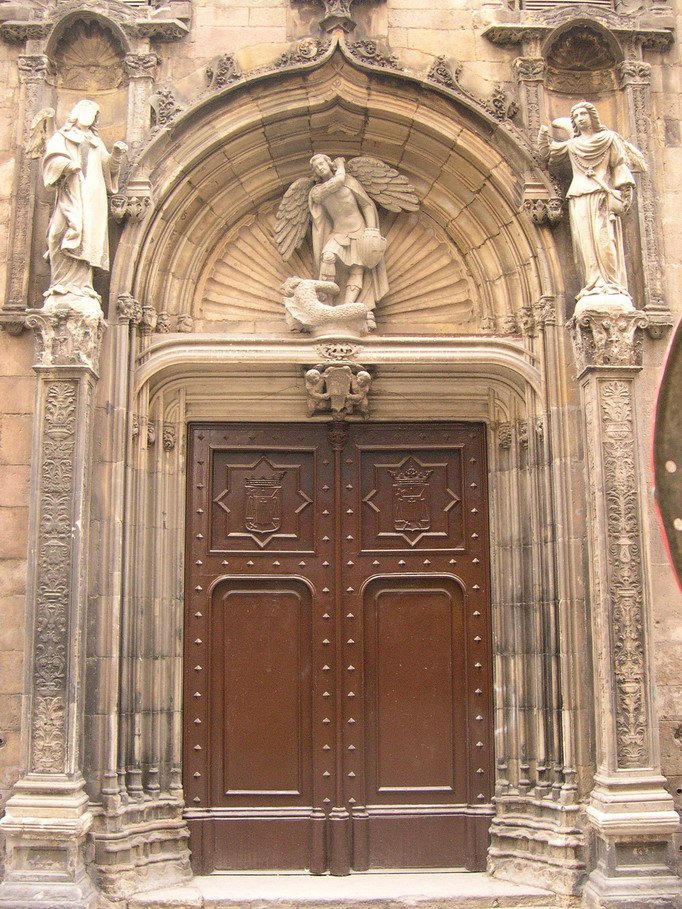
The building’s later history is confiscation and transplant. In 1835 the Mercedarian convent next door was seized in the disentailment; after spells as barracks and military casino it became, from 1846, the Capitanía General — the army headquarters it remains today, linked to the church by the covered passage still bridging Carrer de la Mercè. The church gained its second dedication by municipal salvage: in 1870, when the old church of Sant Miquel was demolished to enlarge the city hall, its flamboyant Gothic portal of 1516 — St Michael triumphant over the dragon in the tympanum, attributed to the French sculptor René Ducloux with the master builder Gabriel Pellicer — was rebuilt stone by stone on the basilica’s Carrer Ample flank. It is a glorious misfit, two and a half centuries older than everything around it, and it is why the parish is still La Mercè i Sant Miquel. In 1918 Benedict XV granted the title of minor basilica for the seventh centenary of the apparition — the second Barcelona church so honoured, after the Cathedral — and the Virgin was crowned anew in Plaça de Catalunya as queen of the city.
The Dome and the Virgin Over the Port
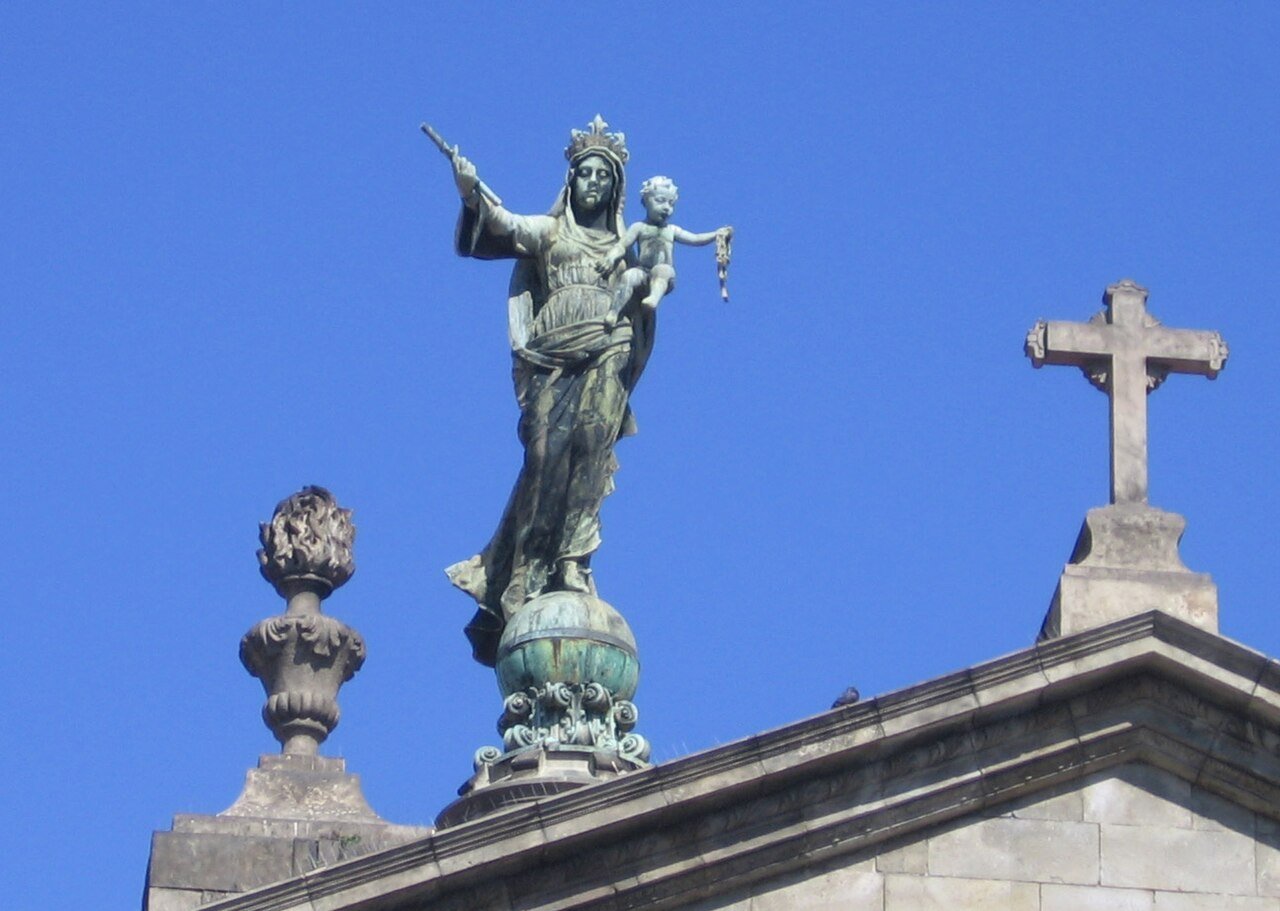
For its first century the Baroque church had no dome, and from the sea it must have looked unfinished. The coronation year fixed that: in 1888 Joan Martorell i Montells — the great Catalan church-builder of the Gothic Revival generation — added the dome over the sanctuary, a tiled cupola of patterned red and white, together with the Chapel of the Blessed Sacrament and the new camarín. On top he set a colossal bronze of Our Lady of Mercy by the sculptor Maximí Sala, raised in the year of the Universal Exposition. From the Moll de la Fusta and the seaside promenade she became what she remains: the harbour’s landmark, sceptre raised over the masts — the patroness literally watching the port her order’s ships had sailed from.
The statue’s biography is Barcelona’s 20th century in miniature. In 1936, in the first fury of the Civil War, the basilica was burned and gutted and Sala’s bronze destroyed — by the usual account, melted down for the war effort. The Gothic Virgin inside survived, hidden away through the war years; the church’s plaque records that in 1939, restored, she received her crown again as Mother and Patroness of the city. The dome stood empty for twenty years. Then, in 1959, the brothers Miquel and Llucià Oslé cast a replacement, deliberately larger than the lost original, and the present Virgin rose over the port: crowned, robed, the Christ Child dangling the little chains of captivity, her sceptre lifted towards the sea. The connoisseurs’ angle is the one the neighbourhood guides all give: walk up the narrow Carrer d’en Carabassa behind the church and look back through the slot of the lane, where dome, tiles and Virgin stack up in a single frame.

Inside: A Single Nave of Marble, Stucco and Gold
Step in from the square and the Baroque machine does its work. The plan is the Counter-Reformation formula perfected: one broad nave on a Latin-cross plan, four chapels off each side between the buttresses, a short transept, and Martorell’s dome of 1888 pouring light over the sanctuary. What surprises is the finish. Barcelona’s other great churches are stone-grey — the Cathedral’s shadowy Gothic, Santa Maria del Mar’s bare ashlar — but La Mercè is dressed: fluted pilasters with gilded Corinthian capitals, marble, stucco and mural painting, crystal chandeliers, and above the chapels a gallery screened with gilded latticework, behind which the convent’s community once followed the offices unseen. The decoration is Rococo in flavour, delicate rather than bombastic, and much of it is careful post-war restoration: stripped by fire in 1936, the ornament was rebuilt from 1939 onwards — which is why the interior reads so complete, and so bright.
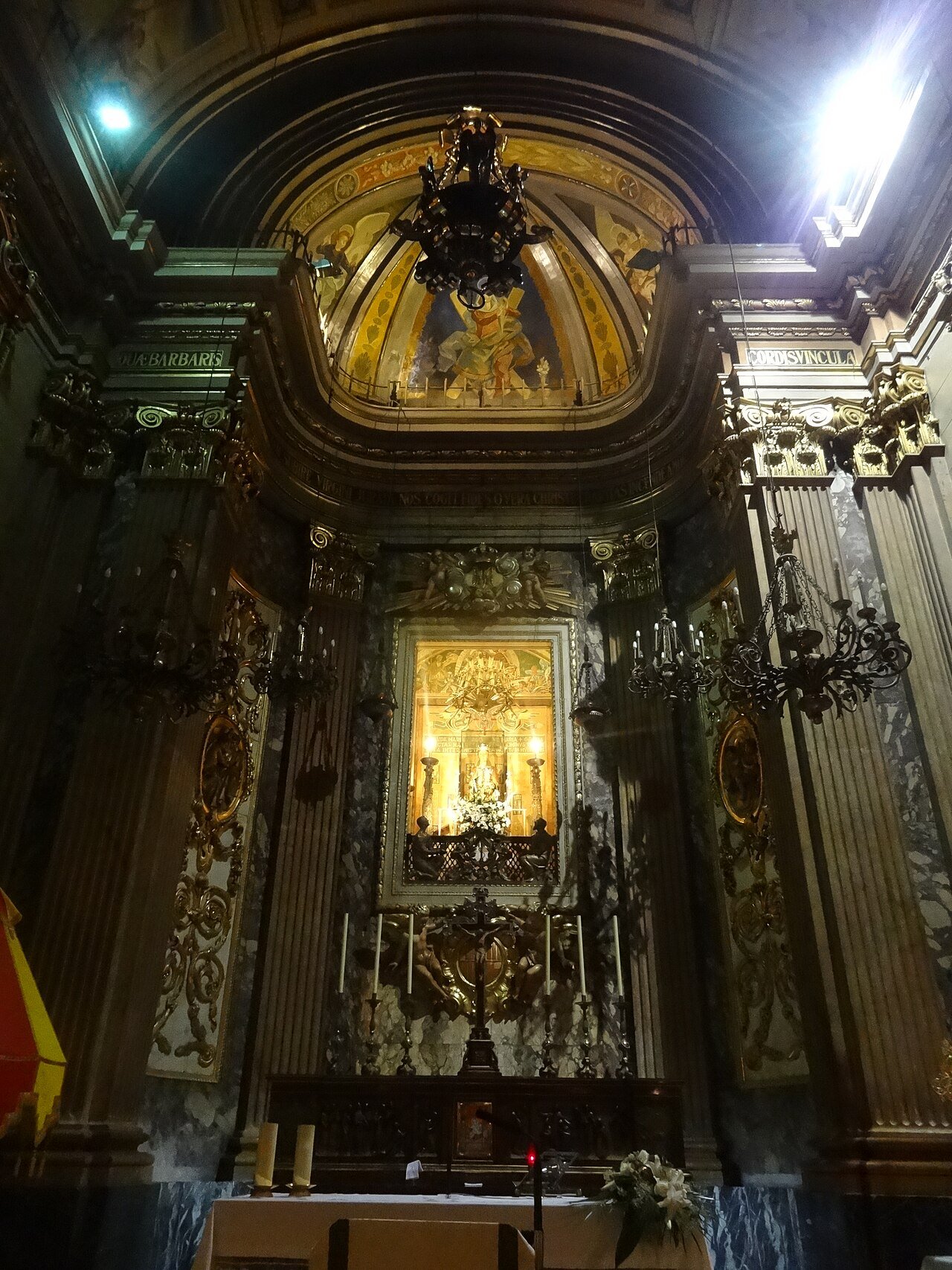
Take the nave slowly, from the back. The coffered barrel vault carries painted medallions of the arms of Barcelona — the city itself woven into the ceiling of its patroness’s house. Halfway down stand the twin pulpits, relics of the age of the great sermon. At the far end the sanctuary rises in coloured marble, and above the high altar glows the feature the whole interior is organised around: a tall illuminated window, framed in gold, through which the Gothic Virgin presides over the nave from her camarín behind the altar wall — small, distant and luminous from your seat, a deliberately staged apparition at the end of the perspective. The close view, up the stairs, is the next section’s business.

The Camarín: Face to Face with the Virgin
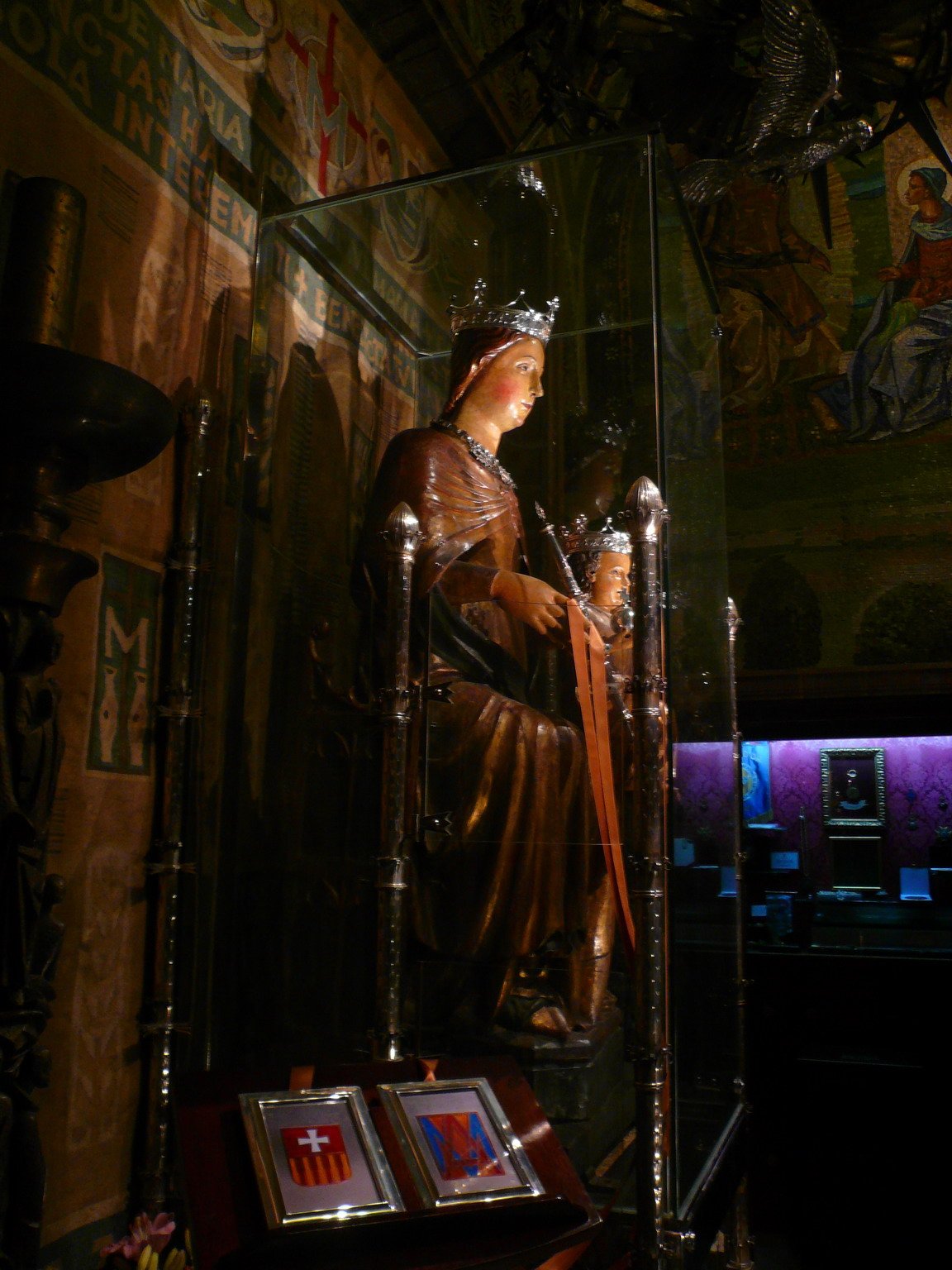
The camarín — cambril in Catalan — is the small raised chamber behind the high altar where the Virgin keeps court, and reaching it is this basilica’s essential experience. The route is unceremonious and free: up the left-hand side of the nave to the end, where a small door gives onto the stairs (if in doubt, ask — this is a parish, not a turnstile attraction). The present camarín belongs to Martorell’s works of 1888, the dome’s campaign, refurbished around the new throne built for the Virgin in 1963, for the 75th anniversary of her canonical coronation. On the way up you pass a small room of religious objects, and then you are in the chamber itself, painted with her legend, under its own little oval dome.
And there she is, at touching distance, behind her protective glass: the image of 1361, attributed to Pere Moragues, a metre and a half of Gothic carving — grave-faced, crowned, sceptre in hand, the Christ Child (a 15th-century addition) enthroned on her knee with his orb. Everything Baroque falls away in this room; what remains is the medieval object itself, and the realisation that this small wooden figure is the reason for the church, the dome, the festival and, in a sense, the city’s September. Ransomed captives prostrated themselves before her for five hundred years — the church’s plaque says so, and the chains her Child dangles are the order’s whole story in one attribute. Give the room its silence for a minute. It has earned it.

Chapels, Saints and Founders
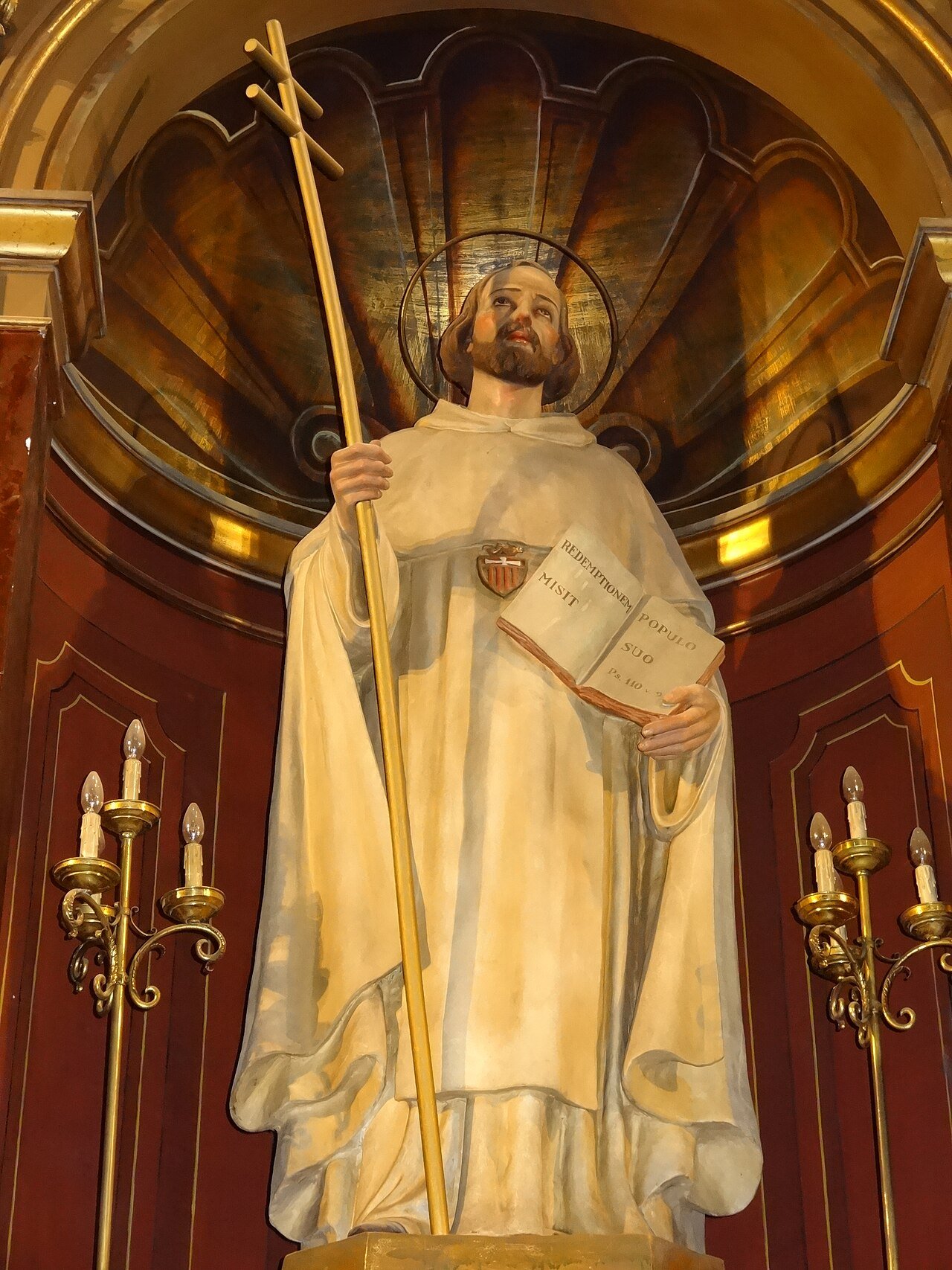
The eight side chapels and two great transept altars read as the order’s family album, and reward a slow circuit. Start in the transept. On the Gospel side stands the altar of Santa Maria de Cervelló (1230–1290), the first Mercedarian nun, a Barcelona girl who joined Nolasco’s work while the founder still lived; her remains rest in her altar here — the city’s own saint, hiding in plain sight. Opposite, the Epistle-side altar honours the founder himself, Sant Pere Nolasc, in the white habit of his order, its shield on his breast, his book open at the psalm that became the order’s motto: Redemptionem misit populo suo, “He sent redemption to his people”. St Bartholomew and St Teresa of Ávila share his altar.
The side chapels mix the universal and the intensely local: Sant Miquel, the co-dedicatee, whose Gothic door you passed on Carrer Ample; St Peter and St Paul; Our Lady of Hope and Our Lady of Solitude; Our Lady of Montserrat, Catalonia’s other great Virgin, present in her Barcelona rival’s house with perfect courtesy; and Catalan saints including Sant Josep Oriol, the miracle-working priest of the neighbouring parish of El Pi. One chapel near the door belongs to Sant Iu (St Yves), patron of lawyers, a nod to the notaries and advocates of the old quarter. None of these altars is, singly, a masterpiece on the camarín statue’s level; together they make the church’s point — a working parish sedimented with seven centuries of particular devotions, not a gallery. Light a candle in one and you are using the building exactly as intended.
La Mercè: The Festival of 24 September
Every 24 September the basilica’s quiet detonates into the biggest week of Barcelona’s year. La Mercè — the Festa Major, held across several days around the feast — began as the Virgin’s own celebration: religious festivities after the 1868 confirmation of her patronage, turned civic festival from 1871, and grown into a citywide takeover of concerts, street arts and Catalan tradition. The basilica remains its spiritual address: the feast day still centres on her church — the solemn Mass, the offerings, the city authorities in attendance — before the day spills into the streets with the Seguici Popular, the procession of the city’s festive retinue of giants, big-heads and beasts, filing through the old town in strict, centuries-old order of precedence.
The set pieces happen within a few streets of her door. In Plaça de Sant Jaume, five minutes away, the colles castelleres build their castells — human towers eight, nine, ten levels high, a child climbing to the summit to salute the patroness; the diada castellera of La Mercè is among the great dates of the castells calendar. After dark comes the correfoc, the fire-run, when devils and fire-breathing beasts shower the Via Laietana with sparks, and the festival closes with the Piromusical, music and fireworks over Montjuïc. And watch the sky: if the first autumn rain falls on the 24th itself, every local will give you the same explanation — Santa Eulàlia is crying. Whether from grief or sabotage depends on which patroness’s partisan you ask.

Music in the Basilica: The Organ and the Night Concerts
A church built for the sung liturgy, with a dome over the sanctuary and marble underfoot, was always going to be a concert hall in waiting — Barcelona Turisme says it invites “contemplation and the enjoyment of the best music”. The instrument is new: in September 2018, during the La Mercè festival itself, the basilica inaugurated a purpose-built organ by the renowned Grenzing workshop — some 2,800 pipes, designed for the liturgy and for professional recitals alike. If your visit coincides with an organ recital, take it: there is no better way to hear the room, or to see the gilded organ tribune doing the job it was built for.
The reliable, bookable way in after dark is the commercial concert series that has made this church its home: a one-hour evening programme of greatest hits — Vivaldi’s The Four Seasons, Pachelbel’s Canon, Mozart’s Requiem, Bach’s Air on the G String, Schubert’s Ave Maria, Beethoven’s Fifth, Handel, Ravel’s Boléro — played by the Barcelona Gala Orchestra with violin soloist and soprano under the dome. It is unashamedly a programme for first-timers, and the basilica — gilt Baroque, kind acoustics — is the star billing. Book the Vivaldi and Mozart concert at the Basilica of Our Lady of Mercy ahead for weekend dates — it sells to a fixed number of seats, and the printed programme is included.

Practical Info
Address: Carrer de la Mercè 1, 08002 Barcelona — the basilica fills the block between Carrer de la Mercè and Carrer Ample on Plaça de la Mercè, in the southern Gothic Quarter, five minutes from the port. Official site: basilicadelamerce.cat.
What it is: a working parish church and minor basilica — the church of Barcelona’s patroness, free to enter, worship first and sightseeing second. No ticket desk, no audio guide, no museum shop; instead a camarín to climb to, a Gothic statue of European significance, and, several evenings a week, a concert series. Protected as a Cultural Asset of Local Interest.
| Best for | The story of Barcelona itself — patroness, festival and port — plus Baroque church architecture and anyone who wants one great church without a queue |
| Entry | Free for the church and the camarín; the evening concerts are the only ticketed element — see Tickets, below |
| Time needed | 30–45 minutes for church and camarín; an hour if the chapels hold you; the concert runs 1 hour |
| Nearest metro | Drassanes (L3), about 4 minutes on foot; Jaume I (L4) about 6 minutes; Barceloneta (L4) about 7 minutes |
| Don’t miss | The camarín and its 1361 Virgin, the Oslé Virgin on the dome, and the transplanted Gothic portal of Sant Miquel on Carrer Ample |
Tickets and Booking
Only one door of this visit has a price on it. The church — nave, chapels, transept altars and the climb to the camarín — needs no ticket and takes no booking: entry is free, and donations are the appropriate currency. There is no official online ticket for the basilica itself, and any site selling you a “Basílica de la Mercè entry ticket” is selling something that does not exist. The concerts, by contrast, are a commercial series staged inside the church and are properly ticketed in advance. The bookable product is the one-hour classical concert in the Basilica of Our Lady of Mercy — seating categories, a printed programme, free cancellation up to 24 hours ahead and reserve-now-pay-later on the listing; at the time of writing, tickets started from the mid-€20s depending on category. Guided visits in Catalan and Spanish have been offered in the past but are not currently running on a regular schedule.
Opening Hours
This is a parish church, not a museum, and its doors follow the rhythm of worship — which means the published timetables genuinely disagree, and all of them, this one included, are approximations. The pattern given by the basilica’s own listing and most current guides is two blocks a day: mornings from about 09:00 to 13:00–13:30, and afternoons/evenings from about 16:30 to 20:00, Monday to Saturday, with Sunday and feast-day mornings given over to Masses. Some reputable listings print a shorter split (10:00–13:00 and 18:00–20:00); others print an unbroken day (09:00–20:00) you should not rely on. Aim for mid-morning or the early evening block, expect a midday closure, and check the door notice or the official site before building a morning around it — especially in August and festival weeks. The camarín keeps the church’s hours and is best attempted outside Mass times.
Getting There
You will arrive on foot unless you are trying not to. The basilica stands at the port end of the Gothic Quarter: five minutes from La Rambla’s Drassanes end, from the Columbus Monument and from Plaça de Sant Jaume; ten from the Cathedral; and the church door opens onto its own square, Plaça de la Mercè, with Neptune’s fountain for a landmark. By metro, Drassanes (L3) is closest, about four minutes’ walk; Jaume I (L4) about six minutes and Barceloneta (L4) about seven. City buses serve the Passeig de Colom and Via Laietana stops nearby. Driving into the southern Gothic Quarter is a fool’s errand — narrow one-way streets, restricted access; the nearest public car parks are around the port. The basilica is step-free at the main entrance from the square; the camarín, reached by an internal stair, is not.
When to Go
An ordinary weekday morning is the classic slot: the church at its quietest, the camarín perhaps yours alone. Late afternoon, in the second opening block, runs it close — and lets you stay on for the evening concert. Two dates belong to this church above all others. The first is her own: the days around 24 September, when festival crowds, the Seguici and the feast-day Mass turn the quarter into her front parlour — book concert and hotel well ahead. The second is subtler: 12 February, Santa Eulàlia’s day, when the co-patroness takes her turn — a fine moment to visit both patronesses’ churches in one walk and judge the rivalry yourself. August brings midday closures and heat: come early or not at all.
How Long You Need
Thirty to forty-five minutes is the honest measure: ten for the nave and high altar, ten for the chapels and transept founders, ten for the climb to the camarín — which deserves more if the room is empty. Add nothing for tickets, because there are none, and add an hour in the evening for the concert. Nothing here rewards rushing, but nothing punishes a short visit either: as a free church five minutes from the Rambla, La Mercè is the ideal old-town interlude — the twenty peaceful minutes between the port and the Cathedral that most visitors never take.
Free Barcelona travel guide
Planning a trip to Barcelona? Get our free one-page Barcelona checklist: what to book ahead, what to skip, and the Gothic Quarter corners most visitors walk straight past.
Tips for Visiting
- Climb to the camarín — it is the point of the church. The stair is at the end of the left-hand side of the nave, entry is free, and the 1361 Virgin at touching distance is worth more than everything else in the building combined. Go outside Mass times, and ask at the door if the little door is not obvious.
- Do not pay anyone for church entry. Admission is free, always. The only genuine paid product here is the evening concert series; a “skip-the-line ticket” for this basilica is a ticket to a queue that does not exist.
- Photograph the dome from Carrer d’en Carabassa. The lane behind the church frames dome, tiles and Virgin in one shot — the angle the local guides recommend. From the port and Moll de la Fusta you get the statue’s classic skyline view.
- Time the two opening blocks. Mid-morning and late afternoon are the safe windows; expect a midday closure whatever your guidebook prints.
- Dress and behave as a guest at worship. This is a working parish and the city’s shrine; shoulders and knees covered, voices down, and no sightseeing circuits during Mass — sit, instead, and listen to the room work.
What to See Nearby
The basilica anchors the port end of the old town, and its own square is the first sight: Plaça de la Mercè, with Neptune’s fountain presiding — the sea god keeping watch over the square of the Virgin who guards his harbour — and, across from the church, the sober bulk of the Capitanía General, the Mercedarians’ confiscated convent, still linked to the basilica by its covered bridge. Five minutes west stand the Columbus Monument and the start of La Rambla; in the royal shipyards of the Drassanes, a few minutes further, the Museu Marítim keeps the galleys of the seafaring world the Mercedarians sailed. Ten minutes north, the Cathedral keeps Santa Eulàlia’s crypt and her geese — pay the co-patroness her respects on the same walk. And ten minutes east, in El Born, Santa Maria del Mar raises its bare Gothic nave, built by the porters of this same waterfront: the austere sister against La Mercè’s Baroque gold, and the perfect second half of a two-churches morning.

Travel insurance, sorted
Whether it is a two-week holiday or a longer move, travel insurance is not the most glamorous part of a trip — but it is the one booking you want to have in place before a trip, and while you are already away. Get a quote from SafetyWing
Final Thoughts
La Mercè is the church Barcelona built for itself: not a king’s foundation or a bishop’s trophy, but the house of the Virgin who ransomed its captives, ended its locusts, commanded its last defence and still gives her name, her image and her September week to the city. Come for the Baroque — Mas i Dordal’s façade, Martorell’s dome, the marble nave — and stay for the small Gothic figure at the top of the stairs who started all of it in 1361, and for her great bronze sister above the port, watching the harbour since 1959. Of all Barcelona’s churches, this is the one that explains the city to itself. ¡Buen viaje!

Photo credits: Jordiferrer (CC BY-SA 3.0 and CC BY-SA 4.0); Enric (CC BY-SA 4.0); Pere prlpz and Canaan (CC BY-SA 3.0), via Wikimedia Commons.

One Comment