Palacio de San Telmo Seville: The Complete Guide to the Palace of the Montpensiers
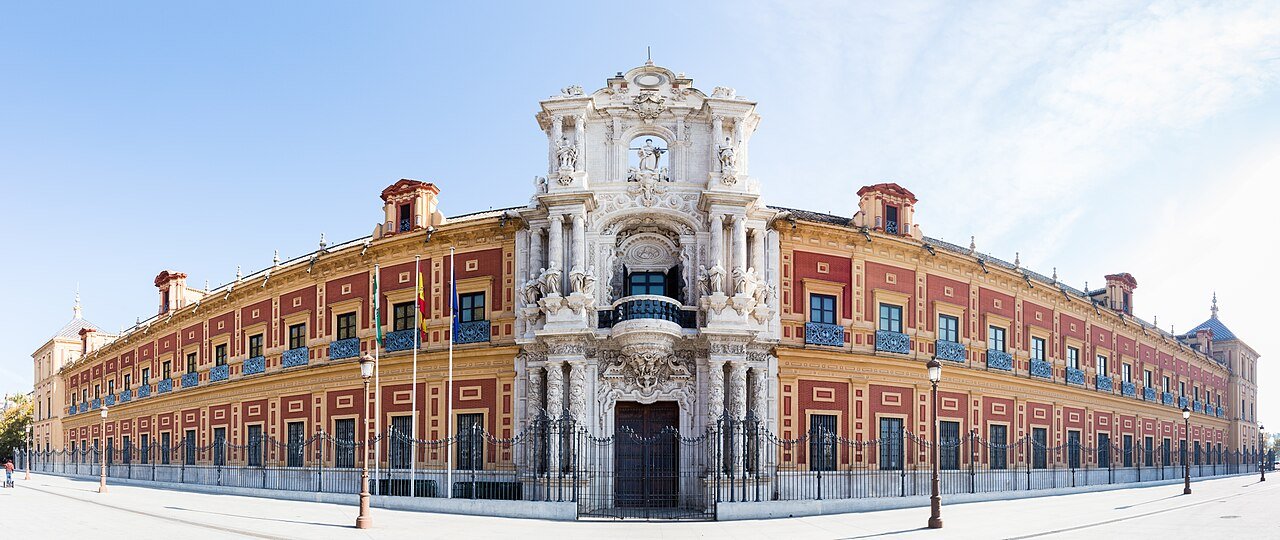
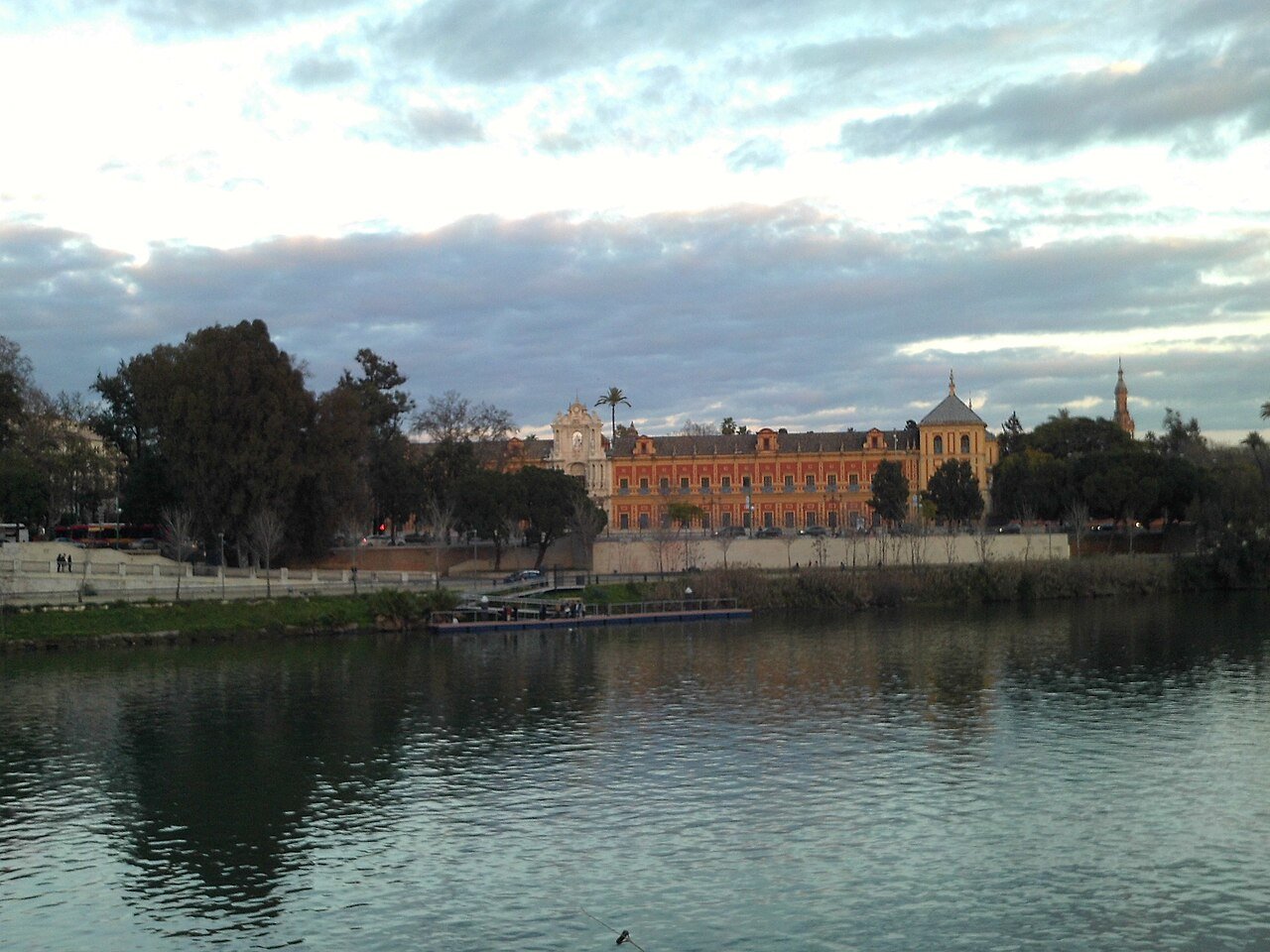
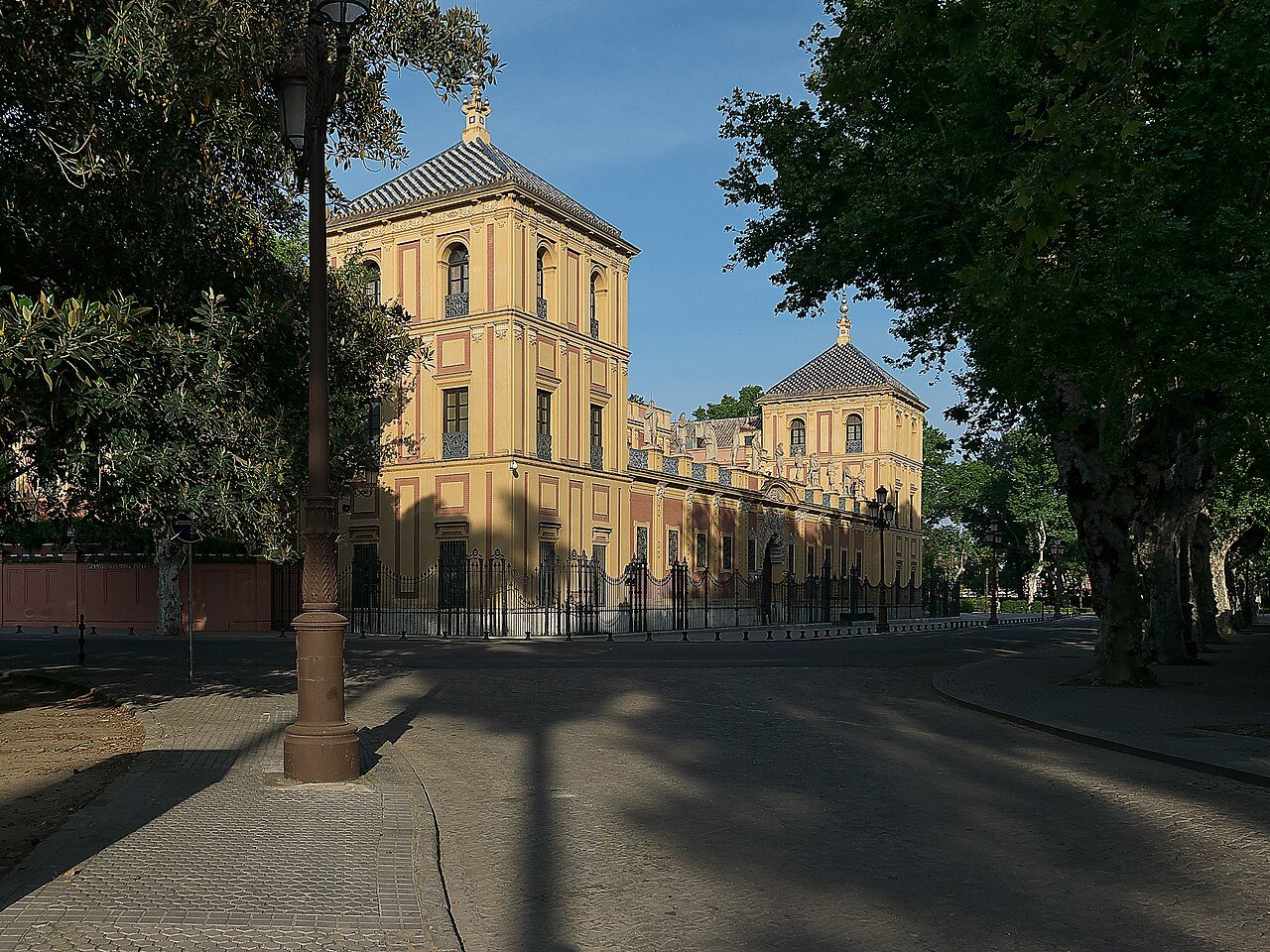
Walk south from Seville Cathedral along the river side of the old town and, just past the Hotel Alfonso XIII, the pavement suddenly fronts a palace 135 metres long: red brick and ochre stone, four corner towers, and at its centre a white stone portal so densely carved it looks embroidered. This is the Palacio de San Telmo — built as a college for orphaned sailors’ sons, turned into the Seville court of the Dukes of Montpensier, then a seminary, and today the seat of the Presidency of the Junta de Andalucía, the Andalusian regional government.
It is the great overlooked building of the monumental quarter, and it earns its place on any serious list of the best things to do in Seville for two set pieces alone: the portal, the single most extravagant façade of the Spanish Baroque, and the row of twelve famous Sevillians standing in stone along the far roofline. Getting inside takes planning — this is a working government palace, not a museum — but the exterior is free, permanent and magnificent, and the official guided visits, when you can catch one, are free too.
Short Answer
The Palacio de San Telmo is Seville’s great Baroque palace on the Paseo de Roma, between the river and María Luisa Park. It was built between 1682 and 1796 as the college of the Universidad de Mareantes, the seamen’s guild school that trained the orphans of sailors; its Churrigueresque main portal, finished in 1734 by the Figueroa family of architects, is crowned by San Telmo, patron of sailors, and lined with statues of the twelve subjects of navigation. Bought in 1849 by Antoine d’Orléans, Duke of Montpensier, and his wife the Infanta Luisa Fernanda, it became a royal court in exile; the north façade carries Antonio Susillo’s twelve statues of famous Sevillians (1895). Since 1992 it has been the seat of the Presidency of the Junta de Andalucía. The interior opens only on the Junta’s free guided visits — “San Telmo Abierto”, published for Thursdays, Saturdays and Sundays, advance booking only — while the façades can be admired from the street at any time, free.
Table of Contents
- The Short Version
- A School for Sailors: The Universidad de Mareantes
- The Great Portal: A Stone Sermon on Navigation
- The Chapel of the Sailors’ Virgin
- Twelve Sevillians on the Roofline
- The Montpensier Court: A Rival Court on the River
- Seminarians, Silence and a Seat of Government
- Practical Information
- What to See Nearby
- Final Thoughts
The Short Version
- What it is: A 135-metre Baroque palace of 1682–1796 — seamen’s college, Montpensier court, seminary and now the seat of Andalusia’s president, declared a monument in 1968.
- Don’t miss: The main portal on Avenida de Roma (best in morning light), the twelve statues along the Calle Palos de la Frontera roofline, and — on an official visit — Leonardo de Figueroa’s chapel.
- The honest catch: You cannot simply walk in. The interior opens only on the Junta’s free guided visits, booked in advance and published for set days; most visitors see the palace from the street, which is still very much worth doing.
- Time needed: 20–30 minutes for the full exterior circuit; around 90 minutes for the official guided visit.
- Combine with: The palace stands between the Torre del Oro and María Luisa Park — and a guided old-town walking tour stops at the façade on its way between the Archive of the Indies and the river.
A School for Sailors: The Universidad de Mareantes
San Telmo began as an act of maritime charity. The Universidad de Mareantes — the seamen’s guild-university of Seville — ran a college-seminary for the orphaned sons of sailors, boys raised by the guild and trained in the arts of navigation for the fleets of the Indies run. In 1682 the Crown granted the guild a site for a purpose-built college outside the city walls, on the Huerta de la Bella Vista between the walls and the river, and the first stone of the present palace was laid.
The building that rose over the following century is a small fortified city in itself: a rectangular block around interior patios, a tower at each of its four corners, its own chapel, and gardens running south towards what is now the park. The main works ran from 1682 to 1796, in the hands of a dynasty of architects — Leonardo de Figueroa, the master of Seville’s Baroque, designed the main courtyard and the chapel, and his son and grandson carried the palace towards its completion. Generations of cadets learned their charts, astronomy and gunnery here; among the college’s later pupils, in the years when it also housed literary studies, was the young Gustavo Adolfo Bécquer, Seville’s great Romantic poet.
The curriculum was the serious science of the age. A San Telmo graduate was expected to handle a chart and a quadrant, work the mathematics of a course, understand the tides and the stars, and know a ship’s guns — the college existed to produce pilots and masters for the Carrera de Indias, the treasure-fleet run to America, at a time when a navigational error could cost a fleet. The boys lived a regulated, almost monastic life inside the patios, under the eyes of the guild’s chaplains and masters, in a building deliberately set apart from the city’s distractions beyond the walls.
The college’s fortunes were the port’s. When the Casa de Contratación — the House of Trade that ran the American fleets — left Seville for Cádiz, the river trade drained away and the school slowly lost its reason to exist. The navigation school closed in 1844, and the great building by the river stood waiting for its second life.
The Great Portal: A Stone Sermon on Navigation
Everything the college existed for is written on its front door. The main portal on Avenida de Roma — the portada — was executed by Matías and Antonio Matías de Figueroa, Leonardo’s son and grandson, and its own inscription dates it to 1734; it cost 50,000 pesos, a fortune, and it is generally reckoned the most splendid single piece of the Sevillian Baroque. A year after its completion, lightning destroyed the topmost body, which was rebuilt in a cooler neoclassical taste — look closely and you can read the seam where exuberance gives way to restraint.
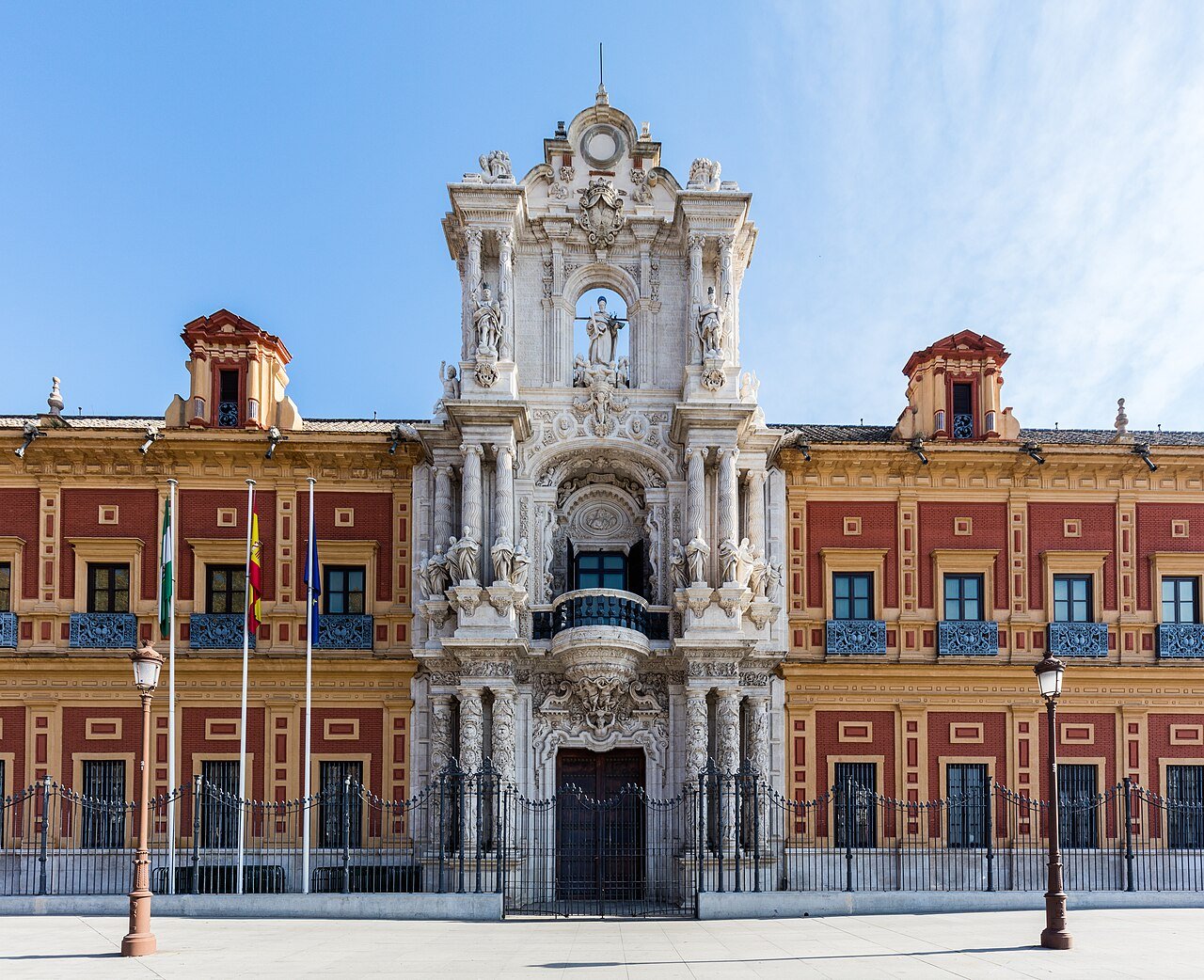
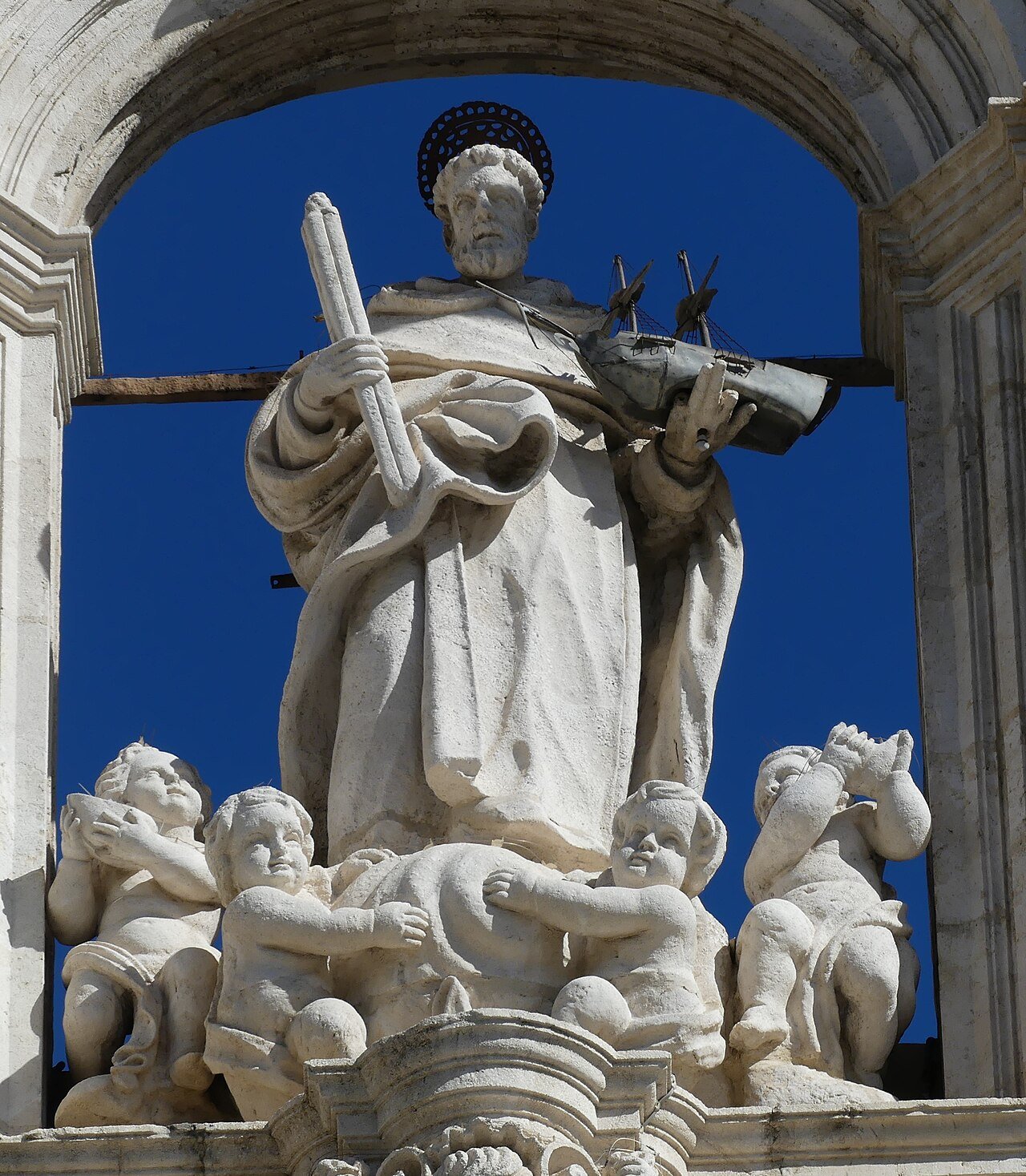
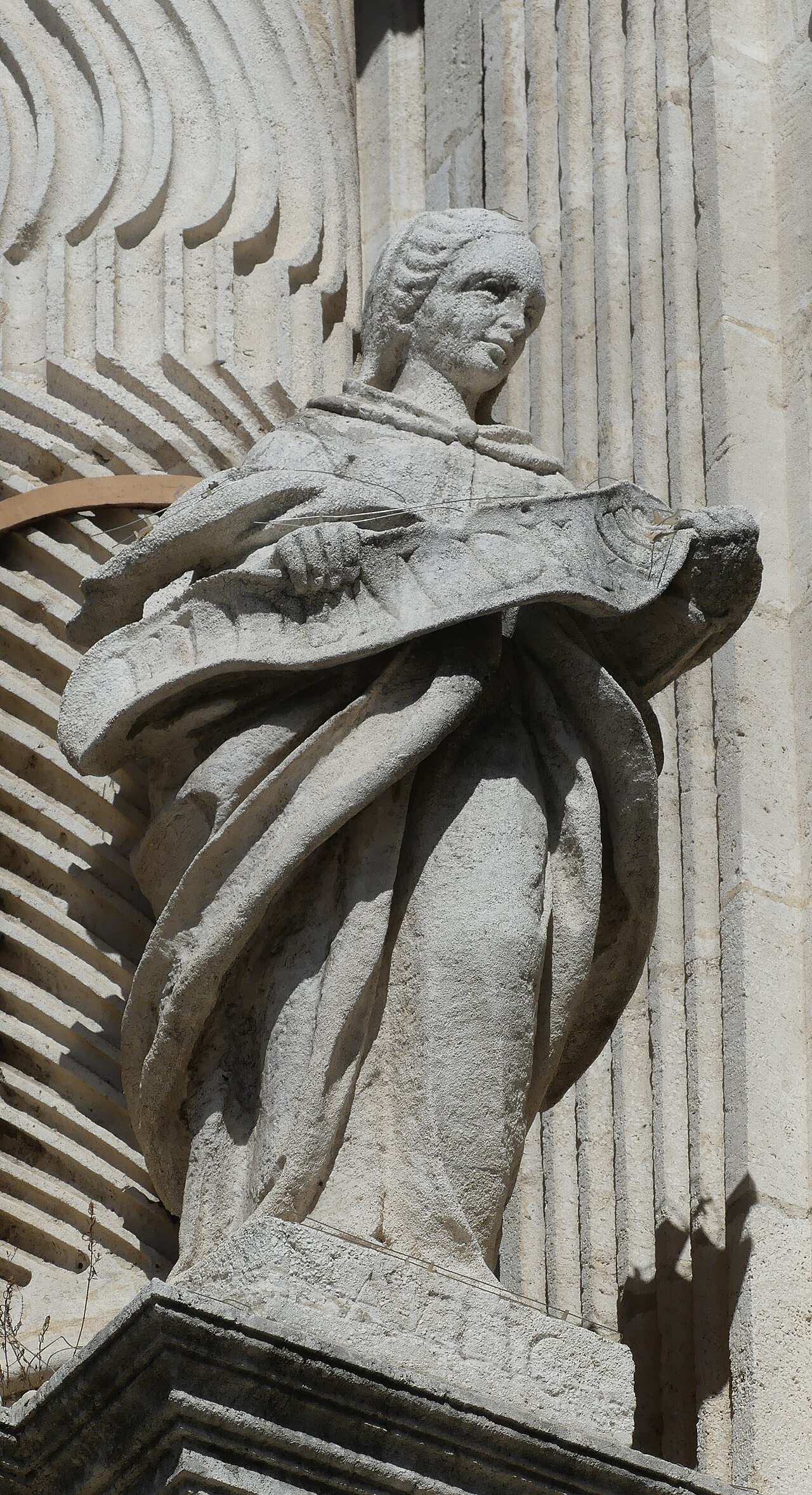
Read it from the top down. In the crowning arch stands San Telmo himself — St Elmo, patron saint of sailors — a model ship in one hand, flanked by Seville’s own patrons, San Fernando and San Hermenegildo. Below him, around the central balcony, stand twelve female figures, six to a side: they are the curriculum. Each personifies one of the artes de navegación taught inside — Náutica, Geometría, Aritmética, Trigonometría, Cosmografía, Hidrografía, Astronomía, Planimetría, Arquitectura, Artillería, Escultura and Pintura — the whole science of getting a ship across an ocean, carved as a guard of honour for the boys who would learn it. And holding up the balcony itself, straining under its weight, are atlantes carved with the features and feathered headdresses of the indigenous peoples of the Americas — the Indies made literal in stone, carrying the college on their shoulders.
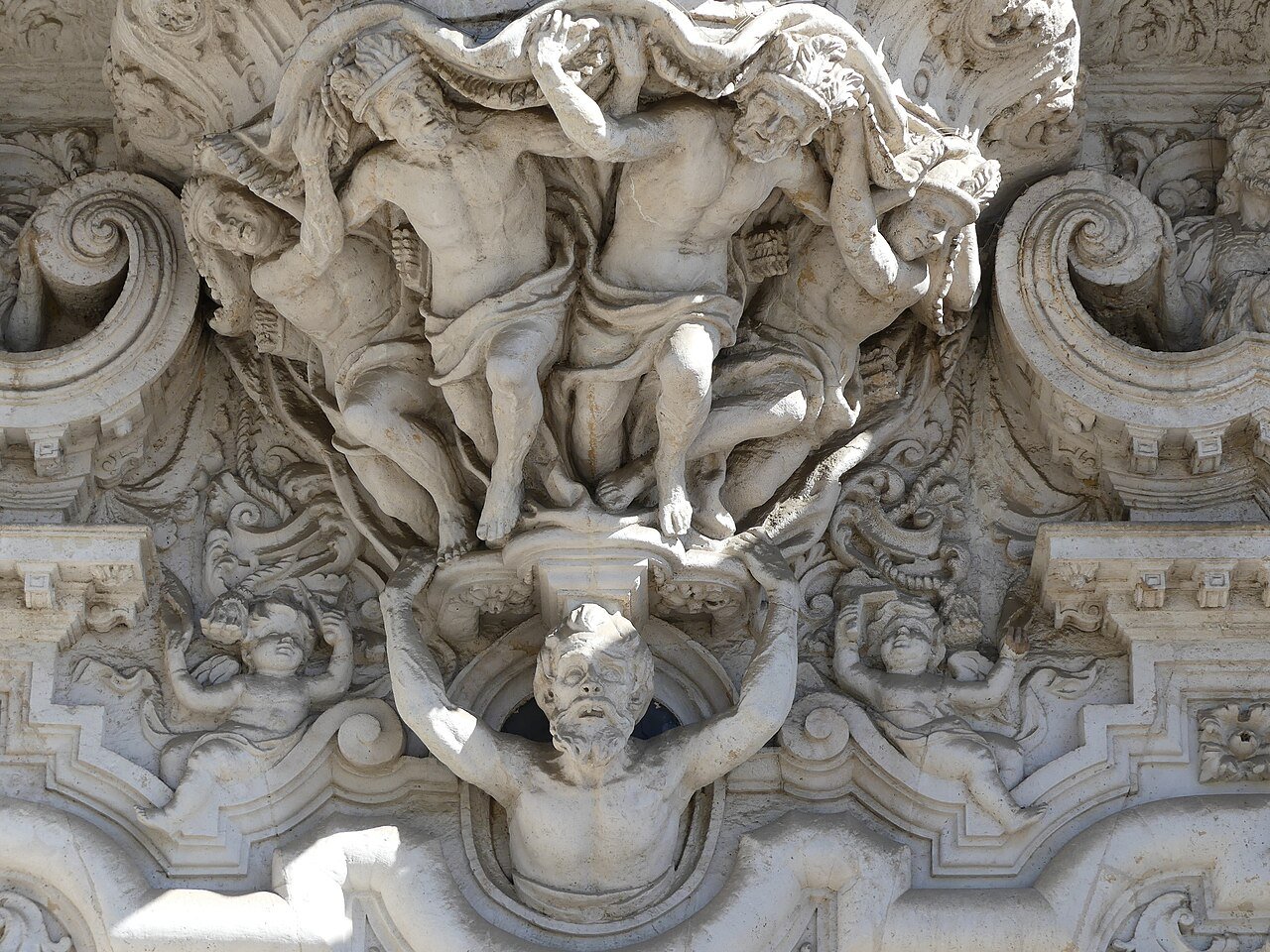
Stand back and take in the portal’s construction as a whole and its oddity sharpens: this is not a doorway with decoration added, it is a three-storey stone altarpiece built onto a façade — twisted Solomonic columns, broken pediments, reliefs of instruments and sea creatures, every surface worked. Nothing else in Seville, not even the city’s exuberant churches, attempts this density outdoors. It was advertising as much as art: a guild school that taught the most valuable technical skill of the empire announced, on its front, exactly what it taught and to whom it prayed.
The Chapel of the Sailors’ Virgin
Behind the portal, off the main courtyard, stands the palace’s other Figueroa masterpiece: the chapel, designed by Leonardo de Figueroa himself. For the cadets this was the spiritual centre of the college, and its presiding image is exactly right for a sailors’ school — Nuestra Señora del Buen Aire, Our Lady of the Fair Wind, an early-17th-century image of the Virgin and Child, holding a little ship, set into a main altarpiece of 1723–1726 that boils with gilded Baroque carving. Five further 18th-century altarpieces line the chapel, and its painted decoration is the work of Domingo Martínez, the leading Sevillian painter of his day.
The chapel is on the route of the official guided visits, and it is the single strongest reason to take one: from the street, nothing prepares you for the density of gold inside. Note, too, the palace’s newest artwork on the same route — the ceiling of the entrance hall, Parra en otoño, a vine in autumn painted by Carmen Laffón, Seville’s beloved modern painter, where the Montpensier-era entrance sequence begins.

Twelve Sevillians on the Roofline
Walk around the palace to its north side, along Calle Palos de la Frontera towards the Hotel Alfonso XIII, and look up. Along the roofline of the north façade stands a stone congress: twelve life-size figures in a row, the Galería de los Doce Sevillanos Ilustres — the Gallery of the Twelve Illustrious Sevillians. They were commissioned by the Dukes of Montpensier and modelled in 1895 by the sculptor Antonio Susillo, in cement — then a daringly modern material for sculpture. The north façade itself was only finished that same year, closing the palace’s last open side.
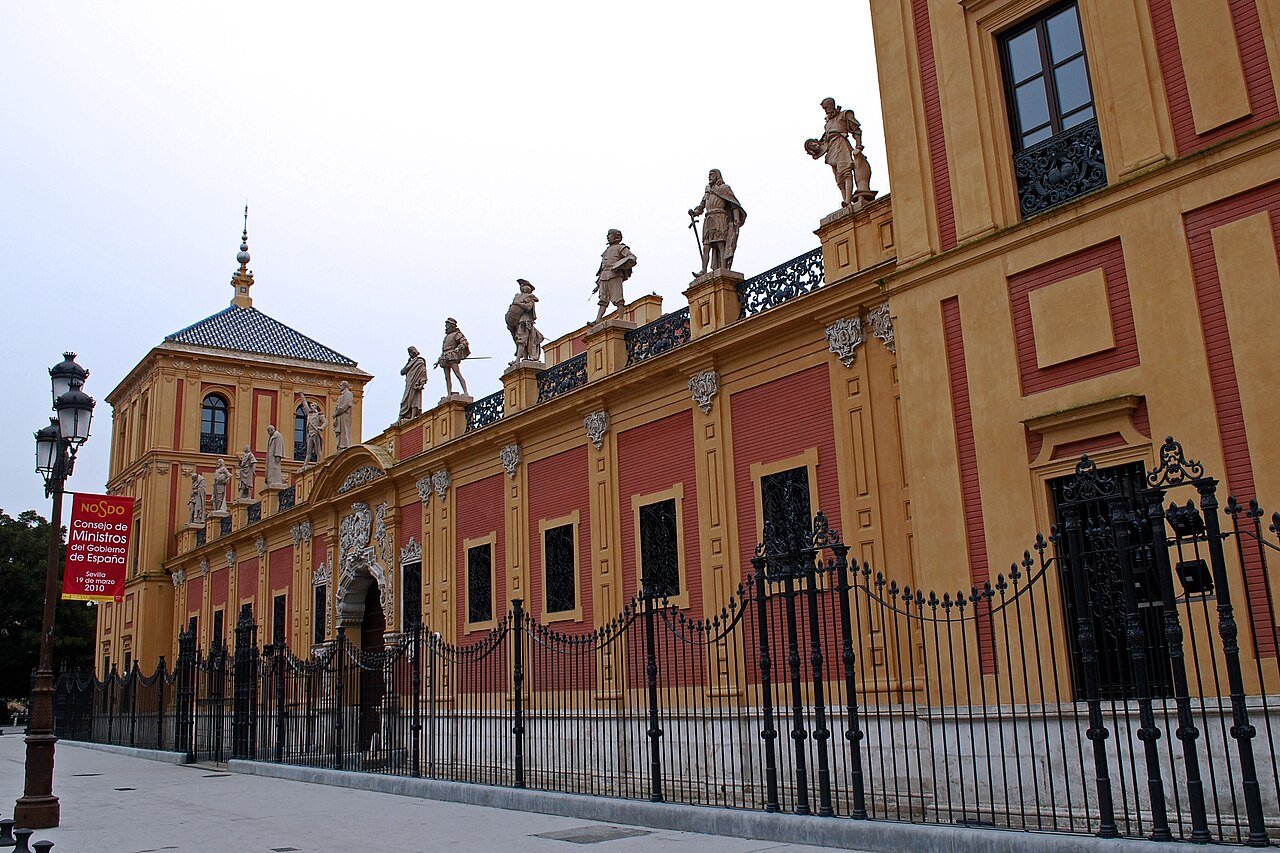
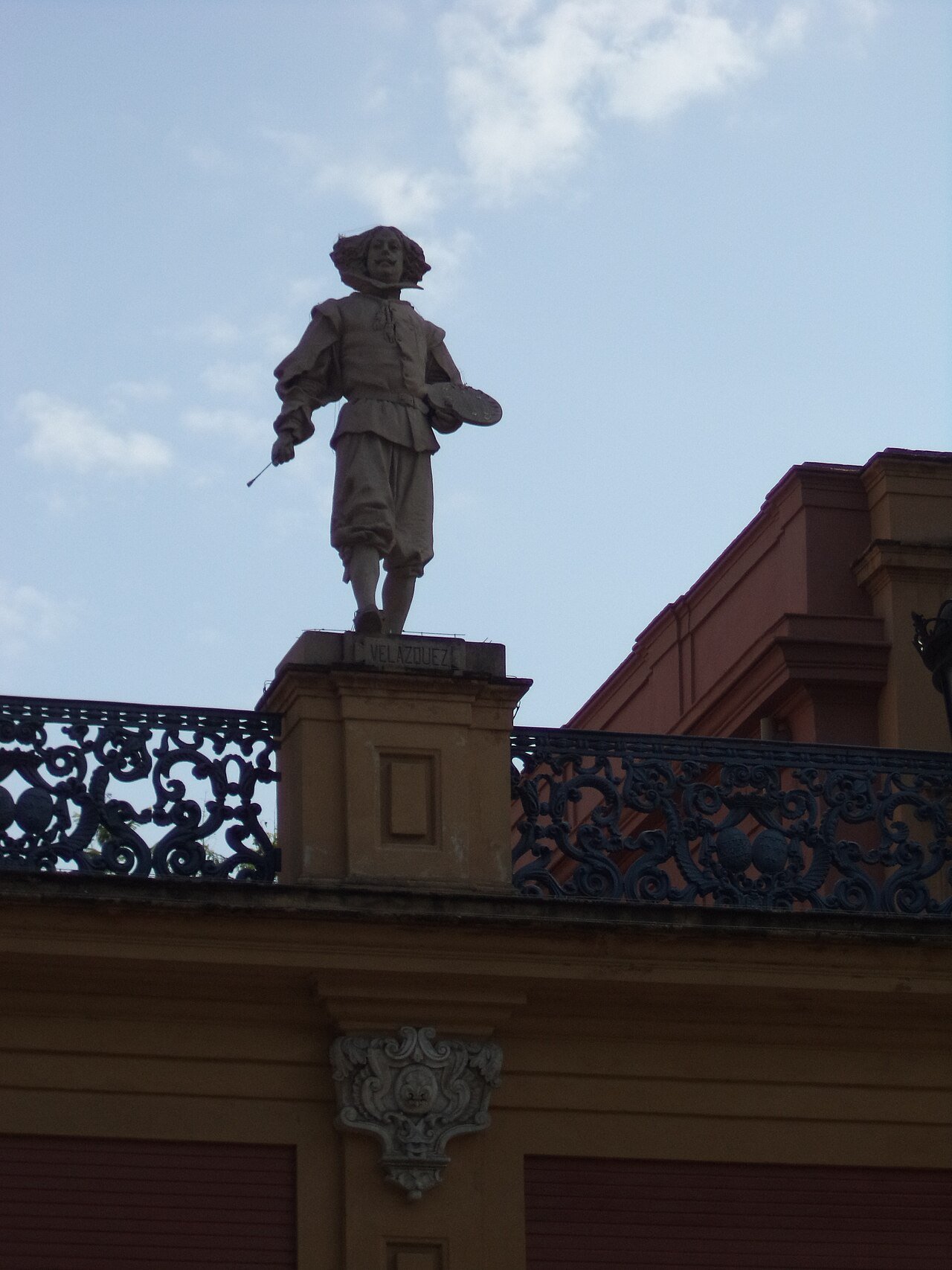
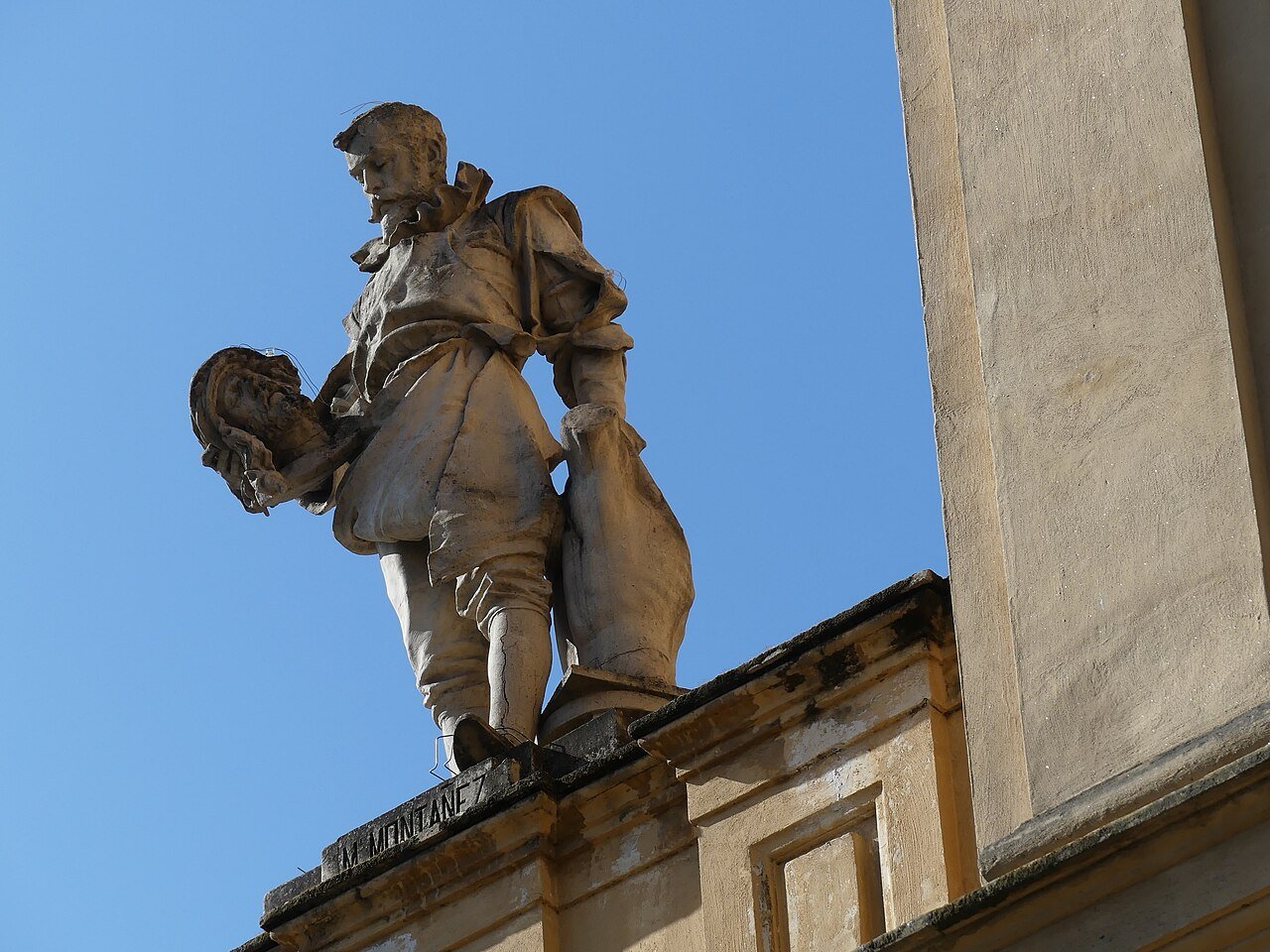
The twelve are a portrait of how Seville saw itself at the end of the 19th century. Painters take two places — Velázquez, brush and palette in hand, and Murillo. The sculptor Juan Martínez Montañés holds the carved head of his Jesús del Gran Poder, as a sculptor should. Miguel de Mañara, the reformed rake who founded the Hospital de la Caridad, carries a sick man in his arms — charity as biography. Around them stand the playwright Lope de Rueda, father of the Spanish theatre; the poet Fernando de Herrera; the humanist Benito Arias Montano; the historian Diego Ortiz de Zúñiga; Fray Bartolomé de las Casas, defender of the peoples of the Indies; Fernando Afán de Ribera, Duke of Alcalá; Rodrigo Ponce de León, Marquis of Cádiz; and Luis Daoíz, the artillery captain who died resisting the French in 1808. Three of the twelve were Sevillians by adoption rather than birth — Montañés, Ponce de León and Arias Montano — which Seville, characteristically, counts as no disqualification at all.

Free Seville travel guide
Planning a Seville trip? Get our free Seville checklist — the sights, neighbourhoods and practical tips that make a first visit easy.
The Montpensier Court: A Rival Court on the River
In 1849 the palace was bought by the couple who gave it its second name. Antoine d’Orléans, Duke of Montpensier, was the youngest son of King Louis-Philippe of France; his wife, the Infanta Luisa Fernanda, was the sister of Queen Isabel II of Spain and, for a time, heir presumptive to the Spanish throne. Exiled from France by the revolution of 1848, the Montpensiers made San Telmo their seat and ran it as nothing less than a rival court — receptions, balls, a famous art collection, and a household whose splendour Seville had not seen since the trade fleets. Locals called the building simply the Palacio de los Montpensier, and many still do.
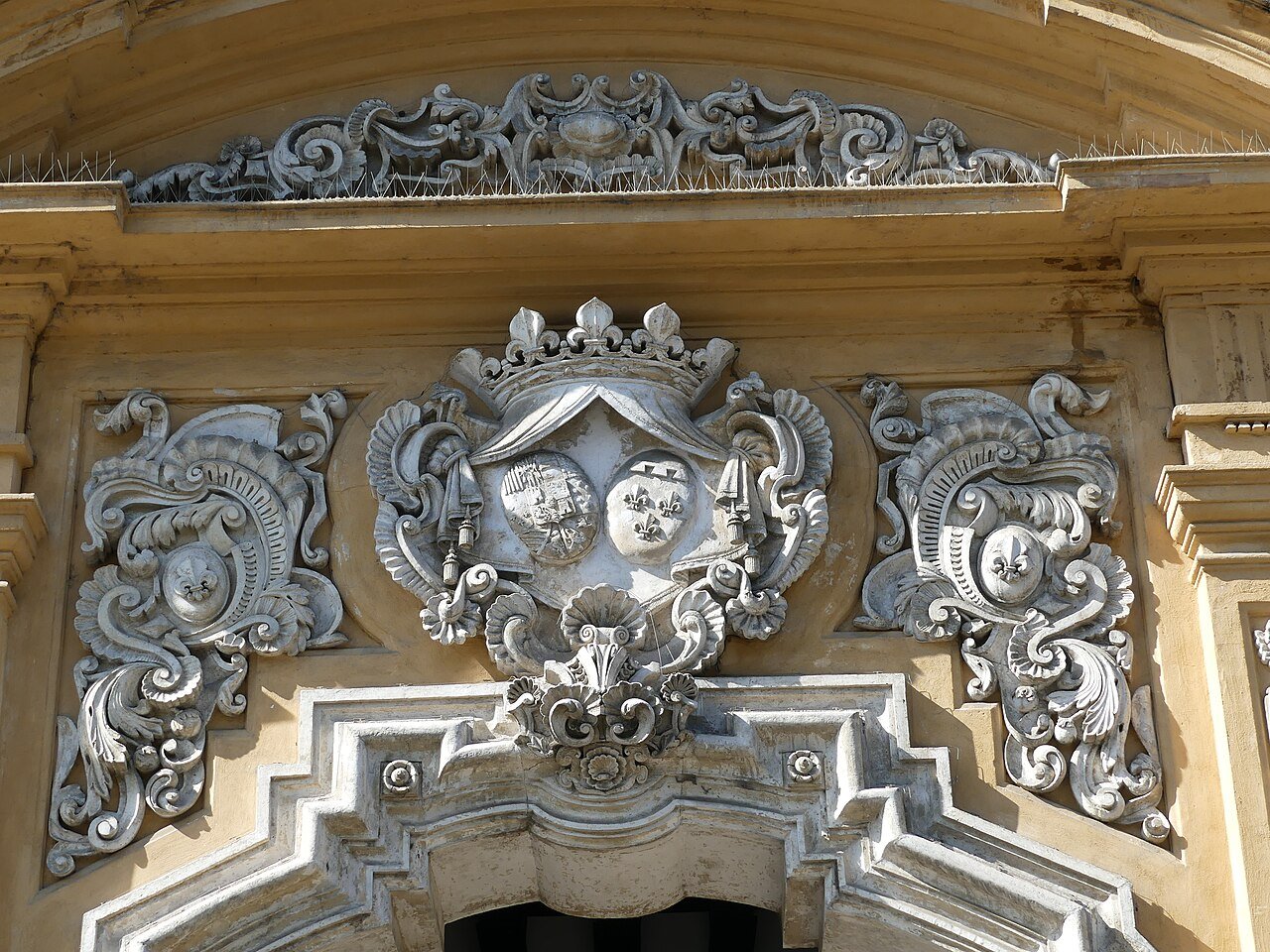
The dukes reshaped the palace inside and out — state salons, a ballroom, the finished north façade with its gallery of statues — and in 1878 the court very nearly captured the throne itself, when their daughter María de las Mercedes married her cousin Alfonso XII and became Queen of Spain. She died within six months of the wedding, at nineteen, and the famous romance left its mark on San Telmo: the palace still keeps the painted record of the Duke of Sesto asking for her hand on the king’s behalf. The Montpensier name faded; the building they bought is still called by it.
And their greatest gift to the city lay outside the walls. The palace gardens ran south in a great landscaped sweep, and in 1893 the widowed Infanta — Antoine had died in 1890 — gave most of them to Seville. Those gardens are the Parque de María Luisa, named for her (María Luisa Fernanda), and the palace still stands at the park’s northern gate, which is why a walk from the Plaza de España so naturally ends at its railings.
Seminarians, Silence and a Seat of Government
The Infanta died in 1897 and left the palace to the Archdiocese of Seville; in 1901 it opened as the city’s Seminario Metropolitano, and for most of the 20th century San Telmo’s salons echoed to seminarians rather than waltzes. The building had been declared a monument in 1968, but its public life was over — until, in 1989, the Junta de Andalucía reached an agreement with the Archdiocese (the Junta built the seminary a new home) and took the palace for itself. In 1992 San Telmo became the seat of the Presidency of the Junta, and between 2005 and 2010 the architect Guillermo Vázquez Consuegra directed a definitive restoration that recovered the Montpensier salons, the chapel and the surviving gardens.
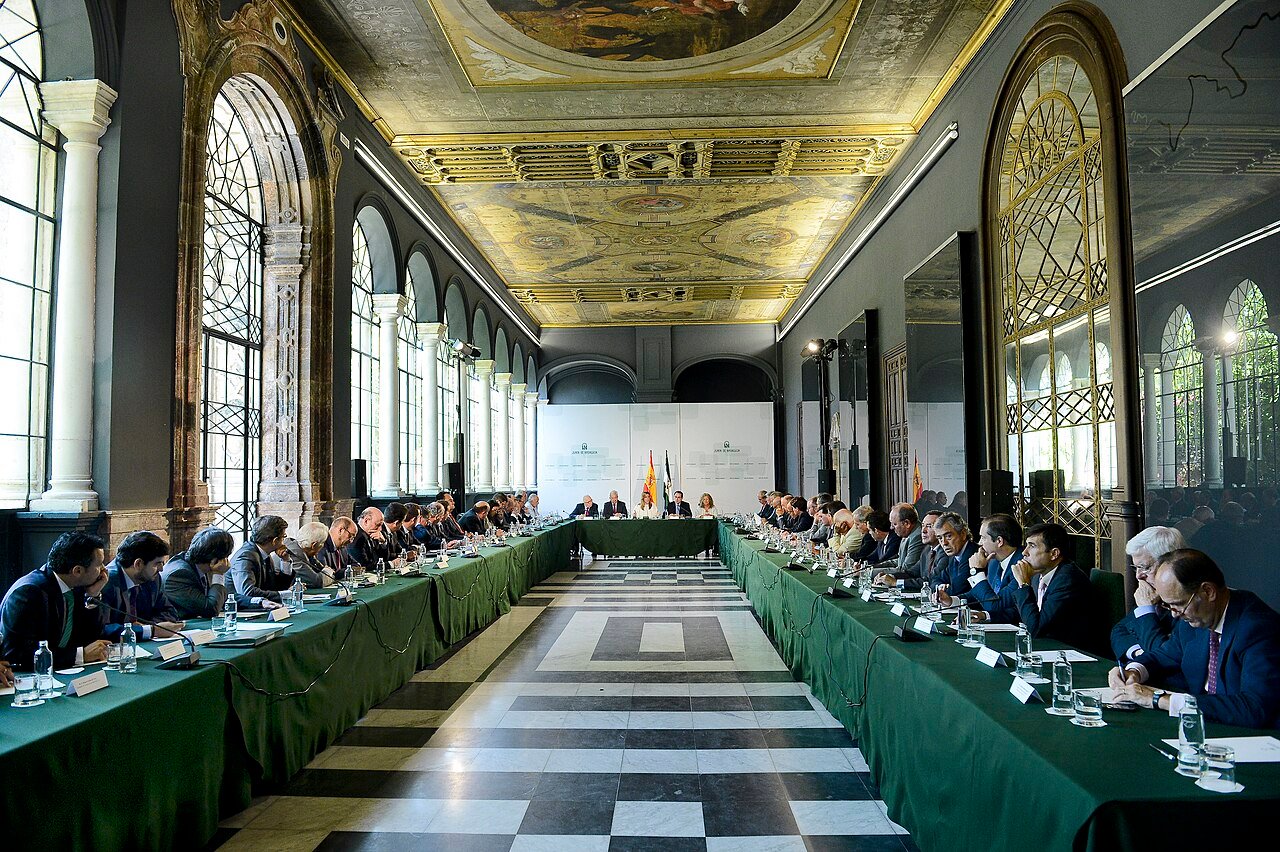
That double life is the palace’s present reality, and the official visits embrace it: the same route that passes the Baroque chapel also walks through the working rooms of a regional government. The Salón de los Espejos — the long mirrored gallery where the Montpensiers received — now hosts the meetings of the Andalusian government, its painted ceiling and chequerboard floor doing duty as a boardroom backdrop. Two small towers punctuate the interior skyline as you cross the patios — one with the palace clock over the entrance passage, one with bells over the chapel door, college furniture that still tells the government’s time.
Practical Information
Everything practical about visiting the Palacio de San Telmo, in one place.
| Address | Avenida de Roma s/n (Paseo de Roma), 41013 Sevilla — between the river and María Luisa Park |
| Interior visits | Free guided group visits only, under the Junta’s “San Telmo Abierto” programme — advance booking essential via the Junta de Andalucía’s official San Telmo Abierto platform |
| Published visit days | Thursday, Saturday and Sunday, by prior reservation (as published on Spain’s official tourism portal and the Junta’s visits material; slots change with the official calendar) |
| Price | Free |
| Visit length | Around 90 minutes — patios, main staircase, Montpensier salons, ballroom, chapel and gardens; the route varies |
| Bring | Photo ID (DNI, passport or residence card) for every visitor — it is checked; there is no left-luggage, so come without suitcases |
| Exterior | The façades on Avenida de Roma and Calle Palos de la Frontera are public street views, free at any time |
| Nearest metro/tram | Puerta de Jerez (Metro Line 1 and Tram T1), about 5 minutes’ walk |
Tickets and How to Book
There are no tickets to buy and nothing to pay: the Junta de Andalucía opens its own palace free, but only on its own terms. Book a place on the official San Telmo Abierto platform as far ahead as you can — groups are small, the published days are limited, and a visit can be cancelled when the palace is needed for official business. If the platform shows no availability, the interior is simply not an option for your dates, and the palace becomes an exterior sight — build your expectations around that from the start.
For the outside, a guide transforms the façades: the Seville old-town walking tour that stops at San Telmo gives the palace a guided stop on its route from the Giralda past the Archive of the Indies and the Hotel Alfonso XIII — but be clear about what it is: a walking tour of the monuments from outside. It does not, and cannot, take you through the door.
Opening Hours
The guided visits run on the days the Junta publishes — currently Thursdays, Saturdays and Sundays, by prior reservation only, with the exact session times set by the official platform and liable to change with the government calendar. There are no walk-up hours. The exterior, by contrast, never closes: the portal and the statue gallery are street architecture, viewable at any hour, and the evening light on the white stone is superb.
Getting There
San Telmo stands on the Paseo de Roma, the river-side avenue south of the old town. From the Cathedral it is a ten-minute walk down Avenida de la Constitución and across Puerta de Jerez. Metro Line 1 and the T1 tram both stop at Puerta de Jerez, five minutes away; the palace also sits on the natural walking route between the Torre del Oro and María Luisa Park, so most visitors arrive on foot without trying.
When to Go
For the exterior, come in the morning: the east light rakes across the main portal and picks out every carved figure, exactly as local guides recommend, while the Calle Palos de la Frontera statues read best in the softer light of late afternoon. For the interior, the only “when” that matters is the Junta’s calendar — if a San Telmo Abierto slot falls inside your trip, take it, whichever day it is.
How Long You Need
Half an hour covers the full exterior circuit properly — portal, both façades, the statue gallery, a pause for the river view. The official guided visit runs about 90 minutes and is the only way to see the interior at all.
Tips for Visiting
- Book the official visit first, plan the trip second. San Telmo Abierto places are the scarcest free ticket in Seville; check the platform before fixing your dates.
- Bring the ID you booked with. Entry is to a working seat of government; the check at the door is real.
- Read the portal top-down. San Telmo at the crown, the twelve subjects around the balcony, the atlantes at the base — the composition is a ladder, and it explains itself in order.
- Don’t stop at the main façade. The statue gallery is on the other side — many visitors photograph the portal and never walk the two minutes round to Calle Palos de la Frontera.
- Pair the exterior with the park. The palace plus its former gardens make one continuous story: façade first, then into María Luisa Park by the gate the dukes used.
What to See Nearby
San Telmo is the hinge between two of Seville’s great walks. North along the river stands the Torre del Oro and, behind it, the old town: the Archivo de Indias, where the paperwork of the empire the cadets sailed for is still kept, then the Cathedral and the Alcázar beyond. The Hotel Alfonso XIII, built for the 1929 Exhibition, stands almost opposite the statue gallery — go in for a coffee in its courtyard if the palace door stayed shut.
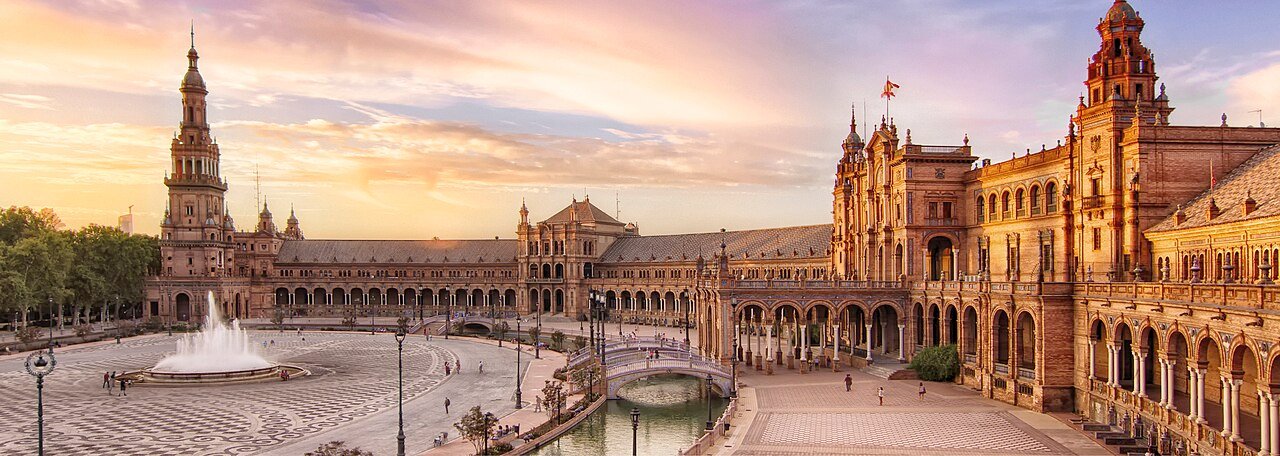
South, the palace’s own gardens begin. María Luisa Park runs from the railings to the Plaza de España, the 1929 Exhibition’s great semicircular set piece — the natural finale to a San Telmo morning, and the place to understand how much land this one palace once commanded.
Travel insurance, sorted
Whether it is a two-week holiday or a longer move, travel insurance is not the most glamorous part of a trip — but it is the one booking you want to have in place before a trip, and while you are already away.
Final Thoughts
San Telmo is Seville in one building: a sailors’ school that taught the science of empire, a French prince’s court in Spanish exile, a seminary, and now the working seat of Andalusia’s government — each era leaving its layer on the same 135 metres of façade. Most palaces this good are museums; this one still has a job, and seeing it asks a little more of you — a booking made in advance, or at least the walk around the back to the twelve statues. It is worth the small effort either way, and easiest of all with a guided walk of the old town to set the façades talking. ¡Buen viaje!
Photos: Diego Delso, CarlosVdeHabsburgo, Anual, José Luis Filpo Cabana, Jl FilpoC and Junta Informa, via Wikimedia Commons (CC BY 3.0, CC BY 4.0, CC BY-SA 2.0, CC BY-SA 3.0 and CC BY-SA 4.0).