Triana: The Complete Guide to Seville’s Riverside Quarter
Seville faces the river, but Triana lives on it. The old town across the water has the Cathedral, the Alcázar and the fame; this side has the potters, the sailors, the flamenco singers and the stubborn local conviction that the relationship runs the other way — that Triana is not a neighbourhood of Seville but a small, proud republic that allows Seville to sit opposite. Cross the iron bridge and the city changes key within fifty paces: the monuments fall behind you, the streets fill with tile-fronted bars and ceramics shops, and the Guadalquivir runs along the bottom of the quarter like a main street that happens to be water.
This guide walks Triana the way Trianeros would want it walked: over the bridge and into the Plaza del Altozano, down the riverfront of Calle Betis, through the market that stands on the Inquisition’s castle, into the pottery museum where the quarter’s famous tiles were fired, and finally to its two great churches — the sailors’ chapel of the Esperanza and Santa Ana, the oldest church in Seville. It sits high in our Best Things to Do in Seville guide, and it is the essential counterweight to the monumental city: everything across the river is Seville showing off; everything on this side is Seville at home.

The Short Answer
Yes — Triana is essential, it is mostly free, and it deserves at least half a day: a morning for the market, the castle museum and the ceramics, and an evening for Calle Betis and flamenco. There is no single ticket and no queue culture here. The quarter’s sights are small, cheap and close together — a market hall, a free archaeological museum under it, a €2 pottery museum, two remarkable churches — and the real attraction is the fabric between them: tiled façades, workshop windows full of painted plates, and a riverfront that fills with half of Seville at sunset. Come over in the morning when the market is in full voice, retreat from the midday heat like everyone else, and come back across at dusk, when the Betis terraces light up and the old town turns gold across the water. That rhythm — Triana by day, Triana again by night — is the whole secret.
Table of Contents
- The Short Answer
- The Story in Brief: Potters, Sailors and a Republic of Its Own
- What to See: The Bridge and Plaza del Altozano
- What to See: Calle Betis and the Riverfront
- What to See: The Mercado de Triana and the Castillo de San Jorge
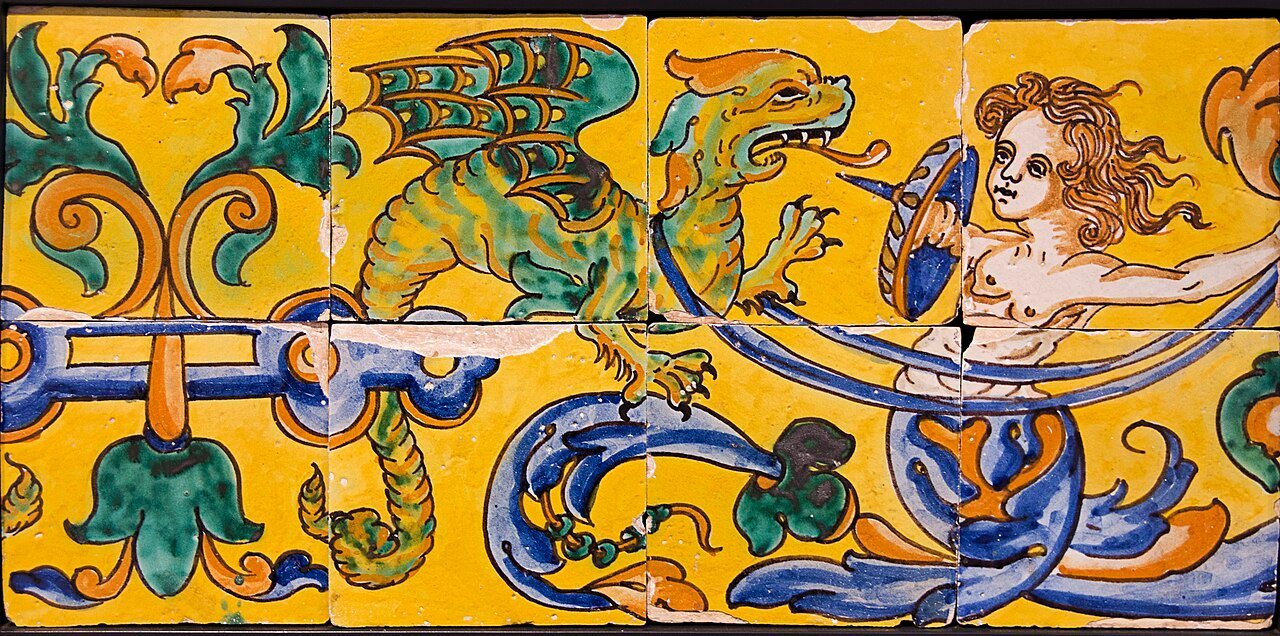
- What to See: The Centro Cerámica Triana and the Pottery Streets
- What to See: Santa Ana, the Capilla de los Marineros and the Capillita del Carmen
- What to See: Flamenco and Tapas in Triana
- Practical Info
- Tips for Visiting
- Final Thoughts
The Story in Brief: Potters, Sailors and a Republic of Its Own
Triana began as the far bank — a suburb and a bridgehead, settled since Roman times and fortified under the Almohads, whose castle of San Jorge guarded the famous bridge of boats that linked it to Seville. For centuries the connection was literally floating — a line of chained boats with planks across them — so Triana grew up half-attached to the city and entirely used to managing without it. What it managed with was mud. The riverbanks here are clay — the famous Triana barros — and the quarter became Seville’s pottery from the beginning: Roman workshops, then Moorish kilns that perfected the glazed tilework of al-Andalus, then the great Christian-era factories whose azulejos would eventually skin half the buildings of Spain and its empire. If a Seville church, palace or plaza wears tiles, they were almost certainly fired in Triana.
The other Triana trade was the river itself. This was the sailors’ quarter — the men who crewed the fleets to the Indies lived in these streets, prayed to their Esperanza before sailing and, with the potters, the gypsy families of the Cava and the bullfighters and flamenco artists who followed, gave the quarter its durable character: working-class, devout, theatrical and fiercely itself. Triana supplied Seville with two of its defining art forms. Juan Belmonte, the revolutionary bullfighter who reinvented bullfighting in the early twentieth century, grew up here; and flamenco — forged in the communal patios and taverns of poor quarters across Andalusia — has one of its recognised birthplaces in these streets, where the soleá de Triana is still a style singers name with respect. The quarter paid for its character: floods battered it into the twentieth century, the gypsy community of the Cava was broken up and rehoused in the 1950s and 60s, and the grand southern slice of old Triana was hived off as the modern district of Los Remedios. What remains — the streets between the bridge, the market and Calle Pagés del Corro — is smaller than historic Triana, and completely undiluted.

What to See: The Bridge and Plaza del Altozano
You arrive the way everyone has arrived since 1852: over the Puente de Isabel II, universally called the Puente de Triana. It is worth pausing on, because until it opened Seville had never had a permanent bridge — seven centuries of a great city crossing its river on boats. French engineers designed it on the model of the Pont du Carrousel in Paris, and its signature is the row of great iron rings slung between the arches, a piece of industrial jewellery that has become the quarter’s coat of arms: the rings appear on Triana’s tiles, souvenirs and football scarves alike. Cross slowly. Halfway over, the view downstream takes in the Torre del Oro and the Giralda across the water — the postcard — while the view under your feet is all rowers, fishermen and the slow green river.
At the Triana end, the bridge delivers you into Plaza del Altozano, the quarter’s front hall. The statue in the middle is Juan Belmonte, cape in hand, gazing across at the city he conquered from these streets; through the hole where his heart would be, you can frame the Giralda — try it. The Altozano is where Triana’s threads cross: the market on one side, the castle museum beneath it, Calle Betis running south along the river, Calle San Jorge and the pottery streets running west, and on the corner the little tiled tower of the Capilla del Carmen, which belongs to the churches below. Do not hurry out of the square. It is the one place where the whole quarter can be read at a glance.
What to See: Calle Betis and the Riverfront
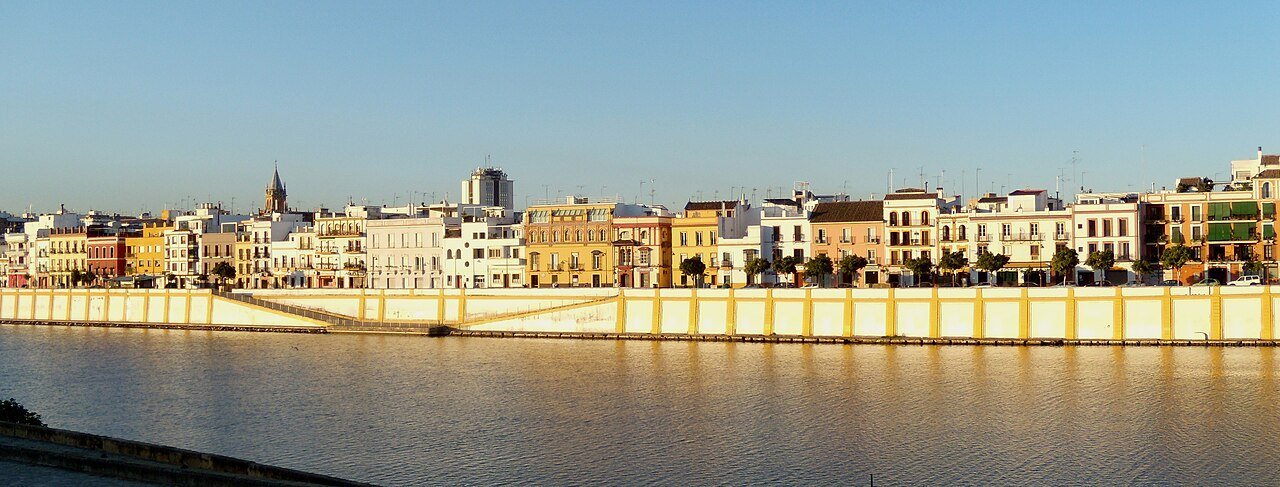
From the Altozano, Calle Betis runs south along the river wall — Betis being the Roman name for the Guadalquivir, a street named after the river it watches. By day it is a handsome, ordinary frontage of coloured houses over the water, with the old town laid out opposite like a stage set: the bullring, the Torre del Oro, the Cathedral and the Giralda in one long panorama. Walk it in the morning for the light on the far bank and the rowers below.
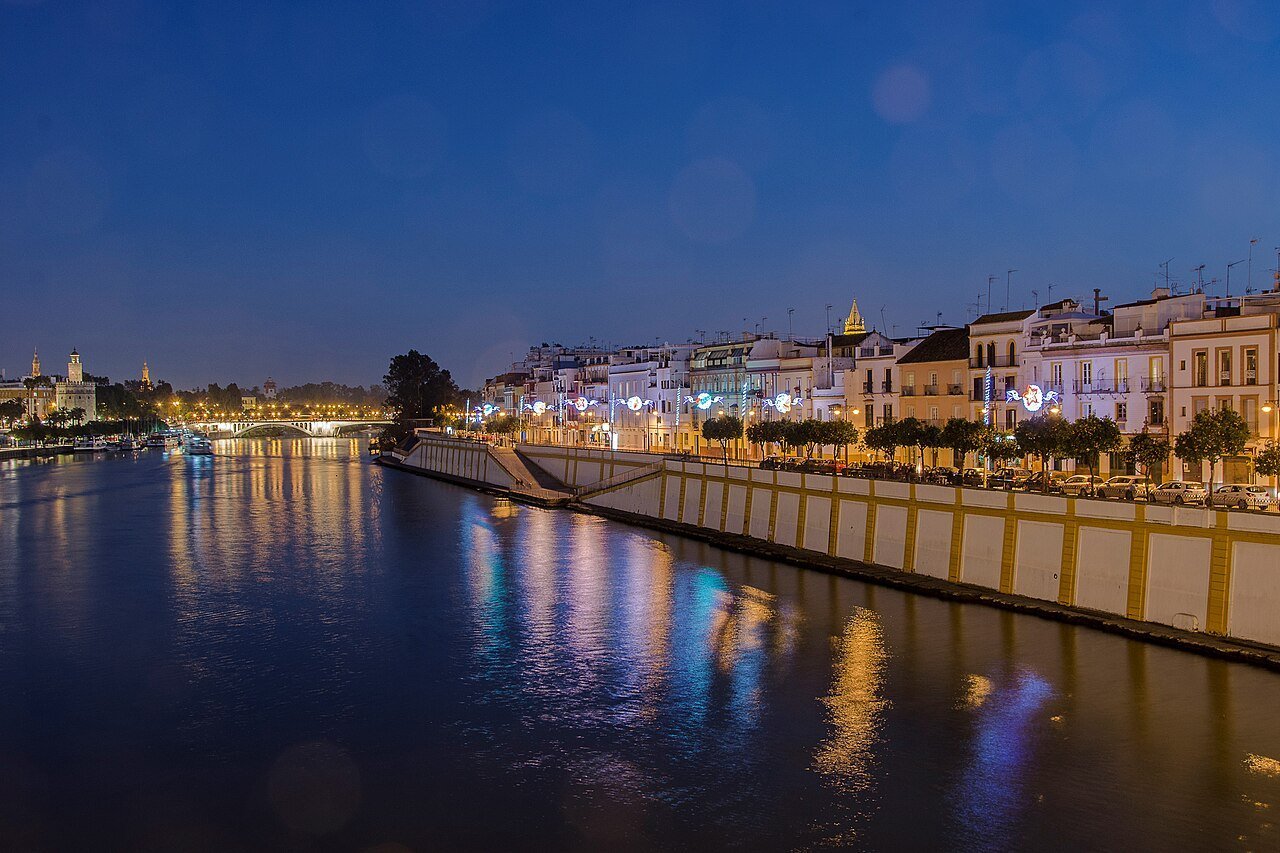
Then come back at dusk, because Betis is really an evening street, and one of the great free shows of Seville. The bars and restaurant terraces that line its landward side fill from about eight onwards — later in summer — and the whole quarter turns out to watch the light go down over the river and the old town ignite. This is where Sevillanos bring visitors to prove a point about their city, and the point lands. In late July the street becomes the floor of the Velá de Santa Ana, Triana’s own summer festival around the feast of its patron saint, when the river hosts the cucaña — a greased pole stretched over the water that young Trianeros attempt, to general hilarity, for a ham at the end of it. If your trip touches the last week of July, Betis on Velá nights is Seville at its most itself.
Free Seville travel guide
Planning a trip to Seville? Get our free one-page Seville checklist: what to book ahead, what to skip, and the tapas bars we actually eat in.
What to See: The Mercado de Triana and the Castillo de San Jorge
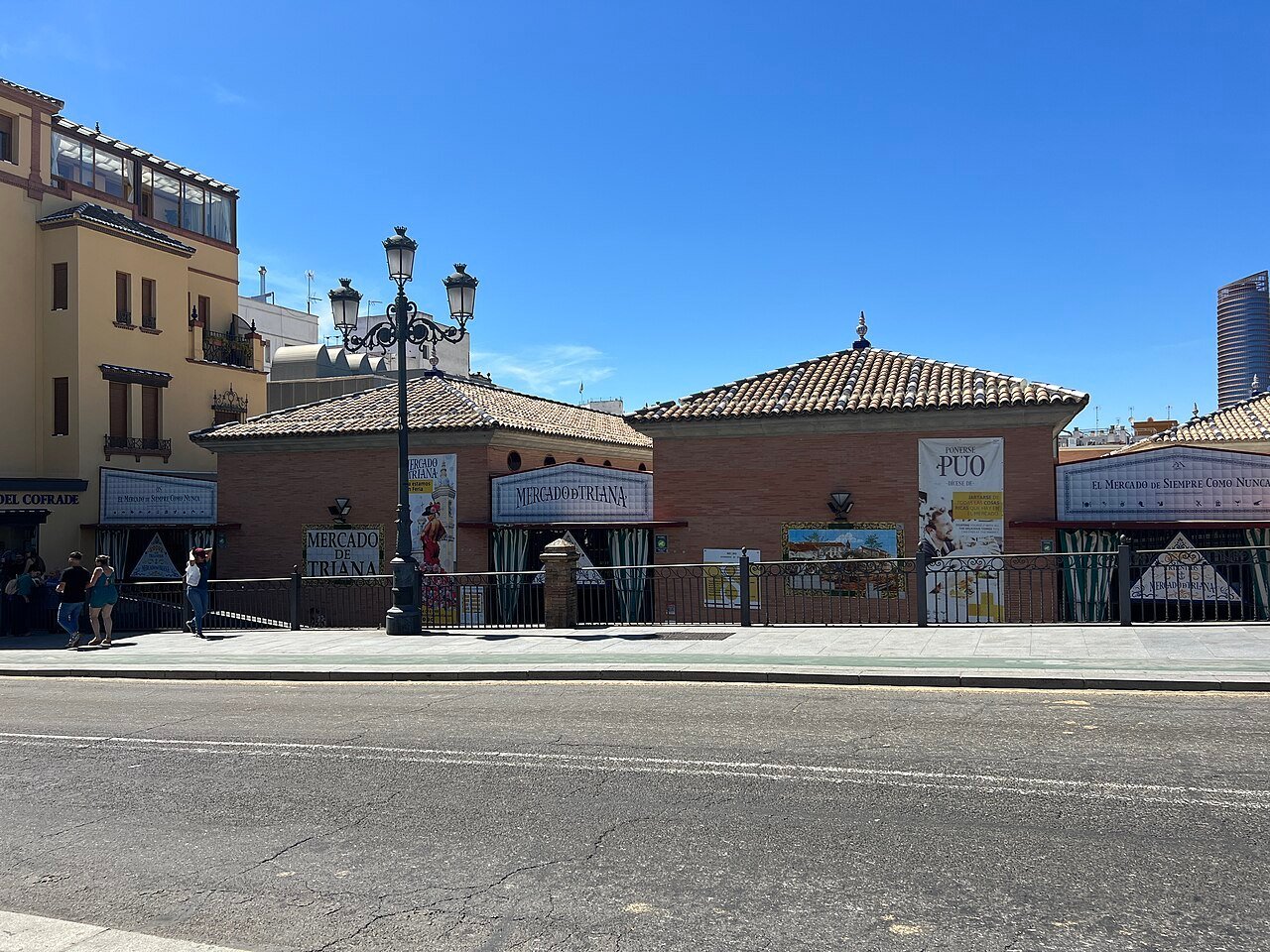
Behind the Altozano, under its tiled signs on Calle San Jorge, stands the Mercado de Triana — the quarter’s stomach and social club. A market has traded on this site since the nineteenth century; the present hall, a cheerful 1990s rebuild faced in the quarter’s own tiles, holds the full Andalusian repertoire: fishmongers with the day’s catch from Huelva, jamonerías hung with hams, cheese and spice stalls, fruit piled like still lifes — and, woven between the counters, a dozen small bars where you can eat what the stalls sell, cooked on the spot. This is the correct Triana breakfast or early lunch: a lap of the hall, then a stool, a glass of something cold and whatever the bar is proudest of. The stalls keep market hours — mornings, roughly 9am to 2.30 or 3pm, closed Sundays — while the bars run on into the afternoon and evening, so time the shopping for the morning and the eating whenever you like.
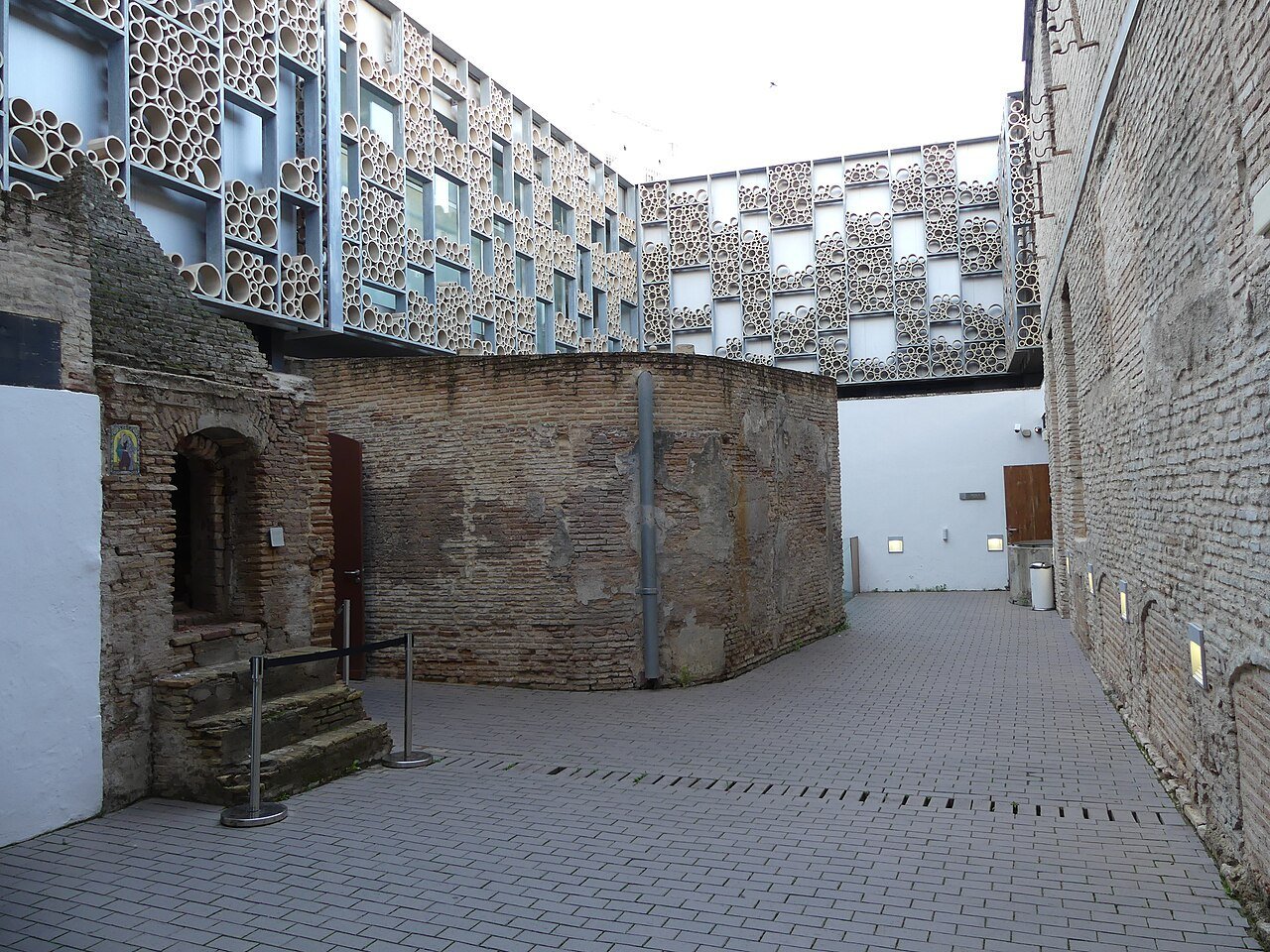
Then go underneath it. The market stands on the Castillo de San Jorge, the Almohad fortress that guarded the bridge of boats and earned a darker fame after 1481, when it became the Seville headquarters of the Spanish Inquisition, from whose shadow the first auto-da-fé in Spanish history processed in February of that year. The castle was demolished in the nineteenth century to widen the market, but its foundations survived below ground, and they are now a small, free museum: excavated walls and courtyards under low light, and an exhibition that tells the Inquisition’s story through the people it processed rather than through instruments of torture, of which there are pointedly none. It takes half an hour. Entry is free; opening runs on museum hours that vary with exhibitions — typically mornings, Tuesday to Sunday — so check the board by the entrance (which sits on the river side of the market, below the Capilla del Carmen) before planning around it.


What to See: The Centro Cerámica Triana and the Pottery Streets
If the market is the quarter’s stomach, pottery is its soul, and the place to understand it is the Centro Cerámica Triana on Calle Callao, a few streets west of the Altozano. The museum occupies the old Cerámica Santa Ana factory — one of the great Triana works, founded in the nineteenth century — and it keeps the industrial bones in place: the bottle kilns still stand in the courtyard, the clay pits and workshops are explained where they stood, and upstairs the finished art runs from Roman and Moorish fragments through the golden age of the painted azulejo to the vast tile schemes Triana supplied for the 1929 Ibero-American Exposition — the Plaza de España across the river is, among other things, a showroom of this quarter’s work. It is a small museum, an hour is plenty, and it is quietly one of the best-value visits in Seville: entry is a couple of euros (free for Seville residents and under-16s, and city tourism lists it as free with an Alcázar ticket — worth asking at the desk), open Tuesday to Sunday and closed Mondays, with hours that shift a little by season.
The museum is also the key to the streets around it. Walk Calle San Jorge, Calle Callao and Calle Antillano Campos afterwards and the shopfronts read differently: this is still a working pottery district, thinner than in its factory heyday but real — workshops and shops selling hand-painted plates, tiles and the classic Triana designs, several in tiled premises that are exhibits in themselves. A painted Triana tile is the one Seville souvenir that is genuinely of its place — made from this river’s clay, in these streets, in an unbroken line from the kilns you have just walked through.
What to See: Santa Ana, the Capilla de los Marineros and the Capillita del Carmen
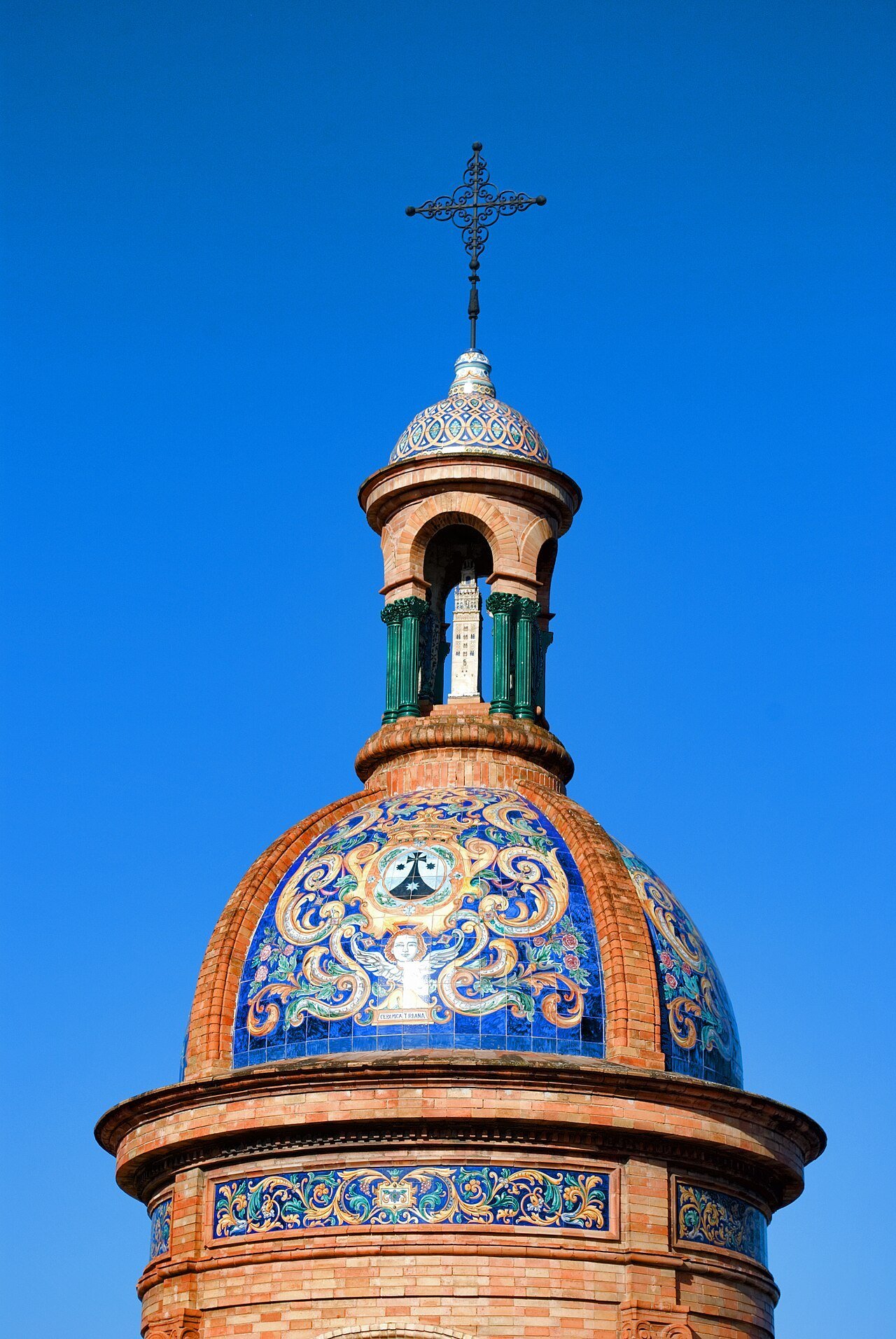
Triana’s churches are not stops on a route; they are the quarter’s living rooms, and three of them tell its whole story. Start with the little one you have already met: the Capilla del Carmen, the tiled chapel at the Triana end of the bridge, built in 1928 to a design by Aníbal González — the architect of the Plaza de España — and nicknamed el mechero, the lighter, for the shape of its brick-and-tile tower. Its dome is a billboard for the quarter’s craft, glazed in Triana ceramics — look closely and you will find even a miniature Giralda worked into it. It is tiny, beloved, and the natural full stop at the end of the bridge.
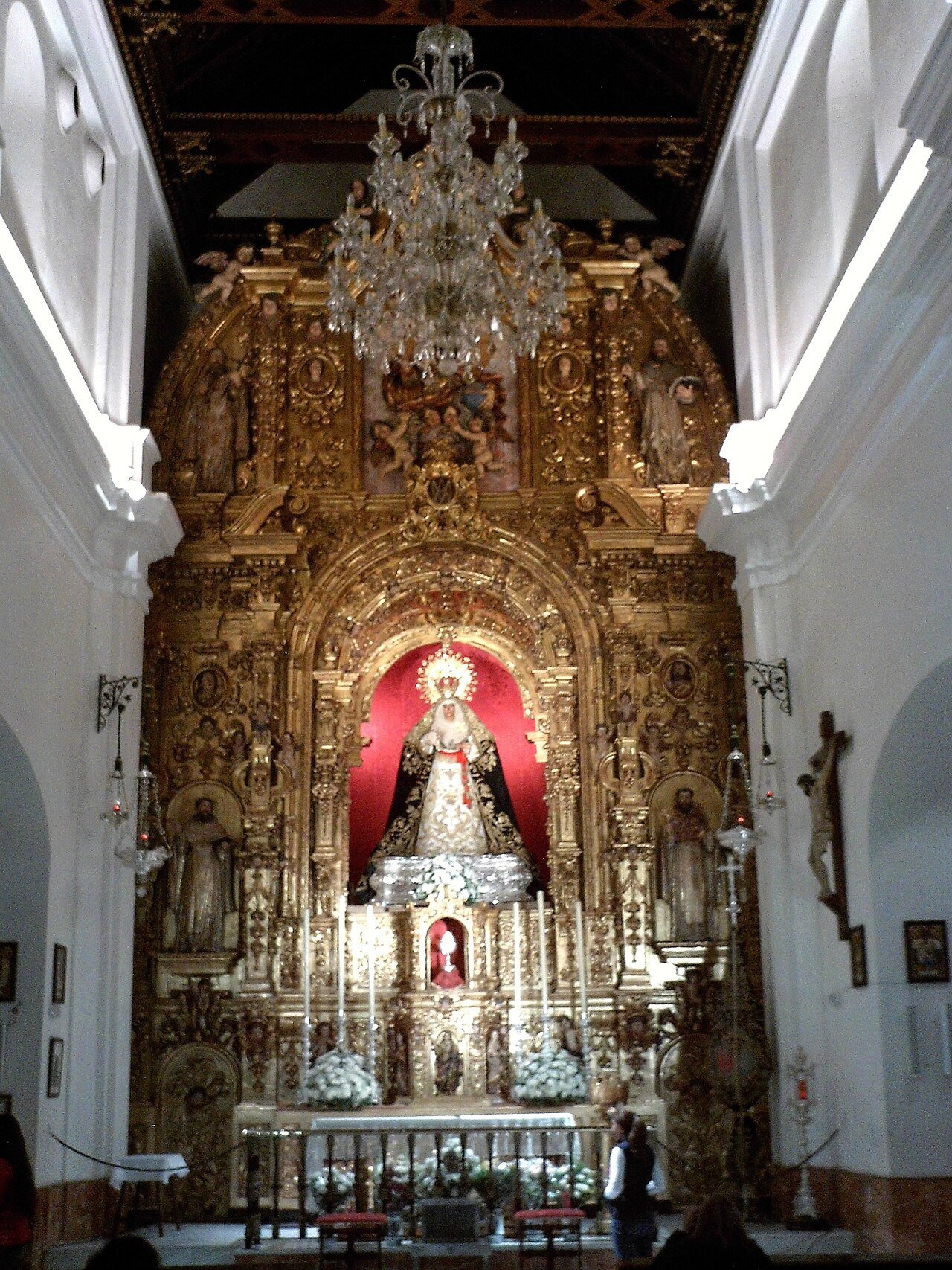
Down Calle Pureza, the quarter’s old main street, stands the Capilla de los Marineros — the Sailors’ Chapel, home of Nuestra Señora de la Esperanza de Triana. The brotherhood that keeps her was founded by the river’s sailors, and her name tells you what she was for: hope, carried on board. Inside, the small chapel blazes — a single gilded altarpiece wall with the Esperanza enthroned at its centre in her embroidered mantle, in a room that smells of wax and flowers. Her great night is the madrugá of Good Friday, when the brotherhood carries her across the bridge in the small hours, through crowds that have waited all night, in one of the supreme moments of Seville’s Semana Santa. The chapel keeps generous hours — mornings and evenings, closed across the middle of the day, entry free — and it is the single most atmospheric interior in Triana.
A few streets south stands the quarter’s giant: the parish church of Santa Ana, founded in 1266 by Alfonso X — legend says in fulfilment of a vow made when an affliction of the eyes was cured — and generally counted the oldest church in Seville, the first raised from the ground after the Christian conquest. Trianeros, inevitably, call it la catedral de Triana, the cathedral of Triana, and it has the scale to back the joke: a fortress-like Gothic-Mudéjar church of brick and tile, its exterior walls studded with ceramic altarpieces, its tower spire glazed in blue. Inside are a fine sixteenth-century main altarpiece and the accumulated art of seven and a half centuries of parish life. It is a working church first — visit outside service times, and expect a modest charge for sightseeing visits when those are running.

What to See: Flamenco and Tapas in Triana
End the day the Triana way. The quarter’s flamenco is not a show laid on for visitors but one of the art’s founding traditions — the singing that rose in the patios de vecinos, the communal courtyards of the old tenements, and was carried into the cafés cantantes and theatres of the world. The great names of the soleá and the Triana styles are honoured here the way saints are, and on any evening the quarter offers the full range: intimate tablaos and flamenco bars along and behind Calle Betis where the audience is half local, guitars in ordinary bars, and now and then a voice from an open window that stops the street. A booked Triana flamenco show in the quarter is the reliable way to hear the real thing at close range — small room, no amplification to speak of, the singer close enough to read.
Eat before it, in the same streets. Triana eats superbly and without ceremony: the market bars at midday, and at night the tapas bars of Calle Betis, Calle San Jacinto and the Altozano’s edges — spinach with chickpeas, salmorejo, grilled fish from the market’s own stalls, and the quarter’s beloved serranito sandwiches. Nobody dresses up, nobody is in a hurry, and the bill will remind you that this side of the river still cooks for its own. Our Plaza de España guide covers the great square a short walk south of the quarter; pair a morning there with a Triana evening and you have seen the 1929 city and the eternal one in a single day.
Practical Info
Getting there. Triana is a walk, not a journey: from the Cathedral, cross the Puente de Isabel II and you are in the Altozano in about ten minutes — the same crossing our Seville Cathedral & La Giralda guide ends with, reversed. The nearest metro is Plaza de Cuba (line 1), a few minutes south of the Altozano in Los Remedios, and city buses thread the Altozano and Calle Pagés del Corro — the quarter’s long, straight main street, useful as your north–south ruler when the smaller streets begin to wander. Everything in this guide sits within fifteen minutes’ walk of the bridge.
How long, and when. Allow half a day for the quarter done properly — an hour in the market and castle, an hour in the ceramics museum, the churches as you pass them — and know that the evening return to Calle Betis is not a repeat but the other half of the experience. Sundays are the quarter’s quiet day (the market stalls rest; the churches fill), Mondays close both museums. In summer, follow the local physics: sights in the morning, shade and a long lunch at midday, Betis and flamenco after dark. Spring and autumn are perfect throughout the day, and the last week of July brings the Velá de Santa Ana, when the quarter parties in its own honour.
Staying in Triana. The quarter makes an excellent base for travellers who want Seville lived-in rather than monumental: small hotels and apartments in converted pottery-era houses, breakfast in a neighbourhood café, and the old town ten minutes away across the bridge when you want it. The comparison our Barrio Santa Cruz guide makes for the old town’s quarter applies here in mirror image — Santa Cruz is the postcard you sleep inside; Triana is the city you come home to.
Tips for Visiting
- Cross the bridge on foot, slowly. The Puente de Triana is not transport, it is the overture — the rings, the river, the old town arranged across the water. Never let a taxi have it.
- Do the market in the morning and the museum under it straight after. Stalls fade by mid-afternoon and the castle keeps shorter hours than you expect; both are at their best before lunch.
- Ask at the ceramics museum about your Alcázar ticket. City listings have it free with one — and either way it costs about the price of a coffee. Cheapest education in Seville.
- Time the churches around the middle of the day. Triana’s chapels close across the siesta hours like everything else here; mornings and early evenings are your windows, and services always come first.
- Book the flamenco, then eat late. A Triana flamenco show followed by tapas on Calle Betis at Spanish hours — ten onwards — is the quarter’s perfect evening, in the quarter’s own order.
- Look for the Giralda through Belmonte. The statue in the Altozano is pierced at the heart, and the tower across the river lines up through it. It is the quarter’s favourite photograph, and it is free.
Travel insurance, sorted
Whether it is a two-week holiday or a longer move, travel insurance is not the most glamorous part of a trip — but it is the one booking you want to have in place before a trip, and while you are already away.
Final Thoughts
Every traveller falls for one side of Seville’s river first, and the falling is usually for the wrong reasons — the old town because it is magnificent, Triana because somebody whispered that it is “authentic”. Walk it properly and the whisper proves true for better reasons than romance: this is a quarter that made things — tiles for an empire’s churches, crews for its fleets, a revolution in the bullring and a music the whole world now borrows — and that has kept its own accent through floods, clearances and fame. Cross the iron rings in the morning for its market and its kilns, and cross back at dusk for its riverfront and its singing, and you will understand the local heresy completely: Seville is a wonderful city, and Triana is its heart, outsourced across the water.
¡Buen viaje!

Photo credits: The Puente de Triana from the river — Diego Delso, CC BY-SA 4.0 · Plaza del Altozano, inside the Mercado de Triana, the castle remains and the Capilla de los Marineros — CarlosVdeHabsburgo, CC BY-SA 4.0 · Calle Betis in the morning light — Grez, CC BY-SA 3.0 · Calle Betis after dark and a painted azulejo panel at the Centro Cerámica Triana — Anual, CC BY-SA 4.0 · The Mercado de Triana from Plaza del Altozano — Chabe01, CC BY-SA 4.0 · The Castillo de San Jorge from the bridge — Gzzz, CC BY-SA 3.0 · The Capilla del Carmen’s tiled dome — Anual, CC BY 3.0 · The church of Santa Ana — Anual, CC BY 3.0. All via Wikimedia Commons.



One Comment