Santos Juanes Valencia: The Complete Guide to the Market Church

Short Answer
Santos Juanes — the Real Parroquia de los Santos Juanes, also called San Juan del Mercado — is the great Baroque parish church that faces the Lonja de la Seda across Valencia’s market square, and after one of the most ambitious church restorations in modern Spain it is, quite simply, unmissable. A Gothic church rebuilt in Baroque dress between 1693 and 1702, it holds Antonio Palomino’s vast ceiling frescoes — 1,200 square metres of painting, burned in 1936, blackened for decades, and recovered to around 90% of their original colour by a restoration that finished in 2025. The church reopened on 27 November 2025: book the Santos Juanes entry ticket with audioguide (€15, €12 reduced, audioguide in seven languages), walk in under the restored ceiling, and give it at least an hour — including the “Barroc Immersive” video-mapping show, which recreates the one Palomino painting the fire destroyed for good.
Table of Contents
- A Mosque by the Market Gate
- The Gothic Church of the Two Johns
- The Baroque Remake, 1693–1702
- The West Front and the O de Sant Joan
- Inside: One Vast Nave
- Palomino’s Ceiling: 1,200 Square Metres of Sky
- Els Blancs: Jacob and the Twelve Tribes in White Stucco
- The Presbytery and the Travelling Retablo
- The Chapel of the Communion
- 19 July 1936: The Fire
- The Restoration, 2021–2025: A Ceiling Brought Back
- Practical Info
- Tickets and Booking
- Opening Hours
- Getting There
- When to Go
- How Long You Need
- Tips for Visiting
- What to See Nearby
- Final Thoughts
The Short Version
If you only have a morning in old Valencia, make it this triangle: the Lonja, the Mercado Central, and the church that watches over both. Santos Juanes is one of the largest churches in the city, a working parish that has served the market quarter since the 1240s, and its interior is now the single most dramatic comeback story in Valencian heritage — a ceiling that spent most of a century under soot and bad repairs, glowing again in full Baroque colour. It earns its place on any list of the best things to do in Valencia; pair it with La Lonja de la Seda across the square, arrive when the doors open for the quietest look at the ceiling, and do not skip the little shops tucked under the church’s own façade — they have been trading there for three centuries.
A Mosque by the Market Gate
The church stands where Valencia’s market has always stood, and its first life was not Christian at all. Before 1240, when the city was still Muslim Balansiya, a mosque occupied this plot outside the Arab walls, near the Bab al-Qaysariya gate, on the edge of the market quarter of Boatella. After Jaume I conquered Valencia in 1238, the mosque was converted into a Christian hermitage, and Santos Juanes became one of the city’s “foundational parishes”, the first ring of churches planted to organise the new Christian city.
The position explains everything that followed. A parish planted beside the market became the market’s church: where traders worshipped, confraternities met, and commercial wealth was eventually spent on art. The two patron saints came with the territory — John the Baptist and John the Evangelist — and their symbols, the Lamb and the eagle, appear all over the building, inside and out; once you know to look for them, you will spot the pair on almost every surface.
The church’s Valencian name tells the same story: Església de Sant Joan del Mercat, Saint John of the Market. Everything about Santos Juanes — its size, its decoration, even the little shops built into its façade — flows from eight centuries of standing at the commercial heart of Valencia.
The Gothic Church of the Two Johns
The mosque-hermitage did not last. In the early 1300s the parish built a proper church in Valencian Gothic: a single wide nave with chapels tucked between the buttresses, the standard plan for the city’s parish churches. Fire then became the rhythm of its life. A blaze in 1311 destroyed the first Gothic church, and it was rebuilt larger — local tradition holds that in this rebuilt church the young San Vicente Ferrer, Valencia’s patron saint, preached his first sermon, on the feast of St John the Baptist. A second great fire in 1592 gutted the presbytery, which was repaired under the Patriarch Archbishop San Juan de Ribera and given a magnificent new high altarpiece by Juan Miguel Orliens, said to contain more than 3,000 carved figures. Remember that retablo: its fate, three centuries later, is one of the saddest lines in this church’s story.
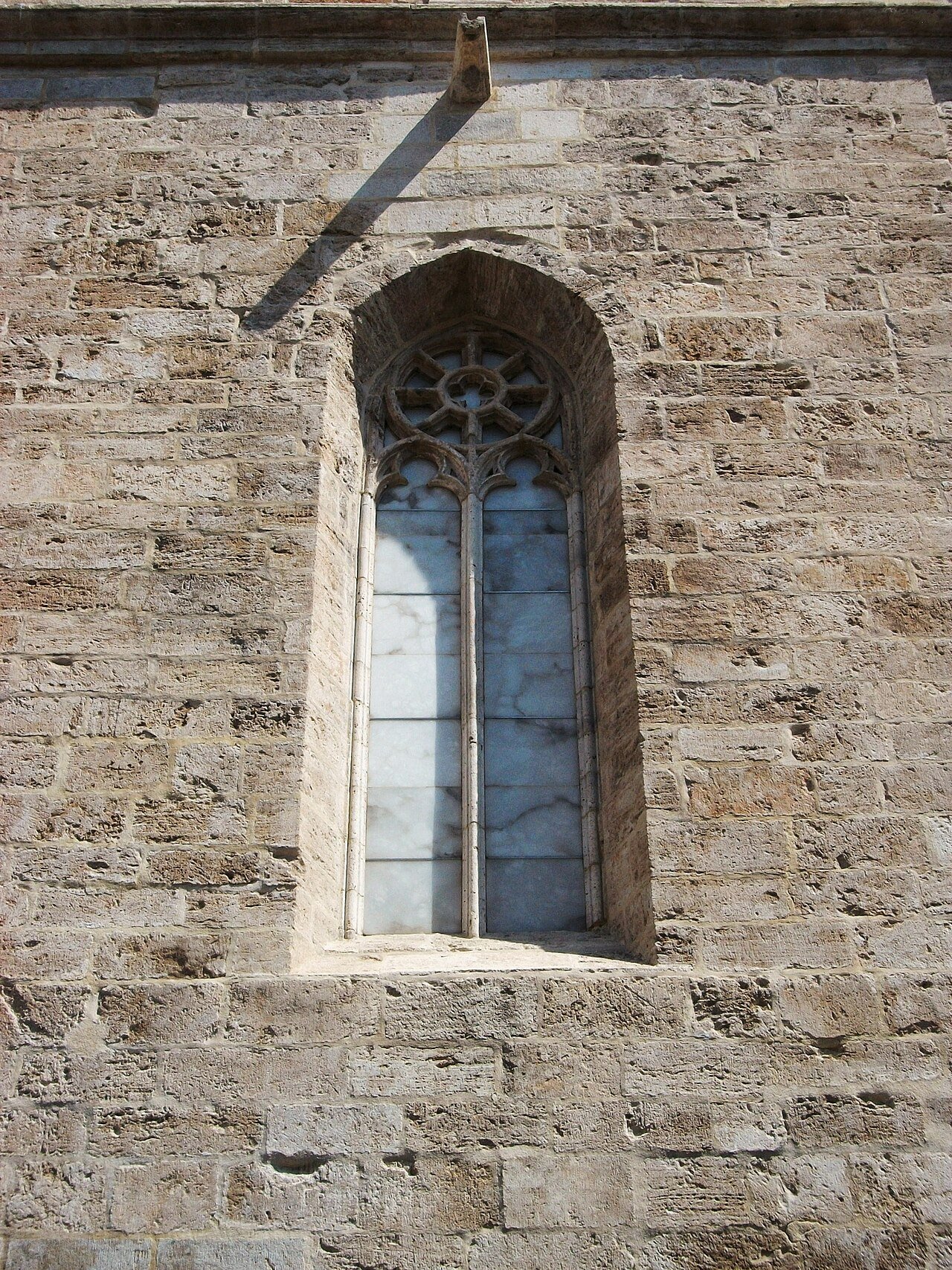
What survives of the Gothic building is mostly bones. The nave’s structure is Gothic under its Baroque skin, and on the side facing the Mercado Central an abandoned remodelling left original Gothic windows exposed in the wall — plain, pointed openings that look almost austere next to the decorated façades. In the mid-1600s the parish added the Chapel of the Communion. But the Gothic church was about to be swallowed whole by something far more ambitious.
The Baroque Remake, 1693–1702
Between 1693 and 1702 the parish carried out one of the great Baroque transformations in Spain, and it gave Santos Juanes the face you see today. The money and the taste came from José Gernesio y Perellós, third Count of Parcent, who lived beside the church and brought two Lombard artists from Italy to remake it: the sculptor Giacomo Bertesi and the stuccoist Antonio Aliprandi. The iconographic programme — the way painting, sculpture and stucco would speak to each other across the whole interior — was devised by Canon Vicente Vitoria together with the painter Antonio Palomino, of whom much more below.
Start outside, on the market side, because that is where the Baroque church shows off. The east end of the church — the cabecera — was rebuilt as a piece of urban theatre facing the Lonja, to designs by Bertesi and Aliprandi with the Valencian master Bernardo Pons. A raised platform runs along the façade, and underneath it are the covachuelas, a row of little vaulted rooms — the casillas de San Juan — that have served as market and second-hand shops for three hundred years and still trade today. Above them, statues by Leonardo Julio Capuz and Felipe del Corral line the front: San Francisco de Borja, San Juan Bautista, San Luis Bertrán and San Juan Evangelista, left to right. At the centre, sheltered under a little stone canopy, stands the image of the Virgen del Rosario, carved by Bertesi himself and flanked by the two titular saints.
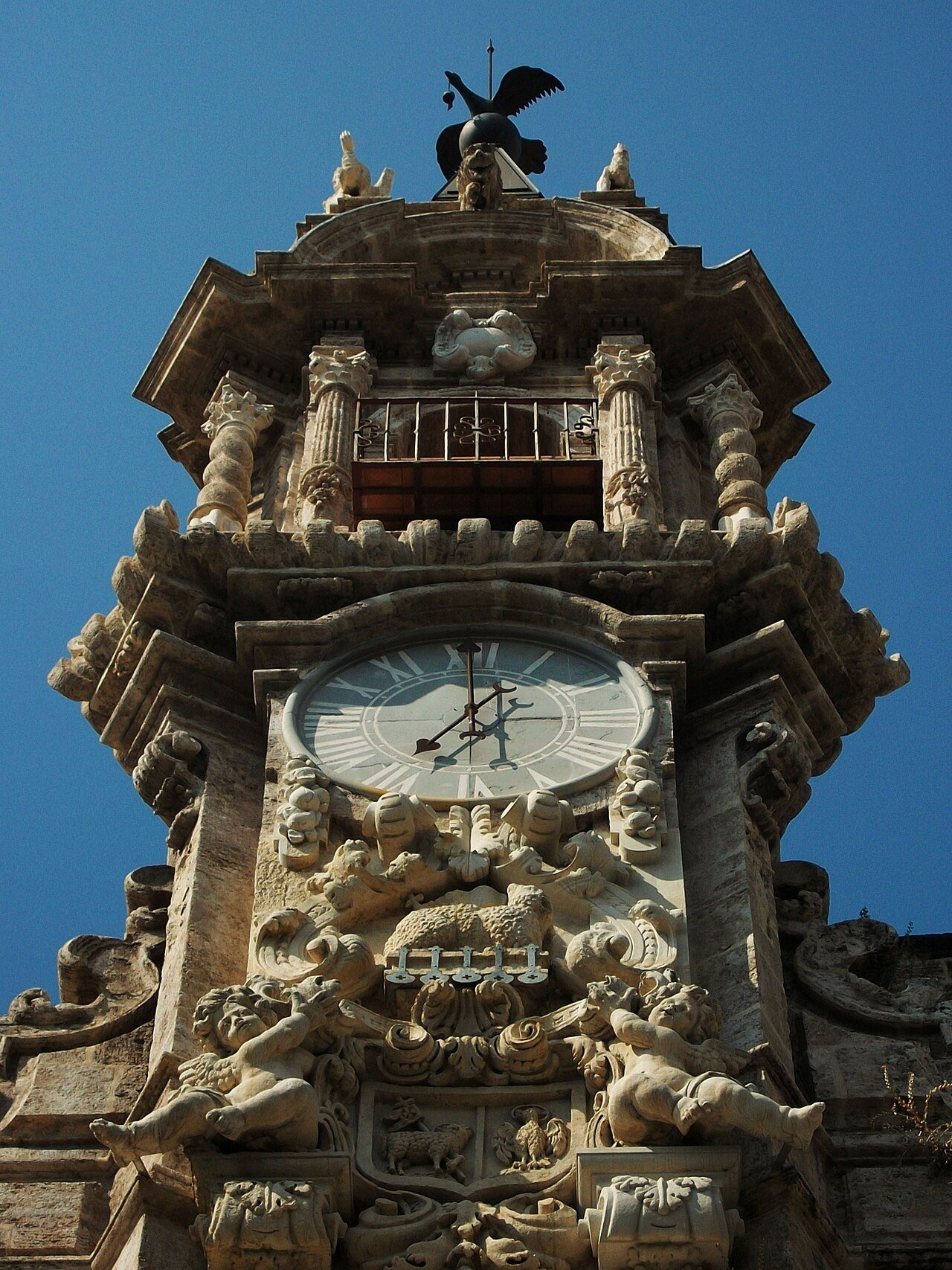
Crowning the whole composition is the campanil, a triangular-gabled bell gable of extraordinary richness: three wrought-iron balconies between twisted Solomonic columns, statues of San Vicente Mártir, San Vicente Ferrer and San Lorenzo, and the church clock, which has told the market its hours for three centuries. Below the clock face, look for the Lamb resting on the book with seven seals — the Baptist’s symbol, straight out of the Revelation his namesake the Evangelist wrote. And at the very top, perched on a pyramid and a sphere, sits an eagle with an inkwell in its beak: the Evangelist’s symbol, doubling as the weather vane. Valencians call it the Pardalot de Sant Joan — the “big bird of Saint John” — and it is one of the city’s best-loved skyline details.
The West Front and the O de Sant Joan
Walk around to the other end of the church, to the Plaça Ciutat de Bruges, and the mood changes completely. The west façade — the feet of the church — is a plain wall of Gothic ashlar with a single astonishing feature: a gigantic blind oculus, the O de Sant Joan. It was conceived as a huge rose window, among the largest attempted in the old Crown of Aragón, but it was never glazed; instead the great stone ring frames a small window, and in a later century the blank disc was painted as a sundial, inscribed Ave Maria, with the eagle of St John perched beneath it and the Lamb carved on the portal below. A rose window that became a clock of sunlight: it is the perfect emblem of this practical, market-side church.

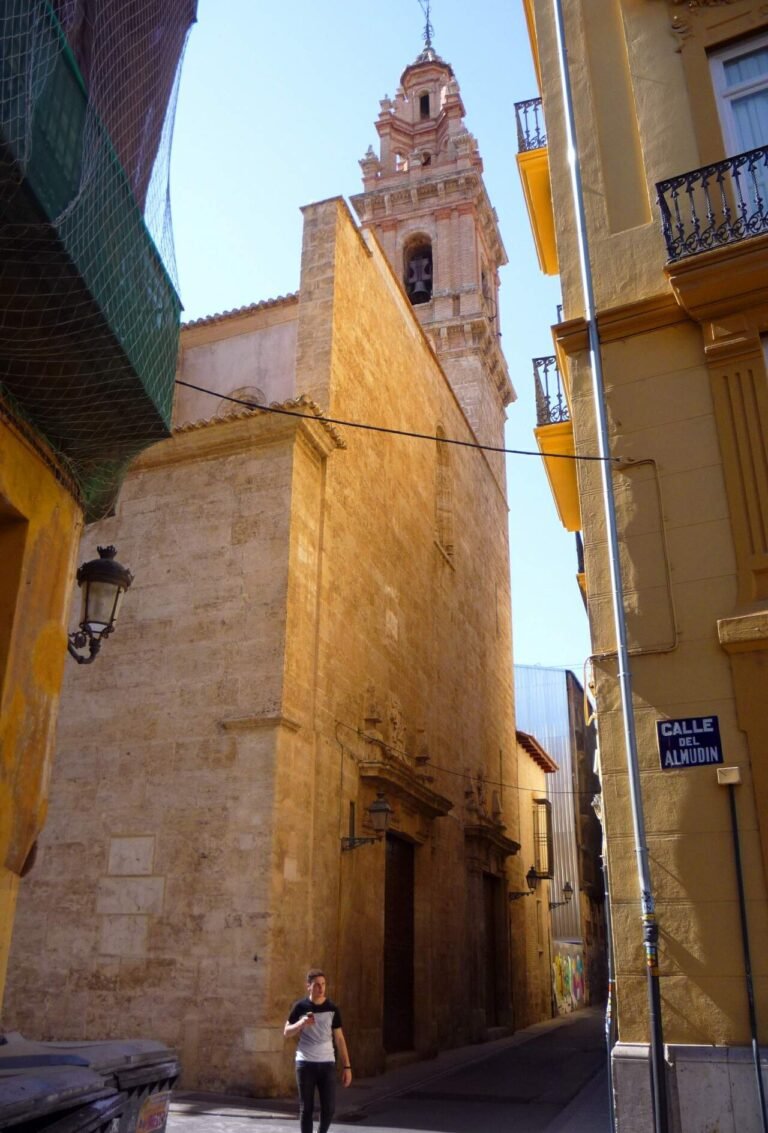
The bell tower stands beside the west front — a sober stone tower quite unlike the exuberant market-side campanil, built across the seventeenth century and finished with a little tiled lantern. From the Bruges square you can read the whole biography of the building in one view: Gothic west wall, Baroque tower, and the long flank of the nave running back towards the market.

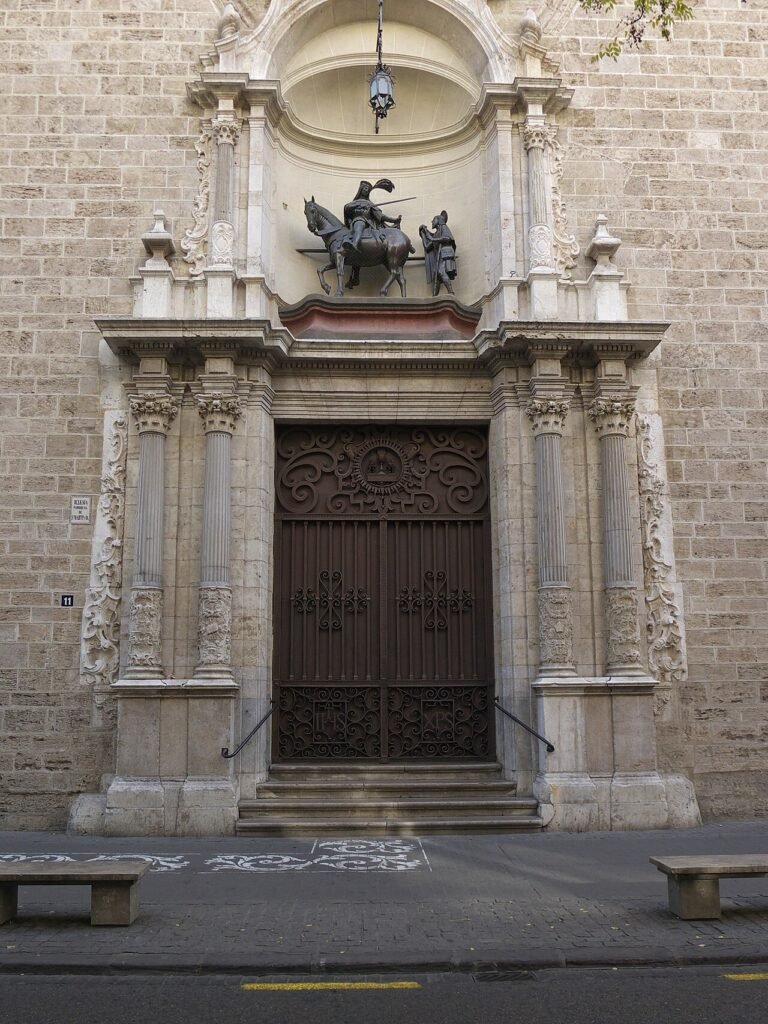
One more face deserves a look: the south portal, on the Carrer Vell de la Palla. It is a full Baroque doorway in its own right, framed by Ionic columns, with the Lamb in a wreath above the lintel and a statue of the Virgin in the niche — the everyday entrance for generations of market families, and a foretaste of the stucco exuberance waiting inside.

Inside: One Vast Nave
Step in, and the first surprise is scale. Santos Juanes is a single-nave church — no aisles, no forest of columns — and the nave is one of the widest and grandest in Valencia, a great preaching hall wrapped in painted and gilded decoration. The Baroque remodelling lowered the chapel ceilings to make room above the arches for a ring of oval medallions telling the lives of the two Saints John, and covered the Gothic vault with a new barrel bóveda designed from the start as a single gigantic picture surface.

The second surprise is how unified it all is. This was a deliberate, single artistic campaign — sculpture, stucco and fresco conceived together by Vitoria and Palomino — and after the restoration it reads again as one work of art rather than a collection of objects. Take a seat in the middle of the nave before you do anything else, and just look up.
Palomino’s Ceiling: 1,200 Square Metres of Sky
Antonio Palomino (1655–1726) was court painter to Carlos II, the last Spanish Habsburg, and in 1697 the king effectively sent him to Valencia for this church. Palomino painted the presbytery and the entire vault — some 1,200 square metres of fresco, the largest surface he ever painted and one of the largest Baroque fresco cycles in Spain. The work was delivered on St John’s day, 1701.
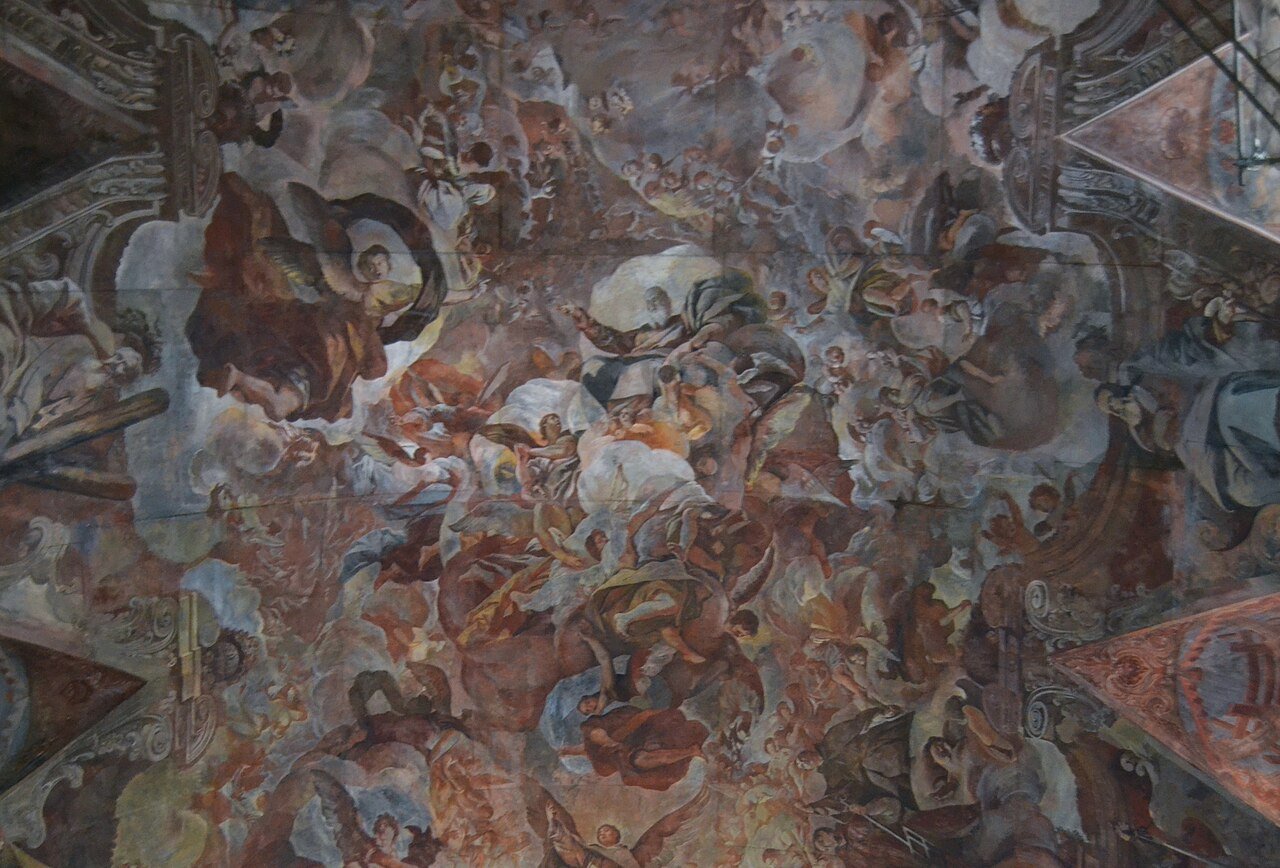
The programme is a vision of heaven organised around the church’s two patrons. At the centre unfolds the Glory of the Holy Trinity; around it, the Book of the Seven Seals opened by the Lamb — the Evangelist’s Revelation made paint — the Immaculate Virgin with the moon at her feet, the two Saints John, and tier upon tier of the blessed: Virgins, Patriarchs, Doctors and Angels, the saints of the Apocalypse, St Michael casting down Lucifer, and, in a place of honour near the presbytery, San Vicente Ferrer, who had preached in the Gothic church below. Along the nave the Apostles sit enthroned on clouds. It is theology you can read from a pew, and the audioguide — which even includes drone footage of the ceiling — is genuinely worth using here, because half the cast is twenty metres above your head.

What you are looking at is also a rescue. For most of the twentieth century this ceiling was a rumour — darkened, flaking, partly hidden under the botched repairs described below — and older guidebooks wrote it off as lost. It was not lost; it was waiting. The colours you see now, luminous ochres, blues and flesh tones, are overwhelmingly Palomino’s own, cleaned and consolidated by the 2021–2025 restoration.
Stand under the vault as long as you like, then book the show version of the same story: the entry ticket with the multimedia audioguide includes the option of the Barroc Immersive session, which turns the one painting that could not be saved — the apse fresco — into light and music on the very wall where it hung.
Els Blancs: Jacob and the Twelve Tribes in White Stucco
Now look sideways. Standing on brackets along the nave, at the level of the chapel arches, is one of the most original sculptural groups in Spanish Baroque: thirteen figures in gleaming white stucco — the patriarch Jacob and his twelve sons, the heads of the Twelve Tribes of Israel. Valencians call them els blancs, “the white ones”, and the name has stuck for three centuries.
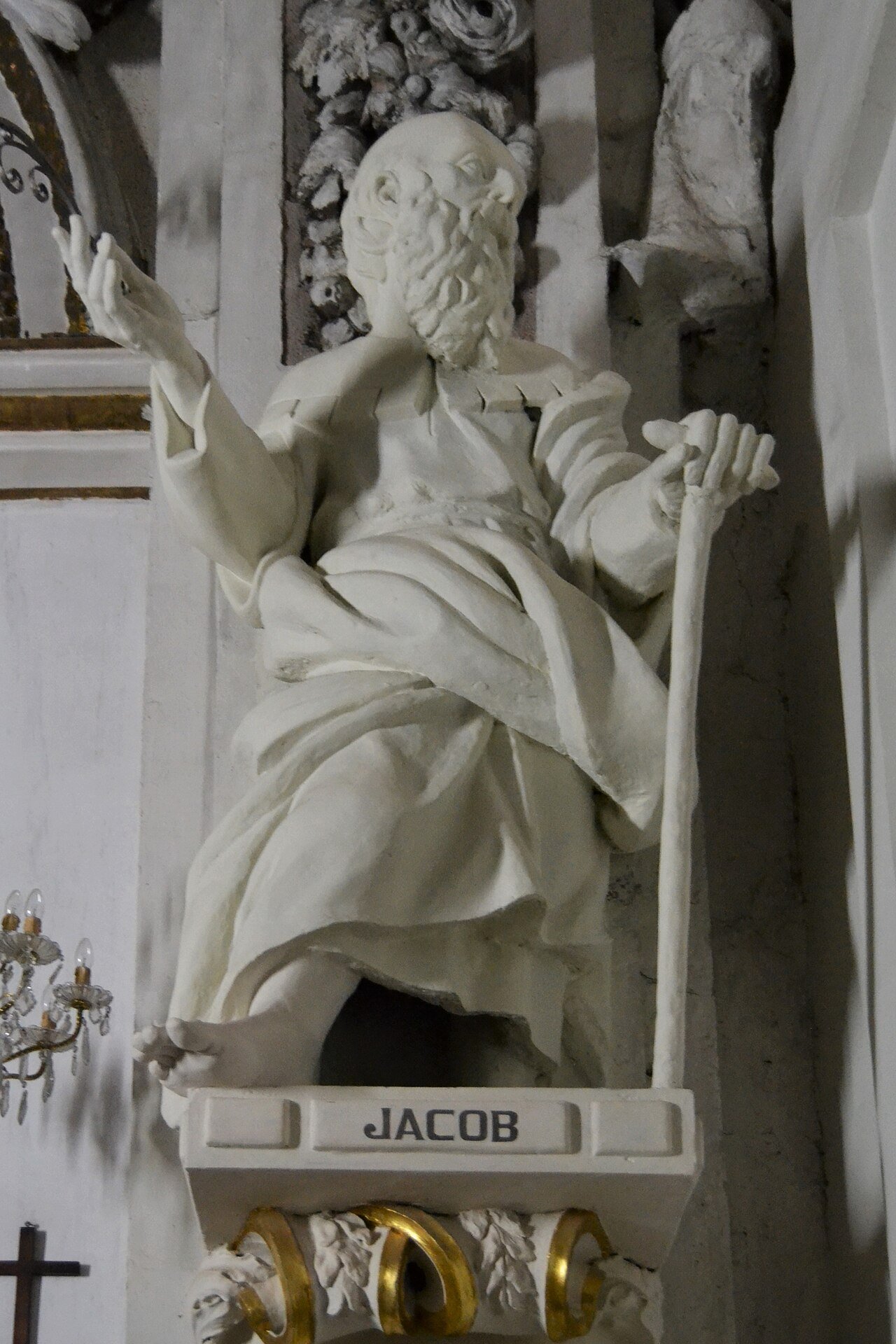
They are the work of Bertesi and Aliprandi, modelled in the Italian stucco forte technique between 1693 and 1702 — the first iconographic programme of this complexity attempted in Valencia, and the sculptural half of the conversation Vitoria designed: below, the Old Testament tribes in white stucco; above them, painted by Palomino, the Apostles who inherited their mission. Aliprandi’s hand is everywhere between the figures, in garlands of stucco fruit and flowers spilling down the pilasters. Fire and twentieth-century repairs damaged the stuccos badly, and a large part of the recent restoration was devoted to them: recovering lost modelling, stripping repaints, and bringing back the crisp white and gilded finishes.
The Presbytery and the Travelling Retablo
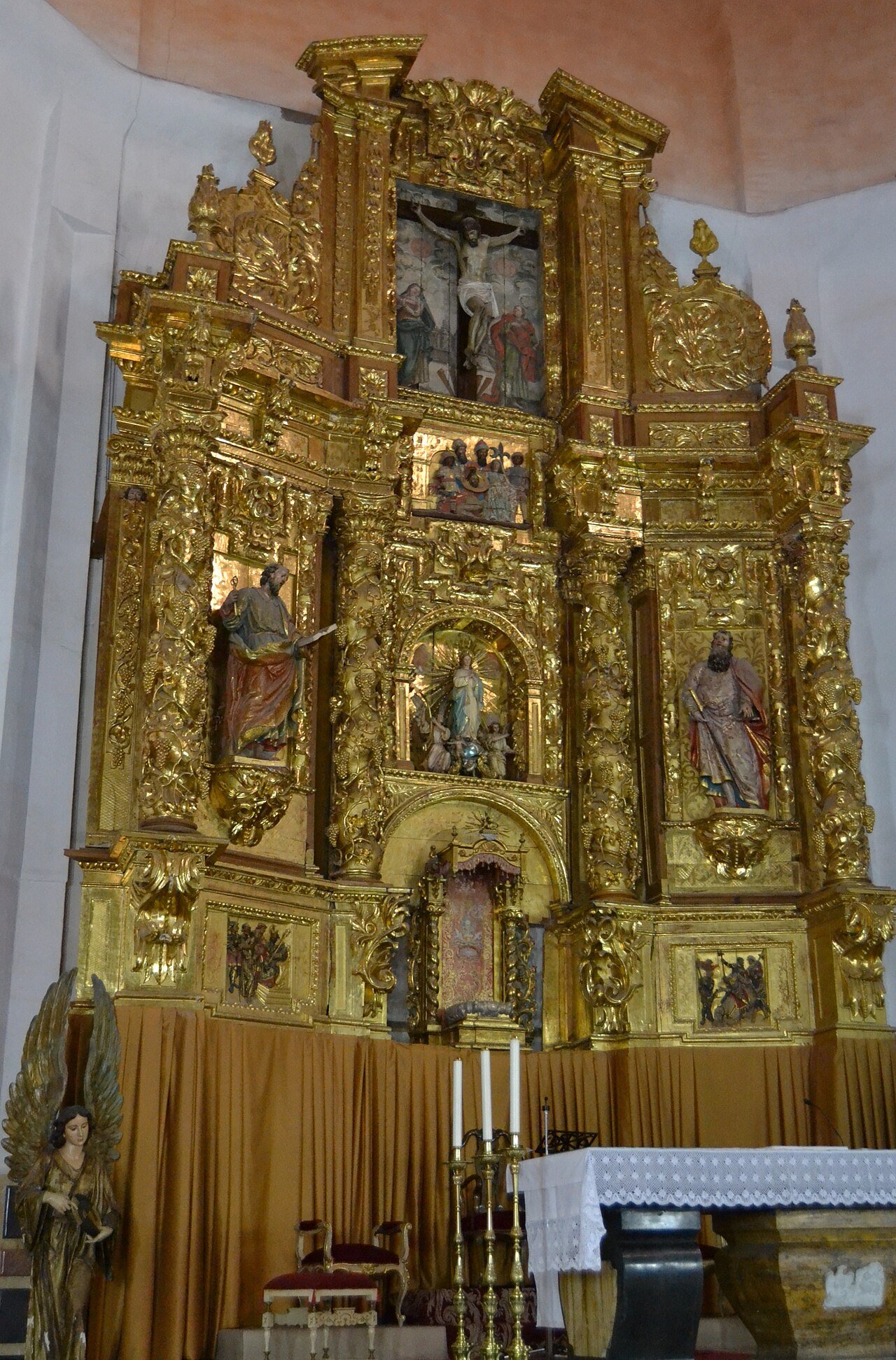
The presbytery tells the church’s whole modern story in one glance. The gilded high altarpiece that fills it is handsome, two tiers of polychromed and gilded wood with the Inmaculada in the central niche, San Pedro and San Pablo at the sides and Christ on the Cross above — but it is not Valencian, and it was never made for this church. It came from the church of Betolaza in Álava, in the Basque Country, brought here to fill the void left in 1936, when the great Orliens retablo of 1592 — the one with 3,000 figures — burned with everything else. Flanking the altarpiece stand two large statues of the titular saints by the Valencian sculptor Octavio Vicent, twentieth-century works that hold their own remarkably well in Baroque company.

And above the retablo is the presbytery’s party trick. Palomino’s fresco on the apse semi-dome was the one major painting the 1936 fire destroyed outright — it survives only in a pre-war photograph. The restorers refused to fake it in paint. Instead, the Barroc Immersive experience recreates it digitally, projected onto the semi-dome with music recorded live in the church, so that for a few minutes the lost painting burns bright again in light. It is honest, moving, and unlike anything else in Valencia.
The Chapel of the Communion
Tucked against the nave is the church’s second complete interior: the Chapel of the Communion, added in the mid-seventeenth century, before the great Baroque campaign, and decorated in a cooler, more classical taste — marble-panelled walls, a domed ceiling, a serene altarpiece of the Immaculate Conception. The frescoes in its vault, including a Communion of the Virgin, are among the quieter pleasures of the visit, and the chapel is still used for worship, which gives it a lived-in calm.

19 July 1936: The Fire
On 19 July 1936, days into the Spanish Civil War, Santos Juanes was set on fire. The Orliens retablo burned. The images and furnishings burned. Palomino’s frescoes were scorched and then slowly blackened by the smoke of the burning church; the apse semi-dome painting was destroyed completely. What the flames left, the following decades nearly finished: a well-meant 1960s restoration glued detached fresco fragments to plywood boards with animal glue, and the salts that followed hardened and bloomed across the paint surface, locking the damage in.

The church stayed open as a parish — Mass under a soot-black ceiling — and for decades that was simply what Santos Juanes looked like: a great church in mourning. If you visited before 2021, this is the interior you remember, and it is worth coming back precisely because of that memory.
The Restoration, 2021–2025: A Ceiling Brought Back
The rescue took forty years of preparation. Teams from the Universitat Politècnica de València pioneered techniques on this very church — including cleaning frescoes with bacteria that digest salts and hardened glue, led by the microbiologist Pilar Bosch — and those trials became the foundation of the full project. On 19 January 2019 the Archdiocese of Valencia and the Fundación Hortensia Herrero signed the agreement to finish the job, and on 16 June 2021 the works began: the same pairing that had restored San Nicolás, Professor Pilar Roig directing the restoration and the architect Carlos Campos coordinating, funded entirely by the Foundation at a reported cost of close to €10 million.
The team cleaned and consolidated all 1,200 square metres of Palomino’s fresco and recovered around 90% of his original colour — a figure nobody dared predict in 2021. Detached fragments were lifted off their failing plywood mounts and re-supported on carbon fibre and aluminium; cleaning combined gel emulsions, laser and the bacteria technique proven here; and the passages that were truly lost were reinstated with digital transfers made from J. Alcón’s photograph of the frescoes taken before the 1936 fire, so the ceiling reads whole again without pretending the fire never happened.
The church reopened, complete and scaffold-free, on 27 November 2025, in a ceremony led by Archbishop Enrique Benavent. What you visit today is not a work in progress: it is the finished result, run as a cultural visit while the building continues its parallel life as a working parish. Santos Juanes waited ninety years for this. It was worth the wait.
Practical Info
Address: Plaza del Mercado, 46001 Valencia — directly across the square from the Lonja de la Seda, with the Mercado Central at its shoulder.
What it is: the Real Parroquia de los Santos Juanes, a working parish church (declared a National Historic-Artistic Monument in 1947) that also runs a ticketed cultural visit with audioguide. Sightseeing pauses during services.
The one rule to know: this is a church first. Shoulders covered, voices down, and no wandering with the audioguide while Mass is on.
| Best for | Baroque art lovers, fresco hunters, anyone who thinks they’ve “done” Valencia’s old town |
| Entry | €15 general / €12 reduced (audioguide included); under the combined ticket with San Nicolás and the Centro de Arte Hortensia Herrero, €32 |
| Time needed | 45–60 minutes; 75–90 if you stay for Barroc Immersive |
| Nearest metro | Àngel Guimerà (lines 1, 2, 3, 5, 9), about 7 minutes on foot; Xàtiva (3, 5, 9), about 10 minutes |
| Don’t miss | The moment the Barroc Immersive projection lights the apse — Palomino’s lost painting, back from the dead |
Tickets and Booking
Buy at the door or online through the church’s own ticket site; in high season and at weekends, booking ahead is the safer play. The standard visit is the Entrada Inmersiva: €15 general, €12 reduced for students, pensioners, large families, disabled visitors, the unemployed and Valencia Tourist Card holders. Every ticket includes the multimedia audioguide in Spanish, Valencian, English, Italian, French, German and Dutch — use it; the ceiling’s cast of hundreds needs a narrator. The same visit is sold on GetYourGuide as the Santos Juanes entry ticket with audioguide, with two options at booking: general admission, or admission including the Barroc Immersive video-mapping session. If the immersive show is on your list, choose that option and check the session times for your day on the official site before you go.
Two upgrades are worth knowing about. The church’s own guided visit (€18) runs daily at 12:30, and its 90-minute panoramic visit (€22, Fridays at 19:00, in Spanish and English) pairs the interior with the Lonja–Mercado triangle outside. And if you are also visiting San Nicolás — you should be — the combined ticket covering Santos Juanes, San Nicolás and the Centro de Arte Hortensia Herrero costs €32 (€25 reduced) and stays valid for five days.
Opening Hours
Cultural visits run every day: Monday, Tuesday, Thursday and Friday 10:00–20:00; Wednesday 13:00–20:00; Saturday 10:00–18:00; Sunday 13:00–20:00. Last entry is 30 minutes before closing. The shorter Wednesday and Sunday mornings are the parish protecting its Masses — this is a working church, and sightseeing yields to worship, so expect the cultural visit to pause during services on any day. Hours can shift on feast days; the official site (santosjuanesvalencia.com) carries the current calendar.
Getting There
You will probably arrive on foot: Santos Juanes stands in the Plaza del Mercado, in the middle of the old town’s greatest hits, two minutes from the Plaza de la Reina side of the quarter and ten from the Cathedral. The church is the building with the clock and the eagle on top, directly facing the Lonja’s crenellated silhouette.
By metro, Àngel Guimerà (lines 1, 2, 3, 5 and 9) is the closest station, about seven minutes’ walk; Xàtiva (lines 3, 5 and 9), beside the Estación del Norte, is about ten. City buses stop around the square and on the Plaza del Ayuntamiento. Driving into the market quarter is a penance — narrow, largely pedestrianised streets — so come by metro or on foot.
When to Go
For the ceiling, come in the morning. The cultural visit opens at 10:00 (13:00 on Wednesdays and Sundays), the nave is at its quietest in the first hour, and you can sit in the centre pews with the vault almost to yourself. The audioguide’s drone footage is a bonus, not a substitute — nothing replaces standing under the real thing with nobody jostling your elbows.
Seasonally, Santos Juanes is a headline sight again after its November 2025 reopening, so expect company in the Fallas weeks of March, at Easter and through the summer; winter weekdays are the connoisseur’s slot. Pair the visit with the market’s rhythm: church first, then the Mercado Central while the stalls are still in full cry, then lunch behind the Lonja.
How Long You Need
Give it an hour. The audioguide route through the nave, chapels and presbytery takes about 45 minutes at a natural pace; add 15–20 minutes if your ticket includes a Barroc Immersive session, and another few simply for sitting in the nave doing nothing but looking up — budget for that too, it is the best part. Ninety minutes is generous; thirty is a disservice.
Free Valencia travel guide
Planning a trip to Valencia? Get our free one-page Valencia checklist: what to book ahead, what to skip, and the paella places we actually eat in.
Tips for Visiting
- Book the immersive option if it’s offered. The Barroc Immersive session is the only way to “see” Palomino’s destroyed apse painting, and it is the emotional peak of the visit.
- Look for the two symbols. The Lamb (the Baptist) and the eagle (the Evangelist) repeat across the façade, the clock tower, the west portal and the interior — a good game for children, and a shortcut to reading the building.
- Don’t confuse your San Juans. Valencia has two famous churches of St John a short walk apart. This one, Santos Juanes, is the market church by the Lonja; San Juan del Hospital, the austere thirteenth-century hospital church, is a different building entirely — see both, they are perfect foils.
- Check the covachuelas. The little shops under the market façade have traded since the Baroque rebuilding; they are part of the monument, not an intrusion on it.
- Combine the ticket. If San Nicolás is on your list — it should be — the €32 combined ticket with Santos Juanes and the Centro de Arte Hortensia Herrero, valid five days, is the best-value heritage buy in the city.
- Respect the parish. Masses continue daily; if a service is on, wait quietly at the back or come back after — the cultural visit pauses, and the church is worth the patience.
What to See Nearby
You are standing in the densest square kilometre of historic Valencia. Across the square is the Lonja de la Seda, the Gothic silk exchange and UNESCO World Heritage Site that has faced this church for five centuries — the pair were built to impress each other, and they still do. At your shoulder is the Mercado Central, one of Europe’s great food halls, and the obvious next stop. A ten-minute walk north-east brings you to Valencia Cathedral and the Miguelete tower; on the way, the Plaza Redonda makes a charming detour. And for the perfect counterpoint, walk ten minutes east to San Juan del Hospital, the sober church founded in 1238 — everything Santos Juanes is not: plain where this is painted, silent where this is theatrical, and just as moving.
Travel insurance, sorted
Whether it is a two-week holiday or a longer move, travel insurance is not the most glamorous part of a trip — but it is the one booking you want to have in place before a trip, and while you are already away.
Final Thoughts
Every great city has a building that embodies its luck, and Santos Juanes is Valencia’s: burned in 1311, burned in 1592, burned again in 1936, smothered in soot and bad glue — and now, ninety years after its worst night, glowing again in the colours its painter mixed in 1701. Go for the ceiling; 1,200 square metres of recovered Baroque sky is reason enough. But stay for what it means: a market parish that refused, across eight centuries, to stop being the most beautiful room in its neighbourhood. The Pardalot de Sant Joan still turns in the wind above the square. Below it, at last, the church looks the way it was meant to.
¡Buen viaje!

Photo credits: Enric (CC BY-SA 4.0), Joanbanjo (CC BY-SA 3.0), Rafa Esteve (CC BY-SA 4.0) and Archivo de Arte Valenciano (public domain), via Wikimedia Commons.