15 Best Spanish Towns to Visit: Beautiful Small Towns From Ronda to Baeza
Spain’s cities get the itineraries, but its small towns get the love letters — and the love is not always well aimed. The towns on most lists are the famous handful, photographed from the same three angles, while whole provinces of equally deserving places go unmentioned. This list of the best Spanish towns to visit tries to aim better. Every entry is a town, not a city and not a single sight: somewhere with its own streets, its own kitchen and its own reasons to stay the night. The spread runs deliberately wide — eleven regions, from a gorge town in Andalusia to a fishing port under the green hills of Asturias and a stone village in Mallorca’s mountains.
Each town gets the same honest treatment: the one thing it is famous for, what you actually do there, who it suits and who should skip it, and exactly how you reach it — by train where a train exists, with the necessary bus or drive named plainly where it does not. Our guide to the best places to visit in Spain covers the cities and headline sights; think of this as its small-town companion, and of the two Ronda and Cadaqués entries they share as the short version and the full story. At the end, a short section strings the fifteen into routes, because the real pleasure of Spanish towns is rarely one town — it is three of them, well chosen, on one unhurried road.
In This Guide
- 1. Ronda: The Town Split by a Gorge
- 2. Frigiliana: The White Village Above Nerja
- 3. Baeza and Úbeda: Renaissance Twins of the Olive Sea
- 4. Peñíscola: A Castle in the Sea
- 5. Altea: The Blue Dome of the Costa Blanca
- 6. Albarracín: The Pink Village in the Gorge
- 7. Trujillo: Conquistadors’ Plaza
- 8. Sigüenza: The Fortress-Cathedral Town
- 9. Pedraza: One Gate and a Night of Candles
- 10. Potes: Gateway to the Picos de Europa
- 11. Cudillero: The Amphitheatre Harbour
- 12. Hondarribia: Two Towns in One, Facing France
- 13. Besalú: The Bridge and the Bath
- 14. Cadaqués: Dalí’s Whitewashed End of the Road
- 15. Valldemossa: Chopin’s Winter in the Tramuntana
- 16. How to Choose: Stringing Spain’s Towns Into a Route
- 17. Final Thoughts
1. Ronda: The Town Split by a Gorge
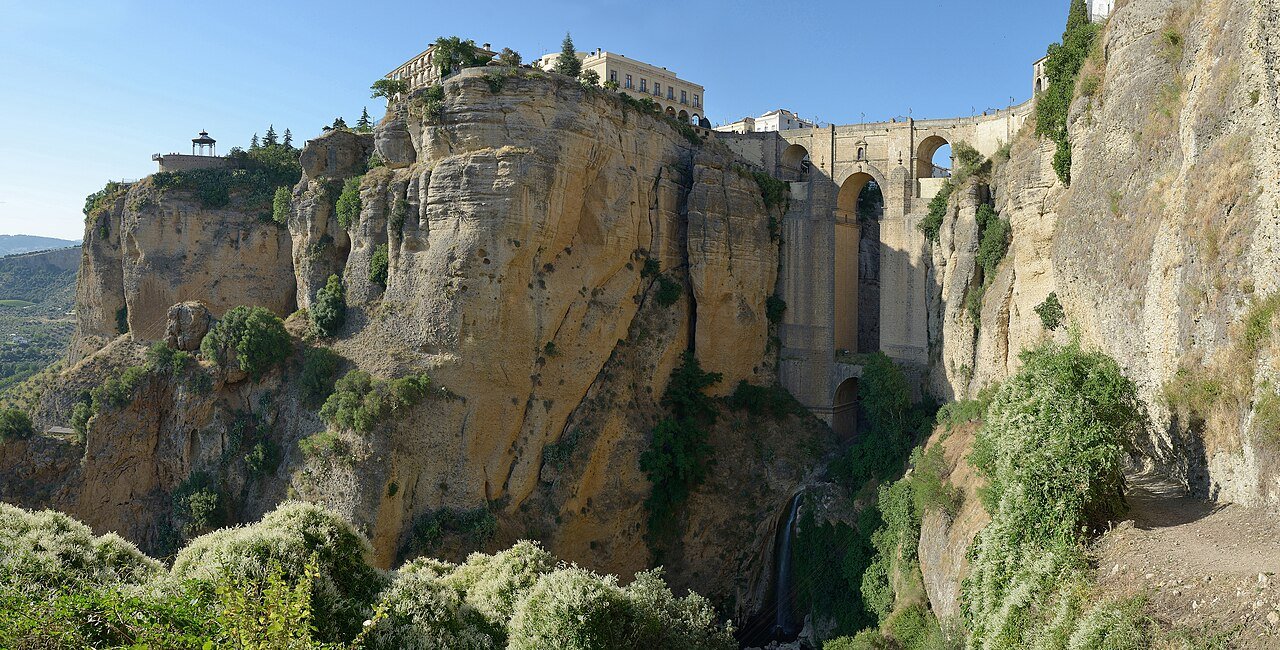
Ronda is the town Spain built on the edge of a cliff and then split in two. The El Tajo gorge cuts more than 100 metres down through the middle of it, the Guadalevín river threads the bottom, and the two halves — the old Moorish town, La Ciudad, on one side and the newer El Mercadillo on the other — are joined by one of the most famous bridges on earth. The Puente Nuevo, finished in 1793 after more than three decades of building, stands some 100 metres above the river, and the correct way to meet it is not from its own parapet but from the path below, where the whole staggering span rises above you and a waterfall threads down beside it. That view is this article’s featured photograph, and it earns the place.
The rest of Ronda keeps the standard up. In La Ciudad there are Moorish-era baths, palace gardens and the old water stairway cut into the cliff; across the bridge, one of the oldest bullrings in Spain anchors the newer town. Hemingway wrote about Ronda, Orson Welles loved it enough to have his ashes brought here, and on a summer afternoon the town can feel like it belongs to its admirers rather than itself. So stay the night if you possibly can: Ronda at nine in the morning, before the day buses arrive, and again at dusk when the gorge turns gold, is a different and far better town. Best for drama, first-time Andalusia and anyone who likes a view with their history. Skip it only if heights genuinely frighten you — the town is one long parapet — or if you can only come at August midday, when its fame works against it.
Getting there is easy from the coast: direct trains and buses run from Málaga, and the town also works as the inland counterweight to a Málaga city break (our guide to things to do in Málaga builds exactly that pairing). If you would rather not drive the mountain road, the day trip this guide rates highest is From Málaga: Ronda & Setenil — nine hours, about four of them in Ronda with an optional guided walk, then little Setenil de las Bodegas, whose houses are built into the rock itself, with its shuttle train included. It is rated 4.7/5 from 9,180 reviews and costs from $38, and the page states free cancellation up to 24 hours in advance for a full refund, plus reserve now & pay later.
2. Frigiliana: The White Village Above Nerja
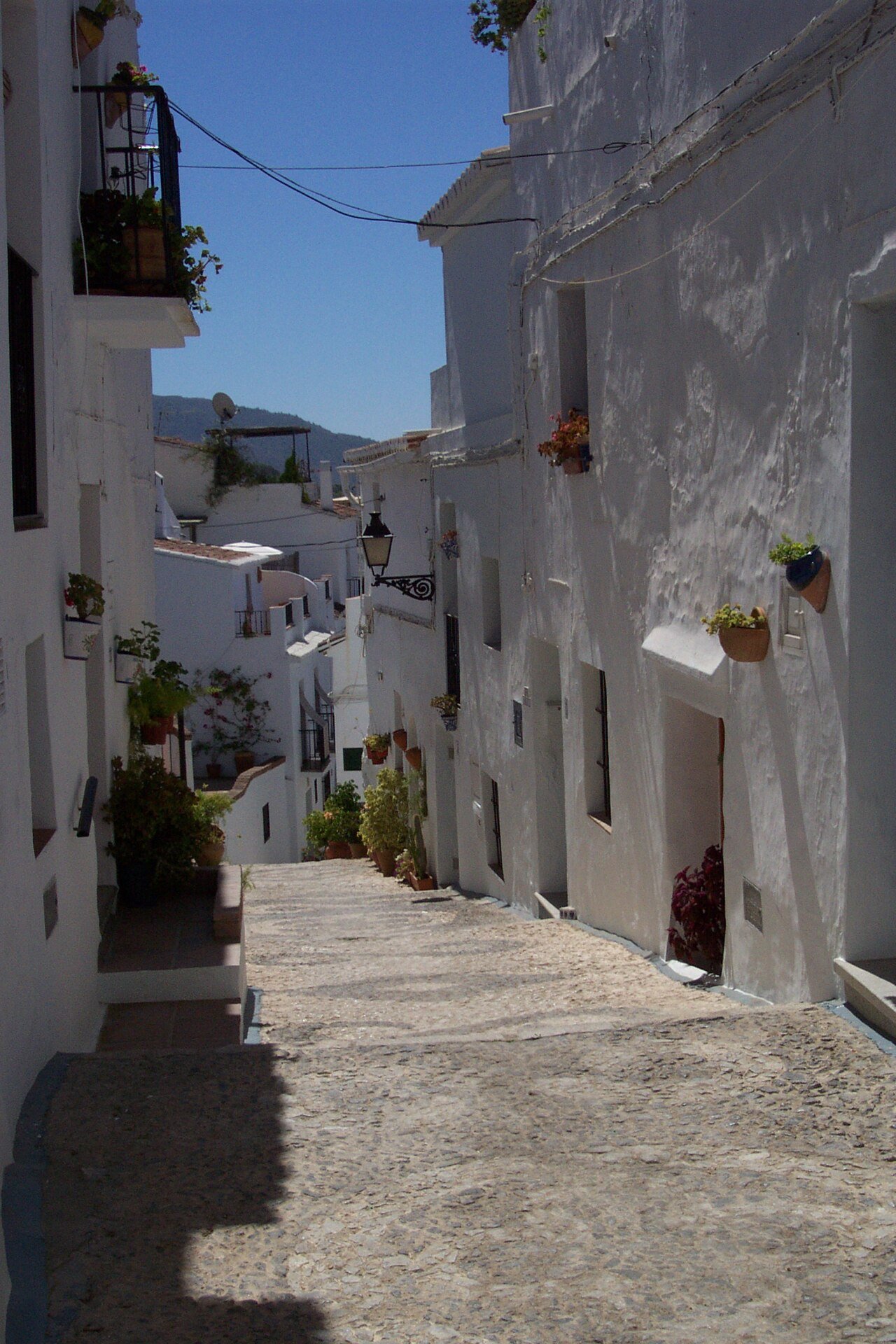
Six kilometres inland from Nerja, where the Costa del Sol’s apartment blocks give out, the road climbs to a village that seems to have been poured down its hillside in whitewash. Frigiliana is routinely listed among the most beautiful villages in Spain, and its old quarter — the Barribarto, the Moorish-Mudéjar heart of the place — is the reason: a maze of steep, stepped, cobbled lanes where every wall is white, every doorway has its flowerpots, and the whole quarter still follows the street plan of the Muslim village it was. Above it all sit the ruins of the Lízar castle, and below it the land falls away through avocado and olive groves to the sea. There is no single monument to queue for, and that is the point — Frigiliana is a village to be wandered, glass of its sweet local Moscatel in hand, at the speed of its own lanes.
Time it, if you can, for the end of August, when the Festival de las Tres Culturas fills those lanes with food stalls, music and markets celebrating the Christian, Muslim and Jewish cultures that layered the village. Best for white-village atmosphere without Ronda’s crowds, slow mornings and photographers. Skip it if you need the beach in the town itself — the sand is down in Nerja — or if steep lanes are a problem, because the Barribarto is a staircase wearing a village as a disguise.
By public transport you chain two buses: Málaga to Nerja (about an hour), then the little local bus up the hill. The organised version folds the whole coast into one day — From Málaga: Caves of Nerja, Nerja and Frigiliana pairs the village with Nerja’s old town and the vast Nerja Caves, is rated 4.6/5 from 3,338 reviews and costs from $76.97. The same pairing is sold from the other direction too: our things to do in Granada notes the small-group version that runs down from Granada, which tells you how neatly Frigiliana sits between the two cities.
3. Baeza and Úbeda: Renaissance Twins of the Olive Sea
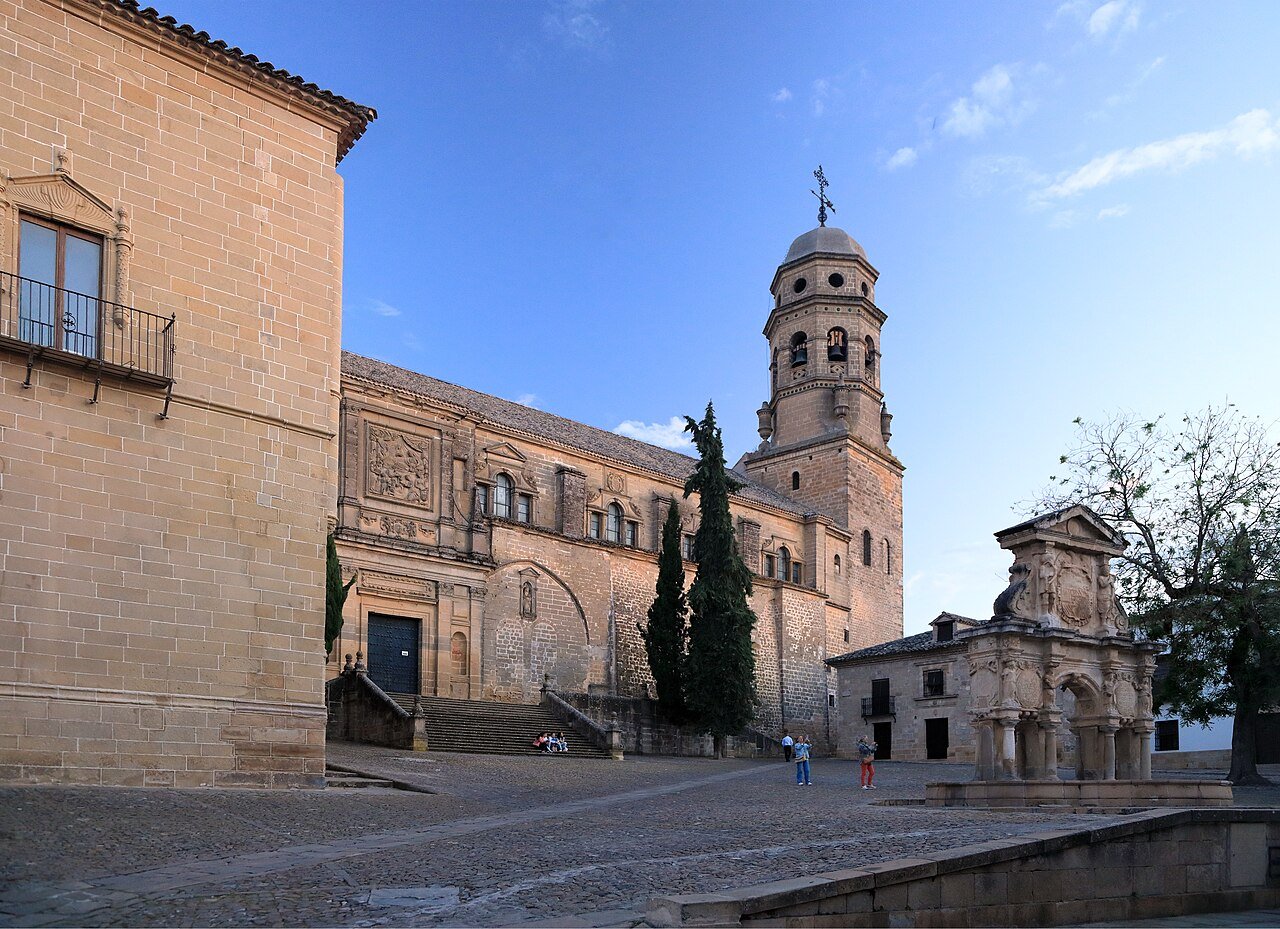
In the middle of Jaén’s endless olive groves, two small towns ten kilometres apart hold between them the finest Renaissance streetscape in Spain. Baeza and Úbeda were inscribed by UNESCO in 2003 as the “Renaissance Monumental Ensembles” — a joint listing for two towns that in the sixteenth century rebuilt themselves in golden stone under architects like Andrés de Vandelvira, and then, when the money moved on, simply stopped, leaving the sixteenth century standing. Baeza is the quieter and, for many, the lovelier: a cathedral in warm stone, the Plaza del Pópulo with its lion fountain, the Palacio de Jabalquinto’s facade carved like lace, and an old university where the poet Antonio Machado once taught French — a plaque and a preserved classroom remember him. Úbeda, the twin, is grander: the Sacra Capilla del Salvador, the Hospital de Santiago, and a parador sleeping inside a Renaissance palace.
Together they make the best overnight stop in Spain that most visitors drive straight past. Come for the architecture and stay for the table — this is the heartland of Spain’s olive oil, and the cooking is the honest, oil-rich kind that Jaén does better than anywhere. Best for architecture lovers, slow travellers and anyone road-tripping Andalusia beyond the famous triangle; the towns pair naturally with things to do in Córdoba on the same inland loop. Skip them if your Andalusia is strictly beach-based — the coast is a long way from here in every sense.
There is no station in either town. The railhead is Linares-Baeza, on the line between Madrid and the south, with local buses covering the last stretch; buses also run from Jaén and Granada. A car makes the twins effortless — ten minutes apart, with the olive sea rolling past the windscreen the whole way.
4. Peñíscola: A Castle in the Sea

Some towns have a castle; Peñíscola is a castle with a town wrapped around its feet. The fortress stands on a great rock joined to the mainland by a strip of sand, built by the Knights Templar at the end of the 13th century — and it holds one of the strangest stories in Spanish history. In the early 1400s, Benedict XIII, the Avignon-line pope the Spanish call Papa Luna, refused every demand to resign and held out in this fortress by the sea, an elderly antipope in a castle at the edge of the world, and ended his days here unconvinced. The walled old town climbs the rock beneath the walls in white lanes and blue-shuttered houses, and at night, floodlit across the water as in our photograph, the whole rock glows like a ship at anchor.
What lifts Peñíscola above the pure history stop is that it is also a proper beach town: long sandy beaches run away on both sides of the isthmus, the old town’s bars do a serious line in rice dishes and seafood, and the castle will be recognised by fantasy fans as Meereen from Game of Thrones. Best for travellers who want sightseeing and swimming in the same day, and families. Skip the last week of August if crowds undo you, and know that the modern resort strip along the north beach is cheerful but ordinary — the magic is all inside the walls. Stay inside them if you can.
Reaching it without a car is easier than the map suggests: the nearest station is Benicarló-Peñíscola, on the coast line between Valencia and Barcelona, and local buses shuttle the last few kilometres into town. By car it sits just off the motorway, midway down the Valencia–Barcelona run — one of the easiest historic towns in Spain to add to a coastal drive.
5. Altea: The Blue Dome of the Costa Blanca

Altea is the Costa Blanca’s act of resistance. Ten minutes north of Benidorm’s towers, it kept its head: a whitewashed old town stacked on a hill above its own bay, crowned by the parish church of Nuestra Señora del Consuelo, built at the start of the 20th century and roofed with two domes of blue-and-white glazed tile that catch the light from everywhere in the bay. Locals call it the Iglesia de Arriba — the church up top — and everything in the old town climbs towards it: cobbled lanes, artists’ studios, small galleries, white houses with geraniums, and a scatter of viewpoints where the whole coast suddenly opens. Artists settled here decades ago, and the town still has their unhurried, slightly bohemian air.
Down below, the beaches are pebble rather than sand — prettier to look at, kinder to no one’s bare feet — and the promenade does long lunches the way the old town does long evenings. Best for couples, photographers and anyone who wants the Mediterranean classic without the resort machinery. Skip it if a big sandy beach is the point of the trip, or if you want nightlife — Benidorm, pointedly, is where that lives, a short tram ride and a whole world away.
Those trams are the transport story: the TRAM’s L9 line runs from Benidorm to Altea in about fifteen minutes, and from Alicante you ride the L1 and change onto the L9 at Benidorm, on a scenic narrow-gauge line that hugs the coast the whole way. It makes Altea one of the easiest towns on this list to reach without a car.
6. Albarracín: The Pink Village in the Gorge
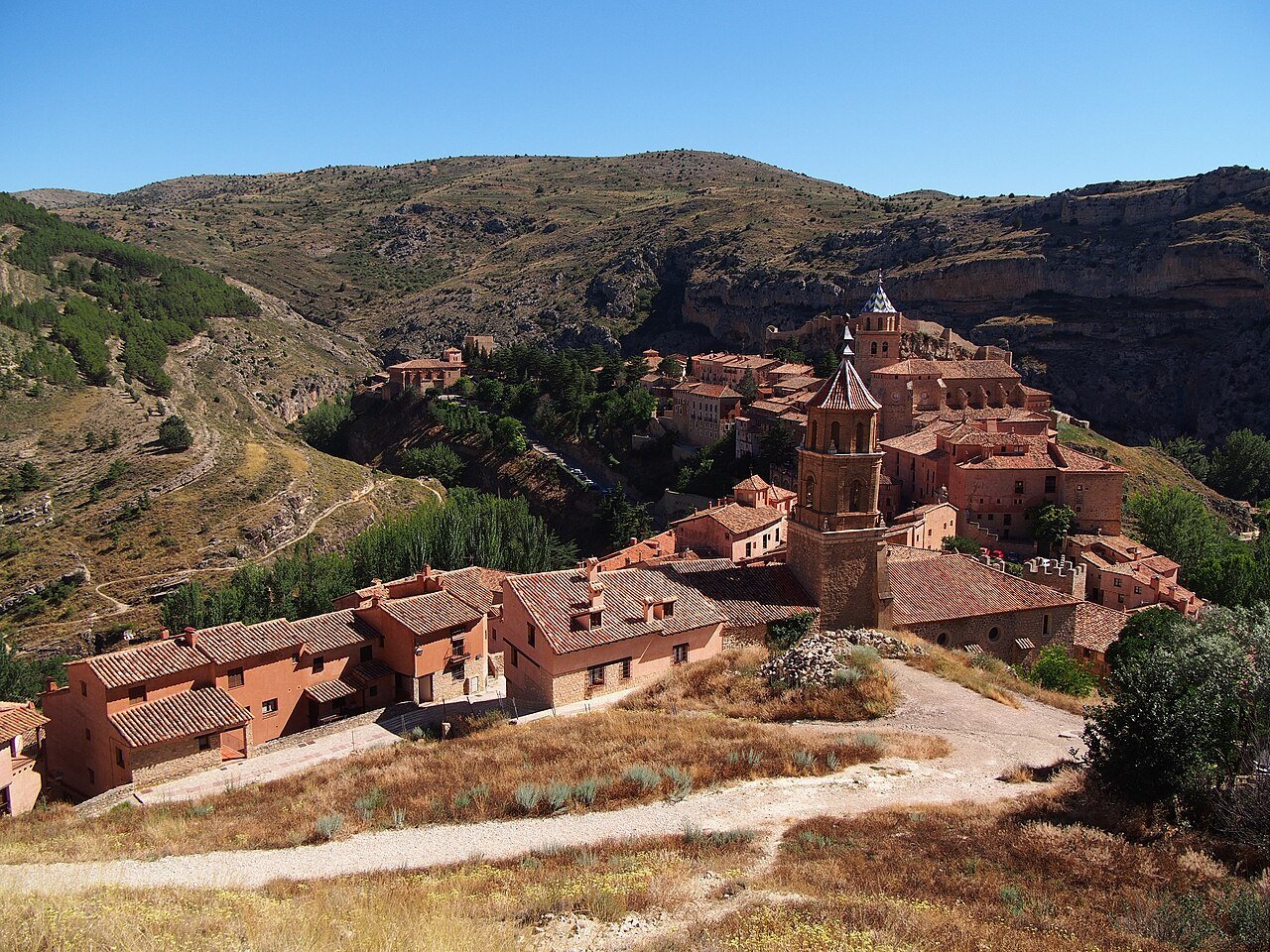
Ask Spaniards to name their country’s most beautiful village and one name comes back again and again: Albarracín, a village of about a thousand people folded into a bend of the Guadalaviar gorge in the empty hills of Teruel. It has topped national polls of Spain’s loveliest villages, and arriving explains the voting. The houses are pink — built of the local gypsum-toned stone and timber, with overhanging wooden balconies that lean out over lanes too narrow and too steep for cars. Above them stand the 10th-century Torre del Andador and the ruins of the castle, because this improbable village was once a capital: the seat of a tiny Moorish taifa kingdom, which is where its name comes from. It was declared a National Monument in 1961, and the surrounding sierra has become one of Europe’s famous bouldering areas, which brings climbers to the village too.
There is very little to do in Albarracín, in the best sense: climb to the tower, walk the walls, eat roast lamb and migas in a stone-floored mesón, watch the light change colour on the gorge. Best for romantics, walkers, photographers and anyone collecting Spain’s quiet corners. Skip it if you need a train station, nightlife or a choice of forty restaurants — it has none of those things and is in no hurry to get them. A night here, when the gorge turns rose at dusk and the lanes empty, is the version to aim for.
The remoteness is real, so plan for it: there is no railway. Buses and the drive run from Teruel — about forty minutes away, itself on the Valencia–Zaragoza rail line — and the drive from Valencia takes about two hours. Albarracín rewards the effort precisely because the effort filters the crowds.
7. Trujillo: Conquistadors’ Plaza
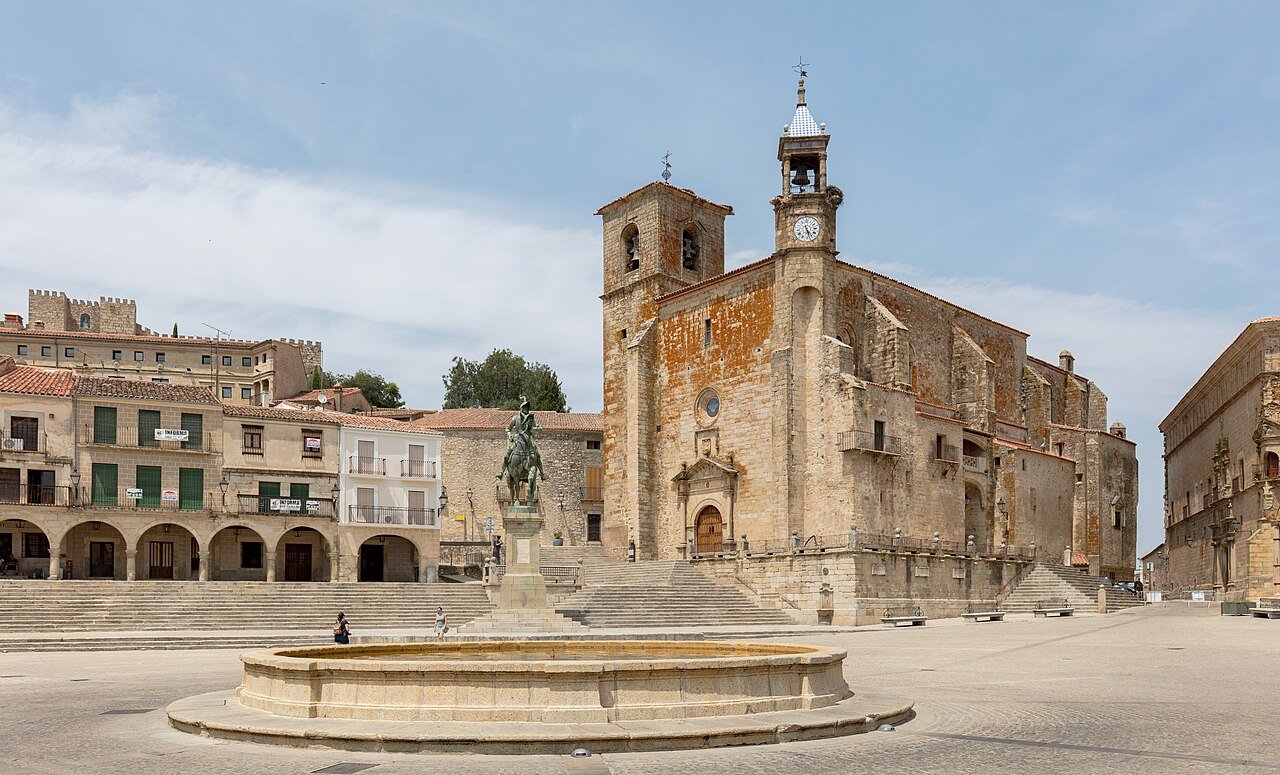
Trujillo owns the most theatrical main square in Extremadura — a vast, sloping, arcaded Plaza Mayor that was built as a stage set for homecoming heroes. This modest town produced an outsized share of the conquistadors, and the money of the Americas came back with them and turned into palaces. Francisco Pizarro, conqueror of the Inca empire, was born here in the 1470s, and his bronze equestrian statue stands at the plaza’s centre in front of the church of San Martín; Francisco de Orellana, the first man to navigate the Amazon, was a Trujillo local too. Around the square, the palaces of the returning families bristle with carved coats of arms and corner balconies, and above the town the old castle keeps watch over the dehesa, the oak-dotted grazing land that rolls to every horizon.
Come in spring and the plaza hosts a national cheese fair — Extremadura’s great torta cheeses are made within a few miles of here — but any week of the year, Trujillo is the thinking traveller’s stop on the Madrid-to-Extremadura road: all the atmosphere of Cáceres’ famous old town with a fraction of the visitors. Best for history obsessives and road-trippers. Skip it only if you have a single Extremadura day and a deeper pull towards Cáceres or Mérida.
Trujillo has no railway station; buses run from Cáceres, about forty-five minutes by road, and from Madrid, and most visitors fold it into a drive. Give it at least a long afternoon and an evening in the plaza — the statue, the storks on the church tower and a glass of Ribera del Guadiana as the light fails is the full Trujillo experience in one sitting.
8. Sigüenza: The Fortress-Cathedral Town
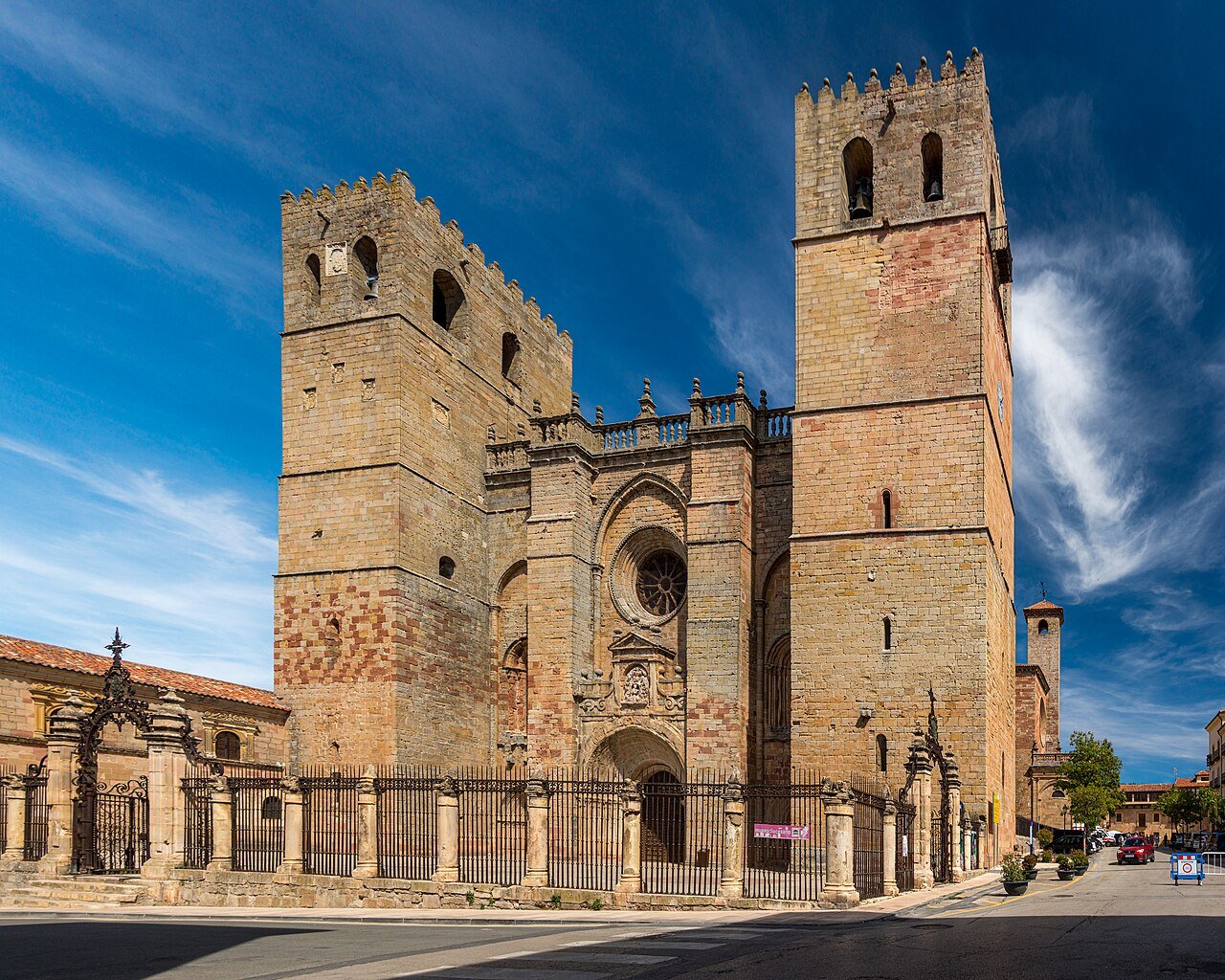
Sigüenza is the great escape from Madrid that Madrid has mostly kept to itself. Its cathedral was built in an age when bishops expected sieges: a fortress-church begun in the Romanesque centuries, with two crenellated towers on its west front that belong on a castle, as our photograph shows. Inside that martial shell sits one of the most beloved artworks in Spain — the tomb of El Doncel, a young knight of the Reyes Católicos’ court, carved in alabaster as a serene young man propped on one elbow, reading for eternity. People who have seen a hundred Gothic tombs remember this one. Around the cathedral unrolls a handsome medieval town: an arcaded Plaza Mayor, the castle on its hill — now a parador, so you can sleep in it — and lanes of stone houses that turn golden in the evening.
It is, honestly, a town for people who like towns: no single blockbuster museum, no beach, just a complete, working, beautiful old place with an extraordinary cathedral at its heart and very good Castilian roasts in its mesones. Best for a Madrid-based weekend, cathedral connoisseurs and parador collectors. Who should skip it? Anyone counting on it being a quick hop — which brings us to the access, because Sigüenza breaks the usual rule.
The drive is quicker than the train. Direct trains do run from Madrid Chamartín, several a day, but the fastest take about two and a half hours on a line that wanders; the car does the A-2 motorway run in about an hour and a half. Either way, treat Sigüenza as an overnight, not a dash: the parador in the castle is half the reason to come.
9. Pedraza: One Gate and a Night of Candles
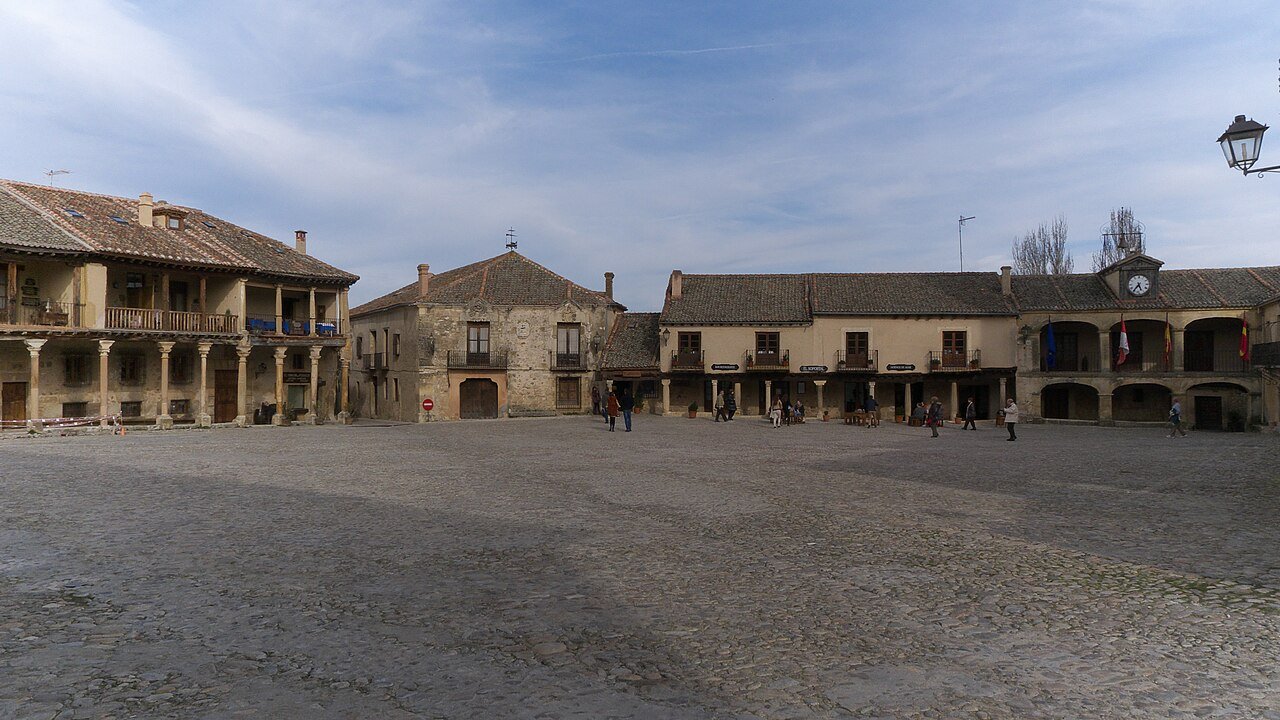
Pedraza has fewer than 500 residents, one gate, and a claim to be the best-preserved medieval village in Spain. The gate matters: the Puerta de la Villa is the only way in or out of the walled hilltop, and passing through it is a small time machine. Inside, nothing much has been built since the 1600s — a sloping, irregular Plaza Mayor ringed with arcaded stone houses and wooden balconies, the old prison by the gate, and at the top of the town a castle that the painter Ignacio Zuloaga bought, restored and lived in, now a museum of his work. The whole ensemble was declared a historic site in 1951, and on an ordinary weekday it can be so quiet you hear the swallows. Our photograph caught it in its natural state: magnificent, and nearly empty.
Then, twice a year, Pedraza does something extraordinary. On the first and second Saturdays of July, for the Concierto de las Velas — the Night of the Candles — the town’s electric lights are switched off and the streets, windows and balconies are lit by tens of thousands of candles, while classical concerts play in the candlelit square and castle. It is one of the most beautiful nights in the Spanish calendar, and attendance is capped: tickets and whatever accommodation you can find must be booked well ahead. Best for medieval atmosphere at its purest, and romantics with a July diary. Skip the candle nights if crowds in the dark undo you — the same gate that makes Pedraza magical makes it a bottleneck — and skip weekday Pedraza if you need bustle.
There is no train; Pedraza lies 37 kilometres from Segovia, reached by bus or, far more usually, by car — about two hours from Madrid. Pair it with Segovia itself and you have one of the finest history weekends in Castile.
10. Potes: Gateway to the Picos de Europa

Every great mountain range needs a front door, and for the Picos de Europa it is Potes. This small Cantabrian town sits where two rivers, the Deva and the Quiviesa, meet in the green Liébana valley, with the pale crags of the Picos standing over it — the view in our photograph, taken across the Deva to the town’s great square keep, the 15th-century Torre del Infantado. Potes is a working mountain town rather than a museum: bars serving the valley’s hearty cocido lebaniego stew, shops selling walking boots and the local orujo firewater. Just outside town, the monastery of Santo Toribio de Liébana is said to hold the largest surviving fragment of the True Cross, and has drawn pilgrims for centuries.
The mountains themselves start the moment you leave: the road up the valley leads to Fuente Dé, where a cable car carries you up to over 1,800 metres and deposits you, blinking, in high alpine country with the walk back down through the clouds as the day’s adventure. Best for hikers who want a real town — with real dinners — as their base, and for drivers touring green Spain. Skip it if you are relying on trains (there are none anywhere near) or if your Picos plan is really a beach plan; the coast is an hour away and a different world.
Buses reach Potes from Santander in about two hours, most of the journey winding through the Hermida gorge. With a car, Potes is the natural hinge between the Cantabrian coast and the high Picos — sleep here, walk up there.
11. Cudillero: The Amphitheatre Harbour
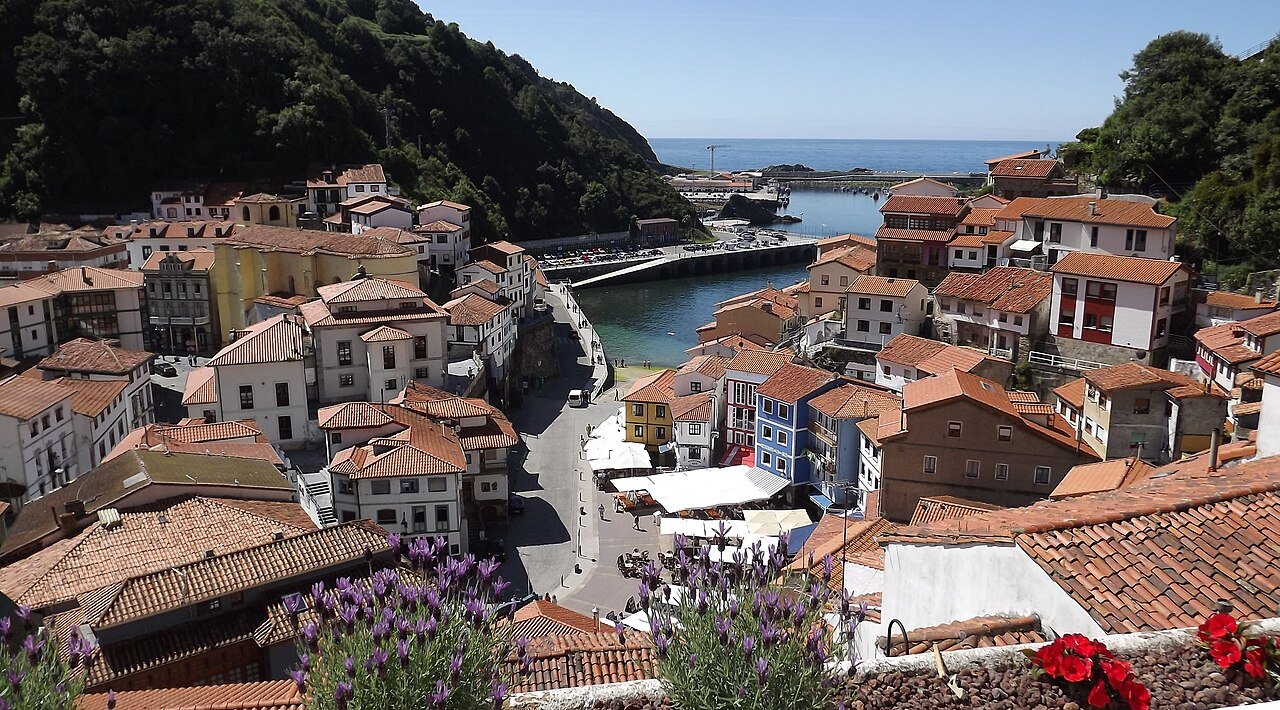
Cudillero looks like a practical joke played by gravity: a fishing village poured into a steep green bowl, its houses stacked in tiers around a harbour the size of a pocket handkerchief. From the viewpoints above — the angle of our photograph — the whole place reads as an amphitheatre of red roofs and painted facades built to watch the boats come in. And the boats are real. Cudillero is a working port whose people have their own name, pixuetos, and their own Asturian dialect; the day’s catch is unloaded at the quay in front of the plaza’s cafés, and the town’s traditional speciality, curadillo, is fish cured in the sea air the old way. The lanes between the tiers are staircases, and the seafood — hake above all — is the north coast at its best.
Best for photographers, seafood pilgrims and anyone touring the Asturian coast who wants the prettiest stop on it. The honest warnings: there is no real town beach (come for the harbour; the wild beaches are a short drive along the coast), the stairs are merciless, and in Asturian weather — which means rain is always a rumour — those colourful houses are doing a lot of the cheering-up.
The train ride is part of the pleasure: the narrow-gauge Cercanías C-4 line, the old FEVE, ends its run from Gijón via Avilés at Cudillero. The station sits above the village, so allow a good twenty minutes to walk down to the harbour — and accept that the walk back up is the price of the amphitheatre.
12. Hondarribia: Two Towns in One, Facing France
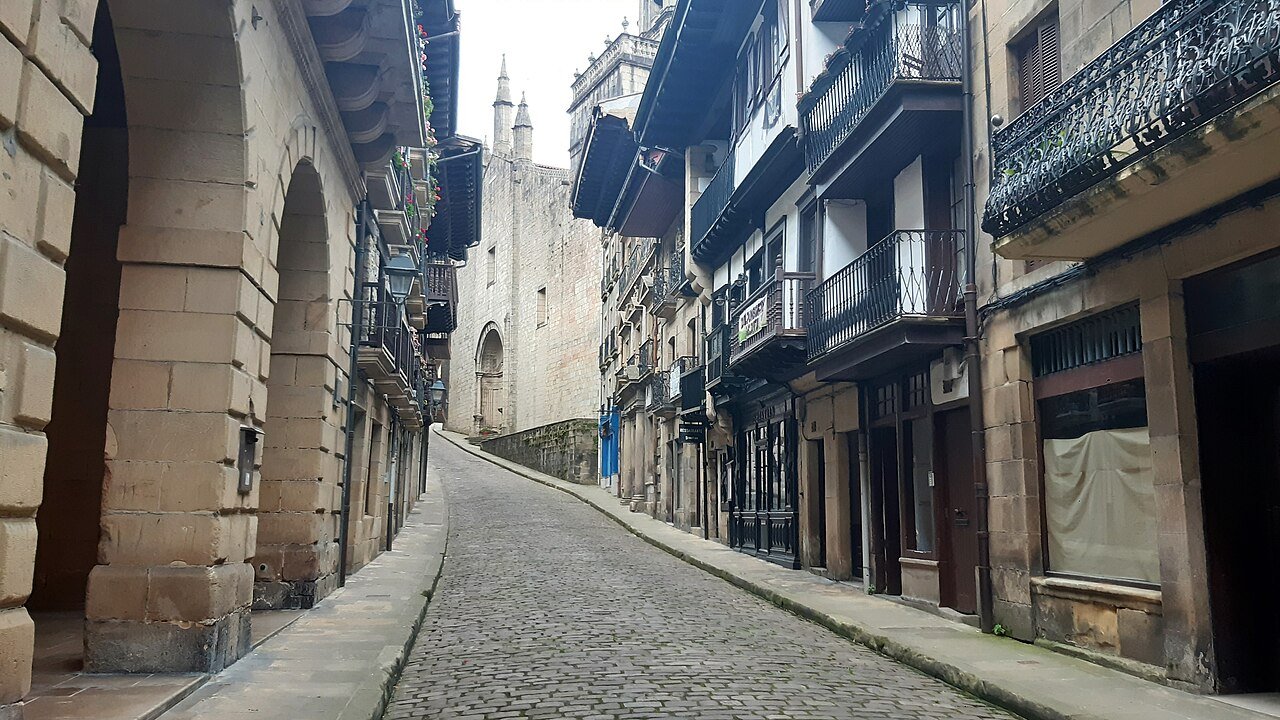
Hondarribia, on the Basque coast where Spain runs out, is really two small towns sharing one name. Up on the hill sits the walled old town: a grid of tall, emblazoned stone houses with dark wooden balconies along its main street, the Kale Nagusia — our photograph — closed at the top by the parish church, with the castle of Charles V standing guard, now a parador. Down by the water spreads the Marina quarter, the old fishermen’s district, where the houses wear green, red and blue balconies and the street of San Pedro has become one of the great pintxo crawls of the Basque Country — which, given the competition, is saying a great deal. Between bites you can look across the Bidasoa estuary at Hendaye: that is France, close enough to walk to over the bridge.
The combination is irresistible — a fortified border town with a food scene, a fishing port and a foreign country as its view. Best for eaters first and history lovers second, and for anyone flying into San Sebastián, whose airport stands right on the town’s edge. It is small, so dose it correctly: a day and a night, dinner in the Marina, a morning inside the walls. Skip it only if your Basque itinerary is already full — and even then, Hondarribia makes the best argument on this coast for stealing a day back.
Getting here is simple: frequent buses from San Sebastián take about thirty-five to forty minutes, the Euskotren runs to Hendaye just across the river, and drivers find it at the very end of the motorway east. It is the gentlest possible first taste of the Basque Country.
13. Besalú: The Bridge and the Bath
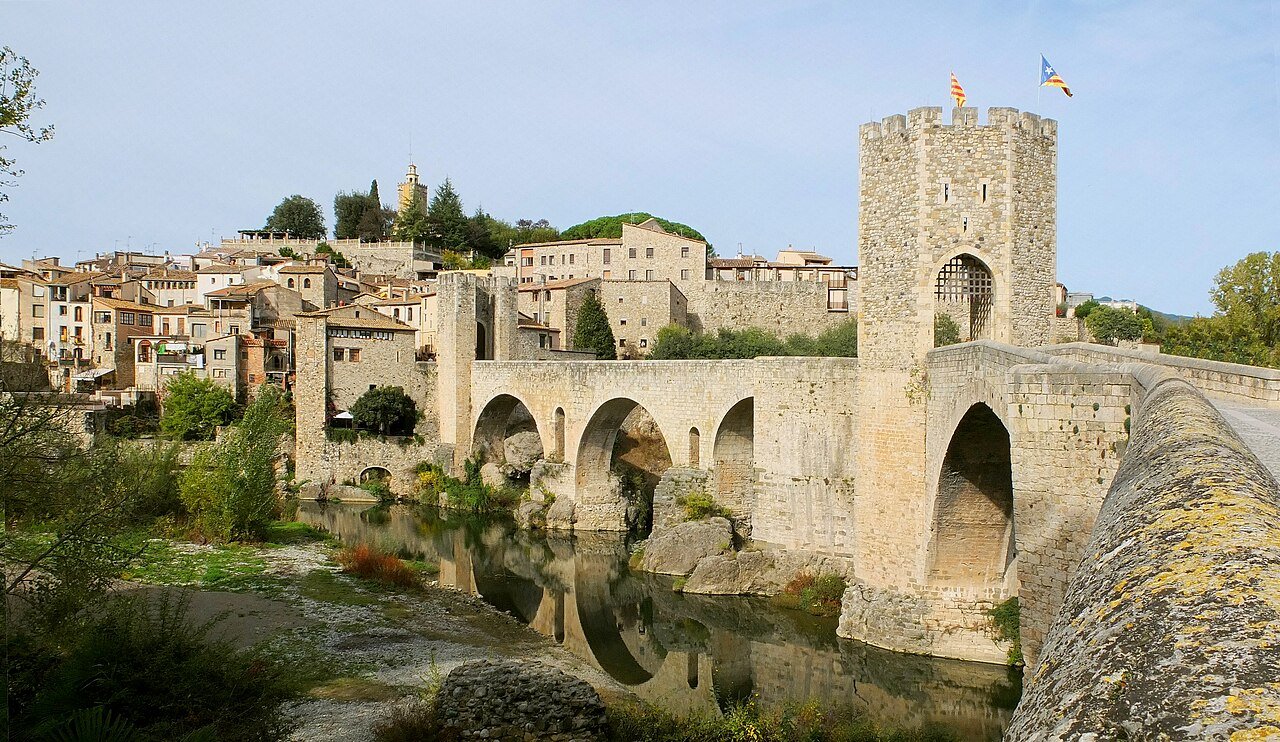
You arrive in Besalú the way its medieval counts intended: over a bridge built like a fortress. The Pont Vell strides across the Fluvià on seven uneven arches, bends in the middle where the river’s rocks dictated, and carries a gate tower on its span where the tolls were once collected — the view in our photograph, with the stone town climbing the hill behind. Besalú, a town of some 2,500 people in Girona’s Garrotxa country, was declared a historic-artistic site in 1966 and is among the best-preserved medieval towns in Catalonia: an arcaded main square, the Romanesque monastery church of Sant Pere, lanes that have not changed their lines in eight hundred years.
But the bridge is only the second-most remarkable thing here. Hidden by the river, down a flight of stone steps, sits the miqvé — a Jewish ritual bath of the 11th or 12th century that lay forgotten under a dyer’s workshop until 1964, and remains the only medieval mikveh ever discovered in Spain, with the remains of the synagogue beside it. It is seen on guided tours run from the tourist office, so book one when you arrive rather than expecting to wander in; it reorders everything you thought you knew about medieval Spain. Best for history lovers, Girona-based travellers and anyone who thinks they have seen every kind of medieval town. Skip it if you need more than a half-day’s entertainment in one place — Besalú is small, and pairs best with Girona or the Garrotxa’s volcanic hills.
There is no station; buses run from Girona, about 35 kilometres away, and drivers have the easiest time of all. However you come, cross the bridge on foot at least once with nobody hurrying you — it is one of the great entrances to any town in Europe.
14. Cadaqués: Dalí’s Whitewashed End of the Road
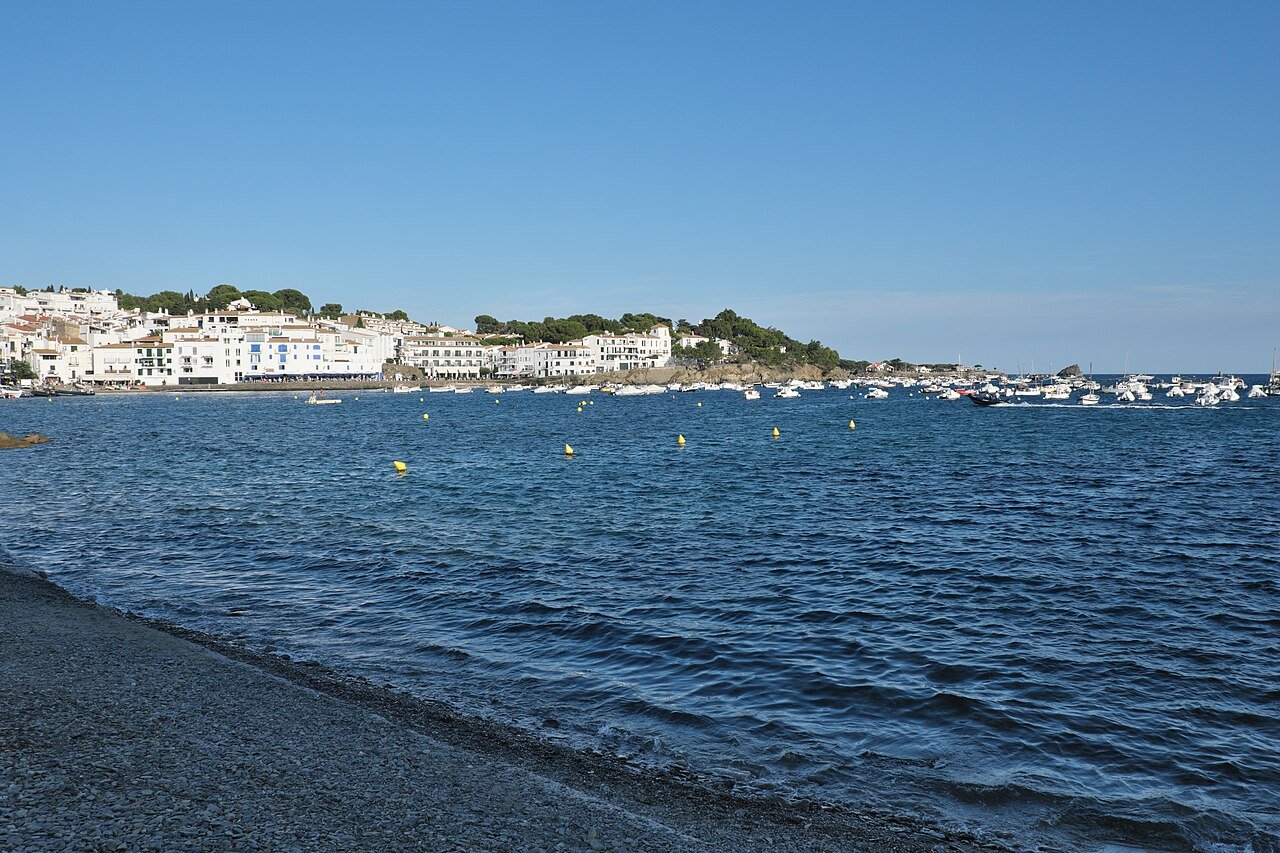
Cadaqués spent centuries being hard to reach, and it shows in the best possible way. The road from the plain ends in a long series of hairpins, and then the village appears all at once — white houses around a blue bay under the church of Santa Maria, at the edge of the Cap de Creus, the Iberian Peninsula’s easternmost point, where the Pyrenees fall into the sea and the tramuntana wind has sculpted every rock and pine. Artists found it first, and one artist made it immortal: Salvador Dalí, whose family holidayed here, and who settled in the neighbouring cove of Portlligat in a fisherman’s hut that grew, room by room, into his house. It was his only stable home, the place he lived and worked until 1982, and its whitewashed maze of a house-museum is now the most intimate of all the Dalí sites.
One rule governs Cadaqués, and it is not optional: Portlligat is visited in small timed groups and must be booked in advance — turn up without a reservation and you will be turned away. Book the house first and build the day around it, leaving hours for the village itself: the harbour lanes, the galleries, a long lunch of suquet fish stew, and the coastal path back towards the lighthouse. Best for art lovers and slow travellers; the village also anchors our favourite packaged version of the whole Dalí story, From Barcelona: Girona, Figueres, Dalí Museum, and Cadaqués — eleven hours taking in Girona’s old town and the Figueres museum before the coast, rated 4.7/5 from 2,418 reviews, from $44, with free cancellation up to 24 hours in advance stated on the page. Note its limits honestly: the Figueres museum entry is an optional extra on that tour, and Portlligat is not included at all — the house is always a separate, advance booking. Skip Cadaqués in August if you can (half of Europe has the same idea), and skip it as a touring base — the hairpins that protect it also imprison it.
There is no railway. Buses run from Figueres and Girona, and drivers earn the view the slow way. However you arrive, stay overnight if the budget allows: when the day coaches leave, Cadaqués remembers what it was.
15. Valldemossa: Chopin’s Winter in the Tramuntana
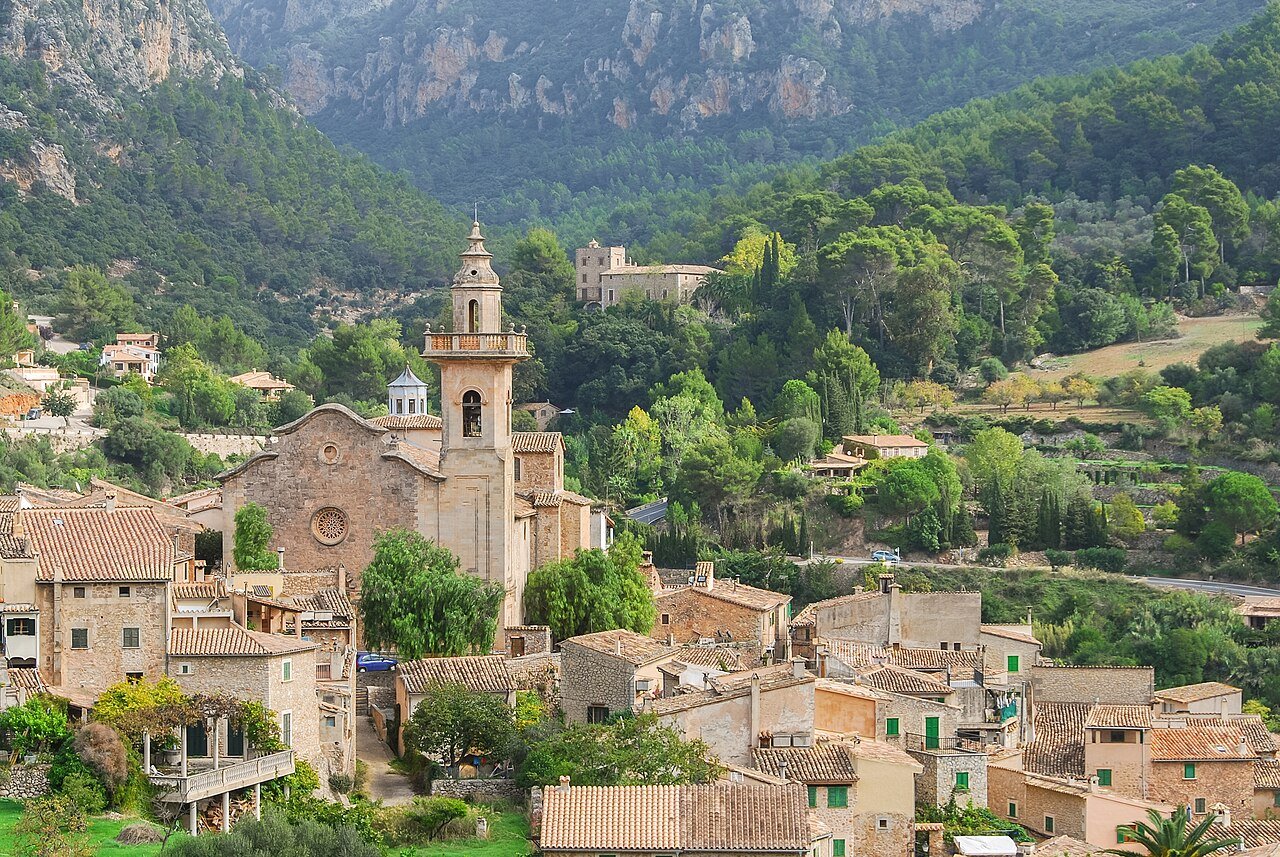
Thirty minutes from Palma, the road climbs into the Serra de Tramuntana — Mallorca’s UNESCO-listed mountain spine — and deposits you in a village of honey-coloured stone that has been famous, improbably, for a failed winter holiday. The Royal Charterhouse of Valldemossa began as a palace of King James II of Mallorca in the early 1300s before passing to Carthusian monks, and in November 1838 two unlikely guests moved into one of its cells: Frédéric Chopin, already ill, and the novelist George Sand, with her children. The winter was cold, the locals wary, and Chopin’s Pleyel piano spent weeks stuck in customs — but in what is now Cell No. 4 he completed the 24 Preludes, among the greatest piano music ever written, and Sand went home and wrote A Winter in Majorca, the book that made the village famous across Europe. You can stand in the cell, see the piano that finally arrived, and then walk out into lanes of stone houses, flower-filled balconies and mountain quiet.
Balance the culture with the village’s other masterpiece, the coca de patata — a sweet, cloud-soft potato bun made for dunking in coffee or thick hot chocolate — and time a Sunday visit for the weekly market. Best for music and literature pilgrims, and for anyone who wants Mallorca’s mountain soul rather than its beach body. The honest warning is popularity: Valldemossa is the island’s favourite village trip, so come on the first bus or stay for the evening, when the day crowds drain away and the Tramuntana light does its work. Skip the midday hours in August entirely.
Buses from Palma take about half an hour, which makes this the gentlest excursion on the whole list — a world-class cultural site at the end of a city bus ride. Drivers should arrive early for the village car parks in season.
How to Choose: Stringing Spain’s Towns Into a Route
Fifteen towns, one holiday: the trick is geography, not willpower. These towns fall into natural clusters, and the honest rule is one town per day at most — with a night in at least one of them, because a Spanish town after the day buses leave is a different, better place. Five ready-made strings:
The Andalusian inland loop. Base yourself in Málaga or Granada and take Ronda and Frigiliana as the two great days out, then run inland: Granada to Baeza and Úbeda (one night for the twins), and on to Córdoba. Our one week in Spain itinerary builds exactly this spine — the towns above are how you flesh it out. The Madrid weekend. Sigüenza by train or motorway in one direction, Pedraza via Segovia in the other; add Trujillo if the road west towards Extremadura is calling. The green north. Fly into San Sebastián for Hondarribia, then run the coast west — Cudillero is the Asturian prize — and dive inland to Potes the moment the Picos show their faces; this is Spain’s great summer road trip. The Girona pairing. Besalú and Cadaqués share one base and one province: medieval stone one day, Dalí’s white coast the next. The Valencia–Alicante coast. Peñíscola and Altea string along the same shoreline, with the TRAM doing Altea’s transport work for you; Albarracín is the inland detour from Valencia for drivers who like their villages earned.
Two bookings outrank everything else in this article: the Portlligat house (§14), which sells its small timed slots ahead, and Pedraza’s candle nights (§9), where the town itself is the ticket. Make those first and let the route bend around them. For the practical machinery — how far ahead Spanish trains release their cheap fares, what the toll roads cost, when the August exodus clogs everything — our Spain travel tips covers the system, and our budget travel in Spain guide prices the car-versus-train decision that every town trip on this list eventually comes down to.
Travel insurance, sorted
Whether it is a two-week holiday or a longer move, travel insurance is not the most glamorous part of a trip – but it is the one booking you want to have in place before a trip, and while you are already away. Get a quote from SafetyWing
Final Thoughts
Spain’s cities will always headline the posters, but it is the towns that people describe, years later, with their hands — the width of a lane in Frigiliana, the drop under Ronda’s bridge, the taste of a coca de patata in a Tramuntana lane. None of the fifteen above needs more than a day of your trip, and several need only half of one; what they ask in return is simply that you arrive as a guest rather than a collector. Pick a cluster, book the two timed things, stay one night somewhere small — God willing, the rest is just the road doing its work.
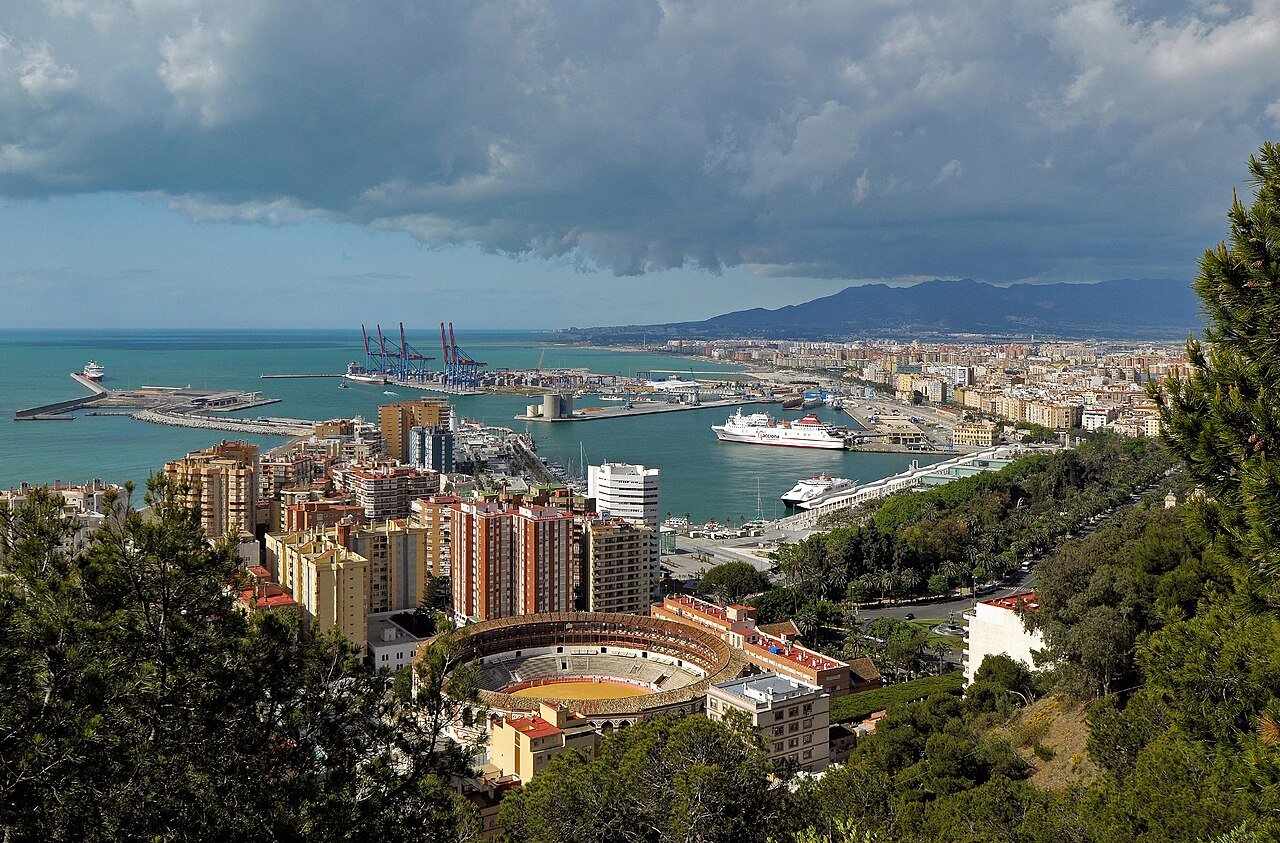
Things to Do in Málaga: 12 Highlights From the Alcazaba to the Caminito del Rey
Frequently Asked Questions
What is the most beautiful town in Spain?
There is no official answer, but Albarracín (§6) is the name Spaniards themselves put forward most often — it has topped national polls of the country’s most beautiful villages, and its pink houses folded into a gorge bend make the case on sight. Ronda (§1) wins on pure drama, Cudillero (§11) on coastal charm. The honest answer is that each region keeps its own champion, which is rather the point of this list.
How many of these towns can I visit on one trip?
Realistically, three to five without rushing. The towns cluster geographically — Ronda with Frigiliana and Baeza in Andalusia, Besalú with Cadaqués behind Girona, Pedraza with Sigüenza around Madrid — and the closing section above strings them into routes. One town per day is the comfortable ceiling; two in a day turns both into photo stops.
Do I need a car to visit small towns in Spain?
Not for most of this list. Ronda, Sigüenza, Altea, Peñíscola and Cudillero all have stations or tram stops, and Frigiliana, Besalú, Cadaqués, Hondarribia and Valldemossa are easy bus rides from their nearest cities. A car genuinely helps for Albarracín, Pedraza, Potes and Trujillo, and for Baeza and Úbeda — all are reachable by bus, but the timetables reward drivers.
Which Spanish towns are best as day trips, and which deserve a night?
Cadaqués, Besalú, Frigiliana, Altea and Valldemossa work beautifully as day trips from Barcelona, Girona, Málaga, Alicante and Palma respectively. Ronda, Albarracín, Baeza and Úbeda, Sigüenza and Pedraza all repay a night — in several cases the evening, after the day visitors leave, is the best part, and Sigüenza and Hondarribia both let you sleep in a castle-turned-parador.
When is the best time of year to visit Spain’s small towns?
Spring and autumn, broadly: April to June and September to October bring warm days without the August crowds and prices. Two dates stand out if you can plan around them — Pedraza’s candle nights on the first two Saturdays of July, and Frigiliana’s Festival of the Three Cultures at the end of August. Inland towns like Trujillo, Sigüenza and Baeza are at their most comfortable outside high summer.
Are these towns expensive to visit?
Mostly, no — small-town Spain remains one of western Europe’s bargains, with modest hotel prices and the best pleasures — lanes, bridges, viewpoints — free. The exceptions are the fashionable few: Cadaqués in season charges capital-city prices, and candle-night Pedraza books out early. Everywhere else on this list, your money goes noticeably further than in the big cities.



3 Comments