Jardín Botánico Valencia: The Complete Guide to the City’s Oldest Garden
Four minutes’ walk from the Torres de Quart, behind a modest gate on Calle Quart, Valencia keeps its oldest green room: the Jardí Botànic, the university’s botanical garden, founded in 1567 and growing on its present plot since 1802. Inside are some 3,000 species of plants — one of Europe’s great palm collections, iron-and-glass glasshouses breathing steam, a slatted shade house built like a wooden cathedral, and shaded avenues where the loudest sound is a fountain and the staff, by common consent, are the colony of garden cats who patrol the paths as if they owned the place, which, emotionally, they do.
This is not a sight that shouts. Valencia’s visitors queue for the City of Arts and Sciences and the Oceanogràfic, and the Botànic carries on regardless, as it has through four and a half centuries of kings, floods, neglect and one heroic restoration. It is the best quiet hour in the city — a working university collection that doubles as a time machine, four and a half hectares where Valencia runs at plant speed.
This guide covers the garden’s long history, walks its highlights — palms, glasshouses, umbracle, botany school, pond and cats — and gives the practical detail: tickets, the little-known guided tour run by the garden’s own educators, seasonal hours, and how to pair the garden with the Torres de Quart and the Turia.
Short Answer
The Jardín Botánico (Jardí Botànic de la Universitat de València) stands at Calle Quart 80, just outside the old town wall line, about four minutes’ walk from the Torres de Quart. Founded in 1567 as a medicinal-plant garden for the university, it has occupied its present site since 1802 and now grows around 3,000 species, including one of Europe’s finest palm collections, across roughly 4.5 hectares of glasshouses, shade houses and tree-lined plots. Entry is a bargain — around €4 for adults, with reductions and free entry for under-7s — and a gentle visit takes one to two hours.
Almost nobody knows the garden can be toured with the people who teach in it: the Jardín Botánico Valencia guided tour is a 1.5-hour walk led by Ginkgo Educación, the garden’s education team for over two decades, meeting at the Calle Quart entrance — the best €15-ish you can spend here if plants interest you at all. For everyone else, the gate ticket and this guide are all you need.
Table of Contents
- The Short Version: Is the Jardín Botánico Worth It?
- A University Garden Older Than Most Countries
- The Palm Collection
- The Glasshouses: Iron, Glass and Warm Rain
- The Umbracle: A Cathedral of Shade
- The Botany School and the Teaching Plots
- The Muntanyeta and the View from the Top
- The Pond, the Water Plants and the Fountain
- The Cats of the Botànic
- A Suggested Stroll
- Practical Info
- Tips That Will Improve Your Visit
- What to See Nearby
- Final Thoughts
The Short Version: Is the Jardín Botánico Worth It?
Yes, if your ideal attraction involves shade, birdsong and leaving slower than you arrived. The Botànic is a scholar’s garden rather than a spectacle — labelled collections, venerable trees, handsome Victorian glass — and its pleasures are cumulative rather than dramatic. It is also, not incidentally, one of the cheapest entries in the city and one of the great escapes from the summer heat, a natural greenhouse run in reverse: degrees cooler than the street outside.
Skip it if you need your sights monumental or your gardens manicured into flower-bed theatre — the Turia Gardens do scale better, and the Bioparc does wildlife. But the Botànic earns its place on any list of the best things to do in Valencia as the connoisseur’s pick: the sight Valencians bring their own visitors to, on the second day, when the big landmarks are done.
A University Garden Older Than Most Countries
The garden was founded in 1567 to supply the university’s chair of medicinal herbs — a jardín de simples, a living pharmacy where students learned their materia medica leaf by leaf. It moved site several times across its first two centuries before settling, in 1802, on the Huerto de Tramoyeres, an orchard plot beside the old road out through the Quart gate — the ground it still occupies today.
The great botanist Antonio José Cavanilles directed the garden at the turn of the 19th century and set its scientific course; after him, generations of professors built the collections, raised the glasshouses, and planted the trees whose grandchildren shade you now. The 20th century was less kind — decades of underfunding let the garden slide towards dereliction — until a full restoration between 1987 and 2000 rebuilt the glasshouses, replanted the collections and gave the garden back to the city. What you walk through today is that rescue, matured: a historic garden with its science intact and its oldest residents — palms and pines planted by professors long dead — still on the payroll.
The medicinal section, where the garden began, still grows the pharmacy of 1567 in labelled beds — the same idea, in the same institution, four and a half centuries on. Few sights anywhere can show you their own origin story still in daily use.

The Palm Collection
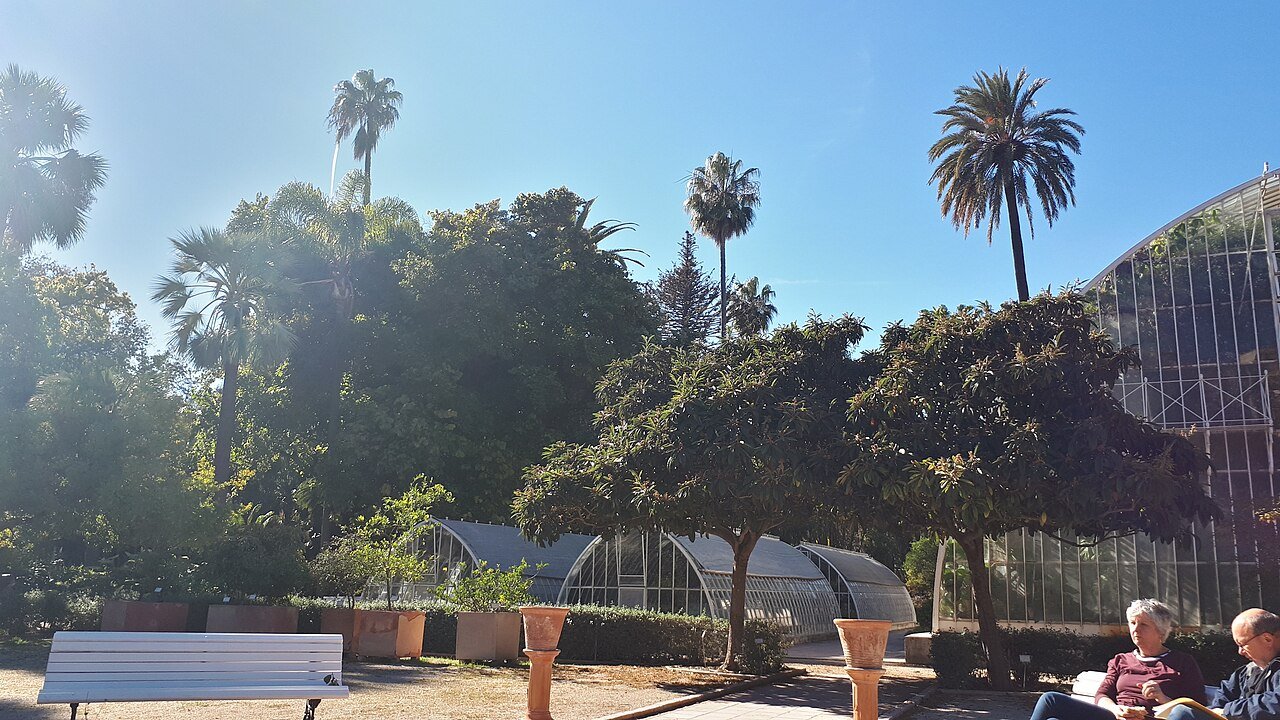
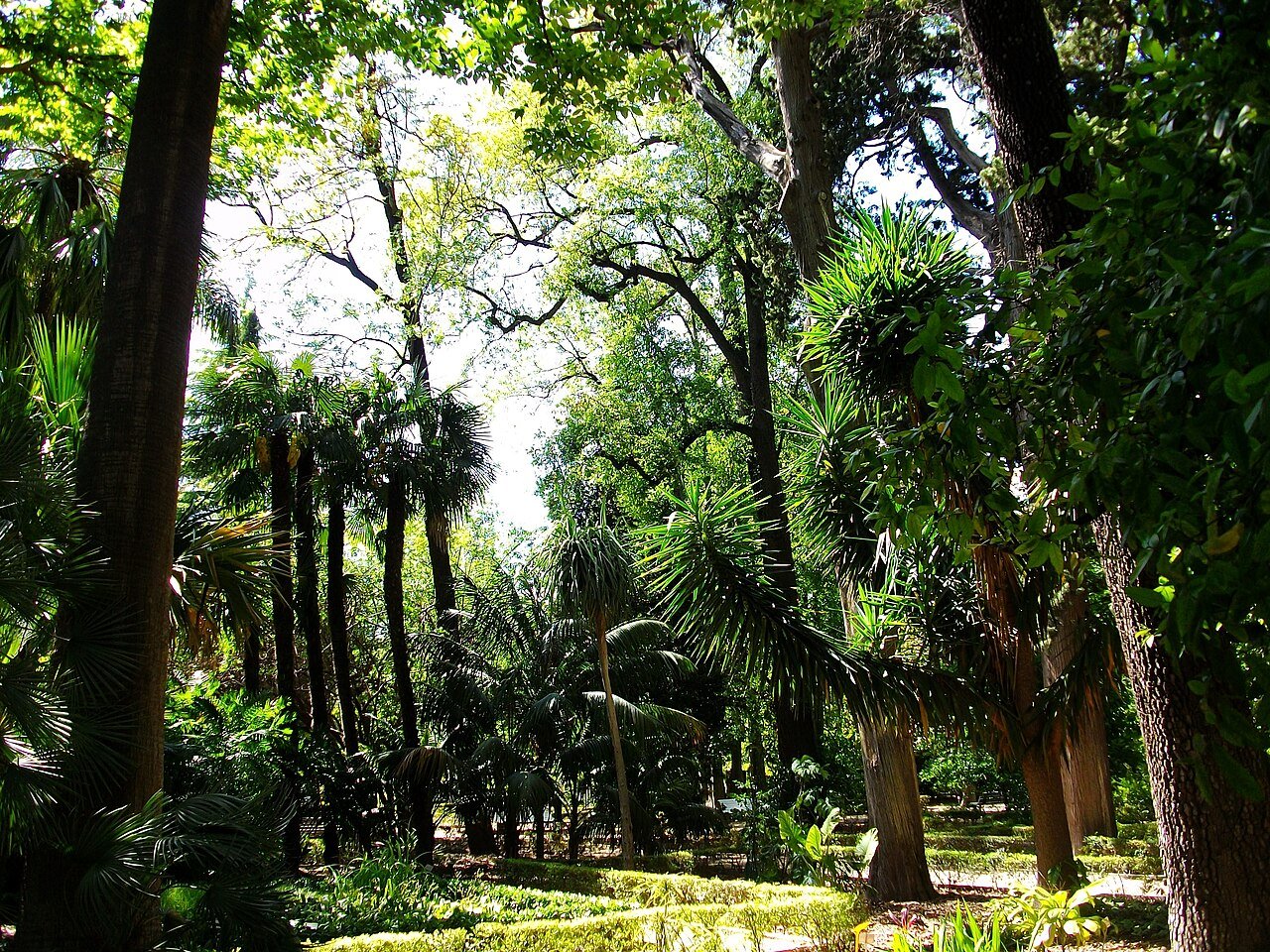
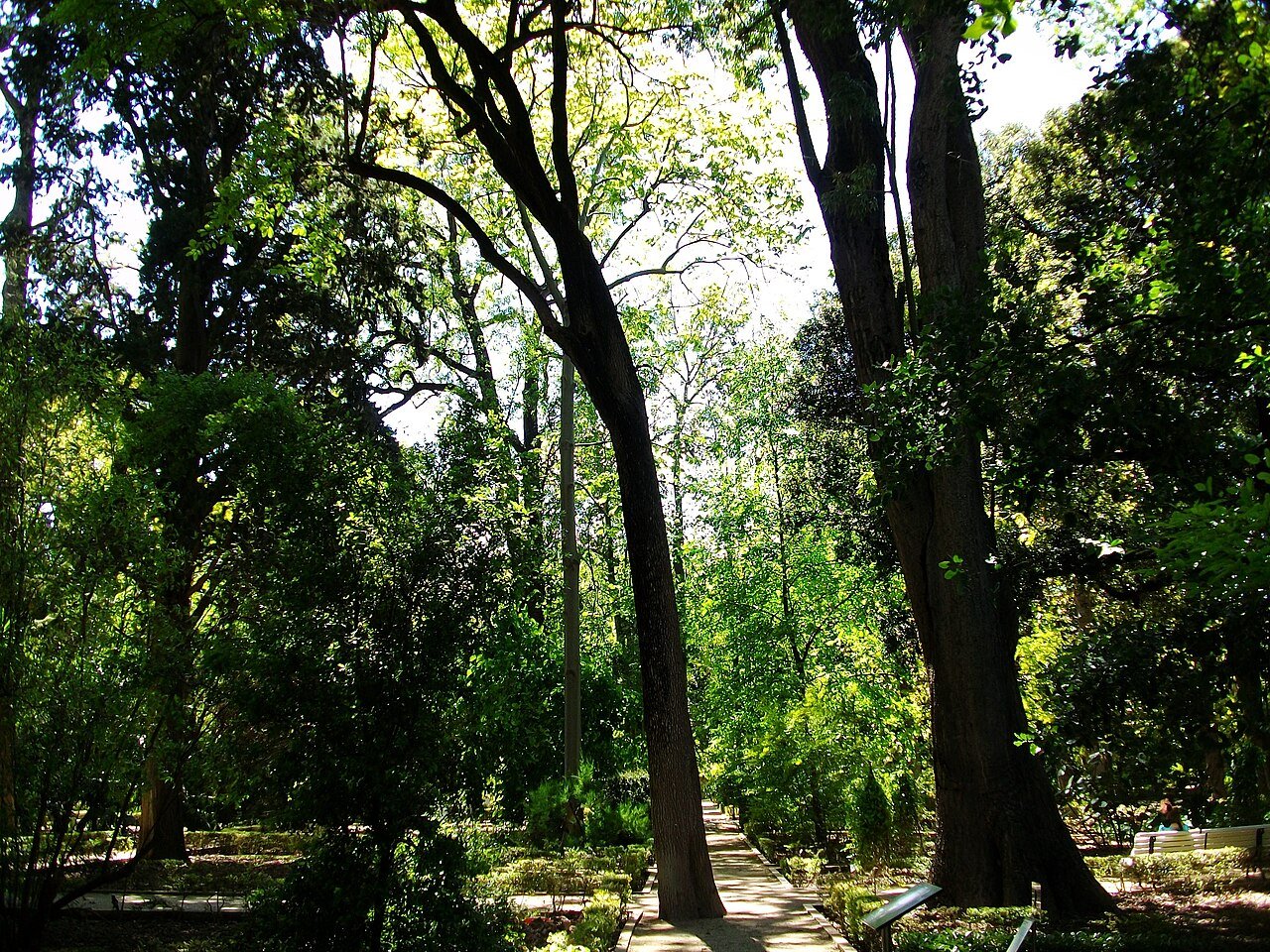
The garden’s pride is its palms — one of the largest and most varied collections in Europe, planted out across the open ground in a way southern Europe’s climate allows and northern gardens can only envy under glass. Dozens of species rise over the paths: date palms and Canary palms, fan palms and feather palms, clustering dwarfs and solitary giants, many of them a century or more old and thick with the patina of genuine age.
Walk the palm ground slowly and read it as a collection, not a backdrop — the labels give you species and homelands from every warm corner of the earth, assembled by a university that treated the Valencian climate as a laboratory. On a bright morning, with light coming through the fronds in blades, it is the most exotic acre in the city.
The Glasshouses: Iron, Glass and Warm Rain
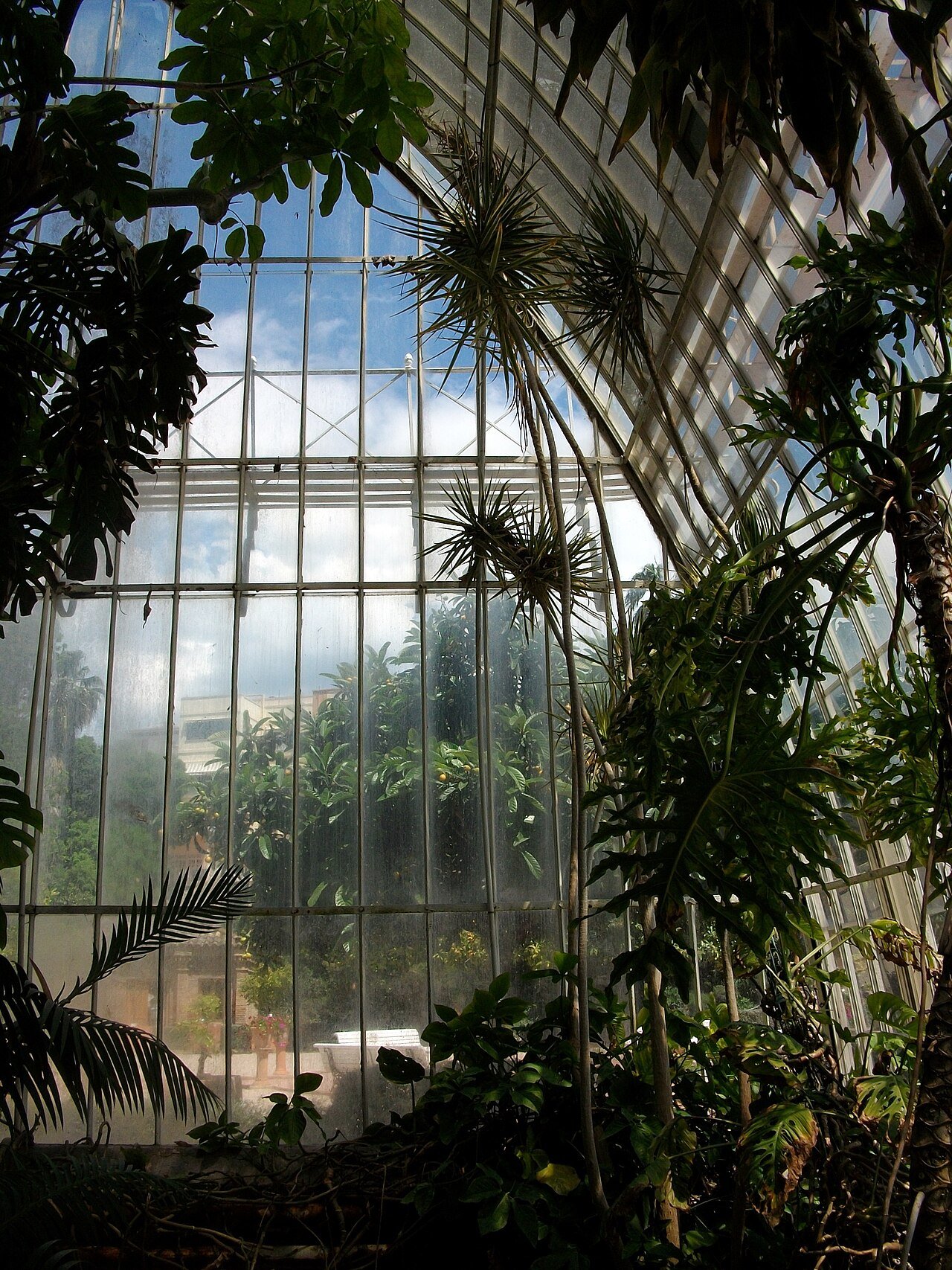
Along the garden’s southern edge stands its little skyline of glass: a family of 19th-century iron-and-glass houses built to keep the tropics alive through Mediterranean winters. The largest, the tropical house, is the full Victorian experience — enter through the door and the air changes country: warm, wet, smelling of leaf-mould and rain, with broad-leaved plants pressing at the path and drips falling from a canopy three storeys up. Smaller houses shelter the cacti and succulents, the orchids and ferns, and the garden’s tender collections in between.
From outside, the row of glass roofs makes a fine sight against the old town — framed, if you stand in the right spot, by the bell tower of the neighbouring church of Sant Sebastià, which has watched the greenhouses go up, decay and rise again across two centuries. These are working houses, not showpieces: you will see the gardeners’ trolleys, the misting lines, the pots of things being coaxed. That is rather the charm.

The Umbracle: A Cathedral of Shade
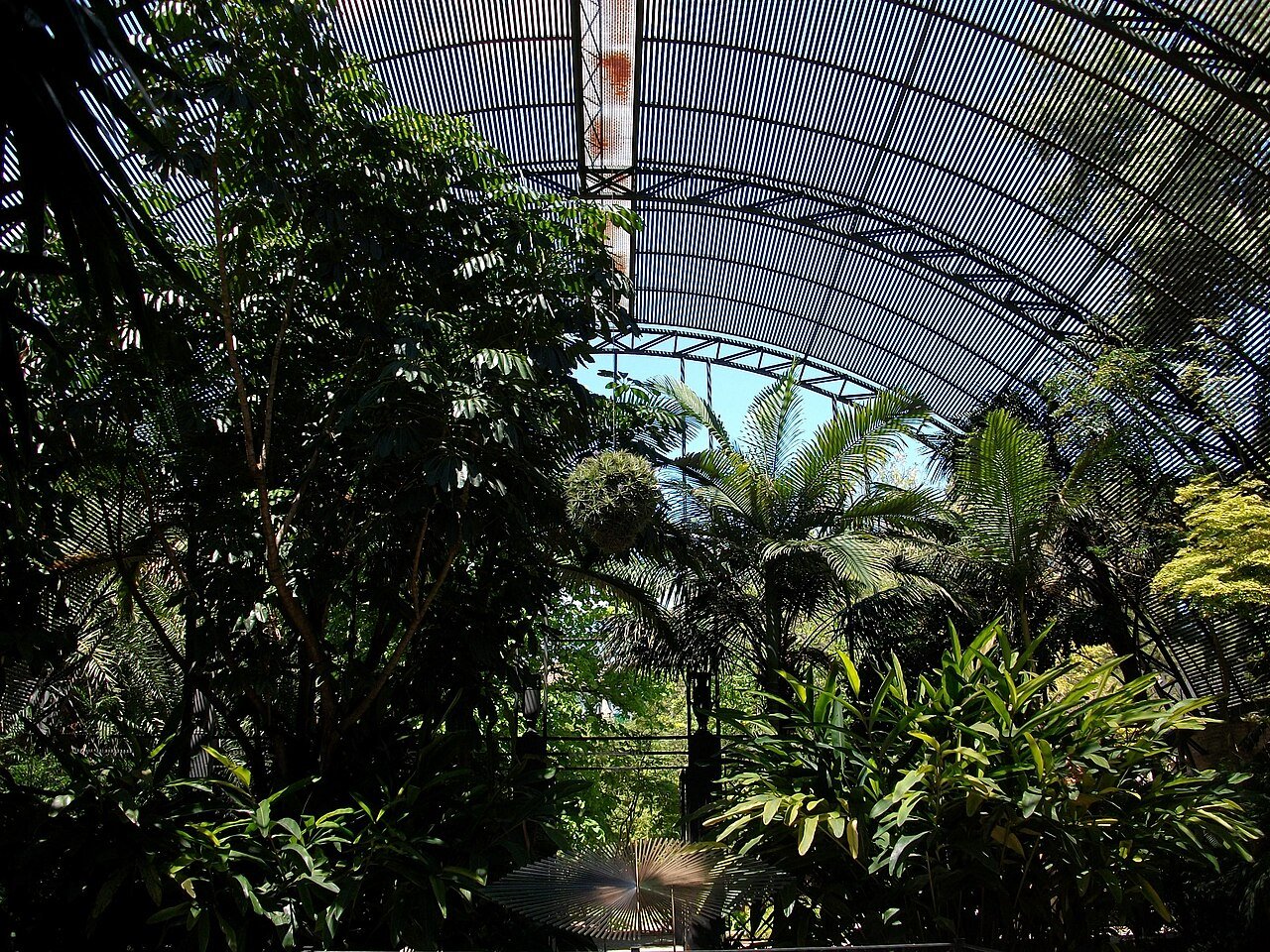
The garden’s most beautiful structure grows no glass at all. The umbracle — the shade house — is a long, barrel-vaulted hall of iron ribs and wooden slats, built to give shade-loving plants the dappled half-light of a forest floor while air moves freely through. Step inside on a summer afternoon and the temperature falls away; climbing plants curtain the sides, ferns and broad leaves fill the beds, and the light comes through the slats in stripes, so the whole hall feels like standing inside a green lantern.
Valencia loved the idea so much it built a famous modern echo of it — the Umbracle at the City of Arts and Sciences is named for structures like this one. The original is smaller, shaggier and, to our mind, better company: a 19th-century machine for making shade, still doing its job with no moving parts.
The Botany School and the Teaching Plots
At the garden’s heart lies the Escola Botànica, the botany school — the teaching collection, laid out in orderly beds where plant families are arranged so students can read evolution off the ground. It is the least showy and most characteristic part of the garden: row upon labelled row of the world’s flora sorted by relationship, from the primitive to the highly evolved, each bed a paragraph in a textbook you walk through.
Even if botany was not your subject, the school repays a slow circuit. Nowhere else in Valencia makes the sheer variety of plant invention so legible — leaves like hands, like feathers, like armour, like nothing on earth — and the labels (Spanish and Latin, with English increasing) do the teaching quietly. This is also where the garden’s purpose clicks into focus: not a park that happens to have plants, but a university that happens to be open to the public.
Free Valencia travel guide
Planning a trip to Valencia? Get our free one-page Valencia checklist: what to book ahead, what to skip, and the paella places we actually eat in.
The Muntanyeta and the View from the Top
Every old garden needs one good folly, and the Botànic’s is the Muntanyeta — the “little mountain,” a wooded mound raised during the garden’s making, planted thick and threaded with paths, from whose top the whole layout suddenly makes sense. Climb it for the garden’s best view: the citrus collection spread below in its pots, the glasshouse roofs beyond, the palms standing over everything like a colonnade — and the city politely absent behind the trees.
The mound is also the garden’s wildest corner, where the planting loosens into shade and undergrowth and the paths feel half-secret. Children navigate the whole visit by it. Give it ten minutes on your way through; a garden you have seen from above is a garden you understand.

The Pond, the Water Plants and the Fountain
Near the glasshouses, the garden keeps its water: a broad, shallow pond — the bassa — planted with water lilies and reeds, fringed with pots of aquatic plants and loud, in season, with frogs. It is the garden’s social centre, the spot where every stroll pauses: toddlers at the rim, photographers at the lilies, and, presiding over all of it with total professional calm, whichever of the garden cats currently holds the pond shift.
The water planting is a collection like any other here — lilies, reeds and rushes from several continents — but it reads as pure pleasure garden, and nobody minds. In high summer the pond terrace, glasshouses behind and shade in front, is the coolest seat in the old town’s orbit.

The Cats of the Botànic
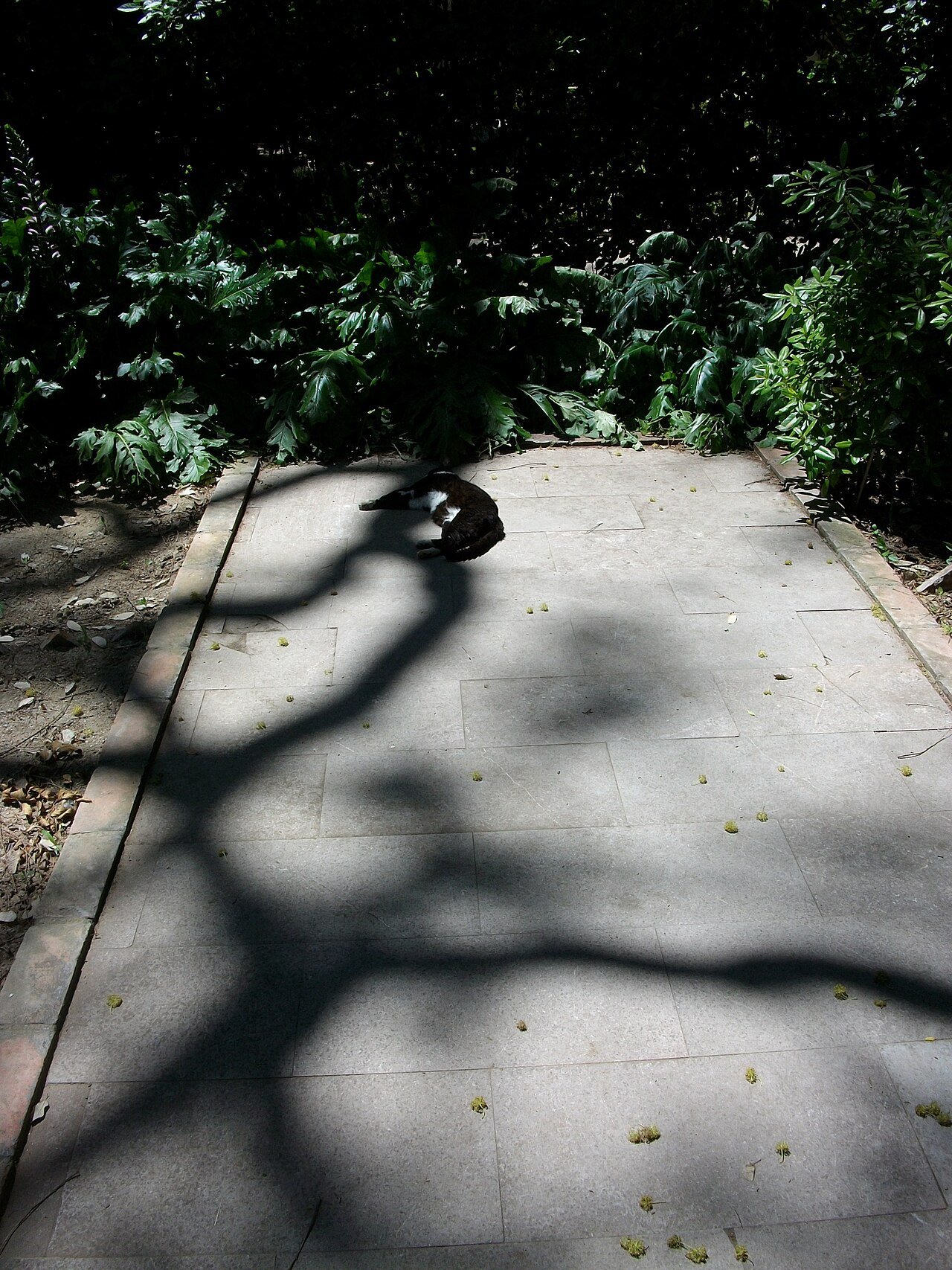
And so to the staff. The garden is home to a famous colony of cats — a managed population, fed and looked after by the garden’s people, protected by house rules (visitors are asked not to feed them, however persuasive the performance) and utterly convinced of their own seniority. You will find them at their posts: asleep in a stripe of sun on the warm paving, sitting sentry at the pond’s edge watching the frogs, or draped, in the garden’s single most photographed arrangement, across the low wall above the bust of Simón de Rojas Clemente, the 19th-century botanist who worked in this garden and now keeps permanent feline company.
They are not a gimmick and the garden does not perform them; they are simply what happens when a walled green world adopts the city’s cats. For many visitors — watch them try to leave — the cats are the memory that outlasts the palms. Photographers: the pond cat at mid-morning is the shot.


A Suggested Stroll
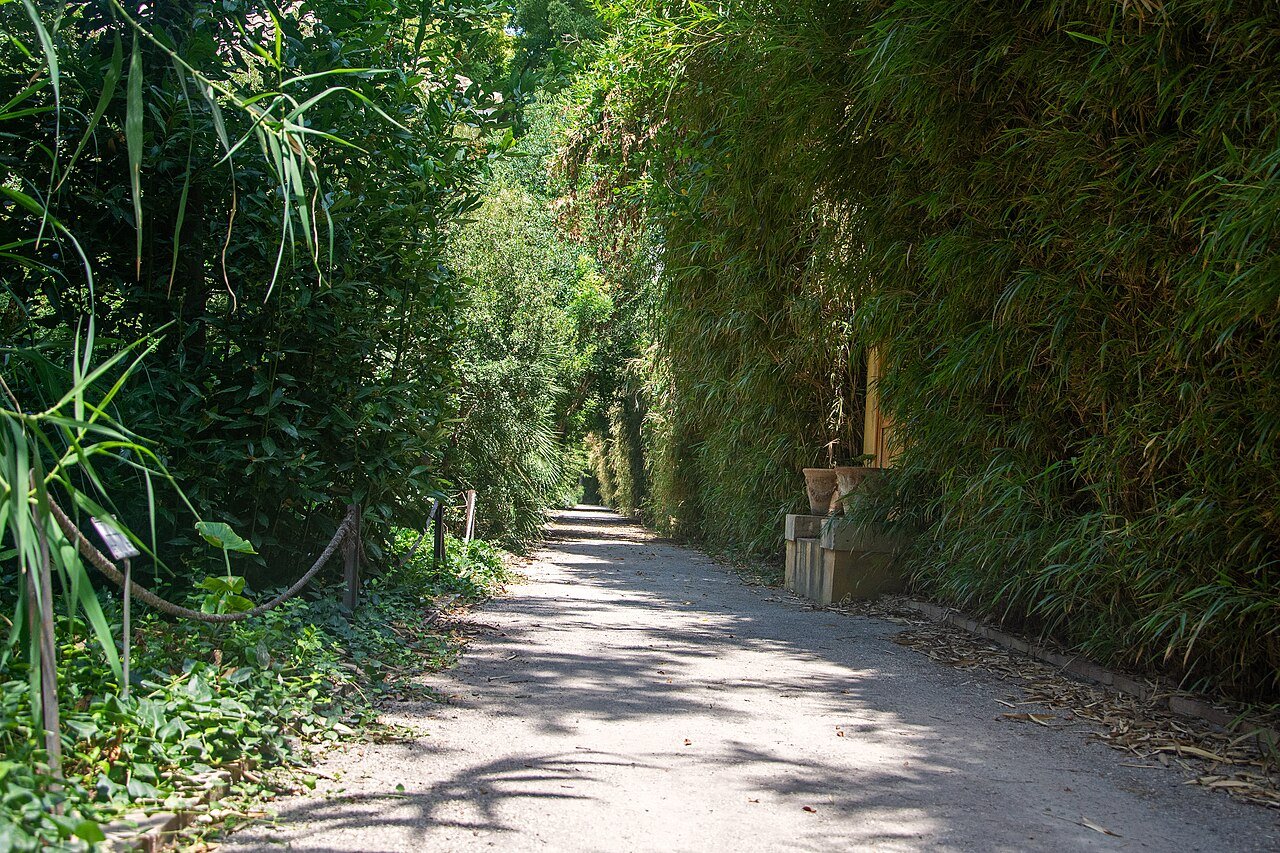
The garden is compact — a single gate, a loop of paths — and impossible to get lost in, which is part of its therapy. A natural circuit:
- 30 minutes: in through the forecourt, the glasshouses and tropical house, the umbracle, a turn past the pond for the cats, and out. The express version, and still lovely.
- 60 minutes: add the palm ground, the medicinal section and the botany school, and climb the Muntanyeta on your way back to the gate. This is the standard, satisfying visit.
- 2 hours: everything above at reading-the-labels pace, plus a second, slower circuit of whichever corner caught you — and ten unhurried minutes on a bench doing nothing at all, which the founders would have recognised as a legitimate use of a garden. To go deeper still, book the Jardín Botánico Valencia guided tour — 1.5 hours with the garden’s own educators, who know which tree was planted by whom and where the cats sleep in winter.

Practical Info
At a Glance
| Detail | Info |
|---|---|
| Address | Calle Quart 80, Valencia |
| Nearest station | Àngel Guimerà or Túria (Metro); the Torres de Quart is a 4-minute walk |
| Opening hours | Daily from 10:00; closing varies by season (18:00–21:00) — check the official site |
| Tickets | Around €4 general; reduced around €1.70; under-7s free |
| Guided tour | 1.5-hour tour with the garden’s education team (Ginkgo Educación), bookable online |
| Time needed | 1–2 hours |
| Official site | jardibotanic.org |
Tickets and the Guided Tour
Buy at the gate — at around €4 for adults (reduced around €1.70; children under 7 free; university members free) this is among the cheapest proper attractions in Spain, and the gate rarely queues. The one paid extra worth knowing is the tour: the Jardín Botánico Valencia guided tour runs 1.5 hours with Ginkgo Educación, the team that has run the garden’s education programme for over twenty years, meets at the Calle Quart entrance and turns a pretty stroll into an education — book it online in advance, as groups are small.
Opening Hours
The garden opens daily at 10:00 and closes with the light: 18:00 in the depths of winter (November–February), 19:00 in March and October, 20:00 in April and September, and 21:00 through the long evenings of May to August. It closes on a small number of days across the year (including 25 December and 1 January) and can shut in dangerous wind — Valencia’s trees are old and the university takes no chances. Confirm on jardibotanic.org if your visit is time-critical.
Getting There
Walk it: from the Torres de Quart, follow Calle Quart away from the old town for about four minutes and the gate is on your left — the two sights are natural partners, which is no accident, since the garden grew up just outside the same wall the towers guarded. From the centre, Metro to Àngel Guimerà (lines 1, 2, 3, 5, 9) or Túria (1, 2) leaves a short walk; buses along Calle Quart and Guillem de Castro stop nearby. Combine with the Turia Gardens afterwards — the riverbed park begins a few minutes west and runs all the way to the Bioparc.
When to Go
Spring is the garden’s glory — March to May brings the full flush of growth and flowering, and the Fallas crowds never find this place. Autumn runs it close. In summer, come at opening or in the long evening: the shade and water make the garden one of the city’s coolest refuges, but the glasshouses at midday are a sauna with educational value. Winter visits are quiet, architectural and honest — the palms and glass carry the show.
How Long You Need
One hour is a proper visit; two is a pleasure. The garden is small enough that nothing forces a decision — see everything, then see your favourite part again.
Tips That Will Improve Your Visit
- Pair it with the Torres de Quart, four minutes away. The cannon-scarred medieval gate and the peaceful garden make a perfect one-two: an hour of Valencia’s defences, an hour of its botany, lunch between or after.
- Book the educators’ tour if plants are your thing. The gate ticket buys you a beautiful garden; the Ginkgo Educación tour buys you its biography — the difference between looking at trees and reading them.
- Visit the tropical house first in summer, last in winter. In summer it is the one hot corner — get it done before the shade spoils you. In winter it is a warm, wet hug to finish on.
- Do not feed the cats, however senior and deserving they look. The colony is fed and veterinary-managed by the garden; your sandwich undermines a system that works. Photograph them instead — they expect it.
- Climb the Muntanyeta before you leave. The view over the citrus pots and glasshouse roofs is the garden’s only panorama, and the visit makes more sense from above.
- Bring the children at pond-o’clock. Mid-morning, when the frogs are loud and the pond cat is on duty, this is the most reliably delightful family half-hour in the old town’s orbit — and under-7s are free.
What to See Nearby
The garden sits at the old town’s western gate, in the middle of a natural circuit. The Torres de Quart themselves — climbed for the view back over the rooftops — are the obvious first partner. A few minutes east, the Barrio del Carmen’s lanes lead to the cathedral and the centre; a few minutes west, the Turia riverbed park opens up, running green all the way to the Bioparc Valencia at its far end — a botanical morning flowing into a zoological afternoon along one green corridor.
For lunch, the streets around the gate and the nearby Mercado Central cover every level from market-counter tapas to full paella ceremony. The garden is the quiet ingredient in a very Valencian day: towers, garden, market, riverbed.
Travel insurance, sorted
Whether it is a two-week holiday or a longer move, travel insurance is not the most glamorous part of a trip — but it is the one booking you want to have in place before a trip, and while you are already away.
Final Thoughts
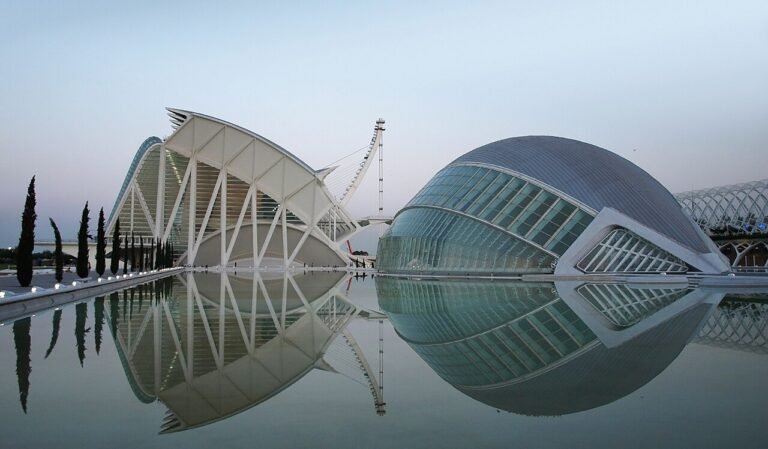
Valencia sells itself on the future — Calatrava’s white city rising from the riverbed — and the Jardín Botánico is the necessary counterweight: four and a half centuries of patient, labelled, watered continuity, a few streets from the medieval gate. It charges almost nothing, asks almost nothing, and gives you palms older than the nation, glasshouses full of weather from another hemisphere, and a cat asleep on a botanist. Go in spring if you can, at opening if you can’t, and give it the unhurried hour it has been practising since 1567.
¡Buen viaje!

Photo credits: Wikimedia Commons contributors Joanbanjo, Donarreiskoffer, Pablo Enzo and Derek Rankine, via Wikimedia Commons (CC BY / CC BY-SA / public domain).