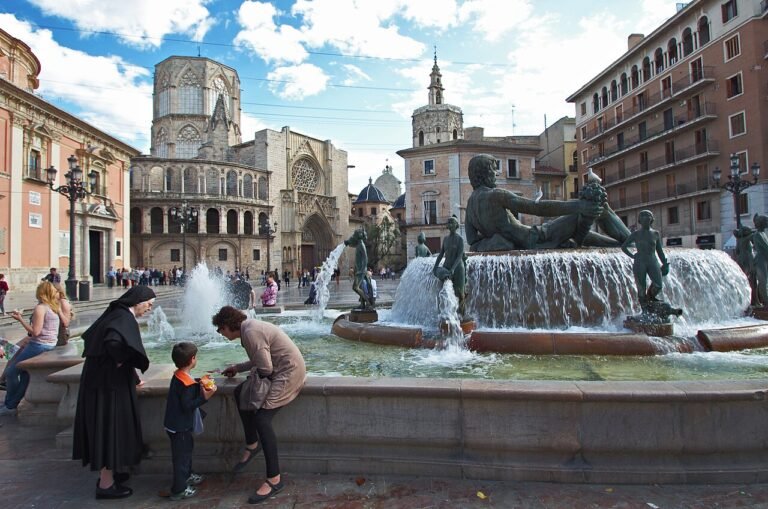
Valencia City Hall & Plaza del Ayuntamiento: The Complete Visitors’ Guide

Short Answer
Valencia City Hall — the Ayuntamiento, or Casa Consistorial — is the palatial seat of the city council on the Plaza del Ayuntamiento, the great triangular square at the southern edge of the old town. The building is really two: an 18th-century school, the Casa de la Enseñanza of 1758–1763, wrapped in an early-20th-century ceremonial block whose clock tower, domed corner towers and sculpted façade were designed to give Valencia a front door worthy of its ambitions. In normal times the ceremonial rooms open to visitors free of charge on weekday mornings: the imperial marble staircase, the glass-vaulted Salón de Cristal, the council chamber, the main balcony and the small Municipal History Museum, which guards the city’s most venerated object, the Real Senyera flag. One honest warning before you plan around that: as of October 2026 the official VisitValencia page flags interior visits as temporarily suspended, so check the current position before you go — the square itself, with its fountain, flower stalls and ring of grand buildings, needs no ticket and no permission at any hour. If you want the square and the building explained while access is in flux, the old town walking tour starts at the station two minutes away and covers Town Hall Square, La Lonja and the Central Market in one guided sweep.
Table of Contents
- The Short Version
- Two Buildings in One: A Short History
- The Façade and the Clock Tower
- Inside: Staircase, Crystal Hall and Council Chamber
- The Municipal Museum and the Senyera
- The Balcony and Las Fallas
- The Square: Plaza del Ayuntamiento
- Practical Info
- Tickets and Costs
- Visiting Hours and Rules
- Getting There
- When to Go
- How Long You Need
- Tips for Visiting
- What to See Nearby
- Frequently Asked Questions
- Final Thoughts
The Short Version
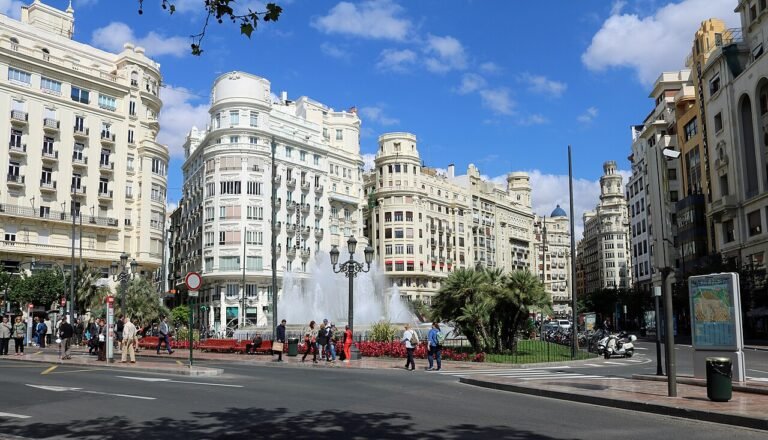
Every Spanish city has a main square; Valencia’s has a government attached. The Plaza del Ayuntamiento is where the city does its public living — where the mascletà shakes the ground at two o’clock through the first nineteen days of March, where the Falleras Mayores greet the crowds from the balcony, where the clock tower rings in the New Year, and where, on quieter mornings, pensioners read newspapers on benches between the flower stalls and the fountain. The building that gives the square its name earns its place on any list of the best things to do in Valencia less for what it is — a working council headquarters — than for how completely it concentrates the city’s character: an 18th-century girls’ school inside a 20th-century palace, a medieval flag in a glass-age hall, and a balcony that functions, for nineteen days a year, as the most important stage in the Valencian world.
Come twice if you can: once on a weekday morning, when the interiors are at their most accessible and the square belongs to shoppers and civil servants, and once at dusk, when the façades turn gold and the whole triangle fills with people doing nothing in particular, beautifully.
Two Buildings in One: A Short History
The older half of the city hall began life in 1758 as the Casa de la Enseñanza, a school for girls founded under Archbishop Andrés Mayoral — the “House of Teaching” whose plain, rational façade still forms the building’s quieter sides. Building work ran to 1763, and the school, with its chapel of Santa Rosa de Lima, taught generations of Valencian girls behind the walls you can still read from the side streets. The city council, which had governed from the medieval Casa de la Ciudad near the cathedral, took the building over in 1854, and the schoolrooms slowly became offices.
They were not grand offices, and Valencia at the turn of the 20th century was a city in a hurry to look important. So from 1904 the council built itself a new ceremonial body on the square side, to designs by the architects Francisco Mora Berenguer and Carlos Carbonell Pañella: a monumental façade of stone, sculpture and glass, raised in stages across the first decades of the century and joined to the old school behind it. The marble staircase was designed in 1924, the Salón de Cristal inaugurated in 1929, and the combined complex — nearly 6,200 square metres of it — was declared a Bien de Interés Cultural, a protected national monument, in 1962.
The building’s hardest chapter came during the Civil War. When Valencia became the capital of the Spanish Republic, the national parliament, the Cortes, sat in the city hall’s chamber from November 1936 to October 1937. On 28 May 1937 the building was bombed in an Italian air raid; damage was reckoned in millions of pesetas. For the schoolchildren who still studied in the old Casa de la Enseñanza, an air-raid shelter for some 700 pupils was dug beneath the building — it survives, entered from Calle Arzobispo Mayoral, and is visitable today as a separate sight with its own arrangements.
The Façade and the Clock Tower
Stand across the square and read the façade from the middle out. At its centre rises the clock tower, a stone campanile crowned by an open iron frame that holds the bell — the silhouette on a thousand Fallas posters. Below the tower, over the main door, the city’s bronze coat of arms is held up by two marble figures representing the Arts and Letters, the work of Mariano Benlliure, the most famous Spanish sculptor of his age. The two projecting blocks that flank the centre carry marble statues of the four cardinal virtues: Justice and Prudence by Carmelo Vicent, Fortitude and Temperance by Vicente Beltrán. At the corners, round towers capped with red-tiled domes give the whole composition its skyline — half palace, half exclamation mark.

The style is deliberate theatre: an eclectic, neo-baroque front in the academic taste of the period, built to be looked at from across a square rather than approached on a street. The 18th-century school behind it never tries to compete; its long, regular window bays along the side streets are the building’s working clothes.
Inside: Staircase, Crystal Hall and Council Chamber
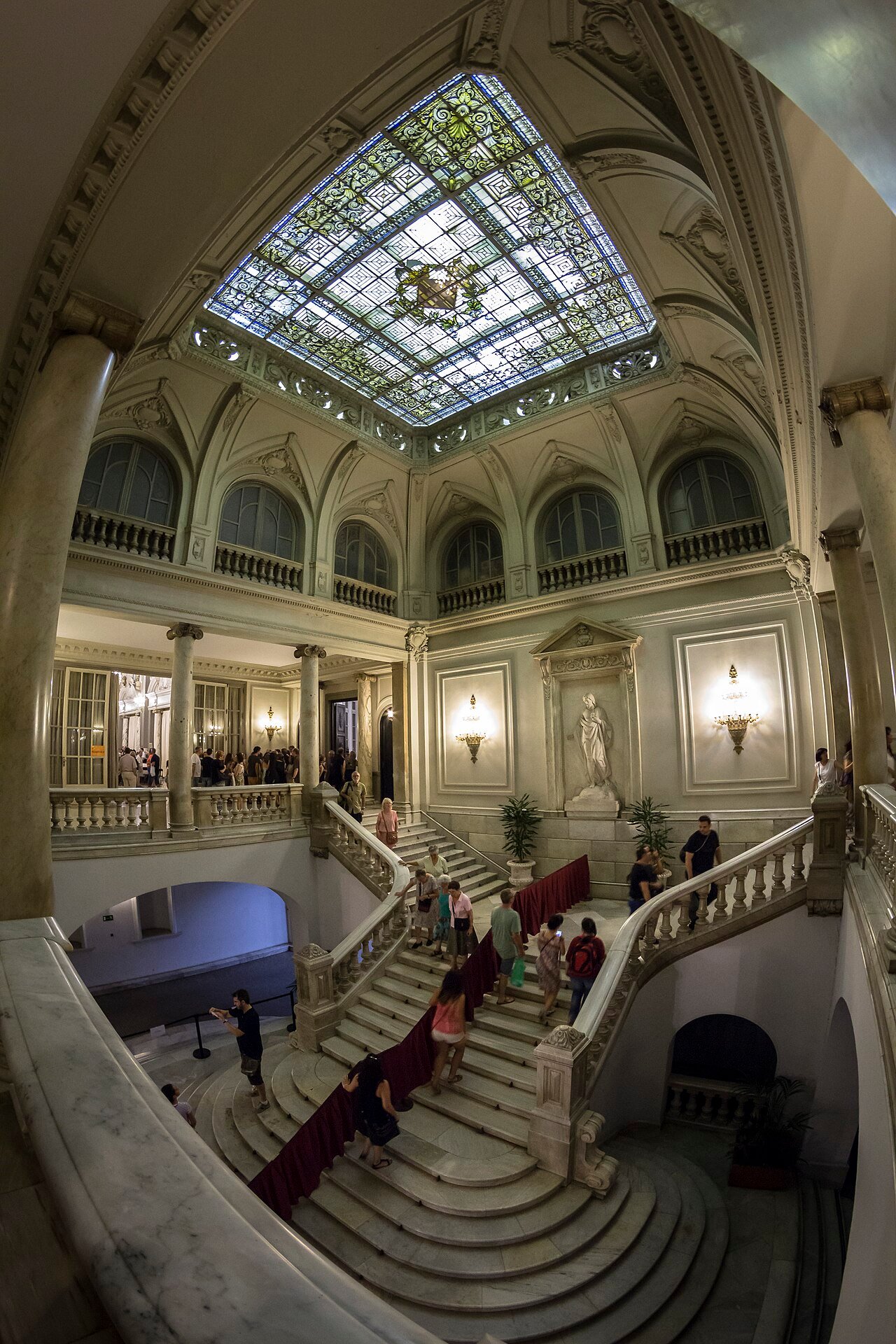
The visit route — when visits are running — climbs in the order the building wants to impress you. First the entrance hall and the imperial marble staircase, designed in 1924: a neoclassical double flight that rises, turns and rises again under a modernist stained-glass skylight bearing the city’s arms, lit by wall sconces and watched over by a marble statue at the landing. It is less a way upstairs than an overture.
At the top waits the Salón de Cristal, the Crystal Hall: an oval former ballroom ringed by eighteen Ionic marble columns and roofed by an iron-and-glass vault, inaugurated in 1929 and now used for official receptions and Fallas ceremonies. Chandeliers the size of small cars hang beneath painted ceiling panels; the council’s own tourist brochure calls it, without embarrassment, a Versailles-style space, and for once the brochure is underselling it.

The third room is the Hemiciclo, the council chamber, its curved benches and presiding table modelled on the Spanish Parliament in Madrid — the same room where the real Cortes sat in 1936–37. VisitValencia’s rule is the practical one: when the government is not in session, visitors may be shown in; when the councillors are debating, the door stays shut. Between the great rooms, look for the glazed courtyard that occupies the site of the old church, and the mosaic floors and stained-glass windows carrying the city’s shield that turn corridors into exhibits.

The Municipal Museum and the Senyera
Tucked into the old school wing, in what was the chapel of Santa Rosa de Lima, the Museo Histórico Municipal has been the city’s memory box since 1927. It is small — a handful of rooms — and it holds things no amount of money could replace. The greatest is the Real Senyera, Valencia’s ceremonial banner: the venerated flag, dated by VisitValencia to 1928, that is carried down from the building each 9 October, the Valencian national day, without ever being lowered or bowed, as custom demands. Beside it rest the sword and shield of Jaume I, the king who conquered the city in 1238, and the keys of the city. The Sala de los Fueros, the Room of the Fueros, lines its walls with Ramón Stolz Viciano’s 1956 portraits of eight medieval monarchs, beginning with Jaume I himself, and other rooms trace the city’s growth through historic maps and plans — five centuries of Valencia expanding across paper.

None of this is displayed with much fanfare, which is precisely the pleasure of it: these are the working relics of a living city government, kept a corridor away from the offices, and the museum is free.
The Balcony and Las Fallas
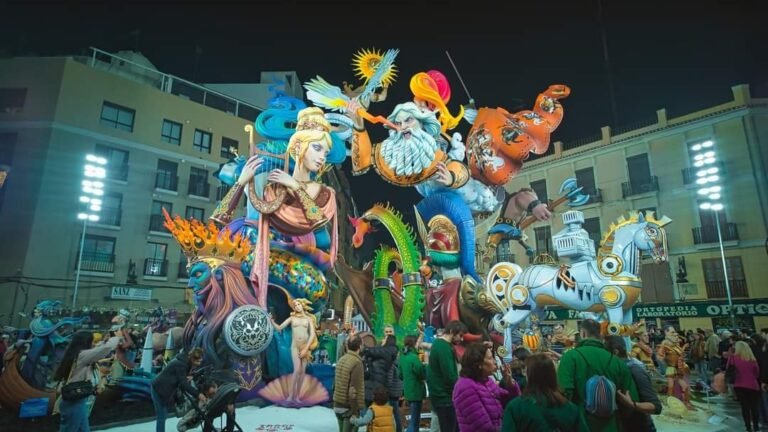
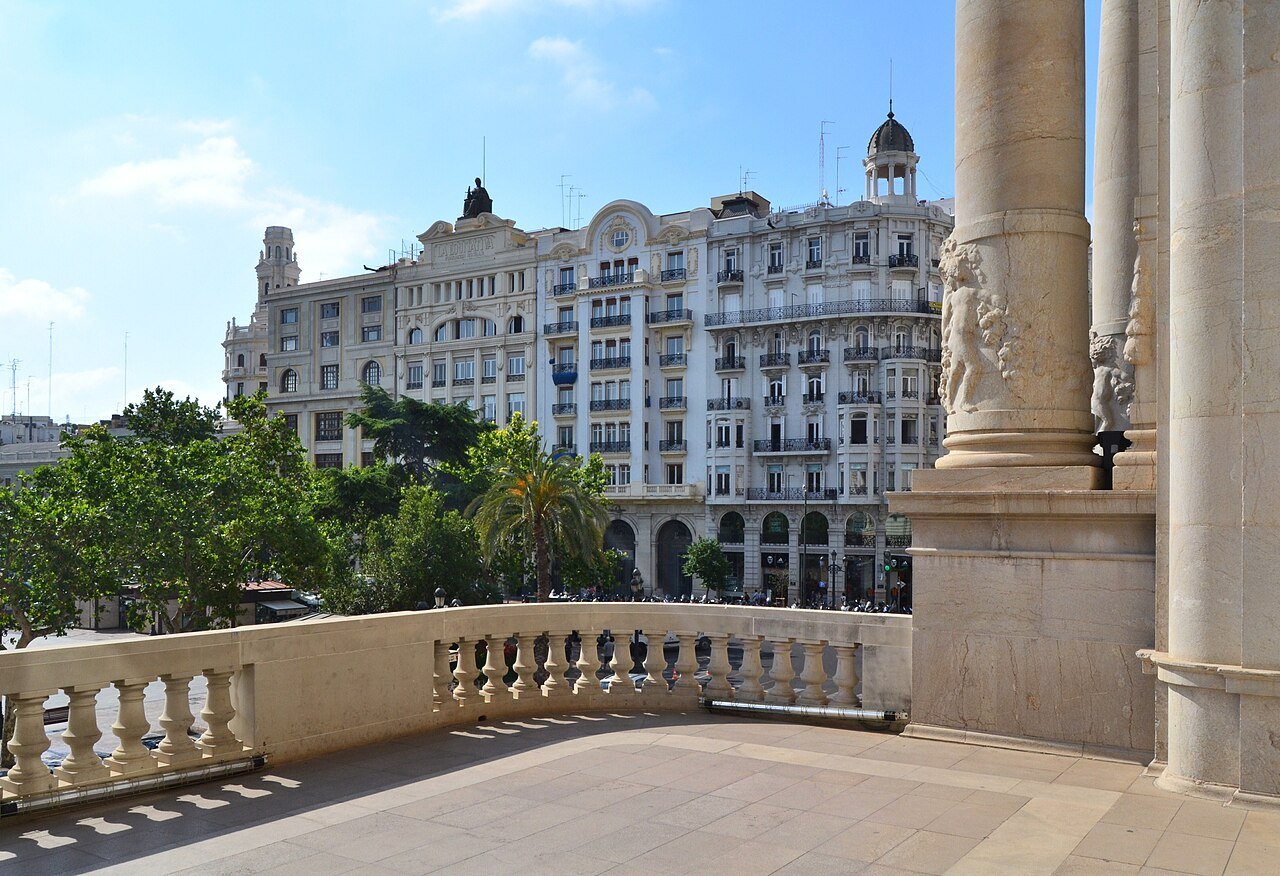
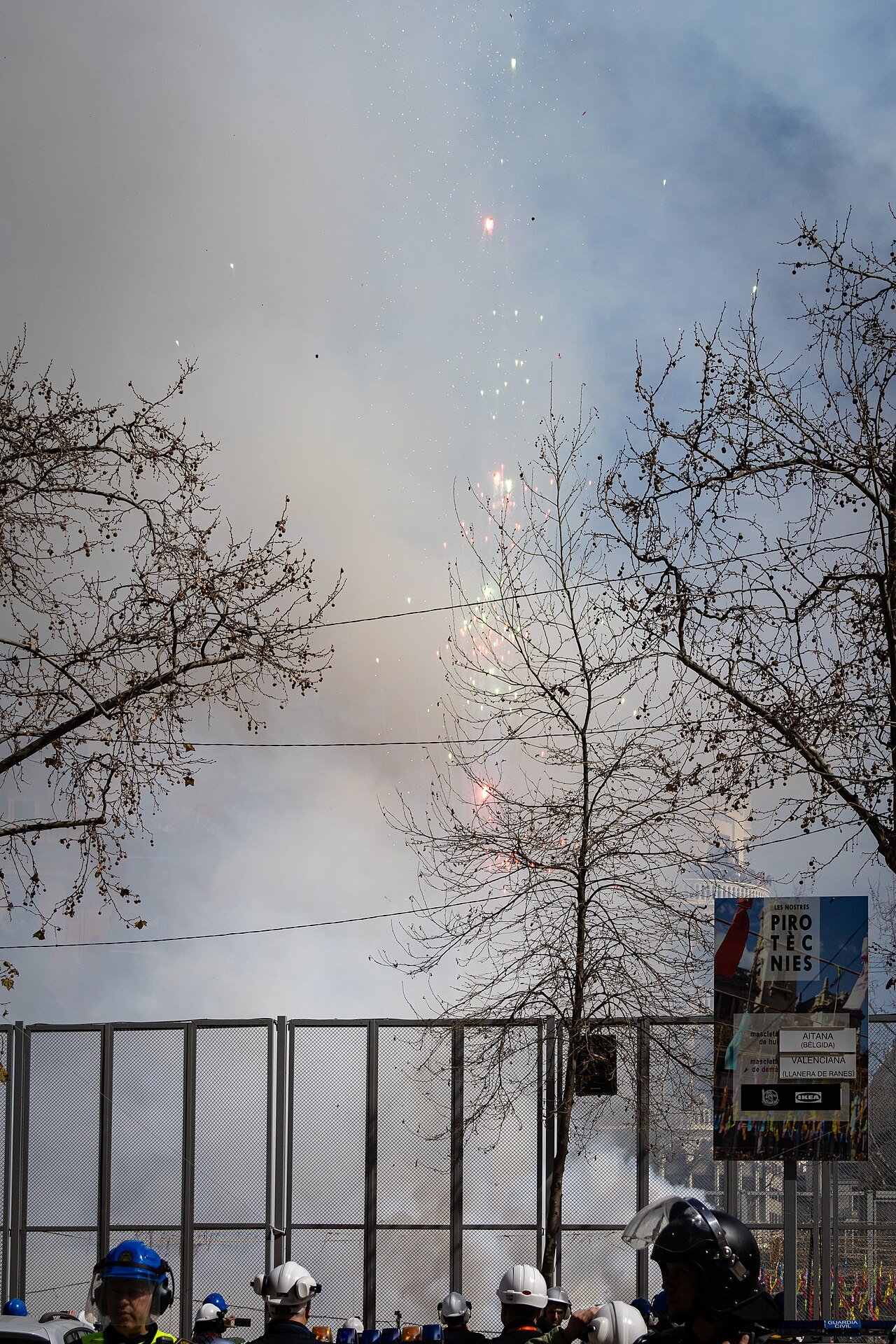
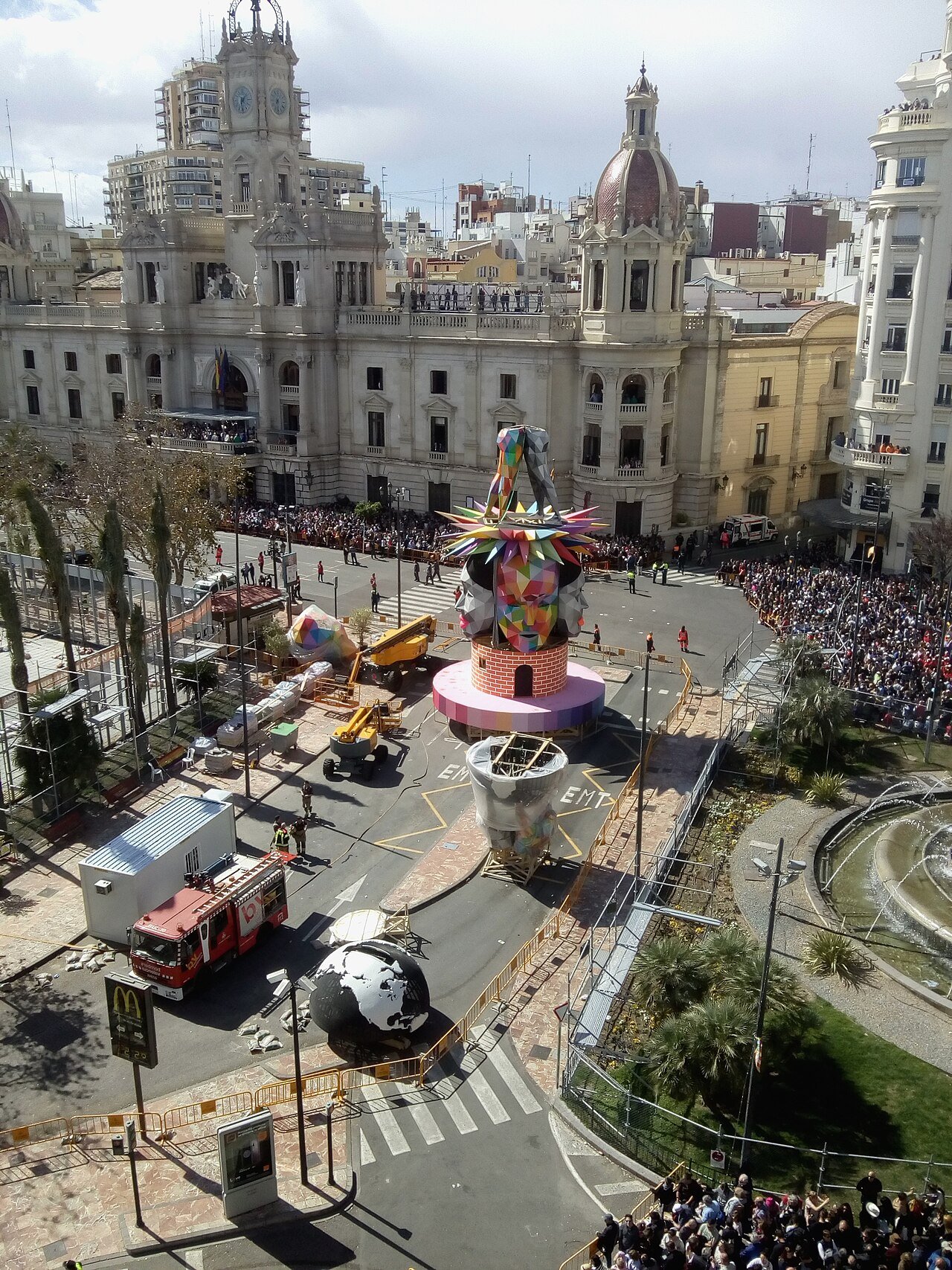
Every city hall has a balcony; this one has a congregation. The main balcony, above the central door, is where the Falleras Mayores — the queens of Las Fallas — preside over the festival’s great acts, where winning fallas are announced, where New Year is rung in and where, at two o’clock each afternoon from 1 to 19 March, the order is given for the mascletà: the five-minute rhythmic barrage of firecrackers fired in a cage in the square below, less heard than felt, through the soles of the feet. From the balcony during the visit route you get the square as its masters see it — the triangle laid out below, the fountain at its point, the Correos palace to one side. The full story of those nineteen days — the plantà, the flower offering, the cremà — is in our guide to Las Fallas Festival Valencia: The Complete Guide to the Fire Festival. In Fallas week the square also hosts the city’s own municipal falla, planted in front of the façade and burned, like all the others, on the night of 19 March.
The Square: Plaza del Ayuntamiento
The square is younger than it looks. Its space was assembled in the 19th and early 20th centuries over the grounds of the demolished convent of San Francisco, and it was given its present unified, roughly triangular form in 1927 to a design by Javier Goerlich — less a plaza in the Spanish sense than a broad civic fan, one long side held by the city hall, the point closed by gardens. At that point stands the square’s modest centrepiece: a circular fountain set in a small garden of lawns and flower beds, with benches that fill at every hour. Around the edges run the flower stalls, selling on this square since 1924 — the splash of colour in every photograph — and at the apex a bronze statue of Francesc de Vinatea, the 14th-century citizen who defied a king to defend the city’s laws, erected in 1993.
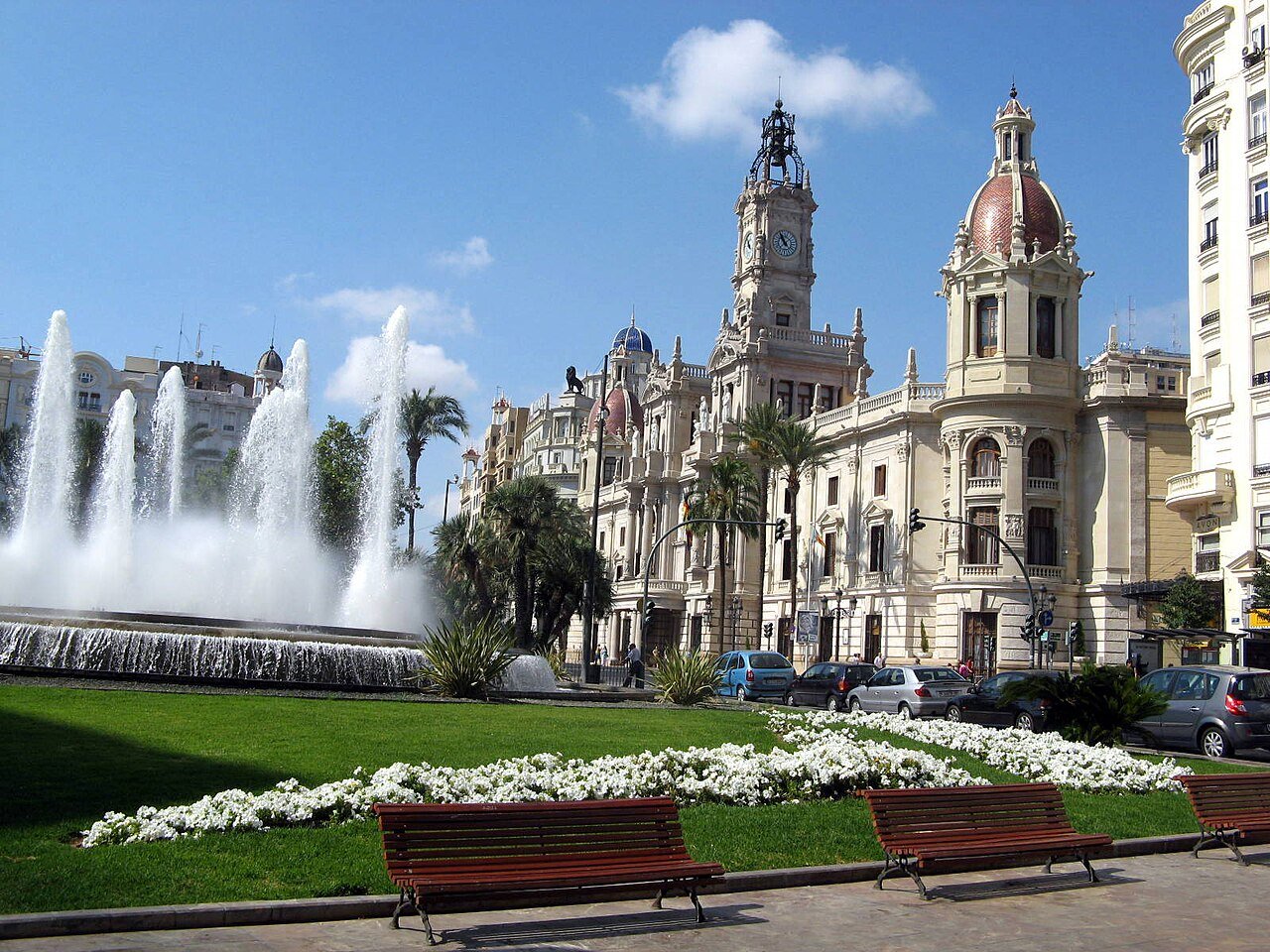
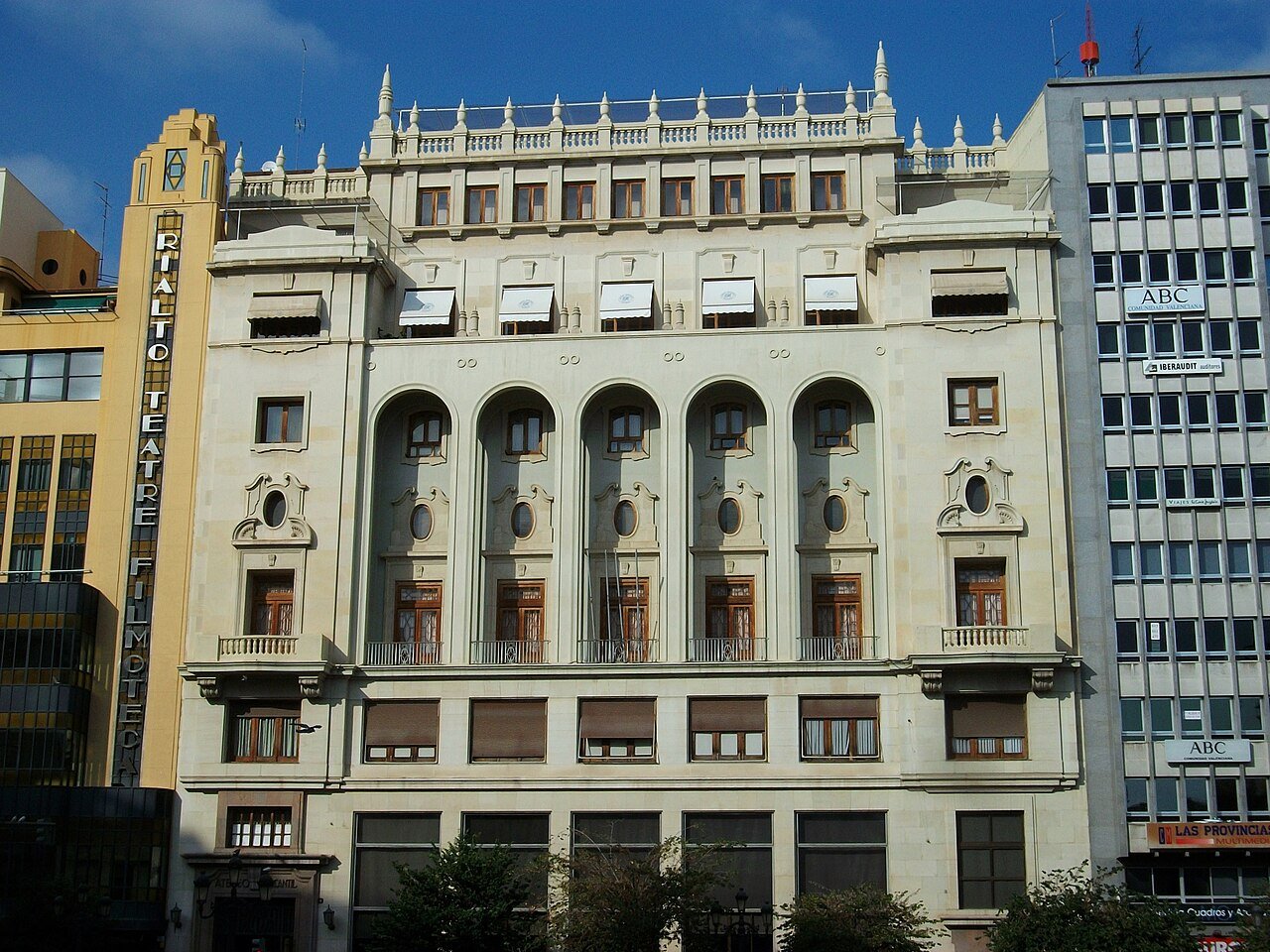
The ring of buildings is the square’s second act. On the eastern side stands the Palacio de Comunicaciones, the old Post Office and Telegraph palace, built between 1915 and 1922 to designs by Miguel Ángel Navarro and inaugurated in 1923: an eclectic palace of carved stone whose tympanum carries the five continents, whose corners wear little domes, and whose slender iron turret — topped by a restored astrolabe — is the square’s second landmark. Step inside if it is open (in recent years the building has reopened to visitors as a cultural venue) for the great stained-glass dome by the Mauméjean brothers: 370 panels ringed with the coats of arms of Spain’s 48 provinces around the shield of Valencia. Next along the same flank, the Ateneo Mercantil, the merchants’ athenaeum that has been the city’s cultural drawing room since the 19th century, stands beside the Rialto theatre — the square’s wall of cafés, clubs and cinemas that keeps it busy long after the offices close.


Practical Info
Address: Plaça de l’Ajuntament, 1, 46002 Valencia — the building fills the western side of the square at the southern edge of the Ciutat Vella. Council phone: +34 963 525 478.
What it is: the Casa Consistorial — Valencia’s working city hall (protected as a Bien de Interés Cultural since 1962), whose ceremonial rooms and municipal museum normally open free on weekday mornings, set in the city’s main civic square.
| Best for | The square at any hour; the interiors — staircase, Crystal Hall, balcony and the Senyera — on a weekday morning when visits are running |
| Entry | Free. No ticket, no booking for the standard visit route |
| Time needed | 30–45 minutes inside; the square rewards as long as you care to sit |
| Nearest transport | Metro Xàtiva (lines 3, 5 and 9) at the Estación del Norte, 2 minutes; Colón (lines 3, 5, 7 and 9) about 8 minutes |
| Don’t miss | The Salón de Cristal, the Real Senyera in the museum, and the balcony view over the square |
Tickets and Costs
There is nothing to buy. The standard visit to the city hall’s ceremonial rooms and the Municipal History Museum is free of charge, unbooked and untimed — you present yourself at the door during the visiting window, pass a brief security check, and follow the route. The air-raid shelter beneath the building is a separate visit with its own entrance on Calle Arzobispo Mayoral and its own arrangements. If interior access matters to your day and you would rather build the square into a guided route regardless, the old town walking tour covers Town Hall Square with a guide as part of a wider old-town circuit — its cost is the tour’s, not the building’s. Everything else in this article — the square, the fountain, the flower stalls, the façades — is public space and free around the clock.
Visiting Hours and Rules
This is the section to read before you set an alarm. The normal arrangement, per the official VisitValencia page, is that several areas of the city hall can be visited free of charge from Monday to Friday in the mornings: the Crystal Room, the balcony, the Municipal History Museum and the council chamber when the government is not in session. The council’s own public hours run 8:30–14:00 on weekdays; the building is closed to visitors at weekends and on public holidays, and individual rooms can close at short notice for official acts, sessions and ceremonies — it is a working seat of government first and a sight second.
The current position needs stating plainly: when this guide was last checked (October 2026), VisitValencia’s City Hall page carried the banner “Visits to the city hall have been temporarily suspended”. Suspensions of this kind come and go with works and official calendars, and no end date was published. So: check the VisitValencia City Hall page or call +34 963 525 478 before planning a morning around the interior, and treat the square, which never closes, as the guaranteed sight. Expect a brief security check at the door when visits resume, and large bags to be unwelcome inside.
Getting There
You are unlikely to need transport at all — the square is the hinge between the old town and the station quarter, and most central sights stand within ten minutes’ walk. The Estación del Norte, Valencia’s main station and itself a Modernista monument of oranges and ceramic tile, is two minutes south, and its metro station, Xàtiva (lines 3, 5 and 9), opens almost onto the square; Colón station (lines 3, 5, 7 and 9) is about eight minutes northeast and handy for the shopping streets. EMT city buses thread around the square’s edges, taxis rank by the station, and the old-town lanes north of the square — toward the market and the cathedral — are pedestrian in all but name. Drivers should simply not: the centre is restricted, and the station car parks are the nearest sensible option.
When to Go
For the interiors, a weekday morning is the only window there is — arrive nearer nine than two, when the light through the Crystal Hall’s vault is at its best and the route is quietest. For the square, the golden hours are literal: early morning, when the flower stalls are setting up and the façade catches the east light, and the hour before sunset, when the stone turns amber and the terraces fill. March is the square’s thunderous high season — the mascletà at 14:00 daily from the 1st to the 19th — and the week of Las Fallas proper (15–19 March) fills it wall to wall; in those days, come early, expect barriers and bag checks, and read our Las Fallas guide before you come. August empties the offices but not the square, and the fountain garden becomes the old town’s waiting room.
How Long You Need
The interior route — staircase, Crystal Hall, chamber, balcony, museum — takes 30 to 45 minutes at a natural pace, longer if the museum’s maps catch you. Add the square itself and a coffee, and the whole visit is an hour; add the Correos palace interior and it becomes a morning. The city hall pairs naturally with the two great sights five minutes north — La Lonja and the Central Market — in a single old-town morning that ends, as it should, with lunch in the market’s bars.
Tips for Visiting
- Check the suspension before you go. As of October 2026 interior visits are flagged as temporarily suspended on the official VisitValencia page; the square is always open, but confirm the interior at visitvalencia.com or on +34 963 525 478 if it is the point of your morning.
- Weekday mornings only, and go early. The visiting window is Monday to Friday mornings (council hours 8:30–14:00); weekends the doors stay shut. The Crystal Hall photographs best before eleven.
- Treat it as a working building. Rooms close for sessions and ceremonies without notice, a security check guards the door, and the council chamber is only shown when the government is not sitting — build slack into the plan.
- Let a guide read the square for you. If the doors are shut, the old town walking tour makes the façade and square legible from outside — the virtues, the Benlliure coat of arms and the balcony’s Fallas role are a story best told standing in front of it — before continuing to La Lonja and the market.
- Time a March visit for 13:30, not 14:00. The mascletà crowd packs the square well before two; arrive by half past one for a place with a view of the cage, and bring ear protection for children.
- Don’t skip the shelter. The Civil War air-raid shelter under the old school, entered from Calle Arzobispo Mayoral, is one of the old town’s most affecting small sights — and the one most visitors walk straight past.
What to See Nearby
Five minutes north up Carrer de Sant Vicent Màrtir, the old town’s two great trading buildings face each other across the Plaça del Mercat: La Lonja de la Seda, the Gothic silk exchange and UNESCO World Heritage Site, and the Mercado Central, the Modernista food market beneath its parrot-crowned dome — go to the Lonja for the architecture and the market for breakfast. The church of Santos Juanes, fire-scarred and frescoed, stands between them. South of the square, the Estación del Norte’s tiled façade and the bullring beside it make a two-minute detour on any arrival or departure. And ten minutes north through the lanes, the Valencia Cathedral and its Miguelete tower close the old-town circuit — climb it at opening time, then come back to the square for coffee and watch the city hall clock do the same job it has done for a century.
Frequently Asked Questions
Can you go inside Valencia City Hall?
In normal times, yes — free of charge on weekday mornings, when the route covers the marble staircase, the Salón de Cristal, the council chamber (when not in session), the balcony and the Municipal History Museum. As of October 2026, however, VisitValencia flags interior visits as temporarily suspended, with no published end date, so check the official page or call +34 963 525 478 before going.
How much does it cost to visit Valencia City Hall?
Nothing. Entry to the ceremonial rooms and the municipal museum is free, with no ticket or booking for the standard route. The only money in the area is optional: a guided old-town tour that includes the square, or coffee at a terrace on it.
What is the Senyera, and where can I see it?
The Real Senyera is Valencia’s venerated ceremonial banner — the city’s own flag, dated to 1928 in its present form — kept in the Municipal History Museum inside the city hall alongside the sword and shield of Jaume I and the keys of the city. On 9 October, the Valencian national day, it is carried out of the building in procession, by custom never lowered or bowed.
What happens at the Plaza del Ayuntamiento during Las Fallas?
Almost everything, at maximum volume. The mascletà — five minutes of rhythmic firecracker thunder — is fired in the square at 14:00 every day from 1 to 19 March; the Falleras Mayores preside from the city hall balcony; and the city’s own municipal falla stands in the square until it burns in the cremà on the night of 19 March.
What are Valencia City Hall’s opening hours for visitors?
Visits run on weekday mornings only — the council’s public hours are Monday to Friday 8:30–14:00, closed weekends and public holidays — and individual rooms close for official business without notice. Note the current temporary suspension of visits (see above) before relying on these hours.
How do I get to the Plaza del Ayuntamiento?
Walk: it adjoins the Estación del Norte at the old town’s southern edge. By metro, Xàtiva station (lines 3, 5 and 9) opens beside the station two minutes away, and Colón (lines 3, 5, 7 and 9) is about eight minutes northeast. Most old-town sights are within a ten-minute walk.
Travel insurance, sorted
Whether it is a two-week holiday or a longer move, travel insurance is not the most glamorous part of a trip — but it is the one booking you want to have in place before a trip, and while you are already away. Get a quote from SafetyWing
Final Thoughts
Most city halls are buildings you are photographed in front of; Valencia’s is a building the city lives in front of, on top of and, for nineteen days each March, at full volume. Its school-turned-palace holds a glass ballroom, a parliament in miniature and a flag older in spirit than the state that surrounds it, while its square does the daily work of fountain, flower market, meeting point and thunderbox. Go on a weekday morning for the staircase and the Senyera, come back at dusk for the square — and if the doors happen to be shut on the day you come, take the consolation the square itself offers: in Valencia, the best room in the city hall has always been the one outside it.
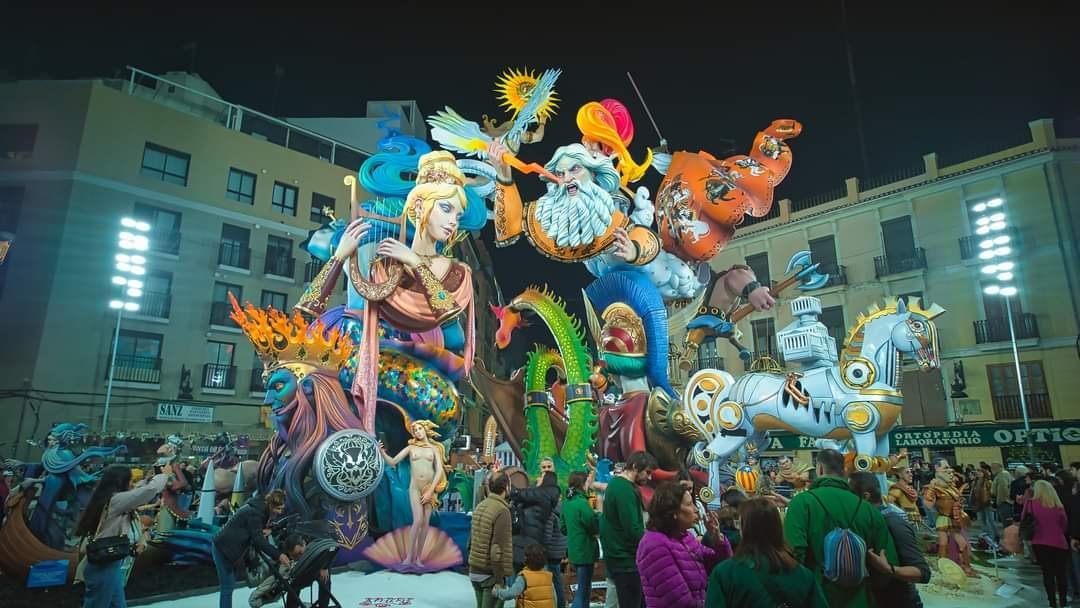
Photo credits: Diego Delso, Frnevado, Rafesmar, Vicente Mocholi Grau, Casanova2000, MCAE Consulting, Joanbanjo, Demiannnn, Anidae and Rafa Esteve, via Wikimedia Commons.