Hospital de la Caridad: The Complete Guide to Seville’s Church of Last Things
Five minutes from Seville Cathedral stands a white-walled hospital most visitors walk straight past — and inside it, behind an unassuming gate, hangs the most terrifying pair of paintings in Spanish art. Two vast canvases face you down as you enter the church: a skeleton snuffing out a candle over the wreckage of crowns, books and glory, and a bishop’s corpse rotting while a scale weighs sin against prayer and finds them exactly balanced. This is the Hospital de la Caridad, the most concentrated dose of the Spanish Baroque anywhere.
The place was built by Miguel Mañara — a reformed libertine often named as a real-life model for Don Juan — as the headquarters of a brotherhood whose work was the city’s grimmest: nursing the abandoned sick and burying the executed and the drowned. Mañara filled its church with art designed to confront visitors with their own death, then asked to be buried where everyone’s feet would walk over him. The hospital still cares for the elderly poor on the same site, 350 years later.
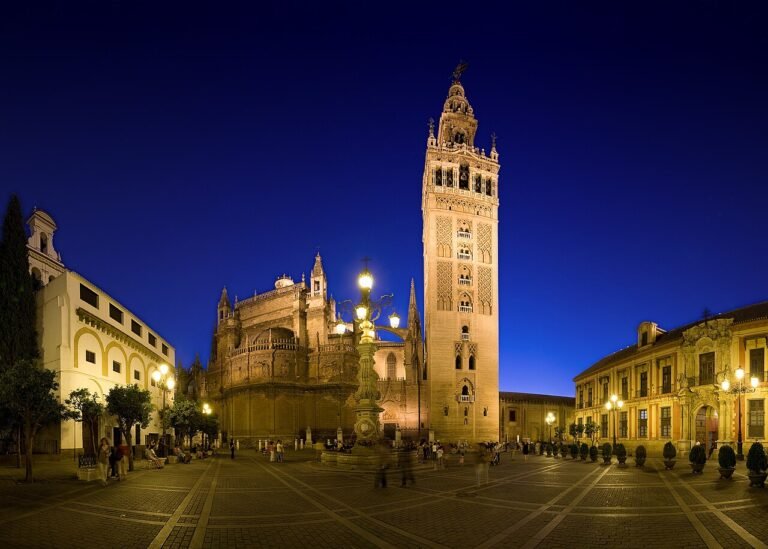
This guide explains the brotherhood and its founder, walks you through the two great Valdés Leal canvases and Murillo’s cycle of mercy (including the four masterpieces Napoleon’s marshal stole), and covers tickets, the joint pass with the Hospital de los Venerables, and how to fit the visit into an El Arenal half-day.
Short Answer
The Hospital de la Caridad stands at Calle Temprado 3 in El Arenal, immediately behind the Maestranza bullring. Its church of San Jorge holds Valdés Leal’s Finis Gloriae Mundi and In Ictu Oculi — the famous “hieroglyphs of death” — four surviving Murillos from his cycle of the works of mercy, and sculpture by Pedro Roldán, all commissioned in the 1670s by Miguel Mañara. Entry is cheap (around €8 with audioguide), the visit takes 45–60 minutes, and a joint ticket with the Hospital de los Venerables (around €12) makes the pair the best-value art double in Seville.
This one is not bookable through the usual platforms — the Hospital de la Caridad entry ticket is not sold on GetYourGuide — so tickets are bought at the door; the good news is that queues are rare. Confirm current prices and hours on the official site (santa-caridad.es) before you go.
Table of Contents
- The Short Version: Is the Hospital de la Caridad Worth It?
- A Brotherhood Built on the Worst Jobs in Seville
- Miguel Mañara: The Libertine Who Became a Legend
- The Church of San Jorge: A Sermon You Walk Into
- Finis Gloriae Mundi: The End of the Glory of the World
- In Ictu Oculi: In the Blink of an Eye
- Murillo’s Works of Mercy — and the Four That Sailed Away
- The Patios: Fountains, Tiles and Two Virtues
- The Chapter House and the Street of the Coffin
- Still a Hospital: The Work Never Stopped
- Pair It with the Hospital de los Venerables
- Practical Info
- Tips That Will Improve Your Visit
- Final Thoughts
The Short Version: Is the Hospital de la Caridad Worth It?
Emphatically yes, if anything in you responds to art with an argument. This is not a pretty church with paintings in it; it is a complete, deliberate programme — architecture, sculpture, painting and text all preaching one sermon about death and mercy. For density of major Spanish Baroque art per square metre, it beats everything in Seville except the cathedral itself.
Skip it only if Baroque religious art genuinely leaves you cold. Everyone else should put it high on their list of things to do in Seville: it is the city’s great connoisseur sight, the one locals name when you ask what visitors miss.
A Brotherhood Built on the Worst Jobs in Seville
The Hermandad de la Santa Caridad — the Brotherhood of Holy Charity — was founded in the mid-1400s and given its first formal rules in 1578, and its rulebook reads like a list of tasks nobody else would take. The brothers collected the helpless sick from the streets and nursed them. They accompanied condemned prisoners to the scaffold. And they buried the dead nobody claimed — above all the corpses the Guadalquivir gave up after floods, and the executed, left on the gallows until the brotherhood cut them down.
Seville in the 1600s needed them: the plague of 1649 killed perhaps half the city, and floods and famine did the rest. Into this world came Miguel Mañara, who joined in 1662, took the brotherhood over within a year, and rebuilt it, its hospital and its church in his own uncompromising image. The wards rose inside the medieval Royal Shipyards, the Atarazanas of Alfonso X, whose brick arches still form part of the complex. The first ward opened in June 1674 — and the institution has cared for the poor on this spot ever since.
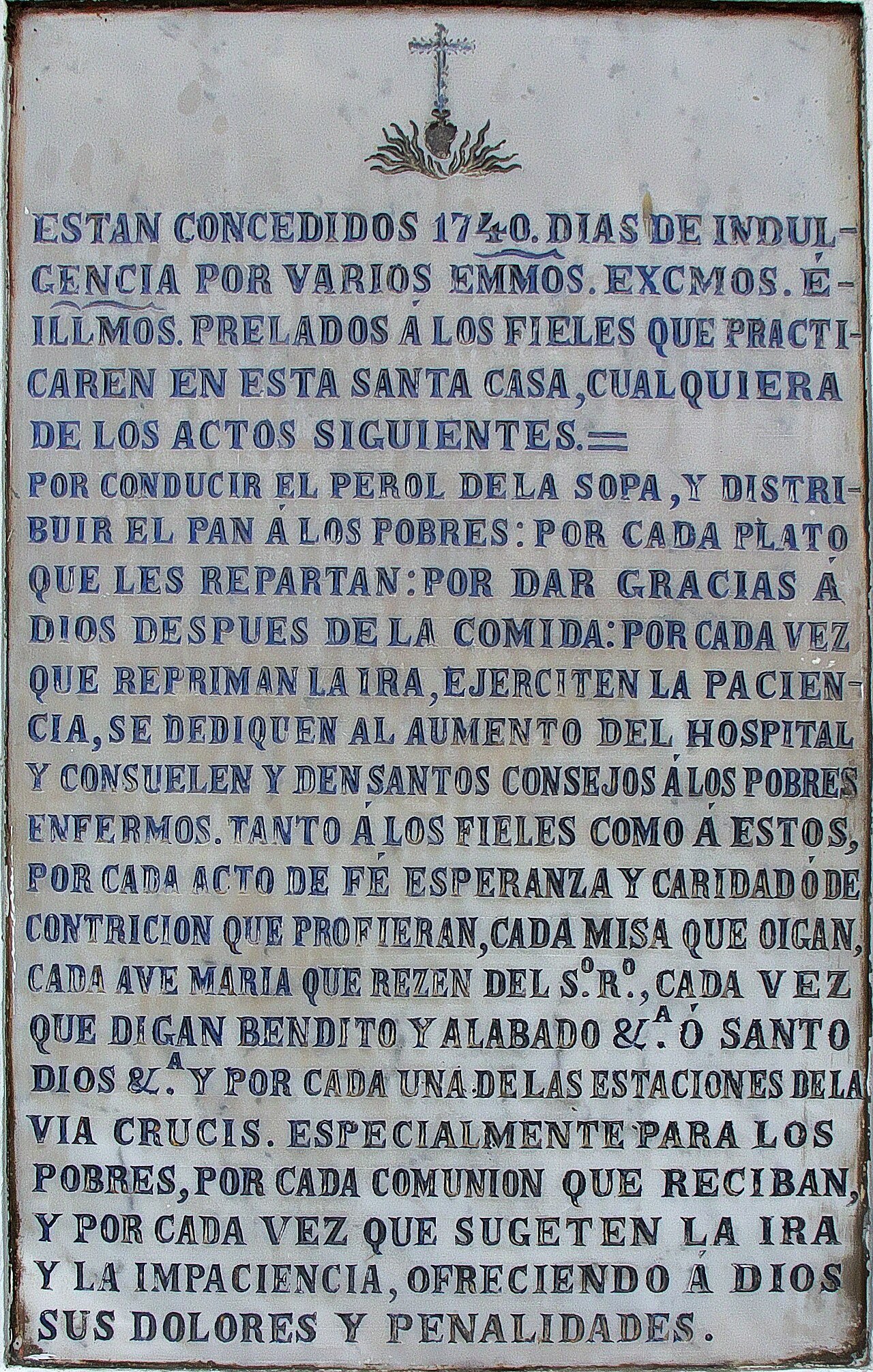
A great tiled inscription inside makes the ethos concrete: 1,740 days of indulgence, it promises, for carrying the soup pot to the poor, for distributing bread, for restraining your anger, for consoling the sick. Charity here was never abstract — it was a rota of unbearable jobs, done daily, as a discipline of the soul.
Miguel Mañara: The Libertine Who Became a Legend
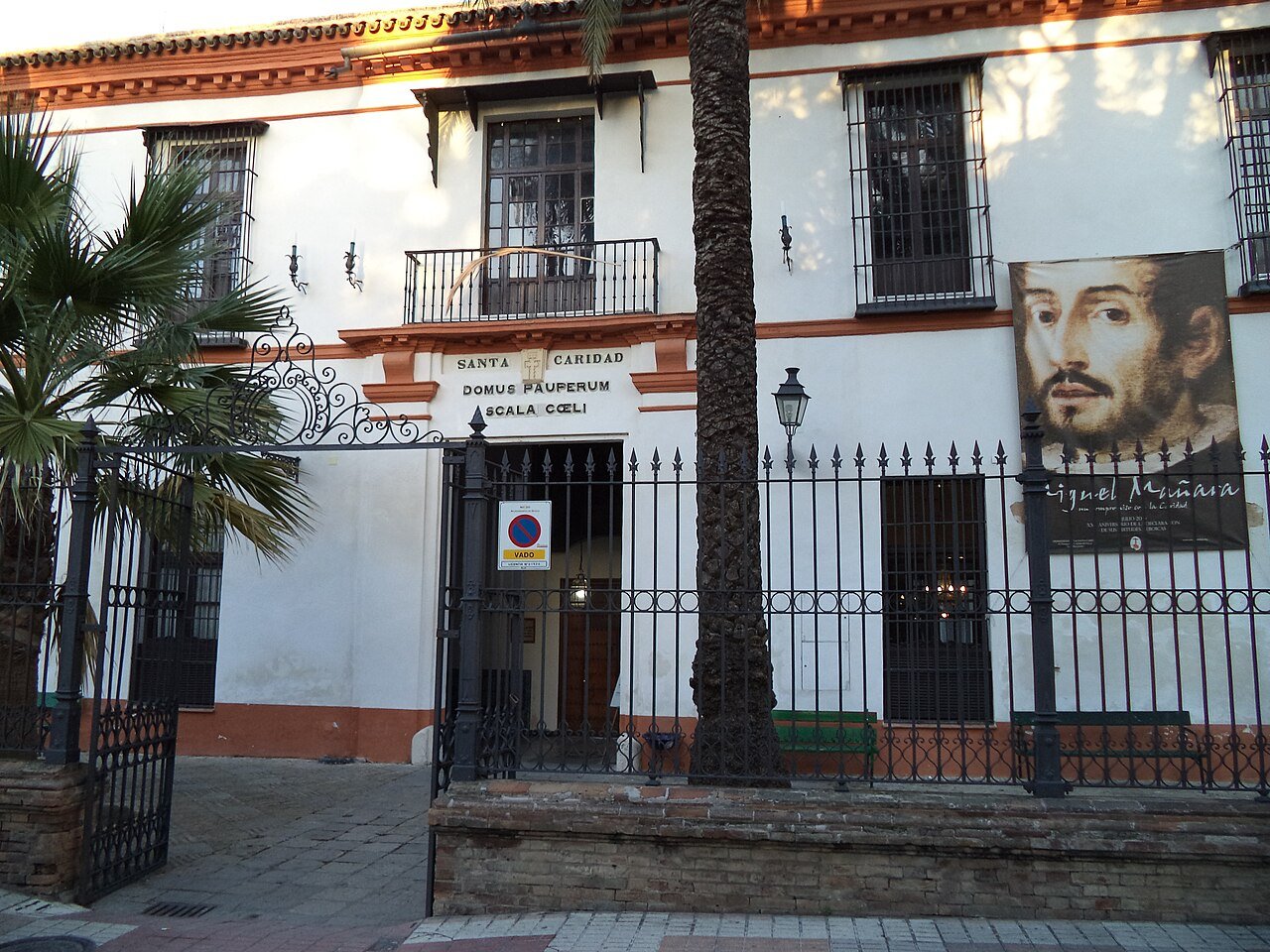
Miguel Mañara Vicentelo de Leca (1627–1679) was born rich, connected and — by his own later account — thoroughly dissolute; Seville tradition has long pointed to him as one of the real men behind the Don Juan legend. Then his wife died in 1661, and Mañara underwent the most spectacular conversion in a city famous for them. He joined the brotherhood in 1662, became its hermano mayor in 1663, and poured his fortune and ferocious energy into its work for the remaining sixteen years of his life.
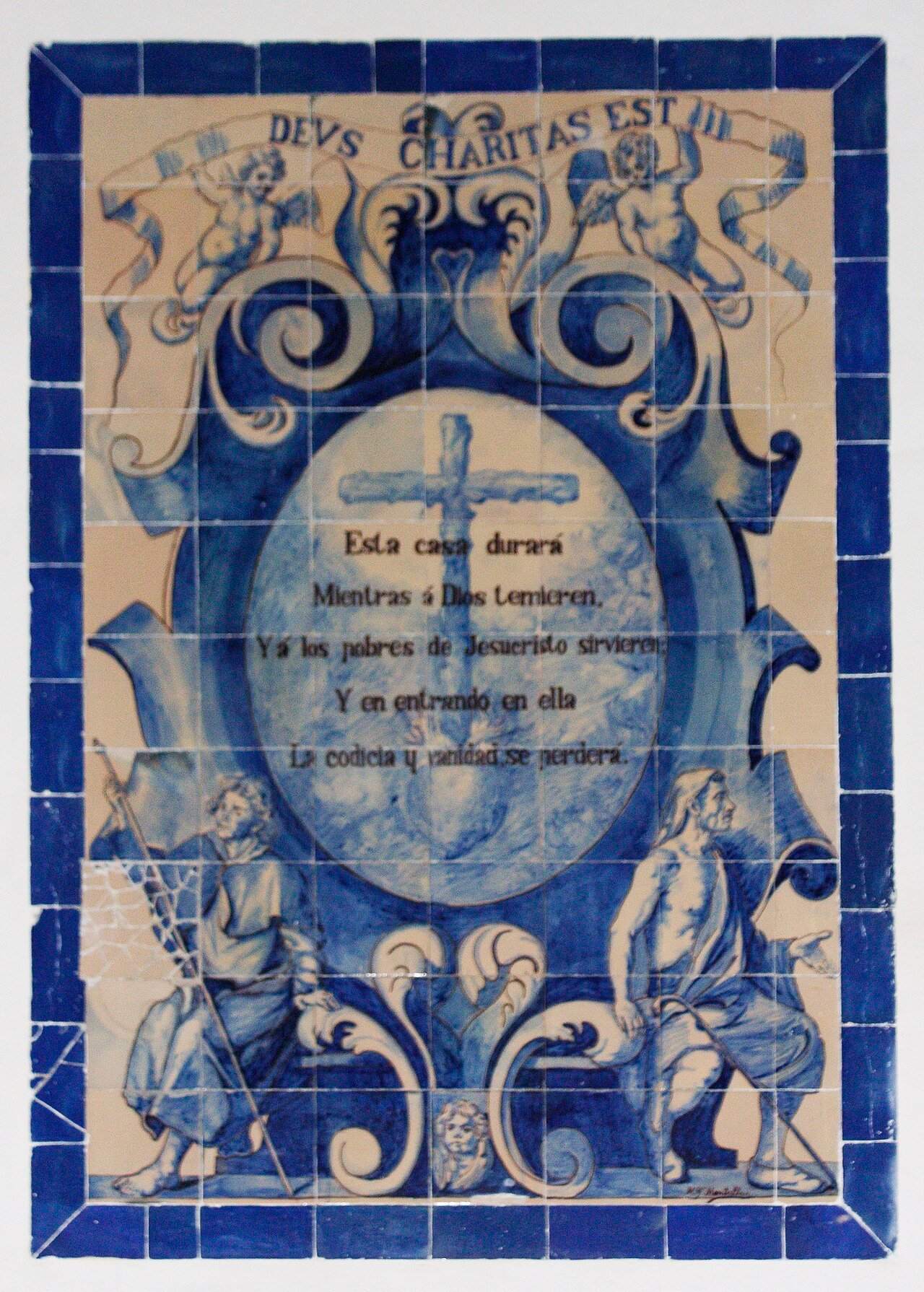
His Discourse on Truth is the key to the church he built — a meditation on death so unflinching that the art he commissioned reads as its illustration. But Mañara was no mere merchant of gloom: he expanded the hospital ward by ward, fed the poor in famine years, and set his promise in tiles at the church door: this house will last while God is feared and Christ’s poor are served in it.
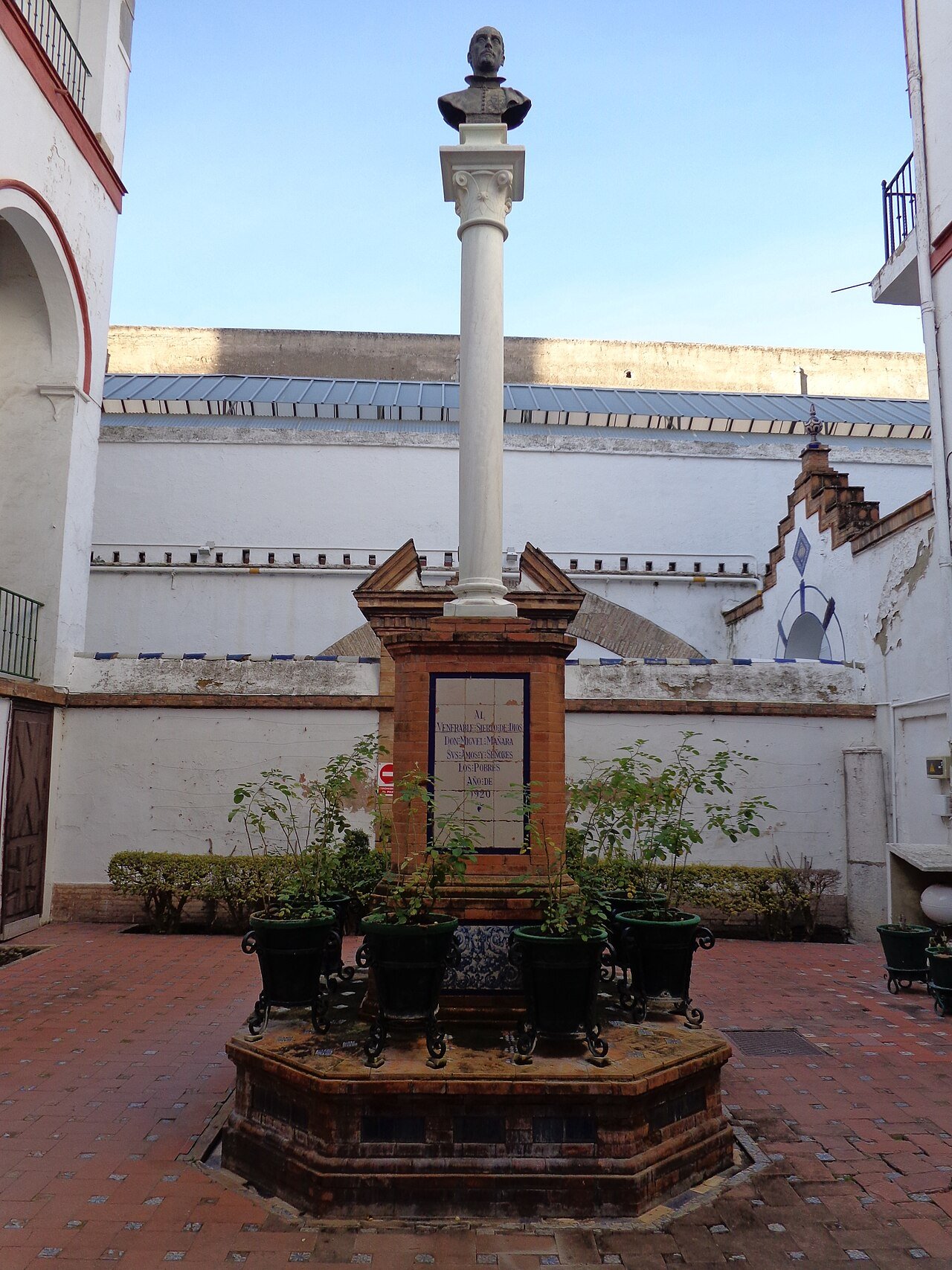
His last instruction concerns his own body. Mañara asked to be buried at the church threshold, where everyone entering would tread on him — the proudest man in Seville choosing the floor as his monument. The entrance passage is still paved with the brothers’ burial slabs; you will walk over them, as he intended, on your way in. In the garden patio his bust stands on a tall column, raised in 1920, ringed by rosebushes tradition says descend from his own plants.
The Church of San Jorge: A Sermon You Walk Into
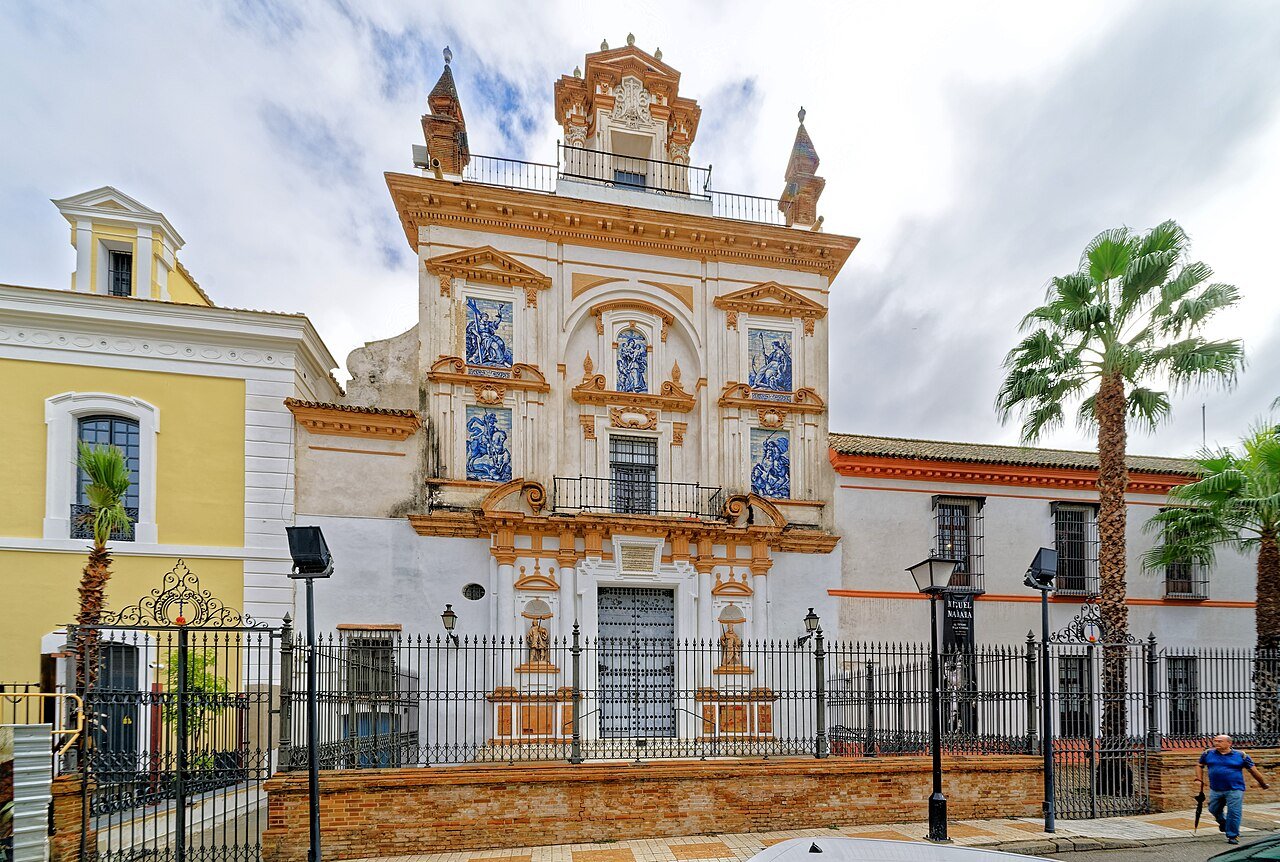
The church — dedicated to St George — rose in the 1670s on the site of the brotherhood’s flood-wrecked earlier chapel, its floor lifted against the river. Its façade, designed by Leonardo de Figueroa, master of the Sevillian Baroque, faces the street in white and gold: blue-and-white tile panels tell the saints’ stories, and in niches stand St Ferdinand and St Louis, the two sainted kings.
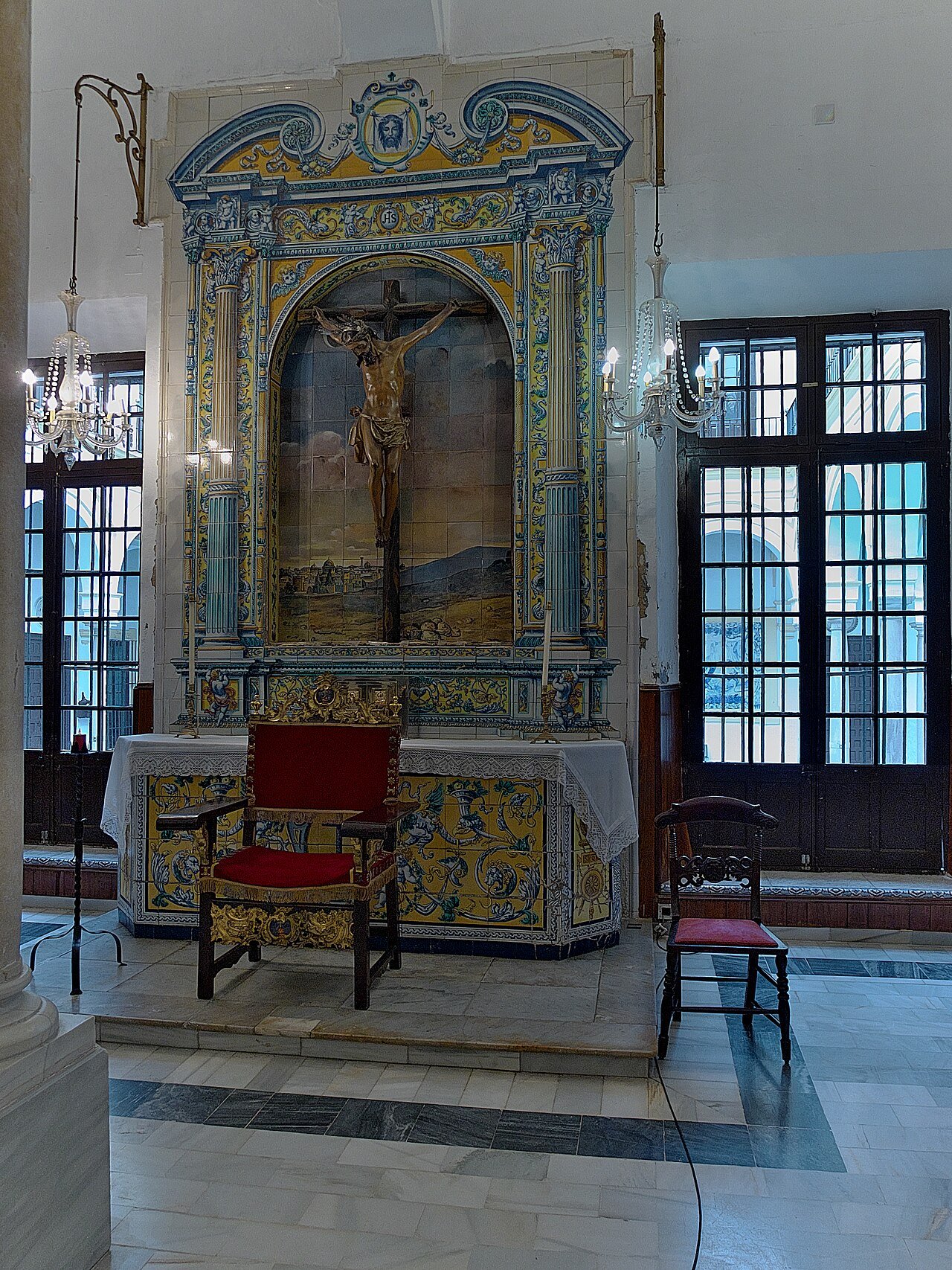
Inside, every element serves one argument about death and mercy, arranged by Mañara like a sermon. The two colossal Valdés Leal canvases wait at the entrance, under the choir — you meet death before you reach the altar. Along the nave, Murillo’s paintings answer with the works of mercy: this is how to live, given that you must die. And at the high altar, Bernardo Simón de Pineda’s gilded altarpiece frames Pedro Roldán’s sculptural group of the Burial of Christ — the brotherhood’s defining act, burying the dead, performed on Christ himself.
Free Seville travel guide
Planning a trip to Seville? Get our free one-page Seville checklist: what to book ahead, what to skip, and the tapas bars we actually eat in.
Finis Gloriae Mundi: The End of the Glory of the World
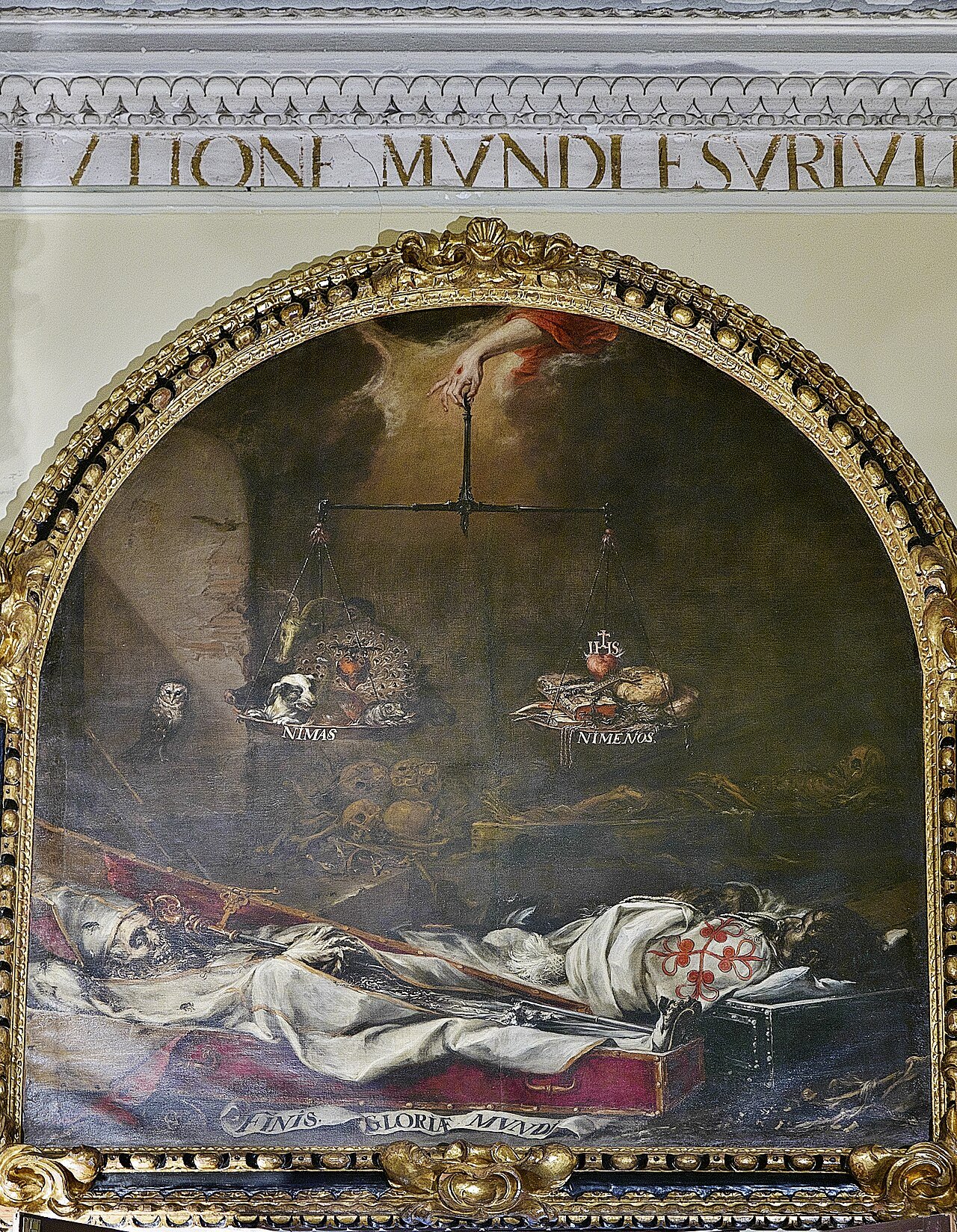
Beneath the choir, in a gilded arch, hangs the most confronting image of the Spanish Golden Age. Finis Gloriae Mundi (1671–72) shows the inside of a tomb. In the foreground, two corpses lie in their coffins: a bishop, still in mitre and crozier, his face and hands alive with decay; beside him a knight of the Order of Calatrava, wrapped in his mantle with its red cross. An owl watches from the shadows; bones and skulls fill the crypt behind.
Above the rot, a hand emerges from glory holding a balance. In one pan, labelled Ni más — “no more” — sit the symbols of sin: a peacock for pride, a dog, a bat, the fruits of every appetite. In the other, Ni menos — “no less” — the instruments of salvation: prayer, penance, books of devotion. The scales hang level. That is the painting’s terrible point: in death the account is exact and final. Nothing more can be added; nothing less will be accepted.
Murillo, who painted serenity better than anyone alive, is said to have remarked that you had to hold your nose in front of this canvas. It has lost none of its power to silence a room.
In Ictu Oculi: In the Blink of an Eye
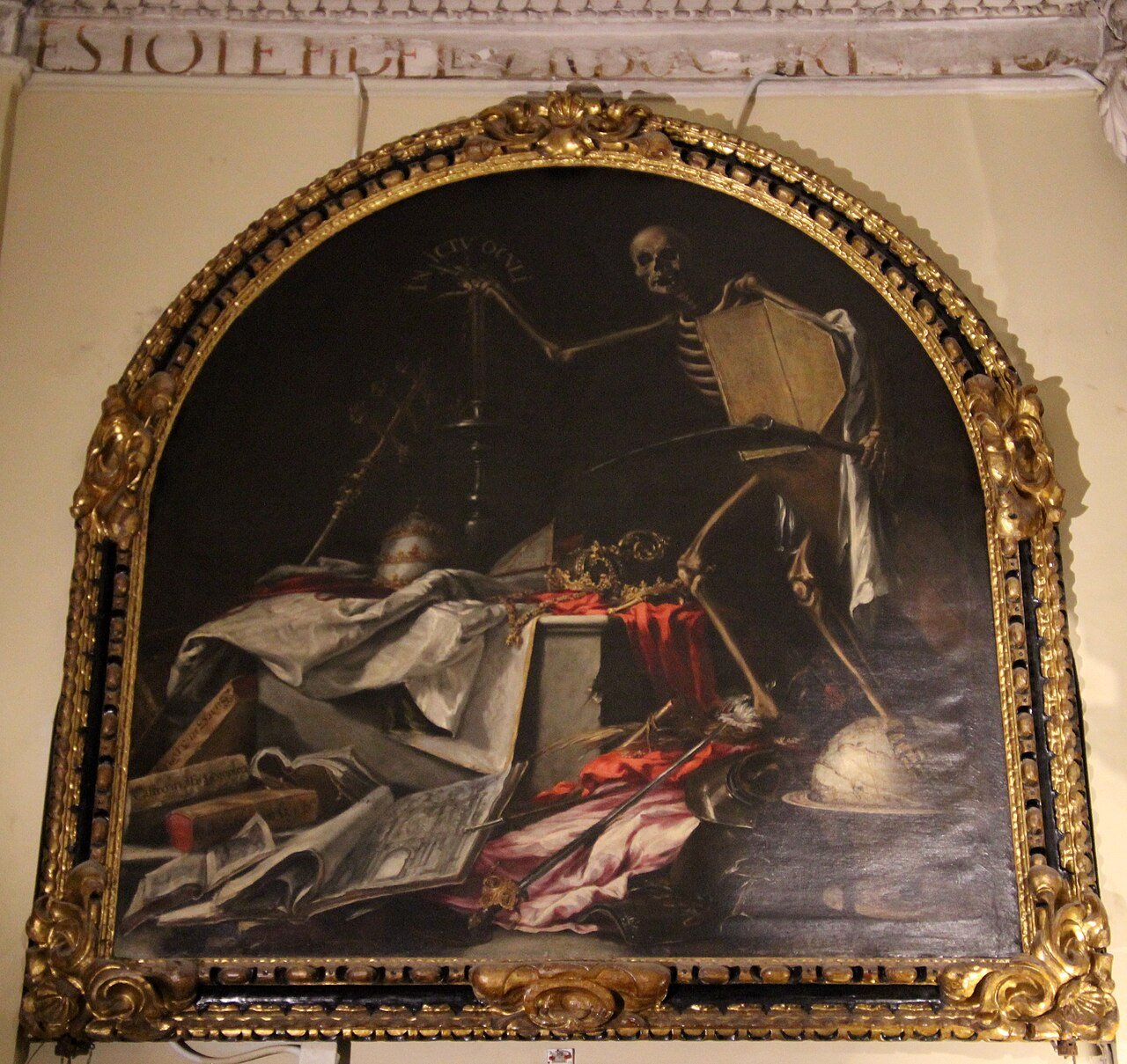
Facing it, the second of Mañara’s “hieroglyphs of death” completes the thought. In Ictu Oculi — “in the blink of an eye,” from Paul’s letter to the Corinthians — shows Death himself as a skeleton striding through the trophies of a life: one bony hand reaches to snuff a candle, while his other arm carries his coffin lid and scythe. Under his feet lie the debris of every human ambition — a papal tiara, a bishop’s mitre, crowns, armour, gold chains, and books, including, pointedly, a volume of architecture. Learning, power, wealth, the Church itself: the candle goes out for all of them, in the blink of an eye.
Read the pair in order, standing between them. In Ictu Oculi is the moment of death — sudden, universal, undefeated. Finis Gloriae Mundi is what follows — the reckoning, weighed to the ounce. Mañara placed them where every brother and visitor had to pass twice, entering and leaving. As visual preaching it has never been equalled; the two canvases, still in their original places, alone justify the trip.
Murillo’s Works of Mercy — and the Four That Sailed Away
If Valdés Leal supplied the warning, Bartolomé Esteban Murillo supplied the answer. Murillo was himself a brother of the Caridad, and between the late 1660s and 1670s he painted eight great canvases for the church illustrating the works of mercy — the largest and most personal cycle of his career, painted for the institution whose rota he shared.
Four survive in the church, and they are magnificent. Moses Striking the Rock of Horeb — the giving of water to the thirsty, known simply as La Sed, “Thirst,” for the desperation of its crowd — faces The Multiplication of the Loaves and Fishes, the feeding of the hungry. Saint John of God Carrying a Sick Man shows the saint staggering under his burden, steadied by an angel: the brotherhood’s daily work, transfigured. And Saint Elizabeth of Hungary Curing the Sick brings the cycle to the ward itself — Elizabeth was stolen too, then repatriated as early as 1815.
The other four are the great loss. In 1810, Marshal Soult, Napoleon’s governor in Andalusia and the most systematic art-looter of the Peninsular War, had them taken down and shipped to France, where they were dispersed after his death. Today The Return of the Prodigal Son is in Washington, Christ Healing the Paralytic in London’s National Gallery, Abraham and the Three Angels in Ottawa, and The Liberation of Saint Peter in the Hermitage. Reproductions now hang in their places, and the brotherhood recounts the theft with undiminished grievance. It is hard to blame them.
The Patios: Fountains, Tiles and Two Virtues
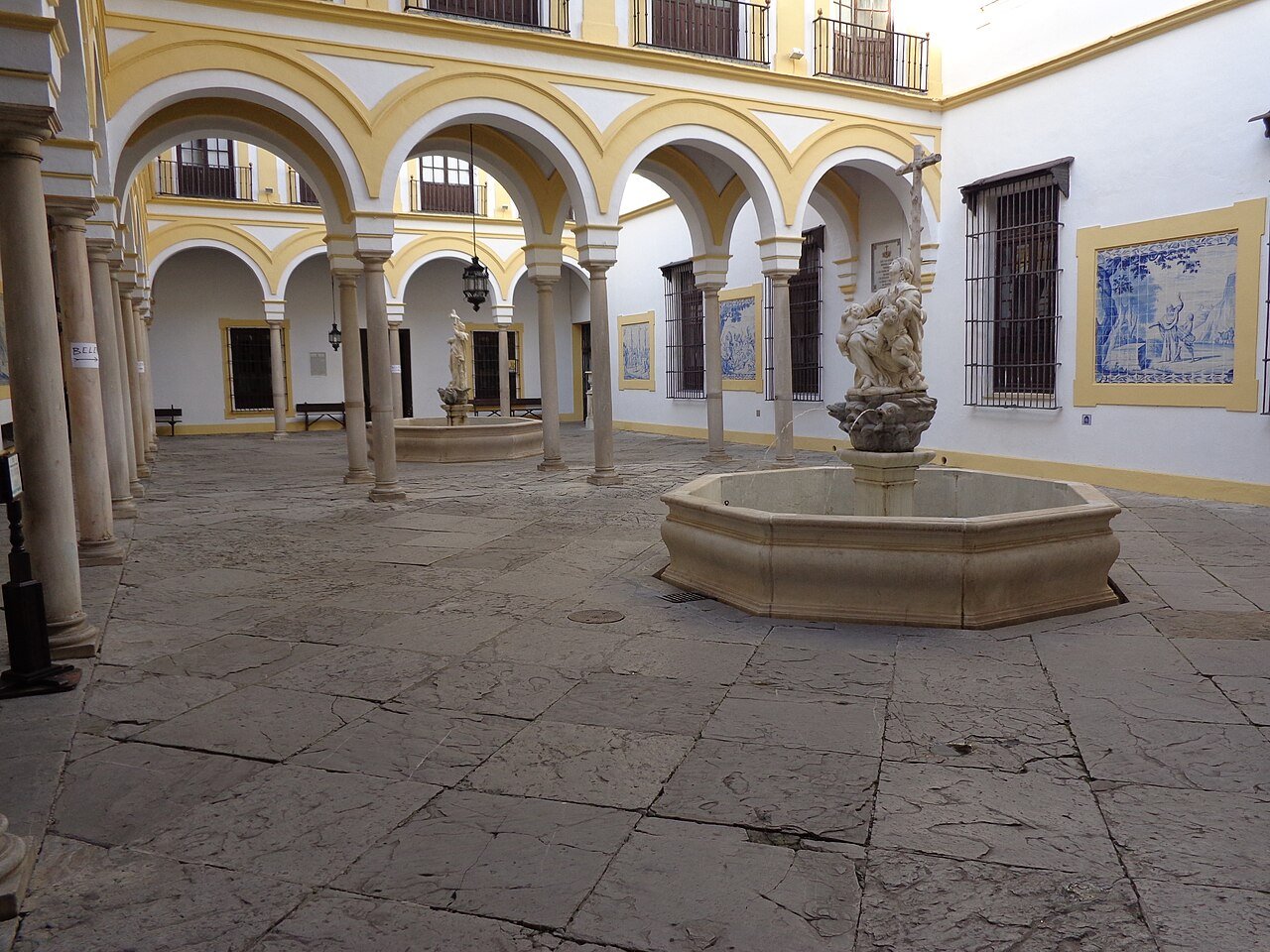
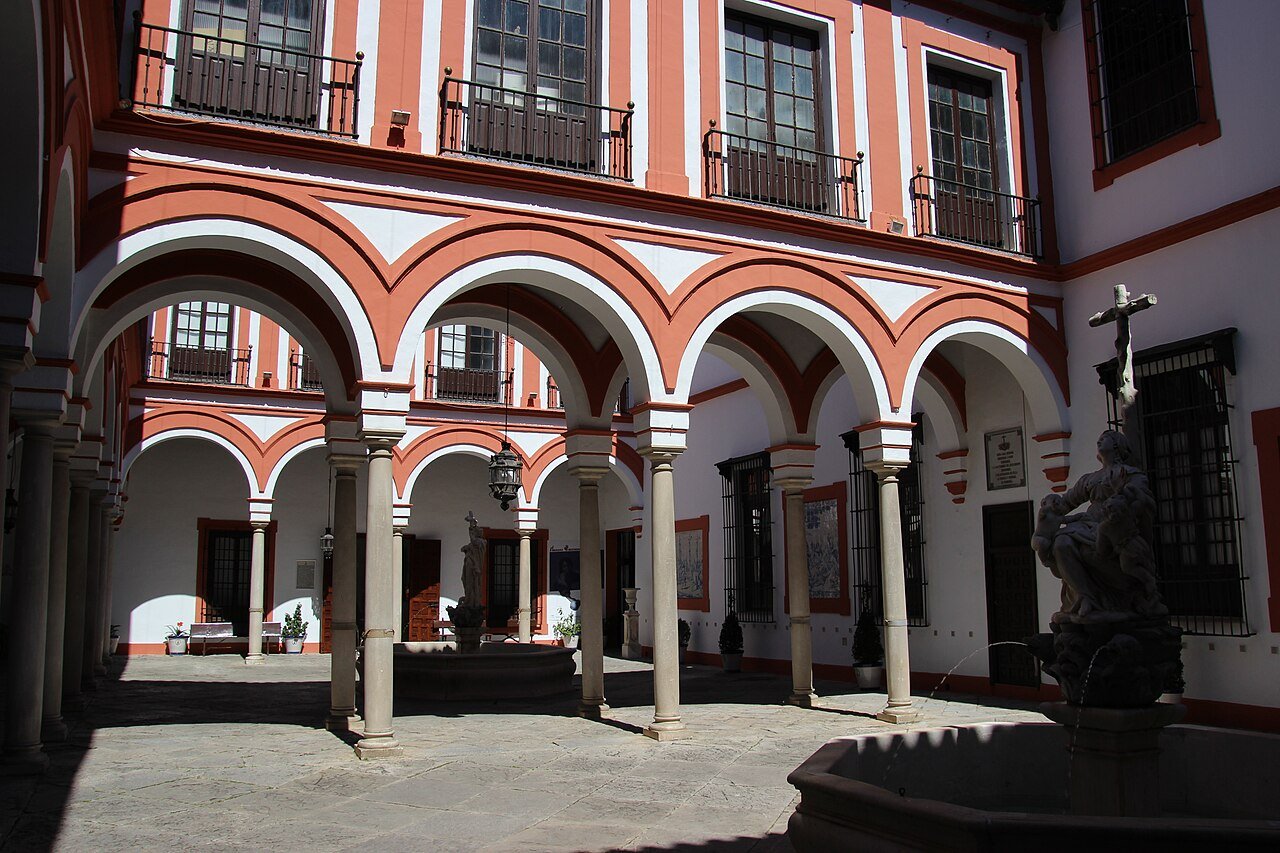
Beyond the church, the tone changes. The hospital opens into two white patios of porticoed galleries, shaded benches and the murmur of fountains — the working courtyards of the residence, lined with rooms where the elderly residents still live. Wandering them after the church’s intensity feels like decompression — the mercy half of the sermon, at the pace of care.
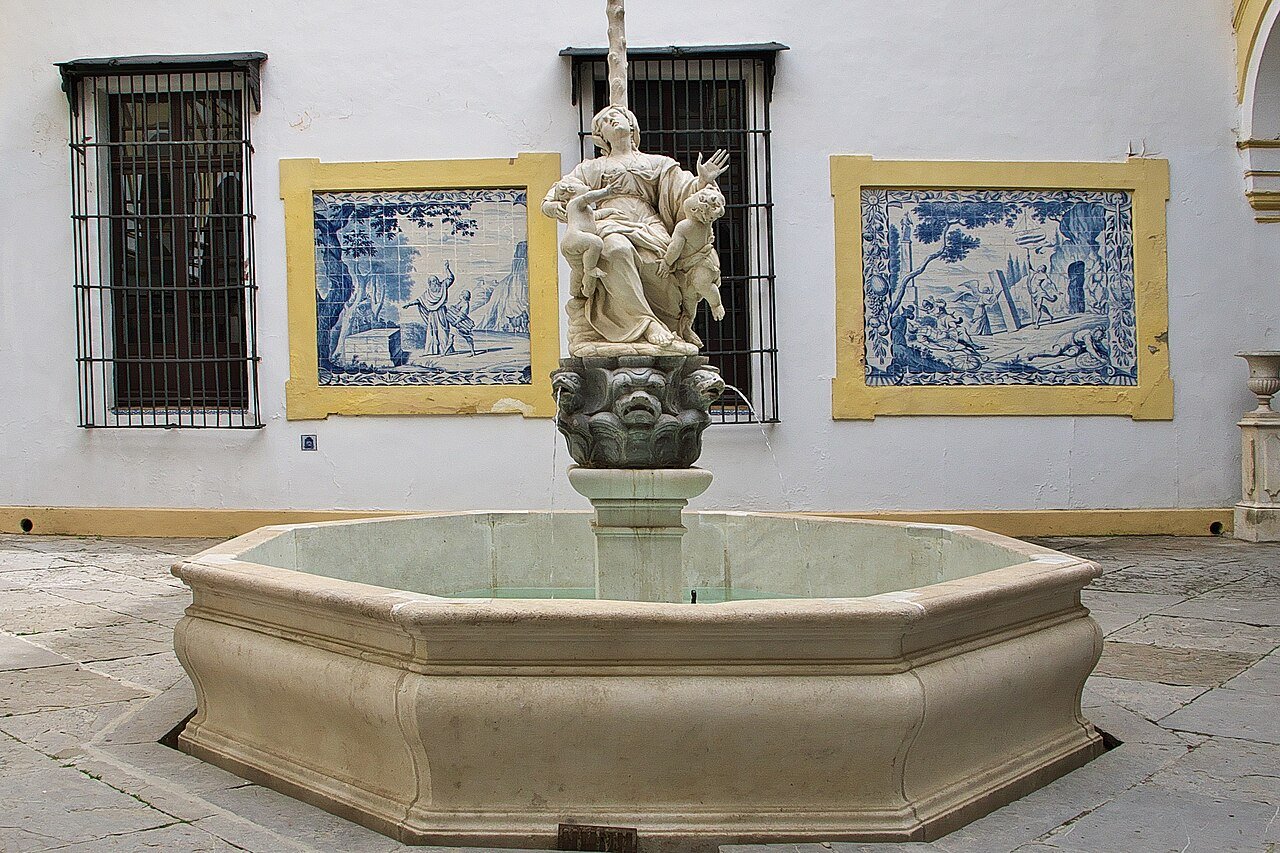
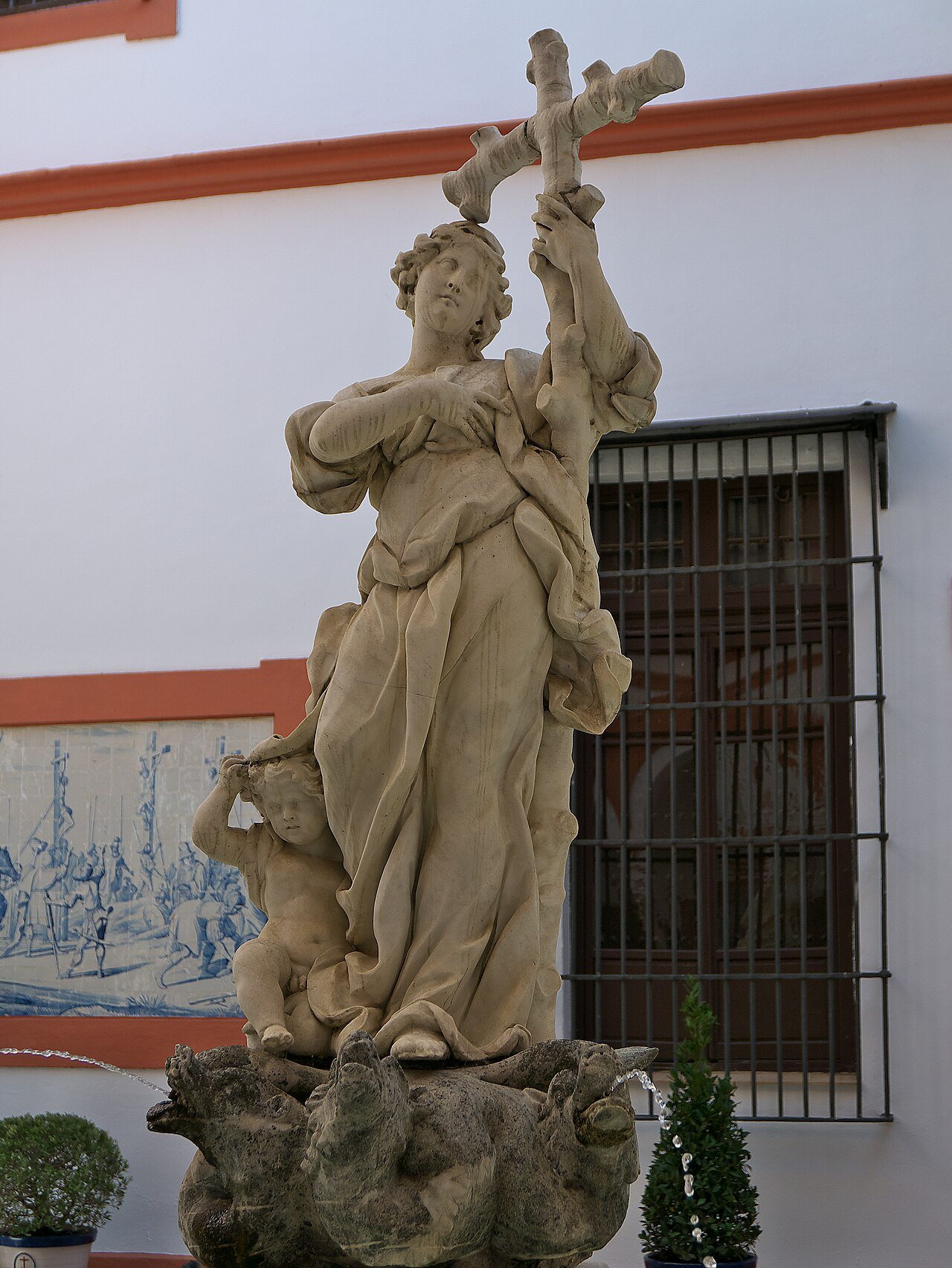
The fountains carry the programme in miniature. They are topped by figures of Faith and Charity — Charity with the children clinging to her skirts, Faith holding her cross — and backed by panels of Dutch Delft tiles showing the miracles of Christ and the Old Testament, in a courtyard washed and swept daily for three centuries. Residents sit out here; visitors share their benches. Behave as the guest you are.
The Chapter House and the Street of the Coffin
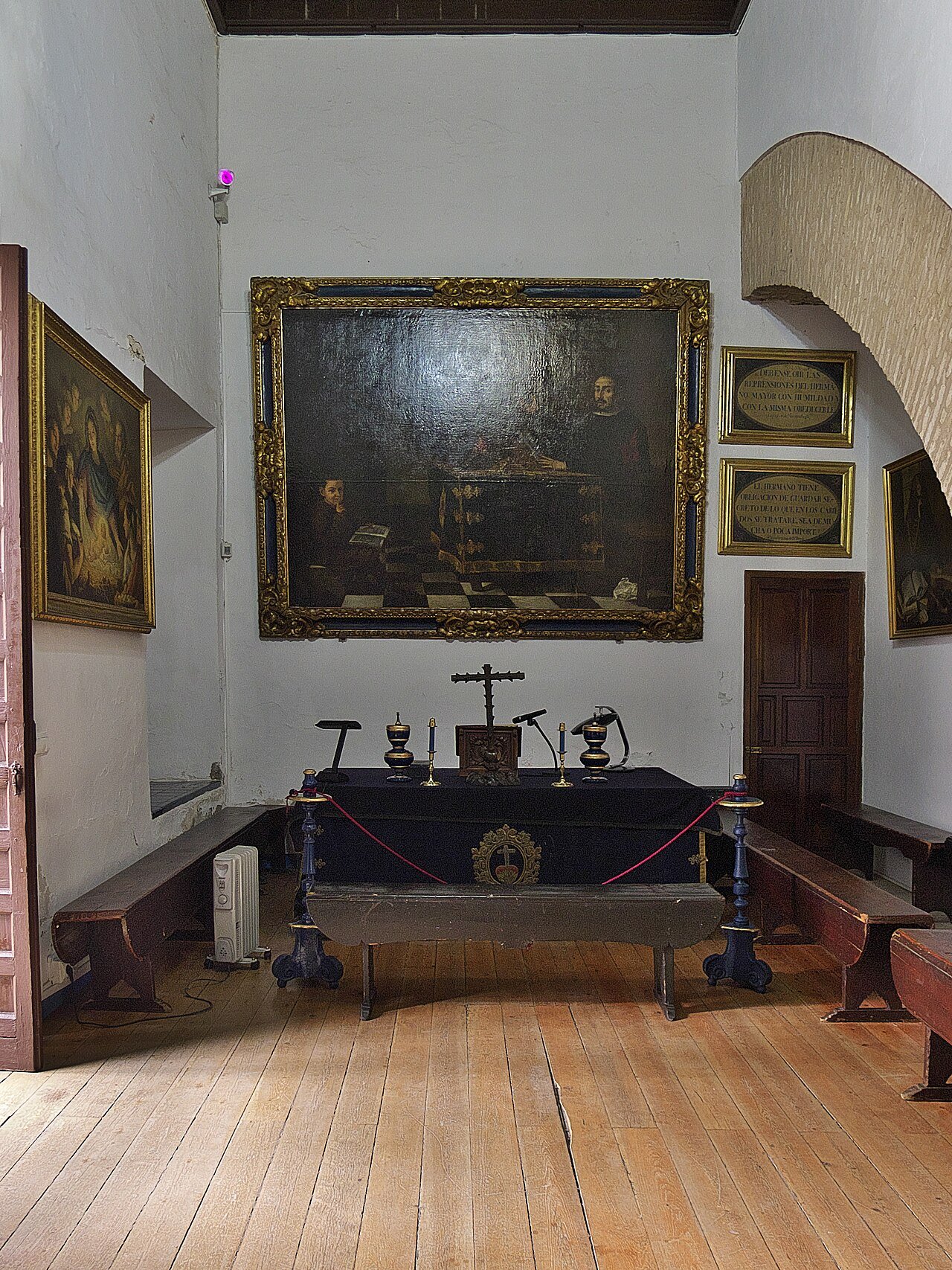
The Sala Capitular, the brothers’ chapter house, is the institution’s boardroom and group portrait: a long room where the brothers still meet beneath dark portraits of their predecessors, presided over by Valdés Leal’s portrait of Mañara himself, sword of the Order of Calatrava at his side — a self-governing corporation that has elected its officers and audited its accounts since the 1600s.
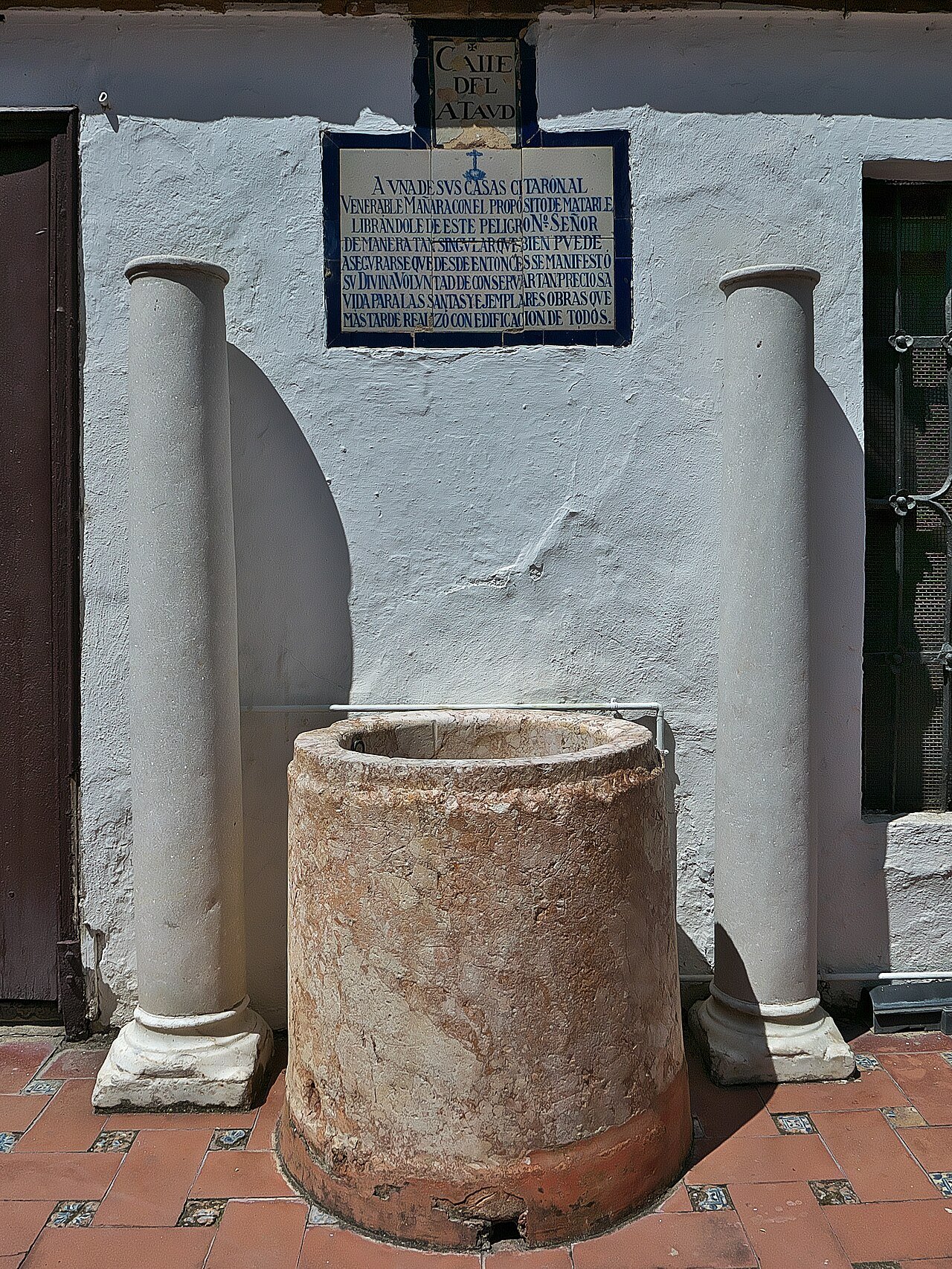
Near it runs one of Seville’s smallest, darkest street names: the Calle del Ataúd, the Street of the Coffin — the passage where the coffins and the dead the brotherhood collected were received. Its tiled plaque and old well survive at the hospital’s edge.
Still a Hospital: The Work Never Stopped
It is easy to visit the Caridad as a museum and miss the point that it never stopped being a hospital. The brotherhood — now working alongside the Hermanos Blancos de la Cruz — still runs the residence on this site, caring for elderly people without means, as it has since 1674. The church you tour is the residents’ church; the patios are their home.
That continuity also explains the visit’s character, and it is why the Hospital de la Caridad entry ticket buys you a quieter, more human experience than the big monuments offer: part gallery, part chapel, part old people’s home, entirely itself. The audioguide follows a simple route through the visitable areas; the residents’ privacy marks its boundary.
Pair It with the Hospital de los Venerables
Seville is uniquely lucky in its charity hospitals, and the two great ones make a perfect pair. The Hospital de los Venerables, in the Barrio Santa Cruz, was built a generation later for retired priests: gentler, sunnier, with a painted church ceiling, a superb patio and a Velázquez research centre. The Caridad is thunder; the Venerables is light. Together they give you the whole emotional range of the Sevillian Baroque in two visits.
The institutions know it: a joint ticket sold at both doors (around €12) covers entry to both hospitals, with their audioguides — one of the best-value art purchases in Andalusia. Do the Caridad first, while your nerve is fresh, then walk fifteen minutes across the old town to the Venerables and let its courtyard restore you.
Practical Info
At a Glance
| Detail | Info |
|---|---|
| Address | Calle Temprado 3, El Arenal, Seville |
| Nearest stop | Puerta de Jerez or Archivo de Indias (tram); Plaza de Armas bus station nearby |
| Tickets | Around €8 incl. audioguide (over-65s around €5); joint ticket with the Hospital de los Venerables around €12 |
| Free entry | Sunday afternoons, 16:30–18:30 at the time of research — confirm on the official site |
| Time needed | 45–60 minutes |
| Official site | santa-caridad.es |
Tickets and Booking
There is no advance-booking system and no online platform to wrestle with: buy the Hospital de la Caridad entry ticket at the door, where the audioguide is included. Prices at the time of research were around €8 general and €5 for over-65s, with free entry on Sunday afternoons (16:30–18:30). Ask for the joint ticket if you plan to visit the Venerables — you do — and keep it safe for the second door.
Getting There
The hospital hides in plain sight: find the Maestranza bullring on Paseo de Cristóbal Colón, walk a minute inland up Calle Dos de Mayo, and the gate is on Calle Temprado. From the cathedral it is an easy five-minute walk; from the Barrio Santa Cruz, fifteen. The tram stops at Archivo de Indias or Puerta de Jerez, both under ten minutes away.
When to Go
Weekday mornings are the quietest, and the church at opening time, before any group drifts in, is an experience of real gravity — you may have the Valdés Leals entirely to yourself. Sunday free afternoons are the budget option but the busiest; arrive at the start of the window.
How Long You Need
Forty-five minutes covers church, patios and chapter house at a decent pace; an hour lets the audioguide tell the full story of the Murillos.
Tips That Will Improve Your Visit
- Stand between the two Valdés Leals first, and read them as a pair. In Ictu Oculi — the moment of death — then Finis Gloriae Mundi — the reckoning. The audioguide walks you through in order; the argument only lands as a pair.
- Play original-or-reproduction in the nave. Four Murillos hang where they always hung; four are fine reproductions standing in for canvases stolen by Soult in 1810. Guessing which are which, then checking, teaches you more about Murillo than a label can.
- Buy the joint ticket with the Venerables. Around €12 for two of Spain’s great Baroque interiors is unrepeatable value; do them the same day, Caridad first.
- Keep your voice down in the patios. This is a residence: the elderly men on the benches live here, and the church is their chapel. Photography is fine where permitted; flash and chatter are not the register.
- Combine with El Arenal. The Maestranza bullring museum is two minutes away, the Torre del Oro five.
- Don’t skip the threshold slabs. The brothers’ burial stones pave the entrance passage. Walk in slowly; you are doing what Mañara designed thousands of feet to do.
Travel insurance, sorted
Whether it is a two-week holiday or a longer move, travel insurance is not the most glamorous part of a trip — but it is the one booking you want to have in place before a trip, and while you are already away.
Final Thoughts
Many great churches ask for your admiration. The Hospital de la Caridad asks for your life. Mañara and his artists built a machine for a single purpose — to make comfortable people confront the truth that death levels every account, and to show them the only answer the brotherhood believed in: mercy, practised daily, on the people nobody else would carry. Three and a half centuries later the machine still works, and visitors emerge subdued and slightly changed. Walk over the founder’s grave on your way out. He would have wanted exactly that.
¡Buen viaje!
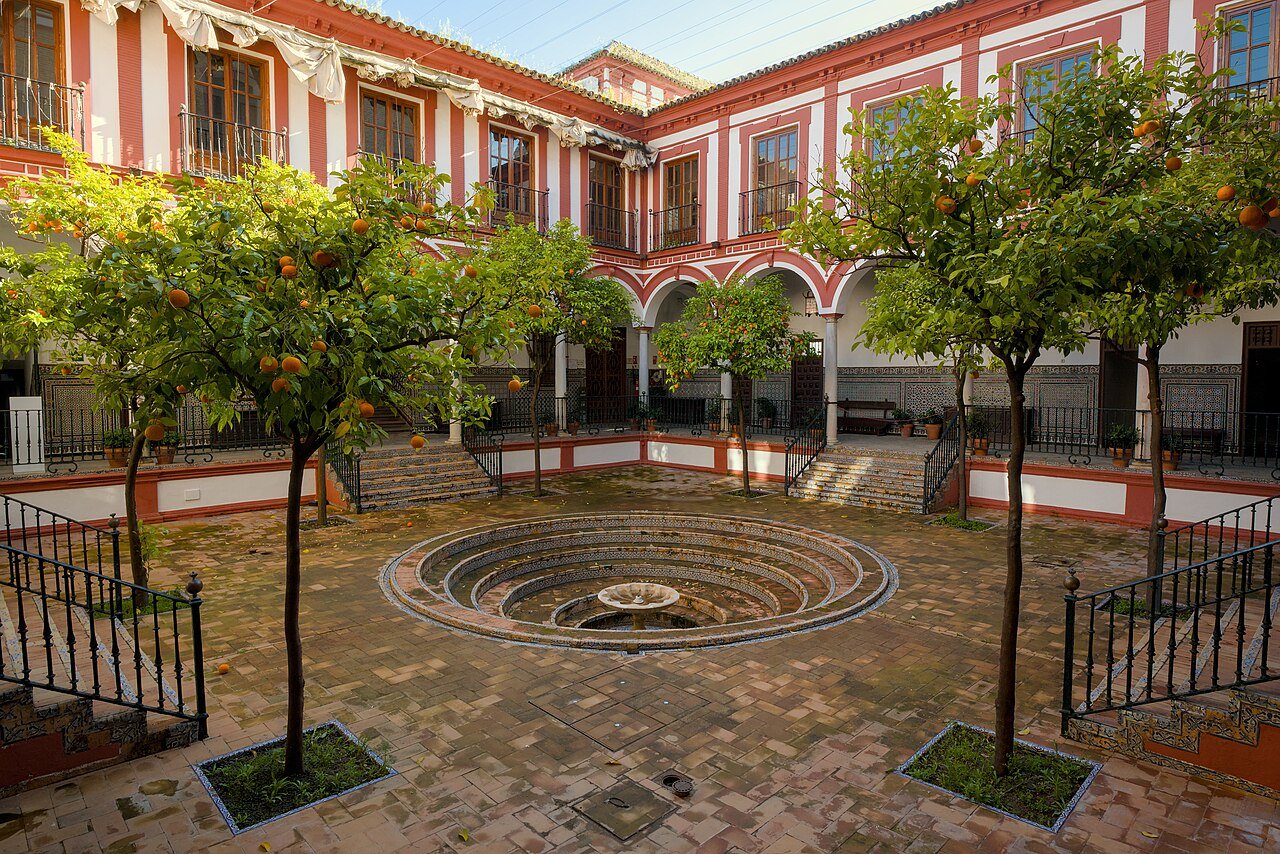
Photo credits: Wikimedia Commons contributors Holger Uwe Schmitt, CarlosVdeHabsburgo, Superchilum, Miguel Hermoso Cuesta, José Luis Filpo Cabana and Daniel VILLAFRUELA, via Wikimedia Commons (CC BY / CC BY-SA).