Palacio del Marqués de Dos Aguas: The Complete Guide to Valencia’s Ceramics Palace
There is a doorway in Valencia that stops people mid-sentence. It looks as if a river has been frozen in the act of pouring itself down a palace wall: two muscular giants in pale alabaster, each tipping a vessel, water turning to stone as it falls, and above them a serene Virgin watching over the whole flood. That doorway belongs to the Palacio del Marqués de Dos Aguas, and it is only the beginning. Inside, the palace keeps going — a ballroom built for dancing until dawn, a Chinese room, a carriage like a gilded pumpkin, and room after room of the ceramics that made Valencia famous across Europe.
Since 1954 the palace has been the home of the Museo Nacional de Cerámica y Artes Suntuarias “González Martí”, Spain’s national ceramics museum. That double identity makes it a satisfying visit: a flamboyant palace and a serious museum for one small ticket.
This guide covers both halves — how to read the famous portal, the palace rooms not to rush, the ceramics route from medieval lustreware to Picasso, and the practical details, including the free-entry times.
Short Answer
The Palacio del Marqués de Dos Aguas is a Rococo palace in Valencia’s old town, famous for its swirling alabaster doorway of 1745, and today it houses the Museo Nacional de Cerámica, Spain’s national ceramics museum. Go for the portal and the palace rooms — the ballroom, the Chinese room and the gilded Nymph Carriage — as much as for the medieval Manises and Paterna pottery inside. Entry is €3, it is free on Saturday afternoons from 16:00 and on Sundays, and you need one to two hours. Tickets are sold at the door; if you would rather have it all explained as you go, a Museo Nacional de Cerámica entry ticket with a guide — a private guided tour with entry included — is the version to book.
Table of Contents
- The Short Version: Is the Palacio de Dos Aguas Worth It?
- The Doorway Everyone Photographs
- Reading the Portal: Two Rivers and a Hidden Virgin
- From Gothic House to Rococo Palace: The Rabassa de Perellós
- The Courtyard, the Staircase and the Carriages
- The Palace Rooms: Ballroom, Chinese Room and Friends
- The Ceramics: A Walk Through the Collection
- Paterna and Manises: The Medieval Potteries
- Alcora, Tiles and the Tiled Kitchen
- Picasso and the Modern Ceramists
- Manuel González Martí: The Collector Who Gave It Away
- Practical Info
- Tips That Will Improve Your Visit
- What to See Nearby
- Final Thoughts
The Short Version: Is the Palacio de Dos Aguas Worth It?
Yes — and it is not even a close call. The building is a spectacle and the collection inside is genuinely important, yet it costs less than a coffee. On our Best Things to Do in Valencia list it sits comfortably among the city’s essentials, and it is the one museum we send first-timers to.
Be honest about what you are coming for. If you love palaces, decoration and photography, you will be happy within five minutes. If you are a ceramics person, block the full two hours. The only visitors who shrug are those who hurry through the palace rooms hunting for porcelain highlights — the palace is half the exhibition, so slow down and treat it that way.
The Doorway Everyone Photographs
The main portal stands on the narrow street named after the family, and the first surprise is its material. It is not marble. The whole surging composition — giants, Virgin, lions, fruit, shells and waves — is carved from alabaster quarried at Niñerola, near the village of Dos Aguas itself, and alabaster’s warm, translucent, honey-coloured stone is why the portal seems to glow in late-afternoon light.

It was finished in 1745, designed by the painter Hipólito Rovira and carved principally by Ignacio Vergara, the leading Valencian sculptor of his century, with the decorator Luis Domingo completing the team. Nothing about it is restrained. The doorway does not frame the entrance so much as erupt around it — a palace advertising, in stone, how rich and cultivated its owners were. It has been one of the most photographed corners of Valencia ever since.
Reading the Portal: Two Rivers and a Hidden Virgin
The portal is not decoration for its own sake; it is the family’s name written in sculpture. Dos Aguas means “two waters”, and the two naked giants flanking the door are the two rivers of the marquis’s lands: the Turia, which runs through Valencia, and the Júcar. Each giant leans over a great vessel and pours his river out at the visitor’s feet, so the family’s title quite literally flows down the front of the house.

Look closer and the carving keeps rewarding you. On one side there are crocodile heads and a quiver of arrows among ivy and a snake; on the other, a reclining lion beside a palm tree. Between the giants hangs the carved shield of the Rabassa de Perellós family — look for the pears, a visual pun on the name Perellós — and two wild men with clubs stand guard over it all.
At the top, in an arched niche, stands the Virgin of the Rosary, patroness of the house, flanked by two matrons: one with a cornucopia for agriculture and prosperity, one scattering coins for justice and magnanimity, with Fame blowing her trumpet at the very summit. What you see today is an 1866 plaster copy by Francisco Cano Molinelli — Vergara’s original of 1740, carved in polychrome wood, was lost — and the niche once had a lid, so that when the marquises were away from Valencia, the Virgin was politely hidden until the family came home.
From Gothic House to Rococo Palace: The Rabassa de Perellós
Underneath the Rococo fireworks there is a much older house. The Rabassa de Perellós, a Valencian noble family, built a Gothic palace here in the 15th century; they bought the barony of Dos Aguas in 1496, and in 1699 the head of the family became the first Marqués de Dos Aguas. Beneath that, the site is believed to have been a Roman necropolis of the 1st to 3rd centuries AD — Roman finds turned up in a courtyard in 1743.
The palace you see is essentially the creation of one man, Ginés Rabassa de Perellós y Lanuza, the third marquis (1706–1765), who in the 1740s had the old Gothic house radically rebuilt in the full Rococo taste. Rovira, Vergara and Domingo redesigned the façades as well as the portal, covering them with painted decoration imitating marble and stone, and giving the windows their extraordinary undulating iron grilles. A century later the palace gained its second entrance: the carriage doorway on Calle Poeta Querol, built in 1864–67, its great oak doors carved with rockery, fruit and two masks of the god Pan, opening onto a small square with a romantic fountain.
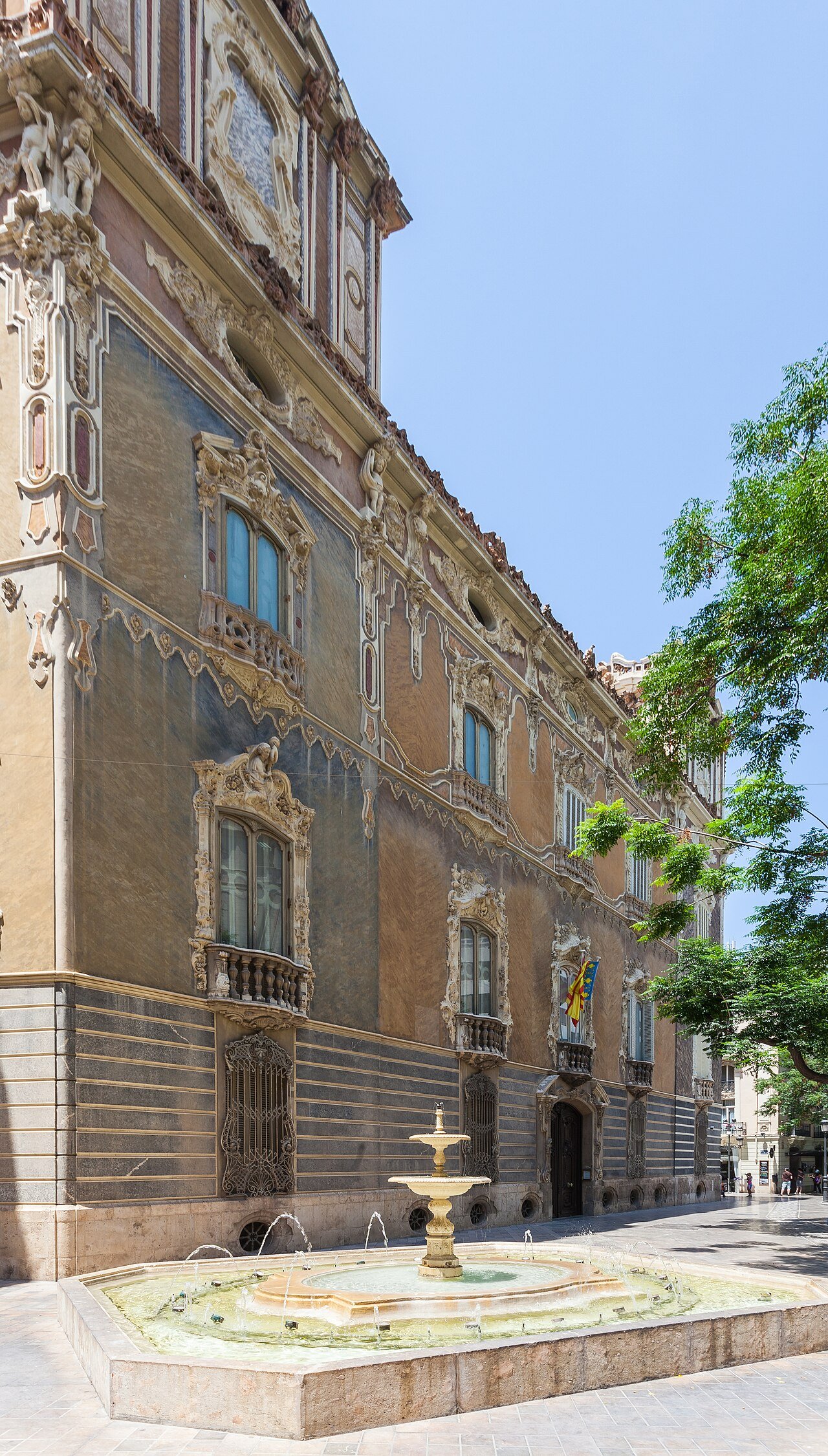
The last marquises left, the building passed through other uses, and in 1941 it was declared a historic-artistic monument — the protection that saved it for the museum it was about to become.
The Courtyard, the Staircase and the Carriages
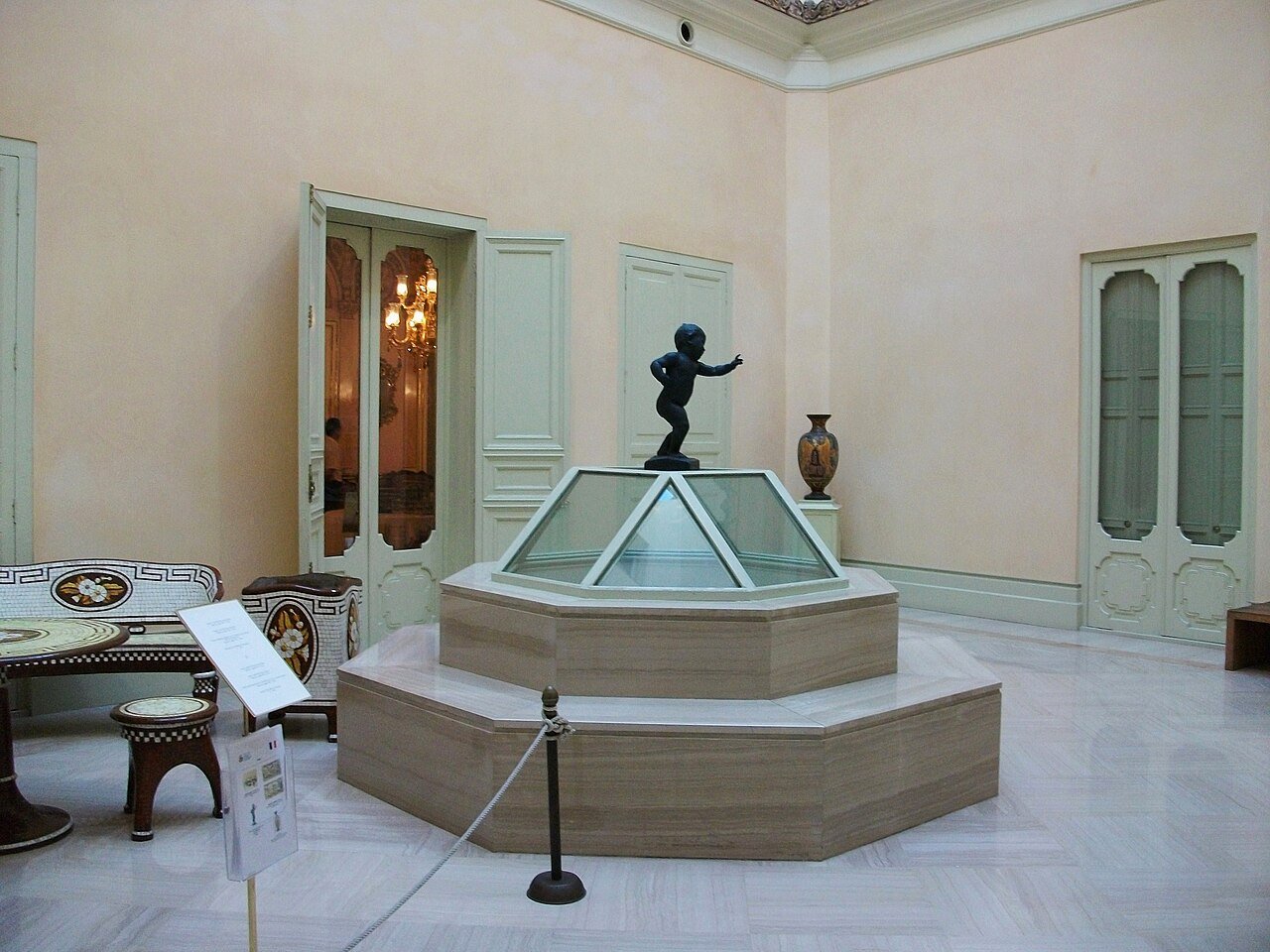
Inside, the street noise drops away. The entrance courtyard — the Patio de la Fuente, named for its small marble fountain of a child riding a swan — was the palace’s working heart, overlooked by balconies carrying terracotta figures of the arts, sciences and gods. Restorations in the 1990s roofed the palace’s open spaces in glass, and today part of the old courtyard survives as a quiet garden terrace, its stepped glass pyramid lighting the rooms below.
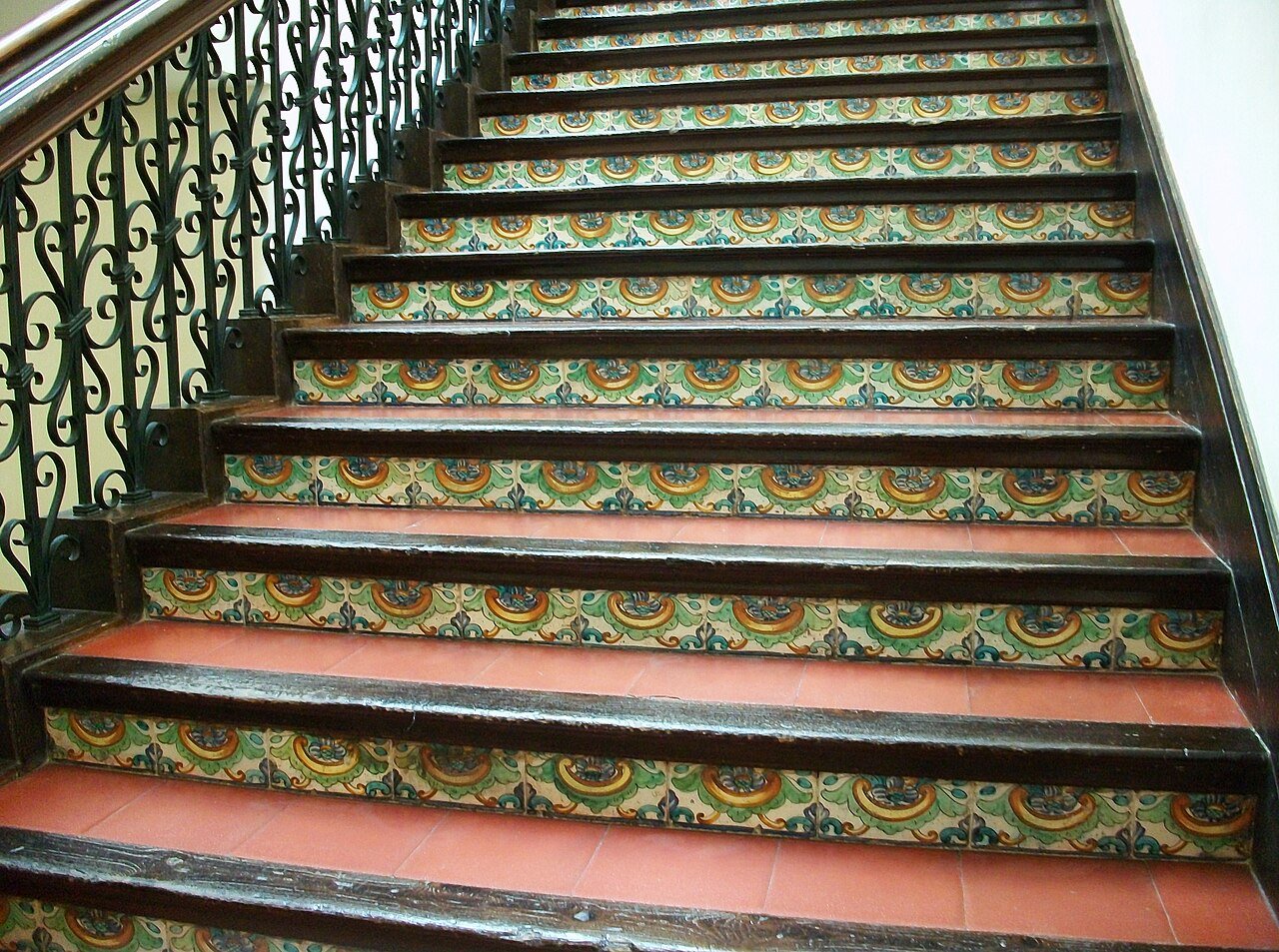
From here the route climbs the palace staircase, and even the stairs are a ceramics exhibition — each step is faced with painted Valencian tiles, so you are walking up a staircase of the very stuff the museum exists to celebrate.
Before you head up, though, do not miss the ground-floor carriage hall. The star is the Carrossa de les Nimfes — the Nymph Carriage — a full-dress Rococo coach smothered in gilded carving, its panels painted with mythological scenes, nymphs included. It looks less like transport than a piece of palace furniture that happens to have wheels, which in a sense it was: a carriage like this was a moving announcement of rank. Beside it stand the Marqués de Llanera’s carriage and a row of sedan chairs, the carried taxis of the 18th century.

The Palace Rooms: Ballroom, Chinese Room and Friends
The piano nobile, the palace’s main floor, was redecorated in the 1860s and survives as a suite of themed 19th-century rooms — less Rococo than the façade, but richer in the way a lived-in great house is rich. First comes the Hall of Illustrious Persons, where the painter José Brel supplied imaginary portraits of five great Valencians: the artists Joan de Joanes and Ignacio Vergara, the humanist Juan Luis Vives, the poet Ausiàs March and the playwright Guillén de Castro. Nobody knew what most of them looked like, which did not stop Brel in the slightest.
Then comes the ballroom, and the visit steps up a gear: a long, glittering hall of mirrors, chandeliers and striped silk, its ceilings painted by Salustiano Asenjo, built for the only purpose that mattered in a marquis’s social calendar. Stand in the middle for a moment and it is not hard to hear the orchestra.

The room everyone talks about afterwards, though, is the smallest: the Chinese room, the Saló xinès, painted by José Flores Vela with chinoiserie panels and furnished with black-lacquer oriental-style furniture by Federico Noguera Picó. Japanese Satsuma vases and an Imari plaque glow against the gold walls. In the 1860s “the Far East” was the height of fashion in European palaces, and this little cabinet is Valencia’s version — part genuine import, part delighted fantasy.

Keep going: there is a Pompeian room, its walls painted in the Roman style then thrilling Europe after the excavations at Pompeii; a dining room whose ceiling Rafael Montesinos painted in 1862 with “The light fecundating Creation”, watched over by busts of the four seasons; the marquis’s bedroom, a smoking room and an oratory; and the porcelain cabinet, our favourite piece of showing off — a little room where not just the vases but the mirror frame, the chairs and the table are made of porcelain, as if the family wanted to live inside its own collection.

Free Valencia travel guide
Planning a trip to Valencia? Get our free one-page Valencia checklist: what to book ahead, what to skip, and the paella places we actually eat in.
The Ceramics: A Walk Through the Collection
The palace rooms would justify the ticket on their own, but the museum wrapped around them is Spain’s national ceramics collection, laid out as a walk through a thousand years of clay. It begins with Islamic ceramics and moves into the Christian kingdoms of the Middle Ages, where the strongest thread is Mudéjar: pottery made in the Islamic tradition under Christian rule, above all in the Valencian towns of Paterna and Manises. Tableware and kitchenware share the cases with the tiles that once covered floors, ceilings and eaves.
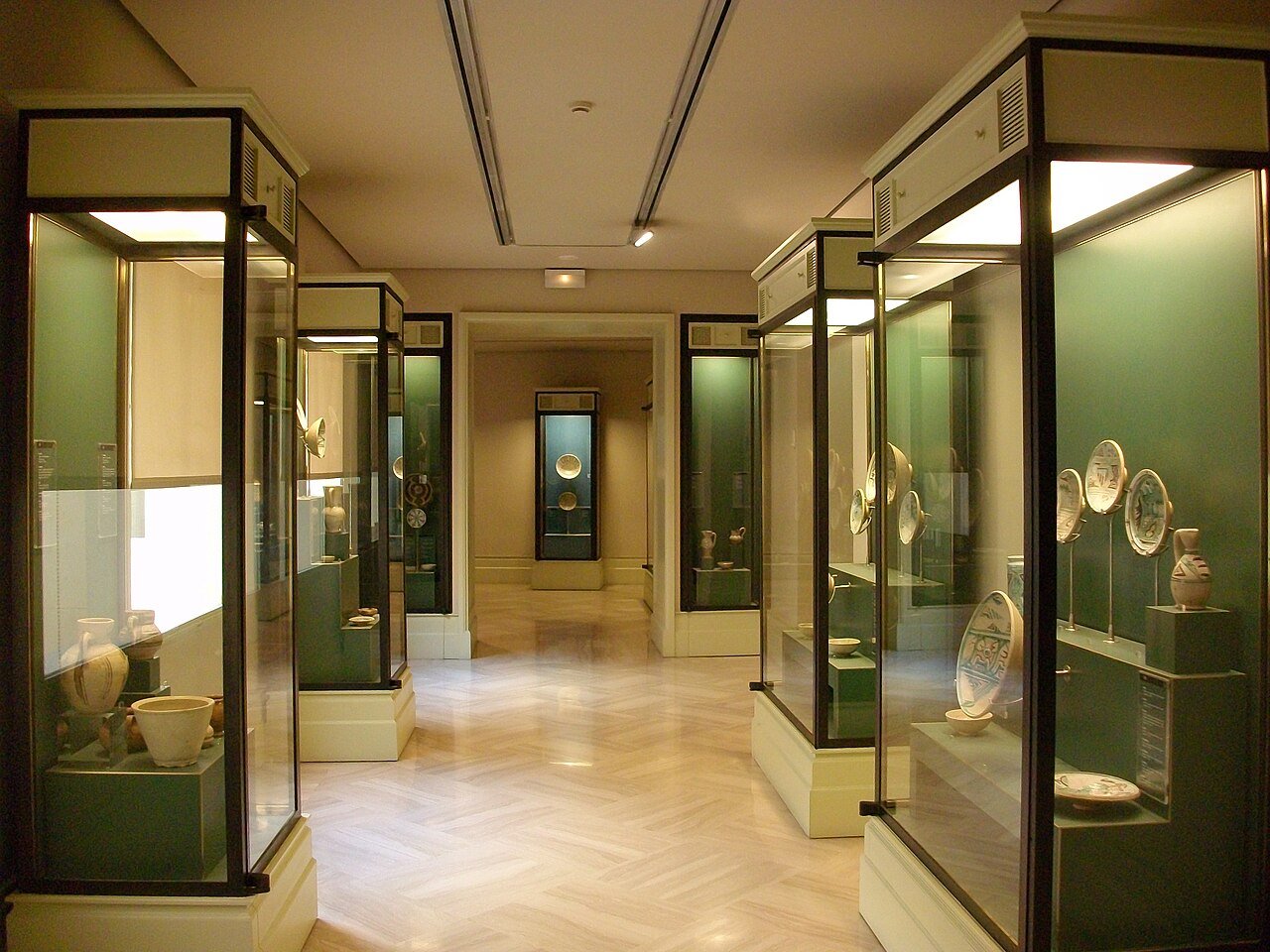
The Renaissance and Baroque rooms (16th and 17th centuries) hold a piece of the palace itself: part of a painted alfarje — a coffered wooden ceiling of the 14th to 16th centuries, rescued from this very building — displayed as an exhibit. If you want the palace explained in depth rather than at your own pace, this is where a Museo Nacional de Cerámica entry ticket with a guide — a private guided tour with entry included — earns its money, because the labels alone only tell half of these stories.
From there the route loosens into the refined 18th century and the colourful popular ware of the 19th, and ends — as it should — in a kitchen and in the present day.
Paterna and Manises: The Medieval Potteries
If the collection has a heart, it beats in the medieval rooms. In the 14th and 15th centuries the potteries of Paterna and, above all, Manises — both a short distance from the city — produced the most coveted tableware in Europe: lustreware, pottery painted with metallic oxides and fired a second time in a reducing kiln until it shone like gold and copper. Valencian lustreware was exported across the Mediterranean and beyond, and sat on the tables of Italian princes.

The great bossed dishes and deep bowls in these cases are the masterpieces: painted with leaves, heraldry and Gothic lettering, their raised central bosses catching the light exactly as they were designed to catch candlelight five centuries ago. Alongside the lustreware, look for the blue-and-white ware and the heraldic floor tiles stamped with the arms of the great Valencian families. This is the part of the museum to take slowly; these objects are why the collection exists.
Alcora, Tiles and the Tiled Kitchen
The 18th century belongs to Alcora, where a factory in the province of Castellón set out to rival the porcelain of France and Meissen in fine earthenware. The museum’s Alcora cases are full of its personality: polychrome plates, trompe-l’œil dishes, and a famous pair of characterful busts — an old man and an old woman — beneath a flying white cherub. It is lighter, wittier ware than the medieval rooms.

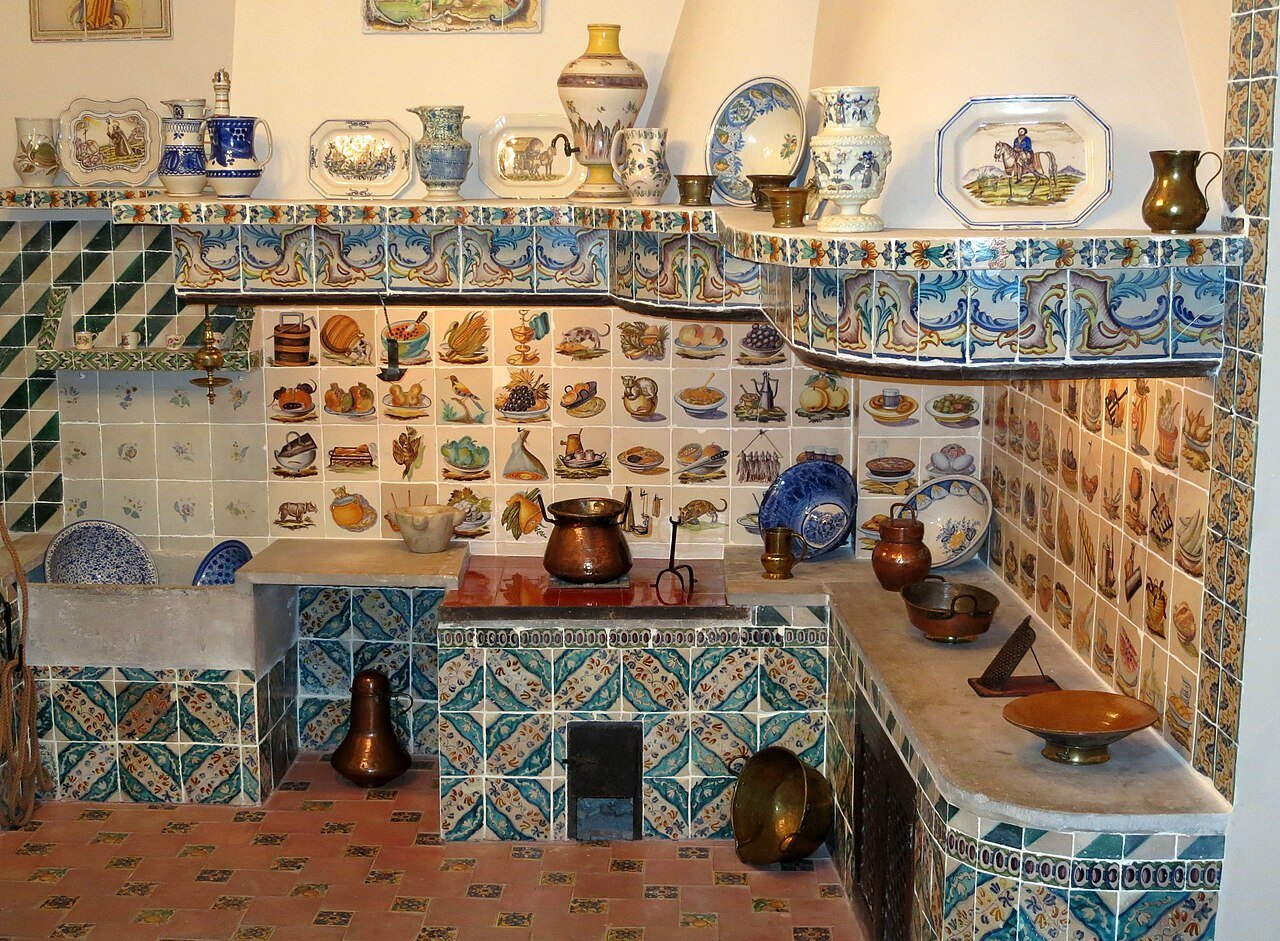
Valencia’s other ceramic language is the tile, and the museum speaks it everywhere — none better than in the complete traditional Valencian kitchen rebuilt inside the museum, every surface tiled. The tiles around the stove are painted, one by one, with the ingredients and dishes of the region: fish, rabbits, aubergines, pots of stew. It is a recipe book you read with your eyes, and a reminder that in Valencia ceramics was never only for palaces — it lined the walls of ordinary houses too.
Picasso and the Modern Ceramists
The route ends, deliberately, in the present. The museum has always collected living potters as well as dead ones, and the contemporary rooms show author ceramics from the 20th century to today. Their most famous name is Picasso, who dedicated ceramic pieces to the museum. We will be honest: this is a handful of pieces, not a Picasso exhibition. Come for the Manises lustreware and the palace; let Picasso be the signature at the end of the letter rather than the reason you opened it.
Manuel González Martí: The Collector Who Gave It Away
None of this would exist without one stubborn collector. Manuel González Martí (1877–1972) was a Valencian lawyer, journalist and caricaturist who spent a lifetime buying Spanish ceramics — rescuing medieval pieces, documenting the potteries and building the finest private ceramics collection in the country. On 7 February 1947 he donated it to the Spanish state, and the museum that bears his name was founded on the gift.

The palace was the obvious home for it: declared a monument in 1941, bought by the state in 1949 and restored, it opened to the public as the Museo Nacional de Cerámica on 18 June 1954, with González Martí himself as its first director. His bronze bust stands near the entrance. When the museum calls itself “González Martí”, that is not branding — it is a thank-you that has lasted seventy years.
Practical Info
At a Glance
| Detail | Info |
|---|---|
| Address | Calle Poeta Querol 2, 46002 Valencia (the famous portal is round the corner, on Calle Marqués de Dos Aguas) |
| Entry | €3 general, €1.50 reduced; annual card €25 |
| Free entry | Saturdays from 16:00, all day Sundays, and on 18 April, 18 May, 12 October and 6 December; under-18s and over-65s free at all times |
| Opening hours | Tuesday–Saturday 10:00–14:00 and 16:00–20:00; Sundays and public holidays 10:00–14:00 |
| Closed | Mondays; also 1 January, 1 May, 24, 25 and 31 December and two local holidays |
| Nearest metro | Colón (lines 3 and 5), a few minutes’ walk |
| Time needed | 1–2 hours |
| Tickets | At the door; no online sale for general entry |
Tickets and Prices
General admission is €3, reduced €1.50, and the annual card is €25 if you are staying in Valencia a while. The free windows are the real story: entry is free every Saturday from 16:00 and all day Sunday, plus on 18 April (World Heritage Day), 18 May (International Museum Day), 12 October and 6 December — and children under 18 and visitors over 65 never pay at all. For a guided visit, a Museo Nacional de Cerámica entry ticket — a private guided tour with entry included — is the option to book online; ordinary entry is sold at the door, with no online booking for ordinary entry, and outside the free slots you will rarely queue for more than a few minutes.
Opening Hours
The museum keeps classic Spanish state-museum hours: Tuesday to Saturday, 10:00–14:00 and 16:00–20:00; Sundays and public holidays, mornings only, 10:00–14:00. It is closed on Mondays, and additionally on 1 January, 1 May, 24, 25 and 31 December and two local holidays each year. The split day catches people out — arriving at 15:00 on a Saturday gets you a photograph of the portal and a closed door — so plan around it, and double-check the official site (mnceramica.mcu.es) before a holiday visit.
Getting There
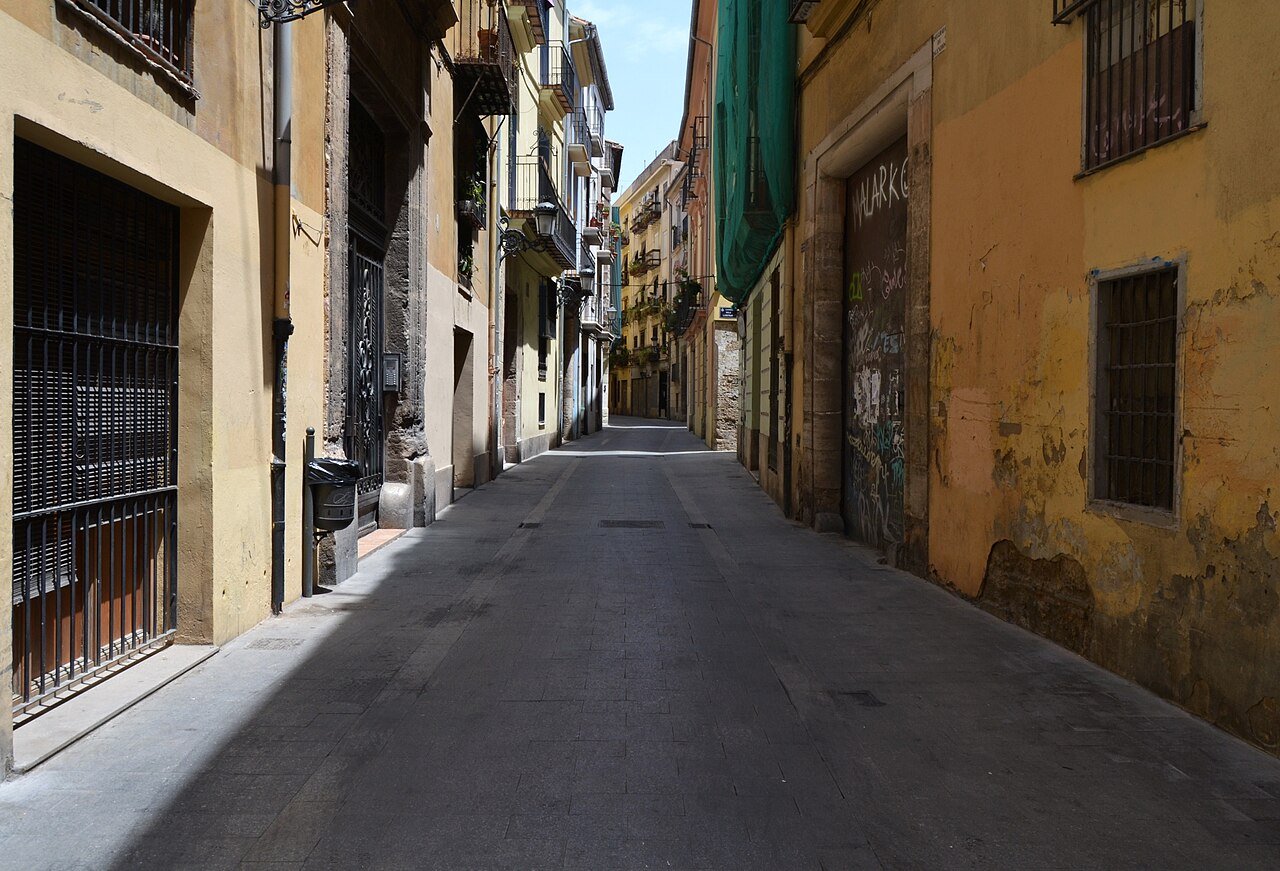
The palace stands in the old town at Calle Poeta Querol 2, a few minutes’ walk from the Plaza del Ayuntamiento. The nearest metro is Colón (lines 3 and 5). You enter through the carriage doorway on Poeta Querol — walk round the corner afterwards to Calle Marqués de Dos Aguas for the famous portal, best seen from the little square opposite.
When to Go
Come on a weekday at 10:00 for the quietest visit, when the palace rooms are often nearly empty. The free Saturday slot from 16:00 is the best value in Valencia sightseeing but also the busiest; arrive a little before 16:00 and head straight upstairs before the crowd spreads. Sunday mornings are a sweet spot — free, but calmer.
How Long You Need
One to two hours covers it honestly. An hour gets you the portal, the carriage hall, the palace rooms and a brisk pass through the medieval ceramics; two hours lets the collection breathe and gives the kitchen and the Alcora rooms their due.
Tips That Will Improve Your Visit
- Do the portal twice: see it when you arrive, then again after the museum. Once you know the rivers, the pears and the hidden Virgin, it reads completely differently.
- Use the free windows: Saturday from 16:00 or any Sunday morning costs you nothing — one of the easiest savings in Valencia.
- Respect the midday closure: the 14:00–16:00 shutdown is real. Morning visit, long lunch, or the free Saturday afternoon are the three good shapes for the day.
- Start upstairs if it is busy: most visitors drift into the ceramics first. The ballroom and Chinese room are at their best in the first twenty minutes after opening — or just after the free slot begins.
- Find the kitchen: it is the most-photographed room inside for a reason — read the food tiles one by one.
- Look for the palace’s own ceiling: the rescued alfarje in the Renaissance rooms came from this building. It is easy to walk under the story without noticing it.
What to See Nearby
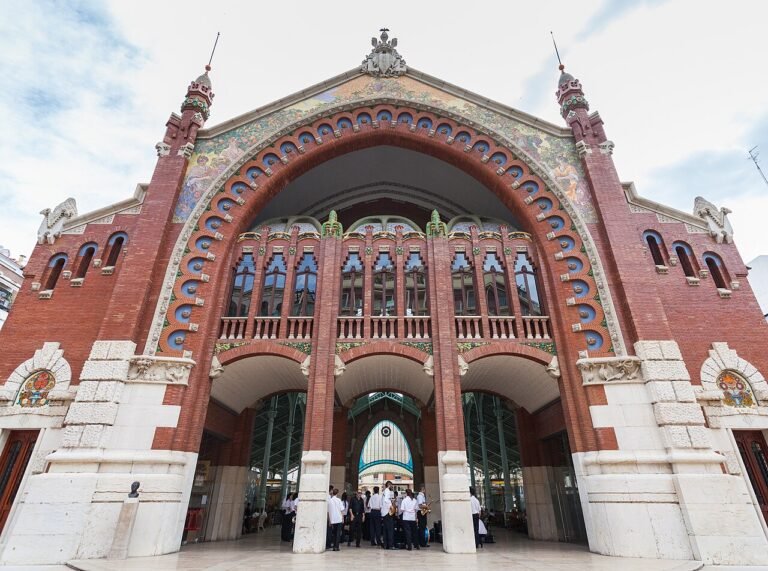
The palace sits in the middle of Valencia’s most walkable square kilometre. Five minutes north brings you to El Carmen, the old town’s liveliest quarter. On the way, Valencia Cathedral and its Miguelete tower anchor the Plaza de la Reina. Ten minutes the other way, the Mercado de Colón fills a gorgeous modernista market hall with cafés and food stalls: the natural next stop after a Saturday-afternoon free visit. Palace, cathedral and market make a satisfying half-day triangle.
Travel insurance, sorted
Whether it is a two-week holiday or a longer move, travel insurance is not the most glamorous part of a trip — but it is the one booking you want to have in place before a trip, and while you are already away.
Final Thoughts
Most cities have a museum you visit for the objects and a palace you visit for the rooms. Valencia hid both in the same building and charges €3 — nothing, on Saturday afternoons and Sundays — to see them. The portal may be the photograph everyone takes home, but it is the combination that stays with you: golden medieval bowls in quiet cases, a ballroom still waiting for its orchestra, a kitchen tiled with dinner. If you see one interior in Valencia, make it this one.
¡Buen viaje!
Photos: Wikimedia Commons — Diego Delso (CC BY-SA 3.0), MollySVH (CC BY 2.0), Joanbanjo (CC BY-SA 3.0 / public domain), Carlos Teixidor Cadenas (CC BY-SA 4.0) and Enric (CC BY-SA 4.0).