El Carmen: The Complete Guide to Valencia’s Old Town Quarter
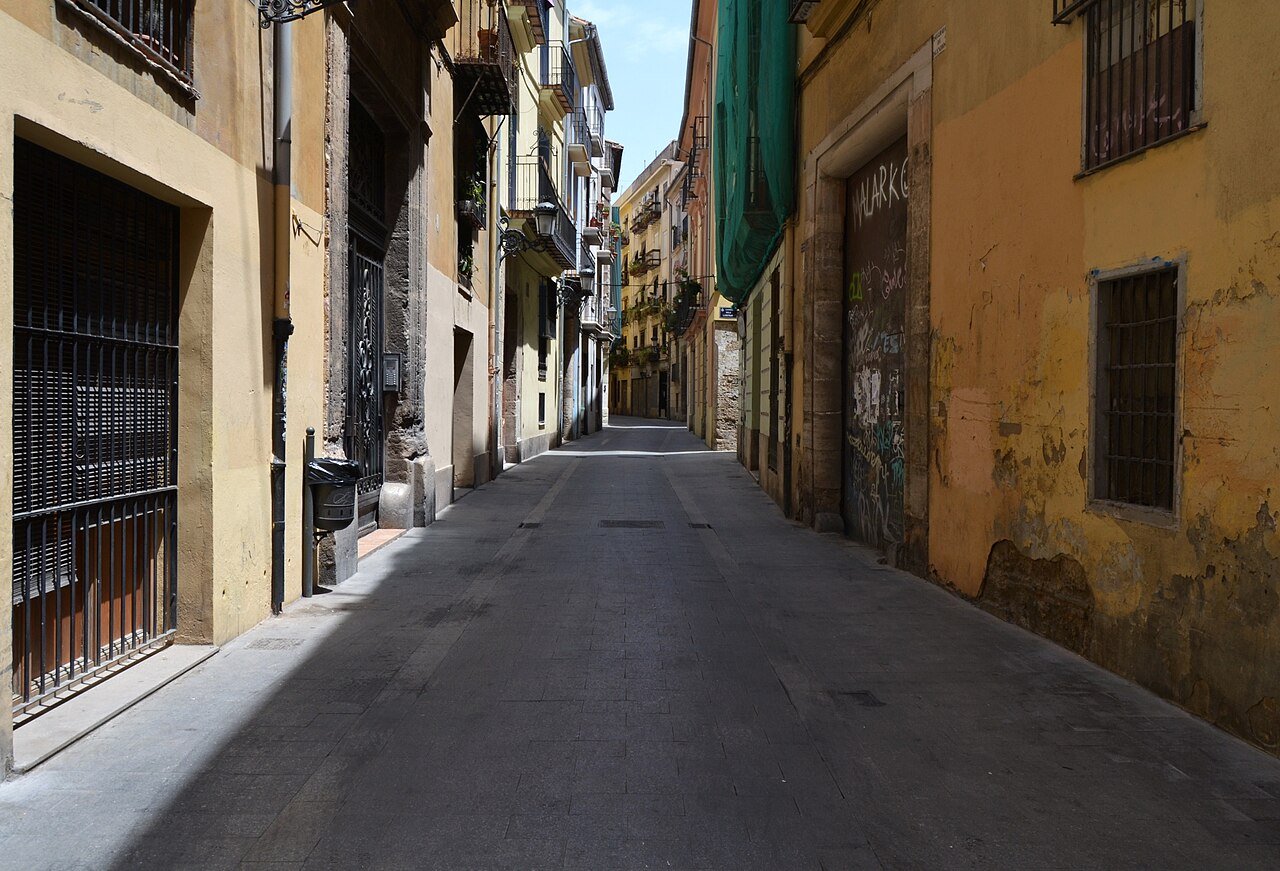
Every old city has a quarter where the centuries refuse to queue in order, and in Valencia it is El Carmen. Wedged into the north-west of the Ciutat Vella — the old town — between the dry green riverbed of the Turia and the cathedral streets, El Carmen is Valencia’s oldest neighbourhood and still, stubbornly, a real one: medieval lanes too narrow for cars, washing strung between balconies, palaces converted into museums, walls blooming with some of the best street art in Spain, and a small house built for cats. By day it belongs to museum-goers and neighbours running errands; by night the same lanes fill with students and bar terraces, and the quarter changes key without changing address.
This guide walks El Carmen as a loop: in through one medieval gate and out through the other, along the ceremonial square at its front step, into its two great museums, past its painted walls and its smallest house, and down — literally — to the Arab wall under its streets. It is one quarter of the story told across our Best Things to Do in Valencia guide, and the part of Valencia visitors most often walk through on their way somewhere else. Slow down. The somewhere else can wait.
The Short Answer
Yes — El Carmen is unmissable and free to wander: Valencia’s oldest quarter, a walkable knot of medieval lanes inside the Ciutat Vella holding two surviving city gates, two major museums, the city’s finest street art and its liveliest old-town nightlife, all within about ten minutes’ walk end to end. There is no ticket and no wrong way to explore it — the lanes reward getting slightly lost — but a first visit repays a loose structure: gates in the morning, museums late morning, street art and the small oddities after lunch, and the bars of Plaça del Tossal towards evening. If you would rather have the layers explained as you go, a Valencia old town walking tour threads El Carmen together with the cathedral streets in a couple of hours. Give the quarter at least half a day — a full one, happily.
Table of Contents
- The Short Answer
- The Story in Brief: Silk, Walls and a Working Quarter
- The Two Gates: Serranos and Quart
- The Ceremonial Front Step: Plaça de la Mare de Déu and the Palau de la Generalitat
- The Museum Pair: IVAM and the Centre del Carme
- Painted Walls and a House for Cats
- Old Walls Under the Lanes, and the Quarter After Dark
- Practical Info
- Tips for Visiting
- Final Thoughts
The Story in Brief: Silk, Walls and a Working Quarter
El Carmen grew up in layers, and the layers are still legible. The deepest is Islamic: Valencia — Balansiya — was a walled Muslim city, and fragments of its Arab wall survive underneath the quarter, most accessibly in the gallery beneath Plaça del Tossal. Over that came the Christian city of Jaume I after 1238, walled again and grander: the 14th-century circuit whose two great gates, Serranos and Quart, still stand at the quarter’s edges. Inside those walls, El Carmen became the artisans’ Valencia — above all, a silk quarter. Its weavers and merchants filled the lanes for centuries, and the street plan they left — narrow, shaded, defensively crooked — is the one you walk today.
The convent that gave the quarter its name, the great Carmelite house founded in the late 13th century, anchored its religious life; its cloisters survive as the Centre del Carme museum. Palaces rose along Carrer de Cavallers, where the nobility built close to power. Later, silk declined and the walls came down in the 1860s — the gates survived largely because they had second jobs, as prisons and landmarks — and El Carmen settled into a long life as a dense, working-class neighbourhood. Its modern revival is double-edged: museums arrived, bars and students followed, street artists colonised its blank walls, and the quarter became fashionable — while never quite ceasing to be lived in. That tension is El Carmen’s defining energy.

The Two Gates: Serranos and Quart
Begin where travellers once began: at the gates. Of the twelve gates in Valencia’s medieval wall, two survive — both on El Carmen’s edge.
At the river end stands the Torres de Serranos (1392–98), the city’s grandest gate, built to face — and impress — the road from the Serranos country to the north. From the old-town side you see its other personality: two polygonal towers opening into great vaulted chambers, a fortified palace turned inside out, the Senyera flying above. The towers did duty as a prison for nobles and a safe store for the Prado’s masterpieces during the Civil War, and today you can climb them for the view over the rooftops to the riverbed gardens we cover in our Turia Gardens guide. Our Torres de Serranos guide gives them their full visit, so here simply register them as the quarter’s front door: pass under the arch at the start of your loop, as arrivals have for six centuries.

At the quarter’s western edge, rougher and in some ways finer, stand the Torres de Quart (1441–60), built in sterner military style: two massive half-round towers of rough masonry flanking a gateway, modelled on Naples’ Castel Nuovo. The Quart towers wear their history on their skin — the pockmarks are cannon fire from the French siege of 1808, left unrepaired on purpose. They guarded the road west, served as a prison too, and can also be climbed; from the top, the view runs down Carrer de Quart across the rooftops to the Miguelete — the whole walk you are about to do, laid out below you. Between the two gates, the wall ran where streets now run; El Carmen is what grew inside it.

The Ceremonial Front Step: Plaça de la Mare de Déu and the Palau de la Generalitat
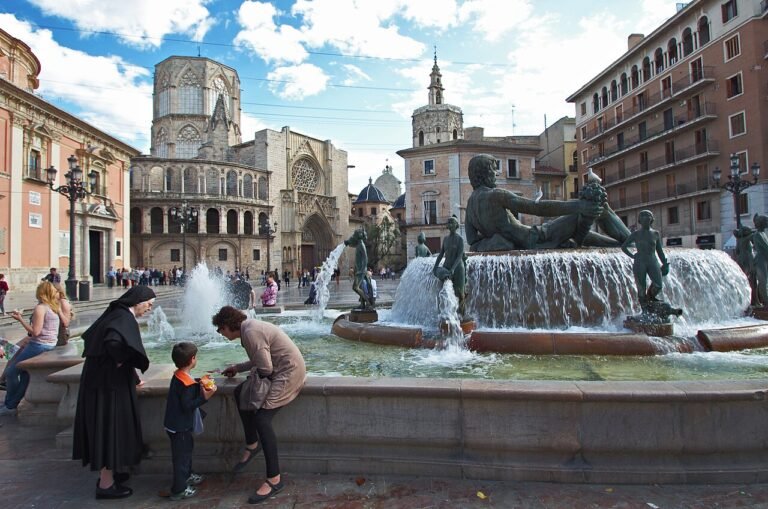
El Carmen’s eastern lanes open, suddenly and ceremonially, onto the Plaça de la Mare de Déu — also known by its Spanish name, the Plaza de la Virgen. Strictly, the square fronts the neighbouring Seu quarter, but it functions as El Carmen’s front step, the hinge between the warren and the monumental city. At its centre plays the Turia fountain, its reclining river god ringed by eight maidens for the eight great irrigation channels; around it stand the pink façade and blue dome of the Basilica of Our Lady of the Forsaken and the cathedral’s Apostles’ Door. In March it becomes the emotional centre of Las Fallas, carpeted with flowers for the Ofrenda; the rest of the year it is café tables and wedding parties. The cathedral itself deserves its own visit, and our Valencia Cathedral guide covers it in full; from this loop, treat the square as the view, the pause and the coffee.

Behind the square, along Carrer de Cavallers — the knights’ street, the quarter’s grandest lane — stands the Palau de la Generalitat, seat of the Valencian government since the 15th century and worth reading from outside even on days it is closed to visitors. Its severe stone tower rises over a little garden of orange trees at the square’s corner, all business in front and Renaissance courtyard within; the palace grew in stages from 1421 as the old kingdom’s tax office became its government, and it still is one. Carrer de Cavallers itself is the quarter in one street: palace fronts and modest houses, old shops and new bars. Walk it slowly.

Free Valencia travel guide
Planning a trip to Valencia? Get our free one-page Valencia checklist: what to book ahead, what to skip, and the paella places we actually eat in.
The Museum Pair: IVAM and the Centre del Carme
Two museums anchor El Carmen culturally, and they make a perfect pair: one modern in a modern building, one contemporary inside a convent that is itself the exhibit.
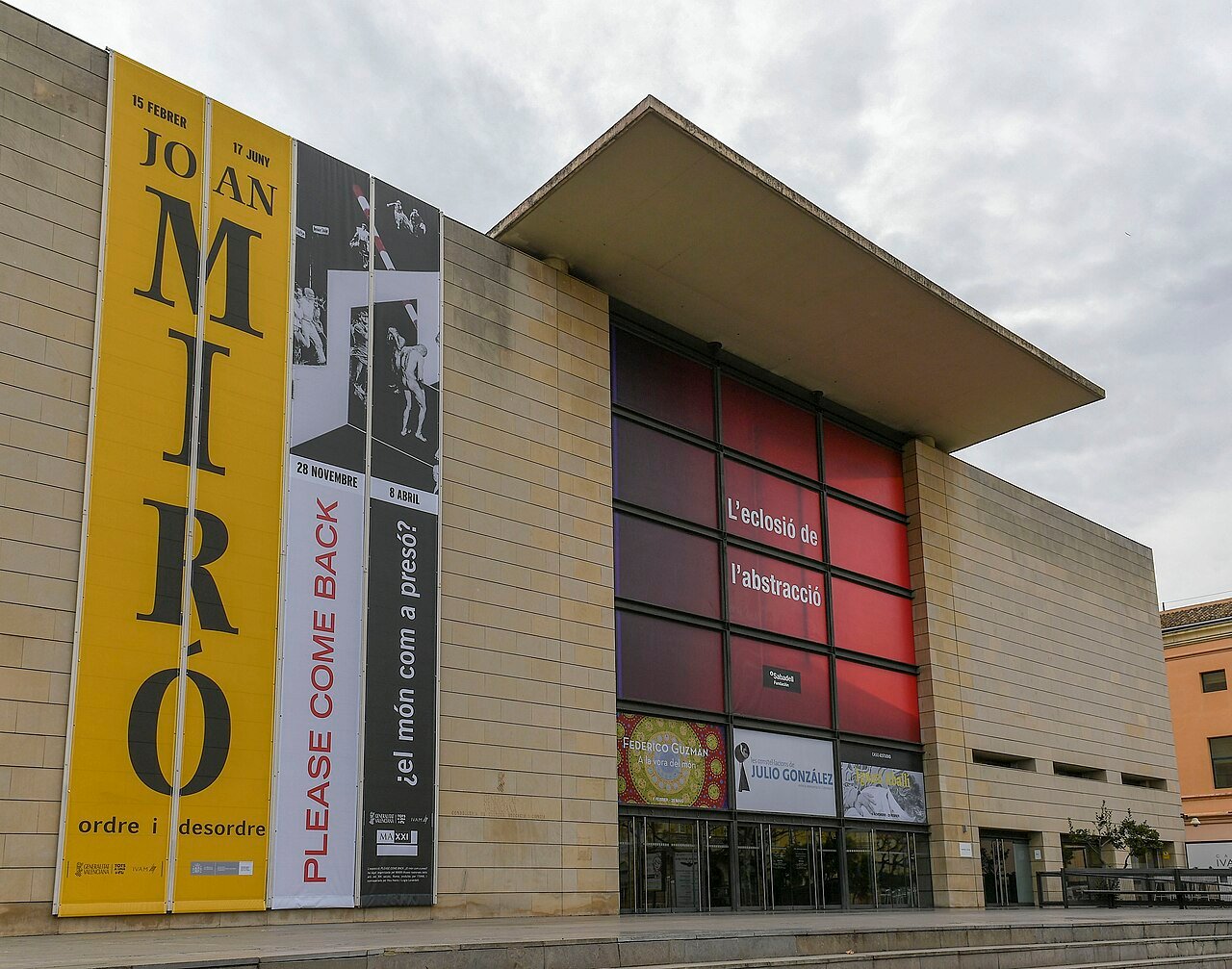
The Institut Valencià d’Art Modern — IVAM — stands at the quarter’s northern edge, a sober stone-clad block opened in 1989 as one of Spain’s pioneering modern art museums. Its heart is the Julio González collection — the Valencian sculptor who taught Picasso to weld iron — alongside a strong permanent holding and rolling temporary exhibitions. It is a calm, manageable museum: an hour or two. Look too for what lies beneath: a stretch of Valencia’s medieval wall found during its construction is preserved in the basement gallery — the modern museum standing guard over the old wall.
Five minutes south, the Centre del Carme Cultura Contemporània — the CCCC — occupies the old Carmelite convent that named the quarter. Come for the building as much as the art: a Renaissance cloister, a Gothic cloister beside it, courtyards where the quarter’s noise simply stops. The programme leans contemporary and Valencian — exhibitions, film cycles, concerts in the cloisters — and admission has traditionally been free, making it the easiest cultural yes in the old town: drift in, see whatever is on, sit in the cloister. Together the pair explain the quarter’s revival: culture arrived here first, and everything else followed.

Painted Walls and a House for Cats
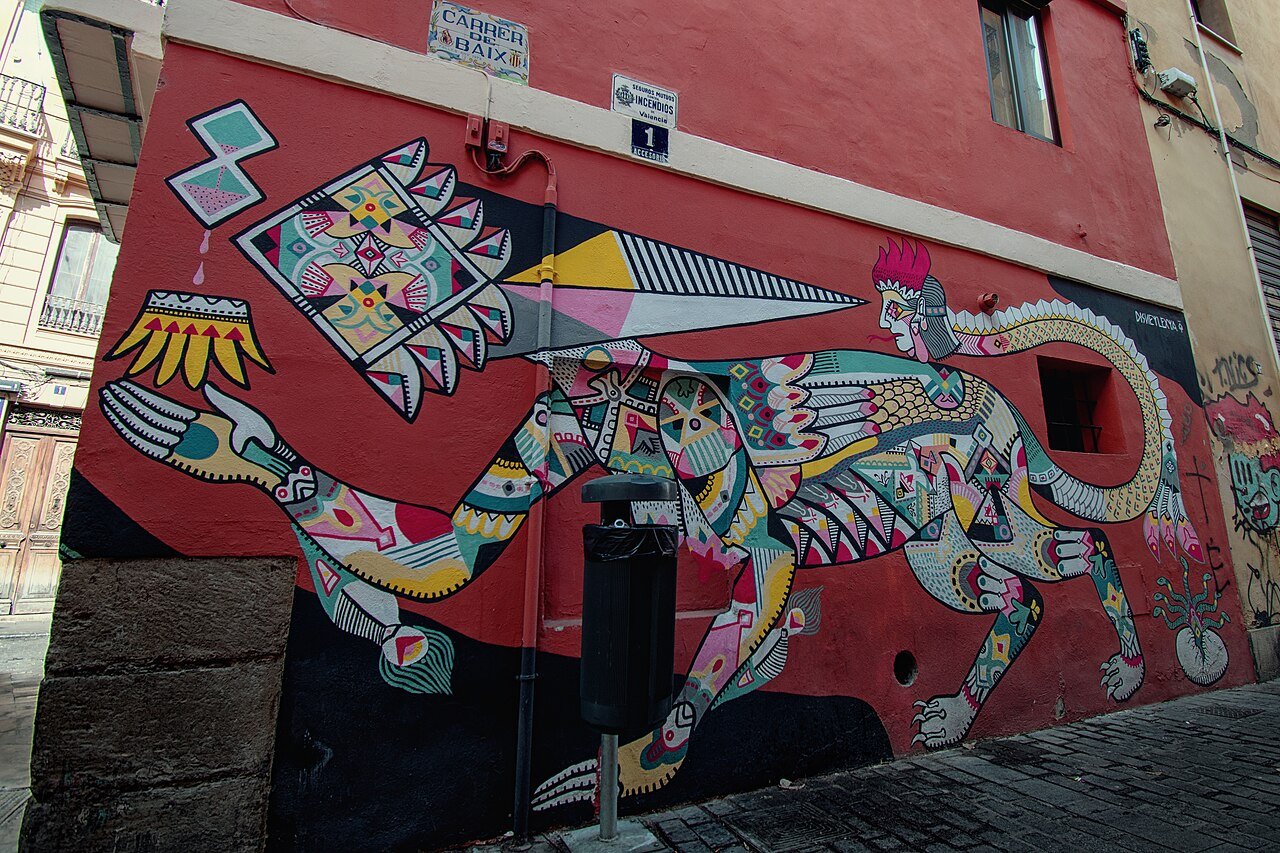
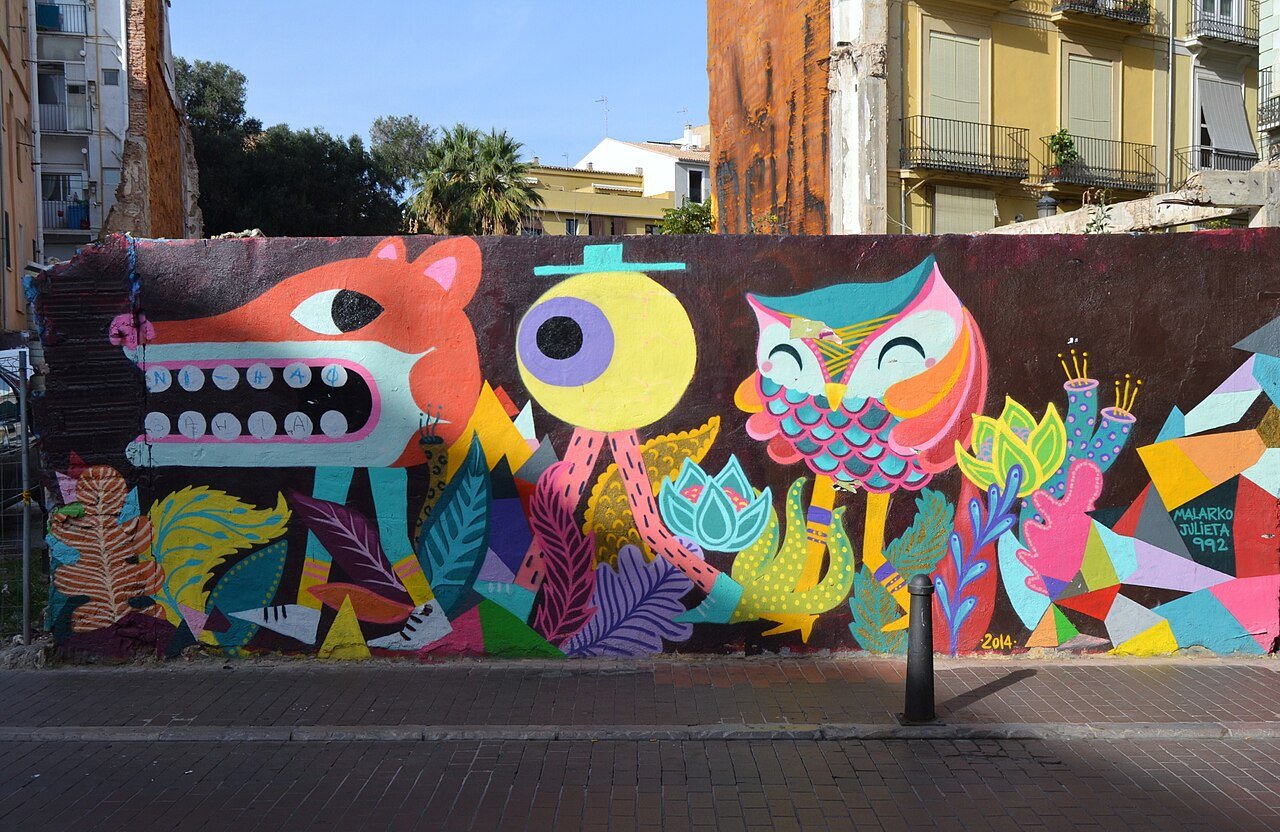
El Carmen is also an open-air gallery — with the honest caveat that its collection changes without notice. Since the 2000s its blank walls, shutters and empty plots have made it Valencia’s street-art heartland: the Valencian artist Escif, whose wry, economical murals turn up across the quarter, is its best-known name, and local and visiting artists have layered work around his ever since. Pieces fade and are replaced — which is the point visitors must accept: no guide, including this one, can promise you a specific mural. What can be promised is the density. Lanes like Carrer de Baix and Carrer del Moro Zeid — named for Moro Zeit, the Muslim lord who handed Valencia’s keys to Jaume I — repay slow walking with your eyes up.
And then, the quarter’s smallest sight and, for many visitors, its most beloved. On Carrer del Museu, at number 9, a wall carries the Casa de los Gatos — the House of the Cats: a complete miniature Valencian house, knee-high, with tiled roof, tiny curtained windows, a little balcony, a fountain and an arched doorway sized for a cat. It commemorates, the plaque explains, the cats of a widow who once lived here and the strays that passed through the hole in the wall — and the quarter’s cats, and their human feeders, have used the spot ever since. It takes two minutes to see and stays with people longer than palaces do. Crouch down, enjoy it, leave nothing but a photograph — the residents, feline and human, are still in residence.

Old Walls Under the Lanes, and the Quarter After Dark
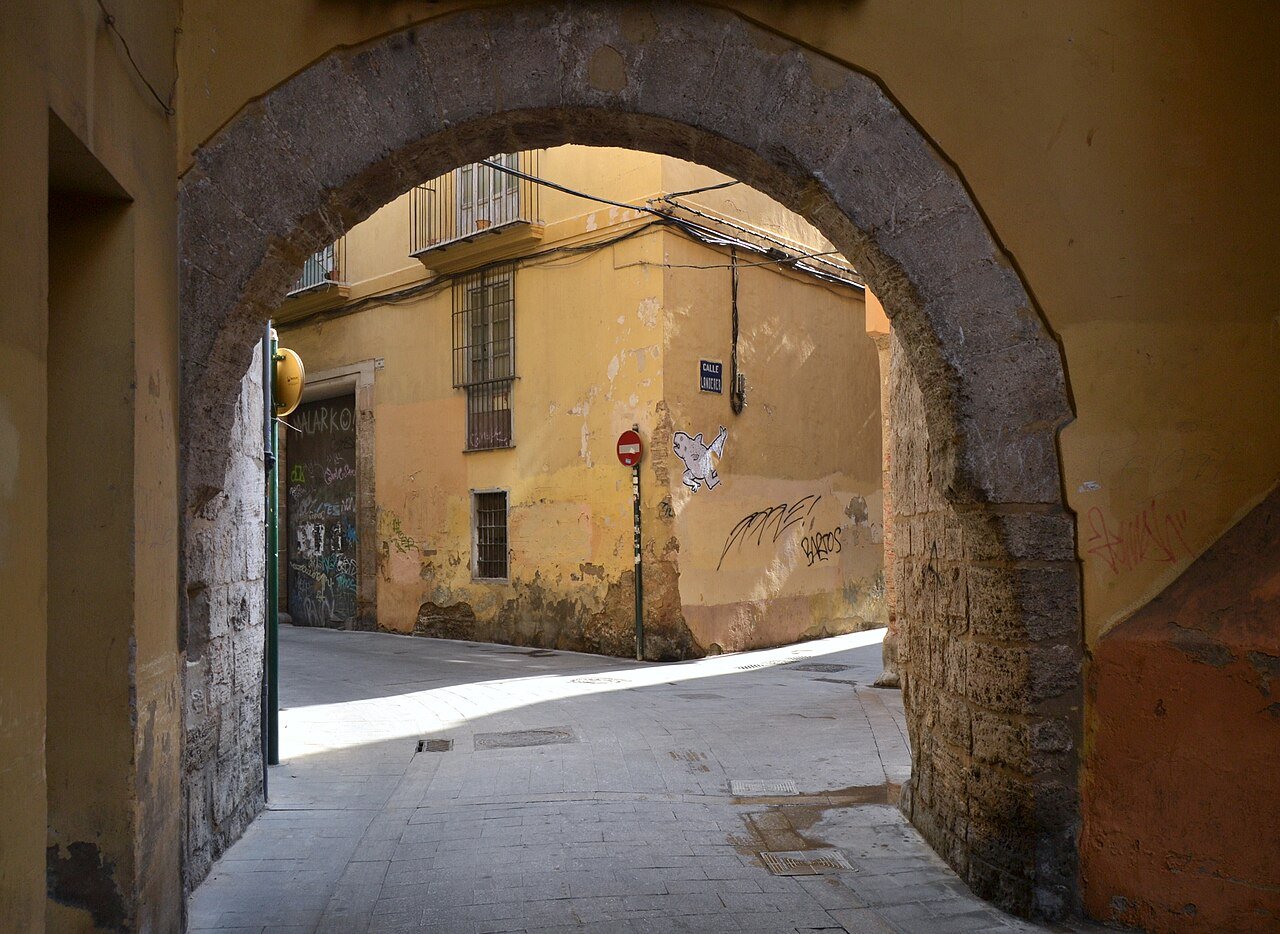
End the loop with the quarter’s buried and late-night faces — the same corner. The Portal de la Valldigna is a modest stone arch of 1400 built into a house front, once the gate separating the Christian city from the Moorish quarter outside it. Thousands walk under it without noticing. Nearby, under Plaça del Tossal, the Galería del Tossal descends to the best surviving stretch of Valencia’s Arab wall, the Bab al-Hanax gate area of Islamic Balansiya, displayed underground where it was found. Between the portal above and the wall below, the quarter’s deepest layer becomes masonry you can stand beside.
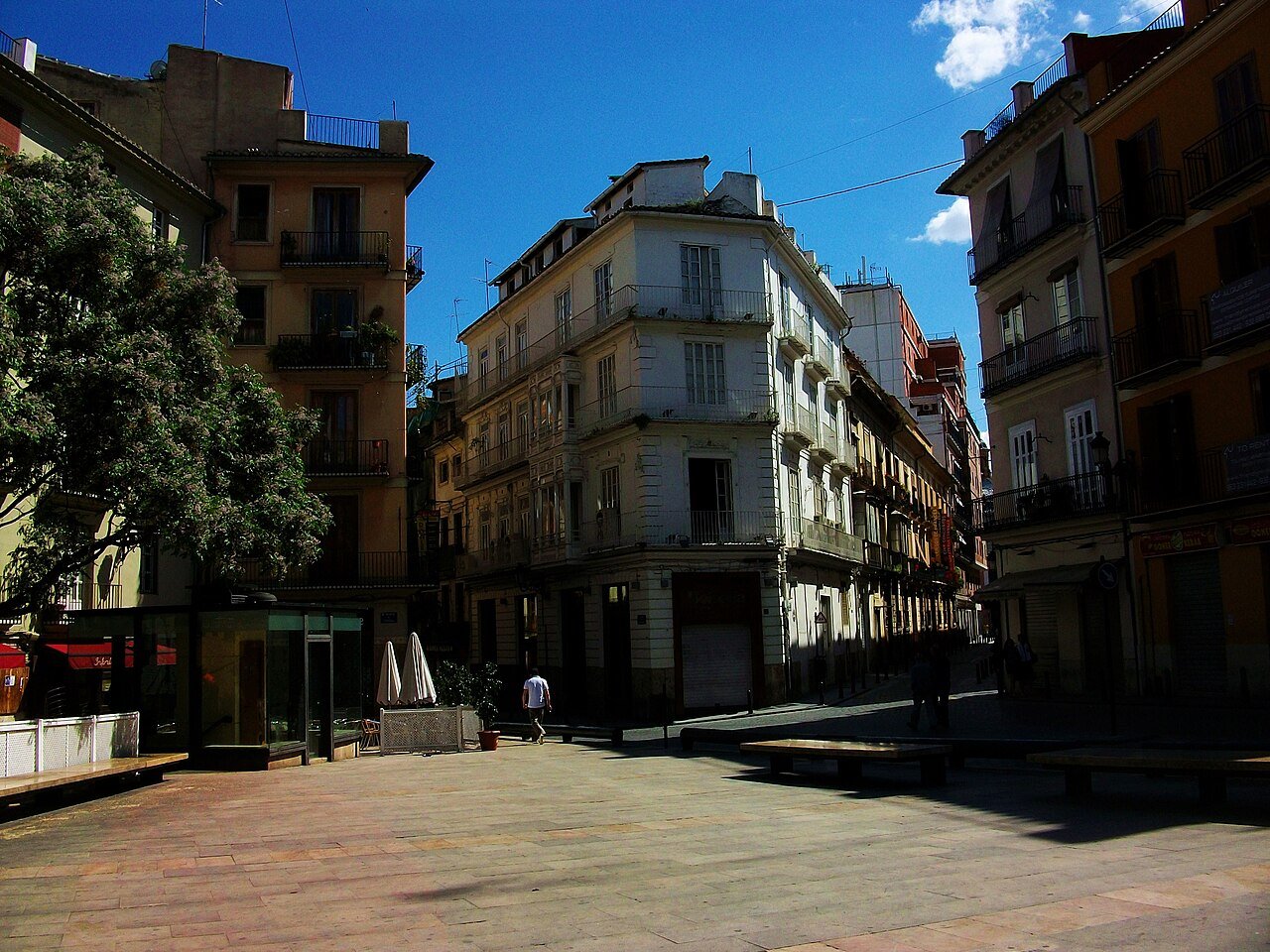
Above that gallery, Plaça del Tossal is El Carmen after dark in miniature: a sloping square where the quarter’s bar life concentrates, terraces filling from early evening, the streets running off it — Carrer de Quart, Carrer de la Bolsería — carrying the night onward. It is fun, and it is also somebody’s bedroom window overhead. El Carmen’s nightlife has a long, loud history, and its residents have pushed back more than once; the sustainable version is the one most visitors naturally choose — drinks on a terrace, dinner in the lanes, voices at conversation level on the walk home. Do that, and the quarter by night is a pleasure: young, local, and still a neighbourhood rather than a theme park.
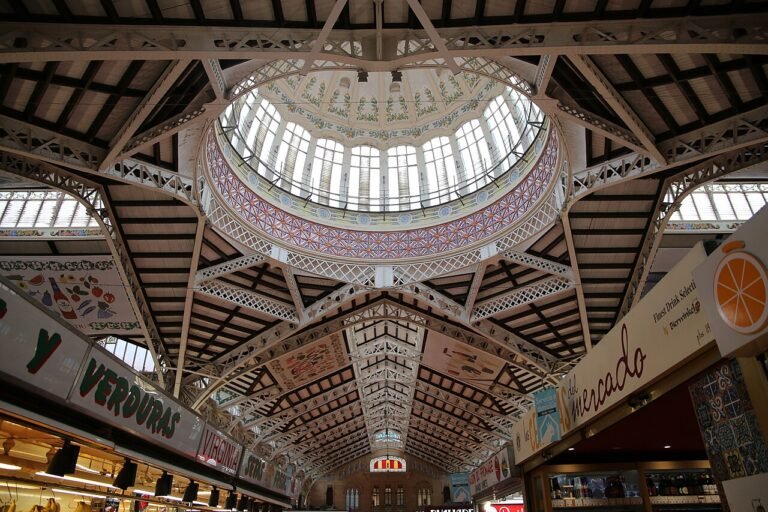
The loop closes from here: a few minutes north brings you back to the IVAM, or east to the cathedral streets. Residents thread the same lanes in the morning with shopping bags bound for the Mercado Central, ten minutes’ walk south, and joining that morning current is as good a finish as any: the quarter not as a sight, but as a place that works.
Practical Info
Getting there. Almost every visitor arrives on foot: El Carmen is five to ten minutes from the cathedral, a few minutes from the Mercado Central, and directly below the Torres de Serranos. The nearest metro stations sit on its edges — Túria and Àngel Guimerà to the west — and buses run along Guillem de Castro and Carrer de Quart on its rim. Do not drive into it: the lanes are largely pedestrian or residents-only, and parking belongs in the car parks on the old town’s edge.
How long, and how to shape the day. The loop is about two kilometres of lanes — an hour of pure walking, half a day done properly with one museum, a full day with both, the gates climbed and the evening kept for the Tossal. Or let a guide do the threading: a Valencia old town walking tour typically covers the quarter with the cathedral and market quarters in two to three hours, after which the lanes are yours to re-wander.
Costs and hours. The quarter, its streets and the Portal de la Valldigna are public space — free, around the clock. The CCCC has traditionally been free; IVAM charges a modest admission, and both keep museum hours — broadly, Tuesday to Sunday daytimes, closed Mondays — that shift by season, so check current listings. The two gates open on a municipal pattern, generally daily except Mondays, for a small fee. The Galería del Tossal keeps limited hours and can close between exhibitions — verify on the day.
Tips for Visiting
- Loop it gate to gate. Start under Serranos in the morning, cross by Cavallers and the museums, and finish at Quart and the Tossal towards evening — the light and the quarter’s mood run in your favour that way.
- Look up, then look down. Balconies, altarpieces and murals above; the Portal, the street plaques and the Galería below. El Carmen punishes eyes-forward walking.
- Treat the street art as weather. Enjoy whatever murals are up, and do not march across the quarter hunting one specific piece from an old photograph — it may be gone, and the lane will offer you a new one instead.
- Do one museum properly. IVAM if modern art is your thing, the CCCC for atmosphere — one done slowly beats both at a march, and the CCCC’s cloister is a rest as much as a sight.
- Keep the nights neighbourly. El Carmen is a residential quarter that hosts nightlife, not the other way round: terrace, dinner, conversation-level lanes after midnight.
- Come back in the morning. Re-walk one lane before ten the next day — shutters up, market bags out, cats at their house — and you will understand the quarter twice as well.
Travel insurance, sorted
Whether it is a two-week holiday or a longer move, travel insurance is not the most glamorous part of a trip — but it is the one booking you want to have in place before a trip, and while you are already away.
Final Thoughts
El Carmen is Valencia with its guard down: silk workshop, fortress edge, poor and crowded barriada, bohemian heart — it has kept something of every version in its lanes. Its genius is density and life: the palace, the mural, the museum, the cat house and the bar terrace are neighbours sharing a street, not attractions arranged for you. Walk the loop, climb a gate, sit in a cloister, crouch at the cats’ door — and when the lanes deliver you back to Serranos, you will have seen the oldest Valencia there is, still working.
¡Buen viaje!

Photo credits: A lane on Carrer del Portal de la Valldigna and the Portal de la Valldigna arch — Joanbanjo, CC BY-SA 3.0 / CC BY-SA 4.0 · The Arab wall in the Galería del Tossal — MCAE Consulting, CC0 · The Torres de Serranos, the Torres de Quart view and Plaça de la Mare de Déu — Diego Delso, CC BY-SA 3.0 · The Palau de la Generalitat — Dorieo, CC BY-SA 4.0 · The IVAM façade — Juan García (IVAM), CC BY-SA 4.0 · The Centre del Carme — Zarateman, CC0 · Street art on Carrer de Baix — Derek Rankine, CC BY 2.0 · The mural on Carrer del Moro Zeid — Joanbanjo, CC BY-SA 4.0 · The Casa de los Gatos — Dudva, CC0 · Plaça del Tossal — Joanbanjo, public domain. All via Wikimedia Commons.


One Comment