Plaza de la Virgen: The Complete Guide to Valencia’s Ceremonial Square
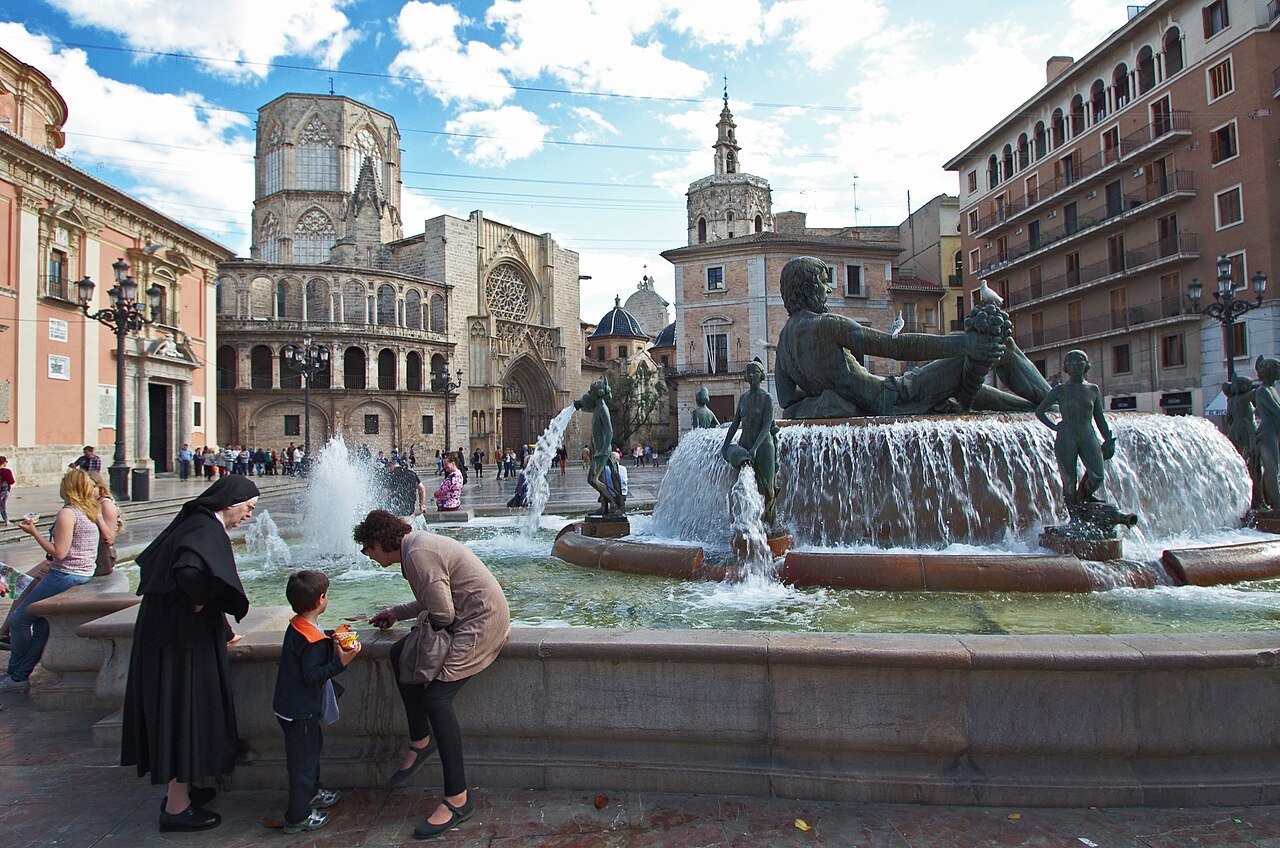
Some squares are for shopping, some for transport, and a few — the rare few — are where a city keeps its soul. Plaza de la Virgen, Plaça de la Mare de Déu in Valencian, is Valencia’s soul in paved form. It is not large, it has no shops to speak of, and yet everything the city holds sacred stands around its edges: the cathedral’s Gothic Apostles’ Door, the pink basilica of Valencia’s beloved patroness, the palace of the Valencian government, and at its centre a bronze river god reclining in his fountain as he has for half a century. Beneath your feet, two metres down, lie the streets and columns of the Roman forum of Valentia — the very ground where the city began in 138 BC.
This is Valencia’s ceremonial front room, and it still works for a living. Every Thursday at noon, farmers in black blouses settle a thousand-year-old water dispute in front of the cathedral door. Every March, a hundred thousand people in silk and lace carpet the square with flowers. The rest of the year it belongs to wedding parties, café terraces, grandmothers feeding pigeons and visitors doing what everyone does here within five minutes — sitting down on the fountain’s edge and simply watching the city be itself. This guide unpacks every layer of it. It is one square of the story told across our Best Things to Do in Valencia guide, and the one square no visit to Valencia should skip.
The Short Answer
Yes — Plaza de la Virgen is unmissable and free: Valencia’s ceremonial heart, a single walkable square holding the cathedral’s Apostles’ Door, the Thursday water tribunal, the Basilica of Our Lady of the Forsaken, the Palau de la Generalitat and the Neptune fountain, standing directly over the Roman forum where the city was founded. There is no ticket and almost no way to do it wrong: read it building by building, then sit down and let it perform. Give it an hour as part of the old town — or arrive on a Thursday before noon and give it a morning. If you want the layers explained as you stand among them, a Valencia old town walking tour puts the square in context with the cathedral streets and El Carmen in a couple of hours.
Table of Contents
- The Short Answer
- Two Thousand Years Under the Paving
- The Fountain: A River God and His Eight Maidens
- The Apostles’ Door and the Water Court
- The Basilica and la Geperudeta
- The Palau de la Generalitat and Its Gardens
- March: The Ofrenda and a Virgin Made of Flowers
- Cafés, Terraces and a Glass of Horchata
- The Square Through the Day
- A Short Walk Away
- Practical Info
- Tips for Visiting
- Final Thoughts
Two Thousand Years Under the Paving
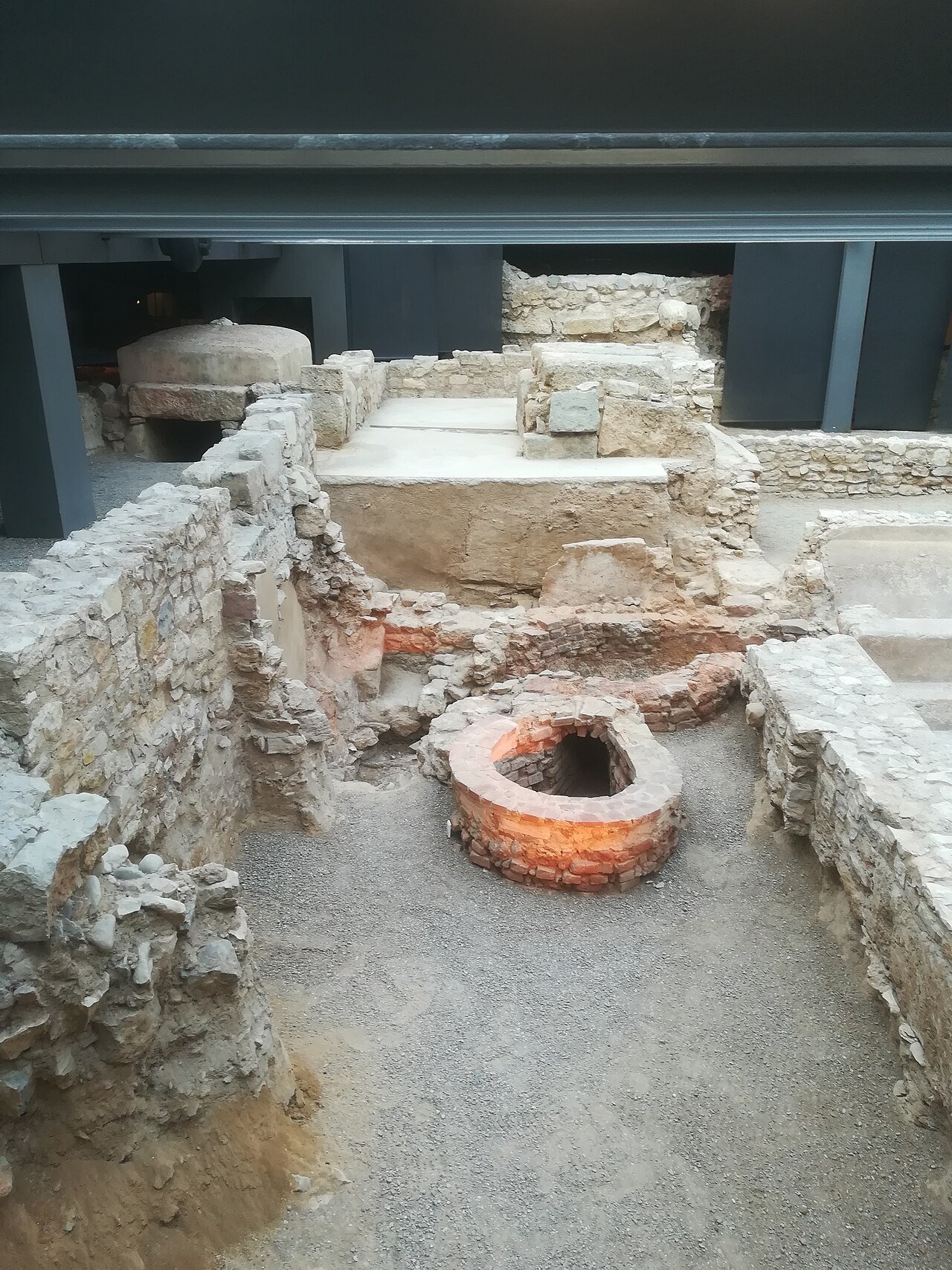
Stand in the middle of the square and you are standing on Valencia’s birth certificate. When Decimus Junius Brutus founded Valentia in 138 BC for retired soldiers of the Lusitanian wars, he planted its forum — the market square, law courts and temples of the new colony — essentially where you are standing. The colony was destroyed in the civil wars of the 1st century BC and refounded under Augustus, and the rebuilt forum grew grander: basilica, curia and temples. Two thousand years of city have been stacked on top ever since, but the forum never moved. Valencia’s centre of gravity has stayed within a few paving stones of this spot for twenty-one centuries.
The layers between then and now are unusually complete. The Visigoths made the Roman city a bishopric; Islamic Balansiya, from the 8th century, raised its medina and principal mosque over the same civic ground — the mosque stood where the cathedral now stands, and the square before it was the city’s commercial and ceremonial core then as now. After Jaume I took Valencia in 1238, the mosque became the cathedral, the square took the cathedral’s shape, and in time it took its name from the basilica that rose beside it in the 17th century — the Virgin’s square, Plaça de la Mare de Déu.
You do not have to take any of this on faith. On the square’s northern edge, the Centre Arqueològic de l’Almoina descends to the excavated forum itself: Roman streets you can walk beside, the great 1st-century BC granary, baths, Visigothic and Islamic remains, all preserved in a calm underground museum under a glass-skinned building. It is the single best hour you can spend understanding Valencia — the square above, explained by the city beneath it.
The Fountain: A River God and His Eight Maidens
The square’s centrepiece is younger than everything around it, and it is already a classic. The Fuente del Turia — Valencians also call it the Fuente de Neptuno, the Neptune fountain — was inaugurated in 1976, a bronze group by the Valencian sculptor Manuel Silvestre Montesinos, known as Silvestre d’Edeta. Its reclining giant, cornucopia in hand, is not merely Neptune borrowed from classical mythology: he is the river Turia personified, the water that made Valencia’s huerta — its famous irrigated farmland — possible, and that the city both fed on and feared for two millennia.
Around him sit eight nude bronze maidens, and they are the fountain’s real lesson. Each represents one of the eight great acequias — the irrigation channels, several of them of Moorish origin and older, that divide the Turia’s water among the farms of the Vega: Quart, Benàger i Faitanar, Tormos, Mislata, Mestalla, Favara, Rascanya and Rovella. Read the fountain as a map of the region’s water, cast in bronze — which is exactly what it is. It also explains the ceremony that unfolds a few metres away every Thursday, because those same eight channels are the court that still governs them. On warm evenings the fountain’s rim is the square’s favourite bench, and the river god presides over it all with the patience of a deity used to being sat on.

The Apostles’ Door and the Water Court
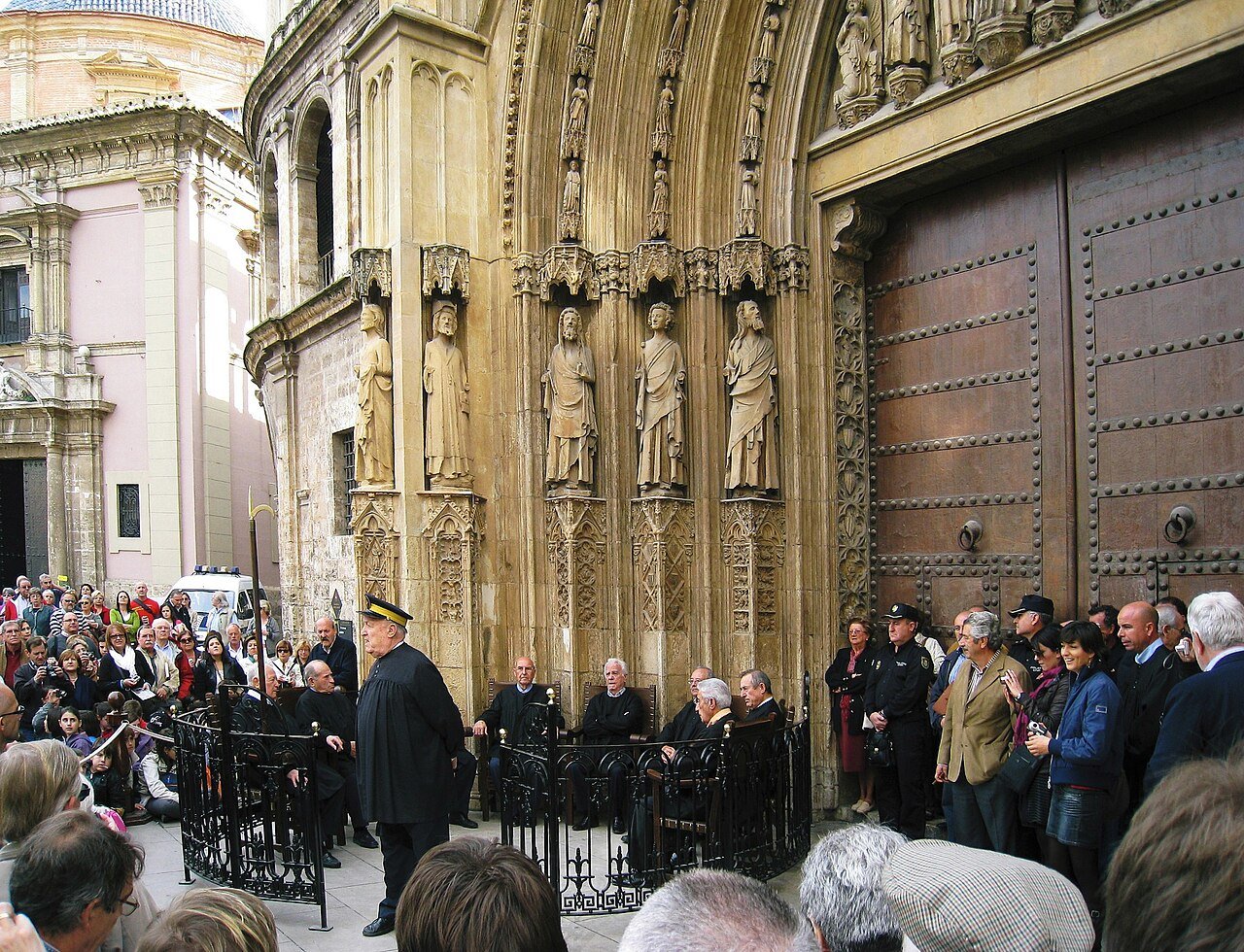
The cathedral closes the square’s eastern side, and it shows the square its best face: the Puerta de los Apóstoles, the Apostles’ Door, a full-blooded Gothic portal of the 14th century. Twelve apostles stand in its jambs under carved canopies, angels and kings crowd its archivolts, and above it blooms the door’s famous rose window, its tracery built around a six-pointed star. Our Valencia Cathedral guide walks the whole building, door by door and chapel by chapel; from the square, simply take in that this weathered, honey-coloured façade has been the backdrop to Valencian ceremony for nearly seven hundred years.
Including, every week, the most extraordinary of them all. At noon on Thursdays, in front of the Apostles’ Door, the Tribunal de las Aguas de la Vega de Valencia — the Water Tribunal — comes into session. Eight judges, the síndics, one elected by the farmers of each of the eight acequias, take their seats in a semicircle of high-backed chairs. They wear the black blouse of the huerta’s labourers. There are no lawyers, no paperwork and no written sentences: disputes over irrigation water — a stolen turn, a blocked channel, a flooded field — are stated aloud in Valencian, argued aloud, and settled on the spot, by a show of assent, in judgements that are final and unappealable. Then the court rises, the crowd applauds, and everyone goes to lunch. The whole thing often takes fifteen minutes.
It is, quite seriously, one of the oldest continuously functioning judicial institutions in Europe, traditionally traced to the caliphal era a thousand years ago, and in 2009 UNESCO inscribed it on its Representative List of the Intangible Cultural Heritage of Humanity. The unassuming building across the square’s corner, the Casa Vestuario, belongs to the same story — it was built so the tribunal’s members had somewhere to robe. Arrive by 11:30 on a Thursday to claim a spot behind the barrier; the square fills, the cathedral clock strikes twelve, and a court older than most European states gets down to business.

The Basilica and la Geperudeta
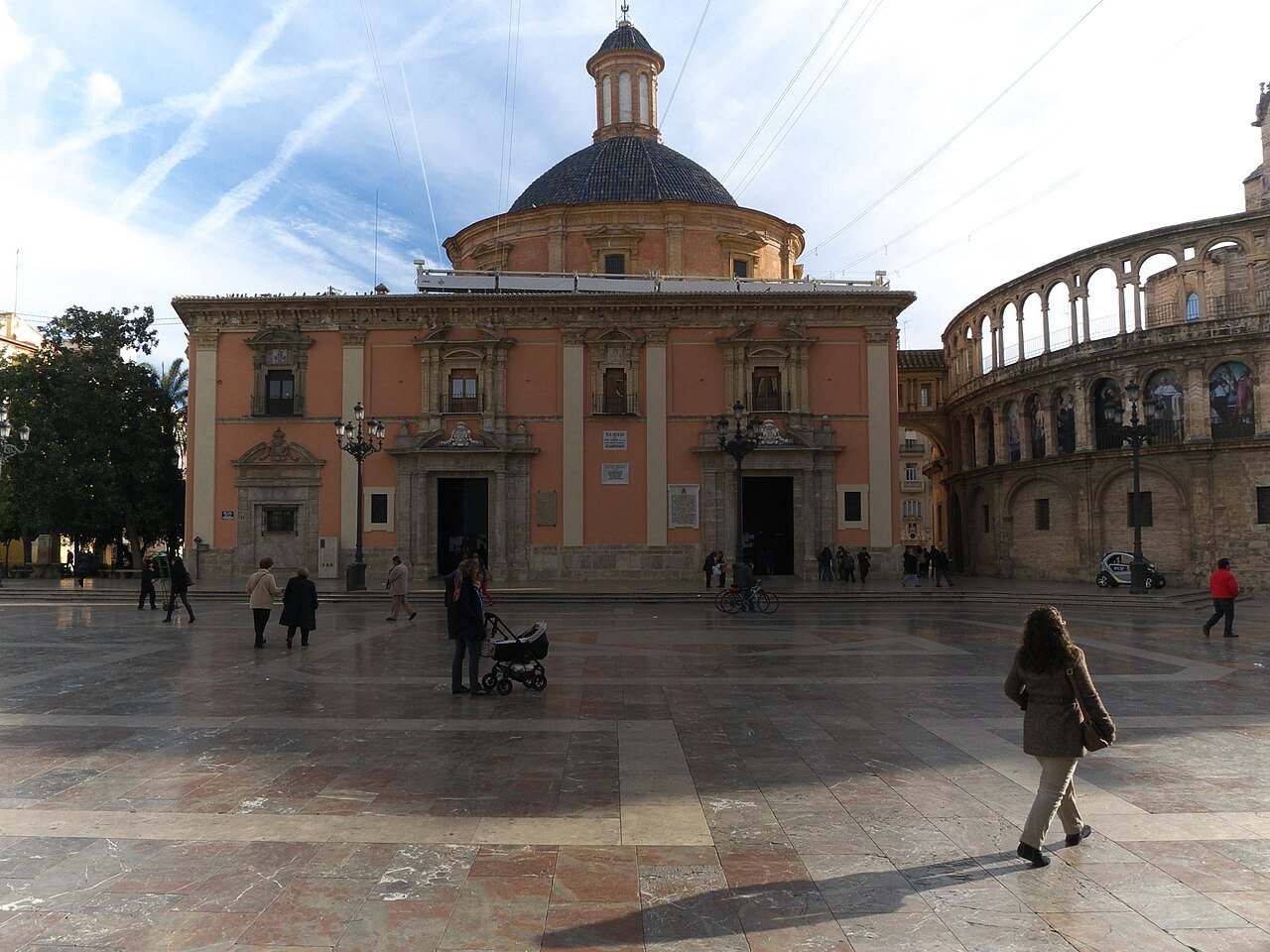
If the cathedral is the square’s monument, the Basílica de la Mare de Déu dels Desemparats — the Basilica of Our Lady of the Forsaken — is its heart. Raised between 1652 and 1667 beside the cathedral, its warm pink façade and blue-tiled dome are the square’s most recognisable silhouette, and it was among the first great Baroque churches built in Spain. It exists for one reason: the image inside it, the Virgin of the Forsaken, patroness of Valencia, a Gothic carving of the early 15th century made for the confraternity founded by Fra Joan Gilabert Jofré to care for the abandoned and the mentally ill — the desemparados, the forsaken ones of its name.
Valencians call her, with total affection, la Geperudeta — the little hunchback — because the image inclines gently forward, as if stooping to shelter the people at her feet. She is loved the way cities love very few things: her basilica is open from early morning, the camarín staircase behind the altar lets the faithful file close past her, and on the second Sunday of May her feast moves half the city into these streets. Even the church’s architecture bends to her — literally. Its famous dome is an oval, slightly askew of the building’s axis, an oddity usually explained by the cramped, irregular plot the basilica was squeezed into between cathedral and square. Step inside for ten minutes whatever your beliefs: the frescoed oval dome, painted by Antonio Palomino at the end of the 17th century, is one of the great ceilings of Spanish Baroque, and the hush in there is the square’s other mood.

Free Valencia travel guide
Planning a trip to Valencia? Get our free one-page Valencia checklist: what to book ahead, what to skip, and the paella places we actually eat in.
The Palau de la Generalitat and Its Gardens
The square’s western side belongs to power. The Palau de la Generalitat, seat of the Valencian government, was begun in 1421 as the seat of the old kingdom’s tax administration and grew, through the 15th and 16th centuries, into the finest civic Gothic palace in the region: a severe stone tower, carved windows, and within, a courtyard and the gilded Saló de Corts. It still does the job it was built for — this is a working government palace, not a museum — which gives the square its pleasing double life: brides on one side, ministers on the other, both entirely at home.
The palace’s gift to the ordinary visitor is its gardens, on the square’s north-west corner where Carrer de Cavallers runs in. The Jardins de la Generalitat occupy the site of Valencia’s old city hall, demolished in the 19th century, and they are the square’s green ante-room: orange trees, benches, shade, and a direct view back across to the Casa Vestuario and the Miguelete. When the palace opens its doors — it offers visits on set days and opens fully for occasions such as 9 October, the Valencian national day — take the chance; the rest of the time, the gardens plus the façade from the square are a fair share. Government has stood on this corner since the square was a forum, after all; the palace is simply the current tenant of a very old office.

March: The Ofrenda and a Virgin Made of Flowers
For most of the year the square is handsome. For two days in March it becomes almost unbearably moving. The Ofrenda de Flores, the Offering of Flowers, is the emotional summit of Las Fallas, Valencia’s great festival of fire (15–19 March), and it happens here. On 17 and 18 March, from afternoon until deep into the night, the city’s falleros and falleras — tens of thousands of them, in full traditional dress, bands playing, babies in costume riding on shoulders — process to this square carrying bouquets for the Virgin.
The bouquets are not simply laid down. In the square’s centre rises a giant wooden figure of the Virgin of the Forsaken, some fourteen metres tall, and florists on scaffolding take each bouquet and weave it into her mantle, building up immense patterns of colour — red, white, pink, purple — until the wooden frame has become a cloak of living flowers. By the end of the second night the square smells like a garden after rain, the mantle is complete, and the crowd stands in something close to silence. If you can be in Valencia for only one Fallas moment that is not the burning itself, make it this one: come at dusk, claim a patch of square, and watch a city dress its patroness in flowers, one family’s bouquet at a time.

Cafés, Terraces and a Glass of Horchata
Every great square doubles as a café, and this one charges accordingly — let us be honest about that first. The terraces ringing Plaza de la Virgen occupy some of the priciest pavement in Valencia, and you will pay a clear premium over the same coffee two streets away. You are renting the view: cathedral, basilica, fountain, and the endless theatre of the square. Budget travellers should take the local’s deal instead — stand at a bar inside, or buy nothing at all and sit on the fountain rim, which is free and arguably better.
What to order, at whichever price point: horchata de chufa, Valencia’s own drink — a cool, sweet, milky-white refreshment ground from tiger nuts, traditionally served with fartons, long soft sponges of pastry made for dunking. The cafés also do a steady trade in coffee, vermouth and agua de Valencia — the city’s cava-and-orange-juice cocktail — as the day turns. One practical note: terraces fill brutally at Fallas and on festival weekends, and service slows to match. The square rewards those who arrive at café-opening o’clock rather than at the rush.

The Square Through the Day
The square has acts, like a play. Early morning is the connoisseur’s hour: deliveries and street-sweepers, the basilica’s doors open for the first mass-goers, the stone still cool, the fountain playing to an audience of a dozen. Mid-morning brings the tour groups and the café terraces filling; on Thursdays everything builds to the tribunal’s noon session, the one weekly appointment the square never misses. Afternoons soften — shoppers crossing to El Carmen, students on the fountain rim, wedding parties spilling from the basilica in a flurry of rice and photographs.
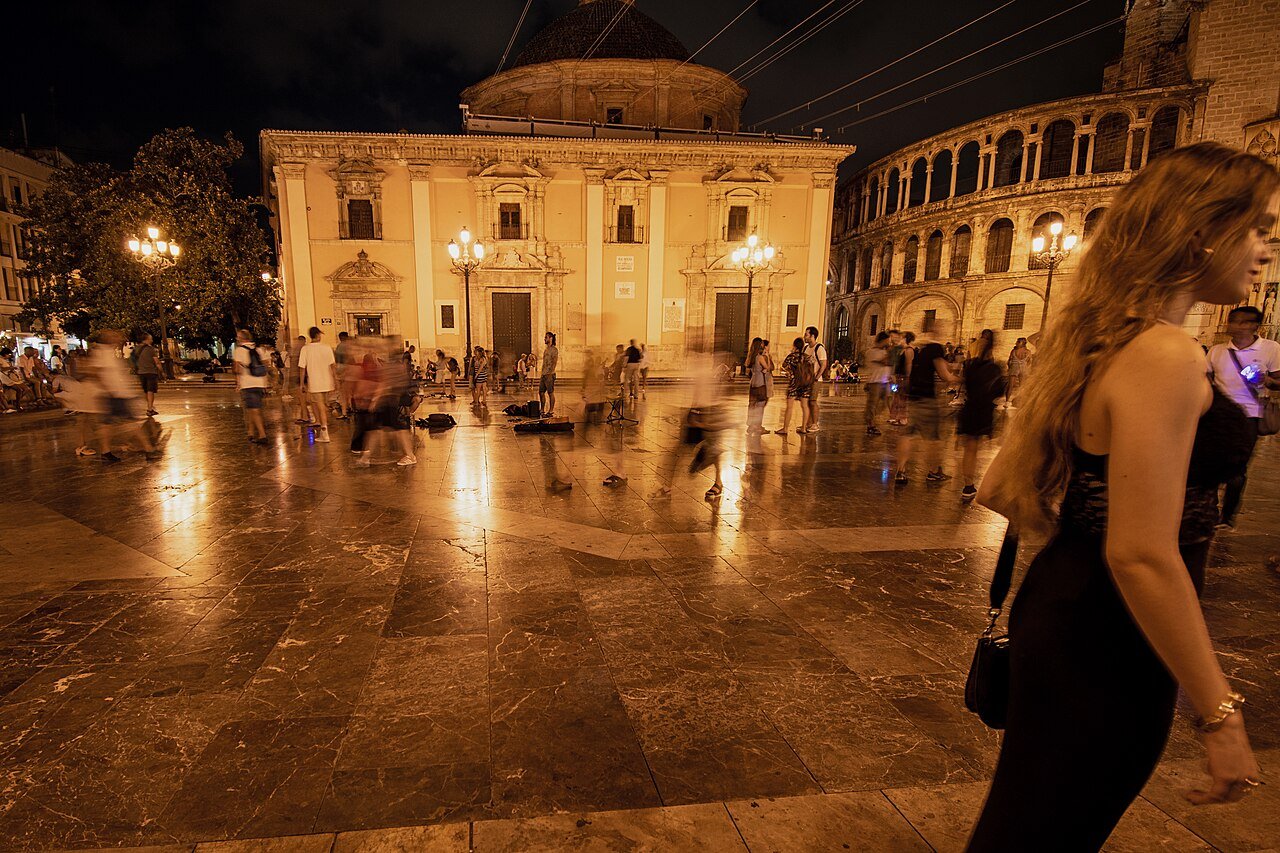
Evening is the paseo, the great Spanish stroll, and the square is its parlour: the façades go amber, the terraces refill with vermouth and agua de Valencia, and half the old town seems to be crossing the square on its way somewhere while in no hurry to arrive. Come back after dark once, too — floodlit, the basilica’s dome and the Apostles’ Door float above a much quieter square. If you have walked our Turia Gardens guide in the afternoon, the square at dusk is its perfect counterweight.
A Short Walk Away
Nothing in the old town is far from this square — that is rather the point of it. The Valencia Cathedral itself, with its Holy Grail chapel and the Miguelete tower to climb, opens off the square’s east side; our Valencia Cathedral guide covers the full visit. Behind the basilica lies Plaza de la Reina, the square’s livelier commercial sister, with the famous old horchaterías of Santa Catalina a few steps beyond. West runs Carrer de Cavallers into El Carmen, the old town’s medieval quarter of gates, museums and street art — our El Carmen guide walks it as a loop starting almost exactly here. North, five minutes through the Seu quarter, brings you to the Torres de Serranos and down into the Turia riverbed gardens. And if the morning has whetted your appetite for the whole city, our Best Things to Do in Valencia guide ranks everything within reach of this square.

Practical Info
Getting there. The square sits in the pedestrianised heart of the Ciutat Vella; almost everyone arrives on foot — it is five minutes from the Mercado Central and adjoins the cathedral. The nearest metro stations are on the old town’s rim (Colón and Xàtiva, ten to fifteen minutes’ walk; Alameda across the riverbed similar). Do not attempt to drive to it: the centre is access-controlled, and car parks sit on the old town’s fringe.
When to come. Any time — it is public space, open around the clock — but the square keeps two appointments worth planning around: Thursday at noon for the Tribunal de las Aguas (arrive by 11:30), and 17–18 March for the Ofrenda, when the square is at its most crowded and most extraordinary. The Almoina museum, the one ticketed sight on the square itself, keeps municipal museum hours — broadly daytime, Tuesday to Sunday, closed Mondays — for a small fee; verify on the day, as hours shift by season. The basilica opens daily from early morning for worship and visits outside service times.
Costs and tours. The square, the fountain and the tribunal cost nothing. If you would like the whole old town threaded together by someone who can read its stones, a Valencia old town walking tour typically links the square with the cathedral, the market and El Carmen in two to three hours — after which you will find yourself back here, seeing it with new eyes.
Tips for Visiting
- Thursday means noon. The water tribunal is the square’s greatest free show, but it is brief and the crowd is real — be behind the barrier by 11:30 and do not plan anything tight for 12:30.
- Do the Almoina first. An hour underground with the Roman forum makes everything above ground — fountain, tribunal, basilica — read twice as deep afterwards.
- Pay for the view once. One terrace horchata at full square prices is a pleasure; three is a budget line. The fountain rim is free forever.
- Step inside the basilica quietly. It is a working shrine, not a museum: dress and behave accordingly, skip it during mass unless you are attending, and look up — Palomino’s dome is the point.
- See it twice in a day. Morning calm and floodlit evening are two different squares. The old town is compact enough that passing through twice costs you nothing.
- Fallas changes everything. On 17–18 March the square is the Ofrenda — glorious, and impassable at peak hours. Come at dusk, expect crowds, and book everything in Valencia far ahead.
Travel insurance, sorted
Whether it is a two-week holiday or a longer move, travel insurance is not the most glamorous part of a trip — but it is the one booking you want to have in place before a trip, and while you are already away.
Final Thoughts
Many cities have a main square; very few have one where a Roman forum sleeps under the paving, a thousand-year-old court still sits at noon, a beloved little hunchbacked Virgin watches from her Baroque dome, and a river god lounges in the fountain while the government gets on with governing at his back. Plaza de la Virgen is not a sight to tick off between the cathedral and lunch — it is the concentrated essence of Valencia, twenty-one centuries deep and still in daily use. Sit on the fountain rim a while. The city will introduce itself.
¡Buen viaje!

Photo credits: Plaza de la Virgen with the Turia fountain — Kiko León, CC BY-SA 4.0 · The excavated Roman remains in the Almoina — Josu PV, CC BY-SA 4.0 · The Fuente del Turia — Diego Delso, CC BY-SA 4.0 · The Puerta de los Apóstoles — Francesco Bini, CC BY-SA 4.0 · The Tribunal de las Aguas in session — Martinvl, CC BY-SA 3.0 · The Basílica de la Virgen de los Desamparados — José Luis Filpo Cabana, CC BY 3.0 · The basilica’s frescoed oval dome — Uriel1022, CC BY-SA 4.0 · The Palau de la Generalitat above its gardens — CésarOP, CC BY-SA 4.0 · The Ofrenda’s Virgin in her floral mantle — Rafa Esteve, CC BY-SA 4.0 · The square’s east front and Plaza de la Virgen by night — Derek Rankine, CC BY 2.0 · The square from the Miguelete — Joanbanjo, CC BY-SA 3.0. All via Wikimedia Commons.