Basílica de Jesús del Gran Poder Seville: The Complete Guide to the Señor de Sevilla

Short Answer
The Basílica de Jesús del Gran Poder stands on Plaza de San Lorenzo, in the San Lorenzo quarter north-west of Seville’s centre, beside the parish church that was its home for two and a half centuries. It exists for one image: Nuestro Padre Jesús del Gran Poder, Christ carrying the Cross, carved in cedar in 1620 by Juan de Mesa and known across Spain simply as the Señor de Sevilla — the Lord of Seville. The church itself is young, a domed neo-Baroque basilica of 1965 inspired by the Pantheon in Rome, built by one of Spain’s oldest brotherhoods as his shrine. Entry is free. At the times posted, you can climb the stairs beside the main altarpiece into his camarín, close enough to kiss — as the faithful do — the heel of his right foot. Come on a Friday if you can: Friday is his day, as it has been since the 18th century, and the basilica stays open until 22:00. Allow 45 minutes for the basilica and camarín — longer on a Friday.
Table of Contents
- The Short Version
- The Señor de Sevilla: Juan de Mesa’s Masterpiece
- A Brotherhood Five Centuries Old
- The Basilica: A Little Pantheon on Plaza de San Lorenzo
- Face to Face: The Camarín and the Besapiés
- The Virgin and San Juan: The Other Images of the Retablo
- The Tesoro and the Pasos: Seville’s Oldest Paso
- The Madrugá: The Night of Silence in Black
- Plaza de San Lorenzo: The Square and the Church Next Door
- Practical Info
- Tickets and Booking
- Opening Hours
- Getting There
- When to Go
- How Long You Need
- Tips for Visiting
- What to See Nearby
- Final Thoughts
The Short Version
Seville keeps its two most beloved images at opposite ends of the old town’s northern arc, and they inspire two different kinds of love. The Macarena is greeted with compliments and falling petals; the Gran Poder is met, overwhelmingly, in silence. His basilica explains why. There is no gilded forest of chapels here, no museum-shop bustle — just a single round, domed room at the far end of which a 400-year-old wooden Christ bends under his Cross while a slow procession of ordinary Sevillians climbs, one by one, to kiss his foot. Builders, grandmothers, students, emigrants home for the weekend: the queue at the camarín stairs is the most democratic sight in Seville. That is why this young church belongs on any serious list of the best things to do in Seville — not as a monument to be ticked off, but as the place where the city’s inner life is most plainly visible.

The Señor de Sevilla: Juan de Mesa’s Masterpiece
Begin, as everyone here begins, with him. Nuestro Padre Jesús del Gran Poder is a Nazarene — Christ on the way to Calvary, bent forward under the Cross on his shoulder. He is carved in cedar, 1.81 metres tall, a masterpiece of Spanish Baroque realism, and he was made to be dressed: over the carved body the brotherhood lays real tunics, most days a plain purple one, on great occasions embroidered velvet splendours such as the túnica de los cardos of 1881, by the Hermanas Antúnez, or the túnica persa of 1908, designed by Juan Manuel Rodríguez Ojeda.
The face is the miracle. Mesa carved the crown of thorns from the same block as the head, and the expression he found — eyes half-closed and lost, suffering carried with a dignity that never tips into theatricality. Art historians call the image perhaps the most perfect Nazarene ever carved in Spain; Sevillians are simpler about it. They call him the Señor de Sevilla, and many call Mesa himself el Dios de la madera — the God of wood.
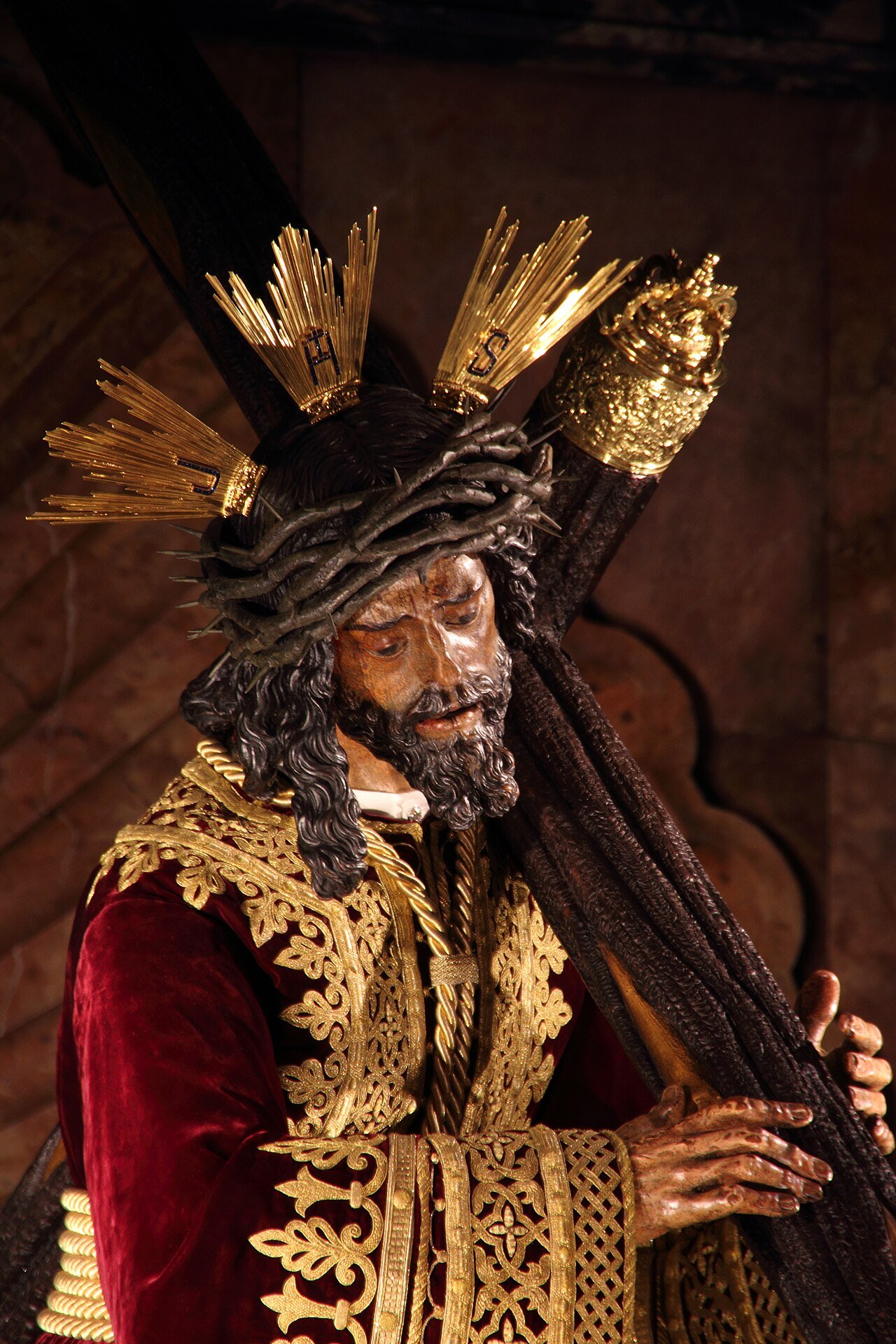
For almost three hundred years, nobody knew for certain who had made him. The carving was attributed to Mesa’s master, Juan Martínez Montañés, until 1920, when Adolfo Rodríguez Jurado first proposed Juan de Mesa — Montañés’s most gifted pupil, dead at just 44. Ten years later the researcher Heliodoro Sancho Corbacho found the proof in Seville’s notarial archive: the contract of 1620, in which the brotherhood paid Mesa 2,000 reales for the Señor and a San Juan Evangelista, first carried in procession in 1621. It remains one of the great detective stories of Spanish art — and if it whets your appetite, the city’s Museo de Bellas Artes, ten minutes away, holds the Montañés-era sculpture against which the argument was fought out.

The image has not had a quiet life. It has been restored repeatedly — by Blas Molner in 1776 and the Cruz Solís brothers in 1983, among others — and in June 2010 it survived an attack during a besapiés, when a disturbed man struck the carving and tore at one arm before being arrested; the Señor was restored, and the camarín has been carefully supervised ever since. In 2020–2021 the brotherhood kept his fourth centenary with a Holy Year granted by Rome.
A Brotherhood Five Centuries Old
The Pontificia y Real Hermandad y Cofradía de Nazarenos de Nuestro Padre Jesús del Gran Poder y María Santísima del Mayor Dolor y Traspaso — its full, magnificent name — is one of the oldest corporations in Seville. Tradition dates its foundation to 1431, in the Benedictine monastery of Santo Domingo de Silos, though some historians prefer 1477, when its first rules were approved. Its original name honoured the Poder y Traspaso de Nuestra Señora — the Power, and Our Lady’s Sorrow at the meeting with her Son — and both devotions were there from the start.
Like most Sevillian brotherhoods, it spent centuries as a tenant. From Santo Domingo it moved to the monastery of Santiago de la Espada, then in 1544 to a chapel of its own in the Franciscan convent of Nuestra Señora del Valle, where the Señor first processed in 1621. After a spell with the Augustinians of San Acacio, in 1703 it settled in a chapel of the parish church of San Lorenzo, a few metres from where you are standing. There it stayed for 262 years.
Two churchmen shaped the devotion you see today. The Blessed Diego José de Cádiz, the great Franciscan preacher of the late 18th century, chose this image above all Seville’s Christs, preached its novena — published in 1800 — and founded the custom that defines the basilica’s week: the Friday visit. A century later the Blessed Marcelo Spínola, parish priest of San Lorenzo in the 1870s, was its honorary elder brother. Even the Señor’s name is a relic of old rivalries: a 1709 lawsuit with the Hermandad del Silencio, which claimed Jesús Nazareno for its own image, fixed Gran Poder as his alone.

By the mid-20th century the little San Lorenzo chapel could no longer hold the crowds, above all on Fridays. In 1958 the brotherhood resolved to build its own temple on the same square, buying the plot next door, and on 27 May 1965 the images were carried in procession to the Cathedral for a triduum, returning that evening to enter their new church for the first time. The basilica was blessed the following day, 28 May 1965, by Cardinal Bueno Monreal. On 29 December 1992 Pope John Paul II raised it to a Minor Basilica — only the second church in Seville to receive the title, after the Macarena.
The Basilica: A Little Pantheon on Plaza de San Lorenzo
The architects, Alberto Balbontín de Orta and Antonio Delgado Roig, were given a plot of some 1,405 square metres — basilica and brotherhood house together — and a brief unlike any other in Seville: build a room for one image and the river of people who come to him. The façade is neo-Baroque, adapted, curiously, from a design the same architects had drawn for the Hermandad del Silencio: a great arched portal flanked by twisted and fluted columns, the brotherhood’s shield in relief beneath the inscription Iesus del Gran Poder, and above everything a graceful espadaña, a bell gable with three bells, in place of a tower.

Inside, the model changes continents and millennia. The nave is a single round — strictly, slightly elliptical — domed space inspired by the Pantheon of Agrippa in Rome: no columns, no visible supports, nothing between you and the altar. Beyond the porticoed atrium and its inner doorway, the room simply opens: a high skirting of red and black marble, plain white striated walls, and overhead a great hemispherical dome of square coffers, lit from a central lantern. Around the wall run the fourteen stations of the Vía Crucis, canvases painted in 1996 by Antonio Agudo Torrico — modern, spare, and deliberately unlike everything else in the building.

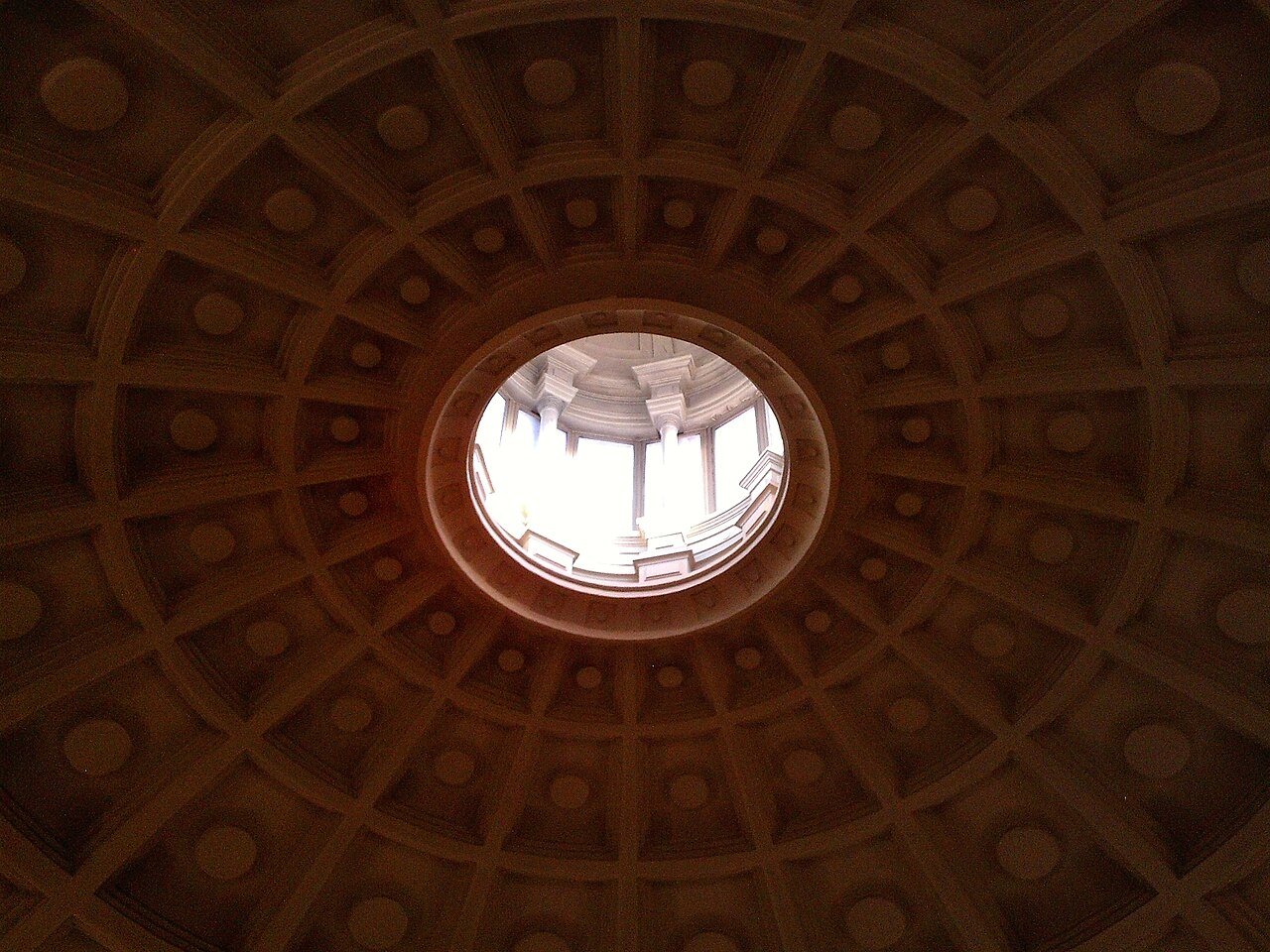
Everything converges on the presbytery. The main altarpiece — a retablo-camarín carved by Manuel Guzmán Bejarano in 1965, a larger echo of the altarpiece the brotherhood had in its San Lorenzo chapel, itself based on a design by the painter Gonzalo Bilbao — is really three altarpieces in one golden frame. In the centre, raised on the very marble pedestal he occupied in the old chapel, the Señor stands in his camarín against a shell-shaped venera of pink marble; to either side wait the Virgin and San Juan. At his feet sits a silver tabernacle by Orfebrería Triana (2000) modelled on the façade of St John Lateran in Rome — a neat piece of heraldry, since the brotherhood has twice been aggregated to the Lateran basilica. The only other voice in the room is above the entrance: the organ, built in 1798 by Pablo de Salazar for a Cistercian monastery at Vileña in Burgos, given to the brotherhood after a fire at its original home and installed here during the works of 2008.

Face to Face: The Camarín and the Besapiés
Most great Spanish images are seen from a distance, across a nave, behind rails and candles. The Gran Poder is met. Behind the retablo lies his camarín, and at the times posted by the door — broadly, when the basilica is open and no Mass is being celebrated, though the brotherhood varies the arrangement — visitors climb one of the two marble staircases flanking the altarpiece and pass, in single file and in quiet, behind the Señor.

What happens there is simple and centuries old. The faithful stoop to kiss the heel of the Señor’s right foot — the besapiés, the foot-kissing — and the polished wear on the carved heel is the basilica’s most eloquent object label: four hundred years of Fridays, written in wood. Some visitors kiss, some touch the foot, some simply stand for a moment in silence. Do as much or as little as feels honest. Keep phones in pockets, speak in whispers if at all, and do not hold up the file — on a Friday the queue behind you may reach across the nave.
A particular word about Fridays. The Friday visit is not a tourist product but the brotherhood’s founding rhythm, instituted under Fray Diego de Cádiz in the 1790s and unbroken since: the basilica opens at 7:30 and stays open continuously until 22:00. Periodic besamanos and besapiés celebrations through the year — around the January quinario, in Lent, and on the great feasts — bring the images within reach for longer hours, with queues to match; join the end of the line and settle in.
The Virgin and San Juan: The Other Images of the Retablo
The Señor does not stand alone. On one side, María Santísima del Mayor Dolor y Traspaso — Our Lady of the Greatest Sorrow and the Transfixion — is the brotherhood’s first and oldest titular devotion: the Traspaso is the moment on the Way of the Cross when Mary, guided by San Juan, meets her Son. The figure you see is a candelero carving of cedar and pine, 1.74 metres tall, made to be dressed. Her head is an undocumented commission of 1798 — on 25 February that year the steward Manuel Benjumea offered to pay for a new head for the Virgin “of excellent taste”, and the unrecorded maker delivered exactly that: an almond-eyed, tearful face of restrained classical beauty, crystal tears on her cheeks and a dagger at her breast. The crown she processes in was made the same year, in gilded silver by Juan Ruiz, and is said to be the oldest processional crown in Seville’s Semana Santa. Later hands shaped her present look: Illanes refashioned her slightly in 1954, and Ortega Bru renewed her polychromy in 1979 after an unhappy darkening.

On the other side stands San Juan Evangelista — the Señor’s twin in the most literal sense. Mesa carved him in the same 1620 commission, for the same 2,000 reales; a document found inside the figure in 1972 records that Mesa finished him on 31 August 1620. He is 1.78 metres of young, fashionable 1620s Seville: hair carefully dressed, a moustache and pointed beard in the style of the court of Felipe III, his gaze turned toward the Virgin across the retablo. He wears a green tunic and a red mantolín, and on the Madrugá he rides with the Virgin under her canopy, still telling her, after four hundred years, where her Son has gone.

The Tesoro and the Pasos: Seville’s Oldest Paso
A basilica visit shows you the images; the brotherhood’s treasure shows you their world. Behind the basilica, in Calle Hernán Cortés, stands a brick building of 1926, the Hermandad’s second house, whose exhibition hall — the Tesoro — displays the pasos fully assembled. Visits run to the brotherhood’s own arrangements rather than a museum’s timetable — banners outside direct you to gran-poder.es for hours and booking — so check before you cross the city for it, and treat an open door as a bonus rather than a promise.
The hall’s glory is the Señor’s paso: the oldest processional paso in Seville. Contracted in 1688 with the carver Francisco Antonio Ruiz Gijón and delivered in 1692 — its architecture possibly from a design by Bernardo Simón de Pineda — it is a portable mountain of gilded wood: double-headed eagles at the corners, carved cartouches retelling biblical scenes from Samson to the Prodigal Son, six angels above, and four great lanterns by the Córdoba goldsmith Rafael León (1908) lighting the Señor. The Virgin’s paso de palio, first carried in 1903, is Juan Manuel Rodríguez Ojeda’s work — a canopy “de cajón” on garnet velvet, its silver tail candelabra added by Jorge Ferrer in 1935. Standing at floor level beside either paso is the only way to understand the Madrugá: these are church façades that walk.

The Madrugá: The Night of Silence in Black
Everything in San Lorenzo exists, ultimately, for one night. The Madrugá — the small hours between Maundy Thursday and Good Friday — brings out six brotherhoods, and the Gran Poder is, by a concordia agreed with the Macarena in 1903 and still in force, the second of them, following only El Silencio. At around one in the morning — the exact salida shifts a little from year to year, so check the current itinerary — the doors open onto a plaza held in complete quiet, and out comes the cortege: the long double files of nazarenos in black ruán tunics of full tail length, wide esparto belts and black sandals, those of the Señor carrying candles the colour of darkness itself, tiniebla. There is no band. There is no music of any kind. The Gran Poder processes, famously, in silence — and the silence of thousands of people in a small square at one in the morning is this city’s most overwhelming sound.
Then the paso comes out, the capataz’s voice the only one raised, and the Señor de Sevilla begins his long walk: Conde de Barajas, the street that bears his own name, the Plaza del Duque, the Campana and the official route to his estación de penitencia in the Cathedral, then home the long way, through the Arenal and San Pablo, as the sky lightens — the last paso home at about eight on Good Friday morning, with the Virgin’s palio closing the cortege. It is on this same night, a few streets north, that the Basílica de la Macarena sends out the other half of Seville’s heart; the order in which the two great images pass the official route was settled between their brotherhoods over a century ago.
A word of honest expectation-setting, as at the Macarena: the Madrugá is an act of faith into which visitors are welcomed, not a spectacle staged for them, and the Gran Poder’s stretch of it is its most austere. Come as a guest. Stand back from the plaza’s centre, let families who have kept the same spot for generations keep it, and do not talk through the salida — in this square, on this night, silence is the whole point. If the night itself is too much, visit during Holy Week instead, when the pasos stand mounted in and around the basilica.

Plaza de San Lorenzo: The Square and the Church Next Door
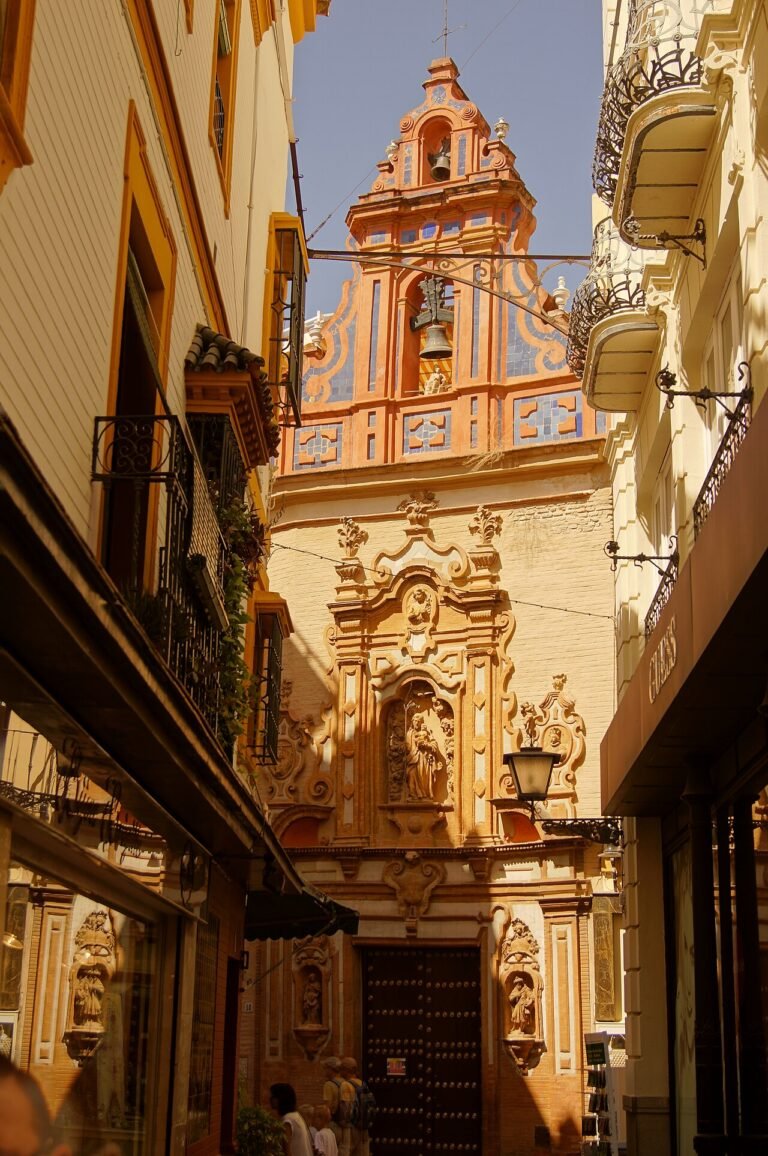
Give the square its own ten minutes; it has earned them. Plaza de San Lorenzo is one of the old town’s most genuinely local spaces — pedestrianised in its present form in 2003, shaded by tall plane trees, ringed by café terraces and the red-and-yellow walls you have already seen in the photographs, and named, as it has been since the 13th century, for the parish church that shares the basilica’s frontage. This was once the ablutions courtyard of a mosque — the parish church keeps vestiges of its minaret — and the plaza has been the quarter’s stage ever since: the great Pendón Verde rising that began on Calle Feria was talked down here, and in 1920 the funeral of the bullfighter Joselito el Gallo filled it. A monument to Juan de Mesa stands in the square — the sculptor keeping watch over the church built for his masterpiece.
The parish church of San Lorenzo itself deserves the short detour through its door. It is a Gothic-Mudéjar church founded in the 13th century — its oldest fabric is 14th-century — and remodelled in the 18th and 19th, with a tower-façade crowned by a bell stage of 1757. Inside you will find one of the oldest Virgins in Seville, the late-14th-century Virgen de Rocamador, and the images of the two brotherhoods now resident here, the Soledad and the Dulce Nombre. For 262 years this modest parish church was the Gran Poder’s home; standing in its quiet nave, you grasp why the brotherhood had to build, and why it refused to move more than a few metres.
Practical Info
Address: Plaza de San Lorenzo 13, 41002 Sevilla — on the plaza it shares with the parish church of San Lorenzo, in the Casco Antiguo.
What it is: a working basilica and the seat of a living brotherhood, not a museum. There is no ticket desk and no audioguide; there is a small souvenir shop, a steady congregation, and on Fridays one of the most moving queues in Spain.
| At a Glance | Details |
|---|---|
| Best for | Living devotion at its most intense; the supreme masterpiece of Spanish Baroque sculpture; Semana Santa’s pasos at floor level; the real, untouristed Seville |
| Entry | Free — basilica and camarín. Donations welcome. Tesoro exhibition: check current visiting arrangements on gran-poder.es |
| Time needed | 45 minutes for basilica and camarín; an hour or more on a Friday; add 30–45 minutes if the Tesoro is open |
| Nearest metro | None at the door — Line 1 (Plaza Nueva / Puerta Jerez) is a 15-minute walk; city buses serve the Plaza del Duque and Campana stops nearby |
| Don’t miss | The camarín and the besapiés — and if you can, come on a Friday, the Señor’s own day since the 1790s |
Tickets and Booking
There is nothing to book and nothing to buy: the basilica and the camarín are free to everyone, at every opening, and always will be — that is rather the point of the place. Ignore any third-party “skip-the-line ticket” for the Gran Poder; no such thing exists, and the only queue here is the devotional one, which no money shortens. The Tesoro exhibition behind the basilica is the one element with its own arrangements: check gran-poder.es or ask at the basilica for the current visiting hours and any booking the brotherhood requires.
Opening Hours
The basilica keeps a working church’s rhythm, with Friday as the great exception. The usual pattern is Monday to Thursday 8:00–13:30 and 17:30–21:00; Friday 7:30–22:00, open continuously; Saturday and Sunday 9:00–14:00 and 17:30–21:00. Treat this as the shape of the week rather than a guarantee: hours shift around feasts, Cuaresma (Lent) and Semana Santa, and the camarín closes during Masses and whenever the brotherhood’s cults require it. The noticeboard by the door and gran-poder.es carry the current week — check before you set out.
Getting There
Walk. From the Cathedral it is about fifteen minutes: north through the shopping streets to the Plaza del Duque, then five minutes more up Calle Jesús del Gran Poder — the street named for him leads, fittingly, straight to his door. From the Alameda de Hércules it is five minutes west. City buses stop around the Plaza del Duque and the Campana; the nearest metro stations (Line 1, around Plaza Nueva and Puerta Jerez) are roughly fifteen minutes south. Do not drive into the Casco Antiguo for this; park outside the old-town core and walk in.
When to Go
On the calendar of this church, one answer outranks all others: Friday. Friday is the Señor’s day by a tradition reaching back to the 1790s, the basilica is open all day until 22:00, and the camarín queue is at its fullest and most eloquent. Across the year: the January quinario around Epiphany opens the brotherhood’s cycle of cults; Lent brings the great besamanos and the pasos mounted ready; the Madrugá itself is overwhelming in every sense; and an ordinary Friday in October or February, when San Lorenzo is simply itself, may be the visit you remember best of all.
How Long You Need
Thirty minutes is an honest minimum: the round nave and the retablo, the climb to the camarín, a slow circuit past the Vía Crucis. Forty-five minutes lets you add the parish church next door. If the Tesoro is open, give the whole complex an hour and a half, and if your visit is a Friday — or falls in Lent — let it take what it takes: the queue at the camarín stairs is not an obstacle to the visit. It is the visit.
Free Seville travel guide
Planning a trip to Seville? Get our free one-page Seville checklist: what to book ahead, what to skip, and the tapas bars we actually eat in.
Tips for Visiting
- Come on a Friday if you possibly can. It is the Señor’s day by 230 years of tradition, the basilica stays open until 22:00, and the camarín queue shows you Seville as no monument can.
- Go to the camarín first. It is the heart of the visit and the one part with its own timetable — it pauses for Masses and cults.
- Dress and behave for a place of intense worship, because it is one. Covered shoulders, low voices, phones away in the camarín, no flash. During Mass, take a seat and stay a while.
- Do not skip the church next door. San Lorenzo was the Señor’s home for 262 years, holds one of Seville’s oldest Virgins, and explains the basilica better than any panel.
- Read the dome properly. Stand in the centre of the round nave and look up: no columns, no side aisles — one room, one image, one purpose.
- In Semana Santa, plan like a local. See the pasos mounted during the week, arrive at the plaza well before the salida on the Madrugá, and keep silence with the crowd.
What to See Nearby
San Lorenzo stitches easily into a northern old-town morning. Next door is the parish church itself, as described above. Ten minutes south, the Museo de Bellas Artes fills a former convent with the finest Spanish painting and sculpture collection outside the Prado — Murillo, Zurbarán, and the Montañés generation that made the Señor’s world. Five minutes east, the Alameda de Hércules — the city’s oldest public promenade, Roman columns at its end, café terraces along its length — is the place for coffee afterwards. Fifteen minutes north-east, the Basílica de la Macarena completes the pair: visiting both great images in one morning, Gran Poder first and Macarena second, is an education no single church can give. And when the northern quarters have shown you the working city, the lanes of Barrio Santa Cruz, twenty minutes south, show you its postcard face.
Travel insurance, sorted
Whether it is a two-week holiday or a longer move, travel insurance is not the most glamorous part of a trip — but it is the one booking you want to have in place before a trip, and while you are already away. Get a quote from SafetyWing
Final Thoughts
Seville has grander churches, older churches and more famous works of art, but it has only one Señor. What the basilica on Plaza de San Lorenzo offers is the rarest thing in travel: not a sight but a relationship, still warm after four hundred years, between a city and a wooden figure it refuses to treat as an object. Come on a Friday. Walk the round, quiet room. Climb the marble stairs and stand where builders and grandmothers stand, close enough to touch a heel worn smooth by centuries of kisses — and by the time you come back down into the plane trees and café tables of the plaza, you will understand the name the whole country uses for him. ¡Buen viaje!
Photo credits: Tiberioclaudio99, CarlosVdeHabsburgo, PEPE GADEIRAS and Jl FilpoC (CC BY-SA 4.0); Anual and one other contributor (CC BY-SA 3.0); Zarateman (CC0), via Wikimedia Commons.


One Comment