Palacio de la Condesa de Lebrija: The Complete Guide to Seville’s Palace of Mosaics
Behind an ordinary door on an ordinary shopping street in the centre of Seville stands the most extraordinary floor in Europe. The Palacio de la Condesa de Lebrija is a 16th-century palace that one determined woman — Regla Manjón, Countess of Lebrija — refilled, from 1901 onwards, with the rescued antiquities of Roman Itálica: hundreds of square metres of ancient mosaics laid as her floors, Roman busts in her alcoves, whole pavements of patterned marble under her guests’ feet. A director of Spain’s Fine Arts administration called it “the best-paved palace in Europe.” He was underselling it: this is a Roman villa wearing a Sevillian palace as its coat.
This guide walks the house as the countess arranged it: her story and the rescue that filled it, the tiled entrance hall, the great patio where you walk — carefully — across a third-century mosaic, the ground-floor rooms paved in antiquity, the famous tiles and ceilings, and the upper floor where she actually lived, open only on guided tours. It is one of the essential interiors on the palace route our Best Things to Do in Seville guide builds across the old town — and the one that tells you most about the woman who built it twice: once as a palace, once as a museum of herself.
The Short Answer
Yes — the Lebrija Palace is worth it, and for anyone who loves antiquity it is unmissable. For one ticket (currently €15, children less) you walk across the largest private collection of Roman mosaics in the world — some 580 square metres of them, in situ as floors — through a genuine Renaissance palace, in the middle of Seville, usually without the crowds that besiege the Alcázar. The visit has two gears: the ground floor, free to wander, is the mosaic museum; the upper floor, the countess’s own apartments, is shown on a guided tour included in the same ticket and is half the pleasure. Give it an hour to ninety minutes, take the tour upstairs, and look down as much as you look up.
Table of Contents
- The Short Answer
- The Story in Brief: The Countess Who Bought a Roman City’s Floors
- First Steps: Calle Cuna and the Tiled Entrance
- The Patio: Walking on the Medallion Mosaic
- The Ground Floor: Rooms Paved in Antiquity
- Tiles and Ceilings: The Palace Above the Floors
- The Upper Floor: The Countess’s Own Rooms
- Among Seville’s Palaces: Lebrija in Context
- The Honest Verdict: Who Should Go, Who Should Skip
- Practical Info
- Tips for Visiting
- Final Thoughts
The Story in Brief: The Countess Who Bought a Roman City’s Floors
The palace came first. Built in the 16th century and remodelled over the following ones, it is a classic Sevillian great house: a discreet street facade, an entrance hall, a marble-columned patio, a grand staircase, summer rooms below and winter rooms above. It might have stayed merely handsome. Then, in 1901, it was bought by Regla Manjón Mergelina, Countess of Lebrija — a woman of formidable energy, wide culture and a collector’s obsession with the Roman past — and she set about turning her home into the safest place in Spain for antiquities that were being lost.
Her timing was archaeology’s accident. The Roman city of Itálica, at Santiponce just outside Seville — founded in 206 BC, the first Roman city in Hispania, birthplace of the emperors Trajan and Hadrian — was being excavated, farmed, built over and, too often, looted or left to weather. Its mosaics, among the finest surviving anywhere, were lifting out of the ground into a world that had no museum ready for them and no law with teeth to keep them in place. The countess owned land there; mosaics were surfacing on her own property. Her answer scandalised some and saved much: she bought the mosaics — whole pavements, lifted from their ruined villas — and laid them in her palace as floors, adapting room after room to fit the ancient carpets of stone. Sculptures, columns, amphorae and inscriptions followed, along with Asian and Persian ceramics, archaeological pieces from across Spain, and one of the great private tile collections in the country.
The world noticed. Visiting scholars marvelled; the Marqués de Lozoya, Spain’s Director General of Fine Arts, delivered the verdict the house still trades on — the best-paved palace in Europe. The countess died in 1938, and her descendants kept the house and the collection, living upstairs, as she had, above the museum she made of the ground floor; a later count died in 1999, and the palace today receives visitors as what it always was in her lifetime — a private home that happens to hold a Roman city in its floors.

First Steps: Calle Cuna and the Tiled Entrance
You will walk past it once. The palace stands at Calle Cuna 8, a narrow central street between the Plaza del Salvador and the Setas, and its facade gives the game away only in the carved stone portal and the great studded door: no queue, no banner, just Seville going about its shopping. This discretion is part of the experience — the Lebrija is the great sight in Seville that still feels discovered rather than administered.
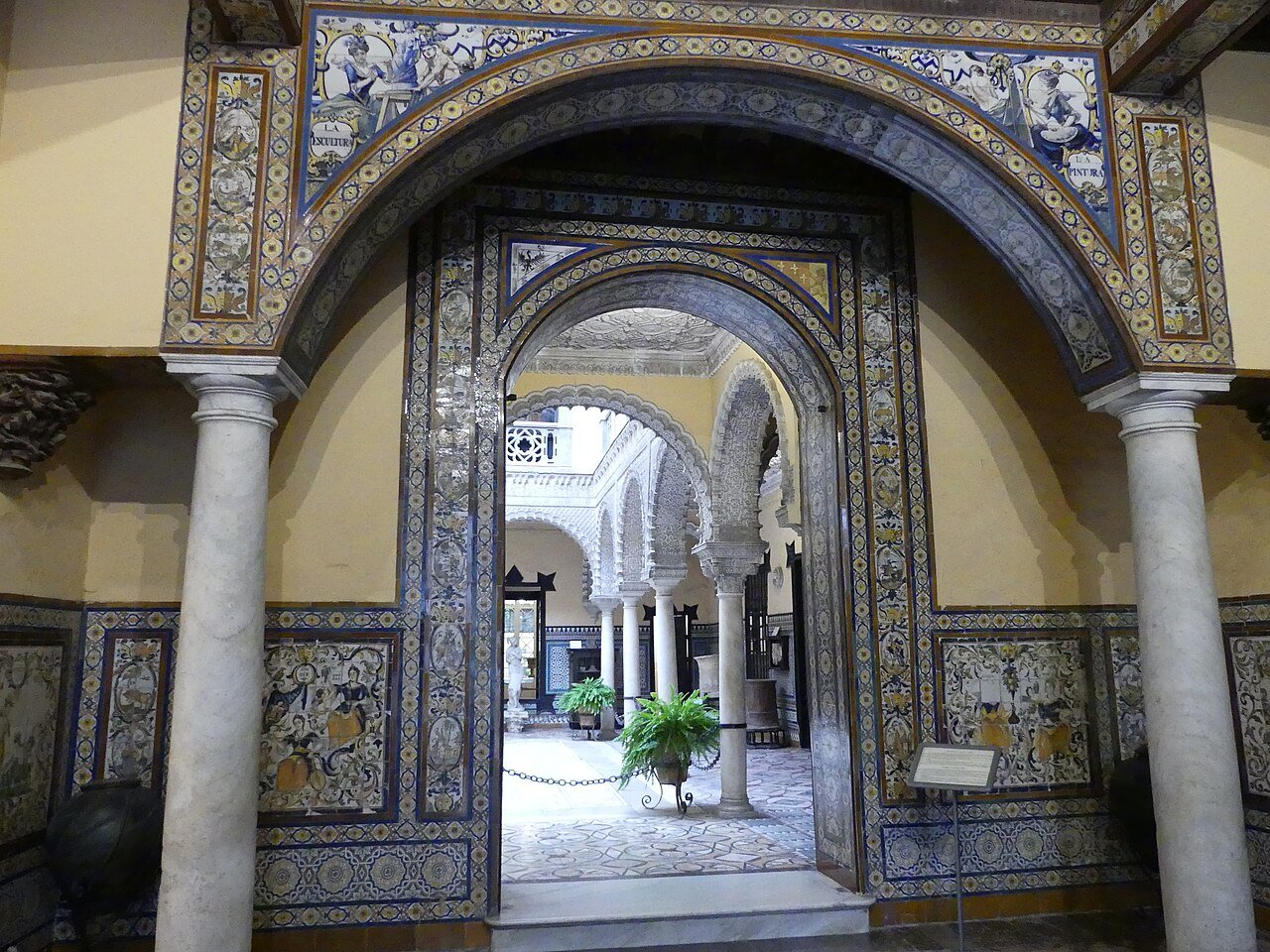
Through the door, the zaguán — the entrance hall — sets the house’s terms: an archway drowned in historic tiles, looking through to the light of the patio beyond. Everything you are about to see announces itself in these few metres: tilework of the 16th century, Roman stone underfoot, and a private house’s proportions rather than a museum’s. Buy the full ticket — the one that includes the upper floor tour; the Palacio Lebrija entry ticket sorted in advance leaves only the tour time to arrange at the door. The ground floor alone is the famous half; the countess’s own rooms are the unforgettable one.
The Patio: Walking on the Medallion Mosaic
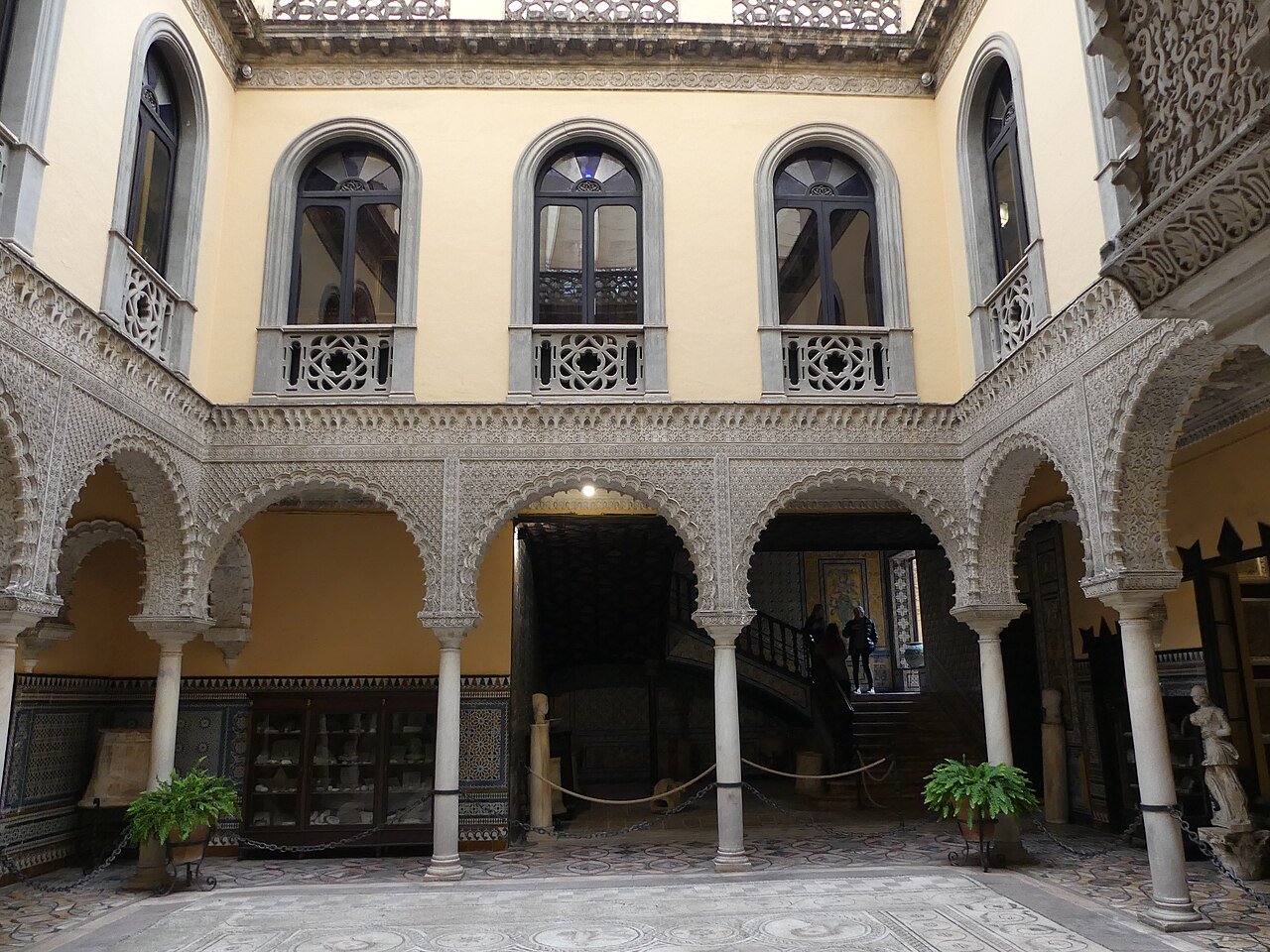
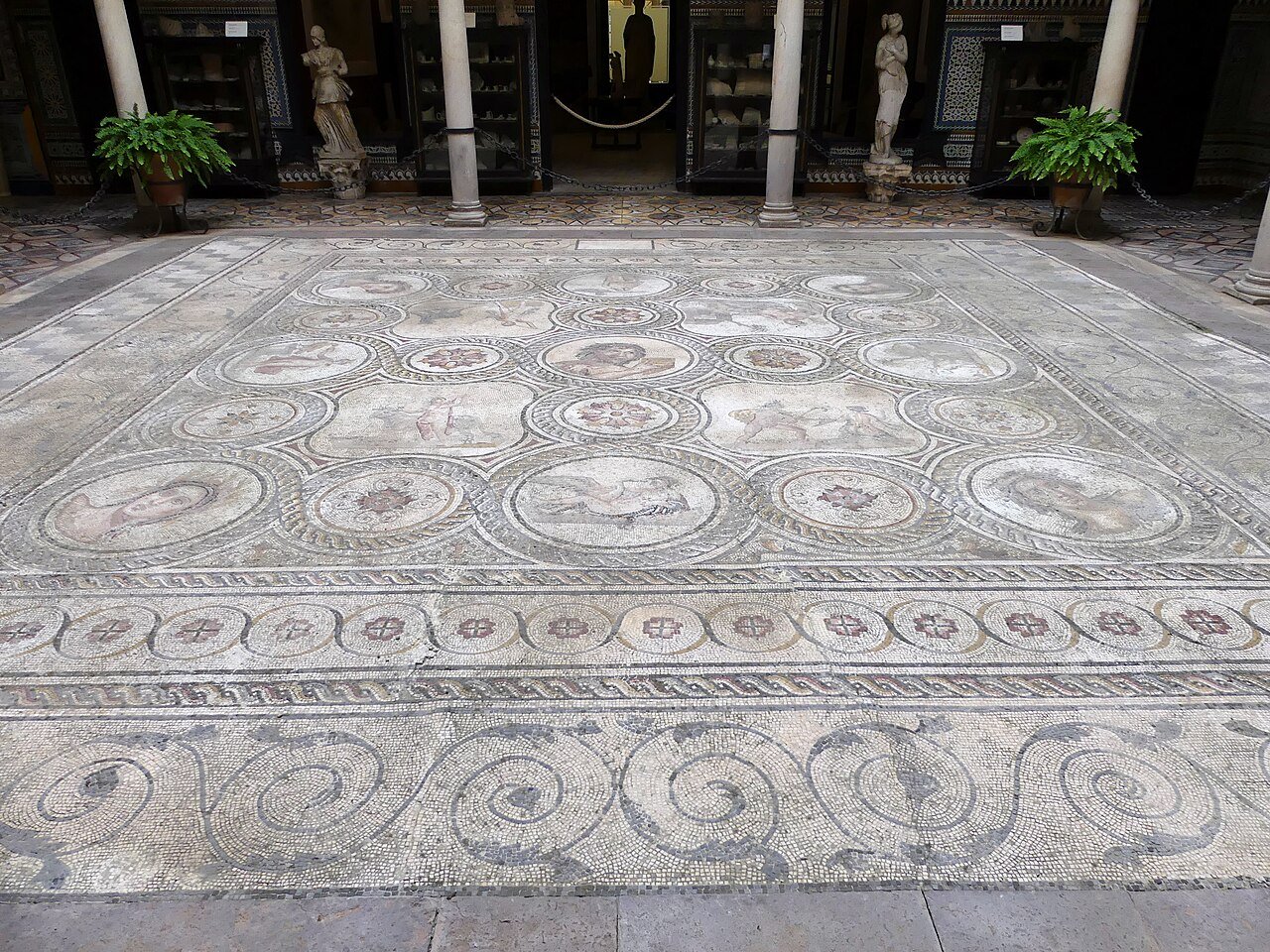
And then the patio stops you. The courtyard is the palace’s glory and its paradox: a beautiful Andalusian patio of carved plaster arches, galleries and marble columns — floored, entirely, with one of the great Roman mosaics of Spain. Roundel after roundel spreads across the pavement in woven borders: the god Pan at the centre of the composition, the loves of Zeus in the medallions around him, the four seasons keeping the corners. It came from Itálica, it is some eighteen centuries old, and you walk on it — on designated paths, under the staff’s eye — as the countess’s guests did, with coffee in the same air it has breathed since roughly the reign of the emperors it depicts.
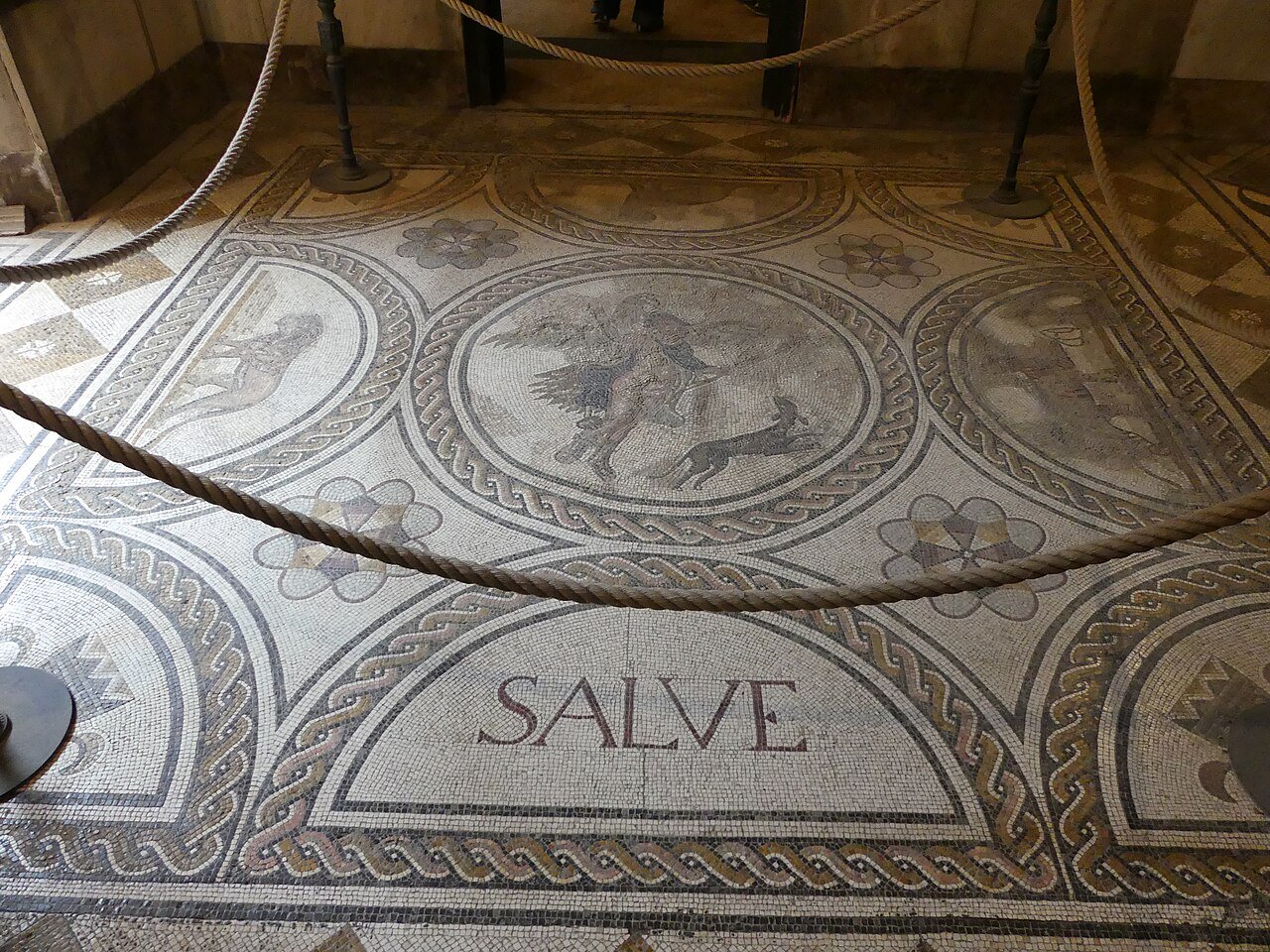
Take the circuit slowly. The mosaic rewards the second look: the borders’ guilloche braiding, the small birds and beasts in the spandrels, the way the whole pavement was re-laid to a Renaissance courtyard’s measure without losing its Roman grammar. Other floors in the house carry the same double life — one room’s pavement greets you, in worn Latin capitals, with a mosaicist’s SALVE: welcome. The countess could not have chosen a better motto if she had commissioned it new.
The Ground Floor: Rooms Paved in Antiquity
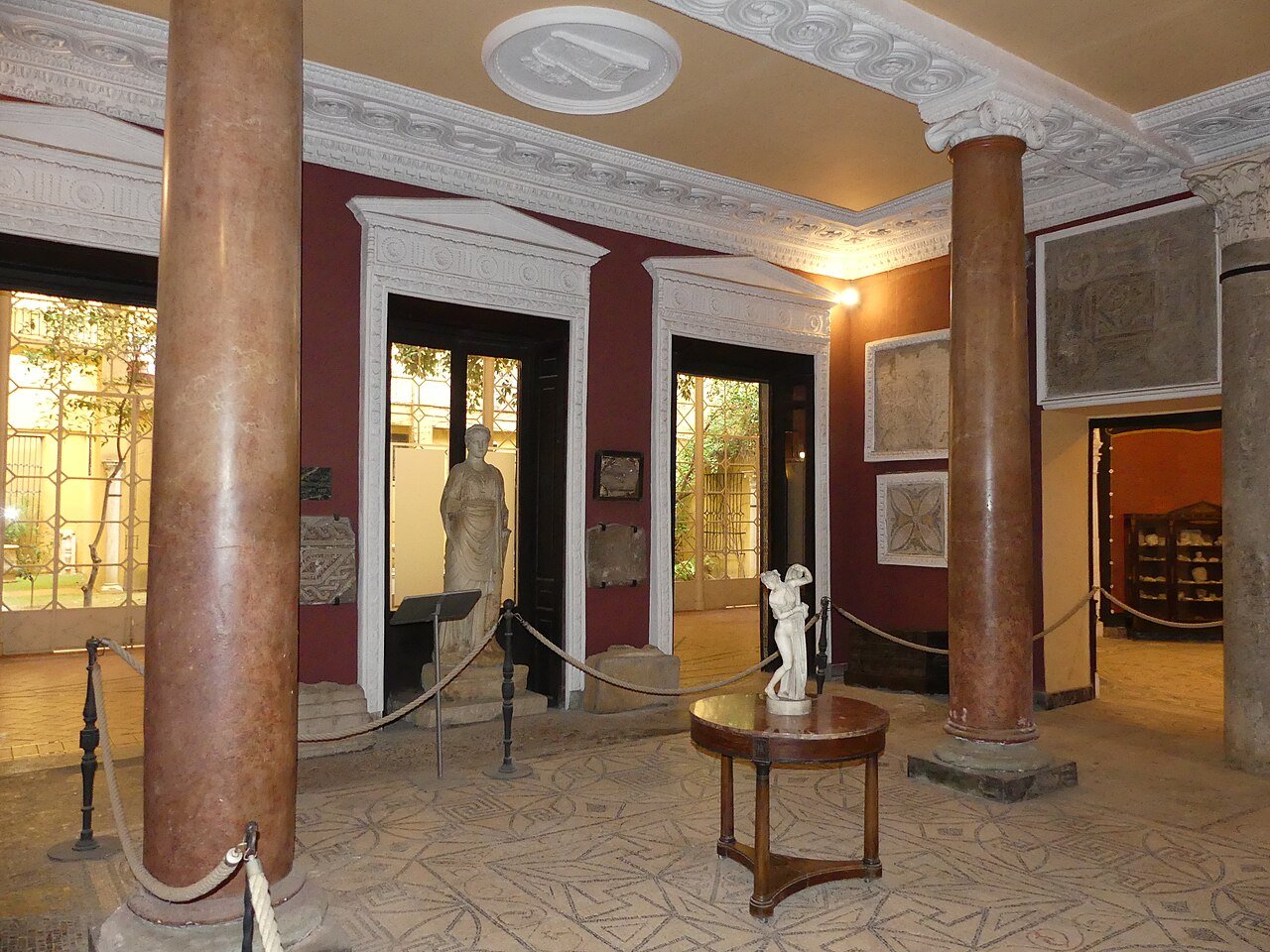
The ground floor — the summer apartment, arranged around the patio — is where the collection lives at ankle height. Room after room is paved differently: an octagonal room floored in a golden mosaic that glows like a held sunset; halls of pure geometry, stars and Solomon’s knots interlocking in red, black and cream; stretches of opus sectile, the Roman luxury pavement of cut coloured marble, which the countess laid with the same confidence as the mosaics. In all, the house is said to hold around 580 square metres of Roman mosaic — the largest private collection of its kind anywhere — quite apart from the marble pavements and the tilework climbing every wall.
Nor is the floor the whole show. Alongside the pavements came everything a Roman city sheds: amphorae and columns, inscriptions and altars, coins, oil lamps and fine glass, gathered in cases and along the walls. And the countess’s net was wider than Rome — she collected across periods and continents, so Persian and Asian ceramics, Spanish archaeological pieces and old masters’ paintings share the house with the emperors. The ground floor reads less like a single-period museum than like the sediment of one magpie lifetime, laid down in strata of tile, marble and tesserae.
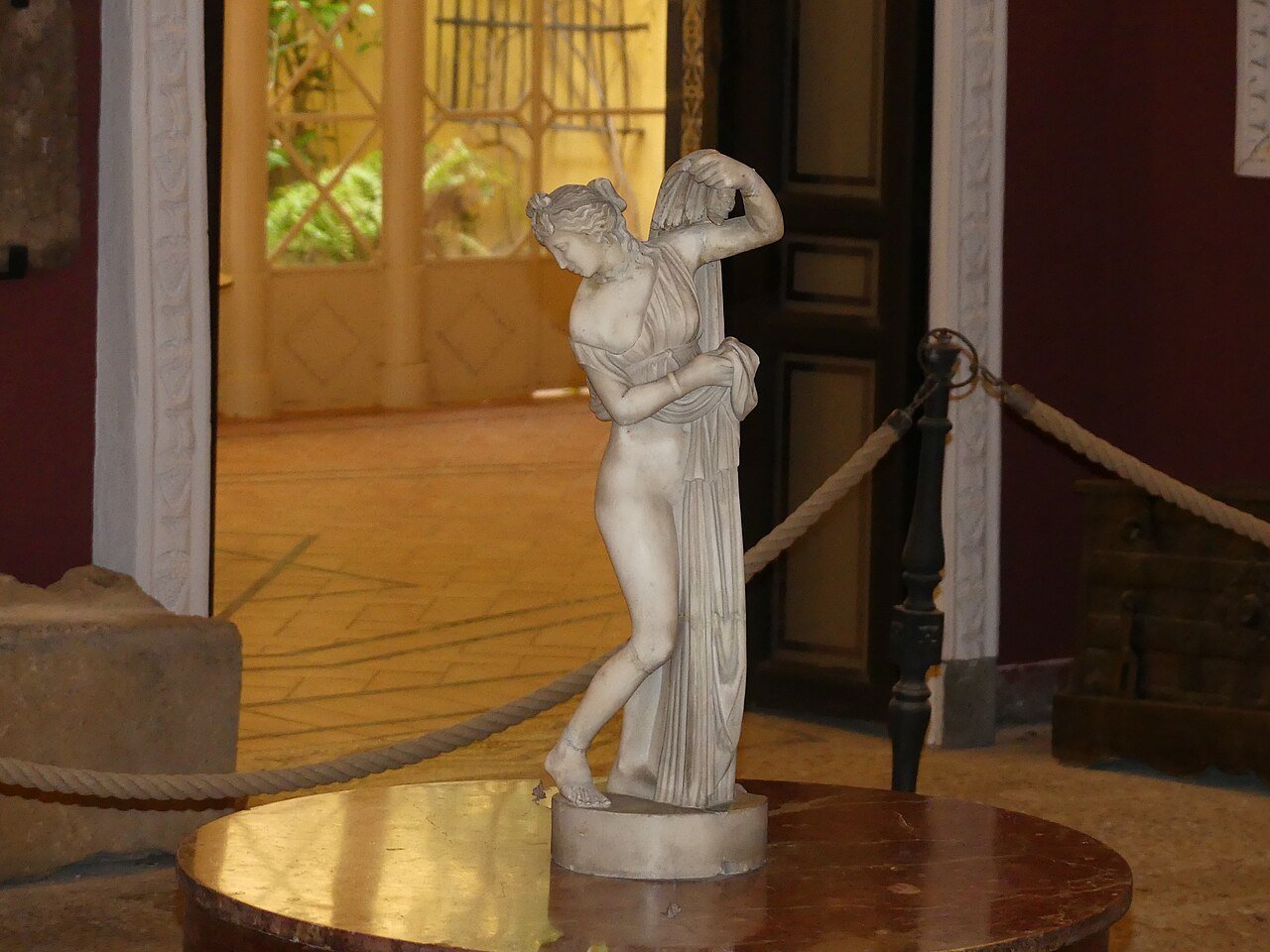
Roman busts preside from tiled alcoves; a classical statue keeps her room like a resident rather than an exhibit; display cases hold the smaller finds — coins, lamps, glass, ceramics — the household goods of Itálica catalogued by a woman who treated archaeology as housekeeping on an imperial scale. The effect is unique in Europe: not a museum of Rome, but a home furnished by Rome, where the antiquities are the carpets and the Sevillian palace is the frame.



Free Seville travel guide
Planning a trip to Seville? Get our free one-page Seville checklist: what to book ahead, what to skip, and the tapas bars we actually eat in.
Tiles and Ceilings: The Palace Above the Floors
Lift your eyes and the second collection begins. The countess loved azulejos — Seville’s glazed tiles — the way she loved mosaics, and she assembled them everywhere: up the grand staircase, whose walls run with historic tiles like a ceramic waterfall; in great heraldic panels; around doors and across the wainscots of rooms whose floors are busy being Roman. Much of it is 16th-century work, gathered from convents and palaces across Spain, and it makes the palace a double museum: Rome underfoot, Renaissance Seville at eye level.
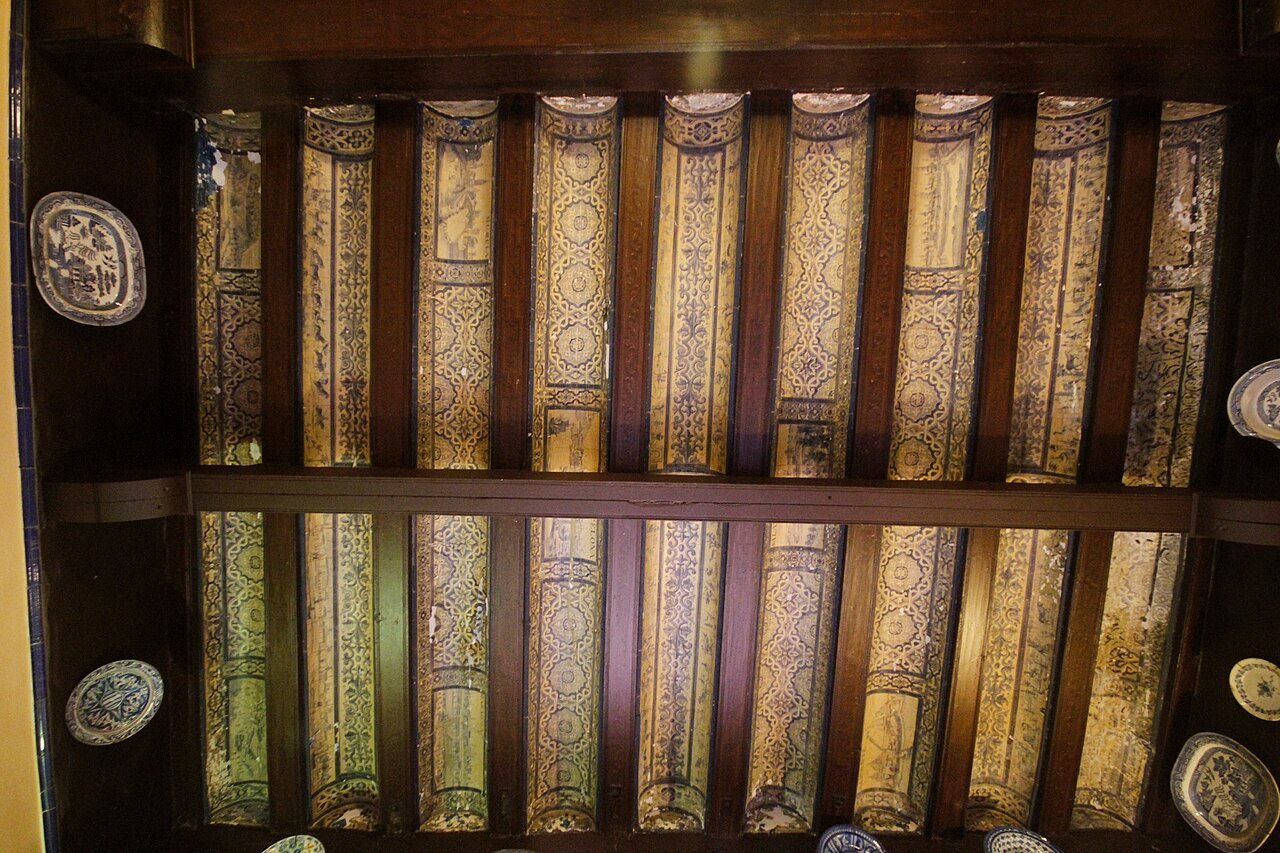
Above that, the ceilings complete the house’s three-storey argument. Polychrome coffered ceilings in the Mudéjar-Renaissance taste, painted and gilded wood, a glass-ceilinged gallery where the light is sieved through patterned coffers — the palace keeps rewarding the upward glance that the mosaics keep stealing. It is the surest sign of the countess’s eye that the house never feels like two collections in collision. It feels like one woman’s taste, applied at every height.


The Upper Floor: The Countess’s Own Rooms
The guided tour — the only way up, and worth structuring your visit around — climbs the tiled staircase to the winter apartment, where the register changes utterly. These are not museum rooms. They are the countess’s own: the dining room, the library of more than 4,000 volumes, the chapel, the family salons, kept as the family left them — paintings, furniture, porcelain, fans and photographs, the whole layered apparatus of an aristocratic Sevillian life lived on top of a Roman pavement warehouse.
The arrangement follows the old Sevillian rhythm the countess never broke: the family wintered up here, in the warmer, closer rooms around the upper gallery, and descended to the cool ground floor for the summer — which is why the museum floor feels like a shaded retreat and this floor like a lived-in nest. The rooms run in enfilade, each keeping its character: formal in the salons, devout in the little chapel, studious in the library, domestic in the dining room where the family’s silver and porcelain still stand ready. It is kept, pointedly, as a home that has paused rather than a period reconstruction — the difference is palpable the moment the guide opens the first door.
Two rules govern the floor, and both are fair: you go with the guide, and you take no photographs — the rooms remain a private collection on trust. The tour runs at set times through the day in Spanish and English; buy the full ticket, note your tour time, and spend the wait on the ground floor below, where photography is allowed and the mosaics are. Visitors consistently call the upstairs hour the revelation of the visit: downstairs is what the countess collected; upstairs is who she was.
Among Seville’s Palaces: Lebrija in Context
Seville is a city of great houses, and the Lebrija makes most sense in their company. Set it against the royal splendour of the palace in our Royal Alcázar of Seville guide — the crown’s Mudéjar masterpiece — and the patrician perfection of the house in our Casa de Pilatos guide, the Renaissance prototype across the old town: the Alcázar is power, Pilatos is taste, and Lebrija is one woman’s will, and of the three it is the one where the personality is still in the rooms. It also neighbours beautifully: Calle Cuna sits minutes from the lanes of our Barrio Santa Cruz guide, so the palace pairs naturally with a Santa Cruz morning — mosaics first, then the old Jewish quarter’s patios and orange shade, with the cathedral bells over both.
The Honest Verdict: Who Should Go, Who Should Skip
Go if you care about Roman antiquity at all — there is nowhere else on earth where this much of it is a private house’s flooring — and go if you like your great sights personal, uncrowded and slightly eccentric. Antiquity people, tile people and palace people can share this visit happily, which cannot be said of every Seville sight.
Know the limits before you go. The palace is compact: an hour sees the ground floor well, ninety minutes with the upstairs tour, and no more is on offer — this is a jewel box, not a day out. The upper floor’s no-photography rule and fixed tour times require a little surrender of control, and on a one-day Seville sprint the cathedral and Alcázar still outrank it. But as the connoisseur’s second sight — the one travellers remember with the proprietary pride of discoverers — the Lebrija has no rival in the city.
Practical Info
Getting there. Calle Cuna 8, in the commercial centre, a few minutes’ walk from the Plaza del Salvador, the Setas and the cathedral. Any central stay puts it on foot; the nearest tram and metro stops (Plaza Nueva / Archivo de Indias side) are a short stroll. If you reach a discreet carved portal with a studded door and no queue, you have found it.
Tickets. The full ticket — ground floor plus the guided upper-floor tour — currently costs €15 for adults and €6 for children aged 6 to 12 (check the palace’s official site, palaciodelebrija.com, for current prices). The palace keeps limited numbers, so in peak season it is sensible to secure the Palacio Lebrija entry ticket ahead where advance sale is offered, and in any case to arrive knowing which upstairs tour you are aiming for. A small free slot for the ground floor exists one morning a week with limited places — currently Friday at 10:00 — but places go fast and the arrangement changes; verify it on the official site rather than planning around it.
Hours and time needed. From September to June the palace opens daily, roughly 10:00 to 18:00; in July and August it opens mornings only, closing around 15:00 — always confirm for your date. Last entry is about 45 minutes before closing. Allow an hour for the ground floor alone, ninety minutes with the upstairs tour.
Tips for Visiting
- Buy the whole palace. The upper-floor guided tour is included in the full ticket and is half the experience; ground-floor-only visits miss the countess herself.
- Structure the visit around the tour time. Note the next English tour when you arrive, then give the mosaics the wait — you will look at them differently after meeting their owner upstairs.
- Look down, then up. The house is three collections stacked: mosaics at your feet, tiles at eye level, ceilings overhead. Give each its pass.
- No photos upstairs — and that’s fine. The rule protects a private home’s atmosphere. Your camera will be busy enough on the ground floor.
- Pair it with Santa Cruz. The palace, the cathedral quarter and the old Jewish quarter make one perfect central morning, all on foot.
- Summer visitors: go early. July and August mean morning-only opening and a warm house; the 10:00 entry is the comfortable one.
Travel insurance, sorted
Whether it is a two-week holiday or a longer move, travel insurance is not the most glamorous part of a trip — but it is the one booking you want to have in place before a trip, and while you are already away.
Final Thoughts
Every great collector leaves two works: the collection, and the story of collecting it. The Countess of Lebrija left both in a single building — a Sevillian palace whose floors are a rescued Roman city, whose walls are a history of Spanish tile, and whose upstairs rooms still smell faintly of the life she lived among her emperors. Seville has grander sights and older ones. It has none that feel more like being let in on a secret. Walk in off Calle Cuna, mind the mosaics, and take the tour: the best-paved palace in Europe is also one of its best told.
¡Buen viaje!
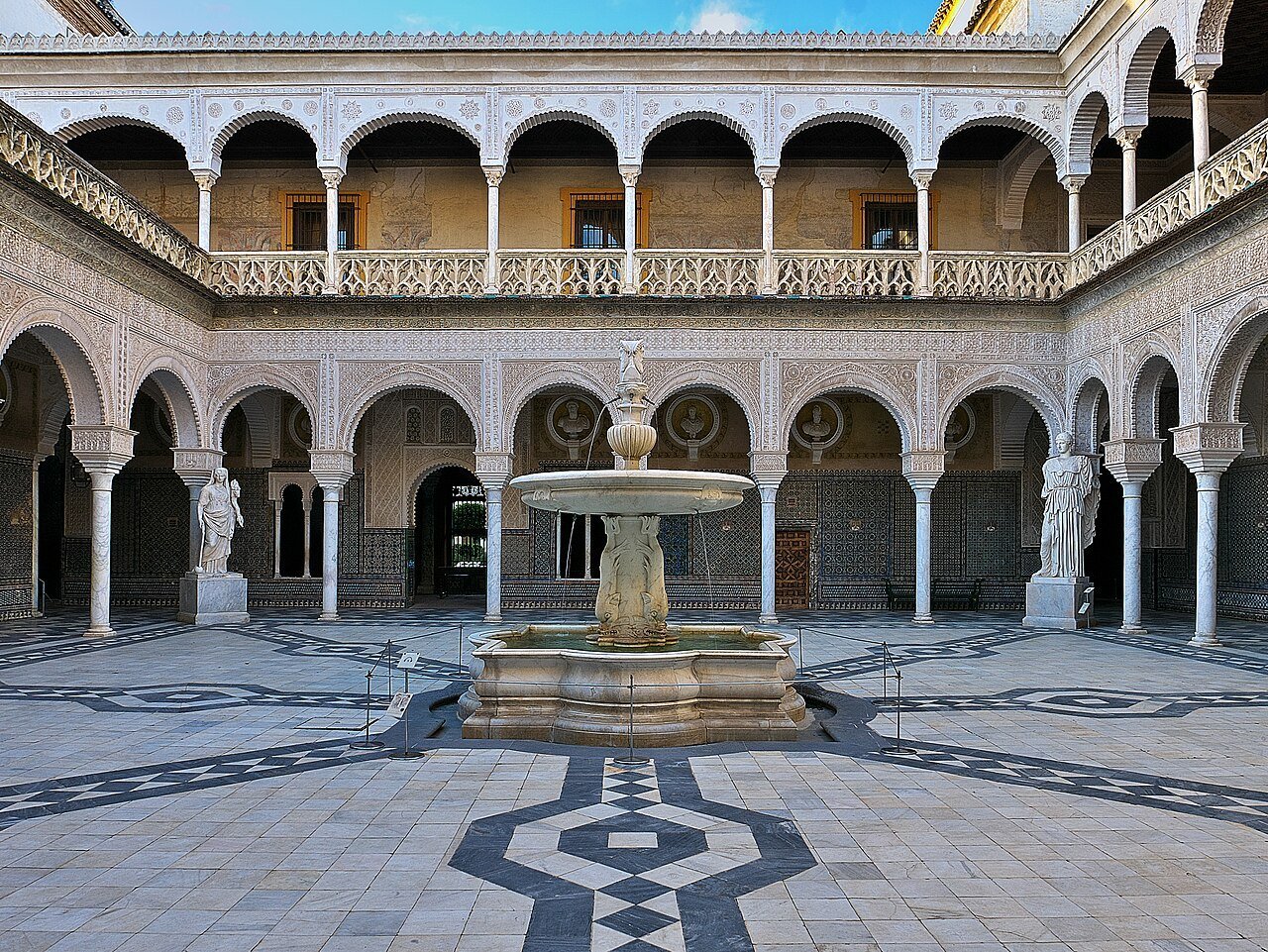
Photo credits: The main patio, the tiled entrance, the medallion mosaic, the SALVE mosaic, a ground-floor room, the Roman bust and the classical statue — CarlosVdeHabsburgo, CC BY-SA 4.0 · The palace door on Calle Cuna — Emilio J. Rodríguez Posada, CC BY-SA 3.0 es · The octagonal room, the geometric mosaic, the grand staircase and the iron chest — Benjamín Núñez González, CC BY-SA 4.0 · The heraldic tile panel — Benjamin Smith, CC BY-SA 4.0 · The painted coffered ceiling — José Luiz, CC BY-SA 3.0. All via Wikimedia Commons.