San Martín Church Valencia: The Complete Guide to the Bronze-Doored Church

Short Answer
San Martín — full name the Real Parroquia de San Martín Obispo y San Antonio Abad — is one of the first parish churches founded in Christian Valencia, rebuilt in Gothic stone between 1372 and 1401 and then wrapped in a white-and-gold Baroque interior in the 18th century. You will find it at Calle de San Vicente Mártir 11, two minutes from the Plaza del Ayuntamiento, and most people walk straight past it. Don’t. Above its main door rides the thing that makes it unmissable once you know it’s there: a life-size bronze of Saint Martin on horseback, cast in Flanders in 1494 and hoisted into its niche in 1495, one of the great pieces of Renaissance bronze work in Spain. Entry is free — it is a working parish, not a ticketed monument — and 30 to 45 minutes is enough to take in the portal, the painted interior and the quiet little square behind the bell tower.
Table of Contents
- One of the First Parishes of Christian Valencia
- The Gothic Church You Can Still Read from the Street
- The Little Horse of San Martín
- The Portal and Its Doors
- Inside: A Baroque Skin over Gothic Bones
- Painted Ovals, a Gilded Frieze and the Main Altarpiece
- The Other Fronts: San Antonio, the Communion Chapel and a Marble Fountain
- What to Look at on a Visit Today
- Practical Info
- Tickets and Booking
- Opening Hours
- Getting There
- When to Go
- How Long You Need
- Tips for Visiting
- What to See Nearby
- Final Thoughts
The Short Version
Valencia’s old town has grander churches, but few with a better story per square metre. San Martín began as a mosque, became one of the foundational parishes of the city Jaume I conquered in 1238, and grew into a Gothic church whose congregation then did two remarkable things: they imported a tonne and a half of Flemish bronze to hang over their front door, and two and a half centuries later they buried their medieval interior under one of the most theatrical Baroque makeovers in Valencia. It belongs on any serious list of the best things to do in Valencia precisely because it is not famous: no queue, no ticket desk, no audioguide — just a parish church that happens to hold a masterpiece. Come for the horse, stay for the interior, and leave by the little plaza at the back, where a red-marble fountain carries the saint’s mitre and crozier.
One of the First Parishes of Christian Valencia
The church stands on one of the oldest sacred plots in Valencia. When Jaume I took the city in 1238, this was the site of one of the ten mosques of Muslim Balansiya, and like several others it was converted for Christian worship in the first years of the new city. San Martín was among the first parish churches founded after the conquest — the ring of parròquies planted to organise Christian Valencia — and its dedication tells you who the new city thought it was: Martin of Tours, the Roman soldier turned bishop, paired with Anthony the Abbot, the hermit of the Egyptian desert.
The mosque-church served for well over a century, but congregations grow and timber-and-plaster buildings age. In 1372 the parish pulled it down and began again in stone, in the Valencian Gothic manner: a single broad nave, side chapels tucked between the buttresses, and a polygonal chancel. The works ran to about 1401, and the side portals were being finished around 1388. What the builders could not do was choose their plot: the church had to fit the streets that already hemmed it in, so the plan came out trapezoidal — wider at one end than the other, a quirk you can still feel inside today, and one the Baroque remodellers later had to disguise.
The parish also grew sideways and upwards over the following centuries. The chancel was enlarged in the 1500s and 1600s and covered with a coffered Renaissance semi-dome — often compared to the Pantheon in miniature, and unlike anything else in a Valencian church of its date. In 1669–1674 the parish added a Chapel of the Communion on the north side, a small church in its own right. And through everything, the congregation kept spending on the one piece of art that had already made them famous across Europe — the bronze horseman over the door, whose story gets its own section below.
The Gothic Church You Can Still Read from the Street
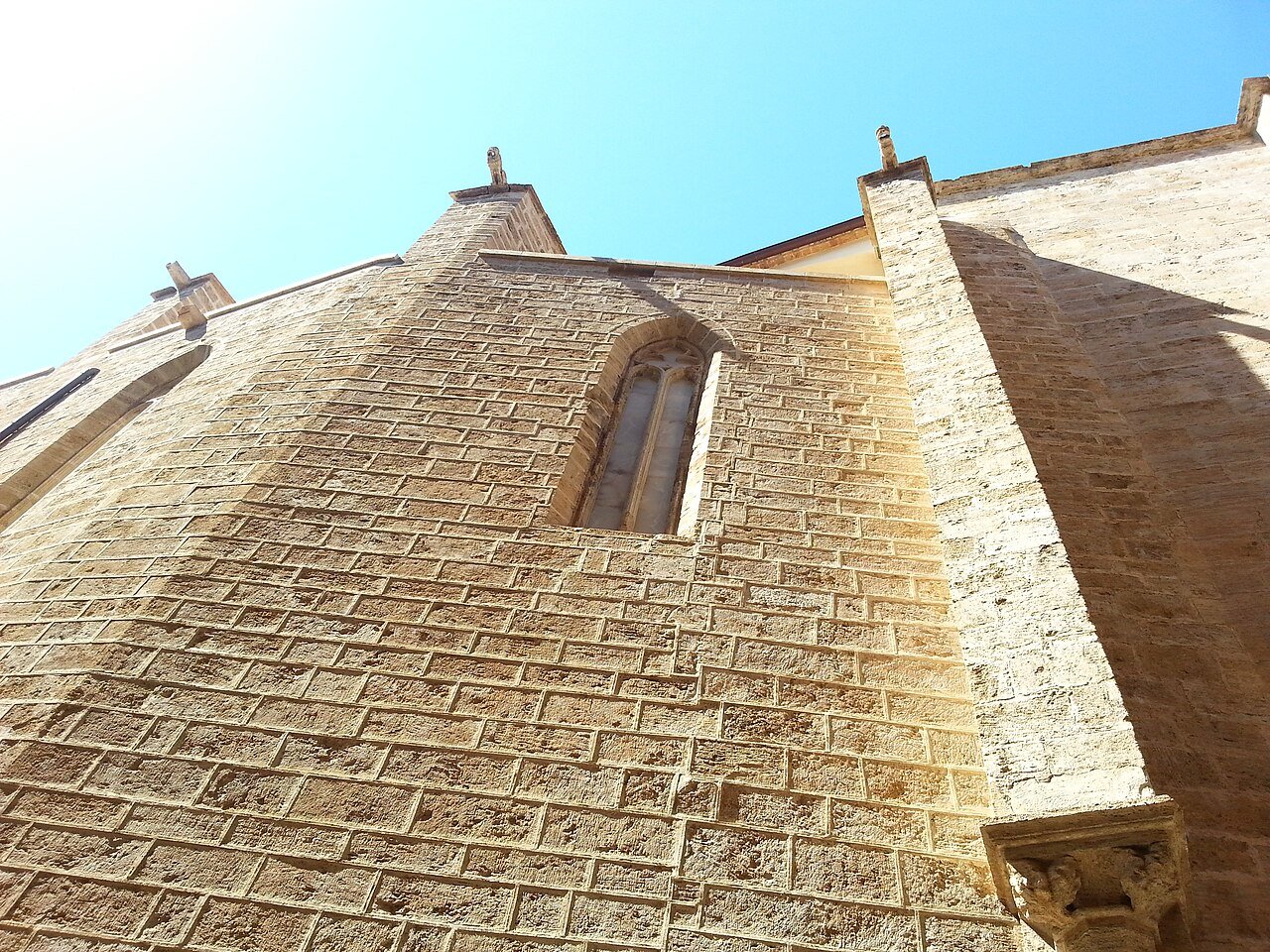
Valencia’s Baroque architects were thorough, but they worked from the inside out. Step back from San Martín and the medieval church is still legible in the walls: plain ashlar masonry, buttresses, gargoyles at the roofline, and tall mullioned windows whose panes are filled with alabaster rather than glass — a Valencian Gothic habit that gives the interior its soft, filtered light. The plan’s trapezoid is easiest to read out here too, where the side walls visibly refuse to run parallel.
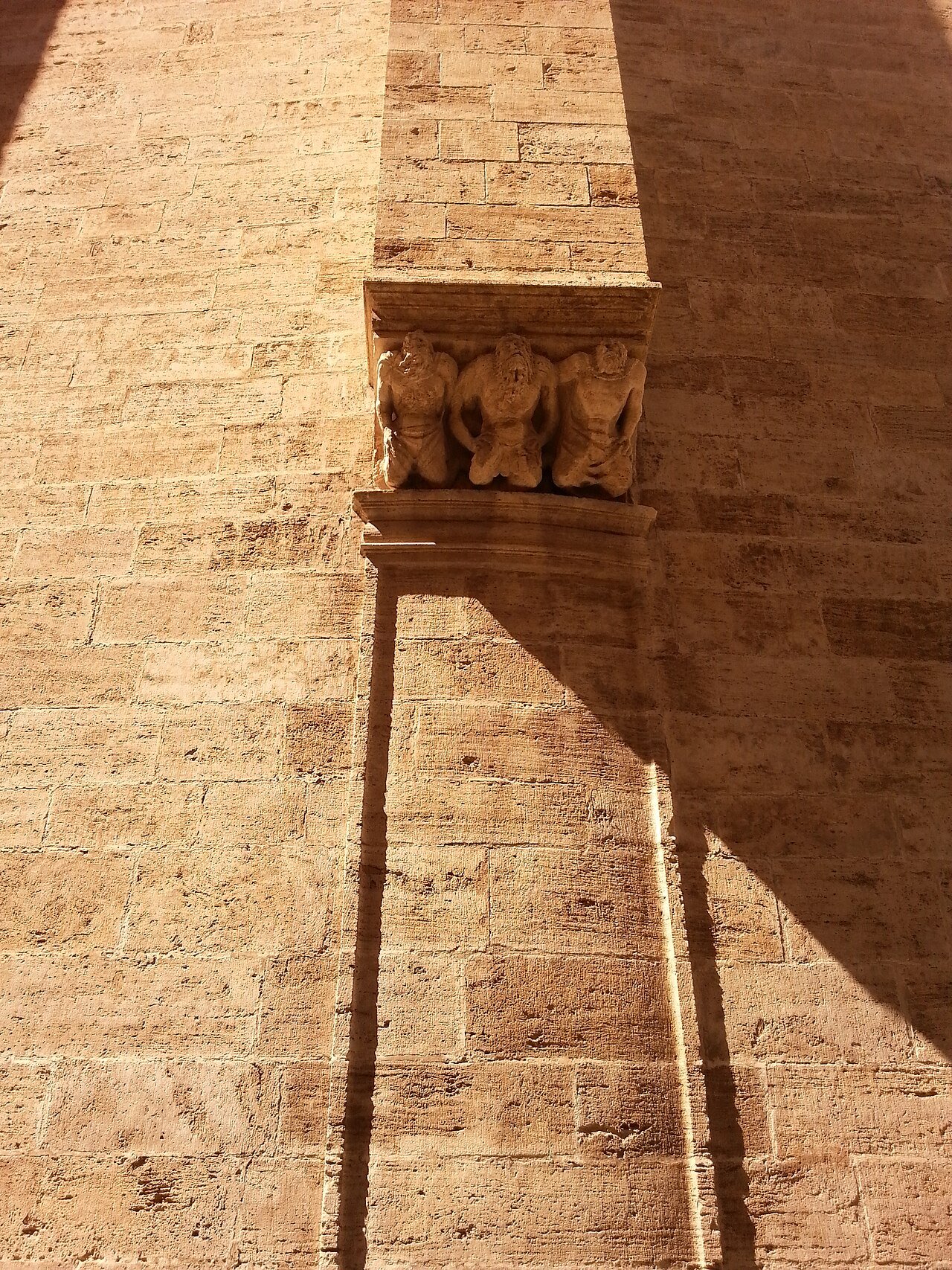
Halfway along the flank, look for the church’s strangest survival: a corbel carved as three atlantes, three straining stone figures crouched shoulder to shoulder, carrying the weight of a buttress on their backs. It is the kind of detail nobody would invent and nobody bothered to remove — five centuries of redecoration, and the three little strongmen are still at work.
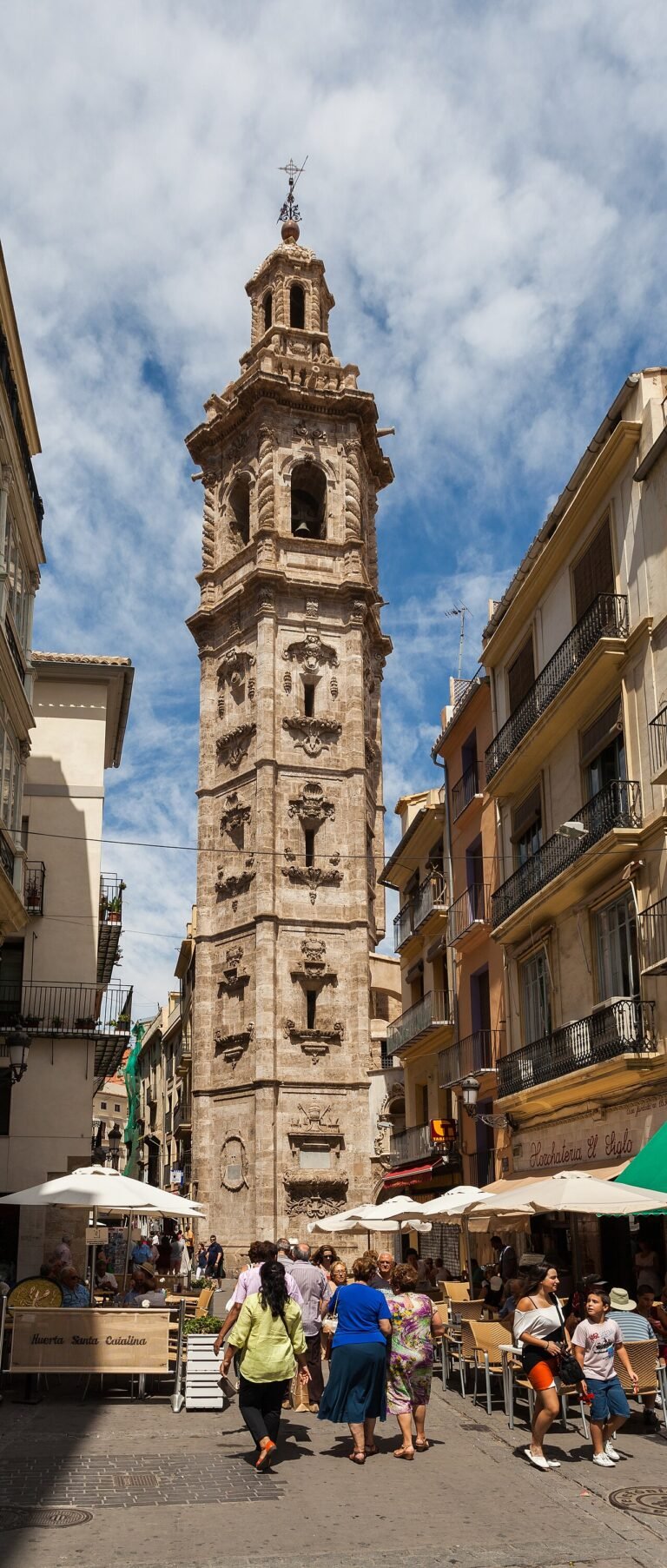
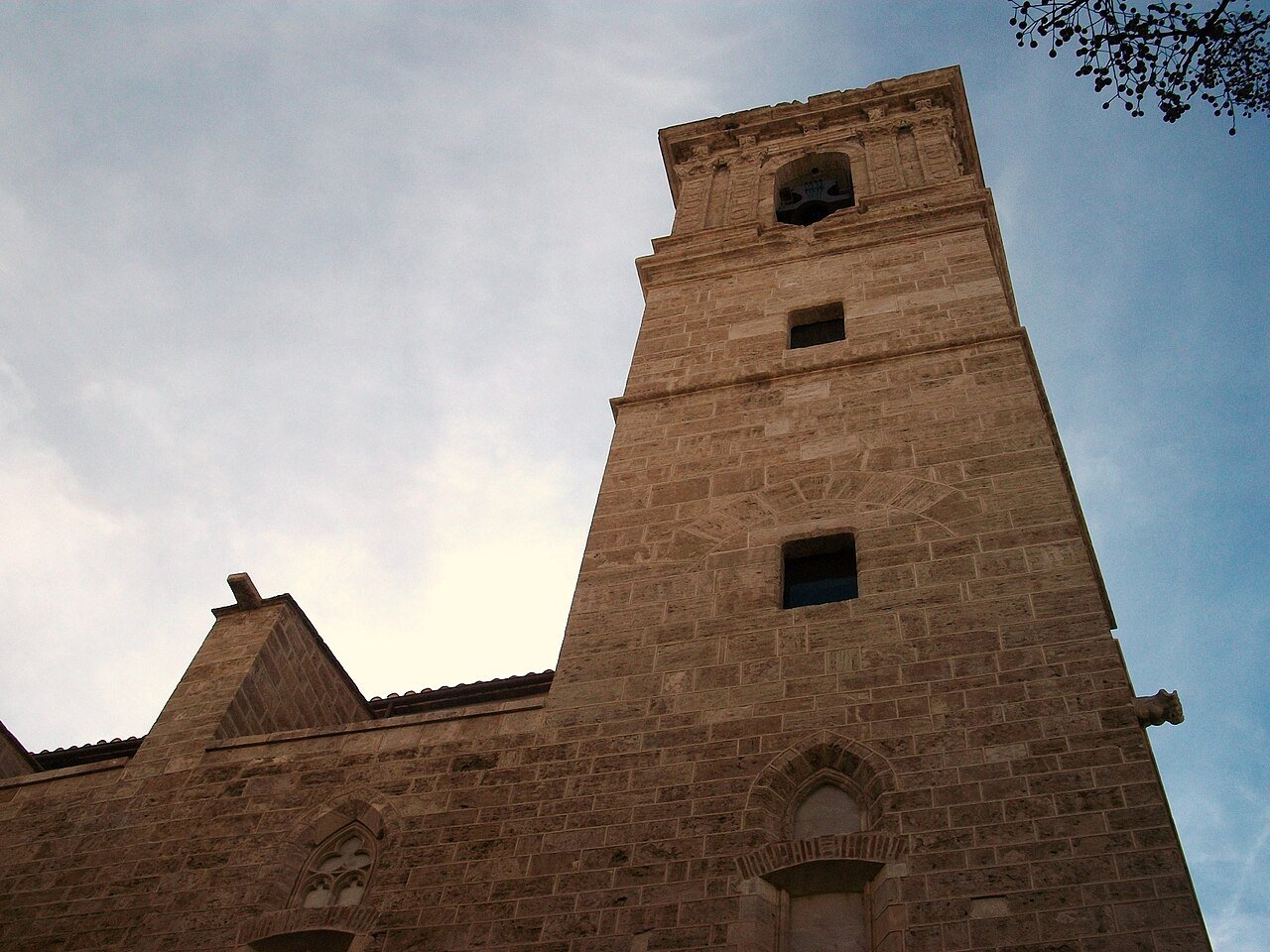
The one major exterior addition is the bell tower, raised between 1621 and 1627 by Bartolomé Abril and Tomás Leonart at the corner of the west front. It is a deliberately plain piece of work — three sober stone stages, 38 metres tall, with the bell chamber at the top framed by Corinthian pilasters. Its bells are modern replacements: the originals were destroyed in the Spanish Civil War, and the present set dates from 1940 and 1967. You cannot climb it, but you will hear it — the tower still works for a living, marking the hours over the Plaza del Ayuntamiento quarter.
The Little Horse of San Martín
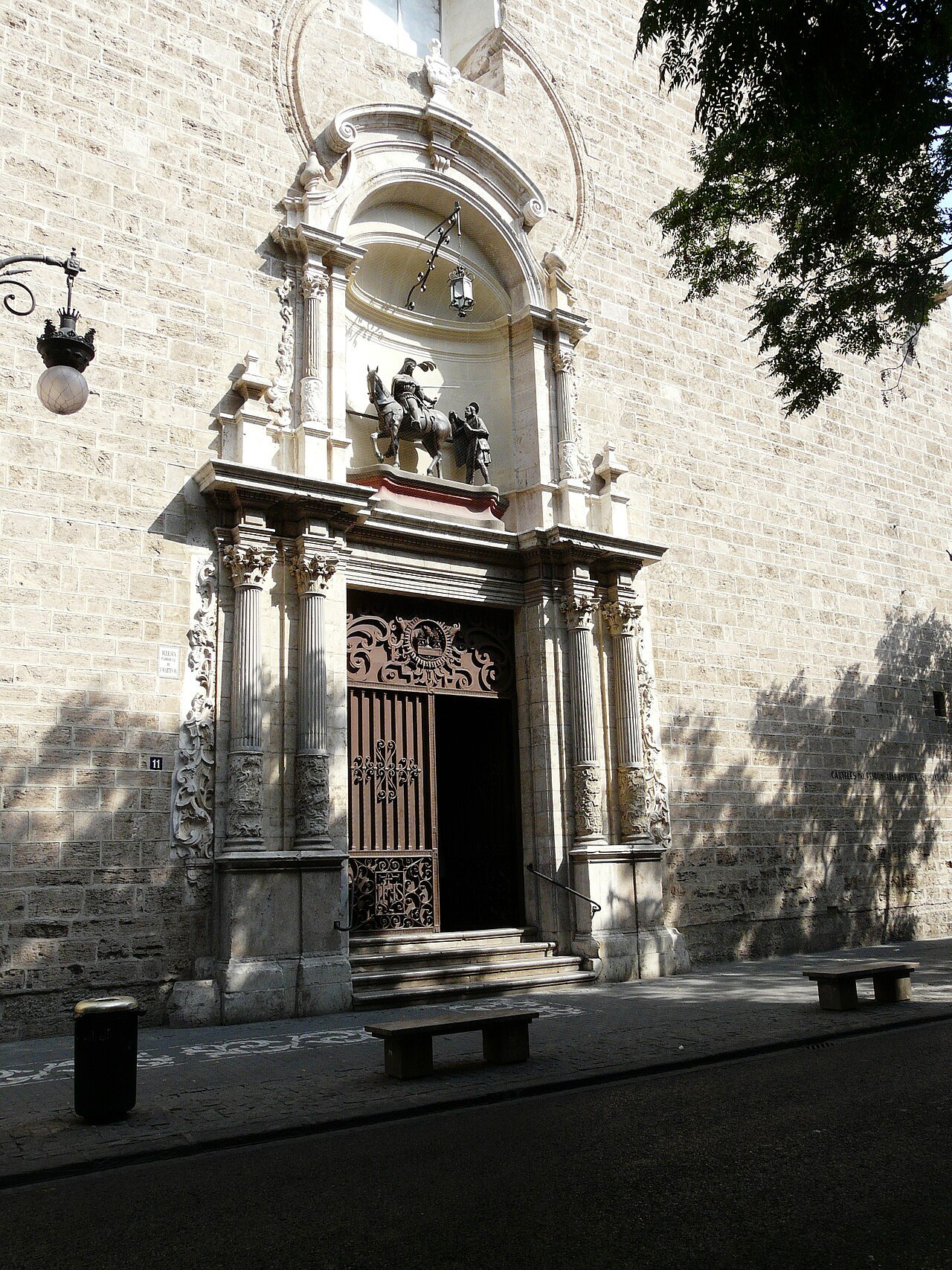
Now look up at the main door. In the niche above it, dark against the pale stone, a horseman in a plumed helmet raises his sword over his cloak while a beggar stands at his horse’s shoulder. This is San Martín y Jesús el Pobre — Saint Martin and Jesus the Poor — and it is the reason this church matters far beyond its parish.
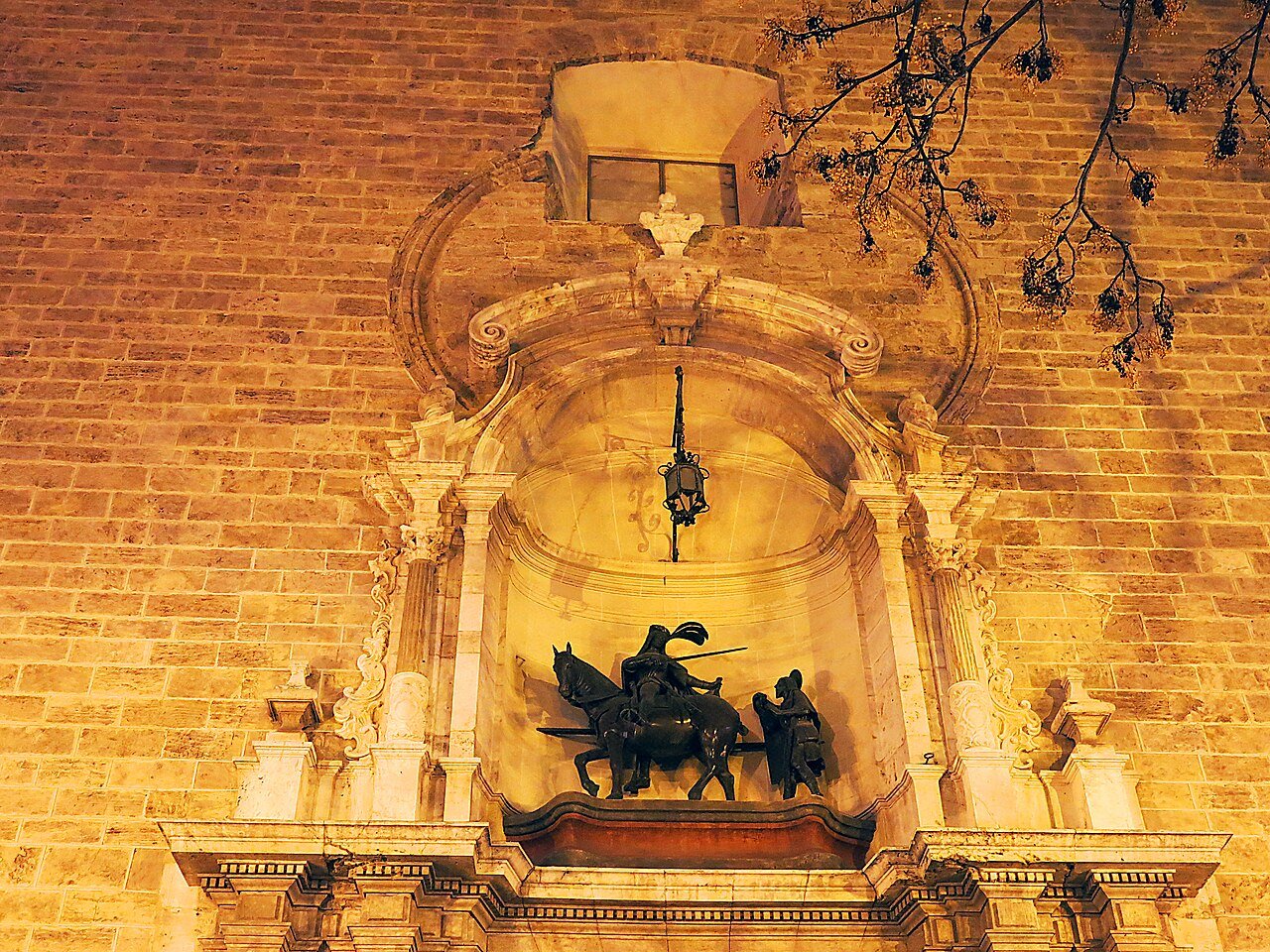
The scene is the most famous moment of Martin’s life. A young Roman cavalry officer at Amiens, on a winter’s day, he met a beggar freezing at the city gate and, having nothing else to give, cut his own military cloak in two with his sword and shared it. That night, the story goes, Christ appeared to him in a dream wearing the half-cloak — which is why Spanish tradition does not call the second figure a beggar at all, but Jesús el Pobre, Jesus the Poor, and why the group shows Christ himself standing at the horse’s head.
The sculpture was made a long way from Valencia. It was cast in the Low Countries in 1494 — hollow, by the lost-wax method, in brass, in some forty separate pieces that were then assembled in the manner of the Tournai workshops — and shipped south as the gift of a Valencian, Vicente Peñarroja, who had commissioned it for his parish church. Peñarroja died before the crates arrived; his two brothers received the group instead, and on 3 June 1495, the eve of the Ascension, it was hoisted into place above the church’s main door. It has been there, in one position or another, ever since: roughly 2.6 metres across and weighing in the region of 1,460 kilos. Art historians attribute it to the Flemish founder Pieter de Beckere — the attribution, made by Elías Tormo in 1923, rests on the casting technique and the style rather than on documents, but it has held for a century.
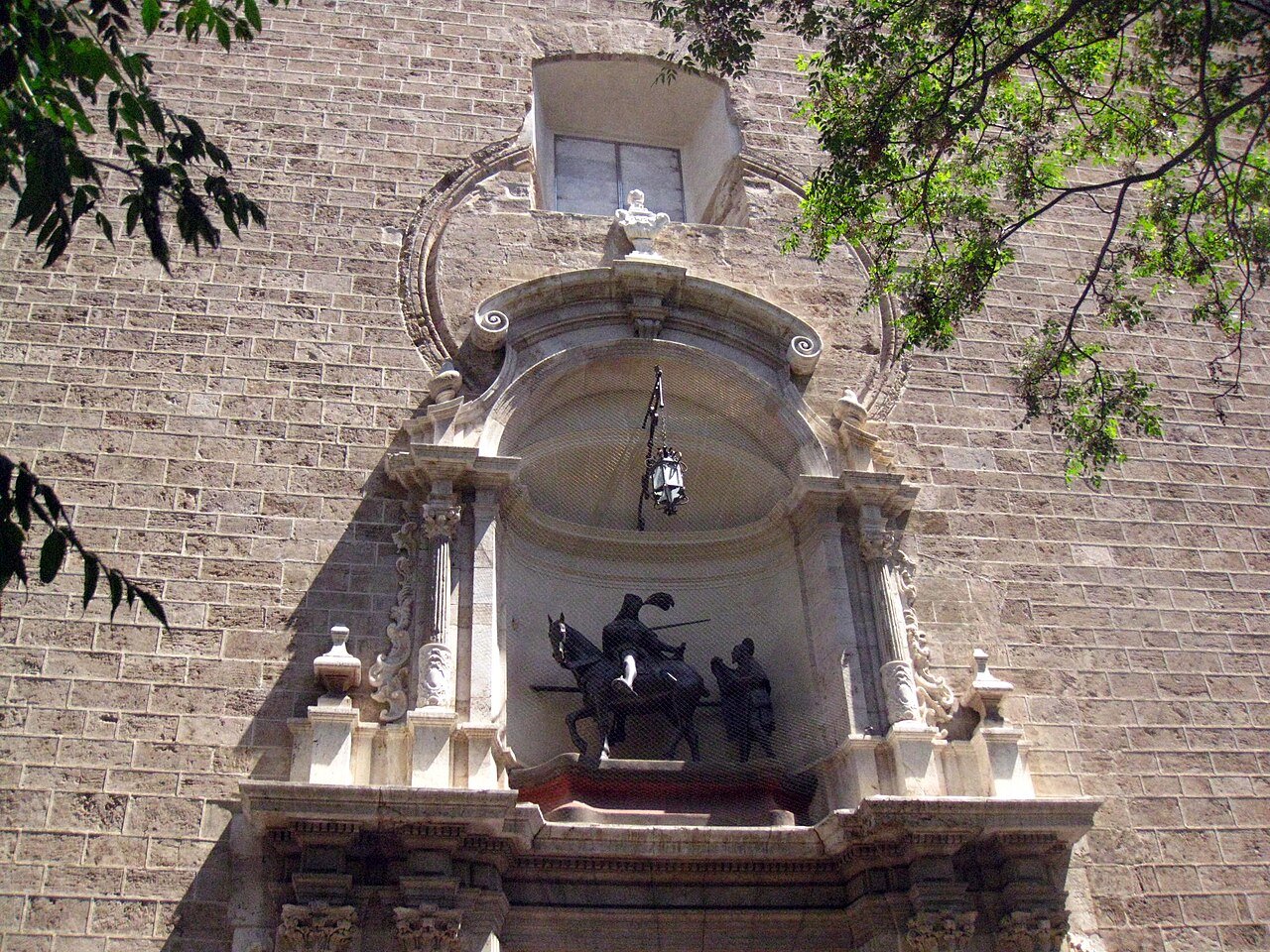
The niche it occupies sits inside the church’s blinded Gothic oculus, the great round west window that was walled up as the façade evolved — you can still trace its ring in the stonework. And the horse has not spent five centuries sitting still. Valencians call it el Caballito de San Martín, the Little Horse, and it may be the most frequently lowered statue in Spain: brought down and cleaned for the wedding of Felipe III in 1599, set up on an altar in the little square behind the tower for the fifth centenary of the conquest in 1738, and taken down and put back for restorations and celebrations ever since. The Valencian conservation institute, the IVC+R, has given it a full modern restoration study — all forty pieces of it — which is how we know its weight, its alloy and its assembly so precisely. When you stand under it, you are looking at a piece of 1490s Flanders that has been loved, moved, cleaned and argued over by the same parish for more than 500 years.
The Portal and Its Doors
A word about this article’s title, because it contains the mistake almost every visitor makes. The church is famous for its bronze — but the bronze is the horseman above the door, not the doors themselves. The gates you actually walk through are dark iron grilles, handsome but workmanlike. Keep that straight and you will understand the west front better than most of the people photographing it.
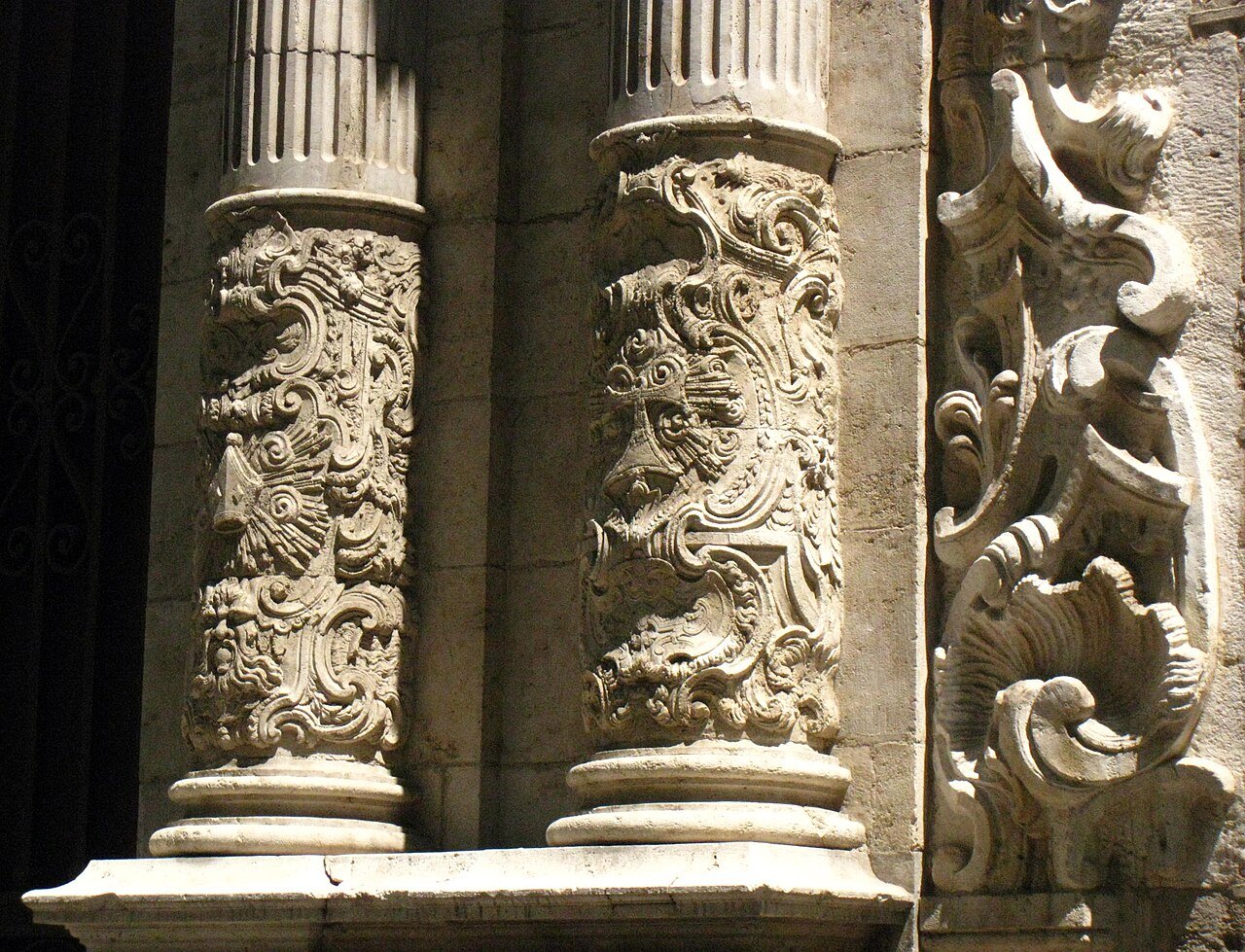
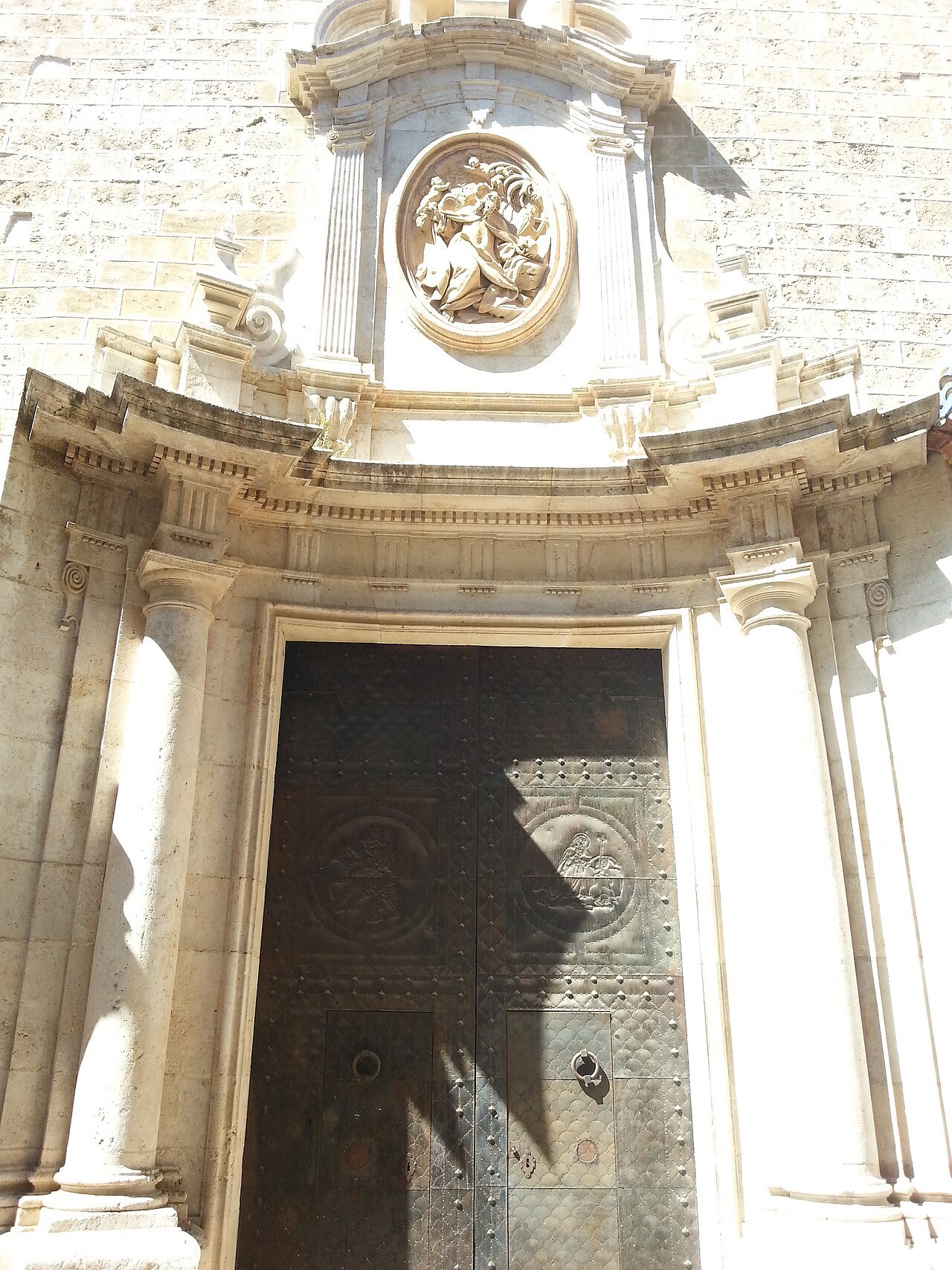
The portal itself is an 18th-century work, built between 1740 and 1750 to a design attributed to Francisco Vergara the Elder — the leading Valencian sculptor of his day, and, fittingly, a parishioner of San Martín who poured much of his career into this church. It is composed in two bodies. Below, the lintelled doorway is flanked by two Corinthian columns on each side, standing on high pedestals; look at the lower third of each shaft, which is carved in deep relief with emblems of the two patrons — the bishop’s mitre and crozier for San Martín among them. Above the cornice, the second body is the niche, framed by more columns and scrollwork, built to receive the bronze group that had already been waiting 250 years for a worthy frame.
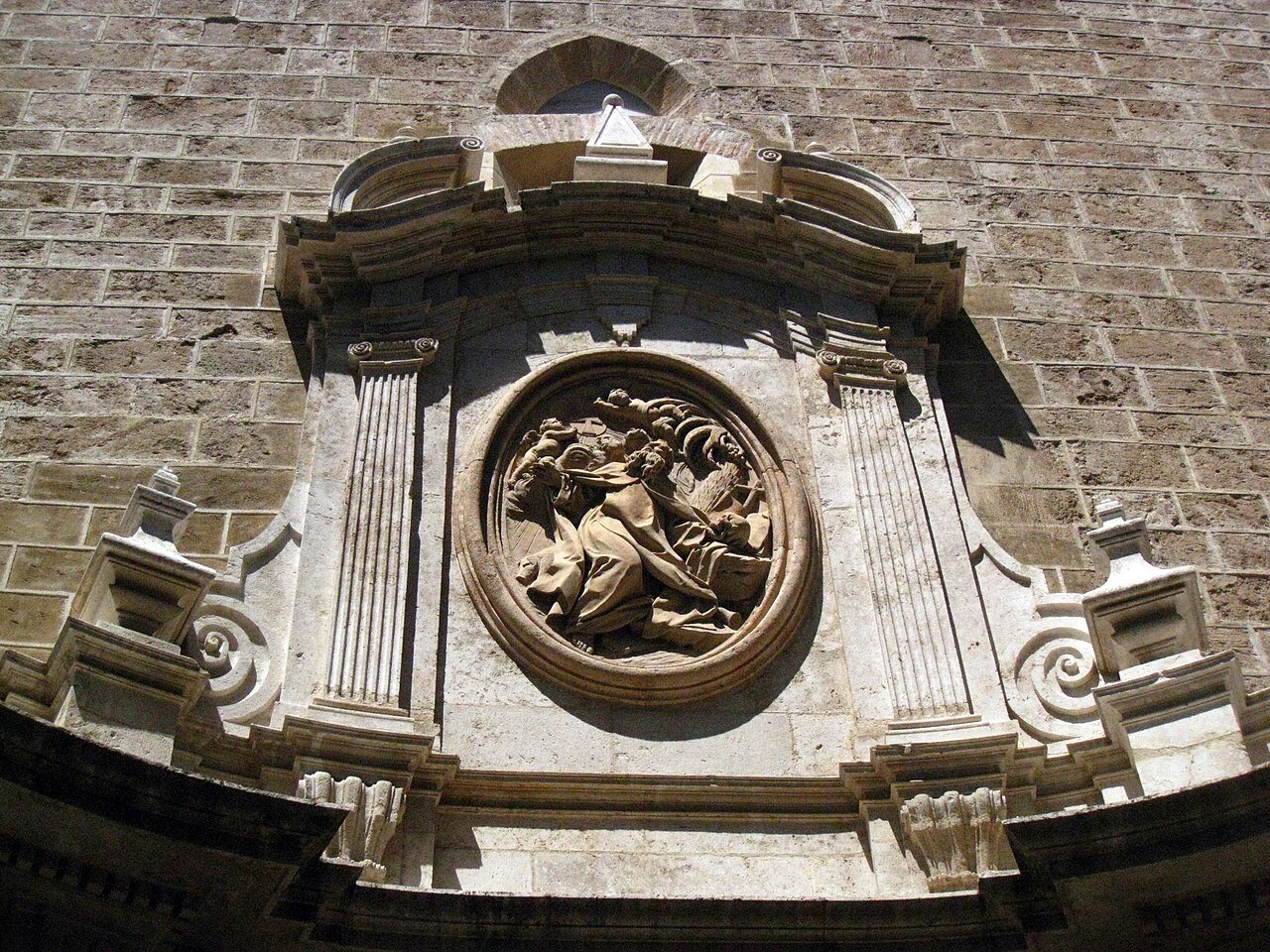
There are three portals in all, and the other two repay the short walk around the building. The south portal, on the Epistle side, was designed a few years after the main one by Francisco’s son Ignacio Vergara. Because the wall there curves, the portal bends with it — columns turned to follow the concave front, a cornice that advances and retreats — and its upper body carries Ignacio’s high relief of the Vision of San Antonio Abad, carved around 1751. Below it hang the church’s most door-like doors: heavy leaves clad in studded metal, embossed with roundels. The north portal, opening onto the Calle de la Abadía de San Martín, is the quiet one — a simple classical front whose frieze of triglyphs and consoles carries a triangular pediment with a carved shell.
Inside: A Baroque Skin over Gothic Bones
Between 1735 and 1753 the parish did to the inside of San Martín what the 1490s congregation had done to its façade: spent seriously, and spent on the best. The architect José Herrero and the sculptor Francisco Vergara — the same Vergara who designed the main portal — re-clothed the entire Gothic interior in the taste of the Spanish Baroque, and they did it so completely that standing in the nave today, you would never guess the bones are medieval.
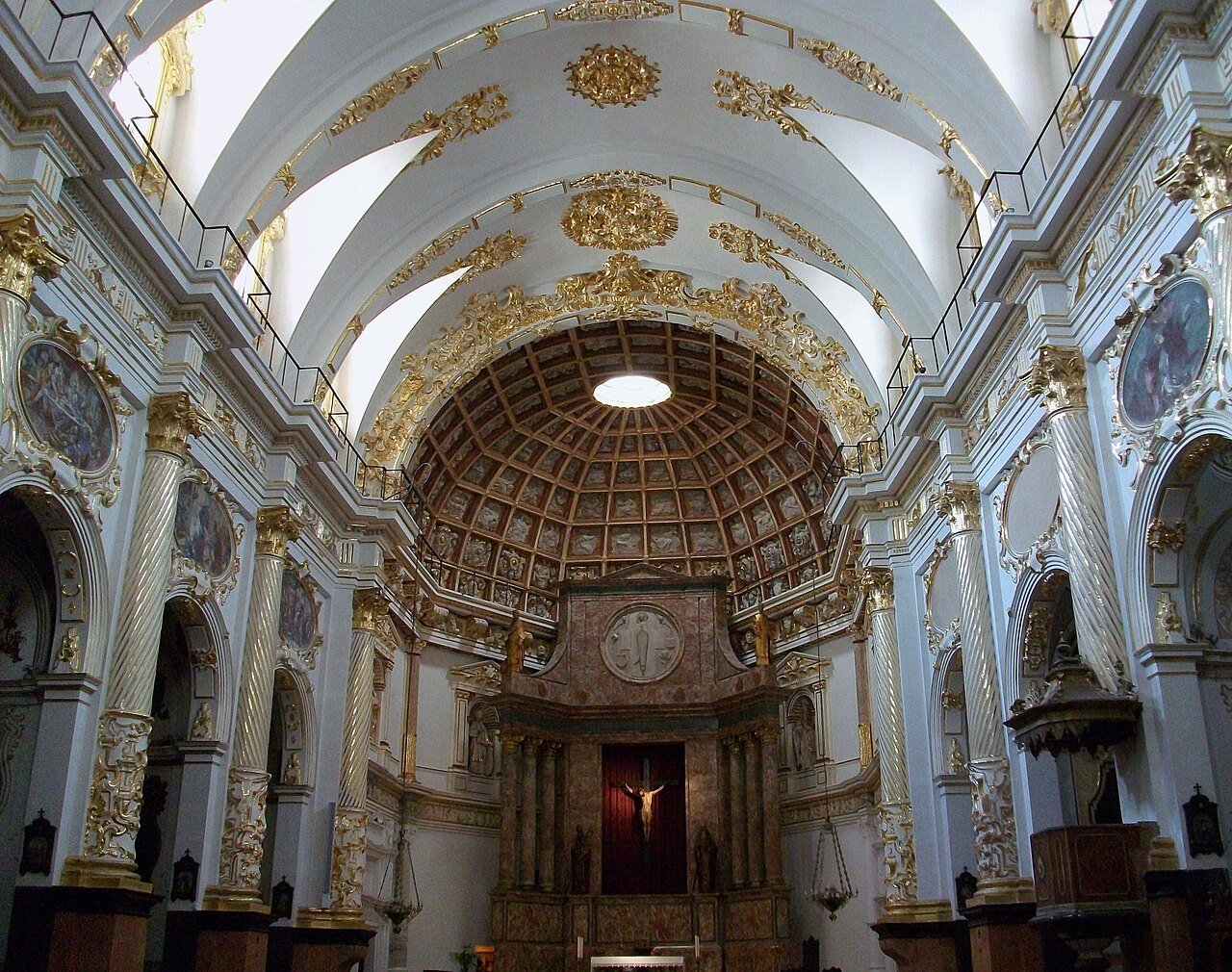
Their first problem was geometry. The trapezoidal Gothic plan — that awkward inheritance from the medieval street pattern — was regularised by building the new lining inside the old shell, thickening and thinning the walls until the nave reads as a proper rectangle. The Gothic rib vaults were then hidden above a new barrel vault with lunettes, and the side chapels, which narrow as the plan narrows, were given little domes of their own — some of them, forced by the geometry, oval rather than round.
The articulation is all theatre. Sixteen great twisted columns — Solomonic columns, spiralling like barley sugar — rise on bases of jasper between the chapel arches, carrying a full entablature and cornice around the church. The palette is white stucco and gold: rocaille ornament spills over the transverse arches, the lunettes and the arch into the presbytery, restrained enough to keep the space luminous rather than heavy. It is a different flavour of Baroque from the riot of Santos Juanes across the old town — cooler, whiter, more classical in its bones — and the contrast between the two churches, fifteen minutes apart, is one of the pleasures of church-crawling in Valencia.
At the east end the remodelling stopped politely at the chancel, and that restraint preserved the church’s other rarity: the polygonal presbytery covered by its Renaissance coffered semi-dome, a survivor of the 16th–17th-century works, glowing softly under its central oculus. Baroque nave, Renaissance chancel, Gothic shell — three centuries stacked in a single glance down the church.
Painted Ovals, a Gilded Frieze and the Main Altarpiece
The decoration runs in a strict programme, and once you see the pattern you can read the whole church. Above each chapel arch sits an elliptical cartouche — an oval frame in stucco — holding a canvas of a saint’s life. Walk down the Gospel (left) side and the ovals tell the life of San Martín Obispo; cross to the Epistle (right) side and they tell the life of San Antonio Abad. The two patrons divide the church between them, exactly as they divide its name. The ovals are the work of painters of the Valencian school, Hipólito Rovira and Joaquín Pérez among them.
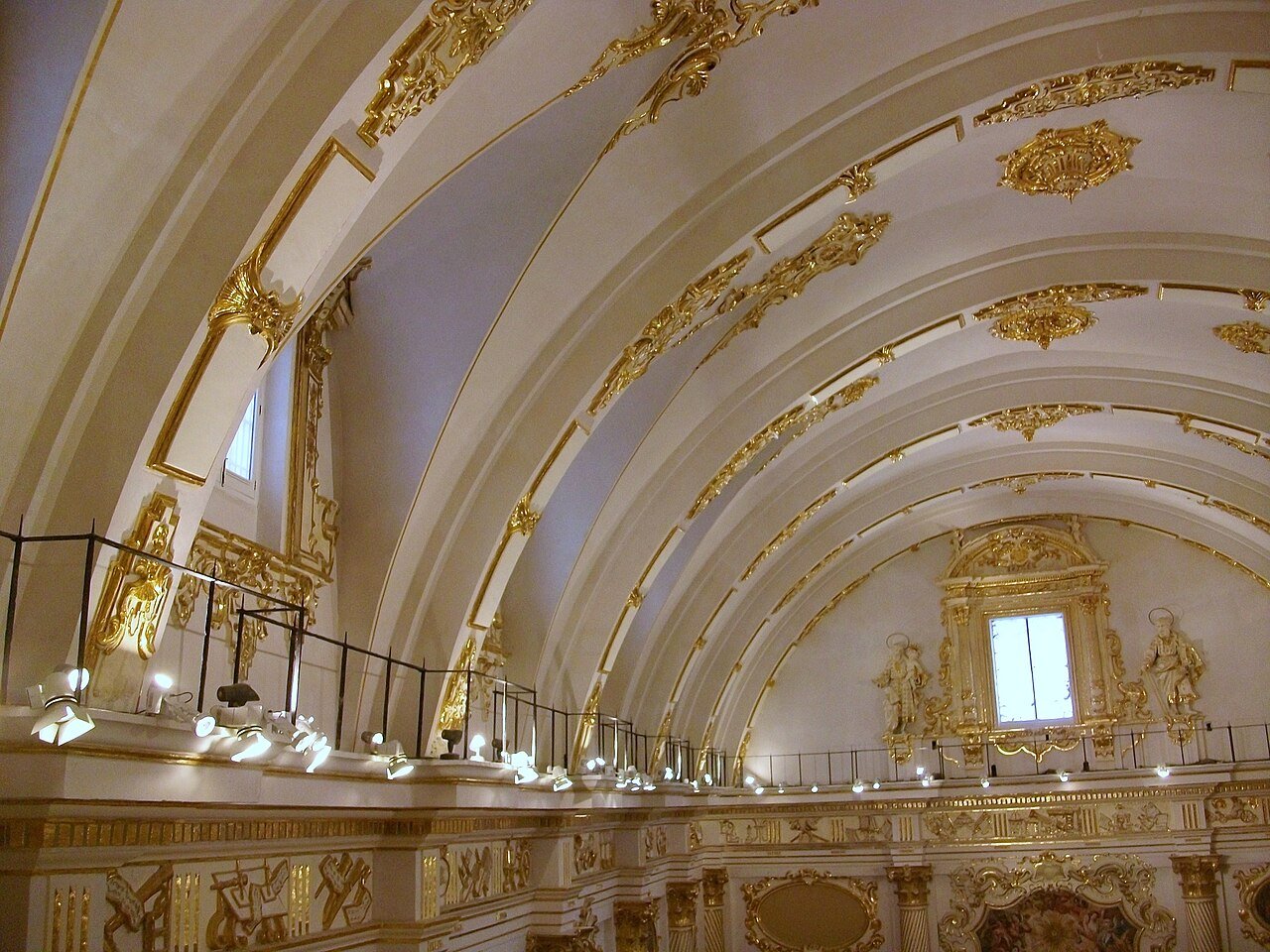
Above the ovals runs the interior’s most original ornament: a frieze of 44 metopes — carved panels set along the entablature — filled with musical instruments and the objects of Catholic worship, lyres and trumpets alongside chalices and censers. It is a frozen orchestra, there to make stone sing the same praises the choir sang below, and it rewards a slow walk with your head tipped back.
Two more works complete the programme. At the west end, above the main door you entered by, is a fresco of the Exaltation of the Eucharist attributed to José Vergara Gimeno — Francisco Vergara’s son, and the outstanding Valencian painter of the following generation, so the church holds the father’s architecture and the son’s painting in a single view. And in the presbytery, under the coffered semi-dome, stands the main altarpiece: a sober Neoclassical composition in coloured stone, later and quieter than everything around it, framing the crucifix at the church’s liturgical heart. After the white-and-gold exuberance of the nave, its restraint feels deliberate — the one calm voice in a talkative room.
The Other Fronts: San Antonio, the Communion Chapel and a Marble Fountain
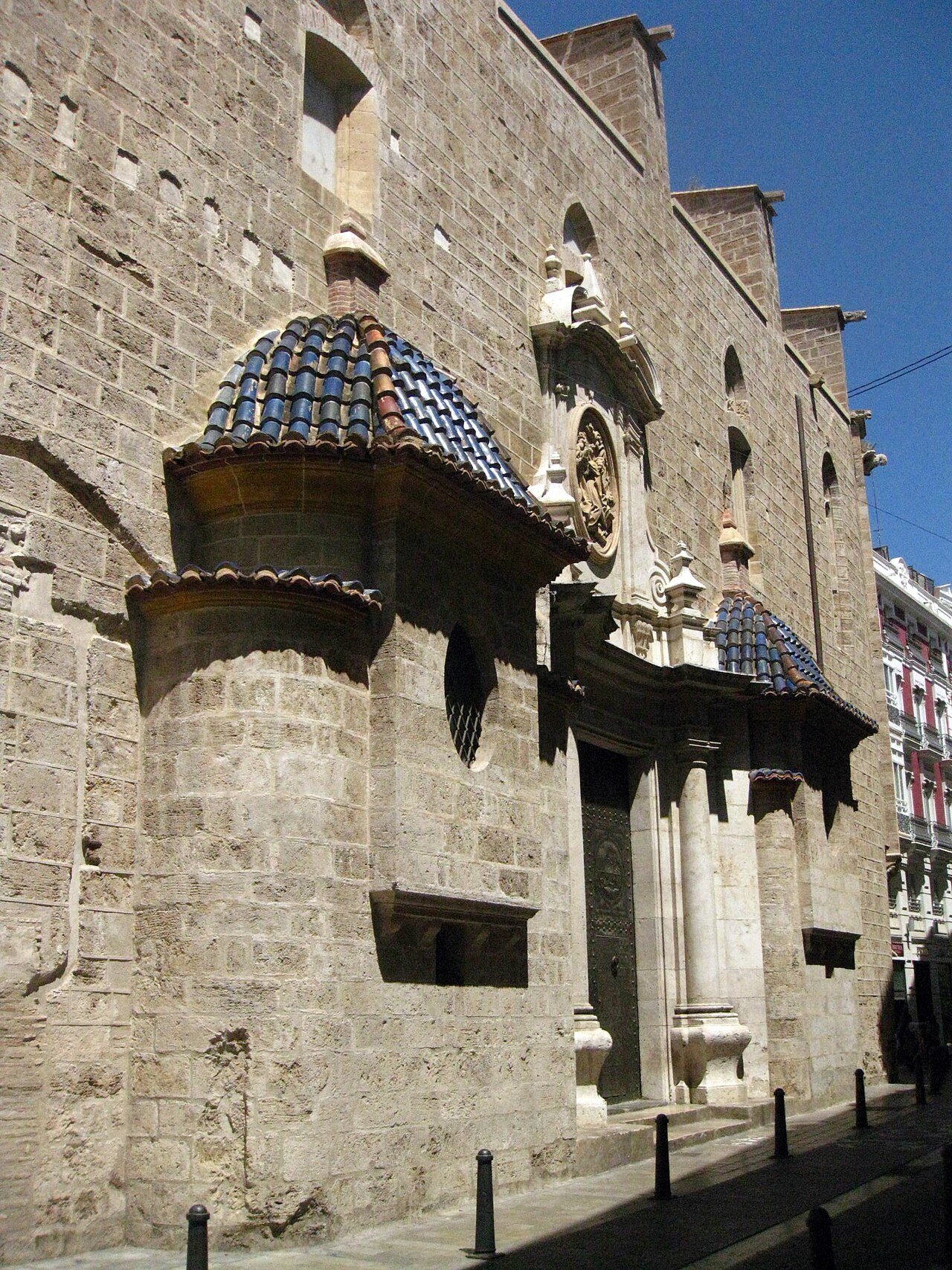
Most visitors see only the west front, but San Martín wraps three more faces around its block, and the parish’s second patron owns one of them. The south front bends along its street in a long ashlar wall, the side chapels pushing out under little pitched roofs of blue glazed tile — the most Valencian silhouette imaginable — with Ignacio Vergara’s curved portal and its relief of San Antonio at its centre.
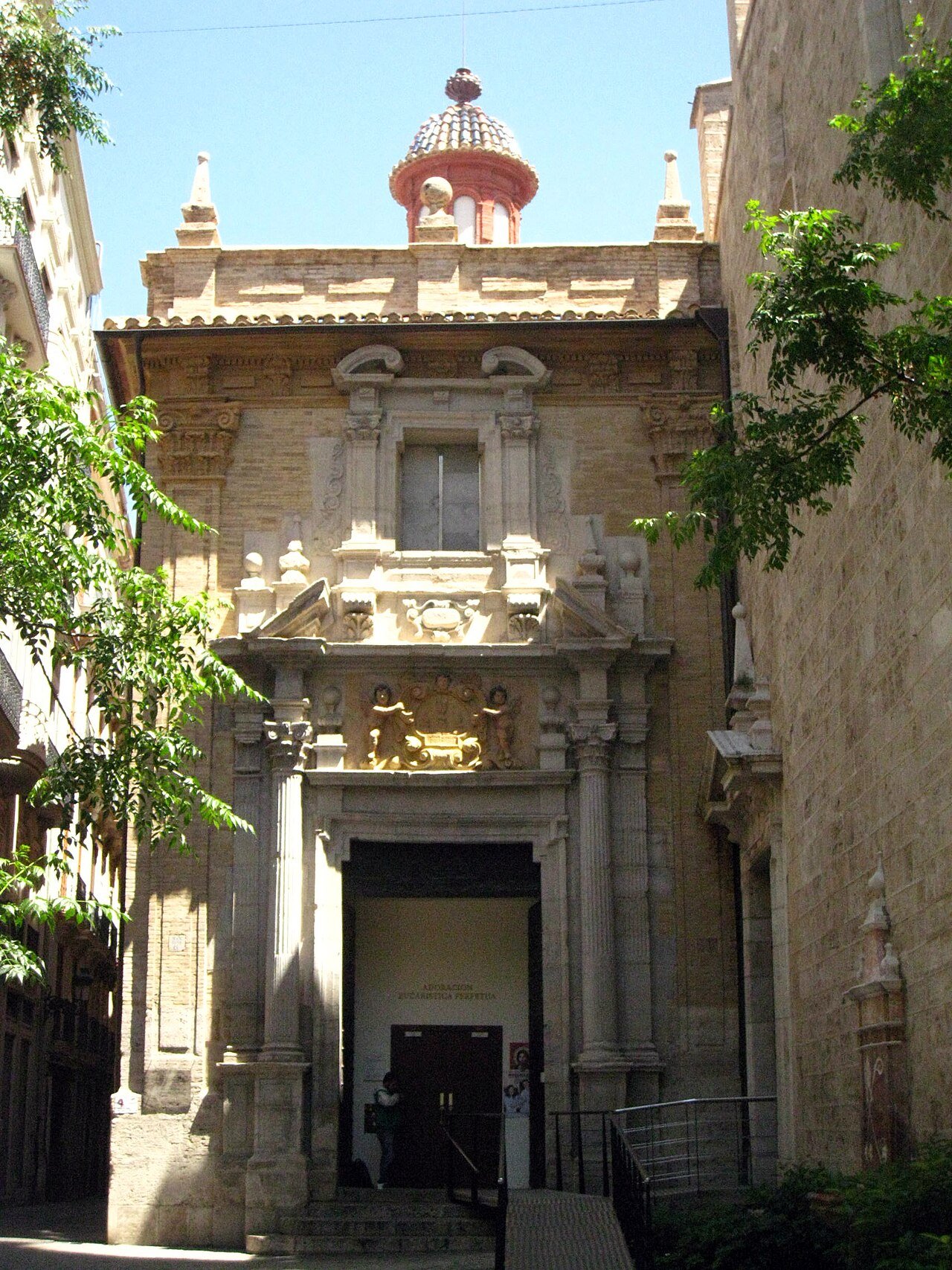
On the north side, the church turns its back on Calle de San Vicente and creates something rare in the dense old town: a small, calm plaza, the Plaza de la Comunión de San Martín, formed where the Communion Chapel meets the street. The chapel, built in 1669–1674 by Gaspar Matutano, has its own classical portal and lantern dome, and today it serves the parish’s perpetual Eucharistic adoration — there is almost always someone praying quietly inside, and visitors are welcome to sit for a moment on the same terms.
Against the base of the bell tower, on the plaza side, stands the neighbourhood’s prettiest small object: a drinking fountain of red marble, inlaid in white marble with the crossed mitre and crozier of San Martín. It is an 18th-century piece, made for the Real Casa de la Enseñanza founded by Archbishop Mayoral, and it only arrived here in the early 1960s, when it was re-erected against the tower wall. Valencians fill bottles at it still; the little plaque beside it reads, simply, agua potable.
What to Look at on a Visit Today
Give the church a slow circuit, outside first and then in. Start across Calle de San Vicente for the full west front: portal, niche, horse, and the ring of the blind oculus. Come close for the carved column shafts — find the mitre — then walk the south flank for the atlantes corbel, the blue-tiled chapel roofs and Ignacio Vergara’s San Antonio relief. Finish the circuit at the Plaza de la Comunión for the fountain and the chapel front.
Inside, walk the nave twice: once at ground level, reading the oval paintings — San Martín on your left as you face the altar, San Antonio on your right — and once with your eyes up, along the metope frieze to the coffered semi-dome. Stand in the centre and turn around for José Vergara’s Eucharistic fresco over the door. Then sit for a few minutes. San Martín is not a museum that used to be a church; it is a church that happens to contain museum pieces, and the visit is better for remembering the order of those things.
Practical Info
San Martín stands at Calle de San Vicente Mártir 11, in the Sant Francesc quarter of the Ciutat Vella, on the short stretch of street between the Plaza del Ayuntamiento and the Plaza de la Reina. Its full name — Real Parroquia de San Martín Obispo y San Antonio Abad — is the longest thing about it; everyone in Valencia just calls it San Martín. It is a working Roman Catholic parish in the Archdiocese of Valencia, protected as a listed historic monument, and it functions exactly as it has for seven centuries: Masses, weddings, funerals, and a steady trickle of the curious.
| Best for | Lovers of sculpture and Baroque interiors; anyone who wants a masterpiece without a queue |
| Entry | Free — working parish church, no ticket desk |
| Time needed | 30–45 minutes (an hour if you read every oval) |
| Nearest metro | Xàtiva (lines 3, 5 and 9), about 6 minutes on foot; Colón is also close |
| Don’t miss | The bronze San Martín y Jesús el Pobre above the main door — and the three atlantes on the south wall |
Tickets and Booking
There is nothing to book and nothing to buy: San Martín has no ticket office, no online reservation and no audioguide, and no GetYourGuide product visits it — the commercial church tours of Valencia go to the Cathedral, San Nicolás and Santos Juanes instead. You simply walk in when the doors are open. If a service is in progress, you are welcome to sit at the back, but sightseeing waits until it ends.
Opening Hours
As a working parish, San Martín opens around its services rather than to a museum timetable: the doors are generally open in the morning and again in the late afternoon and evening, every day, and the church is at its most visitable between Masses. Exact hours shift with the liturgical calendar, so if you are making a special trip, check the timetable posted by the door or on the parish noticeboard in the Plaza de la Comunión.
Getting There
From the Plaza del Ayuntamiento, walk north up Calle de San Vicente Mártir; the church is on your right after about two minutes, its west front set straight onto the pavement. From the Plaza de la Reina and the Cathedral it is three minutes in the opposite direction. The nearest Metrovalencia station is Xàtiva (lines 3, 5 and 9), beside the Estación del Norte, about six minutes away on foot; Colón station is a similar distance to the east. Dozens of EMT bus lines serve the Plaza del Ayuntamiento stops. If you are driving, don’t — the Ciutat Vella is a low-emission, largely pedestrianised maze; use the public car parks around the Plaza de la Reina or Avenida del Oeste and walk.
When to Go
Come in the morning, when the west front catches the light and the bronze group reads clearly against the stone, and when the church is at its quietest between services. Late afternoon is the second-best window: the interior’s white and gold warms up, and the Plaza de la Comunión becomes one of the calmest spots in the centre. Two dates carry special weight here — 11 November, the feast of San Martín, when the parish celebrates its patron in earnest, and the weeks of Fallas in March, when the church sits inside the festival’s loudest quarter and offers a genuinely peaceful half-hour a street away from the mascletà.
How Long You Need
Thirty minutes covers the essentials: the west front and the horse, a circuit of the interior, the ovals and the frieze, and a look at the presbytery. Give it 45 minutes to an hour if you add the full walk around the outside — south flank, atlantes, San Antonio portal, Communion plaza and fountain — which is the version of the visit this guide recommends.
Free Valencia travel guide
Planning a trip to Valencia? Get our free one-page Valencia checklist: what to book ahead, what to skip, and the paella places we actually eat in.
Tips for Visiting
- Look up before you go in. The bronze horse is easy to miss at street level because the niche sits high and the group is dark; cross to the far pavement of Calle de San Vicente for the full façade, then come in close.
- Time it between services. Sightseeing during Mass is not the done thing in a working parish; arrive as one service ends and you will have the interior almost to yourself.
- Do the full circuit. The south flank and the Plaza de la Comunión hold half the church’s stories — the atlantes, the tiled chapel roofs, the marble fountain — and most visitors never see them.
- Read the ovals in order. San Martín’s life runs down the left side, San Antonio’s down the right; knowing the pattern turns a pretty ceiling-line into a story.
- Bring no expectations of facilities. There is no shop, no cloakroom and no audioguide — the pleasure here is precisely that nothing has been packaged.
- Cover shoulders if you plan to linger. It is a place of worship; dress as you would for any working church in Spain.
What to See Nearby
San Martín sits in the densest walking territory in Valencia. Five minutes north, Santos Juanes faces the Lonja across the market square — go straight from Vergara’s white-and-gold restraint to Palomino’s restored ceiling for the full Baroque contrast. A few streets further, San Juan del Hospital is the city’s oldest church, all 13th-century austerity. And the quarter’s anchor is Valencia Cathedral, five minutes away on the Plaza de la Reina, with the Holy Grail chapel and the Miguelete tower. Between them: the Mercado Central for lunch, La Lonja de la Seda for the Gothic at its most confident, and the Plaza Redonda for a coffee in Valencia’s oddest little square.
Travel insurance, sorted
Whether it is a two-week holiday or a longer move, travel insurance is not the most glamorous part of a trip — but it is the one booking you want to have in place before a trip, and while you are already away. Get a quote from SafetyWing
Final Thoughts
Every great church city has one building that the guidebooks underrate because it never learned to sell itself, and in Valencia that building is San Martín. It has no ticket desk, no immersive show and no famous relic — just seven centuries of continuous use, a Baroque interior of real quality, and above its front door a tonne and a half of Flemish bronze that a parishioner loved enough to ship across Europe and that the parish has lowered, cleaned and celebrated ever since. The Little Horse has watched Calle de San Vicente since 1495. Give it half an hour of your walk between the Plaza del Ayuntamiento and the Plaza de la Reina, and it will earn it.
¡Buen viaje!

Photo credits: José Luis Filpo Cabana (CC BY 3.0); Pere López, Enfo and Joanbanjo (CC BY-SA 3.0); Dorieo and Enric (CC BY-SA 4.0), via Wikimedia Commons.