Valencia Beaches: The Complete Guide to the City’s Best Beaches, From Malvarrosa to the Albufera Dunes
Valencia is the rare great Spanish city that never makes you choose between the city break and the beach holiday. The historic centre, the futuristic City of Arts and Sciences and some of the best food in Spain sit barely four kilometres from a Mediterranean shore that runs, almost unbroken, for more than twenty kilometres — and the twelve beaches on that shore are twelve different answers to the same sunny question. At one end stands La Malvarrosa, the city’s grand urban beach, painted by Sorolla and fronted by a promenade of paella restaurants. At the other, the protected dunes of the Albufera Natural Park roll south in near silence, backed by pine forest and not a single tower block.
This guide walks the whole coast in order: the two city beaches every visitor finds first, the local favourites just north of them in Alboraya, the quiet shore south of the port, the wild Albufera trio, and four beaches further out — Canet, Sagunto, Cullera and Gandía — that Valencians themselves drive or take the train to when they want a proper beach day. Every one of them is free. Every one is reachable without a car, though two or three richly reward having one. And the same rule applies at all twelve: the earlier you arrive, the better the beach.
If you do one organised thing with this guide, make it the trip that shows you this entire coastline from the water: Valencia: Sailing Catamaran with Swimming & Optional DJ You board at the Marina de Valencia, beside the white Veles e Vents building at the southern end of Las Arenas beach, sail out along the city shore on a big catamaran, sunbathe on the net stretched over the water, and stop for a swim in the open sea — 1.5 hours in all, rated 4.2/5 from 1,469 reviews, from $28.01, with free cancellation up to 24 hours in advance and reserve now & pay later. Go on your first full day if you can: there is no faster way to get the geography of this coast into your head, because you will spend the rest of the trip looking at beaches you have already seen from the sea.
Table of Contents
- The Quick Verdict
- How Valencia’s Beaches Work: Flags, Lifeguards and the Two Coasts
- 1. Playa de la Malvarrosa: The City’s Grand Beach
- 2. Playa del Cabanyal–Las Arenas: The Fishermen’s Beach
- 3. Playa de la Patacona: The Locals’ Favourite
- 4. Port Saplaya: Little Venice
- 5. Playa de Pinedo: The Quiet Shore South of the Port
- 6. Playa del Saler: Dunes and Pine Forest
- 7. Playa de la Devesa: The Wild One
- 8. Playa de El Perelló: The Village Beach
- 9. Playa Racó de Mar, Canet d’en Berenguer: The Family Secret
- 10. Playa del Puerto de Sagunto: The Castle-and-Beach Day
- 11. Playa de San Antonio, Cullera: The Sheltered Bay
- 12. Playa de Gandía: The Big Resort Beach
- Which Beach Suits You?
- What a Beach Day Costs
- Final Thoughts
- FAQs: Valencia Beaches
The Quick Verdict
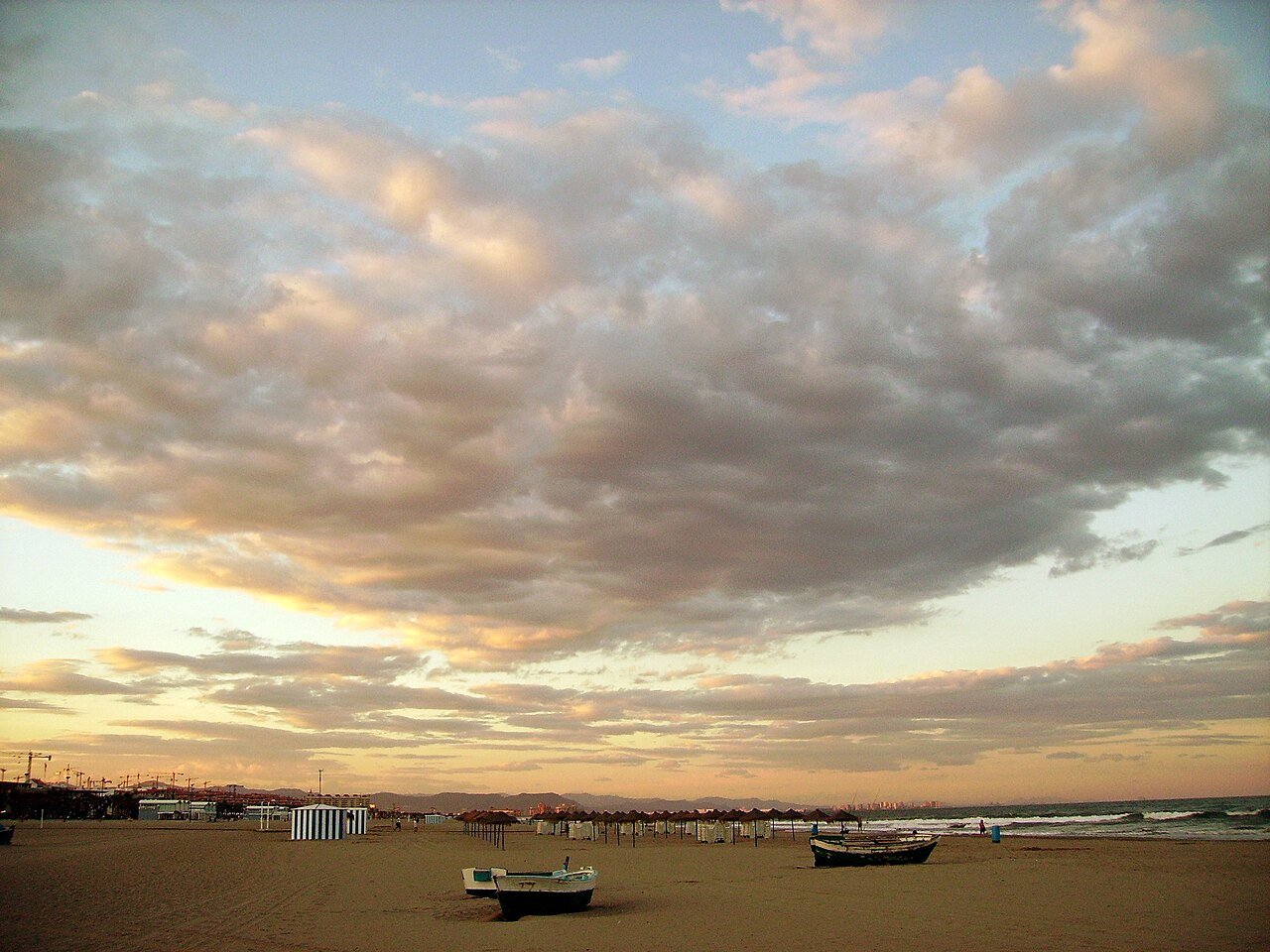
Short on time? Go to La Malvarrosa — tram across the city, towel down, swim, then paella on the promenade; it is the complete Valencia beach in one afternoon. Want the same sand with more soul? Walk ten minutes south to Las Arenas, in front of the old fishing quarter. Want to escape the crowds without leaving the city? Head north one stop further to La Patacona, or cross the port to Pinedo. Want nature? The bus south to El Saler and La Devesa drops you at dune-backed beaches inside a protected natural park, twenty minutes from the centre. Have a car or a train day? Cullera for shelter and a castle view, Gandía for the full resort works, Canet for the family beach Valencians keep to themselves. And whatever you choose, build one late afternoon around the sailing catamaran from the marina — the swim stop alone justifies it.
How Valencia’s Beaches Work: Flags, Lifeguards and the Two Coasts
Geography first, because everything else follows from it. Valencia’s port splits its coast in two. North of the port lies the city shore: the marina, then Las Arenas and La Malvarrosa running north into Alboraya’s beaches — urban, serviced, promenaded, reached by tram. South of the port the city lets go: Pinedo, then the Albufera Natural Park, where the beaches are backed by dunes and pine forest instead of buildings, and reached by bus, bike or car along one straight coastal road. The two coasts feel like different holidays, and most visitors only ever see the first. This guide’s argument, in one line, is: do both.
The practical machinery is reassuringly Spanish. The main beaches fly Blue Flags and run lifeguard services through the bathing season — daily cover through the summer months, roughly June to mid-September, with the flag system doing the talking: green means swim, yellow means care, red means stay out, and a purple or white flag warns of jellyfish, which do visit this coast on some late-summer days. The big city beaches add showers, foot-washes, toilets, boardwalks, rentable loungers and umbrellas, beach bars (chiringuitos) and, on La Malvarrosa and Las Arenas, marked sports areas and some of the busiest beach-volleyball courts in Spain.
The sea itself is the gentle Mediterranean kind: it shelves slowly, warms through the summer to around 25–26°C in August and stays swimmable — by northern European standards — from May into October. Two local habits are worth copying. The first is the midday retreat: Valencians swim in the morning, lunch long and late under shade, and return to the sand from about five, when the light turns gold and the day’s heat breaks. The second is the evening promenade — the whole city shore becomes a strolling, ice-cream-eating parade ground after eight. Join both rituals and you have understood the Valencian beach better than any sunbather who simply bakes from ten to four.
One honest warning, the same one locals give each other: on the city beaches in August, space is the scarce resource. Arrive before eleven or accept the promenade end of the sand. The Albufera beaches, twenty minutes away, almost never fill — that contrast is the single most useful fact in this guide.
1. Playa de la Malvarrosa: The City’s Grand Beach
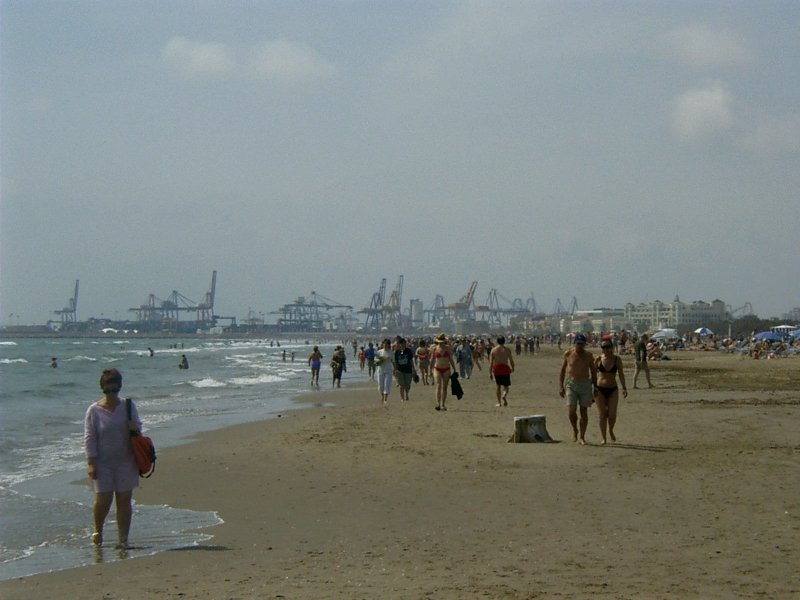
Start where the city starts. La Malvarrosa — the name comes from the malva, the mallow flower once grown here for a 19th-century perfume factory — is Valencia’s flagship beach: over a kilometre of fine golden sand, so wide that the walk from promenade to water is an expedition in itself, backed by the palm-lined Paseo Marítimo and a wall of restaurants famous across Spain for one dish. This is the beach Joaquín Sorolla painted again and again — his canvases of children, fishermen and white-clad bathers in this exact light are now in museums around the world — and the writer Vicente Blasco Ibáñez built his house on the promenade, today a small museum. No other city beach in Spain carries this much art history per square metre of sand.
The Malvarrosa routine writes itself. Swim in the morning while the sand is still findable, hire the lounger if you want the full works, play or watch the volleyball, and then do the thing the promenade exists for: paella at lunch, in the birthplace of paella. The seafront restaurants along the Paseo Marítimo and the streets behind it have served rice to beachgoers for well over a century — the grand old houses among them are institutions — and eating a paella valenciana with sand still on your feet, twenty minutes from where the rice grows in the Albufera, is one of the complete food experiences of Spain. Book for lunch on summer weekends; the whole city has the same idea.
Practicalities: the tram drops you a short walk away (the beach runs north from the Las Arenas end), services are total — lifeguards, showers, toilets, adapted bathing points, bars, rental everything — and the crowds are the price of the fame. If the sand in front of the promenade feels like a festival you didn’t buy a ticket for, walk north. The Malvarrosa thins as it goes, and within ten minutes it hands over to a quieter beach with a different name and the same sea.

2. Playa del Cabanyal–Las Arenas: The Fishermen’s Beach
The southern half of the city shore, directly in front of the old fishing quarter of El Cabanyal, is officially one beach wearing two names — Las Arenas at its southern end, El Cabanyal as it runs north into La Malvarrosa — and it is the half with the history. The landmark is the great white Balneario Las Arenas, the 1930s bathing resort built when this shore was the spa of the Valencian bourgeoisie, now a luxury hotel whose colonnades still preside over the sand. Behind the beach, the Cabanyal’s grid of tiled fishermen’s houses remains the most characterful neighbourhood in maritime Valencia — a morning at its market and a swim here belong to the same outing.
Las Arenas is where the city’s beach life concentrates: the widest spread of chiringuitos and promenade restaurants, the marina a short walk south with the America’s Cup buildings and the Veles e Vents, and the departure point of the Valencia: Sailing Catamaran with Swimming & Optional DJ — look for the catamarans beside the Veles e Vents. Facilities match the Malvarrosa’s — lifeguards, rentals, showers, adapted access — and the sand is the same generous golden shelf. The difference is the backdrop and the lunch options: the Cabanyal behind you is full of small, serious, unpretentious places to eat fish and rice, the maritime end of the city’s cooking, at prices the grand promenade doesn’t attempt.
Families rate this end highly: the sea shelves gently, the promenade is broad and flat for buggies and bikes, and the tram terminates practically on the sand. Come on a weekday morning and you will share it mostly with the quarter — grandmothers with chairs, fishermen mending the morning away, and the beach doing the job it has done for two hundred years.
3. Playa de la Patacona: The Locals’ Favourite
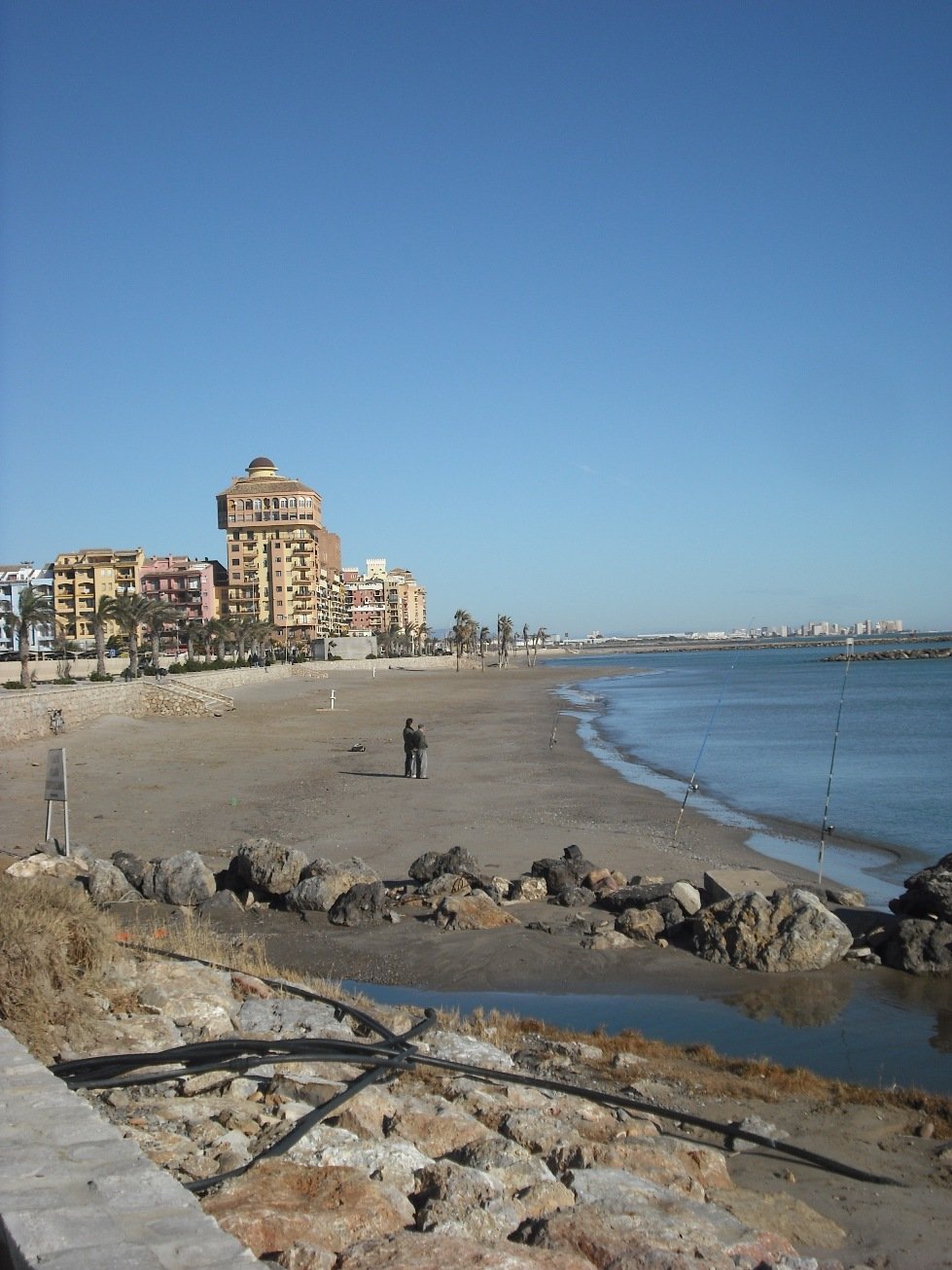
Walk north from La Malvarrosa, cross the dry riverbed of the Carraixet, and the city beach becomes La Patacona — technically in the neighbouring town of Alboraya, in feel the northern suburb of the same shore, and in the opinion of a good share of Valencians the best of the urban beaches. It has the same wide golden sand and the same gentle sea, but a lower, more residential promenade: palm trees, apartment blocks with actual residents in them, a string of well-liked chiringuitos and restaurants, and a fraction of the Malvarrosa’s crowds. This is where the city’s young families, paddle-surfers and Sunday-morning crowds actually go.
Patacona’s mornings are for the water — paddle-surf and kayak hire, swimmers doing lengths parallel to the shore — and its late afternoons are for the promenade: a long, flat, palm-shaded walk or cycle with ice-cream stops, running unbroken back into the city beaches if your legs are willing. Two practical advantages worth knowing: it is usually possible to find your square of sand here even in August, and parking, while never easy on this coast, is noticeably less impossible than by the Malvarrosa.
And then there is the Alboraya bonus. The town behind the beach is the home of orxata — horchata, the sweet tiger-nut drink that is Valencia’s signature refreshment — made here for centuries from the chufa fields of the surrounding huerta, and served in the town’s famous horchaterías with long fartons for dunking. A Patacona beach day that ends with horchata in Alboraya is a small masterpiece of planning; our guide to the best food in Valencia covers where to drink it and everything to eat afterwards.

4. Port Saplaya: Little Venice
Five minutes further north, Alboraya performs its party trick. Port Saplaya is a 1970s marina development built around a harbour that reaches into the town in canals, lined with tall, brightly painted apartment houses in ochre, rose and cream — and the whole confection is known, inevitably, as Valencia’s Little Venice. The canals are photogenic enough on their own; what earns Port Saplaya its place in this guide is that the development is flanked by two small beaches, one on each side of the harbour mouth — Playa Norte and Playa Sur — looking at each other across the entrance channel.
Small is the operative word, and the charm. These are not strands for laying out a camp; they are sheltered neighbourhood beaches of fine sand where the water, protected by the harbour arms, stays calm enough for small children on days when the open coast has a chop. The south beach, in the lee of the development with the ochre tower rising behind it, is the prettier of the two. Come for a morning swim, photograph the canals, lunch on the harbour terraces where the boats tie up under the apartment windows, and accept that Port Saplaya is a place to savour at small scale rather than a full beach day — unless small scale is exactly what your party of toddlers requires, in which case it may be the smartest choice on this entire list.
Reaching it: a short drive or taxi north from the city beaches, or the coastal walk/cycle up through Patacona if you are making a morning of the northern shore. Services are modest — lifeguards in season, a few bars — which is precisely the point.

5. Playa de Pinedo: The Quiet Shore South of the Port
Cross to the southern coast and the city’s noise falls away within a kilometre. Pinedo, the little maritime village pinned between the port and the new channel of the Turia river, fronts a long, open beach that serves its own people first: fishermen’s families, residents of the southern districts, dog owners — Pinedo is home to the city’s designated dog beach, a fenced stretch where dogs swim legally and happily — and cyclists, who ride down the river-mouth cycle path from the City of Arts and Sciences end of the Turia gardens and simply keep going until the path runs out at the sea.
The beach itself is a broad, unpretentious sweep of sand with the working port on the horizon — cranes to the north, open Mediterranean ahead — and services that cover the essentials: lifeguards in season, showers, a handful of places to eat. Those places deserve a sentence of their own: Pinedo’s village restaurants, a short stroll from the sand, are old-school rice houses of exactly the kind Valencians drive out to on Sundays, serving the maritime branch of the family — arroz a banda, arroz del senyoret, black rice — to a clientele that has been coming for decades.
Choose Pinedo when the city beaches feel like too much city. It is the closest shore to the centre where you can reliably find space, quiet and a table for lunch without booking — the locals’ pressure valve, fifteen minutes from the old town, hidden in plain sight behind the port.
6. Playa del Saler: Dunes and Pine Forest
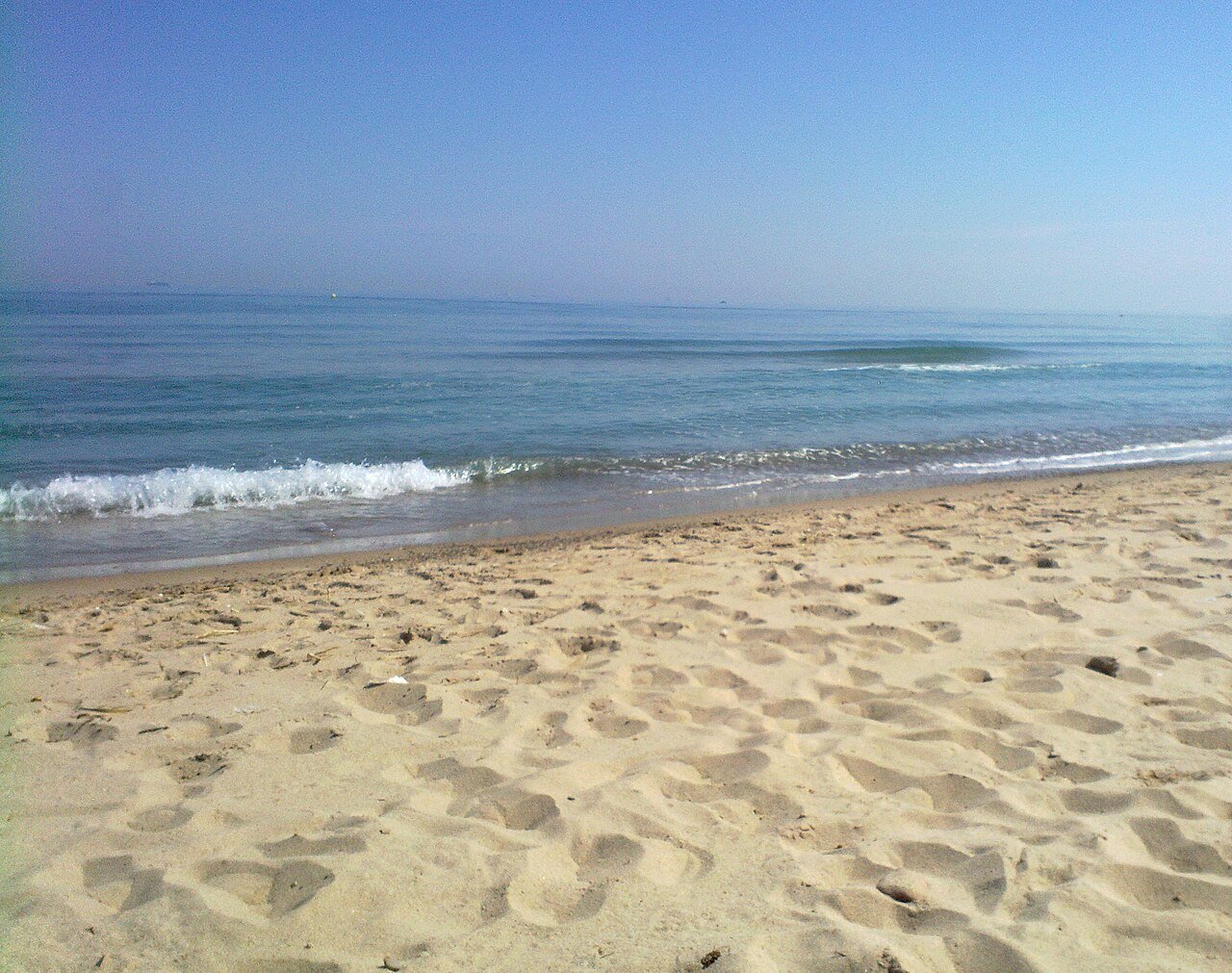
South of Pinedo the Albufera begins, and the coast changes its nature. The Albufera Natural Park — the great freshwater lagoon, its rice fields and its pine-forested dune strip — is Valencia’s wild backyard, and El Saler is its front door: a small village of apartment blocks and rice restaurants standing where the park’s beach road begins, with a beach that runs for kilometres south in a straight, dune-backed line. The sand here is paler and finer than the city’s, the water often clearer, and the backdrop — dunes, then the dark green wall of the Devesa pine forest, with the Parador hotel and its golf course tucked into the trees — is a landscape, not a skyline.
El Saler keeps enough civilisation for comfort: lifeguards in season, showers, beach bars, and the village’s restaurants behind the sand, including some of the most storied paella addresses in the province. It is also the beach where the two Albufera rituals meet — a morning swim here pairs naturally with the lagoon itself, ten minutes inland: the boat trips among the reed beds and the famous sunset over the lake are covered in our Albufera guide, and a Saler swim followed by a lake sunset is the single best summer day out the city offers.
Getting there is part of the pleasure: the 25 bus from the city centre runs down the coast road in under half an hour, the cycle track beside it is flat and shaded for long stretches, and drivers will find the village the easiest parking on this whole coast outside high season. If you only make one trip south of the port, make it this one.
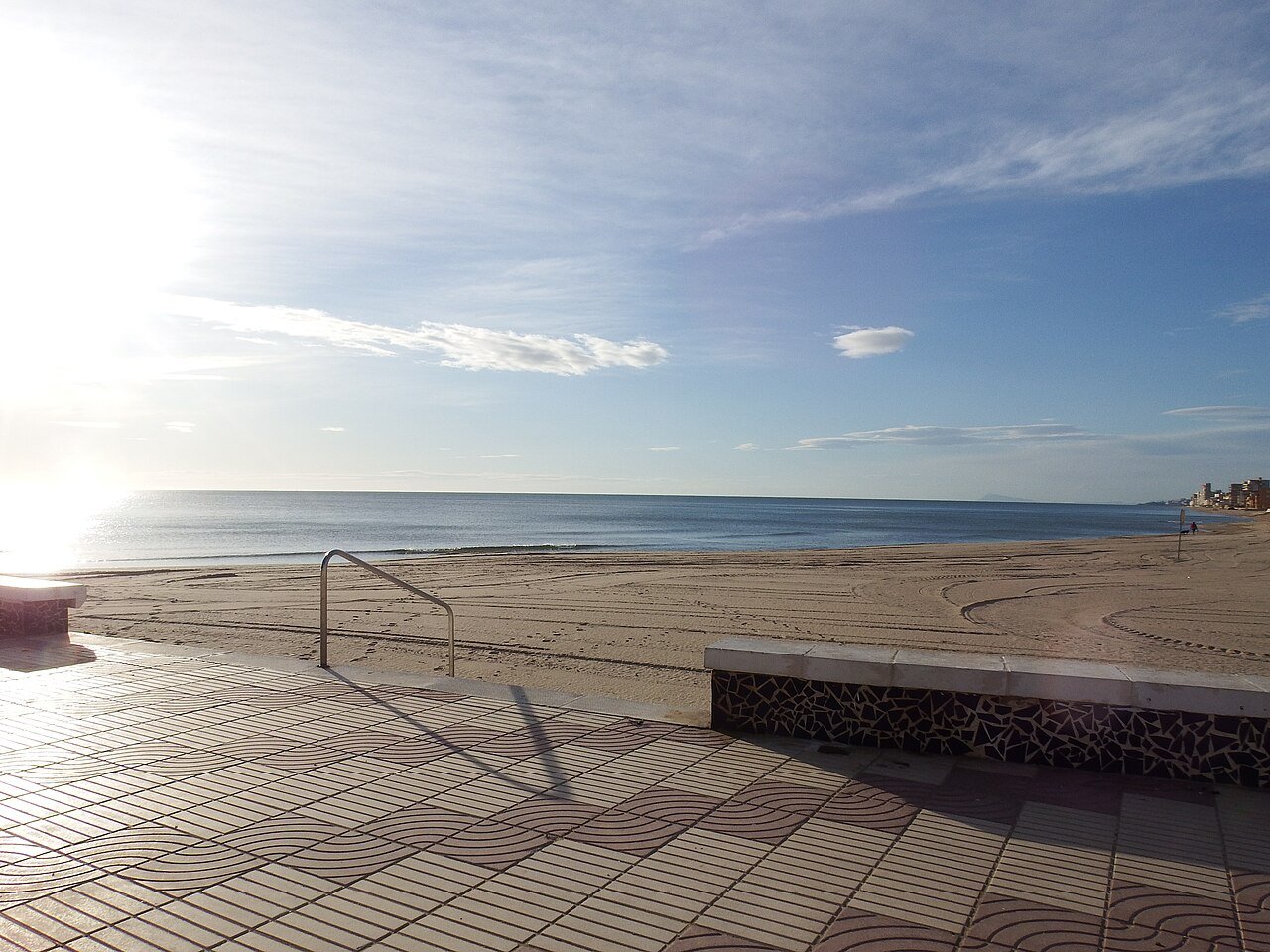
7. Playa de la Devesa: The Wild One
Keep going south from El Saler and the last of the services fall away. La Devesa is the protected heart of the Albufera shore: some five kilometres of beach backed by the full dune system and the pine forest of the Devesa del Saler, with no buildings, no promenade and no commerce — a beach kept deliberately as the sea made it, reached by walking or cycling from El Saler or by taking the coast bus to one of the forest entrances and crossing the dunes on the marked paths. Part of its length, well signed, is one of the coast’s authorised nudist areas; the rest is simply the quietest sand within reach of a Spanish city of this size.
What you get for the small effort is the Mediterranean as it was: dunes ribbed with marram grass, the smell of pine resin on the wind, water that starts clear and stays clear, and — even in August — the near certainty of a stretch of beach to yourself within ten minutes’ walk of the access points. What you must bring is everything: water, food, shade. There is nowhere to buy any of it, which is, of course, the entire appeal.
Two continuations belong to the same protected shore and the same outing, and are named here so the map in your head is complete: La Garrofera, the next stretch south with a small seasonal beach-bar area and a campsite behind the dunes, and L’Arbre del Gos, the last of the park beaches before El Perelló, quiet even by Devesa standards. Think of the whole El Saler-to-Perelló run as one wild beach with four names and choose your entry point by how much company you want: some, a little, or none.

8. Playa de El Perelló: The Village Beach
At the southern edge of the Albufera park, where the lagoon meets the sea through the Perelló canal, the wild shore hands back to civilisation in the shape of El Perelló — a small coastal town in the municipality of Sueca, famous in the province for its tomatoes and, in summer, for a broad, well-kept village beach with a mosaic-tiled promenade, a small marina, and the calm self-sufficiency of a place built for Valencian families’ second homes rather than for tourism. The sand is wide and groomed, the sea gentle, the services complete without being commercial — lifeguards, showers, play areas, a promenade of cafés and ice-cream stops.
El Perelló’s trump card is the double bill: beach in front of you, Albufera behind you. The canal at the town’s edge is one of the lagoon’s three mouths to the sea, and the rice fields begin at the town’s back door — so a beach morning here combines, more neatly than anywhere else on this coast, with a paella lunch in the rice country and a boat on the lake before sunset. Its little northern neighbour, El Perellonet, a few minutes up the coast road, offers a smaller, even quieter version of the same formula.
The town keeps village hours and village prices — the promenade lunch costs noticeably less than its Malvarrosa equivalent — and the coast bus from Valencia, or a half-hour drive, makes it an easy full-day outing. It is the beach this guide would send a family with a week in the city and a hire car: space, calm, good food, and the park on the doorstep.

9. Playa Racó de Mar, Canet d’en Berenguer: The Family Secret
Now jump the map thirty-five kilometres north, to the beach Valencian families have been quietly rating above all others for years. Canet d’en Berenguer is a small town whose beach, Racó de Mar, is a model of the Spanish family strand: a kilometre and a half of fine golden sand, wide enough never to feel full, fronted by a low promenade and backed in places by protected dunes crossed on boardwalks. It flies the Blue Flag season after season, the water is clean and gently shelving, the lifeguard and services setup is complete, and the atmosphere is holiday flats and grandparents rather than beach clubs and bachelor parties.
The secret is really a ratio: Racó de Mar offers city-beach quality with a village’s crowd. Valencians from the capital and from Sagunto, ten minutes inland, fill it on August weekends and still find room; on weekdays it can feel semi-private. The town behind it supplies the full supporting cast — supermarkets, bakeries, a modest line of restaurants and the small marina at its northern end — without any of the resort machinery of the big names further south.
Trains run from Valencia to Sagunto, with Canet a short bus or taxi hop from there, and drivers will find it an easy half-hour up the motorway. If your idea of a beach day is a towel, a paperback and a long lunch — and a child or two building something ambitious in the sand — this is your beach.
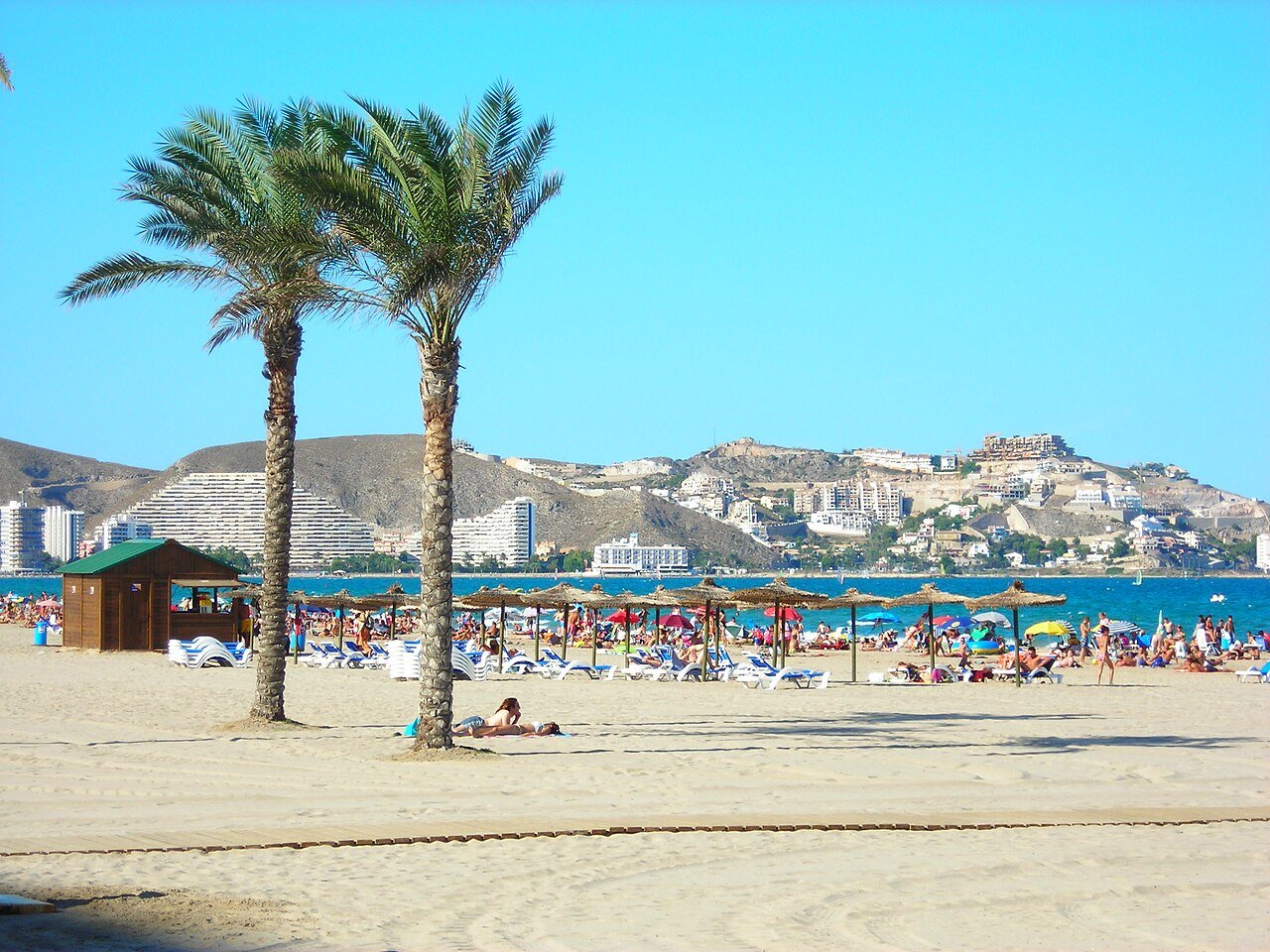
10. Playa del Puerto de Sagunto: The Castle-and-Beach Day
Sagunto’s port, half an hour north of Valencia, holds one of the most under-visited beaches on this coast — and pairs it with one of the great half-days of sightseeing in the province. The Playa del Puerto de Sagunto is a long urban strand of fine sand running south from the harbour: broad, well serviced, promenaded, popular with the town and barely known to foreign visitors, with the sea doing its usual gentle shelving trick and the beach bars doing theirs.
The pairing is the point. Five kilometres inland rises Sagunto itself: a hill crowned by a vast castle whose walls run for nearly a kilometre — Iberian, Roman, medieval in layers — with a Roman theatre below it and one of Spain’s best-preserved Jewish quarters in the lanes between. Castle in the cool of the morning, a wander through the old town, then down to the port for a swim and a late seafood lunch on the promenade: it is a complete Valencian day that almost nobody on the Malvarrosa has thought of, and the trains between Valencia and Sagunto make it effortless without a car — the beach is a bus ride or a long flat walk from the station side of town.
Choose it when the trip needs one day that is more than a beach day. The sand will not beat La Devesa’s, and nobody claims it does; the day as a whole takes some beating.
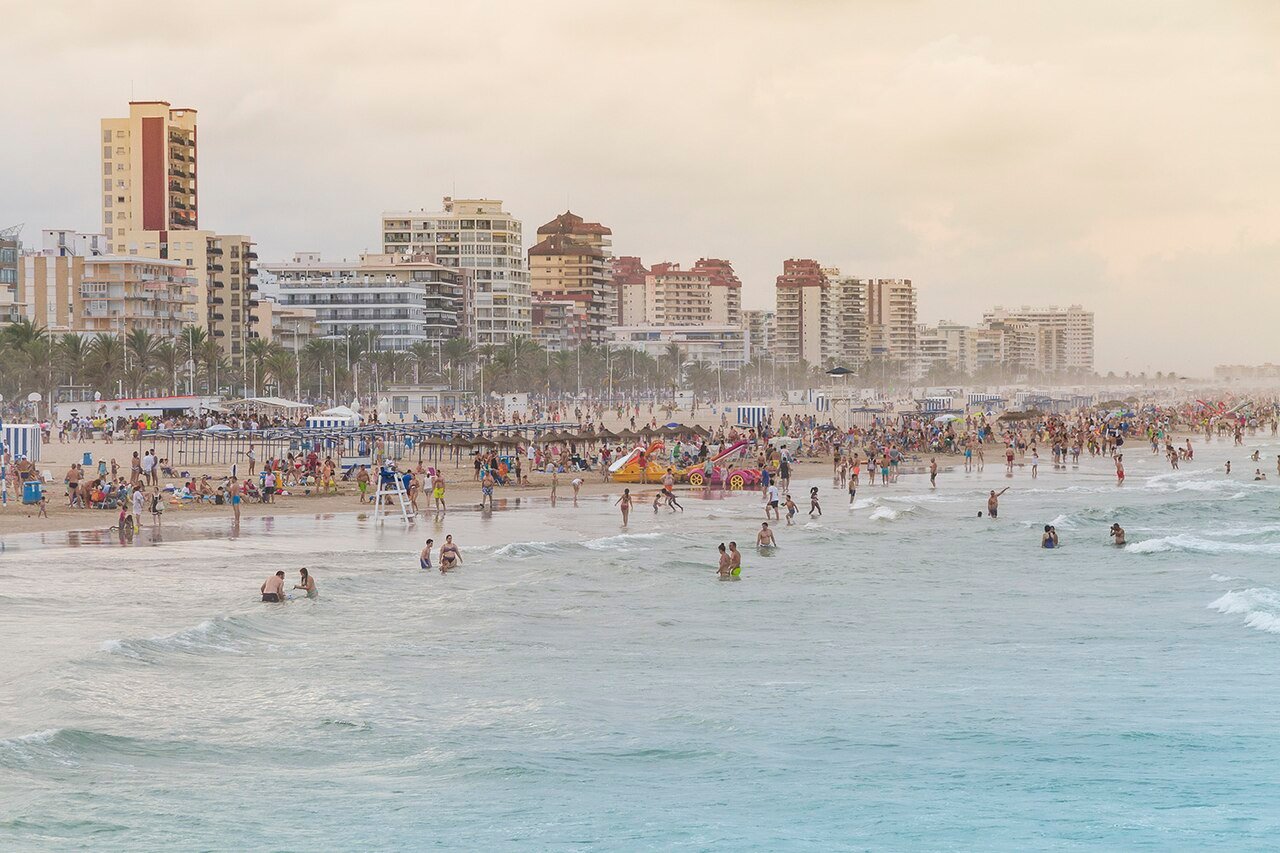
11. Playa de San Antonio, Cullera: The Sheltered Bay
Forty kilometres south, the coast folds around the one harbour-shaped bay in the province. Cullera stands where the Júcar river meets the sea, under a castle-crowned hill, and its main beach — Playa de San Antonio — sweeps around the bay’s sheltered southern curve: fine golden sand, a full promenade of hotels, restaurants and beach bars, and water measurably calmer than the open coast on the days when the wind gets up, because the headland of the Cap del Far takes the weather first. For swimmers who like their sea flat, and families who like it predictable, that shelter is worth the journey by itself.
Cullera is a resort in the honest Spanish sense — apartment towers, summer crowds, everything rentable — set inside a town with real history layered on top: the castle and sanctuary on the hill above the beach, the lighthouse on the headland at the bay’s far end, the river mouth and the fishing port to the north, where the town’s quieter beaches run on. A beach day here scales to appetite: San Antonio for the full works, the lighthouse end for a walk and a view back across the whole bay, the old town for lunch if the promenade palls.
Trains from Valencia’s Estació del Nord reach Cullera in about half an hour on the commuter line, which makes this the easiest of the out-of-town beaches to do without a car — and on a windy August day, when the city shore is all flying sand, the sheltered bay is the smart money.
12. Playa de Gandía: The Big Resort Beach
The list ends with the full orchestra. Playa de Gandía, an hour south of Valencia by train, is regularly counted among the best urban beaches in Spain, and standing on it you understand why: three kilometres of exceptionally wide, fine golden sand — so wide the beach seems to have districts — washed by clean, gently shelving water, backed by a promenade of palms, hotels and apartment towers, and serviced to the last sunshade. Everything a resort beach is supposed to have, Gandía has in depth: lifeguards, sports areas, beach clubs, children’s zones, accessible bathing, and a summer programme that runs from morning yoga to midnight.
What lifts it above the package-holiday stereotype is the town behind it. Gandía proper, a few kilometres inland, was the seat of the Borgias — the Borja dukes — and its ducal palace is one of the great houses of Spain; the historic centre has the churches, squares and café life of a real Valencian city, not a resort façade. Beach Gandía and town Gandía operate as one destination: sand all day, palace and old town in the cool of the evening, and trains back to Valencia until late.
Is it worth an hour each way when La Malvarrosa is fifteen minutes from the centre? For a dedicated beach day in high summer — when you want the best sand, the most space and the complete resort apparatus — Valencians themselves answer yes every weekend. That is the highest rating this guide gives.
Which Beach Suits You?
Here for a weekend? La Malvarrosa once (tram, swim, promenade paella) and Las Arenas once — two afternoons, the whole city-beach story, no logistics. Staying a week? Make Patacona or Pinedo your local and keep the Malvarrosa for the postcard morning. Travelling with small children? Port Saplaya’s sheltered water and Canet’s space and shallows, in that order. Want wild? La Devesa, with El Saler as the civilised version — and pack provisions like you mean it. Beach plus sightseeing? Sagunto for the castle, Cullera for the castle and the sheltered bay, Gandía for the Borgia palace after the sand. Windy forecast? Cullera’s bay. Evenings matter as much as mornings? Base yourself by the city shore and end the day where Valencians do — dinner in El Carmen, after a sunset that the whole promenade turned out to watch.
What a Beach Day Costs
Valencia’s beaches charge no entry, and the honest headline is that a beach day here costs whatever lunch costs. The tram or bus to the city beaches is a standard city fare; the coast buses south to El Saler and El Perelló are ordinary interurban tickets; a lounger-and-umbrella set on the serviced beaches, a beer at a chiringuito and an ice cream on the promenade are all priced for locals, not for tourists in a captive market. Shopping for a picnic first — fruit, bread, cheese, tomatoes — at one of the city markets in our Valencia markets guide can put a first-rate beach lunch for two in a bag for under €10; the promenade paella lunch, the day’s one splurge, is priced like the serious restaurant meal it is. The single organised extra in this guide is priced with the same fairness: the Valencia: Sailing Catamaran with Swimming & Optional DJ at from $28.01 — ninety minutes out on the water with a swim in the open sea, free cancellation up to 24 hours ahead, and reserve now & pay later if your plans are still fluid.
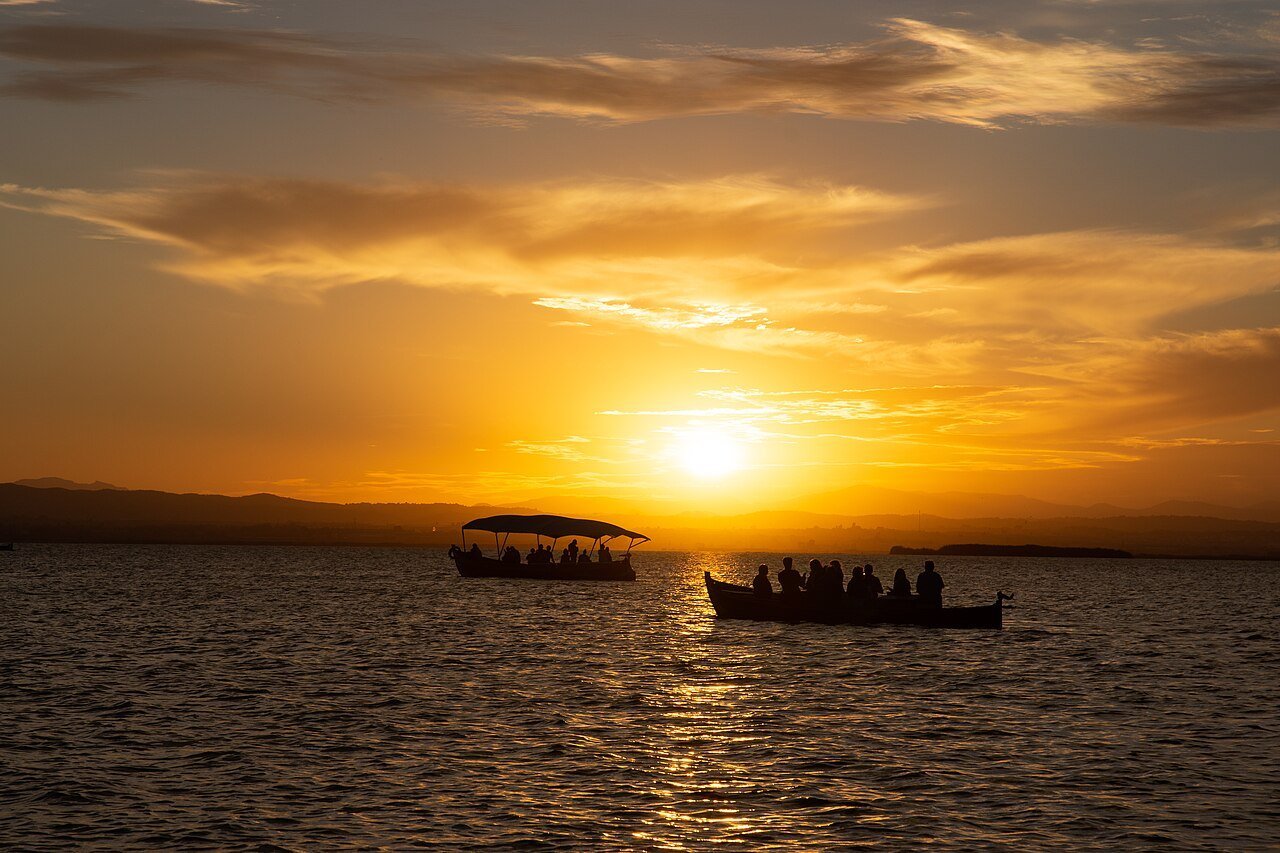
Albufera Natural Park: The Complete Guide to Valencia’s Lake, Rice Fields and Sunsets
Travel insurance, sorted
Whether it is a two-week holiday or a longer move, travel insurance is not the most glamorous part of a trip — but it is the one booking you want to have in place before a trip, and while you are already away. Get a quote from SafetyWing
Final Thoughts
Most great cities keep their beach at arm’s length — a suburb, an excursion, a compromise. Valencia wears hers as a second centre: the same tram system, the same lunch culture, the same city, ending in sand. And the shore refuses to be one thing. It is Sorolla’s painted light on La Malvarrosa and a fisherman’s dawn at Las Arenas; a Little Venice for toddlers and five kilometres of protected emptiness at La Devesa; a castle above Cullera’s bay and the Borgias waiting inland from Gandía’s towers. Pick the famous one first, by all means — then take the bus south one morning, walk out across the dunes, and find the Mediterranean the colour it is in the paintings, with nobody’s towel within fifty metres of yours. Both beaches are Valencia. That’s the whole point of the city. For everything else the city does beyond the sand, start with our guide to the best things to do in Valencia.
FAQs: Valencia Beaches
What is the best beach in Valencia?
La Malvarrosa, for the complete package — the widest sand, the full promenade, the paella restaurants and the art history. La Patacona is the better choice for a quieter local feel, El Saler and La Devesa win outright for nature, and Playa de Gandía is the finest full resort beach within day-trip range.
When is the best time of year for Valencia’s beaches?
June and September are the sweet spots — hot sea, long days, thinner crowds. July and August are the full summer peak. The sea stays swimmable into October, May is warm enough for most visitors, and the city beaches are worth a promenade walk on any sunny day of the year.
Are Valencia’s beaches sandy or pebbly?
Sandy — fine golden sand is the rule along this whole coast, from La Malvarrosa to Gandía. A few spots mix in a little shingle at the waterline (parts of La Devesa can), but you will not need beach shoes anywhere in this guide.
Can you swim at Valencia’s beaches all year?
You can walk them all year, and hardy locals swim in most months, but the lifeguarded bathing season runs through the summer — daily cover roughly from June to mid-September. Outside it, swim cautiously, check the flags where they fly, and expect water nearer 14–18°C than the 25–26°C of August.
How do you get to the beaches from Valencia city centre?
The tram serves the city beaches (Las Arenas and La Malvarrosa) in about twenty minutes from the centre; buses run south down the coast road to Pinedo, El Saler, La Devesa and El Perelló; and commuter trains cover Sagunto, Cullera and Gandía. Every beach in this guide is doable without a car.
Which Valencia beach is best for families?
Canet d’en Berenguer’s Racó de Mar for space, shallows and a family-first atmosphere; Port Saplaya for the calmest water for very small children; and Las Arenas or La Malvarrosa for the fullest facilities — lifeguards, adapted access, play areas and lunch on the promenade.