Iglesia del Salvador Seville: The Complete Guide to the Church of the Saviour
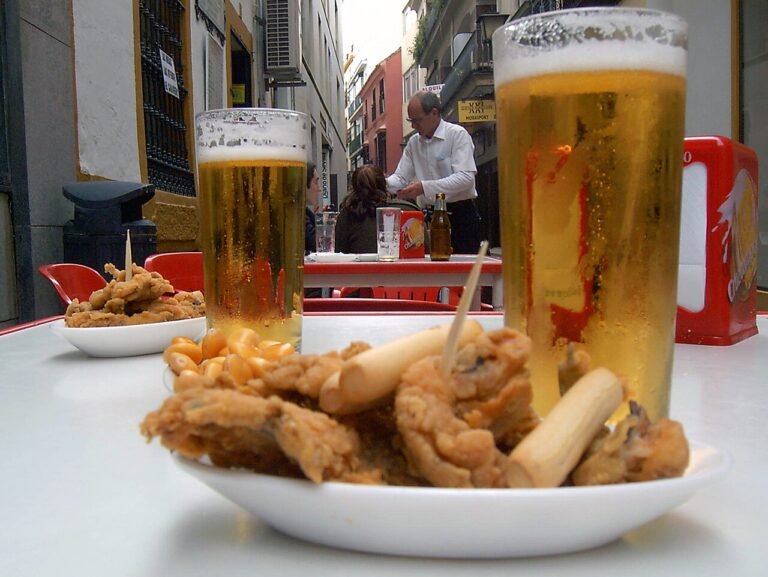
Every visitor to Seville photographs the same church twice without noticing — once deliberately (the Cathedral, three hundred metres away), once by accident, because the great salmon-red façade filling the top of your Plaza del Salvador bar photograph — orange trees, beer terraces — belongs to a church almost nobody goes inside. That is a mistake: behind the sober red front stands the second-largest church in Seville and one of the great Baroque interiors of Spain.
The site is older than the city around it is willing to admit. In 829–830 the mosque of Ibn Adabbas rose here and served as Seville’s main congregational mosque for three and a half centuries. Ferdinand III made it a church in 1248, it grew into the city’s collegiate church — second only to the Cathedral — and when the old building finally gave out, Seville replaced it with the vast hall of stone and gold you see today, finished in 1712 by Leonardo de Figueroa after collapsing once during its own construction.
This guide explains the mosque beneath the church, walks you through the orange-tree courtyard, the dome, Cayetano de Acosta’s overwhelming main altarpiece and the sculptures by Martínez Montañés and Juan de Mesa that Sevillians carry through the streets every Holy Week — plus the one ticket that opens both this church and the Cathedral, and the trick that lets you buy it here and skip the Cathedral queue.
Short Answer
The Iglesia Colegial del Divino Salvador stands on Plaza del Salvador, in the heart of the old town, 300 metres from the Cathedral. It is Seville’s second-largest church: a Baroque hall church built 1674–1712 over the mosque of Ibn Adabbas, whose ablutions courtyard survives as the Patio de los Naranjos. Entry is included in the Cathedral and Giralda ticket (€13 online, €14 at the desk), or buy a Salvador-only ticket for €7 online / €8 at the desk with the audioguide included. Allow 45–75 minutes.
The cultural visit runs Monday–Thursday 10:15–18:00, Friday–Saturday 10:15–17:00 and Sunday 14:30–19:30, the ticket desk closing half an hour earlier. If you want both churches explained rather than merely opened, the Cathedral, Giralda and El Salvador guided tour starts inside El Salvador — mosque courtyard, altarpieces, Montañés sculptures — then walks you to the Cathedral and up the Giralda with skip-the-line entry. Check catedraldesevilla.es for current prices and hours before you go.
Table of Contents
- The Short Version: Is El Salvador Worth It?
- A Mosque Before It Was a Church: Ibn Adabbas and the Patio de los Naranjos
- Collapse and Rebirth: Building the Baroque Church
- The Façade and the Plaza: Seville’s Living Room
- Inside: A Hall of Stone, Gold and Height
- The Main Altarpiece: Acosta’s Transfiguration
- Montañés and Mesa: The Sculptures Sevillians Carry Through the Streets
- The Chapels: Fourteen Altarpieces Around the Walls
- Below and Behind: The Crypt, the Museum and the Roofs
- Holy Week Headquarters
- Practical Info
- Tips That Will Improve Your Visit
- Final Thoughts
The Short Version: Is El Salvador Worth It?
Yes — and the honest reason is arithmetic as much as art. Your Cathedral ticket already includes this church, so the only way to waste money is not to come. What you get for the five-minute walk is the Cathedral’s perfect opposite: where the Cathedral is a Gothic mountain range of separate spaces, El Salvador is one unified, light-filled hall holding two of the most famous sculptures in Spanish art.
It belongs on any serious list of things to do in Seville. The caveats are small: it is a working church, so a wedding, a funeral or a brotherhood ceremony can close parts of it without warning; and it is unapologetically Baroque — if acres of gilded wood leave you cold, the Cathedral’s Gothic will suit you better. Everyone else: come in the morning, and come before the Cathedral, not after.
A Mosque Before It Was a Church: Ibn Adabbas and the Patio de los Naranjos
In 829–830, under the emir Abd al-Rahman II, Seville’s qadi Ibn Adabbas ordered a congregational mosque built here, on ground already old with Roman and Visigothic remains. By tradition it was the second mosque raised in al-Andalus after Córdoba’s, and for 350 years it was the religious centre of Muslim Seville: a hypostyle hall of eleven aisles on brick arches and reused marble columns. Only in 1182, when the Almohads opened their new great mosque — the one whose minaret is now the Giralda — did it lose the title.
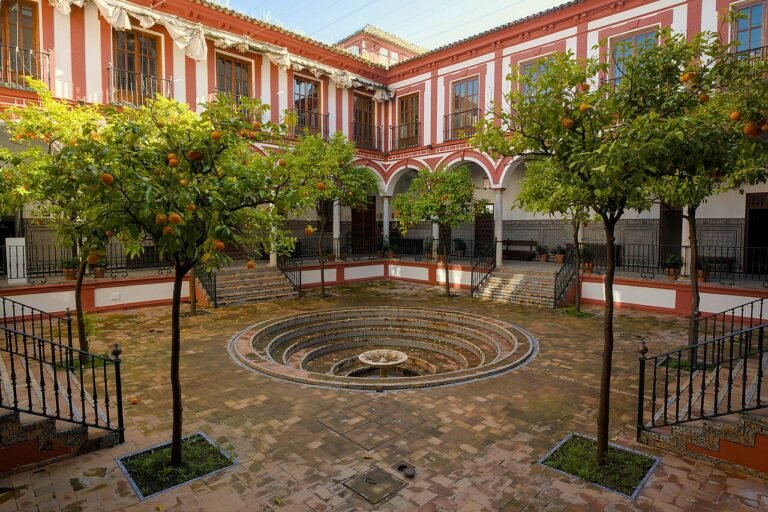
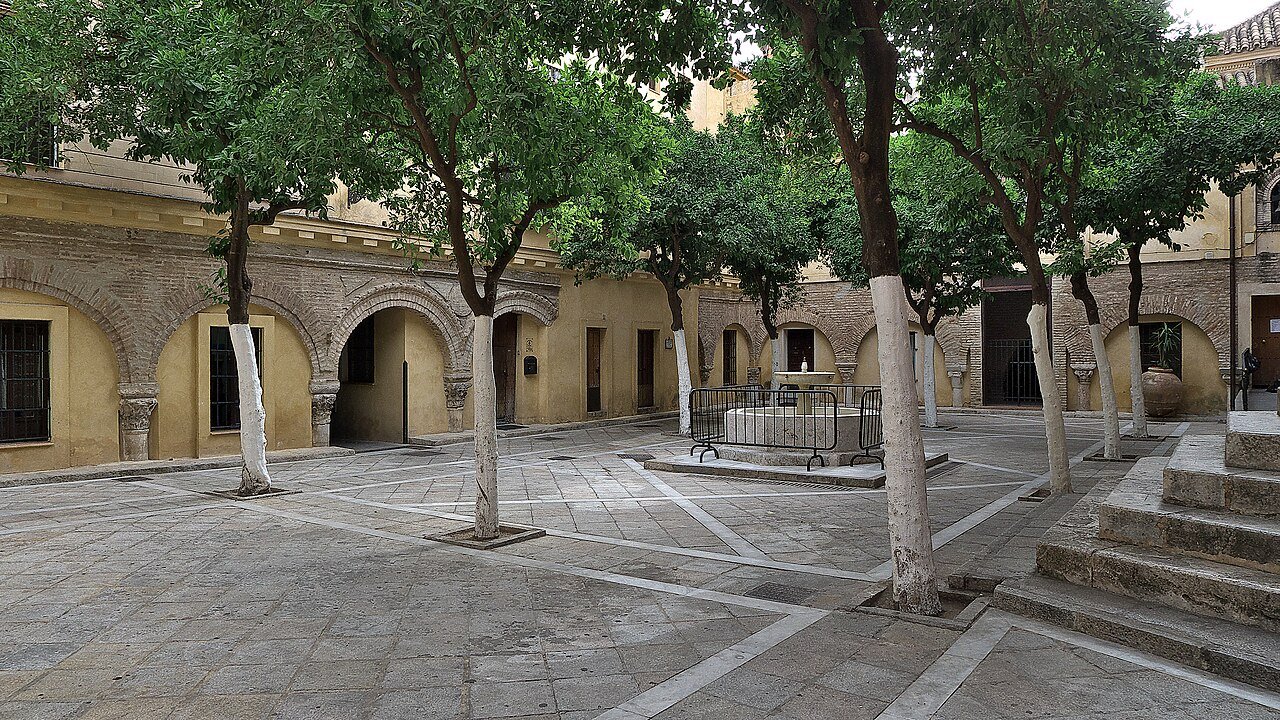
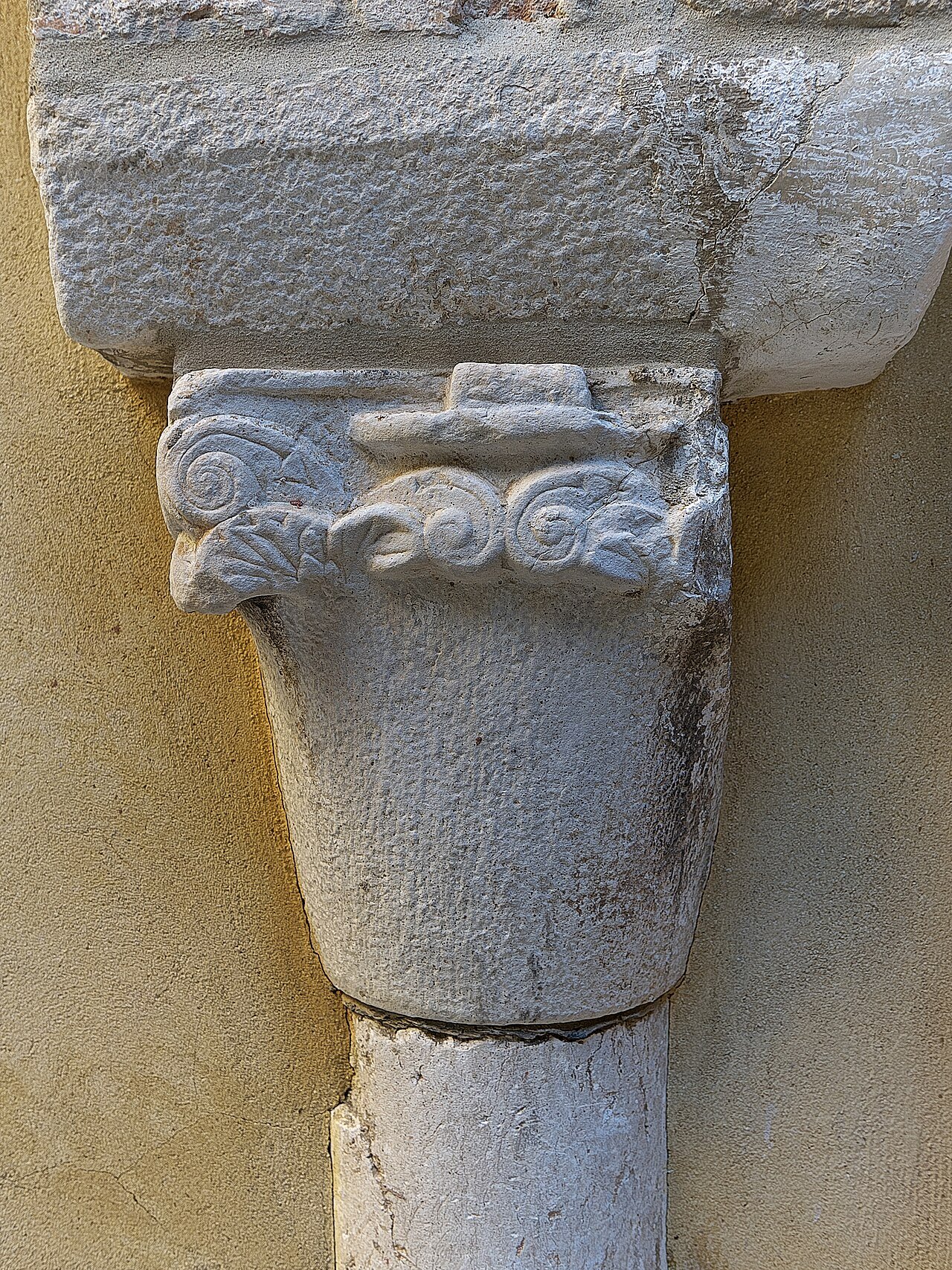
Two pieces of the mosque survive in plain sight. The first is the sahn, the ablutions courtyard, today’s Patio de los Naranjos: orange trees, a central fountain, and a perimeter arcade of brick horseshoe arches on columns far older than the mosque itself — Roman and Visigothic shafts and capitals, recycled by the builders of 830. Run your eye along the capitals: no two match — none were carved for this building. Worshippers still cross the patio to pray in the Sacramental Chapel, entering free through the Calle Córdoba door as their predecessors crossed it to wash.
The second survivor is under the bell tower, which reads in three bands: a Caliphal ashlar base that was the mosque’s minaret, a middle section rebuilt after the earthquake of 1356, and an upper stage finished by Leonardo de Figueroa in 1718–1719. One tower, three Sevilles stacked on top of each other.
After Ferdinand III took Seville in 1248 the mosque was consecrated to the Divine Saviour and in time raised to a collegiate church — the full apparatus of the city’s second temple. The mosque-church served four centuries, but the ground rose around it: by the 1600s you descended some twenty steps to enter. In 1671 the decision was taken to demolish it and start again.
Collapse and Rebirth: Building the Baroque Church
The new church’s first campaign ended in the worst way a building can. Through the 1670s the walls and vaults rose — and in 1679, with the church practically complete, the vaults came down. The collapse came on 24 October 1679, hours before its dedication. The cause, established later, was embarrassingly human: the timber centring and formwork had been struck too early. Seville picked up the pieces and started over.
The façades of the rebuild were designed in 1682 by José Granados de la Barrera, architect of Granada Cathedral. The works passed through several hands until, in 1696, they reached the man who defines the Sevillian Baroque: Leonardo de Figueroa. Figueroa closed the vaults — carefully, this time — built the great dome and composed the interior’s decoration, and in 1712 the church was finished. Follow the same hand twenty minutes north to his San Luis de los Franceses: the same architect at twice the intensity in a quarter of the space.
The church’s institutional life thinned as its fabric was renewed. In 1852 the collegiate chapter was dissolved and El Salvador became a parish church — which is why the “Colegial” in its name is now a courtesy title. Then, between 2003 and 2008, came the great modern restoration, directed by Fernando Mendoza Castells; the church was re-inaugurated on 22 October 2008 in the presence of King Juan Carlos I, and the restoration won Spain’s National Restoration Award. One quiet consequence: El Salvador lost its parish rank and today functions as an exempt church within the parish of San Isidoro — a monument that is also, stubbornly, a place of daily worship, with Mass every evening at 20:00.
The Façade and the Plaza: Seville’s Living Room
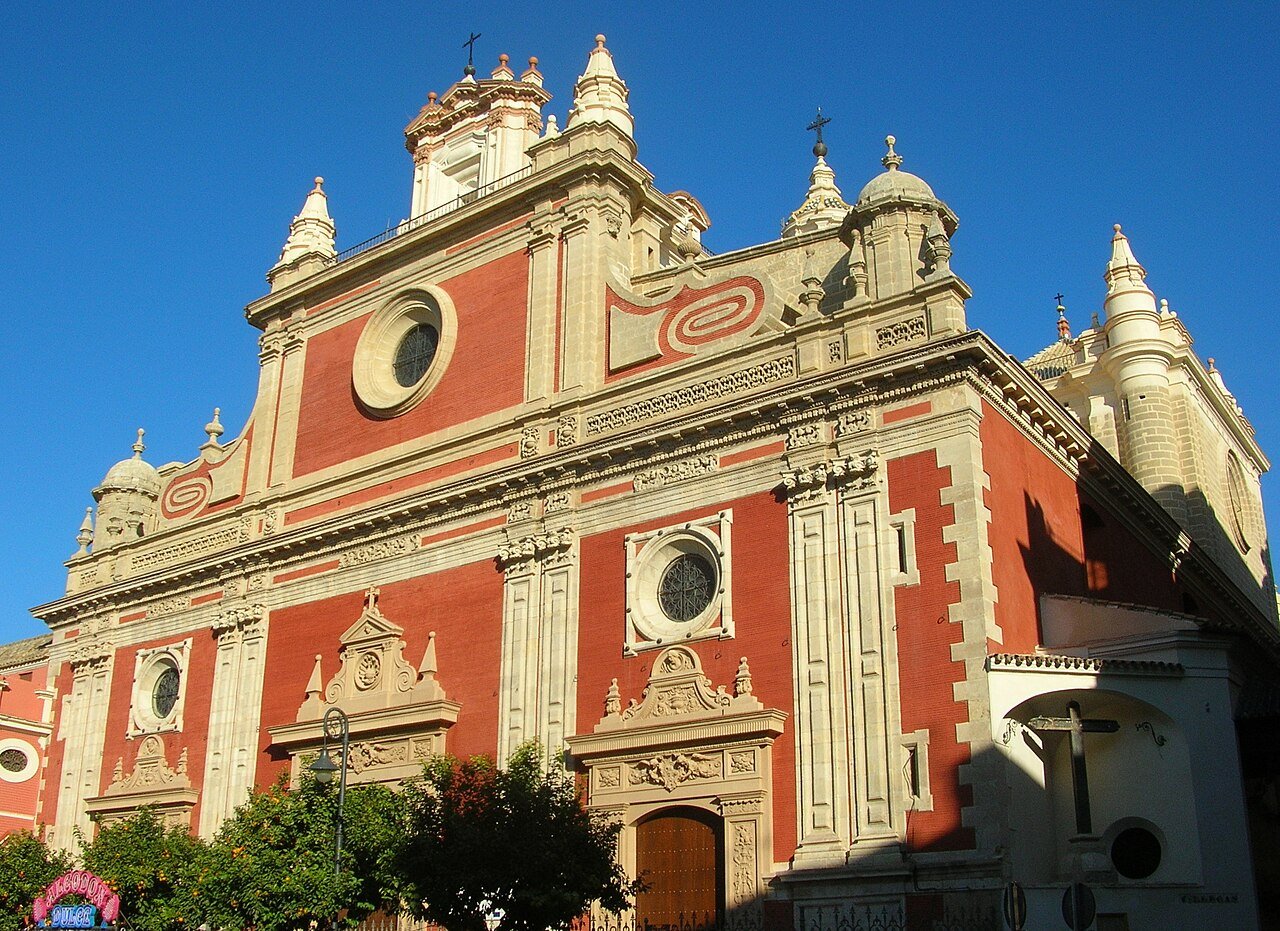
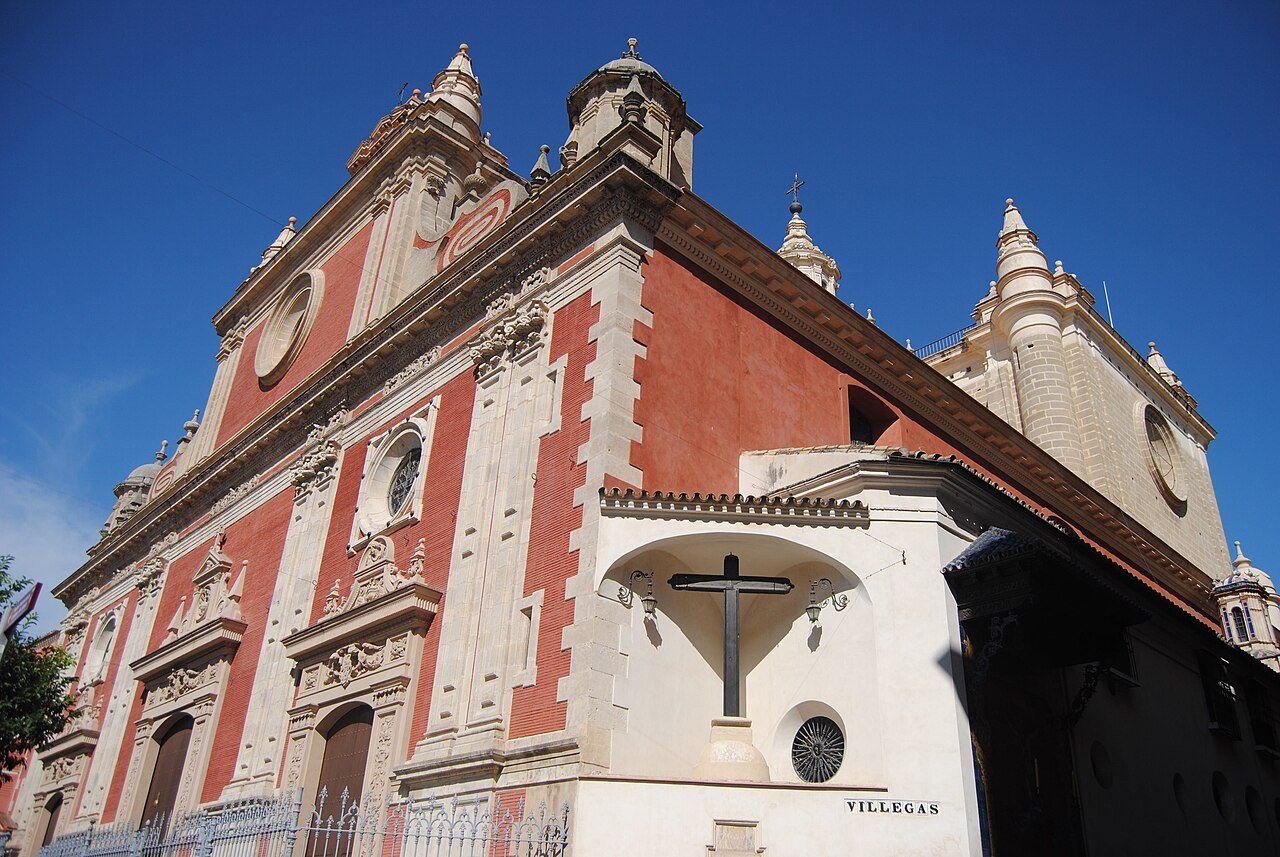
Stand in the plaza and read the front. The two-tone scheme — warm salmon-red brick panels set in pale stone — is Seville’s civic Baroque livery, the same bicromía the city used on the Lonja two centuries earlier. For all the interior’s fireworks, the façade is restrained to the point of Mannerist severity: giant pilasters, three round windows, carved portals, a skyline of turrets and pinnacles around the bell gable. The present façade, though, dates only from the end of the 19th century, and the grand original scheme — a tower flanking each side — was never built.
At the church’s right-hand corner, where Calle Villegas begins, an open whitewashed chapel holds a plain dark cross: the Cruz del Cementerio, cross of the old parish burial ground, which once stood in the middle of the square. And the square itself is the point. Plaza del Salvador is Seville’s living room — a near-permanent festival of standing bars and orange trees, where a bronze Martínez Montañés, the sculptor whose masterpieces wait inside, keeps an eye on the terraces. Order a caña and look up: you are doing exactly what the plaza is for. Then go inside — the contrast between the square’s noise and the church’s hush is part of the visit.
Inside: A Hall of Stone, Gold and Height
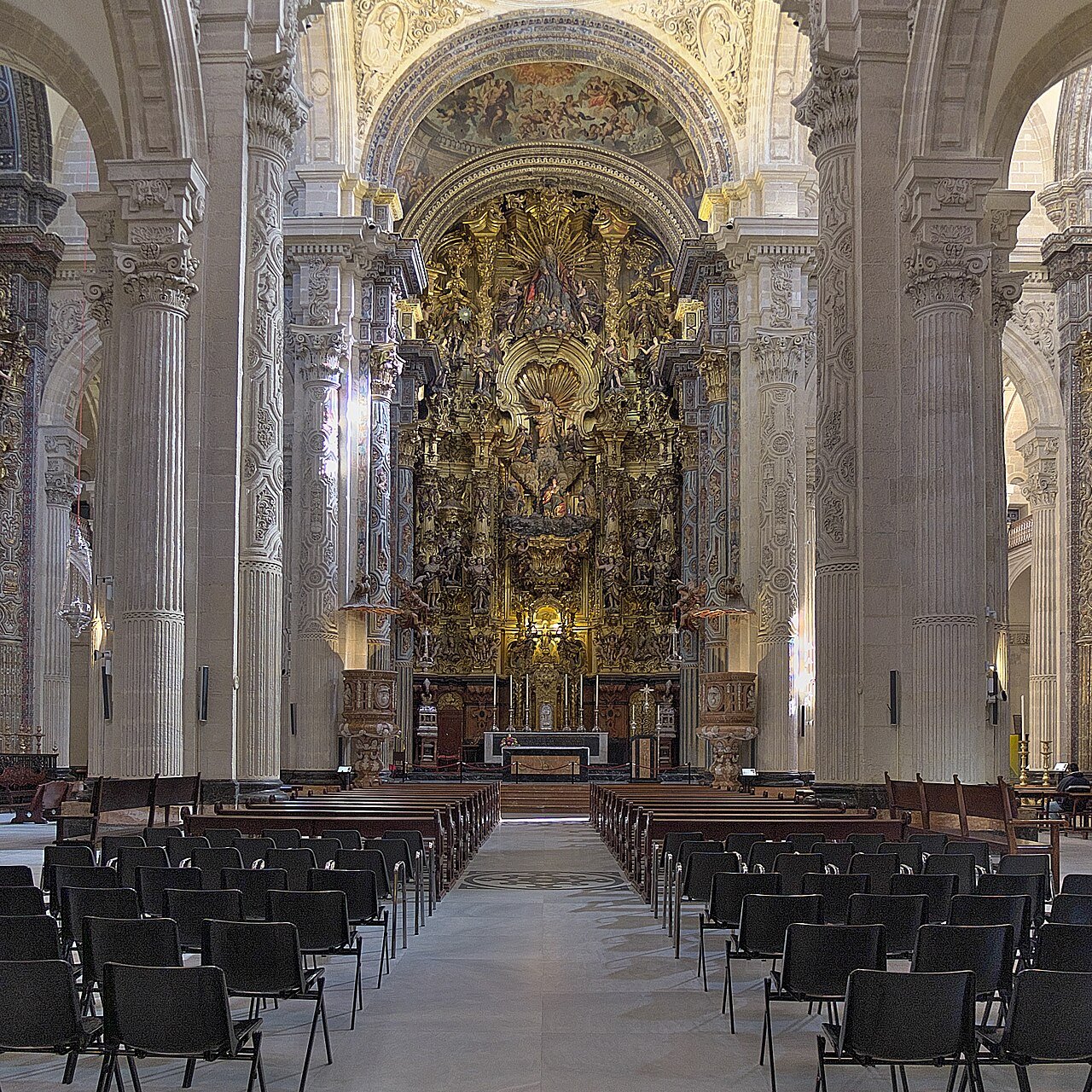
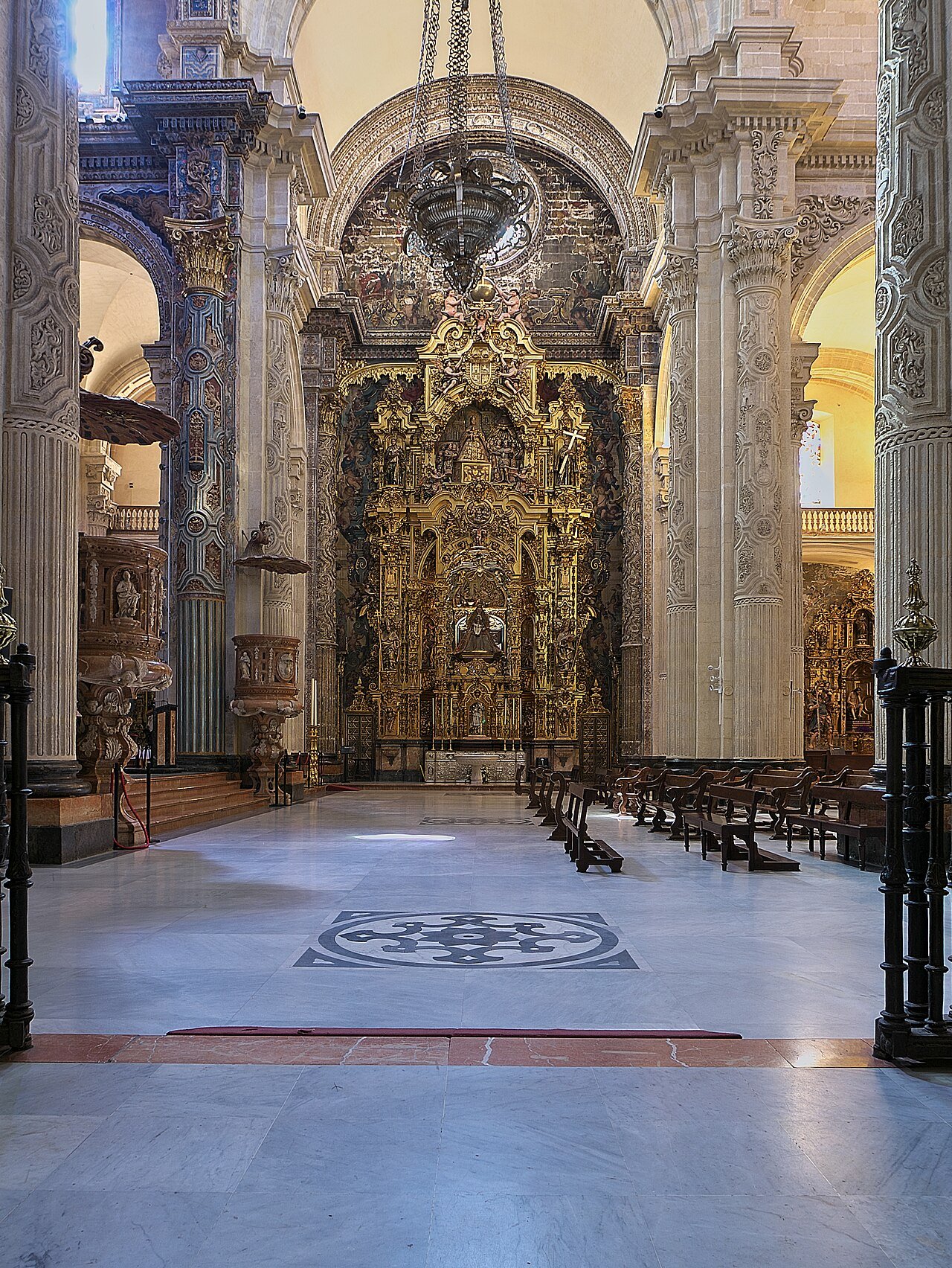
The plan is a great rectangle and the section is the surprise: this is a hall church, its three naves rising to vaults of almost equal height, giving one enormous, even, luminous room — the only church of its kind in the region. Massive pillars fronted with fluted columns carry it, their capitals gilded; around the sanctuary the carving tightens into stone embroidery mixing Eucharistic symbols with the castles and lions of Castile and León.
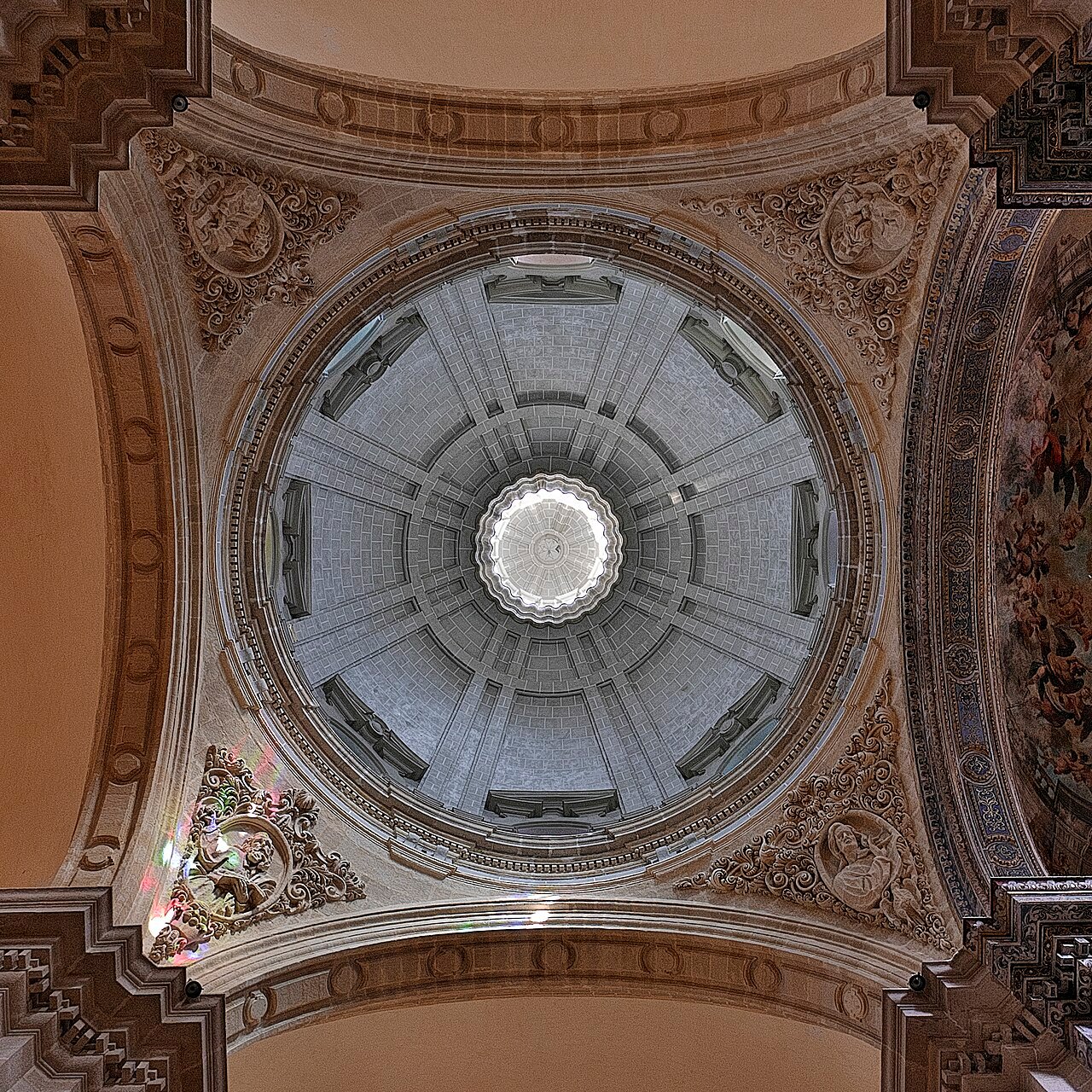
At the crossing, the dome: an octagonal cupola on a high drum, ringed with windows and crowned by a lantern — Figueroa’s signature piece of engineering-as-theatre. The light deserves its own sentence. The stained glass, installed in 1870 under the patronage of the Dukes of Montpensier, fills the drum windows with jewel-toned geometry, and on a sunny morning throws patches of violet, green and red across the pale stone. Stand under it around midday: the whole upper church is a lantern, and the room below is lit like a stage.
The Main Altarpiece: Acosta’s Transfiguration
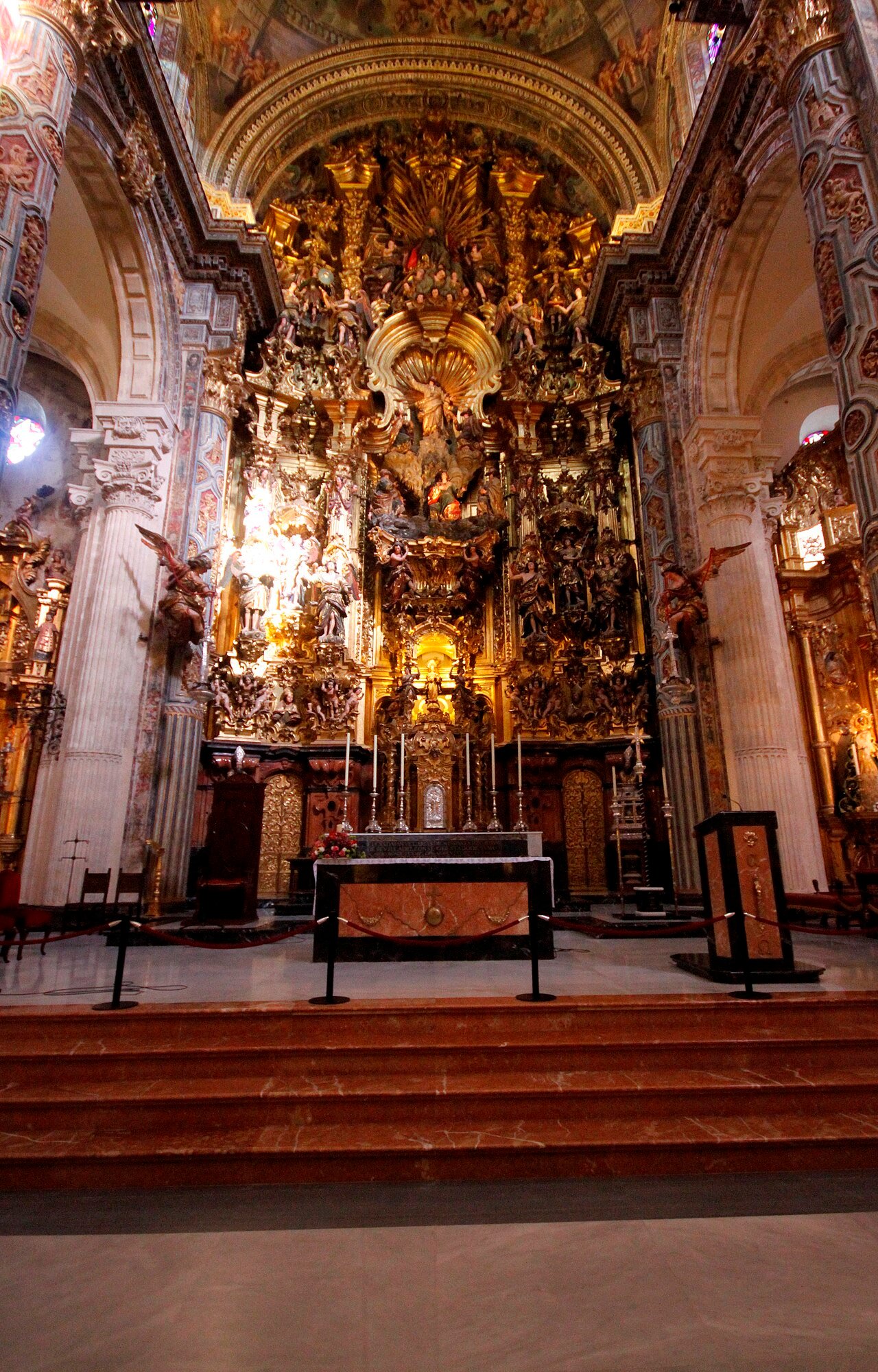
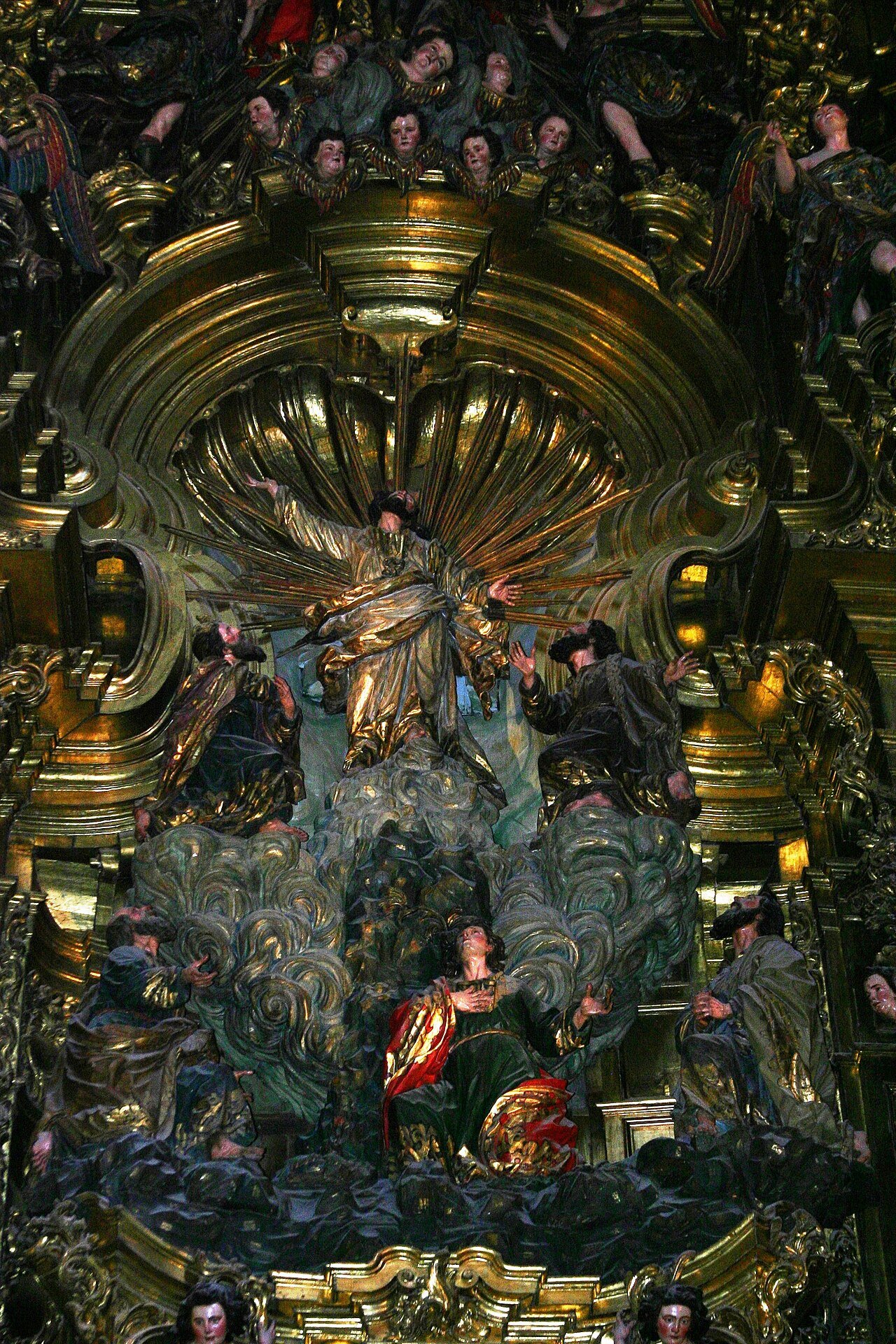
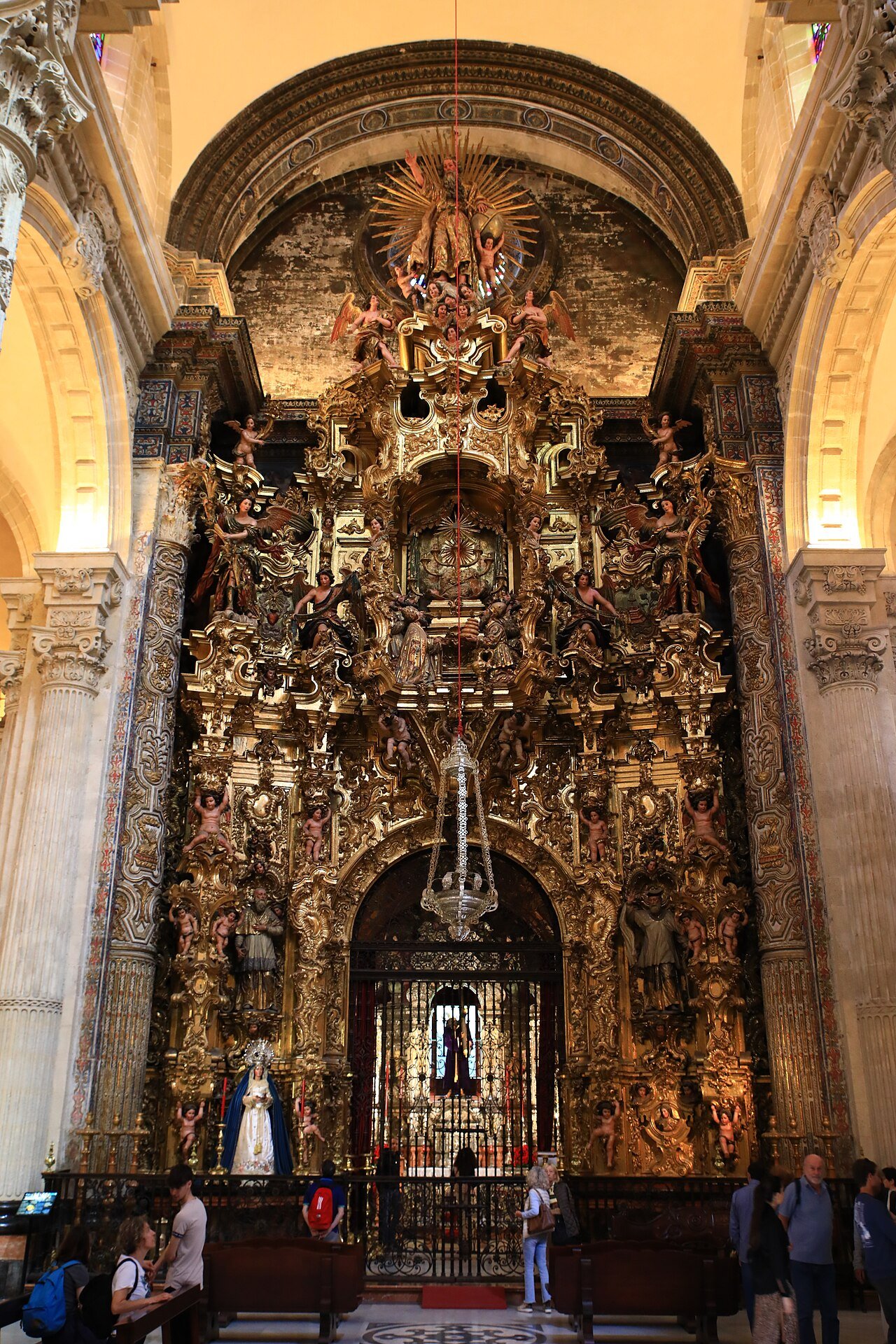
Give the main altarpiece time. Cayetano de Acosta — the last great master of the Sevillian altarpiece — built it between 1770 and 1778, and it is both a mountain of gilded wood and a piece of precision theology. The subject is the church’s dedication made visible: the Transfiguration, the moment the Saviour showed his divinity. At the centre, inside a vast gilded scallop shell, Christ stands radiant between Moses and Elijah, robes white and gold, carved rays bursting behind him; below, Peter, James and John shield their eyes.
Read the rest of the programme around it: the Immaculate Conception over the tabernacle; the Doctors of the Church in the lower register; six archangels — Jegudiel, Raphael, Barachiel, Gabriel, Michael and Sealtiel — attending from the sides; and Acosta’s two great ángeles lampadarios, lamp-bearing angels hovering on the sanctuary pillars. Late in the morning, when sun reaches the camarín, the gold ignites from the inside: the single most theatrical square metre in Seville — and this church is full of competition.
Free Seville travel guide
Planning a trip to Seville? Get our free one-page Seville checklist: what to book ahead, what to skip, and the tapas bars we actually eat in.
Montañés and Mesa: The Sculptures Sevillians Carry Through the Streets
Two images here anchor Spanish Baroque sculpture, carved by master and pupil a generation apart.
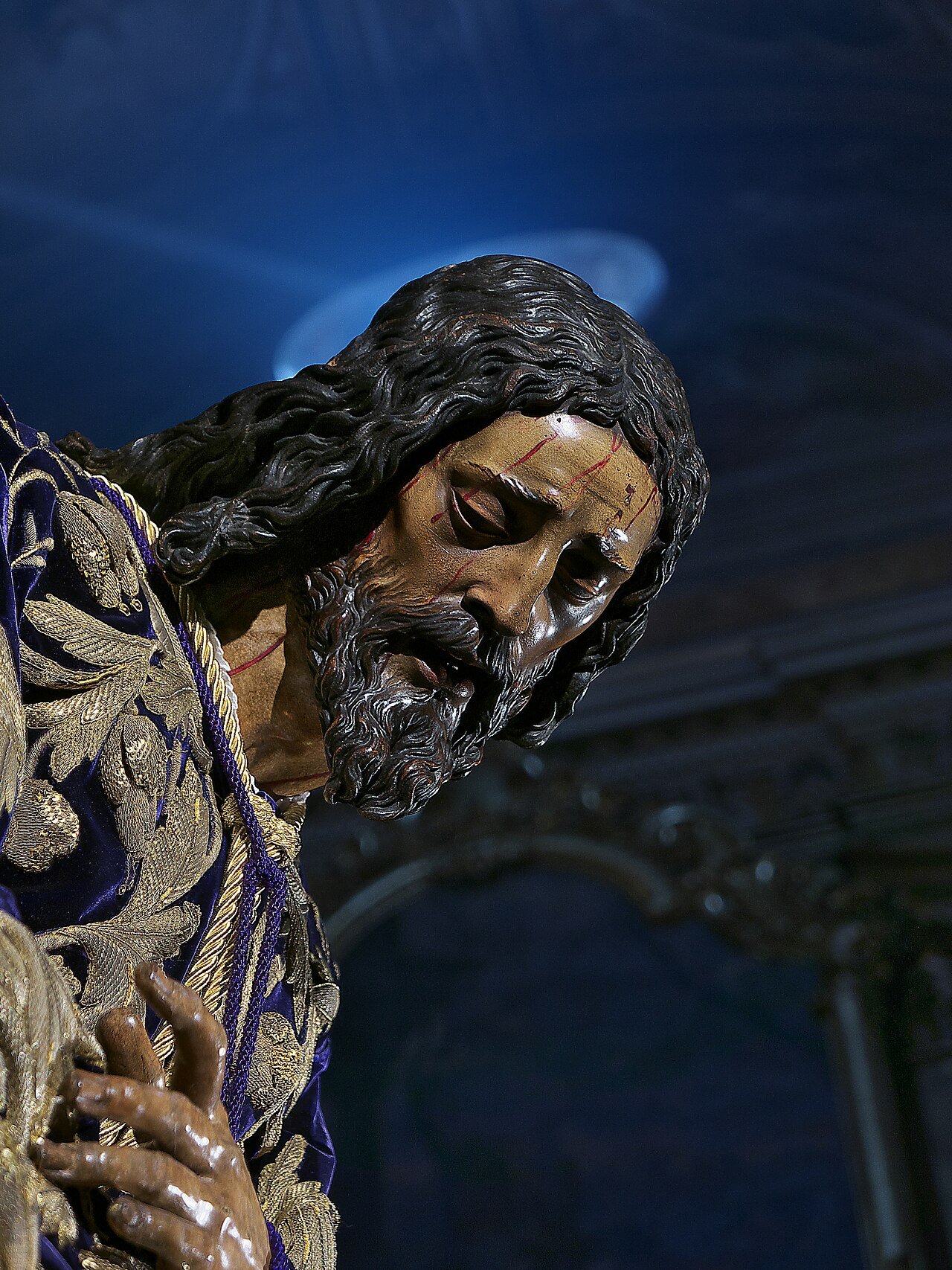
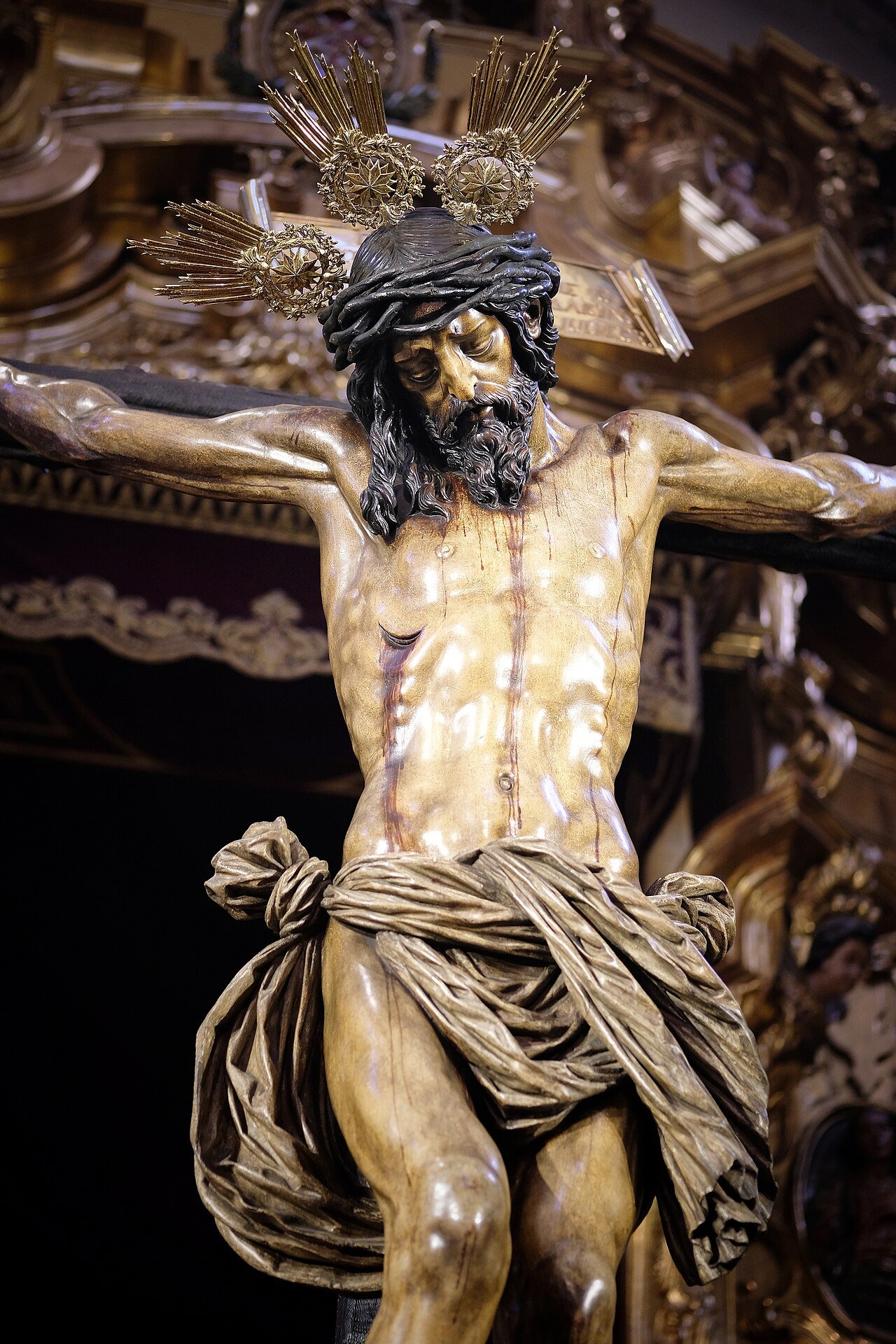
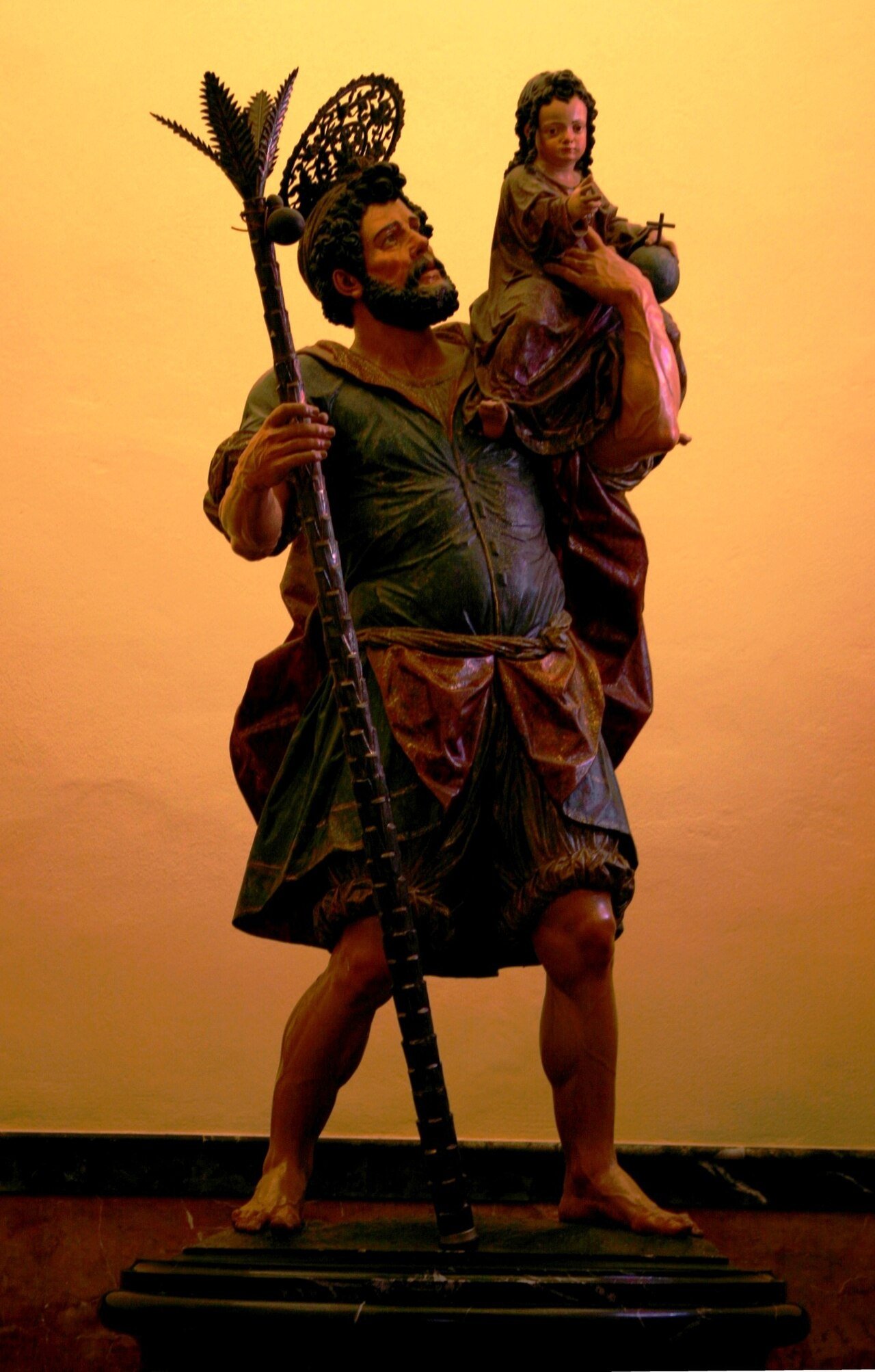
The elder is Juan Martínez Montañés, the “god of wood”. His Jesús de la Pasión (1615) waits in the Sacramental Chapel: Christ bowed under the cross, head fallen to one side, eyes half-closed in an exhaustion so complete it reads as tenderness, in a purple velvet tunic embroidered in gold. In person, the face — thorn scratches, parted lips — justifies every word of the reputation. The young Montañés is here too: the San Cristóbal of 1597 in the baptistery, among his earliest works, the giant striding through the river with the Christ Child — orb of the world in hand — on his shoulder.
The pupil who eclipsed the master is Juan de Mesa. His Cristo del Amor (1620; Mesa was thirty-seven, and dead at forty-four) hangs at the head of the right-hand nave: a dead Christ of terrible anatomical conviction, head fallen, the body slackening, wearing the three golden potencias — rays of divinity — on his crown of thorns; above him, Pilate’s inscription in Hebrew, Greek and Latin. Art historians fly in to study these two sculptures. Sevillians, more sensibly, carry them through the streets — the Pasión on Holy Thursday, the Amor on Palm Sunday — which is why these are not exhibits but neighbours. If you want them explained in place, they are the heart of the Cathedral, Giralda and El Salvador guided tour — it starts in this church for a reason.
The Chapels: Fourteen Altarpieces Around the Walls
Fourteen altarpieces line the walls — a complete anthology of the Sevillian Baroque and Rococo. Two stops matter most.
The first is the Virgen de las Aguas, in José Maestre’s gilded retable of 1727, with its 18th-century silver altar frontal. The image herself is far older than her frame — a serene Virgin and Child of the 13th century. Tradition says Ferdinand III himself gave her to the church as “Protectora de la Ciudad”, Protectress of the City, and Seville believed it for seven hundred years: the records list procession after procession of rogation — for floods, for droughts, for the safety of the Indies galleons. She is the city’s oldest insurance policy, and her chapel still has the worn, prayed-in feel of a working shrine.
The second stop is the Capilla Sacramental, announced by the most extravagant doorway in Seville: a complete Rococo altarpiece built as a portal, carved by Cayetano de Acosta between 1756 and 1764, all scrolls, mirrors and gold. Behind it stands the Jesús de la Pasión — and outside visiting hours the chapel stays open for prayer (weekday evenings 19:00–21:00, Sunday mornings 10:00–13:30) through the patio entrance on Calle Córdoba.
Below and Behind: The Crypt, the Museum and the Roofs
Two parts of the visit hide. Below the church, the crypt became, by 20th-century devotion, a small royal pantheon: the Infante Carlos de Borbón-Dos Sicilias (1870–1949) chose this church as his family’s resting place. Here lie the Infante; his wife Luisa de Orleans; their son Carlos, killed in the Civil War in 1936 and transferred here in 1941; and their daughter María de los Dolores. The Infante was grandfather of King Juan Carlos I — making this modest crypt, improbably, a burial place of the present king’s great-grandparents. Behind the main altarpiece, a small museum holds the church’s treasures, mostly 17th-century Sevillian painting.
The crypt, the camarín of the Virgen de las Aguas and the roofs are opened together on the official Huella de lo Sagrado (“Footprint of the Sacred”) guided visit — an evening tour, in recent seasons on Friday and Saturday nights at around €20, bookable through the Cathedral’s official website. It is the only way up to the roofs, and the view to the Giralda is worth it alone. Check the official site for the current season’s dates.
Holy Week Headquarters
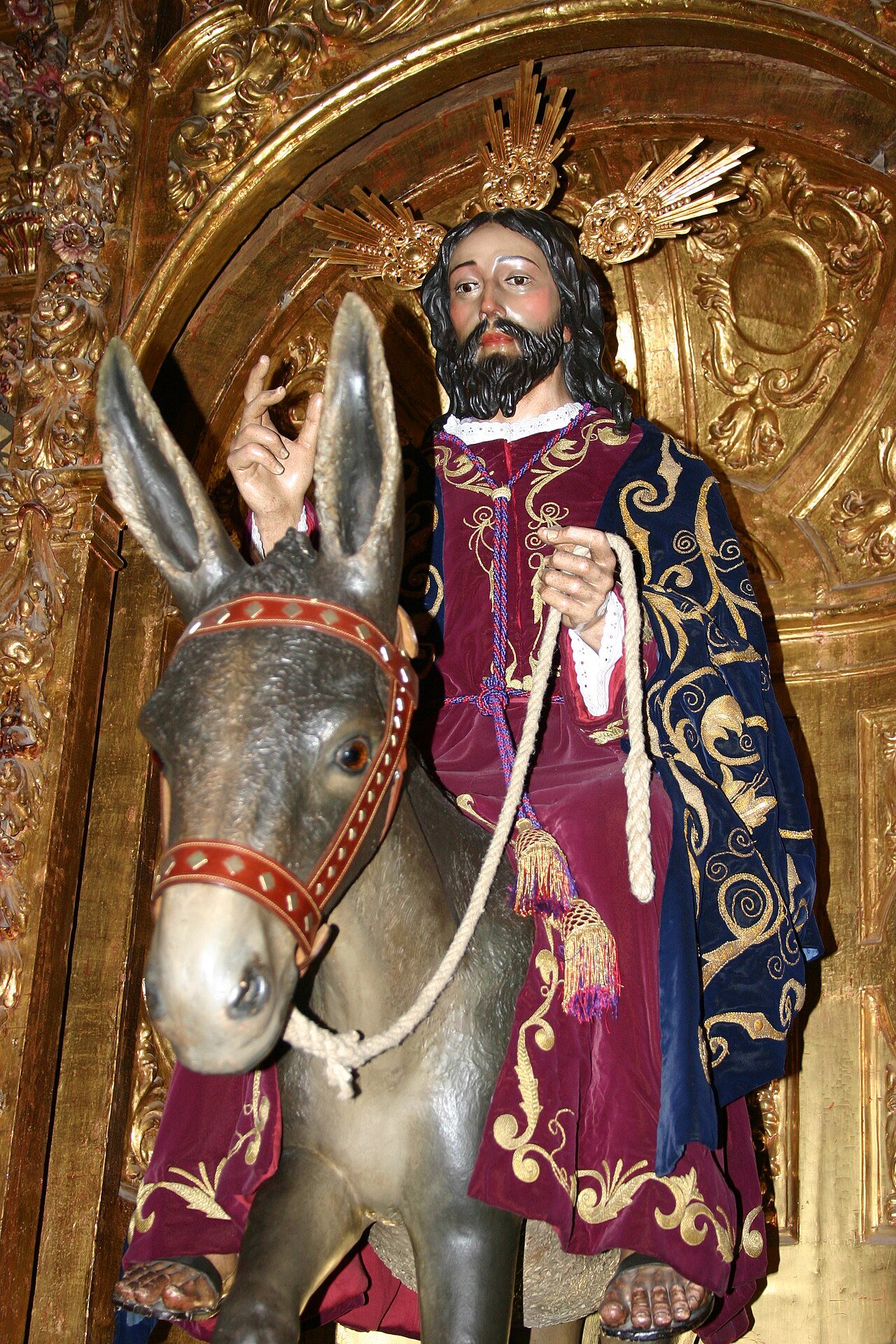
To understand this church, know that it is a barracks of Holy Week. Two great brotherhoods live here. The Hermandad del Amor opens Palm Sunday with the most joyful paso in the city: La Borriquita, “the little donkey”, carrying Christ into Jerusalem, followed later by Mesa’s Cristo del Amor and the Virgen del Socorro. The Hermandad de Pasión processes on Holy Thursday with Montañés’s Nazarene and the Virgen de la Merced.
Practical consequences: in the weeks before Easter the images migrate onto their pasos inside the church — a forest of silver, candles and embroidered velvet that is a spectacle in itself — and during Holy Week the cultural visit closes entirely (officially: “sólo visita pasos” — the church opens only for viewing the floats). If you are here on Palm Sunday afternoon, the plaza, packed shoulder to shoulder as the Borriquita squeezes out of the door, is one of the great free shows of the Spanish year.
Practical Info
At a Glance
| Detail | Info |
|---|---|
| Address | Plaza del Salvador s/n, Casco Antiguo, Seville (41004) |
| Nearest stop | Tram T1 to Plaza Nueva, then 5 minutes on foot; the old town is pedestrianised — come on foot |
| Tickets | Salvador only: €7 online / €8 at the desk, audioguide included. Joint Cathedral + Giralda + Salvador: €13 online / €14 at the desk; reduced €7 / €8 |
| Free entry | Children up to 13 accompanied by an adult; those born or resident in the Archdiocese of Seville; disabled visitors (65%+); Spanish unemployed — proof required |
| Opening hours | Mon–Thu 10:15–18:00; Fri–Sat 10:15–17:00; Sun 14:30–19:30 (desk closes 30 min earlier); closed 1 & 6 Jan, Holy Week, Corpus Christi, 15 Aug, 25 Dec |
| Time needed | 45–75 minutes; a half day combined with the Cathedral and Giralda |
| Official site | catedraldesevilla.es — Iglesia de El Salvador |
Tickets and Booking
You have three ways in. The Salvador-only ticket (€7 online, €8 at the desk, audioguide included) is the right buy if the Cathedral is not on your list. The joint ticket (€13 online, €14 at the desk; €7/€8 reduced) covers the Cathedral, the Giralda and this church — and here is the local knowledge: buy it here, where there is rarely a queue, and it gives you preferential access at the Seville Cathedral and La Giralda, whose ticket line can run around the block. The third way is a guide: the Cathedral, Giralda and El Salvador guided tour starts at this church, takes you through both temples with skip-the-line entry and puts Montañés, Mesa and Acosta in context. The evening Huella de lo Sagrado visit (around €20) is booked separately on the official site.
Getting There
El Salvador stands 300 metres north of the Cathedral, a five-minute stroll through the shopping streets — Calle Francos or Calle Sierpes both deliver you to the plaza. The tram stops at Plaza Nueva, five minutes away; the nearest metro is Puerta de Jerez (Line 1), ten minutes on foot. Do not attempt to drive — the centre is a pedestrian maze.
When to Go
Weekday mornings at opening time are quietest, and the light through the dome drum is best late morning. Sunday cultural visits begin at 14:30, after Mass (Sunday Mass 12:30; weekday Mass 20:00, in the Sacramental Chapel). Avoid Holy Week — the cultural visit is suspended — and note that weddings and brotherhood ceremonies can close the church at short notice on any Saturday.
How Long You Need
Forty-five minutes covers the patio, the nave, the main altarpiece and the two great sculptures. Seventy-five lets the audioguide walk you around all fourteen altarpieces and the little museum — the complete church.
Tips That Will Improve Your Visit
- Buy your Cathedral ticket here. The joint ticket bought at El Salvador’s desk carries preferential access at the Cathedral — the most useful queue-skip in Seville, at no extra cost.
- Don’t rush the patio. Most visitors treat the Patio de los Naranjos as an exit corridor. It is the oldest thing in the complex — mosque courtyard, recycled Visigothic capitals, the ablutions fountain — and deserves ten quiet minutes.
- Stand under the dome late in the morning. That is when the Montpensier stained glass throws its coloured light across the drum, and when the main altarpiece’s camarín catches fire.
- Count the archangels. Six attend the Transfiguration — Jegudiel, Raphael, Barachiel, Gabriel, Michael and Sealtiel.
- Check whether the Pasión and the Amor are “home”. Before Holy Week the images move onto their pasos and may be dressed or veiled; ask at the desk before you pay if seeing them is your main purpose.
- Finish on the plaza. A caña or a coffee on Plaza del Salvador, with Montañés’s statue and the red façade turning gold in the evening light, is the correct full stop.
Travel insurance, sorted
Whether it is a two-week holiday or a longer move, travel insurance is not the most glamorous part of a trip — but it is the one booking you want to have in place before a trip, and while you are already away.
Final Thoughts
Seville’s sacred geography is a triangle of Baroque masterpieces: grief at the Hospital de la Caridad, gold at San Luis, and here — in El Salvador — the Baroque as civic religion: a church built on a mosque, collapsed and rebuilt, filled with the two most carried sculptures in Spain, and still functioning as the city’s second temple. The Cathedral will always win the postcards. But El Salvador is the church Sevillians actually use, pray in, marry in and process from — and for the price of a ticket you were already holding, no visitor should walk past it.
¡Buen viaje!
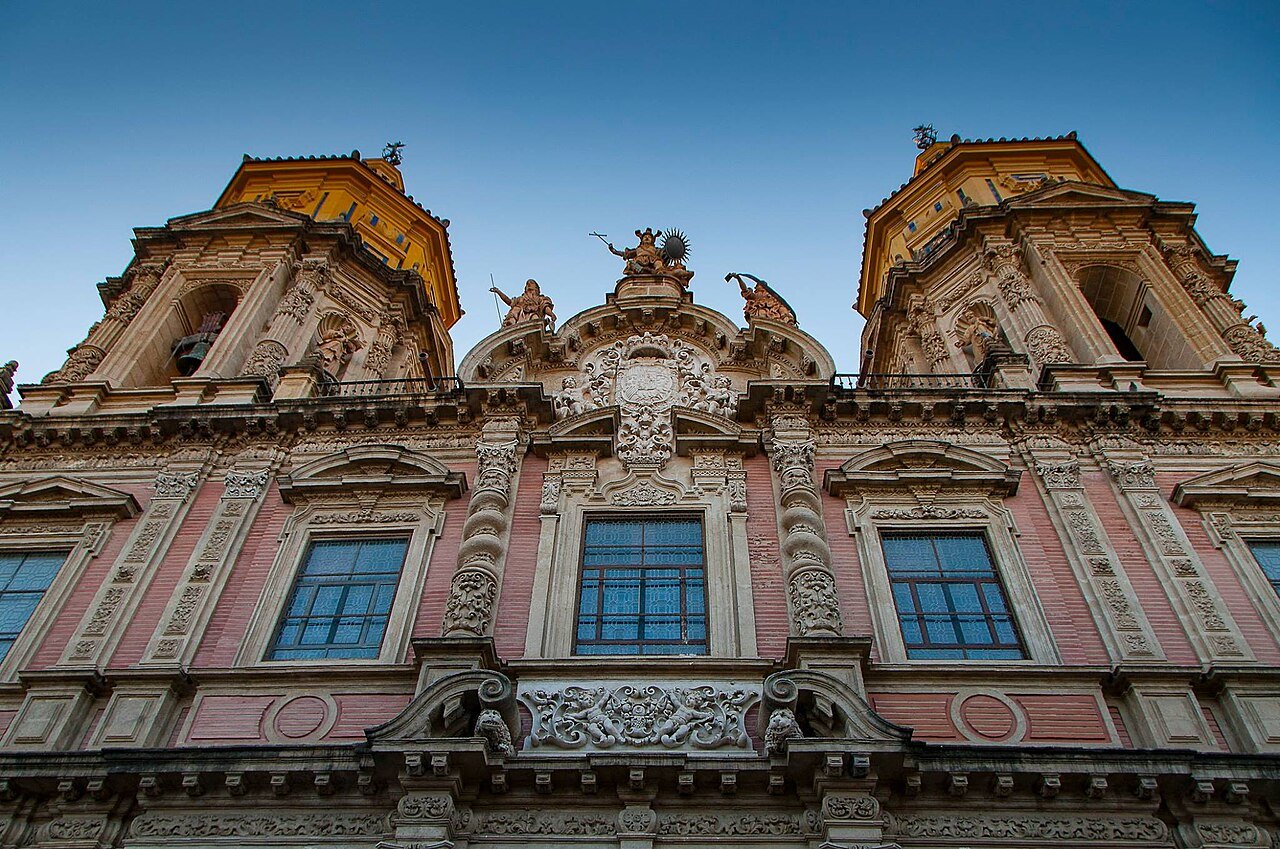
Photo credits: Wikimedia Commons contributors Grez, José Luis Filpo Cabana, anarey, José Luiz, CarlosRuizNieto and Benjamin Smith, via Wikimedia Commons (CC BY / CC BY-SA).