Hospital de los Venerables: The Complete Guide to Seville’s Baroque Jewel
In the heart of Barrio Santa Cruz, down a lane of whitewashed walls and orange trees, stands a building most visitors walk straight past on their way to the Cathedral. That is a pity, because behind its modest red-and-white façade the Hospital de los Venerables hides two of the most beautiful interiors in Seville: a courtyard so calm it feels like a held breath, and a small church covered — walls, vaults, every surface — in the frescoes of the Valdés family, father and son, at the height of the Spanish Baroque.
It began as something humbler than a palace: a retirement home for elderly priests, founded in the 1670s by a canon with a conscience. It became a factory, a residence again, an art foundation’s headquarters and, since 2025, the subject of Seville’s most interesting cultural handover — a building mid-metamorphosis, which makes visiting it now a more interesting proposition, not a lesser one.
This guide tells the whole story — the priests, the painters, the stolen Murillo, the Velázquez centre that came and went — and gives you the practical truth about visiting during the transition, so you can catch this jewel while its next chapter is being written.
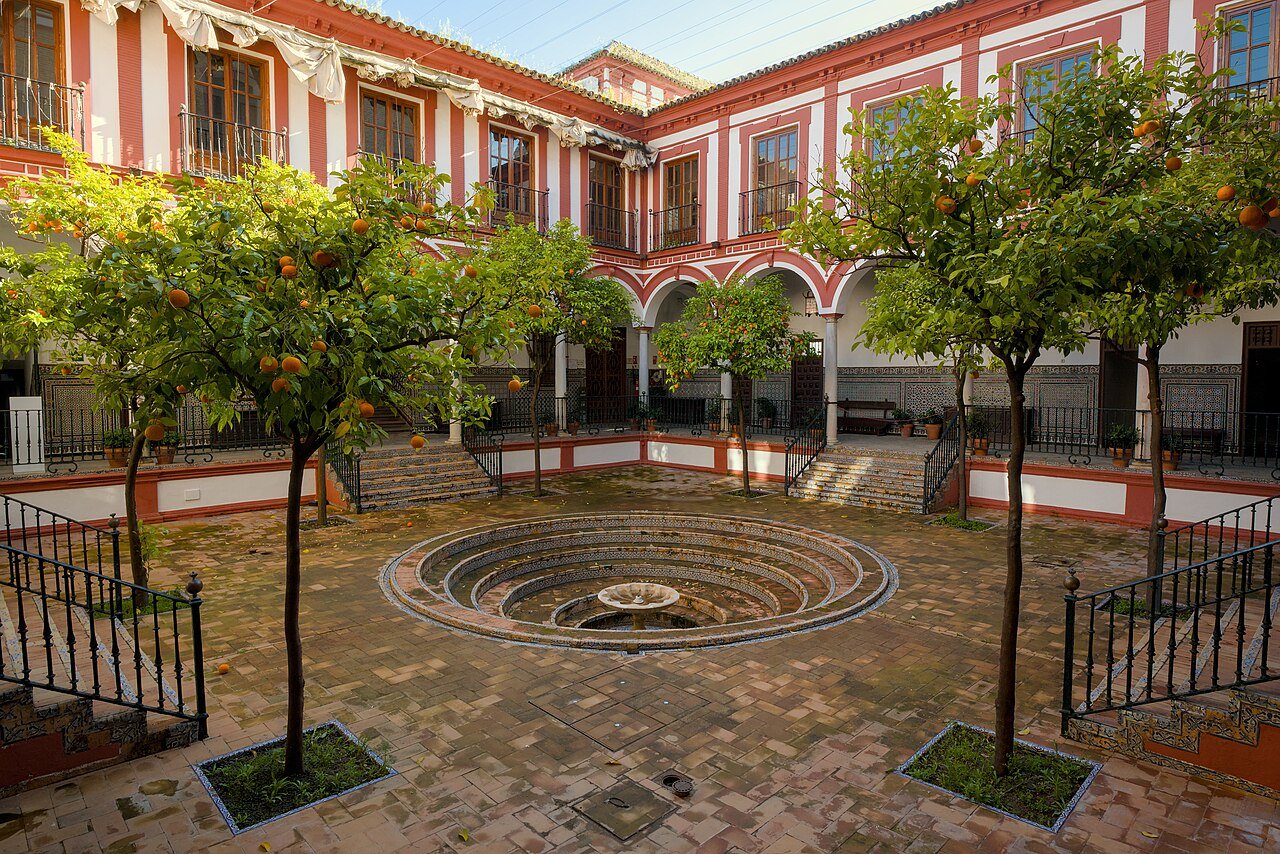
The Short Answer: The Hospital de los Venerables (Plaza de los Venerables 8, Barrio Santa Cruz) is a 17th-century Baroque hospice for elderly priests with a glorious frescoed church and patio. Read this first: the building changed hands in 2025 — the Focus Foundation returned it to the Archdiocese, and the Cathedral Chapter is preparing it as an exhibition space, with full reopening planned for 2027. Visiting currently runs on a reduced schedule (recent pattern: Thursday to Sunday, mornings, around €10, free the first Thursday of the month) and arrangements may evolve — check hospitalvenerables.es before you go. If your days fit, book the Hospital de los Venerables entry ticket and go: the church frescoes alone justify the trip.
Table of Contents
- Hospital de los Venerables at a Glance
- A Home for Old Priests: The Story
- The Patio: Seville’s Quietest Courtyard
- The Main Staircase
- The Church: A Painted Bible
- The Altarpiece and the Chancel
- Look Up: The Vaults and the Sacristy
- Murillo’s Stolen Immaculate
- The Organ and the Choir
- The Velázquez Centre and the Great Handover
- How to Visit Today
- Is the Hospital de los Venerables Worth It?
- Practical Info
- Tips for Visiting the Hospital de los Venerables
- Final Thoughts
Hospital de los Venerables at a Glance
- What it is: A Baroque hospice (1675–1697) for retired priests, with a famous fresco-covered church and a patio with a unique sunken fountain.
- Where: Plaza de los Venerables 8, in the Barrio Santa Cruz, five minutes from the Cathedral.
- Architects: Juan Domínguez began the works; Leonardo de Figueroa, Seville’s Baroque master, completed them.
- Art: Frescoes by Juan de Valdés Leal and his son Lucas Valdés; sculpture by Pedro Roldán; a Murillo masterpiece was painted for this house — and stolen from it.
- Current status: In transition since 2025 (see Short Answer) — reduced visiting hours; full reopening planned for 2027 under the Cathedral Chapter.
- Time needed: About an hour.
A Home for Old Priests: The Story
The idea began in 1627, when Seville’s Brotherhood of Silence started sheltering destitute elderly priests — men who had spent their lives in parishes and had nothing and no one at the end of them. It was the canon Justino de Neve — a towering figure of Seville’s golden age, and a close friend of the painter Murillo — who turned charity into architecture. In 1675 he founded the hospital properly and set it building on a plot in Santa Cruz with a past of its own: the Corral de Comedias de Doña Elvira, a theatre where Golden Age audiences had watched Lope de Vega and heard Cervantes read.

Construction ran from 1675 to 1697, first under Juan Domínguez and then, from 1687, under Leonardo de Figueroa — the architect who would give Seville some of its most exuberant Baroque. The church, built in 1689, was dedicated to San Fernando, the sainted king who had reconquered Seville. Around the patio rose the infirmaries and rooms of the venerables sacerdotes — the venerable priests — who lived here under a rule of prayer and mutual care.
The centuries were not always kind. In 1840 the building was confiscated and turned into a textile factory; the brotherhood fought it back by 1848, and priests lived here again — remarkably, into the 1970s. Then came rescue: between 1987 and 1991 the Focus-Abengoa Foundation restored the whole complex, and Queen Sofía inaugurated it on 5 November 1991 as the foundation’s headquarters and cultural centre. For three decades it was one of the best-kept buildings in the city — until the handover of 2025, which the final sections of this guide explain.
If you are piecing together the quarter, the hospital is one of the essential stops in Barrio Santa Cruz and earns its place on any honest list of the best things to do in Seville.
The Patio: Seville’s Quietest Courtyard
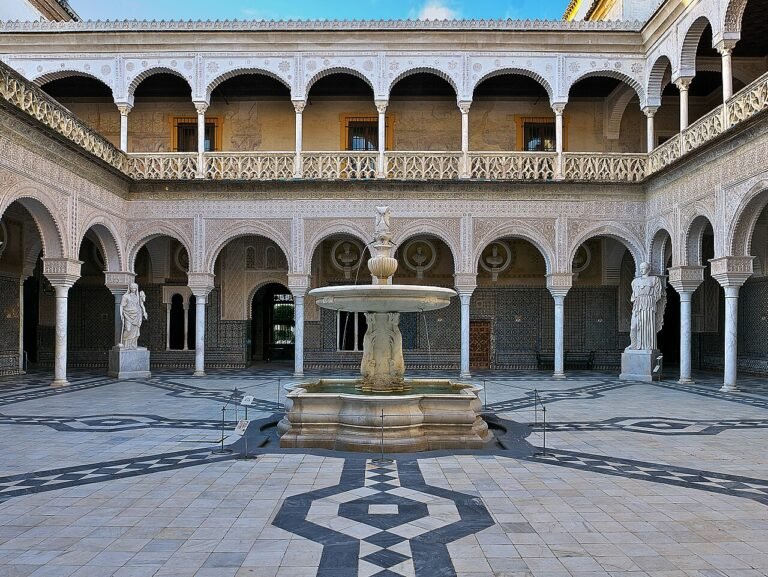
Every Sevillian palace has a patio; almost none has this one. The courtyard of the Venerables is a rectangle of white walls and soft red pilasters, planted with orange trees in clay pots — and at its centre, instead of the usual raised fountain, something found nowhere else: a circular fountain sunk into the paving in concentric tiled steps, like a whirlpool frozen mid-spin. It was designed by Bernardo Simón de Pineda, built by Francisco Rodríguez and tiled by Melchor Moreno, and it stops every visitor who enters.
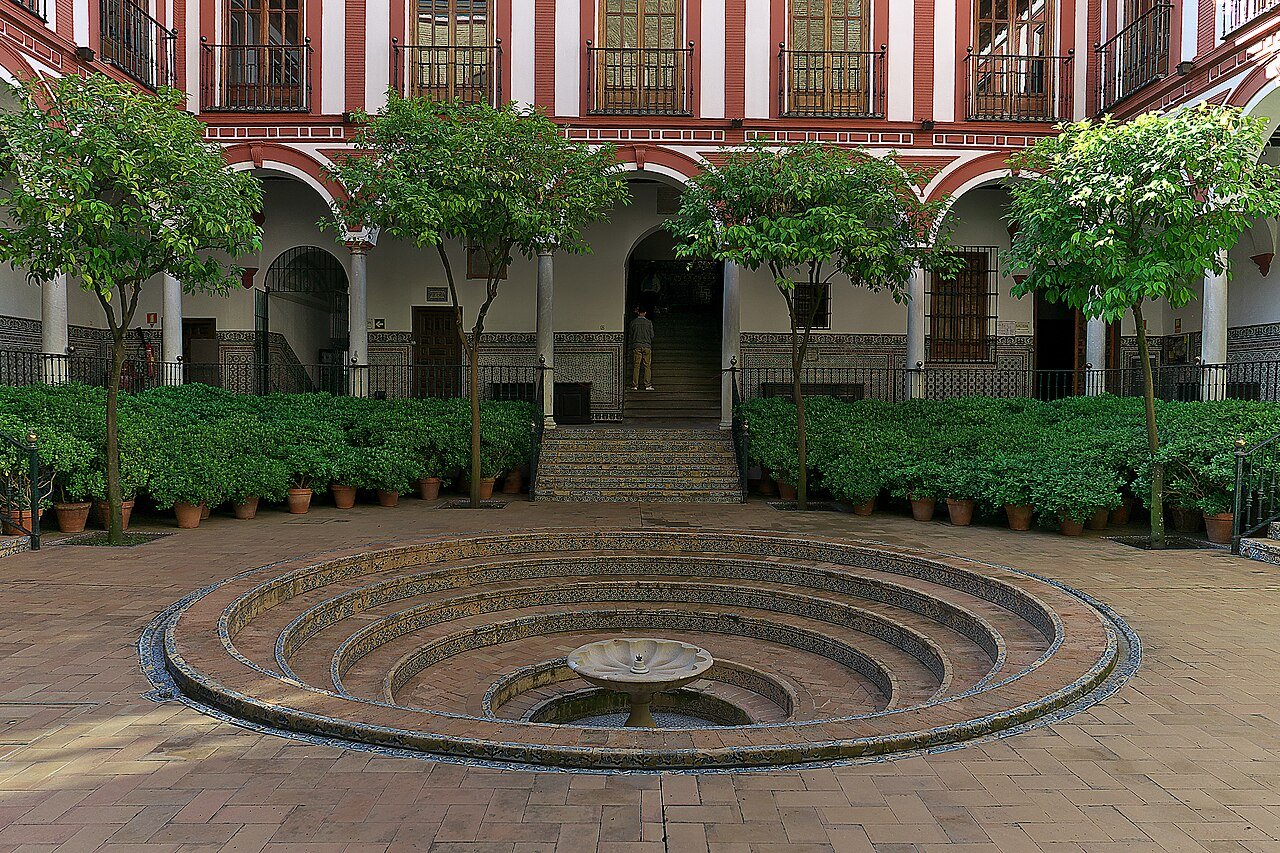
The patio is raised above street level, reached by tiled staircases at its corners — a deliberate platform of peace above the lane outside. Arcades on Tuscan columns run along the east and west sides, shading galleries where the old priests took the air; the infirmary occupied the east range, and at the south-east corner a small Mudéjar-style lookout tower watches over the rooftops of Santa Cruz. Come in the morning, when the light comes over the tiles and the oranges are still cool, and you will understand why this courtyard is the building’s signature.
The Main Staircase
Between patio and church, do not rush the staircase — it is a small Baroque set piece of its own. A broad stair climbs under an elliptical vault encrusted with plasterwork, its walls panelled in the great Sevillian azulejo tradition: patterned tiles below, and above them friezes of imperial eagles, castles and coats of arms worked into the ceramic. It is the decorative language of the whole building compressed into one climb — mudéjar tile, imperial heraldry and theatrical plaster, all in a space built for old men to reach their rooms.


Free Seville travel guide
Planning a trip to Seville? Get our free one-page Seville checklist: what to book ahead, what to skip, and the tapas bars we actually eat in.
The Church: A Painted Bible
The church is the reason art historians cross oceans. It is a single nave with a barrel vault — and every centimetre of it is painted. Between the 1690s and the first years of the 1700s, Juan de Valdés Leal, the most dramatic painter of the Sevillian Baroque, covered the chancel in fresco, and his son Lucas Valdés carried the cycle across the vaults and walls of the nave: scenes from the life of San Fernando, the history of the priesthood, angels, saints and swirling ornamental grotesques in rose, sage and gold.
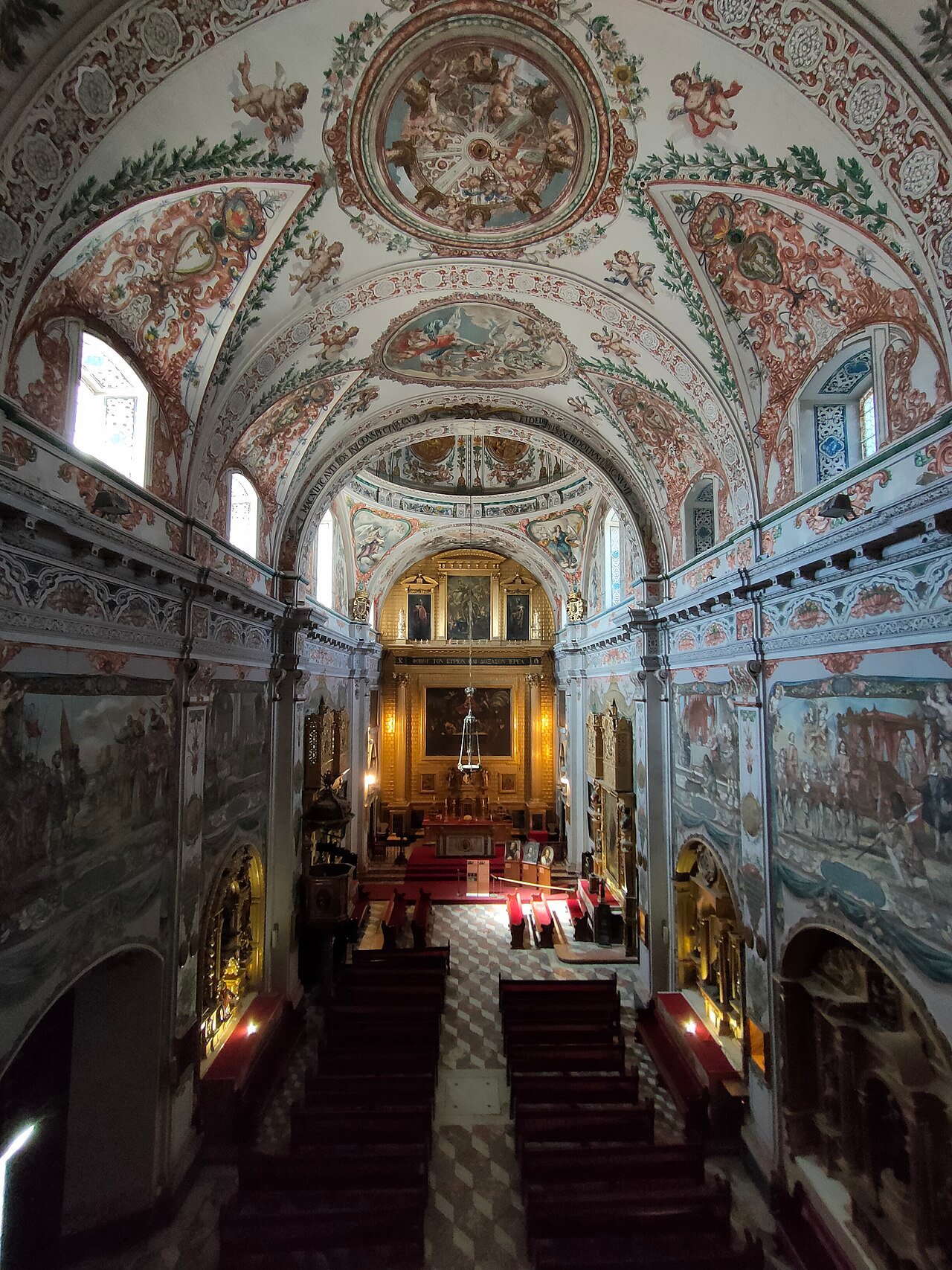
Unlike a gallery, nothing here is in a frame you can ignore: the painting is the architecture. Narrative panels run down both walls like a comic strip for the illiterate — which, in 1700, is close to what they were — each scene boxed in exuberant painted draperies, cartouches and putti. Walk it slowly, wall by wall, and the programme unfolds: this was a church built to teach priests the dignity of their own office, painted by a family firm across two generations.

The Altarpiece and the Chancel
At the head of the nave, Valdés Leal painted the chancel itself: the Invention of the Holy Cross, San Fernando handing the mosque to the archbishop, San Fernando before the Virgin of Antigua — a trilogy on the city’s Christian rebirth. Below them stands the great gilded main altarpiece (1889), whose upper tier holds Lucas Valdés’s Apotheosis of San Fernando, the saint-king raised to glory between painted architecture, under a Greek inscription that runs the width of the church: Fear the Lord and honour the priest — the house motto, addressed to everyone who ever funded, governed or entered this place.
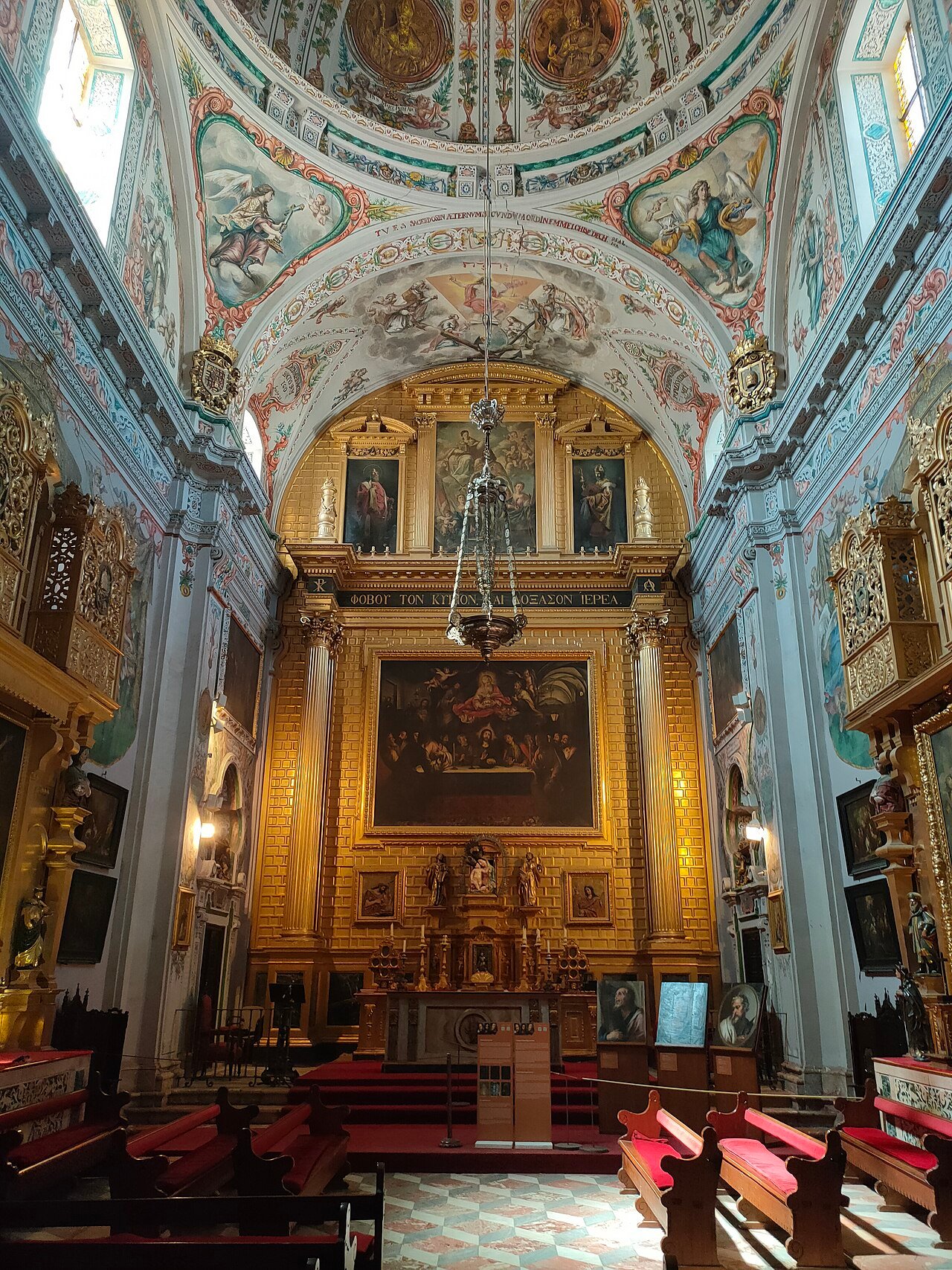

Beneath the choir, look for the two sculptures that guard the entrance — San Fernando and San Pedro, carved by Pedro Roldán, the great Sevillian sculptor of the age — and along the nave, side altarpieces with polychrome sculpture from the circle of Martínez Montañés. For the full context of what Seville was making in these years, pair this church with the Museo de Bellas Artes, fifteen minutes away, where the same painters fill whole rooms.
Look Up: The Vaults and the Sacristy
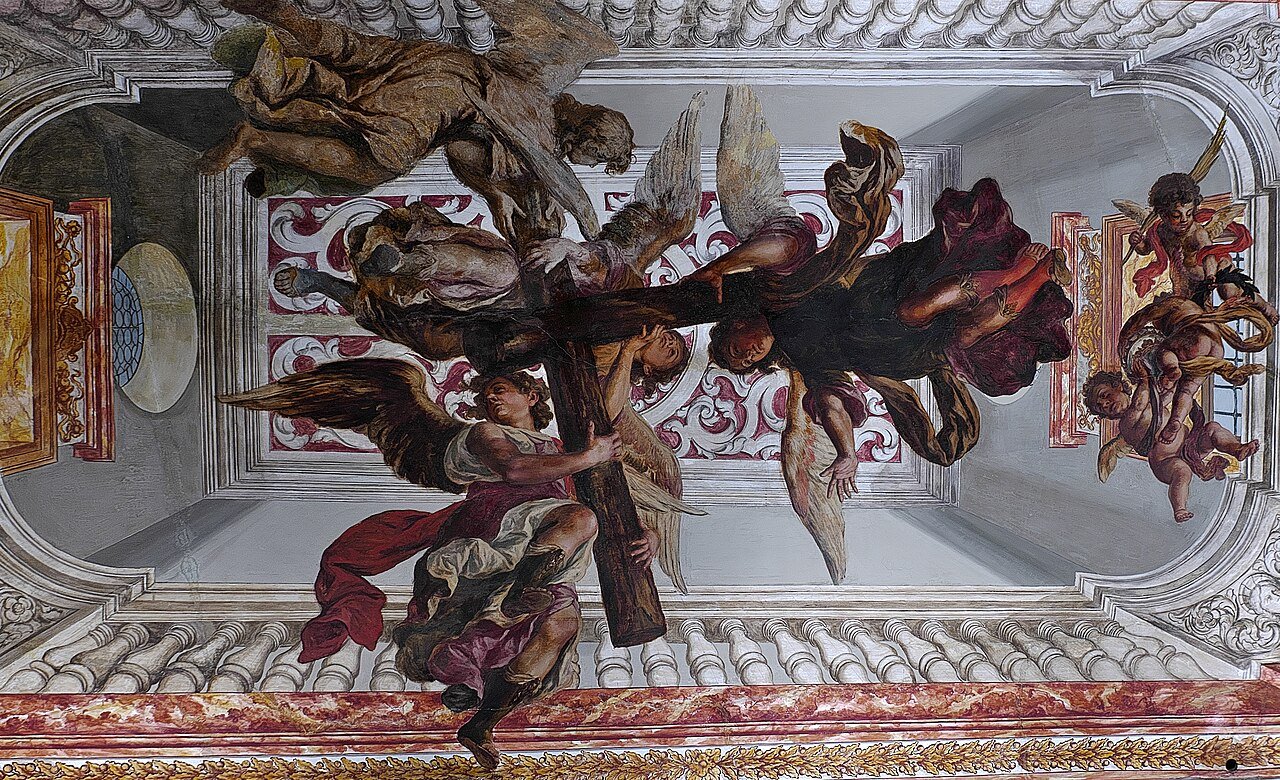
Seville’s Baroque churches reward neck-strain, and this one doubly so. The barrel vault runs in painted bays of medallions and garlands; over the chancel rises a cupola whose ribs are studded with gilded relief medallions. But the masterpiece overhead is through the sacristy door. On the sacristy’s ceiling, Lucas Valdés painted one of the great party tricks of Spanish art: a trompe-l’œil of angels carrying the Holy Cross through a feigned open sky, the figures tumbling out of the painted architecture with such conviction that the flat ceiling reads as a dome full of falling angels. Stand directly underneath and let your eyes adjust — it is the single most astonishing square metre in the building.

Murillo’s Stolen Immaculate
Justino de Neve’s friend Murillo painted for this house its greatest treasure: the Immaculate Conception of Los Venerables (1678), a Virgin floating in golden light through a whirl of cherubs, commissioned for the hospital chapel. De Neve donated it in 1686. In 1813, during the Peninsular War, Napoleon’s Marshal Soult — history’s most systematic art thief in Spain — took it from this church. It was sold to the Louvre in 1852 for 615,300 francs, then the highest price ever paid for a painting, and only returned to Spain in 1941, in a wartime exchange of artworks. It hangs today in the Prado in Madrid.
The hospital keeps the two ends of the story: the painting’s original frame, still in the church, and — displayed where the residents can see her — a full-scale reproduction of the Immaculate herself, credited to the Prado. Two smaller Murillos in the house, the Santa Catalina and the penitent San Pedro, survived the looting era and were recovered under the Focus Foundation’s care. Around them, the visit shows the works that never left, including canvases by Lucas Valdés such as the Presentation in the Temple — solid, serious painting that would headline a lesser church.


The Organ and the Choir
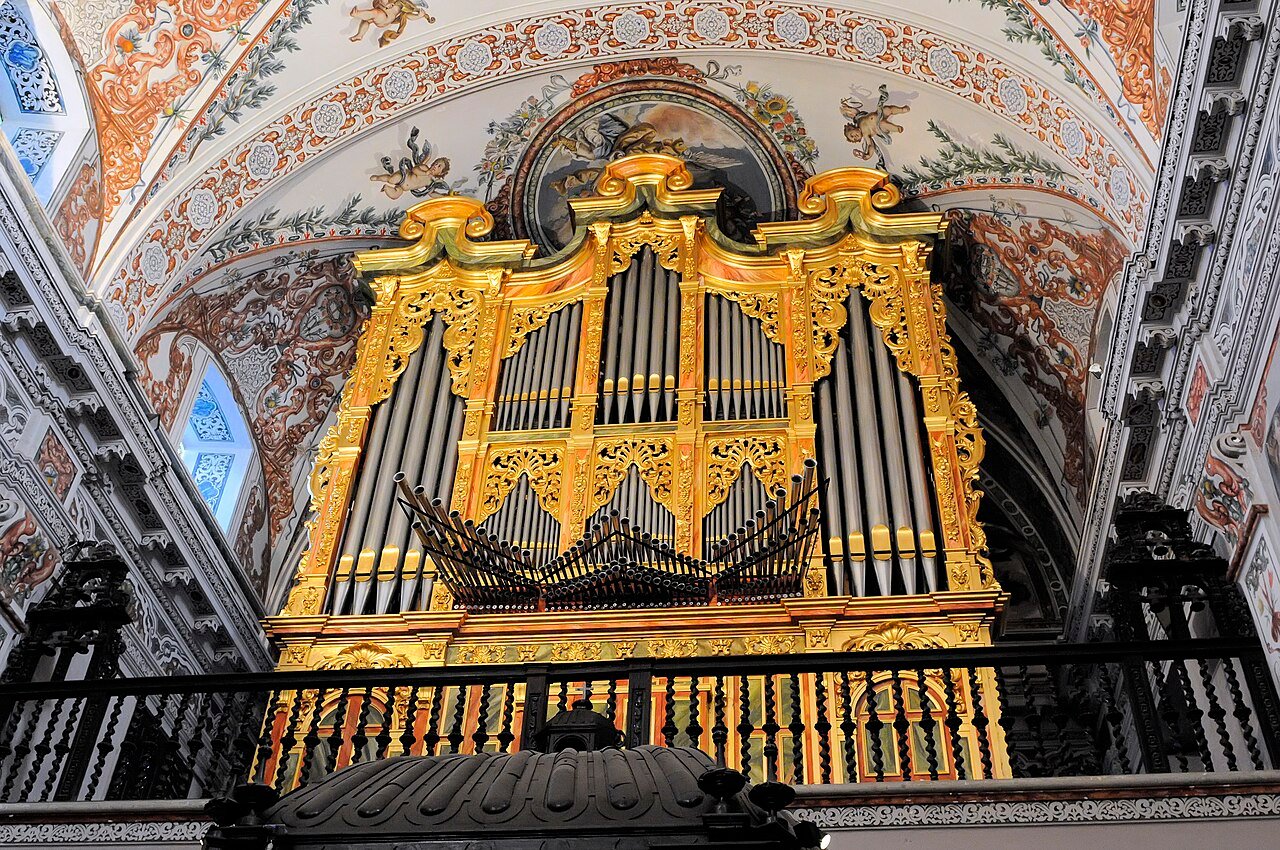
Turn at the door and look up: the choir loft carries the church’s organ, built in 1991 by Gerhard Grenzing for the Focus restoration, its gilded case and horizontal trumpets gleaming against the frescoes. It is no museum piece — the church has an active concert life, and the combination of this acoustic, this decoration and a Baroque programme is one of Seville’s great small pleasures. If a concert falls during your stay, rearrange the evening around it.
The Velázquez Centre and the Great Handover
In July 2007 the hospital opened a new chapter: the Centro Velázquez, a permanent exhibition built around Velázquez’s Santa Rufina, which the Focus Foundation had acquired for €12.4 million — a small, jewel-box display of Sevillian Golden Age painting (Velázquez, Murillo, Zurbarán) in the city where all three were formed. For eighteen years it was one of the essential art stops in Andalusia.
Then, in July 2025, the Foundation (now Focus Loyola) handed the building back to its owner, the Archdiocese of Seville. In October 2025 the Archdiocese leased it to the Cathedral Chapter — the Cabildo — whose plan is to make the hospital the exhibition home of the Cathedral’s own art collection, a kind of annexe to the Seville Cathedral two streets away, with the reopening expected in 2027. The Velázquez collection, meanwhile, has a new home: in April 2026 the city ceded the church of San Hermenegildo, in Plaza de la Concordia, to house it. Nothing has been lost; everything is moving.
What this means for you is simple: the building is between lives, visiting runs on a reduced schedule, and displays may differ from older guidebooks — the Santa Rufina is no longer here. Go for the architecture and the church, which are permanent, and treat anything else on show as a bonus from a collection in transit.
How to Visit Today
Visits in the current transitional period have been running Thursday to Sunday, mornings only (10:00–14:00), with general admission around €10, reduced tickets around €5 (children 6–16, students, over-65s, visitors with disabilities; under-6s free), free entry on the first Thursday of the month, and a joint ticket with the neighbouring Hospital de la Caridad at around €12. Tickets have been sold through the hospital’s official site and its box-office partner. Because the handover is live and schedules can change with the works, confirm the current pattern on hospitalvenerables.es in the week you travel — then book the Hospital de los Venerables entry ticket in advance if your dates allow.
Practicalities of the visit itself: allow an hour; the route is the patio, the staircase, the church and the display rooms, all on a compact footprint. It pairs naturally with the Cathedral and the Alcázar in a Santa Cruz morning — this is the quiet, contemplative counterweight to both — and with the Hospital de la Caridad, Seville’s other great Baroque charity church, on the joint ticket.
Is the Hospital de los Venerables Worth It?
For the frescoed church and the patio alone: yes, completely — together they form one of the finest Baroque ensembles in Spain, and the crowds have yet to find it. The honest caveats are about the transition, not the building: reduced hours mean planning, and the Velázquez centre that older reviews rave about has moved on. If you love painting, architecture or simply beautiful quiet places, schedule your Santa Cruz days so one of them is a Thursday-to-Sunday morning, and go. If your Seville trip is Monday to Wednesday only, admire the façade on Plaza de los Venerables, note the name, and put it at the top of the list for the reopened museum in 2027.
Practical Info
- Address: Plaza de los Venerables 8, 41004 Seville — in the Barrio Santa Cruz, about five minutes’ walk from the Cathedral.
- Nearest stops: The Cathedral and Archivo de Indias tram/bus stops are the closest; the old town is pedestrian — walking is the way in.
- Opening hours (transitional period): Recently Thursday to Sunday, 10:00–14:00 only; the building is being prepared for a full reopening planned for 2027. Always check hospitalvenerables.es for the current week before going.
- Tickets: Around €10 general, €5 reduced; free the first Thursday of each month; joint ticket with the Hospital de la Caridad around €12. Book via the official site or the Hospital de los Venerables entry ticket.
- Time needed: About 1 hour.
- Good to know: Older guidebooks describe the Centro Velázquez display here — the collection has moved (its new home is the church of San Hermenegildo, Plaza de la Concordia). What you are visiting now is the building and its church — which were always the main event.
Tips for Visiting the Hospital de los Venerables
- Build your week around the opening days. With visiting currently limited to Thursday–Sunday mornings, this is the sight to schedule first and fit the flexible sights around.
- Aim for the first Thursday of the month if your dates allow — entry has been free that morning — but arrive at opening; free days draw the neighbourhood as well.
- Go early for the patio. Morning light on the sunken fountain and orange trees is the photograph everyone wants, and the courtyard is at its calmest before 11:00.
- Do not skip the sacristy ceiling. It is easy to walk under Lucas Valdés’s falling angels without noticing. Stand still, look straight up, wait ten seconds.
- Read the Greek. The inscription over the altarpiece — “Fear the Lord and honour the priest” — is the whole foundation charter in one line; it explains the building better than any panel.
- Pair it with the Caridad. The joint ticket covers the Hospital de la Caridad, Seville’s other Valdés Leal masterpiece (including the famous Finis Gloriae Mundi) — the two churches together are the complete Baroque Seville story.
Travel insurance, sorted
Whether it is a two-week holiday or a longer move, travel insurance is not the most glamorous part of a trip — but it is the one booking you want to have in place before a trip, and while you are already away.
Final Thoughts
The Hospital de los Venerables is Seville in miniature: charity and splendour, Murillo and theft, decline and rescue, all inside one whitewashed block in Santa Cruz. Its church is a painted sermon, its patio the city’s quietest room, and its present moment — between the foundation that saved it and the cathedral that will reinvent it — is a chapter worth witnessing in person. Check the hours, plan the morning, and go while the painters of 1700 still have the place almost to themselves.
¡Buen viaje!

Photo credits: Benjamin Smith, Anual, José Luis Filpo Cabana, Millars, Son of Groucho, Jl FilpoC — via Wikimedia Commons (CC licences as listed in the image file).




One Comment