Casa Amatller: The Complete Guide to Barcelona’s Other Modernista House
Everyone on Passeig de Gràcia is looking at the house next door. The crowds queue for Casa Batlló, Gaudí’s dragon-backed fantasy, while the building at number 41 — a stepped-gabled, tile-covered house that looks as if a Flemish merchant’s home had been teleported into the Eixample — gets a photograph and a shrug. That is a mistake, and it is also your opportunity.
Casa Amatller is the quieter masterpiece of the Manzana de la Discordia, the “Block of Discord” where Barcelona’s three great modernista architects fought their famous façade war. Behind its sgraffito skin you will find one of the best-preserved bourgeois interiors in the city: the home of a chocolate dynasty, filled with original furniture, medieval-style craftsmanship and one of Europe’s great photographic archives. Visits run in small groups, in near silence, while the house next door processes its thousands.
This guide covers everything you need: the story of the chocolatier who built it, what to look for on the façade, the rooms you will walk through, how the visit formats work, and how to finish, as every visit should, with a cup of thick Amatller hot chocolate downstairs.
The Short Answer: Casa Amatller, at Passeig de Gràcia 41, is Josep Puig i Cadafalch’s 1898–1900 rebuild for chocolate maker Antoni Amatller — a Flemish-gabled, sgraffito-covered house directly beside Casa Batlló. Book the Casa Amatller entry ticket (around €17 with a video guide and a chocolate tasting) for a small-group visit of about 45 minutes through the preserved main floor; children under 7 are free. Expect original 1900 furniture, a sculptural staircase under a stained-glass skylight, and a fraction of the crowds next door. The ground-floor chocolate shop and café are free to enter.
Table of Contents
- Casa Amatller at a Glance
- The Manzana de la Discordia: Barcelona’s Most Famous Feud
- Antoni Amatller and the Chocolate Fortune
- The Façade: A Flemish Gable in Barcelona
- Through the Entrance Hall
- The Main Staircase and the Skylight
- The Main Floor: Living in 1900
- Teresa Amatller and the Photography Archive
- How to Visit: Tickets, Tours and Timing
- The Chocolate Shop and Café
- Is Casa Amatller Worth It?
- Practical Info
- Tips for Visiting Casa Amatller
- Final Thoughts
Casa Amatller at a Glance
- What it is: A modernista house-museum — the preserved home of the Amatller chocolate family, reopened as a museum in 2015.
- Architect: Josep Puig i Cadafalch, who rebuilt an existing 1875 house between 1898 and 1900.
- Where: Passeig de Gràcia 41, in the Eixample — immediately beside Casa Batlló.
- Why go: The most intact modernista interior on the boulevard, seen in small groups, plus the story of chocolate, photography and a remarkable father-daughter pair.
- Time needed: 45 minutes to an hour for the house; add half an hour for the café.
- Book: Casa Amatller entry ticket — groups are capped, so timed slots sell out at busy times.
If you are building a modernista day, the house slots naturally into any list of the best things to do in Barcelona: Batlló beside it, Casa Milà ten minutes up the same boulevard, and the Palau de la Música across the old town in the evening.
The Manzana de la Discordia: Barcelona’s Most Famous Feud
In the 1900s, the stretch of Passeig de Gràcia between Carrer del Consell de Cent and Carrer d’Aragó became an architectural prize fight. Three wealthy families hired the three star architects of Catalan modernisme to remodel three neighbouring houses, and each architect tried to out-dazzle the others. The block earned a punning nickname: manzana means both a city block and an apple — this was Barcelona’s Apple of Discord, the mythological prize the goddesses fought over.
Puig i Cadafalch struck first with Casa Amatller (1898–1900). Lluís Domènech i Montaner answered at the corner with the floral exuberance of Casa Lleó Morera (1902–1906). Then Antoni Gaudí, given the house immediately next door to the Amatller home, produced Casa Batlló (1904–1906) — the dragon roof, the skull balconies, the underwater light. Standing on the pavement today, you can read the whole argument in thirty metres of street frontage: medievalist scholarship, floral naturalism and full-blown fantasy, shoulder to shoulder.

The Amatller house held its own then and holds it now. What it could not have predicted is the modern imbalance: Batlló became a global icon with global queues, while its neighbour kept the atmosphere of a private house that happens to admit visitors.
Antoni Amatller and the Chocolate Fortune
The money was chocolate. The Amatller firm had been making chocolate in Barcelona since 1797, and Antoni Amatller Costa (1851–1910) was its third-generation head — an industrialist of the new Barcelona bourgeoisie, and a man of unusually wide curiosity. He was an art collector, an antiquarian and, most unusually for his class and era, a serious amateur photographer who travelled with his cameras.
In 1898 he bought the house at Passeig de Gràcia 41 — a conventional 1875 building by the architect Antoni Robert — and commissioned the 32-year-old Puig i Cadafalch to transform it inside and out. The brief produced a manifesto in stone: a façade that nodded to the family’s trading roots in northern Europe, and an interior fitted with every modern comfort of 1900 — a lift, a garage for the new motor age, a photographic studio under the roof and one of the finest private collections of ancient glass in Spain.
Antoni died in 1910. The house passed to his daughter Teresa, who lived there until 1960 — nearly five decades in the house her father built — and in 1942 founded the institution that still owns and studies it. The chocolate story and the photography story both begin with Antoni, and this house is where they meet.
The Façade: A Flemish Gable in Barcelona
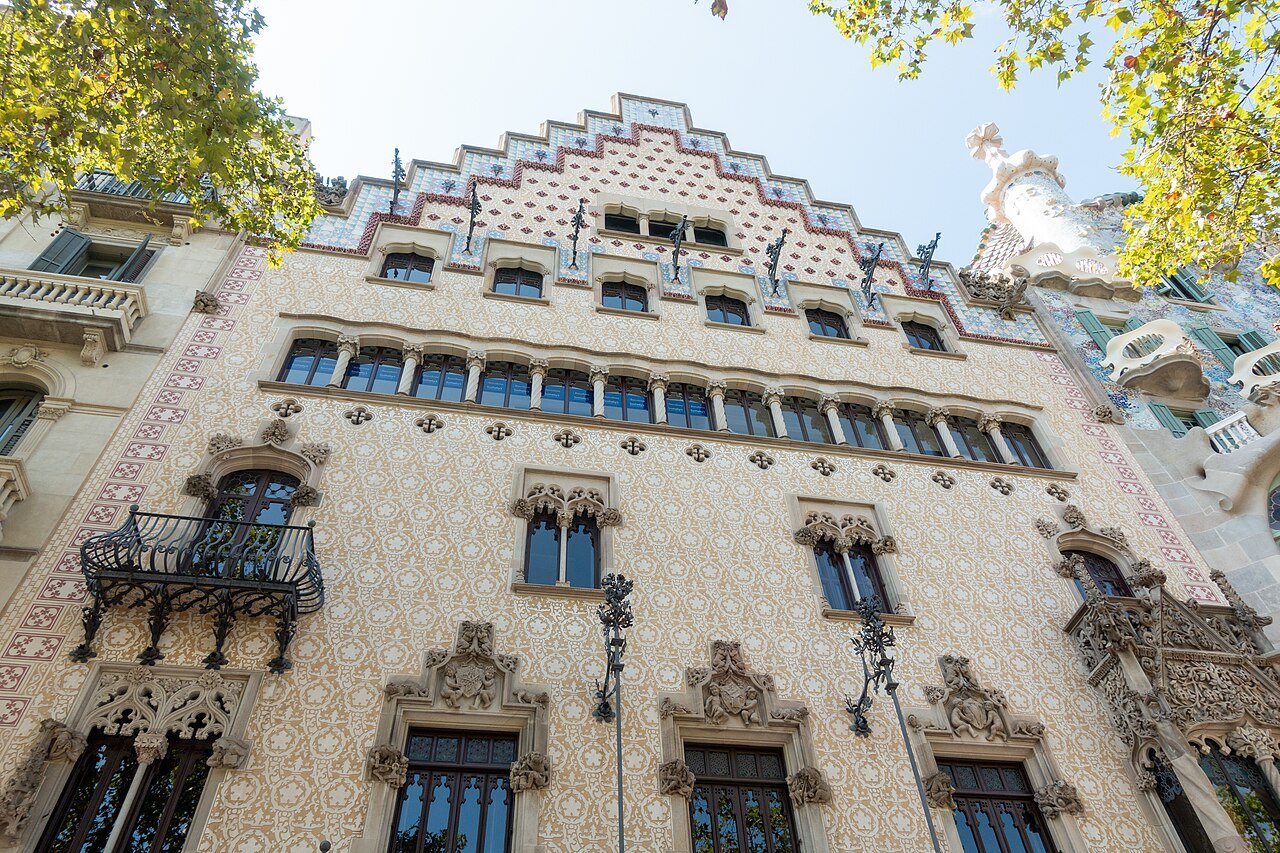
Walk across the boulevard and look up. The first thing you see is the roofline: a steep stepped gable, outlined in coloured tile, that belongs on a canal house in Bruges or Amsterdam. Puig i Cadafalch — scholar of Catalonia’s medieval past as much as modernista showman — was quoting the Flemish and Dutch merchants’ houses of the trading world the Amatller firm dealt in, and fusing them with Catalan Gothic detail. It remains the most surprising silhouette on the street.

The wall beneath the gable is a skin of sgraffito — plaster incised in repeating patterns of almond blossom, the flower of the ametller, the almond tree that gives the family its name and its quiet coat of arms. Between the windows stand slender wrought-iron lamp standards, and the main-floor windows are crowned with exuberant Gothic carving, much of it by the sculptor Eusebi Arnau and the craftsman Alfons Juyol.
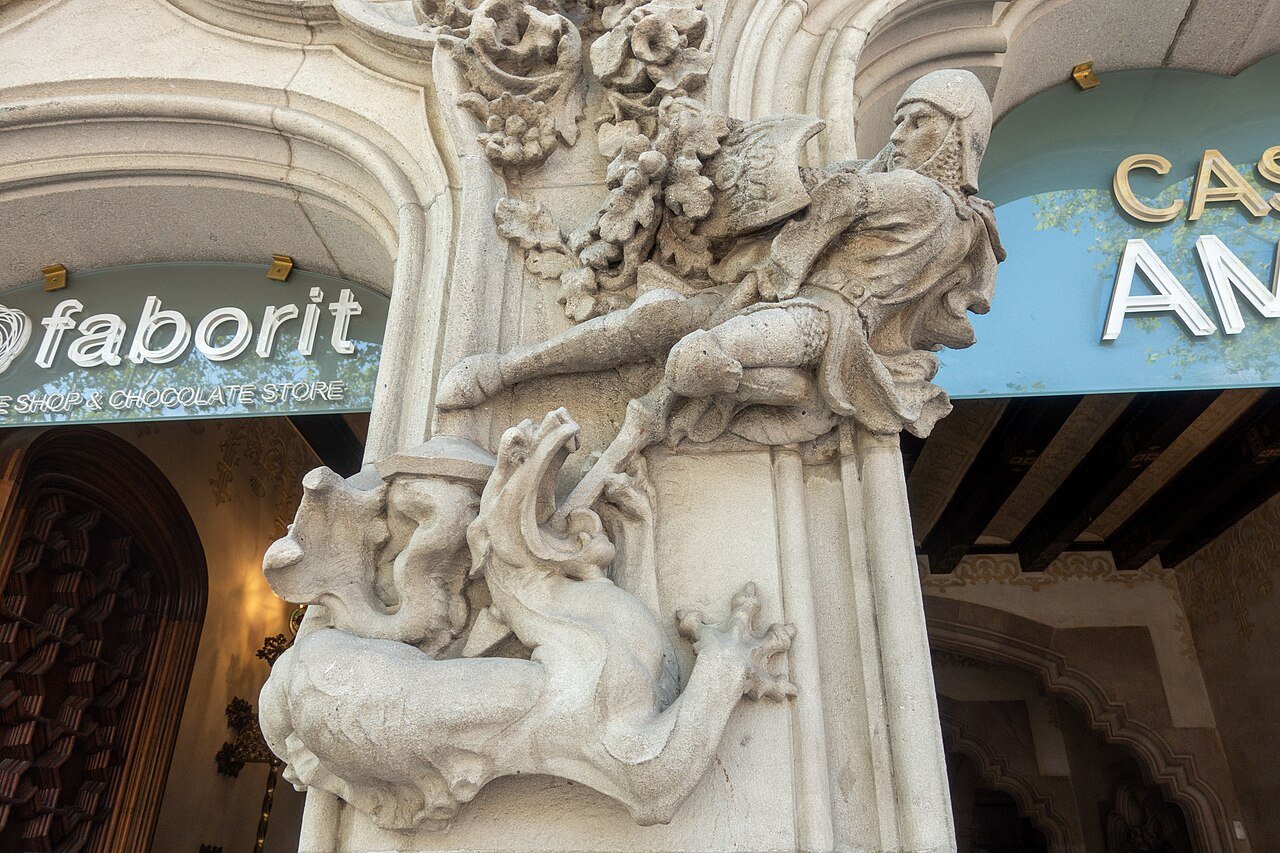
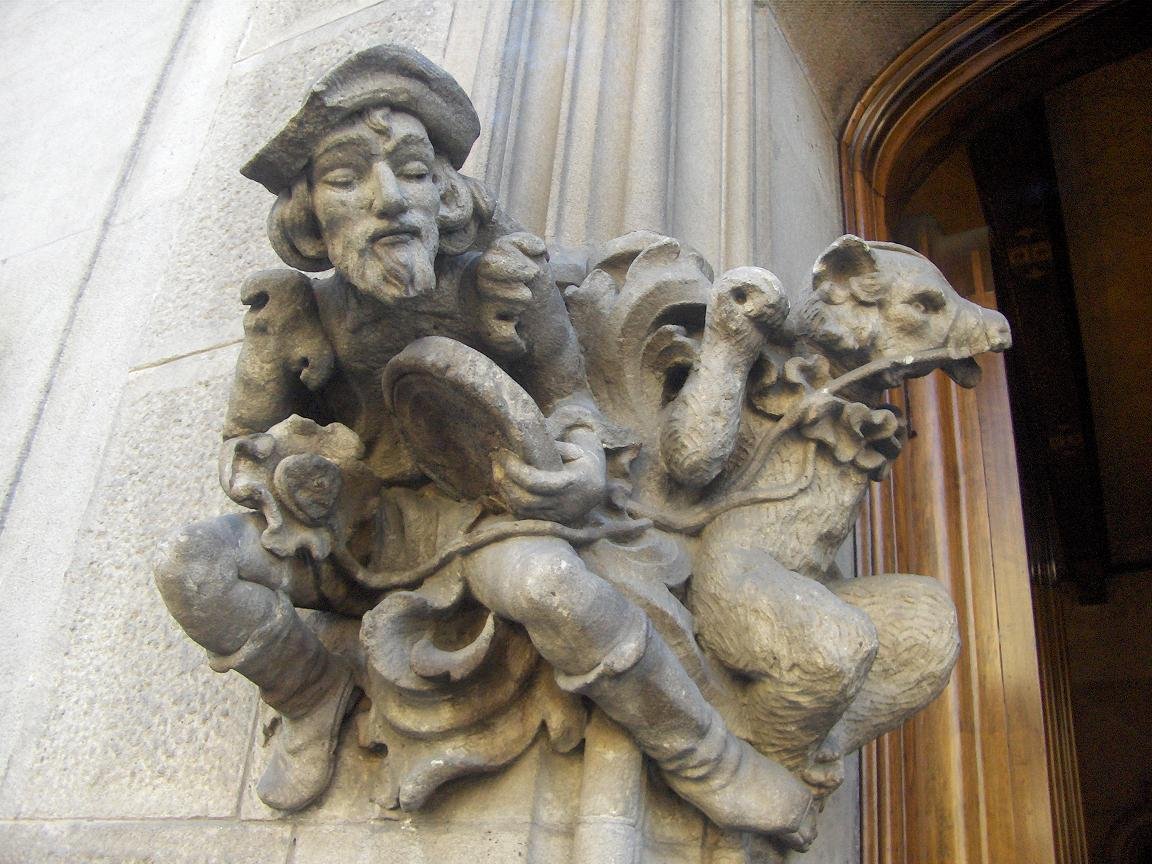
Arnau’s signature stands guard between the two street doors — and note, first, that there are two doors of different sizes: a broad one for the horse-drawn carriage, a narrower one for the family on foot. Above them, Saint George, patron of Catalonia, slays his dragon in stone. Around the entrances, Arnau carved a small bestiary of jokes and fables — donkeys, monkeys, and the house’s most beloved detail: a rat holding a camera, the sculptor’s wink at Antoni Amatller’s famous hobby.
Through the Entrance Hall
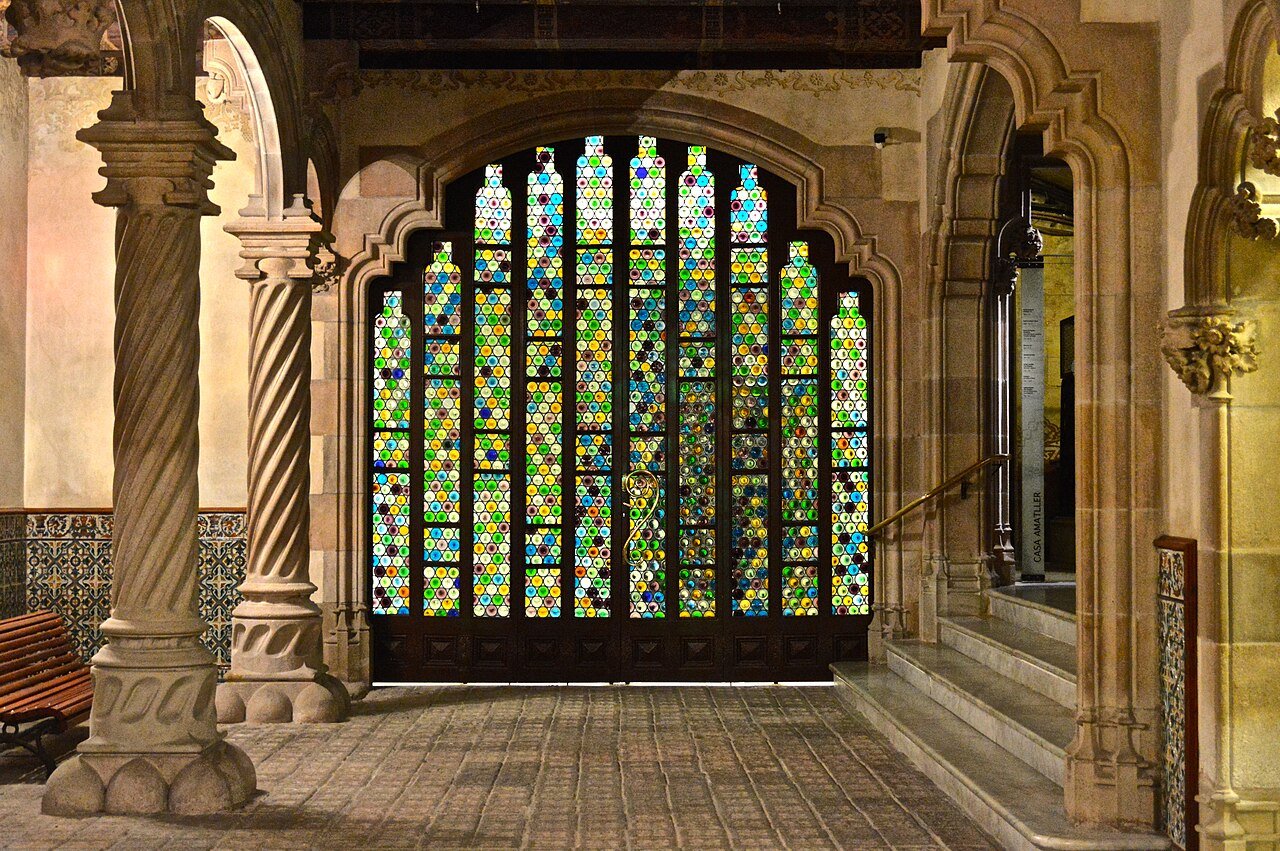
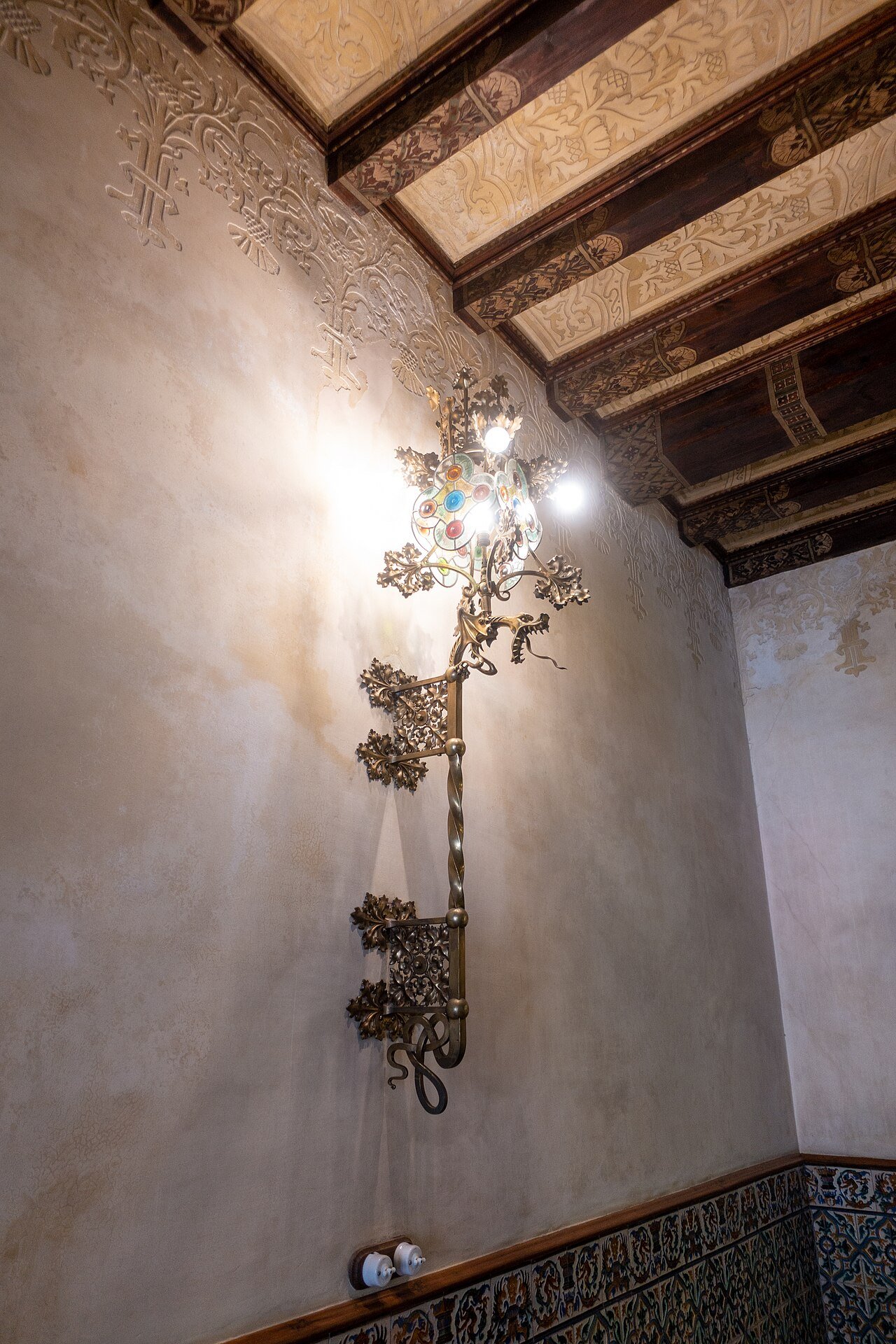
The carriage door opens into a wide, cool hall built for horses and now home to the café tables and the ticket desk. Everything here announces the programme of the house: a forest of twisted stone columns, walls wainscoted in patterned tiles, a painted wooden ceiling of dark beams and gilded coffers, and ironwork that turns every lamp and grille into a small sculpture — including the house’s celebrated dragon lamp.
Behind the hall, one great door glows with hundreds of coloured glass discs — bottle-glass panes in green, blue, amber and violet that turn daylight into confetti. It is the house in miniature: medieval in form, industrial in technique, joyful in effect. The ground floor also held the working Amatller world of 1900 — stables and carriage space then; the chocolate shop and the foundation’s rooms now — and Antoni’s studio and collections above the street level at the back, where the light was right.

The Main Staircase and the Skylight
From the hall, the ceremonial stair climbs to the main floor — and this is where the house stops being a townhouse and becomes a theatre set. A broad flight in white stone, carpeted in red, sweeps up past walls where the sgraffito pattern flows downhill with the steps like water. On the landing, a huge window of stained glass set in iron branches — clusters of grapes in wrought metal — filters the light from the inner courtyard.

Above the courtyard, Puig i Cadafalch stretched a skylight of stained glass in waves of yellow, blue and pink — the sun, poured through coloured water, onto the landing below. Stand under it at midday and the whole stairwell changes colour with the hour. It is the single most photographed interior moment in the house, and on a small-group visit you will have time to actually stand in it.

Practical theatre has its rules here: visits to the main floor are made in protective shoe covers, and heels stay downstairs — the original floors, carpets and hydraulic tiles are the exhibits as much as the furniture is.
The Main Floor: Living in 1900
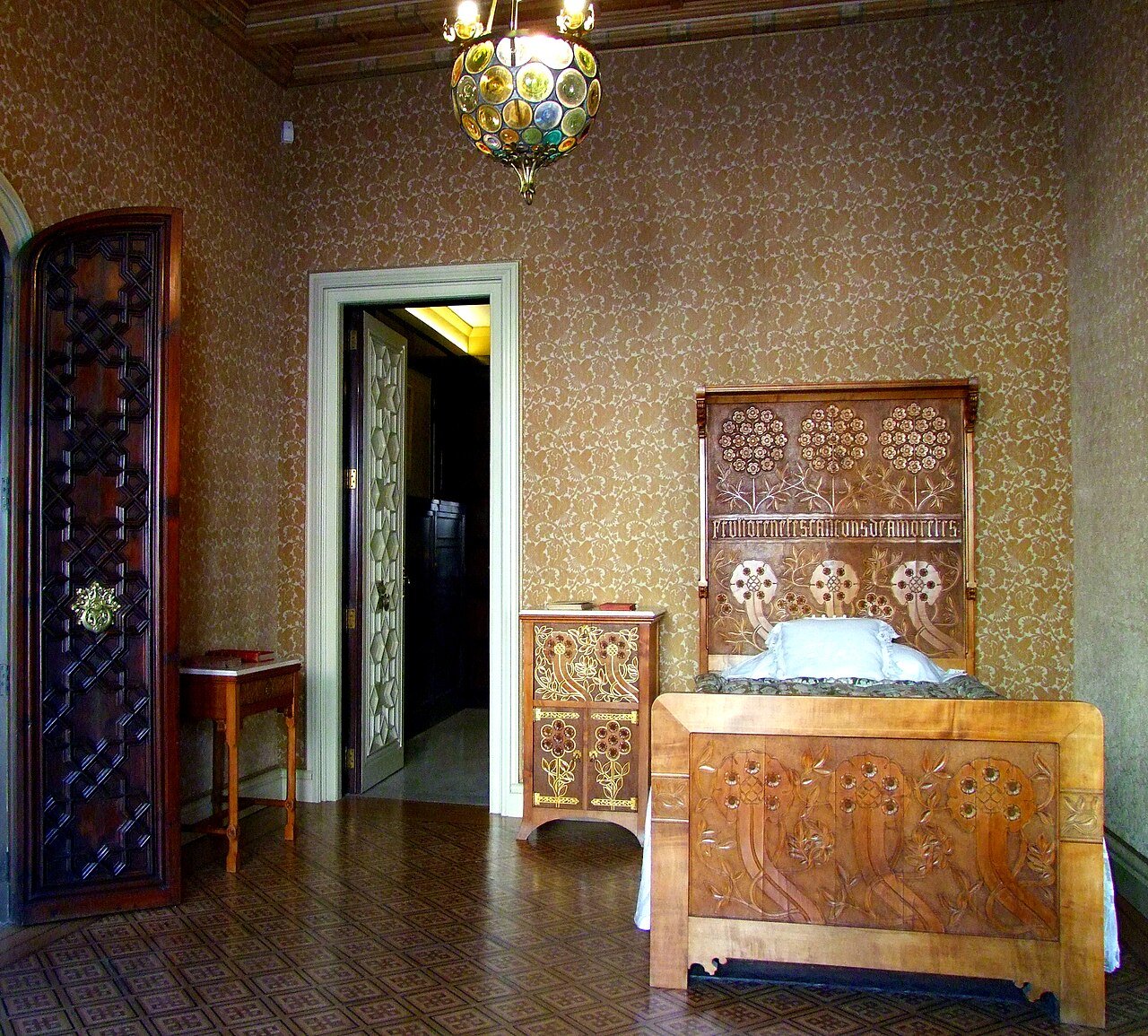
The main floor — the planta noble — opened to the public in 2015 after a six-year restoration, and it is the reason to come. This is not a reconstruction with rope barriers and replicas: the rooms were recovered down to the wallpaper patterns (restorers found original designs hidden under later layers, along with small treasures like coins tucked into a false ceiling), and they are furnished with the family’s own pieces, above all the sinuous inlaid furniture designed for the house by Gaspar Homar, the great modernista cabinetmaker.
You move through the world of 1900 in sequence: the hall and music room, the dining room — where the stone window frame is carved with a larder’s worth of food, lobster and spider included, and where Antoni entertained — and the bedrooms at the back. Teresa’s bedroom keeps her Homar bed, its headboard inlaid with flowers, and the sculpted capital retelling the four ages of woman’s life. Everywhere there are signs of how modern this medieval-looking house was: the lift with its Mudéjar lattice door and heart-shaped handles, electric light, heating, a telephone — the full kit of the new century, dressed in Gothic Revival clothes.


Free Barcelona travel guide
Planning a trip to Barcelona? Get our free one-page Barcelona checklist: what to book ahead, what to skip, and the tapas bars we actually eat in.
Teresa Amatller and the Photography Archive
The house’s second life is as unlikely as its first. Teresa Amatller (1873–1960) outlived her father by fifty years in these rooms, and in 1942 she founded the Fundació Institut Amatller d’Art Hispànic to preserve the house and the family’s collections — and to pursue the passion she shared with Antoni: photography as a tool for knowing art.
Antoni had photographed his travels across Europe and North Africa with a professional’s discipline, building an image library of the art he loved; the institute grew that seed into one of the reference photographic archives for Spanish art, built around the great Arxiu Mas, the life’s work of the photographer Adolf Mas. Researchers still work from its negatives today. In the house you will see the other half of Antoni’s collecting: pieces of his celebrated Hispano-Roman glass — bought from the Caballero-Infante collection and once among the finest private holdings of ancient glass in Spain — displayed near the rooms where he kept his studio.
It gives the visit an unusual depth. Casa Batlló is a masterpiece you look at; Casa Amatller is a masterpiece somebody worked in — and the work, improbably, was documenting all the other masterpieces.
How to Visit: Tickets, Tours and Timing
The house runs on timed, small-group visits — groups are capped at around 20 — and there are two main ways in. The standard visit — the Casa Amatller entry ticket — is a self-paced tour of the main floor with a video/audio guide at your own speed (allow about 45 minutes), ending with a chocolate tasting; recent prices have been around €17 for adults, with children under 7 free. The alternative is a theatrical guided tour — an actor-led visit in period character, slightly more expensive (around €20) and enormous fun if your Spanish or Catalan is up to it; check which languages run on your dates.
Opening patterns have shifted between seasons — recent schedules open the house Tuesday to Sunday, roughly 10:00–19:00, with high-summer variations and the house traditionally closing for part of August — so treat casaamatller.cat as the final word for your exact day and book the slot ahead; the small groups mean weekends and holiday slots go first. The visit is compact enough to pair with its neighbours, and it combines beautifully with an interior visit to the Palau de la Música Catalana across town — the same world of Puig i Cadafalch’s generation, in full concert-hall glory.
The Chocolate Shop and Café
You do not need a ticket for the sweetest part. The ground floor holds the Amatller chocolate shop and a café — run under the Faborit name — where the thing to order is the house’s own tradition: a cup of thick hot chocolate, Spanish style, made with the family’s chocolate, the descendant of the product that paid for everything upstairs. Buy a bar or two as well; the tins and wrappers have carried modernista designs since Antoni’s day, and they make better souvenirs than most of what is sold on the boulevard.

It is also the pragmatic traveller’s trick for this block: if Batlló’s queue defeats you, or your Casa Amatller slot is an hour away, this hall — free to enter, cool, beautiful — is the best waiting room on Passeig de Gràcia.
Is Casa Amatller Worth It?
Yes — and for many visitors it will be the modernista interior they remember most fondly. It cannot match Casa Batlló’s scale or Casa Milà’s rooftop theatre, and it does not try to. What it offers instead is rarity value: an authentic, furnished, quietly told domestic interior, seen in a group small enough to hear the floorboards, in the middle of the most visited block in Barcelona. If you can only do one of the two neighbours, Batlló is the spectacle; if you can do both, Amatller is the one that feels like a discovery. And if interiors bore you, the façade and the chocolate are still free.
For the Gaudí side of the story, continue up the boulevard to Casa Milà (La Pedrera) — and if you are choosing between the houses, our Casa Batlló guide covers its neighbour in the same detail.
Practical Info
- Address: Passeig de Gràcia 41, 08007 Barcelona — beside Casa Batlló.
- Metro: Passeig de Gràcia (L2, L3, L4) — the house is a two-minute walk from the station exits on the boulevard.
- Opening hours: Usually Tuesday to Sunday, around 10:00–19:00, with seasonal changes and a traditional summer closure period — always confirm the current pattern and your timed slot on casaamatller.cat before you go.
- Tickets: Priority entry with video/audio guide ≈ €17 (chocolate tasting included); theatrical guided tour ≈ €20; children under 7 free. Book via the Casa Amatller entry ticket or the house website.
- Visit rules: Small groups (about 20 maximum); timed entry; protective shoe covers provided for the main floor and high heels are not allowed on the visit — wear flat, soft-soled shoes.
- Time needed: 45–60 minutes for the house, plus café time.
- Accessibility: There is a lift in the house, but the visit involves historic rooms and the shoe-cover rule — check the accessibility notes on the official site if you have mobility needs.
- Good to know: The ground floor (shop and café) is free to enter during opening hours; the historic main floor is ticketed.
Tips for Visiting Casa Amatller
- Book the first slot of the day. The small groups stay small, but the earliest visit has the staircase and skylight almost to itself — and the light through the bottle-glass door is at its best in the morning.
- Do the neighbours in one sweep. Amatller → Batlló → Casa Milà is a single walk up one boulevard; book all timed entries in that order with breathing room between them.
- Wear flats. Shoe covers are provided and heels are refused on the main floor — do not make the trip in your best stilettos.
- Budget for the chocolate. The tasting at the end is a taster, not the full ceremony; the real cup of hot chocolate in the café afterwards is the ritual — leave time and a few euros for it.
- Look for the jokes. The rat with the camera by the door, the lobster in the dining-room stone, the almond blossom in the sgraffito — the house rewards slow looking more than quick photographing.
- Photography: Personal photography has generally been allowed in the visit areas — confirm the current rule at the desk, and keep flashes off around the furniture and textiles.
Travel insurance, sorted
Whether it is a two-week holiday or a longer move, travel insurance is not the most glamorous part of a trip — but it is the one booking you want to have in place before a trip, and while you are already away.
Final Thoughts
Casa Amatller is proof that Barcelona’s modernista golden age was not a one-man show. Puig i Cadafalch built a house that is scholarly and playful at once — a Flemish gable over a Gothic staircase over a chocolate shop — and the Amatller family, father and daughter, filled it with furniture, glass and photographs, then gave it to the city as an institute that still guards it. Go for the interior, stay for the archive’s story, and leave with chocolate on your breath. On the most famous block in Barcelona, it is the house that still feels like a secret.
¡Buen viaje!

Photo credits: Felton Davis, Bernard Gagnon, Mutari, Tdorante10, Canaan, Jorge Franganillo, Ввласенко, Mycatkins — via Wikimedia Commons (CC licences as listed in the image file).