Iglesia de Santa Ana Seville: The Complete Guide to Triana’s Oldest Church
Cross the Puente de Isabel II into Triana and, two streets in, the crowds of the cathedral quarter evaporate. What replaces them is an ochre fortress of a church with battlements on its roofline and a tiled tower — Santa Ana, the first church built in Seville after the Christian conquest of 1248 and still the beating heart of its neighbourhood. Trianeros call it, without irony, la catedral de Triana — the cathedral of Triana — and it earns the title: this is the church where Magellan’s fleet swore its oath before sailing around the world, and where Seville’s sailors, potters and gypsy families have been baptised ever since.
Most visitors never cross the river for it, which is exactly why it belongs on any honest list of the best things to do in Seville. Inside the fortress walls you will find the finest Renaissance altarpiece in the city, a 13th-century image of St Anne older than the present church, and a floor slab in painted tiles that started Seville’s love affair with ceramics.

Short Answer
Santa Ana in Triana is the oldest church in Seville: tradition says Alfonso X founded it in 1266 in thanks for a cure, while the documents date the start of work to 1279–80. It is a Gothic-Mudéjar fortress-church — crenellated, brick-built, its tower finished in blue-and-white tiles — containing Seville’s greatest Renaissance altarpiece, fifteen panels by Pedro de Campaña around a 13th-century group of Santa Ana, the Virgin and Child. The parish runs a cultural visit (church and crypt museum) on weekday mornings and afternoons for a small charge — recent visitors report around €3.
Table of Contents
- The Short Version
- Alfonso X, a Vow and an Eye: The Founding of Santa Ana
- A Fortress on the Far Bank: Apse, Tower and Doorways
- Inside: Brick Naves, Ribs and Star Vaults
- The Main Altarpiece: Pedro de Campaña’s Fifteen Panels
- The Trascoro and Alejo Fernández’s Virgen de la Rosa
- The Chapels: Magellan’s Virgin, the Baptismal Font and the Carmen
- A Knight in Tiles: The Lauda, the Crypt and the Parish Museum
- Holy Week and Triana’s Devotions
- Practical Information
- What to See Nearby
- Final Thoughts
The Short Version
- What it is: The oldest church in Seville and the parish church of Triana — a Gothic-Mudéjar fortress-church founded under Alfonso X in the late 13th century, declared a monument in 1931.
- Don’t miss: The main altarpiece by Pedro de Campaña, the chapel of the Virgen de la Victoria where Magellan’s expedition was blessed, the 1503 ceramic tomb slab, and a look up at the star vaults.
- The honest catch: It is a working parish first and a monument second. The cultural visit runs on weekdays only, hours vary between listings, and there is no online booking — you turn up at the door.
- Time needed: 45–60 minutes, including the crypt museum.
- Combine with: The rest of the quarter — the market, the potters’ museum and the Esperanza’s chapel are all a few minutes’ walk, and a small-group Triana walking tour finishes at Santa Ana’s door.
Alfonso X, a Vow and an Eye: The Founding of Santa Ana
Every Trianero knows the founding story. Alfonso X — the Learned King — was suffering from a disease of the eyes, and he vowed to raise a church to St Anne, the Virgin’s mother, if she cured him. She did, and in 1266 the king ordered the church built across the river in Triana. The parish celebrated its 750th anniversary in 2016.
The documents tell a slower, stranger story, and Santa Ana is more interesting for it. In 1266 the king was neither in Seville nor ill; the surviving record puts the start of work in the autumn of 1279 or the first weeks of 1280 — by which time Alfonso really was losing an eye, to a tumour that eventually cost him the eye itself. The vow may be embroidered, but the gratitude of an ageing, ailing king fits the church that resulted.
What is certain is the setting. After Fernando III took Seville in 1248, Triana grew up outside the walls around the Almohad Castillo de San Jorge, which Alfonso granted to the city council in 1253. Santa Ana replaced the castle’s small hermitage of St George as the parish church of the new settlement — the first church raised in Seville after the conquest, and still the oldest church in the city.
A Fortress on the Far Bank: Apse, Tower and Doorways
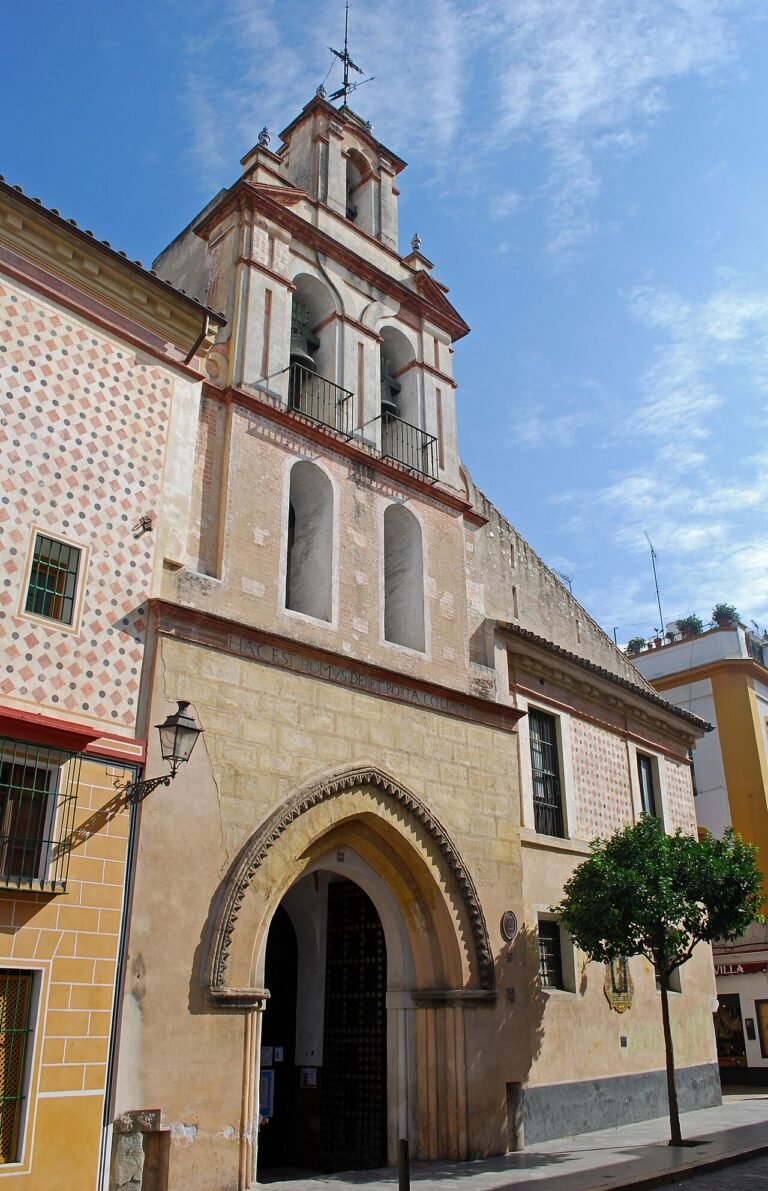
Santa Ana looks like a castle because, in its first centuries, it had to work as one. Triana lay beyond Seville’s walls with nothing between it and trouble but the river, so its parish church was built defensible: thick walls, few and small windows, flat roof terraces — azoteas — and a continuous line of battlements along the top of the walls, still traceable above the ochre render. At the east end the point becomes obvious: the polygonal apse reads less like a church sanctuary than like the keep of a small fortress.

The whole church is brick — the material of Triana’s own kilns — with stone reserved for what brick cannot do: vault ribs and arches, doorways, columns and corbels. An earthquake in 1356 damaged the young church badly enough that it was substantially rebuilt in the late 14th century; the Lisbon earthquake of 1755 shook it again, and the remodelling that followed under the architect Pedro de Silva gave the exterior its present ochre-and-red face. Read the building as three layers: a Gothic brick skeleton, shaken twice and repaired twice, wearing an 18th-century skin.
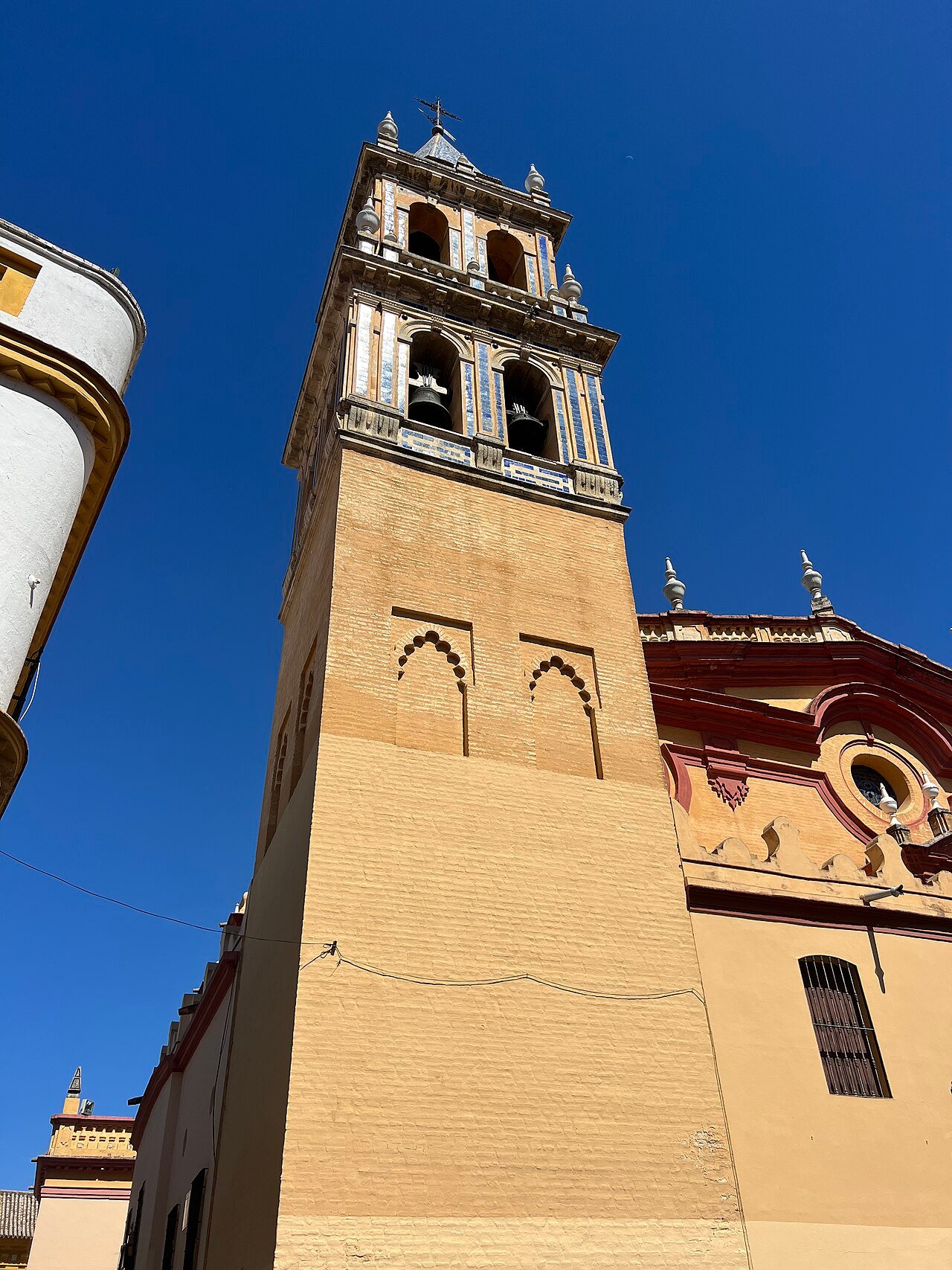
The tower tells the same story vertically. Its lower body is Mudéjar work of the first half of the 14th century — halfway up the plain brick shaft you can still make out its original poly-lobed arches, bricked up within their rectangular alfiz frames. Rebuilt in the 16th century, it gained its second belfry and crowning spire from 1629 under the master Martín Izquierdo, to designs by Diego López Bueno — the spire sheathed in blue-and-white glazed ceramic, potters’ work on the potters’ church. Consolidated again after 1755, the tower reads Baroque at the top and medieval at the base.
Of the three medieval doorways, one is a small masterpiece. The Gospel-side door — the one the cultural visit uses — is cut in stone: a deeply splayed pointed arch on seven pairs of slender colonnettes with carved vegetal capitals, its outer archivolts worked in diamond points and zigzag, crowned by a steep pointed gablet carrying the shield of Castile. The main west door opens onto Calle Párroco Don Eugenio, and beside the church a plaque survives from the old parish cemetery. Stand here and you are at the centre of old Triana — our guide to the Triana neighbourhood walks the whole quarter from this spot.

Inside: Brick Naves, Ribs and Star Vaults
The interior is a surprise after the fortress exterior: tall, pale and austere. Three naves run the length of the church in five bays, the central vessel higher and wider than the sides, all carried on stone ribs springing from corbels carved with heads, lions, castles and vine leaves. In 1972 the architect Rafael Manzano directed a restoration that stripped the Baroque interior dressing and re-exposed the medieval fabric, which is why Santa Ana today feels older inside than almost any other church in Seville. Assaulted in the Civil War — though not burned — it lost artworks on the way; the gilded richness that remains is concentrated in the chapels and the great altarpiece, which is exactly what makes the altarpiece, when you reach it, hit so hard.

Look up in the side aisles and the vaulting relaxes into geometry. Most bays carry simple ribbed vaults, but the chapels added over the centuries experimented: the Capilla del Capitán Monte Bernardo, built into the left nave in the 15th century, is roofed with true star vaults. The chapel of the Cristo del Socorro, at the head of the right nave, keeps its Gothic ribs under a skin of 18th-century tempera painting — a rare survival of the Baroque layer Manzano removed elsewhere.

The Main Altarpiece: Pedro de Campaña’s Fifteen Panels
The main altarpiece fills the apse wall — a gilded architectural machine of three bodies designed (the trazas are his) by Martín de Gaínza, carved under a contract of 1542 by Nufro Ortega and Nicolás Jurate, its bench reliefs of the Evangelists attributed to Roque Balduque, and its polychromy not finished until 1565. It is generally considered the finest Renaissance altarpiece in Seville, and its glory is the painting: fifteen panels, all by one hand.
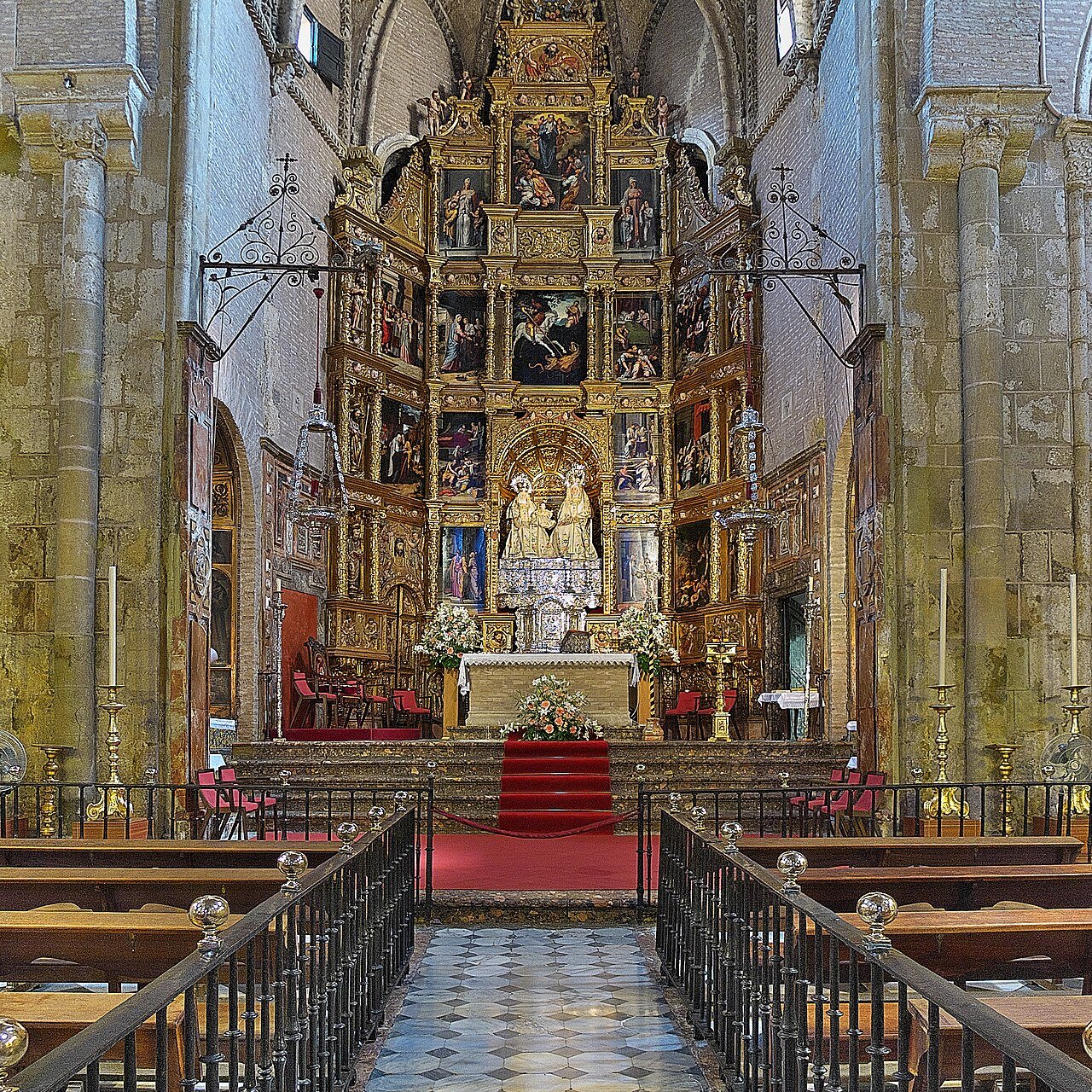
The painter was Pedro de Campaña — born Pieter de Kempeneer in Brussels, and by the 1540s the leading painter in Seville. His fifteen panels tell a cycle almost no other church attempts: the apocryphal story of St Anne and St Joachim and of the Virgin’s childhood, running up to the Nativity of Christ. At the centre, St George kills the dragon — Triana’s first patron, from the castle hermitage, keeping his place in the new church. And in one panel, look for St Anne’s other daughters with their children: among the small boys is a child Santiago — St James as a toddler, a subject of real rarity.
At the centre of it all, in a gilded shrine of its own, sits the reason the church exists: the group of Santa Ana, the Virgin and the Child, carved in the second half of the 13th century — older than the rebuilt church around it, very possibly from Alfonso’s first building. It is a de candelero group, carved to be dressed: embroidered robes, silver crowns, grandmother, mother and child. Francisco de Ocampo retouched the carving in the early 17th century. The parish restored the whole retablo with the Andalusian heritage institute (IAPH) in 2008–2010, and it has glowed at the east end ever since.

Free Seville travel guide
Planning a Seville trip? Get our free Seville checklist — the sights, neighbourhoods and practical tips that make a first visit easy.
The Trascoro and Alejo Fernández’s Virgen de la Rosa
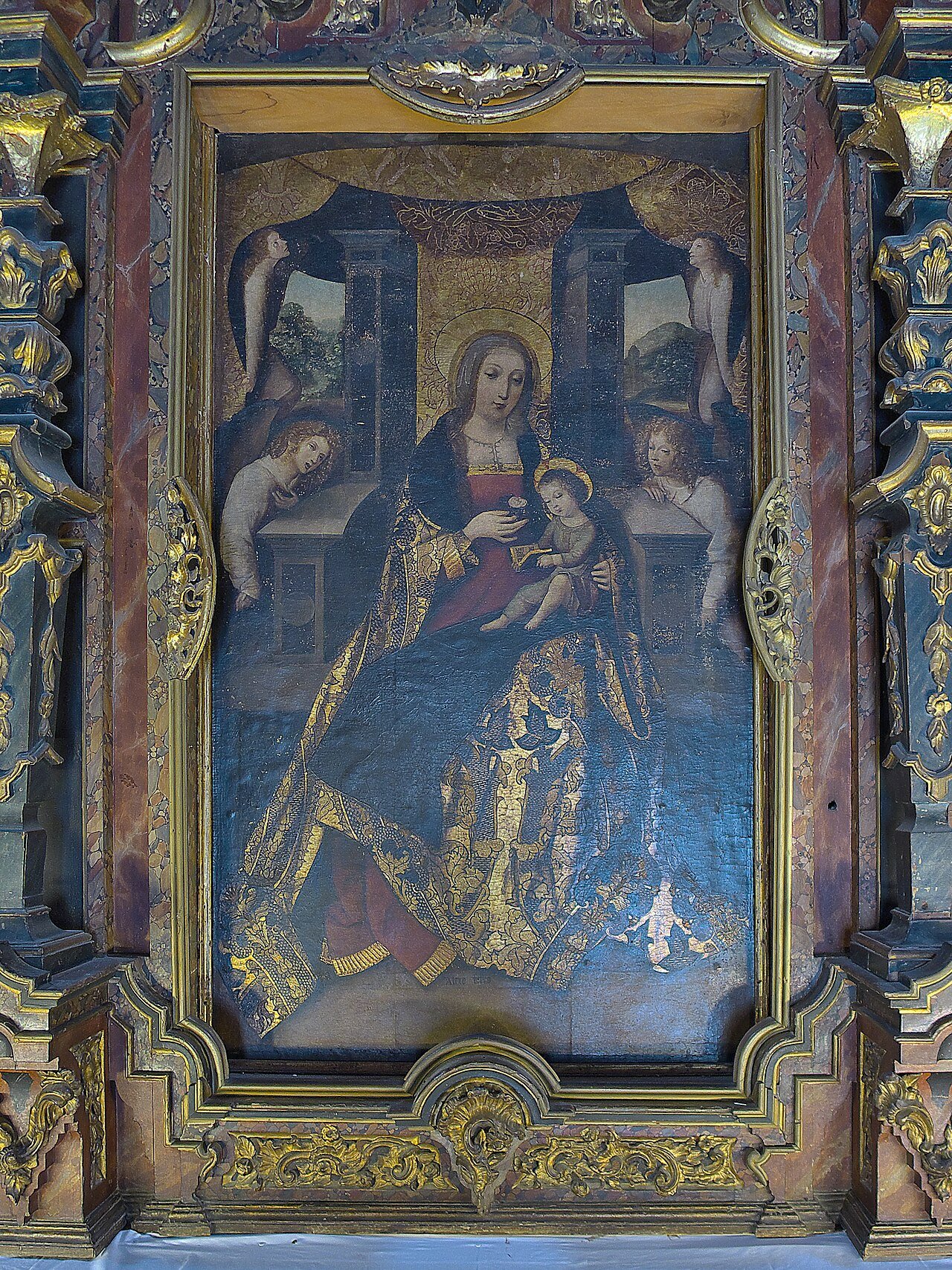
Turn around. At the foot of the church stands the trascoro, the painted screen that backs the choir — late 18th-century work by Martín de Toledo, the organ in its two facing cases above. Set into its centre is the church’s other great painting: the Virgen de la Rosa — the Virgin of the Rose — painted in 1525 by Alejo Fernández, the master who founded the Seville school of painting a generation before Campaña. The Virgin, in a gold-brocaded mantle, holds out a white rose to the Christ Child, who ignores it politely in favour of his book; four angels lean in from the sides. It rewards the slow, close look the cultural visit allows — Hispano-Flemish painting at its most jewel-like, at the west end of a church whose east end Campaña would fill a generation later.
The Chapels: Magellan’s Virgin, the Baptismal Font and the Carmen
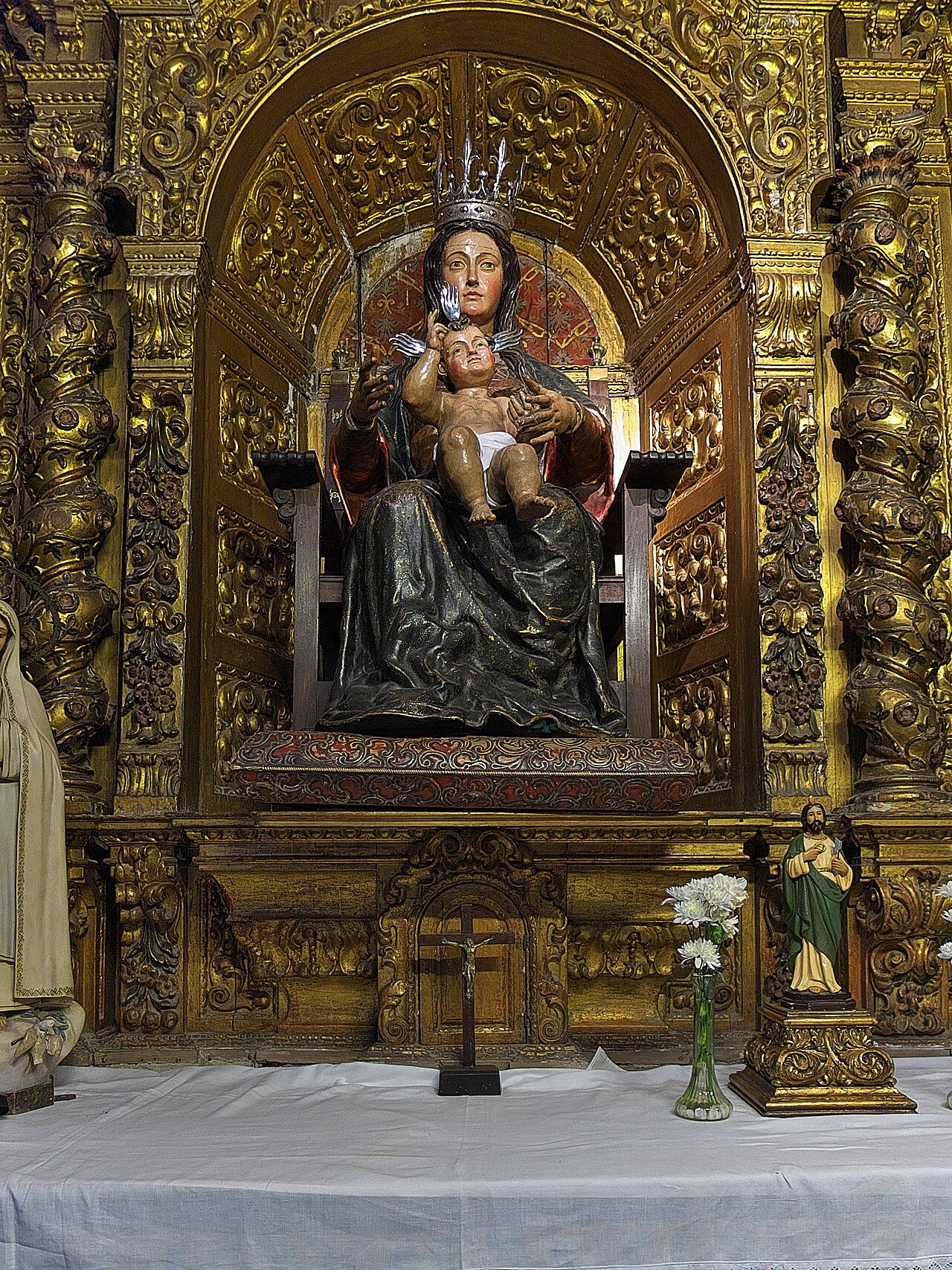
The side chapels are where Santa Ana stops being a monument and becomes a parish — and where its history suddenly goes global. In the chapel at the head of the left nave stands the Virgen de la Victoria, an image of the early 16th century in a retablo carved by Bernardo Simón de Pineda in 1664. Before this Virgin, on 2 August 1519, the banners of Ferdinand Magellan’s five ships were presented and the expedition’s oath sworn; the fleet sailed on 10 August. Three years later, on 9 September 1522, Juan Sebastián Elcano and the seventeen other survivors of the nao Victoria — eighteen men of 234 — came back to this same chapel to give thanks before her. No other room in Seville holds both ends of the first voyage around the world.
The maritime thread runs through the whole building: the navigator Vicente Yáñez Pinzón, co-discoverer of America on Columbus’s first voyage, has his remains in this church, marked by a ceramic plaque outside. And in the baptistery stands the great fluted stone font that Triana calls la pila de los gitanos — the gypsies’ font. Generations of the quarter’s sailors, potters and gypsy families were baptised in it; in a parish where everyone worked the river or the kilns, the font was the true register of Triana.

First on the left as you enter, you meet the Virgen del Carmen in a blaze of silver — a great sunburst ráfaga behind her, the brown scapulars of her order in her hand. For a river parish she is the essential Virgin: patroness of sailors. Her brotherhood, reorganised in January 2018, keeps her feasts across the year, above all in July. Around her the other devotions layer up: the Madre de Dios del Rosario, patroness of the capataces and costaleros who carry Seville’s processions, in a retablo of about 1710 by Miguel Franco, and the Divina Pastora, the Shepherdess Virgin, who processes in September.

A Knight in Tiles: The Lauda, the Crypt and the Parish Museum
On the floor of the church, behind a protective iron grille, lies the object that ties Santa Ana to Triana’s other great industry. The lauda sepulcral of Íñigo López is a tomb slab made entirely of painted tiles — maiolica — signed by the Italian potter Niculoso Pisano and dated 1503. It is the first maiolica work made in Seville: the moment the technique that would cover the city in ceramics arrived, in the potters’ own parish church. Triana folklore nicknamed the armoured knight el Negro and long held that a single woman who kicked the slab would find a husband — please don’t: the parish restored the lauda for the 750th anniversary and firmly discourages the tradition now.

The cultural visit continues below. A side door descends to the crypt under the right nave, where the parish keeps a small museum: a Gothic portapaz of the early 16th century, and the great silver processional custodia, attributed by some to the silversmith Andrés de Ocampo, which still heads the parish’s Corpus Christi procession through Triana each year. And look at the walls as you leave: the lower walls run with early-20th-century tile wainscots from Triana’s Mensaque factory. Font, tomb, tower spire, wall tiles — Santa Ana is a ceramics museum that happens to be a church.

Holy Week and Triana’s Devotions
Santa Ana is not a Holy Week church in the way the great basilicas are — it is something older: the place Triana’s Holy Week began. The Esperanza de Triana is based at the Capilla de los Marineros a few metres away on Calle Pureza, but until 1845 her estación de penitencia was made not to the cathedral but here, to her own parish church. The bond never broke: on Good Friday morning her return route still passes the Plazuela de Santa Ana and Calle Párroco Don Eugenio, the silver palio squeezing home past its mother church towards midday, and the Good Friday afternoon liturgy of the Passion is celebrated at Santa Ana itself.
The rest of the year has its own rhythm. The parish’s sacramental brotherhood organises Triana’s Corpus Christi procession; the Divina Pastora processes in September; the Rosario on 12 October; and the Carmen’s feasts fall in July — the month of the Velá de Santiago y Santa Ana, the quarter’s own summer fair, held around 25–26 July in honour of St James and St Anne herself.
Practical Information
Everything practical about visiting Santa Ana, in one place.
| Address | Calle Párroco Don Eugenio, 1, 41010 Sevilla — on the Plazuela de Santa Ana, in the heart of Triana |
| Cultural visit | Monday–Friday, mornings 10:30–13:30 and afternoons from 16:30 (listings give closing between 19:00 and 20:30) |
| Price | A small charge at the door — recent visitors consistently report around €3. The price is not published on an official page, so confirm on the day |
| Mass | Daily and Sunday services in a working parish church; sightseeing pauses during Mass |
| Time needed | 45–60 minutes, including the crypt museum |
| Nearest metro | Plaza de Cuba (Line 1), about 10 minutes’ walk |
| Good to combine with | Triana Market, Capilla de los Marineros, Centro Cerámica Triana, Calle Betis |
Tickets and How to Book
There is no online booking and no ticket desk: the parish runs the cultural visit itself — arrive at the Gospel doorway on Calle Párroco Don Eugenio during the published hours and pay the small charge at the door. If you prefer to arrive with the quarter already making sense, the small-group Triana and Guadalquivir walking tour crosses the bridge, walks the market and the ceramics streets and finishes at Santa Ana — but it does not include monument tickets, so the church’s own charge still applies when you go in.
Opening Hours
The cultural visit — church and crypt museum — is published for Monday to Friday, 10:30–13:30 and 16:30 into the evening, with afternoon closing variously listed between 19:00 and 20:30; one listing adds short weekend windows around Mass times. Parish schedules change for weddings, funerals and feasts, so check the parish’s official channels before a special trip. Entry for worship at Mass times is free — but a Mass is not a sightseeing slot.
Getting There
From the old town, walk: cross the Puente de Isabel II from the Plaza del Altozano — the church is about 300 metres from the bridgehead — and follow Calle Pureza or the parallel streets to the Plazuela de Santa Ana, where the church fills the square. From further afield, Metro Line 1 to Plaza de Cuba leaves you a ten-minute walk north through the quarter. Driving is a mistake here — the old streets are narrow and parking scarce, and the bridge walk is part of the pleasure.
When to Go
A weekday morning is the classic slot: the cultural visit is open, and the light through the small high windows is at its best. Come in late July and the church stands at the centre of the Velá de Santiago y Santa Ana, the quarter decorated and the Carmen’s feasts in the same weeks. Good Friday morning brings the Esperanza past the door — unforgettable, and crowded in the way of all great Triana moments.
How Long You Need
Forty-five minutes covers the church properly — altarpiece, chapels, lauda, a look up at the vaults — and an hour includes the crypt museum at an unhurried pace.
Tips for Visiting
- Don’t skip the crypt. The museum’s silver custodia and the portapaz are half the point of the ticket.
- Look for the child Santiago in the retablo’s panel of St Anne’s daughters.
- Don’t kick the knight. The lauda tradition is real folklore, but the slab is a fragile 1503 original and the parish asks visitors to leave it in peace.
- Photograph respectfully, and not during Mass. This is a parish church that lends you its treasures, not a museum that happens to hold services.
- Pair it with lunch at Triana Market, five minutes away — the visit and the market make a perfect cross-river morning.
What to See Nearby
Santa Ana anchors a natural Triana walk. Start at the Plaza del Altozano, the bridgehead square, and drop into Triana Market, built over the remains of the Castillo de San Jorge, the castle that preceded the church. On Calle Pureza, a few metres from Santa Ana, the Capilla de los Marineros holds the Esperanza de Triana and the Cristo de las Tres Caídas. The Centro Cerámica Triana, in the old Santa Ana factory, tells the potters’ story that the church’s tiles begin. Finish along Calle Betis, the riverside street, looking back at the old town.
Back across the river, the pairing writes itself: Santa Ana is the natural west-bank counterweight to a morning in the Barrio Santa Cruz, and if this church gives you a taste for Seville’s great parish churches, cross back north to the Iglesia de San Luis de los Franceses, the city’s Baroque firework of a church.
Travel insurance, sorted
Whether it is a two-week holiday or a longer move, travel insurance is not the most glamorous part of a trip — but it is the one booking you want to have in place before a trip, and while you are already away.
Final Thoughts
Seville’s churches compete in splendour, but Santa Ana wins on something rarer: continuity. The oldest church in the city is still the parish of the quarter that grew up around it — the font still in use, the Carmen still watching the door, the Esperanza still passing on Good Friday. Come for the Campaña altarpiece and the Magellan story; stay for the feeling of a neighbourhood church that has been loved for 750 years.
Cross the bridge in the morning, give it its hour — with a guided walk of Triana if you like — and you will understand why Triana insists it keeps its own cathedral. ¡Buen viaje!
Photos: Zarateman, Chabe01, José Luis Filpo Cabana, Anual, Jl FilpoC and CarlosVdeHabsburgo, via Wikimedia Commons (CC0, CC BY 3.0 and CC BY-SA 4.0).