Montjuïc Olympic Pool, Barcelona: The Complete Guide to the Piscina Municipal de Montjuïc
Short Answer
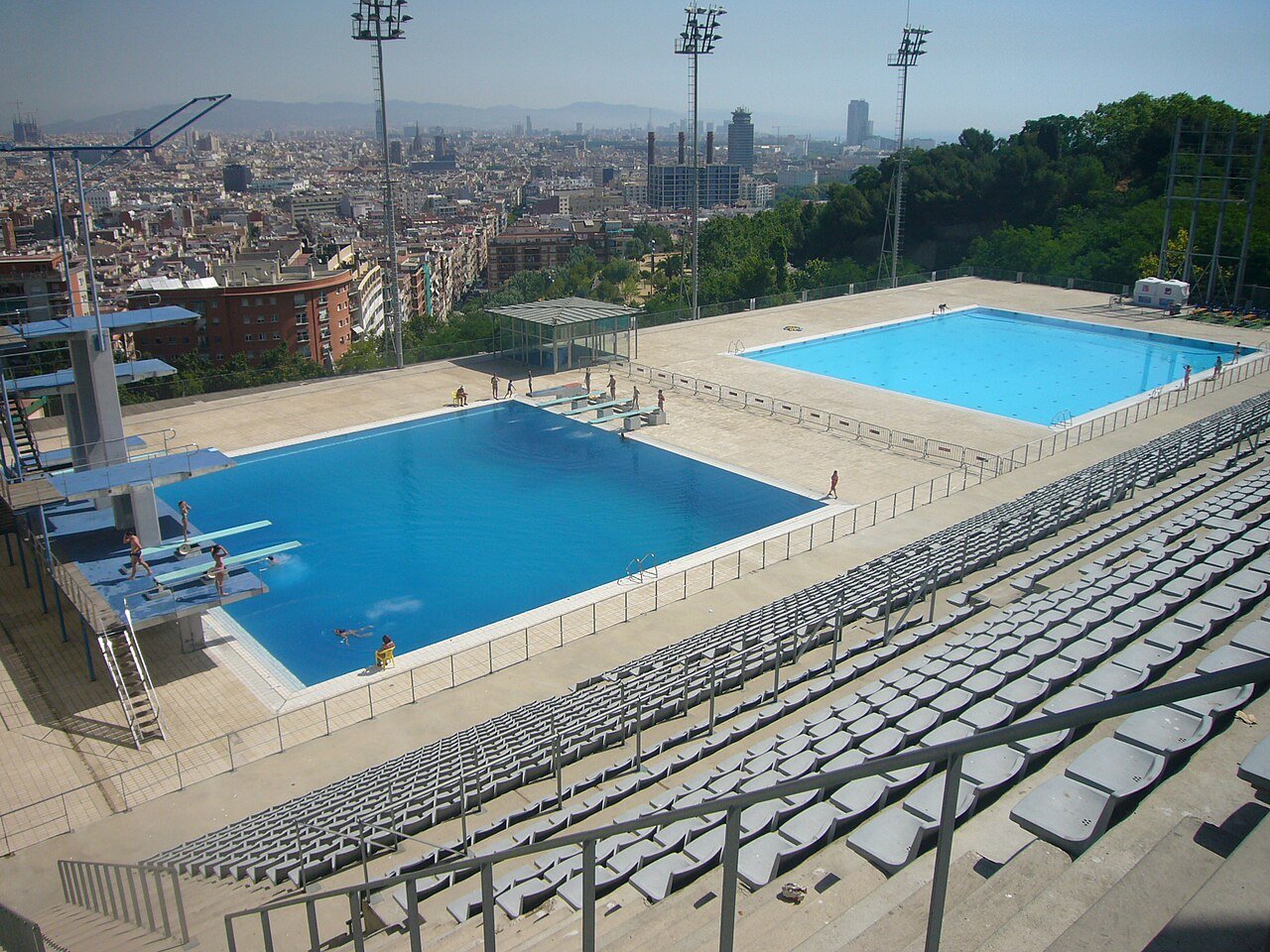
The Piscina Municipal de Montjuïc is Barcelona’s Olympic diving venue — an open-air pool complex cut into the slope of Montjuïc hill, where the diving events and water polo preliminaries of the 1992 Summer Olympics were staged against the most famous backdrop in sport: the entire city, laid out below the diving boards. It has two pools — a dedicated diving pool with platforms up to 10 metres, which the public can look at but never jump from, and a 25-metre outdoor pool beside it, which opens to public swimming for one short season each summer. In 2026 the season ran from 8 June to 6 September, with entry at €7.92 for adults and €5.48 for under-15s and over-65s, paid at the gate — there are no advance tickets. Outside those weeks the venue hosts diving competitions and training, and the second Olympic pool complex on the hill, the Piscines Bernat Picornell, covers the rest of the year. Come in season and you swim, sunbathe and take in the view from a genuine Olympic venue for the price of a sandwich.
Table of Contents
- The Short Version
- A Pool Older Than the Olympics: A Short History
- The View: A Pool Above the City
- The Diving Tower
- Swimming Here Today: The Summer Season
- Screen Fame: Kylie, an iPhone Ad and Dua Lipa
- The Other Olympic Pool: Piscines Bernat Picornell
- Watching the Divers: Events at the Pool
- Practical Info
- Tickets and Costs
- Getting There and Getting Around
- When to Go
- How Long You Need
- Tips for Visiting
- What to See Nearby
- Frequently Asked Questions
- Final Thoughts
The Short Version
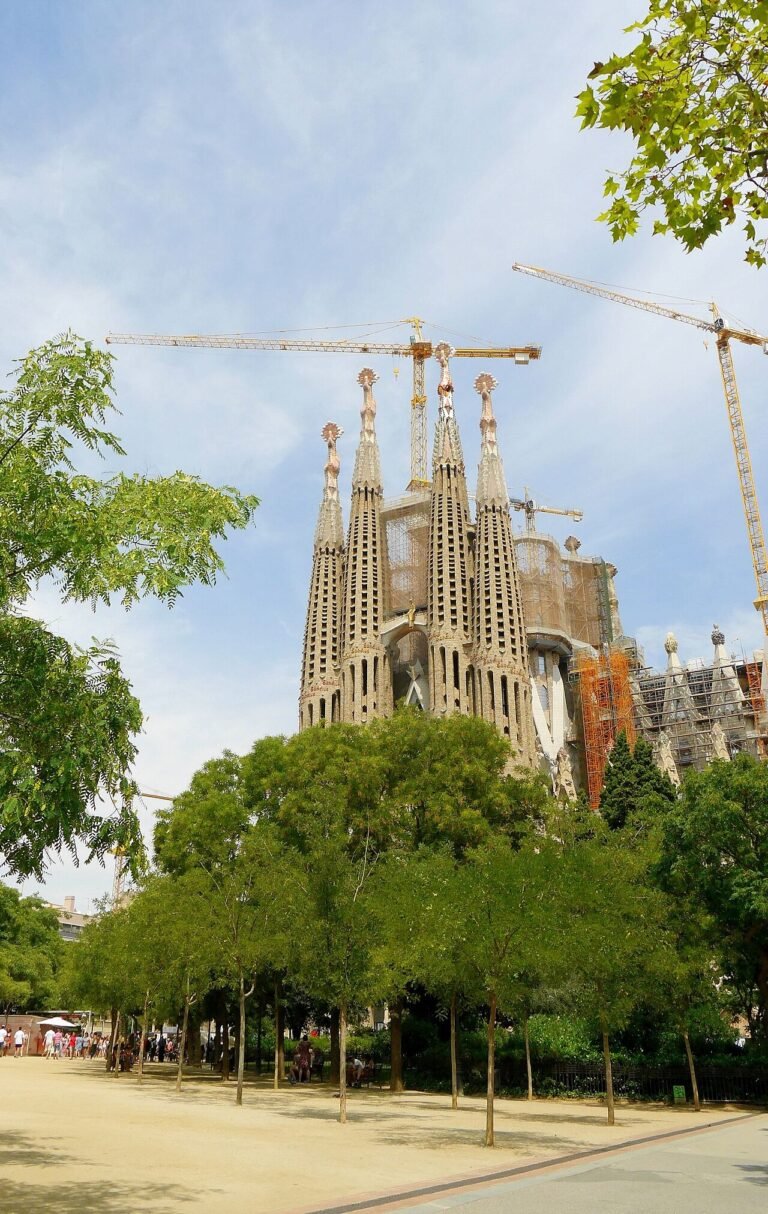
Every city has one photograph that explains it, and Barcelona’s might be this: a diver suspended in the air, springboard behind, and behind that — instead of a stadium wall — the whole city, the Sagrada Família rising out of the grid a mile and a half away. That image, broadcast to the world in the summer of 1992, was made here, at a municipal swimming pool on the side of Montjuïc hill. The extraordinary thing is what happened next: the venue did not become a museum or a ruin. Every summer it simply opens its gates, charges the standard city pool price, and lets anyone swim in it. It belongs on any serious list of the best things to do in Barcelona — with two honest warnings. The first is that the season is short, barely three months. The second is that you cannot book anything for the pool itself: entry is pay-at-the-gate, numbers are controlled at the door, and the only bookable part of a Montjuïc pool day is the ride up the hill — the Montjuïc Cable Car roundtrip ticket glides from the park station a few minutes’ walk from the pool up to the castle at the top, and turns the journey into part of the visit.
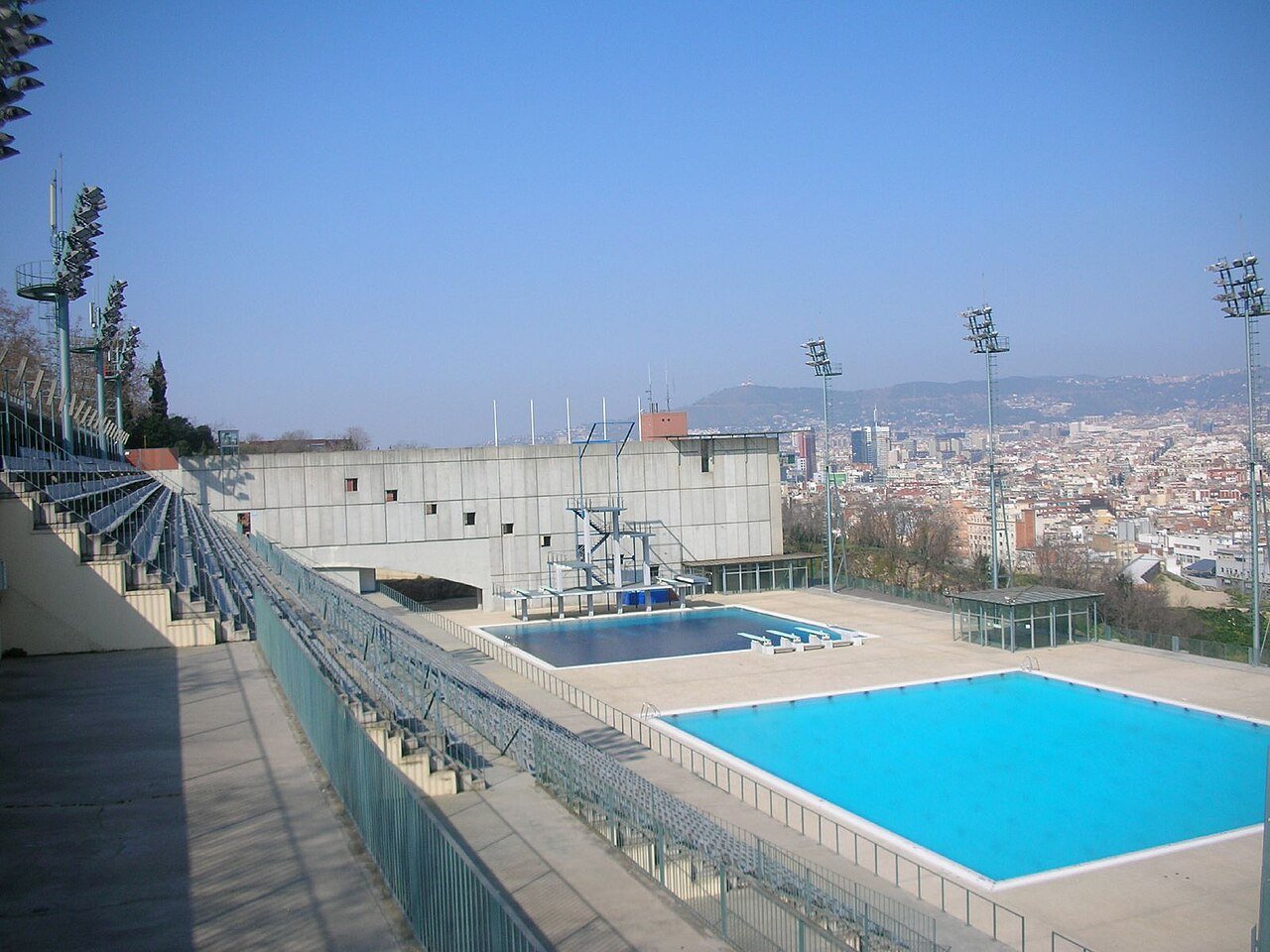
The venue confuses first-timers because of its name. There are, in fact, two Olympic pool complexes on Montjuïc, ten minutes apart, and both are public. This one — the Municipal — is the photogenic diver’s venue: spectacular, seasonal, and deliberately basic, a competition shell with a big terrace and almost nothing else. The other, the Piscines Bernat Picornell beside the Olympic Stadium, is the working sports centre where the 1992 swimming races were actually held: three pools, a gym, open all year. This guide covers the famous one in full, and the practical one honestly — which one you want depends entirely on whether you came for the view or for the swimming.
A Pool Older Than the Olympics: A Short History
The Olympics made the pool famous, but they did not make the pool. A swimming venue has stood on this slope since 1929, when a single 50-metre pool was opened here for the Barcelona International Exposition — the same exhibition that built the palaces, fountains and avenues all over Montjuïc. The pool was refurbished to host the swimming events of the 1955 Mediterranean Games, and for decades it served the city as an outdoor venue in a peerless position, the grandstands staring out over the rooftops.
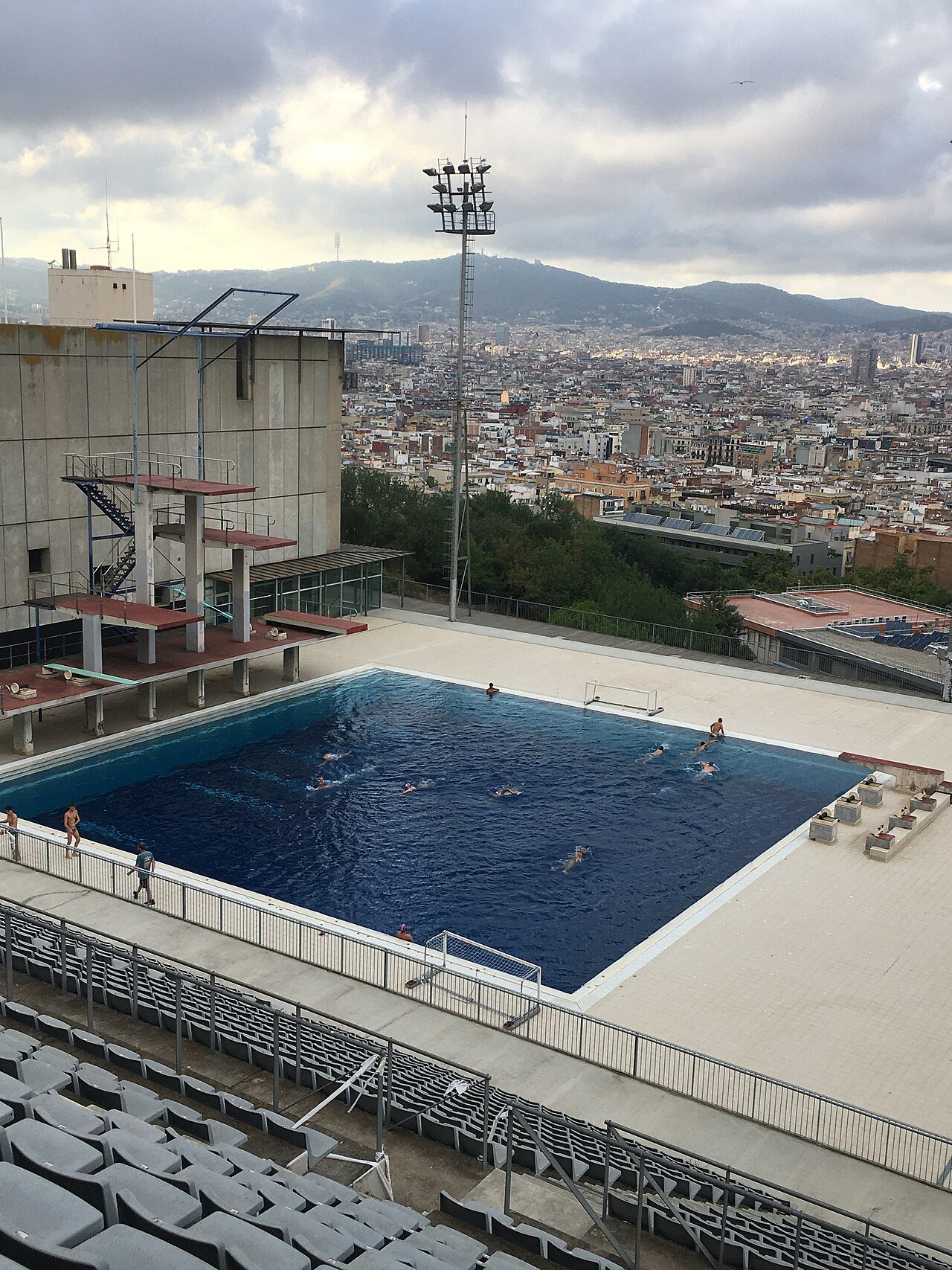
The transformation came with the 1992 Games. Refurbishment works began in 1990 to a design by the architect Antoni de Moragas i Gallissà: the old single pool was replaced by the two pools you see today — the diving pool and the 25-metre pool — and temporary grandstands pushed the capacity to 6,500 spectators. In the summer of 1992 the venue hosted the diving events and the water polo preliminaries, and television did the rest: shot after shot of divers arcing against the skyline turned a municipal pool into one of the most recognised sporting venues on earth. The venue’s second life has been in the same sport — it staged the diving at both the 2003 and 2013 World Aquatics Championships, when Barcelona hosted the championships — and its permanent spectator capacity now stands at 4,100.
The View: A Pool Above the City
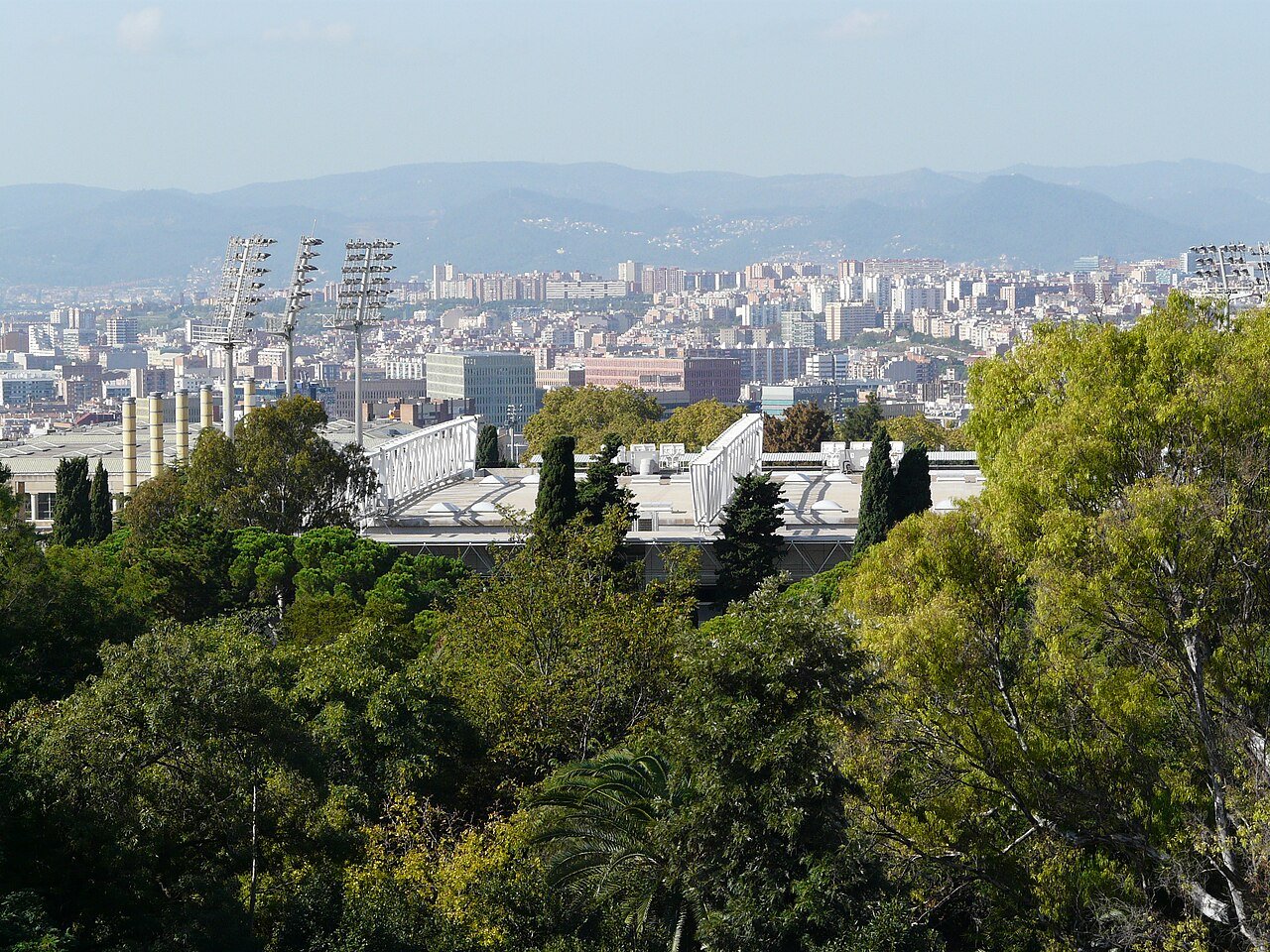
Plenty of pools have views. This one has the view, and it is worth being precise about why it works. The venue is terraced into the northern slope of Montjuïc, so the pools sit on a shelf with the city falling away in front of them: from the water and the sunbathing terrace you look straight across the rooftops of Poble-sec and the old town to the Eixample grid, with the Sagrada Família’s cranes and spires unmistakable, the Torre Glòries off to the east and the Collserola hills closing the horizon behind. The divers of 1992 performed with that panorama behind them, which is why the footage still looks staged — nowhere else in Olympic history has a venue borrowed an entire city as its backdrop.
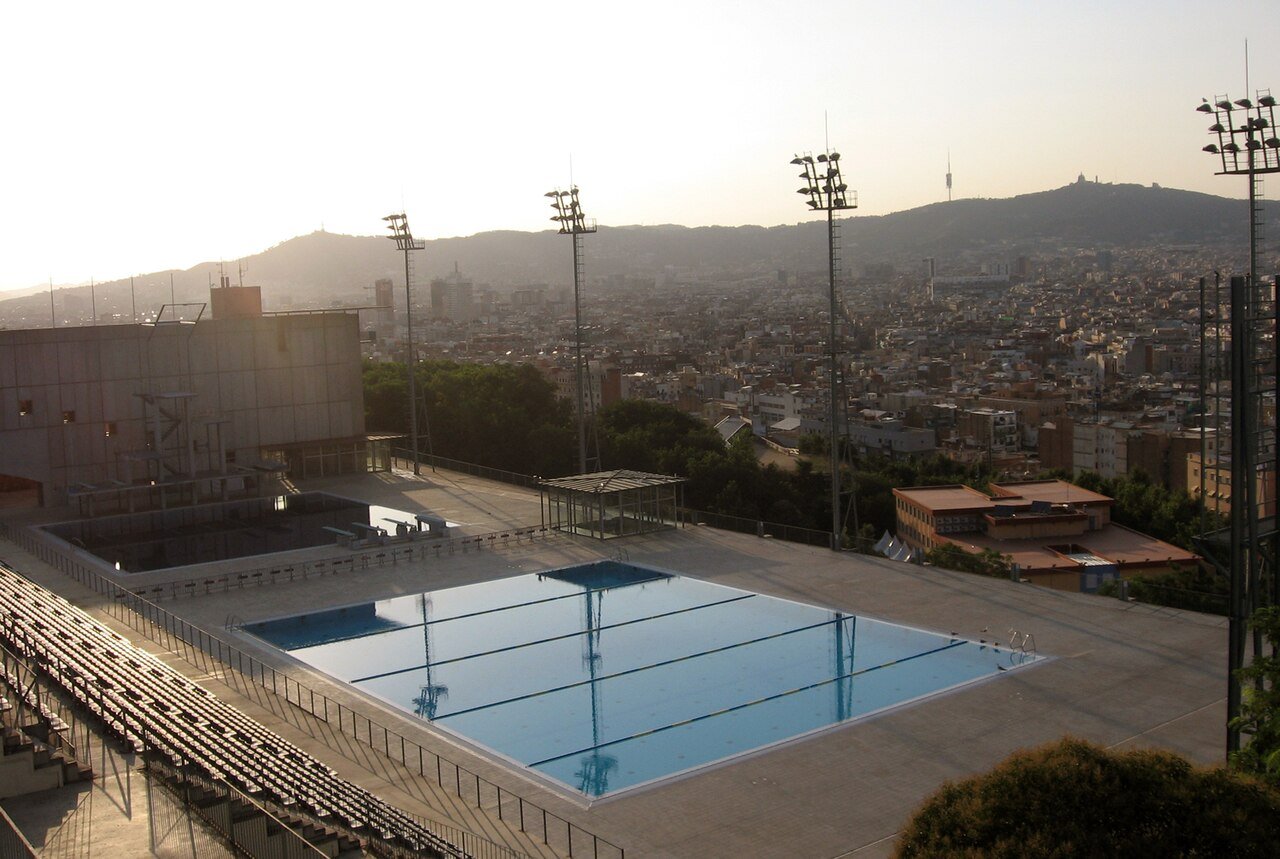
The practical consequence is that the pool rewards timing. Midday gives you the postcard in hard blue light; late afternoon softens it; and on the Friday-to-Sunday evenings when the venue stays open later, the last hour — warm light, the city turning gold, the floodlights coming on — is the finest swim in Barcelona at any price. You do not need to swim to see it, either: the terrace bar above the entrance, Bar Salts, is open to everyone, and a coffee there costs a fraction of pool entry while delivering the same panorama (see Practical Info).
The Diving Tower
The tower is the venue’s monument: a stack of concrete platforms and springboards rising at the western end of the diving pool, the 10-metre platform at the top looking out over the city it made famous. Up close it is beautiful brutalist equipment — all business, built for one purpose — and it still earns its keep, because this remains a working diving venue, used for training and for national and international competition long after the Olympics left.
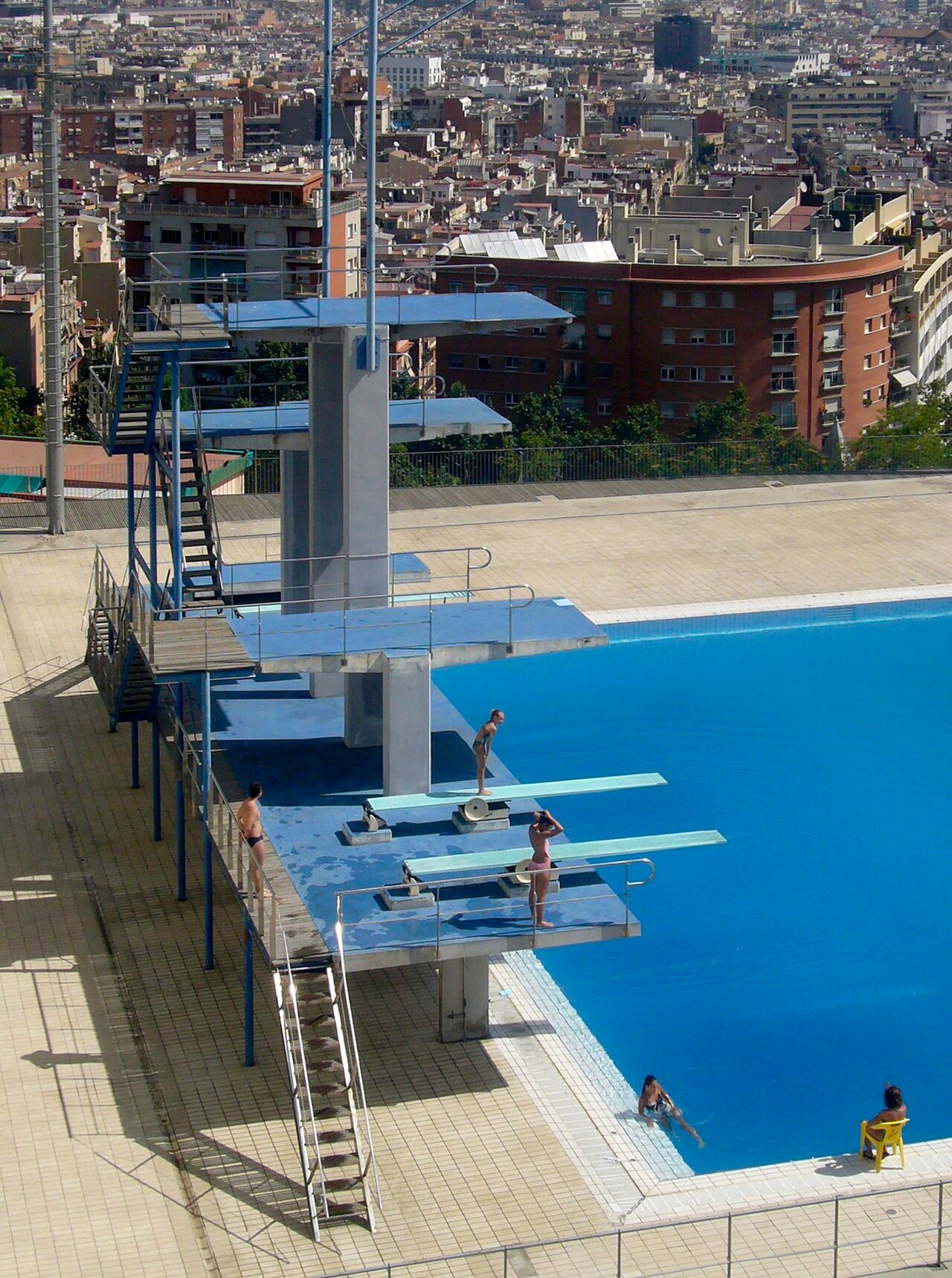
Now the honest disappointment, stated plainly because every visitor deserves to know it before the climb: you cannot dive. The platforms and springboards are closed to the public at all times — they are competition equipment, used by trained divers — and public swimming happens only in the 25-metre pool next door. What you get as a swimmer is arguably better than a jump anyway: you do your lengths and your floating in the second pool while the tower stands over you, and between swims you can sit on the terrace in the exact sightline of the 1992 broadcasts. Plenty of visitors arrive expecting a go on the boards; none leave unhappy with the exchange.
Swimming Here Today: The Summer Season
For roughly three months each year, the venue puts on its second identity. The 25-metre pool opens for public bathing, the big terrace — some 2,520 square metres of it — fills with sun loungers and parasols (hired at the venue for a small extra charge), and the place runs as a cheerful, unpretentious city lido with an absurdly grand backdrop. In 2026 the season ran from 8 June to 6 September, opening 11:00–19:00 Monday to Thursday and 11:00–20:30 on Fridays, Saturdays, Sundays and public holidays; the season’s dates and hours are set by the city each year, so check the current year’s before you plan around them.

Understand what kind of pool this is and you will love it. It is a leisure pool, not a training pool: there are no roped lanes for lengths, and the water is deep, competition-depth water rather than a paddling gradient — confident swimmers will be in their element, and it is not the place to teach a small child to swim. Facilities are those of a 1992 competition venue and make no apology for it: changing rooms and showers below the stands, the terrace, the bar, and not much else. There is no gym, no slides, no frills. What there is, is space, sun, warm water and the view — and on a weekday morning, very often, a near-empty pool in the middle of one of Europe’s busiest tourist cities.
Screen Fame: Kylie, an iPhone Ad and Dua Lipa
The 1992 broadcasts made the pool recognisable; pop culture has kept it that way. In 2003 Kylie Minogue filmed the video for “Slow” here — all slow-motion sunbathers around the diving pool — and quietly introduced the venue to a generation that had never watched Olympic diving. In 2016 Apple chose the same tower for “Dive”, the iPhone 7 commercial built entirely around one long, loving shot of a diver leaving the top platform. And in 2024 Dua Lipa shot the video for “Illusion” at the pool, platforms, terrace and skyline all present and correct. Three decades, three productions, one unchanged set: the venue needs no dressing because it already looks like a location scout’s invention. If the pool feels familiar when you arrive, this is why.
The Other Olympic Pool: Piscines Bernat Picornell
Ten minutes’ walk along the Olympic Ring, beside the Lluís Companys Olympic Stadium, stands the venue where the 1992 swimming races, synchronised swimming, water polo final and modern pentathlon swim were actually held: the Piscines Bernat Picornell. It opened in 1970 for the European Swimming Championships and was remodelled for the Games, and where the Municipal pool is a monument that opens for summer, Picornell is a working municipal sports centre that happens to be an Olympic venue. It has three pools — a 50-metre indoor pool, a 50-metre outdoor pool with its own spectator stands, and a diving pool — plus a gym, sauna and the rest of a full sports centre’s facilities.

The practical difference is the calendar. Picornell is open all year — the indoor pools run through winter, and the outdoor pool’s season stretches roughly from April to October, far beyond the Municipal pool’s three months. A day pass cost €15.10 for adults in 2026, more than the Municipal pool but buying a great deal more: proper lanes, serious lengths, and the centre’s facilities. A swimming cap is compulsory, as it is in most Catalan pools. So the rule for visitors is simple. In high summer, for the view and the occasion: the Municipal. For real swimming, or in any other month: Picornell. And if you are touring the hill’s Olympic sites in one day, the scenic way to stitch the day together is the Montjuïc Cable Car — it climbs from the park station near the diving pool to the castle above both venues.
Watching the Divers: Events at the Pool
Because the venue never stopped being a diving venue, some of the best visits here involve no swimming at all. The pool continues to host diving training and competition — it staged the diving events of two World Aquatics Championships, in 2003 and 2013 — and on event days the grandstands fill and the place briefly becomes what it was in 1992. There is no fixed public calendar a guide can honestly print here: competitions are scheduled season by season, and the venue can also close to public bathing for events even inside the summer season, which is one more reason to check the current programme before a dedicated trip.

Even outside event days, take ten minutes in the stands. The seats are the ones the Olympic crowds sat in, the sightline down through the tower to the city is the commentator’s shot from 1992, and it costs nothing but the entry you have already paid.
Practical Info
The Piscina Municipal de Montjuïc stands at Avinguda Miramar, 31, on the northern slope of Montjuïc in the Sants-Montjuïc district (postcode 08038). It is run as one of the city’s municipal sports centres (the Picornell centre’s team manages the municipal pools on the hill — you will see their banners at the gate). Public swimming is summer-only: in 2026, 8 June to 6 September, 11:00–19:00 Monday to Thursday and 11:00–20:30 Friday to Sunday and public holidays. Entry is bought at the gate; there is no advance booking and no online ticket for the pool. Capacity is controlled, and on hot weekend afternoons the venue can fill — mornings are the reliable slot. The diving pool, platforms and springboards are never open to the public. The Bar Salts terrace bar, at the top of the venue by the entrance, is open to non-swimmers too — you can take the view with a drink without buying pool entry. Bring your own towel; loungers and parasols are hired on the terrace for a small charge. Outside the season, the exterior, the tower and the view from Avinguda Miramar are still worth the walk up, but the gates open only for events and training.
Tickets and Costs
Entry is a municipal pool price, not an attraction price: in 2026 a day’s bathing cost €7.92 for adults and €5.48 at the reduced rate (under-15s and over-65s), paid at the gate. Set that against a beach club or a hotel pool pass and it is one of the great bargains in Barcelona — an Olympic venue with the city’s best view for under eight euros. Loungers and parasols on the terrace cost a small extra. There is genuinely no way to buy pool entry in advance, and any website offering “skip-the-line Olympic pool tickets” is selling something that does not exist. The one part of the day you can — and should — book ahead is the ride: the Montjuïc Cable Car roundtrip ticket is the official ticket, sold by Turisme de Barcelona, with free cancellation up to 24 hours before; the cable car’s lower station is a few minutes’ walk from the pool along Avinguda Miramar, and the cars climb to Montjuïc Castle. At Picornell, a day pass cost €15.10 for adults in 2026, bought at the centre.
Getting There and Getting Around
Funicular (the easy way). The Funicular de Montjuïc is part of the metro system and runs from Paral·lel station (lines L2 and L3) up the hill on a normal metro ticket. Its upper station, Parc de Montjuïc, lands you on Avinguda Miramar a few steps from the pool gates — this is the route the venue was designed around, and the one most visitors should take.
Metro and bus. From Espanya (L1 and L3), bus 150 climbs the hill through the Olympic Ring, and bus 55 serves Avinguda Miramar from the city side; both stop within a short walk of the venue. The walk up from Espanya past the Magic Fountain is the scenic option — twenty-odd minutes uphill, through the best of Montjuïc’s 1929 avenues.
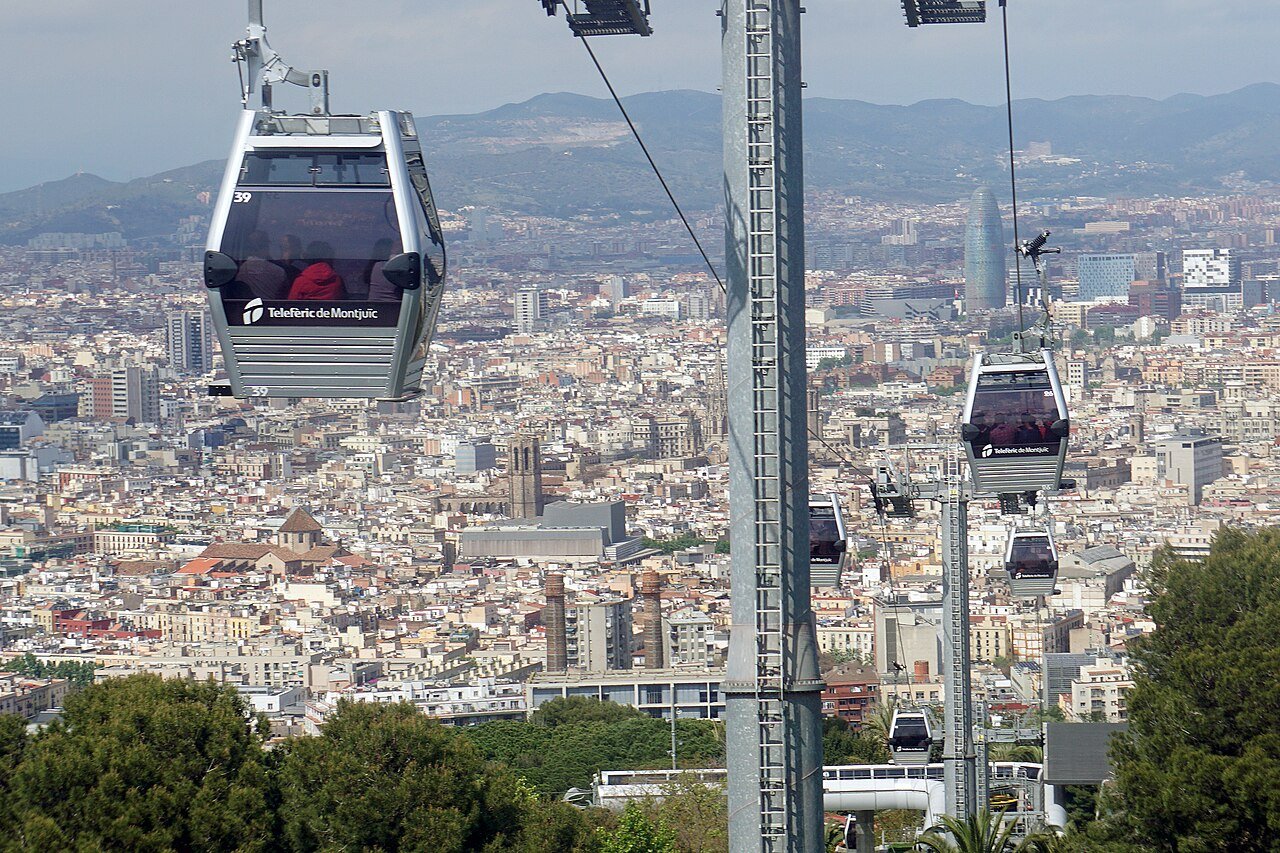
Cable car. The Telefèric de Montjuïc is a separate, scenic system (not the harbour cable car, and not part of the metro): its lower station stands on Avinguda Miramar near the funicular’s top station, and its cabins — eight seats each, on a 750-metre line — rise via the Mirador stop to Montjuïc Castle at the summit. It pairs naturally with the pool: swim first, ride up for the castle and the full panorama after.
On foot and by car. The pool sits on the Poble-sec side of the hill; fit walkers can climb the stairs and paths from Poble-sec or the Miramar gardens in fifteen minutes. Driving up Montjuïc is possible and parking exists around the Olympic Ring, but on a summer weekend the funicular is faster than the traffic.
When to Go
The season is the whole answer: outside early June to early September there is no public swimming at all, however hot the day. Within the season, weekdays are a different world from weekends — the same pool, the same view, a fraction of the people — and mornings are quieter than afternoons. The connoisseur’s slot is a Friday or weekend late session, arriving mid-afternoon and swimming through the golden hour as the light drops over the city and the floodlights come on. Weather matters more than at a normal pool: the venue is fully outdoors and elevated, so a windy or overcast day takes the edge off, while a clear hot day in July or August is what the place exists for. And build in one check before you set out — the venue occasionally closes to public bathing for competitions and events, even mid-season, so confirm the day is a public day before climbing the hill.
How Long You Need
As a swim stop on a Montjuïc day, two to three hours is the natural visit: a swim, a long sunbathe on the terrace, a drink at Bar Salts, ten minutes in the grandstand. It combines beautifully with the rest of the hill — the castle above by cable car, the Miró foundation a short walk along Avinguda Miramar, the Olympic Stadium and Picornell around the ring, the Magic Fountain on the way down — and a full Montjuïc day built around a midday swim is one of the best days out in Barcelona. What does not work is treating it as a quick photo stop in winter: the gates will be shut, the pools may be empty, and all you will get is the (admittedly fine) view from the road.
Tips for Visiting
- Check the season before anything else. Public swimming ran 8 June to 6 September in 2026, with dates set annually — outside them, there is nothing to book a trip around.
- Go on a weekday morning. Same price, same view, a near-empty pool; weekend afternoons fill to capacity.
- Swim late on a Friday or weekend. The extended 20:30 closing in 2026 put the golden hour in the water — the best swim in the city.
- Bring your own towel. Loungers and parasols can be hired on the terrace, but the venue is a municipal pool, not a beach club.
- Do not expect to dive. The tower and boards are competition-only, always. The view from the water is the compensation.
- Serious lengths? Go to Picornell. No lanes here; the 50-metre lanes are ten minutes away at the other Olympic pool, and a cap is compulsory there.
- Use the funicular. Paral·lel, one metro ticket, and you step out beside the gates — no hill climb in the heat.
- Take the bar view for free. Bar Salts’ terrace is open without a pool ticket — the panorama with a coffee, any day the venue is open.
What to See Nearby
The pool sits in the middle of the richest square mile in Barcelona. Along Avinguda Miramar to the east are the Joan Brossa gardens; a few minutes west along the same avenue stands the Fundació Joan Miró, the artist’s own museum, as calm and white as the pool is exuberant. Above everything sits Montjuïc Castle, reached by the cable car from beside the pool, with the harbour and the whole coastline at its feet. Around the Olympic Ring, ten minutes west, are the Lluís Companys Olympic Stadium — still in use, still impressive, with the Olympic and Sports Museum beside it — and the Picornell pools themselves, an attraction in their own right for anyone who swims seriously.

And on the way down, save the evening for the slope’s other great free spectacle: the Magic Fountain of Montjuïc, below the Palau Nacional at the Plaça Espanya end of the hill — swim at the top in the afternoon, watch the fountain light up at night, and you have had Montjuïc at its best in a single day.
Frequently Asked Questions
Can you swim in the Olympic diving pool in Barcelona?
You can swim at the venue, but not in the diving pool itself, and never off its boards. Public swimming takes place in the 25-metre outdoor pool beside the diving pool, during the summer season only — in 2026, from 8 June to 6 September. The platforms and springboards are reserved for trained divers and competitions at all times.
How much does it cost to swim at the Montjuïc Olympic pool?
In 2026, entry cost €7.92 for adults and €5.48 at the reduced rate for under-15s and over-65s — the standard municipal price, paid at the gate. There are no advance tickets. Sun loungers and parasols on the terrace cost a small extra.
When is the Piscina Municipal de Montjuïc open?
Only in summer. The 2026 public season ran from 8 June to 6 September, opening 11:00–19:00 Monday to Thursday and 11:00–20:30 on Fridays, Saturdays, Sundays and public holidays. Dates and hours are set by the city each year and the venue can close for competitions, so check the current season before you go. For swimming outside those weeks, use the Piscines Bernat Picornell, which open all year.
Can you visit the pool without swimming?
Partly. The Bar Salts terrace bar at the venue is open to everyone and gives you the famous view without a pool ticket. The pools and grandstands themselves are inside the paid venue during the season; outside it, the gates open only for events and training, though the tower and the panorama can still be seen from Avinguda Miramar.
Why is the Montjuïc pool so famous?
Because of how it looked on television. The diving events of the 1992 Barcelona Olympics were staged here with the entire city — not a stadium wall — behind the divers, producing some of the most replayed images in Olympic history. The pool has since starred in Kylie Minogue’s “Slow” video (2003), Apple’s iPhone 7 “Dive” commercial (2016) and Dua Lipa’s “Illusion” video (2024).
What is the difference between the Piscina Municipal and Bernat Picornell?
They are the two Olympic pool complexes on Montjuïc. The Piscina Municipal is the 1992 diving venue: two outdoor pools, summer-only public swimming, the famous view, minimal facilities. Piscines Bernat Picornell, by the Olympic Stadium, hosted the 1992 swimming races and is a full sports centre — indoor and outdoor 50-metre pools, diving pool, gym — open all year, at a higher day-pass price.
Travel insurance, sorted
Whether it is a two-week holiday or a longer move, travel insurance is not the most glamorous part of a trip — but it is the one booking you want to have in place before a trip, and while you are already away. Get a quote from SafetyWing
Final Thoughts
Most Olympic venues ask to be admired. This one asks you to bring a towel. For under eight euros, on the right summer weekday, you can float in a 1992 Olympic venue with the whole of Barcelona spread out below the diving tower — then dry off on the terrace, take a coffee where the commentators sat, and ride a cable car up to a castle for the evening. It is not luxurious, it is not open for long, and you cannot book it in advance, and none of that matters: this is the rare famous place that has stayed exactly what it was, a city pool in a ridiculous position, open to anyone who climbs the hill. Time a summer trip to catch the season, arrive before the crowds, and swim in the photograph.
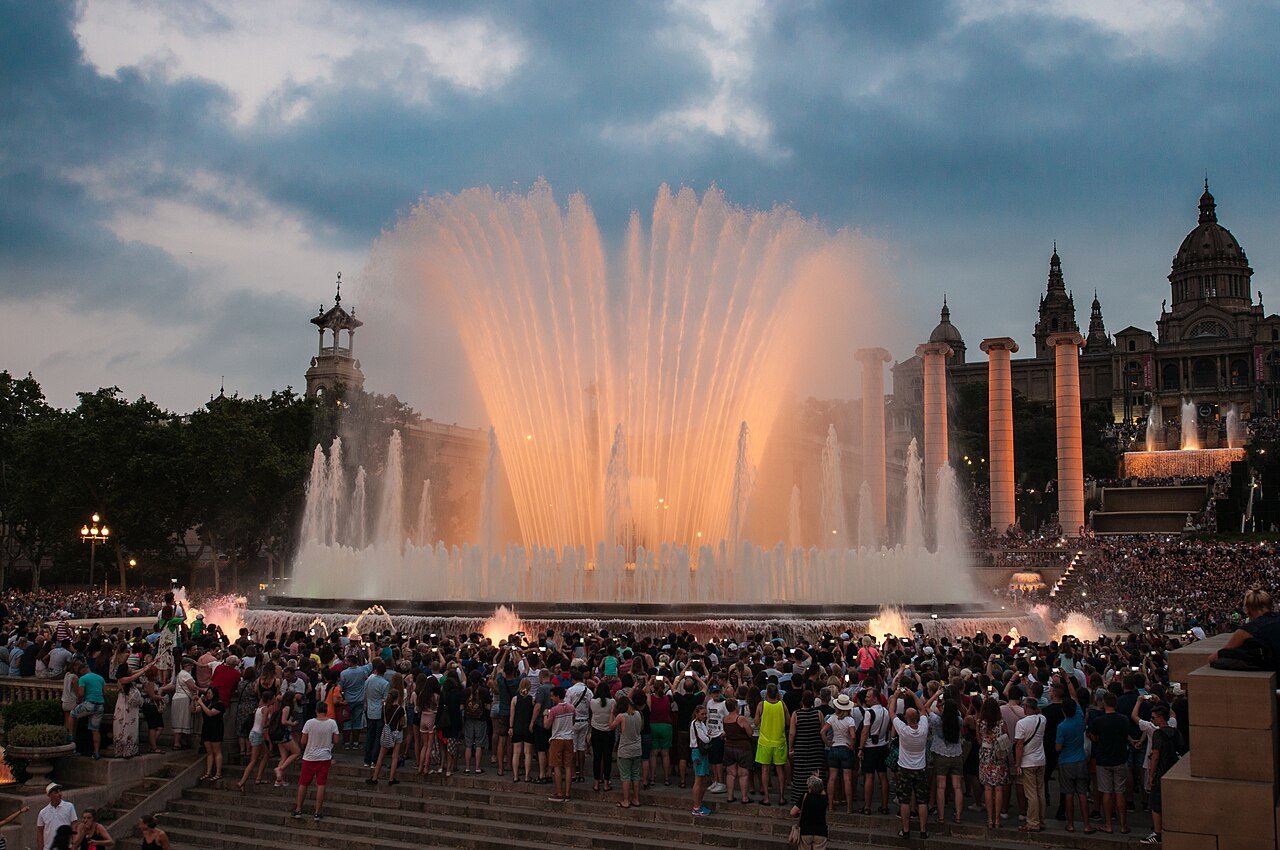
Photo credits: Jordiferrer, puroticorico, Mooonswimmer, barcelonatips.nl, Enric, pere prlpz, Txllxt TxllxT and Mariordo (Mario Roberto Durán Ortiz), via Wikimedia Commons.