Palacio de las Dueñas: The Complete Visitors’ Guide
Some palaces in Seville were built to be looked at. This one was built to be lived in — and then, for five centuries, it was: by duchesses and poets, by a family that married emperors’ cousins and entertained kings, and most famously by Cayetana Fitz-James Stuart, the 18th Duchess of Alba, who was born into this house’s orbit, celebrated two weddings here, and loved it above every other palace she owned. The Palacio de las Dueñas is the Seville home of the House of Alba — a Gothic-Mudéjar and Renaissance palace folded around lemon trees and quiet courtyards in the Santa Catalina quarter — and until 2016 almost nobody outside the family had seen inside it. Her son, the present Duke, opened the doors that year. What you get is not a monument with ropes and echoes, but a great house still warm from occupation: furnished salons, family portraits, a brass brazier on the rug, and gardens where the loudest sound is a fountain.
This guide tells the palace’s double story first — a ducal seat that was also, for a while, a tenement where Spain’s greatest modern poet was born — then walks the visit in the order you will make it: the courtyards, the lemon-tree garden, the carriage hall and stables, the family’s main rooms, and the little chapel. It earns its place in our Best Things to Do in Seville list by being the Seville palace that feels like a home — the necessary third act after the Alcázar’s splendour and Pilatos’s antiquities.
The Short Answer
Yes — the Palacio de las Dueñas is the most personal palace visit in Seville, the one to choose if you want the Alba family’s world rather than another set of empty state rooms; give it an hour to an hour and a half, and take the audioguide, because the stories are the exhibit. The visit is all on the ground floor and almost entirely outdoors-in-spirit: a main courtyard planted like a garden, a second courtyard of palms and tile, lemon and orange groves, the old stables, a chapel with a Florentine altarpiece, and a run of furnished salons hung with the family’s paintings, tapestries and memorabilia. Entry is in the region of fifteen euros with the audioguide included, there is rarely a queue, and on non-holiday Monday afternoons entry has traditionally been free. Buy your Palacio de las Dueñas entry ticket ahead in spring if you like certainty, or simply at the door — and come in the morning, when the courtyards are cool and the light is kind.
Table of Contents
- The Short Answer
- The Story in Brief: Duchesses, a Poet and Five Centuries of One Address
- What to See: The Courtyards
- What to See: The Gardens and the Limoneros
- What to See: The Apeadero and the Stables
- What to See: The Main Rooms
- What to See: The Chapel
- Practical Info
- Tips for Visiting
- Final Thoughts
The Story in Brief: Duchesses, a Poet and Five Centuries of One Address
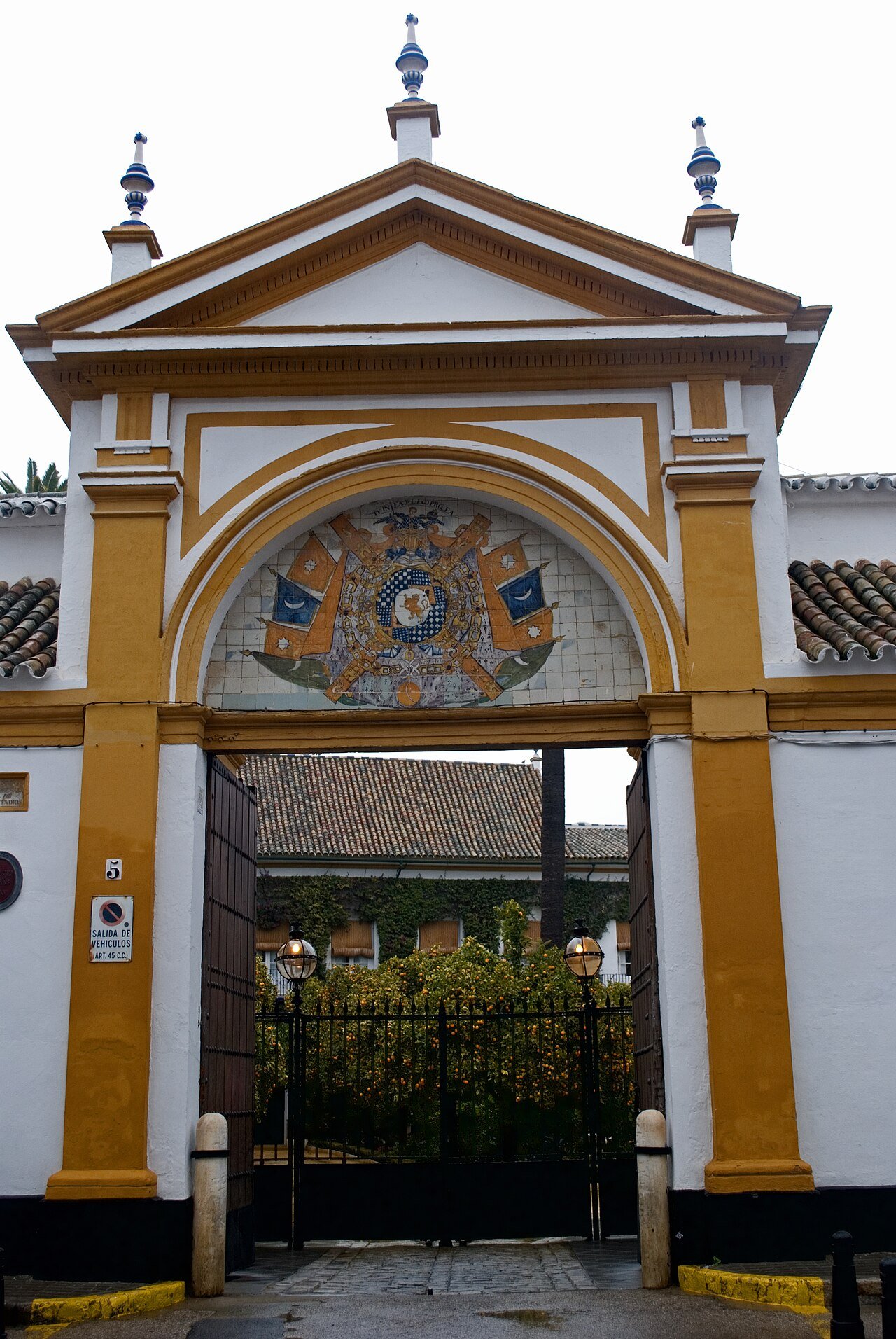
The palace takes its name from a neighbour that no longer exists: the convent of Santa María de las Dueñas, which stood on the adjoining plot until its demolition in 1868. The house itself began as the palace of the Pineda, lords of Casabermeja — a family rich enough to build big and unlucky enough to have to sell: tradition has it that the sale helped ransom Juan de Pineda, captured in the Granada war. In 1496 the property passed to Catalina de Ribera, the same formidable widow who was reshaping the Casa de Pilatos across town, and under the Enríquez de Ribera the palace took its enduring form — Gothic-Mudéjar bones, Renaissance manners, courtyards turned inward against the heat. Then, in 1612, a marriage carried it into the orbit of the House of Alba, where it has remained ever since: the Alba’s Seville residence, counterpart to their Palacio de Liria in Madrid. The street portal you enter by — ochre and white, the Alba arms blazoned in tile above the arch — was rebuilt for the 12th Duke in 1771, and it is still the palace’s only real piece of showing off.
The strangest chapter came in the nineteenth century, when the great house was divided up and let as a casa de vecinos — a tenement of rented rooms. The palace administrator was one Antonio Machado Álvarez, and in a rented apartment here, on 26 July 1875, his son was born: Antonio Machado, who would become Spain’s defining modern poet. He spent his first eight years inside these walls, and he never forgot the address. “Mi infancia son recuerdos de un patio de Sevilla” — my childhood is memories of a courtyard in Seville — begins his famous self-portrait: the clear orchard, the ripening lemon tree. That courtyard is this one. A plaque and a small monument by the entrance keep the connection, and the lemon trees are still doing exactly what the poem says.
The twentieth century returned the palace to splendour and to gossip. The guest book runs from the Empress Eugenia de Montijo and Alfonso XIII to Jacqueline Kennedy and Grace Kelly, but the palace’s defining resident was Cayetana Fitz-James Stuart, 18th Duchess of Alba — by repute the most titled aristocrat on earth, and a woman who belonged to Seville as much as to her house. She held the reception of her first wedding here in 1947, married her third husband in the palace chapel in 2011 at the age of eighty-five, and died here in November 2014, after which Seville mourned her like a head of state. Her son Carlos Fitz-James Stuart, the 19th and present Duke, authorised public visits in March 2016. The family’s private apartments stay private; everything else — courtyards, gardens, stables, chapel and salons — is now yours to wander, audioguide in hand.
What to See: The Courtyards
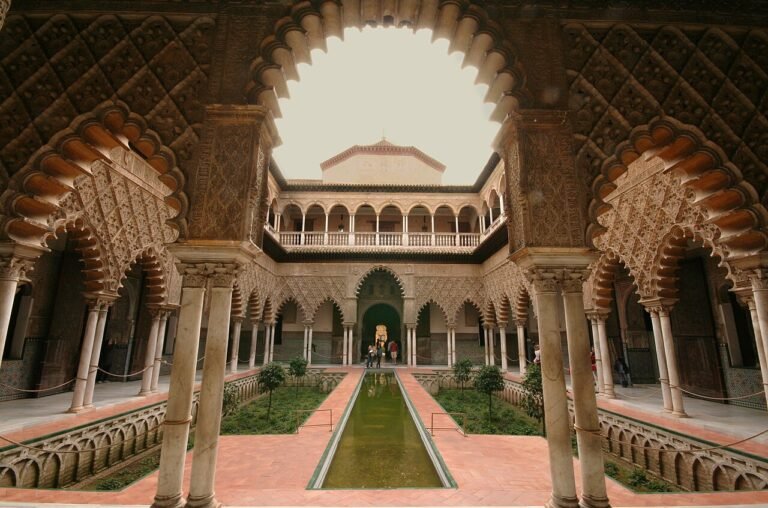
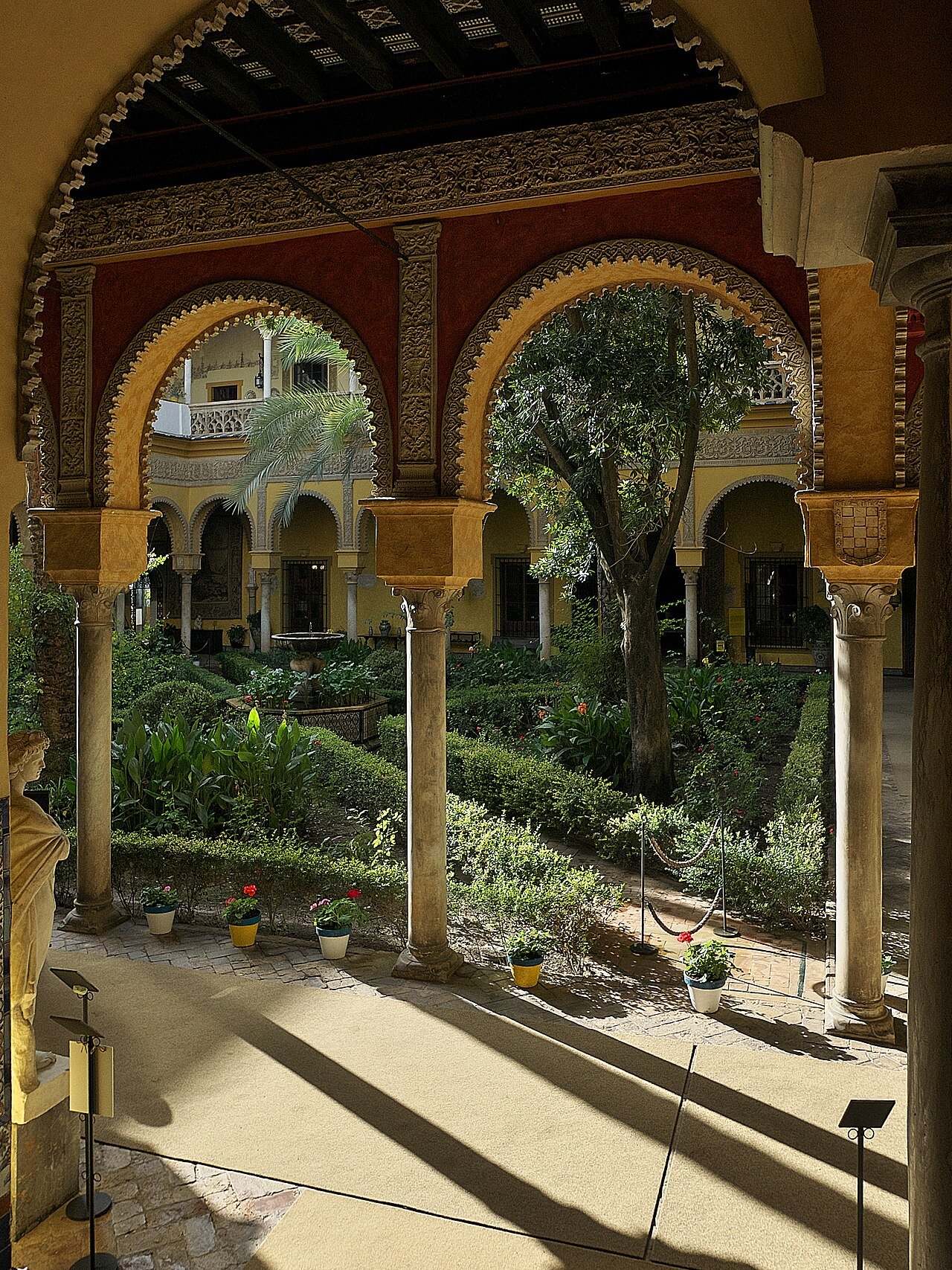
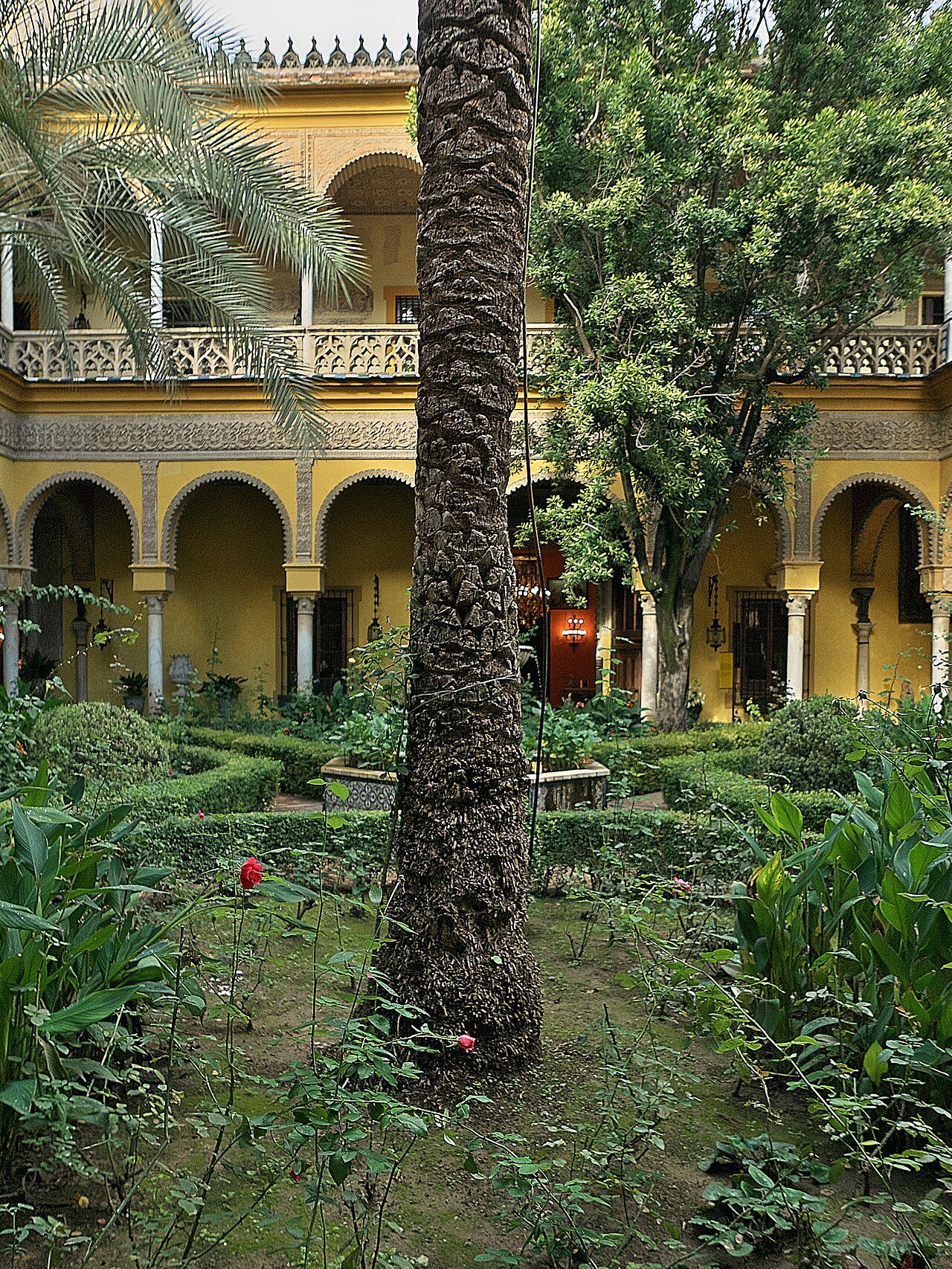
Seville palaces are organised around patios, and Las Dueñas has two of entirely different character. The Patio Principal is the heart — but where Pilatos’s courtyard is a marble stage set, this one is a garden that happens to have galleries around it. You see it first the way the audioguide wants you to: from beneath the arcade, through round Mudéjar arches on marble columns, their spandrels carved in plaster, out into green. Hedges and flower beds fill the quadrangle; a palm and a magnolia climb past the upper gallery, whose pierced plaster balustrade runs around all four sides; a low fountain murmurs somewhere in the middle distance. The walls are washed a warm ochre, the plasterwork is white lace, and the whole court smells faintly of lemon leaf and warm stone. This is Machado’s courtyard — the one a tenant’s child played in while duchesses’ portraits looked down — and it is still arranged for sitting in, which visitors do, on the benches, for longer than they planned.
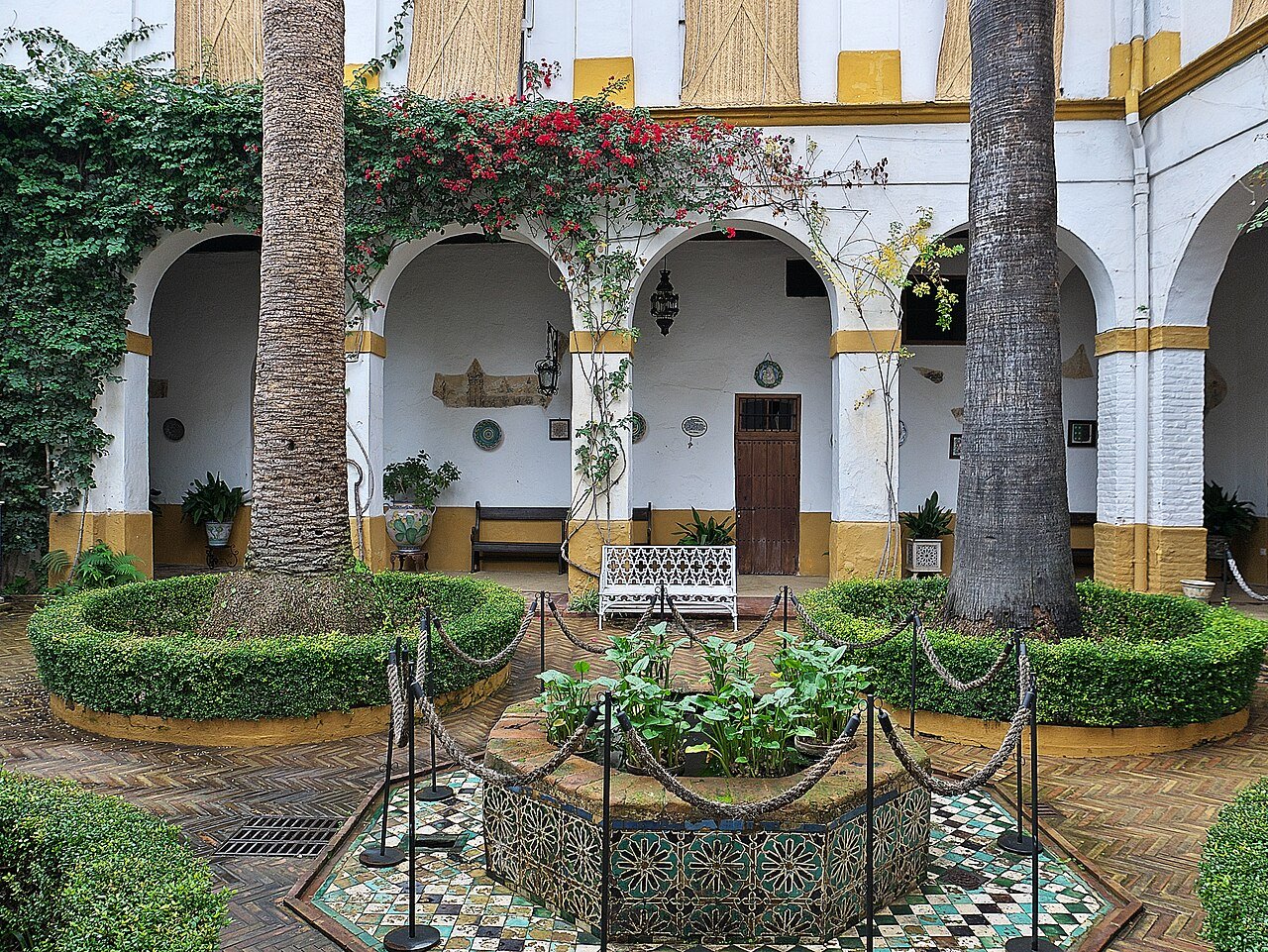
The second court, the Patio del Aceite — the Oil Courtyard, named for the stores that once kept the estate’s oil here — is the palace in working dress: white walls banded in ochre, plain round arches, two great palms, bougainvillea spilling red over the gallery, and a low octagonal fountain faced in green-and-white tile at its centre. Quieter than the main court and, on a hot afternoon, cooler; its arcade benches are the palace’s best-kept secret. Between the two courtyards you get the house’s whole grammar: one patio for ceremony, softened into a garden; one for the household economy, softened into shade.
Free Seville travel guide
Planning a trip to Seville? Get our free one-page Seville checklist: what to book ahead, what to skip, and the tapas bars we actually eat in.
What to See: The Gardens and the Limoneros
Beyond the courtyards the palace dissolves into green. The visit threads a series of connected gardens — the entrance garden you cross on arrival, the groves behind the main rooms — and their presiding spirit is citrus. The Jardín de los Limoneros, the lemon-tree garden, is the Machado corner of the palace: a shaded grove of lemon and orange trees over clipped hedges and agapanthus, a green ceramic jar standing on a tiled plinth like a garden ornament in a painting, and at its centre the palace’s prettiest piece of plumbing — a low octagonal fountain rimmed in diamond-patterned tile, flanked by urns on ochre pedestals, the oranges hanging so close overhead you could pick your own shade. Stand here a moment and the poem stops being literature: a clear orchard, a ripening lemon tree, a child who would spend the rest of his life writing his way back to this garden. It is the single most affecting spot in the palace, and it is made of almost nothing — trees, water, tile, quiet.
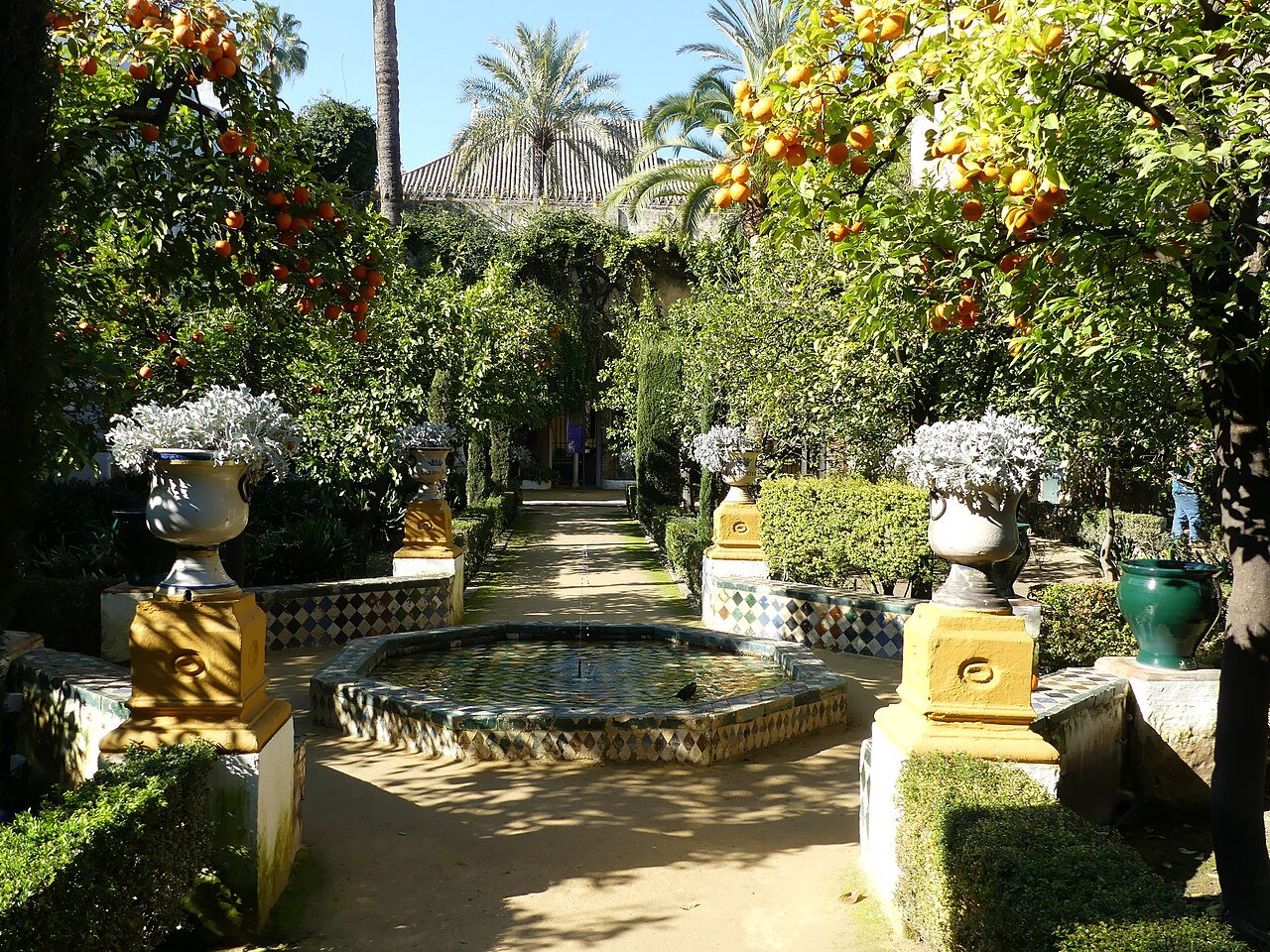
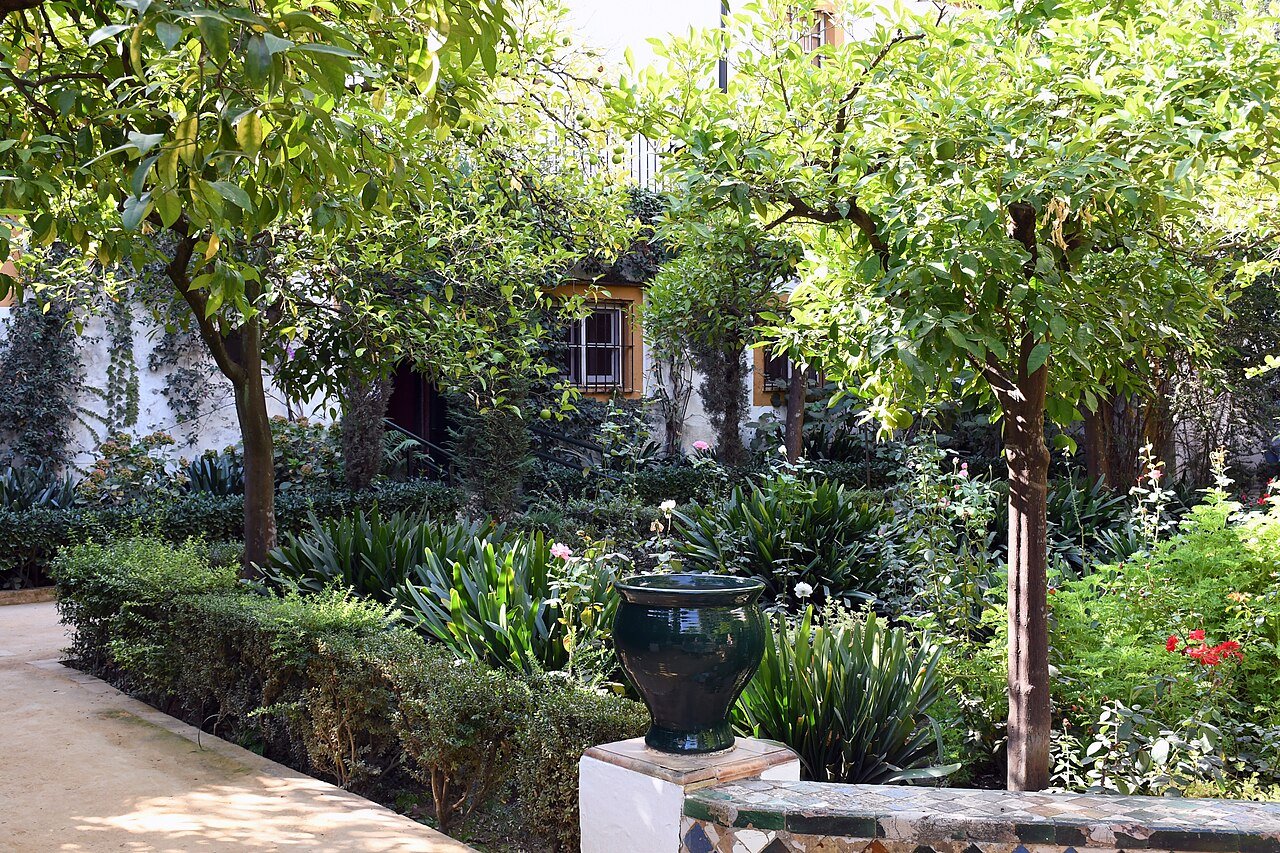
The rest of the grounds work as the palace’s green corridors: a vast old ficus throwing a tent of shade, magnolias, palms, the odd classical torso standing in the planting as if the garden had grown around the family’s sculpture collection. This is the practical glory of Las Dueñas in a Seville summer: half the visit is outdoors but almost none of it is in the sun. The whole complex covers some 9,000 square metres, and the green half does as much of the showing-off as the rooms.
What to See: The Apeadero and the Stables
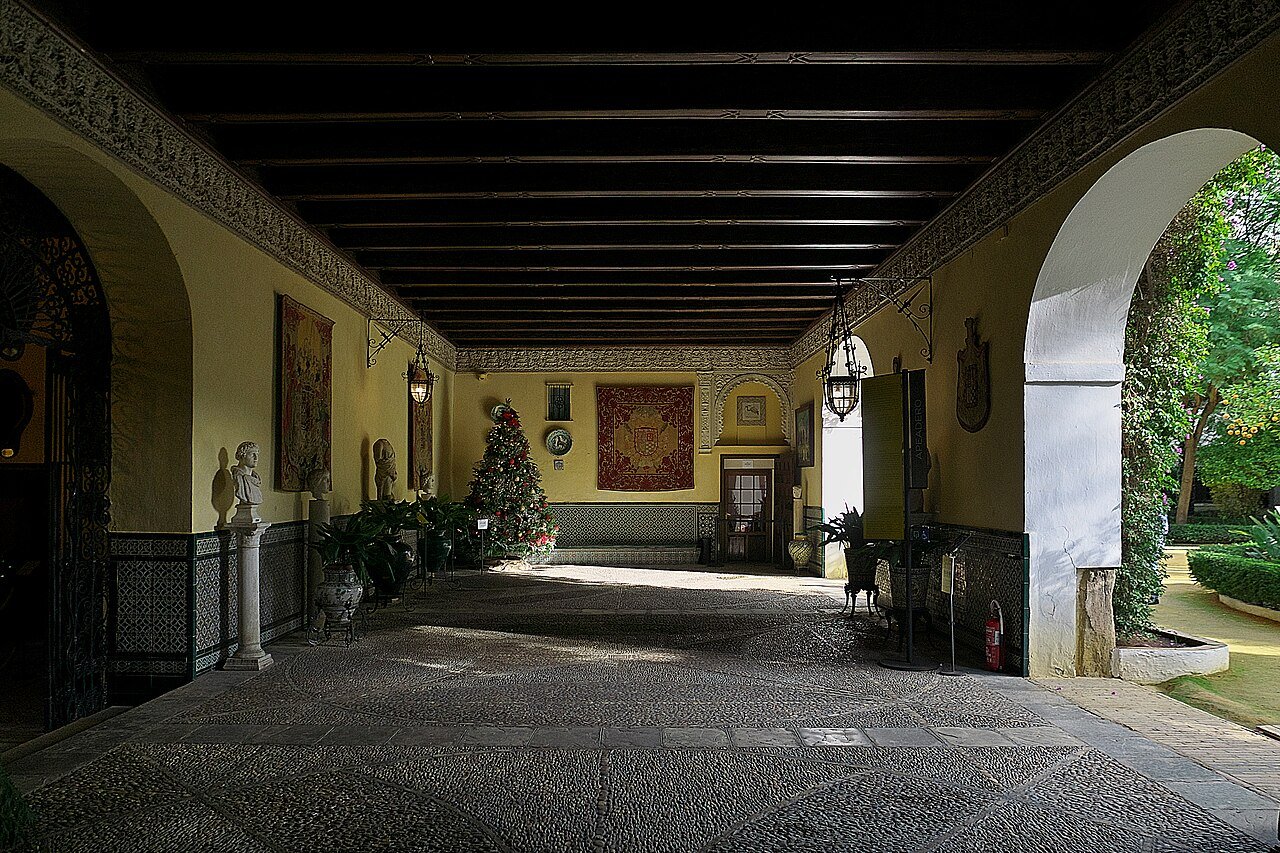
Most visitors hurry through the palace’s working entrance; go slowly instead. The Apeadero — the setting-down hall where carriages discharged their passengers — is a long, cool, covered court on patterned cobbles, its walls hung with tapestries and heraldry, classical busts along the tile dado. It is the palace’s overture: the whole vocabulary — tile, tapestry, cobble, beam — in one room. (Come in December and you may find it keeping Christmas, tree and all.)
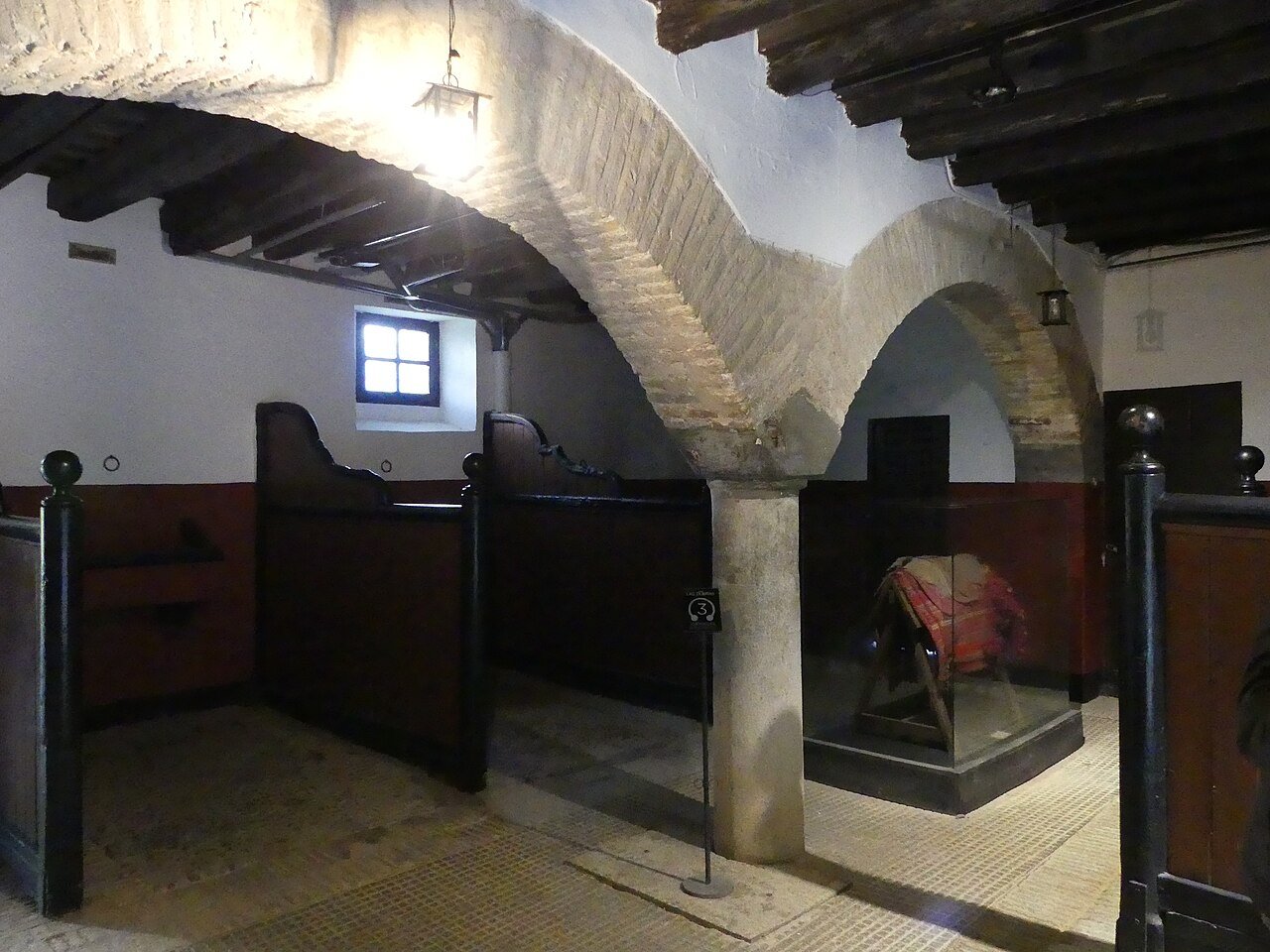
Opening off the entrance court are the Caballerizas, the stables — brick arches on a stout column, dark wooden stalls with their mangers and tethering rings intact, a saddle preserved under glass like a reliquary. Cayetana was a serious horsewoman, and the stables are kept as the palace’s memory of her world: a house that ran on horses well into living memory, its stalls looking ready to do it again. A quick stop, but it grounds the palace as the salons cannot — the whole machine of a great house in one brick-vaulted room.
What to See: The Main Rooms
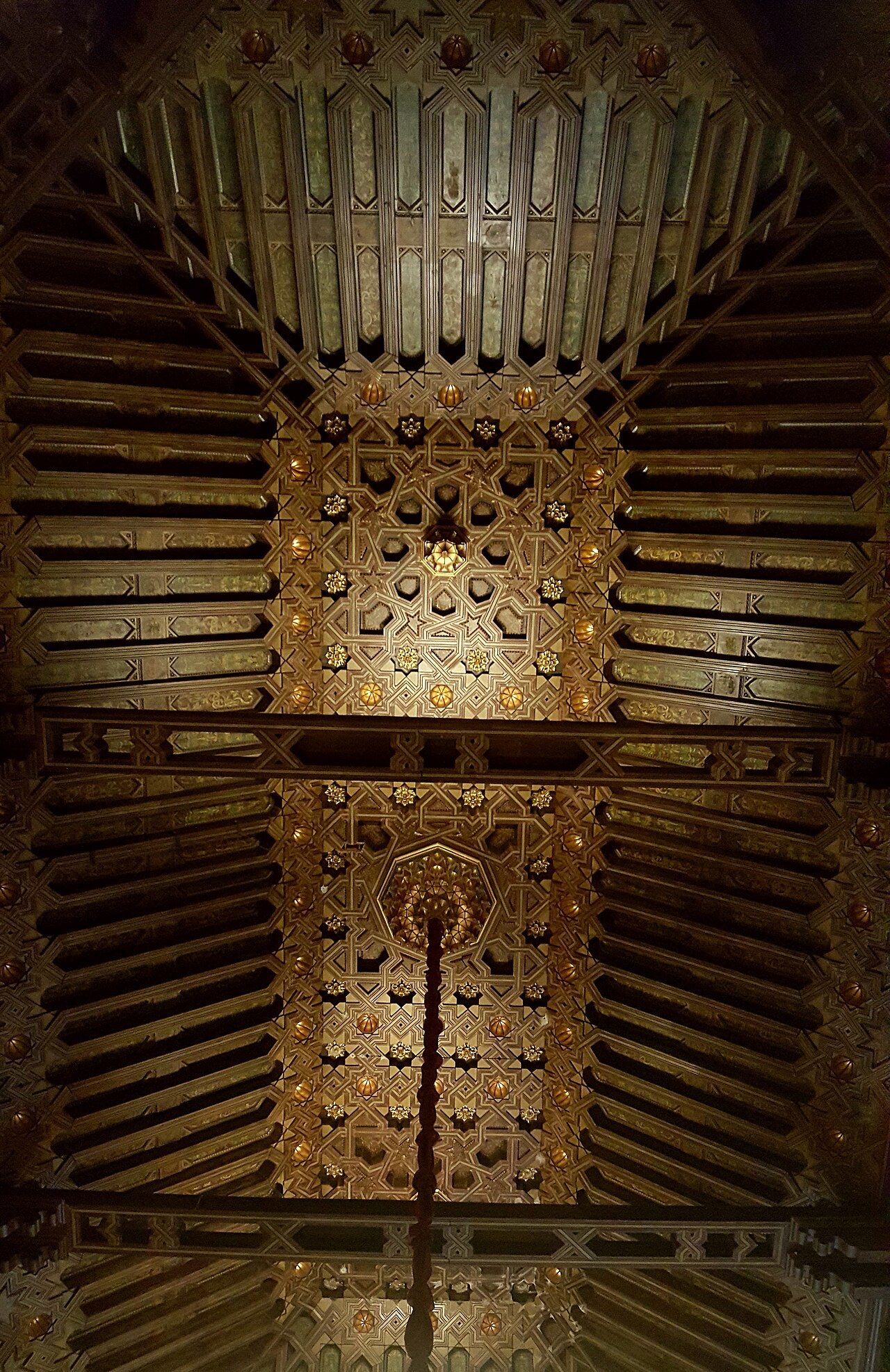
The ground-floor salons are where Las Dueñas stops resembling its cousins. At the Casa de Pilatos guide, the great rooms stand largely empty so you can read their walls; here the rooms are furnished to the point of intimacy — and that is the entire point. Before them, look up on the main staircase: its Mudéjar artesonado, a coffered wooden ceiling of interlaced stars and gilded bosses, is among the finest in any Seville house, and the visit takes you to its first landing even though the family’s floor above stays closed.
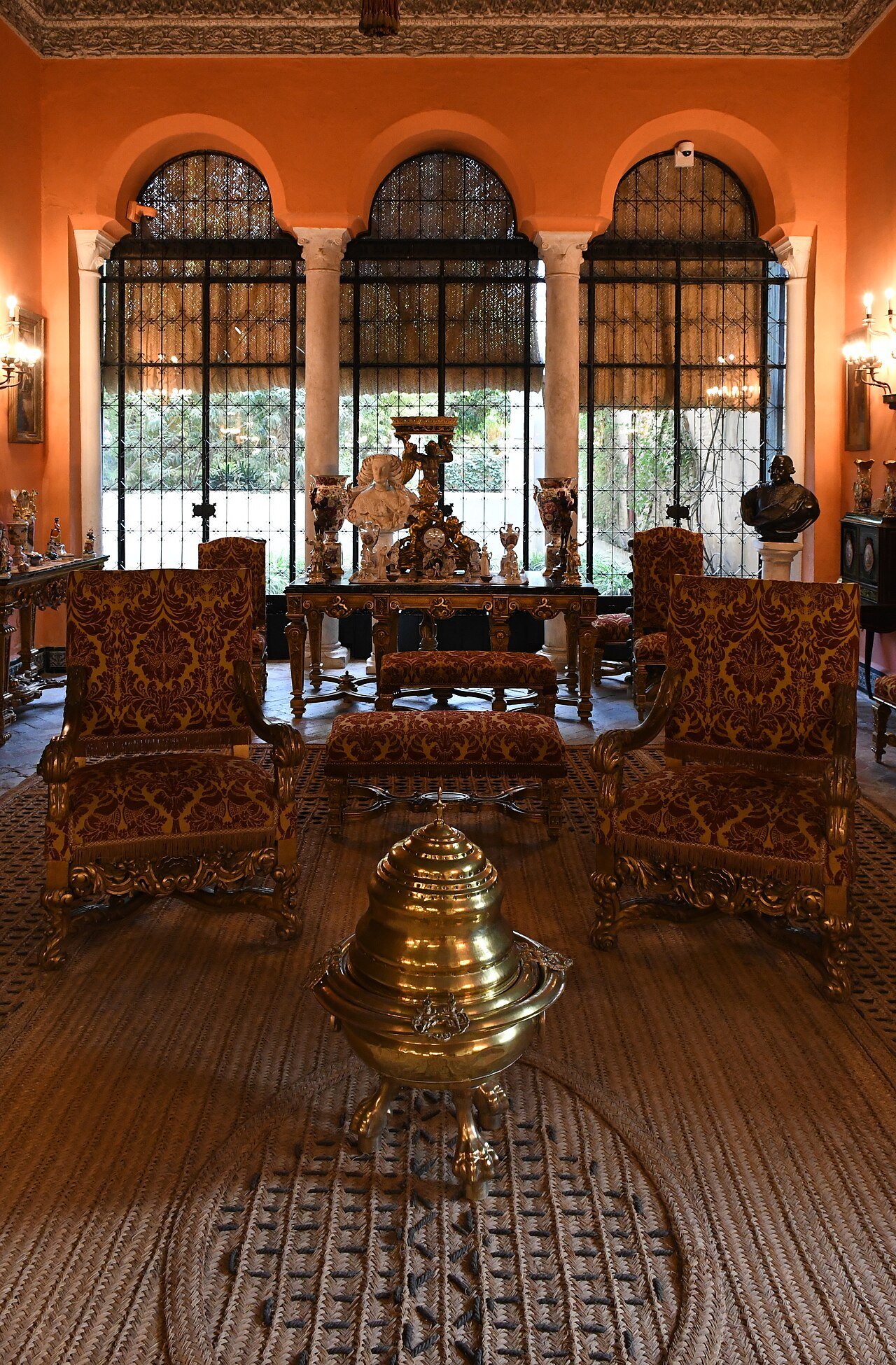
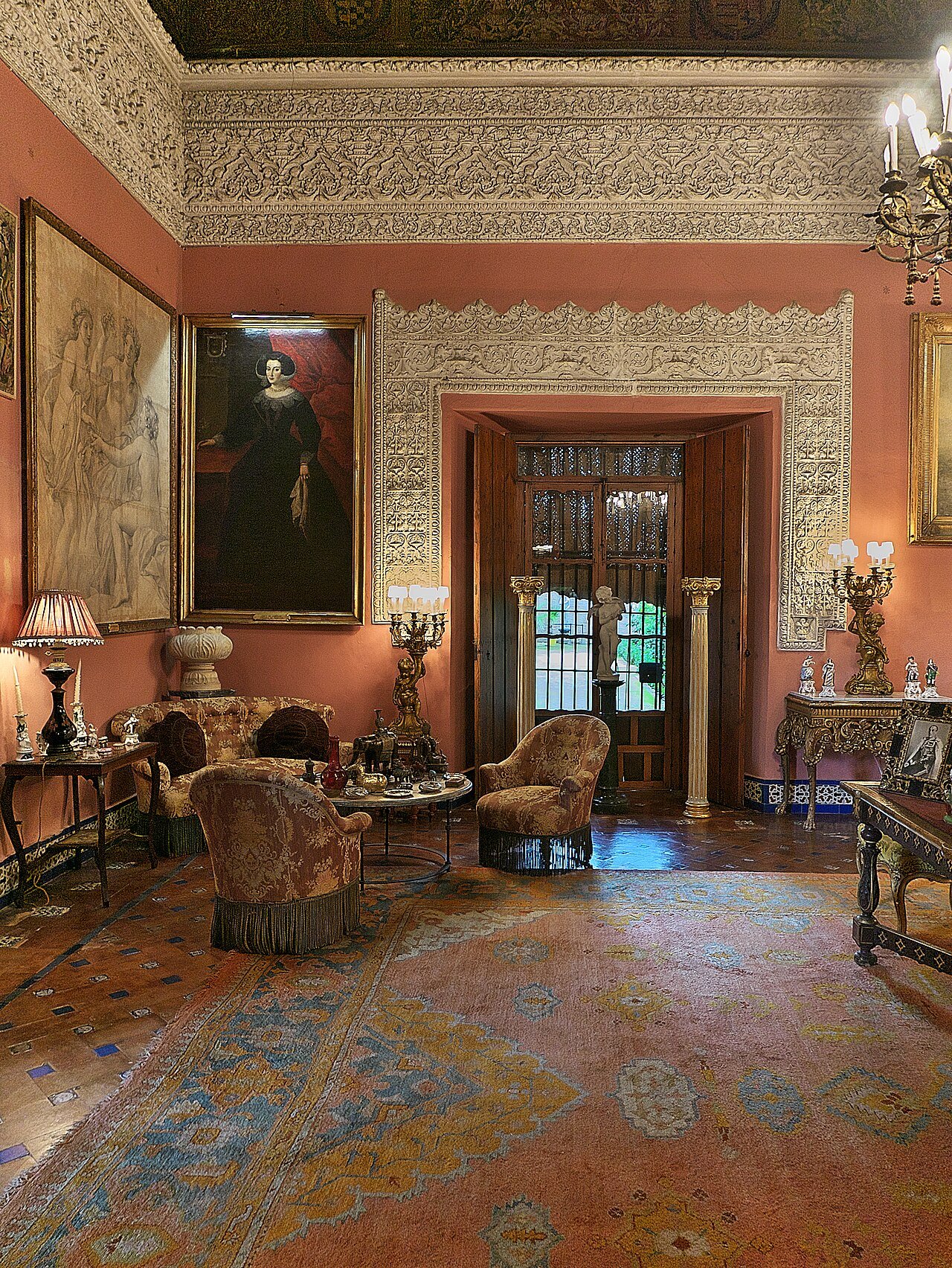
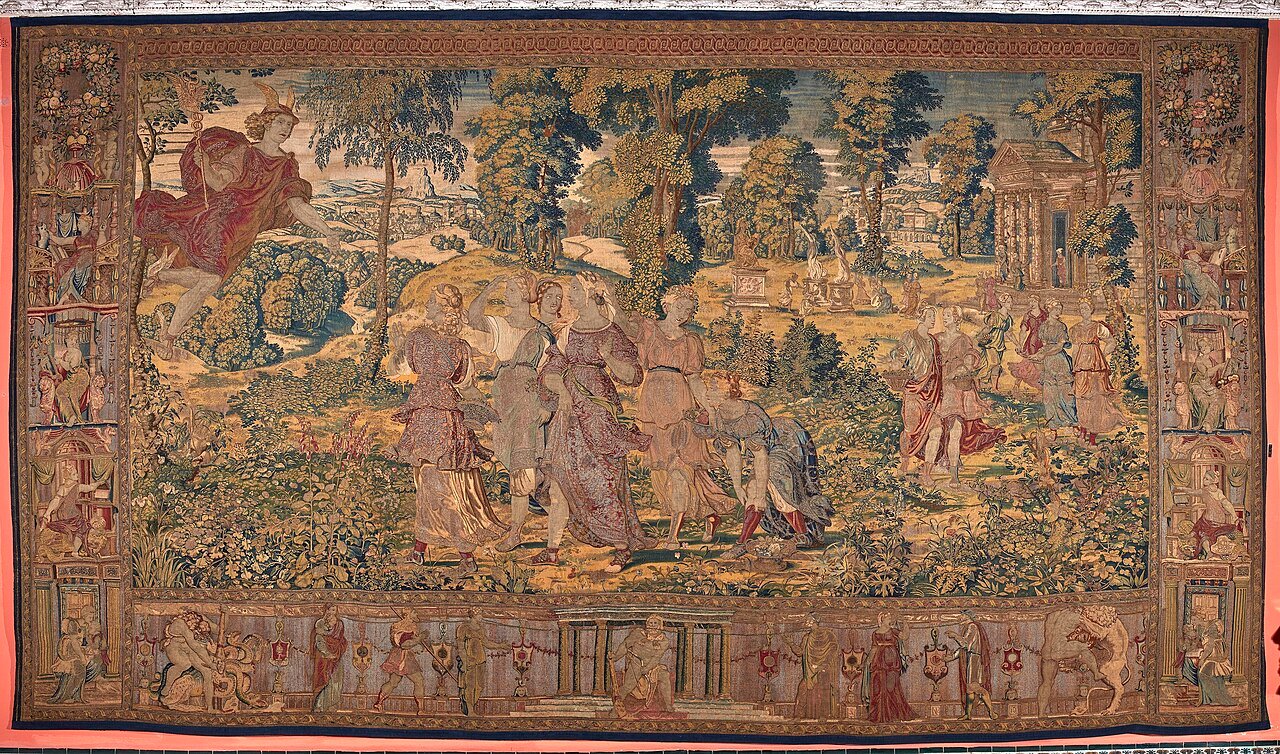
The Salón de la Gitana — named for the gypsy figure at its heart — is the palace at its most theatrical: damask armchairs in crimson and gold arranged around a great brass brazier on a woven esparto rug, a table crowded with porcelain, clocks and busts, and a whole wall of arched glass opening to the garden, so the room is half salon, half loggia. The Salón Cuadrado next door is softer and more lived-in: rose-pink walls under a deep frieze of carved plaster, a full-length portrait of a black-dressed duchess of another century, lamps lit, family photographs on the tables. This is Cayetana’s palace exactly as she kept it — rooms arranged not for display but for use, into which the public has been politely admitted. The collection threaded through them is serious, too: the Alba hold well over a thousand works here, from the Flemish tapestries woven in Willem de Pannemaker’s Brussels workshop in the sixteenth century to Italian and Spanish painting, sculpture, ceramics and the memorabilia of a family that has been collecting since before collecting was a hobby. Room labels are light, which is why the audioguide earns its keep: without it you are looking at beautiful rooms; with it you know whose chair you are looking at.
One honest note on the rooms: because they are furnished and full of fragile things, they are the most supervised part of the visit, and photography inside them is restricted or closely managed depending on the room — follow the staff’s lead, keep the camera away where asked, and take your pictures in the courtyards and gardens, where nobody minds and the light is better anyway.
What to See: The Chapel
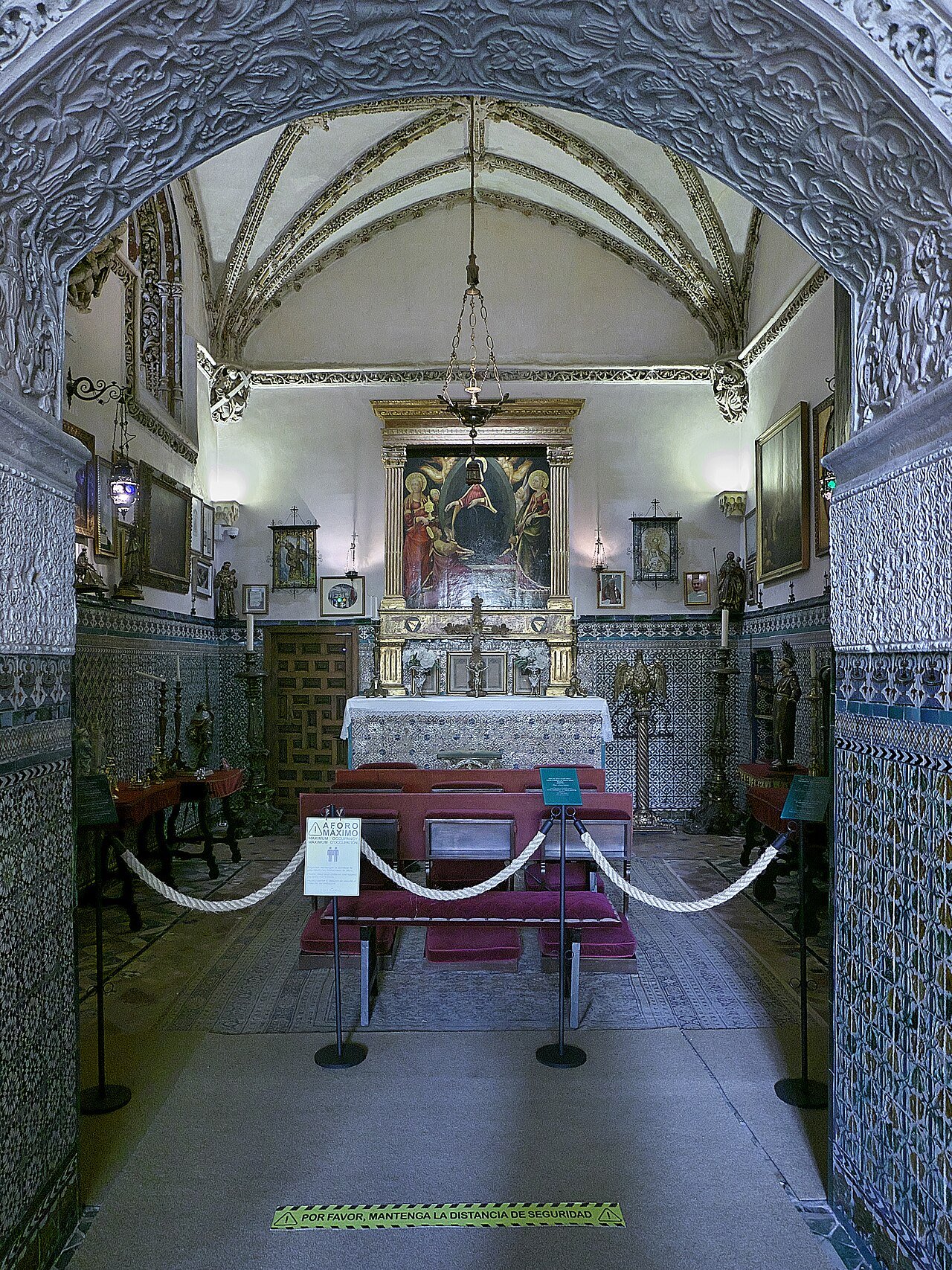
The palace’s sacred room is reached like a secret: through an antechapel and under an arch carved in plaster as fine as anything in the Alcázar, into a small rib-vaulted chapel tiled to shoulder height and crowded with five centuries of family devotion. The altarpiece is the treasure — a Florentine panel attributed to Neri di Bicci, gold still glowing — above a tiled altar frontal, candlesticks and reliquaries that read less like a museum case than a sacristy in daily use. Palace tradition even marries Amerigo Vespucci here, to María Cerezo, in the first years of the sixteenth century. This is where Cayetana married in 2011, and where Seville effectively said its farewells to her three years later: the room where the family’s public and private lives are impossible to separate, and the quietest five minutes of the visit.
Practical Info
Tickets and how the visit works. The standard visit is self-guided with an audioguide (downloaded to your phone via the palace’s app; Spanish, English, French, German and Italian among the languages) and cost €15 for general admission at the time of writing, with reduced and local rates below that and children under six free — the palace is run for the Casa de Alba by Culturia, and its official site (lasduenas.es) carries the current prices and hours. Official guided tours run at set times for a few euros more. And keep the palace’s generous custom in mind: on non-holiday Monday afternoons, entry from 16:00 has traditionally been free (booked online, with a small booking fee) — worth building a Monday around, but confirm on the official site before you rely on it, as the arrangement can change.
Hours and closed days. The palace opens every day, in recent seasons 10:00–18:00 from October to March and 10:00–19:00 from April to September, with last entry 45 minutes before closing; it closes on 1 and 6 January and 25 December (the official list also closes it on 30 and 31 December, with early closing on the days before the big holidays, and the palace occasionally shuts for family or private events) — check the day’s times on the official site when you plan, as hours shift around holidays.
Getting there. The palace stands at Calle Dueñas 5, in the Santa Catalina quarter at the northern edge of the old town — roughly a ten-minute walk from the Cathedral up through the shopping streets, and a few minutes from the Metropol Parasol (Las Setas) and the Plaza Cristo de Burgos. The T1 tram to Plaza Nueva plus a ten-minute walk is the easiest public-transport version; city buses serve the Plaza del Duque and La Campana a few streets away. If you are coming from the Seville Cathedral & La Giralda guide end of the old town, walk up via Calle Imagen and you will arrive as the palace’s own neighbours do.
How long. Allow an hour at a minimum, ninety minutes if you take the audioguide at its word, two hours if the gardens get you. The visit is on the ground floor (only the staircase’s first landing is included), largely step-free, and pairs naturally with a Santa Catalina morning — or walk the ten minutes south to Pilatos and do both palaces in one day (see Tips).
Tips for Visiting
- Do Las Dueñas and Pilatos as a pair — and know the difference. The two palaces are cousins, begun by the same Ribera circle, ten minutes apart on foot, and together they make Seville’s great palace day. Casa de Pilatos guide is the connoisseur’s palace: antiquities, tile and plaster, rooms kept empty to be read. Las Dueñas is the family’s palace: furnished, planted, personal — the Alba at home. If you can only do one, choose Pilatos for art and architecture, Las Dueñas for atmosphere, gardens and the Cayetana story.
- Take the audioguide seriously. Room labels are deliberately light in a house that is still a home; the audioguide is what turns pretty salons into the Duchess’s salons. It is included in the standard ticket — use it.
- Aim for opening time, or the free Monday. Mornings are coolest in the courtyards and emptiest in the salons. If your trip includes a non-holiday Monday, the free afternoon entry (book it online ahead; slots go in spring) is one of Seville’s best bargains — but arrive at 16:00 sharp, as everyone else has had the same idea.
- Save the Limoneros for last. The lemon garden is the palace’s emotional payoff and its best seat. Do the route, then come back to the fountain with nothing left to see — Machado’s courtyard repays the pause.
- Mind the rooms’ house rules. Photography is restricted or supervised in the furnished rooms; the courtyards and gardens are fair game. Dress and behave as a guest — the family still uses this house, and the staff will (politely) remind you if you forget.
- Place it against the Alcázar honestly. The Royal Alcázar of Seville guide is the greater building and a first-trip essential; Las Dueñas is not competing with it. Come here on your second palace slot, when what you want is not more splendour but a way of life.
Travel insurance, sorted
Whether it is a two-week holiday or a longer move, travel insurance is the one booking not to skip. We point readers to SafetyWing’s Nomad Insurance — cover built for travellers, remote workers and longer stays abroad, on a flexible monthly subscription you can start before a trip or while you are already away.
Final Thoughts
Seville has grander palaces, and one — the Alcázar — that belongs on every list of Europe’s essential buildings. What it did not have, until 2016, was a palace you could simply visit with the family still in it: the chairs where they sat, the brazier they warmed themselves at, the chapel they married in, the lemon trees a poet remembered from the other side of fame. The Palacio de las Dueñas is that palace. It accumulates — a courtyard here, a saddle under glass there, a duchess’s portrait, a poet’s fountain — until somewhere in the lemon garden you realise you have been let, briefly and on trust, into one of Spain’s great private worlds. Go in the morning, take the audioguide, and sit by the fountain a while. Everyone else is at the Alcázar — and for once, they are the ones missing out.
¡Buen viaje!

Photo credits: The Patio Principal from its arcade — Jl FilpoC, CC BY-SA 4.0 · The street portal — Anual, CC BY 3.0 · The Patio Principal at ground level — Jl FilpoC, CC BY-SA 4.0 · The Patio del Aceite — Jl FilpoC, CC BY-SA 4.0 · The Limoneros fountain — CarlosVdeHabsburgo, CC BY-SA 4.0 · The Jardín de los Limoneros — Gzzz, CC BY-SA 4.0 · The Apeadero — Jl FilpoC, CC BY-SA 4.0 · The stables — CarlosVdeHabsburgo, CC BY-SA 4.0 · The staircase artesonado — Mangelrp, CC BY-SA 4.0 · The Salón de la Gitana — Gzzz, CC BY-SA 4.0 · The Salón Cuadrado — Jl FilpoC, CC BY-SA 4.0 · The Pannemaker tapestry — LasDueñas, CC BY-SA 4.0 · The chapel — Jl FilpoC, CC BY-SA 4.0. All via Wikimedia Commons.