Torres de Serranos: The Complete Visitors’ Guide
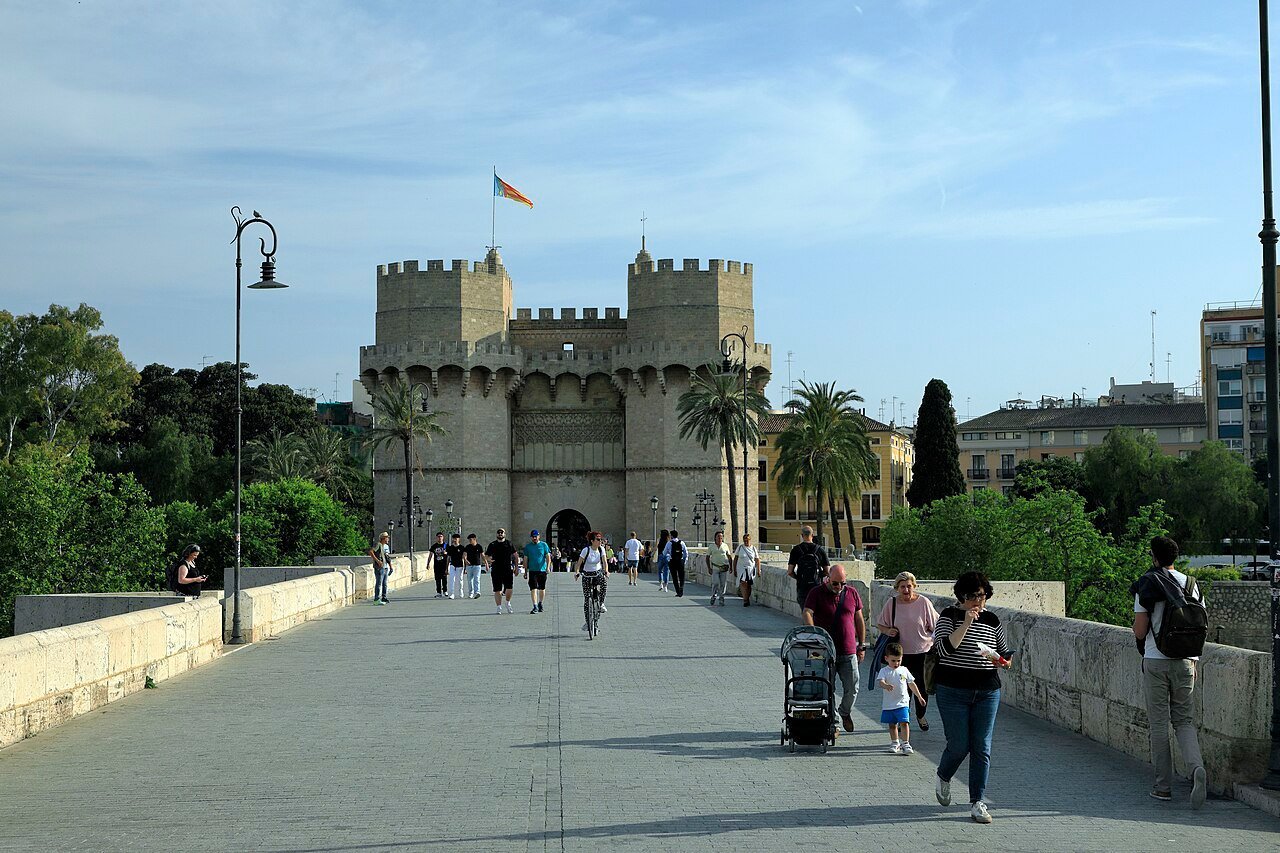
Stand in the old Turia riverbed and look north, and Valencia’s Middle Ages are still standing in front of you. Two enormous polygonal towers of pale limestone flank a single great arch, crowned with battlements and machicolations, a panel of blind Gothic tracery between them and the red-and-gold Senyera flying overhead. These are the Torres de Serranos, the northern gate of medieval Valencia — for five centuries the city’s ceremonial front door, the first thing kings, ambassadors and brides saw when they arrived, and now the most complete city gate of its age in Spain. Almost everything else of the wall was demolished in the nineteenth century. The Serranos towers survived — partly because they were useful, partly because they were loved — and today you can climb them for two euros, or for nothing at all on a Sunday.
This guide covers the gate properly: its building and its strange second careers as a prison for noblemen and a wartime vault for the Prado’s paintings, how to read the famous façade and its shields, why the towers are hollow shells when you walk round the back, what the climb is like, and what you can see from the top — plus their loudest modern role, the Crida that opens Las Fallas. It is a short visit, and this guide will not pretend otherwise; it is simply one of the essential ones.

The Short Answer
Yes — climb them: the Torres de Serranos are the best two euros in Valencia, and on Sundays and public holidays they are free. What you get is a complete medieval city gate you can walk through, into and on top of: the ceremonial façade from the riverbed, the echoing vaulted chambers inside, open stone staircases up the back, and a battlements walk with the old town spread out one way and the green ribbon of the Turia gardens the other. It takes thirty to forty-five minutes, there is no booking and rarely a queue, and it earns its place on any Best Things to Do in Valencia list on views alone. Go on a clear morning, pay at the little door under the arch — or walk in free on a Sunday — and stand on top of a gate that has watched Valencia arrive for six hundred years.
Table of Contents
- The Short Answer
- The Story in Brief
- The Front: A Fortress Dressed for a Parade
- The Open Back
- Inside the Towers: Prison, Paintings and Vaults
- The Climb and the Terrace
- The Views from the Top
- The Towers and Las Fallas: La Crida
- Practical Info
- Tips for Visiting
- Final Thoughts
The Story in Brief
Valencia’s Christian wall went up in the fourteenth century, a ring of stone with twelve gates, and of those twelve the gate of Serranos was always the grandest. It stood at the city’s northern edge, where the bridge crossed the Turia and the road ran away towards the mountain comarca of Los Serranos — the country the towers are named for — and so it became the gate of arrivals: everyone who mattered entered Valencia here. The city council wanted a gate that could fight and a gate that could receive, and in the master mason Pere Balaguer they got a builder who understood both. Work began in April 1392 and finished in March 1398; Balaguer gave Valencia two five-sided towers of rubble masonry faced in fine, expensive limestone, joined by an arch and crowned by a gallery of machicolations — a fortress wearing its best clothes. A year before completion he added the finishing ceremonial touch, the great open staircase on the city side, so official welcomes could be staged up and down it in proper theatre.
Then the gate settled into its double life. By day it was protocol — kings, ambassadors and royal brides processed through the arch to trumpets; by necessity it was defence, with a wet moat dug in front of it. The first great change of use came in 1586, when a fire gutted the city prison and Valencia needed somewhere secure for its most awkward category of inmate: noblemen and knights, too grand for the common gaol. The vaulted chambers became their cells, and stayed cells for three hundred years, until the last prisoners were moved to the convent of San Agustín in 1887. That unlikely career is the reason you can visit today: when Valencia tore down its walls from 1865 onwards, gates that were still working prisons were gates nobody demolished, and Serranos and its western sister, the Torres de Quart, survived the ring almost alone.
The twentieth century gave the old gate one more extraordinary job. During the Spanish Civil War, Valencia — briefly the capital of the Republic — became the refuge for Spain’s art, and in 1937 the towers were converted into a strongroom for masterpieces evacuated from the Prado. Engineers roofed the first floor with reinforced concrete, buried the paintings under a metre of rice husks and a metre of earth to absorb any bomb blast, and fitted climate controls; some of the most famous paintings in the world sat out the war inside a medieval gate. Declared a national monument in 1931 and cleaned back to pale gold stone in 2000, the towers today do lighter duty — viewpoint, landmark, and once a year the loudest stage in the city.
The Front: A Fortress Dressed for a Parade
Approach from the riverbed, as every arrival did, and read the front from the ground up. The towers are polygonal — five flat faces each — which was engineering before it was style: angled faces deflect missiles, give defenders views along the wall, and catch the Valencian light in planes, so the gate changes colour through the day. The stonework is the second message: rough masonry cores faced in smooth ashlar limestone, costly and regular — deliberate civic showing-off, the fourteenth-century equivalent of marble cladding on a ministry. Across the central body runs the gate’s jewellery, a wide panel of blind tracery — row upon row of carved Gothic arches and quatrefoils with nobody’s window behind them, pure decoration laid over a defensive wall. Above it, the machicolations, the overhanging parapet with openings in its floor for dropping unpleasant things on attackers, remind you the jewellery is worn by a soldier.

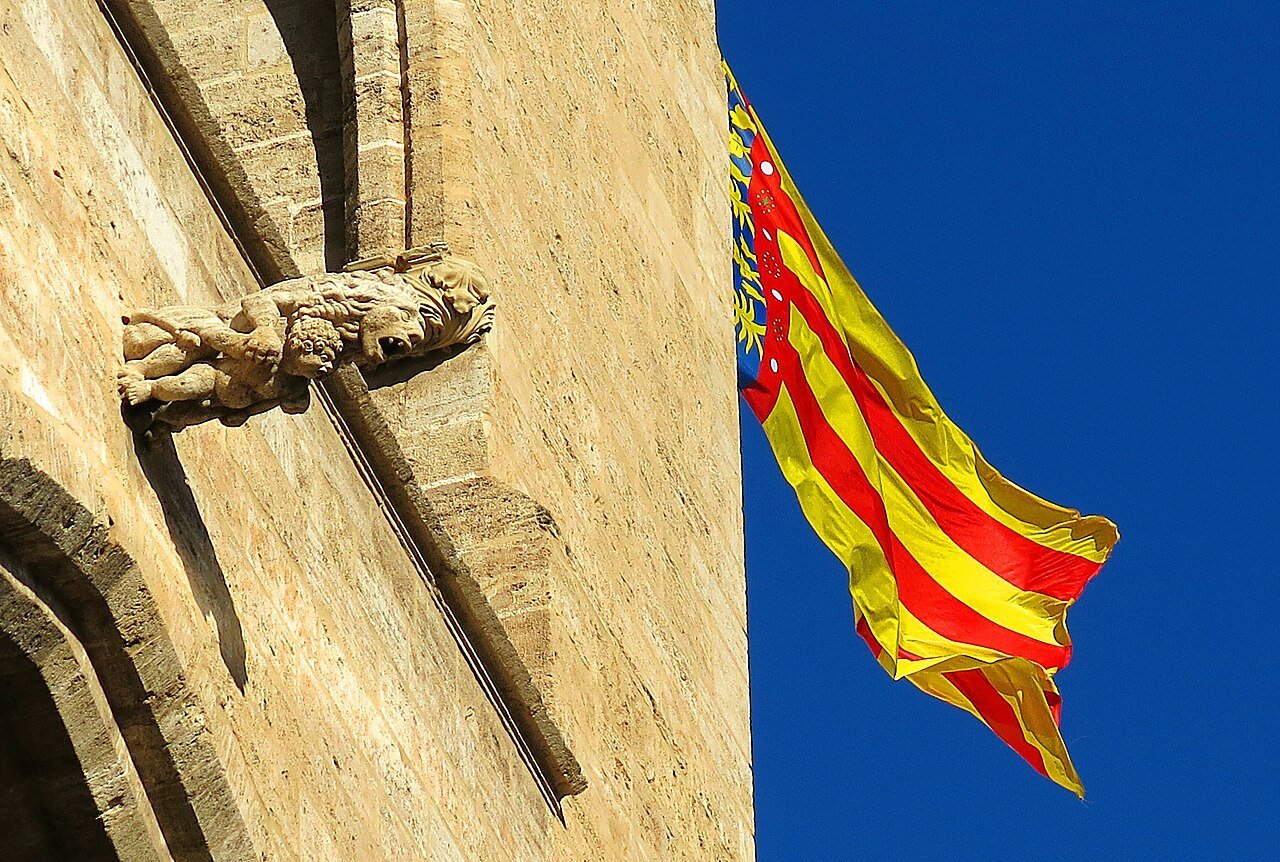
Below the tracery, three shields carry the gate’s whole politics in stone. In the centre, the arms of the Kingdom of Valencia: the striped shield beneath a helmet crested with a winged dragon — lo rat penat, the bat of Valencian legend. To either side, held up by carved angels, the arms of the city itself. The shields you see are early twentieth-century replicas, the weathered originals retired indoors, but their message is unchanged: crown and city, kingdom and town hall, sharing one gate. And do stand in the passageway itself, under the high round arch, and look up: the groove in the vault is the slot of the portcullis. Kings came through here in procession; so did carts, armies, prisoners and, in 1937, crated Velázquez. The arch has seen everyone.

Free Valencia travel guide
Planning a trip to Valencia? Get our free one-page Valencia checklist: what to book ahead, what to skip, and the paella places we actually eat in.
The Open Back
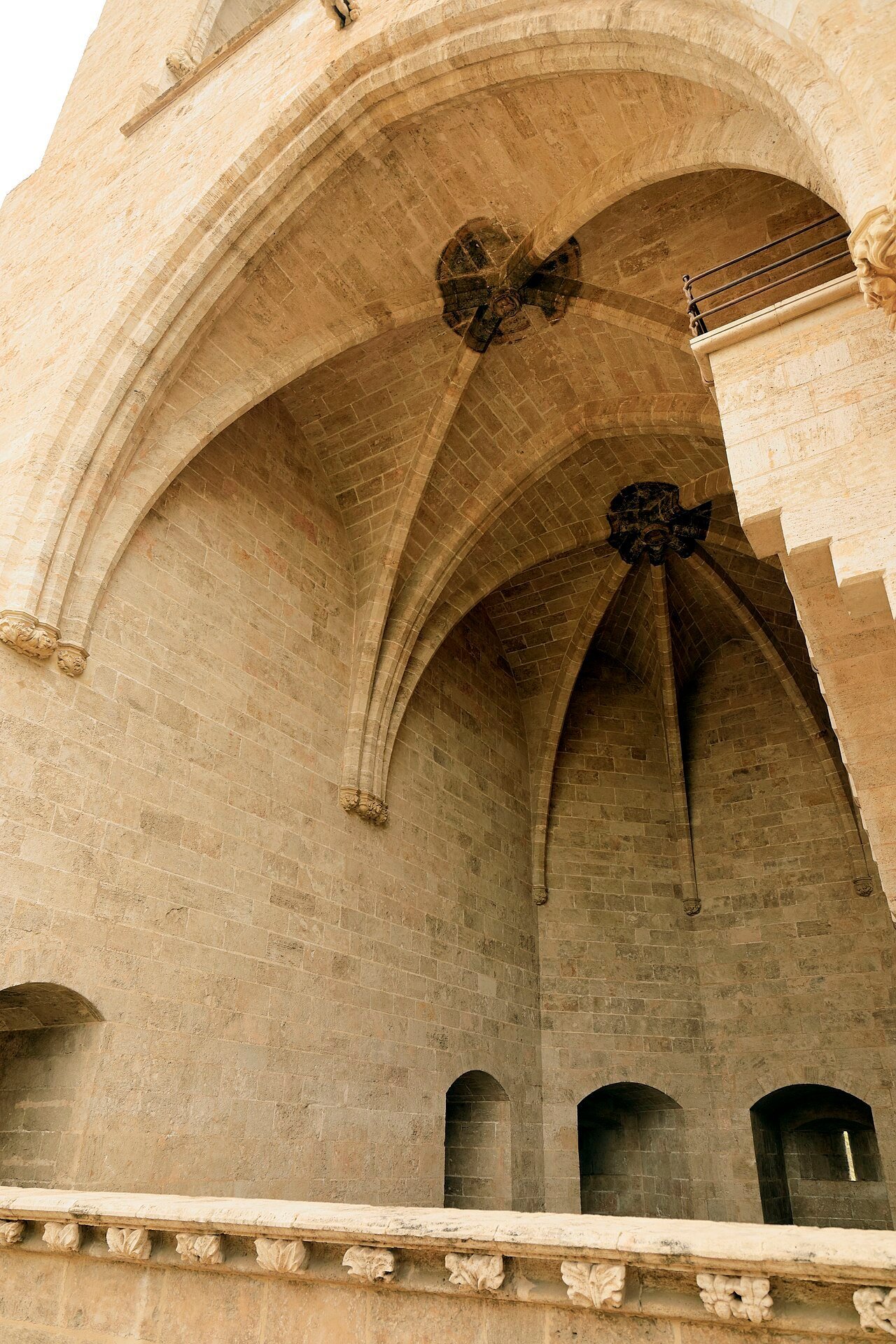
Now walk through the arch, turn round in the Plaça dels Furs — and prepare for the surprise. From the city side, the mighty gate is a shell. The towers have no backs: their three levels of vaulted chambers open straight onto the square in huge pointed arches, so you are looking into the building’s ribcage, stone vaults, ribs and keystones exposed like the inside of a cutaway model. This was not damage or economy; Balaguer built them open-backed, de gola oberta, on the same principle as the royal gate at Poblet that inspired him. A gate whose rooms open only towards the city can never be seized and held against that city — an enemy who took it would find no defensible back wall to hide behind — and as a bonus the chambers are flooded with light and air rather than sweating in the dark like ordinary towers.

The open back explains the gate’s other famous feature: the staircases are all out here too. The broad ceremonial stair of 1397 and the flights zig-zagging up the inner faces are exterior architecture, part staircase, part stage set — when a king arrived, the city could line them with officials and watch him climb his own welcome. At dusk, when the vaults fill with shadow and the gargoyles lean off the parapet, this side of the gate is the more haunting of the two.
Inside the Towers: Prison, Paintings and Vaults
You enter through a modest door in the gate’s city side, and the interior is everything the façade promises: bare limestone, enormous height, vaulting everywhere. The chambers stack three levels high, and their architecture is the Valencian Gothic of the Lonja generation — ribbed vaults springing from carved corbels, ribs gathering into keystones carved with shields, arrow slits for windows, stairs running up the walls in the open.

Read these rooms with their history in mind and they change character twice. As prison cells — which the upper chambers were for three centuries — they are grand and grim at once: a nobleman’s confinement, with vaulted ceilings a cathedral would accept and a view through the arrow slit of the river road home. As the Prado’s strongroom they are more moving still: in chambers like these, under concrete, rice husks and earth, Spain hid its painted memory while bombs fell on Madrid. There is no museum display to speak of; the architecture is the collection, and the emptiness suits it.
The Climb and the Terrace
The climb is the visit. Open staircases — some broad and ceremonial, some narrow flights within the walls — take you up level by level, and because the towers are open-backed you climb in daylight, the square shrinking below you and swallows flicking through the arches. It is a proper climb: dozens of worn stone steps, no lift, a low doorway or two to duck through. Anyone reasonably fit will manage it in minutes; anyone with vertigo or bad knees should know the last flights are steep and the parapets are medieval in their ideas about height.

At the top you step out onto the terrace that joins the towers, some thirty-three metres up: a wall-walk between battlements, the little stepped turret where the stair arrives, the iron weathervane, and the Senyera flying over the whole composition. Walk the full circuit — front parapet above the riverbed, round the towers, back along the city side — because the two prospects are different cities, and the next section is about reading them.

The Views from the Top
Face south first, into the old town. The rooftops of the Carmen quarter run away in terracotta, and the whole skyline of historic Valencia stands up out of them in a row, as if arranged for this one viewpoint: the cathedral’s octagonal Miguelete bell tower dead centre, its cimborio dome beside it, church towers and blue-tiled domes dotted between. Everything in our Valencia Cathedral guide is down there at postcard distance. This is the view to get your bearings by on a first morning in the city: the wall is gone, but from up here you can still trace exactly where it ran.

Turn around, and the second Valencia opens: the north. Below you is the Puente de Serranos, and beyond it the Turia — not a river any more but the sunken green park the city made of the riverbed after the catastrophic flood of 1957, running east towards the City of Arts and Sciences, whose white shapes you can just pick out on a clear day. On the horizon, the blue line of the Sierra Calderona. A gate built to watch for enemies approaching across a river now watches joggers crossing a park; Valencia’s whole modern story is in that one glance.

The Towers and Las Fallas: La Crida
Once a year the old gate goes back to work as the city’s stage. On the last Sunday of February, tens of thousands pack the riverbed and the square in front of the towers for la Crida — the proclamation that opens Las Fallas, Valencia’s festival of fire. From a platform built against the façade, the Fallera Mayor, the festival’s queen, calls the city and the world to the party; the towers behind her are floodlit in the red and gold of the Senyera, projections play across the stone, and the ceremony ends the way everything in Valencia ends, with fireworks over the battlements. Six hundred years of ceremonial arrivals make sense at that moment: this gate has always been where Valencia announces things.
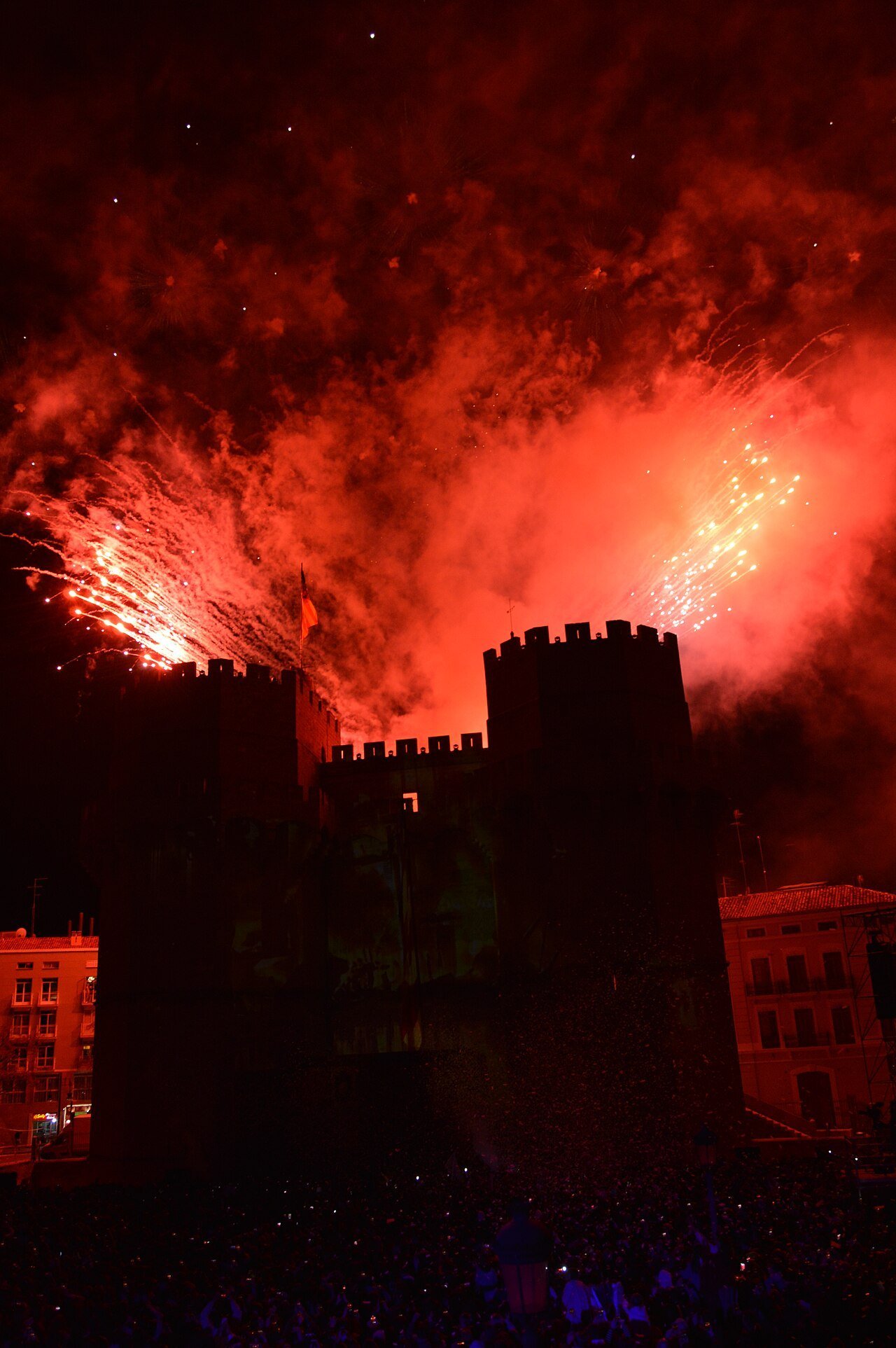
If you are in Valencia in late February, the Crida is unmissable and free — you watch from the riverbed with everyone else; the towers are closed to climbing that day. And if you come in March for the festival proper, climb the towers early in your trip: the view over a city filling with fallas monuments is the festival’s best overture.
Practical Info
Tickets and hours, honestly hedged. The towers are a municipal monument, and the arrangements are pleasingly simple: no booking, tickets at the door. At the time of writing the standard price is €2, with a reduced €1 rate (students, pensioners, children and groups among those who qualify), and entry is free on Sundays and public holidays. The towers are closed on Mondays, and also on 1 and 6 January, 1 May and 25 December. In the long season — roughly mid-March to mid-October — they open Tuesday to Saturday, 10:00 to 19:00; in winter closing comes forward to 18:00; Sundays and holidays keep shorter hours, 10:00 to 15:00. Bad weather can shut the terrace, and the council occasionally changes the pattern — check the current timetable on valencia.es before you build a morning around it.
How long, honestly. Thirty to forty-five minutes: up one side, through the chambers, round the terrace, down the other. A short, dense visit — the perfect first or last stop of an old-town day, not its centrepiece.
Getting there. The towers stand in the Plaça dels Furs at the old town’s northern edge, an easy ten-minute walk from the cathedral down Carrer de Serrans. City buses stop around the riverbed, the Pont de Fusta tram and metro station is just across the bridge, and Alameda metro station is about ten minutes east along the gardens. If you are walking the Turia park — and you should be — the towers are its natural old-town exit.
Access. Be clear-eyed: this is a medieval fortress. Entry is by stairs only, there is no lift, and the climb, while short, is steep in places. The façade, the passageway and the open back in the Plaça dels Furs are all fully rewarding from ground level, free and step-free — nobody misses the point of the building by staying on the ground.
Tips for Visiting
- Come on a Sunday morning and pay nothing. Free entry, soft light on the façade, the old town still quiet — then five minutes into the Carmen for coffee as the city wakes.
- Do the front first, the back second, the climb last. The gate reads as a story in that order: fortress face to the world, hollow shell to its own city, the whole thing explained from the top.
- Pair it with its sister gate. The Torres de Quart, the wall’s other survivor, stands a fifteen-minute walk west — round towers instead of polygonal ones, still pocked with French cannonballs from 1808. The pair make a perfect medieval hour.
- Continue into the old town’s greatest hits. Through the arch and down Carrer de Serrans you are minutes from the cathedral; our La Lonja de la Seda guide covers the silk exchange a few minutes further south, and our San Nicolás Church guide covers the painted parish church that stands between them — gate, market, cathedral and chapel make the finest half-day walk in Valencia, and most of it costs almost nothing. A guided Valencia old town walking tour strings the same sights together with the stories told properly, if you prefer company.
- Mind the wind at the top. The terrace is high, open and unsheltered; on a levante day it can be fierce, and the monument may close the top level. Hold on to hats and loose papers.
- Photograph it at the ends of the day. Morning light rakes across the tracery and shields; at dusk the open back in the Plaça dels Furs fills with shadow and drama. Midday, the pale stone burns out to white.
Travel insurance, sorted
Whether it is a two-week holiday or a longer move, travel insurance is not the most glamorous part of a trip — but it is the one booking you want to have in place before a trip, and while you are already away.
Final Thoughts
Most medieval gates that survive do so as ruins or as traffic islands. The Torres de Serranos survive as a working piece of their city — climbed every day, floodlit every February, still doing the two jobs Balaguer built into them in 1398: looking formidable from the river, and welcoming Valencia home. They have been a fortress, a stage, a prison for dukes and a bomb shelter for Velázquez, and they wear all of it in plain pale stone. Give them forty minutes and two euros — or a Sunday and nothing — and let the oldest view in Valencia put the whole city in order for you.
¡Buen viaje!

Photo credits: Diego Delso — the front of the gate from the riverbed, CC BY-SA 4.0, and the open back from the Plaça dels Furs, CC BY-SA 3.0; Falk2 — the Puente de Serranos approach, a vaulted chamber and the Turia gardens from the top, CC BY-SA 4.0; MCAE Consulting — under the great arch and inside a tower chamber, CC0; Enric — the angels’ shield and the gargoyle, CC BY-SA 4.0; Joanbanjo — the top terrace, CC BY-SA 3.0; Carlesmari — the old-town skyline from the top, CC BY 3.0; Distritofallas — la Crida fireworks, CC BY-SA 4.0. All via Wikimedia Commons.


2 Comments