MNAC Barcelona: The Complete Visitors’ Guide
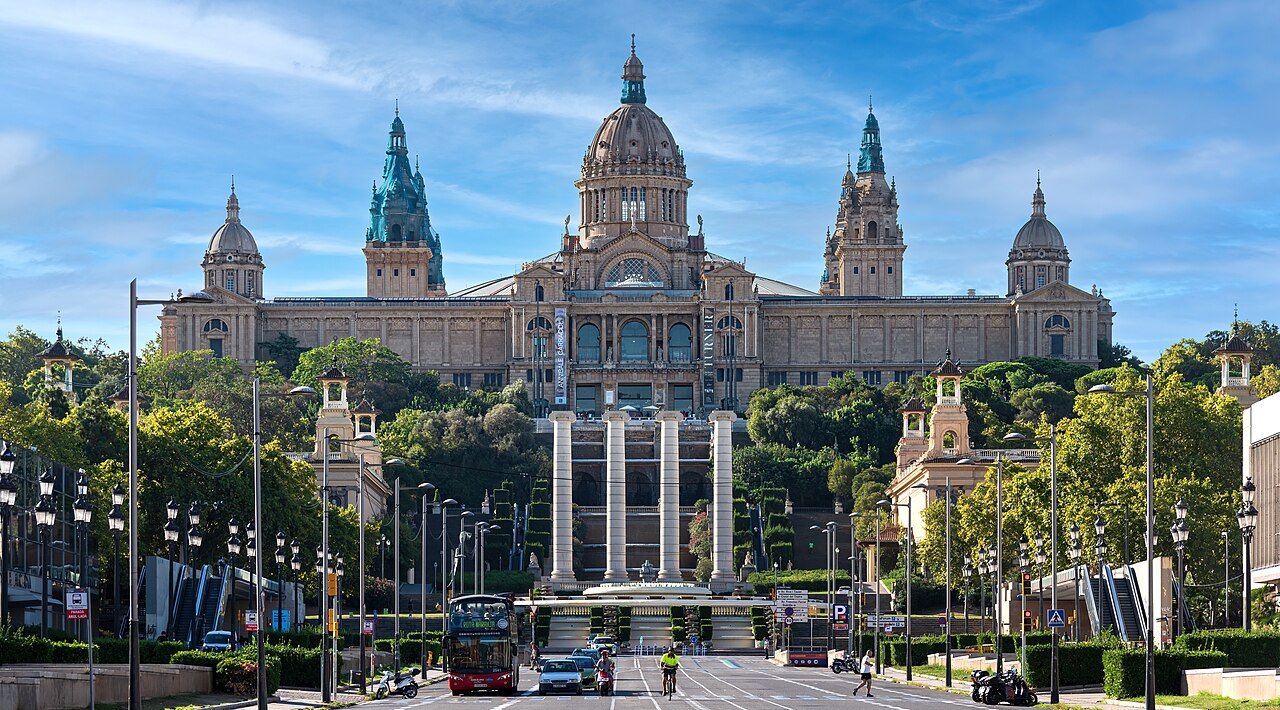
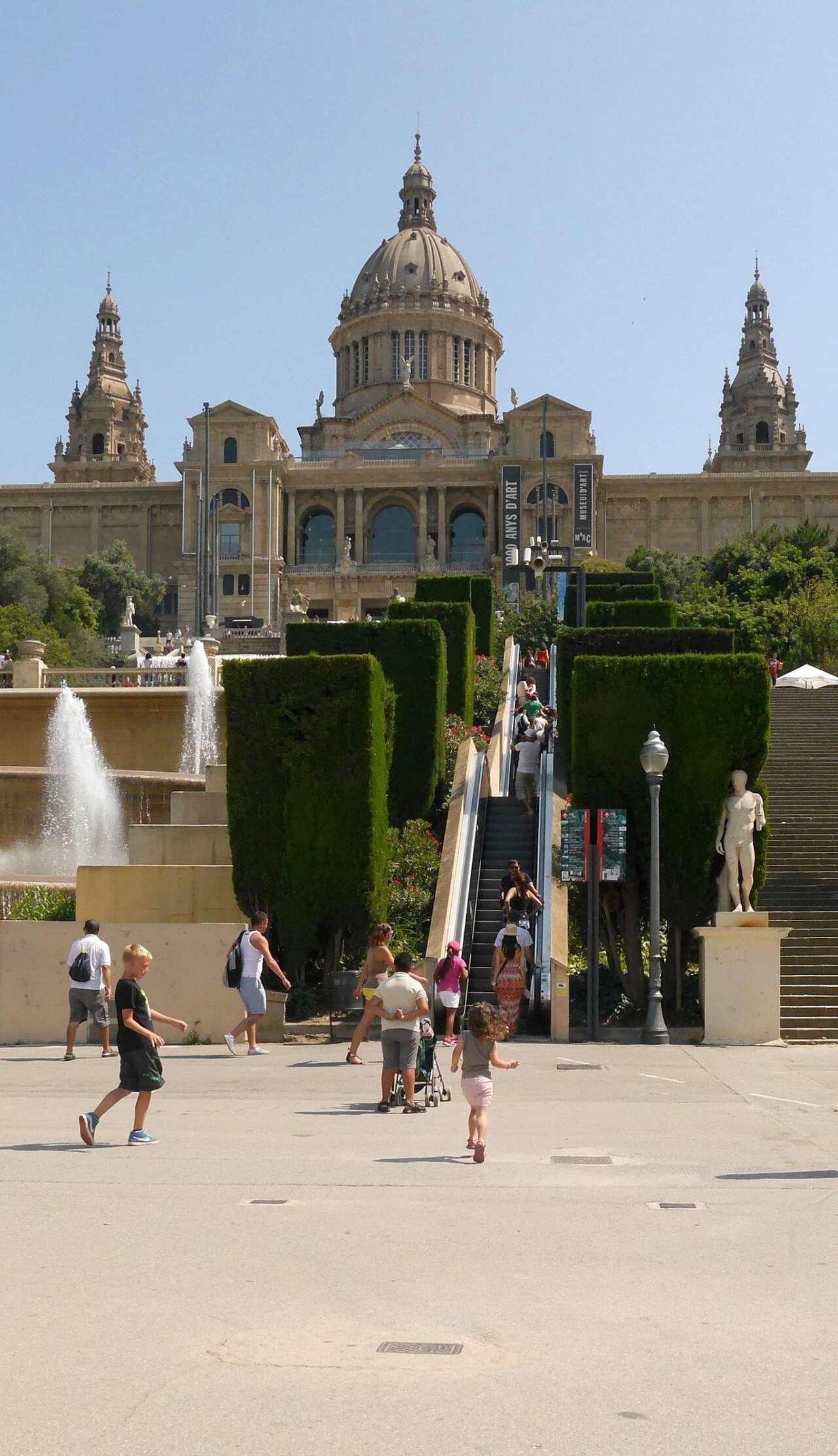
You see it long before you reach it. From Plaça d’Espanya, past the Venetian towers and the four white columns, the Palau Nacional sits on its green shoulder of Montjuïc like a palace from a fairytale the city decided to keep — a great dome in the middle, blue-tiled towers at the corners, cascades pouring down the hill in front of it. Inside that palace is the Museu Nacional d’Art de Catalunya, the MNAC, and inside the MNAC is the single best room of medieval art in Europe: a suite of dim galleries where the painted apses of Pyrenean village churches glow as they have not glowed in their empty villages for a century. This is the museum that took Christ in Majesty down from the wall of Sant Climent de Taüll — a village of a few hundred people in a high valley — and made him the face of Catalan art. Gaudí gets the crowds in this city, and deservedly; but if you only have one museum in you, make it this one.
This guide walks the visit the way the museum gives it to you: the palace and its impossible oval hall first, then the Romanesque galleries that are the reason the place exists, the Gothic altarpieces and the Spanish masters, the modern art floor where Ramon Casas pedals a tandem through Modernista Barcelona, and finally the rooftop, where the whole city lines up below you from the Collserola hills to the sea. It earns its place in our Best Things to Do in Barcelona list the honest way: a thousand years of art, one of the great buildings of 1929, and a view at the end that most visitors never learn is included in their ticket.
The Short Answer
Yes — the MNAC is emphatically worth it, and its Romanesque collection alone justifies the trip up Montjuïc. For a general ticket of €12 — valid for two days within a month, so you can split the visit — you get the finest collection of Romanesque mural painting in the world, Catalan Gothic altarpieces, Velázquez and Zurbarán, the modern art of the Modernisme generation, the palace’s vast oval hall, and a rooftop viewpoint over the whole city. Allow two to three hours; art lovers will fill a day. Entry is free for under-16s and over-65s, free for everyone on Saturday afternoons from 3pm and on the first Sunday of the month (reserve the free slot online), and there is even a €2 basic ticket that covers the building and the rooftop if you only want the palace and the view. Book your MNAC entry ticket ahead for the paid days, ride the metro to Espanya, and let the escalators do the climbing.
Table of Contents
- The Short Answer
- The Story in Brief: A Palace for an Exhibition
- What to See: The Sala Oval and the Dome
- What to See: The Romanesque Collection
- What to See: Gothic, Renaissance and Baroque
- What to See: The Modern Art Collection
- What to See: The Rooftop Viewpoint
- Practical Info
- Tips for Visiting
- Final Thoughts
The Story in Brief: A Palace for an Exhibition
The palace came first, and it was never meant to be a palace at all — it was the ceremonial centrepiece of the 1929 International Exposition, the world’s fair that rebuilt Montjuïc and gave Barcelona its Magic Fountain, its cascades and its Spanish Village. Architects Eugenio Cendoya and Enric Catà, working under the supervision of Pere Domènech i Roura, raised a vast essay in Spanish Renaissance revival: a central dome modelled in spirit on the great domes of the Spanish Golden Age, flanked by towers whose blue spires you can pick out from half the city. In May 1929 King Alfonso XIII inaugurated the exhibition in the palace’s oval hall, and for one summer this hill was the centre of the world.
When the fair closed, the palace needed a purpose, and Catalan art needed a home. The Museu Nacional d’Art de Catalunya was created in 1934, gathering the medieval collections that had been kept across the park in the Ciutadella — above all the Romanesque frescoes, which had been rescued from Pyrenean churches in dramatic campaigns between 1919 and 1923, when teams from the museum board strapped painted plaster off church walls (the strappo technique) to stop the murals being sold abroad to foreign collectors. It remains one of the great museum rescue stories: without those expeditions, the apse of Taüll would likely hang in Boston today. The modern art collections joined the same roof decades later, the two museums formally merged in 2004, and the galleries were rebuilt room by room — the Romanesque rooms reopened in 1995, the modern art display in 2014. The result is a single, walkable line through a thousand years of Catalan art, inside the most theatrical museum building in Spain.

What to See: The Sala Oval and the Dome
Every visit starts with a gasp, and it is architectural. The Sala Oval, the palace’s great hall, is one of the largest oval rooms in Europe — a coffered barrel of a space, ringed with paired columns and tall windows, built to hold the ceremonies of 1929 and still used for concerts and great occasions. At one end stands the hall’s other giant: the enormous pipe organ, built for the exhibition by the German firm Walcker and among the largest instruments of its kind in Spain. You pass through the hall on your way to the galleries, and it sets the scale of everything that follows: this museum was a palace first, and it never lets you forget it.
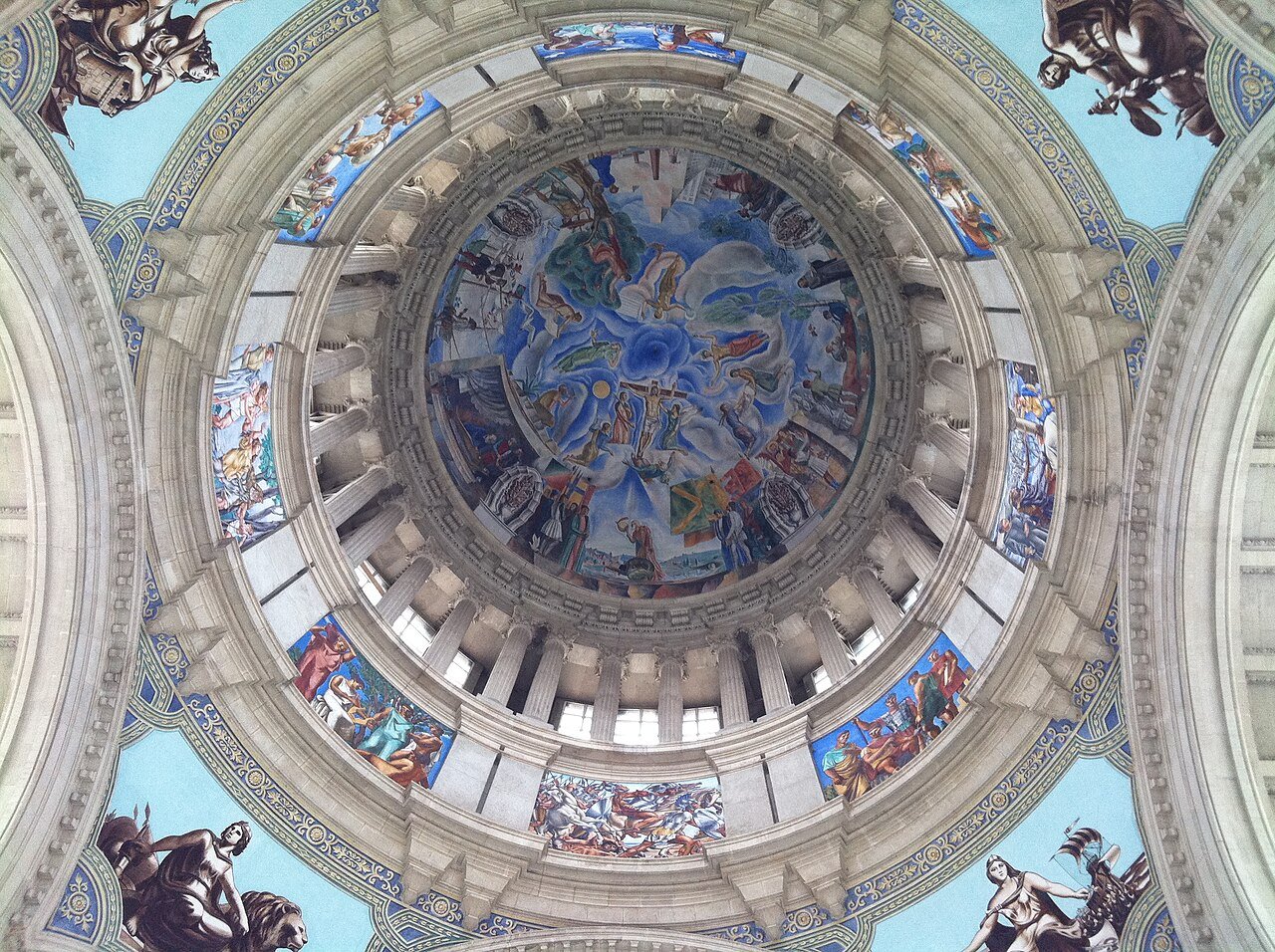
Then look up — in the hall beneath the dome, where the palace keeps its painted sky. The great cupola rises some sixty metres above the floor, and its interior is a single swirling allegory painted by Francesc d’Assís Galí and fellow artists for 1929, all clouds, figures and colour, ringed by windows that pour daylight down the drum. It is worth pausing here before any art at all: the dome is the building’s signature from outside, and from inside it is a reminder that in 1929 Barcelona intended this hill to announce a culture, not just an exhibition.

What to See: The Romanesque Collection
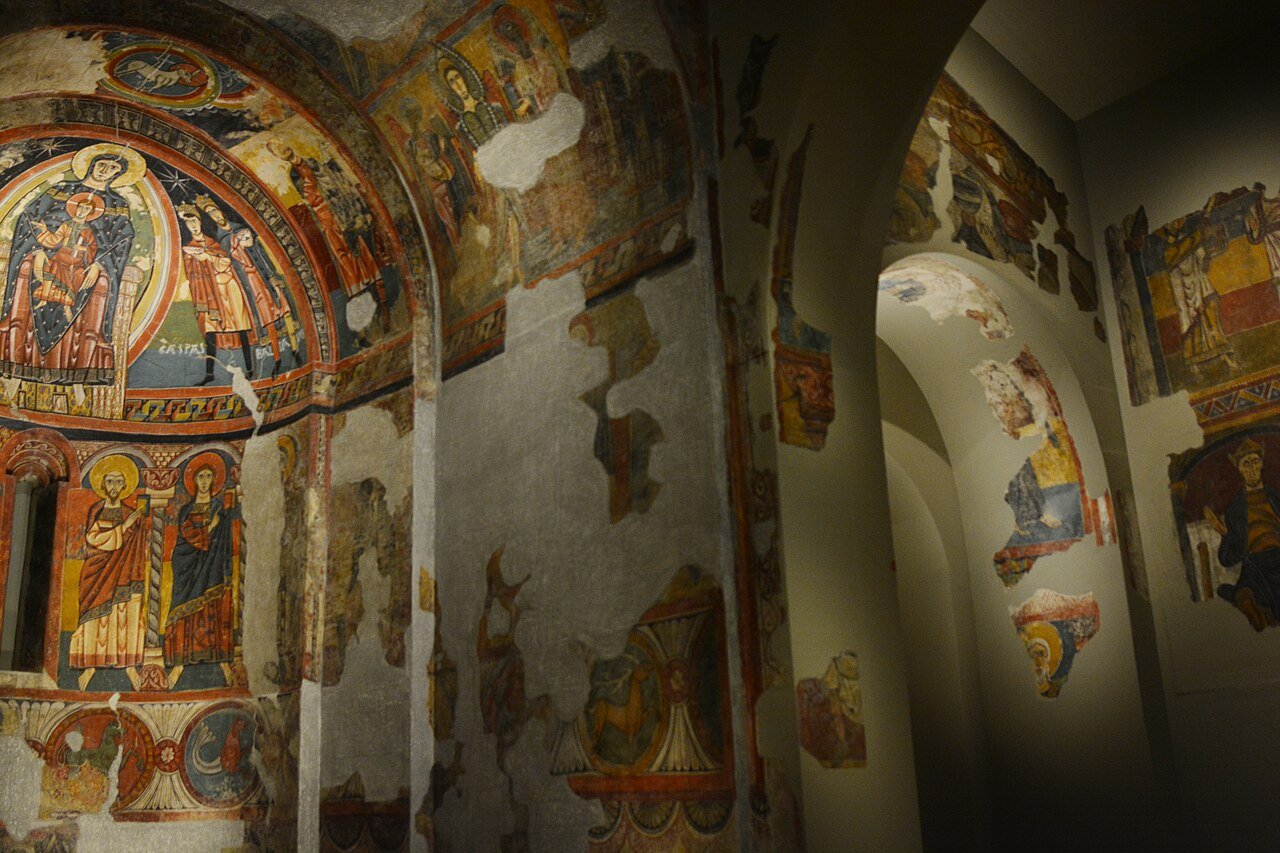
And now the reason this museum matters to the world. The Romanesque galleries, on the ground floor, hold the largest and finest collection of Romanesque mural painting anywhere — not panels or fragments in cases, but whole church apses, rebuilt inside the museum at full scale, so that you walk from village church to village church down a thousand-year-old Pyrenean valley that happens to be indoors. The lighting is low, the walls are curved, and the paintings do what they were painted to do in about 1123: overwhelm you.
The first apse is the icon. From Sant Climent de Taüll, in the Vall de Boí, comes the most famous Romanesque image on earth: Christ in Majesty inside his almond-shaped mandorla, book open on his knee — “Ego sum lux mundi”, I am the light of the world — one hand raised in blessing, the symbols of the four evangelists around him and the Virgin and apostles in a row below. The original church still stands in Taüll (its apse now holds a copy, lit by a famous video mapping), but the painting itself is here, close enough to see the brushwork in Christ’s beard. A few steps away, the apse of Santa Maria de Taüll answers it with tenderness: the Virgin and Child enthroned inside the mandorla, the Magi approaching with their gifts. And from Sant Pere de Burgal, a whole apse of grave, staring apostles beneath a lost heaven, its lower walls painted with the donors and saints of a vanished congregation.
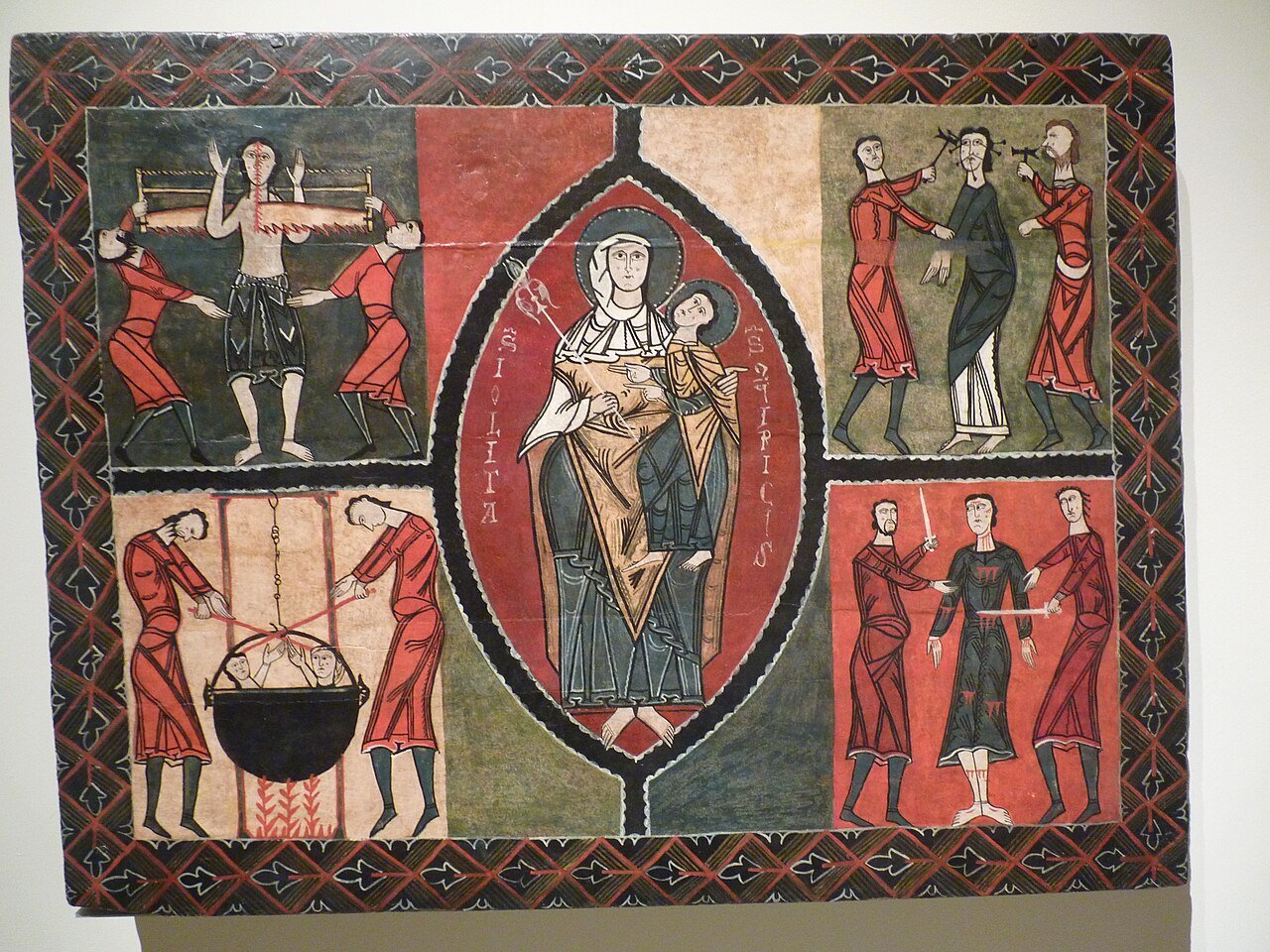
Give the supporting arts their due, because this collection explains a whole civilisation, not just its walls. Catalonia’s Romanesque churches were furnished with painted wooden altar frontals — flat, comic-strip panels of saints’ lives in red, black and gold — and the museum’s set of them, like the frontal from Durro showing the martyrdom of Santa Julita and her little son Sant Quirze being sawn, boiled and nailed by smiling executioners, is the best in existence. Around them stand the carved wooden Virgins and Christs that once presided over these same altars, enamelled crosses and goldsmith work in glass cases, and whole painted arches under which the museum lets you walk. Come here first, come slowly, and let your eyes adjust: this floor is the masterpiece, and everything upstairs is a bonus.


Free Barcelona travel guide
Planning a trip to Barcelona? Get our free one-page Barcelona checklist: which Gaudí houses and museums to book ahead (the MNAC’s free Saturdays included), what to skip, and the tapas bars we actually eat in.
What to See: Gothic, Renaissance and Baroque
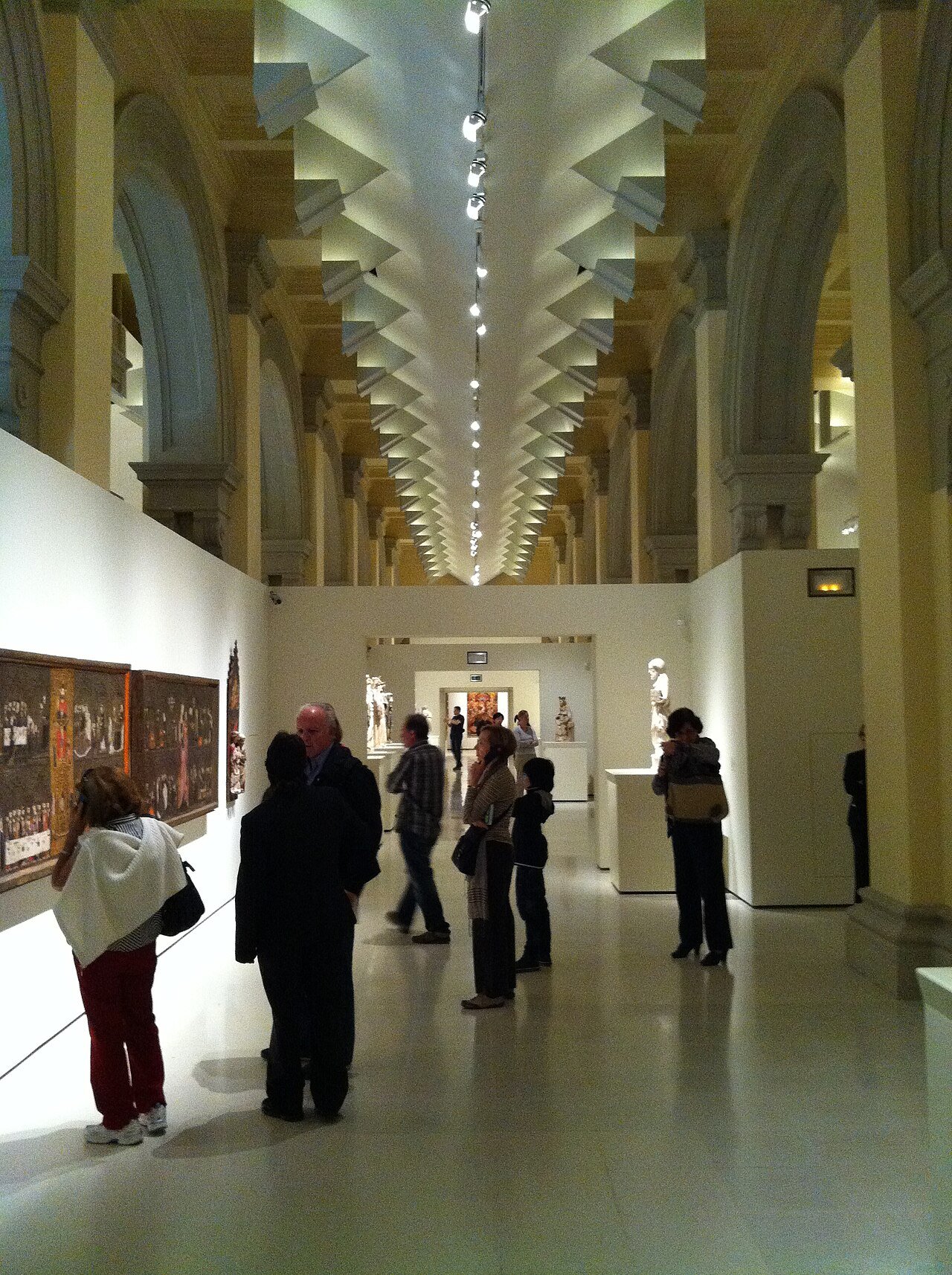
Upstairs, the story continues in gold. Catalonia in the 14th and 15th centuries was a Mediterranean power, and its Gothic painting is the art of rich cities: vast carved and gilded altarpieces — retaules — that once rose behind altars like golden screens, painted by the masters of the Barcelona workshops. Look for Lluís Dalmau’s Virgin of the Councillors (1443), the city’s councillors kneeling before the Virgin in a painting that announced the arrival of Flemish oil technique in Catalonia; for Bernat Martorell’s elegant saints and dragons; and for Jaume Huguet, the defining painter of Catalan Gothic, whose altarpieces glow with gold leaf and patterned brocades. The galleries run long and high, altarpiece after altarpiece, and the effect is cumulative — a whole civilisation praying in gold.
The Renaissance and Baroque rooms widen the map to Spain and Europe. Velázquez is here — his gaunt Saint Paul, painted in the master’s early Seville years — and Zurbarán, whose Saint Francis seems carved from shadow and cloth; Ribera and the Neapolitan Baroque darken the walls around them. The Thyssen-Bornemisza deposit adds an international gleam, led by Fra Angelico’s Madonna of Humility, a small panel of impossible serenity. None of this is the museum’s headline, and that is its pleasure: rooms of first-rank Spanish painting that you will often have nearly to yourself, because the crowds are all downstairs with the frescoes or outside with Gaudí.
What to See: The Modern Art Collection
The top floor jumps eight centuries in a staircase, and lands in a Barcelona recognisably ours. The modern art collection — roughly 1850 to 1950, redisplayed in 2014 — is the story of the city that built the Eixample and invented Modernisme: portraitists and poster artists, sculptors like Josep Llimona, the painters of the tavern Els Quatre Gats, and the whole applied-arts world of the movement, down to its furniture, jewellery and stained glass. The room everyone photographs is Ramon Casas’s great, deadpan self-portrait of 1897: the artist and his friend Pere Romeu, landlord of Els Quatre Gats, pedalling a tandem bicycle in white flannels, Romeu smoking his pipe at the front and Casas grinning back at you from the rear saddle — the bohemian manifesto of a generation, painted life-size.
Modernista Barcelona was a total-design culture, and this floor proves it better than any single building. Gaudí is here not with a façade but with furniture — the carved oak pieces he designed for the Casa Calvet, all bone and muscle — alongside the sinuous benches, doors and decorative panels of his contemporaries. Add one of Europe’s strong early photography collections and the museum’s other quiet giant, the Numismatic Cabinet, whose coins and medals run from ancient Iberia to the present in their tens of thousands, and the top floor could swallow an afternoon by itself. It rarely gets one — which, again, is your gain.

What to See: The Rooftop Viewpoint
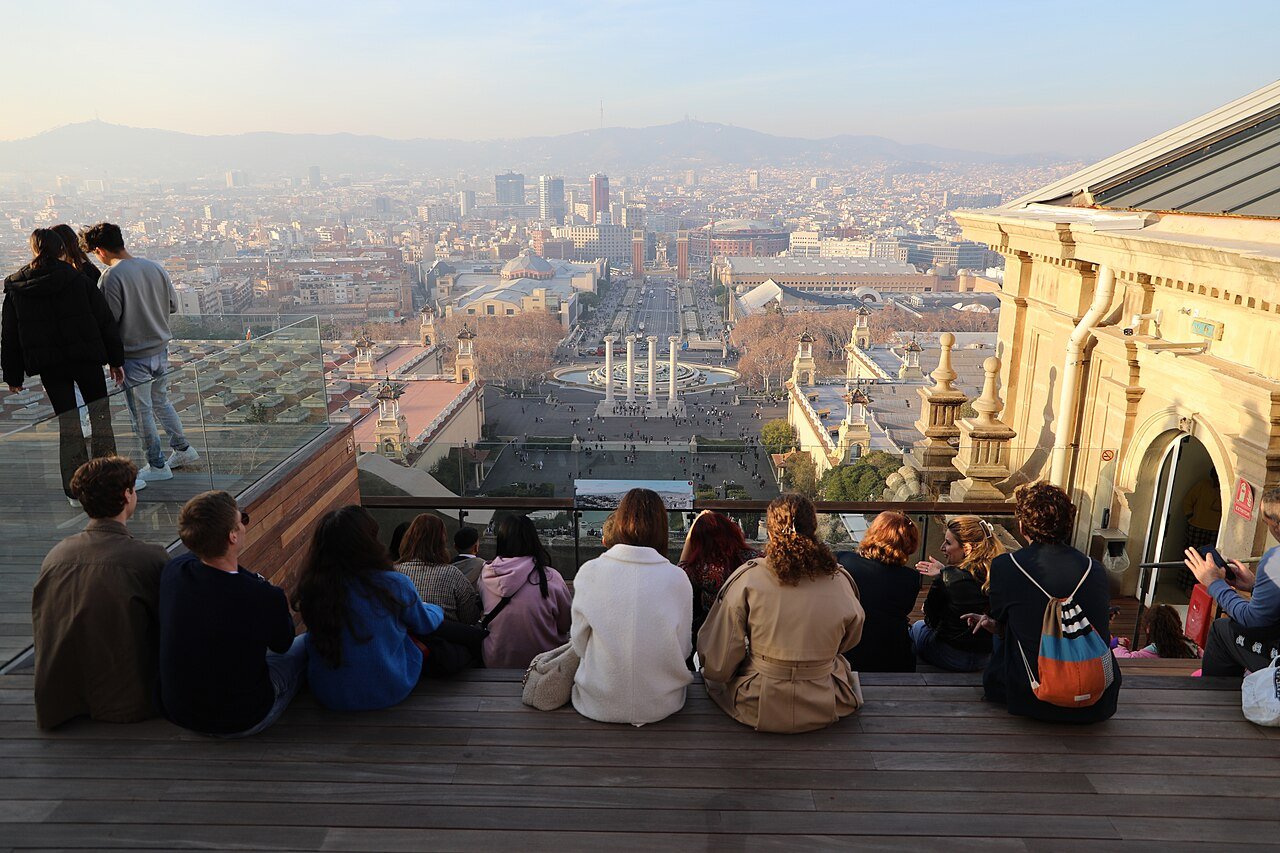
Save the last half hour for the roof. The palace’s terraces — the Rooftop Viewpoint, included in general admission and the whole point of the €2 basic ticket — walk you around the base of the dome, close enough to touch the building you have been photographing all day. From the west terrace the great cupola fills your frame, lantern, statues and all; from the front, the city does. Barcelona unrolls in one long lesson: the cascades and the Magic Fountain at your feet, the Quatre Columnes and the Venetian towers marking Plaça d’Espanya, the grid of the Eixample running to the Sagrada Família’s cranes, Tibidabo and the Collserola hills behind, the sea at your back. People come up here with no interest in art at all, and they are right to — but it lands differently after the frescoes, when the city below is the same one those Pyrenean painters’ descendants built.
Time it if you can for late afternoon, when the stone warms and the fountains below are lit. And if the Magic Fountain is performing that evening — its schedule is seasonal and has been reduced in dry years, so check before you plan around it — the palace steps are the finest seat in the city from which to watch it.

Practical Info
Tickets — the honest version. General admission is €12 and covers the permanent collection, the temporary exhibitions and the Rooftop Viewpoint; unusually, it is valid for two days within a month of purchase, which makes splitting a long visit painless. Basic admission is €2 and covers the building and rooftop only — the local’s trick for the view. Admission is free for under-16s and over-65s, and free for everyone every Saturday from 3pm, on the first Sunday of the month and on open-door days; for the free sessions you must still reserve a timed slot online, and they go fast. Students get 30% off. If you want the booking handled, the MNAC entry ticket covers general entry. An audioguide is worth it in the Romanesque rooms, where every apse has a village and a story.
Hours. Winter (October to April): Tuesday to Saturday 10am–6pm. Summer (May to September): Tuesday to Saturday 10am–8pm. Sundays and public holidays close at 3pm all year. Mondays closed, except public holidays; the museum shuts entirely on 1 January, 1 May and 25 December. Ticket offices close 30 minutes before the museum does, and the rooms are cleared 15 minutes before — so the last entry of the day is shorter than it looks.
Getting there. Palau Nacional, Parc de Montjuïc. Take the metro to Espanya (lines L1 and L3), cross Plaça d’Espanya to the Venetian towers, and ride the outdoor escalators up past the cascades — they do most of the climbing, with steps beside them for the energetic. Buses stop at the square too, including the 150 that continues up to Montjuïc Castle, which pairs naturally with an MNAC morning: our Montjuïc Castle guide covers the fortress at the top of the hill. The museum is step-free inside, with lifts between floors, a cloakroom for large bags (required), a café, and a restaurant in the old throne room.
How long. Two to three hours is the honest minimum: an hour for the Romanesque floor, forty minutes for the Gothic and Spanish masters, forty for modern art, and half an hour of palace and rooftop. With the two-day ticket, there is no shame — and real pleasure — in doing the frescoes one day and everything else on another.
Tips for Visiting
- Start downstairs, start early. The Romanesque galleries are the masterpiece and the first rooms to fill. At 10am on a weekday you may have the Taüll apse to yourself; by midday you will be sharing it.
- Use the two-day validity. The €12 ticket’s second day is the museum’s best-kept secret. Frescoes today, modern art and the rooftop tomorrow — the visit halves in effort and doubles in pleasure.
- Free Saturday? Book the slot the week before. Saturday from 3pm and first-Sunday entry are free but reservation-only, and the slots disappear. Set the reminder when you book your flights, not your weekend.
- The €2 rooftop trick. Short on time or money? Basic admission gets you the palace interior and the full Rooftop Viewpoint for the price of a coffee. It is the best-value view in Barcelona.
- Pair it with a Modernisme day. The MNAC’s modern floor is the perfect prologue to the buildings themselves: Casas and Gaudí’s furniture here in the morning, then the real thing — our Casa Vicens guide and Park Güell guide cover the houses where this world was built.
- Stay for the fountain if it is running. On performance evenings, the Magic Fountain below the palace is the city’s great free show, and the museum terraces and steps are its natural amphitheatre. Check the current schedule — drought restrictions have trimmed it in recent years.
Travel insurance, sorted
Whether it is a two-week holiday or a longer move, travel insurance is the one booking not to skip. We point readers to SafetyWing’s Nomad Insurance — cover built for travellers, remote workers and longer stays abroad, on a flexible monthly subscription you can start before a trip or while you are already away.
Final Thoughts
Barcelona markets itself on one architect, and the MNAC is the standing correction: a palace built for a party in 1929 that ended up holding a thousand years of a nation’s art, rescued fresco by fresco from mountain churches and hung in the grandest rooms in Spain. The Taüll Christ alone would justify the escalators; that he comes with Burgal and Santa Maria, with Huguet’s gold and Velázquez’s shadows, with Casas pedalling his tandem and a rooftop that explains the whole city, makes this the best-value museum day in Barcelona — €12, two days, one palace. Go up the hill. The crowds are wrong about where the masterpiece is.
¡Buen viaje!

Photo credits: The Palau Nacional from Plaça d’Espanya, the Sala Oval and the dome from the west terrace — Didier Descouens, CC BY-SA 4.0 · The apse of Sant Pere de Burgal — Didier Descouens, Public domain · The palace dome from the cascades — Enric, CC BY-SA 4.0 · The dome interior, the apse of Sant Climent de Taüll and the gallery hall — Kippelboy, CC BY-SA 3.0 · The apse of Santa Maria de Taüll — Joe Mabel, Public domain · The altar frontal from Durro — David Monniaux, Public domain · Ramon Casas’s tandem painting in the galleries — Benjamín Núñez González, CC BY-SA 4.0 · The Rooftop Viewpoint — Francesco Bini, CC BY-SA 4.0 · The cascades and escalators — Ronny Siegel, CC BY-SA 4.0. All via Wikimedia Commons.



One Comment