Tibidabo: The Complete Guide to Barcelona’s Hilltop Fairground
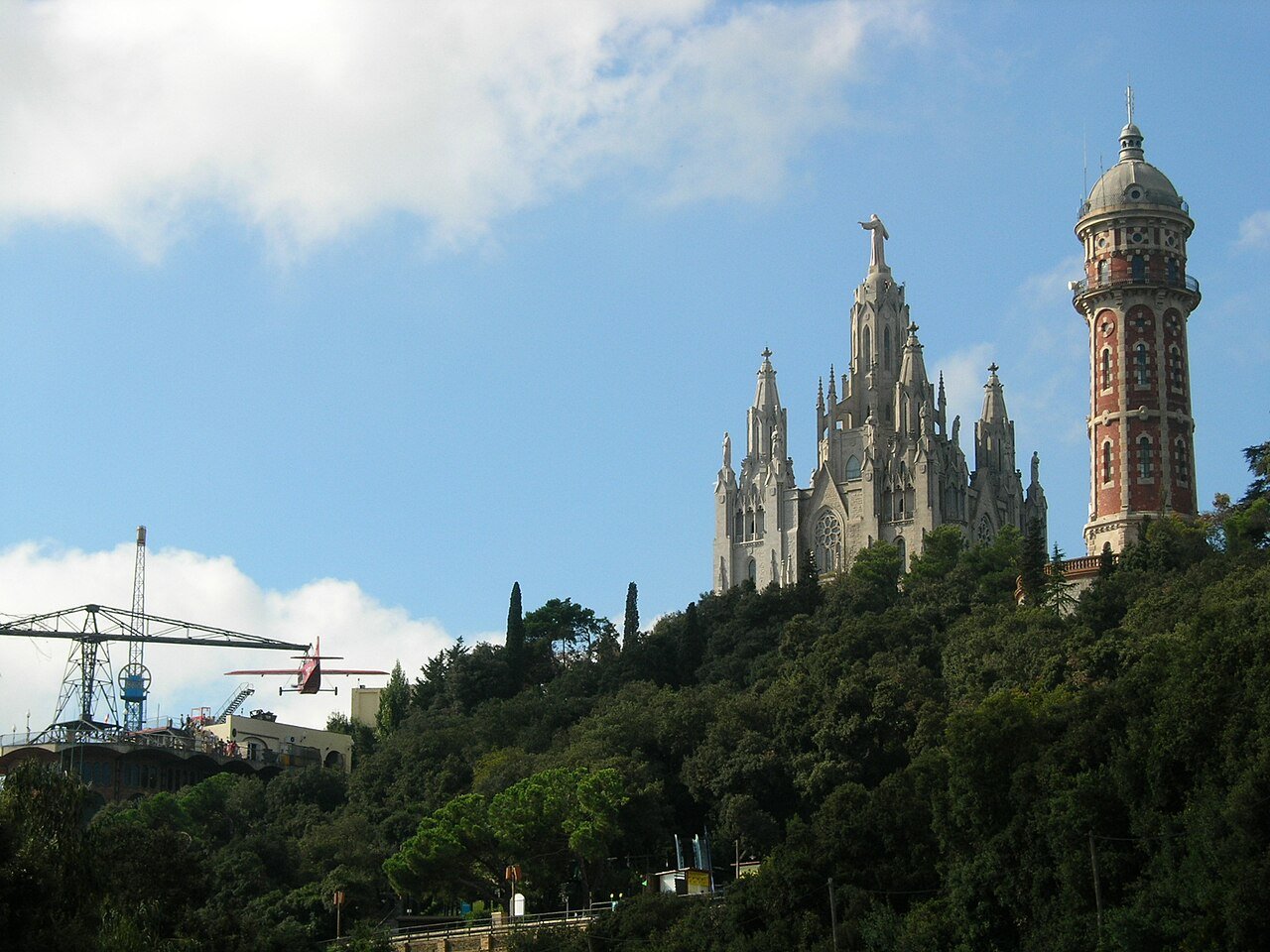
Every city has a silhouette it shows the world, and Barcelona’s has a fairground in it. Stand on any rooftop, look up at the green wall of the Collserola hills behind the city, and there it is: a white church crowned by a Christ with open arms, and beside it — improbably, wonderfully — a Ferris wheel and a red aeroplane, turning slowly in the sky. That is Tibidabo, at 512 metres the highest point of the Serra de Collserola and of Barcelona itself: a mountain that holds, all at once, one of the world’s oldest amusement parks, a great neo-Gothic church, a Norman Foster communications tower and the finest all-round view the city owns.
This guide takes the mountain piece by piece: the name and the legend; the tram, funicular and bus that climb it; the vintage rides that have thrilled Barcelonans since 1901; the church above them and the crypt below; the tower across the ridge and the view in every direction; and the practical business of when to come and what it costs. It is the rooftop chapter of the story told across our Best Things to Do in Barcelona guide — the one you read with the whole city at your feet.

The Short Answer
Yes — Tibidabo is worth the climb, and the climb is half the fun: Barcelona’s highest hill, holding a vintage amusement park of 1901, the Sagrat Cor church with its panoramic lift, and views running from the Pyrenees foothills to the open Mediterranean. The summit square, the church and the park’s top-level Panoramic Area are free to enter — ride up, walk the church terraces and take in the view without a park ticket at all — while the full park and its thirty-odd rides are a ticketed, seasonal pleasure: mostly weekends and holidays, daily in high summer. Families should give it a full day; view-hunters can do the summit in a couple of hours. Book the park entry ahead in season — Tibidabo amusement park entry includes the funicular — and pick a clear day, because everything up here is weather.
Table of Contents
- The Short Answer
- The Mountain in Brief: A Name, a Legend and a Working Hill
- Getting Up There: Tram, Funicular and the Direct Bus
- The Amusement Park: A Fairground in the Sky
- The Classic Rides: The Plane, the Lookout and the Wheel
- The Sagrat Cor: The Church on the Roof of Barcelona
- The Collserola Tower and the Views
- Tibidabo with Kids
- Where to Eat Up There
- Practical Info
- Tips for Visiting
- Final Thoughts
The Mountain in Brief: A Name, a Legend and a Working Hill
The name is a quotation. Tibi dabo — “I will give you” — is what the Devil says to Christ on the mountaintop in the Latin Bible, offering him all the kingdoms of the world below: haec omnia tibi dabo. Somewhere in the centuries of retelling, the highest hill above Barcelona — from which the world really does seem spread out below — took the Tempter’s words for its own. The perfect name for a mountain that now offers you a whole city, plus a fairground, from its summit.
For most of its history the hill was what the rest of Collserola still is: pine and holm-oak forest, hermits and masies, somewhere city people climbed to escape the summer heat. The change came with one man — Salvador Andreu, a pharmacist turned property developer with a genius for the grand gesture. Around 1900 Andreu promoted the whole package at once: a garden suburb on the slopes, an avenue of mansions climbing to it, a blue tram up the avenue, a funicular up the final wall of the hill, and at the top an amusement park. Tram and funicular opened together on 29 October 1901 — the funicular was the first in Spain — and the fairground followed on the summit. Barcelona has been riding up to its own rooftop ever since.
The hill still works around the visitors. Just below the summit stands the white dome of the Observatori Fabra, an observatory of 1904 still scanning the sky; the summit itself carries a small resident community, the Colònia del Tibidabo, in the lanes behind the church. And behind everything stretches the Parc Natural de Collserola — some 8,000 hectares of protected Mediterranean forest, the green lung that makes the view a two-way pleasure: city in front of you, wilderness at your back.
Getting Up There: Tram, Funicular and the Direct Bus
Half of Tibidabo’s charm is that getting there is a small expedition in period transport — but go in knowing which parts of the classic journey currently run. The traditional route starts at Plaça de Catalunya: the FGC railway (line L7) climbs through the upper city to its terminus at Avinguda Tibidabo, where the journey’s famous second act used to begin — the Tramvia Blau, the blue heritage tram of 1901, rattling 1.3 kilometres up the mansion-lined Avinguda del Tibidabo to Plaça del Doctor Andreu and the funicular station. The tram, honestly, is a building site at present: out of service since 2018 for a deep overhaul of its tracks and the avenue itself, with restoration promised but not yet dated. Bus 196 covers the same avenue meanwhile, and the walk up past the modernista mansions is a pleasure in itself.

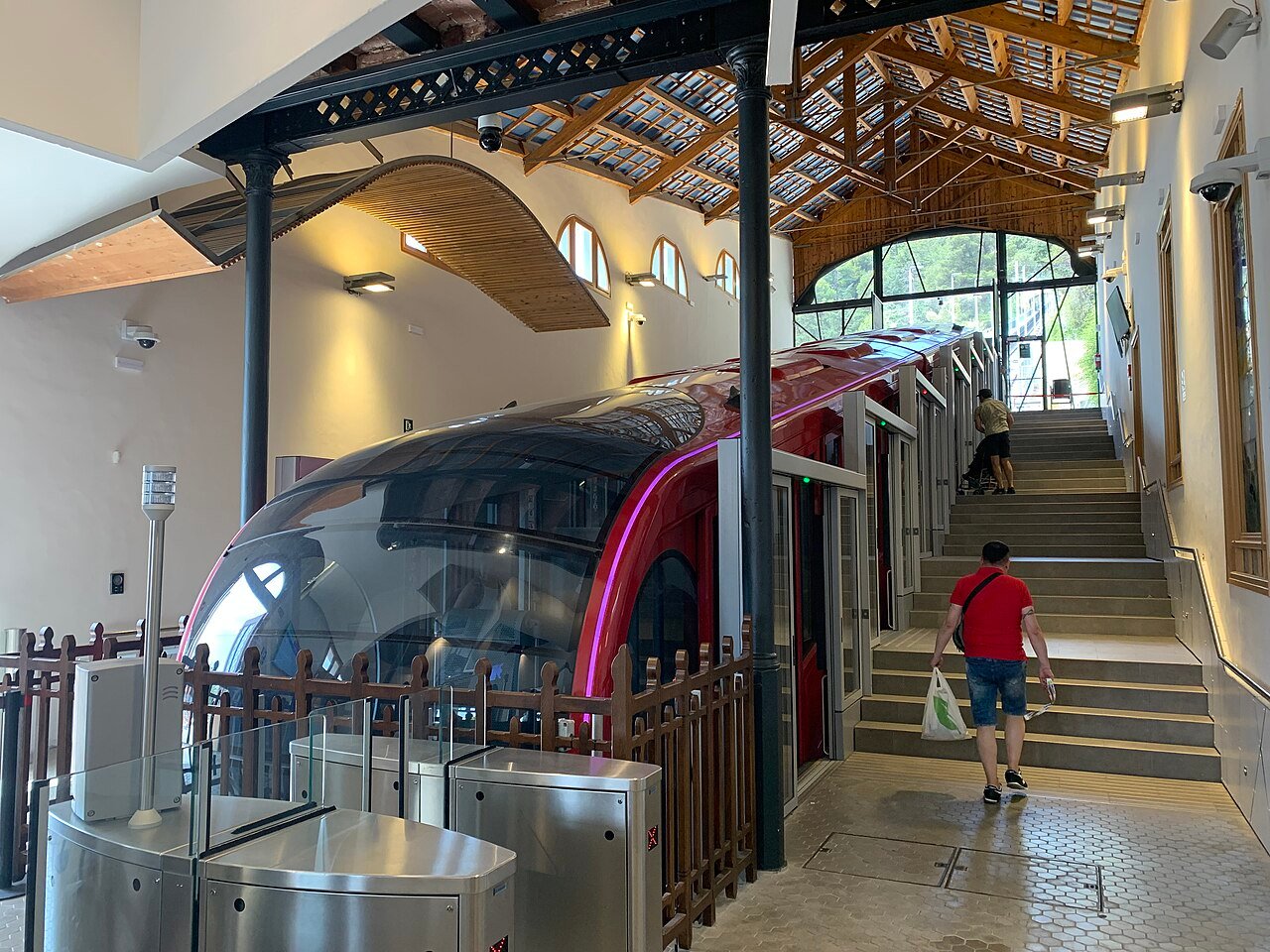
At Plaça del Doctor Andreu the third act begins, and this one runs beautifully. The Funicular del Tibidabo — the line of 1901, the park’s own railway — climbs 1,130 metres through the pines to the summit square. Since June 2021 it has done so in new cars named for a firefly: the Cuca de Llum, glassy red panoramic trainsets that replaced the old funicular after a two-year rebuild, carrying more people, faster, with the city opening out behind you as you rise. The ride takes about four minutes and is an attraction in its own right. The funicular sells its own return ticket, and park entry includes it — but note it stands outside the city’s integrated fare network, so your metro card will not cover it.
Simpler routes exist. The park runs direct Tibibus shuttles from the city on opening days, and the back door is scenic too: FGC to Peu del Funicular, the Vallvidrera funicular up the ridge’s other side, then bus 111 along the crest. Driving up is possible, but summit parking is limited and priced for it; the funicular is the better theatre. Either way, budget the best part of an hour from the centre: the mountain is in the city, but it is not near it — and that is rather the point.
The Amusement Park: A Fairground in the Sky
The Parc d’Atraccions Tibidabo is among the oldest amusement parks in the world still in operation — opened with the funicular in 1901, when its first pleasures were a hall of mirrors, swings and a carrier-pigeon station — and it has grown the way the hill dictates, in terraces. Some thirty rides and attractions are stacked across six levels cut into the summit, so that almost every queue and carousel comes with a view of the city falling away below. It is not a modern thrill park, and does not try to be: its magic is vintage machinery, a family scale, and that altitude.
Know the layout before you pay. The top level — the sixth, at the summit itself — is the Àrea Panoràmica, and it is free: anyone can ride up and wander among the emblematic rides — wheel, lookout, plane — paying per ride if they choose, or simply take the view with a coffee. The ticketed park proper spreads over the levels below; a full entry ticket covers the rides throughout, including, in the usual arrangement, the funicular. Barcelona’s other great designed hilltop, Park Güell guide, sells wonder by the timed ticket; Tibidabo’s top floor still lets you just wander in — one of the last free pleasures of its kind in the city.

Free Barcelona travel guide
Planning a trip to Barcelona? Get our free one-page Barcelona checklist: what to book ahead, what to skip, and the viewpoints we actually send friends to.
The Classic Rides: The Plane, the Lookout and the Wheel
Three rides are the park’s soul, and all three are really viewpoints in disguise. The most famous is the Avió — the Aeroplane — of 1928: a bright-red replica of the aircraft that flew the first Barcelona–Madrid route, hung from a great crane arm on the park’s edge. You board it like a passenger of 1928, the propeller turns, and the plane swings out over the hillside with nothing beneath it but pines and the whole of Barcelona — one of the world’s first flight simulators, and still the park’s defining image. It does not loop or dive. It does something better: it flies, gently, at 500 metres.

Older still is the Talaia — the Watchtower — of 1905: a slender lattice arm with a cage at its end, which lifts its passengers some 50 metres into the air and holds them there, turning slowly, with the summit’s best unobstructed panorama. It is a Edwardian engineer’s idea of a thrill — altitude itself — and on a clear day it out-thrills everything built since. The third emblem is newer: the Giradabo, the big panoramic wheel that joined the top level in 2014, whose coloured cabins rise and fall against the whole Eixample grid — the wheel you see from every rooftop in the city, returning the compliment.

Around the emblems, the supporting cast mixes eras happily. The Embruixabruixes, the park’s suspended scenic railway, has been gliding its little trains around the mountainside since 1915; the red Muntanya Russa of 2009 dives through the pine trees on the park’s lower edge like a coaster in a forest; and the carved horses of the Carrousel turn under their lights on the top level as they have for generations. Ride the old ones first. They are why this park, and not a newer one, is on the mountain.
The Sagrat Cor: The Church on the Roof of Barcelona
Above the fairground, literally and in every sense, stands the Temple Expiatori del Sagrat Cor de Jesús — the Expiatory Church of the Sacred Heart. The summit was given to Saint John Bosco on his visit to Barcelona in 1886, and the Salesians who received it dreamed on the grand scale: a crypt first, then a church above it, then a statue above all. The architect was Enric Sagnier, Barcelona’s most prolific church-builder, and the work outlived him — begun in 1902, it was finished by his son Josep Maria and not completed until 1961. The result is two churches in one building: below, a crypt in warm stone with round arches and glittering mosaics, in the neo-Romanesque taste of 1900; above, a soaring neo-Gothic church in pale stone, all pinnacles and stained glass, crowned by a seven-metre bronze Christ with arms open to the city.
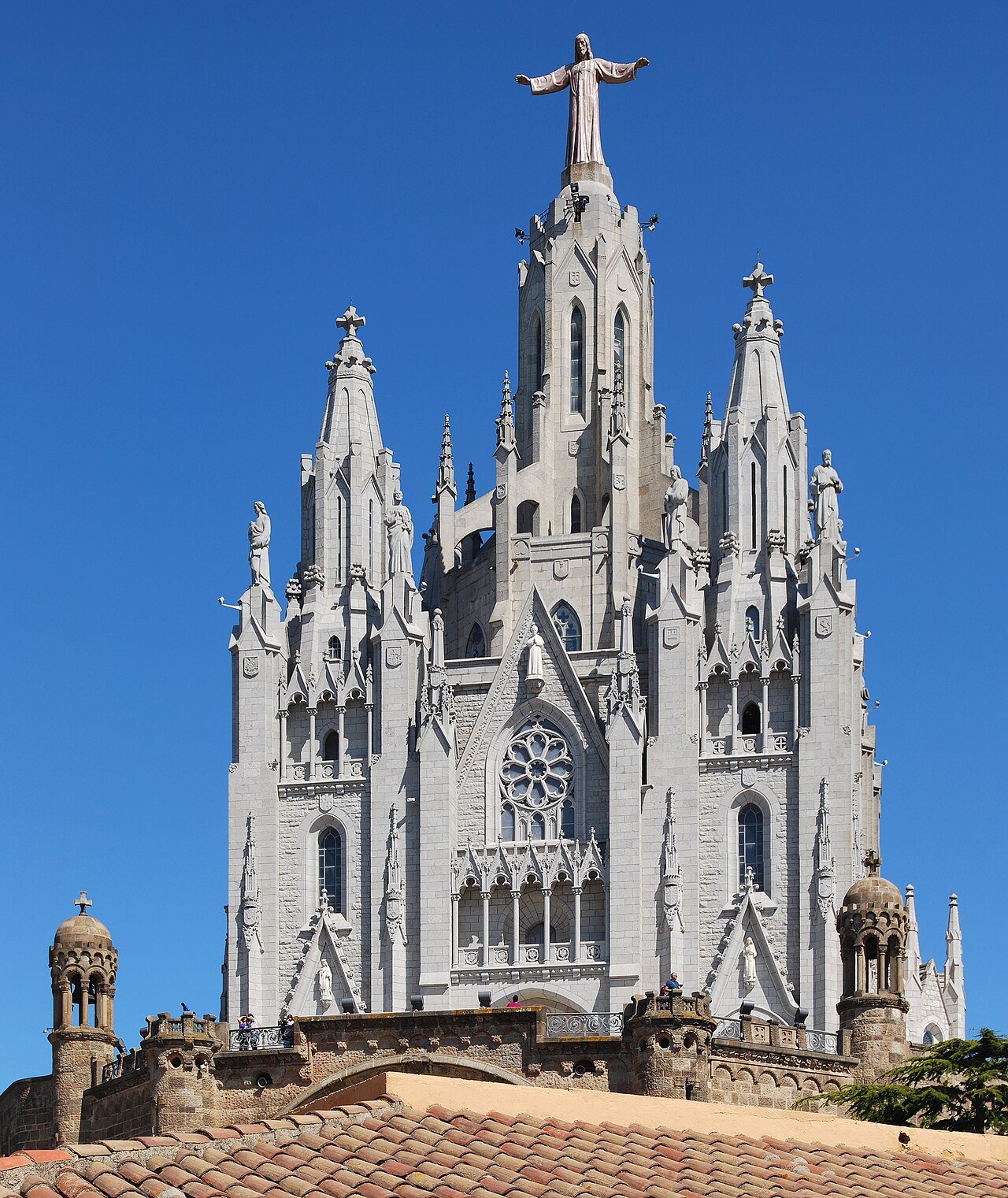
The Christ is the second of his line: the original statue, raised in the 1930s, was destroyed in the Civil War, and the figure that blesses Barcelona today — by Josep Miret — took its place as the church was completed. Entry to the church and crypt is free, and the crypt alone justifies the climb: a hushed, mosaic-lined undercroft unlike the white Gothic above. But the visit’s climax is vertical. A lift rises inside the church to the terrace at the statue’s feet, ringed by the twelve apostles, at some 539 metres above the sea — higher than the Talaia, higher than anywhere else you can stand in Barcelona. Small fee, enormous view. The church is still in Salesian hands and still a working sanctuary; treat it as one, and it will give you the mountain’s quietest half-hour.

The Collserola Tower and the Views
A few minutes’ walk along the crest from the summit — and in view from almost everywhere on it — the mountain keeps its third landmark. The Torre de Collserola, Norman Foster’s communications tower, was built for the 1992 Olympics: a 288-metre needle of concrete and steel, steadied by guy wires, carrying the city’s broadcasts from the neighbouring Turó de la Vilana. Up close it is elegant, a mast with a building threaded onto it; its tenth-floor observation deck opens on selected days and adds the one view Tibidabo itself cannot give you — Tibidabo, church, wheel and all, seen from outside. Admire it from the summit as the fairground’s space-age neighbour: 1901 and 1992, sharing one ridge.

And then there is the view itself, the one the Devil was offering. From the church terrace, the park’s levels and the summit square, Barcelona lies arranged like a teaching model: the Eixample’s grid with the Sagrada Família rising from it, the old town at the port, Montjuïc Castle guide’s fortress hill answering yours across the city, the airport and the Llobregat delta to the south, the sea doing its long blue line along everything. Turn around and the second view is wilder — Collserola’s wooded folds running inland to the Vallès, and on clear days Montserrat’s serrated ridge on the horizon like a second skyline. On the clearest winter days, the locals’ claim goes, you can pick out Mallorca across the water. We have never caught it. We keep going up to try.


Stay for the light if you can. The summit faces the whole arc of the day — morning clarity for the long views, evening for the city turning gold. Sunset on a clear day, with the park lights coming on and the church floodlit against the dark, is Tibidabo’s finest hour, and the funicular queue down is the price everyone gladly pays for it.
Tibidabo with Kids
This is, by design, one of the great family days out in Barcelona — the park was built for the city’s children and has been re-supplied with them every weekend since 1901. The journey itself is the first ride: a train, a bus up a mansion avenue, a glass funicular climbing through pines. Inside, the scale suits the young — the emblem rides are gentle, the levels explorable, the whole place run at a fairground’s pace rather than a theme park’s frenzy. Small children get the carousel and the little trains; older ones get the coaster through the pines and the Talaia’s cage in the sky.
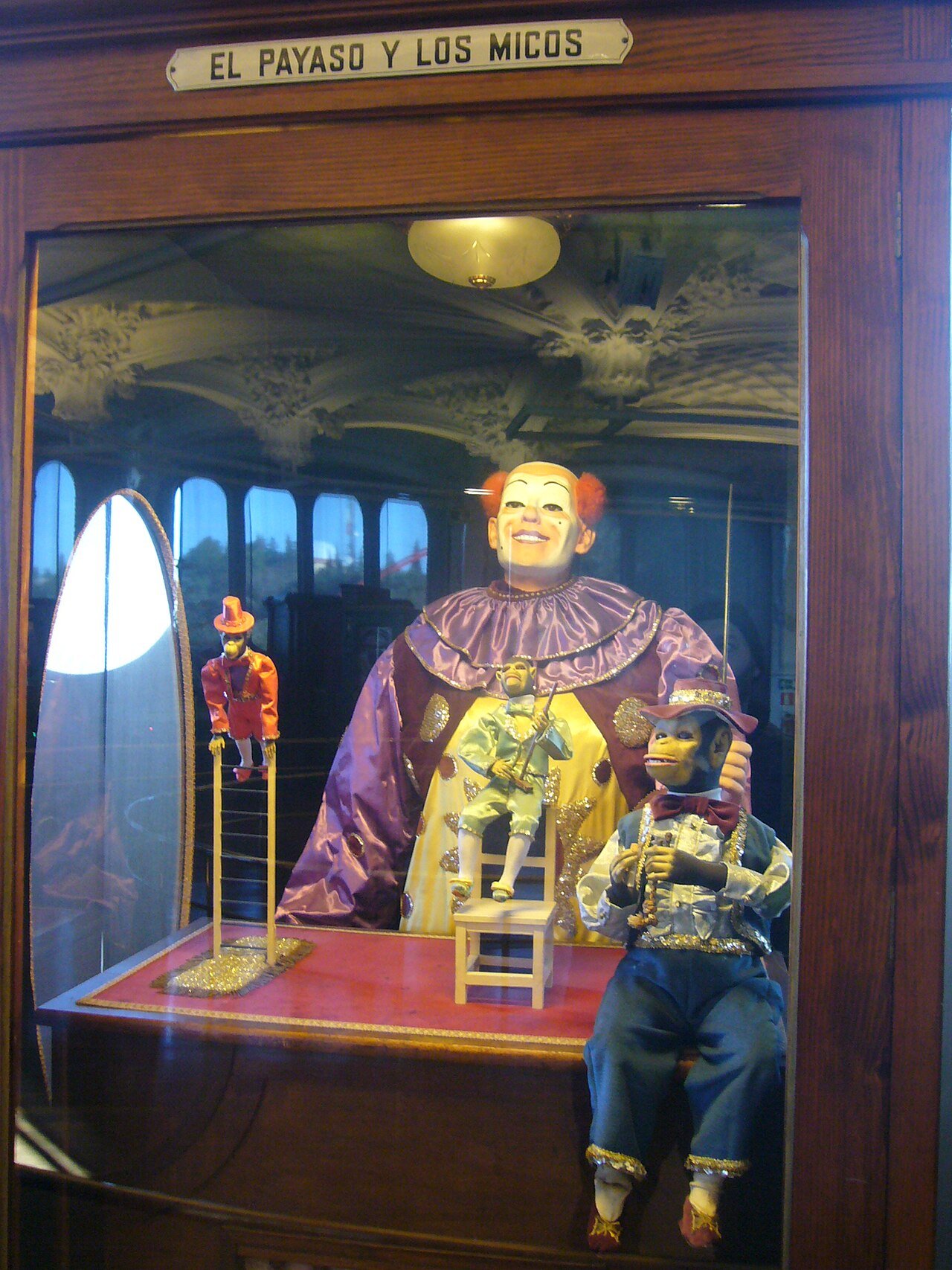
Do not skip the park’s quiet masterpiece. The Museu d’Autòmats, on the park’s lower terrace, holds one of Europe’s finest collections of mechanical figures and fairground machines — most a century or more old, and most still working: feed in the token and the clown plays, the monkeys perform, the fortune-tellers stir. Children who have ridden everything will stand in front of its cabinets longest. Add the Marionetàrium’s puppet shows, and a family can fill the day without a single screen. Practical notes: the park is stroller-manageable but terraced — expect ramps, lifts and some pushing — and the mountain is cooler than the city, so pack a layer even in summer.
Where to Eat Up There
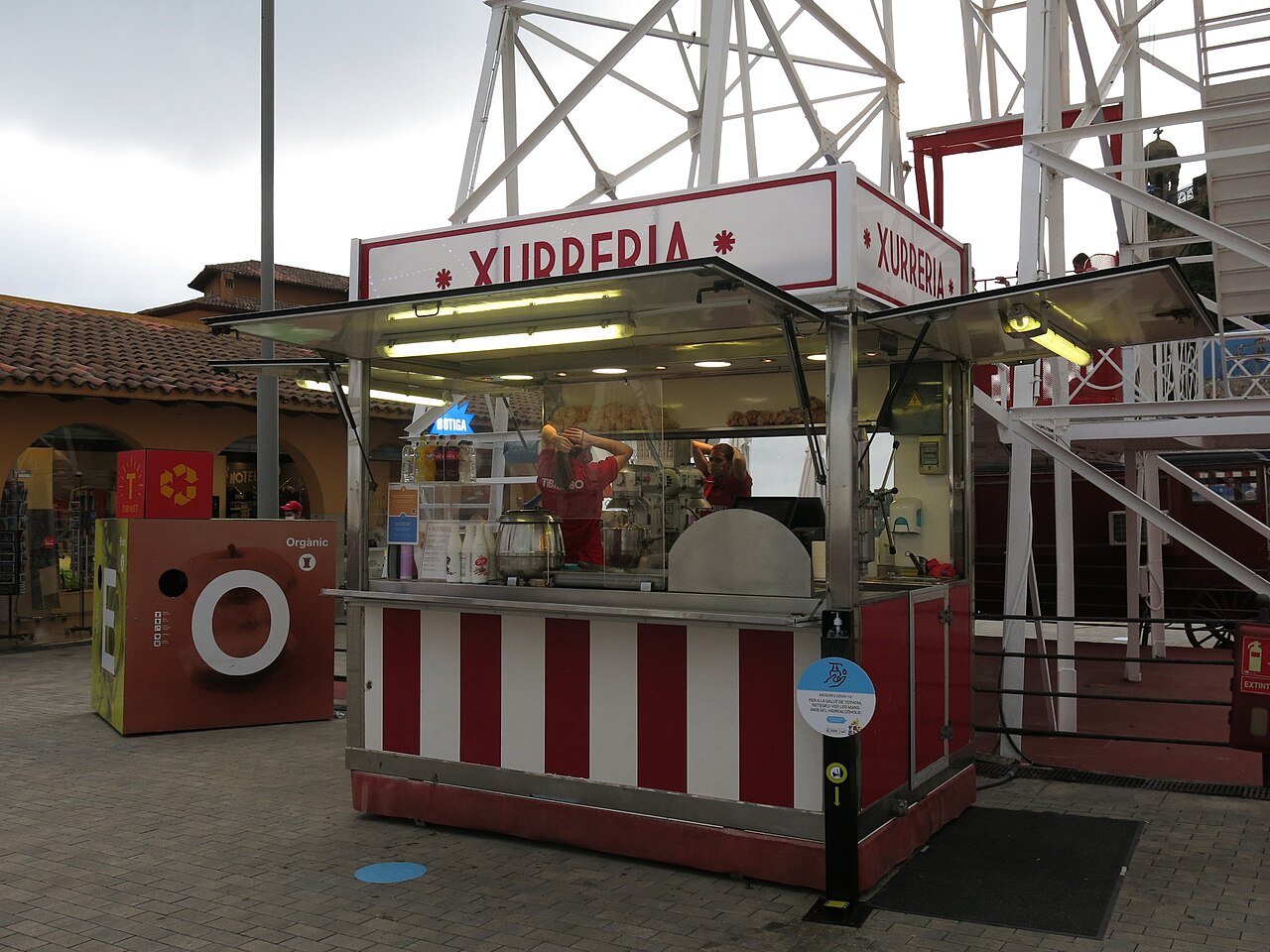
Nobody climbs Tibidabo for a gastronomic pilgrimage, but the summit feeds its visitors with fairground honesty. The ritual item is on the top level: xurros — churros — from the red-and-white Xurreria stand beneath the Talaia, eaten hot with the city at your feet; around it, the park levels run the full fairground menu of popcorn wagons, ice cream, hot dogs and crepes. For a sit-down meal, the park’s La Masia restaurant serves Catalan standards in a farmhouse-style building, and the bars and cafés around Plaça del Tibidabo — the summit square by the church and funicular — will do you a coffee, a vermouth or a simple lunch on a terrace at altitude.
The connoisseur’s options sit a little off the square: the white palace on the Vallvidrera road below the summit is the Gran Hotel La Florida, a grand hotel of 1925 whose terrace makes the splurge drink of the mountain; and the picnic is always available — the park’s benches have hosted a century of Barcelonan sandwiches, and a morning market stop on the way up provisions you better than any summit kitchen. Eat for the view, in short, and you will eat very contentedly.
Practical Info
Getting there. The classic route: FGC line L7 from Plaça de Catalunya to Avinguda Tibidabo, then bus 196 (while the Tramvia Blau is restored) to Plaça del Doctor Andreu, then the Cuca de Llum funicular to the top. The park’s Tibibus shuttles run direct from the city on opening days, and the Vallvidrera side — FGC, Vallvidrera funicular, bus 111 — is the quiet alternative. Allow the best part of an hour from the centre each way. The funicular is not part of the integrated fare network: buy its return ticket separately, or take park entry with it included.
Costs and booking. The summit square, the church and crypt, and the park’s Panoramic Area are all free. The full park is a single entry ticket covering the rides across its levels (with pay-per-ride arrangements in the Panoramic Area for non-ticket-holders); the church lift to the statue terrace charges a small fee. In season, book ahead — Tibidabo amusement park entry in advance saves the funicular-station queue, which on a fine Sunday can be the longest line of the day.
When the park is open. The full park keeps a seasonal calendar — chiefly weekends and holidays through much of the year, daily in high summer, resting for a stretch of midwinter; the Panoramic Area and funicular run on a wider schedule. The church opens daily. Everything up here is weather-exposed: on a day of low cloud the mountain sits in fog while the city basks below, so check the summit forecast — and the calendar on tibidabo.cat — before you commit.
How long. View, church and summit square: two hours, unhurried. The full park with children: a full day, easily, and the sunset is worth arranging it around.
Tips for Visiting
- Pick a clear day — ruthlessly. The mountain’s whole offer is the view; in cloud you get a fairground in fog. Check the morning sky from the city: if you cannot see the church from below, wait.
- Use the free top floor first. Ride up, walk the Panoramic Area, the church and the summit square, and only then decide whether the full park ticket earns its money for your party.
- Take the church lift. The terrace at the statue’s feet, ringed by the apostles, is the single highest and finest viewpoint in Barcelona — worth every cent of its small fee.
- Ride the old three. Avió, Talaia, Embruixabruixes: 1928, 1905, 1915. Newer parks have faster rides; nowhere else has these.
- Don’t plan around the blue tram. The Tramvia Blau is mid-restoration and out of service; bus 196 runs its avenue. If you find it running again, take it — it is the loveliest approach in the city.
- Stay for sunset. The floodlit church, the blue wheel and the city’s lights coming on are the mountain’s second show, and the crowds thin as it starts.
- Pack a layer. At 512 metres with the sea breeze, the summit runs several degrees cooler than the Eixample — summer evenings included.
Travel insurance, sorted
Whether it is a two-week holiday or a longer move, travel insurance is not the most glamorous part of a trip — but it is the one booking you want to have in place before a trip, and while you are already away.
Final Thoughts
Tibidabo is Barcelona’s memory of itself at play, kept at the top of the city where everyone can see it. Other cities demolished their Victorian fairgrounds; Barcelona kept riding its 1905 lookout and its 1928 aeroplane, built a church over them and a space-age tower beside them, and folded the whole unlikely stack into its skyline. Come up for the view — everyone does — and you will stay for the strangeness of the place: a mosaic-lined crypt under a white Gothic church, a red plane flying in circles over the pines, a devil’s bargain of a name, and a whole city laid out below, being offered to you. Take it. That’s what it’s for.
¡Buen viaje!

Photo credits: The park from the Sagrat Cor terrace, the Tramvia Blau at the funicular station, the Carrousel and Talaia at dusk, the crypt of the Sagrat Cor, the Torre de Collserola and the Xurreria — Enric, CC BY-SA 4.0 · The Sagrat Cor above the pines — Enfo, CC BY-SA 3.0 · The Cuca de Llum funicular — Bigtime Boy, CC BY-SA 4.0 · The Avió in flight — Dromedar61, CC BY-SA 3.0 · The Talaia raised — Joe Mabel, CC BY-SA 4.0 · The Sagrat Cor façade — Felix König, CC BY 3.0 · The Giradabo over Barcelona — DimiTalen, CC0 · Tibidabo by night — DavidRoviraPujol, CC BY-SA 4.0 · El Payaso y los Micos in the Museu d’Autòmats — Jordiferrer, CC BY-SA 3.0. All via Wikimedia Commons.




5 Comments