Girona Day Trip from Barcelona: The Complete Guide to Girona’s Old Town, Cathedral and Jewish Quarter
Short Answer
Girona is the day trip Barcelona hides in plain sight. Ninety-nine kilometres north-east of the capital — 38 minutes on a high-speed train — stands a complete medieval city of some 100,000 people, wrapped in Roman walls, split by the slow green Onyar and crowned by a cathedral whose single nave is the widest Gothic span on earth. Its old town, the Barri Vell, packs a Roman fortress, one of Europe’s best-preserved Jewish quarters, 12th-century baths and a film set’s worth of staircases into a hill you can cross in twenty minutes.
On any honest shortlist of the best day trips from Barcelona, Girona fights for first place with Montserrat — and wins on variety: the mountain gives you one great abbey, Girona gives you a whole second city. Go for the cathedral and the Call, stay for the river houses and the xuixos.
Table of Contents
- The Short Version: Why Girona Works So Well
- A City Built to Be Besieged: A Short History
- The Cathedral: One Nave, Ninety Steps
- El Call: The Jewish Quarter
- The Arab Baths and Sant Feliu
- The Onyar Houses and the Eiffel Bridge
- Sant Pere de Galligants and the Northern Old Town
- Girona on Screen: Walking the Game of Thrones City
- The City Walls: Passeig de la Muralla
- The Other Girona: Rambla, Independència and the Xuixo
- Should You Add the Costa Brava?
- Practical Info
- Tickets and Costs
- Getting There and Getting Around
- When to Go
- How Long You Need
- Tips for Visiting
- What to See Nearby
- Frequently Asked Questions
- Final Thoughts
The Short Version: Why Girona Works So Well
Everything about Girona is sized for a day. The fast train from Barcelona Sants takes 38 minutes; the station is a 15-minute walk from the old town; and the sights form a natural walking loop — river houses, cathedral hill, Jewish Quarter, baths, walls — that takes four to six unhurried hours. It is also weatherproof: a living city, with cafés, bakeries and bookshops woven through the monuments, so a grey Tuesday in February works almost as well as a May morning.
The one decision is how to go. Independently, Girona is easy and cheap (see Getting There below). If you want the city explained as you walk it — and the Costa Brava bolted on without a second journey — the Girona & Costa Brava small-group tour does both in one 8-hour day: hotel pick-up, a guided old-town and Jewish Quarter walk in a group of no more than eight, then Pals and Calella de Palafrugell — rated 4.8 out of 5 on GetYourGuide. This guide is written for the independent trip, with the tour marked where it genuinely helps.
A City Built to Be Besieged: A Short History
Girona began as a Roman strongpoint. Around 79 BC the Romans fortified the hill where the Via Augusta crossed the rivers, calling the place Gerunda and walling it into the triangular fortress — the Força Vella — whose stones still form the skeleton of the old town. Charlemagne took the city in 785, and the counts and bishops who followed built a frontier capital of the Spanish March, rich on trade and scholarship.
Two communities shaped its golden centuries. The cathedral chapter raised one of the great churches of Catalonia on the hilltop, while in its shadow grew the Call, the Jewish Quarter — home from the 9th century to the community that produced the Kabbalist school of Nahmanides (Bonastruc ça Porta), one of the most important in the western Mediterranean. That world ended with the expulsions of 1492, and the quarter slept, built over and half-forgotten, until its lanes were recovered in the late 20th century — which is precisely why so much survives.
The rest of Girona’s story is told in sieges — most savagely in 1809, when the city held out for months against Napoleon’s armies. The reputation for refusal still flavours its character: proud, self-contained, quietly certain of itself. A city of just over 100,000 people that behaves like a capital is what a thousand years of walls will make.
The Cathedral: One Nave, Ninety Steps
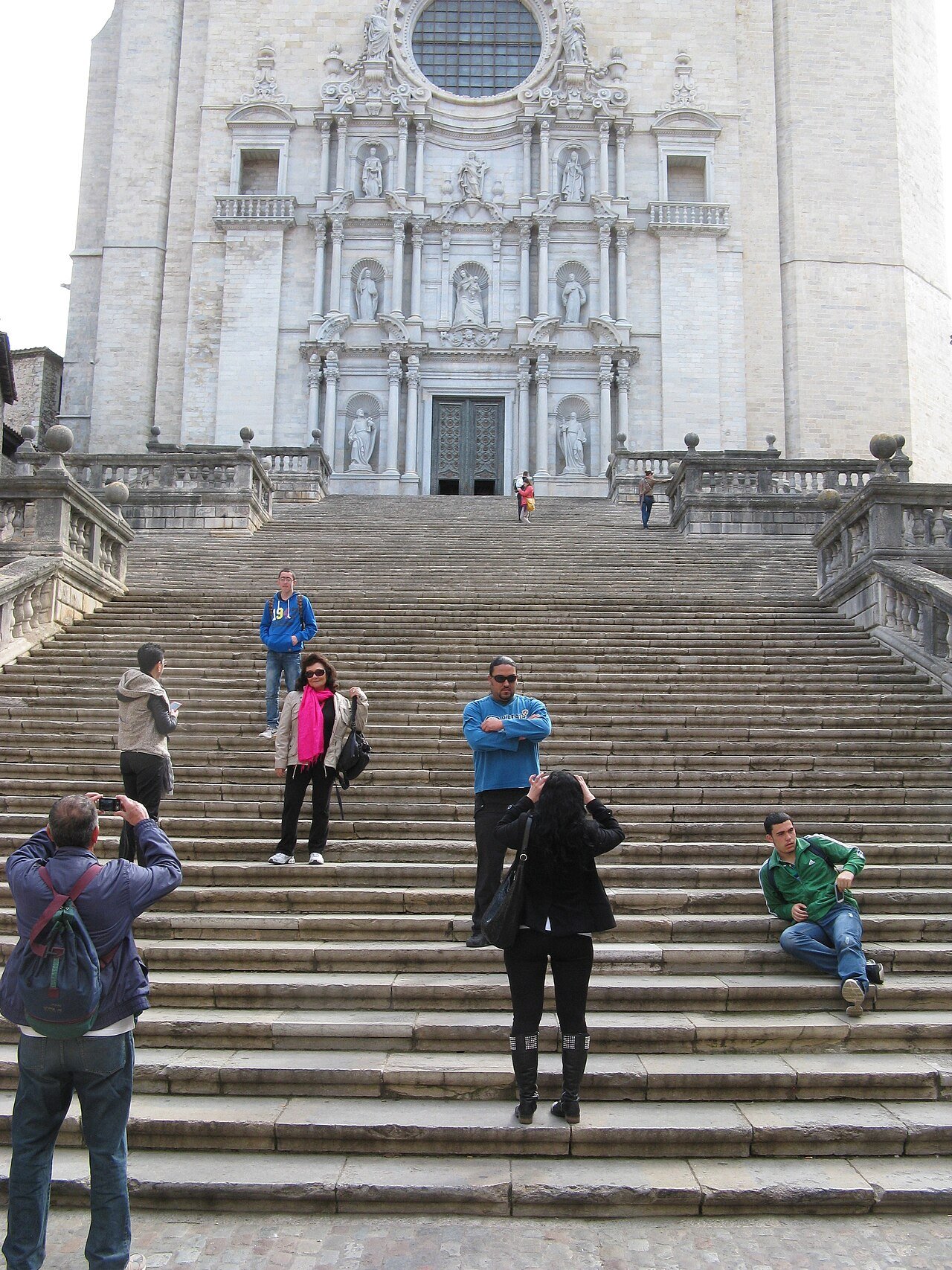
Girona Cathedral announces itself properly — up a staircase of some 90 steps, one of the grandest church approaches in Spain, climbing to a Baroque façade so tall and pale it seems to hold up the sky. The façade was built in stages between the 17th century and 1961, and its statues look down on a square that has seen everything from medieval markets to, in 2015, a film crew turning it into the steps of the Great Sept of Baelor.
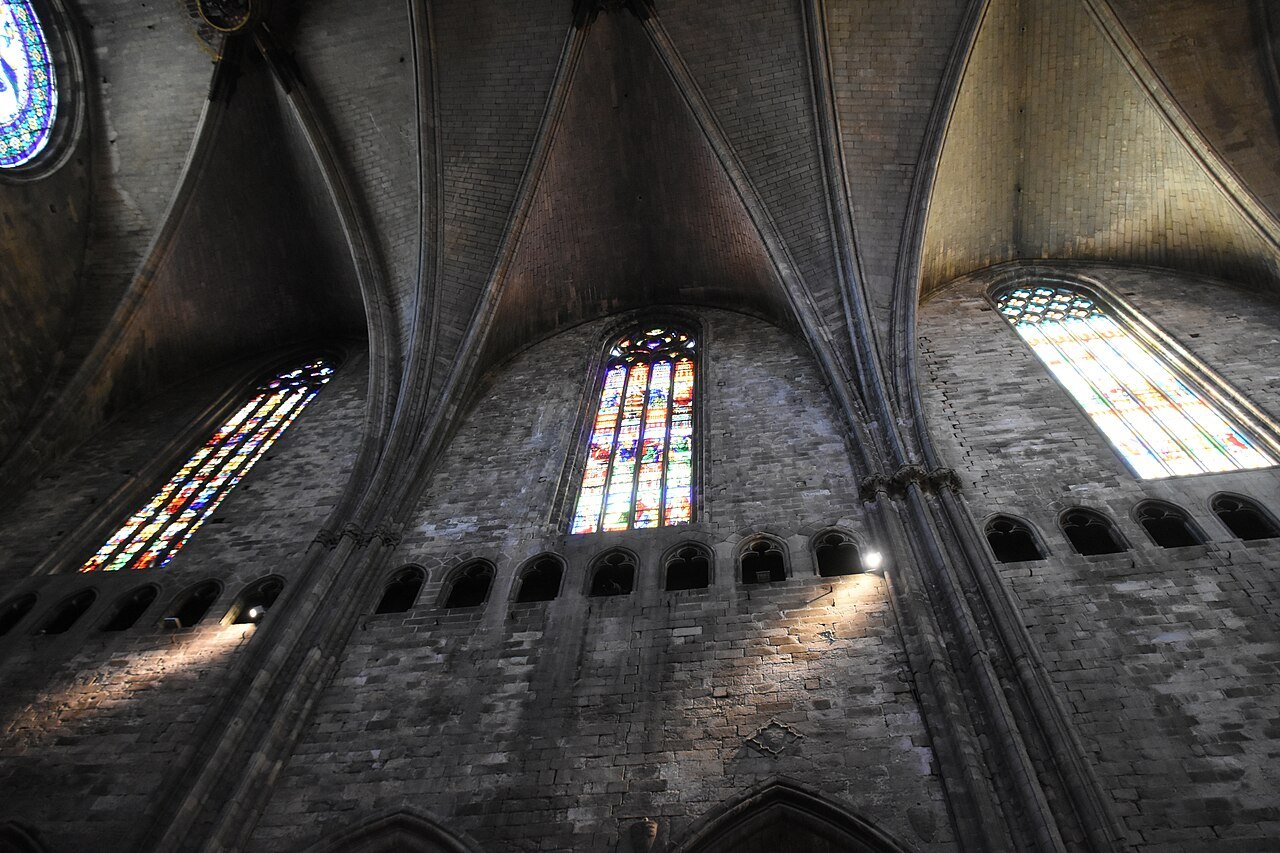
Inside is the shock. Most Gothic cathedrals divide their width into a nave and two aisles; in 1416, after decades of argument, the master builder Guillem Bofill proposed covering Girona’s whole width with a single vault — and the chapter accepted. The result is a nave 22.98 metres wide, the widest Gothic nave in the world and wider than any church vault except St Peter’s in Rome, rising some 30 metres over an interior of almost Romanesque severity. Stand in the middle and it feels less like a church than a stone sky.
The cloister and chapter museum earn their time too. The cloister is 12th-century Romanesque, its capitals carved with biblical scenes and medieval daily life; beside it rises the Torre de Carlemany, the Romanesque bell tower named for Charlemagne. The museum’s treasure is the Tapestry of Creation (the Tapís de la Creació), an 11th–12th-century embroidery mapping the whole medieval cosmos — Christ in Majesty at the centre, ringed by the winds, the seasons and the labours of the year. The surviving piece, roughly 3.6 by 4.7 metres, is a fragment of something larger, and one of the great textile survivals of Romanesque Europe.

The cultural visit (cathedral, cloister and museum) costs €7.50 on the cathedral’s published tariffs, with concessions at €5, €1.50 for under-16s and under-7s free; a combined “Girona Episcopal” ticket at €12 adds Sant Feliu and the Girona Art Museum, valid for 48 hours. Visits run from 10:00 Monday to Saturday and from 12:00 on Sundays — Mass comes first in a working church, and winter hours contract, so check catedraldegirona.cat before you travel.
El Call: The Jewish Quarter
From the cathedral, Carrer de la Força runs downhill into the Call — and the city changes key. The Jewish Quarter is a knot of lanes, stairs and covered passages, some barely a shoulder wide, stacked up the hill between the cathedral and the river. For six centuries this was one of the great Jewish communities of the Mediterranean — merchants, physicians and the Kabbalists of Nahmanides’ school, in a self-governing quarter of synagogues, schools and markets — until the violence of 1391 and the expulsion edict of 1492 emptied it street by street.

What makes the Call extraordinary is its completeness. Absorbed into the Christian city rather than demolished, its medieval street plan survives almost intact — the lanes still climb, turn and dead-end as they did in 1400. The centre of the visit is the Centre Bonastruc ça Porta on Carrer de la Força, home to the Museum of Jewish History (Museu d’Història dels Jueus), whose eleven rooms tell the story of Jewish Catalonia through tombstones, ritual objects, documents and the remains of the quarter’s last synagogue complex. Admission is €4 (concessions €2, under-14s free); from September to June it opens Tuesday to Saturday 10:00–18:00 and Mondays, Sundays and holidays 10:00–14:00, with longer hours in July and August.

Give the Call an hour at minimum, and let yourself get lost in it — getting lost is the correct way to see it. The lanes around Carrer de Sant Llorenç are the atmospheric heart, and in the evening the quarter empties into lamplight and quiet.
The Arab Baths and Sant Feliu
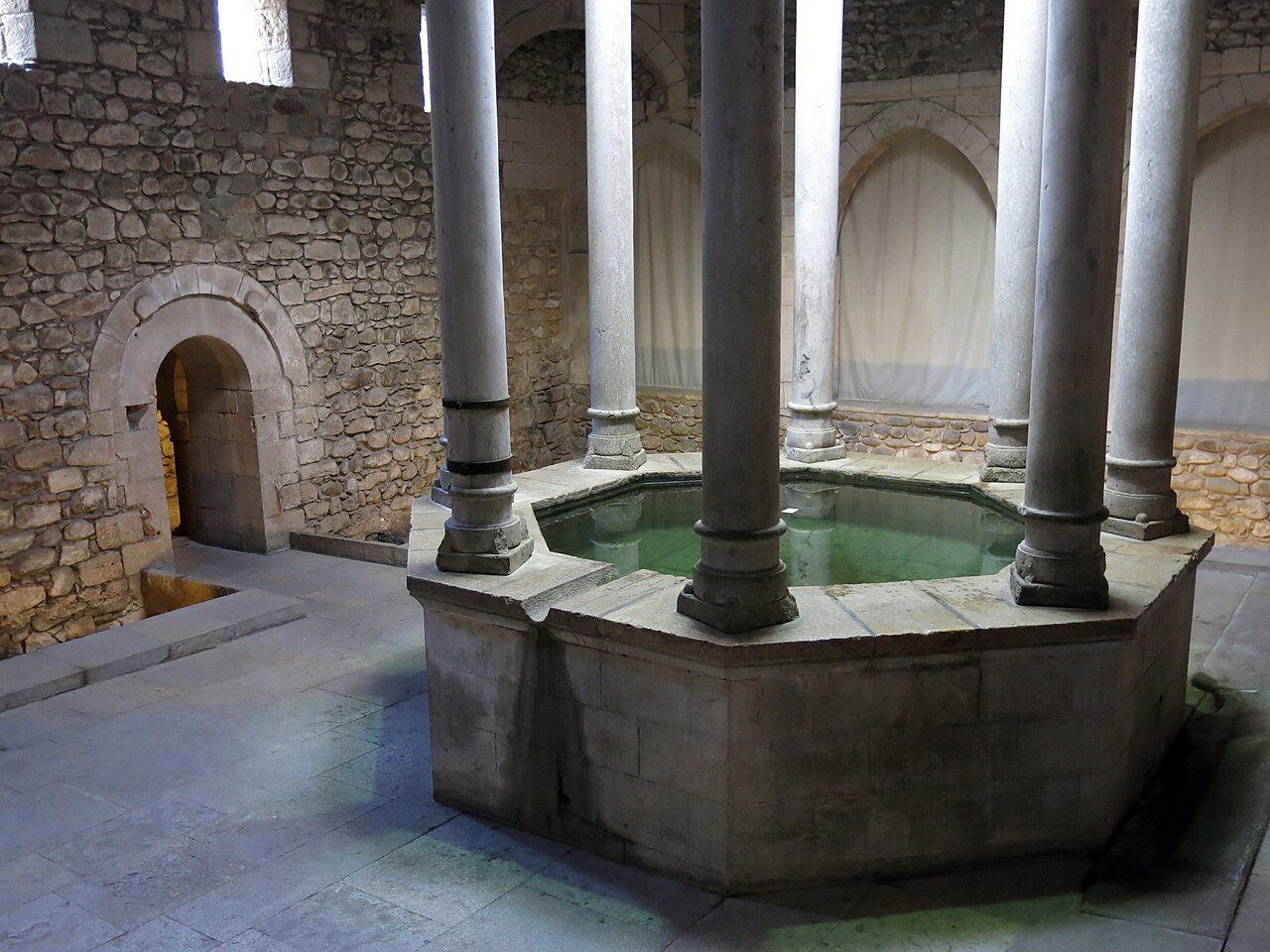
Behind the cathedral stand the Banys Àrabs — the Arab Baths — and the name is a beautiful misdirection. They are not Arab at all: a Romanesque building of the late 12th century, raised by Christian Girona in imitation of Islamic bathhouses and used into the 15th century. The heart of it is the apodyterium, the changing hall, where an octagonal pool sits under a small domed lantern on slender columns — one of the most photographed interiors in the city. Beyond run the cold, warm and hot rooms. The visit is short and cheap: €3 (over-65s €2, reduced €1, under-8s free), open Monday to Saturday 10:00–18:00 and Sundays 10:00–14:00.
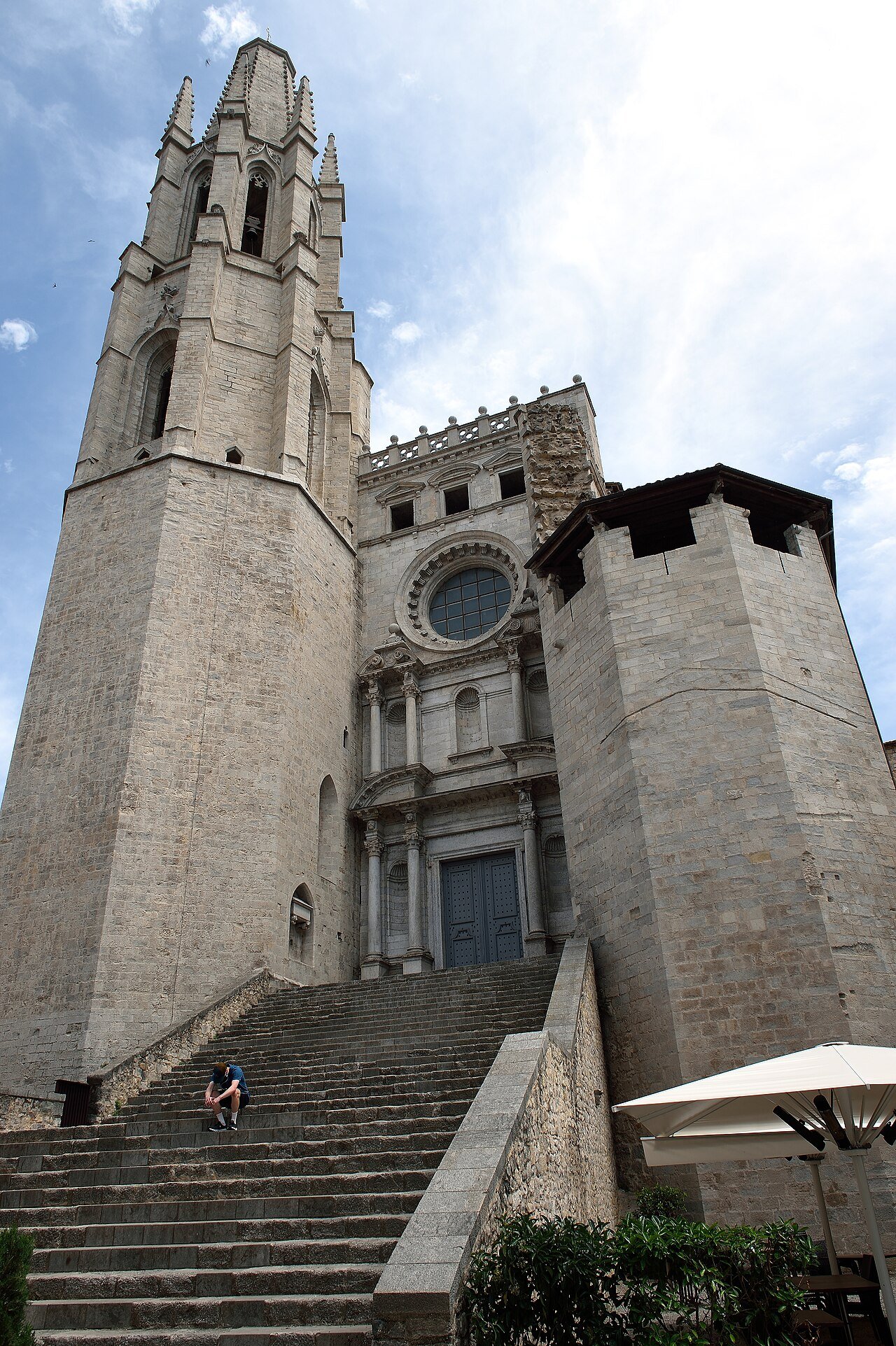
Two minutes away, the Basilica of Sant Feliu was Girona’s cathedral before Santa Maria took the title, and it still feels like a fortress-church: a tall, spare Gothic nave behind its single famous spire (the top was struck by lightning in 1581 and never rebuilt), holding 4th-century early Christian sarcophagi and the tomb of Sant Narcís — from whose coffin, legend insists, a swarm of flies rose in 1285 to drive off a French army. Down in the square stands La Lleona, the lioness: her stone original is in the Girona Art Museum, a copy waits on the column, and tradition says you must kiss her bottom to be sure of returning to Girona. The queue of people doing so, on tiptoe, is one of the city’s small daily comedies.
The Onyar Houses and the Eiffel Bridge
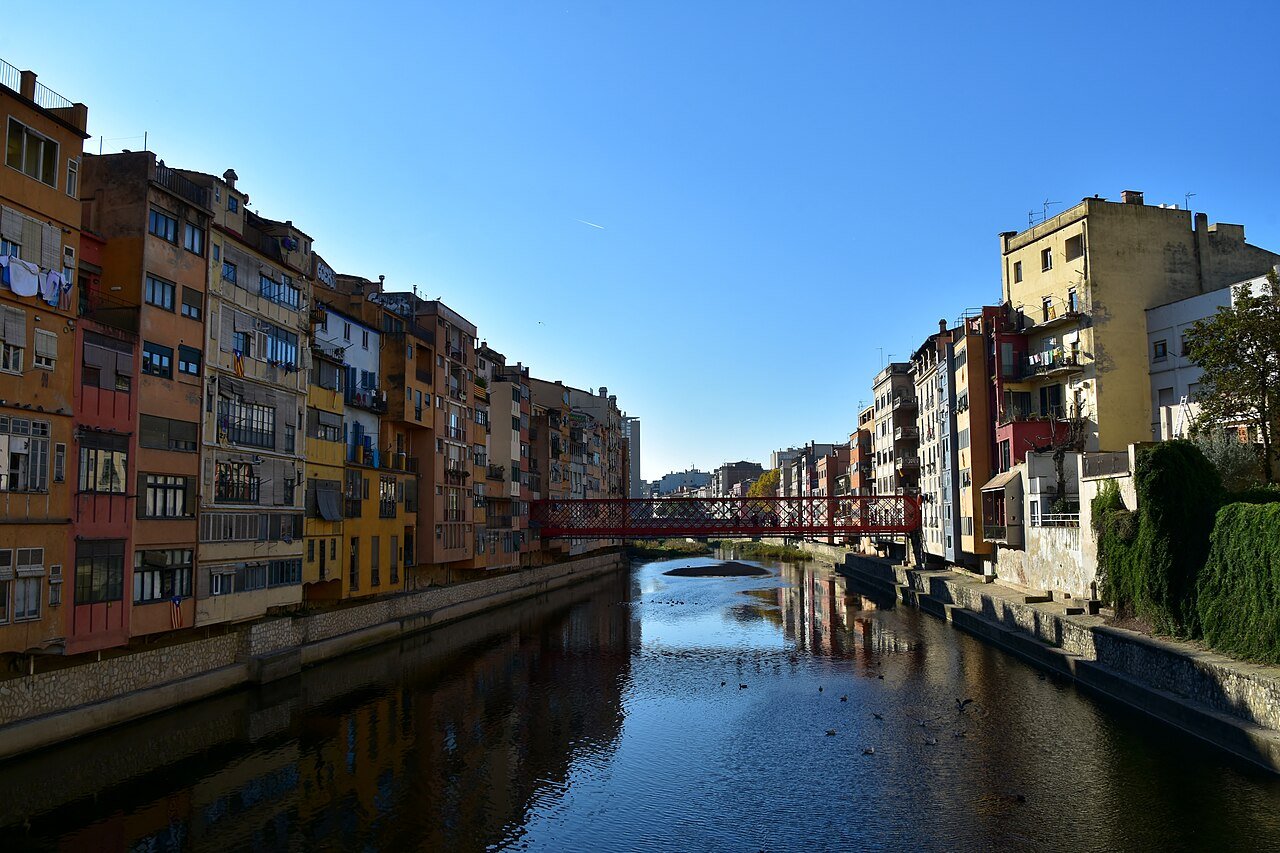
Walk down from the old town and Girona turns to colour. Along the east bank of the Onyar, the houses stand shoulder to shoulder in ochre, rose, terracotta and mustard, their backs rising straight out of the water — the postcard view, and one of the great urban riverfronts of Spain. The best of them is open to visit: Casa Masó, birthplace of the architect Rafael Masó, a jewel of Catalan Noucentisme preserved by the Fundació Rafael Masó.
Eleven bridges cross the Onyar, and two are famous. The Pont de Pedra (1856) is the dignified one; the beloved one is the Pont de les Peixateries Velles — the old fish-market bridge — a red iron lattice thrown across the river in 1876–77 by the Paris workshop of Gustave Eiffel, a decade before the tower. From its deck you get the classic photograph: painted houses in front, the cathedral and Sant Feliu stacked on the hill behind. Cross it twice — once for the view upriver, once for the view down.

Sant Pere de Galligants and the Northern Old Town
Across the little Galligants river stands Girona’s oldest great church: the monastery of Sant Pere de Galligants, a 10th-century Benedictine house whose church and cloister are pure Catalan Romanesque — a Lombard bell tower of two arched storeys, carved capitals, and an interior now housing the Girona branch of the Archaeology Museum of Catalonia. It is the quietest of the city’s monuments, and the natural start or finish of the old-town loop; television viewers know it dressed with books and candles, as the Citadel of Oldtown.

Girona on Screen: Walking the Game of Thrones City
In the autumn of 2015 Girona closed its old town, filled it with extras and became three cities at once for the sixth season of Game of Thrones. The cathedral steps played the Great Sept of Baelor in King’s Landing — Jaime Lannister rides up them on horseback. The streets behind the cathedral and the lanes of the Call became Braavos: a blind Arya Stark begs on the steps of Carrer del Bisbe Cartañà, her chase with the Waif crashes down the Pujada de Sant Domènec scattering market oranges, the Arab Baths appear as the baths of Braavos and the Passeig Arqueològic as its market.

You do not need a tour to walk the route: cathedral steps, Bisbe Cartañà, Plaça dels Jurats (the Braavosi theatre square), Sant Domènec, the Call and the baths all fall inside the same half-hour loop as the sights above. Do it early, before the lanes fill, and the old town obliges by looking exactly like a set — because underneath the cameras, it never stopped being itself.
The City Walls: Passeig de la Muralla
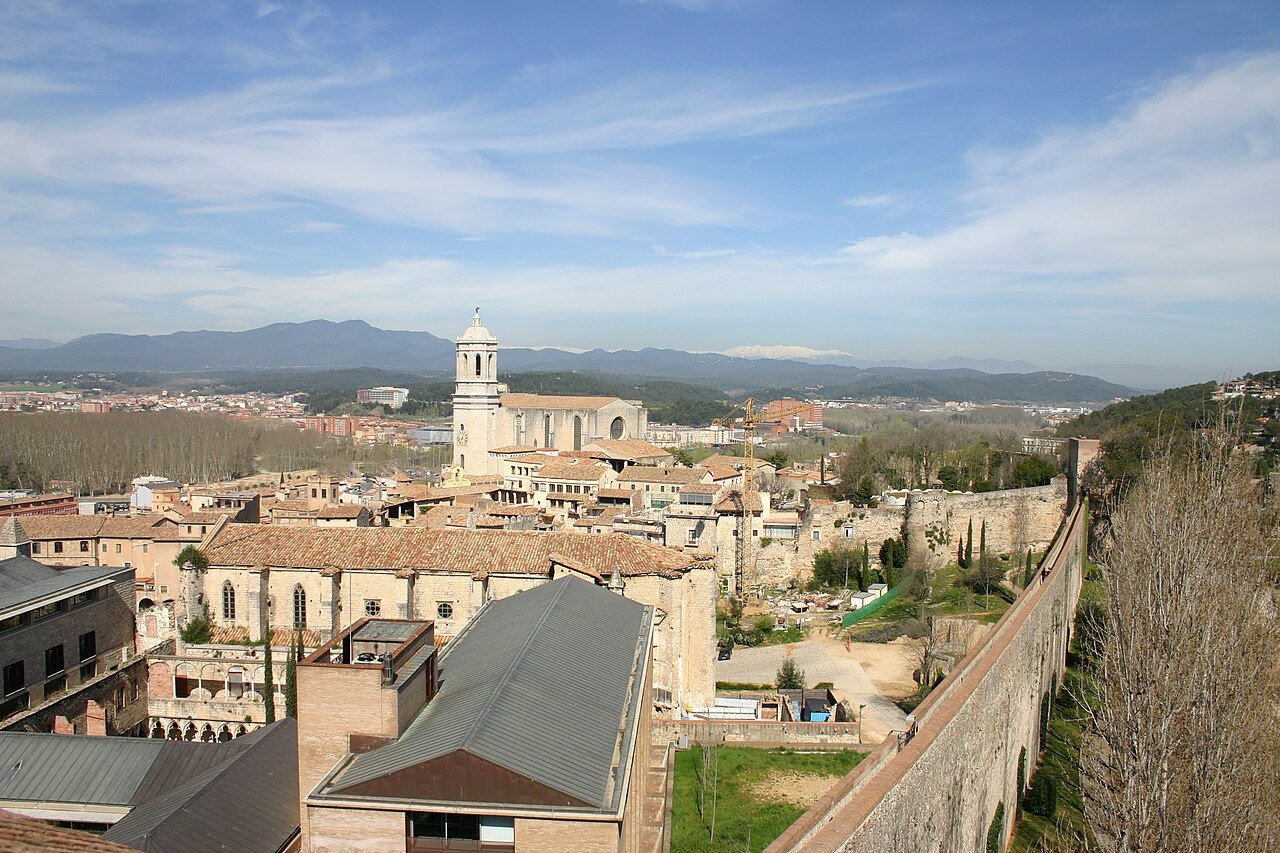
The finest free sight in Girona is its walls. From the gardens behind the cathedral, the Passeig de la Muralla runs along the eastern ramparts — Roman foundations, Carolingian and medieval rebuilding — in a walkway of towers, stairs and parapets that takes about half an hour end to end. Climb the towers: views open over the rooftops to Sant Feliu and the cathedral, and on clear winter mornings the snow line of the Pyrenees fills the horizon. Combine it with the Passeig Arqueològic gardens below, running in the walls’ shade past Sant Pere de Galligants.
The Other Girona: Rambla, Independència and the Xuixo
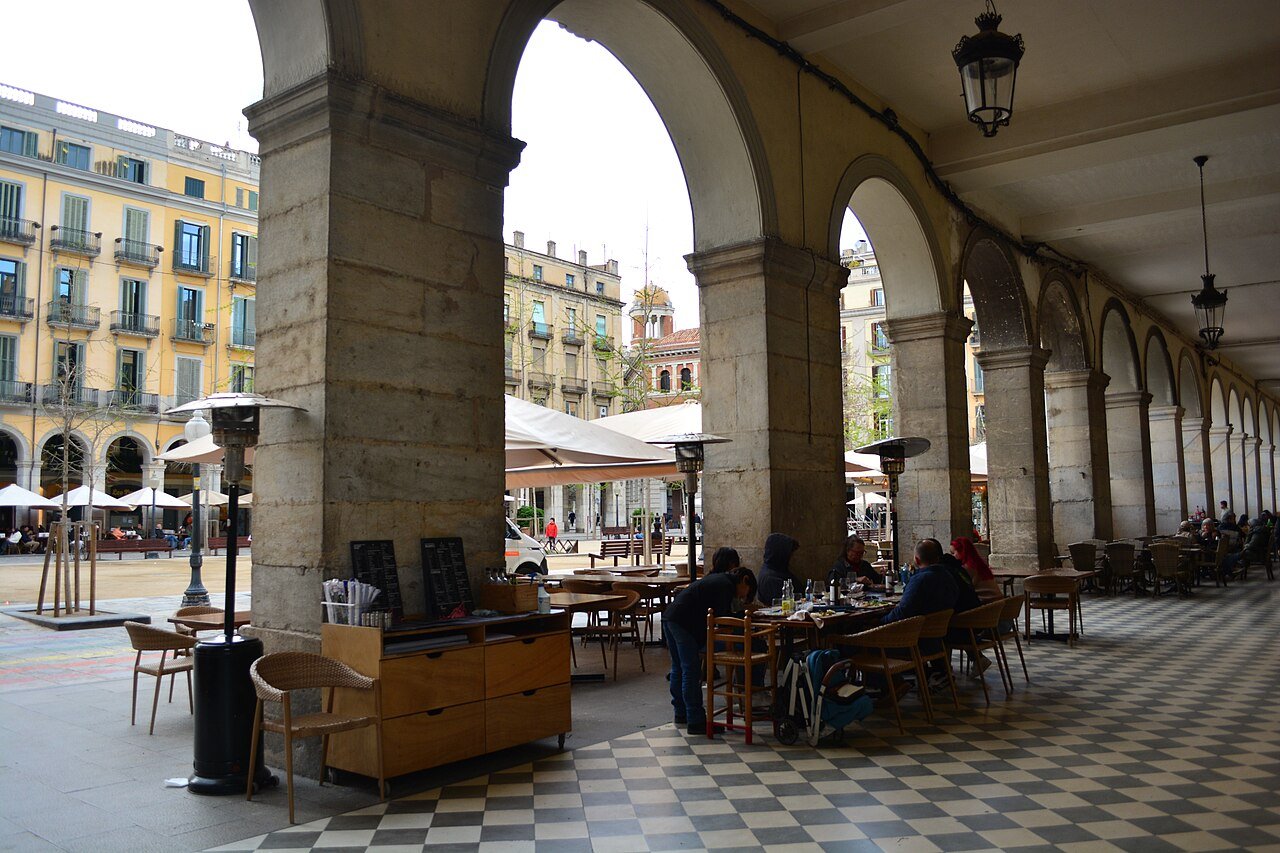
Cross the river and Girona changes century. The Rambla de la Llibertat, arcaded and tree-lined, is the city’s drawing room — café terraces under the vaults and a Saturday flower market. A few streets south, the Plaça de la Independència spreads its perfect 19th-century arcades around a monument to the defenders of 1809: this is where Girona eats, and its terraces are the best lunch bet in the city.
And then, the xuixo. Girona’s gift to pastry is a deep-fried, sugar-crusted cylinder of fine dough filled with crema catalana, said to have been created here in the 1920s and protected by fierce local loyalty. Buy one warm from a pastisseria near the Rambla and eat it walking — it is not breakfast or dessert; in Girona it is simply what the morning is for. Between the pastry, the Rambla’s coffee culture and a seriously good restaurant scene (this is the Roca brothers’ city), Girona feeds a day tripper better than most cities feed a resident.
Should You Add the Costa Brava?
Girona city stands about 35–40 minutes’ drive from the sea, and the coast at its feet is the Costa Brava — a different Mediterranean from the long urban sand of the Barcelona beaches: rocky coves, pine woods running down to clear water, and fishing villages like Calella de Palafrugell that kept their whitewash and their boats. Buses run from Girona to the coast towns, but adding the coast independently turns a relaxed day into a logistics exercise.
This is the one gap the organised tour genuinely fills. The small-group Girona and Costa Brava tour spends its morning on a guided walk of Girona — cathedral hill, Call, river houses — and its afternoon in Pals, a hilltop medieval village, and Calella de Palafrugell, with time on the Camí de Ronda coast path. If your trip has no other Costa Brava day in it, the combination is the efficient way to buy one; if Girona is your only goal, the train remains king.
Practical Info
- What and where: Girona, provincial capital in north-eastern Catalonia, ~99 km from Barcelona at the meeting of four rivers — the Ter, the Onyar, the Güell and the Galligants. Everything in this guide sits in the Barri Vell (old town) on the Onyar’s east bank, a 15-minute walk from the station.
- The loop: station → Pont de Pedra → Onyar houses and Eiffel bridge → cathedral → the Call and Jewish Museum → Arab Baths → Sant Feliu and La Lleona → Sant Pere de Galligants → city walls → Rambla and Plaça de la Independència for lunch. Four to six hours at a gentle pace.
- Cathedral: cultural visit €7.50 (concessions €5, under-16s €1.50, under-7s free); Girona Episcopal ticket €12 (cathedral + Sant Feliu + Art Museum, 48 hours). Visits from 10:00 Mon–Sat, from 12:00 Sun; no tourist visits during services; check catedraldegirona.cat.
- Arab Baths: €3 (over-65s €2, reduced €1, under-8s free); Mon–Sat 10:00–18:00, Sun 10:00–14:00.
- Museum of Jewish History: €4 (concessions €2, under-14s free); Sep–Jun Tue–Sat 10:00–18:00, Mon/Sun/holidays 10:00–14:00; Jul–Aug open to 19:00 Mon–Sat.
- Walls, bridges, old town: free, open access. The Passeig de la Muralla is a public walkway; towers are climbed at your own pace.
- Footwear and fitness: the old town is a hill of cobbles, lanes and stairs — the cathedral alone asks for its 90 steps. Comfortable shoes are not optional; step-free routes exist along the river, but the Call and the walls are inherently stepped.
- Language: Girona is proudly Catalan-first; everyone speaks Spanish, and English is widely understood in the visitor economy.
Tickets and Costs
Girona is one of the cheapest great days out in Catalonia, because its greatest sights — walls, river houses, lanes, bridges — are free. The paid list is short: the cathedral at €7.50 (or €12 for the Girona Episcopal pass), the Jewish Museum at €4, the Arab Baths at €3. A fully-loaded independent day — return fast train booked ahead, all three sights, a menú del día lunch and a xuixo — can still land under €60 a head.
The one significant spend is the organised alternative: the Girona & Costa Brava day tour is priced per person on GetYourGuide, varying by date and by small-group or private option; it replaces your train fare and guiding, and adds Costa Brava towns an independent traveller would need a car to combine in one day. The cathedral, baths and museum are all bought at the door — queues are short outside festival weeks.
Getting There and Getting Around
By train — the way to go. Renfe runs two kinds of service. The high-speed trains (AVE and Avant) leave from Barcelona Sants and reach Girona in 38–39 minutes; bookable in advance on renfe.com, with fares from around €7–8 booked early and flexible fares rising towards €35 — the cheap seats go first. The regional trains (Media Distancia and Rodalies R11) take 1 hour 10 to 1 hour 35 minutes, also call at Passeig de Gràcia, and need no reservation. Around twenty trains a day run between the two. All arrive at Girona station, on the west bank; cross the river and the old town is 15 minutes on foot.
By bus. Coaches from Barcelona’s Estació del Nord take about 1 hour 30 minutes or more — cheaper than the fast train, slower door to door. They make most sense when connecting with Girona Airport, 12 km south, which has no rail link.
By car. The AP-7 motorway (toll-free since 2021) covers the ~100 km in about 1 hour 15 minutes. Park on the edge of the old town — around the Parc de la Devesa or the river crossings — and walk in; the Barri Vell itself is a pedestrian world.
Getting around Girona. You walk. The old town is compact and largely pedestrianised; the west bank holds the station and the vast Devesa park, one of the largest urban parks in Catalonia. City buses exist, but a day visitor will not need one.
When to Go
Girona’s great week is Temps de Flors, the flower festival held every May since 1954, when for nine days the old town’s courtyards, stairs and churches are opened and dressed with floral installations; the cathedral steps become a river of flowers. The 2026 edition ran 9–17 May; expect the 2027 festival in the same mid-May window (the city confirms dates each year). It is the most beautiful week to come and the most crowded — book trains and rooms well ahead.
Outside the festival, spring and autumn are the sweet seasons: mild air, raking light on the Onyar and the old town to yourself on weekdays. Summer is hot in the stone lanes by midday — go early, lunch long, save the walls for evening. Winter is Girona’s secret: cold, clear and quiet, with the Pyrenees white on the horizon. Like Tibidabo above Barcelona, Girona rewards the early starter — the first fast train out of Sants buys you an old town still waking up.
How Long You Need
A full day is the honest unit: a fast train out by 9:00, the cathedral and the Call in the morning, lunch under the Independència arcades, the baths, walls and river houses in the afternoon, an evening train home — or stay for dinner, when the old town empties. Half a day covers the cathedral, the Call and the riverfront at a push, but short-changes the walls and the wandering, which are half the point. If Girona is competing for a slot among the best things to do in Barcelona on a short trip, give it the whole day: it is the rare day trip visitors routinely say deserved two.
Tips for Visiting
- Take the fast train, book it early. The 38-minute Avant/AVE from Sants is the difference between a day trip and an expedition; advance fares from around €7–8 sell out on festival and weekend mornings.
- Do the cathedral first. Morning light fills the single nave, the tour groups are still on their buses, and you will have the Tapestry of Creation almost to yourself.
- Buy the €12 Girona Episcopal ticket if you are doing two of the three. Cathedral + Sant Feliu + Art Museum, valid 48 hours.
- Walk the walls in the late afternoon. The light rakes across the rooftops, the stone has cooled, and the Pyrenees show on clear days.
- Get lost in the Call on purpose. The quarter is tiny and safe; every wrong turning is a 14th-century lane you would otherwise have missed. Save the museum for after you have wandered.
- Eat the xuixo warm, and lunch on a menú del día. Plaça de la Independència’s arcades are the reliable lunch ground; the old town’s famous-name restaurants book out, but the city’s everyday cooking is the real prize.
- Kiss the lioness. La Lleona’s copy stands in Plaça de Sant Feliu; the tradition — kiss her bottom and you will return to Girona — is nonsense, and everyone does it anyway.
- Respect the church. The cathedral is a working place of worship; tourist visits pause for services, shoulders and knees should be covered, and Sunday mornings belong to Mass, not sightseeing.
What to See Nearby
Girona is a hub as much as a destination. North, 20 minutes by train, Figueres holds the Dalí Theatre-Museum, the largest surrealist object in the world — the classic double-header with a Girona morning. East, the Costa Brava begins within 40 minutes’ drive: Calella de Palafrugell and Llafranc for swimmers, Pals and Peratallada inland. South-west, the volcanic Garrotxa is the green counterweight. And without leaving Girona, the Parc de la Devesa’s plane trees and the Museu del Cinema fill a gentle extra hour.
Frequently Asked Questions
Is Girona worth a day trip from Barcelona?
Yes — the most complete day trip in Catalonia. One compact old town holds a record-breaking Gothic cathedral, one of Europe’s best-preserved Jewish quarters, Romanesque baths, walkable city walls and a painted riverfront, 38 minutes from Barcelona Sants by fast train.
How do I get from Barcelona to Girona?
By train. High-speed AVE and Avant services from Barcelona Sants take 38–39 minutes (fares from around €7–8 booked early); regional Media Distancia and Rodalies R11 trains take 1 hour 10 to 1 hour 35 minutes, also call at Passeig de Gràcia, and need no booking. Buses from Estació del Nord take about 1½ hours; the drive is ~100 km, around 1 hour 15 minutes on the AP-7.
How much does Girona Cathedral cost, and when is it open?
The cultural visit costs €7.50 (concessions €5, under-16s €1.50, under-7s free); a combined Girona Episcopal ticket at €12 adds Sant Feliu and the Girona Art Museum for 48 hours. Visits run from 10:00 Monday to Saturday and from 12:00 on Sundays; it is a working cathedral, so visits pause during services and winter hours are shorter — check catedraldegirona.cat for your date.
What should I not miss in Girona?
The cathedral’s single nave and Tapestry of Creation; the lanes of the Call and the Museum of Jewish History (€4); the Arab Baths (€3); the Onyar houses from the red Eiffel bridge; and the Passeig de la Muralla, the free walk along the walls. Finish with a xuixo from a Rambla bakery.
Where was Game of Thrones filmed in Girona?
Season 6 (2016) used the old town as three cities: the cathedral steps as the Great Sept of Baelor in King’s Landing; the lanes behind the cathedral and in the Call, and the Pujada de Sant Domènec, as Braavos; the Arab Baths as the Braavos baths; and Sant Pere de Galligants as the Citadel of Oldtown. All are inside the normal old-town loop.
When is Temps de Flors, Girona’s flower festival?
Every May, for nine days — the festival has run since 1954 and transforms the old town’s patios, churches and stairs into floral installations, most of them free. The 2026 edition ran 9–17 May; the 2027 dates are expected in the same mid-May window. It is Girona’s busiest week — book trains and accommodation early.
Travel insurance, sorted
Whether it is a two-week holiday or a longer move, travel insurance is not the most glamorous part of a trip — but it is the one booking you want to have in place before a trip, and while you are already away. Get a quote from SafetyWing
Final Thoughts
Some day trips are sights; Girona is a city — a small, proud, thousand-year-old capital that Barcelona’s visitors keep rediscovering with the same startled delight. It gives you the biggest Gothic room in the world and the smallest Jewish lanes, a river of painted houses and a pastry worth crossing a province for, wrapped in walls you can walk for free. Take the fast train, climb the ninety steps slowly, lose yourself in the Call, and kiss the lioness on your way back to the station. The tradition is only a tradition — but like most people, you will probably return anyway.
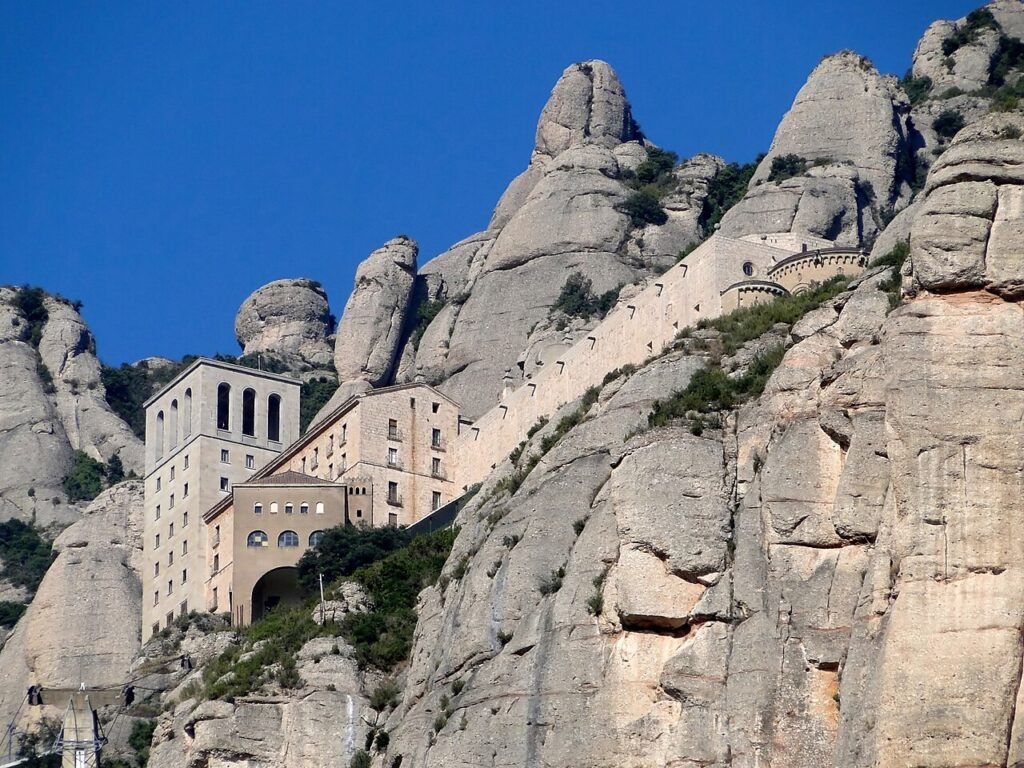
Photo credits: Richard Mortel, Yair Haklai, Sebastià Giralt, Assayas, Enfo, Tim Adams, Andrew Bone, Aktron, Yearofthedragon, Joe Mabel and Alberto-g-rovi, via Wikimedia Commons.