Free Things to Do in Barcelona: 20 Brilliant Ways to See the City Without Spending a Cent
Here is the secret Barcelona’s ticket queues don’t want you to know: the best of this city is already free. The Gothic Quarter’s lanes, Gaudí’s wildest façades, a Roman temple hidden in a courtyard, sunset over the whole skyline, a beach in the middle of town — none of it has a ticket desk.
This guide rounds up the 20 best genuinely free things to do in Barcelona — not “cheap”, not “free with a pass”, but walk-up-and-enjoy €0 experiences. Every entry tells you the honest catch, where there is one: the museum that’s only free if you time it, the viewpoint that costs a bus fare to reach, the monument zone inside the otherwise free park.
If you do one organised thing, make it the walk that ties the old town together. The Barcelona: Old Town and Gothic Quarter Walking Tour covers the same Gothic Quarter streets we rave about below, and at around $20 it’s the sort of story-rich splurge that makes everything else on this list make more sense.
Table of Contents
- 1. Walk La Rambla from Plaça Catalunya to the Port
- 2. Get Lost in the Gothic Quarter
- 3. Stand Inside the Temple of Augustus
- 4. See the Sagrada Família From Outside
- 5. Window-Shop the Block of Discord on Passeig de Gràcia
- 6. Roam Park Güell’s Free Green Zones
- 7. Watch Sunset From the Bunkers del Carmel
- 8. Graze Your Way Through La Boqueria
- 9. Spend an Afternoon in the Parc de la Ciutadella
- 10. Swim and Stroll at Barceloneta Beach
- 11. Climb Montjuïc for the Gardens and the Olympic Ring
- 12. Time the Big Museums for Their Free Hours
- 13. Browse the Mercat de Sant Antoni and Its Sunday Book Market
- 14. Hop the Plazas of Gràcia
- 15. Take in the View From Tibidabo’s Church Steps
- 16. Watch the Skaters at the MACBA Square in El Raval
- 17. Duck Into Palau Robert’s Free Garden and Exhibitions
- 18. Wander El Born: Santa Maria del Mar and the Fossar de les Moreres
- 19. Dig for Treasure at the Encants Flea Market
- 20. See the Castells at a Neighbourhood Festa
- Which Free Thing Suits You?
- What a Free Day in Barcelona Really Costs
- Final Thoughts
- FAQs: Free Things to Do in Barcelona
The Quick Verdict
Short on time? Do these three and you’ll have seen the essential city for nothing: walk La Rambla into the Gothic Quarter in the morning (§1–2), take the Sagrada Família’s exterior and the Block of Discord in the afternoon light (§4–5), and finish above the whole grid at the Bunkers del Carmel for sunset (§7). Because here, the free layer isn’t the consolation prize. It’s the main event.
Free in Barcelona: The Ground Rules
Three things worth knowing before the list. First, Barcelona’s “free” is mostly outdoors: streets, squares, parks, viewpoints, church exteriors and one glorious beach. The paid layer in this city is interiors — so the game is seeing the icons brilliantly from outside and timing the few interiors that open their doors for free. Second, the museums run on a rhythm: the first Sunday of the month is the city’s great free day, with weekly free slots on top (§12 has the strategy). Third, “free” sights keep hours too — so check the day’s timings before you set out, especially on Mondays when some sites rest.
1. Walk La Rambla from Plaça Catalunya to the Port

Every Barcelona story starts here: a 1.2-kilometre, tree-shaded boulevard running from Plaça Catalunya down to the Columbus Monument and the port, and walking its full length is the city’s classic free pleasure. La Rambla is really five little ramblas stitched together, and the walk has a rhythm — start at the iron Canaletes fountain, where legend says a drink guarantees you’ll return to Barcelona, then drift down the Rambla de Sant Josep, where flower stalls have perfumed the pavement for well over a century.
Slow down around the Liceu opera house to find Joan Miró’s circular mosaic set into the paving at the Pla de l’Os — most people walk straight over a masterpiece without noticing. The stalls get tackier as you descend, but that’s part of the show: this is Barcelona’s front room, equal parts promenade, market and street theatre. Finish beneath the Columbus Monument at the harbour. Go before 10am for the local version — dog-walkers, market porters, the city waking up — or at dusk, when the plane trees light up.
2. Get Lost in the Gothic Quarter
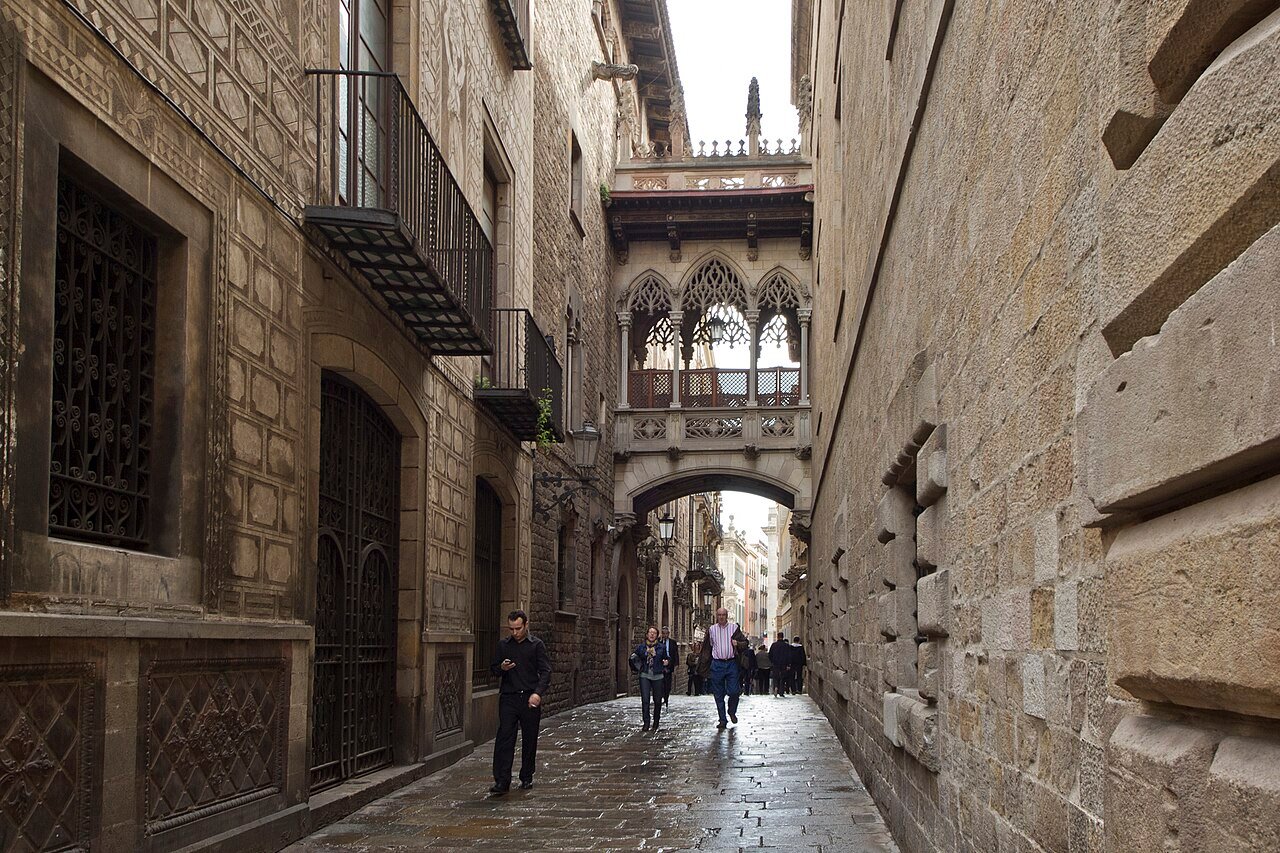
Step off La Rambla at almost any point and you fall into the Barri Gòtic, the medieval maze built over Roman Barcino — and getting gloriously lost in it costs nothing at all. The greatest hits are all within a few shadowy blocks: the Pont del Bisbe, the lacy neo-Gothic bridge (a 1928 fake, and all the more loved for it) arching over Carrer del Bisbe; Plaça del Rei, the royal square where the old palace complex stacks Roman walls, a medieval hall and a watchtower into one view; and Plaça de Sant Jaume, the political heart of Catalonia, where the Palau de la Generalitat faces the City Hall.
Wander without a map on purpose. Duck into the old Jewish quarter of El Call, find the tiny Plaça de Sant Felip Neri with its shrapnel-scarred church wall, and pop out onto Plaça Reial, the palm-filled arcade just off La Rambla, where the fantastical lampposts were an early commission for a young Antoni Gaudí. One honest note: admiring Barcelona Cathedral from the square outside is free, but the full tourist visit inside is ticketed — the quarter’s streets, squares and church exteriors are the free show here. Our full guide to Barcelona’s Old Town and Gothic Quarter maps the whole quarter when you want the deep version.
3. Stand Inside the Temple of Augustus
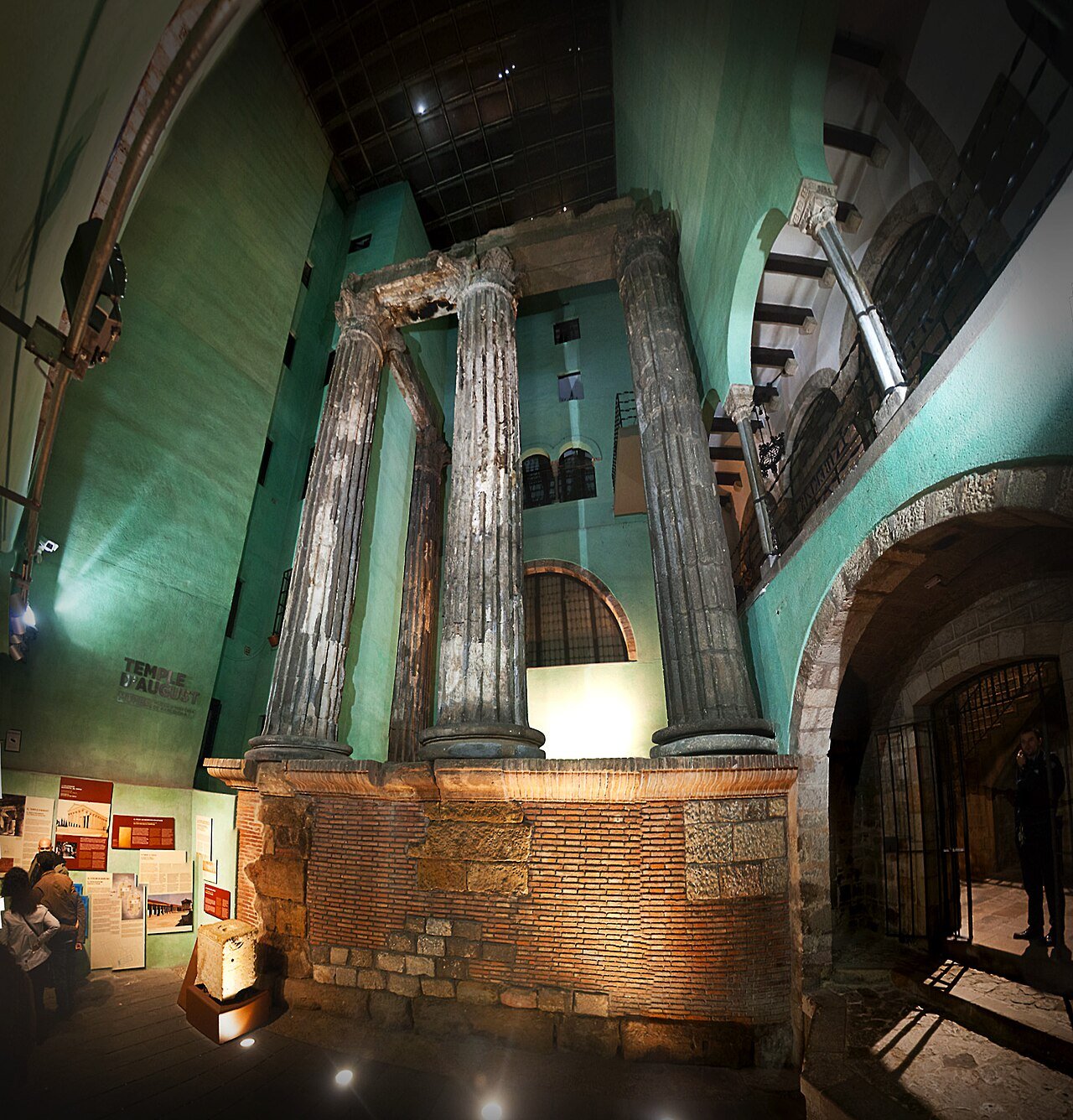
This might be the single most astonishing free sight in Barcelona. Slip through the doorway of Carrer del Paradís 10 — look for the little millstone carved above the door — cross a quiet medieval courtyard, and you’re standing in front of four towering Corinthian columns, nine metres of Roman stone that have stood here for roughly 2,000 years. They’re the surviving corner of the Temple of Augustus, which crowned the forum of Roman Barcino.
The temple is one of the MUHBA city-history sites, and remarkably, entry is free — walk in, stand on the podium where Roman Barcelona worshipped its emperor, and read how the columns were swallowed by later buildings and only revealed again in the 19th century. It rarely queues, because most visitors pass within fifty metres without knowing it exists. Opening hours are limited — mornings are your best bet, and it’s often closed on Monday — so make it a mid-morning stop while you’re exploring the Gothic Quarter (§2).
4. See the Sagrada Família From Outside

The Sagrada Família’s interior is one of the great ticketed experiences in Europe — but Gaudí designed the outside to preach to the whole city, and the sermon is free. The trick is knowing your viewpoints. For the classic postcard, cross to the Plaça de Gaudí on the Marina side, where a little park and pond put the whole Nativity façade in one frame, reflections and all. That east-facing façade — the old, dripping, organic one, carved under Gaudí’s own direction — catches the morning sun, so come before 10am.
Walk the block to the Plaça de la Sagrada Família for the opposite face: the Passion façade, all stark angles and gaunt sculpture, which glows in the late-afternoon light. From either square you can read the building like a book — biblical scenes stacked up the Nativity side, skeletal towers topped with fruit-like pinnacles, and the cranes that have been part of the skyline for a century, now joined by the completed central tower of Jesus Christ, crowned with its cross. A slow circuit of the block, lingering at the free details — the schoolhouse Gaudí built for the workers’ children, the carved doors, the tortoises holding up the Nativity columns — is an hour of world-class architecture for €0. When you do decide to go in, our walkthrough of what awaits inside the Sagrada Família helps you make the ticket count.
5. Window-Shop the Block of Discord on Passeig de Gràcia

On one short block of Passeig de Gràcia, Barcelona’s three great modernista architects went head to head — and the pavement outside their battle is one of the finest free galleries in Spain. The block is nicknamed the Manzana de la Discordia, the Block of Discord, and the rivalry is written across the façades: Casa Batlló, Gaudí’s underwater dream of bone-like balconies and a dragon’s-back roof; right next door, Casa Amatller, Puig i Cadafalch’s answer, all Flemish stepped gables and ceramic sparkle; and on the corner, Casa Lleó Morera, Domènech i Montaner’s sculpture-crusted contender.
Three fortunes, three egos, one pavement — and it costs nothing to stand there comparing them. Continue a few minutes up the boulevard and you get a bonus: Casa Milà, La Pedrera, Gaudí’s great stone wave of a building, equally free to admire from the street. The honest tip is timing: by mid-morning the Casa Batlló ticket queue colonises the pavement and a hundred phones are in the air. Come at 9am or in the golden hour before sunset, and the block is yours to study in peace.
6. Roam Park Güell’s Free Green Zones

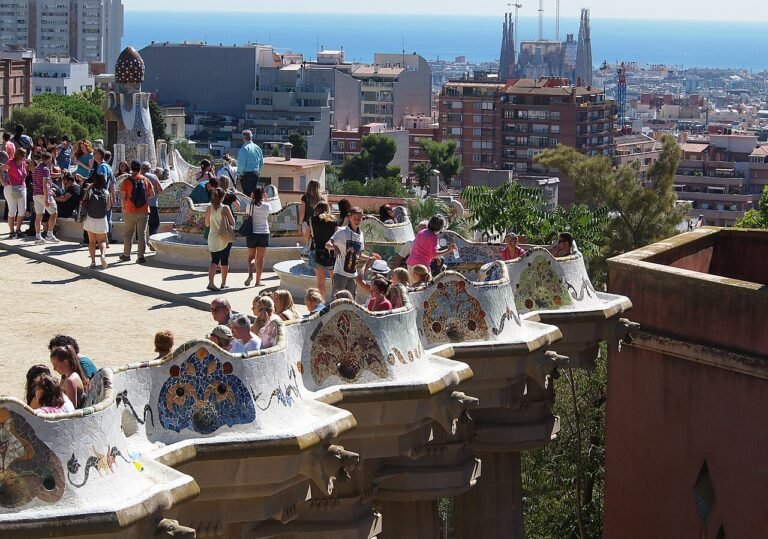
Here’s what the ticket machines don’t shout about: most of Park Güell is a free public park. Only the famous Monumental Zone — the entrance stairway with the mosaic salamander, the Hypostyle Hall and the great wavy-bench terrace — is ticketed and timed. Everything else, the larger part of the park, is open green hillside that Barcelonans stroll, jog and picnic in for nothing.
Enter away from the main gate — from the Carretera del Carmel side or up the outdoor escalators of the Baixada de la Glòria — and wander the winding paths Gaudí landscaped into the hill: stone viaducts grown over with planting, pine shade, the Austria Gardens’ lawns, and steady views back over the city to the sea. Climb to the Turó de les Tres Creus, the stony summit with its cross at the park’s highest point, for one of the best free panoramas in Barcelona. You won’t sit on the mosaic bench — that’s inside the paid core — but you’ll get the park as locals use it. Our complete Park Güell guide explains exactly where the free area ends and the ticketed zone begins.
7. Watch Sunset From the Bunkers del Carmel

If you take one tip from this entire guide, take this one. On top of the Turó de la Rovira hill, 262 metres above the city, sits a concrete platform built in 1938 as an anti-aircraft battery during the Spanish Civil War — and today it offers the single best free view in Barcelona. The whole story at once: the Eixample grid pouring down to the sea, the Sagrada Família rising from the middle of it, Montjuïc and the port to one side, the Collserola hills behind you, and the Mediterranean filling the horizon.
The Bunkers del Carmel have become a sunset ritual — locals arrive with drinks and snacks, find a patch of concrete and watch the grid light up. Come an hour before sunset to claim your spot, and bring whatever you need with you: there’s nothing to buy up here, and the walk down in the dark is lit but steep. The battery terrace now keeps managed daytime hours and is fenced overnight, so check the closing time for the season before you set out. The climb from El Carmel or El Guinardó metro takes about 20 minutes uphill; buses get you closer.
8. Graze Your Way Through La Boqueria

You don’t need to buy a thing to feast in La Boqueria. Barcelona’s great food market, the Mercat de Sant Josep de la Boqueria, opens straight off La Rambla beneath its stained-glass modernista sign, and wandering its aisles is a free assault on the senses: pyramids of cherries and dragon fruit, jamón legs hanging like chandeliers, fish stalls glittering on ice, mushroom mountains in autumn, sweet stalls laid out like jewel boxes.
To see the market rather than the crowds, go before 10:30am, and walk past the photogenic front stalls into the deeper aisles, where the working market lives — fishmongers shouting prices, offal stalls that pull no punches. The house rules are simple: don’t touch the produce (the stallholder will serve you), and don’t block the aisles for photos at peak hour. Closed on Sundays. The honest catch? Resistance is hard — a fresh juice will set you back a few euros. But browsing, smelling and marvelling costs exactly nothing, and it’s one of the great free shows in the city.
9. Spend an Afternoon in the Parc de la Ciutadella

The Parc de la Ciutadella, laid out on the site of the hated Bourbon citadel the city was finally allowed to demolish, is Barcelona’s green living room — 17 hectares of lawns, palms and orangery shade, all free, all day. The centrepiece is the Cascada, a gloriously over-the-top monumental fountain of winged dragons, gilded horses and cascading water, designed for the 1888 Universal Exposition by Josep Fontserè — with a very young Antoni Gaudí, then his student assistant, said to have helped on the hydraulics.
Circle the boating lake (the view is free; the rowing boats are a few euros if you’re tempted), find the life-size stone mammoth hiding among the trees, and duck into the Umbracle, the slatted palm house, and the restored Hivernacle glasshouse, both free to wander when open. Pack a picnic, claim a lawn, and watch the city do its weekend best: tightrope walkers, tango dancers, birthday parties and half of Barcelona’s dogs.
10. Swim and Stroll at Barceloneta Beach

A city beach this central should not be free — but in Barcelona it simply is. Barceloneta’s broad golden sweep starts a 15-minute stroll from the Gothic Quarter, and everything that matters about it costs nothing: the sand, the swim, the palm-lined Passeig Marítim promenade and the people-watching. Walk the promenade and you get a free sculpture trail as a bonus: Rebecca Horn’s rusty stacked cubes, L’Estel Ferit, rising from the sand, and Frank Gehry’s great golden Peix d’Or fish glittering further along, both survivors of the 1992 Olympic makeover that gave Barcelona its waterfront back.
Swim in the morning when the water is calmest and clearest, stroll at golden hour when the beach empties and the light turns the W Hotel’s sail to copper. The honest notes: the xiringuito beach bars are charming and not free, and this beach has a pickpocket reputation — swim with your valuables watched or left at the hotel. For the full coastline picture, see our guide to Barcelona’s beaches — every beach on it is free, so pick your stretch and settle in.
11. Climb Montjuïc for the Gardens and the Olympic Ring
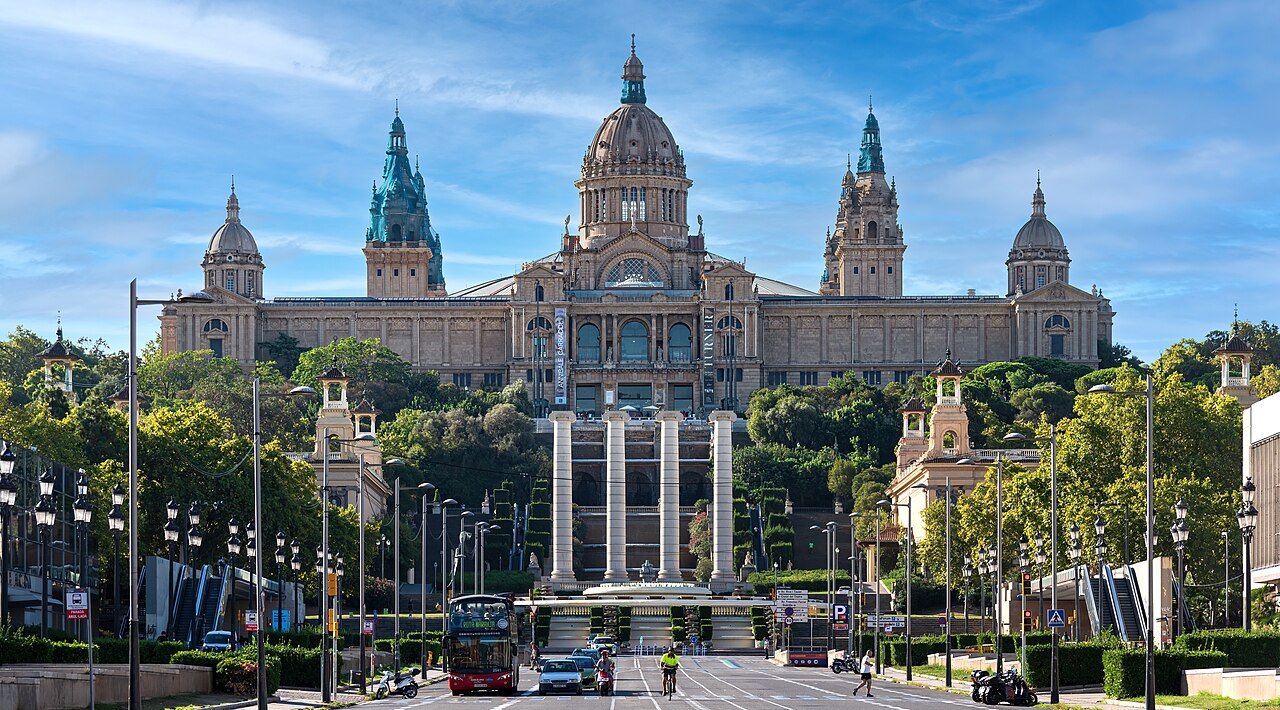
Montjuïc is less a hill than a free open-air museum that happens to have the city’s best south-facing views. Start at Plaça d’Espanya, walk up between the Venetian Towers and the cascading terraces to the Palau Nacional — the palace built for the 1929 International Exposition that now houses the MNAC art museum (free on its special days, §12). The grand steps and esplanade in front are a free viewpoint over the whole avenue, and a favourite sunset perch in their own right. One honesty note: the Magic Fountain’s famous light-and-music shows have been paused for long stretches under drought restrictions, so treat a running show as a bonus, not a plan.
From there, the hill keeps giving. Wander the Jardins de Laribal’s shaded stairways, find the Teatre Grec, a Greek-style amphitheatre carved into an old quarry for the 1929 Expo, and stroll the Olympic Ring, where the 1992 Games’ stadium, the soaring Calatrava communications tower and the Palau Sant Jordi arena can all be admired free from outside. On the sea side hides one of the hill’s secrets: the Jardins de Mossèn Costa i Llobera, a terraced cactus garden with hundreds of spiky species and a harbour view. Only the castle at the very top charges a (small) entry fee; everything else on Montjuïc is yours for the price of the climb.
12. Time the Big Museums for Their Free Hours
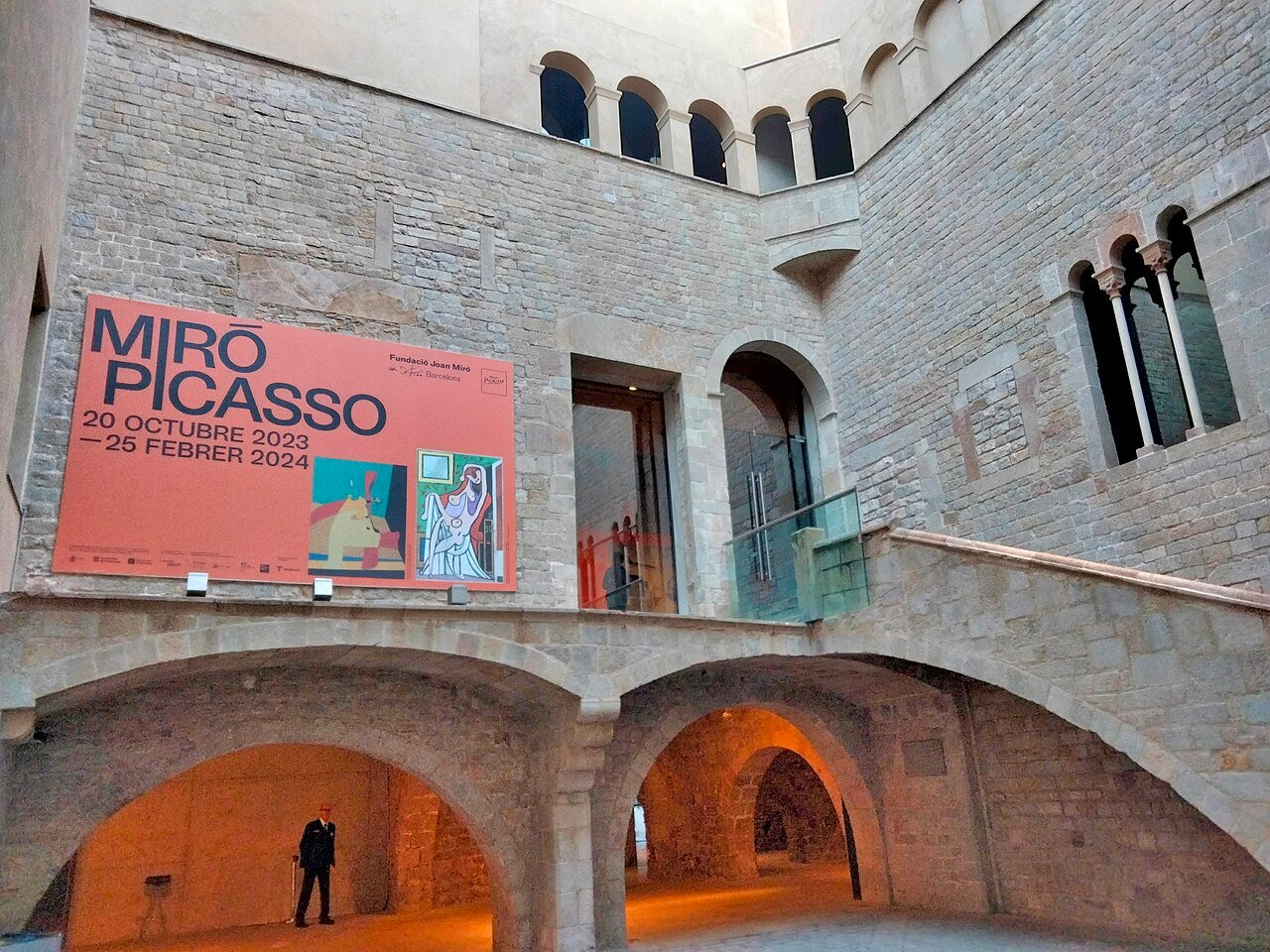
This is the one entry on the list that turns “free” into a strategy. The headline rule: most city museums are free on the first Sunday of the month. Layer on the weekly slots and you can build an entire cultural itinerary for €0: the MNAC, the national art museum up on Montjuïc, is also free on Saturday afternoons; the Museu Picasso opens free on Thursday evenings and the first Sunday; and city venues like the MUHBA history sites and the CCCB add free Sunday afternoons.
First, book: the most popular free slots — Picasso above all — are handed out as free online tickets that must be reserved in advance and disappear days ahead for busy weekends. Second, arrive at opening time, when the “free day” crowds are still in bed. If the Picasso’s early paintings and blue-period rooms are your target, our Museu Picasso guide walks you through what to look for once you’re inside. Schedules do change, so confirm the current free hours on each museum’s own site first — but plan you should, because this one habit turns Barcelona’s priciest culture into its best bargain.
13. Browse the Mercat de Sant Antoni and Its Sunday Book Market

If La Boqueria is the famous market, Sant Antoni is the beloved one. This vast red-iron hall, opened in 1882 as the first great market built outside the old city walls, is still where the Eixample does its shopping — a full food market inside, clothing stalls around its skirts. Browsing is free, the building itself is a landmark of iron architecture, and a preserved stretch of the Roman Via Augusta, uncovered during the market’s restoration, is on view inside — a 2,000-year-old road beneath your grocery run.
The real free treat, though, is Sunday morning. From about 8:30 until 14:30, the streets around the hall fill with the Mercat Dominical, Barcelona’s weekly collectors’ market: stalls of second-hand books, comics, coins, postcards, vinyl, stamps and football memorabilia. It costs nothing to dig through the crates, and the people-watching — serious collectors, grandparents hunting childhood comics — is pure Barcelona.
14. Hop the Plazas of Gràcia
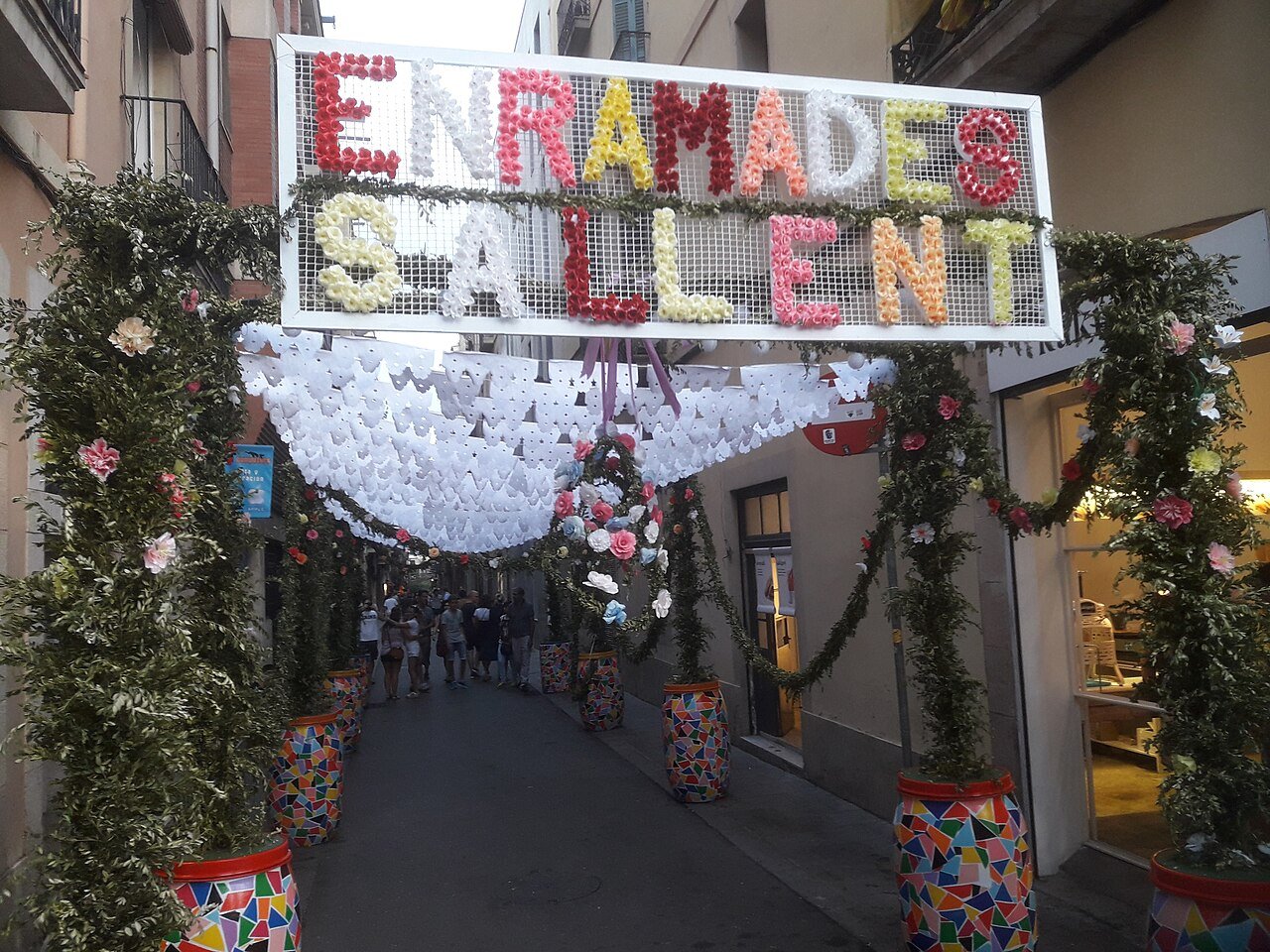
Gràcia was its own town until Barcelona swallowed it in 1897, and it still behaves like a village — one whose streets open, every few minutes, into another small, café-ringed plaza. Plaza-hopping here is a free afternoon perfectly spent: start at the Plaça de la Vila de Gràcia, beneath the slender clock tower that became the neighbourhood’s symbol after the revolts of 1870; drift to the Plaça del Sol for the terrace scene; on to the Plaça de la Revolució and the Plaça del Diamant — made famous by Mercè Rodoreda’s novel, with a Civil War air-raid shelter hidden beneath it — and finish on Carrer de Verdi, the indie high street.
Then there’s August. For a week around the 15th, the Festa Major de Gràcia turns the neighbourhood into Barcelona’s greatest free spectacle: residents spend months building themed decorations that transform whole streets into jungles, oceans, film sets and fantasies, judged in a fiercely contested competition. Walking the decorated streets costs nothing, the concerts in the plazas are free, and the atmosphere — half village fiesta, half art exhibition — is unlike anything else in the city.
15. Take in the View From Tibidabo’s Church Steps
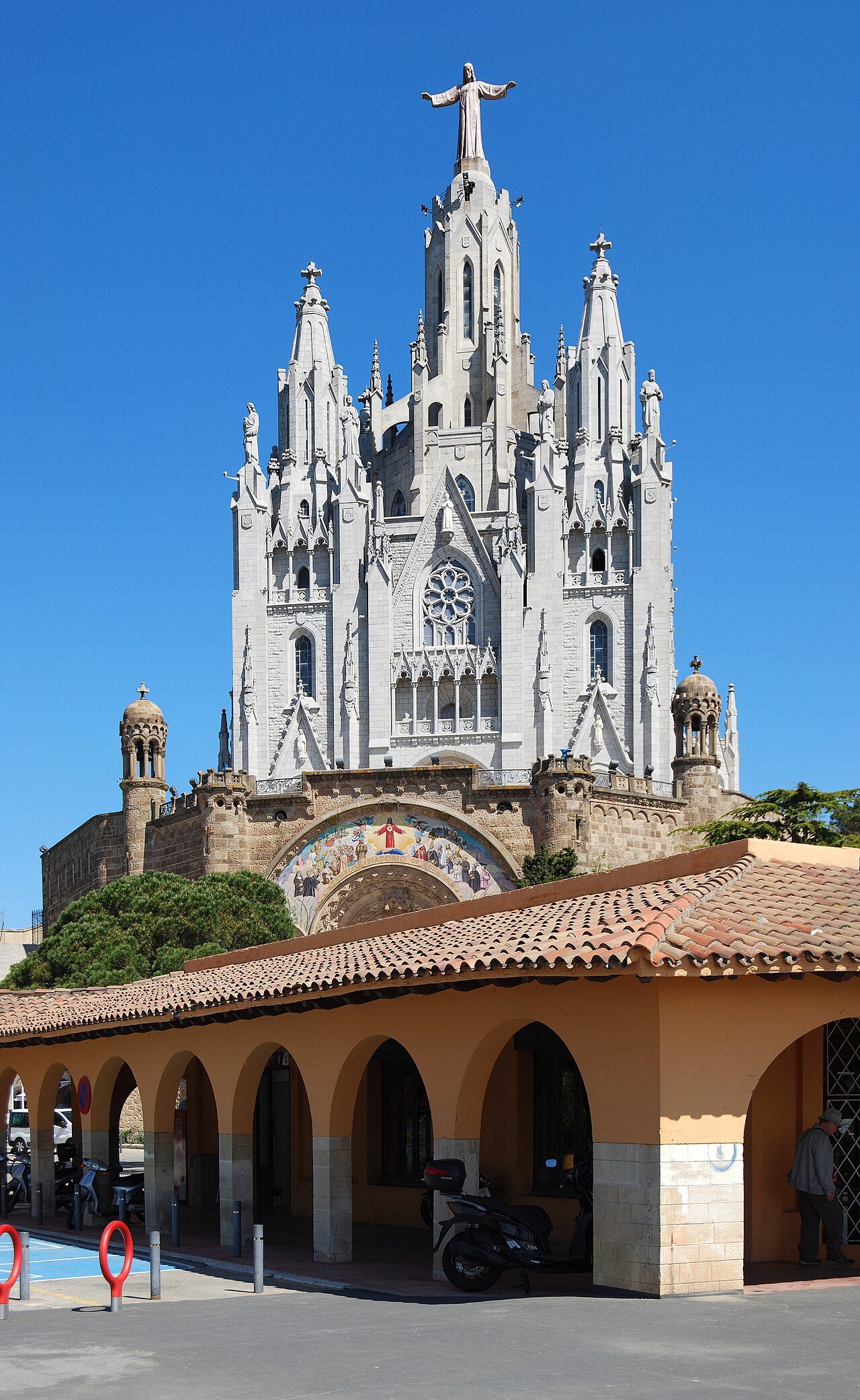
Every city has a highest point; Barcelona’s has a church on it, a fairground beside it, and a view that swallows the entire metropolis. Tibidabo, the 512-metre summit of the Collserola hills, is crowned by the Sagrat Cor, the white neo-Gothic church topped with a bronze Christ, arms spread over the city. The square and terraces in front of the church are free to stand on — and on a clear morning the whole street grid lies below you like a model, between the Pyrenees and the sea.
The honest catch is the journey: the church square is free, but unless you hike up through the Collserola park trails (a proper, rewarding walk), getting here costs a bus or funicular fare. The church itself works on the usual two levels — the lower crypt is a working church you can enter freely and respectfully, while the lift up the tower to the statue is paid, as is the vintage amusement park next door. Treat Tibidabo as the free climax of a Collserola walk, or the one small transport spend of your free day — no paid viewpoint in the city shows you more than this square does for nothing.
16. Watch the Skaters at the MACBA Square in El Raval

You don’t need a ticket to the museum to enjoy the best show at MACBA. The Plaça dels Àngels, the wide granite square in front of Richard Meier’s gleaming white museum in El Raval, is the most famous street-skating spot in Europe — a perfect storm of smooth stone, long ledges and a gentle bank that draws world-class skaters and an audience of students, tourists and locals every day of the week.
Take a seat on the steps and treat it as theatre: the lines, the tricks, the applause for a landed flip off the big ledges. It runs from late morning until the square empties at night, and it’s one of the best windows in the city on Barcelona’s young, creative, slightly scruffy side. The museum behind you is ticketed (though it appears in the free-hours strategy in §12), and the CCCB cultural centre sits just behind it.
17. Duck Into Palau Robert’s Free Garden and Exhibitions

Walk up Passeig de Gràcia past the designer flagships to number 107, at the corner of Diagonal, and you’ll find the classiest free pause in the Eixample. The Palau Robert, a grand 1903 mansion built for an aristocratic family, is now run by the Catalan government as an exhibition centre — and both its exhibitions and its garden are entirely free, every day.
The shows inside rotate through photography, design, history and Catalan culture, and they’re consistently good; but the secret is out the back. The garden is a quiet, palm-shaded terrace with benches, a small café and the palace’s grand staircase sweeping down to meet it — a place where locals slip in to read or rest their feet, while the shopping crowds stream past outside, unaware. It opens long hours daily and makes the perfect free reset between the Block of Discord (§5) and Gràcia (§14), which start just a few streets away.
18. Wander El Born: Santa Maria del Mar and the Fossar de les Moreres
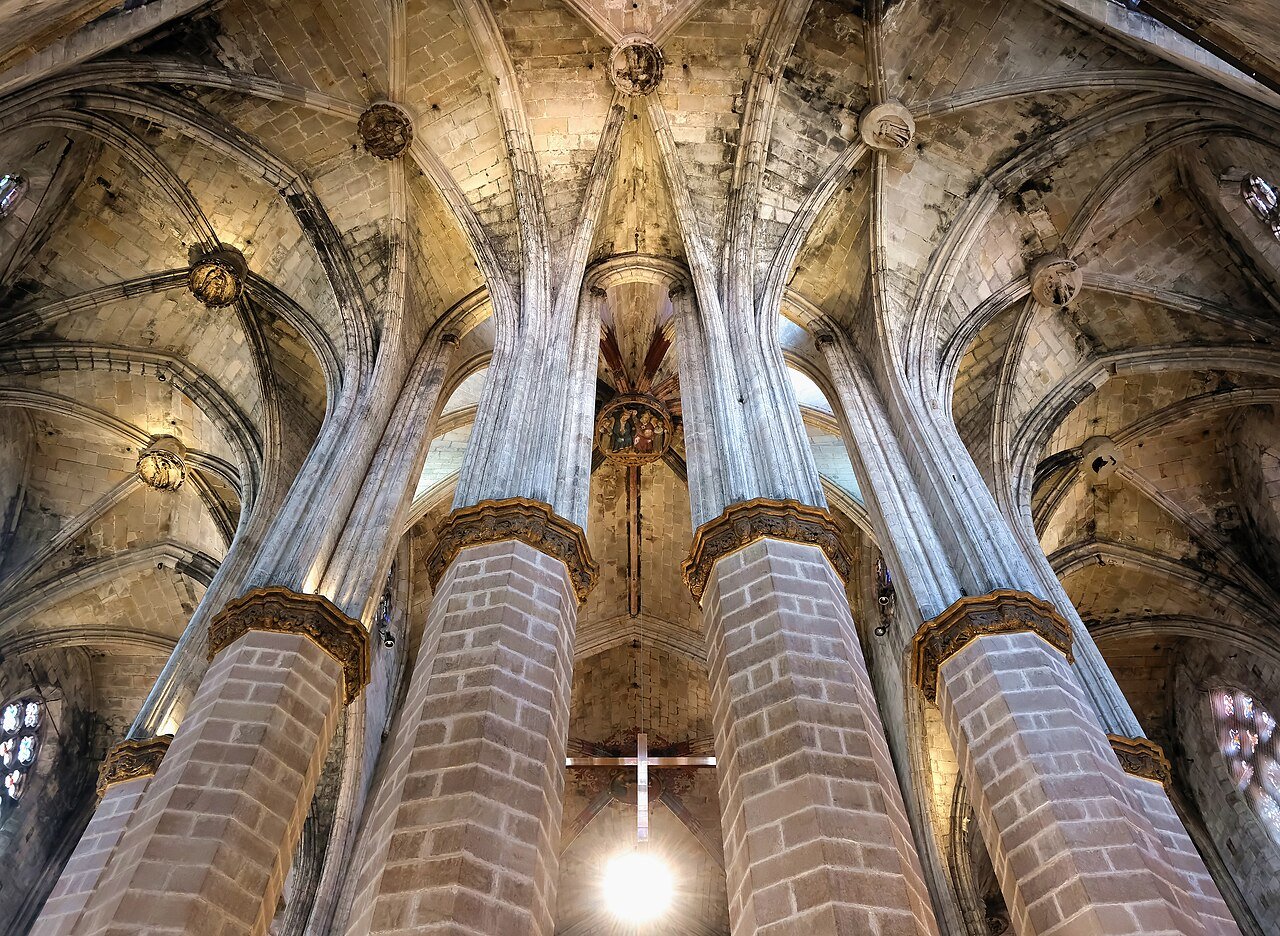
El Born, the Gothic Quarter’s eastern neighbour, pairs Barcelona’s most beautiful church with its most moving square — and both are free. Santa Maria del Mar was built between 1329 and 1383 by the port’s own people: the bastaixos, the dock porters, hauled the stone down from Montjuïc on their backs, which is why it’s known as the Cathedral of the Sea. Inside, it’s the purest Catalan Gothic in existence — impossibly slender columns opening into a single soaring space, flooded with coloured light. As a working church it welcomes visitors free during morning worship hours; the organised tourist visits later in the day are ticketed, so time it early.
Outside, the neighbourhood unfolds in layers. The Fossar de les Moreres, the square beside the church, covers the burial ground of the Catalan defenders who fell in the Siege of Barcelona in 1714 — an eternal flame burns over it, and it remains a solemn focal point of Catalan memory. Stroll the Passeig del Born, the old jousting ground turned café-lined promenade, and finish at the El Born Centre de Cultura i Memòria, the vast old market hall where you can look down, free of charge, on the excavated streets of the neighbourhood as it stood before 1714. These lanes reward context more than any in the city — which is why the Barcelona: Old Town and Gothic Quarter Walking Tour earns its keep around here, stitching El Born and the Gothic Quarter into one story.
19. Dig for Treasure at the Encants Flea Market

Barcelona’s oldest flea market has a space-age roof. The Mercat dels Encants, official name Mercat Fira de Bellcaire, has traded second-hand goods in some form for centuries, and since 2013 it has done so beneath a vast, tilted, mirrored canopy by the Plaça de les Glòries that reflects the market chaos back at itself in golden fragments. Entry is free, and on its two levels you can browse everything from antique furniture, vinyl and vintage cameras to job lots, house-clearance boxes and brand-new socks.
The market runs on Monday, Wednesday, Friday and Saturday mornings, and its soul is the early public auction on the ground floor, where clearances are sold to a circle of dealers in a rapid-fire chant worth arriving early just to watch. The honest rules of the Encants: the good stuff goes fast, prices on the stalls are a starting point for polite haggling, everything is sold as seen, and you should keep a hand on your bag in the crush. Even if you buy nothing, it’s one of the great free mornings in the city.
20. See the Castells at a Neighbourhood Festa

The most spine-tingling free show in Barcelona involves no stage, no tickets and several storeys of human beings. Castells — the human towers built by teams called colles — are Catalonia’s defining tradition, recognised by UNESCO as Intangible Cultural Heritage. Hundreds of people pack into a solid base, the pinya; levels lock arms and climb onto shoulders; and a small child, the enxaneta, scrambles to the very top to raise one hand — l’aleta — before the whole tower is dismantled as carefully as it was built.
You watch for free from the square, because castells are performed at neighbourhood festivals, not in arenas. The biggest chances: La Mercè, Barcelona’s city festival in late September, when Plaça de Sant Jaume fills with towers; the Festa Major de Gràcia in August (§14); and a calendar of festes across the districts from late spring to November, when local colles perform in their home plazas. There’s no commentary and no programme to buy: just arrive, find a spot with a clear view, keep the base circle clear, and let the silence-then-thunder of a rising castell do the rest. Of everything on this list, it’s the experience money genuinely cannot buy.
Which Free Thing Suits You?
- First morning in the city? Walk La Rambla (§1) straight into the Gothic Quarter (§2) and the Temple of Augustus (§3).
- Only one viewpoint? The Bunkers del Carmel at golden hour (§7). Staying central? The Montjuïc palace steps (§11).
- Gaudí on a zero budget? Sagrada Família from the squares (§4), the Block of Discord (§5) and Park Güell’s free zones (§6).
- Travelling with kids? Ciutadella park (§9) plus a Barceloneta beach afternoon (§10): grass, sand, sea, no tickets.
- Here on the first Sunday of the month? That’s museum jackpot day — run the free-hours strategy in §12.
- Want the Barcelona locals live in? Gràcia’s plazas (§14), Sant Antoni’s Sunday book market (§13) and the MACBA square (§16).
- Here during a festa? Castells in the plazas (§20) — and if it’s August, Gràcia’s decorated streets (§14) too.
What a Free Day in Barcelona Really Costs
A strict €0 Barcelona day is entirely possible — every sight on this list is walkable from the last. Realistically, most people spend a little around the edges, so here’s the honest shape of it, at the time of writing:
- Getting around — €0–€13: Walk and it’s nothing. A single metro or bus ride costs about €2.65; the T-casual 10-journey card (around €13) is the one most visitors should buy.
- Fuel — €2–€6: A coffee at a neighbourhood bar is €1.50–€2; a juice or fruit cup at La Boqueria a few euros; a supermarket picnic for the park, as little as you like.
- Museums — €0 if you time them: Free Sundays and weekly free slots (§12) make culture cost nothing. Mistime it and the same museums run to roughly €12–€15 a ticket — timing really is the whole game.
- The one splurge worth making — about $20: If you add a single paid experience, we’d make it the Barcelona: Old Town and Gothic Quarter Walking Tour — 2.5 hours, rated 4.8/5 from nearly 2,000 reviews, through the same streets as §2 and §18. It’s the context that turns free wandering into understanding.
- The bottom line: €0–€10 buys a superb free day; €25–€30 with the tour buys one of the best-value sightseeing days in Europe.

30 Best Things to Do in Barcelona for First-Time Visitors
Travel insurance, sorted
Whether it is a two-week holiday or a longer move, travel insurance is not the most glamorous part of a trip — but it is the one booking you want to have in place before a trip, and while you are already away. Get a quote from SafetyWing
Final Thoughts
Barcelona’s generosity is structural: the city put its genius on the outside of its buildings, its history in its squares, its leisure on a public beach and its best view on a hill anyone can climb. The 20 experiences in this guide aren’t a budget compromise — most of them are what Barcelonans themselves actually do with a free day, and several (a rising castell, sunset at the Bunkers, Gràcia in festa week) outclass anything you could pay for. And when you’ve worked through this list, dig one layer deeper with Barcelona’s hidden gems — the city’s quieter corners are, of course, free as well.
FAQs: Free Things to Do in Barcelona
Can you really see Barcelona without spending money?
Yes — unusually well, in fact. Barcelona’s defining sights are its streets, squares, façades, parks, viewpoints and beach, and all of those are free. What costs money is interiors: museum collections, church tourist visits and the inside of Gaudí’s houses. With the free museum hours in §12, even much of that layer opens up for €0.
Which Barcelona museums are free, and when?
Most city museums are free on the first Sunday of the month. Beyond that, the MNAC is free on Saturday afternoons, the Museu Picasso on Thursday evenings and the first Sunday, and venues like the MUHBA history sites and the CCCB offer free Sunday afternoons. Popular free slots at the Picasso must be reserved online in advance — they go quickly. Always confirm the current schedule on the museum’s own website first.
Is Park Güell actually free?
Mostly, yes. Park Güell is a public municipal park, and the larger part of it — the paths, gardens and viewpoints — is free to everyone at all opening hours. Only the Monumental Zone in the middle (the mosaic salamander stairway, Hypostyle Hall and the wavy-bench terrace) requires a timed, paid ticket. Enter from the Carmel or Vallcarca side and you can enjoy the park for hours without paying anything.
Are Barcelona’s churches free to enter?
Working churches are free to enter for prayer, and many welcome quiet visitors outside service times — Santa Maria del Mar in the morning is the great example. The exceptions are the ticketed tourist operations: the Sagrada Família’s interior is paid (booked online), and Barcelona Cathedral charges for its full tourist visit, including the cloister and rooftop. Exteriors, squares and cloister-viewing from the street are always free.
When is the best time of year for free Barcelona?
Spring and autumn are the sweet spots: warm enough for the beach and the viewpoints, cool enough to walk all day, and stacked with festivals — Sant Jordi in April, La Mercè in September. August brings the Festa Major de Gràcia but also peak heat and crowds, while winter offers the clearest viewpoint days and an emptier, local-feeling city.
Is it safe to explore Barcelona on foot like this?
Yes, with normal city awareness. Barcelona’s one real nuisance is pickpocketing, concentrated on La Rambla, the metro and the beach — keep your phone and wallet in a front pocket or zipped bag, and don’t leave belongings unattended while you swim. None of the places on this list is anywhere you shouldn’t be, day or evening.



4 Comments