El Raval, Barcelona: The Complete Guide to the City’s Most Multicultural Neighbourhood

El Raval is the Barcelona neighbourhood immediately west of La Rambla — the most densely lived, most international and most argued-about district in the old city. Some 46,000 people live in its tight grid of narrow streets, close to half of them born abroad: Filipino, Pakistani, Bangladeshi, Moroccan, Romanian and Latin American communities share the blocks with Catalan families who have been here for generations, design students from the universities on Carrer de Montalegre, and visitors who have worked out that some of the city’s best sights stand here, not across the Rambla.
This is not a single-attraction neighbourhood, and that is exactly its appeal. Within a ten-minute walk you can stand in Barcelona’s oldest church; walk into MACBA, whose plaza is one of the most famous skate spots on earth; see an early Gaudí palace; eat your way through La Boqueria market; and end the day on a palm-lined boulevard built on top of demolished tenements. This guide covers what to see, what it costs, how the neighbourhood got this way, and — honestly — what to know about safety before you go.
The Short Version
If you only have a few hours, do this: start at the Plaça dels Àngels, where MACBA’s white façade and the CCCB face each other, and look for Keith Haring’s red mural on the wall beside the museum. Walk ten minutes south to Sant Pau del Camp, the oldest church in Barcelona, then cross to the gardens of the old Hospital de la Santa Creu, where Gaudí died in 1926. Continue to the Rambla del Raval for a coffee under the palms by Botero’s Cat, and finish at La Boqueria, on the Rambla edge of the neighbourhood.
The one thing most first-time visitors get wrong is treating El Raval as somewhere to hurry through. The streets make far more sense once somebody explains them — which buildings were convents, which were factories, why one boulevard is brand new and one church is eleven centuries old. The guided option that matches the neighbourhood best is the Raval Street Art and Graffiti Walking Tour, a 2-hour small-group walk rated 4.9 out of 5, from the Tres Xemeneies skate spot past the Arnau Gallery to the Keith Haring mural at MACBA — the street-level story of the district, told on its walls.
Everything below is the full version: the history, each sight in turn, the eating streets, an honest word on safety, and all the practical detail — prices, opening arrangements, metro stops and timing.
Table of Contents
- A Short History of El Raval
- MACBA and the Plaça dels Àngels
- The CCCB and the University Quarter
- Palau Güell: Gaudí in the Raval
- Sant Pau del Camp: Barcelona’s Oldest Church
- The Old Hospital and Its Gardens
- Rambla del Raval and Botero’s Cat
- La Boqueria: The Raval’s Market
- The Southern Raval: Filmoteca, Theatres and the Old Shipyards
- Street Art in El Raval
- Eating and Drinking in El Raval
- Is El Raval Safe?
- Practical Info
- Tickets and Costs
- Getting There
- When to Go
- How Long You Need
- Tips for Visiting
- What to See Nearby
- Frequently Asked Questions
- Final Thoughts
A Short History of El Raval

The name gives the history away. Raval comes from the Arabic rabád, meaning a suburb or quarter outside the walls — and for most of Barcelona’s history that is precisely what this was. When the city was a walled medieval core around today’s Gothic Quarter, the land west of La Rambla was market gardens, orchards and scattered convents, close to the city but not of it. The 14th-century city wall finally enclosed the area, and the religious orders moved in: convents, monasteries and, in 1401, the Hospital de la Santa Creu, whose Gothic courtyards you can still sit in today.
Industry changed everything. In the 19th century the Raval filled with textile factories — some of the first steam-powered mills in Spain — and with the workers’ tenements built to house the people who ran them. Streets were narrow, flats were small, and the district became one of the most densely populated urban areas in Europe. Its southern half acquired the name that stuck for a century: the Barrio Chino, the “Chinese Quarter”, coined in 1925 by the journalist Francisco Madrid. There was no Chinese population to speak of — the name evoked density, exoticism and the nightlife of cabarets and theatres around the port end of the district.
The modern Raval was made by a deliberate decision. From 1985 the city council’s PERI reform plan set out to open the district up: demolishing the most decayed blocks and planting flagship institutions in the north. MACBA opened in 1995 and the CCCB a year earlier, and between 1996 and 2001 the city cut the Rambla del Raval through the middle of the district — a boulevard that cost almost 3,000 houses and commercial premises and displaced thousands of residents. That is the central tension of El Raval today: the regeneration brought light, museums and universities into a neglected district, and it also pushed out many of the people it claimed to help. You will see both Ravals on the same street — the design museum and the social housing, the cocktail bar and the €3 falafel shop — and the current argument over MACBA’s expansion, opposed by neighbours who want the site used for a public health centre, is the same argument still running.
MACBA and the Plaça dels Àngels

The Museu d’Art Contemporani de Barcelona — MACBA — is the anchor of the new Raval. The American architect Richard Meier’s white building, all ramps, glass and Mediterranean light, opened in 1995 on a square carved out of the old district. Inside is one of Europe’s significant contemporary art collections, around 5,000 works strong, with rotating exhibitions and a programme that leans into the political and experimental. The ticket arrangement is unusually generous: general admission is €15 at the desk or €13.50 booked online, and the ticket stays valid for a full month with unlimited re-entry. The museum opens 11:00–19:30 on weekdays for most of the year (10:00–20:00 in high summer) and closes on Tuesdays.
For many visitors, though, the real spectacle is free and outside. The smooth stone of the Plaça dels Àngels in front of the museum has become one of the most filmed skateboarding spots in the world — its long ledges and flat ground draw skaters from every continent, and the square ticks over all day with students, skaters and museum-goers sharing the space. One practical note: expansion works on the square run into 2027, but the main building and the square stay open throughout.
The CCCB and the University Quarter

Facing MACBA across Carrer de Montalegre is its older, quieter sibling. The CCCB — Centre de Cultura Contemporània de Barcelona — occupies the former Casa de Caritat, the vast almshouse complex that sheltered the city’s poor for centuries, and opened as a cultural centre in 1994. The surviving courtyard, the Pati de les Dones, is one of the most handsome open spaces in the Raval, and the centre’s angled glass façade is its signature. Inside, the CCCB keeps no permanent collection; it mounts two or three substantial temporary exhibitions at a time — photography, architecture, AI, the climate — alongside festivals, debates and one of the city’s best bookshops.
Prices are moderate and current: one exhibition costs €8 booked online or €10 at the desk (two exhibitions €10/€12), and entry is free on Sunday afternoons from 15:00 to 20:00 if you reserve ahead — though capacity is limited and the free slots go first. The centre is open Tuesday to Sunday, 11:00–20:00, and closed on Mondays. Around it, Carrer de Montalegre has been the neighbourhood’s student quarter since the University of Barcelona moved two faculties here in 2006 — expect cheap lunch menus and bookshops.
Palau Güell: Gaudí in the Raval
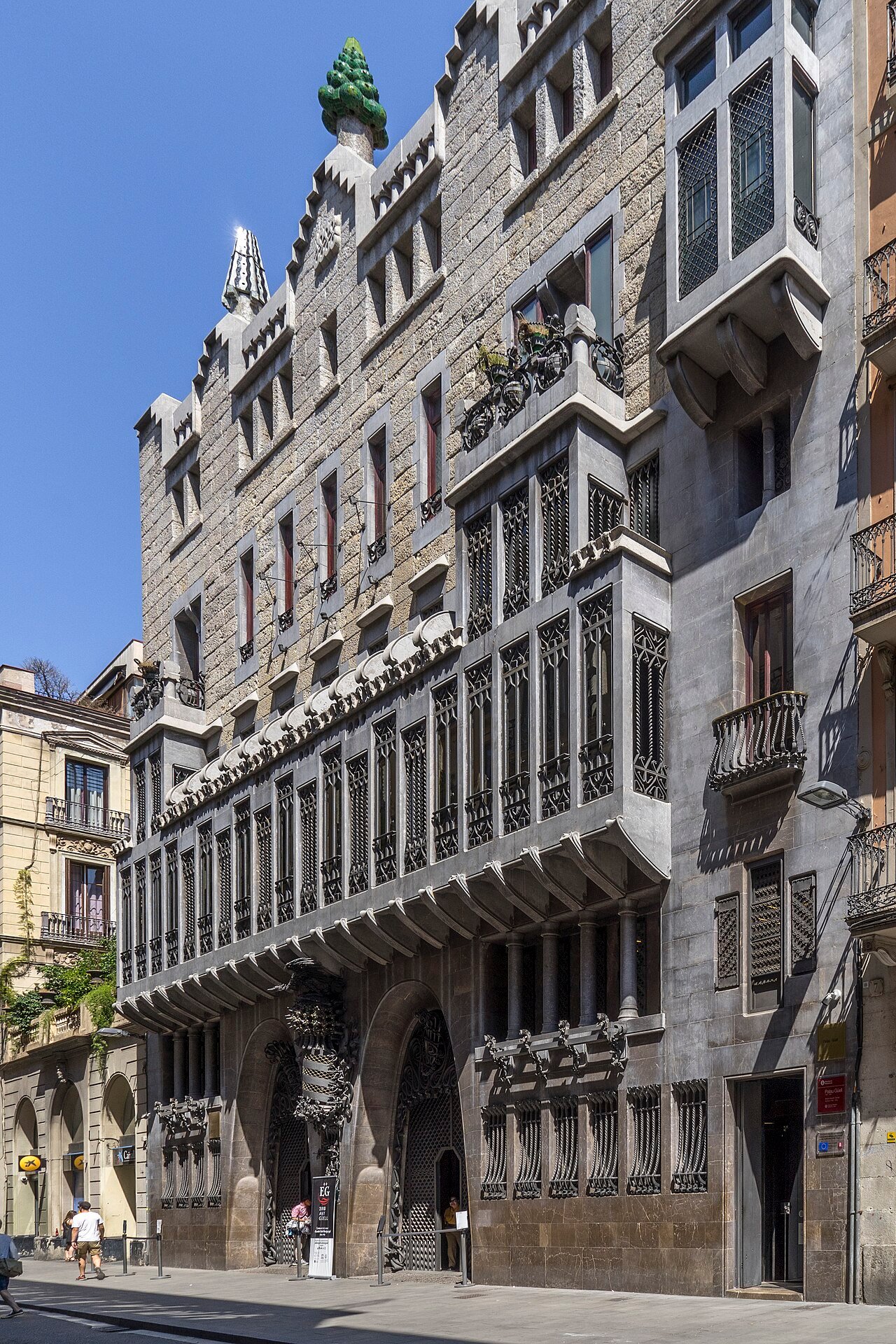
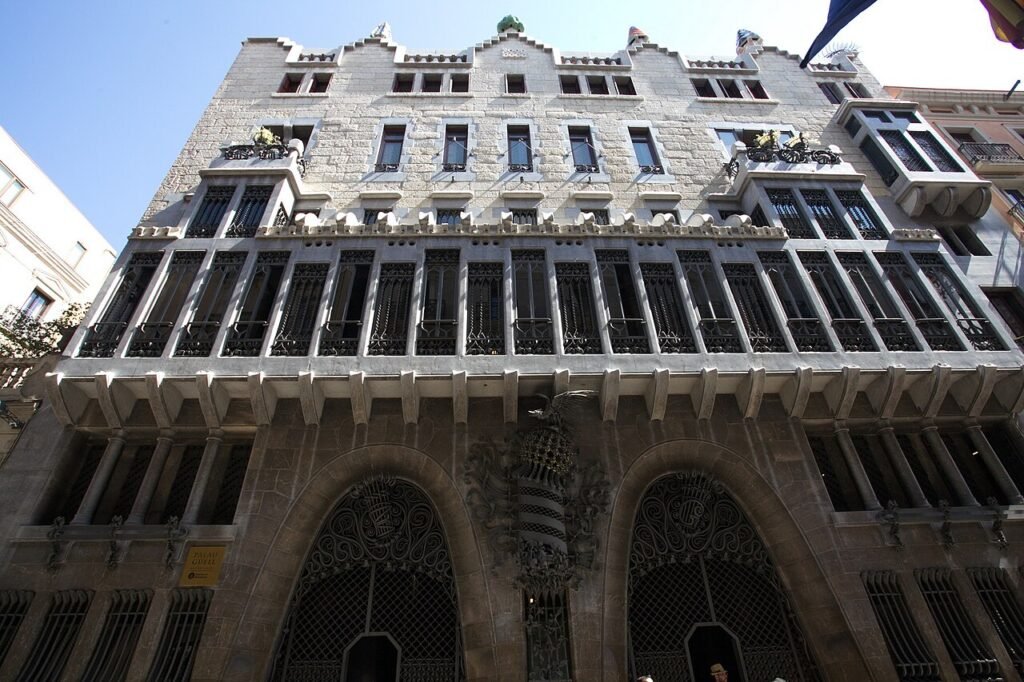
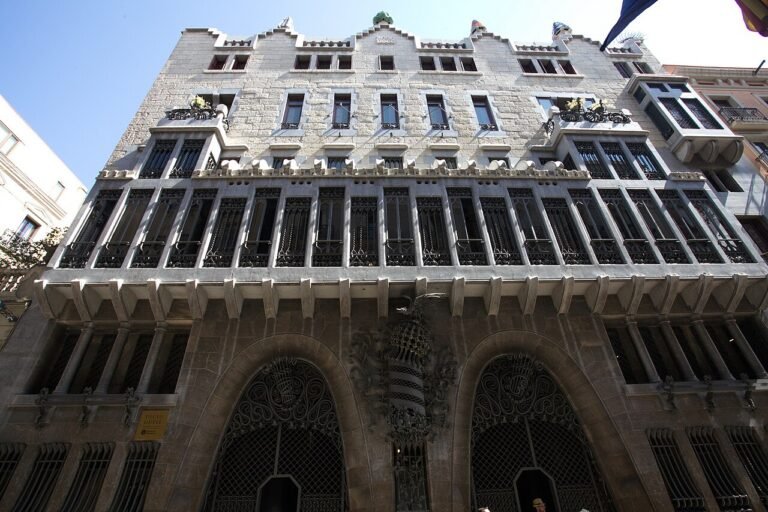
Plenty of visitors see Gaudí’s Palau Güell without realising which neighbourhood they are standing in. The palace rises on Carrer Nou de la Rambla, just off La Rambla in the heart of El Raval — the young Antoni Gaudí’s first great commission, built in the 1880s for the industrialist Eusebi Güell. Behind its severe stone façade sit a central hall lit through a parabolic dome, stables with mushroom-shaped brick columns in the basement and a rooftop of fantastical tiled chimneys that previews everything Gaudí did later. It is a UNESCO World Heritage Site and one of the essential Gaudí interiors, far less crowded than the Sagrada Família or Casa Batlló — we cover it room by room in our full Palau Güell guide.
Sant Pau del Camp: Barcelona’s Oldest Church

At the southern end of Carrer de Sant Pau stands the most quietly astonishing building in the neighbourhood. Sant Pau del Camp — Saint Paul in the Fields, named for the open country it once stood in — is the oldest preserved church in Barcelona. A Benedictine monastery stood here by the end of the 9th century, traditionally dated to 897–910 and associated with Count Guifré II, whose tombstone is still inside; destroyed in the raid of 985, it was rebuilt in the Romanesque form you see today in the 12th century. The monastery worked on until 1835, when Spain’s confiscation of church property emptied it — the miracle is that the building survived the factories and tenements that grew up on every side.

The treasure is the tiny cloister, built in the 13th century. Its arches are polylobate — each one scalloped into multiple lobes, a form borrowed from Islamic architecture — and this cloister is considered unique in Europe for them. It takes five minutes to walk around and feels a thousand miles from the streets outside the gate. Cultural visits run in the mornings: at the time of writing the visit ran Monday to Saturday, 10:00–13:00, with a basic ticket around €5 and a guided option on Saturdays — the arrangement is small-scale and can change, so check the monastery’s own site (santpaudelcamp.cat) before you walk down.
The Old Hospital and Its Gardens

Two streets north of Sant Pau del Camp, behind an unassuming gateway on Carrer de l’Hospital, is the Raval’s best free secret. The Hospital de la Santa Creu was founded in 1401, when Barcelona merged its small medieval hospitals into one great public institution, and it treated the city’s sick for more than five centuries. The buildings around its courtyard are pure Catalan Gothic — cloistered galleries, a great vaulted ward, the old pharmacy and chapel — and today they house the Biblioteca de Catalunya, Catalonia’s national library, along with art and study institutes, which keeps the complex a working place rather than a museum piece.
The courtyard itself, planted as the Jardins de Rubió i Lluch, is open to everyone: orange trees, benches, a small café and students reading in the shade of the galleries — the calmest spot in the old town. It also holds one of Barcelona’s most poignant footnotes: Antoni Gaudí, knocked down by a tram on 7 June 1926 and unrecognised for hours because of his shabby clothes, was brought to this hospital — the hospital of the poor — and died here on 10 June 1926.
Rambla del Raval and Botero’s Cat

The Rambla del Raval is the neighbourhood’s living room: a wide, palm-lined boulevard running north–south through the middle of the district, lined with café terraces, benches and playgrounds. It is also the most deliberate street in Barcelona. Before 1996 this was one of the densest blocks of tenements in the city; the boulevard was driven through it over five years of demolition, and the cylindrical tower of the Barceló Raval hotel at its northern end — whose rooftop terrace gives one of the best viewpoints over the old town — marks where the new Raval announces itself.
At the southern end of the boulevard stands the neighbourhood’s mascot. El Gat de Botero, Fernando Botero’s enormous bronze cat — fat, placid and polished shiny by decades of children climbing on it — was bought by the city in 1987 and moved around Barcelona for years before it settled here in 2003. It has become the meeting point and selfie stop of the Raval, and locals will tell you rubbing the cat brings luck; they will also tell you exactly which part, and it is not the nose.
La Boqueria: The Raval’s Market

Most visitors file La Boqueria under “La Rambla”, but historically the market is the Raval’s own. The Mercat de Sant Josep de la Boqueria grew up on the site of a Carmelite convent on the Rambla’s western — Raval — side, where traders had sold food since the medieval period; the iron-roofed hall at La Rambla 91 is the neighbourhood’s pantry, and on weekday mornings it still works as one, with chefs and stallholders’ regulars crowding the fish and produce aisles at the back. The market opens Monday to Saturday, 8:00–20:30, and closes on Sundays. Go before 10:00 to see it as a market rather than an attraction, and note that a long-term renovation of the hall is under way in phases — the market stays open throughout, but expect the odd aisle behind boards. Our dedicated La Boqueria guide covers the best stalls and bars in detail.
The Southern Raval: Filmoteca, Theatres and the Old Shipyards
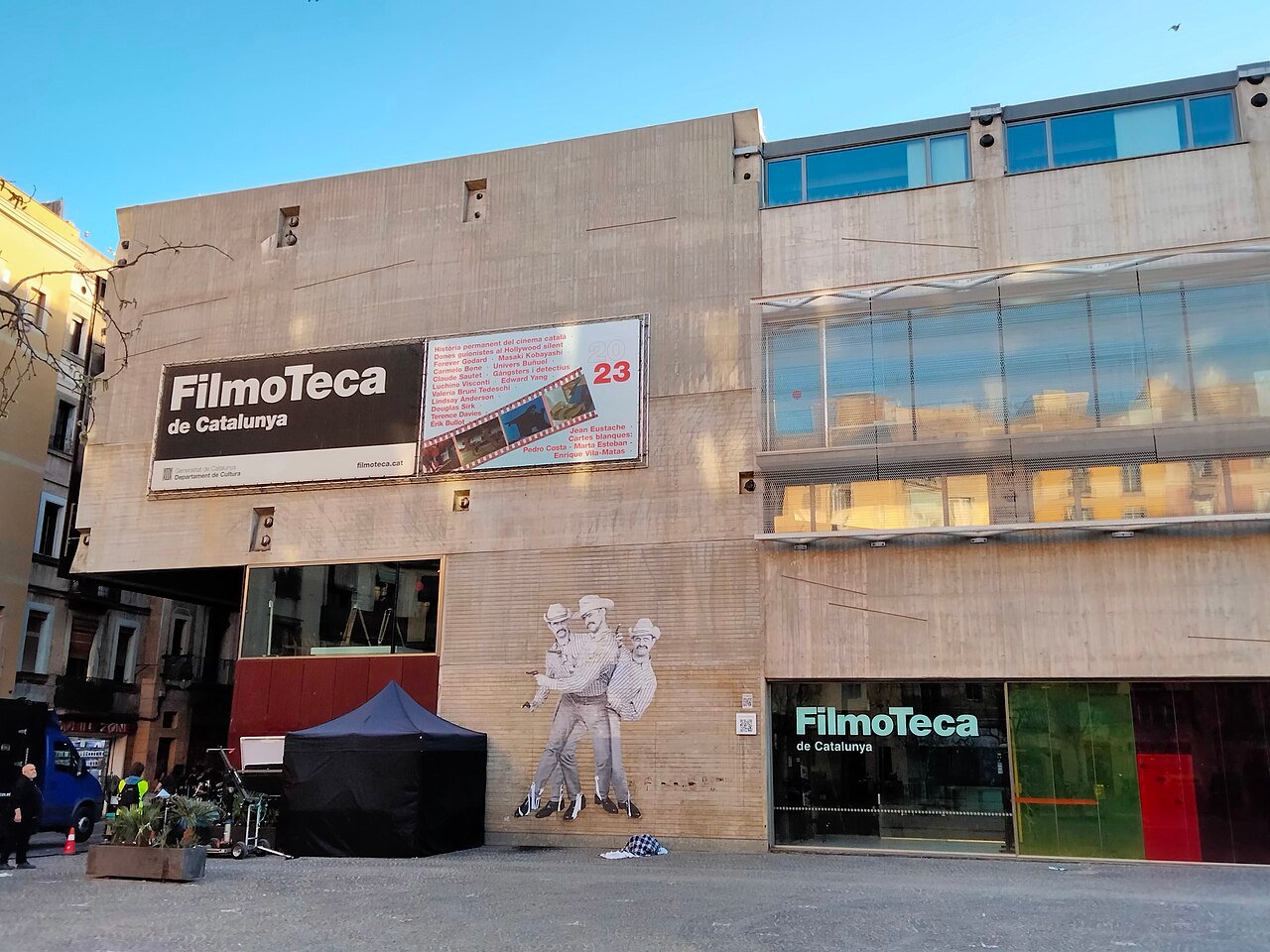
The southern Raval is the old entertainment district, reinvented rather than replaced. Its new anchor is the Filmoteca de Catalunya, the Catalan film archive’s headquarters on Plaça Salvador Seguí, a raw concrete building by Josep Lluís Mateo that opened in February 2012. Downstairs are two cinemas — the 360-seat Chomón and the 175-seat Laya — running around 1,400 screenings a year of classics, retrospectives and restored prints, almost always in the original language with subtitles. It is one of the great bargains in Barcelona culture: a standard screening costs €4, €3 reduced, and the exhibitions in the building are free. The restaurant attached to it, La Monroe, is named for exactly who you think.
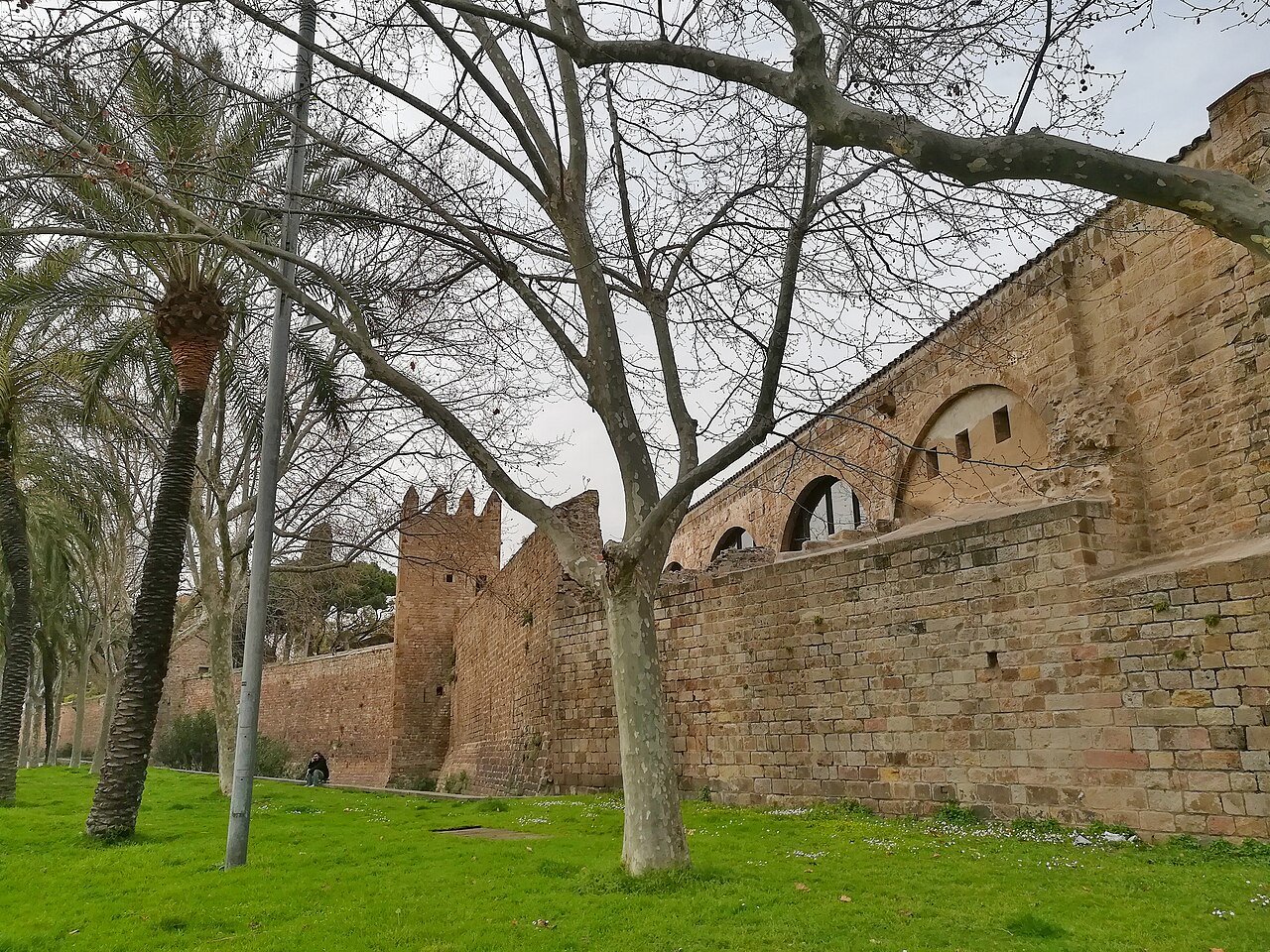
South of the Filmoteca, Avinguda del Paral·lel was Barcelona’s Broadway in the early 20th century — a wall of theatres, music halls and cabarets facing Montjuïc — and several historic venues still run along it. At its eastern end stands the Portal de Santa Madrona, the only surviving gate of Barcelona’s medieval sea wall, now part of the Royal Shipyards (Drassanes): the vast Gothic sheds where the Crown of Aragon built its galleys, today home to the Maritime Museum. The shipyards are a sight of the first order in their own right — we give them their full due in our Maritime Museum guide.
Street Art in El Raval

El Raval is where Barcelona’s street art story is written largest. The landmark work is Keith Haring’s mural Todos Juntos Podemos Parar el SIDA — “Together We Can Stop AIDS” — painted in 1989 on a wall in the old Barrio Chino, in the middle of the heroin epidemic that was devastating the district. Haring, already ill himself, chose the spot deliberately. The original wall did not survive the redevelopment, but the mural did: the version you see today, red outline figures on the wall beside MACBA at the Plaça dels Àngels, was faithfully re-created from the original and stands as both artwork and memorial.
Around it, the district is an open-air gallery that changes monthly. The gardens by the Tres Xemeneies — the three great chimneys of the old power station by Paral·lel — double as a skate park and one of the city’s legal graffiti spots, and the Arnau Gallery, on the façade of the old Teatre Arnau, is an open-air gallery project where large murals rotate in view of the avenue. This is the Raval that the Raval Street Art and Graffiti Walking Tour covers: two hours with a local guide, from the Tres Xemeneies through the Arnau Gallery to the Haring mural, explaining who painted what and why it matters here — the context is what turns painted walls into a story you can read.
Eating and Drinking in El Raval
El Raval eats better, and cheaper, than anywhere else in the old town — because it feeds its own residents first. The main bar street is Carrer de Joaquín Costa in the north, a run of small bars, vermouth spots and vintage shops that fills with students and locals in the early evening; on Saturdays, Carrer de la Riera Baixa, the next street over, lays out second-hand stalls and becomes the neighbourhood’s weekly open-air flea market. For a historic drink, Bar Marsella on Carrer de Sant Pau has poured absinthe since 1820 and claims, plausibly, to be the oldest bar in Barcelona — the Picasso and Hemingway associations are tradition rather than paperwork, but the dusty bottles are entirely real. And for straightforwardly excellent value, follow the residents: the Raval is the best place in central Barcelona for Pakistani, Indian, Filipino and Middle Eastern food, with €8–12 lunch menus on and around Carrer de Sant Pau and the Rambla del Raval that the tourist centre cannot match.
Is El Raval Safe?
Honestly, because you will read warnings elsewhere: El Raval has a reputation that is twenty years out of date in one direction and worth respecting in another. The district is home to 46,000 people, contains two of the city’s most visited museums and a famous market, and its main streets — the Rambla del Raval, Carrer de l’Hospital, Carrer de Sant Pau, the streets around MACBA — are busy and walked by thousands of visitors every day. You should visit, and you should not be nervous about doing so.
What is true is that this remains one of the poorer districts of the centre, and petty crime is the realistic risk: pickpocketing, especially around La Rambla and the Boqueria crowds, and bag-snatching at café tables. A couple of pockets — parts of Carrer d’en Robador and the streets around Plaça Salvador Seguí — feel rough late at night, and like most locals you will simply choose the busier parallel streets after dark. That is the whole of it: normal big-city awareness, a zipped bag, your phone off the café-table edge, and no special precautions beyond that.
Practical Info
- Where it is: Immediately west of La Rambla in the Ciutat Vella district. Boundaries: Carrer de Pelai to the north, La Rambla to the east, Ronda de Sant Antoni, Ronda de Sant Pau and Avinguda del Paral·lel to the west and south.
- MACBA: Plaça dels Àngels 1. Admission €15 at the desk / €13.50 online; the ticket is valid for one month with unlimited entry. Weekday hours 11:00–19:30 for most of the year (10:00–20:00 late June–late September); Saturday 10:00–20:00; Sunday 10:00–15:00; closed Tuesdays. Expansion works on the square run into 2027 — the main building stays open.
- CCCB: Carrer de Montalegre 5. One exhibition €8 online / €10 at the desk; two exhibitions €10 / €12. Free on Sundays 15:00–20:00 with advance reservation. Open Tuesday–Sunday 11:00–20:00; closed Mondays (except holidays).
- Palau Güell: Carrer Nou de la Rambla 3-5 — see our Palau Güell guide for ticket and hours detail.
- Sant Pau del Camp: Carrer de Sant Pau 99-101. Cultural visits run on weekday and Saturday mornings (10:00–13:00 at the time of writing, basic visit around €5) — confirm the current arrangement at santpaudelcamp.cat before going, as hours change.
- La Boqueria: La Rambla 91. Open Monday–Saturday 8:00–20:30; closed Sundays.
- Filmoteca de Catalunya: Plaça Salvador Seguí 1-9. Screenings €4 standard / €3 reduced / €2 for children’s sessions; exhibitions free.
- The neighbourhood itself: Always open and always free — El Raval is a living district, not an attraction.
Tickets and Costs
El Raval is one of the cheapest great days out in Barcelona, because most of it costs nothing: the streets, the Rambla del Raval, the hospital gardens, the Plaça dels Àngels and the Haring mural are all free. The paid elements are the interiors. MACBA is €15 (€13.50 online); the CCCB is €8–10 for one exhibition, or free on a Sunday afternoon with a reservation; Sant Pau del Camp’s cultural visit is around €5; a Filmoteca screening is €4; and Palau Güell’s ticket is covered in its own guide. Lunch from a neighbourhood menu runs €8–12.
The one guided expense worth considering is the walk that explains the district’s walls: the Raval Street Art and Graffiti Walking Tour runs for two hours in a small group, rated 4.9 out of 5, from the Tres Xemeneies to the Haring mural at MACBA. Everything else in this guide can be done entirely on your own.
Getting There
El Raval is stitched into the metro. Liceu (L3) and Drassanes (L3) serve the Rambla edge and the south; Paral·lel (L2, L3) covers the southern Raval, the Filmoteca and the Paral·lel theatres; Sant Antoni (L2) is the handiest stop for the Rambla del Raval and Sant Pau del Camp; and Universitat (L1, L2) lands you at the northern, MACBA end. On foot, the neighbourhood begins the moment you step west off La Rambla: Plaça Catalunya to MACBA is about a 10-minute walk, and Sant Pau del Camp is 15 minutes from the Columbus Monument — which is why the Raval pairs so naturally with a day built around the best things to do in Barcelona in the old town.
When to Go
El Raval works in every season, because so much of it is indoors or everyday rather than weather-dependent. For the museums, weekday mornings are quietest — MACBA on a Monday (the day the CCCB closes) and the CCCB on a Sunday afternoon for the free entry. La Boqueria is at its best before 10:00 on a weekday morning and closes on Sundays, the one day to avoid for a market-centred visit. The neighbourhood’s own festival, the Festa Major del Raval, fills the streets around the feast of the Mare de Déu del Carme in mid-July — dates are confirmed by the district each year — and it is the single best week to see the Raval celebrating itself, giants, concerts and communal meals included.
How Long You Need
Give the neighbourhood half a day at minimum, and a full day if you go inside the museums. A highlights route — Plaça dels Àngels and the Haring mural, the CCCB courtyard, Sant Pau del Camp, the hospital gardens, the Rambla del Raval and Botero’s Cat, and a lap of La Boqueria — takes three to four unhurried hours on foot. Add MACBA’s galleries and you are at a full day. If your Barcelona time is short, the Raval combines in a single day with La Rambla and the Gothic Quarter across it.
Tips for Visiting
- Start at the Plaça dels Àngels. MACBA, the CCCB, the Haring mural and the university quarter are all within two minutes of each other — the natural front door of the neighbourhood.
- Use MACBA’s month-long ticket properly. If you are in Barcelona for a week or more, the €13.50 online ticket with unlimited re-entry for a month is one of the best-value culture buys in the city.
- Book the CCCB’s free Sunday afternoon slots ahead. Entry from 15:00–20:00 on Sundays is free but capacity-limited; the reservation takes two minutes and the walk-up queue is the alternative.
- Check Sant Pau del Camp before you go. The cultural visit is small-scale and morning-only; a glance at the monastery’s website saves a wasted walk — and the church exterior and garden are worth seeing regardless.
- Do La Boqueria early, and eat at the back. Before 10:00 the market belongs to shoppers; the bars and stalls deeper inside are cheaper and better than the juice cups at the entrance.
- Give the hospital gardens twenty minutes. The Jardins de Rubió i Lluch are free, shaded and calm — the old town’s best reset button between sights.
- Rub the cat. El Gat de Botero at the end of the Rambla del Raval is the neighbourhood’s good-luck ritual and its best meeting point.
- Apply ordinary big-city sense. Zipped bag, phone away from the table edge, busier streets after dark — the same rules as La Rambla itself, and nothing more dramatic than that.
What to See Nearby
El Raval is one third of old Barcelona, and its neighbours begin at its borders. On the far side of its eastern edge runs La Rambla itself — the Liceu, the Boqueria’s front door and the Columbus Monument all sit on the seam between the two districts. Cross the Rambla and you are in the Gothic Quarter, the medieval core of cathedral and Roman walls that the Raval spent centuries sitting outside. South of Paral·lel rises Montjuïc, with its castle, museums and gardens; west along the Rondas is Sant Antoni, the Raval’s calmer sibling, with its own famous market. Base yourself in the old town and all of it is walkable in a single day.
Frequently Asked Questions
Where exactly is El Raval in Barcelona?
El Raval is the old-town neighbourhood immediately west of La Rambla, in the Ciutat Vella district. Carrer de Pelai bounds it to the north, La Rambla to the east, and Ronda de Sant Antoni, Ronda de Sant Pau and Avinguda del Paral·lel to the west and south. Its handiest metro stops are Liceu and Drassanes (L3), Paral·lel (L2, L3), Sant Antoni (L2) and Universitat (L1, L2).
Is El Raval safe for tourists?
Yes, with ordinary big-city awareness. The Raval is home to 46,000 people and contains MACBA, the CCCB and La Boqueria; its main streets are busy all day. The realistic risk is pickpocketing, as anywhere around La Rambla, and a few streets feel rough late at night — stick to the busier routes after dark, as locals do.
What was the Barrio Chino?
“Barrio Chino” — the Chinese Quarter — was the nickname given to the Raval’s southern half from 1925, when the journalist Francisco Madrid coined it. There was no Chinese community behind the name; it evoked the district’s density and its nightlife of theatres, cabarets and bars. Residents today simply say El Raval.
What are the must-see sights in El Raval?
MACBA and the Plaça dels Àngels, the CCCB, Gaudí’s Palau Güell, Sant Pau del Camp — the oldest church in Barcelona — the gardens of the old Hospital de la Santa Creu, the Rambla del Raval with Botero’s Cat, La Boqueria market, and Keith Haring’s 1989 mural beside MACBA. Most are free, and the whole route is walkable in half a day.
How much does it cost to visit El Raval?
The neighbourhood itself is free. Paid sights: MACBA €15 (€13.50 online, valid a month), the CCCB €8 online/€10 at the desk for one exhibition (free Sunday afternoons with a reservation), Sant Pau del Camp around €5, and Filmoteca screenings €4. A neighbourhood lunch menu runs €8–12.
When is the Festa Major del Raval?
The neighbourhood’s main festival falls in mid-July, around the feast of the Mare de Déu del Carme on 16 July, with street concerts, giants and communal meals. Exact dates are announced by the district council each year, so check the current programme if you are visiting in July.
Travel insurance, sorted
Whether it is a two-week holiday or a longer move, travel insurance is not the most glamorous part of a trip — but it is the one booking you want to have in place before a trip, and while you are already away. Get a quote from SafetyWing
Final Thoughts
El Raval is the part of old Barcelona that never stopped being a real neighbourhood — and that is precisely why it is worth your time. The Gothic Quarter shows you the city Barcelona was; the Raval shows you the city Barcelona is: a 9th-century monastery and a skateboarded museum square, a Gothic hospital garden and a bronze cat, forty nationalities sharing the same few streets. Come for MACBA or the market and stay for the streets in between, eat where the residents eat, and you will leave understanding Barcelona better than any single monument can teach you. The Raval does not perform for visitors. It rewards them.
Photos: Enric (CC BY-SA 4.0 and CC BY 4.0), Ximonic (Simo Räsänen), Thomas Ledl and Michielverbeek (CC BY-SA 4.0), Till Niermann (CC BY-SA 3.0), Jorge Franganillo (CC BY 2.0) and Zarateman (CC0), via Wikimedia Commons.


One Comment