Bunkers del Carmel: The Complete Guide to Barcelona’s Best Viewpoint
Every city has a viewpoint it puts on the posters, and then it has the one its own people climb to. In Barcelona the second kind wins by a distance. High above the Eixample, on a bare hill in the working-class district of El Carmel, a ring of concrete gun platforms left over from the Civil War has become the city’s favourite balcony: no ticket, no queue, no café — just a 360-degree panorama that takes in everything from the Sagrada Família to the sea, and a story under your feet that runs from an Iberian hillfort through an anti-aircraft battery to a shanty town that survived into the 1990s. The Bunkers del Carmel — properly the MUHBA Turó de la Rovira — reward the climb like nowhere else in the city.
This guide covers the whole visit: the hill and how to read it, the battery built here in 1937 and the war it fought, the vanished neighbourhood of Los Cañones that grew up among the guns, the museum site the hill has become, what the famous view actually shows in every direction, and — important, this — the new gated hours that since 2023 have changed how a visit works. It is the hilltop chapter of the story told across our Best Things to Do in Barcelona guide, and the chapter with the best light in the city.
The Short Answer
Yes — the Bunkers del Carmel are unmissable and completely free: a Civil War anti-aircraft battery on the 262-metre Turó de la Rovira, now an open-air MUHBA heritage site, holding what most Barcelonans consider the finest panorama of their city — the whole Eixample grid, the Sagrada Família, the port and the Mediterranean in one turn of the head. There is nothing to book and nothing to buy; the visit is the climb, the concrete platforms, the panels that explain them, and the view. Two things have changed in recent years and both matter: the summit is now fenced and gated, closing in the early evening, so the famous sunset visit runs on a schedule; and the site is a protected monument in a residential neighbourhood, so it asks to be treated as both. Give it an hour at the top — two, happily, if you pair it with the story — and come in the late afternoon for the light everyone talks about.
Table of Contents
- The Short Answer
- The Hill: Turó de la Rovira
- The Battery: Guns Over Barcelona
- Los Cañones: The Shanty Town on the Gun Platforms
- The Site Today: MUHBA’s Hilltop
- The View: Reading Barcelona in 360°
- Sunset: The Ritual and the New Rules
- Getting There: The Climb
- Pairing the Visit: Park Güell and Gràcia
- Practical Info
- Tips for Visiting
- Final Thoughts
The Hill: Turó de la Rovira
First, the geography, because the hill explains everything built on it. The Turó de la Rovira rises 262 metres above the north of Barcelona, one of the Tres Turons — the Three Hills — that interrupt the city’s climb from the Eixample plain to the Collserola ridge. It stands between the neighbourhoods of El Carmel, Can Baró and El Guinardó, in the district of Horta-Guinardó, and from almost anywhere below it is identifiable at a glance: a wooded cone topped by a great cylindrical water tank and a thicket of communications antennas, with the pale scar of the battery terraces on its southern shoulder.

People have valued this summit for a very long time. In the 4th century BC an Iberian settlement stood here — part of its wall and entrances were excavated in 1932 — and the logic then was the logic of 1937 and the logic of your visit now: from this one hill you can see everything. The sea approach, the plain, the passes through the hills. What changed across the centuries is only what each age chose to put on top: a hillfort, then farmland and a watchman’s hill, then guns, then homes, then a museum. The tank and the antennas came with the modern city — water for the hilltop neighbourhoods in 1963, signals after — and they are part of the site’s honest jumble rather than blemishes on it. A hill this useful never gets to be just one thing.

The Battery: Guns Over Barcelona
The concrete you sit on was poured in a hurry, in a war. When the Spanish Civil War began in 1936, Barcelona became the first great city in history to be bombed systematically from the air — Italian aircraft flying from Mallorca raided it again and again, and the March 1938 raids alone killed around a thousand people in three days. The Republican anti-aircraft defence authority, the DECA, ringed the city with batteries, and for the keystone position it chose this hill: in 1937 the summit of the Turó de la Rovira was levelled and built over with an anti-aircraft battery.
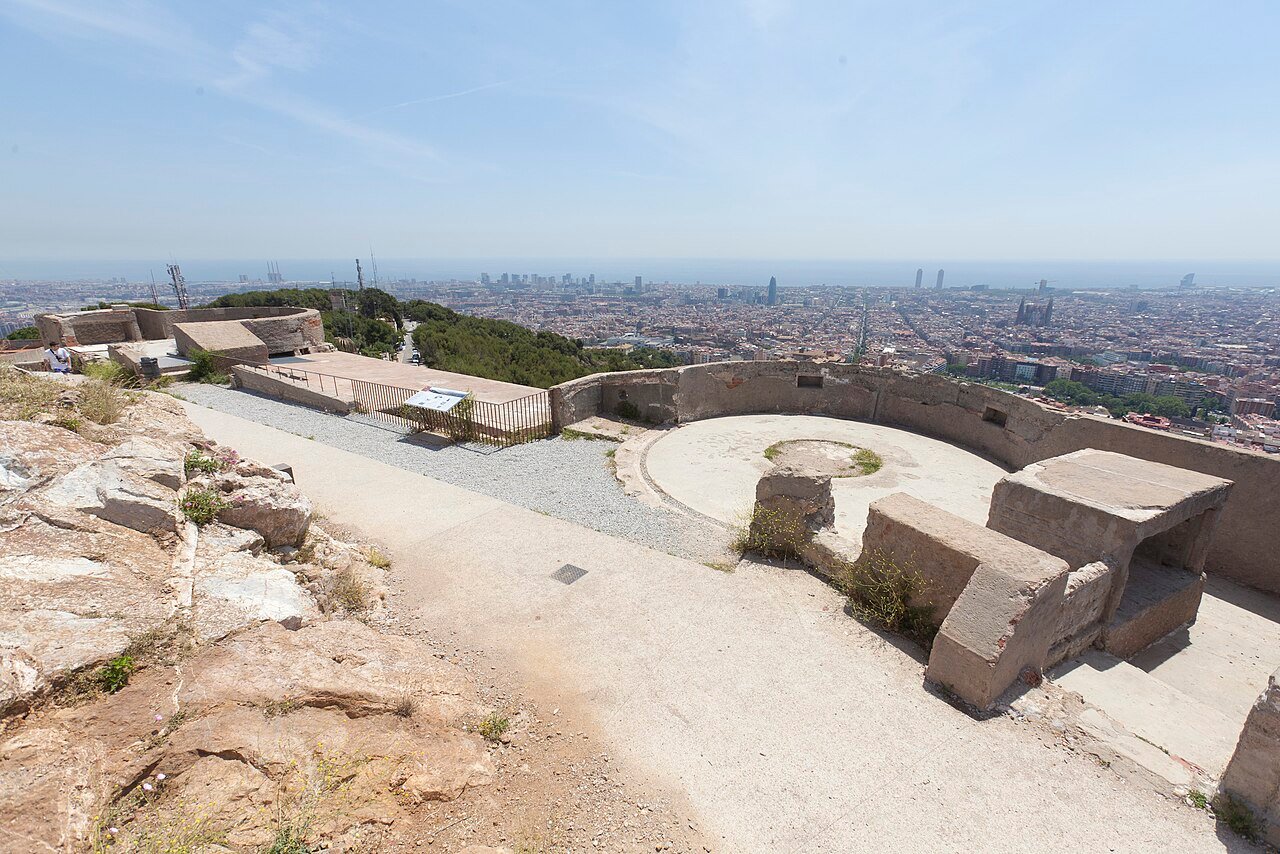
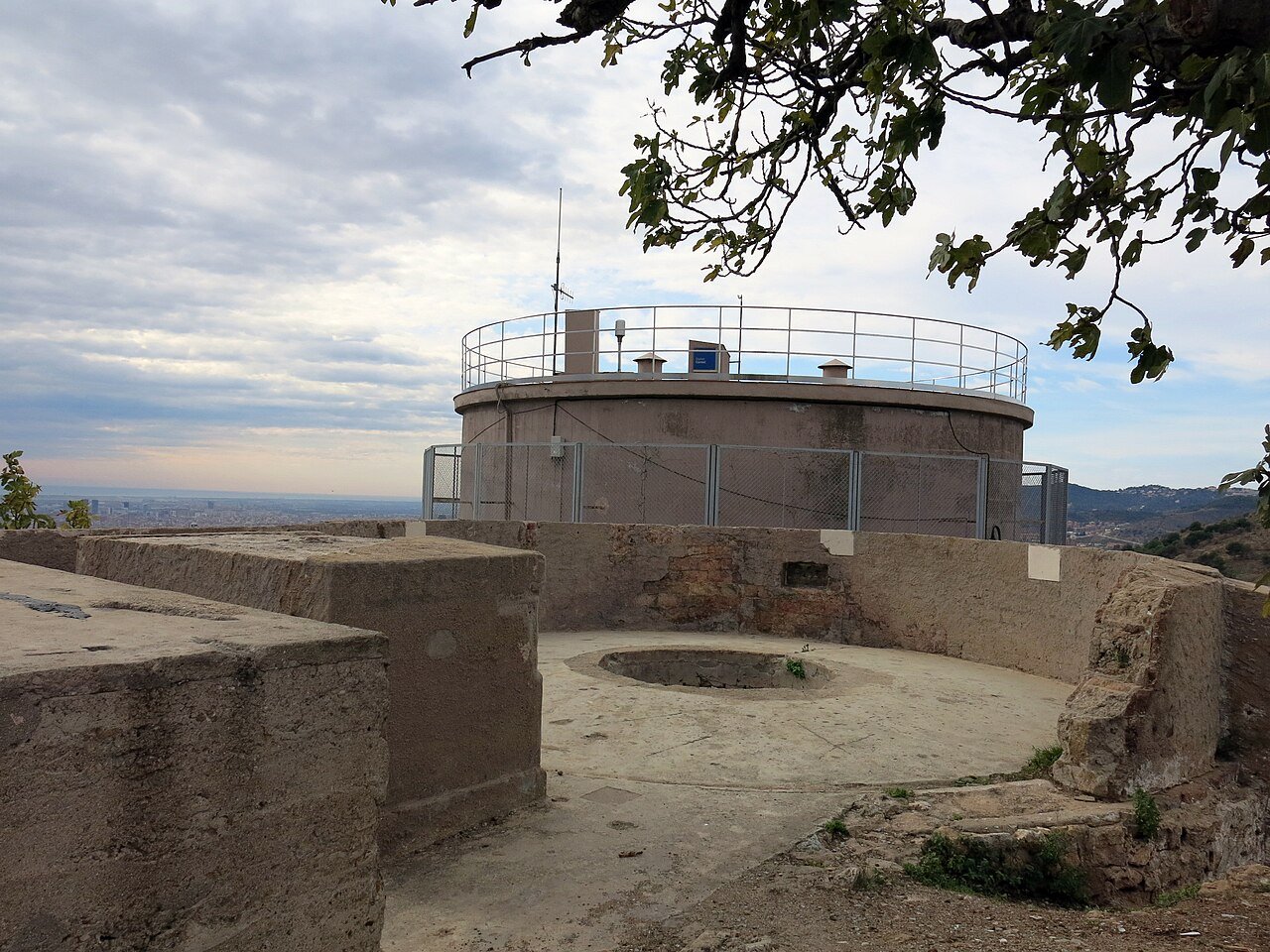
What was built here survives almost entire, and you can still read it like a plan. Four circular gun platforms — the great concrete rings that are now the viewpoint’s terraces — held four Vickers 105mm guns, their crews serving them from the ammunition recesses built into each platform’s wall. Behind the guns stood the battery’s small garrison world: a command post, an officers’ pavilion, a troops’ barracks — the long building with the barred windows below the platforms — and an ammunition store, all served by searchlights and acoustic locators, the era’s ear-and-eye technology for finding aircraft in the dark. For two years the battery fired on the raiders over the city it was built to defend.
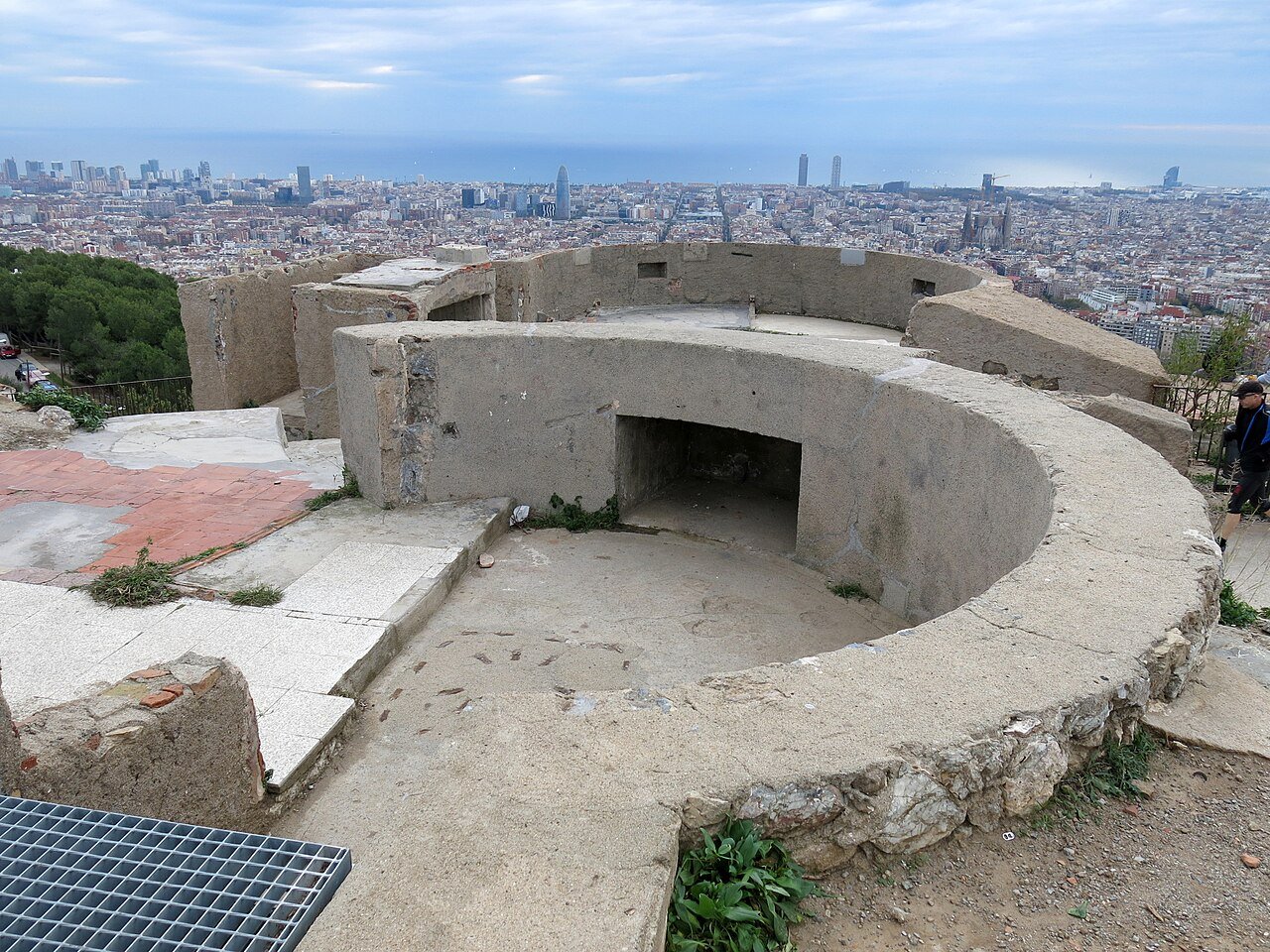
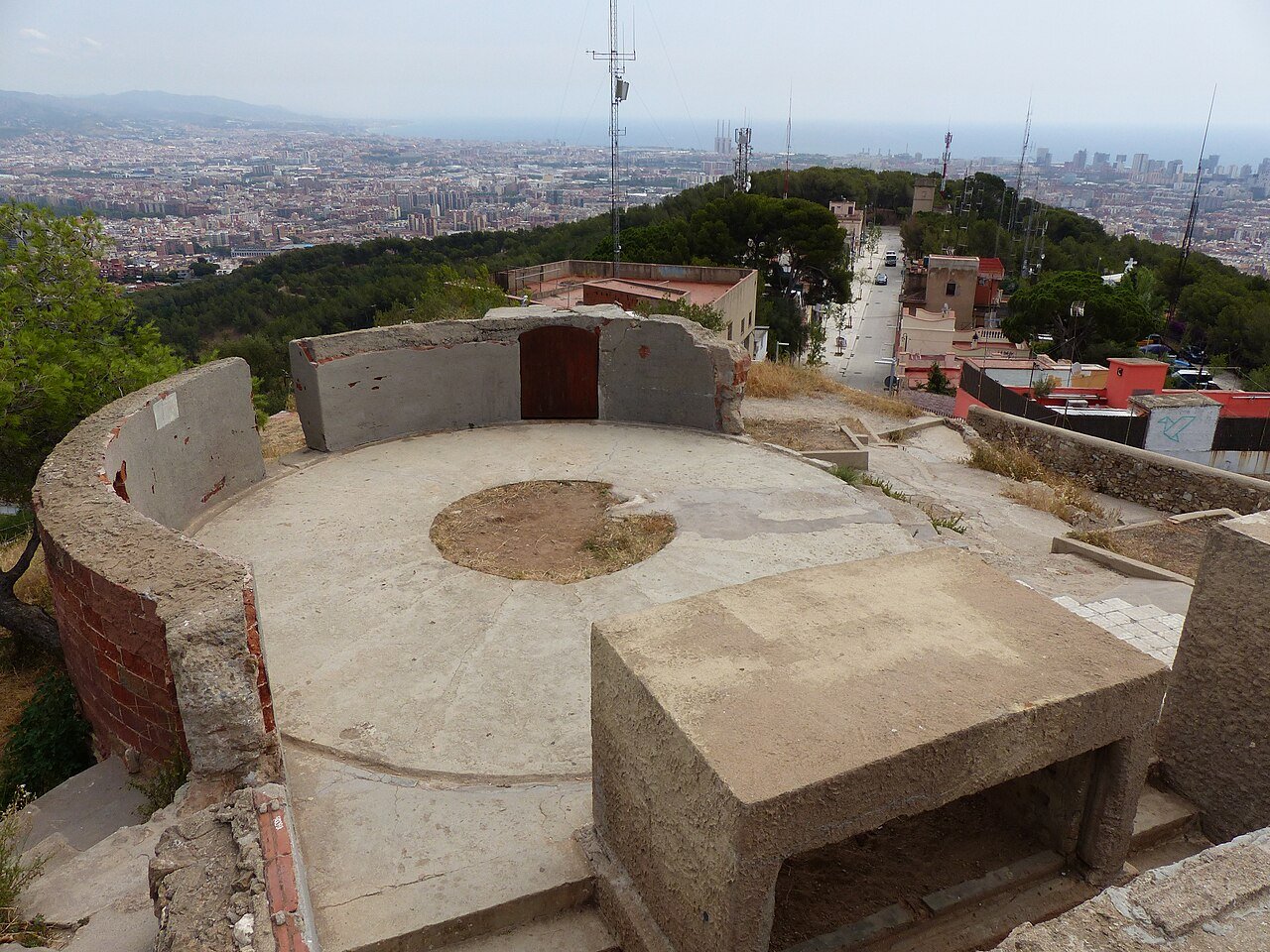
It ended the way the war ended. As Franco’s troops closed on Barcelona in January 1939, the battery’s own gunners disabled the guns during the retreat of 25–26 January; the city fell the next day. The platforms were left to the weather — an abandoned fort on a hill above a city with more urgent ruins to clear. Nobody in 1939 could have predicted the battery’s second life, because nobody predicted that within a few years people would be living in it.

Los Cañones: The Shanty Town on the Gun Platforms
Post-war Barcelona filled with migrants — families arriving from Andalusia, Extremadura and the rural south to work in the city’s factories, into a housing shortage so severe that tens of thousands built their own homes wherever land was free. On the Turó de la Rovira, the free land came with concrete floors, low walls and the best view in Spain. The shanty town that grew up around and inside the battery was called Los Cañones — in Catalan, Els Canons, “the Cannons” — after the guns whose platforms became its foundations.
At its height the summit settlement held around 110 huts and some 600 residents, arranged with remarkable order along the battery’s own axis, which served as its main street. The houses were whitewashed in the Andalusian manner, so that from below the hilltop glittered; inside, families lived without the basics — water above all, carried up until the great reservoir was built on the summit in 1963 and an improvised fountain was tapped into it. The community organised: in 1972 Los Cañones’ residents were among the founders of the Carmel Residents’ Association, and through the seventies they fought the council for refuse collection, toilets, running water — the ordinary dignity of a neighbourhood that officially did not exist.
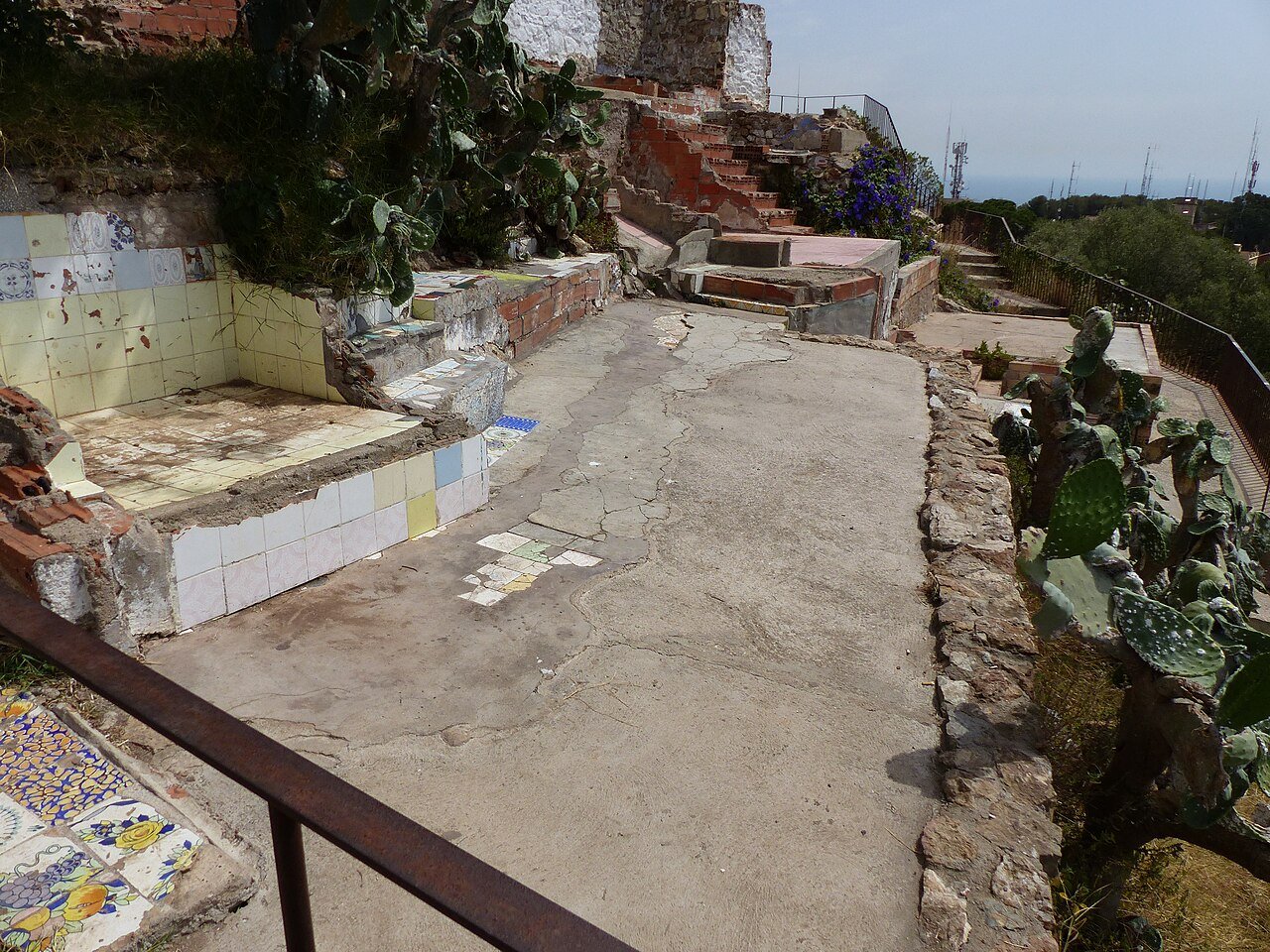
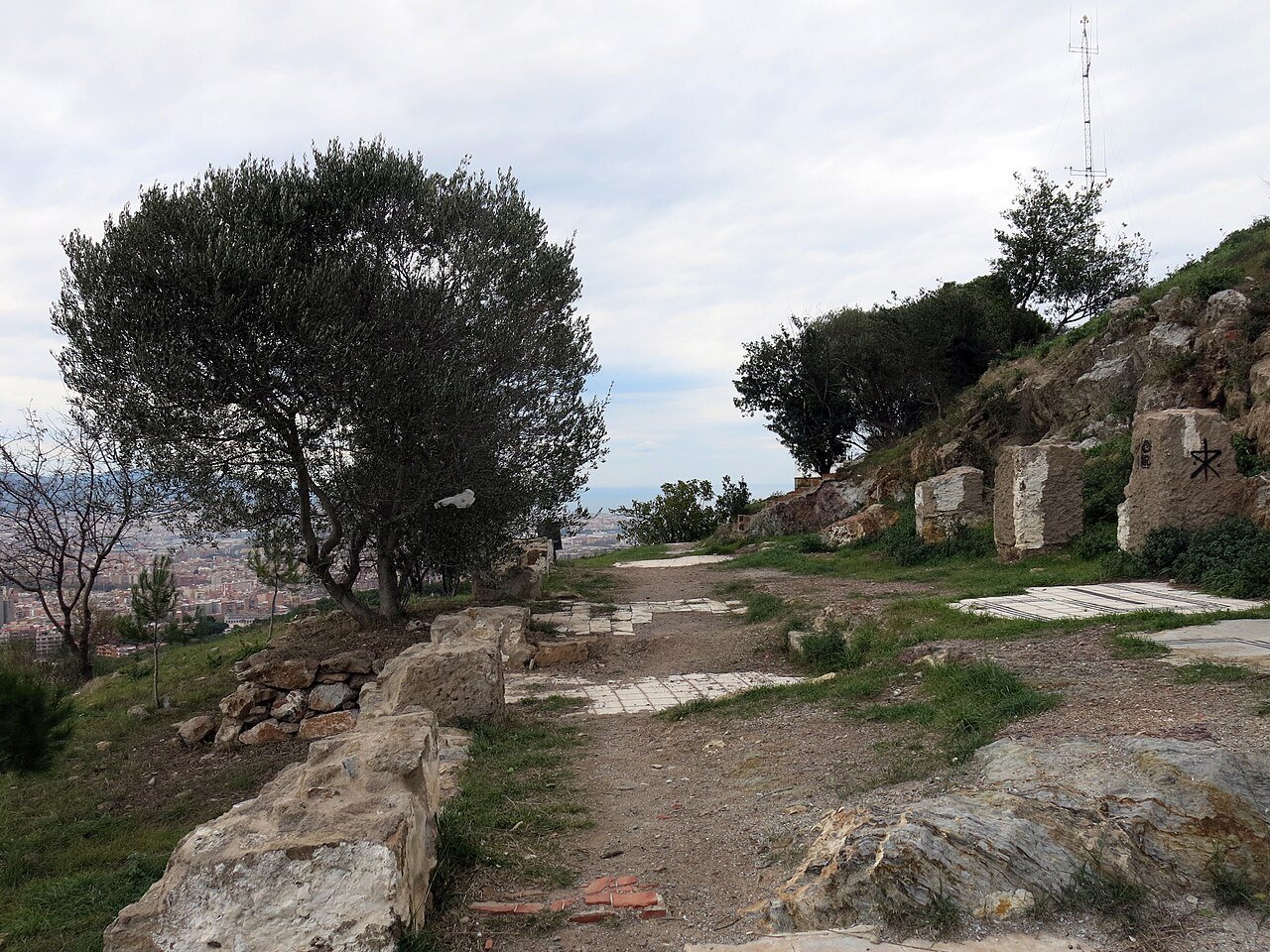
The end came slowly, then all at once. Through the eighties the city rehoused the shanty towns family by family, and around 1990 — as Barcelona rebuilt itself for the 1992 Olympics — the last homes on the Turó de la Rovira were demolished and their residents moved to housing below. What the demolition crews left, deliberately or by chance, is the most moving layer of the site today: the ground plan of the neighbourhood, written in tiles. Walk the southern slope and you tread on the floors of the demolished houses — patterned kitchen tiles, hearth bases, doorsteps — a street plan of a vanished community preserved under the open sky.
Free Barcelona travel guide
Planning a trip to Barcelona? Get our free one-page Barcelona checklist: what to book ahead, what to skip, and the viewpoints we actually send friends to.
The Site Today: MUHBA’s Hilltop
For twenty years after the demolitions the hilltop drifted — known to neighbours, walked by dog owners, slowly gathering the graffiti and the sunset crowds. Its rescue came in 2011, when the Museu d’Història de Barcelona (MUHBA) restored the summit as one of its heritage spaces: the MUHBA Turó de la Rovira. The gun platforms were cleaned and consolidated, paths and railings laid out, and interpretation panels set into the terraces explaining each structure — this ring a gun, that building the command post, those tiles a family’s kitchen floor. In the officers’ pavilion, a small exhibition — “Barcelona al límit” (Barcelona on the Edge) — tells the three stories of the hill: the air war, the shanty town, and the city growing around both.
The MUHBA framing is what lifts the visit above a photo stop. The museum calls this hill part of the “balcony of Barcelona” — the chain of heights from which the whole growth of the city can be read — and it runs guided visits to the site that can be booked through MUHBA; if one coincides with your day, take it, because the guides walk you through rooms and details the panels only sketch. But the unguided visit is complete in itself, and it is free: the grounds, the platforms and the panels are open to anyone who climbs, within the gated hours covered below. The big water tank still broods over the summit, the antennas still hum — the museum has tidied the hill’s history without pretending the hill was ever tidy.
The View: Reading Barcelona in 360°
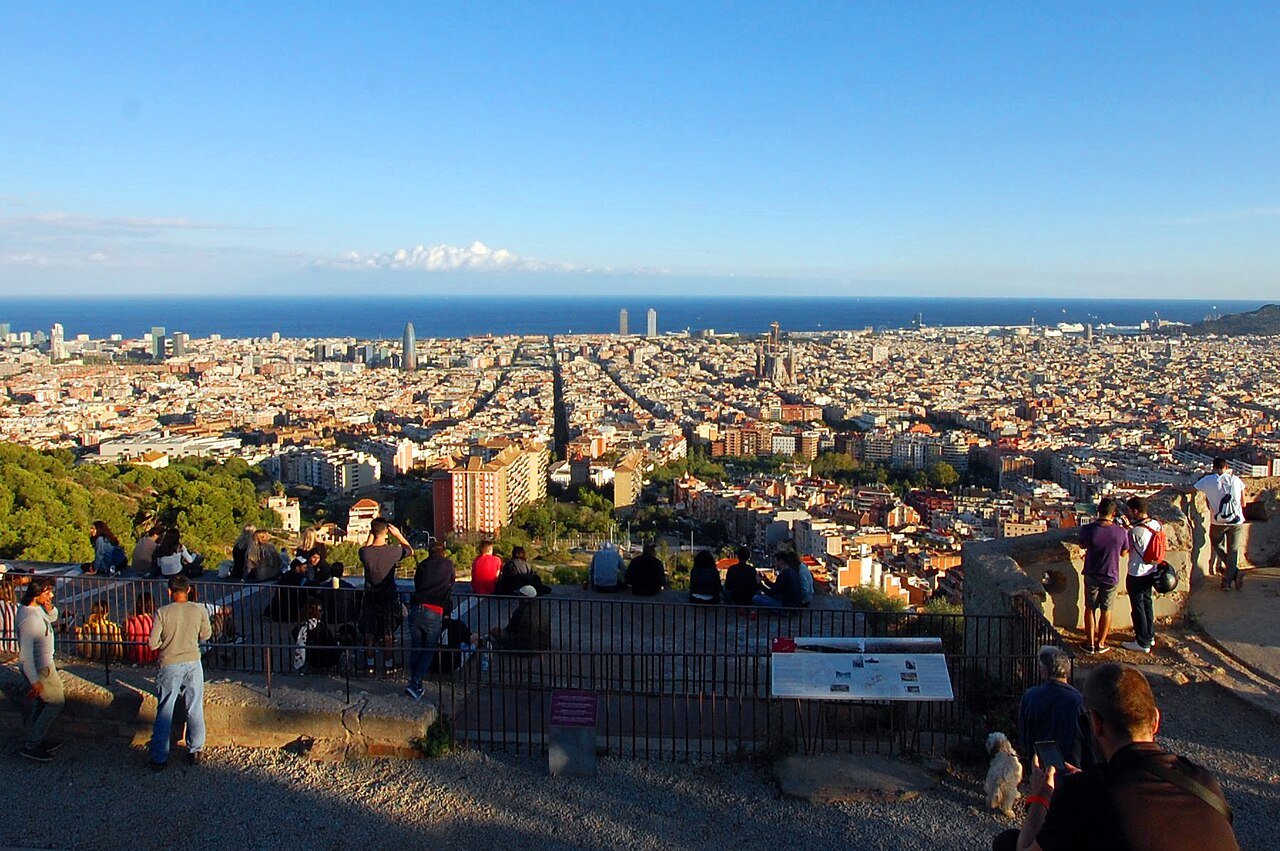
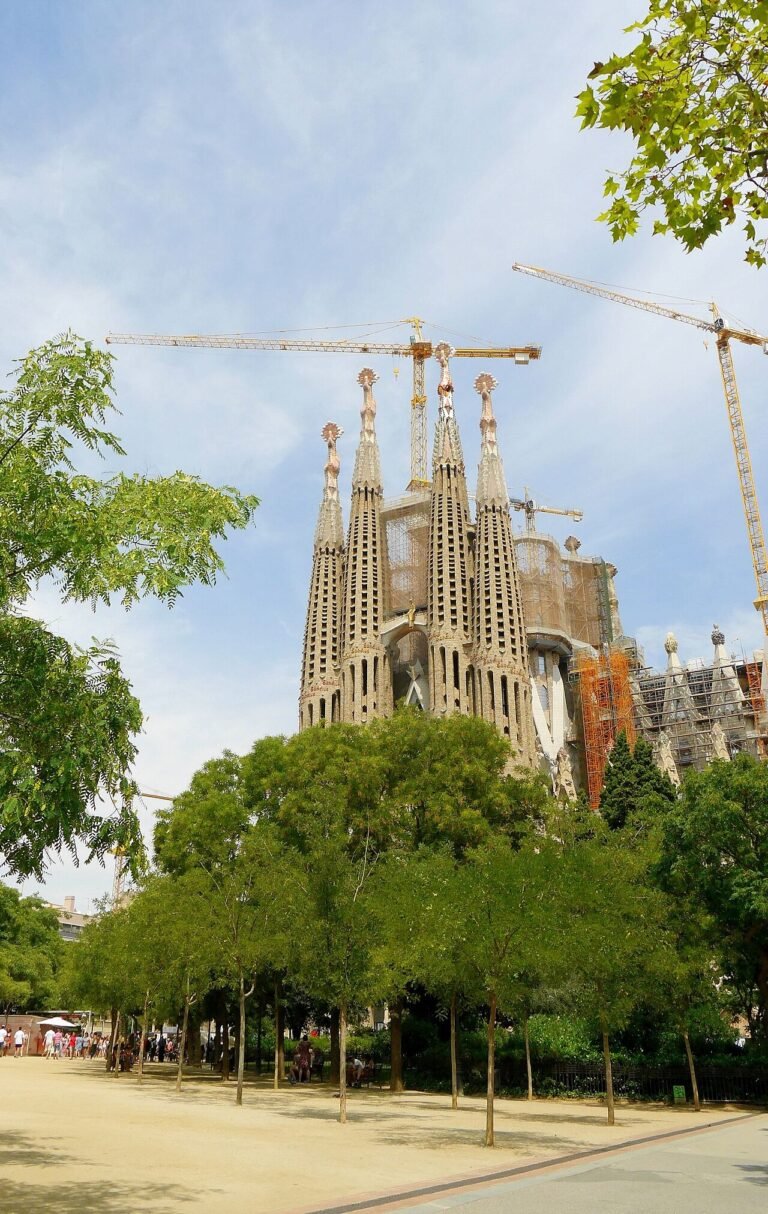
And then there is the reason half of Barcelona has climbed here at least once. Stand on the top platform and turn slowly. South, the famous money shot: the Eixample grid running in perfect chamfered blocks down to the sea, with the Sagrada Família rising from it unmistakable, Torre Glòries — the bullet-shaped tower — marking the grid’s eastern edge, and on the seafront the twin towers of the Olympic port, the Torre Mapfre and the Hotel Arts, with the harbour and Montjuïc closing the view to the right. East and north the city thickens into the working districts — Horta, Sant Andreu — and climbs to the other two of the Tres Turons. West, your back to the sea, the panorama reverses: the ridge of Collserola fills the horizon, the Torre de Collserola needle and the Sagrat Cor church on Tibidabo above it all, and planes on their long approach to El Prat crossing the sky in front of you.

What makes this view different from the city’s other lookouts — Montjuïc’s terraces, the Park Güell bench, Tibidabo itself — is the combination of height and closeness. You are high enough to hold the whole city in one turn, and near enough to read it: the avenues line up, the old town shows as a darker knot in the grid, the beaches draw their long pale line. Do one slow circuit when you arrive and another before you leave; the hill rewards the second look, when the landmarks have become a map you know.
Sunset: The Ritual and the New Rules
For a decade the bunkers’ sunset was Barcelona’s worst-kept secret: every fine evening, hundreds of people — students, couples, half the city’s visitors under twenty-five — climbed with drinks and guitars to watch the light go down over Collserola and the city turn to embers below. It was glorious, and it was unsustainable. The crowds partied on into the night on a protected monument, above the homes of El Carmel, and the noise, litter and damage became the neighbourhood’s nightly grievance.
So the rules changed, and any honest guide now has to lead with them. Since May 2023 the summit has been fenced and gated: the site opens in the morning and closes in the early evening — the published schedule has run to 7.30pm in summer and 5.30pm in winter, varying by season, so check the current hours on the MUHBA site before you plan a sunset visit. In summer the maths works — the sun sets well before closing and the ritual survives, tidier and wardened. In winter, sunset and closing time collide, and the evening show belongs to the streets below the gate. The spirit of the new regime is simple and fair: this is a museum and a monument that happens to be outdoors, in a neighbourhood that lives underneath it. Come for the light, take everything you brought back down with you, keep the volume at conversation level, and leave when the wardens call time — the hill has hosted enough history without adding ours.

Getting There: The Climb
There is no lift, no funicular and no café at the top: the bunkers are reached the way everything on this hill has always been reached, on foot, uphill. Plan the climb as part of the visit — it is twenty honest minutes from the nearest transport.
By metro and foot. The yellow line (L4) serves the hill’s eastern side: from Alfons X or Guinardó | Hospital de Sant Pau it is a fifteen-to-twenty-minute walk, climbing through the Guinardó streets to the summit paths. From the blue line (L5) at El Carmel, the walk is similar in length and steeper in feel, up through the Carmel streets — the route that finishes, as almost every route does, on Carrer de Marià Labèrnia, the lane that climbs the last stretch to the site entrance with the battery appearing above the rooftops.

By bus, and the scenic traverse. The 24 bus climbs to Park Güell guide and on to El Carmel; ride it to the park and walk east along the hill paths — about twenty minutes of ridge-walking with the view opening as you go. It is the prettiest approach and the one that pairs the two sights, below. By taxi, ask for the Bunkers del Carmel / Turó de la Rovira and be dropped at the top of the Carmel streets; you will still have the last short climb on foot. Wear shoes with grip — the summit paths are gravel and worn concrete — and carry water: there is no shop on the hill, little shade, and the Barcelona sun at 262 metres is not a metaphor.
Pairing the Visit: Park Güell and Gràcia
The bunkers sit on the same ridge system as the city’s other great hilltop sight, and the classic pairing is a walk, not a transfer. From the summit, paths run west along the heights to Park Güell guide in about twenty minutes — Gaudí’s park approaching from its quiet, free back side, the famous monumental zone below you. Do the bunkers first in the late afternoon, cross to the park, and you have had the city’s two essential hilltops in one outing, with the sunset decision made by the bunkers’ closing time rather than by the crowds.
Then come down into Gràcia guide. The Vila de Gràcia lies at the foot of the hills, twenty minutes’ descent from the park’s lower gates, and it is the perfect landing: squares with terraces, the vermouth hour, dinner on Carrer de Verdi. Hill, park, village — war concrete, mosaic dragons and a neighbourhood that still lives at walking pace — is as complete a Barcelona afternoon as the city offers, and it costs nothing but the optional tickets you choose at the park.
Practical Info
Cost and hours. The site is free — the grounds, platforms and panels carry no charge, and the MUHBA exhibition space on the hill is free to enter when open. The summit is gated: since May 2023 it has opened in the morning and closed in the early evening (published schedules: around 7.30pm in summer, 5.30pm in winter), and the interior exhibition space keeps its own, shorter hours. Both change by season and year — verify on the MUHBA website before building an evening around them.
Facilities. Summit facilities are minimal by design: no café, no shop, no water fountain to rely on, and shade only at the hill’s edges. Bring water and sun protection; the nearest bars and shops are the Carmel and Guinardó streets below.
Access. The visit involves a steep climb and uneven ground — gravel paths, worn concrete, steps without handrails in places. It is not a step-free visit, and it is not one for wheels of any kind beyond the first terrace. Allow an hour at the top, two and a half to three hours door to door from the city centre.
Tips for Visiting
- Time it for late afternoon. The light from about ninety minutes before closing is the light in all the photographs — but check the day’s closing time first, especially in winter, when the gate can shut at sunset itself.
- Read the hill in order. Battery first, tiles second, view last: walk the platforms and the Los Cañones floors with the panels before you settle at the railing, and the panorama will mean more.
- Bring everything, take everything. Water, a layer for the wind that lives at 262 metres, and a bag for your rubbish — there is no shop on the summit and the bins fill fast.
- Be the guest the neighbourhood wants. Quiet voices on the way down, no speakers, nothing left behind: El Carmel’s patience is the reason the site stayed open at all.
- Walk the ridge to Park Güell. The twenty-minute traverse beats any bus between the two sights, and it keeps you in the view the whole way.
- Go on a clear morning for the map. Sunset is for atmosphere; a bright morning is when the 360° reading of the city — every tower, avenue and beach — is at its sharpest.
Travel insurance, sorted
Whether it is a two-week holiday or a longer move, travel insurance is not the most glamorous part of a trip — but it is the one booking you want to have in place before a trip, and while you are already away.
Final Thoughts
The Bunkers del Carmel are the rare sight that improves the more of its story you know. The concrete rings are guns, the tiles are kitchens, the tank is a neighbourhood’s water and the crowd at the railing is only the latest of the hill’s congregations — Iberian lookouts, Republican gunners, Andalusian families, and now the whole city at golden hour. Barcelona has grander monuments and more famous views, but it has nothing else quite like this: its hardest century, laid out in one panorama, free to anyone willing to climb. Go up in the late light, read the hill properly — and when the wardens call time, walk down into Gràcia for dinner, and raise the vermouth to Los Cañones.
¡Buen viaje!

Photo credits: The viewpoint crowd above the city — Malet, CC BY-SA 4.0 · The Turó de la Rovira above El Carmel — Pere López Brosa, CC BY-SA 4.0 · The battery from Parc del Guinardó, the gun platforms, the barracks building, the shanty-town floors, the gun pit and water tank, and Carrer de Marià Labèrnia — Enric, CC BY-SA 4.0 · The gun platform from above and the tiled shanty floor — Benjamín Núñez González, CC BY-SA 4.0 · The restored battery — Kippelboy, CC BY-SA 3.0 · The gun platforms and the panorama — Toniher, CC BY-SA 3.0 · The sunset crowd on the platforms — Barcelonatips, CC BY-SA 4.0. All via Wikimedia Commons.



2 Comments