Park Güell: The Complete Visitors’ Guide
Most parks have a gate. Park Güell has a staircase guarded by a dragon. You come up the hill from Gràcia, pass between two gingerbread pavilions that look baked rather than built, and climb a white double stairway split by fountains — a Medusa head spouting water, a shield of Catalonia, and halfway up, the most photographed lizard on earth: a three-metre salamander skinned in broken-tile mosaic, grinning at the crowds it has charmed for over a century. Behind it, a forest of stone columns holds up a plaza the size of a village square, ringed by a bench that wriggles like a sea serpent and looks out over the whole of Barcelona to the sea. This is the park I send everyone to — not despite the fact that it began life as a failed housing estate, but partly because of it. Everything here was meant to be somebody’s front garden. It just happens to be the front garden Antoni Gaudí designed.
This guide is the visit the way I walk it myself: the story in brief, then everything worth your time in the order you will meet it — the dragon and the stairway, the Hypostyle Hall, the great plaza and its bench, the stone viaducts most visitors never find, Gaudí’s own house, and the free hilltop above it all. It also gives you the honest practical picture, because Park Güell has one rule that catches people out every single day: the famous centre of the park is ticketed and timed, and the people turned away at the rope are always the ones who assumed they could just wander in. It sits near the top of our Best Things to Do in Barcelona guide — read this first, book the ticket, and the park is pure pleasure.

The Short Answer
Yes — Park Güell is unmissable, it deserves two to three hours, and you must book the Monumental Zone ticket in advance. The park has two parts. The wooded hillside around the edges — paths, viaducts, viewpoints — is a public park and free to everyone. But the famous core around the entrance — the stairway and El Drac, the Hypostyle Hall, the great plaza with the serpentine bench — is the regulated Monumental Zone: entry is by timed ticket only, visitor numbers are capped each hour, and in high season the slots sell out days ahead. Booked ahead GetYourGuide – Park Güell entry, it currently costs €18 (€13.50 for children and seniors) and the booking takes two minutes; turned up without one, you may be offered a slot hours later or none at all. Go for the first entry of the day if you can — the light is golden, the bench is empty enough to sit on, and the dragon is not yet wearing a crowd.
Table of Contents
- The Short Answer
- The Story in Brief: The Garden City That Failed
- What to See: The Entrance, the Dragon and the Stairway
- What to See: The Hypostyle Hall
- What to See: The Greek Theatre and the Serpentine Bench
- What to See: The Viaducts and Walkways
- What to See: The Gaudí House Museum
- What to See: The Free Zone and the Views
- Practical Info
- When to Go
- Tips for Visiting
- Final Thoughts
The Story in Brief: The Garden City That Failed
In 1900 the textile magnate Eusebi Güell — Gaudí’s great patron, the man behind the Palau Güell and the Colònia Güell crypt — bought a bare, rocky hill above Gràcia called the Muntanya Pelada, the Bald Mountain, and hired Gaudí to do something fashionable and very English with it: a garden city. Güell had admired England’s garden suburbs and wanted Barcelona’s version — some sixty large plots among gardens and pine trees, each with views over the city to the sea, served by winding carriage roads, with the shared spaces — entrance, stairway, market hall, theatre plaza — designed by Gaudí as the estate’s public rooms. Work ran from 1900 to 1914, and Gaudí, by then in his fifties and at the height of his powers, poured into those shared spaces some of the most joyful architecture ever made.
The houses, though, did not sell. Barcelona’s rich preferred the flat, fashionable grid of the Eixample to a steep hill on the city’s edge, and of the sixty plots exactly two houses were ever built: one for the lawyer Martí Trias — still standing, pink and handsome, at the edge of the plaza — and a show house meant to tempt buyers. Nobody bought the show house either. In 1906 Gaudí bought it himself and moved in with his father and niece; he lived there for almost twenty years, until 1925, walking down the hill each day to the Sagrada Família works. By 1914 Güell had accepted defeat and stopped the project. After his death the city bought the estate, and in 1926 the failed garden city opened as what it had secretly always wanted to be: a public park. In 1984 UNESCO made it a World Heritage Site. The housing scheme failed completely; the park won completely.

What to See: The Entrance, the Dragon and the Stairway
The main entrance, on the Carrer d’Olot, is a piece of theatre before it is a doorway. The iron gates swing between two small pavilions with roofs like spun sugar and caramel — stone and tile twisted into the shapes of toadstools and storybooks. The bigger one, with the tall tiled spire, was the porter’s lodge; its smaller brother across the steps housed the estate’s administration and waiting room. They are the first thing the garden city’s buyers would have seen, and they set the terms of the whole park: nature, but nature as Gaudí dreamed it, all curves and colour and not one straight line where a bent one would do.
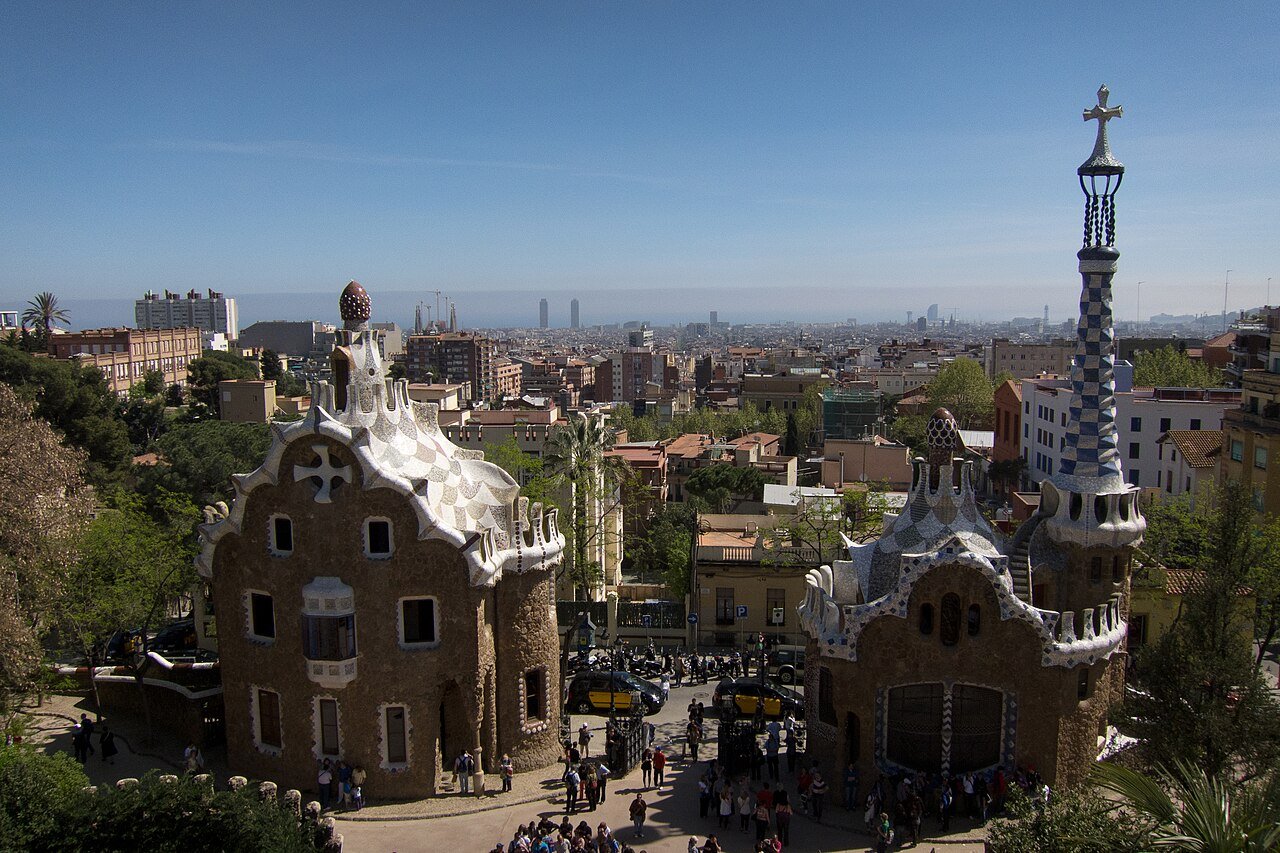
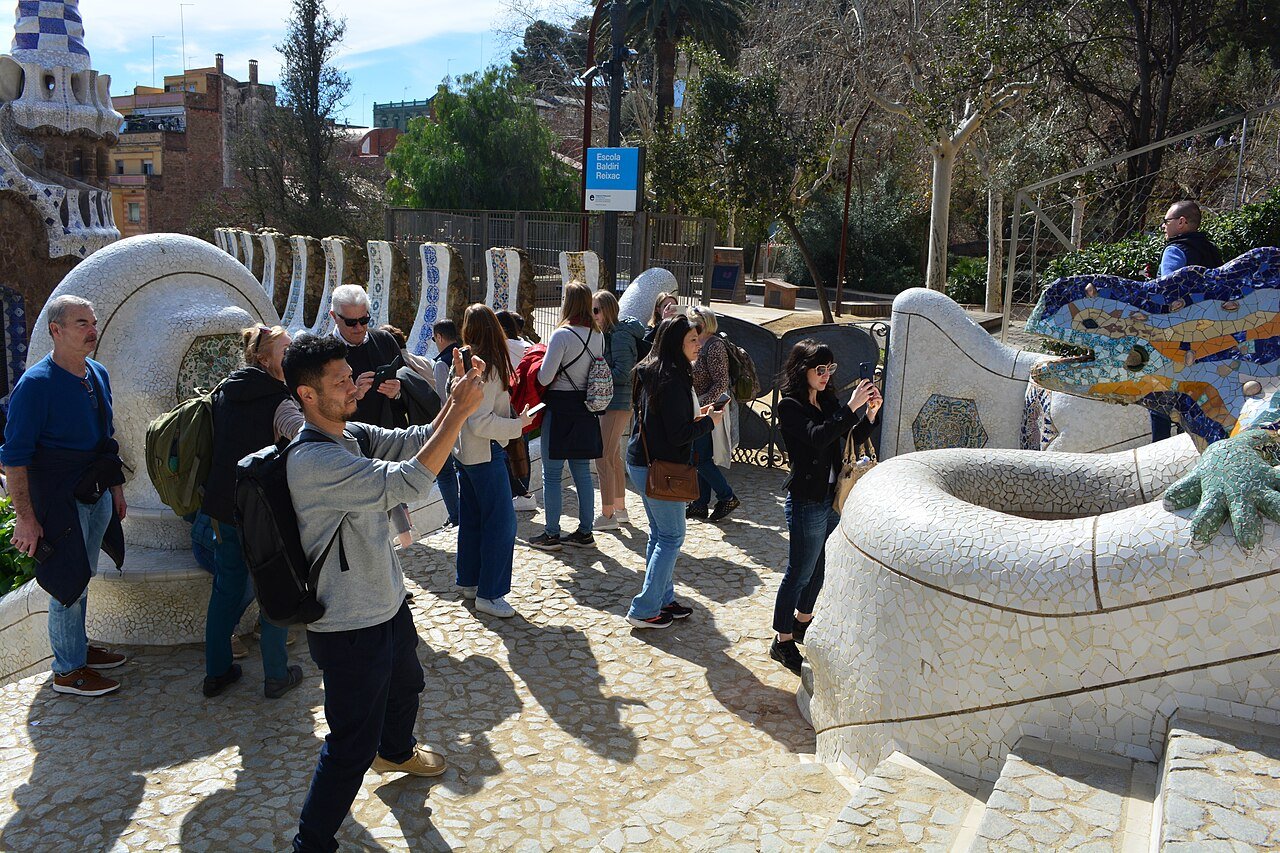
Between them rises the entrance stairway, a broad double flight of white steps climbing to the Hypostyle Hall above, and it is best read as a story in three fountains. At the bottom, water runs through a cascade of rocks and a circular mosaic medallion. Halfway up, the steps divide around a fountain carrying the shield of Catalonia and a serpent-like Medusa head that spouts the water down. And on the landing above sits El Drac — the Dragon, though everyone who meets him calls him a salamander, and the whole city calls him the park’s symbol. He is skinned in trencadís, the broken-tile mosaic Gaudí and his collaborator Josep Maria Jujol made from smashed ceramics, and his water — the overflow of the great cistern beneath the plaza, as practical as everything here is secretly practical — runs from his mouth. There is almost always a small queue to be photographed with him. Join it or don’t; he has been posing since 1906 and is in no hurry.

What to See: The Hypostyle Hall
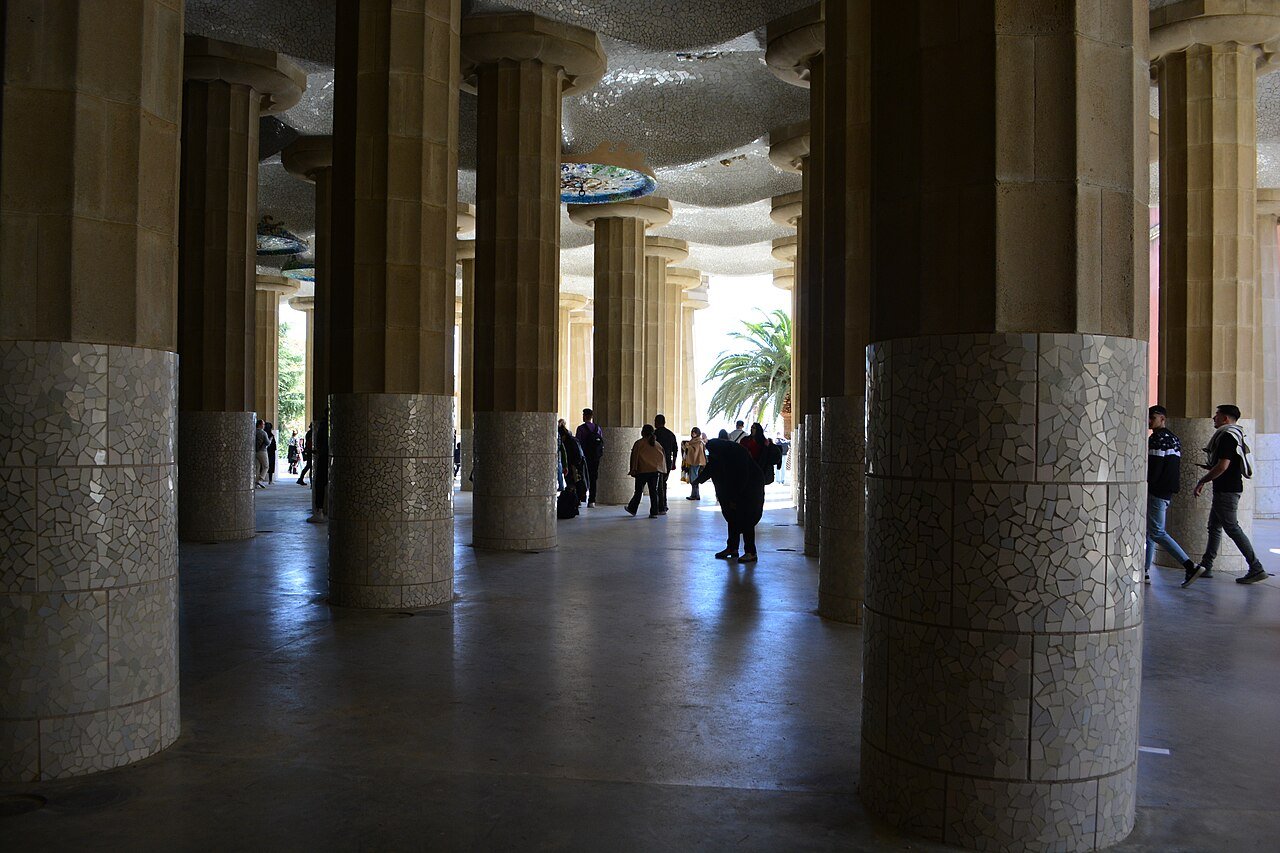
At the top of the stairway the park changes key, from fairy tale to temple. The Hypostyle Hall — the Sala Hipòstila — is a forest of 86 fluted Doric columns of stone-coloured concrete, holding up the great plaza above. It was designed as the garden city’s market: the residents would have bought their bread and olives here, in cool shade, whatever the weather was doing on the hill. A market that looks like a Greek temple is a joke only Gaudí would build at full size, and walking through it, with the columns striding away in every direction, is one of the park’s great pleasures — it is the calmest, coolest space in the Monumental Zone, and musicians know it, which is why there is so often a guitar somewhere among the columns.

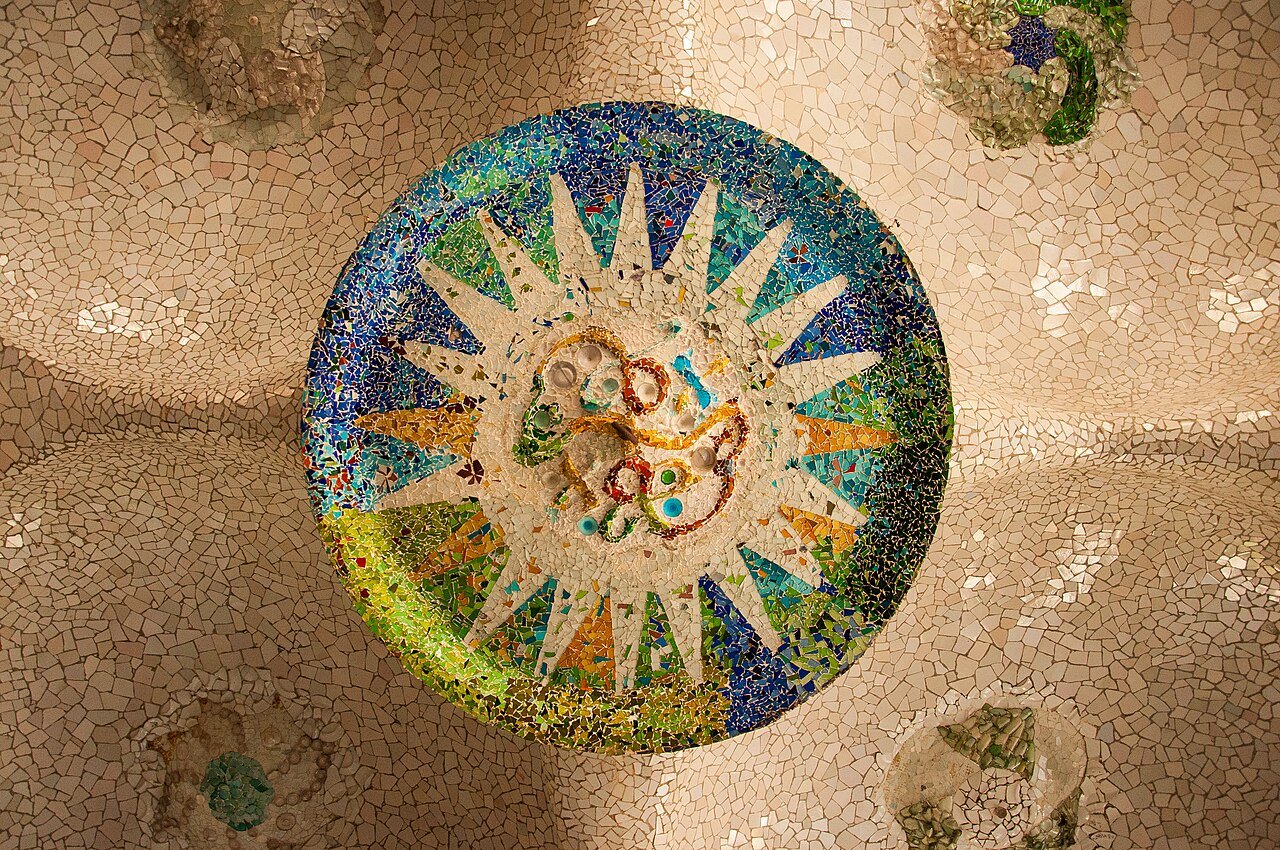
Look up before you leave. Set into the ceiling are rosettes of coloured trencadís — suns and moons and swirling medallions made by Jujol out of tile shards, bottle glass and whatever else the workshop floor offered. And look down, too, at what you cannot see: beneath the hall’s floor is the park’s great cistern, which gathers the rain that falls on the plaza above and once supplied the estate’s water, the surplus spilling out through El Drac’s mouth on the stairway. Gaudí’s nature was never just decoration. In this park, the dragon is part of the plumbing.
Free Barcelona travel guide
Planning a trip to Barcelona? Get our free one-page Barcelona checklist: what to book ahead, what to skip, and the tapas bars we actually eat in.
What to See: The Greek Theatre and the Serpentine Bench
Climb the side stairs from the hall and you surface in the park’s great room: the Nature Square, the Plaça de la Natura, originally designed as a Greek Theatre — an open-air stage for the garden city’s concerts and gatherings, built on an ancient Greek model with the audience looking out as well as in. It is a vast oval of packed earth, some 3,000 square metres, and its floor is the roof of the Hypostyle Hall and the cistern below. Half the square is carved into the hillside; the other half stands on the columns — which is why its edge floats over the city like a balcony.
That edge is the famous one. Running around it is the serpentine bench, some 110 metres of continuous, wriggling seat, often called the longest bench in the world. Its back is a wave of trencadís — thousands of broken tiles in blues, greens, suns and abstract swirls, much of it laid by Jujol, who is said to have sent workers to gather the city’s discarded ceramics for it. The bench is cleverer than it looks: its curves are shaped to the human back — Gaudí is said to have taken the mould from the imprint of a workman sitting in wet plaster — its slight outward tilt sheds the rain, and drainage holes keep the seat dry. Sit down. The view is the one on every postcard: the two pavilions below like toys, the whole grid of the Eixample running down to the sea, the Sagrada Família’s towers rising out of it, and on a clear morning the Mediterranean doing its flat blue best at the end of every street.

What to See: The Viaducts and Walkways
Now leave the crowds their plaza and go and find the park almost nobody walks. To move carriages — and now visitors — around a steep, rocky hill, Gaudí built a network of stone viaducts and ramped paths out of the hill itself: rough, uncut stone, slanted columns leaning like tree trunks, parapets that grow out of the rock in waves. The Viaducto de las Flores carries its path on mushroom-capped columns like a stone forest; the Camino de las Palmeras runs beneath palms along the hillside; and the portico of La Bugadera — the Washerwoman, named for the one column carved, if you look, into a woman with her washing bundle — holds up the path on a row of leaning stone pillars, a tunnel of cool shade on a hot day. These paths are in the free zone, they are half the park’s genius, and on a busy afternoon they can be nearly empty.


What to See: The Gaudí House Museum
Up in the free zone, among the pines, stands the pink house with the little spire — the garden city’s unsold show house, which Gaudí bought and lived in from 1906 to 1925. A small honesty about this one: the house was designed not by Gaudí but by his assistant Francesc Berenguer, and it is a separate museum with its own ticket — your Park Güell entry does not include it, and it is run by the Sagrada Família’s foundation, not by the park. Inside are rooms furnished with pieces Gaudí designed — the sinuous furniture of his great years — and his own sparse bedroom and study, preserved from the years when he lived here almost like a monk, walking down to the church site every morning.
Is it worth the extra ticket? If you are a Gaudí devotee, yes without hesitation — this is where the man actually lived, and it is the most human of all his houses. If time or budget is tight, the honest answer is that the park itself is the masterpiece and the house the footnote: photograph the pink façade and garden, and spend the ticket money on the Sagrada Família instead.

What to See: The Free Zone and the Views
Do not let the ticket rope fool you into thinking the park ends at the plaza. Most of Park Güell — the pine woods, the viaducts, the upper paths — is the free municipal park, and it holds the best views of all. The paths climb through rosemary and pine to the Turó de les Tres Creus, the Hill of the Three Crosses, the park’s highest point. Gaudí had planned a chapel for this summit; the money and the moment passed, and instead there is a small stone Calvary of three crosses, one of them tipped like an arrow. From here the panorama is the full 360: the sea and the port, the Eixample grid with the Sagrada Família standing out of it, Montjuïc across the city, and the Collserola hills at your back. At sunset, with the tour groups gone from the plaza below, this is where I would have you end the visit — the free zone, freely giving the best seat in the park.

Practical Info
Tickets and the timed-entry rules. The Monumental Zone — entrance stairway, Hypostyle Hall, plaza and bench, and the paths immediately around them — admits ticket holders only, in timed slots, with numbers capped to protect the mosaics. The rules that matter: book online in advance GetYourGuide – Park Güell entry(€18 at the time of writing; the official site and authorised sellers carry the same slots); arrive at the checkpoint within your entry window — staff scan tickets at the zone’s gates, and late arrivals are not guaranteed entry; once inside you may stay until the park closes, but if you leave the zone you cannot re-enter on the same ticket. The rest of the park is free and open to all, dawn to closing. (Barcelona residents have their own free-access arrangements; they do not transfer to visitors, so do not count on them.)
Getting there — honestly. The park sits on a hill, and every route involves some uphill; the only question is how much Gaudí does for you. Metro Lesseps (L3) is the most-used stop: from there it is a ten-to-fifteen-minute walk, level at first along Travessera de Dalt and then properly uphill up the Carrer de Larrard to the main entrance — manageable, but you will feel it in August. Metro Vallcarca (L3) is the connoisseur’s route: the walk is shorter and the Baixada de la Glòria has public escalators climbing much of the hill for you — with the honest caveat that they are ordinary street escalators, occasionally out of service, and the last stretch to the Passatge de Sant Josep de la Muntanya entrance is still a climb. If you are coming by bus, the H6 and D40 stop on Travessera de Dalt below the park, and there is a shuttle for ticket holders from Alfons X metro (L4) — the easiest ride of all, and worth checking when you book. Taxis and ride-hails can drop you at the Carretera del Carmel entrance on the park’s upper side, which skips the climb almost entirely.
Which entrance for which arrival. From Lesseps or on foot from Gràcia, use the main entrance on Carrer d’Olot — the pavilions and the stairway, the full theatrical start. From Vallcarca and the escalators, you enter at Sant Josep de la Muntanya, near the Casa Trias and the plaza’s edge. By taxi or bus on the Carmel side, the Carretera del Carmel entrance drops you near the top of the park — walk down through the free zone to the plaza. All entrances lead into the free park; the ticket checkpoints are at the Monumental Zone’s own gates.
Facilities. There are toilets near the main entrance and by the plaza, a small book-and-gift shop in the porter’s lodge pavilion, a café terrace by the Carretera del Carmel entrance and drinking fountains along the paths — but the park is short on shade-and-sit-down food options inside the monumental core, so bring water in summer and plan lunch in Gràcia before or after. The monumental core has steps everywhere by design; step-free access to the plaza level exists via the upper entrances, but the stairway, the dragon and the viaducts are unavoidably stepped and sloped.
When to Go
First slot of the day, if you can. The monumental gates currently open at 9:30 — earlier in high summer; check when you book — and the first hour is the park as it should be: the bench empty enough to sit anywhere along it, the light lying gold across the plaza. Late afternoon is the other sweet spot, when the day-trippers drain away and the light off the sea turns the mosaics warm — and it pairs naturally with a climb to the Tres Creus for sunset afterwards. Midday, especially from May to September, is the worst of it: full slots, full sun, and a queue for a photograph with a salamander. Spring and autumn are kindest; our Best Time to Visit Barcelona guide sets the park against the city’s seasons.
Tips for Visiting
- Book the ticket before you book anything else in Barcelona. Of all the city’s sights, this is the one where “we’ll just turn up” fails most completely. A day or two ahead in winter, the better part of a week in summer.
- Do the Monumental Zone first, the free zone second. Your ticket time is fixed; the hilltop is not. Plaza, bench, hall and dragon while your slot is fresh, then wander the viaducts and climb to the Tres Creus at your own pace.
- Give it two to three hours in total. Ninety minutes for the monumental core and the museum if you add it; another hour for the paths and the summit. It pairs naturally with an afternoon in Gràcia below.
- Sit on the bench properly. It is furniture, not a photo backdrop — sit, lean back into the famous curve, and take the view in. The right-hand end, near the plaza’s edge, is usually the quietest.
- Bring water and wear real shoes. The park is a hill wearing a mosaic dress: gravel paths, stone steps and slopes everywhere, and precious little shade at midday.
- Combine it with the Sagrada Família on the same day only if you must. They are the two great Gaudí sights but they are not neighbours, and both deserve fresh eyes; our How Many Days in Barcelona guide shows the saner pairing — Park Güell with Gràcia in the morning, the church on its own day.
Travel insurance, sorted
Whether it is a two-week holiday or a longer move, travel insurance is the one booking not to skip. We point readers to SafetyWing’s Nomad Insurance — cover built for travellers, remote workers and longer stays abroad, on a flexible monthly subscription you can start before a trip or while you are already away. Get a quote from SafetyWing
Final Thoughts
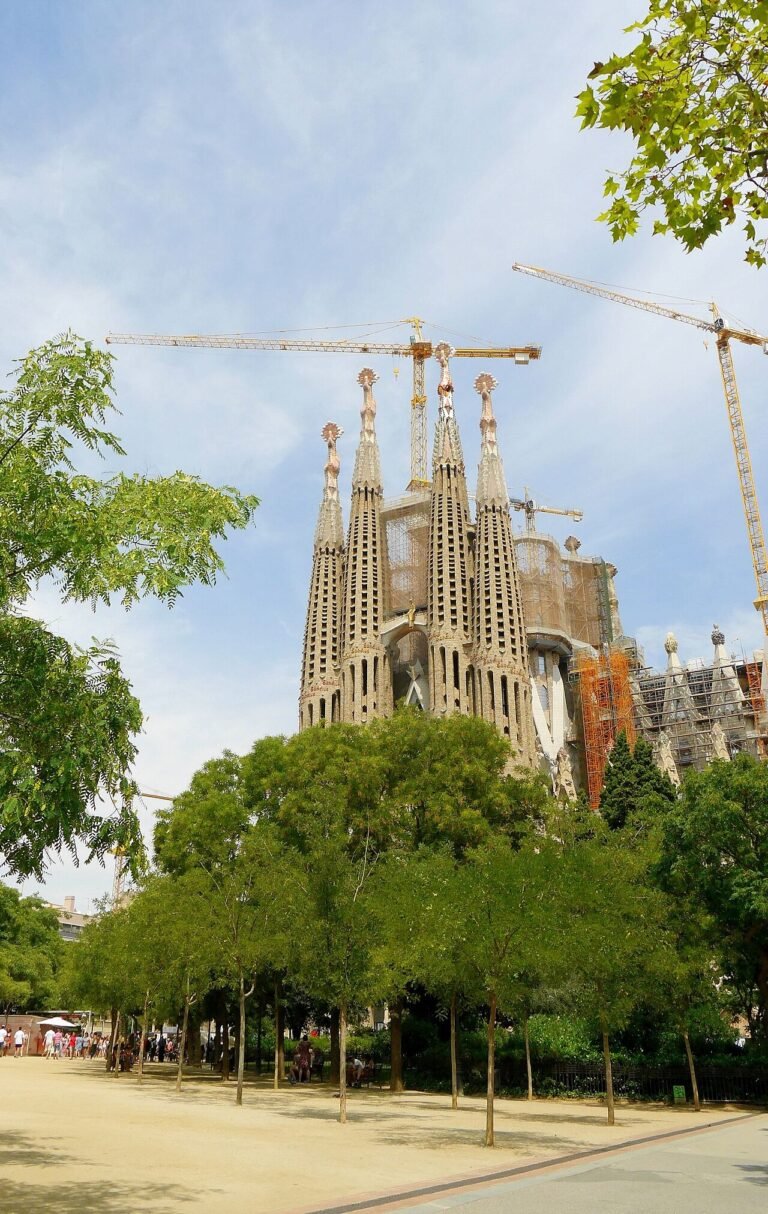
Park Güell is the happiest failure in architecture. A housing estate that sold two plots became the park a whole city picnics in; a market hall became a temple of columns; the overflow of a water tank became a dragon the world queues to meet. Come early, sit on the bench, walk the stone viaducts nobody else bothers with, and finish on the hill of the three crosses with the whole city at your feet. And when you are ready for the other end of Gaudí’s life — the park was his exuberant middle, the church his consuming end — our Inside the Sagrada Família guide and the Sagrada Família Towers guide walk you through the GetYourGuide – Sagrada Família entry that completes the story. The garden city failed. Barcelona won. Go and sit in the winnings.
¡Buen viaje!

Photo credits: The Nature Square and serpentine bench — Baikonur, CC BY-SA 3.0 · The entrance pavilions — Thomas Quine, CC BY 2.0 · The entrance stairway fountains — Joe Mabel, CC BY-SA 4.0 · El Drac — Isiwal, CC BY-SA 3.0 · The Hypostyle Hall from below — Joe Mabel, CC BY-SA 4.0 · Inside the Hypostyle Hall — Joe Mabel, CC BY-SA 4.0 · The Hypostyle ceiling rosette — Delialendeczki, CC BY-SA 3.0 · The serpentine bench detail — Joe Mabel, CC BY-SA 4.0 · The bench and Casa Trias — Txllxt TxllxT, CC BY-SA 4.0 · The Viaducto de las Flores — AxaxaxaxMlö, Public domain · The Bugadera portico — Txllxt TxllxT, CC BY-SA 4.0 · The Gaudí House Museum — Kristoffer Trolle, CC BY 2.0 · The Turó de les Tres Creus — The ed17, CC BY-SA 4.0. All via Wikimedia Commons.


11 Comments