Best Things to Do in Barcelona at Night: 15 Ways to Own the Evening, From Sunset Onwards
Most visitors meet Barcelona in daylight — the queues, the cruise crowds, the midday glare off the Eixample’s pavements — and then, sometime around their second evening, they discover that the city they came for was the night one all along. Barcelona runs on a clock several hours behind the one tourists bring with them. Dinner starts when other cities are washing up. The great concert halls and the opera house raise their curtains as the day-trippers leave. Gaudí’s houses, freed from the daytime crowds, stage their most theatrical visits after dark. And above it all, on a Civil War gun platform and a funfair mountain and a working observatory, the city lays out its favourite trick: itself, lit up, from above.
This guide is the evening half of a Barcelona trip, organised as fifteen complete nights out rather than a list of bars. It starts where every Barcelona evening should start — watching the sun go down — and runs through fountain shows and flamenco, opera intervals and observatory telescopes, sunset sails, ten-o’clock dinners and lamplit villages, to the small hours. It also covers the machinery that makes or breaks a night here: when things actually happen, how dinner timing works, and how you get home afterwards.
If you book only one ticket in this guide, make it the smallest and the most Barcelona of them: Barcelona: Flamenco Show at Palau Dalmases Fifty minutes of flamenco — one singer, one guitarist, two dancers — in the candlelit Baroque hall of a 17th-century palace on Carrer de Montcada, with the palace’s art gallery thrown in. It is rated 4.6/5 from more than 1,400 reviews, runs four times a night, and cancels free of charge up to 24 hours ahead. Everything else in this guide is free, or nearly; this is the one worth paying for first.
Table of Contents
- The Quick Verdict
- How a Barcelona Night Works: Timing, Dinner and Getting Home
- 1. Sunset at the Bunkers del Carmel
- 2. The Magic Fountain of Montjuïc
- 3. La Pedrera Night Experience: Gaudí by Night
- 4. Casa Batlló After Dark: Night Visits and Rooftop Concerts
- 5. Flamenco in a Baroque Palace: Palau Dalmases
- 6. A Concert at the Palau de la Música Catalana
- 7. Opera Night at the Gran Teatre del Liceu
- 8. La Rambla and the Gothic Quarter After Dark
- 9. Tibidabo: The Funfair Above the Lights
- 10. Stargazing at the Fabra Observatory
- 11. A Sunset Sail Off the Coast
- 12. The Beach After Dark: Barceloneta and the Chiringuitos
- 13. Dinner at Ten: The Tapas Crawl
- 14. Rooftop Terraces Over the Old Town
- 15. Poble Espanyol: The Village That Wakes Up at Night
- Which Night Suits You?
- Night Costs, Honestly
- Final Thoughts
- FAQs: Barcelona at Night

The Quick Verdict
Short on evenings? Spend them like this. One night: sunset at the Bunkers del Carmel, then down into the old town for the 9:15pm flamenco at Palau Dalmases and dinner afterwards — the full Barcelona arc, hilltop to tablao to table, in five hours. Two nights: add the Magic Fountain on a show night, paired with the La Pedrera Night Experience across town. Three: give the third evening to music — a concert at the Palau de la Música or an opera at the Liceu — and finish with a slow walk down a lamplit La Rambla. Everything else in this guide is how you spend nights four to fifteen, and how you repeat the good ones.
How a Barcelona Night Works: Timing, Dinner and Getting Home
Three facts organise every night in this city, and visitors who learn them stop fighting the place and start enjoying it. The first is that the evening begins late and in two acts. Sunset — the hinge of the whole night — swings wildly across the year in Barcelona, from around half past five in December to half past nine in late June, so “evening” is a season, not a time. The second act is dinner, and it is later than you think: restaurant kitchens generally open around 8pm, and locals sit down between nine and ten. Arrive at a good restaurant at seven and you will eat alone, from a menu the kitchen is still waking up to; the city’s real dinner rush is at ten, and nobody will hurry you out of your table afterwards.
The second fact is that the headline night sights run on calendars, not clocks. The Magic Fountain performs only on certain evenings, the observatory opens its dome on certain nights, the funfair keeps its longest hours in high summer, and the Gaudí houses’ night formats sell out days ahead. A Barcelona night is therefore planned backwards: fix the one ticketed or calendar-bound thing first, then build the sunset and the dinner around it.
The third fact is merciful: getting home is easy. The metro runs until midnight on weeknights, until 2am on Fridays, and — the detail that makes Saturday the city’s great night out — continuously all night on Saturdays and on the eves of the biggest festivals, at the time of writing. Night buses (the Nitbus network) cover the gaps, and the old town, the Eixample and the beach are all walkable from each other in any case. One unglamorous warning, because it belongs in any honest night guide: Barcelona’s pickpockets work the same hours as everyone else, and they work La Rambla, the metro and crowded viewpoints hardest. A zipped bag, a phone kept off café tables, and the same city sense you would use in any capital will cover you.
1. Sunset at the Bunkers del Carmel
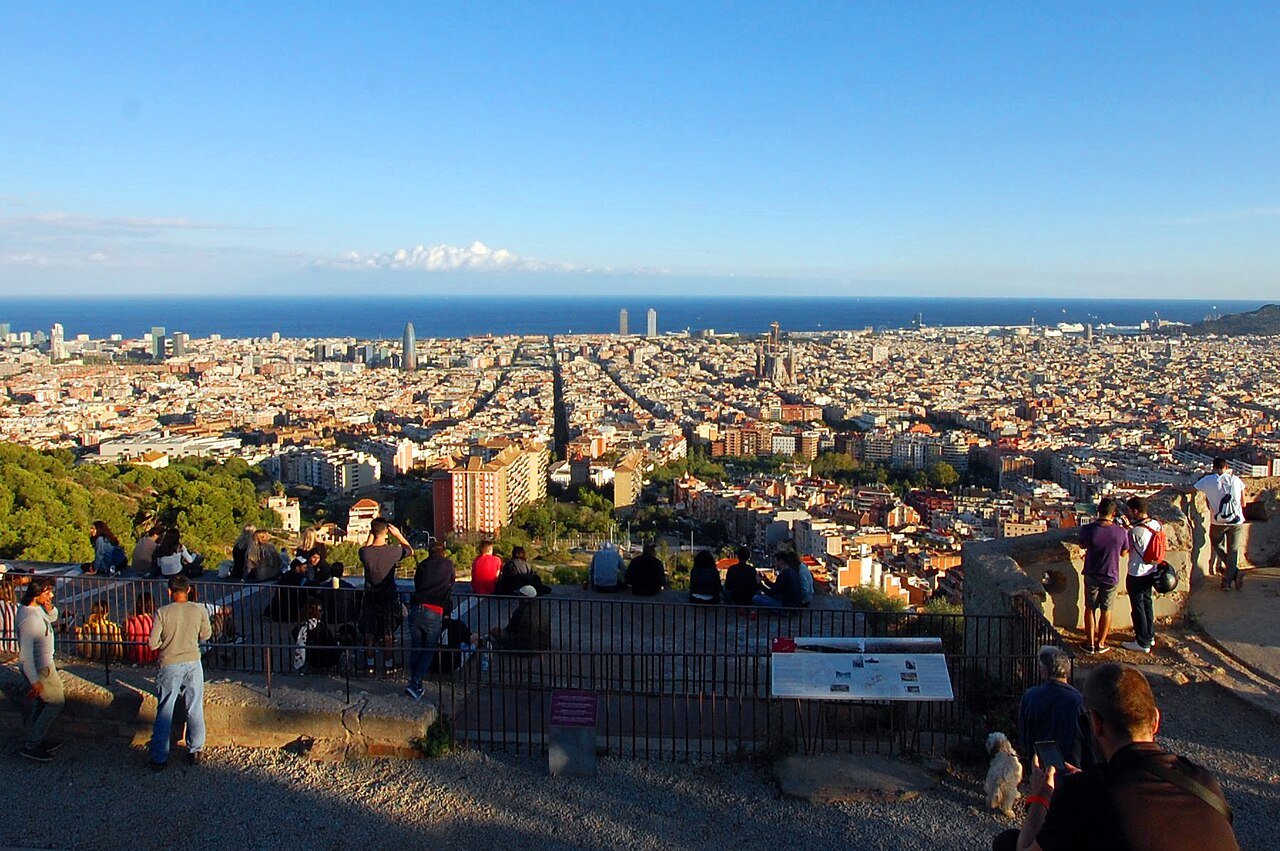
Every Barcelona evening worth having starts on a gun platform. The Bunkers del Carmel are the remains of an anti-aircraft battery built in 1937–38, during the Spanish Civil War, on the Turó de la Rovira — a bare hill 262 metres above the city, chosen because it commands a complete 360-degree view of Barcelona, which made it first an excellent place to defend the city and now the best place in it to watch the city turn on its lights. The guns are long gone. The concrete platforms remain, and every clear evening they fill with the city’s young and its visitors, sitting on the warm concrete with the whole grid of the Eixample, the Sagrada Família, the towers of the seafront and the Mediterranean laid out in front of them, waiting for the light to do its work.
There is no ticket, no turnstile and no programme: the show is the sunset itself, and the sequel — the half-hour afterwards, when the sky goes indigo and the streetlights come up across the grid in sequence, is arguably better. Arrive at least half an hour before sunset to claim a place on the platforms; the little exhibition the city history museum keeps in the battery’s old quarters runs to museum hours, so see it on a separate morning if it interests you, and combine the climb with the neighbourhood at the hill’s feet using our Bunkers del Carmel guide. The honest costs of the evening are a bus or taxi up (the hill is a climb, and the nearest metro stations leave you a stiff walk) and whatever picnic you carry. Of the fifteen nights in this guide, this is the one Barcelonans themselves would choose.

2. The Magic Fountain of Montjuïc
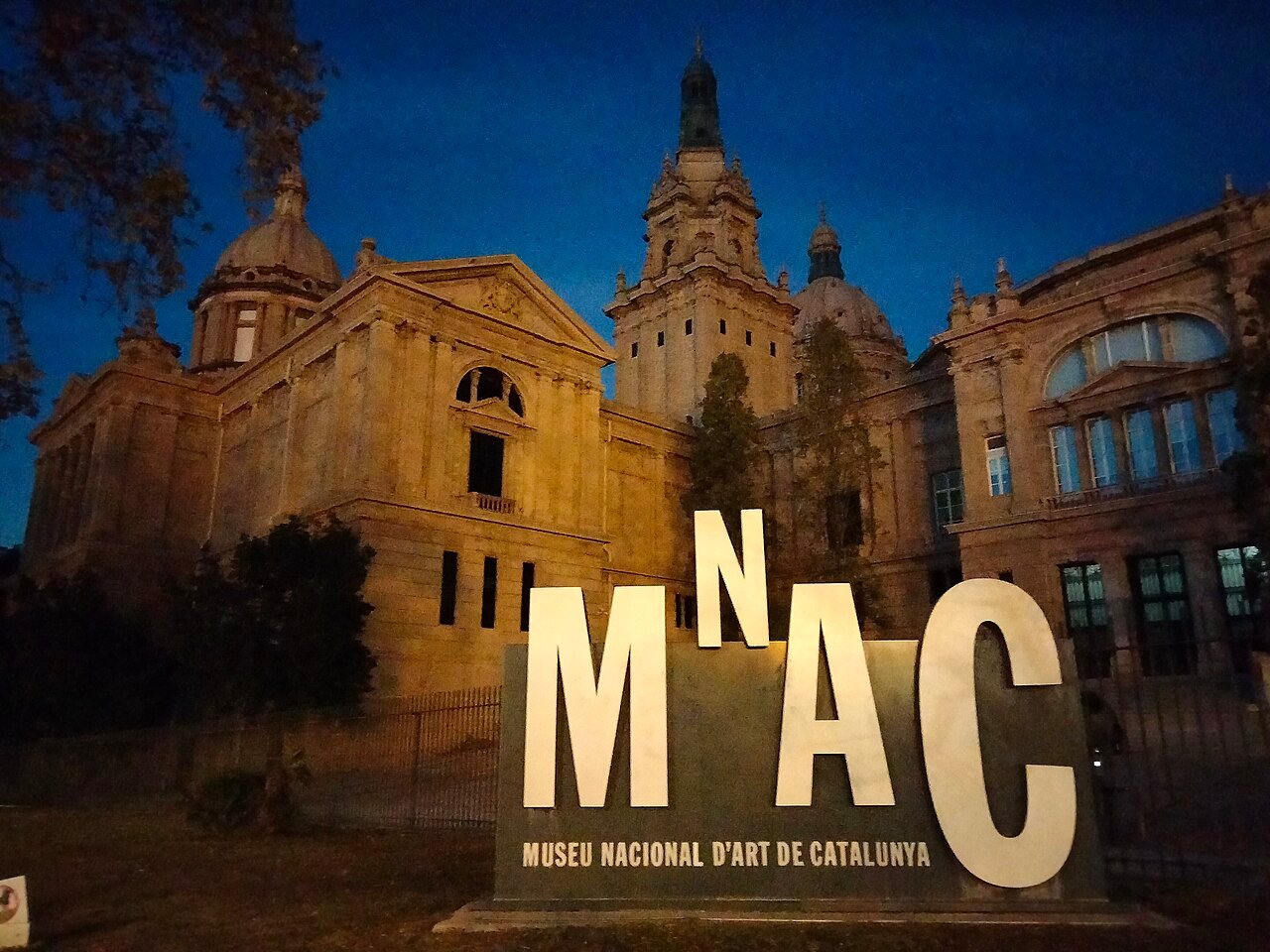
At the foot of Montjuïc, where the Avinguda de la Reina Maria Cristina runs from Plaça d’Espanya up to the Palau Nacional, stands the largest ornamental fountain in Barcelona — built for the 1929 International Exposition to a design by Carles Buïgas, and still performing the trick it was built for: thousands of litres of water a second, choreographed to music and run through coloured light, in front of crowds that fill the avenue’s steps. When the fountain performs, it is the city’s great free night out — half an hour of water, light and music with the floodlit palace above and the twin Venetian towers behind you.
The fountain’s recent history needs stating plainly, because older guidebooks get it wrong. The shows stopped for almost three years during the drought emergency, when the city shut its ornamental fountains to save water, and they resumed in September 2025, relaunched for the La Mercè festival with upgraded lighting. At the time of writing the established pattern is a seasonal one: shows on Thursday, Friday and Saturday evenings for most of the year — starting around 8pm in winter and 9pm in the warmer months — with extra nights (Wednesday to Sunday, starting 9:30pm) in high summer, and a pause for annual maintenance in the depths of winter. The choreography runs in sequences of around twenty minutes. Individual nights can still be cancelled for weather, maintenance or city events, so check the city’s programme for your exact date before building an evening around it — our Magic Fountain guide tracks the schedule and the best vantage points. Arrive twenty minutes early, watch from the steps beside the cascades rather than the crush at the basin, and stay afterwards for the view back down the avenue: the palace behind you, the towers and Plaça d’Espanya lit up in front, and the whole scene built, nearly a century ago, to be seen at night.
3. La Pedrera Night Experience: Gaudí by Night
By day, Casa Milà — La Pedrera — is a museum with a queue. By night, it becomes a piece of theatre with Gaudí as the set designer. The La Pedrera Night Experience, run by the building’s own foundation, is a guided after-hours visit that moves through the house as darkness does: the courtyards lit from below, the tenants’ apartment in lamplight, the great whale-ribbed attic in shadow, and finally the rooftop, where the warrior chimneys and stairwell turrets become the screen for a video-mapping show of light and sound about the building’s origins — and the visit ends, correctly, with a glass of cava under the stars.
At the time of writing, sessions run from 8:40pm, the visit lasts about an hour and twenty minutes, and tickets cost €39.50 for adults, €19 for 12- to 17-year-olds, with under-12s free — book on the building’s own site, and book ahead, because the foundation’s own warning is that it sells out nightly. The daytime visit shows you more of the house with more interpretation; the night visit shows you the building the way its architect, a man obsessed with light, would have wanted it judged. If you only have one Gaudí night in you, this is the one: no other ticket in Barcelona buys you a rooftop, a light show and a glass of cava on the city’s most famous avenue in a single booking.

4. Casa Batlló After Dark: Night Visits and Rooftop Concerts
Casa Milà’s neighbour on the Block of Discord keeps the longest hours of any sight in the city: Casa Batlló opens every day and does not close until 10:30pm, at the time of writing — which means that even its ordinary visit, booked for the last slots of the day, is an evening experience, the dragon-backed house lit, the Passeig de Gràcia outside strung with lights, and the crowds of the afternoon gone. But the house also runs evenings of its own. Its Night Visit takes entries in the later evening (from around 8:30pm), runs about 75 minutes through the noble floor and courtyard under mood lighting, with a drink included on the upper ticket levels. And in season, its Magical Nights pair a visit starting at 8pm with a live concert on the dragon rooftop at 9pm — jazz, soul, rumba and flamenco nights above the avenue, the format that turns Gaudí’s roof terrace into the city’s most improbable concert hall.
Evening formats have started from around €25 for the Night Visit and €59 for Magical Nights in recent seasons, sold online only and quick to sell out in high season, so this is the other night booking to make before you arrive; our Casa Batlló guide walks the house room by room for the daytime version. Choose between the two Gaudí nights by temperament: La Pedrera’s is a produced show with a guide and a narrative; Batlló’s is a house party in a masterpiece, with music. Neither is the wrong answer.

5. Flamenco in a Baroque Palace: Palau Dalmases
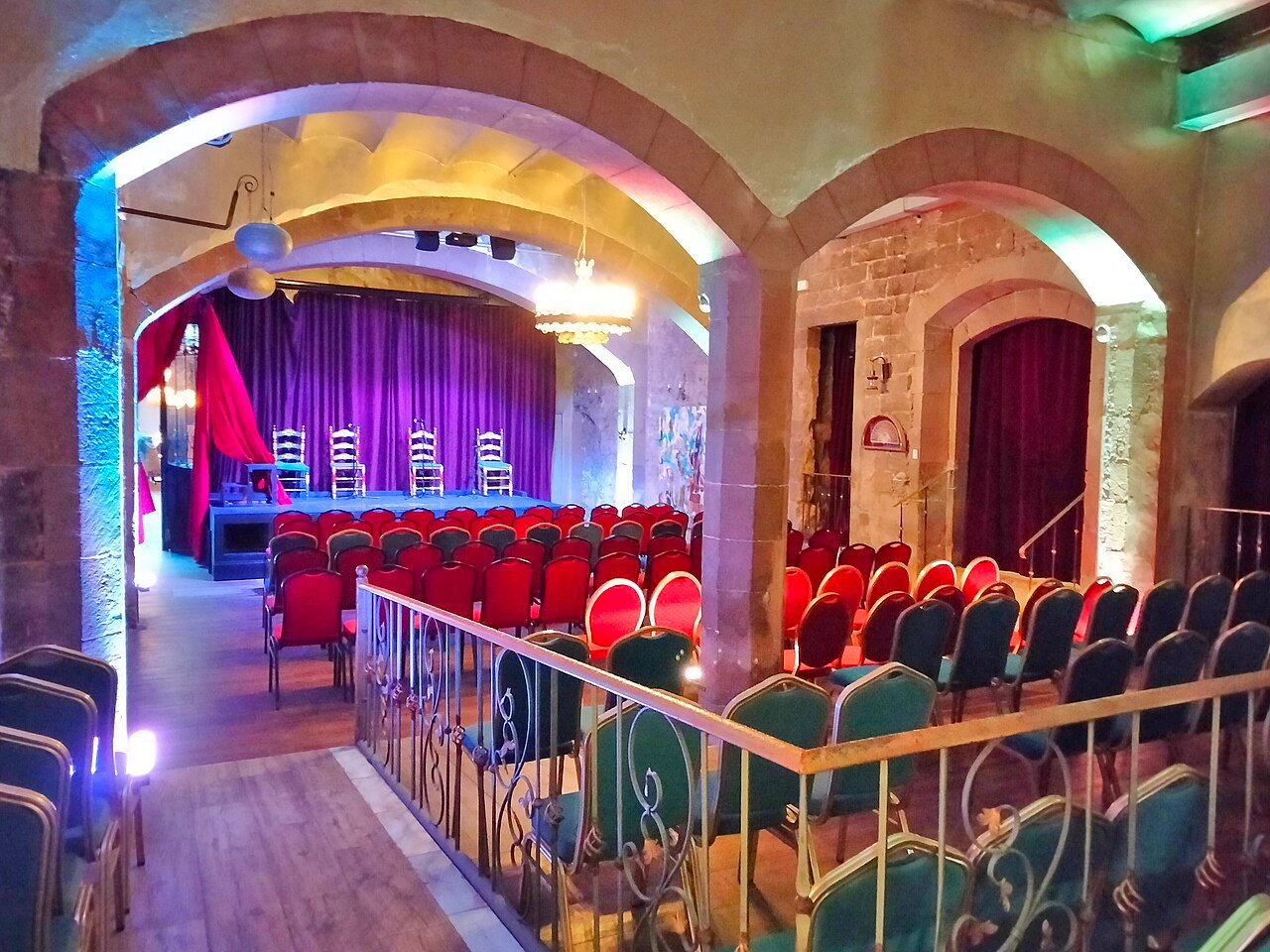
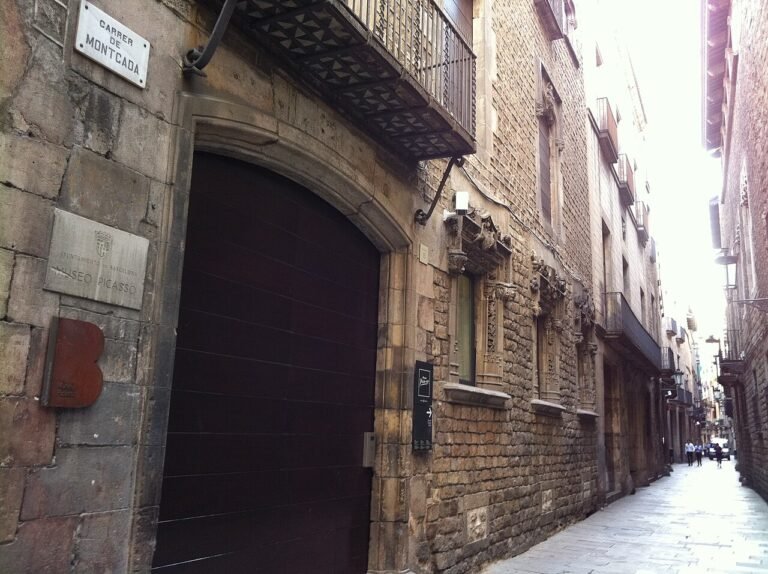
Flamenco is Andalusia’s art, not Catalonia’s — Barcelona’s own traditional stages are for sardanes and rumba catalana — but the city has been importing great flamenco for a century, and it houses it in the most beautiful small room in Spain. The Palau Dalmases is a 17th-century Baroque palace at Carrer de Montcada 20, in the heart of El Born — the same street of palaces as the Picasso Museum — and its candlelit hall, all stone arches and red velvet, holds barely a hundred seats around a small tablao stage. The company that performs there fields the classic small format: one singer, one guitarist, two dancers, fifty minutes, nowhere to hide. In a room that size, flamenco is not watched so much as weathered: the heels strike the boards three metres from your seat, the singer’s voice comes off the stone, and the stillnesses land as hard as the storms.
The practicalities are the easiest in this guide. Shows run four times a day, at 5:30pm, 6:45pm, 8:00pm and 9:15pm, so the flamenco can be the overture to dinner or the main event after it; tickets are sold in zones by distance from the stage, with a drink included in the Zone VIP and Zone A seats, and the palace’s small art gallery is included with every ticket. Book the 9:15pm show, eat afterwards at ten like a local, and you have built the single best evening in this guide. The booking we recommend is the one linked at the top of this article: Barcelona: Flamenco Show at Palau Dalmases — rated 4.6/5 from 1,402 reviews, from $33.38, with free cancellation up to 24 hours in advance. And leave time before or after to walk the street you are standing on: Montcada and the lanes around Santa Maria del Mar are the old town at its best after dark, as our El Born guide covers corner by corner.
6. A Concert at the Palau de la Música Catalana
Every great hall is better at night, but the Palau de la Música performs a specific trick after dark: the building that daylight turns into a stained-glass garden becomes, under concert lighting, a jewel box — the great inverted dome of the skylight glowing from within, the muses on the stage wall emerging from the mosaic, the whole improbable wedding cake of Lluís Domènech i Montaner’s architecture lit like a lantern in the Sant Pere lanes. The hall was built between 1905 and 1908 for the Orfeó Català choral society, it is a UNESCO World Heritage Site, and it is not a museum that occasionally hosts music: it is a working concert hall with a programme running from symphony orchestras and piano recitals to jazz, gospel and flamenco nights, most evening performances starting around 8:30pm.
Two honest pieces of advice. First, programme beats repertoire for a first visit: on a short trip, book whatever is on during your dates in the main hall rather than holding out for a favourite composer — you are buying the room as much as the music, and the room never has an off night. Second, the sightlines are as eccentric as the architecture: the cheapest seats high at the sides can trade view for atmosphere, while the stalls and the first balcony give you the skylight and the stage together. Tickets for popular nights sell out, so book on the Palau’s own site ahead; our Palau de la Música guide covers the building’s daytime tours and its history. Dress is smarter than sightseeing clothes but far from formal — Barcelona dresses for a concert the way it dresses for a good restaurant.

7. Opera Night at the Gran Teatre del Liceu
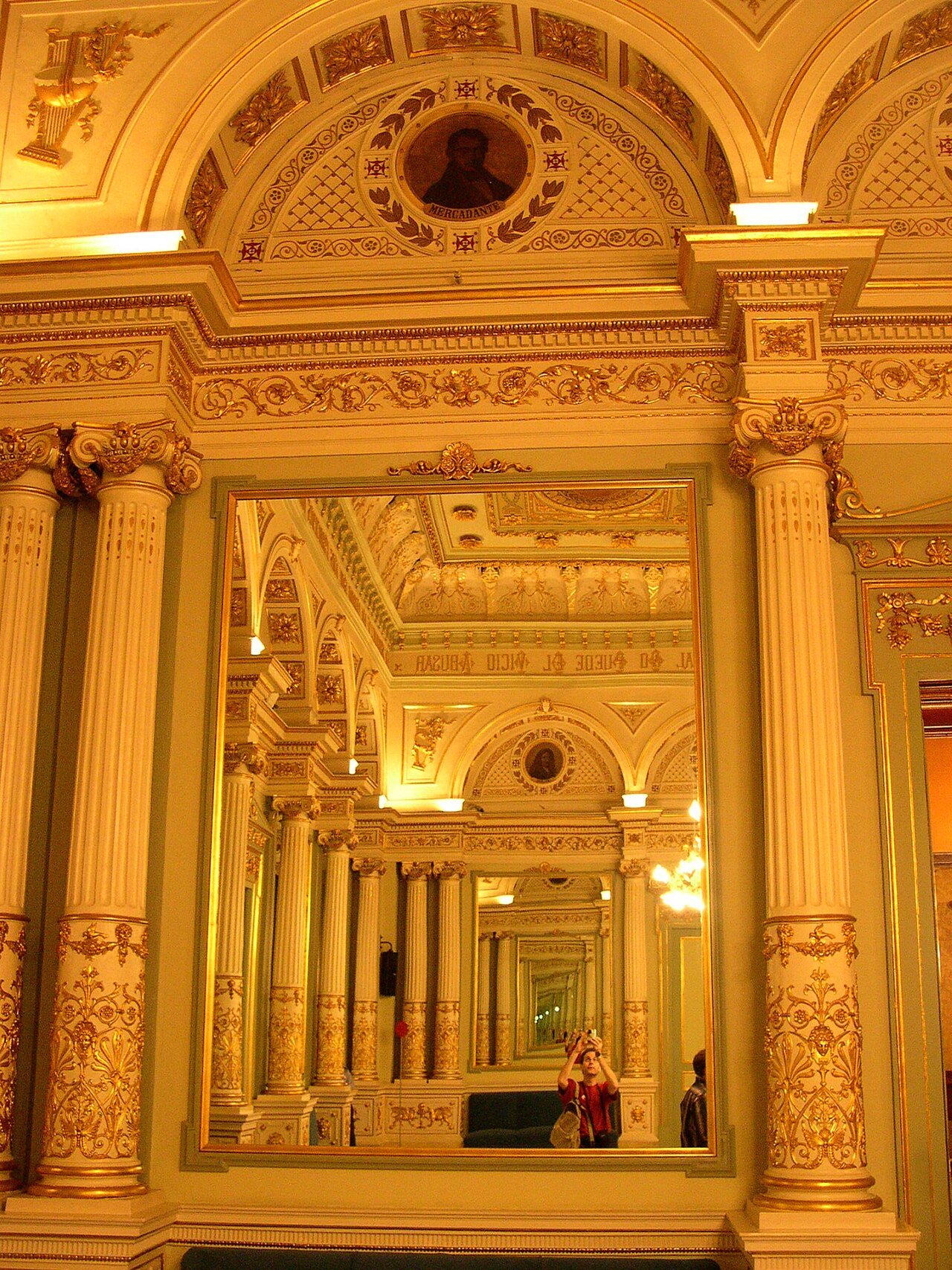
Halfway down La Rambla stands the city’s other great night room, and its grandest: the Gran Teatre del Liceu, Barcelona’s opera house since 1847, rebuilt after the fire of 1994 and reopened in 1999 with its horseshoe auditorium — one of the largest in Europe, seating over 2,200 — restored to its red-and-gold glory. An opera night at the Liceu is the most formal evening in this guide and the one that best explains old Barcelona to itself: this was the bourgeoisie’s drawing room, and the interval ritual in the Saló dels Miralls, the gilded Hall of Mirrors, is still half the performance. The season runs from autumn to early summer — opera, ballet, concerts and recitals — with evening curtains typically between 7:30pm and 8:30pm.
Practical notes for first-timers: the Liceu sells honestly by sightline, and the upper tiers are priced for locals who come for the music, which makes an opera here cheaper than its equivalents in London or New York — but the cheapest seats can be high and side-on, so read the seat map rather than the price ladder. Surtitles run in Catalan with English among the languages on the screens. There is no enforced dress code, though the Rambla-side of the house still dresses up, and arriving by the boulevard as the façade lights come on is part of the evening. If opera itself is a stretch, the house’s concert and ballet nights are the same room at an easier door. Either way, book ahead on the Liceu’s own site for anything in the main season.
8. La Rambla and the Gothic Quarter After Dark
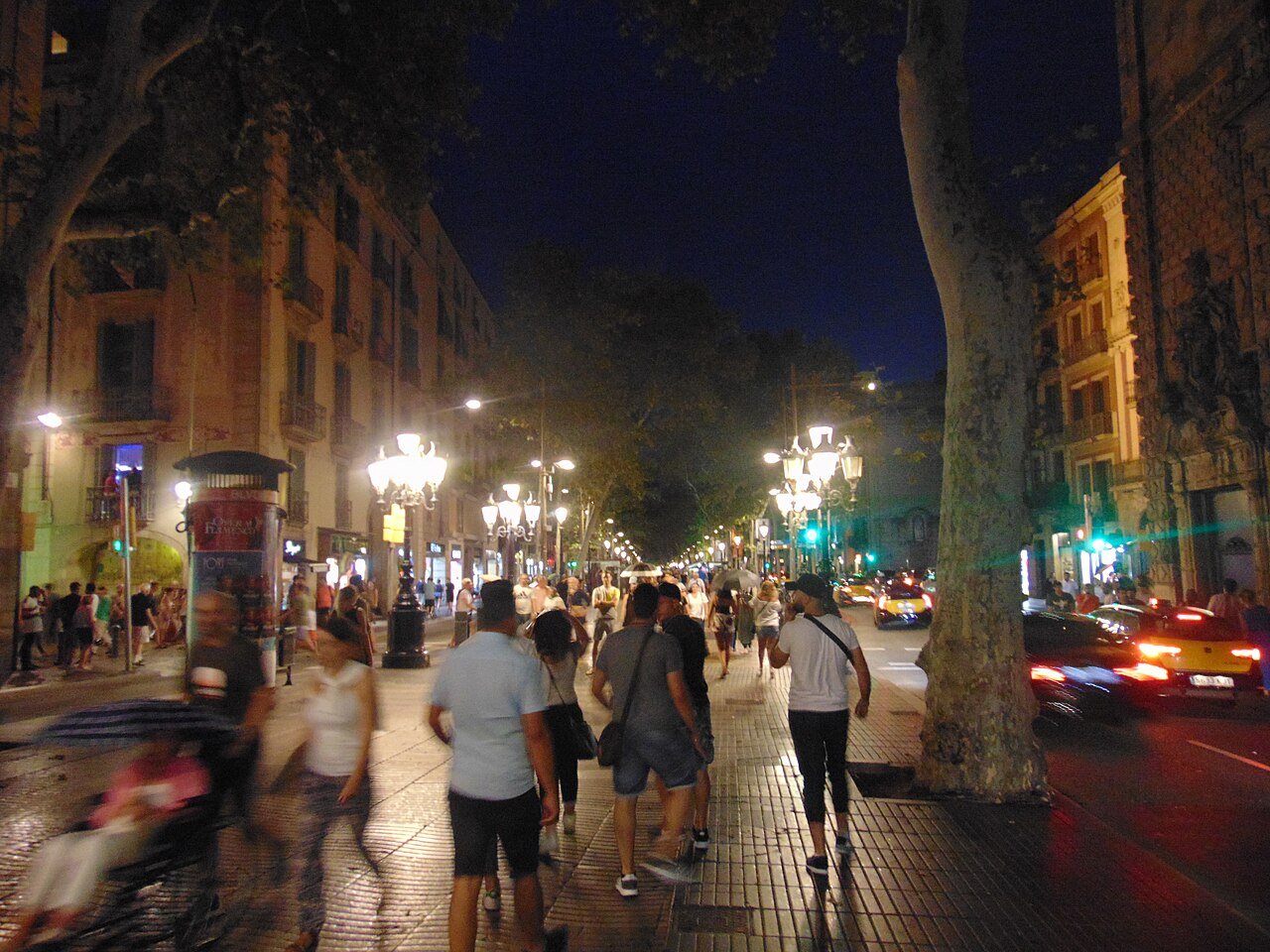
Some nights out need no ticket at all. La Rambla — the 1.2-kilometre boulevard of plane trees and ornate lamps that runs from Plaça de Catalunya to the Columbus Monument — is Barcelona’s promenade, and the promenade is an evening institution: families, theatre crowds, buskers and half the city, walking slowly in both directions for the pleasure of it. After dark the boulevard’s fixtures take their evening turn: the Liceu’s façade lit, the flower stalls closing one by one, the Canaletes fountain at the top (drink from it, the legend says, and you will return to Barcelona), and Joan Miró’s mosaic under your feet at the Pla de l’Os. Our La Rambla guide maps the whole boulevard sight by sight.
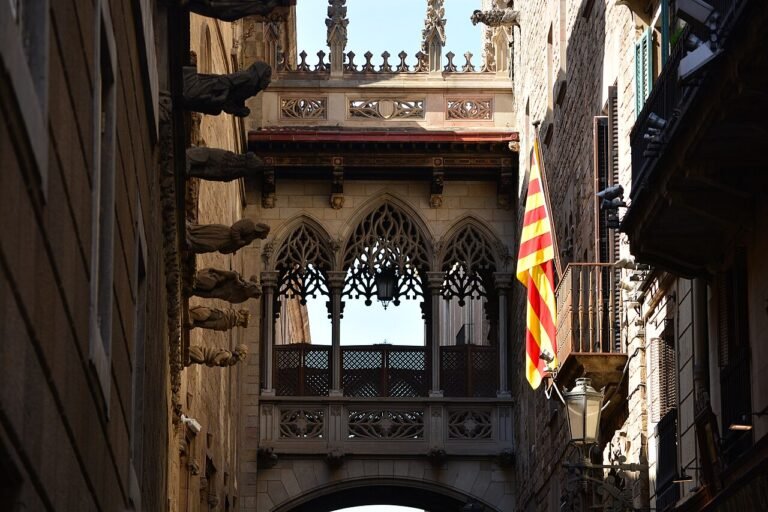
The boulevard is the overture; the opera is the lanes beside it. Slip east into the Gothic Quarter once the day crowds have gone and the quarter becomes what it secretly is — a small medieval city of lamplit stone: the cathedral’s façade floodlit above its square, the cloister geese asleep, Plaça de Sant Felip Neri hushed and melancholy, the Roman walls and the columns of the Temple of Augustus standing in courtyards you may have entirely to yourself. Then loop back west to Plaça Reial, the arcaded square off the lower Rambla, where the palm trees and the lampposts Gaudí designed as a young man preside over a hundred terrace tables — touristy, yes, and still the city’s handsomest room for a late drink. Keep the pickpocket rule from the top of this guide in mind on the boulevard itself, and this whole night costs you a vermouth.
9. Tibidabo: The Funfair Above the Lights
Barcelona keeps its funfair where other cities keep a cathedral: on top of its mountain. Tibidabo, at 512 metres the highest point of the Collserola ridge, carries the Sagrat Cor church, a telecommunications tower — and an amusement park that has been up here since the first years of the 20th century, one of the oldest in the world still running, its rides arranged on terraces down the summit with the whole city glittering below. In the daytime it is a family park. On the nights it stays open late — which, at the time of writing, means the long evenings of high summer and special calendar dates, so check the park’s own calendar before you go — it becomes something else entirely: a vintage fairground in the sky, the 1928 aeroplane ride circling over a sea of lights, the Giradabo Ferris wheel turning slowly against the dark.
Even when the park itself closes early, the summit is worth the trip at dusk: the church is floodlit, the viewing terraces are free, and the city performs the same light-show it gives the Bunkers, from twice the height and with a fraction of the crowd. Getting up is half the fun since the new Cuca de Llum funicular replaced the century-old one — take the metro and bus or the funicular from the Vallvidrera side, and check the last descent times before you settle in for the full dark; the mountain rewards planners and strands romantics. Pair it with §10, five minutes away, for the city’s great high night.

10. Stargazing at the Fabra Observatory
Five minutes below the Tibidabo summit, on a pine-covered shoulder of the Collserola at 415 metres, stands the night out for people who find funfairs insufficiently cosmic. The Fabra Observatory, opened in 1904 and run by the Royal Academy of Sciences and Arts of Barcelona, is a working observatory — its astronomers still observe double stars and minor planets — that opens its dome to the public on night visits across much of the year: at the time of writing, the pattern is Friday nights (with Saturdays added in the busiest seasons), run by the observatory’s outreach team and booked in advance. The evening is the complete observatory ritual: the modernista building and its museum, a talk, and then the dome, where you take your turn at the eyepiece of the great Mailhat refractor of 1904 — one of the oldest large telescopes in the world still in regular use — trained on the Moon, a planet or a double star, before stepping onto the terrace to see the other exhibit: Barcelona, all of it, lit up below.
In summer the observatory adds its famous variation, Dinner with Stars (Sopars amb estrelles): dinner on the terrace at dusk, then the visit and the observation — one of the hardest tickets in the city to feel cleverer than. Two honest warnings: the observation depends entirely on the sky, and a cloudy night shrinks the evening to the tour and the talk, so book the clearest forecast you can and treat anything through the eyepiece as a gift; and the observatory is genuinely out of town — up in the hills, reached by car, taxi or the funicular-and-bus combination — so plan the journey home before the journey up. Friday night visits have been listed at €15 in recent seasons: for a century-old telescope and the best night view in Barcelona, the bargain of this guide.

11. A Sunset Sail Off the Coast
Barcelona faces the sea the way a theatre faces its stage, and the city’s most relaxing night out starts by leaving it. Every evening in the warmer half of the year, sailing boats and catamarans slip out of Port Olímpic and Port Vell on sunset cruises — typically an hour and a half to two hours, timed so the boat is off the beaches as the light goes, with the skyline doing the Bunkers trick in reverse: instead of watching the city light up from a hill, you watch it light up from the water, the Sagrada Família and the Torre Glòries picking out the grid, the W Hotel’s sail glowing at the harbour mouth, Montjuïc darkening behind. Most boats are small, most pour a glass of cava as the sun touches the Collserola, and the better skippers cut the engine and let the boat sail the last of the light in quiet.
The practicalities are seasonal and weather-bound: the sunset fleet runs roughly from spring to autumn, departures move with the sunset (an 8:30pm boat in June is a 6pm boat in October), and a rough sea cancels without apology — book a day or two ahead rather than a month, once you have seen a forecast. Prices move with the season and the boat, and the honest framing is that this is a treat, not a bargain: what you are buying is the one view of Barcelona that never appears in the daytime guides, its whole lit seafront at once, from the dark. Bring a layer whatever the month: the Mediterranean is warm, and the breeze two miles out is not.

12. The Beach After Dark: Barceloneta and the Chiringuitos
Barcelona’s beaches do not close at sunset; they change shifts. The daytime city of towels and beach volleyball gives way, as the light fails, to the evening’s version: couples and groups of friends spread along the sand with the day’s heat gone, drummers somewhere down the shore, the promenade full of strollers, and the chiringuitos — the beach bars that line Barceloneta and the beaches north of the Olympic Port through the warm season — doing their best trade of the day, grills lit, tables in the sand. This is the city’s cheapest evening and its most democratic: no booking, no ticket, no programme — just the Mediterranean doing its night routine in front of a city that never quite leaves the beach.
Base yourself at Barceloneta, the old fishermen’s quarter, where the evening has the most layers: a swim-free stroll (the lifeguards are a daytime service, and the night sea is for looking at), a drink at a chiringuito, then dinner in the quarter’s seafood streets behind the sand — the bombas and fideuà country that feeds the neighbourhood. Rebecca Horn’s rusted tower of cubes, L’Estel Ferit, lit from within on the promenade, is the evening’s landmark and its meeting point. Two honest notes: the chiringuito season runs roughly from spring to autumn, so in winter this section shrinks to a beautiful, emptier promenade; and keep the party on the bars’ terraces — drinking on the sand itself draws fines from a city that polices its beaches kindly but firmly.

13. Dinner at Ten: The Tapas Crawl
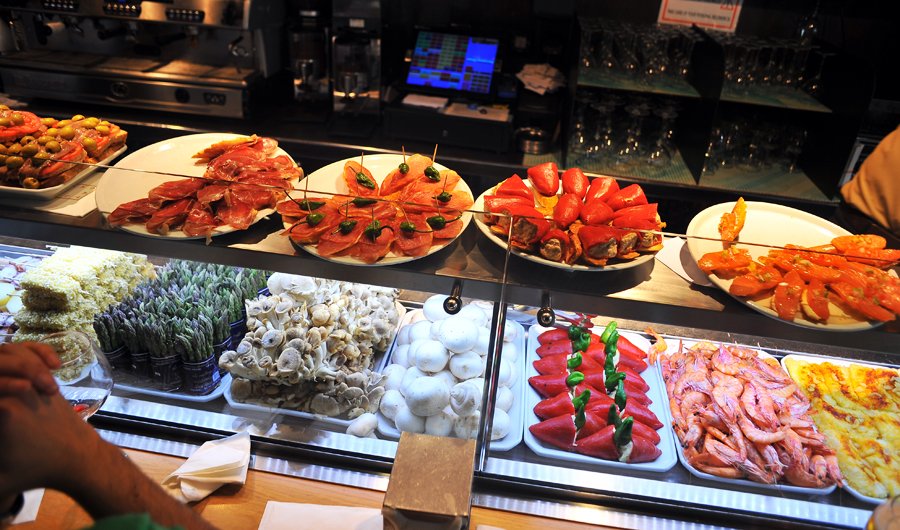
The night out that requires no planning, no booking and no ticket is the one the city itself is having: dinner, at ten, in company, in no hurry. To eat like a Barcelonan for one night, work in the city’s own three movements. Start with the vermouth hour — before dinner, not after: a glass of house vermouth with an olive and a slice of orange, standing at a bar counter, with something small and salty beside it. Then the crawl proper: tapas are eaten in motion, a dish or two per bar, counter first and table second — patatas bravas where the queue says the bravas are famous, a plate of jamón somewhere that carves it in the window, croquettes, grilled prawns, a tortilla still warm from the pan, and the blackboard’s special wherever the blackboard looks handwritten and short. Finish with the sit-down course if the night is young: a shared paella or fideuà near the sea, or the market-bar tradition adapted to night in the old town’s taverns.
Where? The old town lanes around El Born and the Gothic Quarter for atmosphere, Gràcia and Sant Antoni and the streets of Poble-sec (Carrer de Blai, the city’s great tapas-crawl street, where the pintxos counters do their briskest trade of the day after nine) for the locals’ version. The rules are the ones from the top of this guide: kitchens wake up around eight, the room fills at ten, nobody minds you lingering, and the bill, split the local way across many small pleasures, stays kind. This is also the section to remember at the end of every other night in the guide: whatever else you have done — opera, flamenco, fountains — dinner at ten is waiting afterwards, and it is the city’s true headline act.
14. Rooftop Terraces Over the Old Town
Barcelona’s second skyline is its roofscape, and the city’s hotels have spent a decade converting theirs into the evening’s most civilised seats. The format is standard and wonderful: a lift to the top floor of a hotel you are not sleeping in, a terrace, a short cocktail list priced for the view, and the old town spread out at parapet height — the cathedral’s towers and the Sagrada Família the two poles of the view, with the sea at one end and the Collserola at the other. The terraces cluster where the views are: around the cathedral and Plaça de Catalunya, along the Passeig de Gràcia, and above the seafront, and the season runs from spring to autumn, with the best of them taking bookings for the sunset slots and filling the walk-in stools by nine.
Choose by what you want to look at. Terraces near the cathedral trade the basilica view for the Gothic Quarter’s rooftops and the cathedral itself, floodlit, close enough to study; the Passeig de Gràcia roofs put you level with Gaudí’s chimneys and the Eixample grid; the seafront hotels give you the harbour and the darkening sea. The honest costs: a cocktail on a famous roof costs what cocktails on famous roofs cost everywhere, the sunset hour is rationed, and some terraces reserve their best tables for guests. The free alternative to the whole section is woven through this guide — the Bunkers, the Tibidabo terraces, the steps of the Palau Nacional above the fountain — but for one evening of being served the view instead of climbing to it, the rooftop bars are the city’s drawing rooms, and every visitor should sit in one once.
15. Poble Espanyol: The Village That Wakes Up at Night
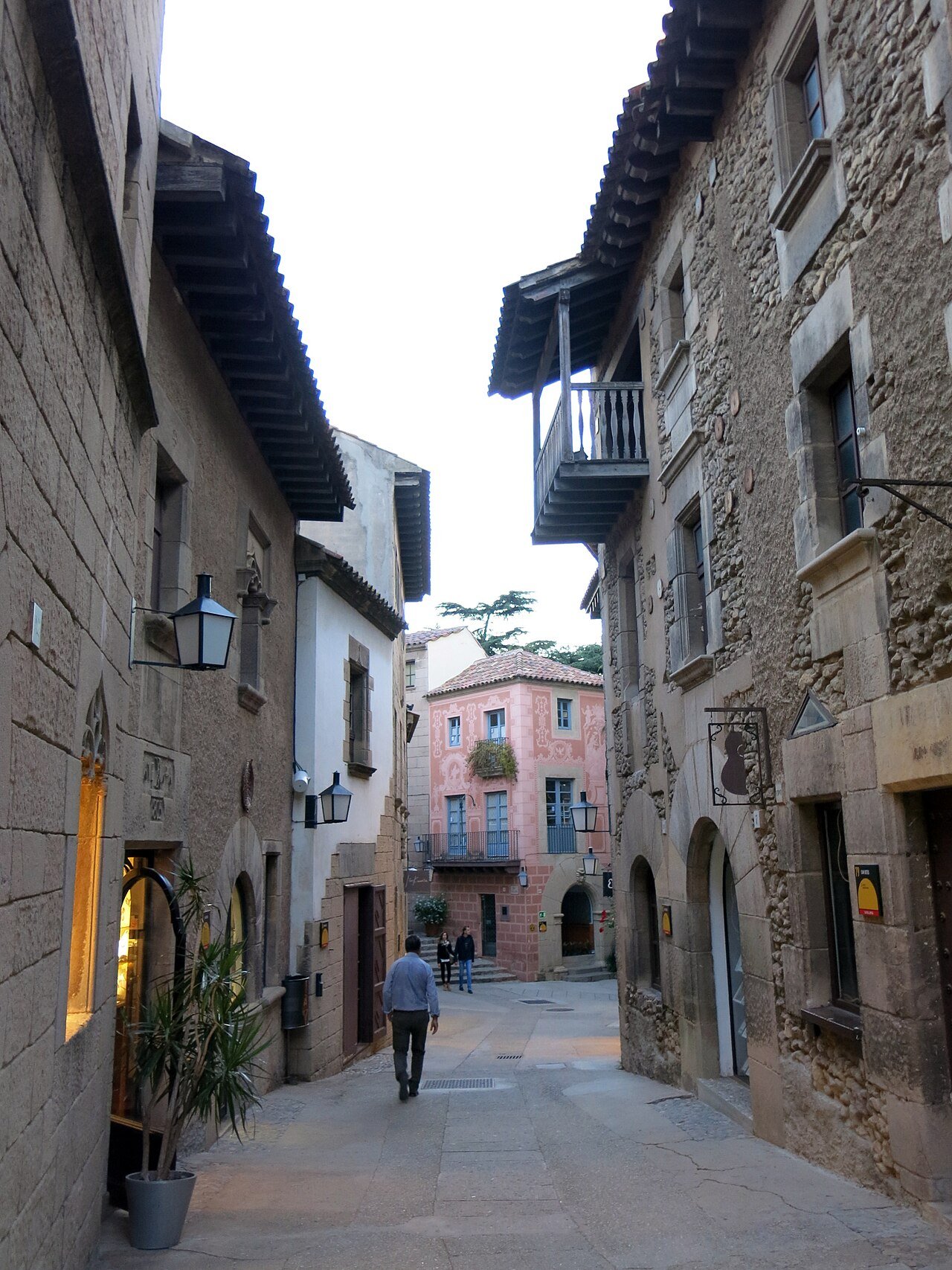
On the lower slopes of Montjuïc stands the strangest and most likeable of Barcelona’s night venues: a whole Spanish village, built in 1929 for the International Exposition and never demolished — 117 full-scale replicas of real buildings from every region of Spain, arranged as streets, squares and quarters around a great main plaza, built by architects who toured the country with notebooks. By day it is an open-air museum of architecture and craft workshops. By night — when the day visitors have gone, the lamps come on in the lanes and the restaurants and bars open their terraces — it becomes a small lamplit town with no cars, no through traffic and no reason to leave: dinner in an Andalusian courtyard, a drink in a Castilian square, the streets of half of Spain in a single evening’s stroll.
The village’s night credentials run deeper than atmosphere. Its Tablao de Carmen, founded in 1970 in honour of the great Carmen Amaya, who danced for King Alfonso XIII on this site at the 1929 inauguration, is one of the city’s historic flamenco stages — the grand-production alternative to the small room of §5; and across the year the main square hosts concerts, open-air cinema seasons and festival nights that use the village as a ready-made stage set. It pairs naturally with the rest of Montjuïc after dark: the fountain below, the castle above, and the village in between, open late into the evening — check the calendar for your date, as closing swings with the season and the event programme. Daytime crowds rate it a minor sight; after dark, with the lanes lit and the squares humming, it is one of the best evenings in this guide.
Which Night Suits You?
Only got one night? The arc of §1, §5 and §13: Bunkers sunset, the 9:15pm flamenco at Palau Dalmases, dinner at ten in the old town. Here on a fountain night? Build the evening on Montjuïc: Poble Espanyol as the light fades, the fountain show, and the Palau Nacional steps afterwards. Want Gaudí? La Pedrera’s produced night show for theatre, Casa Batlló’s Magical Nights for music — and the houses are ten minutes apart if you want both in one trip, on different nights. Here for music? The Palau for the room, the Liceu for the occasion, Palau Dalmases for intensity. Travelling with children? Tibidabo on a late-opening night, the fountain, and the beach evening at Barceloneta. On a budget? The Bunkers, the fountain, the old town walk and the beach are all free, and dinner by tapas-crawl undercuts every restaurant row in the city. In December? The same skeleton in warmer clothes — and the Christmas fairs add a season of their own, the subject of a whole other guide on this site.
Night Costs, Honestly
A Barcelona night can cost almost nothing, and the free core of it is genuinely the best of it: the Bunkers sunset, the Magic Fountain, the old town after dark, the beach evening and the Tibidabo summit terraces (outside park hours) are all free, and the metro that stitches them together runs all night on Saturdays. The ticketed layer is equally honest. The Gaudí nights are the splurges — La Pedrera’s Night Experience at €39.50, Casa Batlló’s evening formats from around €25 in recent seasons, its rooftop-concert nights from around €59 — followed by the flamenco, the Barcelona: Flamenco Show at Palau Dalmases at $33.38 doing more for the money than anything else in this guide, and the observatory’s Friday nights at €15, the bargain of the list. Concert and opera tickets scale with ambition, from upper-tier seats priced for locals to stalls priced for occasions; a sunset sail is a treat priced like one; a rooftop cocktail costs a famous-view premium; and dinner by tapas crawl — a dish or two in three bars and a vermouth to start — will feed you better, and usually cheaper, than a single white-tablecloth sitting. Budget for the one cost nobody plans: in this city, the first night out tends to book the second.
Best Views in Barcelona: 15 Viewpoints, Rooftops and Towers Worth the Climb
Travel insurance, sorted
Whether it is a two-week holiday or a longer move, travel insurance is not the most glamorous part of a trip — but it is the one booking you want to have in place before a trip, and while you are already away. Get a quote from SafetyWing
Final Thoughts
Daytime Barcelona belongs to the world; night-time Barcelona still belongs to itself. The same city that queues in the heat for its monuments spends its evenings on gun platforms and funfair terraces, in Baroque palaces and gold-leafed halls, eating at ten and walking home under plane trees at midnight — and it is generous about sharing all of it, provided you keep its hours. So keep them. Watch the sun go down from somewhere high, give the night one anchor — a fountain, a show, a telescope, a table — and let the rest of the evening be the walk between the two. Fifteen nights are listed here; the city will supply the rest of the month.
FAQs: Barcelona at Night
What is the best thing to do in Barcelona at night?
If you have exactly one evening: watch the sunset from the Bunkers del Carmel, take the 9:15pm flamenco show at Palau Dalmases in El Born, and eat dinner afterwards at ten in the old town. That single arc — the city from above, its most intense small performance, and its favourite meal at its favourite hour — is Barcelona’s night in miniature.
Is the Magic Fountain of Montjuïc running in 2026?
Yes. The fountain was shut for almost three years during the drought emergency and its music, light and water shows resumed in September 2025. At the time of writing it performs on Thursday, Friday and Saturday evenings for most of the year, with extra nights in high summer and start times that shift with the season (around 8pm in winter, 9:30pm in summer). Shows are free; check the city’s programme for your date, as individual nights can be cancelled.
What time do people eat dinner in Barcelona?
Late, by almost any other standard. Restaurant kitchens generally open around 8pm, locals sit down between 9pm and 10pm, and the busiest hour in a good dining room is ten o’clock. Tapas bars run more flexibly, and the vermouth — an aperitif with something salty — belongs to the hour before dinner, not after it. Book a table for nine or later and you will be eating with the city instead of ahead of it.
Is Barcelona safe at night?
Barcelona is a big, busy, late-night city whose centres stay lively until the small hours, and its night risks are the ordinary urban ones rather than anything exotic. The one crime the city is genuinely known for is pickpocketing, which targets La Rambla, the metro and crowded viewpoints at all hours: keep bags zipped and phones off café tables, be politely deaf to street distractions, and use the same judgement you would use in any capital at midnight.
Do you need to book Barcelona’s night attractions in advance?
For the ticketed anchors, yes. La Pedrera’s Night Experience and Casa Batlló’s evening formats sell out days ahead in season, Palau Dalmases’ small hall fills for the later shows, the Fabra Observatory’s night visits are reservation-only in practice, and opera and concert seats at the Liceu and the Palau de la Música go early for popular programmes. The free layer — Bunkers, fountain, old town, beaches — needs no booking at all, which is why the city’s best plan is a booked anchor with free evenings around it.
How do you get around Barcelona late at night?
Easily, and on Saturdays almost too easily: at the time of writing the metro runs until midnight on weeknights, until 2am on Fridays, and continuously all night on Saturdays and festival eves, with the Nitbus night-bus network covering the other hours and the gaps. The old town, Eixample and seafront are also walkable between each other, taxis are plentiful and metered, and the ride up to Tibidabo or the Fabra Observatory is the only journey in this guide that truly needs planning in both directions.

3 Comments