Best Views in Barcelona: 15 Viewpoints, Rooftops and Towers Worth the Climb
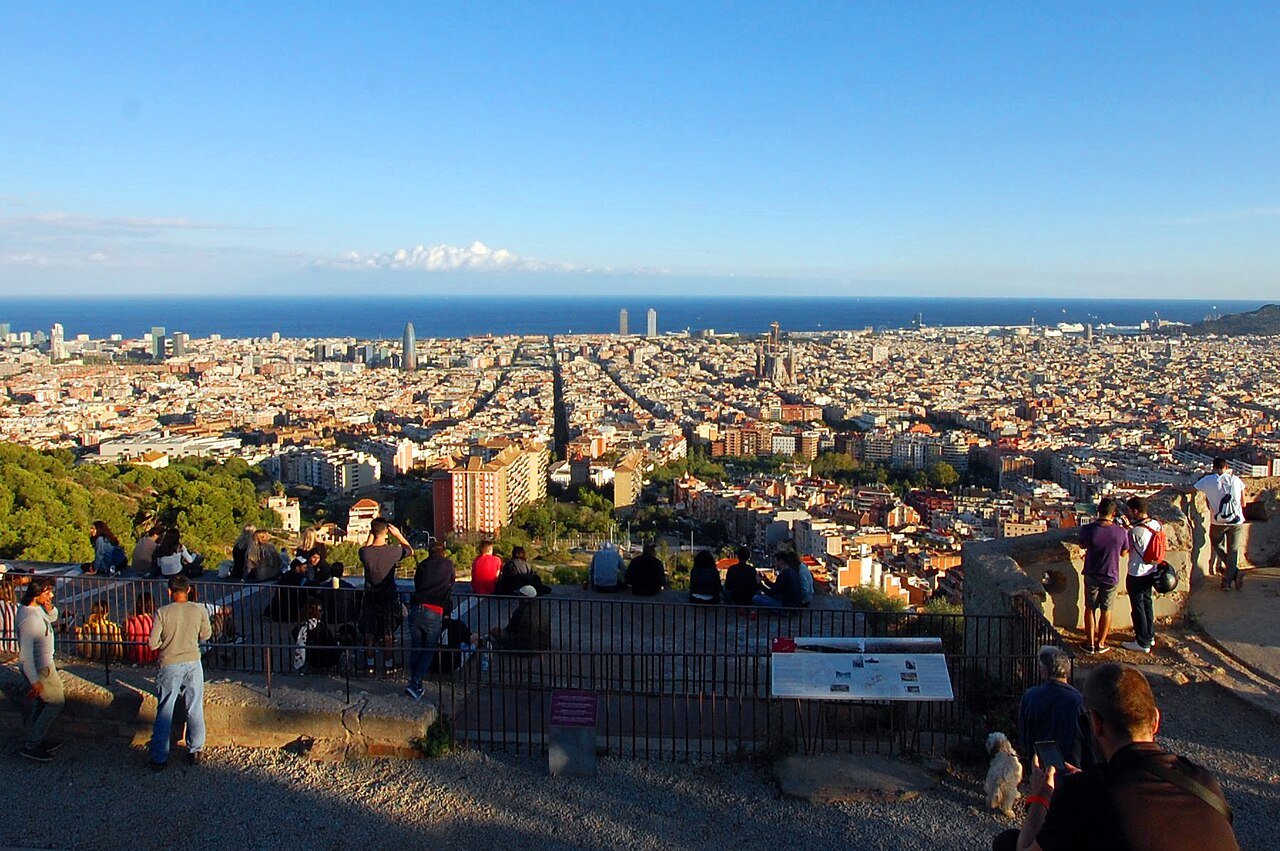
Barcelona is a city built for looking at. A grid of chamfered blocks runs from a crescent of hills straight down to the Mediterranean, so almost every high point frames the same satisfying picture — the Eixample’s octagonal blocks, the Sagrada Família’s towers, the bullet of the Torre Glòries, and the sea doing the horizon. What changes is the angle, the price and how hard you have to work for it. This guide ranks the fifteen that matter: free hilltops, church towers, two Gaudí rooftops, a castle, a bullring, and one viewpoint that moves.
That moving viewpoint is worth meeting early. The Barcelona: Montjuïc Cable Car Roundtrip Ticket floats you 750 metres up Montjuïc in an eight-seat cabin, from the park station to the castle gates, the whole city unrolling below — the only sight in this guide that is a view from start to finish rather than a place you arrive at. Everything else here is a destination; this list tells you what each costs, what it takes, and when to go.
The Short Version
The fifteen, in the order most visitors should tackle them:
- Bunkers del Carmel — the free 360° hilltop the whole city climbs at sunset
- Tibidabo and the Sagrat Cor — the highest terrace in Barcelona
- Torre de Collserola — a 560-metre observatory inside a TV tower
- Montjuïc Castle — ramparts and cannon over the working port
- Mirador de l’Alcalde and the Montjuïc Cable Car — the view that moves
- Park Güell: El Calvario — Gaudí’s park from its own summit
- The Sagrada Família Towers — the city framed between Gaudí’s spires
- Torre Glòries — the purpose-built observation deck, 125 metres up
- Casa Milà’s Rooftop — warrior chimneys above Passeig de Gràcia
- Palau Güell’s Rooftop — mosaic chimneys on the best-value Gaudí ticket in town
- Barcelona Cathedral’s Rooftop — walkways around the spire
- Santa Maria del Mar’s Rooftops — El Born at rooftop height, on a guided climb
- The Columbus Monument — a tiny platform 60 metres over the harbour
- The MNAC Terraces — a palace rooftop over the grandest axis in the city
- Las Arenas — a free 360° walkway on top of a former bullring
Table of Contents
- The Short Version
- Bunkers del Carmel: The People’s Viewpoint
- Tibidabo and the Sagrat Cor: The Highest Terrace in the City
- Torre de Collserola: The Observatory in the Sky
- Montjuïc Castle: The Fortress Over the Port
- Mirador de l’Alcalde and the Cable Car: The View That Moves
- Park Güell: El Calvario, the Park’s Own Summit
- The Sagrada Família Towers: Between the Spires
- Torre Glòries: The Purpose-Built Deck
- Casa Milà: The Rooftop of Warriors
- Palau Güell: Chimneys on a Budget Ticket
- Barcelona Cathedral: The Rooftop Walkways
- Santa Maria del Mar: The Rooftop Tour
- The Columbus Monument: Small Platform, Big Harbour
- MNAC: The Palace Terraces
- Las Arenas: The Bullring Roof
- Practical Info
- Tickets and Costs
- Getting There
- When to Go
- How Long You Need
- Tips for Getting the Best Views in Barcelona
- FAQs
- Final Thoughts
Bunkers del Carmel: The People’s Viewpoint
If you ask a Barcelonian where the best view is, this is the answer — and it costs nothing. The Bunkers are not really bunkers: they are the concrete platforms of an anti-aircraft battery built in 1937, during the Civil War, on the Turó de la Rovira, 262 metres above El Carmel. The guns are long gone. What remains is a bare hilltop with a railing, an interpretation panel or two from the MUHBA history museum, and a completely unobstructed 360° panorama: the grid laid out like graph paper, the Sagrada Família dead centre, the sea in front of you and Collserola at your back.
There is no ticket, no lift and no café — the climb is the price. Bring water, and time it for the last hour of light, when half the neighbourhood joins you on the platforms with drinks and guitars: this is the one viewpoint where the view and the crowd are equally the point. Our full guide to the Bunkers del Carmel covers the battery’s history and every route up the hill.
Tibidabo and the Sagrat Cor: The Highest Terrace in the City

Every other viewpoint in this guide is something you look from. Tibidabo is the thing you look at — the mountain that closes the city’s skyline, crowned by a neo-Gothic church and a bronze Christ. At 512 metres it is the highest point of the Serra de Collserola and of Barcelona itself, and the terrace of the Temple Expiatori del Sagrat Cor, built on the summit between 1902 and 1961, is the highest place a visitor can stand: a lift inside the church, then a final stair, to the platform at the statue’s feet, some 541 metres above the sea.
The church and crypt are free to enter; the lift to the top is the paid part, listed at €8 at the time of writing (it was €5 for years, so check at the desk). What you get is the complete geography lesson: the entire city in one frame, Montserrat on a clear day, the 1901 fairground spinning at your feet. Getting up is half the fun — funicular, Tramvia Blau or the Tibibus from Plaça de Catalunya. Our Tibidabo guide walks through every route.
Torre de Collserola: The Observatory in the Sky
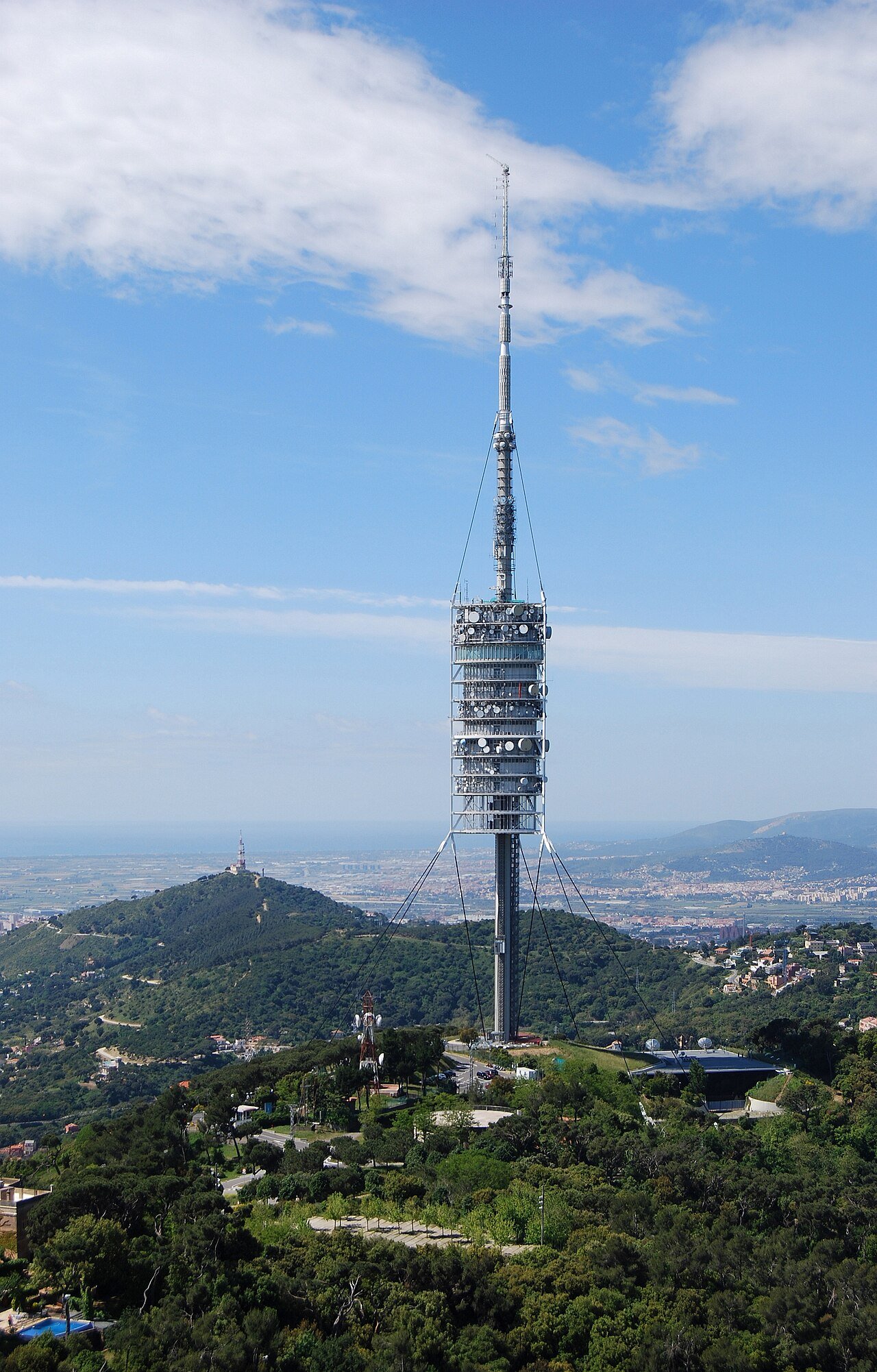
A short walk from the Sagrat Cor stands the strangest viewing platform in Spain: the tenth floor of a working telecommunications tower. The Torre de Collserola is Norman Foster’s 288-metre needle, built for the 1992 Olympics and held up partly by guy wires, like a mast. A glass lift climbs the shaft to the public observatory, which sits 560 metres above sea level — higher than the Sagrat Cor’s platform, and the highest viewpoint in this guide. On the clearest days the claim is a 70-kilometre horizon: Montserrat, the sea, and the whole metropolitan sprawl in one slow turn.
Two honest warnings. The observatory opens on a limited, seasonal schedule — historically weekends and parts of the summer, with short midday hours — so check the tower’s own site before building a day around it. And the ticket, €5.60 at the time of writing, is the smallest in this guide for the biggest view. Pair it with Tibidabo, five minutes away, and take the church terrace as your fallback if the tower is shut.
Montjuïc Castle: The Fortress Over the Port

Montjuïc is the hill that guards the harbour, and its castle is a star fortress with a dark résumé — thrown up in weeks during the Reapers’ War of 1640, rebuilt in stone, used since as fortress, prison and execution ground. Today it is a municipal museum, priced like one: entry is only a few euros, no timed slots, rarely a queue, and Barcelona’s municipal museums traditionally open free on Sunday afternoons.
The views split in two. Landward, the terrace looks straight down the city’s length — Eixample, old town, the hills behind. Seaward, the bastions hang over the working port: container cranes, cruise ships and the whole industrial harbour laid out like a model, cannon still pointing down the barrel-line of the view. It is the most historically loaded viewpoint in this list, and the least polished. Our Montjuïc Castle guide covers the fortress and the moat gardens; ride up by cable car, as the next entry describes, and walk down through the gardens for free.
Mirador de l’Alcalde and the Cable Car: The View That Moves
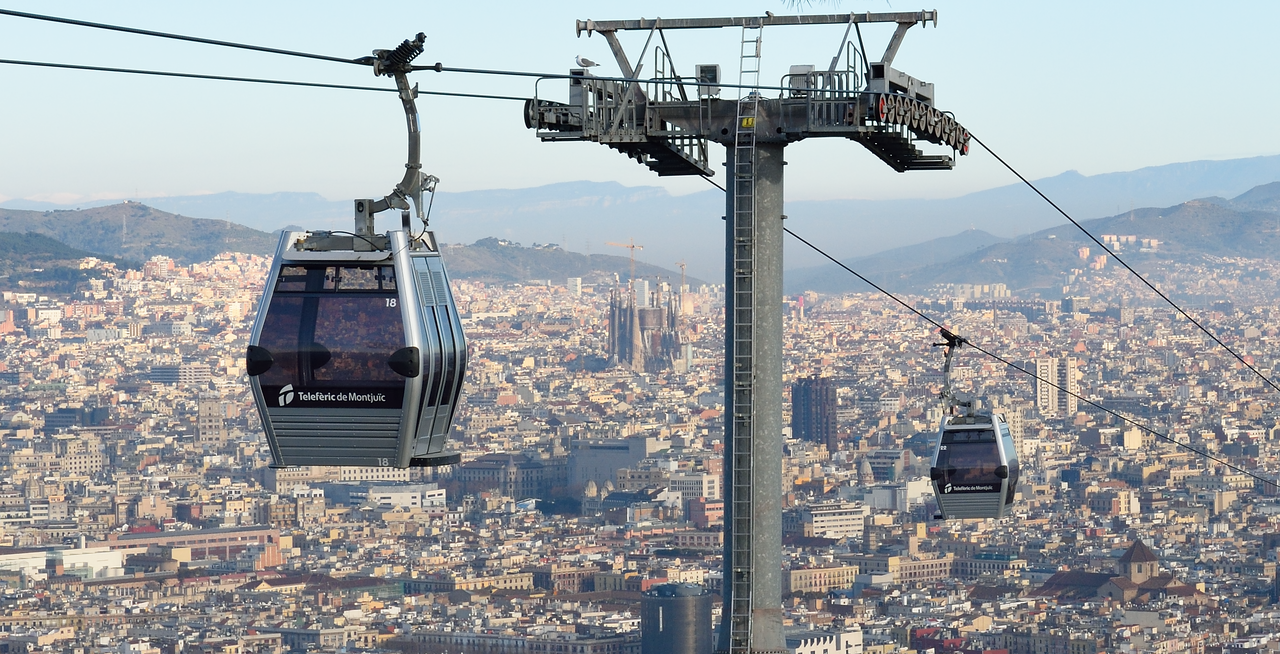
Halfway down Montjuïc’s seaward slope, the Jardins del Mirador de l’Alcalde terrace the hillside into fountains, lawns and a great pavement mosaic — a mayor’s showpiece garden of the 1960s, free to wander, hanging over the harbour. It is also the middle station of the Telefèric de Montjuïc, the natural hinge of a Montjuïc day: ride up, stop here for the port view, ride on to the castle.
The cable car itself is the viewpoint. The Barcelona: Montjuïc Cable Car Roundtrip Ticket covers the full 750-metre run between the Parc de Montjuïc station and the castle in a modern eight-seat cabin — Collserola behind you, the Mediterranean in front, the Sagrada Família picking itself out of the grid as you climb. It is a roundtrip ticket valid for a day, with free cancellation up to 24 hours ahead, rated 4.5/5 from more than 25,000 reviews at the time of writing. Do not confuse it with the older Port cable car, the red cabins crossing the harbour on a different line — our Barcelona cable cars guide untangles the two systems.
Park Güell: El Calvario, the Park’s Own Summit

Everyone photographs the same three things at Park Güell — the salamander, the mosaic bench, the gatehouses — and most visitors never climb to the park’s actual high point. At the top of the monumental zone, some 182 metres above the sea, a rough stone mound carries three crosses: El Calvario, the Turó de les Tres Creus, where Gaudí’s planned chapel for the failed garden-city was never built. From its base the whole design reads at once — the park below, the city beyond, Carmel hill opposite, the sea closing the frame.
It sits inside the ticketed monumental zone, so it folds into a normal visit: book the slot, do the Hypostyle and the bench, then keep climbing while the tour groups thin out. Early morning is the quietest this park ever gets. Our Park Güell guide covers the zone and the free outer park.
The Sagrada Família Towers: Between the Spires

Most viewpoints look at the Sagrada Família. This one looks out from inside it. Two of Gaudí’s tower groups can be climbed — the Nativity towers on the east, older and more ornate, joined by the famous bridge between towers; and the Passion towers on the west, starker and usually the easier booking. A lift carries you up; the descent is on foot, down a narrow spiral stair — hence no step-free route, and closures in high wind.
At the top you are at eye level with the basilica’s own stonework — the mosaic fruit and white doves of the Nativity cypress at arm’s length — with the Eixample’s chamfered blocks running away beneath you. Price, honestly, mirrors our towers guide: basilica entry sits somewhere in the €30s at the time of writing and the tower version costs more on top. Treat this as the splurge viewpoint, and book the combined slot the moment your dates are fixed. Our Sagrada Família towers guide compares the two tower groups.
Torre Glòries: The Purpose-Built Deck
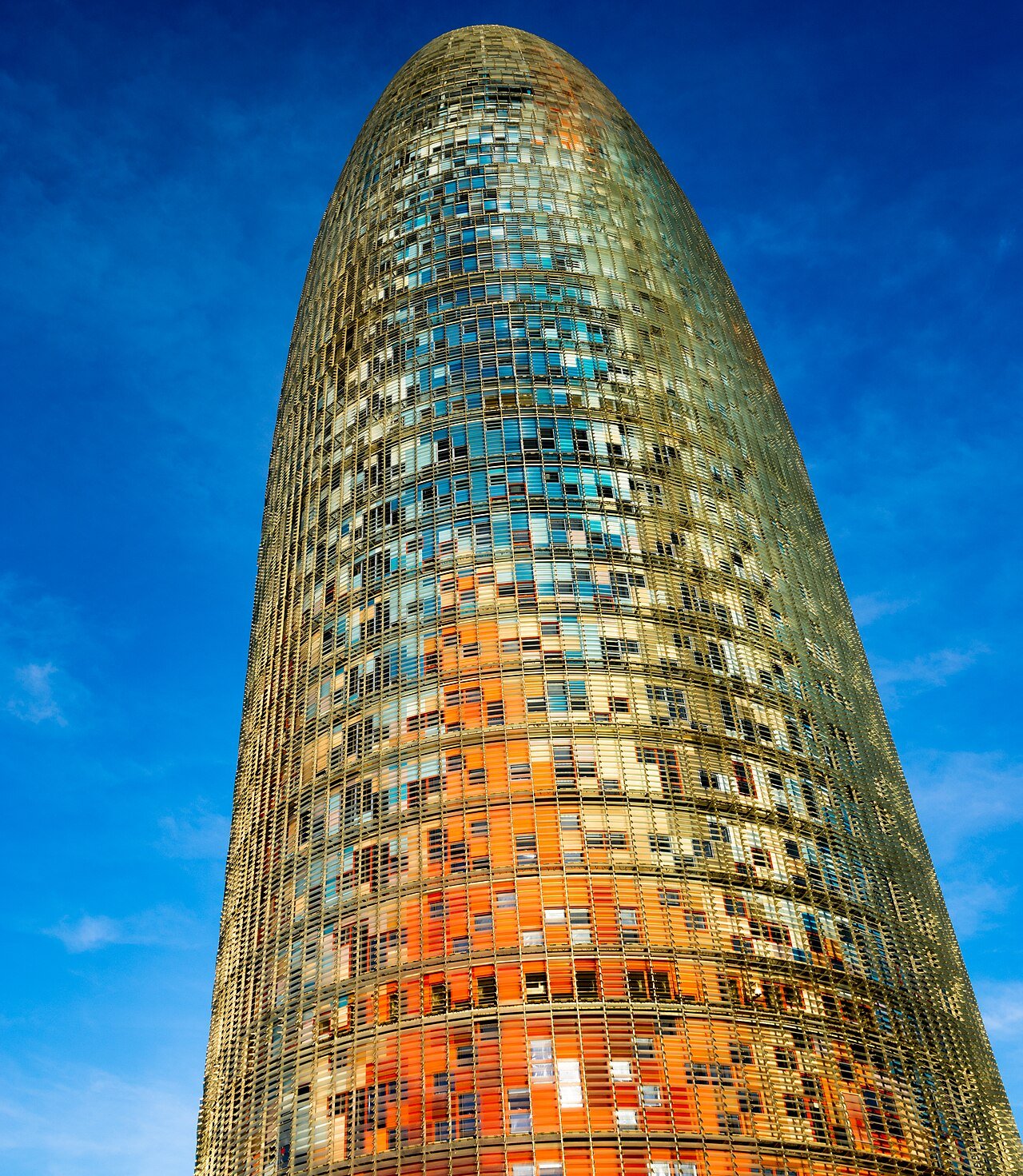
For a century Barcelona’s viewpoints were borrowed — church towers, castle walls, a hill with guns on it. The Mirador Torre Glòries, opened in May 2022, is the first one built for the job. Jean Nouvel’s 144-metre bullet of a tower, the old Torre Agbar, now hides a two-part visit: the Hipermirador, an underground exhibition that reads the city through data and sound, then a glass lift to the 30th-floor observation deck at 125 metres — a full 360° ring of glass with the Sagrada Família close enough to study.
The general ticket was €18 on the venue’s own site at the time of writing (children under 13 free on it — check current terms), and there is an extra-cost flourish: Cloud Cities Barcelona, Tomás Saraceno’s suspended sculpture of mirrored cells hanging in the dome at 130 metres, which you can climb through on a separate ticket. It is the most polished and most weatherproof viewpoint here. Sometimes that is exactly what you want.
Casa Milà: The Rooftop of Warriors
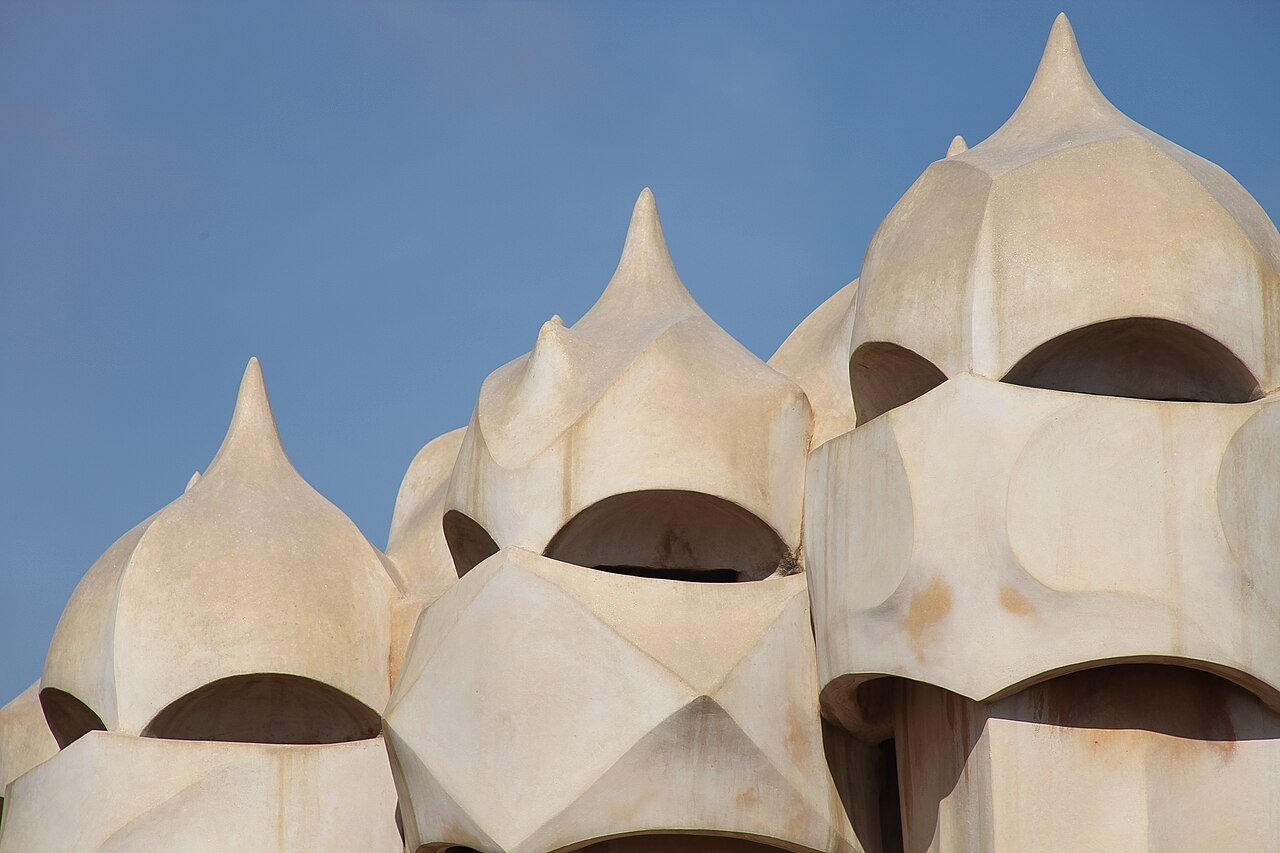
La Pedrera’s roof is the most famous rooftop walk in Europe: an undulating terrace where Gaudí turned the building’s plumbing into sculpture — stairwell exits like sandcastles, ventilation towers, and the great helmeted chimneys everyone calls the warriors, in a row along the ridge. You walk through a stone landscape that happens to have Barcelona arranged around it — Passeig de Gràcia below, the Sagrada Família’s cranes on one side, Tibidabo closing the other.
The rooftop is the finale of the standard visit, which also covers the courtyards, the Pedrera Apartment and the attic’s whale-rib arches. Adult prices ran from around €29 online at the time of writing, by timed slot, audioguide included — book the first slot for the roof at its emptiest, or the last for the light.
Palau Güell: Chimneys on a Budget Ticket
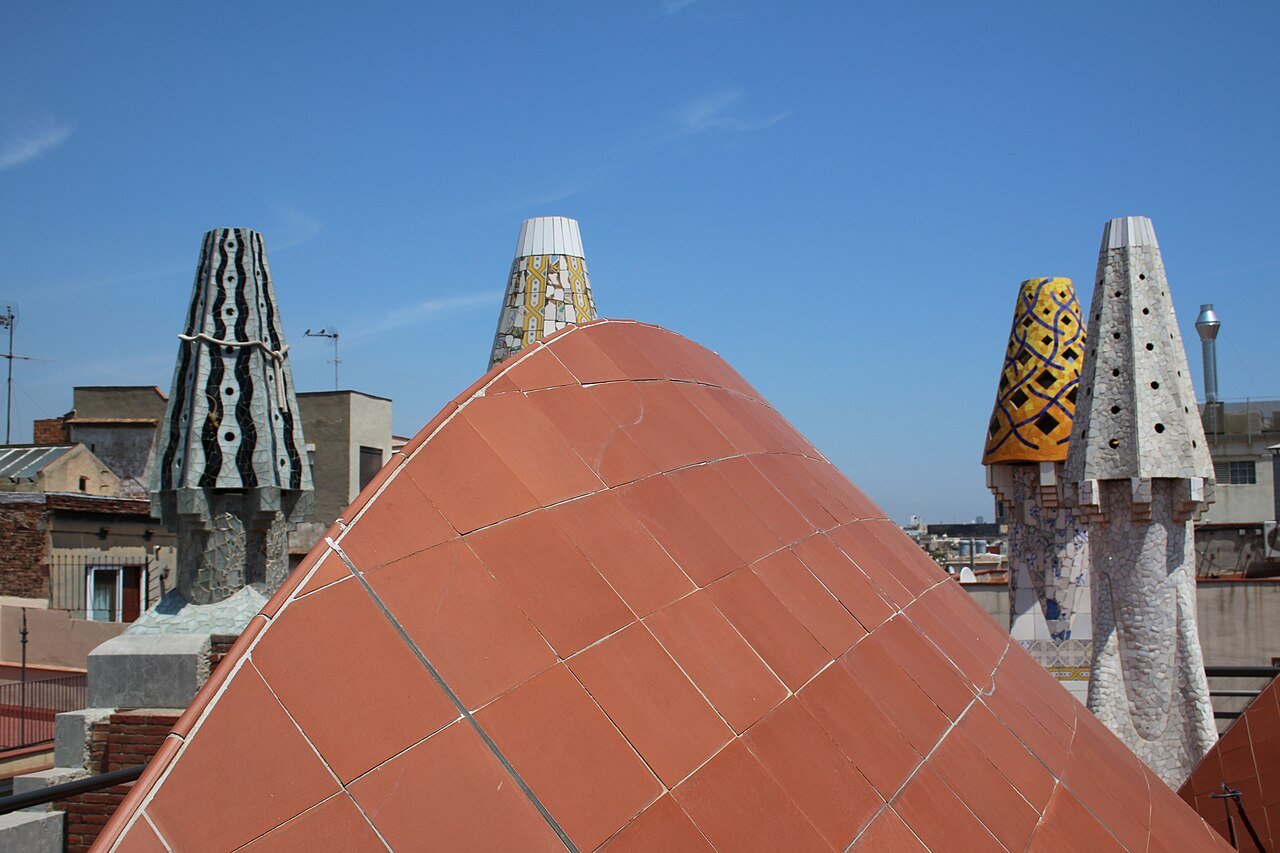
Gaudí’s other great rooftop hides in the Raval, five minutes from the Rambla, on the first palace he built for his patron Eusebi Güell. The roof is a small forest of chimneys — twenty of them, each clad differently in trencadís, ceramics and glass, no two alike — around the great cone that caps the central hall. The view is humbler than La Pedrera’s: old-town rooftops, the Columbus Monument and the port, Montjuïc on the skyline. You come for the chimneys and stay for the panorama.
The reason it earns its place is the ticket. The whole palace — carriage gates, stable crypt, concert hall and rooftop, audioguide included — was still under €10 at the time of writing, which our Palau Güell guide calls the best deal in Gaudí’s Barcelona. It is also the quietest of the Gaudí rooftops, and still often feels half-discovered.
Barcelona Cathedral: The Rooftop Walkways
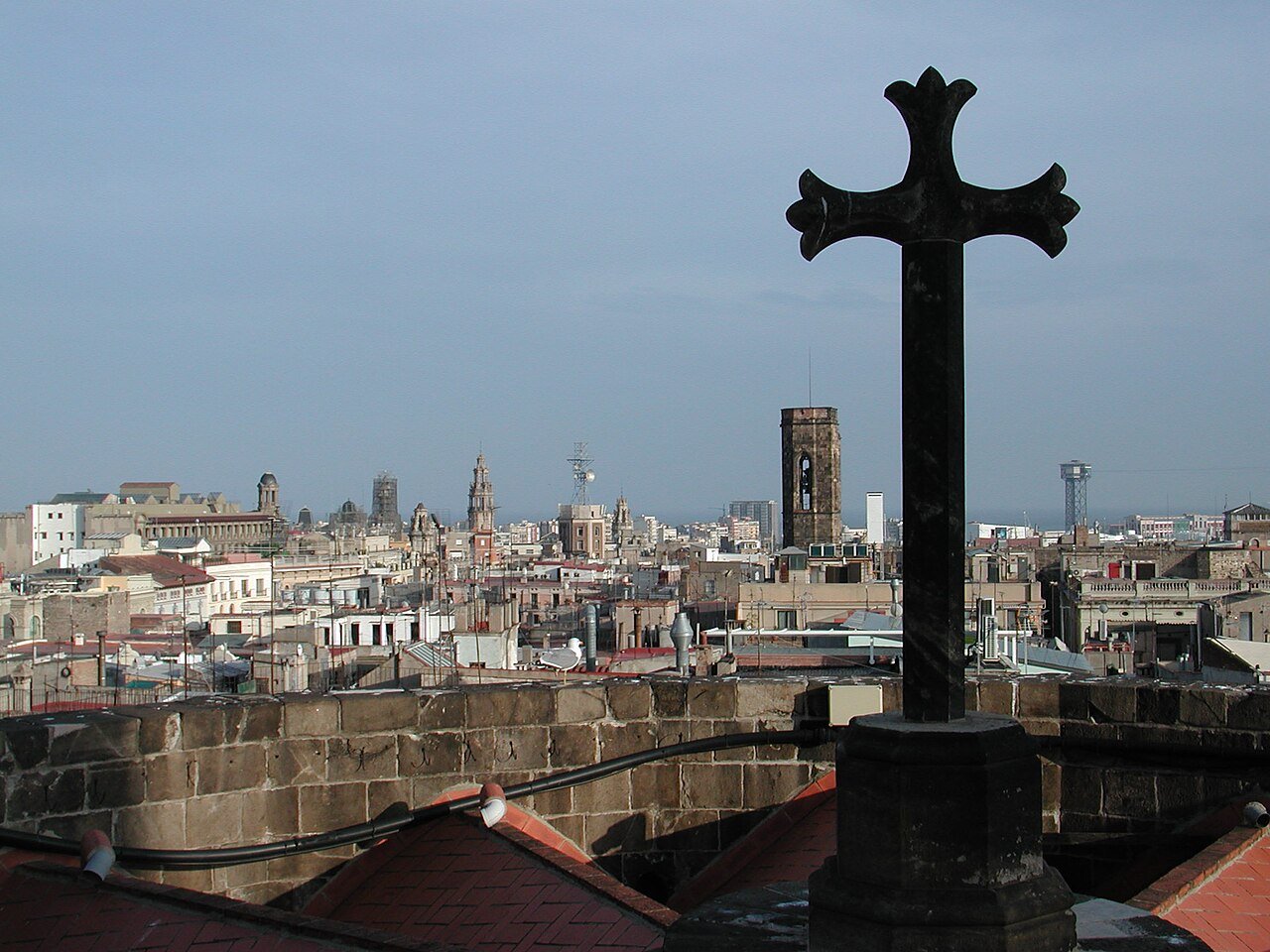
The old town has no hills, so the Cathedral lends you its roof. The tourist ticket — €16 at the time of writing, covering the church, choir, crypt, cloister and audioguide — includes the small lift to the rooftop terraces, where walkways run around the base of the great central spire. Up here the Gothic quarter becomes a map you can read: terracotta roofs and church towers, Santa Maria del Mar and Santa Maria del Pi picking themselves out, the Torre Glòries and the sea at the edge of the frame.
It is an intimate, close-quarters view rather than a grand panorama — some 30 metres up, inside the city rather than above it — and that is its charm. Go in the morning, when the terraces are quietest, and meet the cloister’s thirteen geese on the way down.
Santa Maria del Mar: The Rooftop Tour

Santa Maria del Mar was built between 1329 and 1383 by the bastaixos, the porters who hauled its stone from the harbour on their own backs — and the rooftop tour climbs into the world they built. At set times, guides lead small groups up through one of the octagonal towers and out onto the terraces above the nave: you walk the roof with the church’s towers at arm’s length, looking across El Born’s rooftops to the port.
It is, as our Santa Maria del Mar guide puts it, the most underrated rooftop experience in the old city — a working church’s roof, not a viewing platform, with a schedule to match: places are limited, times vary, and the climb involves stairs and low passages, so check the church’s current timetable and book ahead. So few people share the view that it rewards the effort by itself.
The Columbus Monument: Small Platform, Big Harbour
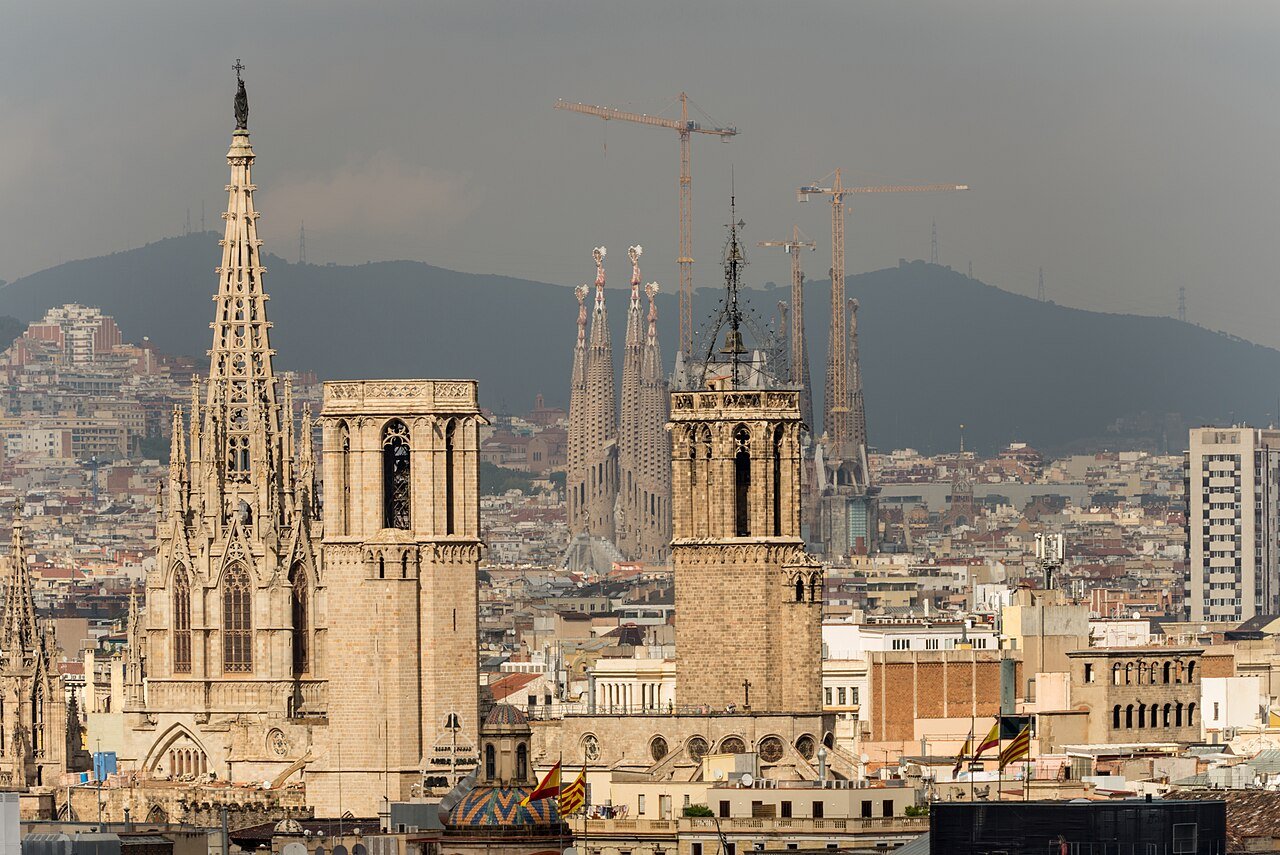
At the foot of the Rambla, Columbus stands on a 60-metre Corinthian column built for the Universal Exposition of 1888, pointing out to sea. The column is hollow, and inside it runs a tiny lift — said to be the first ever installed in Barcelona — carrying a handful of visitors at a time to the viewing gallery beneath the statue’s feet. The platform holds perhaps six or seven people; on a clear morning you may have it nearly to yourself.
The view is the hinge of the city: the Rambla running straight as a ruler into the old town one way, Port Vell and the harbour the other, Montjuïc to the left, the whole seafront unrolling to the right. Tickets are a small fee — under €10 at the time of writing, the exact price varying by seller. It is the quickest paid viewpoint in Barcelona: twenty minutes, up and down.
MNAC: The Palace Terraces
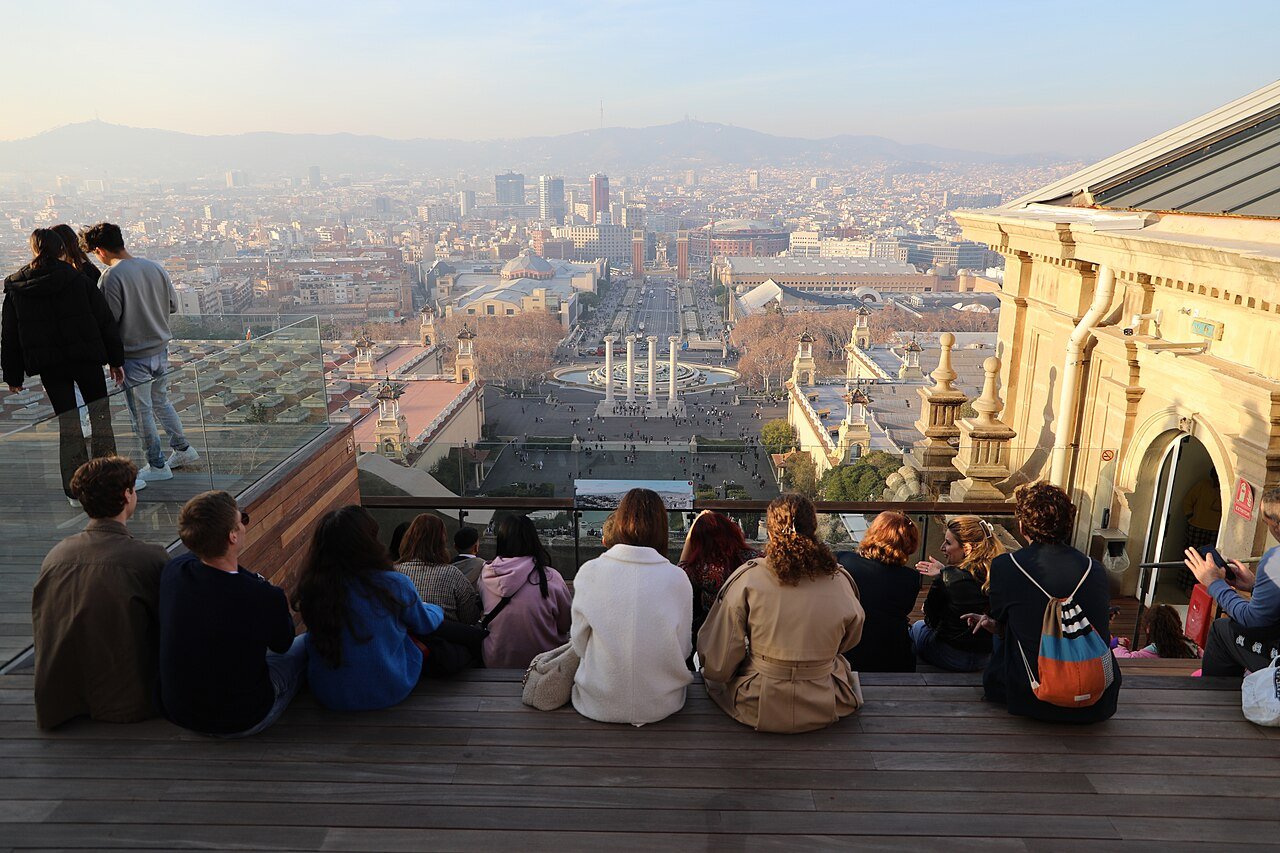
The Palau Nacional, the great domed palace built on Montjuïc’s flank for the 1929 exposition and now home to the Museu Nacional d’Art de Catalunya, commands the grandest axis in Barcelona: from its terrace the city falls away in one composed line — cascades, the Quatre Columnes, the Venetian towers, Plaça d’Espanya, the Eixample running on to Collserola. The museum’s Rooftop Viewpoint walks you around the base of the dome: the best sunset seat on the hill.
The pricing has a trick worth knowing. General admission is €12, covers the museum and the rooftop, and is valid for two days within a month — but there is also a €2 basic ticket covering the building and rooftop alone, which our MNAC guide flags as the cheapest paid viewpoint deal in the city. Entry is free for everyone on Saturday afternoons from 3pm and on the first Sunday of the month, if you reserve the free slot.
Las Arenas: The Bullring Roof

The last viewpoint is the easiest in the guide: walk into a shopping centre at Plaça d’Espanya, ride the escalators up, and step onto a circular rooftop walkway. Las Arenas was a bullring — a Neo-Mudéjar brick cylinder opened in 1900, closed after the last bullfight in 1977 — until Richard Rogers’ conversion reopened it in 2011 with its façade intact. The rooftop ring is free via the centre’s escalators; the glass lift up the outside costs a euro or so if you want the theatre of it.
From the walkway you look straight across at the Palau Nacional and Montjuïc, down at the Venetian towers and the fountain axis, and around a full 360° that takes in Tibidabo and the Sagrada Família. It is open into the evening, lined with terrace restaurants — the viewpoint to choose with tired feet or one last hour before a train from Sants. No ticket, no climb, no planning.
Practical Info
Barcelona’s viewpoints divide into three kinds. The hilltops — Bunkers, Tibidabo, Collserola, Montjuïc — are about weather: outdoors, exposed, and only as good as the day’s clarity, so watch the haze, not just the rain forecast. The towers and rooftops are about booking: Sagrada Família tower slots, Casa Milà and Palau Güell all run timed entry and sell out, so reserve them early. The free terraces — Bunkers, the Mirador de l’Alcalde, Las Arenas, the Palau Nacional steps — need no planning at all. Visitors with vertigo should start low (Las Arenas, MNAC) and give the Columbus lift and the Sagrada stairs a miss.
Tickets and Costs
The view habit can be free or €40, and the spread is the story:
- Free: Bunkers del Carmel, Mirador de l’Alcalde, the Las Arenas rooftop, the Palau Nacional steps and terraces outside the museum
- Torre de Collserola — €5.60 at the time of writing, on its limited opening days
- Sagrat Cor lift, Tibidabo — €8 at the time of writing (the church itself is free)
- Palau Güell — still under €10, rooftop included, the best-value Gaudí ticket in the city
- Park Güell monumental zone — €18, El Calvario included
- Columbus Monument — under €10; prices vary slightly by seller
- MNAC — €12 general (rooftop included, valid two days in a month) or €2 for the building-and-rooftop basic ticket
- Barcelona Cathedral — €16, rooftop lift included
- Torre Glòries — €18 general at the time of writing, Cloud Cities extra
- Montjuïc Castle — a few euros; municipal museums traditionally free on Sunday afternoons
- Casa Milà — from around €29 online, rooftop included
- Sagrada Família — basilica entry in the €30s, the tower ticket on top of that
The one upgrade worth singling out is the ride between the Montjuïc viewpoints. The Barcelona: Montjuïc Cable Car Roundtrip Ticket costs about what the station charges for the same return trip (€19 at the ticket office, less online), with free cancellation to 24 hours ahead — the castle, the Mirador and the gardens joined into one journey, half of which is itself the view. Note the ticket is the ride only: castle entry is paid separately at the top.
Getting There
The Collserola pair share a journey: rail or bus up the mountain, then the Vallvidrera or Tibidabo funiculars — allow the best part of an hour from the centre. The Bunkers are a metro ride to Alfons X or El Carmel plus a steep ten-to-fifteen-minute climb, or a bus most of the way. Montjuïc gathers at Plaça d’Espanya and Paral·lel: funicular from Paral·lel to the park station, cable car onward, buses up the hill for the castle. The old-town rooftops — Cathedral, Santa Maria del Mar, Columbus, Palau Güell — sit within a ten-minute walk of each other. Torre Glòries is at the Glòries metro interchange.
When to Go
Clarity beats season. The great view days come with the tramuntana and after rain, when the air is washed and Montserrat stands out behind Tibidabo; humid summer afternoons haze the horizon to a white smudge. Within the day: go early for empty terraces, or aim at the golden hour, when the Eixample glows and every viewpoint fills with locals. Sunset belongs to the Bunkers, the MNAC terrace and Las Arenas, in that order. Winter’s low sun gives the crispest long views.
How Long You Need
A viewpoint takes twenty minutes (Columbus, Las Arenas) to two hours (Casa Milà’s full visit) — the art is in the grouping. Give Collserola half a day: Tibidabo’s church and terrace, the tower if it is open, the amusement park if you have children. Give Montjuïc the same: cable car up, Mirador, castle, MNAC rooftop at the end of the day for the light. The old town stacks into one morning — Cathedral roof, Santa Maria del Mar’s tour, Columbus, Palau Güell — and the Bunkers are a sunset expedition on their own.
Tips for Getting the Best Views in Barcelona
- Check the sky, not the forecast. Haze kills more viewpoints than rain. After a clear-out — rain overnight, wind from the north — drop your plans and go high.
- Sunset at the Bunkers means arriving an hour early. The platforms fill; the light peaks after the sun drops behind Collserola, so stay for the ten minutes after.
- Book the towers first, plan around them. Sagrada Família tower slots and Casa Milà mornings sell out days ahead in season; the free hilltops will fit around whatever you fix.
- Use the €2 MNAC trick. If you only want the palace rooftop, the basic ticket covers it — the cheapest paid panorama in the city.
- Ride the cable car up, walk down. The gardens, the Mirador and the castle moat are all on the downhill path.
- Mind the wind closures. The Sagrada towers, the Sagrat Cor lift and the Collserola observatory all close in high wind — on a blustery day, choose street-level rooftops instead: Palau Güell, the Cathedral, Las Arenas.
FAQs
What is the best free viewpoint in Barcelona?
The Bunkers del Carmel, and it is not close: a full 360° panorama from 262 metres, no ticket, no time limit. Las Arenas is the best free option at street level; the Mirador de l’Alcalde is the best free view over the port.
What is the highest viewpoint in Barcelona?
The Torre de Collserola’s observatory, at 560 metres above sea level — higher than the Sagrat Cor’s platform on Tibidabo (about 541 metres). The catch is the tower’s limited opening calendar; the Sagrat Cor terrace is the highest viewpoint you can rely on any day.
Where is the best view of the Sagrada Família?
From the Bunkers, where it rises from the centre of the grid in one clean line of sight — or from the Torre Glòries’ deck, close enough to study the towers. The strangest view is from the Sagrada’s own towers, looking back across the nave.
Which viewpoint is best at sunset?
The Bunkers del Carmel for the full ritual — the sun dropping behind Collserola, the city lighting up below. The MNAC terrace runs it close for pure composition: the fountain axis, Plaça d’Espanya and the whole Eixample in the last light.
Are the Sagrada Família towers worth it, when the Bunkers are free?
They are different purchases. The Bunkers give you the city, free, as a panorama. The towers give you Gaudí’s building from inside — the bridge between the spires, the mosaic at touching distance — with the city as a bonus. Visiting the basilica anyway? Add the towers. Only want a panorama? Climb Carmel hill and spend nothing.
Which viewpoints work for children or anyone who hates climbing?
Las Arenas (escalators, free), the Torre Glòries deck (lift the whole way) and the MNAC rooftop. The cable car does the climbing on Montjuïc for you. Avoid the Columbus Monument’s tiny lift if confined spaces are the problem, and the Sagrada towers — stairs-only on the way down.
Travel insurance, sorted
Whether it is a two-week holiday or a longer move, travel insurance is not the most glamorous part of a trip — but it is the one booking you want to have in place before a trip, and while you are already away. Get a quote from SafetyWing
Final Thoughts
Barcelona rewards anyone willing to go uphill. The city keeps its best self-portrait at altitude — in a Civil War battery the neighbours have adopted, on church roofs built by porters, inside a television tower and on the roof of a bullring that stopped holding bullfights half a century ago. Start with the free ones, because they are genuinely among the finest: the Bunkers at sunset will recalibrate what you expect a view to cost. Then spend where the building is part of the view — a Gaudí rooftop, the Sagrada’s bridge between spires. Go up early and go up often: this is a city that only fully makes sense from above.

Bunkers del Carmel: The Complete Guide to Barcelona’s Best Viewpoint
Photo credits: Bunkers del Carmel viewpoint by Malet, CC BY-SA 4.0; Tibidabo amusement park from the Sagrat Cor terrace by Enric, CC BY-SA 4.0; Torre de Collserola by Felix König, CC BY 3.0; Montjuïc Castle cannon by The ed17, CC BY-SA 4.0; Telefèric de Montjuïc by Tim Adams, CC BY 3.0; El Calvario, Park Güell by The ed17, CC BY-SA 4.0; view from the Sagrada Família’s Nativity tower by Maksim Sokolov, CC BY-SA 4.0; Torre Glòries by Bjørn Erik Pedersen, CC BY-SA 4.0; Casa Milà rooftop chimneys by Rick Ligthelm, CC BY 2.0; Palau Güell rooftop by FrDr, CC BY-SA 4.0; Barcelona Cathedral rooftop by Paolo da Reggio, public domain; Santa Maria del Mar roof by Dror Feitelson, CC BY-SA 3.0; view from the Columbus Monument by Ralf Roletschek, GFDL 1.2; MNAC rooftop viewpoint by Francesco Bini, CC BY-SA 4.0; Las Arenas by Felix König, CC BY 3.0 — all via Wikimedia Commons.



3 Comments