La Rambla: The Complete Guide to Barcelona’s Most Famous Street
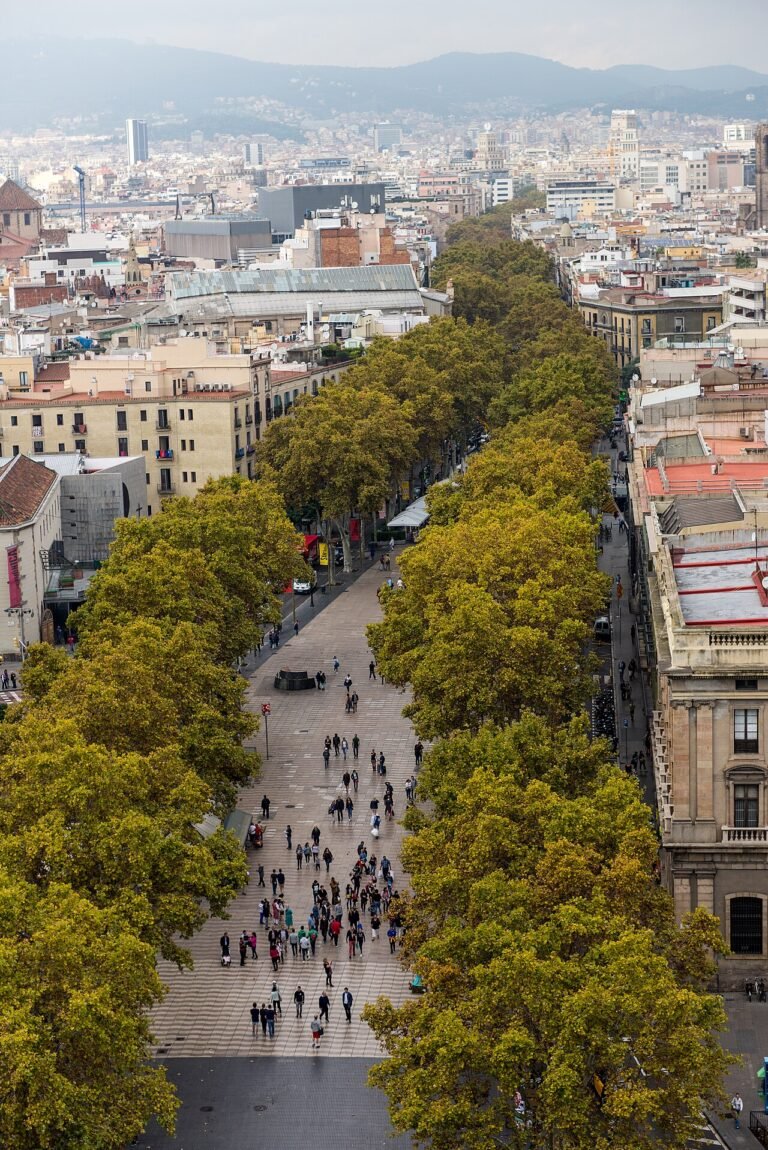
Ask a Barcelonan to name their city’s street and they will not hesitate — but they may surprise you with the reason. La Rambla is not where Barcelona shows off its masterpieces; the Gaudí buildings stand elsewhere, and our Best Things to Do in Barcelona guide rounds them up. La Rambla is where Barcelona shows off itself: 1.2 kilometres of tree-lined promenade running gently downhill from Plaça de Catalunya to the Columbus Monument at the old port, walked by everybody, owned by nobody, and busy from the first coffee of the morning to the last argument of the night. Lorca called it the one street in the world he wished would never end. The locals simply call it les Rambles — always plural — because it is not one street but five, each with its own name, its own trade and its own temper.
This guide walks it as it is meant to be walked, top to bottom and in order: the football fountain at Canaletes, the old bird-sellers’ stretch of the Estudis, the market and the flower stalls of Sant Josep, the opera house and Miró mosaic of the Caputxins, and the statues and artists of Santa Mònica down to the sea. It is entirely free, entirely flat, and impossible to get lost on — the one navigation rule is to keep the water downhill. All you have to manage is the crowd, the terraces and your own bag, and this guide is honest about all three.

The Short Answer
Yes — walk La Rambla once, slowly, end to end, and then use it as your compass for the old town for the rest of the trip. The full walk takes twenty minutes without stopping and half a day done properly: a coffee opposite the opera house, a circuit of the market, a detour through Plaça Reial, a pause to find the Miró mosaic under your feet. Almost everything in this guide is outdoors and free; the paid pleasures are optional extras — an opera-house tour, the lift inside the Columbus Monument. Come before ten for the street at its calmest and most local, or at dusk for its golden hour, and read the safety section before either: La Rambla’s pickpockets are as famous as its plane trees, and the honest defences are below.
Table of Contents
- The Short Answer
- The Story in Brief: A Riverbed That Became a Living Room
- What to See: Rambla de Canaletes — the Fountain End
- What to See: Rambla dels Estudis — the Bird-Sellers’ Stretch
- What to See: Rambla de Sant Josep — the Market and the Flowers
- What to See: Rambla dels Caputxins — the Liceu, the Café and the Mosaic Underfoot
- What to See: Rambla de Santa Mònica — Statues, Artists and Columbus
- Practical Info
- Tips for Visiting
- Final Thoughts
The Story in Brief: A Riverbed That Became a Living Room
The name gives the street away: rambla comes from the Arabic ramla, a sandy riverbed, and water is exactly what ran here. For centuries a seasonal stream flowed down this line outside the medieval city wall, and the far bank was a margin of monasteries, market gardens and not much else. When Barcelona’s second ring of walls came down in the mid-nineteenth century and the stream was buried, the city found itself with a long, flat, slightly sloping strip of no-man’s-land — and did the most Barcelonan thing possible with it: planted plane trees down both sides, opened the central strip to pedestrians only, and turned it into a promenade.
Each stretch kept the name of what stood beside it. At the top, the Rambla de Canaletes took its name from the drinking fountain by Plaça de Catalunya; then came the Rambla dels Estudis, named for the old university; the Rambla de Sant Josep, named for a Carmelite convent where the market now stands; the Rambla dels Caputxins, for the Capuchin friars; and finally the Rambla de Santa Mònica, for the convent at the bottom, now an arts centre. The trades followed the names — bird-sellers at the top, florists in the middle, theatres and cafés below — and within a generation the whole city, from duchesses to dockers, was walking the same 1.2 kilometres. That is the street’s real history: not a monument but a habit, two centuries old and still going.

What to See: Rambla de Canaletes — the Fountain End
Start at the top, in the roar of Plaça de Catalunya, and walk the few metres down to the street’s first landmark: the Font de Canaletes, a modest cast-iron drinking fountain of 1892, black and gold, crowned with lamps and wearing the Barcelona shield. It is the most superstitious object in the city. The legend is fixed to it in Catalan: whoever drinks from Canaletes falls in love with Barcelona and will return — qui beu de Canaletes, torna a Barcelona. The promise is cast into the little plaque at the fountain’s base, and generations of visitors have queued for a sip of municipal tap water on the strength of it; the fountain has never once been known to send anyone to the wrong city. Take the drink. It costs nothing and the insurance policy is two centuries old.
The fountain’s second life is louder. Since the 1930s, when supporters gathered at the Canaletes newspaper kiosk to hear results chalked up after away matches, this corner has been where Barça celebrates: every league title, every cup, ends with thousands of fans around this little fountain, flares in the air and the bravest climbing the lamp-posts. If you are in town on a trophy night, Canaletes is the best free party in Europe and the worst place in Europe to be carrying anything stealable — both facts at once, like everything on this street. From the fountain, the old town lies two lanes east: the Roman towers of Plaça Nova and the Cathedral close are five minutes away, and our Barcelona Cathedral guide walks that building in full.


What to See: Rambla dels Estudis — the Bird-Sellers’ Stretch
The second stretch takes its name from the Estudi General, the medieval university that stood here — its site is now the Royal Academy of Sciences and Arts, the building with the clock, home to the Teatre Poliorama — but its fame is feathered. For well over a century this was the ocellaires’ Rambla: the bird-sellers, whose stalls of cages lined the central promenade selling songbirds, chickens, rabbits and anything else that could be kept in a flat with a balcony. Barcelonans of a certain age still describe Sunday mornings here by the noise.
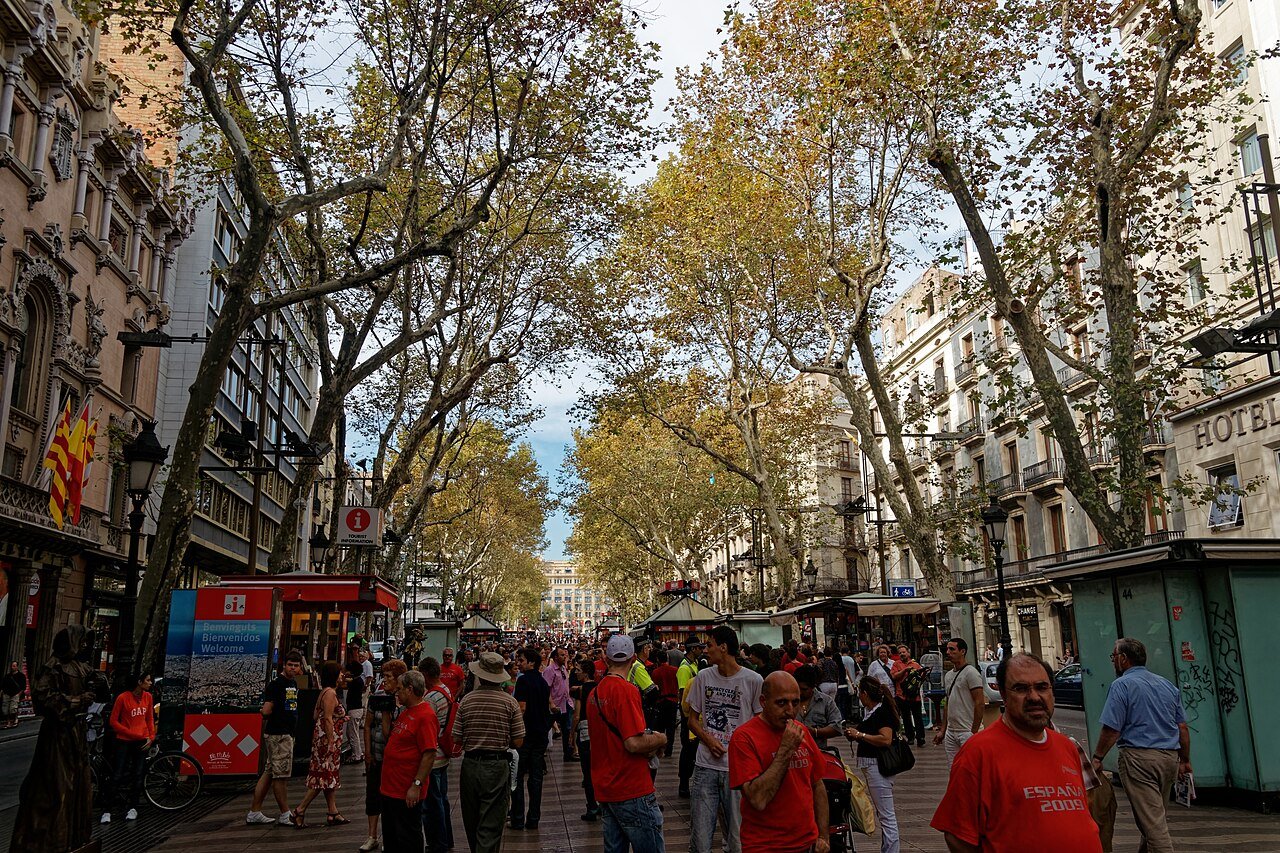
The animals are gone — animal-welfare rules ended live sales and the last pet stalls closed years ago — and honesty requires saying the stretch is now the quietest and least distinct of the five: news kiosks, souvenir stalls, the promenade running on. Look for the Academy building’s clock as you pass: for generations it kept Barcelona’s official time, and half the city once set its watches by it twice a day. The theatre beneath it, the Poliorama, earned its own footnote in 1937, when the fighting of the May Days swept this stretch of the Rambla and George Orwell watched it from a rooftop nearby — the same street, doing its other job as the city’s stage for history. But walk it with the picture in mind and it reassembles: this is where the street’s kiosk culture began, where the flower-sellers’ grandmothers bought canaries, and where the plane trees — planted in the nineteenth century and now enormous — first close overhead into the green tunnel that shades the rest of the walk. It takes four minutes to cross. Spend five, and look up.
What to See: Rambla de Sant Josep — the Market and the Flowers
Halfway down, the street changes key. On your right, under a great stained-glass arch, is the entrance to the Mercat de Sant Josep — La Boqueria, Barcelona’s most famous market, trading on the site of the old Sant Josep convent since 1840. It deserves far more than a paragraph, and it has one: our La Boqueria guide walks its aisles stall by stall. Here, just register the essentials from the street — the modernista entrance arch of 1913 with the city’s coat of arms, the roar of the first fruit stalls, and the working rule of every Rambla local: admire the entrance, then eat deeper inside or not at all.
This stretch has a second name — the Rambla de les Flors, the Rambla of the Flowers — and it has earned it since the nineteenth century, when the floristes set up here and this became, for decades, effectively the only place in Barcelona to buy flowers. The flower stalls still stand in a line down the middle of the promenade, a dozen or so family kiosks selling roses, bouquets and seed packets to a stream of locals who genuinely buy them: grandmothers, boyfriends in trouble, and half the wedding parties in the old town. On Sant Jordi’s day, 23 April, the whole street gives itself over to roses and books and the flower Rambla becomes the city’s front room. Opposite the market, pause at the Palau de la Virreina, the street’s one great palace: a rococo mansion built in the 1770s for the viceroy of Peru and named for his widow, now a city exhibition centre whose shows are usually free — the grandest front door on La Rambla, and most walkers pass it without a glance.


Free Barcelona travel guide
Walking La Rambla? Get our free one-page Barcelona checklist: what to book ahead, where to eat one street off the boulevard, and the old-town lanes to wander next.
What to See: Rambla dels Caputxins — the Liceu, the Café and the Mosaic Underfoot
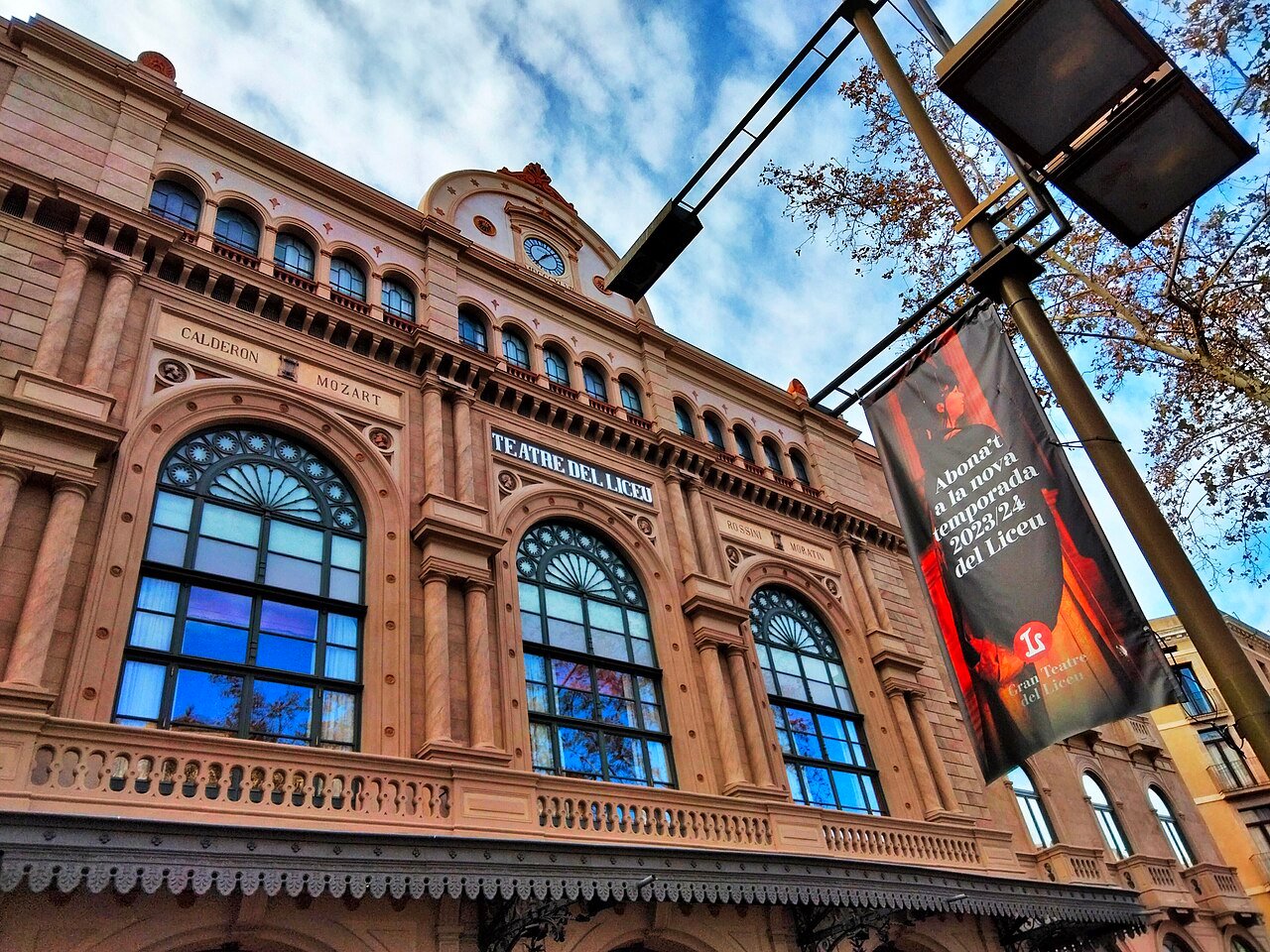
The fourth stretch is the street’s grand salon, and its centrepiece faces you on the right: the Gran Teatre del Liceu, Barcelona’s opera house, opened in 1847 and twice risen from fire — razed in 1861, burned again in 1994, and rebuilt both times by a city that treats it as a member of the family. From the promenade it is all arched windows and restraint; inside are some 2,300 seats and one of Europe’s great auditoriums. You do not need an opera ticket to see it — the house runs daytime guided visits — but even from outside it anchors the street: this is where La Rambla puts on its evening clothes.
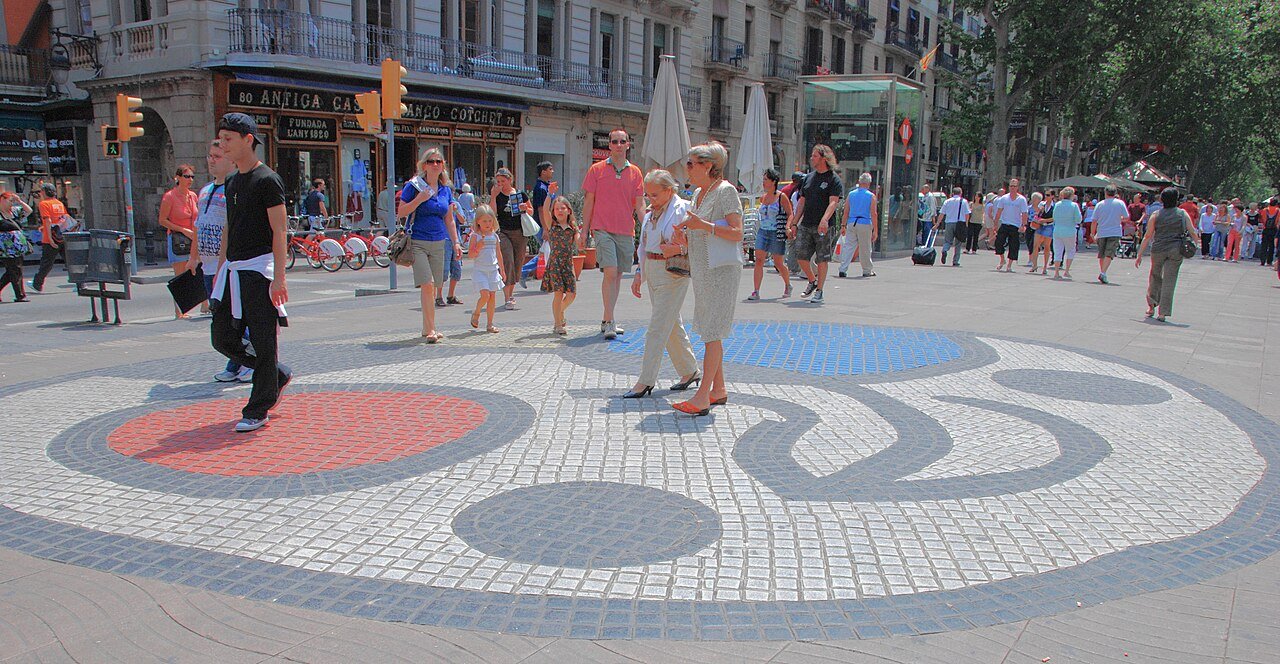
Directly opposite, at number 74, is the opera house’s eternal interval: the Café de l’Òpera, pouring coffee since 1929 in a modernista interior of etched glass, mirrors and dark wood that has survived everything the century threw at the street, including the war — it famously stayed open through the Civil War. It is the one terrace address on the central Rambla we will actually recommend, because what you pay for here is a century of history rather than a view of the crowd. Then look down. Set into the pavement at the Pla de l’Os, in front of the Liceu, is a circular mosaic of coloured tiles — red, blue, yellow, black — designed by Joan Miró in 1976 as a gift to the city he was born in, a few lanes from this spot. Thousands cross it daily without seeing it; now you cannot unsee it. A good Las Ramblas and Gothic Quarter walking tour earns its money on exactly these two metres of pavement.
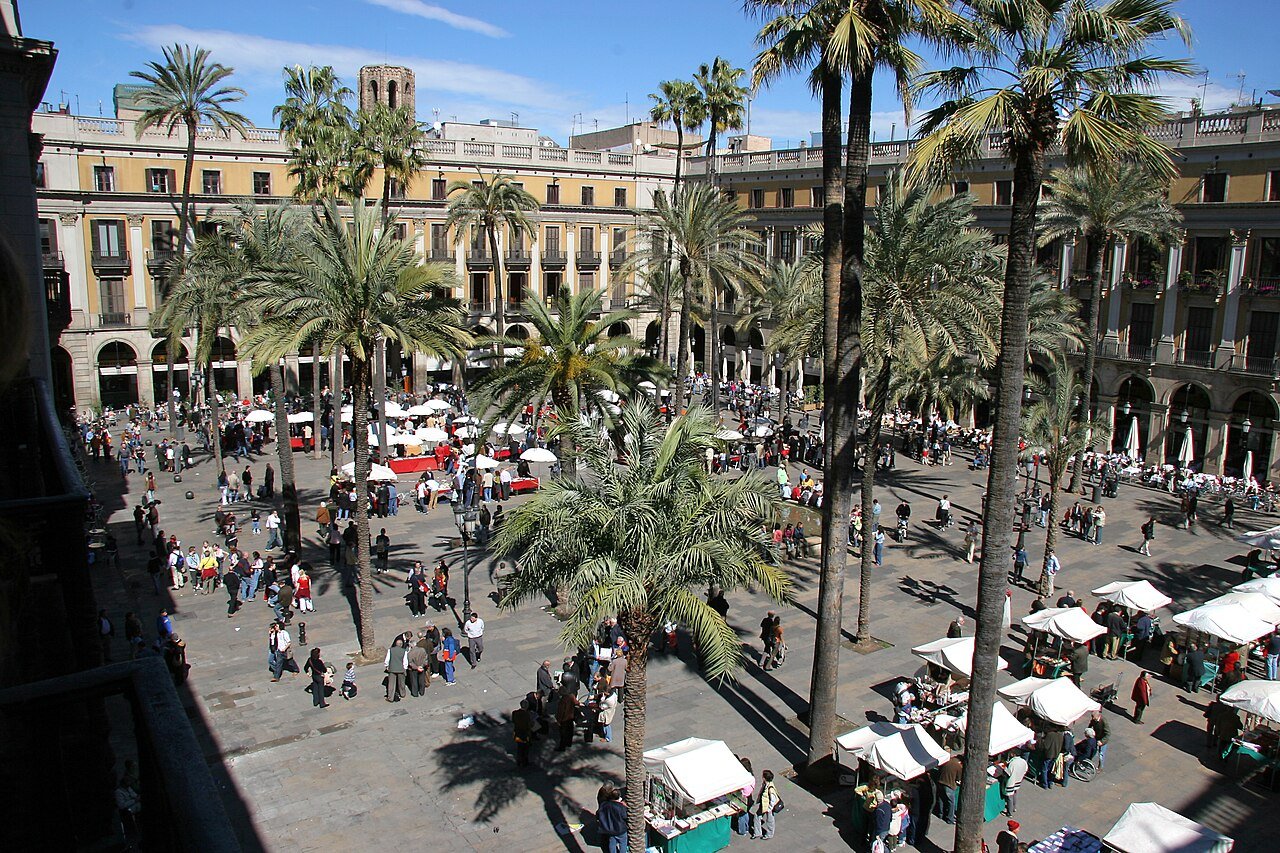
One archway east of the mosaic, slip through the arcades into Plaça Reial, the old town’s palm-shaded salon of café terraces and Gaudí lampposts. It has its own full treatment in our Gothic Quarter guide, so here it is a pointer, not a stop: coffee if you must, photographs certainly, and back to the boulevard before the square’s late-night alter ego clocks on.

What to See: Rambla de Santa Mònica — Statues, Artists and Columbus
The last stretch runs from the old Capuchin ground down to the sea, and it has always been the street’s theatre. This is where the human statues made La Rambla famous a second time: through the 1980s and 1990s the lower promenade filled with living statues of real genius — Dalí ladies with drawers in their dresses, levitating monks, dragons, whole chess sets — until the city, faced with a pavement of competing miracles, stepped in and regulated them. Performers are now licensed, their pitches set toward this Santa Mònica end, and their numbers are a fraction of the golden age; the standard, perhaps because of the auditions, remains absurdly high. The etiquette is unchanged and fair: a photograph earns a coin, and a coin earns a movement. Alongside them, portrait artists and caricaturists work the railings near the Plaça del Teatre, as they have for generations, and on the Raval side the old Augustinian convent that gives the stretch its name survives as Arts Santa Mònica, a free exhibition centre whose stark white galleries are the calmest rooms on the whole boulevard — step in for ten minutes of air-conditioned silence whenever the promenade’s theatre gets too loud.
The street ends — and the city turns seaward — at the Monument a Colom, the Columbus Monument: a 60-metre cast-iron column raised for the Universal Exposition of 1888, topped by Columbus pointing out to sea, with a tiny lift inside the column that carries you to a viewing gallery at his feet for one of the great cheap views in Barcelona — the whole Rambla laid out behind you like a green river running uphill. From its base the wooden boardwalk of the Rambla de Mar reaches across the harbour to the Maremagnum, and the old town’s waterfront begins. You have walked the street. Turn around: it reads completely differently uphill, and the fountain owes you a drink.


Practical Info
Getting there, and the lay of the land. Three metro stations serve as the street’s doors: Catalunya (lines 1 and 3) at the top, Liceu (line 3) in the middle, Drassanes (line 3) at the bottom. The walk itself is 1.2 km of flat, step-free promenade; the centre is pedestrians only, with a traffic lane and a pavement on each side — stay in the middle, where the life is. The five stretches in order, top to bottom: Canaletes, Estudis, Sant Josep, Caputxins, Santa Mònica. Street numbers run from Plaça de Catalunya down to the port, odd on the Raval side, even on the Gothic side — a genuinely useful compass.
Safety, honestly. La Rambla is not dangerous, but it is routinely described — by police, guidebooks and Barcelonans alike — as one of Europe’s pickpocket capitals, and this guide will not pretend otherwise. The risk is theft, never violence: hands in bags in the Canaletes crush, phones lifted from terrace tables, and the classic distraction plays — something spilled on your shoulder, a petition thrust at you, a stranger suddenly dancing around you after a goal. The defences are boring and they work completely: a zipped bag worn in front of you, nothing in a back pocket, phone in your hand or away — never on the café table — and a cheerful, firm refusal of anything spilled, offered or thrust. Do that and the street is all pleasure; every local walking beside you is doing exactly the same.
Eating and drinking, honestly. The central Rambla’s terraces charge for their postcode, and the giant photographic paella boards along the promenade are the street’s one reliable warning sign: laminated menus in four languages, dishes nobody local orders, prices nobody local pays. The rule that fixes everything is one street: step a single lane off the boulevard — into the Raval on one side, the Gothic lanes on the other — and prices fall by a third while quality climbs. The honourable exceptions are already in this guide: the Café de l’Òpera for the room, and the market’s inner counters via our Boqueria guide. For everything else, one street off is the whole strategy.
When to walk it. Before ten in the morning the Rambla belongs to delivery scooters, stallholders and locals walking dogs under the plane trees — the street at its most itself. Midday to early evening is peak crowd, peak theatre and peak pickpocket; dusk is the beautiful compromise, when the lamps come on and the passeig — the evening stroll that is the street’s founding ritual — fills the promenade with three generations at once.
Tips for Visiting
- Walk it twice: once early, once at dusk. The 9 a.m. Rambla of stallholders and dog-walkers and the 8 p.m. Rambla of the evening passeig are two different streets sharing one set of trees.
- Book the walking tour for this street specifically. La Rambla’s sights are deliberately camouflaged — a fountain, a mosaic, a palace front — and a Las Ramblas and Gothic Quarter walking tour at the start of your trip turns the whole boulevard into a labelled diagram for the days after.
- Drink from Canaletes, then guard the bag you drank with. The legend promises a return trip; the pickpockets of the Canaletes corner would happily make it a return trip to the police station instead.
- Find the mosaic before you find the Liceu. Miró’s circle at the Pla de l’Os is the street’s best-hidden famous sight — stand on it, photograph your feet on it, and watch how many passers-by look down for the first time.
- Never eat on the central promenade. One street off in either direction — that’s the whole rule. Your wallet and your standards will both notice the difference within fifty metres.
- Ride the Columbus lift at the end of the walk. The view back up the green river of the Rambla is the street’s portrait of itself, and it costs less than a terrace coffee on the street below.
Travel insurance, sorted
Whether it is a two-week holiday or a longer move, travel insurance is not the most glamorous part of a trip — but it is the one booking you want to have in place before a trip, and while you are already away.
Final Thoughts
Every great city keeps one room where it receives the world, and Barcelona’s is a buried riverbed with plane trees. La Rambla has been, by turns, a stream, a wall-side waste ground, a bird market, a flower garden, an opera foyer and a football terrace — and it has never stopped being the city’s living room, the one address where duchess and docker have always walked the same promenade. It is crowded, it is theatrical, it charges too much for coffee, and it remains utterly itself. Walk it slowly, drink from the fountain, keep a hand on your bag, and let it do what it has done for two hundred years: introduce you to Barcelona by walking you through it.
¡Buen viaje!

Photo credits: La Rambla from above — Djm1279, public domain · The Rambla de les Flors in the early twentieth century — Antoni Esplugas, public domain · The Font de Canaletes — Enfo, CC BY-SA 3.0 es · The Rambla de Canaletes towards Plaça de Catalunya and the Rambla dels Estudis — Txllxt TxllxT, CC BY-SA 4.0 · The Boqueria entrance — Francisco Javier Guerra, CC BY-SA 4.0 · The Palau de la Virreina — Didier Descouens, CC BY-SA 4.0 · The Gran Teatre del Liceu and the Café de l’Òpera — Enric, CC BY-SA 4.0 · Miró’s Pla de l’Os mosaic — Mike McBey, CC BY 2.0 · Plaça Reial from above — Sebastian Schreiber, CC BY-SA 3.0 · A living statue on the lower Rambla — Jordiferrer, CC BY-SA 4.0 · The Columbus Monument at dusk — Jorge Láscar, CC BY 2.0. All via Wikimedia Commons.