Eixample, Barcelona: The Complete Guide to Gaudí’s Golden Grid

Short Answer
The Eixample — the name simply means “extension” or “enlargement” in Catalan — is the district Barcelona built when it burst out of its medieval walls in the mid-19th century, and it is unlike anywhere else on Earth. Its designer, the engineer Ildefons Cerdà, laid out a strict grid of square blocks, each 113.3 metres a side, and then cut every corner off at 45 degrees, so that from the air the whole district reads as a honeycomb of octagons. Into that rational grid the rich of industrial Barcelona poured their money and their rivalry, hiring Antoni Gaudí, Lluís Domènech i Montaner and Josep Puig i Cadafalch to outbuild each other — which is why a district drawn up as an exercise in public health became an open-air museum of Modernista architecture.
You do not “visit” the Eixample the way you visit a monument; you are in it for much of your stay, because it holds the Sagrada Família, Casa Batlló, La Pedrera and most of the city’s hotels, shops and metro interchanges. It earns its place on any list of the best things to do in Barcelona not as a single sight but as the stage on which half the famous sights stand. Give it at least half a day of deliberate wandering — the grid rewards walkers who look up.
Table of Contents
- The Short Version: A District You Read Like a Map
- A Walled City Bursts Out: A Short History
- How the Grid Works: Blocks, Chamfers and Courtyards
- The Quadrat d’Or and Passeig de Gràcia
- Beyond the Golden Square: The Diagonal and the Side Streets
- The Sagrada Família Side: Avinguda Gaudí and Sant Pau
- The Six Neighbourhoods: Six Versions of the Eixample
- Markets, Superblocks and Green Axes: The Eixample Barcelonans Use
- One Perfect Eixample Walk
- Practical Info
- Tickets and Costs
- Getting There and Getting Around
- When to Go
- How Long You Need
- Tips for Visiting
- What to See Nearby
- Frequently Asked Questions
- Final Thoughts
The Short Version: A District You Read Like a Map
Most visitors experience the Eixample as a blur of similar-looking streets between one Gaudí house and the next, and that is a shame, because the district has a legible structure once someone points it out. Three ideas unlock it. First, the grid itself: identical blocks, cut corners, and streets wide enough for the light and air the old town never had. Second, the Quadrat d’Or, the “Golden Square” around Passeig de Gràcia where the great Modernista houses concentrate. Third, the living district underneath the postcard — the markets, courtyards, superblocks and green axes where Barcelonans are still renegotiating Cerdà’s plan today.
The fastest way to absorb all three in one go is with a guide for your first walk. The Private Barcelona Modernism and Gaudí Walking Tour spends three hours in the district with a private guide, starting at the Sagrada Família and working through the Eixample to Passeig de Gràcia — Casa Batlló, La Pedrera, Casa Amatller, Casa Lleó Morera and lesser-known houses such as Casa Comalat and the Palau del Baró de Quadras, finishing at the Casa de les Punxes. It is an exterior tour: you learn to read the façades, and you book the interiors you like the look of separately, for your own time. It is rated 4.7 out of 5 on GetYourGuide.
A Walled City Bursts Out: A Short History
By the 1850s Barcelona was suffocating. Still fenced in by its medieval walls, it had become one of the most densely populated cities in Europe, and its mortality rates showed it. The walls began coming down in 1854, and in 1855 the government in Madrid commissioned the civil engineer Ildefons Cerdà to survey the plain between the old city and the surrounding villages. Cerdà did something nobody had done before: before drawing a single street, he made a statistical study of how Barcelonans actually lived — housing, work, diet, disease, death — and designed the new district as a cure.
The result, approved by royal order in Madrid in 1859 and begun when the first stone was laid on 4 September 1860 in what is now Plaça de Catalunya, was imposed over the city council’s own competition winner, Antoni Rovira i Trias — a grievance Catalans noted at the time. Cerdà’s plan was radical in its equality: every block the same size, every street the same width, sun and ventilation for rich and poor alike, buildings kept low and set around shared gardens. His Teoría General de la Urbanización of 1867 effectively founded the modern discipline of urban planning — the Spanish word urbanización is his coinage.
What got built was Cerdà’s geometry filled with other people’s ambitions: developers enclosed all four sides of the blocks instead of two or three, built above his 16-metre height cap, and filled in the garden courtyards. Then, from the 1880s, came Modernisme, as textile and shipping fortunes competed in stone along the new avenues. The grid drawn for public health became the frame for the most exuberant architecture in Spain.
How the Grid Works: Blocks, Chamfers and Courtyards
Start with the numbers, because the numbers are the district. Each block — illa in Catalan, manzana in Spanish — is a square of 113.3 metres by 113.3 metres. Ordinary streets are 20 metres wide; the great avenues run to 30, 50 or 60 metres. And at every corner, the square is sliced off by a 45-degree chamfer, the xamfrà, with a face 20 metres long. Do that to every block in a grid and each crossroads becomes a small octagonal plaza: the slice improves visibility for traffic — Cerdà, remarkably, designed the chamfers with steam trams and future mechanised vehicles in mind — and at street level it gives every corner room for a terrace, a kiosk and a conversation.

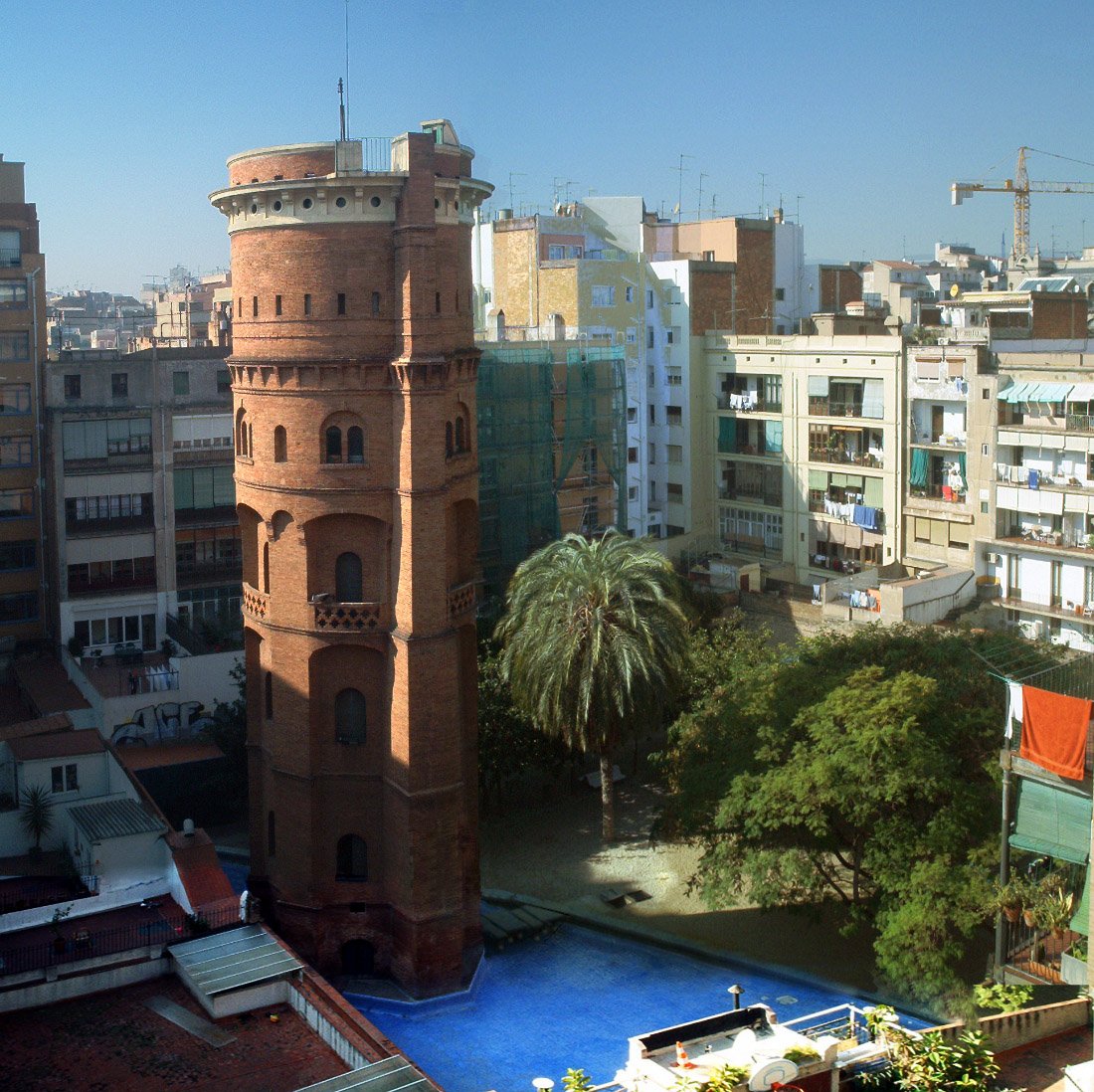
The second half of the idea is hidden. Cerdà intended each block to be built on only two or three sides, leaving the middle as a garden for its residents. Speculation filled most of the courtyards in, but since 1987 the city has been buying back block interiors and opening them as public gardens — more than forty in the Eixample district alone, with the stated aim that every home should be within 200 metres of a green space. They are the district’s secret rooms: you slip through a passage at street level and emerge in a quiet garden surrounded by the backs of apartment buildings. The best-known is the Jardins de la Torre de les Aigües, where a tall brick water tower of 1870 rises over a shallow paddling pool that locals treat as a tiny urban beach in summer.
Learn to read the map the local way and the grid becomes a gift: one set of streets climbs from the sea towards the hills, the other runs parallel to the coast, and the exceptions — the Gran Via, Passeig de Gràcia, Passeig de Sant Joan and the Diagonal slashing across at 45 degrees — orient you instantly. Getting lost is nearly impossible; walking one block too far is a constant, charming hazard.
The Quadrat d’Or and Passeig de Gràcia
If the grid is the district’s body, the Quadrat d’Or — the Golden Square — is its jewellery box. The name covers the blocks between Carrer Aribau and Passeig de Sant Joan, from Plaça de Catalunya up to the Avinguda Diagonal, with Passeig de Gràcia as its main artery. This was the address industrial Barcelona’s wealth chose for itself, and the concentration of Modernista architecture here is unmatched anywhere: Turisme de Barcelona’s own description calls it an open-air museum, and for once the phrase undersells it.

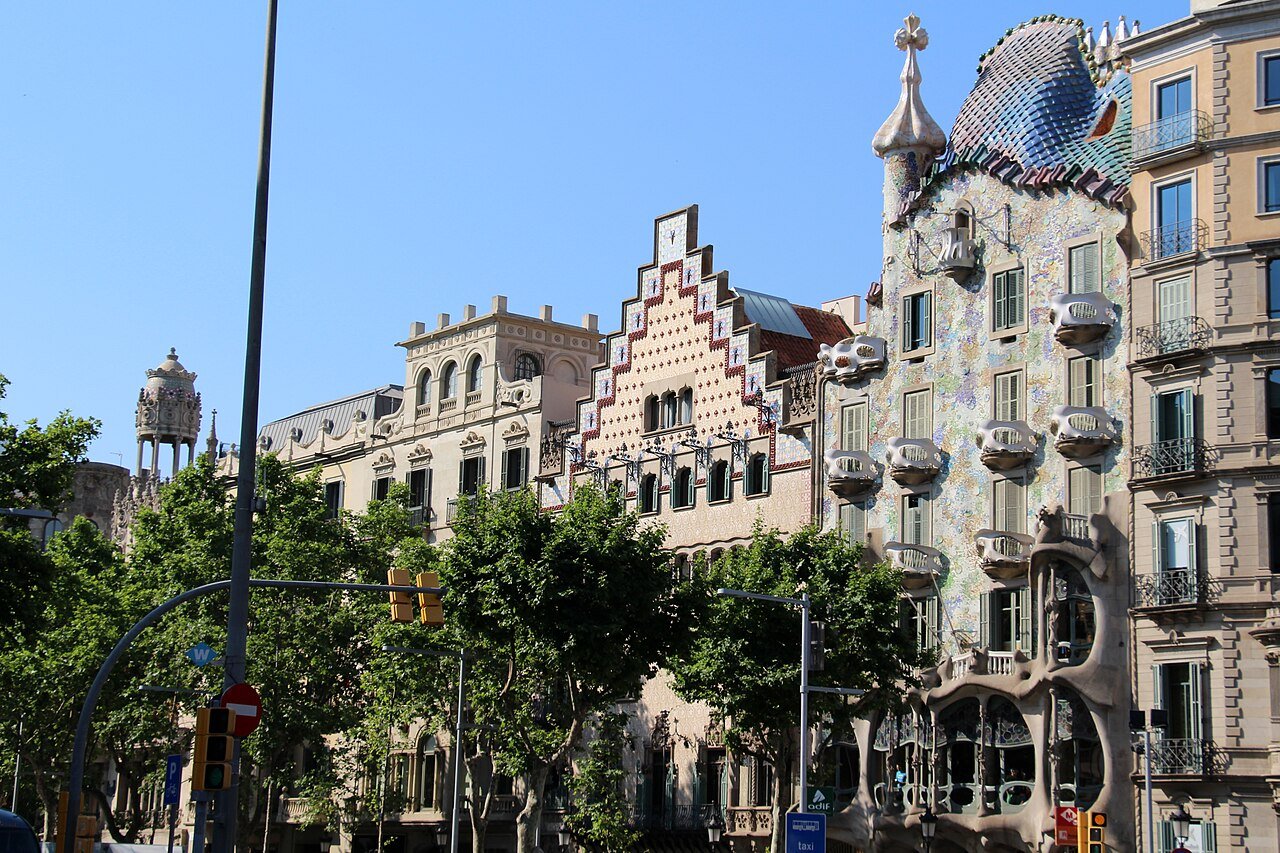
Passeig de Gràcia itself is a sight before any single building: a 60-metre-wide boulevard of plane trees, luxury shops and the famous bench-lampposts of Pere Falqués, its pavements inlaid with the hexagonal panot tiles that have become a symbol of the city. Halfway up stands the block that gives the whole district its party piece — the Illa de la Discòrdia, the Block of Discord, where the three great rivals built side by side on the same block frontage within a single decade. At number 35 is Casa Lleó Morera by Domènech i Montaner, all carved stone and floral mosaic; at 41, Puig i Cadafalch’s Casa Amatller, a Flemish-stepped-gable fantasy built for a chocolate manufacturer; and at 43, Gaudí’s Casa Batlló, its dragon-back roof and bone-like balconies dissolving the very idea of a façade. The “discord” is the clash: three geniuses, three incompatible styles, one pavement to judge them from. Next door to Casa Batlló, Casa Amatller is the connoisseur’s visit — a guided tour of a preserved bourgeois interior, chocolate tasting included in its history if not always in the ticket.
Four blocks further up, on the corner of Carrer de Provença, Casa Milà — La Pedrera rolls along the chamfer like a cliff face: Gaudí’s last civil commission, finished in 1912, a self-supporting stone façade with no straight line in it and a rooftop of warrior chimneys. Book both interiors ahead — they are the two most visited houses in the district — but do not skip the quieter names between them: Gaudí’s early, almost conventional Casa Calvet on Carrer de Casp, and at the top of the avenue, Domènech i Montaner’s Casa Fuster of 1911, now a hotel, where the Quadrat d’Or hands over to Gràcia.

This is the stretch where a guide pays for themselves twice over, because the façades are a written language — dragons, roses, skulls, industrialists’ coats of arms — and most of it passes at eye level unnoticed. The Modernism and Gaudí private walking tour works this avenue house by house before heading up to the Sagrada Família side of the district; take it on your first morning and every façade you pass for the rest of the trip reads differently.
Beyond the Golden Square: The Diagonal and the Side Streets
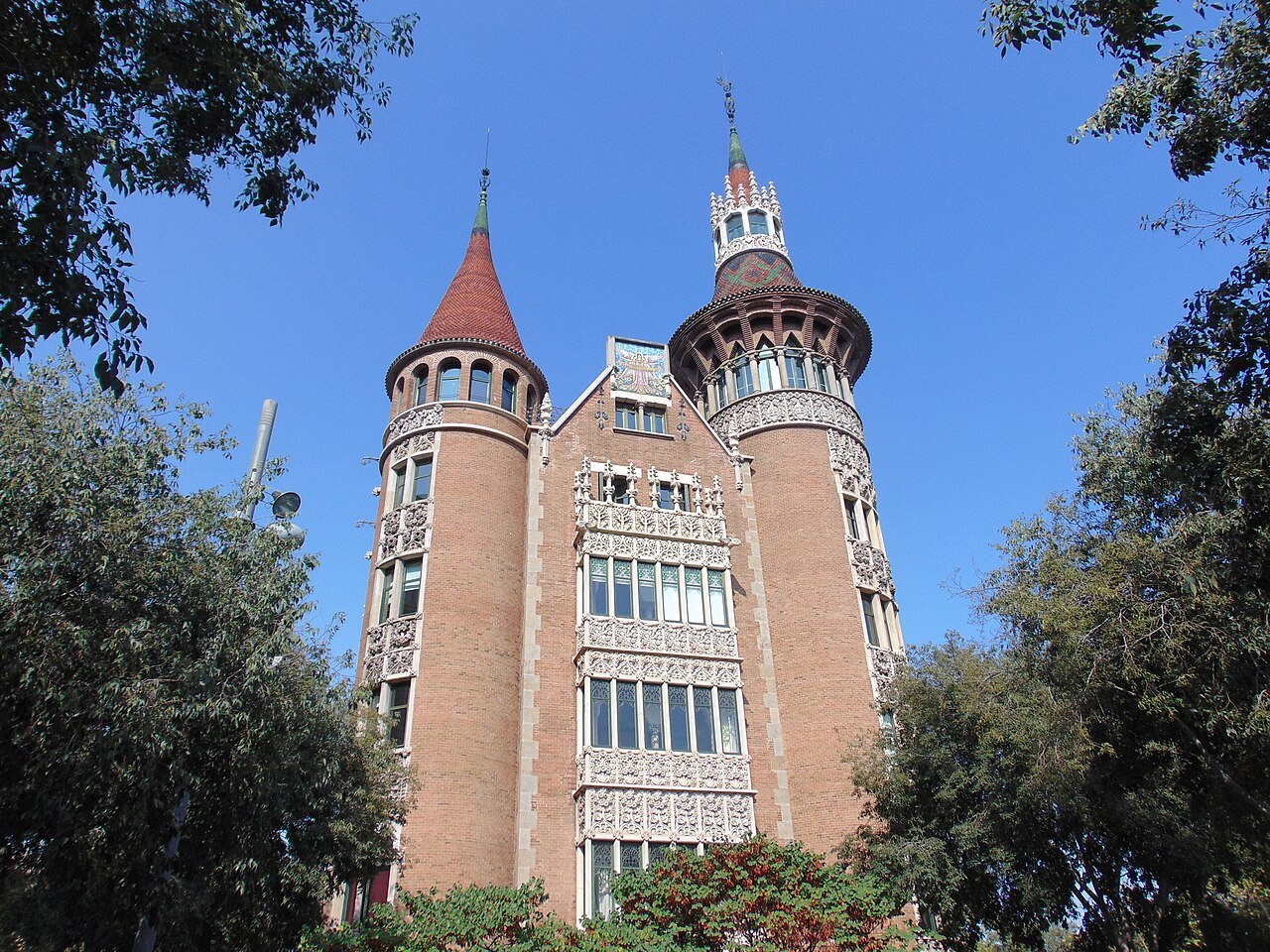
The Avinguda Diagonal cuts the grid at 45 degrees and collects a second rank of masterpieces along its chamfers. The star is the Casa de les Punxes — the “House of Spikes”, formally Casa Terradas — Puig i Cadafalch’s 1905 castle for three sisters, its six pointed towers pure northern-European fairytale transplanted to a Barcelona crossroads. A few blocks west, the Palau del Baró de Quadras, also by Puig i Cadafalch, hides two utterly different façades — ornate Gothic facing the Diagonal, restrained modernity behind — and Salvador Valeri’s Casa Comalat wears its famous face at the back, a swooping wooden gallery on Carrer de Còrsega that photographers hunt down.
Back on the grid’s ordinary streets, the rewards are smaller and quieter. On Carrer d’Aragó, the Fundació Antoni Tàpies occupies Domènech i Montaner’s pioneering Montaner i Simó publishing house of the 1880s — an early Modernista landmark in brick and iron, crowned by Tàpies’ own sculpture Núvol i cadira (Cloud and Chair), a tangle of wire floating over the roofline. On the Gran Via, the Universitat de Barcelona’s historic building opens its cloisters and gardens to anyone who walks in. And everywhere, look at the floors above the shops: wrought-iron balconies, stained-glass galleries, sgraffito and mosaic — the bourgeoisie competed on every floor, not just in the famous houses.

The Sagrada Família Side: Avinguda Gaudí and Sant Pau
The eastern half of the district belongs to one building. The Sagrada Família rises from its own neighbourhood — construction began in 1882, Gaudí took over a year later and worked on it for the remaining 43 years of his life — and the basilica’s presence shapes everything around it, from the souvenir streets to the two parks laid out to frame views of its façades. Book the interior well ahead; it is the one ticket in Barcelona that genuinely sells out days in advance.
From its northern side, a short pedestrian avenue runs diagonally uphill: the Avinguda Gaudí, lined with cafés and Modernista lampposts, built precisely to connect the basilica with the second giant of the neighbourhood. At its top stands the Recinte Modernista de Sant Pau, Domènech i Montaner’s garden-city hospital — a UNESCO-listed complex of tiled pavilions that worked as the city’s hospital until 2009 and is now visited for its architecture alone. Sagrada Família in the morning, the avenue’s terraces for lunch, Sant Pau in the afternoon: it is the single most satisfying half-day the district offers, and the walk between the two monuments takes ten minutes.

The Six Neighbourhoods: Six Versions of the Eixample
Administratively the Eixample is one district of six neighbourhoods, and visitors feel the differences without knowing the names. The Dreta de l’Eixample, on the right as you climb from Plaça de Catalunya, is the golden half — Passeig de Gràcia, the Quadrat d’Or, the grand hotels. The Antiga Esquerra and Nova Esquerra, the old and new left, are more residential: the university, the Mercat del Ninot and local bars around the Hospital Clínic. Sant Antoni, in the south-west, is the district’s village, where the Eixample’s reinvention began around its market and superblock. The Sagrada Família neighbourhood mixes the basilica’s crowds with stubbornly local streets two blocks away. And el Fort Pienc, in the east, runs down to the Arc de Triomf — the quietest corner of the six.
Markets, Superblocks and Green Axes: The Eixample Barcelonans Use
To see the district as its residents do, go to its markets. Each neighbourhood has one, and they are serious food halls, not tourist sets. The Mercat de Sant Antoni is the grandest: opened in 1882 to a design by Antoni Rovira i Trias — the architect whose expansion plan Madrid rejected in favour of Cerdà’s — it fills an entire block, the first market built outside the old walls. It reopened in 2018 after a long renovation that uncovered Roman remains beneath it, now displayed in the basement, and on Sunday mornings the surrounding streets host a beloved second-hand book and collectables market. The Mercat de la Concepció, opened in 1888, is known as the flower market for its florists; the Mercat del Ninot, by the Hospital Clínic, is where chefs shop.

The newest chapter of Cerdà’s story is the fight for his streets. Barcelona’s superilles (superblocks) programme takes groups of blocks, pushes through-traffic to the perimeter and hands the inner streets back to pedestrians; the first full superblock was laid out around Sant Antoni market in 2018, its chamfered junctions turned into pocket plazas with planters, benches and play markings. Its successor idea, the eixos verds (green axes), goes further along whole streets: the first phase, completed in May 2023, rebuilt 2.8 kilometres of Carrer del Consell de Cent plus stretches of Rocafort, Comte Borrell and Girona as green, pedestrian-priority axes with new squares at four crossroads — and the long-term plan turns one street in three across the district into a green axis. Walk Consell de Cent today and you walk the Eixample’s third draft: traffic calmed to a crawl, trees and benches where cars queued, and Cerdà’s octagonal junctions finally used as the little plazas he drew them to be.


One Perfect Eixample Walk
If you have one morning, walk this line. Start at Plaça de Catalunya and climb Passeig de Gràcia slowly, façade by façade, through the Illa de la Discòrdia to La Pedrera. Cross the Diagonal to the Casa de les Punxes, then turn east along the Avinguda Gaudí’s café terraces until the Sagrada Família fills the end of the street, and finish at Sant Pau’s pavilions. It is about three kilometres, it passes every idea in this article — grid, chamfers, rivalry, reinvention — and there is no better introduction to Barcelona.

Practical Info
- What it is: a city district, not a ticketed sight — the Eixample is open streets, free to wander at any hour. Individual buildings (Casa Batlló, La Pedrera, Sagrada Família, Sant Pau, Casa Amatller, Fundació Tàpies) are separately ticketed; see Tickets and Costs.
- Where it is: between the old town (Ciutat Vella) and Gràcia, bounded roughly by Plaça de Catalunya and the Rondes at the bottom, the Avinguda Diagonal across the middle-top, Carrer de Sants side streets to the west and the Fort Pienc/Arc de Triomf to the east. The Sagrada Família neighbourhood forms its eastern-central quarter.
- Orientation: streets on the grid run parallel and perpendicular to the sea; the Avinguda Diagonal cuts across at 45°. Street numbers climb from the Besòs (east) side and from the old town upward; chamfered corners mean house numbers sit on the chamfer as often as on the façade.
- Maps: Turisme de Barcelona’s information points (Plaça de Catalunya and elsewhere) stock the Ruta del Modernisme map of Modernista buildings, most of which stand in this district.
Tickets and Costs
Wandering the Eixample costs nothing — the architecture is the street itself. What costs money are the interiors, and they are priced like the major attractions they are: expect the headline houses (Casa Batlló, La Pedrera, the Sagrada Família, Sant Pau) to sit in the same band as Barcelona’s other big-ticket sights, with timed-entry tickets that should be booked on the official sites days ahead in season — our dedicated guides to each house keep their current prices and booking rules. Casa Amatller is visited on timed guided tours; the Fundació Tàpies charges a standard museum entry; the block-interior gardens, markets and green axes are free.
The one organised product worth paying for in the district itself is a guide for the façades. The private Modernism and Gaudí walking tour runs three hours with a private guide — so the price is per group and varies with group size; check GetYourGuide for your date. It does not include monument entry, which keeps its cost honest: you are paying for the storytelling, then choosing your interiors separately. Free cancellation terms are shown on the product page at booking.
Getting There and Getting Around
The Eixample is the best-connected district in the city. Metro lines L1, L2, L3, L4 and L5 all cross it: Plaça de Catalunya (L1, L3, plus FGC and Rodalies trains) anchors the bottom; Passeig de Gràcia (L2, L3, L4, plus Rodalies) is the Quadrat d’Or’s own interchange; Diagonal (L3, L5, plus FGC at Provença) serves the top; Sagrada Família (L2, L5) and Sant Antoni (L2), Girona (L4), Verdaguer (L4, L5), Hospital Clínic (L5) and Universitat (L1, L2) fill in the grid. The airport bus and the city sightseeing buses both terminate or pass at Plaça de Catalunya.
Inside the district, walk. Blocks are short — about 130 metres corner to corner including the street — distances deceive on the map, and the façades are the point. The grid is flat, tilting gently uphill away from the sea, and step-free at the chamfered crossings; buses run the length of the Gran Via, the Diagonal and Carrer d’Aragó, and taxis are plentiful. One warning: on the green axes and inside superblocks, cars must turn at every block, so a taxi crossing the district travels around the perimeter streets, not through them.
When to Go
The Eixample is a year-round, all-day district, but it has its hours. Come before 10:00 for Passeig de Gràcia at its calmest and the best light on the Illa de la Discòrdia’s façades; they glow again in late afternoon. The block-interior gardens keep municipal hours, generally opening in the morning and closing around dusk, and are liveliest at lunchtime and on Saturday mornings. Markets trade Monday to Saturday, mornings strongest, and Sant Antoni’s book market takes over its surrounding streets on Sunday mornings. August empties the district of locals while filling it with visitors; spring and autumn give you façades, market life and green axes at their best together.
How Long You Need
Allow a minimum of half a day to walk the Quadrat d’Or and Passeig de Gràcia properly, façades only. A full day adds one or two interiors — La Pedrera plus the Sagrada Família is the classic pairing — and the walk up the Avinguda Gaudí to Sant Pau. With two days you can do the district justice: both Gaudí houses, Casa Amatller, Sant Pau, a market morning, a block-interior garden or three and an evening on the Consell de Cent green axis. But treat the Eixample less as a block of time than as your base: most visitors cross it daily, and its details accumulate across a whole trip.
Tips for Visiting
- Look up, then look down. The façades are the show, but the details underfoot — hexagonal panot paving, Falqués bench-lampposts, mosaic shop thresholds — are half the district’s design story.
- Do the Block of Discord from the far pavement. The central reservation of Passeig de Gràcia gives you the only viewpoint that fits Lleó Morera, Amatller and Batlló into one photograph.
- Book interiors in this order: Sagrada Família first (it sells out furthest ahead), then Casa Batlló and La Pedrera timed tickets, then Sant Pau, which is usually the easiest of the four.
- Hunt the courtyards. Any passage at street level with a garden visible beyond it is worth ten steps: the Torre de les Aigües garden is the famous one, but the district has more than forty, each signed at its entrance.
- Use the chamfers as cafés. The cut corners were designed as breathing spaces and now hold the district’s terrace cafés — the classic Eixample pause is coffee on a xamfrà, watching the grid go by.
- Mind the green axes when crossing town. On Consell de Cent and its sister streets, traffic turns at every block by design; allow the extra minutes, and never assume a car can carry you straight across.
- Stay here if you can. The district’s mix of grand hotels and apartment-hotels, its metro web and its evening restaurant streets make it Barcelona’s most practical base — our guide to where to stay in Barcelona breaks down the options.
What to See Nearby
The Eixample touches almost everything. At its foot, Plaça de Catalunya opens into La Rambla and the Gothic Quarter of the old town. At its top, the Passeig de Gràcia runs on into Gràcia, the former village whose squares begin where the grid ends. To the east, the Arc de Triomf and the Parc de la Ciutadella wait below the Fort Pienc; to the west, Plaça d’Espanya, the MNAC and the hill of Montjuïc rise over the Nova Esquerra. The Palau de la Música Catalana stands just outside the district’s south-east edge in the old town, and the beach districts of the Barceloneta and Poblenou are a straight metro ride east.
Frequently Asked Questions
What does “Eixample” mean?
It is Catalan for “extension” or “enlargement” — the widening of Barcelona beyond its demolished medieval walls. In Spanish the same district is called the Ensanche, and you will see both names used.
Why are the corners of the blocks cut off?
The 45-degree chamfers — xamfrans in Catalan — were designed by Ildefons Cerdà in 1859. They widen each crossroads into a small octagonal plaza, improve visibility, and were planned with turning room for the steam trams Cerdà predicted, long before the motor car. They are now the district’s signature, visible in every aerial photograph.
What is the Quadrat d’Or?
The “Golden Square”: the central blocks of the Eixample between Carrer Aribau and Passeig de Sant Joan, running from Plaça de Catalunya up to the Avinguda Diagonal, with Passeig de Gràcia as its main street. It holds the densest concentration of Modernista architecture in Barcelona.
What is the Illa de la Discòrdia?
The “Block of Discord” — a single block frontage on Passeig de Gràcia where the three great Modernista rivals built neighbouring houses within a decade: Casa Lleó Morera (Domènech i Montaner), Casa Amatller (Puig i Cadafalch) and Casa Batlló (Gaudí). The discord is stylistic: each house seems to argue with the next.
Is the Eixample a good area to stay in Barcelona?
Yes — for most first-time visitors it is the best base in the city: central, flat, safe-feeling at all hours, dense with hotels at every level and crossed by five metro lines. The Dreta de l’Eixample around Passeig de Gràcia is the grandest part; Sant Antoni and the Esquerra are quieter and more local.
Can you go inside the block courtyards?
Many of them, yes. Since 1987 the city has recovered more than forty Eixample block interiors as public gardens, entered through passages at street level and open during municipal hours, free of charge. The Jardins de la Torre de les Aigües, with its water tower and paddling pool, is the best known.
Travel insurance, sorted
Whether it is a two-week holiday or a longer move, travel insurance is not the most glamorous part of a trip — but it is the one booking you want to have in place before a trip, and while you are already away. Get a quote from SafetyWing
Final Thoughts
Every great city has a district that explains it, and in Barcelona it is not the medieval old town — it is this. The Eixample is where Barcelona argued, in public and in stone, about what a modern city should be: Cerdà’s hygienic equality against the bourgeoisie’s competitive splendour, and now a third argument, as the superblocks and green axes hand his streets back to the people he designed them for. Walk it slowly, look up constantly, slip into its courtyards, and the rest of Barcelona — Gaudí, the markets, the museums, the metro map itself — falls into place around you.

Photo credits: Alhzeiia, DimiTalen, Jordi Domènech, Celsoazevedo, Fred Romero, Matti Blume, Nicholas Gemini, Equip Fundació Antoni Tàpies, Robert Rutkowski, Julian Lupyan, Cataleirxs, Pere López Brosa and Ilkka Simomaa, via Wikimedia Commons.