Palau Güell: The Complete Visitors’ Guide
Palau Güell does not announce itself. Casa Batlló glitters on Passeig de Gràcia and Casa Milà rolls along the same boulevard like a stone wave, but Gaudí’s first great palace hides two minutes away in the narrow streets of El Raval, on Carrer Nou de la Rambla just off La Rambla, behind a façade of grey stone so sober that most visitors walk straight past it. That sobriety is the palace’s disguise. Step through its twin parabolic arches and the building turns inside out: a hall of polished marble, a basement of brick mushrooms fit for horses, a central hall that rises three storeys into a dome pierced with stars, and — twenty years before the famous rooftops of the Eixample — a roof already sprouting a garden of fantastic chimneys. This was the young Antoni Gaudí’s first masterpiece for the richest patron he would ever have, and it is where nearly every idea of his later career appears for the first time, fully formed.
This guide walks the visit the way it runs: the story in brief, then the street façade and its great gates, the hall of lost steps and the towering central hall, the family’s rooms and their organ, the stables below and the chimney rooftop above. It also gives you the honest practical picture — Palau Güell is the gentlest of the Gaudí houses: one modest ticket that includes the audioguide, no premium tiers, no night spectacular, and crowds a fraction of those two streets away. It sits high in our Best Things to Do in Barcelona guide for exactly that reason — read this, and give the quiet palace the attention its louder neighbours steal.

The Short Answer
Yes — Palau Güell is absolutely worth it, it is the best-value Gaudí house in Barcelona, and it needs no strategy at all. For a single modest ticket — still under €10 at the time of writing, with an excellent audioguide included — you get the complete arc of early Gaudí under one roof: carriage gates and marble halls, a stable built like a crypt, a concert hall crowned by a star-pierced dome, and the first of his great sculptural rooftops. Allow an hour and a half. Where Casa Batlló and Casa Milà demand timed slots booked days ahead, Palau Güell can usually be decided on the day: buy at the door or on the official site, walk in, and climb from the horses in the basement to the chimneys on the roof at your own pace. A guided GetYourGuide – Gothic Quarter and La Rambla guided walking tour passes the palace’s gates if you would rather explore the quarter with the stories told for you; but the house itself, taken slowly with its audioguide, needs no help to astonish.
Table of Contents
- The Short Answer
- The Story in Brief: The Palace That Launched Gaudí
- What to See: The Façade and the Street
- What to See: The Hall of Lost Steps and the Central Hall
- What to See: The Family Rooms and the Organ
- What to See: The Stables and the Basement
- What to See: The Rooftop and Its Chimneys
- Practical Info
- Tips for Visiting
- Final Thoughts
The Story in Brief: The Palace That Launched Gaudí
In 1886 the textile magnate Eusebi Güell — the richest industrialist in Catalonia, and a man collecting architects the way other men collect paintings — gave a 34-year-old Antoni Gaudí the commission that would make them both immortal: a family palace on Carrer Nou de la Rambla, in the dense old streets just off La Rambla, on a tight plot beside the house Güell already lived in. Güell wanted a palace that would receive the world — concerts, receptions, royalty — and Gaudí, who had caught his patron’s eye with a display case at the Paris exhibition of 1878 and a handful of smaller works, understood that money like Güell’s did not knock twice. He spent it magnificently: local stone and marble by the shipload, carved wood, iron, glass and ceramics, all fused into a building that is a Venetian palazzo, a medieval Catalan manor and something entirely new. Construction ran from 1886 to 1890, and the palace opened to a city astonished that anything so strange could stand in so ordinary a street.
Everything Gaudí later became is here in embryo. The parabolic arch — the curve his whole career would ride on — carries the palace from its entrance gates to its great dome. The trencadís of broken tile that would one day cover a dragon’s back at Casa Batlló appears here first, on the rooftop chimneys. The mushroom columns of the basement, the screened galleries, the play of hidden light: Gaudí tried his entire vocabulary in this one house, for the one patron who never asked him to stop. The Güells used the palace as their Barcelona residence and concert hall until the family decamped up the hill to Park Güell; after Eusebi’s death in 1918 the building drifted through harder lives, including service as a police station during the Civil War, before passing to the Diputació de Barcelona in 1945. A long, careful restoration returned it, piece by piece, to 1890 — original furniture tracked down, the organ rebuilt, the chimneys re-clad — and in May 2011 the palace reopened complete. UNESCO had seen it coming: the building was inscribed as a World Heritage Site in 1984, among the very first Gaudí works listed, a quarter-century before most visitors had heard of it.

What to See: The Façade and the Street
Read the façade slowly, because its restraint is deliberate and its details are not. The front is built in pale stone — grey marble from the Garraf below, lighter stone above — and it rises in sober, almost fortress-like order: rows of windows, a crenellated crown, and, running across the middle like a glazed balcony a whole room deep, the great tribune of the noble floor, a screen of slender columns behind which the family’s drawing room took the light and watched the street. This is Gaudí dressing for El Raval in 1886, channelling the palaces of Venice and medieval Catalonia rather than shouting over them — the palace whispers from the pavement. But two things give the game away, and both are at your eye level.
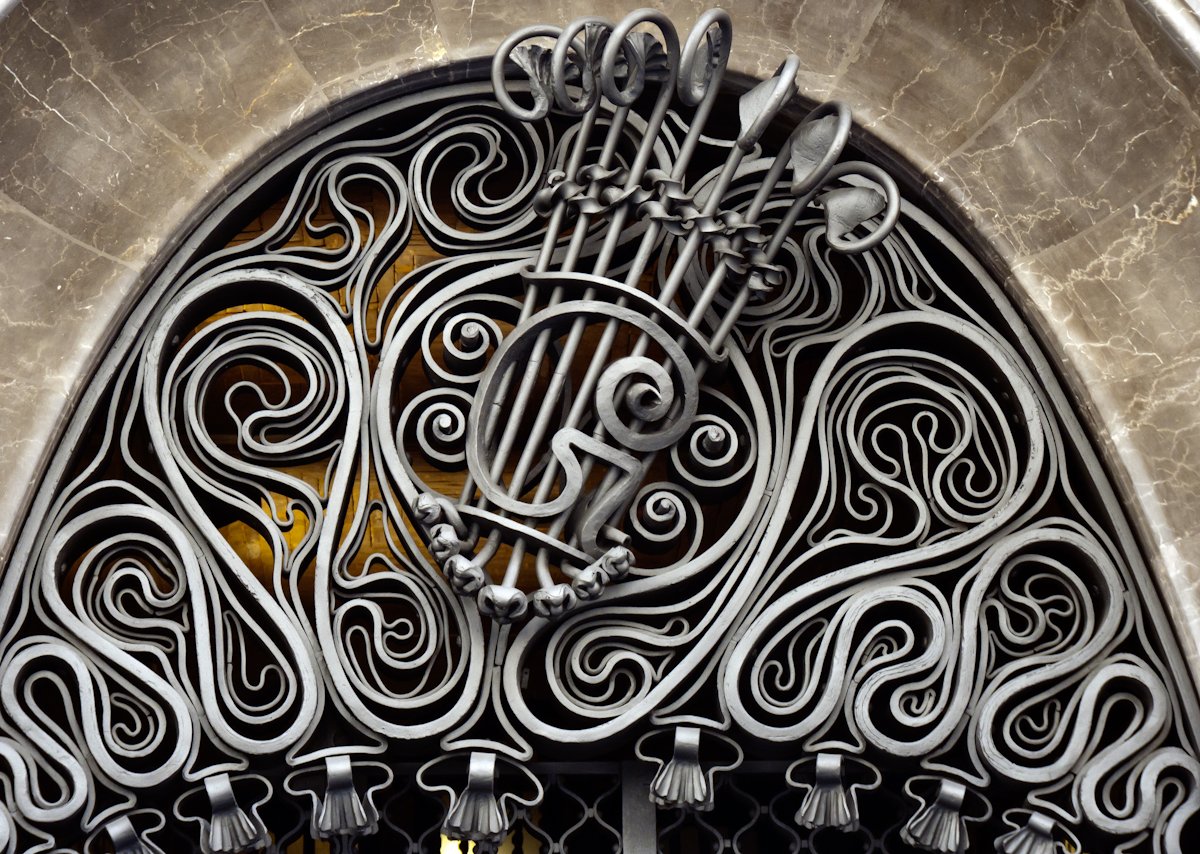
The first is the pair of entrance arches — two great parabolic arches, side by side, sized not for people but for horse-drawn carriages to sweep through. The parabola is the load-bearing curve Gaudí trusted above all others, and here, at the very start of his career, he puts it on the street like a signature. The arches are filled with wrought-iron gates of extraordinary workmanship: a lattice below for strength, and above, a swirling iron calligraphy in which, if you look, you can find Güell’s initials worked into the scrolls. Between the two arches stands the second giveaway: the coat of arms of Catalonia wrought in iron, its red-and-gold stripes wound with a ribbon and crowned by a helmeted, winged crest — heraldry as metalwork, announcing whose house this was to a street that could read it at a glance. Stand across the narrow street — there is barely room, and that is part of the point — and take in the whole composition. Then go through them.

What to See: The Hall of Lost Steps and the Central Hall
Inside the gates, the palace reveals its plan: everything is arranged for arriving in style. Carriages rolled through the arches into a vestibule of polished grey stone, where the horses turned down a ramp to the stables below while the guests climbed. That entrance floor — the hall of lost steps, a place for waiting, arriving and being announced — is all marble and shadow: a single great column with a mushroom capital, an iron-beamed ceiling, and the main staircase sweeping up in red carpet between stone balustrades. It feels more like the hall of a bank or a small cathedral than a house, and that is the design working: the room was built to lower voices.
But the palace’s true heart is one floor up and several storeys tall. The central hall — the saló central — is the room the whole building is secretly organised around: a soaring central space that rises through three floors to a parabolic dome, around which every other room in the house is arranged like boxes around a stage. From the family apartments and bedrooms above, screened windows and hidden openings look down into the hall, so the Güells could attend the concerts below in privacy, unseen — the palace’s social life performed in this one vertical theatre, with the family watching from the shadows of their own home. Look up: the dome is clad in hexagonal stone tiles and pierced with small holes, so that by day it scatters a field of stars above the hall, and the whole space glows with a soft, underwater light filtered from a lantern at its crown. It is a music room built like a chapel, and standing in it, the palace’s priorities become clear — this house was not built to sleep in. It was built to sound.
One wall of the hall hides the musicians themselves. Behind a lattice screen of turned wooden spindles — hundreds of them, twisted and inlaid like a Moorish mashrabiya — sits the small gallery where the orchestra played during the palace’s concerts: the guests heard the music pour out of the wall itself, the players invisible behind the screen. Find the lattice and look through it; it is the most quietly theatrical device in the house, and the audioguide’s story of the hall makes no sense without it.


Free Barcelona travel guide
Planning a trip to Barcelona? Get our free one-page Barcelona checklist: what to book ahead, what to skip, and the tapas bars we actually eat in.
What to See: The Family Rooms and the Organ
Around the central hall, on the noble floor and the floors above it, runs the family’s own world — and it is here that the palace stops being a monument and becomes a house, albeit the richest house in Barcelona. The drawing room sits behind the great street tribune, taking its filtered light through those slender columns. The dining room is panelled in dark carved wood, its long table set beneath a coffered ceiling, with a fireplace and the intimate scale of family dinners rather than state banquets. The bedrooms above are arranged around the hall’s upper galleries, each with its own character — a chapel for the family’s devotions, rooms dressed in the carved wood, inlaid furniture and gold that Güell’s fortune could summon from the best workshops in the city. Much of what you see is the family’s own furniture, recovered and returned during the restoration — including pieces Gaudí and his circle designed for these very rooms — and the effect is of a house paused rather than a museum assembled. Walk these rooms slowly and look back, whenever a screened window offers, into the great hall below: the house was designed to be lived in around its music.
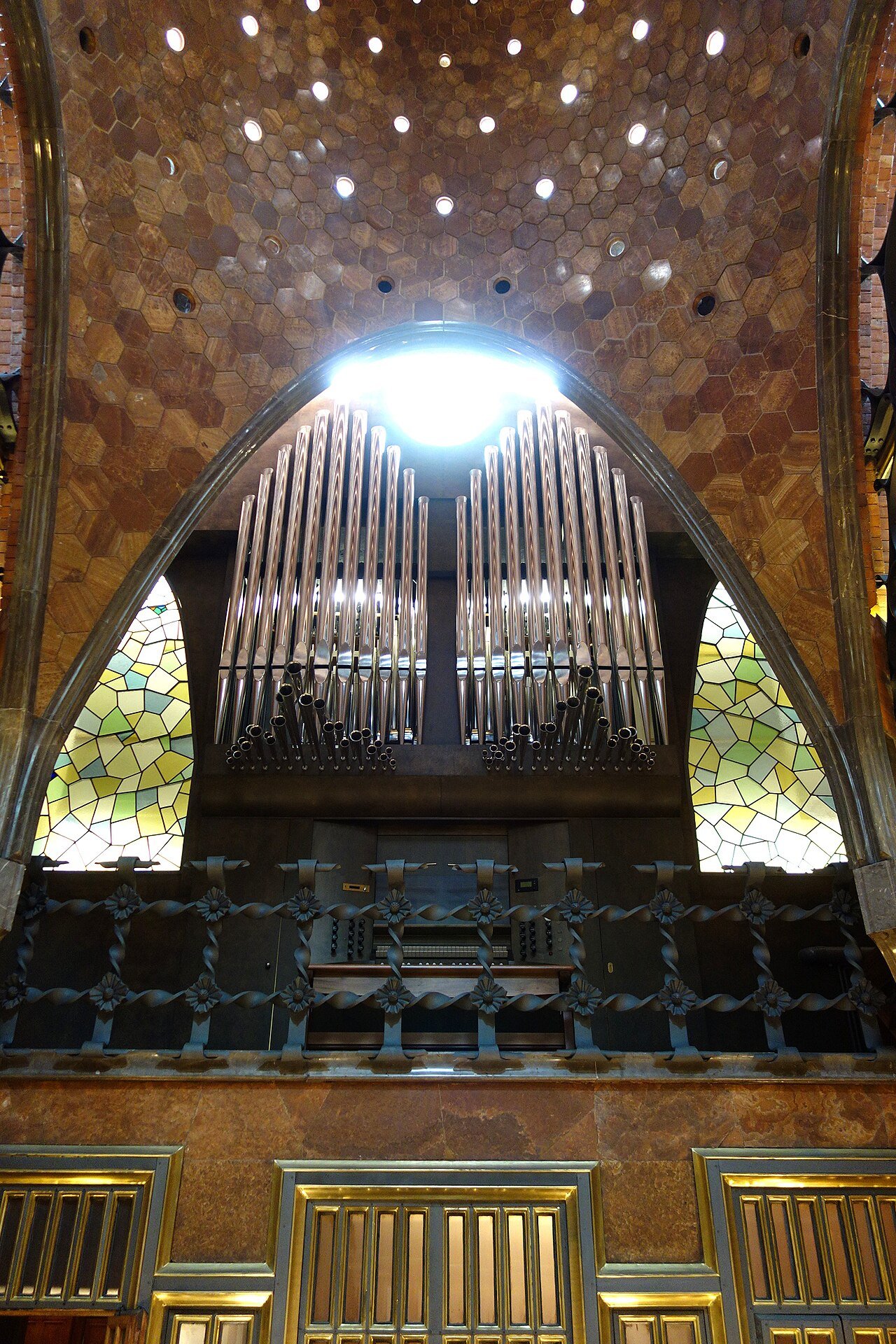
The music’s engine still stands in the central hall itself. High on the hall’s wall, in its own arched loft flanked by stained glass, sits the palace’s organ — its ranks of pipes gleaming under the dome, its console placed so that the sound pours down the full height of the space. The original instrument, built for the palace’s concerts, was one of the glories of the house; the organ you see today was rebuilt for the palace’s reopening by the organ-builder Albert Blancafort, returning a working voice to the hall after decades of silence. If your visit coincides with one of the short demonstrations the palace sometimes gives, stop everything and listen: the hall was tuned like an instrument, and music falling through that dome of stars is what it was made for.

What to See: The Stables and the Basement
Every palace tour ends up in the kitchens; this one begins, if you follow the visit route, with the horses — and the basement of Palau Güell is one of the wonders of early Gaudí. The carriages that swept through the great arches turned down a broad ramp into this vaulted underworld, where the stables stood: a forest of brick pillars, each one flaring at the top into a mushroom capital that carries the low parabolic vaults, built entirely of brick laid with a mason’s joy in the material. It is a stable designed like a Romanesque crypt — or perhaps a crypt that happens to smell, faintly and forever, of horses. The grooms’ and servants’ quarters shared the floor; the ramp that brought the carriages down winds through it in a sculptural curve, engineering and architecture indistinguishable. Nothing in the palace above is more honest than this room: before Gaudí had a style, he had this — structure itself, in brick, made beautiful because it was built true.
Look for the small things down here, because the basement kept the evidence of its working life. Set into the brick pillars are the tethering rings where the horses were tied — iron rings held in the mouths of cast-iron horse heads, stable furniture raised to sculpture. Between the stables, the ramp and those mushroom pillars, the basement explains the palace’s whole social machine: the horses below, the servants beside them, the guests ascending the marble stair, and the family above in their gilded rooms — an entire nineteenth-century world stacked in section, in one narrow plot off La Rambla. Come down here even if horses bore you: this is the room where Gaudí invents himself.


What to See: The Rooftop and Its Chimneys
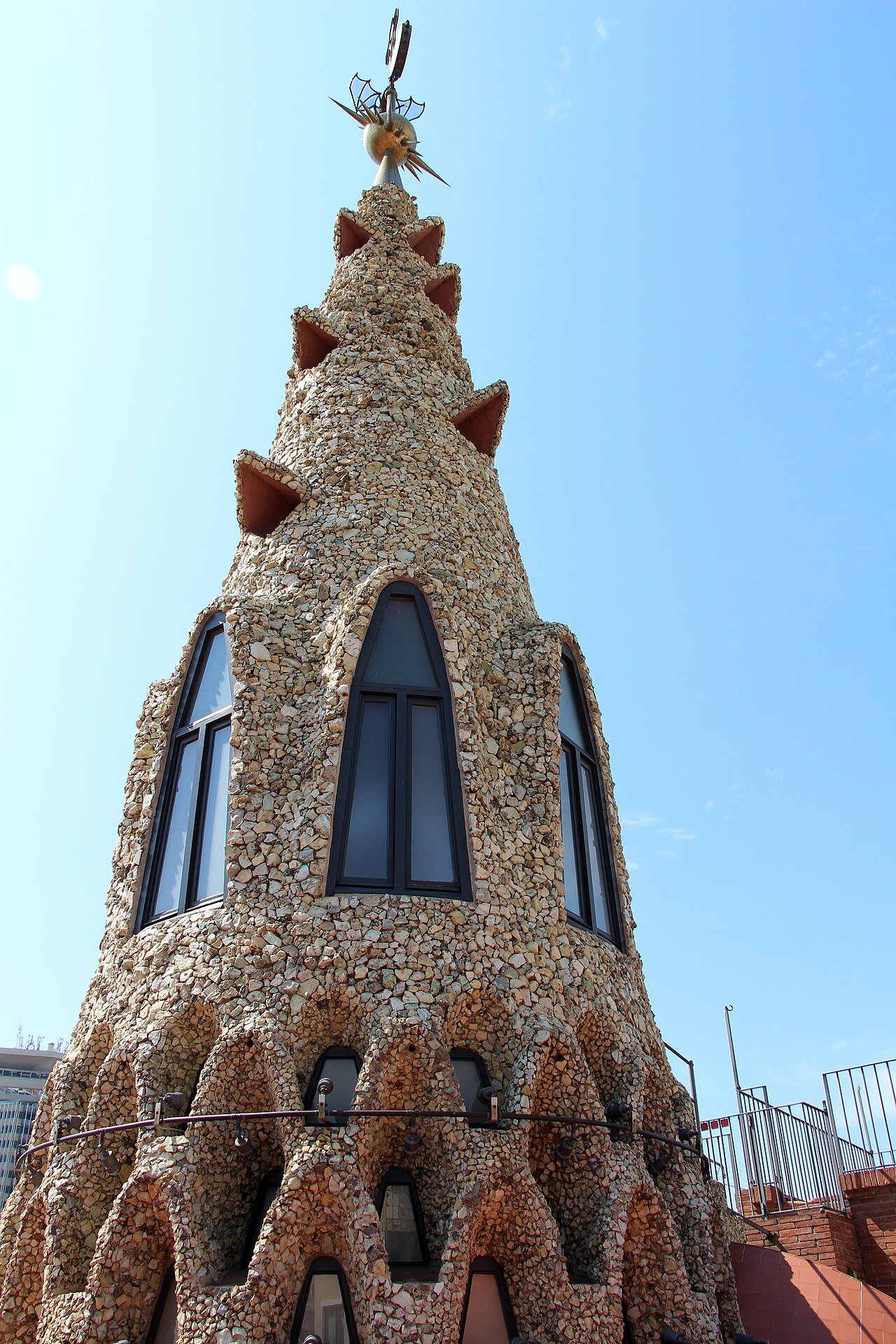
End, as every Gaudí visit should, on the roof — and remember as you climb that this is the first one. Twenty years before the warrior chimneys of Casa Milà, Gaudí filled the roof of the Güell palace with a skyline of invention: some twenty chimneys, no two alike, rising around the great central spire like a court around a king. That spire — the lantern of the central hall’s dome, drawn up into a tall cone clad in broken stone and crowned with a weathervane of sun, moon and bat — is the palace’s exclamation mark, visible from streets away. Around it the chimneys perform in every material Güell’s workshops could offer: cones of multicoloured trencadís, spirals of glazed ceramic, a green pinecone, striped and chessboarded caps, chimneys faced in stone shards, in glass, in tile — each one a small sculpture that happens to draw smoke. It is a sketchbook for everything the later rooftops would do at full scale, and in some ways it is fresher than they are: the inventions here are young, playful, unrepeatable, made before anyone knew they would become a signature.
The roof is also a viewpoint, and an underrated one. From the terrace the old city lies below you in every direction — the towers of the Gothic Quarter one way, the column of Columbus and the harbour another, the rooftops of El Raval at your feet. Come up in the late afternoon if you can, when the light warms the trencadís and the long shadows model every chimney. Then look back at the spire above the hall where the music played, the stables far below where the horses stood, and read the whole palace in one glance: this young man’s building, from crypt to crown, is the complete draft of Gaudí.

Practical Info
Tickets — the honest version. There is one ticket, and it is the best deal in Gaudí’s Barcelona: general admission was still under €10 at the time of writing — check the current price on the official site (palauguell.cat) before you go — and it includes the full palace, the rooftop (weather permitting) and an audioguide that is genuinely among the best in the city, unhurried and full of the house’s stories. There are the usual concessions, and children go free or nearly so; there is no premium tier, no night version, and no upsell waiting at the till. Entry is usually easy: the palace runs timed entry in busy periods, and summer weekends can sell out, so booking online a day ahead is cheap insurance — but this is not Casa Batlló; deciding in the morning, over coffee, is normally fine. The palace is closed on Mondays (and on a handful of holidays through the year), so do not leave it to a Monday.
Getting there. Carrer Nou de la Rambla 3–5, in El Raval, two minutes from La Rambla. The Liceu metro station (line L3) is the closest stop; Drassanes (also L3) serves the palace from the port end of the street. You will enter through the great arches themselves — the ticket desk is inside the vestibule — and the visit then runs as a set route: basement, noble floor, family rooms and roof. There is a lift for the main floors, toilets, and a small shop; photography is allowed.
How long. Give the palace an hour and a half. The audioguide’s full circuit takes about that; an hour is the honest minimum, and the rooftop on a clear afternoon can stretch it happily. Palau Güell pairs naturally with the Gothic Quarter and La Rambla around it — it is the natural Gaudí of a first morning in the old town.
Tips for Visiting
- Do the young Gaudí first. Visit Palau Güell before the two famous houses and you will read them backwards with pleasure — the parabolic arches, the rooftop chimneys and the hidden screens all begin here. Our Casa Batlló guide and Casa Milà guide walk the mature versions; seeing the draft first makes both of them better.
- Take the audioguide and keep it. It is included in the ticket, it is excellent, and the palace’s best stories — the hidden musicians, the watching family, the horses below — are invisible without it. This is not a house to wander mute.
- Come in the morning, whatever the season. The palace is the calmest Gaudí visit in the city at any hour, but mornings are calmest of all, and the light through the dome’s stars is at its best before noon. Our Best Time to Visit Barcelona guide sets the seasons; the palace itself, mostly indoors, forgives almost any of them.
- Do not skip the basement. Visitors in a hurry head for the roof and miss the room where Gaudí starts. The mushroom columns and the horses’ rings are the foundations — literally — of everything above them.
- Look for the family’s eyes. In every room around the central hall, find the screened window or hidden opening that looks into it. The palace’s secret — a family living unseen around its own concerts — only lands when you have stood where they stood.
- Save the roof for last light. If your entry allows a choice of hours, late afternoon flatters the chimneys and opens the view over the old town and the port. The roof closes in high wind or heavy rain, so a calm day is a rooftop day.
Travel insurance, sorted
Whether it is a two-week holiday or a longer move, travel insurance is the one booking not to skip. We point readers to SafetyWing’s Nomad Insurance — cover built for travellers, remote workers and longer stays abroad, on a flexible monthly subscription you can start before a trip or while you are already away. Get a quote from SafetyWing
Final Thoughts
Casa Batlló is the masterpiece of Gaudí’s maturity and Casa Milà of his defiance, but Palau Güell is the miracle of his youth: a 34-year-old with one rich patron and no reputation to protect, inventing — in a single narrow house off La Rambla — the parabolic arch, the sculptural chimney, the screened gallery and the star-pierced dome that the rest of his career would spend elaborating. Everything is here, and it is here at the most human scale of any Gaudí building: a house, not a monument, whose horses, musicians, children and concerts can still be felt in its rooms. That it costs a fraction of the price of its famous neighbours, queues less, and explains more, makes it the easiest recommendation in this entire guide series. Go in the morning, start with the horses, end with the chimneys, and let the palace make its quiet case: the greatest career in modern architecture began in this street, behind two grey arches that most of Barcelona still walks past.
¡Buen viaje!

Photo credits: The façade from Carrer Nou de la Rambla — Amadalvarez, CC BY-SA 4.0 · Palau Güell in about 1910 — Unknown author, Public domain · The parabolic entrance arches — Piggyofdoom, CC BY-SA 4.0 · The entrance gate ironwork — Turol Jones, CC BY 2.0 · The entrance vestibule, the musicians’ lattice and the dining room — Amadalvarez, CC BY-SA 4.0 · The central hall — Jun Seita, CC BY 2.0 · The organ — Hans-Jörg Gemeinholzer, CC BY 3.0 · The basement stables — Amadalvarez, CC BY-SA 4.0 · The horse-head tethering ring — Bernard Gagnon, CC BY-SA 3.0 · The rooftop and its spire — Balou46, CC BY-SA 3.0 · The spire at close range — Fred Romero, CC BY 2.0. All via Wikimedia Commons.


One Comment