Hidden Gems in Barcelona: 20 Secret Spots Most Visitors Walk Straight Past
There are two Barcelonas. The first is the one on the postcards — the Sagrada Família’s cranes, the Block of Discord, the queue shuffling up to Park Güell’s mosaic salamander — and most visitors see it thoroughly, enjoy it honestly, and go home believing they have seen the city. The second Barcelona is underneath and in between: a Roman temple standing in a courtyard behind an unmarked door, a medieval synagogue two streets from the cathedral that almost nobody finds, gardens that open for five hours a week, a royal palace garden, a cactus forest above the port, a cemetery with the most unsettling sculpture in Spain. None of it is secret in the sense of being closed. All of it is secret in the sense that the crowds walk straight past.
This guide collects twenty of them, chosen to a strict rule: every place here is somewhere a first-time visitor, following the famous list, would almost certainly miss — and every one is open to you, most of them free. They are arranged in clusters rather than at random, because hidden Barcelona rewards geography: seven of these gems sit within a short walk of each other in the old town, three gardens chain together on Montjuïc, and the upper-town four make a single quiet afternoon.
If you book only one thing in this guide, make it the walk that strings the old-town gems together with the stories a plaque can’t tell: Barcelona Small Group Walking Tour: Gothic and Old Quarter A small-group, 2- to 2.5-hour walk through the Gothic Quarter and El Born covering 15+ sights — Roman walls, secret alleyways, the cursed Bridge of Sighs, Santa Maria del Mar, a century-old shop or two — rated 4.9/5 from 295 reviews and starting from $22.03. Everything else in this guide you can do alone with this page open; this is the one that pays for a storyteller.
Table of Contents
- The Quick Verdict
- How Hidden Gems Work in Barcelona: Clusters, Calendars and the Sunday Rule
- 1. The Temple of Augustus: A Roman Temple in a Courtyard
- 2. Plaça de Sant Felip Neri: The Square That Keeps Its Scars
- 3. Sinagoga Major: The Synagogue Under the Street
- 4. Via Sepulcral Romana: The Roman Cemetery Under the Square
- 5. El Born CCM: The Neighbourhood That Was Demolished
- 6. Sant Pau del Camp: The Oldest Church in Barcelona
- 7. The Rubió i Lluch Gardens: The Hospital Courtyard
- 8. Refugi 307: The Air-Raid Shelter in the Mountain
- 9. Museu Egipci: An Egyptian Museum Nobody Mentions
- 10. Palau Baró de Quadras: The Palace With Two Faces
- 11. Biblioteca Arús: The Freemasons’ Library and Sherlock Holmes
- 12. The Hivernacle: The Glasshouse That Came Back From the Dead
- 13. Poblenou Cemetery and the Kiss of Death
- 14. The Laribal Gardens and the Font del Gat
- 15. The Joan Maragall Gardens: The Royal Garden Open Five Hours a Week
- 16. The Mossèn Costa i Llobera Gardens: A Cactus Forest Above the Port
- 17. The Pavellons Güell and Gaudí’s Dragon Gate
- 18. The Tamarita Gardens: The Manor Garden Nobody Finds
- 19. Turó del Putxet: The Viewpoint Without the Crowd
- 20. Carrer d’Aiguafreda: The Street of the Washerwomen
- Which Gems Suit You?
- What the Hidden City Costs
- Final Thoughts
- FAQs: Hidden Gems in Barcelona
The Quick Verdict
Short on time? Hunt in clusters. One morning: the old-town seven — Temple of Augustus, Sant Felip Neri, the Sinagoga Major, the Via Sepulcral, the Born CCM, Sant Pau del Camp and the Rubió i Lluch courtyard — all inside a fifteen-minute walking radius, most of them free. One afternoon: Montjuïc’s gardens in a chain — Laribal, the cactus forest of Costa i Llobera, and the Joan Maragall Gardens if it’s a weekend. One Sunday: the 10:30am English tour of Refugi 307, then the MUHBA sites in their free Sunday hours. One splurge: the guided visit to the Biblioteca Arús, the single most extraordinary interior in this guide. Everything else is a second trip’s worth of mornings — which is rather the point of a hidden city.
How Hidden Gems Work in Barcelona: Clusters, Calendars and the Sunday Rule
Three facts organise the hunt. The first is that hidden Barcelona is clustered, not scattered. The old town alone holds a Roman temple, a Roman cemetery, a medieval synagogue, a bomb-scarred square, a demolished neighbourhood preserved under a market hall, the city’s oldest church and a hospital courtyard — you can walk between all of them in less time than the Sagrada Família queue. Montjuïc holds a second cluster of gardens, and the upper town a third. Work cluster by cluster and twenty gems become three or four outings.
The second fact is that these places run on calendars, not clocks. Refugi 307 opens for three guided tours a week, all on Sunday morning. The Joan Maragall Gardens open on weekend mornings only. The synagogue closes on Saturdays; Sant Pau del Camp closes on Sundays; the Arús and the Baró de Quadras admit visitors only on guided visits on set days. Hence the Sunday rule, the single most useful sentence in this guide: Sunday is hidden-gem day in Barcelona — the shelter’s English tour in the morning, the history museum’s sites free from 3pm, the weekend gardens open — while Saturday is the day several of the smallest places shut. Check the day before you check the hour.
The third fact is the pleasant one: the hidden city is nearly free. Fourteen of these twenty places cost nothing at all, and most of the rest cost less than a vermouth. What they charge instead is timing and attention — a booked tour here, a weekend morning there, the willingness to walk down the lane that has no queue on it. And a note of respect that applies across the list: several of these are working places — a library in daily use, a parish church, a royal residence, a cemetery where funerals still take place. Go quietly, photograph considerately, and you’ll be welcome in all of them.
1. The Temple of Augustus: A Roman Temple in a Courtyard
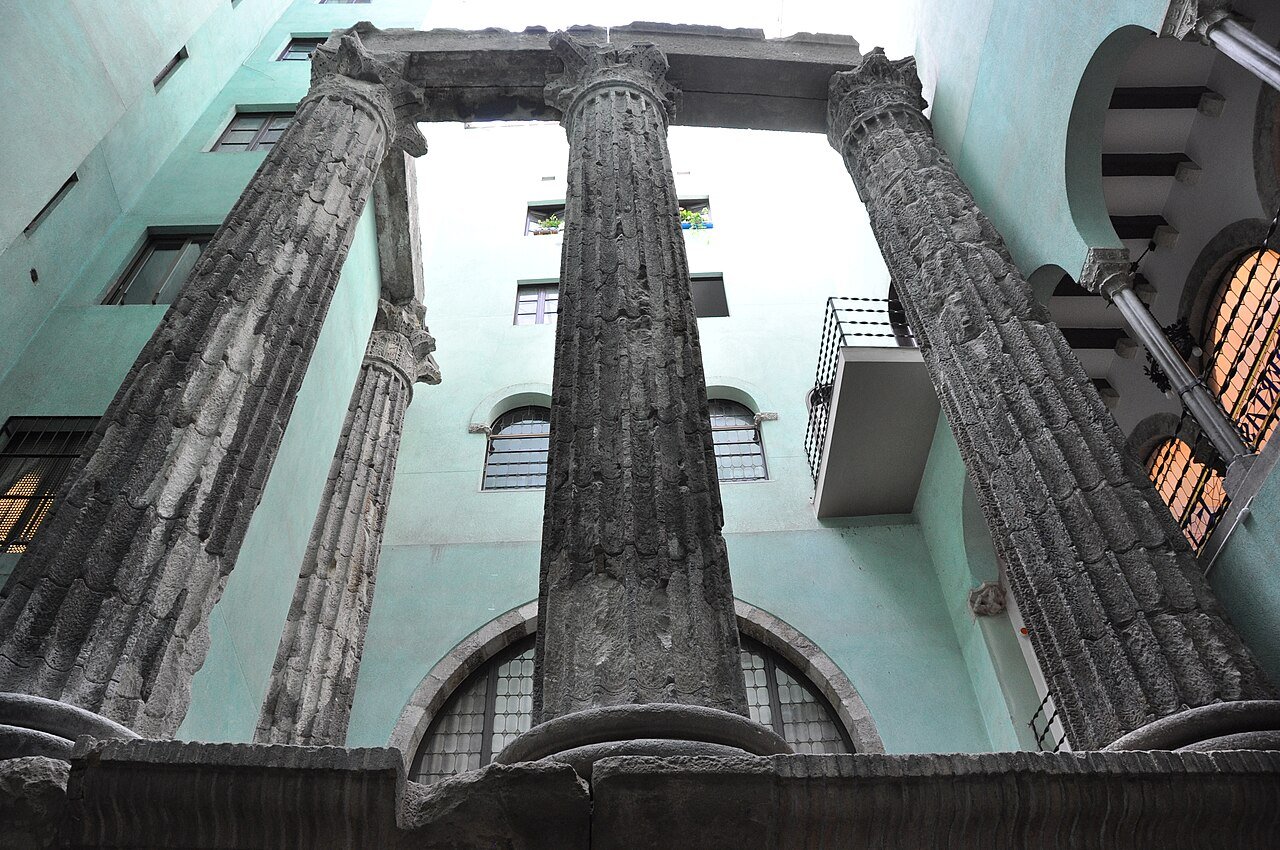
Two minutes from the cathedral, down the lane of Carrer del Paradís, an ordinary doorway at number 10 leads into the headquarters of the Centre Excursionista de Catalunya, a mountaineering club — and there, standing in its light-well courtyard on a great stone podium, are four Corinthian columns of the Temple of Augustus, nine metres of fluted stone that have been standing on this spot since the 1st century BC. This was the temple of the forum of Barcino, the Roman colony underneath Barcelona, dedicated to the emperor Augustus and set on Mont Tàber, the little hill — barely 17 metres — that was the highest point of the Roman city. A millstone set into the pavement outside number 10 still marks the summit.
The columns survived because the medieval city swallowed them: houses grew around and between them, and three stood embedded in buildings for centuries before being freed and gathered onto the podium in the early 20th century. There is no ticket desk and usually no queue. Entry is free, and the site, one of the MUHBA history museum’s outposts, opens Monday 10am–2pm, Tuesday to Saturday 10am–7pm and Sundays until 8pm, at the time of writing. It is the most astonishing free five minutes in Barcelona.

2. Plaça de Sant Felip Neri: The Square That Keeps Its Scars
The Gothic Quarter has grander squares, but none that stays with you like this one. Plaça de Sant Felip Neri is a small, still square at the end of a lane — a fountain in the middle, a Baroque church (1752) on one side, a primary school on another, and an air of deliberate quiet. Then you look at the church wall: it is pocked and gouged from top to bottom, as if the stone had been flayed. On the morning of 30 January 1938, during the Civil War air raids on Barcelona, a bomb fell on this square. Forty-two people were killed, most of them children sheltering in the church’s basement refuge. The square has kept the scars as its memorial, unrepaired, at a child’s eye height.
It is not a sombre place now, and that is its power: on school days the square fills with the noise of the children of the Sant Felip Neri school, playing football under the wall their predecessors died against. Go in the early morning or at dusk, when the tour groups have gone and the fountain is the loudest thing in it. Our guide to Barcelona’s Old Town and the Gothic Quarter maps the lanes that lead here.
3. Sinagoga Major: The Synagogue Under the Street
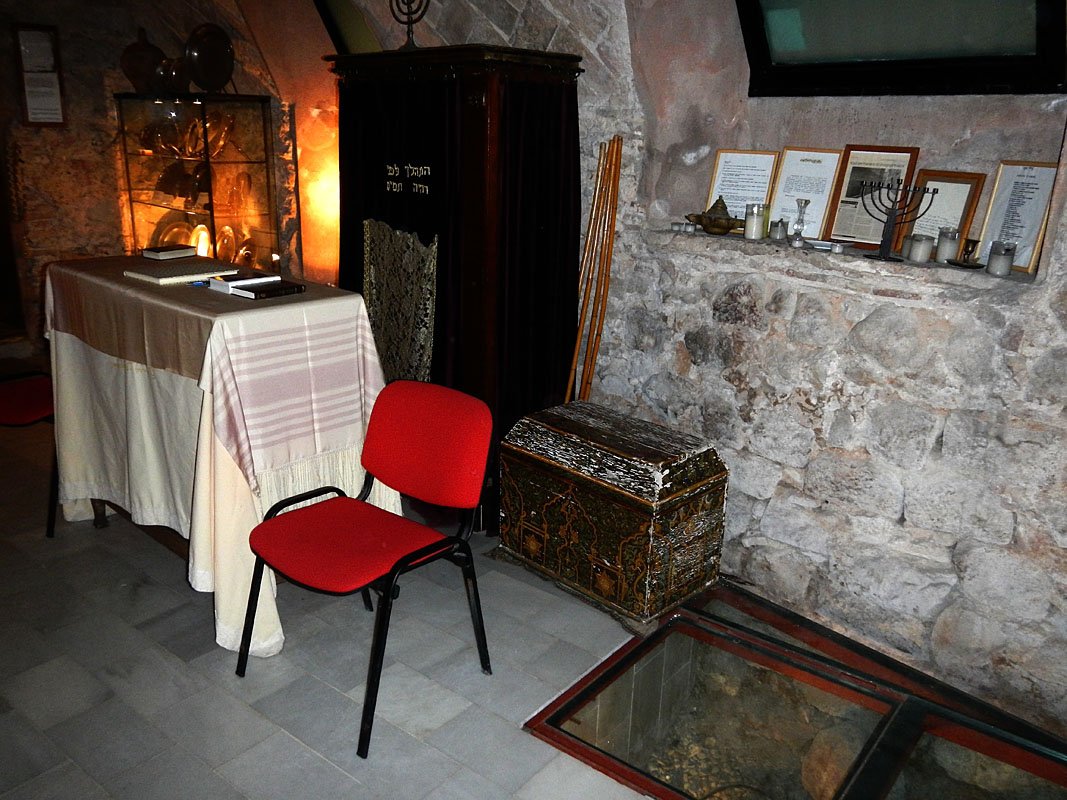
El Call, Barcelona’s medieval Jewish quarter, is a knot of lanes west of the cathedral that most visitors cross without knowing what it was — its community, one of the great Jewish communities of medieval Europe, was destroyed in the pogrom of 1391. At Carrer de Marlet 5, a small door below street level leads down into the Sinagoga Major, identified in 1987 by the historian Jaume Riera i Sans, who matched medieval documents to a building that had spent centuries as, among other things, a furniture shop.
There is almost nothing to it, and it is unforgettable: two small stone rooms in one of the oldest synagogue buildings in Europe, the ark, a menorah, a glass panel in the floor looking down to the older levels, and a short explanation from the staff that does the work of a museum ten times the size. Entry costs around €5, the visit takes twenty minutes, and the hours are short and seasonal — and it is closed on Saturdays, the detail that catches people out.
4. Via Sepulcral Romana: The Roman Cemetery Under the Square
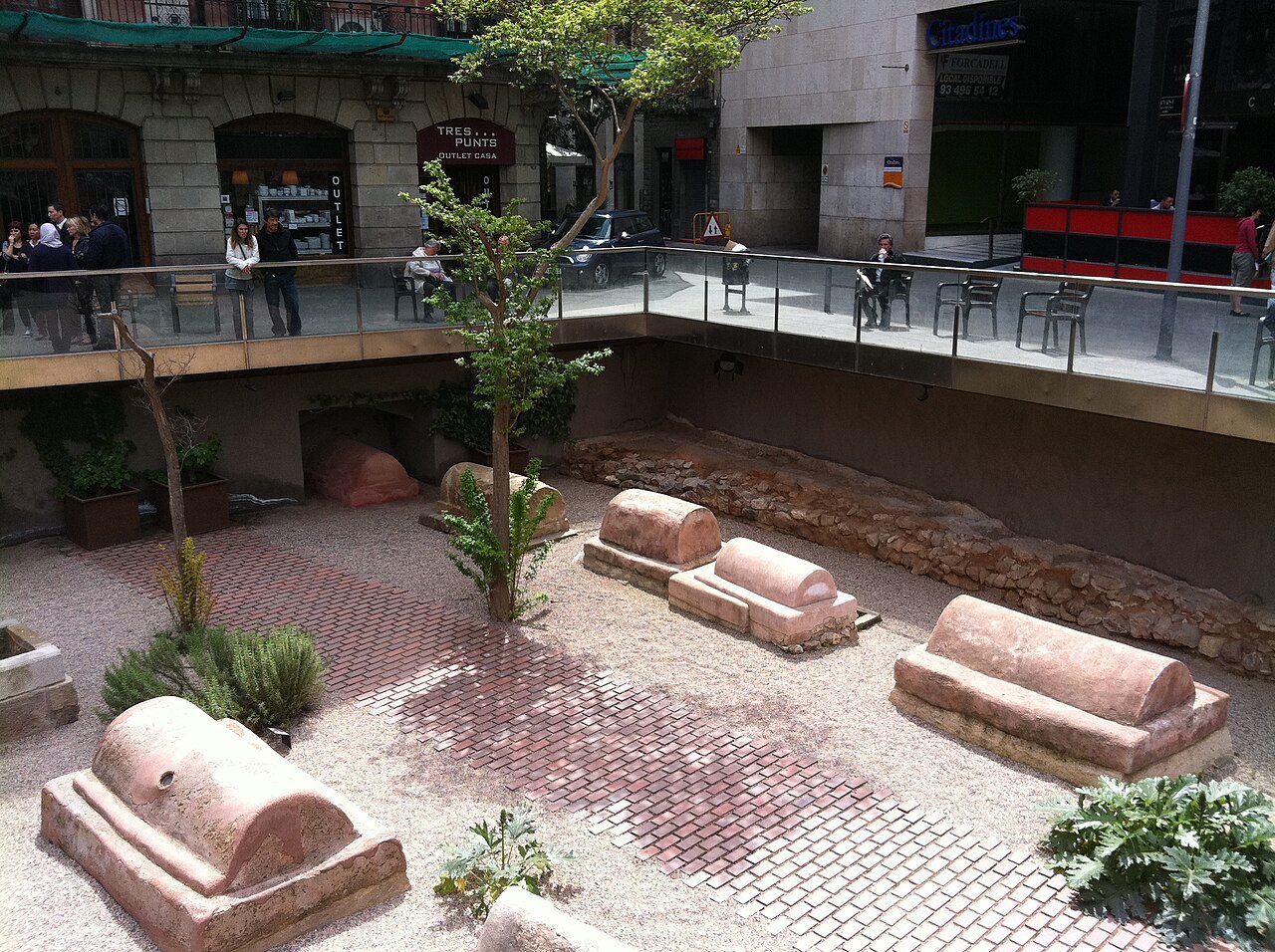
Plaça de la Vila de Madrid, just off La Rambla, looks like an ordinary city square with a sunken garden in the middle. Lean on the railings and the garden resolves into something else: a stretch of Roman road running below street level, lined with stone tombs. Roman law buried the dead outside the city walls, along the roads out — and this was a road out of Barcino, used as a burial street between roughly the 1st and 3rd centuries AD. Around seventy tombs survive, many of them cupae: plain barrel-shaped stone monuments, the graves of freed slaves, artisans and working families rather than the marble rich — which is exactly what makes the place so moving. This is Roman Barcelona’s ordinary dead, in an ordinary street, under a square where people eat lunch.
The site belongs to MUHBA, and the ticket — €2 at the time of writing, free on Sunday afternoons — admits you to the walkway down at road level and the small exhibition. Hours are short: Tuesday to Friday 11am–2pm, weekends 11am–7pm, closed Mondays. But the elegant cheat is built in: the whole necropolis is visible, free, from the square’s railings at any hour, and most people standing at those railings have no idea what they’re looking at.

5. El Born CCM: The Neighbourhood That Was Demolished
In 1876 Barcelona opened the Mercat del Born, a soaring iron-and-glass market hall in the Ribera quarter. It traded until 1971, stood empty for decades, and was finally earmarked as a library — at which point the builders dug into the floor and found a city. Under the market lay the streets of La Ribera as they stood in 1714 — a neighbourhood demolished after the Siege of Barcelona, its residents ordered to tear down their own homes to clear the ground for the Ciutadella fortress. In 2013 the hall reopened as El Born Centre de Cultura i Memòria, with the excavated quarter preserved entire beneath its floor.
You walk the hall’s balcony walkways and look down on a street plan three centuries old — the single most eloquent sight in Barcelona about what 1714 means to this city. Entry to the centre and the archaeological site is free (temporary exhibitions and guided visits are ticketed), and it opens Tuesday to Sunday, 10am–8pm in the long season, closed Mondays. It stands in the middle of the quarter our El Born guide covers lane by lane — and it is the one building in it that explains all the others. It is also the natural finishing point of the Barcelona Small Group Walking Tour: Gothic and Old Quarter — the guided version of this whole old-town cluster, which threads the Roman walls, the secret alleyways and Santa Maria del Mar before ending among these streets, with 1714’s story told standing in the middle of it.

6. Sant Pau del Camp: The Oldest Church in Barcelona
Its name is its biography: Sant Pau del Camp, Saint Paul of the Fields, founded as a Benedictine monastery in open countryside outside the Roman walls and long since swallowed by the city that grew around it. A monastery is documented here from 977, and the church preserves the funerary slab of Count Guifré II Borrell, who died in 911 — among the oldest stones in Barcelona. Almanzor’s troops destroyed the monastery in the raid of 985; what stands now is the rebuilt church of the 12th and 13th centuries, and it is the oldest surviving church fabric in the city: thick Romanesque walls, three apses, and a cloister so small and perfect it feels like a secret kept in stone — its paired columns carry lobed, almost Moorish arches, a singular survival in Catalan Romanesque.
Sant Pau sits at Carrer de Sant Pau 99 in El Raval, a quarter most visitors hurry through, which is why you’ll likely have the cloister to yourself. Tourist visits run Monday to Saturday, 10am–6pm (last admission 5:40pm), €6 at the time of writing; guided tours run on the first and third Sunday of the month at 12:45pm (€10) — the Sunday exception that proves this guide’s rule is about checking, not assuming. Dress and behave as in any working church; the silence in the cloister at midday is the exhibit no ticket can improve on.
7. The Rubió i Lluch Gardens: The Hospital Courtyard
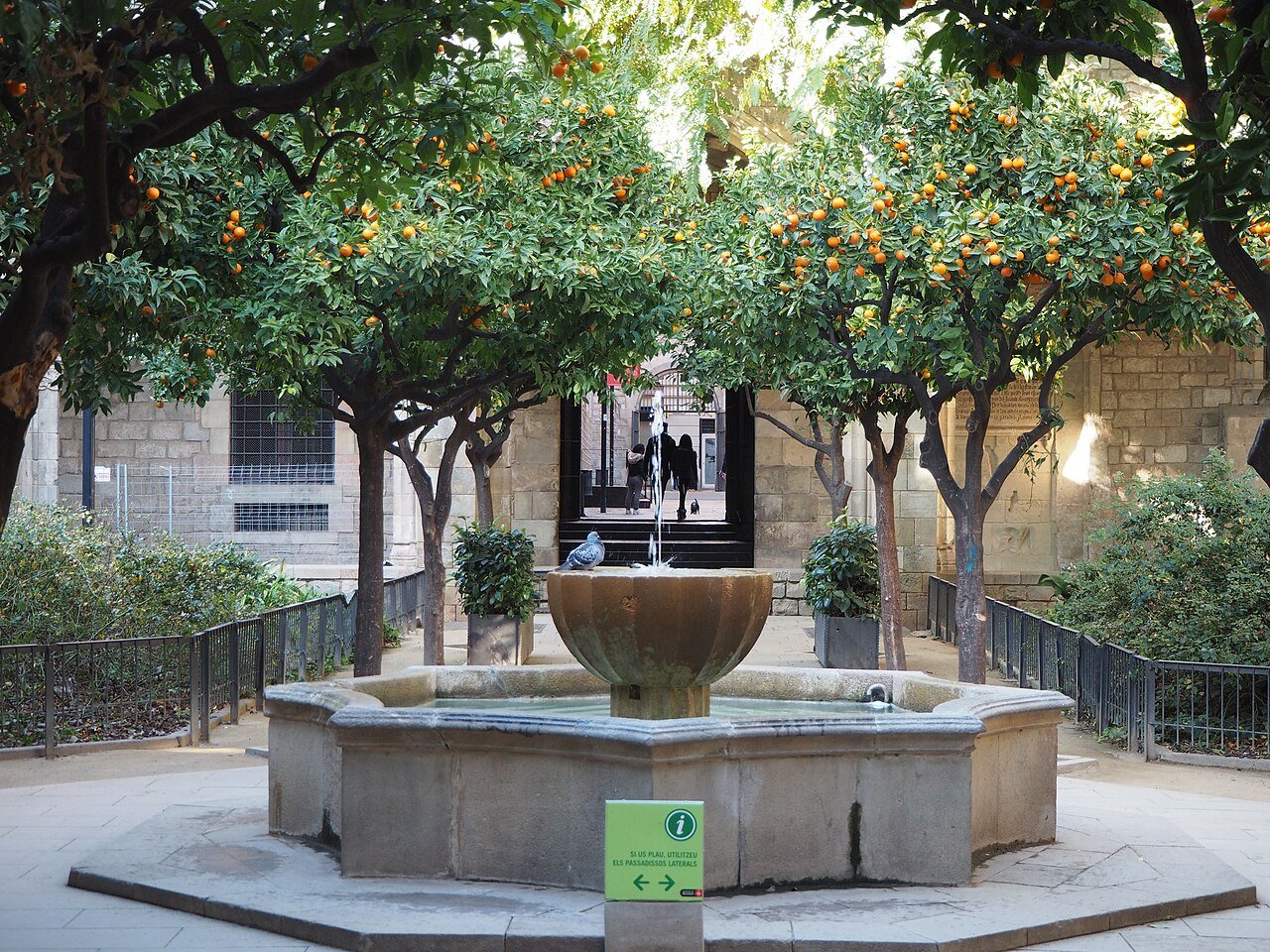
From Carrer de l’Hospital in El Raval, an unmarked gateway at number 56 leads into one of the great civil Gothic complexes of Barcelona — the Antic Hospital de la Santa Creu, founded in 1401 to gather the city’s scattered hospitals into one, and Barcelona’s general hospital for the next five centuries. Its courtyard, planted as the Jardins de Rubió i Lluch, is a walled garden of orange trees, a central fountain and long Gothic galleries, now home to the Biblioteca de Catalunya, the national library, whose readers cross with armfuls of books where the wards once stood. Antoni Gaudí died in this hospital in June 1926, brought here — unrecognised at first, in the charity ward of the city he had rebuilt in stone — three days after a tram struck him on Gran Via.
The gardens are not a ticketed sight; they are a courtyard you are free to wander while the complex is open, and they are the calmest acre in the city centre — students reading under the orange trees, the fountain, the galleries’ shade, five minutes from La Boqueria’s crush. Our El Raval guide puts the hospital in its neighbourhood. Sit for ten minutes: recovery is what this place has been for, in one form or another, for six hundred years.

8. Refugi 307: The Air-Raid Shelter in the Mountain
Barcelona built more than a thousand air-raid shelters during the Civil War, dug by the residents of each street against the bombers that made the city a laboratory of aerial warfare. Refugi 307, at Carrer Nou de la Rambla 175 in Poble-sec, is the one you can still walk: some 400 metres of tunnel driven into the flank of Montjuïc by the neighbourhood itself in 1937–39, with its infirmary, its latrines, its drinking fountain and its benches still in place — a small underground town built by people who intended to survive. The MUHBA guides who take you through it tell the story street by street: the shifts, the rules, the children, the nights the mountain shook.
It is also the most rationed sight in this guide: the shelter opens only for guided tours on Sunday mornings — 10:30am in English, 11:30am in Spanish, 12:30pm in Catalan — and booking ahead through MUHBA is essential, because the English tour is one hour, once a week, for a small group. The standard MUHBA ticket (around €7) covers it. Book it the week you book your flights; build the Sunday around it.

9. Museu Egipci: An Egyptian Museum Nobody Mentions
Barcelona has an Egyptian museum of European standing, and it is not being modest — it is being ignored. The Museu Egipci de Barcelona, at Carrer de València 284 in the Eixample, houses the collection of the Fundació Arqueològica Clos: more than a thousand pieces — sarcophagi and mummies, jewellery, amulets, a carved head of Nectanebo I, the furniture of eternity — assembled by the hotelier and Egyptologist Jordi Clos and displayed in a handsome Eixample interior seven minutes’ walk from Plaça de Catalunya. In any other city this would be a headline museum. In Barcelona it sits quietly between the Gaudí queues, visited mostly by schools and the curious, which means you will have its glass cases nearly to yourself.
The practicalities carry one trap: the museum keeps a split day — Monday to Friday 10am–2pm and 4pm–7:30pm, Saturday 10am–3pm and 4pm–7:30pm, Sunday 10am–2pm — so a 3pm arrival finds a locked door. General admission is €14 (reduced €10, children 6–12 €5), and the admission price includes the guided tour of the permanent collection offered on Saturdays (11am in Catalan, 5pm in Spanish). Allow an hour and a half. It pairs naturally with §10 and §11, a ten-minute walk away: three Eixample secrets in a single morning, none involving a Gaudí queue.

10. Palau Baró de Quadras: The Palace With Two Faces
Between La Pedrera and the Casa de les Punxes, on Avinguda Diagonal, stands a palace that plays a double game. From the Diagonal, the Palau Baró de Quadras (number 373) shows a carved-stone neo-Gothic front of extraordinary richness — a long gallery of sculpted figures and heraldry by Eusebi Arnau and Alfons Juyol, all northern severity. Walk around to Carrer de Rosselló and the same building is a different palace entirely: a flowing Modernista façade of floral sgraffito and ironwork, all Mediterranean softness. Both faces are by Josep Puig i Cadafalch, who remodelled the house in 1904–06 for the Baron of Quadras — the same architect, in the same years, giving one building two national styles and getting away with it.
The palace is a working building — it houses the Institut Ramon Llull, which promotes Catalan culture abroad — so the interior opens only on guided visits run by Cases Singulars, on Wednesday and Saturday mornings (around €14; the Wednesday English tour runs at 11am), at the time of writing. Book ahead; the groups are small. Even the free version — both façades from the street — is the finest five minutes on the Diagonal.
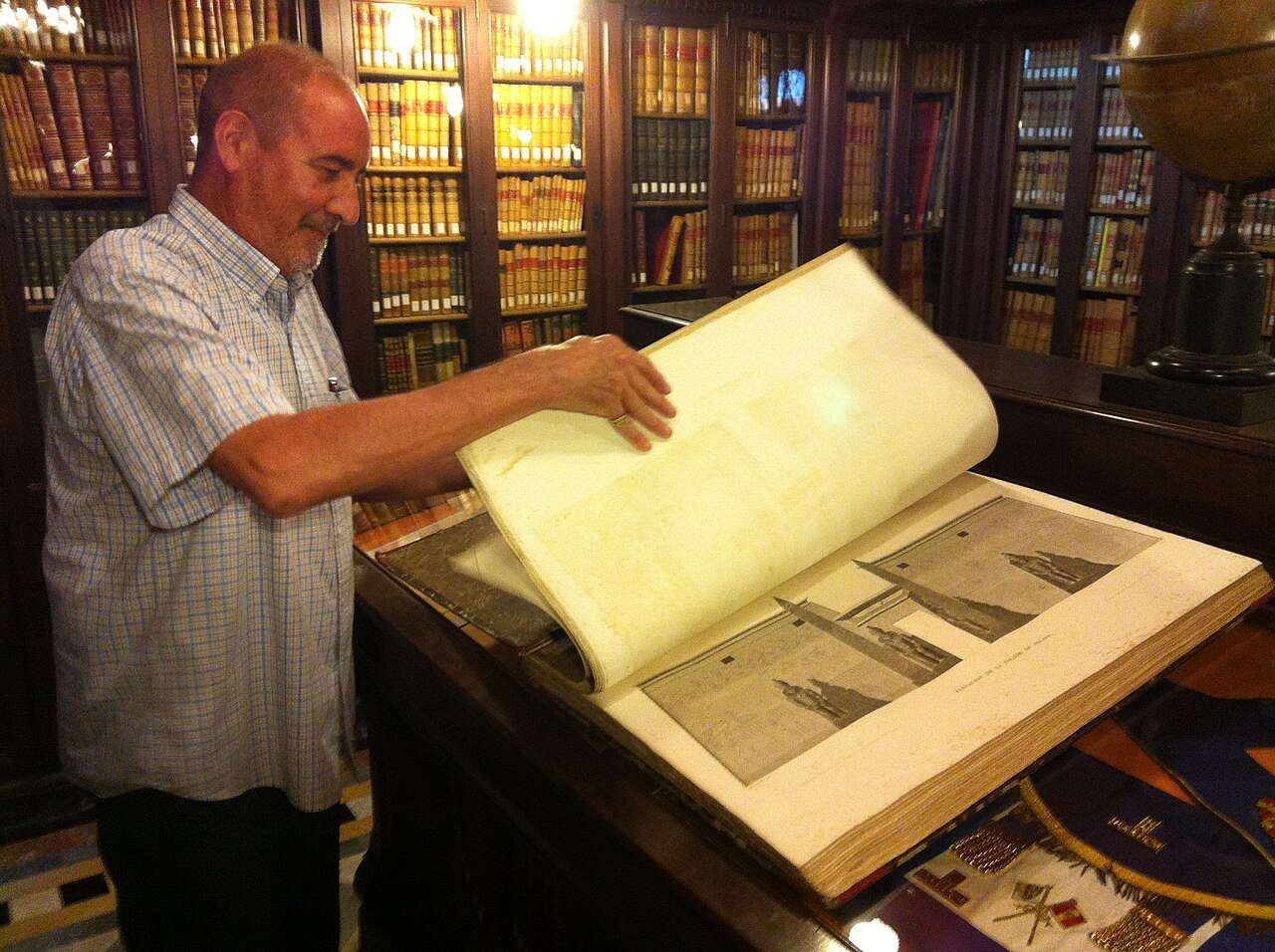
11. Biblioteca Arús: The Freemasons’ Library and Sherlock Holmes
At Passeig de Sant Joan 26, up a flight of stairs guarded by a small Statue of Liberty — a Barcelona-made replica that predates almost every souvenir version — is the Biblioteca Pública Arús, and stepping into it is stepping into 1895. Rossend Arús was a playwright, journalist and Freemason who left his house and his fortune to found a public library for the education of working people; it opened on 24 March 1895 with processions and bands, and its reading room survives astonishingly intact: the glass-fronted shelves, the great volumes, the hush. The library — some 80,000 volumes — became the research home of the movements official Spain tried to forget: its collections on the labour movement, anarchism and Freemasonry are among the most important in the country.
And then, because Barcelona is like this, there is the other collection: in 2011 the library received Joan Proubasta’s Sherlock Holmes archive, making this the largest Holmes collection in Spain — pipes, deerstalkers and first editions, in the Freemasons’ library, under the little Liberty. Readers use the library free, as Arús intended; visitors need the guided visit run by Cases Singulars — on Saturdays in season, €19 at the time of writing, the English tour at 10am — booked in advance. It is the most expensive ticket in this guide and the one regulars call the bargain.

12. The Hivernacle: The Glasshouse That Came Back From the Dead
Everyone visits the Parc de la Ciutadella; almost everyone walks past its finest building. The Hivernacle, on the Passeig de Picasso side of the park, is a cathedral of iron and glass designed by Josep Amargós for the Universal Exhibition of 1888 — a winter garden of slender columns and a great glazed nave, built when the park was the young city’s showpiece. Its biography since then is a Barcelona parable: spells as an aviary and a restaurant, decades of decline, then outright abandonment — the glasshouse stood derelict and fenced off for years, one of the city’s most beautiful ruins hiding in plain sight in its most visited park.
The ending, for once, is happy. A fifteen-month restoration recovered the building’s original appearance and purpose, and the Hivernacle reopened in December 2023 — a working display of more than a hundred plants of special interest, free to enter (capacity is limited, so a short wait is possible at busy times), opening at 10am and running into the evening. Go at dusk, when the glass glows from inside and the palms press against the panes. Next door, its sibling the Umbracle — a slatted shade house of dappled light — is the even quieter version of the same trick, and equally free.

13. Poblenou Cemetery and the Kiss of Death
Barcelona’s first cemetery outside the walls was opened here in 1775, flattened by Napoleon’s troops, and reopened in 1819 to a neoclassical design by the Italian architect Antonio Ginesi — a walled city of the dead at Avinguda d’Icària 204, with avenues, squares and more than 34,000 graves. And in its third department stands the reason it is in this guide: El Petó de la Mort, the Kiss of Death (1930), the tomb of Josep Llaudet i Soler, a young man of a textile family. A winged skeleton — Death itself, gentle as a nurse — holds the slumped body of the youth and kisses his forehead. It was carved in Jaume Barba’s workshop, to a design attributed to Joan Fontbernat, and the verses at its base are Jacint Verdaguer’s: his young heart is thus extinguished…
Nothing prepares you for how tender it is; it may be the most famous funerary sculpture in Spain, and it stands in a cemetery most visitors never enter. Entry is free, the gates open daily 8am–6pm, and a free map at the entrance marks the route to the Kiss. Two courtesies: this is a working cemetery, so keep voices down and photography discreet. Go in the morning, when the avenues are empty.
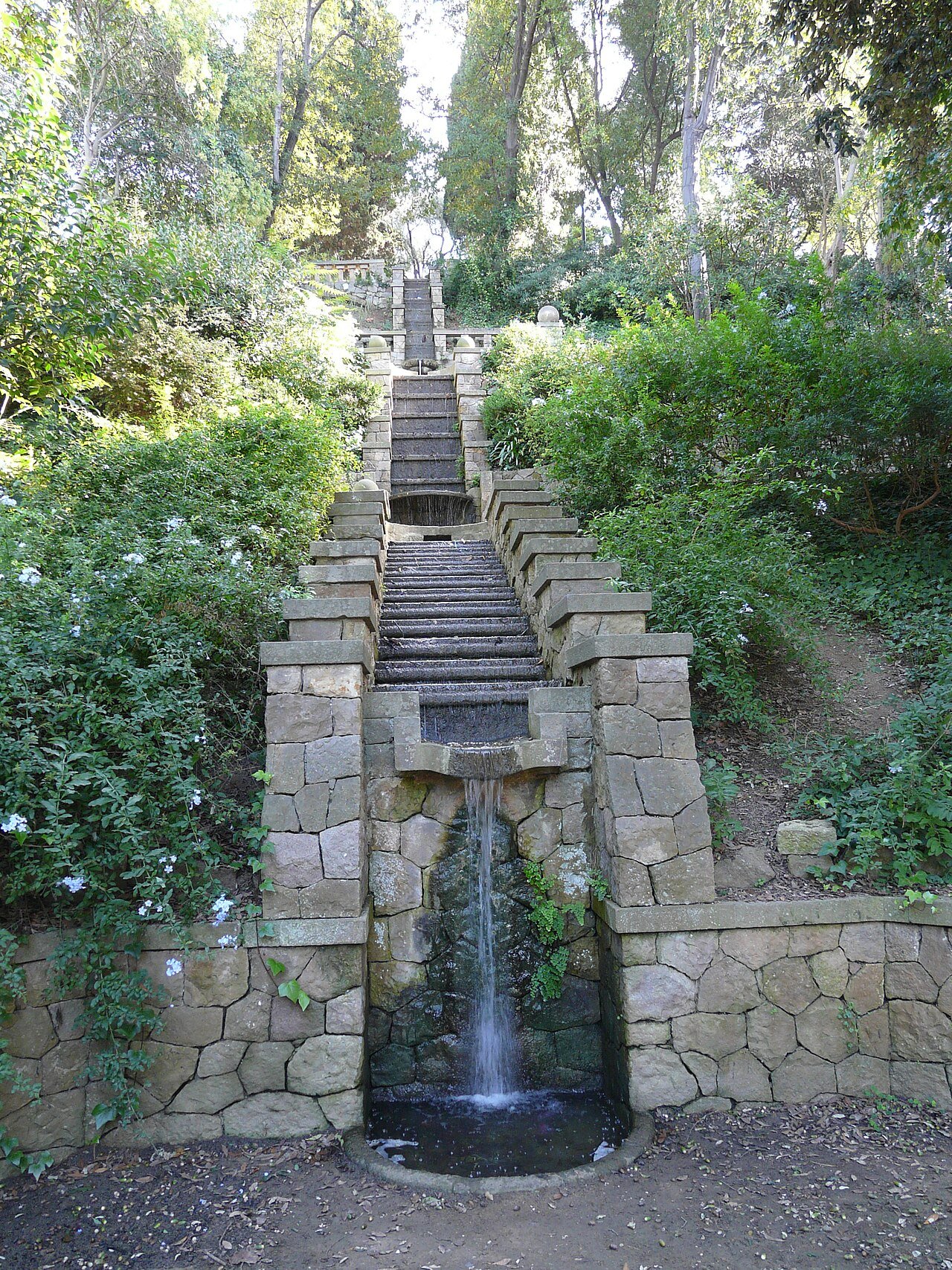
14. The Laribal Gardens and the Font del Gat
Below the Palau Nacional, where the MNAC’s crowds thin out, Montjuïc keeps its most romantic garden. The Jardins de Laribal were laid out from 1922 and reworked for the 1929 Exhibition by Jean-Claude-Nicolas Forestier and Nicolau M. Rubió i Tudurí — a hillside arranged as a sequence of terraces, pergolas, tiled benches and water, where every stair turns into a small cascade and every landing frames the city. At its heart runs the Font del Gat, the Cat’s Fountain, its cat’s-head spout (a work of 1918) presiding over a stairway of falling water — a fountain so woven into the city’s affections that it lives in a Catalan song every schoolchild here learns, about a soldier, a girl, and a meeting at the fountain when the water was running.
The gardens are free and open in daylight hours with the park; the honest way to do them is slowly, downhill, letting the water lead — start at the top by the Palau Nacional steps, follow the cascades down through the pergolas, and finish at the Font del Gat’s terrace. On a weekday morning you may share the whole garden with two gardeners and a cat. Montjuïc is usually sold as a castle and a cable car; its gardeners built better — and the chain that links §14 to §16 is the finest free walk in Barcelona.

15. The Joan Maragall Gardens: The Royal Garden Open Five Hours a Week
There is a formal French garden in Barcelona with tree-lined avenues, broderie flowerbeds, ornamental fountains and a neoclassical palace at its heart — and you can only enter it on weekend mornings. The Jardins de Joan Maragall, at Avinguda de l’Estadi 69 on Montjuïc, were designed by Forestier for the 1929 Exhibition around the Palauet Albéniz (architect Joan Moya), built as the royal pavilion for Alfonso XIII — and the palace is still the Spanish royal family’s official residence when they visit Barcelona, which is why the gates keep office hours of their own: Saturdays, Sundays and public holidays (except 24 September), 10am–3pm only, through the single gate on Avinguda de l’Estadi, at the time of writing. Entry is free.
Inside, the city drops away: gravel avenues, clipped lawns, sculptures standing in the flowerbeds, the palace façade behind its great fountain, and a quiet you can hear. It is the most elegant room in Barcelona that happens to be outdoors — and because of the hours, it is self-selecting: everyone inside made a small effort to be there, and it shows. Our guide to the best parks and gardens in Barcelona covers the hill’s greener corners; this garden is its crown. Plan the Montjuïc morning backwards from 10am on a Saturday and the rest of the hill arranges itself.
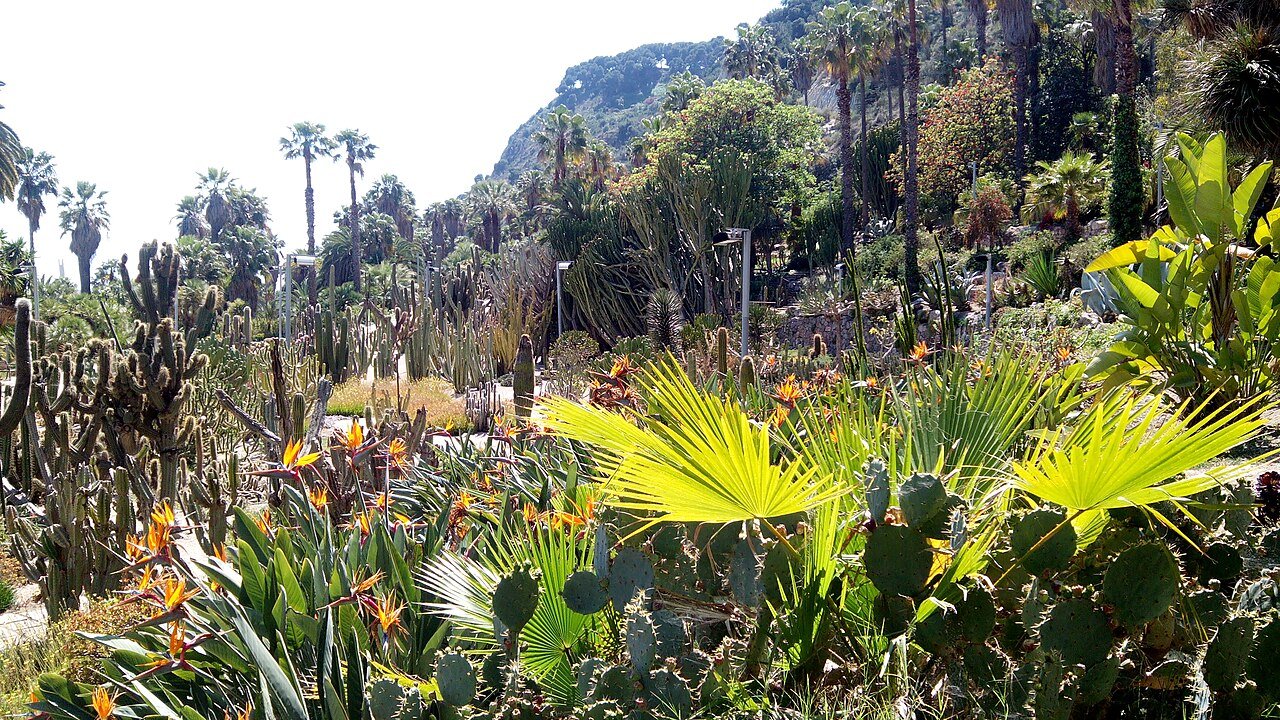
16. The Mossèn Costa i Llobera Gardens: A Cactus Forest Above the Port
On the sea-facing slope of Montjuïc, in a sheltered hollow below the Miramar that most of the city doesn’t know exists, grows a desert: some 800 species of cacti and succulents across about six hectares — organ pipes and golden barrels, agaves like green explosions, palms overhead — one of the most important cactus collections in Europe, with the port glittering below. The Jardins de Mossèn Costa i Llobera (Carretera de Miramar 38) were created in 1970 by the architect Joaquim M. Casamor and the gardening teacher Joan Pañella, who understood what the hollow offered: a frost-free microclimate, a few degrees warmer than the city around it, where the plants of Mexico, South Africa and Australia would thrive outdoors all year.
The gardens are free, open every day — roughly 8am–7pm in winter and 8am–9pm in summer, closing at dusk, at the time of writing — and they are the emptiest big garden in Barcelona: ten minutes’ walk from the Columbus Monument, and you will have whole terraces to yourself. Pair them with the Montjuïc Castle above — the funicular and the Miramar road stitch the two together — and take the slope slowly on the way down: the collection is arranged as a descent through the deserts of the world, and the last terrace, where the biggest cacti stand over the harbour cranes, is the best free seat in the city.

17. The Pavellons Güell and Gaudí’s Dragon Gate
Before the palaces, before the park, there was a gate. In 1884–87, a young Antoni Gaudí received his first commission from the man who would become his great patron, Eusebi Güell: the entrance buildings of the family’s Pedralbes estate — the gatehouses, the riding school and stables, and the boundary wall with its gate. That gate, at Avinguda de Pedralbes 7, is one of the wonders of Barcelona hiding at pavement level: a colossal wrought-iron dragon, wings spread, mouth open, forged in the Vallet i Piqué workshop — Ladon, the dragon who guarded the golden apples in the Garden of the Hesperides, a reference to Jacint Verdaguer’s epic L’Atlàntida, the poem the Güell circle revered. Older accounts say the dragon’s jaw was articulated to move as the gate swung; today it is still, and still magnificent, and most of the city walks its dogs past it without a glance.
The estate now belongs to the University of Barcelona. The dragon itself is free to admire from the street at any hour; the pavilions and garden behind it have recently reopened as the Jardí Gaudí, with weekday opening (Monday to Friday, roughly 10am–4pm) and guided visits — the arrangements are new, so check the current hours before going.
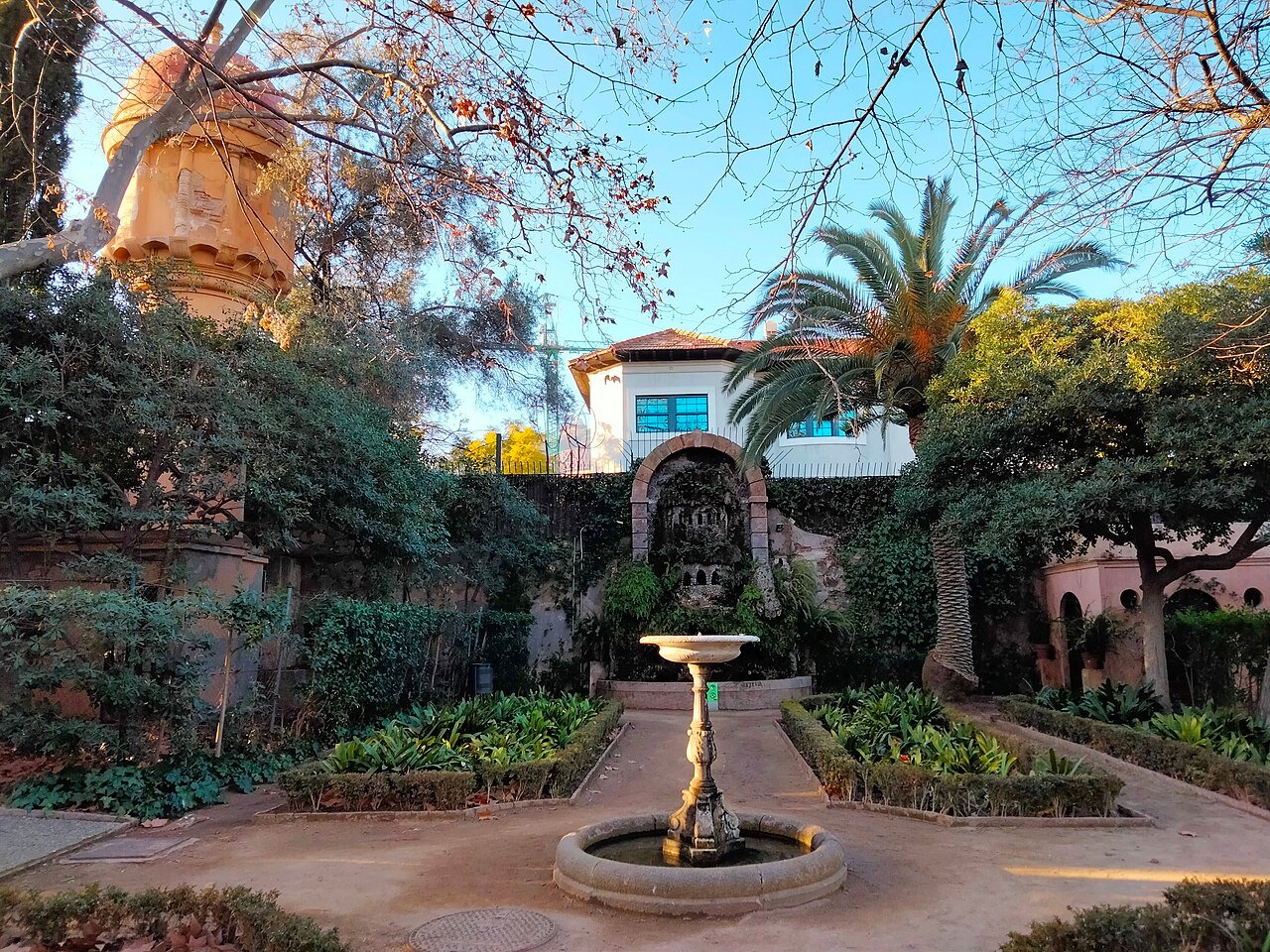
18. The Tamarita Gardens: The Manor Garden Nobody Finds
Sarrià-Sant Gervasi, the city’s well-kept upper district, keeps a garden that even its neighbours underuse. The Jardins de la Tamarita, at Passeig de Sant Gervasi 47, wrap around an early-20th-century manor house — some two hectares laid out in the orbit of Rubió i Tudurí’s generation of garden-makers: a formal court with a fountain and a small tower, pergolas drowned in climbers, a pond, lawns running down to old specimen trees, and everywhere the particular silence of a private garden that happens, almost apologetically, to be public. The house was a family estate when this district was a separate town of summer residences; the city inherited the garden, opened the gates, and then — the visitor figures suggest — largely forgot to tell anyone.
It is free, open daily in daylight hours, and it is the easiest gem in this guide to have entirely to yourself: a bench, a book, the tower over the fountain court, forty minutes from the centre. District families use it the way it was meant to be used — birthdays on the lawn, grandparents on the benches — and as a visitor you are simply one more person in a garden being lived in, which after a week of ticket barriers feels like a small restoration of the natural order.

19. Turó del Putxet: The Viewpoint Without the Crowd
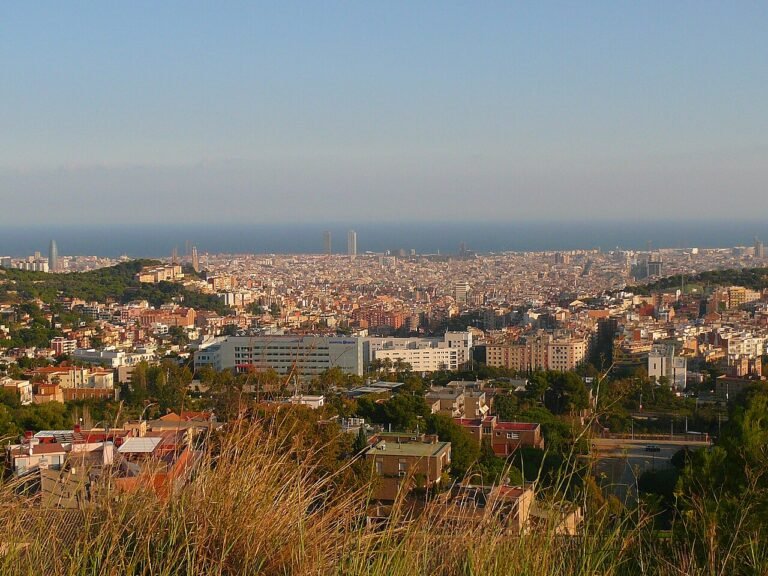
Every guide sends you to the Bunkers del Carmel for the panorama, and the Bunkers at sunset now hold a crowd worthy of the view. Barcelona’s other hilltop keeps its counsel. The Turó del Putxet, in the neighbourhood of El Putxet i el Farró, is a 178-metre hill that spent the 19th century as the garden of other people’s summer estates — viewpoints, pergolas and pine groves for families escaping the old town’s heat — and has come down to us as a public park of paths and lawns wrapped around its summit. From the top the whole composition of Barcelona is laid out for inspection: the Eixample’s grid running to the sea, the Sagrada Família and the Torre Glòries picking out the pattern, Collserola at your back and Montjuïc across the bowl of the city.
The park is free, open in daylight hours, and used overwhelmingly by the people who live on its slopes: dog-walkers at eight, grandparents at eleven, teenagers at dusk. There is no ticket, no terrace bar and no queue for the parapet; the sunset here is the one the Bunkers had twenty years ago. Metro to Lesseps or the Ferrocarril to El Putxet, then a ten-minute climb.

20. Carrer d’Aiguafreda: The Street of the Washerwomen
The last gem is a street. Carrer d’Aiguafreda, in Horta at the foot of Collserola, is a lane of modest whitewashed houses — some thirty of them — each built with a covered wash-yard at its front, and for two centuries those yards were Barcelona’s laundry. Horta had what the city lacked: abundant cold water — aiguafreda means exactly that — and from the 18th century into living memory the bugaderes d’Horta, the washerwomen of Horta, took in the washing of half of Barcelona, beating it clean in these great stone sinks under their pergolas and hanging it along the lane. The washhouses survive — stone basins, pillars, sloping roofs — preserved as the street’s front parlours, most now gardens and patios, one after another down a lane that has kept the scale and quiet of the village Horta used to be.
There is nothing to book and nothing to pay: it is a public street, free at any hour, best walked slowly in the morning when the yards are full of plants and cats. The Parc del Laberint d’Horta, the maze garden, is a ten-minute walk away, so the laundry street and the labyrinth make one outing. And the whole of hidden Barcelona is in this lane — a working place, an ordinary street, a story two centuries deep, and nobody trying to sell you a ticket to it.
Which Gems Suit You?
Only got a morning? Work the old town in a ring: Temple of Augustus → Sant Felip Neri → the synagogue → the Via Sepulcral → the Born CCM — five gems, under €10 spent, done by lunch. Here on a Sunday? The city’s hidden machinery turns your way: Refugi 307’s English tour at 10:30, MUHBA’s sites free from 3pm, the Joan Maragall Gardens open in the morning. Here on a Saturday? Check the traps first: the synagogue is shut, but the Arús guided visit runs — book the library and give the morning to it and the Eixample pair (§9, §10). A garden person? The Montjuïc chain — Laribal down to Costa i Llobera — plus the Tamarita. Chasing the dark chapters? Sant Felip Neri’s wall, Refugi 307 and the Kiss of Death, in that order, with time to sit down between them. Travelling with children? The Hivernacle’s glass nave, the Born’s excavated streets and the Putxet’s grass — wonder without a single queue. Prefer your secrets after dark? Several of these change character at nightfall — the Barcelona at night guide is this list’s evening twin.
What the Hidden City Costs, Honestly
The hidden city’s admission policy can be summarised as: mostly, there isn’t one. Fourteen of these twenty places — the Temple, the square, the Via Sepulcral from the railings, the Born CCM, the Rubió i Lluch courtyard, the Hivernacle, the cemetery, both Montjuïc garden chains, the dragon gate from the street, the Tamarita, the Putxet and the laundry street — are free. The small-ticket layer is almost symbolic: the Via Sepulcral at €2, the synagogue at around €5, Sant Pau del Camp at €6, the Refugi 307 tour within MUHBA’s standard ticket at around €7. The mid layer holds the Museu Egipci at €14 and the Baró de Quadras guided visit at around €14. And the splurges are relative — the Biblioteca Arús guided visit at €19, and the one guided experience that ties the old town together, the Barcelona Small Group Walking Tour: Gothic and Old Quarter from $22.03 — the same money as a single Gaudí house, for fifteen sights and the stories that make them legible. Budget, in other words, is not the barrier to the second Barcelona. The real currency is timing: a Sunday morning kept free, a Saturday booked ahead, an alarm set for a garden that opens at ten and shuts at three.
30 Best Things to Do in Barcelona for First-Time Visitors
Travel insurance, sorted
Whether it is a two-week holiday or a longer move, travel insurance is not the most glamorous part of a trip — but it is the one booking you want to have in place before a trip, and while you are already away. Get a quote from SafetyWing
Final Thoughts
The famous Barcelona is a performance the city gives superbly, and you should see it — the basilica, the houses, the park. But the city itself lives in the second list: in a mountaineering club’s courtyard where an emperor’s temple still stands, in a laundry lane in Horta, in a garden that opens when it pleases and a cemetery that asks only for quiet. None of these places is hard to reach. All of them require the one decision that separates the two Barcelonas — to walk down the lane with no queue on it, and push the door that has no sign. Do it twenty times, and the postcard city reassembles around the hidden one, richer than before.
FAQs: Hidden Gems in Barcelona
What is the most underrated place in Barcelona?
The Temple of Augustus. Four columns of the Roman forum’s temple — among the oldest structures in the city, free to enter, two minutes from the cathedral — stand in a courtyard most visitors walk past a dozen times without knowing.
Are Barcelona’s hidden gems really free?
Most of them, yes. Fourteen of the twenty places in this guide cost nothing, including the Temple of Augustus, the El Born CCM, the Hivernacle, Poblenou Cemetery and all the gardens. The ticketed exceptions are small: €2–€6 for the Via Sepulcral, the synagogue and Sant Pau del Camp, €14 for the Egyptian Museum, and €19 for the guided visit to the Biblioteca Arús.
What is the best day of the week for hidden gems?
Sunday, with planning. Refugi 307’s only English tour runs at 10:30am on Sundays, MUHBA’s sites are free on Sunday afternoons, and the Joan Maragall Gardens open on weekend mornings. The counterweights: the synagogue closes on Saturdays, and Sant Pau del Camp closes to tourist visits on Sundays — so split the list across the weekend.
How many hidden gems can you see in one day?
Six or seven, comfortably, if you work by cluster: the old-town ring (§1–§5) takes a morning, and Montjuïc’s three gardens (§14–§16) an afternoon. Scattered one-offs — the Pavellons Güell, the Tamarita, Carrer d’Aiguafreda — are better saved for a second day and paired with their neighbourhoods.
Do you need to book any of these in advance?
Three of them, yes: Refugi 307 (its Sunday tours fill, and the English tour runs once a week), and the guided visits to the Biblioteca Arús and the Palau Baró de Quadras, which run on set days with small groups. Everything else in this guide is walk-in — several are walk-in in the literal sense that there is no door to knock on.
Are these places suitable for children?
Largely, yes: the Hivernacle, the Born CCM, the Montjuïc gardens, the Putxet and the dragon gate all land well with children, and none involves a queue. Two need parental judgement: Refugi 307’s Civil War story is told plainly, and Poblenou Cemetery — beautiful, calm, and working — suits older children better than toddlers.



One Comment