La Lonja de la Seda: The Complete Visitors’ Guide
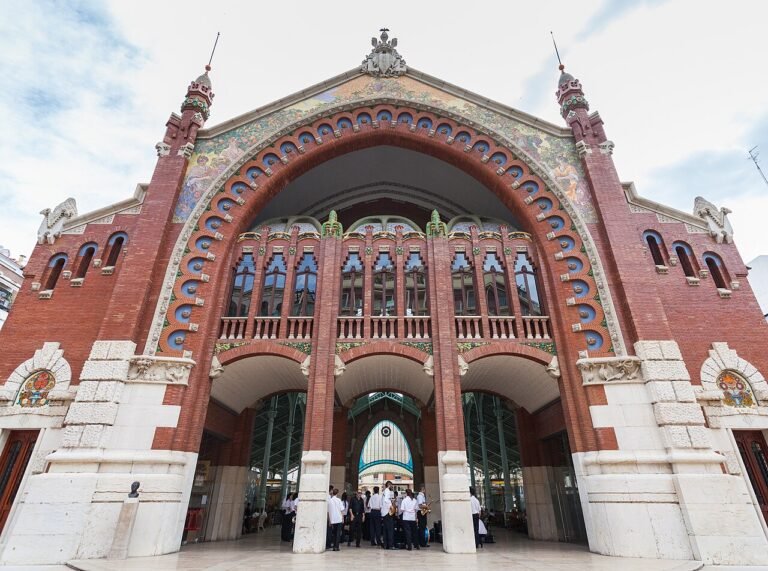
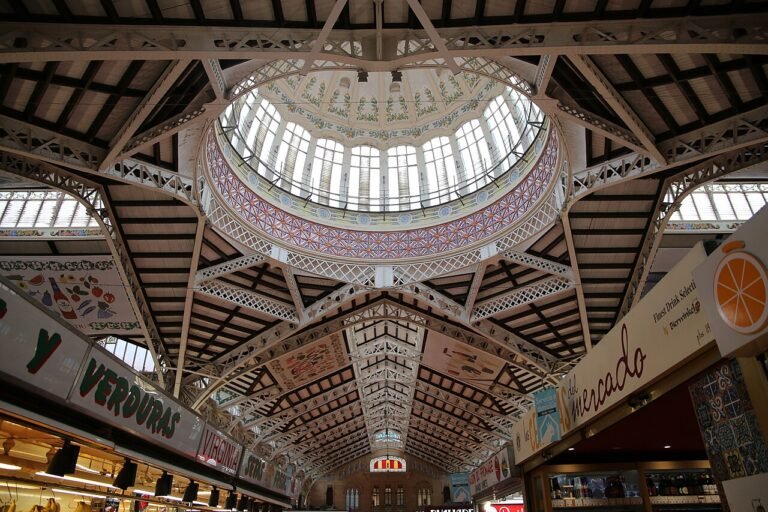
Stand in the Plaça del Mercat at about eleven in the morning and you are standing between two of the finest buildings in Valencia, facing in opposite directions. Behind you, all glass and iron and ceramic domes, is the Mercado Central, the city’s great food market. In front of you, five hundred years older and built of plain honey-coloured stone, is the building that paid for this whole quarter’s confidence: La Lonja de la Seda, the Silk Exchange. From the square it looks almost severe — a fortress wall of Gothic windows with a crenellated tower in the middle. Walk through its door, though, and you step into one of the most beautiful rooms in Spain: a hall of twisted stone columns that branch overhead into star-patterned vaults, built not for God or for a king, but for merchants — specifically, for the silk merchants who made fifteenth-century Valencia one of the richest trading cities in the Mediterranean.
This guide tells you what the Lonja actually is, how it fits together — the great hall, the tower, the orange-tree courtyard and the sea court with its golden ceiling — and how to see it properly in the forty-five minutes it deserves. It sits high on our Best Things to Do in Valencia list, and pound for pound, minute for minute, it may be the best-value great building in the city: a UNESCO World Heritage Site that most visitors walk past on their way to buy oranges.

The Short Answer
Yes, La Lonja is absolutely worth it — it costs only a couple of euros, takes under an hour, and contains the single most astonishing interior in Valencia’s old town. The ticket covers the whole complex: the Sala de Contratación with its spiral columns, the little courtyard of orange trees, and the Consulate pavilion with its gilded medieval ceiling. Go in the morning and pair it with the Mercado Central across the square, which is shutting up by mid-afternoon; and check the current rules before you go, because entry has traditionally been free on Sundays and public holidays, when the Lonja also keeps shorter hours. If you only have one morning in the old town, this building and the cathedral are the two interiors to choose.
Table of Contents
- The Short Answer
- The Story in Brief
- The Sala de Contratación
- The Tower and the Chapel
- The Patio de los Naranjos
- The Consulate and the Cámara Dorada
- The Details Everyone Walks Past
- Practical Info
- Tips for Visiting
- Final Thoughts
The Story in Brief
To understand the Lonja, start with a worm. In the fifteenth century the hills and farmsteads around Valencia were planted with mulberry trees, and the city filled with silk workshops — weavers, dyers, merchants — trading Valencian silk across the Mediterranean and deep into Europe. Business on that scale needs a stock exchange, and Valencia’s merchants had outgrown their old trading hall, the Lonja del Aceite by the market. So in 1482 the city council voted to build something bigger and grander: not a church, not a palace, but a temple to honest trade, on the market square where the deals were actually done.
The master mason was Pere Compte, the leading Valencian stonemason of the age, working with Joan Ibarra. Compte gave the merchants their great hall in just fifteen years — a fact the building itself boasts about, as you’ll see — and work on the rest of the complex, the tower and the Consulate pavilion, continued until 1548. What they produced is the masterpiece of Valencian civil Gothic: sacred architecture’s engineering, put to gloriously secular use. UNESCO agreed in 1996, adding the Lonja to the World Heritage list as one of the finest secular Gothic buildings in Europe.
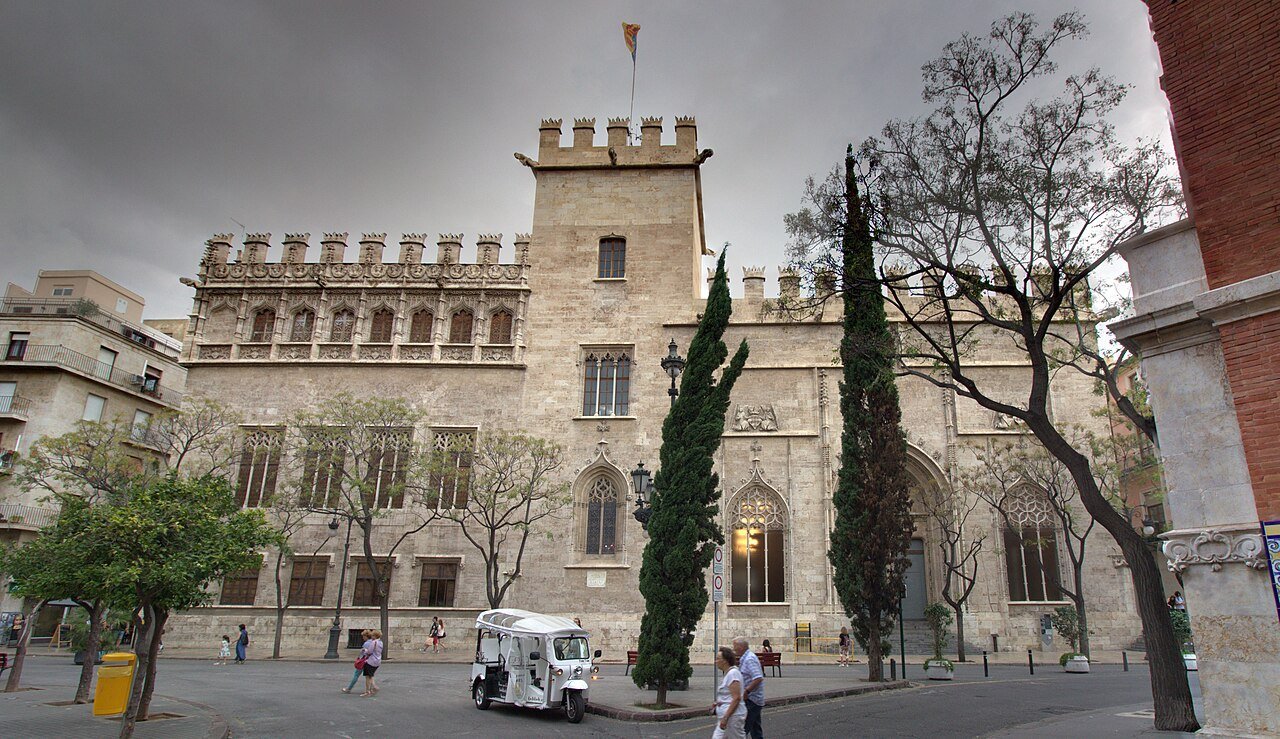
The other half of the story is legal. Seaborne trade runs on trust and on rules for when trust breaks down, and Valencia had the Mediterranean’s most famous rulebook: the Llibre del Consolat de Mar, the Book of the Sea Consulate, the maritime law code compiled here and respected in ports from Barcelona to Alexandria. The tribunal that applied it — the Consulat del Mar, founded back in 1283 — eventually got its own pavilion attached to the exchange. Keep that pairing in mind as you walk through: the hall is where the money changed hands, and the pavilion is where the arguments were settled.
The Sala de Contratación
This is the room. The Sala de Contratación — the Contract Hall — is a single vast chamber, some 36 metres long and 17 metres high, and it is held up by one of the great party tricks of Gothic engineering: eight free-standing columns (with matching half-columns against the walls) twisted like barley sugar, or rope, or — the comparison Valencians prefer — the trunks of palm trees. Each column rises without a capital and simply unravels into the ribs of the vaults, so the ceiling becomes a stone net of stars and the whole hall feels less built than grown. There is no decoration competing with the structure, because the structure is the decoration. Stand in the middle, where the merchants stood, and turn slowly. It does not get old.
Then walk the walls. Running right around the hall, high up, is a dark band carrying a Latin inscription in gold letters — the building’s mission statement, carved by the city for everyone who traded here. In essence it says: I am a famous house, built in fifteen years. Try me, fellow citizens, and see how good is trade that does not deal in deceit, that keeps its word to its neighbour, and that does not lend money at usury. The merchant who trades in this way will abound in riches, and in the end will enjoy eternal life. Read that again and savour it: a stock exchange that promises its users heaven, conditional on honest dealing. The merchants worked under those words every day, which was rather the point.

Notice, too, the light. The hall’s great windows are filled with flamboyant stone tracery, so the sunshine arrives patterned, and the marble floor — laid in coloured geometric stars — throws it back. This was a working floor, loud with brokers and buyers in its day; now it is usually blissfully quiet, because the tour groups photograph it and move on in five minutes. Don’t be them. The Sala rewards ten unhurried minutes more than almost any room in Spain.
The Tower and the Chapel
Between the hall and the courtyard stands the tower, the Lonja’s strong right arm — crenellated, slightly severe, and flying the Valencian flag from its top. Seen from the square, its finest ornament is easy to miss: one of the hall’s traceried windows climbs its flank, and above the window two carved angels present the crowned shield of the city, as if to remind everyone whose authority stood behind the bargains struck inside. Look for it from the Plaça del Mercat before you go in.

The tower had two unsentimental jobs. At its base was a small chapel, dedicated to the Immaculate Conception, where merchants could hear Mass before the trading day — faith first, then business. And in its upper rooms, behind a spiral staircase reached by a little flamboyant doorway in the corner of the great hall, the city kept its debtors’ prison: bankrupt merchants were locked up in the tower until their debts were paid. Admire that doorway when you find it — a miniature Gothic jewel of an arch, crowned with a carved cross and guarded now by an iron gate. The tower is not open to climb, and honestly it doesn’t need to be: its story is told perfectly well from the hall floor, by that pretty little door with the lock on it.

The Patio de los Naranjos
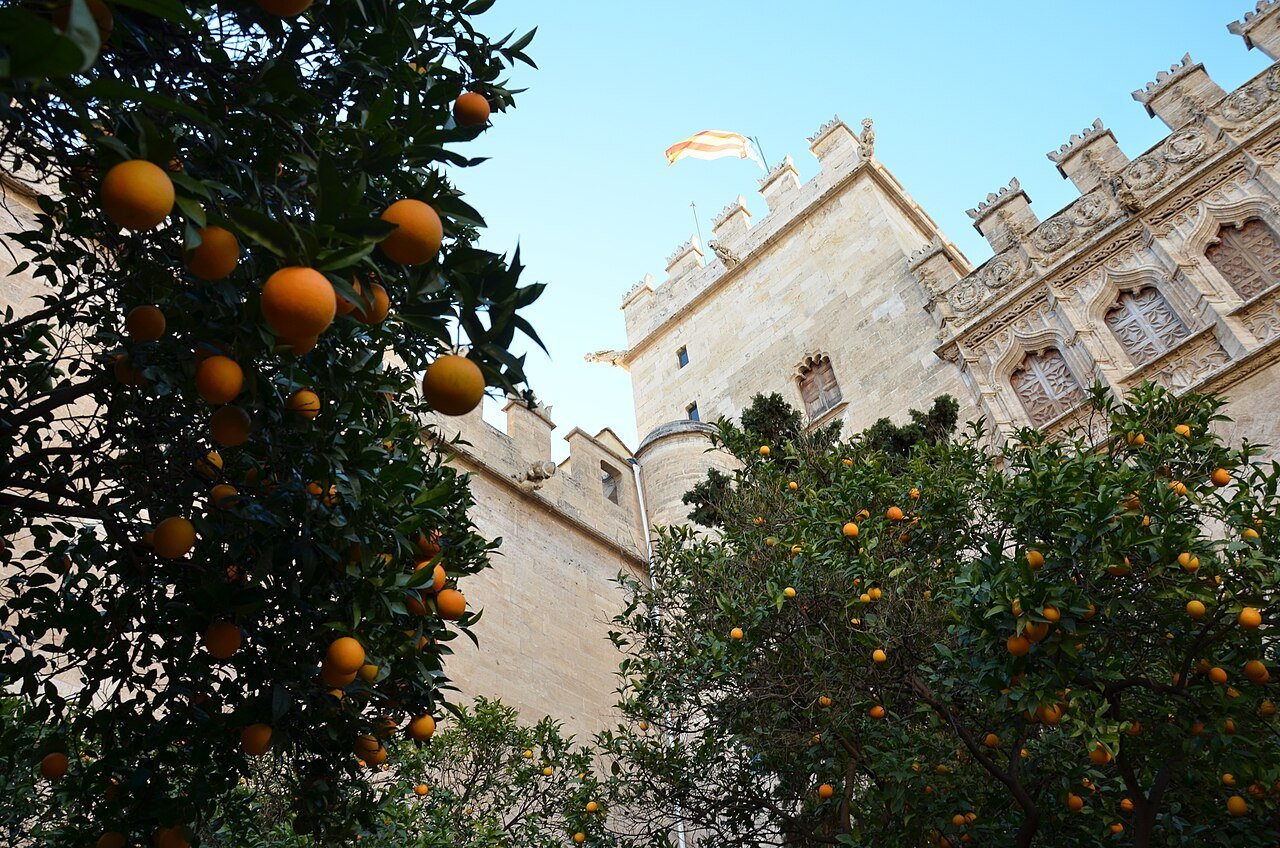
Every route through the Lonja passes through its calm centre: the Patio de los Naranjos, the Courtyard of the Orange Trees. It is a small, square, walled garden between the hall and the Consulate pavilion, planted with neat rows of orange trees over gravel and a little star-shaped fountain, and it does for the visit what a cloister does for a cathedral — it lowers your voice. The merchants used it as breathing space between deals; you can use it exactly the same way between the hall’s drama and the Consulate’s gold.
Come here in spring if you can, when the orange blossom — azahar — scents the whole courtyard, or in winter when the trees are loaded with fruit and the tower rises behind them bright against the blue. It is also the best place to read the building’s outside walls: the Consulate’s carved gallery is at close range here, without the market crowds at your elbows.
Free Valencia travel guide
Planning a trip to Valencia? Get our free one-page Valencia checklist: what to book ahead, what to skip, and the paella places we actually eat in.
The Consulate and the Cámara Dorada
The pavilion closing the far side of the courtyard is the Pabellón del Consulado, built last, between 1506 and 1548 — and you can see the century turning in its stonework. Its courtyard face is a Renaissance gallery of elegant ogee-arched windows, topped by a frieze of carved portrait medallions and a row of dainty little turrets, quite different in spirit from the hall’s muscular Gothic. This was the seat of the Consulat del Mar, the sea court: downstairs were its offices and courtrooms, where the consuls — merchants themselves, elected by their peers — judged shipping disputes quickly, orally and without lawyers, by the customs of the sea.

Upstairs is the pavilion’s treasure, and the Lonja’s second great interior: the Cámara Dorada, the Golden Chamber, the consuls’ great hall. Run your eyes up and keep them there. The whole room is roofed with a magnificent gilded coffered ceiling — panel after panel of dark wood picked out in gold, crawling with carved beasts, musicians, wrestlers and shields of the city’s arms. Here is the twist, and it is a good one: the ceiling is older than the room. It was made at the end of the fifteenth century, by the master Joan del Poyo, for the old Casa de la Ciutat, Valencia’s medieval town hall. When that building was demolished in the 1920s, the ceiling was rescued, dismantled and re-erected here — a homeless masterpiece given the best available roof. So the Cámara Dorada is two monuments in one: a Renaissance courtroom wearing a Gothic ceiling saved from the wreckers.
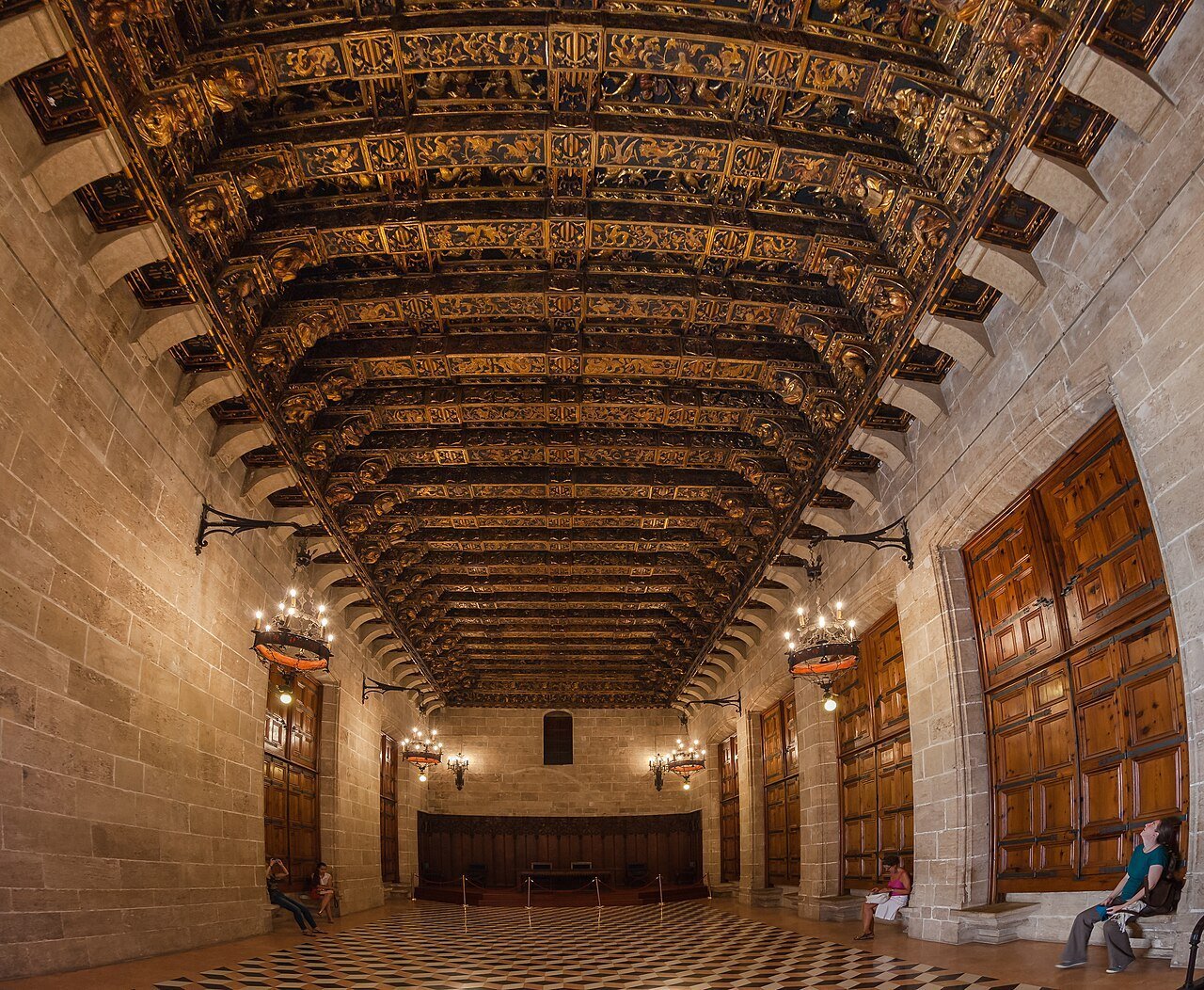

Take a moment with the floor, too: the chamber’s chequered marble plays the same black-and-gold game as the ceiling, and the long table at the far end, where the consuls sat in judgement, still faces down the room. Of all the Lonja’s spaces this is the one that feels most like government — money upstairs, law downstairs, and the sea at the end of every argument.
The Details Everyone Walks Past
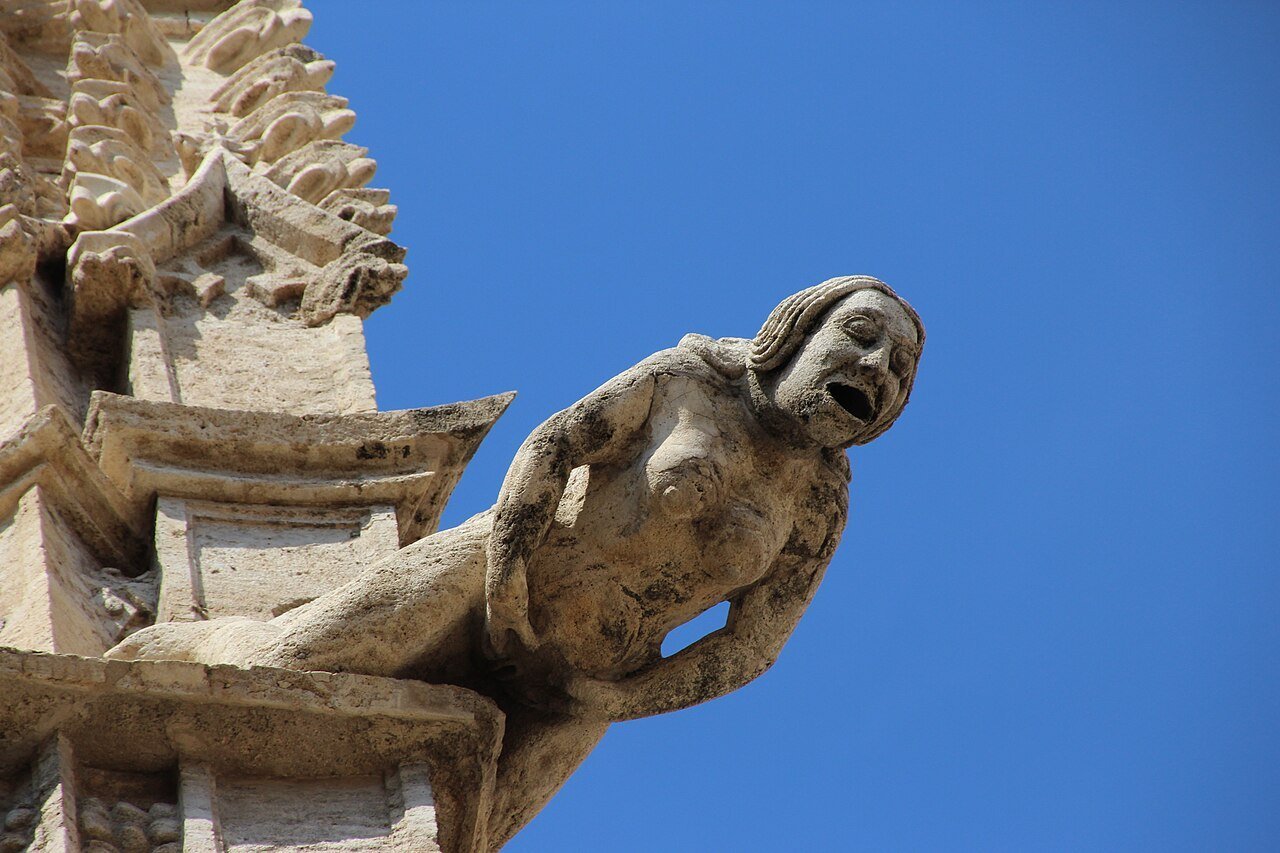
The Lonja’s stonemasons had a sense of humour, and they carved it where only the observant would find it. The building wears 28 gargoyles, and a good number of them are, frankly, filthy: monsters, drunkards, and most famously a grinning naked woman leaning out from a corner as if mooning the market square below. Nobody knows exactly why the city fathers signed off on them — the usual explanation is that the carvers carved what the merchants were thinking — but they have been up there for five centuries, so at this point they are heritage. Bring your zoom lens, or borrow the view through your phone, and hunt along the cornice lines.
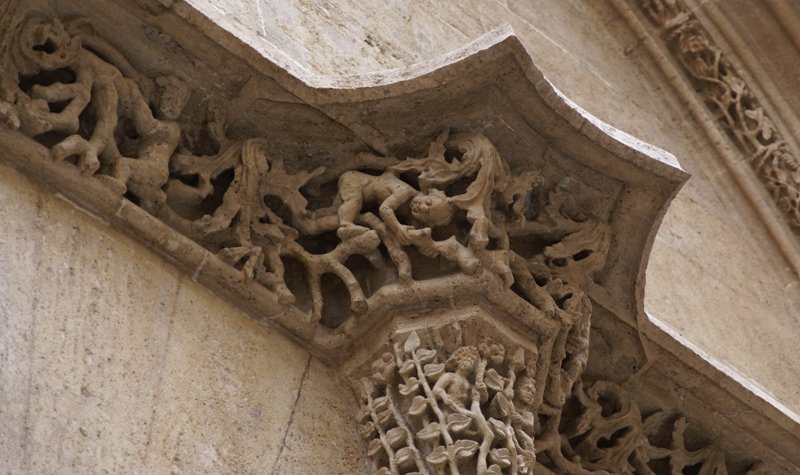
The same jokes run at smaller scale through the carved friezes around the windows and doors: tiny figures wrestling, tumbling and climbing through vine scrolls, angels and grotesques sharing the same few inches of stone. None of it is labelled and none of it is in the audio guides, which is exactly why it is worth five minutes of your visit. A building this concerned with honest trade, it turns out, was decorated by men who took nothing — not even the building — entirely seriously.
Practical Info
Tickets and hours. The Lonja stands on the Plaça del Mercat, in the heart of the old town, a five-minute walk from the cathedral. Entry costs only a couple of euros, and the ticket covers the hall, courtyard, tower exterior and the Consulate pavilion. Traditionally, entry is free on Sundays and public holidays — but the rules and the timetable are set by the city museum service and do change, so check the current arrangements before you plan around them. As a rule of thumb the Lonja opens Tuesday to Saturday from mid-morning to early evening, Sunday mornings only, and closes on Mondays — and the short Sunday window draws a crowd, so arrive at opening if you go then.
How long, and what to combine it with. Give the Lonja forty-five minutes to an hour: fifteen for the hall, ten for the courtyard, fifteen for the Consulate and the Cámara Dorada, and five for gargoyle-hunting. It slots perfectly into a market morning — the Mercado Central across the square is at its best before noon and winds down by mid-afternoon, so do the market first, the Lonja second, and then lunch; our Best Food in Valencia guide will point you at what to eat and where. The Baroque church of Santos Juanes stands immediately next door, and Valencia Cathedral is five minutes’ walk away through the old town — Lonja in the morning, cathedral and the Miguelete after lunch is the classic pairing, and a good one.
Getting the quarter explained. If you would like the whole neighbourhood — the Lonja, the market, the silk quarter’s streets and the stories behind them — tied together by someone who knows it, a guided GetYourGuide – Valencia Old Town walking tour incl. La Lonja area takes in the Silk Exchange quarter as part of a wider old-town walk. To be clear about what that is: it is a guided walking tour of the old town, not a Lonja-only ticket — the Lonja is so cheap to enter alone that no tour is needed for the building itself. Book the tour for the context, and walk into the hall afterwards with the inscription already translated for you.
Tips for Visiting
- Do the Lonja first, the market second — or the other way round, but before lunch. The Mercado Central fades by mid-afternoon and the Lonja closes its doors in the early evening; the pair of them make one perfect morning, and neither survives being left to the end of the day.
- Read the inscription before you look at anything else. It takes thirty seconds, it is translated on the panels in the hall, and it changes how you see the whole building: this was a machine for making trade trustworthy.
- Photograph the hall from its corners. The twisted columns line up into a forest from the corners in a way they never quite do from the centre, and the Sala is emptiest — and most photogenic — in the first half-hour after opening.
- Don’t skip the Cámara Dorada. Half the visitors never find the upstairs room in the Consulate pavilion, which means the Lonja’s second masterpiece is usually the quietest room in the complex.
- Hunt the gargoyles last, from the courtyard and the square. Work the cornice with your phone camera’s zoom. The famous lady is worth the search; children find this game far funnier than adults expect them to.
- Closed Mondays, short Sundays. If your Valencia days are limited, put the Lonja anywhere except Monday, and if you aim for the free Sunday entry, be at the door at opening time.
Travel insurance, sorted
Whether it is a two-week holiday or a longer move, travel insurance is the one booking not to skip. We point readers to SafetyWing’s Nomad Insurance — cover built for travellers, remote workers and longer stays abroad, on a flexible monthly subscription you can start before a trip or while you are already away. Get a quote from SafetyWing
Final Thoughts
La Lonja de la Seda is the building Valencia built to brag — not about a saint or a king, but about itself: its silk, its ships, its law and its word. And the brag holds up. The merchants who traded under that inscription are five hundred years gone, but the hall they paid for is still standing in the middle of the market quarter doing its quiet work of making visitors stop, look up and grin. It costs less than a coffee, it takes less than an hour, and it contains the most joyful ceiling in Valencia — twice over, if you count the golden one the city loved too much to let be demolished. Go in the morning, read the walls, find the gargoyle, and then cross the square for lunch in the market the silk money built a city around. Our Best Things to Do in Valencia guide will help you plan the rest of the day around it.
¡Buen viaje!

Photo credits: Diego Delso — the Sala de Contratación, its vaults and the inscription band, and the Cámara Dorada, CC BY-SA 3.0; Juan Mayordomo — La Lonja from the Plaça del Mercat, CC BY-SA 4.0; Carlos Teixidor Cadenas — the tower window and the angels with the city shield, CC BY-SA 4.0; José Luis Filpo Cabana — the tower staircase doorway, CC BY 3.0; Steven Lek — the Patio de los Naranjos, CC BY-SA 4.0; Jl FilpoC — the Consulate gallery, CC BY-SA 4.0; Nicolas Vollmer — the Cámara Dorada coffers, CC BY 2.0; Fcarrionyague — the gargoyle, CC BY-SA 4.0; Otter — the carved frieze, CC BY-SA 3.0. All via Wikimedia Commons.