City of Arts and Sciences: The Complete Visitors’ Guide
Most cities put their spaceship in a museum. Valencia built a whole fleet of them in a riverbed, parked them in turquoise water, and called it a Tuesday. Walk down into the old bed of the River Turia and this is what rises out of the gardens: a giant glass eye blinking over its own reflection, the bleached skeleton of some enormous beached creature, a white helmet the size of a cathedral, and — a little further on — a blue whale of a building guarded by a leaning harp of a bridge. This is the Ciutat de les Arts i les Ciències, the City of Arts and Sciences, and it is less a complex than a dare: Santiago Calatrava, Valencia’s own architect-engineer, betting that a city would fall in love with buildings shaped like bones, eyes and shells. The city grumbled about the bill for years. Then it put the place on every postcard it owns.
This guide walks it the way I walk it myself: the strange story of how a flooded river became a park full of monuments, then building by building — the Hemisfèric, the science museum, the Umbracle, the great aquarium, the opera house, and the Ágora and its bridge — with the honest practical picture on tickets, timing and food, because this is a sight that repays planning and punishes improvisation. It sits at the very top of our Best Things to Do in Valencia guide — allow it a full day of your trip, minimum, and read this first.

The Short Answer
Yes — the City of Arts and Sciences is unmissable, it deserves a full day (two is better), and the Oceanogràfic is the one ticket you must book ahead. The complex has three ticketed interiors — the Hemisfèric’s cinema-dome, the hands-on Museu de les Ciències, and the Oceanogràfic, the biggest aquarium in Europe — plus a great deal that is completely free: the Umbracle’s palm walkway, the opera house’s shell, the bridge, and the long reflecting pools that tie it all together. In summer and on holiday weekends the aquarium’s entrance queues are the stuff of local legend, so book ahead GetYourGuide – City of Arts and Sciences guided tour or buy official tickets online before you come. Do the interiors by day, then come back at sunset just to look — the buildings change colour, the pools turn to mirrors, and the whole improbable fleet lights up like it is about to leave orbit.
Table of Contents
- The Short Answer
- The Story in Brief: A Riverbed Full of Spaceships
- What to See: The Hemisfèric
- What to See: The Museu de les Ciències
- What to See: The Umbracle
- What to See: The Oceanogràfic
- What to See: The Palau de les Arts
- What to See: The Ágora and the Assut de l’Or Bridge
- Tickets: Singles, Combos and How to Play Them
- Practical Info
- When to Go
- Tips for Visiting
- Final Thoughts
The Story in Brief: A Riverbed Full of Spaceships
Start with the river that is not there. In October 1957 the Turia burst its banks and drowned Valencia in one of the worst floods in Spanish history; the city’s answer, eventually, was drastic — the river was diverted into a new channel south of the city, and its old bed through the centre was left dry. After years of argument (a motorway was the first plan), the empty riverbed became the Jardín del Turia, nine kilometres of gardens, sports fields and orange trees running through the city like a green scar. At its south-eastern end, where the gardens run towards the sea, Valencia decided to build its monument to the future.
The architect was the obvious and dangerous choice: Santiago Calatrava, born just outside the city, an engineer as well as an architect, whose bridges and stations around the world already looked like skeletons and wings. The first building, the Hemisfèric, opened in 1998; the Museu de les Ciències followed in 2000 and the Oceanogràfic in 2003, with the Palau de les Arts completing the main set in 2005. The bridge and the Ágora arrived in 2008 and 2009. The honest footnote, which every Valencian will give you: the final bill ran to well over a billion euros, several times the original budget, and the grumbling was loud and long. But the grumbling has mostly faded into something closer to pride. The complex gave Valencia a second skyline to set against its Gothic old town — the city of the future, built in the bed of the river that once tried to destroy the city of the past.
What to See: The Hemisfèric
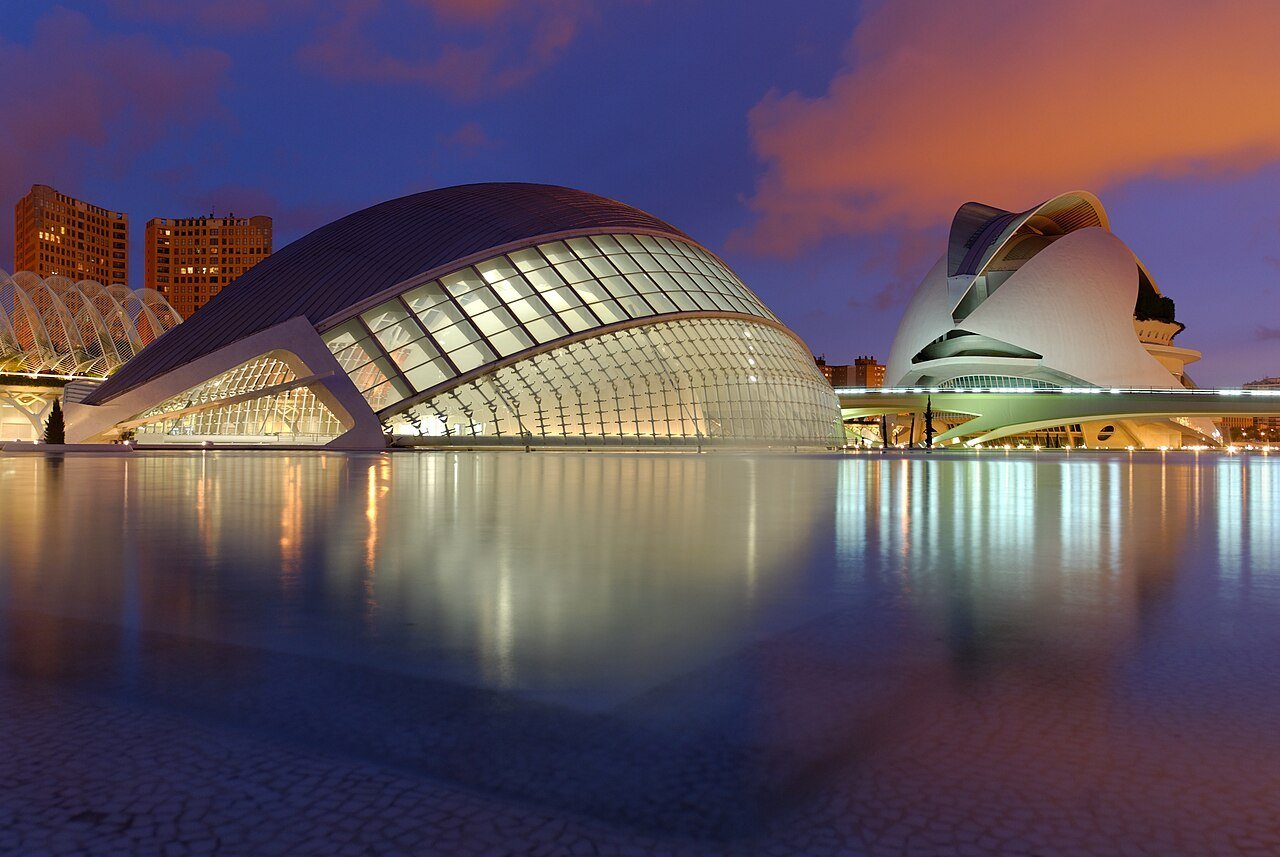
The first building is the one everyone photographs, and it knows it. The Hemisfèric is a giant eye, more than a hundred metres long, lying in a sheet of turquoise water: the pupil is the dome inside, the iris is the glass around it, and the eyelid is the great curved shell above, which opens and closes on enormous hinges. Calatrava called it the eye of knowledge. Stand across the pool and it genuinely seems to be watching you back.
Inside the eye is a cinema of the wrap-around kind: an IMAX dome screen of some 900 square metres, a planetarium and laser shows, with several sessions a day, mostly nature, space and science films running around forty-five minutes. The honest advice: the film is the excuse, the building is the experience — but a dome film done well, lying back in the dark while whales or galaxies roll over the whole ceiling, is forty-five minutes very happily spent, and it is the cheapest ticket in the complex. Sessions are timed and the popular ones fill, so pick your slot when you buy (see Tickets, below). Sit towards the centre and a few rows back: front-row seats in a dome cinema are a neck ache with a view.

What to See: The Museu de les Ciències
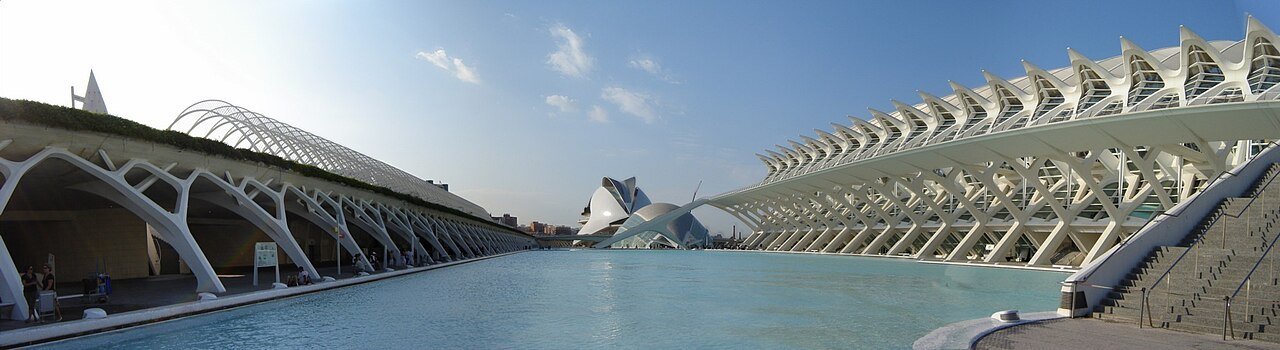
Next door stands the building that looks like the skeleton of a whale — or a dinosaur, or a ribcage designed by a very ambitious spider. The Museu de les Ciències Príncipe Felipe is 220 metres of white bone and glass, and inside it is a science museum with a philosophy you will approve of: prohibido no tocar — forbidden NOT to touch. This is a hands-on museum in the fullest sense, three floors of experiments, illusions and machines that exist to be pushed, pedalled, cranked and climbed on.
The greatest hits: one of the world’s larger Foucault pendulums swinging slowly under the roof, knocking over its little pegs as the Earth turns beneath it; a fifteen-metre sculpture of DNA; halls on space travel, the human body, sound, climate and the science of football; and a rotating cast of big touring exhibitions, with live science shows and workshops through the day. The truth about pacing: adults on their own will graze happily for two hours; anyone with children should surrender and give it half a day, because the third floor is effectively a very educational playground and extraction is difficult. Either way, walk the building’s full length outside as well — the prow ends, where the white ribs converge, are pure Calatrava theatre.

Free Valencia travel guide
Planning a trip to Valencia? Get our free one-page Valencia checklist: what to book ahead, what to skip, and the paella places we actually eat in.
What to See: The Umbracle
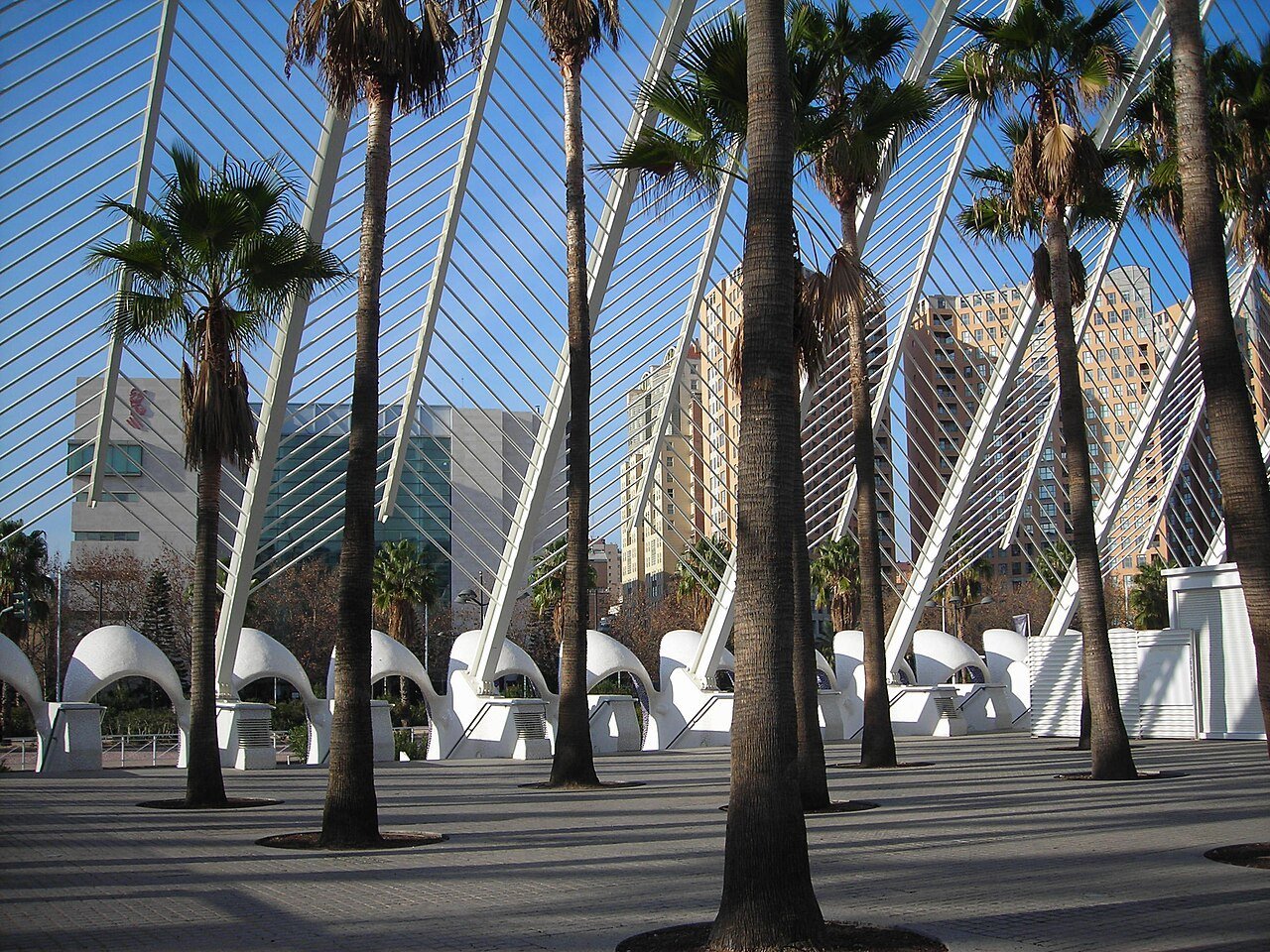
The Umbracle is the part everyone stumbles into and nobody had planned — and it is free. It is a promenade 320 metres long, carried on a rippling white lattice of arches, planted with palms and Mediterranean pines and flowering shrubs: a Valencian umbracle, a shade-house, stretched to the scale of everything else here. Underneath it, discreetly, is the complex’s car park; on top of it is the best free walk in the whole complex, with the Museu on one side, the pools below and open-air sculpture dotted along the way — the Paseo del Arte.
Come here twice if you can. By day it is the shaded gallery from which to look along the whole fleet of buildings. On summer nights its terrace end turns into one of the city’s best-known open-air party spots, all white arches and floodlights — the science city letting its hair down. No ticket, no queue, no plan needed: it is the connective tissue of the visit, and the place where the complex stops being a set of attractions and becomes a city park that happens to contain masterpieces.
What to See: The Oceanogràfic
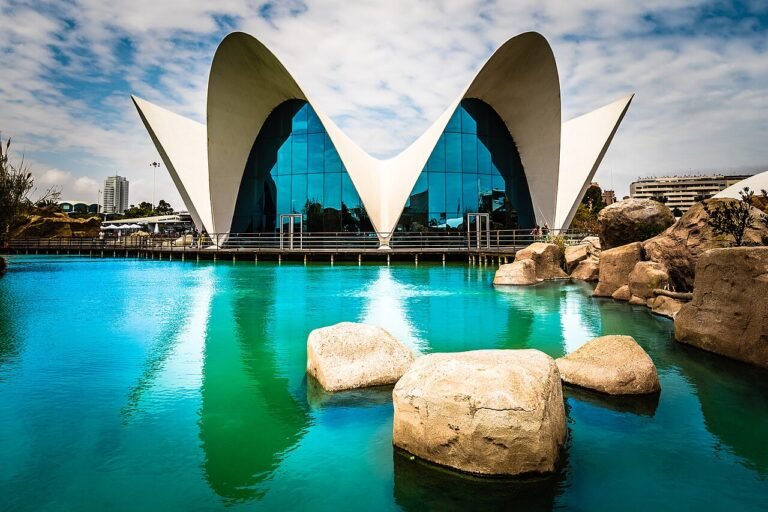
Save your biggest block of time for the building at the far end, because the Oceanogràfic is not an add-on: it is the largest aquarium in Europe, some 42 million litres of water holding around 45,000 creatures of 500 species, arranged as a tour of the world’s waters in a park of lakes and strange white shells. Those shells are the clue to its authorship — the complex’s one great guest star, the Mexican engineer Félix Candela, master of the thin concrete shell, designed the aquarium’s roofs, and its restaurant building opens on the lake like a concrete water lily.
Inside (which is mostly, in fact, outside and underground), the zones run from the Mediterranean to the great sphere of the Wetlands aviary, from a Red Sea tank to the Antarctic penguins and the Arctic, where beluga whales circle inside a white igloo of a building. The set piece is the Oceans tank: a 70-metre underwater tunnel — among the longest in Europe — where you walk the seabed while sharks, rays and whole weather systems of fish pass over your head. The dolphinarium, one of Europe’s largest, runs shows through the day; time a show, but do not let it eat the tunnel. Practical truth: the aquarium alone needs a minimum of three hours and happily takes five, and its gate queue in high season is the longest in Valencia — this is the ticket to have on your phone before you arrive GetYourGuide – Oceanogràfic entry.
And one splurge worth knowing: the Restaurante Submarino, inside that shell building on the lake, seats you at tables ringed by a cylindrical aquarium — dinner inside the fish tank, effectively. Book it well ahead; it is the complex’s one genuinely special meal.


What to See: The Palau de les Arts
The Palau de les Arts Reina Sofía is the opera house, and it is the most wilfully sculptural of the lot: 75 metres tall, wrapped in a sweeping white shell that Valencians read as a helmet, a feather or a wave depending on the light and their mood. It opened in 2005 as the last of the main buildings, and inside are four halls, the largest seating around 1,400, built for opera above all — Valencia takes its music seriously, and this is the city’s grand stage.
Most visitors will never sit in it for a performance, and the building has an answer for that: guided tours run on days without performances, taking you through the halls and terraces — the only way to see an interior that is every bit as sculptural as the shell. Even from outside it earns its place on the walk: circle it slowly, because it changes shape completely from every side, and its reflecting pool on the garden side gives you the complex’s most theatrical portrait. (One honest footnote of the kind this guide deals in: the Palau’s white ceramic skin famously failed within a decade and had to be stripped and replaced. Even spaceships need maintenance.)

What to See: The Ágora and the Assut de l’Or Bridge
The complex’s late arrivals stand together at its eastern end, and they belong in one breath. The Ágora (2009) is the blue one: a tall, finned shell of deep-blue steel and glass, built to host the city’s tennis tournament and now reinvented as CaixaForum Valencia — which matters to you, because it means exhibitions, a bookshop and a café inside the one Calatrava building here you can wander into without a show or a science ticket. From the Turia garden paths it appears through the trees like something that has surfaced.
Holding its hand is the Pont de l’Assut de l’Or, the bridge whose single pylon leans over the whole eastern complex — at 125 metres, the tallest point in Valencia, strung with cables like a harp being played by the wind. Its name is a piece of river history: an assut is a weir, and a weir of the old Turia stood near here. Cross it on foot at least once, slowly — from the deck you get the whole complex laid out in one long view, the gardens at your back and the sea somewhere ahead — and then look back at it at dusk, when the pylon lights up and doubles itself in the pools. It is the exclamation mark at the end of the sentence the riverbed has been writing since 1998.


Tickets: Singles, Combos and How to Play Them
The ticketing is simpler than it first looks. Each interior sells a single ticket — the Oceanogràfic is the expensive one, around thirty-five euros at the time of writing; the Museu is in the low teens; the Hemisfèric under ten — and the complex sells combined tickets that bundle two or all three at a useful discount. The combo’s real gift, though, is not the saving: a combined ticket is valid across two or three consecutive days, which turns the whole visit from a forced march into a pleasure. Use it that way.
The strategy I give friends: day one, the Oceanogràfic — arrive at opening, give it the morning and early afternoon it deserves. Day two, the Museu and a Hemisfèric session, with the Umbracle, the Palau’s exterior and the gardens filling the gaps for free. Trying to crush all three interiors into one day is possible and joyless: you will queue tired, graze the museum and rush the tunnel. If you truly have one day only, book everything in advance, start at the aquarium’s doors at opening time, and let the Hemisfèric go if something has to give — its film will be showing next time; the sharks are the irreplaceable part. And whichever you choose, buy the aquarium entry ahead of time GetYourGuide – Oceanogràfic entry rather than at the gate in summer: the difference is measured in hours, not minutes.
Practical Info
Getting there. The pleasant way is the way the complex was designed to be reached: metro to Alameda (lines 3, 5, 7 and 9), then a twenty-to-twenty-five-minute walk south-east down the Turia gardens — flat, shaded, full of joggers and orange trees, with the white fleet growing on the horizon. City buses 13, 15, 19, 35 and 95 all stop within a short walk of the gates, there are Valenbisi bike stations by the complex, and taxis know it by heart. Drivers: the Umbracle hides the car park underneath it.
Food, honestly. The cafés and fast-food counters inside are convenient, unremarkable and priced for a captive audience. The exceptions and the escapes: the Submarino at the Oceanogràfic for the splurge (booked ahead); the big El Saler shopping centre directly across the avenue from the complex for ordinary restaurants and a supermarket; the Aqua centre near the aquarium; and the local move — picnic supplies eaten on the grass of the Turia gardens, in the shade, with the buildings for a backdrop. For a real Valencian lunch, eat before or after in the Ruzafa or old-town restaurants and treat the complex as the day’s sightseeing, not its kitchen.
How long, in total. One full day is the floor: aquarium (half a day) plus the museum and film squeezed around it. Two days is the comfortable version the combined ticket is built for. The exteriors, pools and Umbracle are free and always open — build them into the evenings.
When to Go
Do the interiors early. The aquarium in its first hour is a different, calmer place — the tunnel nearly empty, the belugas active, the light coming sideways through the water. The museum is at its best before the school groups and at its most golden in the late afternoon, when the low sun comes through the ribs. Midday in summer is for the air-conditioned interiors and the shaded Umbracle, not for the white plazas, which bounce the Mediterranean sun back at you off concrete and water.
Then, whatever you did by day, come back at sunset. This is the complex’s second show and it is free: the shells turn gold, then rose, then the floodlights take over and every building doubles itself in the pools. Photographers should stake out the far side of the Hemisfèric’s pool for the mirror shot and be patient — the reflection sharpens as the wind drops with the light. Seasonally, spring and autumn are kindest for a full day outdoors; our Best Time to Visit Valencia guide sets the complex against the city’s year, Fallas crowds and August heat included.

Tips for Visiting
- Book the Oceanogràfic before anything else. It is the priciest ticket, the longest queue and the one part you cannot abbreviate. Everything else flexes around it.
- Spread the combined ticket over days. It is valid across consecutive days precisely so you do not have to sprint. Aquarium day one; museum and film day two.
- Choose the Hemisfèric session when you buy. Dome films are timed, and the midday sessions sell out in high season. Centre seats, a few rows back.
- Do not pay to “see” the buildings — you already can. The exteriors, pools, Umbracle and bridge are free and are half the experience. The tickets buy you interiors, not views.
- Walk the riverbed at least one way. Metro to Alameda and stroll the gardens down, or walk back at dusk. The approach is part of the monument.
- With children, invert the day. Museum in the morning while their hands-on energy is high, aquarium after lunch — and guard the dolphin show time; it fixes the rest of the plan.
- Finish at the bridge. End the visit standing on the Assut de l’Or at dusk, looking back along the whole lit-up fleet. It is the view the postcards are chasing.
Travel insurance, sorted
Whether it is a two-week holiday or a longer move, travel insurance is the one booking not to skip. We point readers to SafetyWing’s Nomad Insurance — cover built for travellers, remote workers and longer stays abroad, on a flexible monthly subscription you can start before a trip or while you are already away. Get a quote from SafetyWing
Final Thoughts
Here is the thing I keep coming back to: this whole impossible fleet stands in the bed of a river that once tried to drown the city, on the site of the city’s worst day. Valencia’s answer to the flood was not a wall. It was gardens, and at the end of the gardens, an eye, a skeleton, a helmet and a whale — the most joyful argument in modern Spain that a city can build its way out of a disaster and into a postcard. Pair it with the other Valencia: spend a morning in the Gothic old town with our Valencia Cathedral guide, among the Grail and the gargoyles, and the afternoon here among the bones and the belugas, and you will have read the city’s whole story — eight centuries of it — in a single trip. The river left. The future moved in. Go and walk around in it.
¡Buen viaje!

Photo credits: The City of Arts and Sciences along its pool — Diego Delso, CC BY-SA 3.0 · The Hemisfèric — José Luis Filpo Cabana, CC BY 3.0 · The Museu de les Ciències across the pool — Embre, CC BY-SA 4.0 · Inside the Museu — Alberto-g-rovi, CC BY-SA 3.0 · The Umbracle — Bultro, CC BY-SA 3.0 · The Oceanogràfic entrance — Léodras, CC BY-SA 4.0 · The underwater restaurant building — Diliff, CC BY-SA 3.0 · The Oceans underwater tunnel — Marek Ślusarczyk (Tupungato), CC BY 3.0 · The Palau de les Arts — Christian Gebhardt (Bybbisch94), CC BY-SA 4.0 · The Ágora from the Turia gardens — Esniom, CC BY-SA 4.0 · The Assut de l’Or bridge at dusk — Diego Delso, CC BY-SA 3.0 · The complex at sunset — Elemaki / Alvaro qc, CC BY-SA 3.0 · The complex after dark — Emilio García, CC BY-SA 2.0. All via Wikimedia Commons.

5 Comments