Santa Catalina Church Valencia: The Complete Guide to the Bell Tower Church

Short Answer
Santa Catalina Mártir is one of the first parish churches founded in Christian Valencia, raised in the 13th century over a mosque in the knot of little squares — Plaza Lope de Vega in front, Plaza de Santa Catalina at its side — just south of the Plaza de la Reina. The church itself is pure Valencian Gothic, three naves wrapped around one of the very few ambulatories in the city, but what everybody photographs is what stands at its corner: a freestanding hexagonal bell tower built between 1688 and 1705 by Juan Bautista Viñes, all twisted Solomonic columns and carved stone, and often called the most original Baroque tower in Spain. Entry to the church is free, and it works as a temple of Eucharistic adoration, so it keeps long hours and a deep quiet. The tower traditionally opens to climbers for €2 (children €1) up its 128 steps — but access is in the parish’s gift and is not guaranteed, so treat the climb as a bonus, not a promise. Allow 45 minutes to an hour for church, tower and a horchata afterwards. If you want the old town’s stories joined up for you, the guided tour of Valencia’s historic centre deliberately routes through the lanes to this church and its famous tower.
Table of Contents
- The Short Version
- One of the First Parishes of Christian Valencia
- The Gothic Church and Its Ambulatory
- Burned in 1936, Rebuilt in Faith: The Fire and Restoration
- The Bell Tower: Valencia’s Baroque Lighthouse
- Climbing the Tower: What You See
- Horchata at the Church Door: The Santa Catalina Quarter
- Practical Info
- Tickets and Booking
- Opening Hours
- Getting There
- When to Go
- How Long You Need
- Tips for Visiting
- What to See Nearby
- Final Thoughts
The Short Version
Valencia has two great church towers within five minutes of each other, and they could not be less alike. The Cathedral’s Miguelete is Gothic, octagonal and all business. Santa Catalina’s is Baroque, hexagonal and pure theatre — a stone firework of twisted columns and garlands that the city loved so much it opened a whole street, the Calle de la Paz, partly to get a better view of it. Below it sits a church that hides its own surprise: a genuine ambulatory you can walk behind the altar, a rarity in Valencia, inside walls burned twice and patiently rebuilt twice. And at the tower’s feet, the plaza runs on horchata — the tiled Horchatería de Santa Catalina has been pouring it beside the church for as long as anyone can remember. It belongs on any serious list of the best things to do in Valencia not because it shouts, but because everything about it rewards the visitor who slows down for one small square.

One of the First Parishes of Christian Valencia
When Jaume I conquered Valencia in 1238, the plot where Santa Catalina now stands held one of the mosques of Muslim Balansiya, in the commercial heart of the old city near the market. Like San Martín a few streets south, Santa Catalina was among the first parishes planted to organise the new Christian city — the ring of foundational churches from which Valencia’s neighbourhoods grew. Its patroness is Catherine of Alexandria, the learned virgin martyr whose emblems, the wheel and the palm, you will meet again at the very top of the tower.
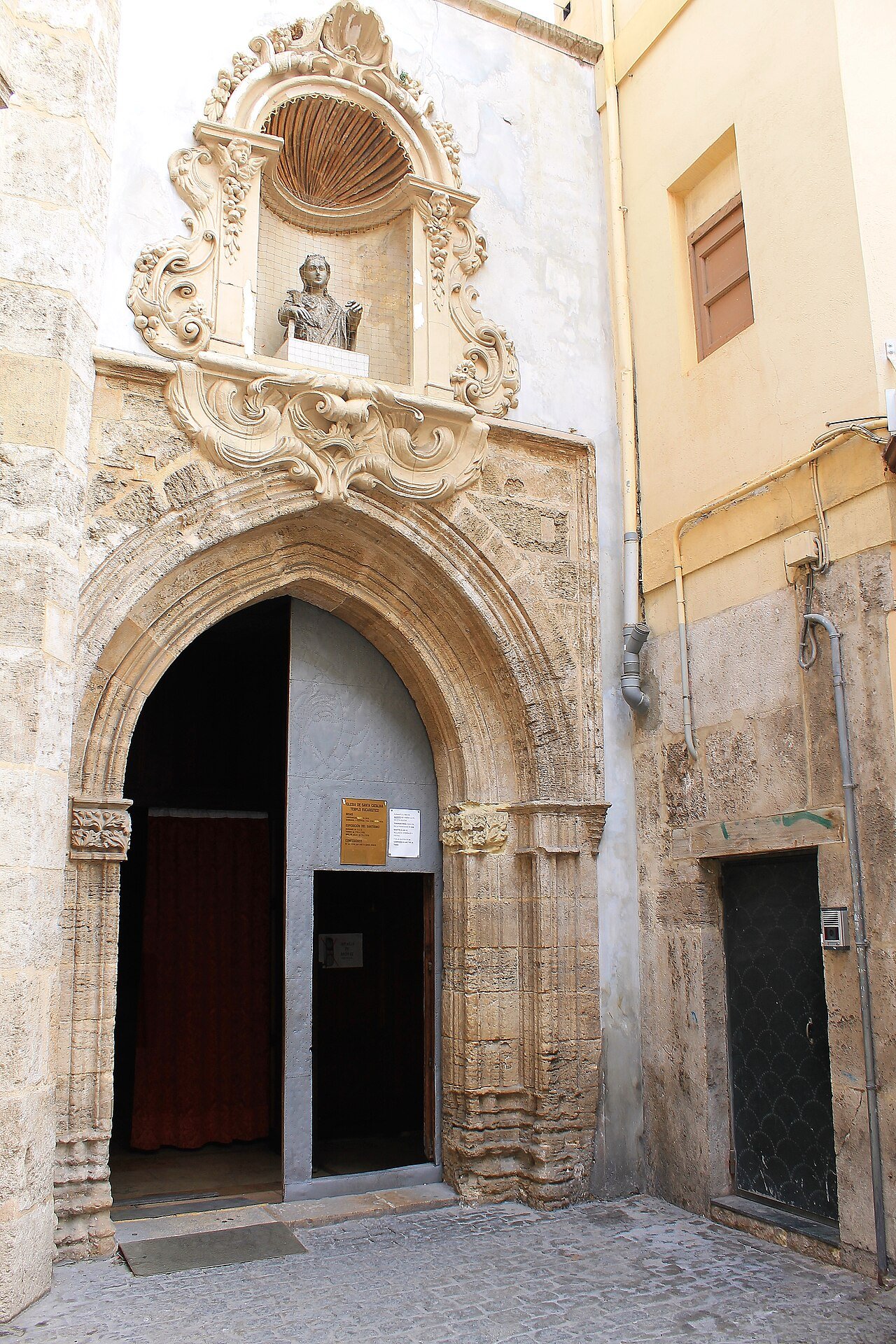
The mosque-church was replaced in stone in the 13th century, in the Valencian Gothic manner: three naves, side chapels slotted between the buttresses, and — the plan’s great distinction — a girola, an ambulatory, curving around behind the main altar. The church’s public face is the west front on Plaza Lope de Vega, and it still reads as a medieval document if you know how to look: the big rose window, the small round window beneath it, and at ground level three pointed tomb arches, arcosolia, walled up now but once the burial niches of notable parishioners. Above the doorway a bust of the saint keeps watch from its niche, and high on the wall survives a small brick espadaña, a bell-gable thrown up in the 1740s as a stopgap while the parish argued about towers — of which more below.
Tradition adds one strange footnote to these early centuries: that devout women, the emparedadas, once had themselves walled into tiny cells against the church to live on the alms of passers-by, a practice the Archbishop Martín Pérez de Ayala abolished in 1566. True or not, it tells you what this building was for its quarter — not a monument but a piece of the neighbourhood’s daily machinery.
The centuries since have not been gentle. In the 16th century the interior was re-dressed in the classicist taste of the Renaissance, and in 1548 a serious fire forced a partial rebuilding. In 1785 the church was given a Baroque aspect, in line with the fashion of the day. None of that layering is what you see now — for the reason the next two sections explain.
The Gothic Church and Its Ambulatory
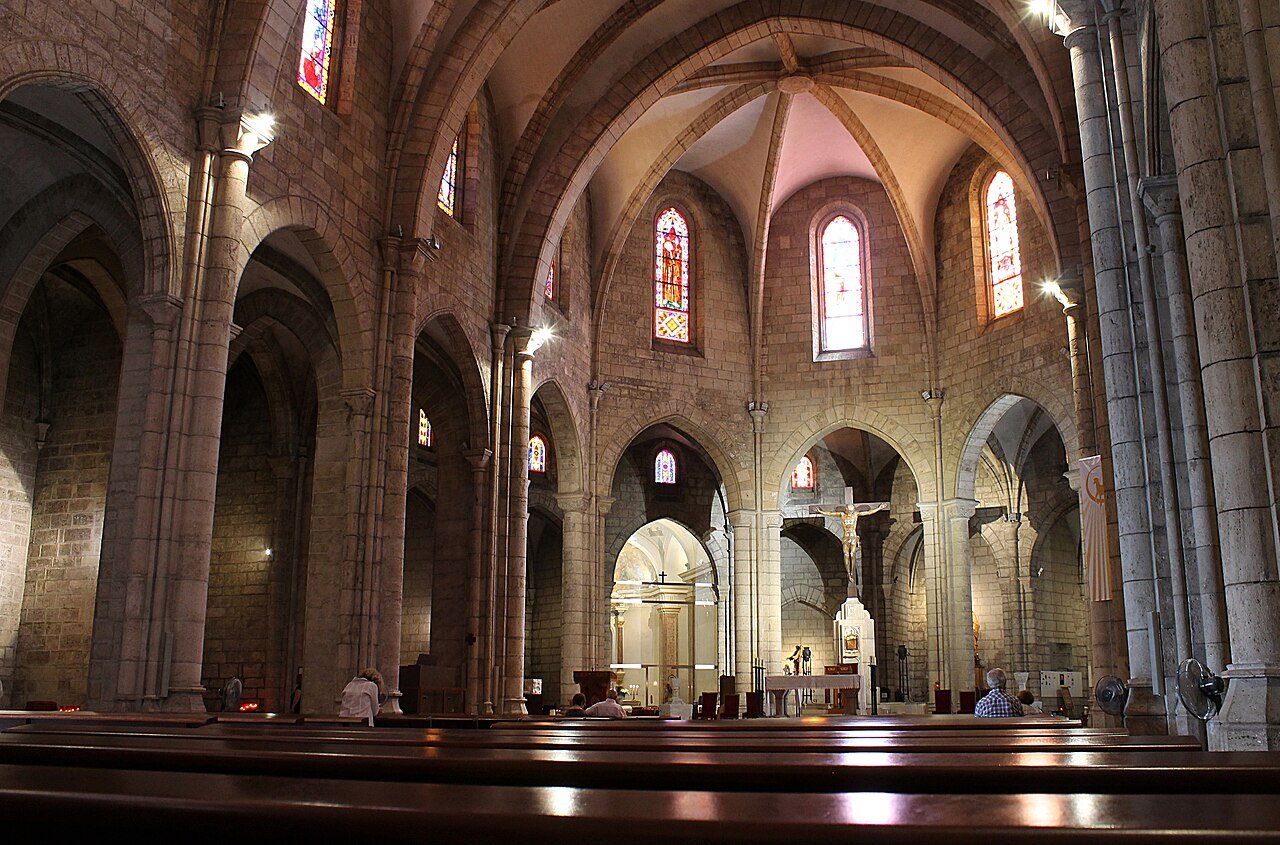
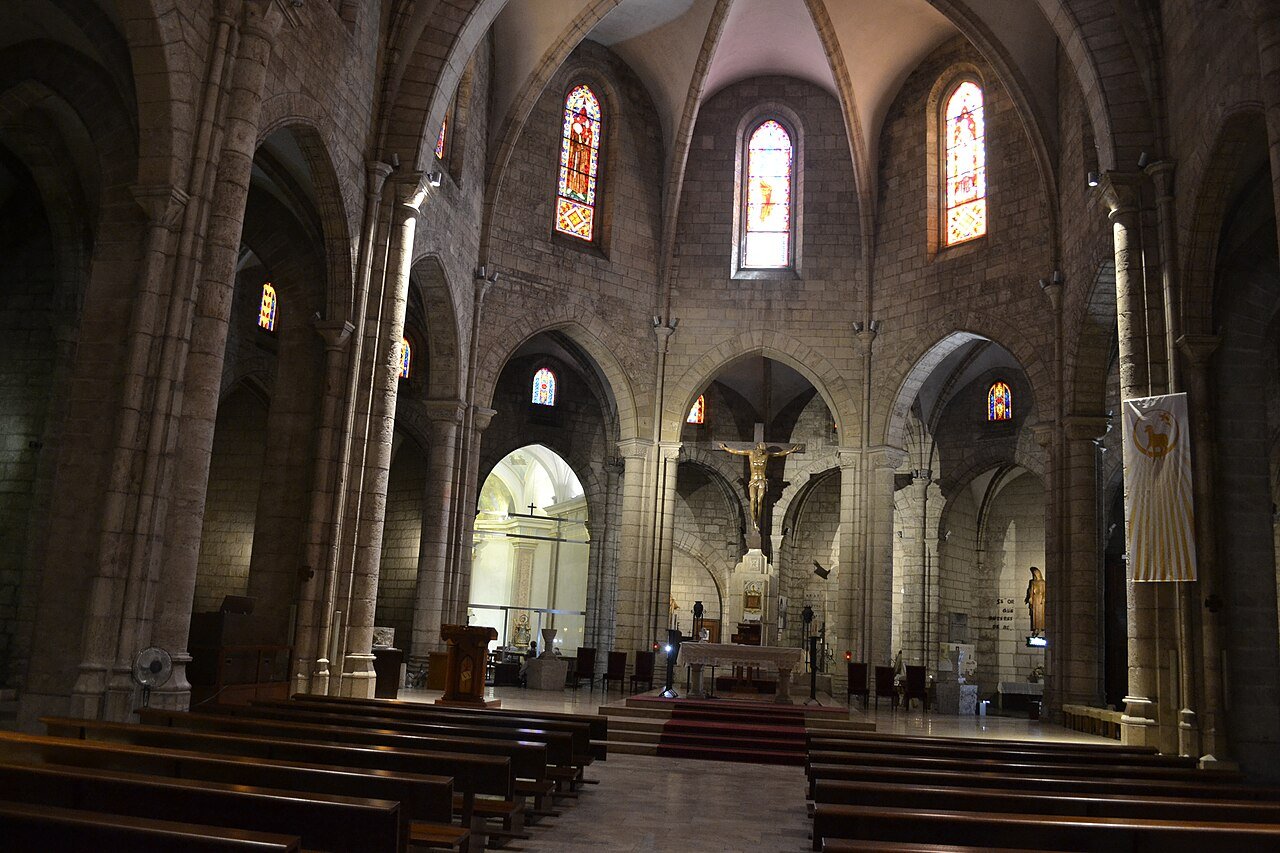
Step inside and the first surprise is the light. Santa Catalina’s seventeen stained-glass windows — all of them post-war work, made in Barcelona between 1966 and 1968 — wash the bare stone in colour, and the stone itself is the second surprise: plain, pale and unmistakably Gothic, with none of the gilded Baroque skin you find in Santos Juanes or San Martín. Three naves run east in seven bays, carried on clustered piers, the side chapels tucked between the buttresses exactly as the 13th-century builders planned.
The glory of the plan is at the east end. Behind the main altar the church does something almost no other Valencian church does: it lets you walk around the back of the sanctuary. The ambulatory — the girola — curves behind the altar in a ring of pointed arches, so the presbytery sits like an island in the middle of the church, with the great crucifix at its centre and the chapels opening off the curve. In Valencia, you can do this in the Cathedral and almost nowhere else; French Gothic influence is usually credited for the idea, and standing in the curve, with the stained glass glowing above and the arches receding on both sides, the debt is easy to believe.
Look for the details as you walk. The presbytery keeps its sober modern arrangement — this is a church arranged for adoration as much as for Masses, and there is almost always a kneeling figure or two in the silence. The chapels around the ambulatory hold the parish’s images and side altars, lit one by one against the stone. And take a moment at the west end to look back: from under the rose window the whole composition reads at once — naves, piers, apse and ambulatory — the Gothic church entire, which is precisely what the restorers of the 1950s intended you to see.
Burned in 1936, Rebuilt in Faith: The Fire and Restoration
The church you have just walked through is, in a real sense, younger than it looks. In 1936, at the outbreak of the Spanish Civil War, Santa Catalina was assaulted and burned by Republican militiamen, and the interior was, in the word the chroniclers use, completely ruined: altars, images, organ, archives and decoration all went into the fire, leaving the Gothic shell standing over ashes. It was the second great burning of the church’s life — the fire of 1548 had already forced one rebuilding — and it might easily have been the end.
Instead, the 1950s brought one of the most determined restorations in Valencia. The post-war restorers made a bold choice: rather than recreate the lost Baroque interior, they would repristinar — strip the walls back to what they judged the church’s original Gothic physiognomy, removing the remains of the Baroque and Neoclassical decoration that had covered the medieval stone. The pale, austere interior that impresses visitors today is their work as much as the 13th century’s: a mid-20th-century act of faith in what the church had first been. The new stained glass followed in 1966–1968, and in 1981 the church was declared a Bien de Interés Cultural, Spain’s top tier of monument protection.
For more than fifty years now the church has also had a second vocation: it is a Templo de Reparación Eucarística, a temple of Eucharistic reparation with perpetual adoration, in the care of the Hermandad de Sacerdotes Operarios Diocesanos. That is why its doors stand open for long hours every day, and why the quiet inside is of a different order from a museum’s — visitors are welcome, but the building’s first business is prayer, and the parishioners will gently enforce the silence if it slips.

The Bell Tower: Valencia’s Baroque Lighthouse
And now the tower — because for all the church’s quiet virtues, the tower is why Santa Catalina is on the postcards. It stands at the corner of the church by the Plaza de Santa Catalina, freestanding in effect if not quite in fact, and it replaced a humbler medieval bell tower that stood at the church’s feet until its demolition in 1742. The first stone of the new tower was laid on 5 October 1688, by order of the Archbishop, fray Juan Tomás de Rocabertí. The work was begun by Valero Viñes; when he died in 1693 his brother, Juan Bautista Viñes, took over, and it is Juan Bautista’s name that the great Latin inscription at the tower’s base records: the sumptuous bell tower, begun in 1688 through the generosity of the parishioners, he brought to completion in 1705. The bill came to 8,997 libras and seventeen years.
What they got for the money was 56.12 metres of the most inventive Baroque masonry in Spain. The plan is hexagonal — the detail that makes the tower instantly recognisable in any skyline photograph. Four storeys climb in carved stone, their corners and window frames rich with ornament, before the bell chamber, where every corner carries a Solomonic column, a twisted barley-sugar shaft wrapped in garlands. Above the chamber a stone balustrade rings the tower, and from it rises a two-stage templete, a little temple repeating the twisted columns, capped by a small dome carved in stone scales like a fish’s back — not tiles, as many assume, but sculpture. On the very top, a globe for the world and a weathervane carrying the emblems of Santa Catalina herself.
The tower also preserves two of Valencia’s best building stories. The first is in its base: the tower went up so close to the lane of the Calle de la Sombrerería — the hatters’ street — that in December 1688 the city ordered a palmo, a hand’s breadth, shaved off the tower’s corner so carts and crowds could still squeeze past; look at the base today and the cut corner is still there. The second is the staircase. The parish’s contract with Viñes, the story goes, said nothing about a stair — so the builder, a suspicious man, built the tower without one and hauled himself up on planks. The parish sued; the courts found for the builder, since the contract truly never mentioned stairs; and the parish had to pay extra for the staircase, built years later with 128 steps. Every visitor who climbs them is walking up the most litigated staircase in Valencia.
The bells had their own drama. The old tower had held just two bells, which the parish judged unworthy of the new one — the neighbouring parishes of San Juan and San Martín mocked them mercilessly for a tower with no staircase and two bells — so in 1729 the parish ordered six new bells from London, cast by the founder Richard Phelps. They arrived at the Grao by ship that October, were carted into the city on wagons drawn by ribboned mules before enormous crowds, and were first rung all together on 21 November 1729, ten men working the ropes while fireworks went off from the tower top. The original English set is gone — lost to the Civil War years and later refoundings — but the chamber is not empty: among today’s bells is the Eloy, cast in 1846 by Miguel Monzó for the silversmiths’ guild with an unusual amount of silver in its metal, returned to the tower in the great restoration of 2001–2002 that cleaned the whole monument. If you want these stories told in situ, the historic centre walking tour stops at Santa Catalina precisely for its tower — though note the tour views the church from the lanes and does not include the climb, which is the parish’s own affair.


Climbing the Tower: What You See
If the tower is open, climb it. The way up is the famous staircase — the one the parish had to pay for twice — 128 steps spiralling inside the hexagonal shaft, lit by the little splayed windows you can see from the street. Tourism listings put the price at €2 for adults and €1 for children, paid at the church, and on paper the climb runs in the church’s visiting hours. In practice, be warned: the tower belongs to a working parish, staffing is thin, and access is not guaranteed — visitors in 2025 were finding it closed even when listings suggested otherwise. Ask at the church when you arrive, accept the answer gracefully, and do not build your whole morning around the ascent.
The reward, when it comes, is one of the best small viewpoints in Valencia, precisely because the tower stands in the middle of the old town rather than above it. West and south, the rooftops of the Mercat quarter spread out in a sea of tiles, and the plain square bell tower that dominates the view is San Martín — the neighbour whose parishioners once jeered at Santa Catalina’s missing staircase, now framed in its rival’s best photograph. East, the Cathedral and the Miguelete stand five minutes and several centuries away. And directly below, if you lean (carefully) to the right side, lies the Plaza Redonda, its perfect 1840 circle impossible to appreciate from the ground and unmistakable from here, ringed by its uniform houses and sheltered by its modern canopy.
On the way down, spare a thought for the bell-ringers of 1729, ten men crammed into the chamber you have just visited, hauling six English bells into their first full peal while the plaza below roared.


Horchata at the Church Door: The Santa Catalina Quarter
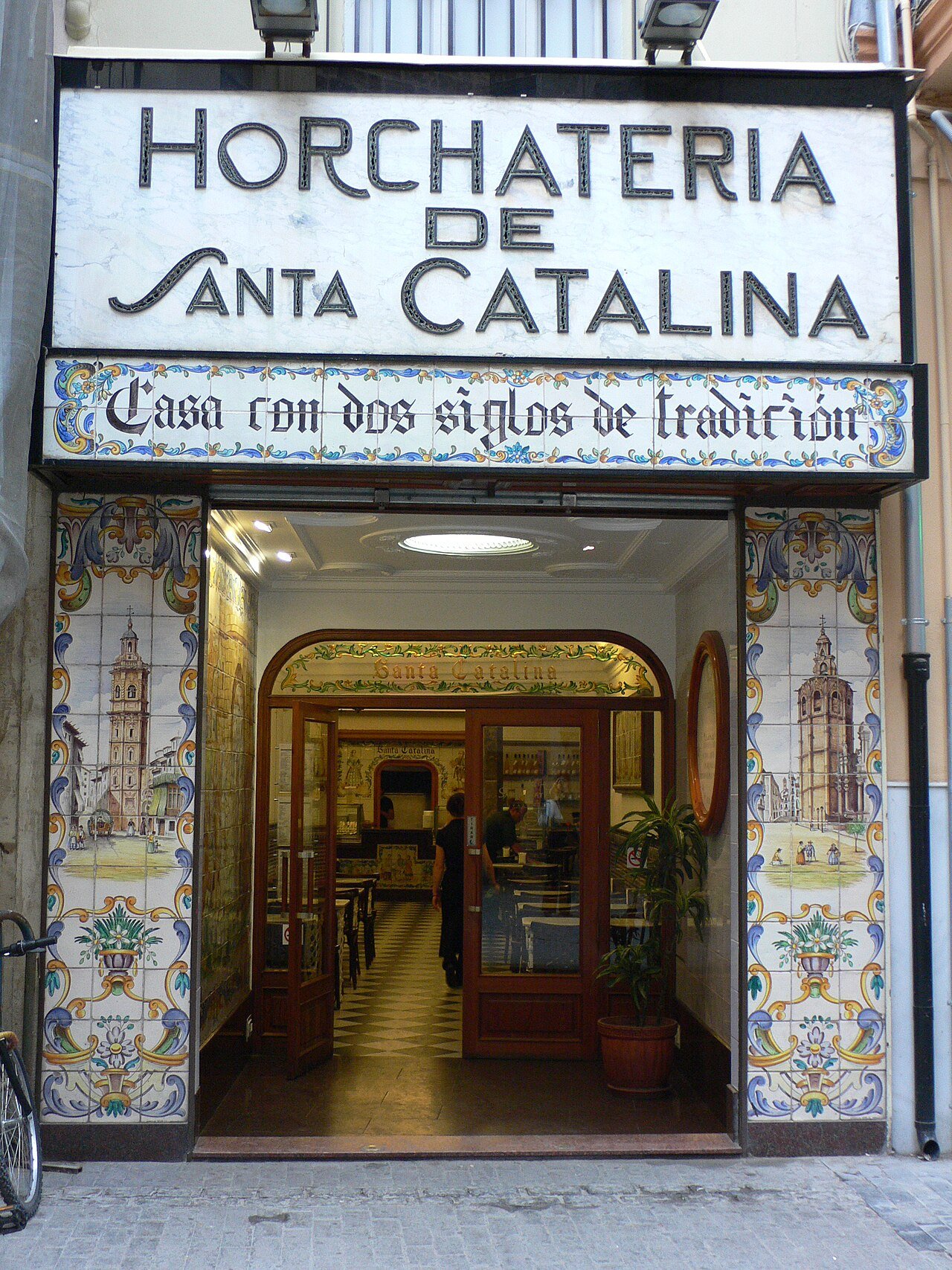
Every great Valencian church has its café; Santa Catalina has a national institution. On the little plaza at the tower’s feet, at Plaza de Santa Catalina 6, stands the Horchatería de Santa Catalina, whose tiled façade announces it, in painted letters, as a casa con dos siglos de tradición — a house with two centuries of tradition. Whether you count the centuries strictly or not, this is one of the oldest and most beloved horchaterías in Valencia: two tiled salons behind a doorway flanked by ceramic panels of the tower itself, the interior all Manises tiles, and a menu built around the white drink of the city.
Horchata de chufa is made from tiger nuts — small tubers grown in the fields north of the city, protected by their own Denominación de Origen — washed, ground and sweetened into a milky, refreshing drink served ice-cold, either líquida or granizada, half-frozen like a slush. The correct accompaniment, non-negotiable in Valencia, is a plate of fartons: long, soft, sugar-dusted fingers of pastry made for dunking. The house also pours hot chocolate, artisan ice creams and agua de Valencia, and it opens all year, holidays included — a church visit followed by a horchata at the tower’s feet is one of the oldest itineraries in the city. Nor is it the only historic name on the square: across the plaza, the Horchatería El Siglo, founded in 1836, keeps the friendly rivalry going, and Valencians divide into loyalists of one house or the other with the seriousness usually reserved for football.
The quarter around the church explains the crowds. This is El Mercat, the market district, a grid of trade streets whose names are a directory of vanished guilds — Sombrerería (hatters), Tapineria (clog-makers), Pescadería (fishwives) — running between the church, the market and the Plaza de la Reina. The church gave the quarter its name and its landmark; the shops gave it its bustle. Come at mid-morning and the plaza is doing what it has done for three centuries: market traffic, café tables, and the tower over everything.

Practical Info
Address: Plaza Lope de Vega / Plaza de Santa Catalina, 46001 Valencia — the church’s west front opens on Plaza Lope de Vega, the tower stands on the corner of Plaza de Santa Catalina, and both squares run together just south of the Plaza de la Reina.
What it is: a working parish church and temple of perpetual Eucharistic adoration, not a museum. There is no ticket desk, audio guide or gift shop — but there is a silence policy that regulars take seriously, long opening hours, and a bell tower that opens when the parish can staff it. Protected as a Bien de Interés Cultural since 1981.
| At a Glance | Details |
|---|---|
| Best for | Gothic lovers, tower climbers, photographers, and anyone who wants the old town’s best small square in one stop |
| Entry | Church free; the tower climb is listed at €2 (children €1) when open — but access is not guaranteed, so check on the day |
| Time needed | 45–60 minutes including the tower; 30 minutes for the church alone |
| Nearest metro | Colón (lines 3, 5, 7 and 9), about 7 minutes on foot; Xàtiva is also walkable |
| Don’t miss | The ambulatory behind the altar, the tower from Plaza Santa Catalina — and a horchata with fartons afterwards |
Tickets and Booking
The church needs no ticket and takes no booking: you walk in, free, whenever the doors are open. The tower climb, when the parish offers it, is paid in cash at the church — €2 for adults, €1 for children in current listings — with no advance sale of any kind; anyone selling you an online “skip-the-line ticket” for Santa Catalina is selling something that does not exist.
The one bookable way to give the church its context is a guide. The Guided Tour of Valencia’s Historic Center is a two-hour walk that threads the old town from the Torres de Serranos through the market quarter and stops at Santa Catalina for the church and its Baroque tower, finishing at the Cathedral and the Plaza de la Virgen — a genuinely useful frame for a building whose meaning is in its layers. Be clear about what it is, though: a walking tour that visits the church from the lanes and (doors permitting) inside, not a tower ticket; the 128 steps remain the parish’s own small enterprise.
Opening Hours
As a temple of perpetual adoration, Santa Catalina opens every day and keeps the longest hours of any church in the old town: in practice, doors open in the morning and again through the afternoon and evening around worship, with published tourist listings giving visiting windows of roughly 10:00–13:00 and 17:30–19:30/20:00. Treat those as a pattern rather than a promise — hours shift with the liturgical calendar, and sightseeing always yields to adoration and services. The tower’s opening is narrower still and depends on the parish’s day; the timetable at the church door is the only authority worth trusting, and a shut tower door on the day is a real possibility to plan around, not a failure.
Getting There
You will almost certainly arrive on foot: from the Plaza de la Reina, walk two minutes south into the little squares and the tower announces itself. From the Plaza del Ayuntamiento it is five minutes north; from the Mercado Central, five minutes east through the market lanes. By metro, Colón station (lines 3, 5, 7 and 9) is about seven minutes’ walk, and Xàtiva (lines 3, 5 and 9), beside the Estación del Norte, about ten. City buses serve the Plaza de la Reina and Ayuntamiento stops. Do not drive — the Ciutat Vella is a pedestrianised maze, and the nearest sensible car parks are around the Plaza de la Reina and Avenida del Oeste.
When to Go
Morning is the tower’s hour: the sun catches its east face over the plaza, the café tables are being set out, and the church is at its quietest between services. Late afternoon gives the stone a warmer colour and pairs naturally with the horchaterías’ merienda hour. Two seasons carry the church’s name: late November, around the feast of Santa Catalina on the 25th — the season when, in 1729, the city held its great bell festival around this tower — and the weeks of Fallas in March, when the quarter fills and the church’s silence becomes the most valuable thing in the centre. On Sunday mornings the Plaza Redonda holds its traditional market bustle a minute away.
How Long You Need
Thirty minutes covers the church properly: the naves, the walk around the ambulatory, the presbytery and a slow look at the façade and its tomb arches. Add fifteen to twenty minutes for the tower — 128 steps up, photographs, 128 steps down — and another unhurried half hour if the horchatería gets its way, as it usually does. Nobody needs more than ninety minutes for the whole ensemble, which is exactly why Santa Catalina pairs so well with the market quarter in a single morning.
Free Valencia travel guide
Planning a trip to Valencia? Get our free one-page Valencia checklist: what to book ahead, what to skip, and the paella places we actually eat in.
Tips for Visiting
- Ask about the tower first. Access is the parish’s gift, not a right, and it is sometimes closed without notice — check on arrival so the rest of your visit can adjust.
- See the tower three ways. From Plaza Santa Catalina for the full height, down the Calle de la Paz for the city’s favourite framed view, and from the Plaza Redonda for the crown over the rooftops.
- Walk the ambulatory. Most visitors stop at the altar rail. Go behind it: the girola is the church’s rarest feature and its best photograph.
- Respect the silence. This is a temple of perpetual adoration with worshippers at prayer all day; keep voices off entirely and save photography for outside service moments.
- Order like a local afterwards. Horchata granizada in summer, líquida the rest of the year, always with fartons for dunking.
- Find the shaved corner and the narrow house. The tower’s cut corner on Calle de la Sombrerería and 107-centimetre La Estrecha on Plaza Lope de Vega are the square’s two best small details.
What to See Nearby
Santa Catalina stands at the centre of the densest walking territory in Valencia. Five minutes north, the Mercado Central fills its modernista hall from early morning, with La Lonja de la Seda and the freshly restored Santos Juanes across its square. Five minutes the other way, the Cathedral and the Miguelete wait on the Plaza de la Reina — climb the Miguelete for the panorama, then come back and compare it with Santa Catalina’s tower: Gothic octagon against Baroque hexagon, the city’s two temperaments in stone. The circular Plaza Redonda, built in 1840 to Salvador Escrig’s design on the old fish-market ground, is one minute through the lanes, and on Plaza Lope de Vega, across from the church’s west front, stands La Estrecha — a house whose façade measures 107 centimetres, long billed as the narrowest in Europe, and now a hat shop, which in this quarter of hatters seems only right.

Travel insurance, sorted
Whether it is a two-week holiday or a longer move, travel insurance is not the most glamorous part of a trip — but it is the one booking you want to have in place before a trip, and while you are already away. Get a quote from SafetyWing
Final Thoughts
Santa Catalina is the old town in miniature: a mosque’s plot, a founding parish, a Gothic church with a French idea behind its altar, two fires, a courtroom staircase, English bells and a horchatería — and a tower so good the city bent a street to look at it. None of it is packaged, little of it is signposted, and the church itself would rather you came to pray than to photograph. Give it a morning hour anyway: walk the ambulatory, read the tower from its three viewpoints, climb it if the parish gods are smiling, and finish with a horchata where Valencians have finished for two hundred years. ¡Buen viaje!

Photo credits: Diego Delso, Enfo, Carlos Teixidor Cadenas and Joanbanjo (CC BY-SA 3.0); Enric, V. Ripoll Hernández, Dorieo and Babelius (CC BY-SA 4.0); José Luis Filpo Cabana (CC BY 4.0); Nicolas Vollmer and Heather Cowper (CC BY 2.0), via Wikimedia Commons.