11 Best Photography Spots in Barcelona: When to Shoot Each One
If you shoot one thing in Barcelona, shoot the Sagrada Família — outside from the little park across the road, and inside, where the stained glass turns the whole nave blue-green in the morning and red-orange by late afternoon. It is the city’s most photographed building for a reason, and it still isn’t close to the whole story: Barcelona gives you a mosaic salamander, a concert hall lit by a stained-glass sun, two hilltop panoramas, a fake-medieval bridge and a beach with a glass sail on it, all inside one metro network.
This guide is about pointing your own camera well. Every spot below comes with the shot to aim for, the hour it works best, and the rules that actually matter — because in Barcelona the difference between a great photo and a wasted trip is usually timing, and occasionally a tripod you weren’t allowed to bring. Most of these places are free to shoot from the street; the interiors run on timed tickets, and the best light slots go first.
One honest warning before the list: the city is strict about drones and picky about professional gear, and the Good to Know section at the end explains both. Everything else is just you, the light, and some very photogenic stone.
In This Guide
- 1. Sagrada Família: The Reflection Outside, the Colour Inside
- 2. Park Güell: A Mosaic Salamander and a Bench Above the City
- 3. Bunkers del Carmel: The 360-Degree Panorama
- 4. Casa Batlló: Get Close, Skip the Postcard
- 5. Casa Milà (La Pedrera): The Rooftop Warriors
- 6. Pont del Bisbe and the Gothic Quarter: Go at Dawn
- 7. Palau de la Música Catalana: The Skylight Concert Hall
- 8. Recinte Modernista de Sant Pau: The Beautiful Hospital
- 9. Arc de Triomf and Parc de la Ciutadella: The Sunrise Avenue
- 10. Tibidabo: The Whole City, Arranged for You
- 11. Barceloneta and the W Hotel: The Glass Sail
- Good to Know Before You Set Out
- Final Thoughts
- Frequently Asked Questions
1. Sagrada Família: The Reflection Outside, the Colour Inside
Best for: the one essential Barcelona photograph — twice over
The shots: the Nativity façade doubled in the Plaça de Gaudí pond; the nave’s stained-glass light
When: early morning outside; morning or late afternoon inside, for two different buildings
Cost: the park and the exterior are free; the interior needs a timed ticket
Start across Carrer de la Marina in the Plaça de Gaudí, the small park facing the Nativity façade. On a still morning the pond in the middle of it goes flat as glass and the whole façade — towers, cranes and all — doubles itself in the water. Shoot low from the pond’s edge, and go early: by ten the surface is rippled, the railings are three deep and the light has gone hard and white. And yes, the cranes will be in your frame. The basilica is still being built; a Sagrada photograph without a crane is the one that’s lying.
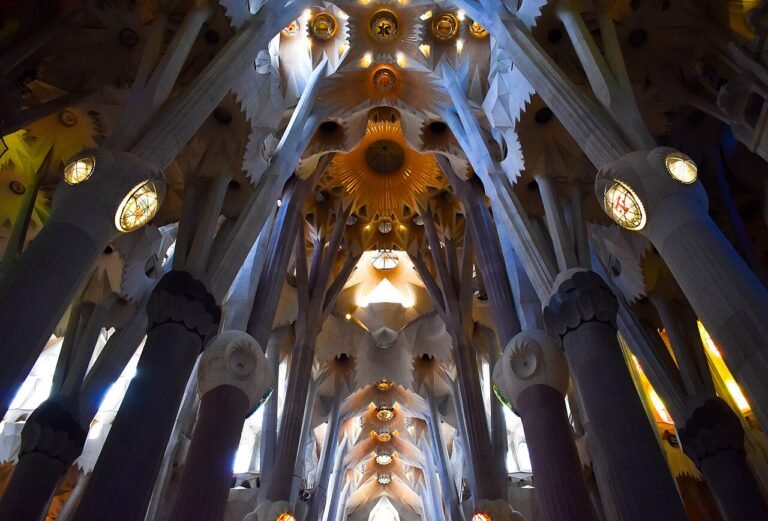
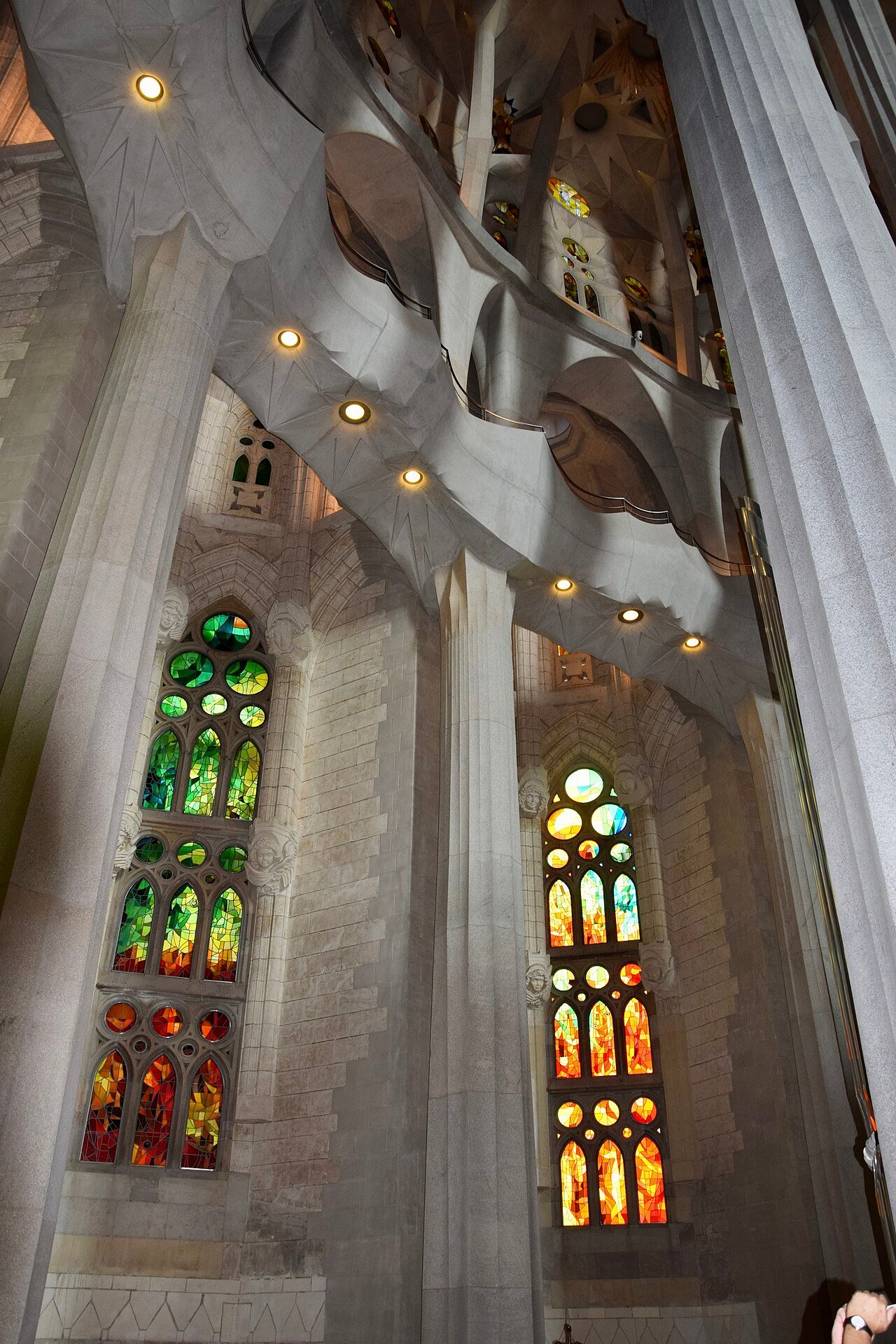
Inside is a different photograph entirely, and it runs on a timetable Gaudí set himself. The stained glass — made by Joan Vila-Grau from 1999, following Gaudí’s scheme — is split by compass point. The east windows, behind the Nativity façade, are blue and green, and the morning sun fires them first: the nave fills with cool, underwater light. The west windows, on the Passion side, are red, orange and gold, and from mid-afternoon they pour fire across the stone tree-columns. Same building, two colour palettes — pick the timed slot for the one you want, and know that the late-afternoon slots sell out first.
The rules are simple and enforced: personal photography is welcome, but no flash, no tripods and no selfie sticks, and anything commercial needs written permission from the Foundation before you arrive — professional kit gets checked at the door. It’s also a working church, so dress and behave like it. Our guide to inside the Sagrada Família covers the visit itself in full; this is the photographer’s version: book for the light, arrive for the pond.
2. Park Güell: A Mosaic Salamander and a Bench Above the City
Best for: colour — the most joyful frames in Barcelona
The shots: El Drac on the entrance staircase; the great wavy bench with the city behind it
When: the first entry slot of the day, or late afternoon on the terrace
Cost: timed ticket for the Monumental Zone; the rest of the park is free
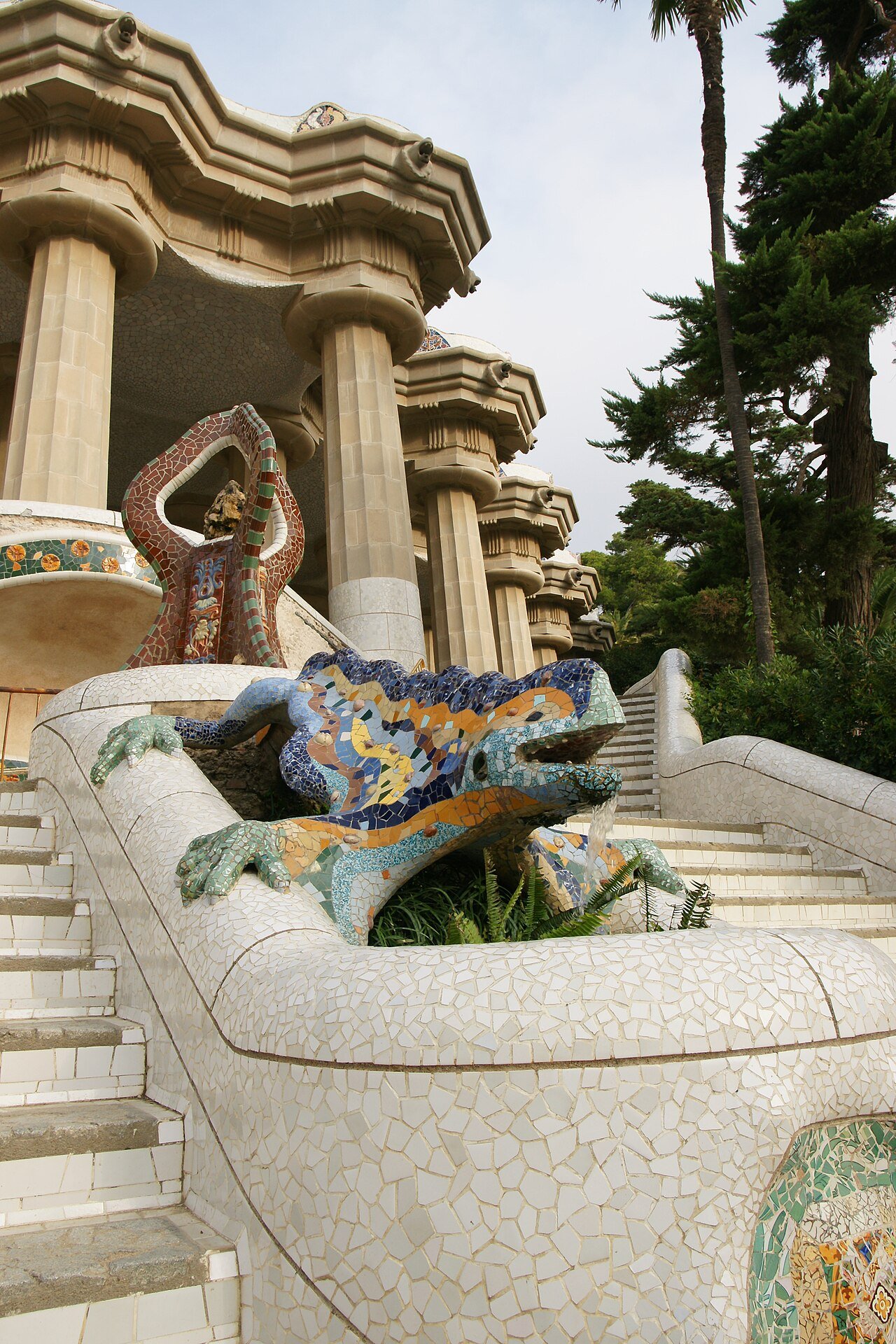
Every photographer in Barcelona eventually queues for the same lizard. El Drac, Gaudí’s trencadís salamander, sprawls across the entrance staircase spouting water, tiled in blue, ochre and green — and the trick is simply to be there before everyone else. Take the day’s first entry slot, walk straight to the staircase while the tour groups are still at the gate, and you’ll get the Drac, the mosaic medallion beside it and the Hypostyle Room’s stone columns behind with nobody climbing into your frame. Ten minutes later, you won’t.
Then climb. The Hypostyle Room shoots beautifully from its edges, where the columns repeat into shadow, and above it the great terrace — the Plaça de la Natura — wraps its famous wavy bench, tiled like a broken rainbow, around a view that runs from the Sagrada Família to the sea. Late afternoon is the terrace’s hour: the bench glows, the city flattens into layers, and the day’s heat comes off the stone. The monumental core is a small part of a big park — the stone viaducts and the free forest paths above it are full of frames nobody queues for. Our Park Güell guide explains the ticket zones and what’s free.
The park’s own rule is worth knowing: personal photography is fine everywhere, but professional and commercial shoots need authorisation — which the park only grants for scientific or training purposes. In other words, shoot for yourself, not for a client. Want to be in the picture instead? The Park Güell Photoshoot + Prints + Video session pairs you with a photographer inside the park: packages run from 6 to 30 edited high-resolution photos, every option includes a printed keepsake, and your gallery lands within 24 to 48 hours. It’s rated 4.7/5 from 39 reviews.
3. Bunkers del Carmel: The 360-Degree Panorama
Best for: the whole city in one frame — free
The shot: the skyline at golden hour, Torre Glòries to the sea, from the battery platform
When: the last two hours of light; in winter, check the closing time first
Cost: free
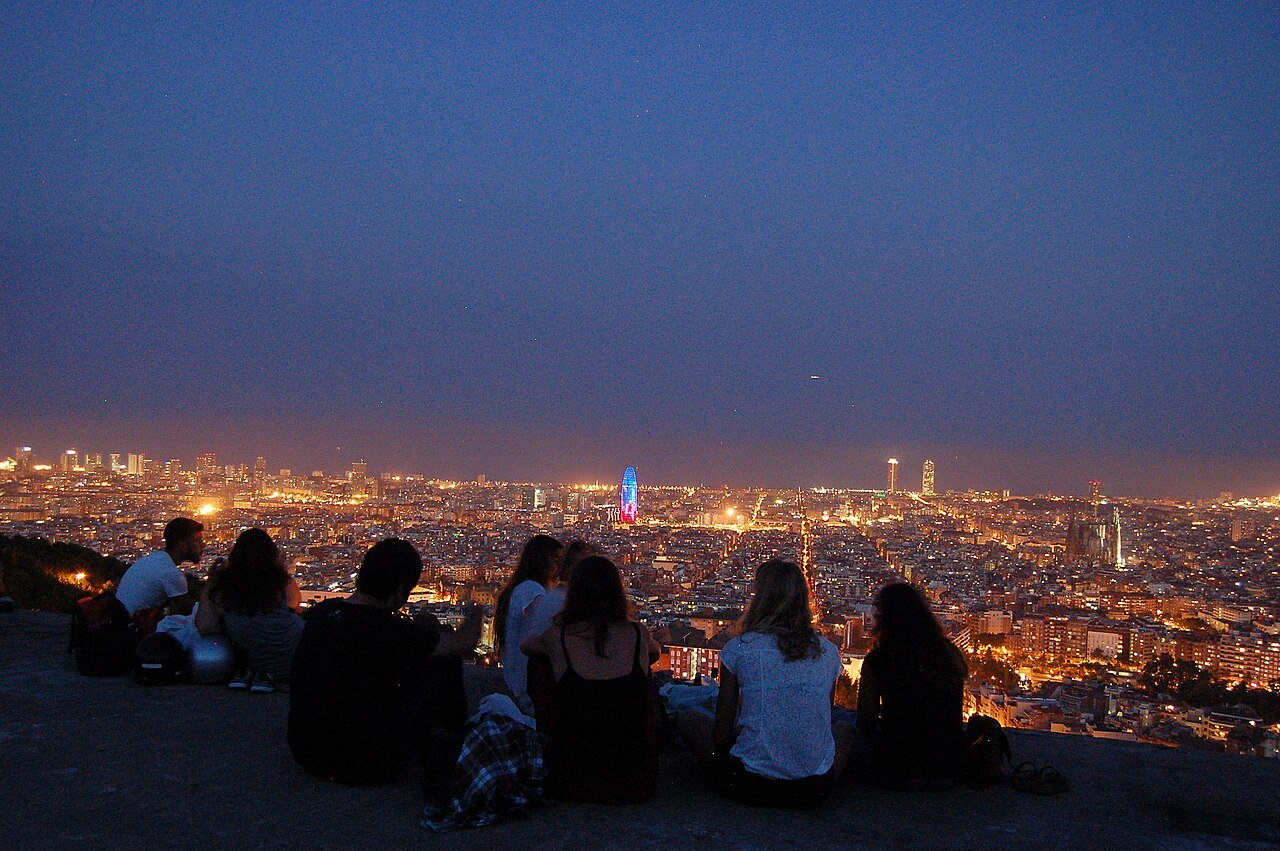
On top of the Turó de la Rovira (262 m) sit the concrete circles of a Civil War anti-aircraft battery, finished in March 1938 and protected as a MUHBA heritage site since 2011 — and from them, Barcelona performs its best trick. The view turns the full 360 degrees: the Eixample grid running down to the sea, the Sagrada and the Torre Glòries standing out of it, Collserola at your back and Montjuïc across the bay. There is no ticket, no queue and no glass between you and it, which is why half the city seems to be up here with a camera at sunset.
Two things to plan around. First, the site is fenced and keeps daytime hours — the gates were introduced in 2023 — so check the closing time for your date before you build an evening around it; in midwinter it can close before dusk, while high summer lets you shoot the full golden hour and walk down in the afterglow. Second, there is no shade and no water up here: in summer, come up late, not early. Morning is the locals’ secret, though — clear, empty and sharp, especially after rain has washed the air. We tell the battery’s full story, and the shantytown that once covered this hill, in our guide to the Bunkers del Carmel.
4. Casa Batlló: Get Close, Skip the Postcard
Best for: detail — masks, scales and mosaic
The shot: the mask balconies and blue-green façade tiles, tight
When: morning, before the Passeig de Gràcia crowds peak
Cost: the façade is free from the street; the interior is a timed ticket
Everyone photographs Casa Batlló the same way — the whole façade, from the middle of the Passeig de Gràcia, with a coach in it. The better photographs are six feet wide. Gaudí’s façade is a detail machine: white mask balconies with hollow eye-sockets, a skin of blue and green ceramic discs that shifts colour as the light moves, bone-shaped columns in the windows. Fill the frame with two balconies and a swatch of that mosaic skin and you have a stranger, stronger picture than the postcard shot — and the façade’s raking morning light models every bump of it.
Go in the morning for a second reason: this is the famous Block of Discord, and by midday the pavement outside is a solid shuffle of tour groups. Inside, the house rewards the same approach — the mushroom fireplace, the swirling ceiling of the Noble Floor, the blue-tiled light well that darkens as it drops. Personal photography is welcome inside; tripods aren’t, so lean on doorframes and keep your shutter speed honest. Our Casa Batlló guide covers the visit; bring a fast lens and shoot the small things.

5. Casa Milà (La Pedrera): The Rooftop Warriors
Best for: sculpture against the sky — Barcelona’s strangest portrait session
The shot: the great stone chimneys in a row, nothing behind them but blue
When: first entry, or the last hour, when the light rakes across the roof
Cost: timed ticket; the façade is free from the street
A few blocks up the same avenue, Gaudí’s other great house keeps its best photography on the roof. The terrace of Casa Milà is patrolled by a regiment of huge twisted chimneys and ventilation towers — the famous “warriors”, helmeted stone figures that look like a chess set designed by a surrealist. Photographed against the sky they stop being plumbing and become sculpture: come at the day’s first entry, when the roof is empty and the light is low, and line three or four of them up in a row with nothing behind them but blue.
The roof gives you two more frames before you go down. Over the balustrade, the Eixample’s chamfered corners repeat to the horizon — the city’s geometry lesson in one shot — and the terrace also lines up a long view towards the Sagrada Família. Inside, shoot the courtyards from their corners, where the curves stack up like a seashell. The wavy stone façade on the street is free, and worth the same close-up treatment as Casa Batlló’s: it’s a quarry face, and it loves side light.

6. Pont del Bisbe and the Gothic Quarter: Go at Dawn
Best for: atmosphere — stone lanes, lamplight, one famous bridge
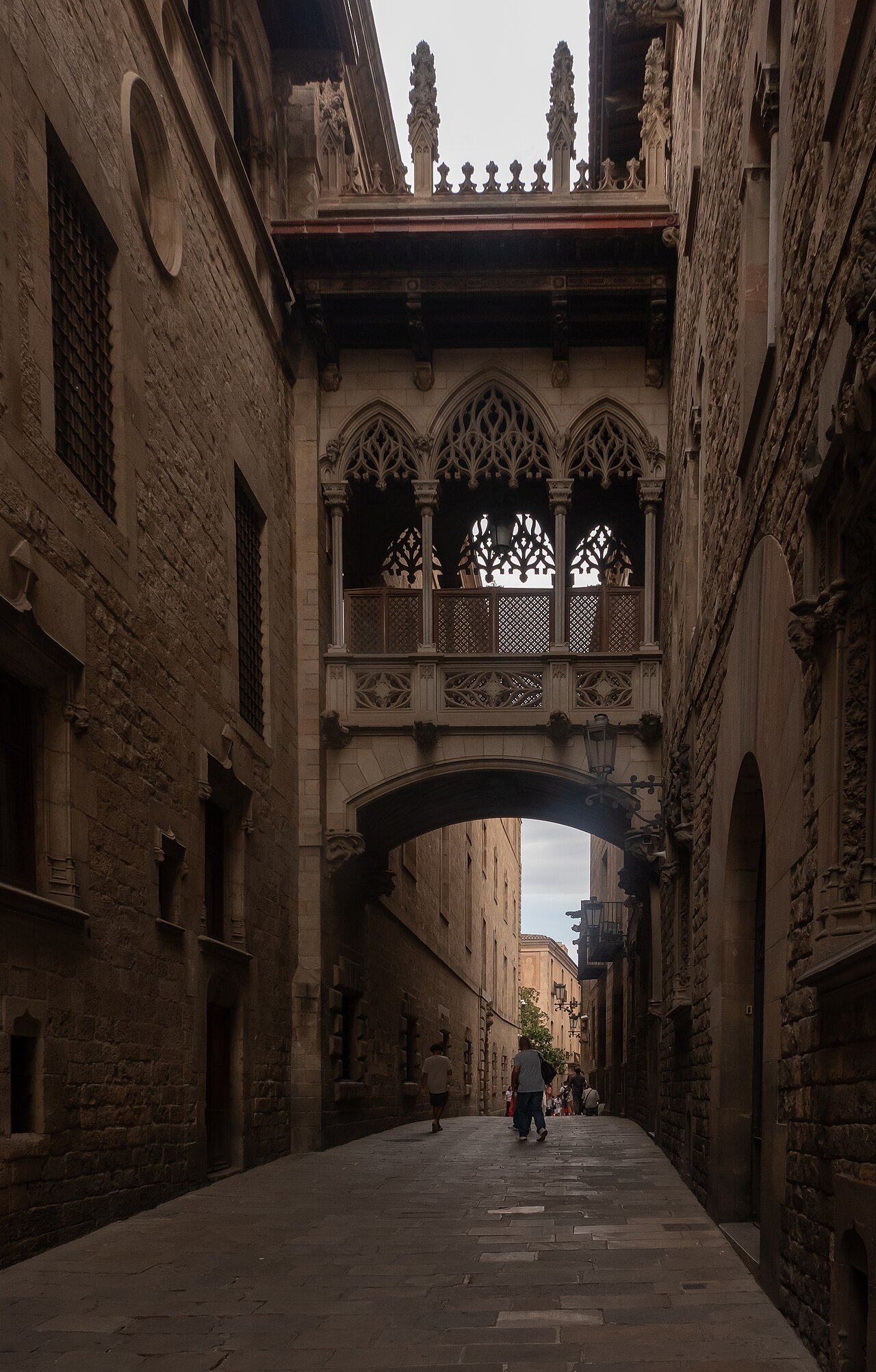
The shot: the Pont del Bisbe down the Carrer del Bisbe, empty
When: before 9 am, when the old town belongs to the delivery vans
Cost: free
The Gothic Quarter is the most photographed district in Barcelona and, after ten in the morning, the hardest to photograph: the lanes are lovely and completely full. So go at dawn. In the first hour of the day the Carrer del Bisbe is empty, the lamps are still on, and the Pont del Bisbe — the delicate neo-Gothic bridge that leaps between the Palau de la Generalitat and the Casa dels Canonges — hangs over the lane exactly as it does in every great shot of it. Here’s the twist worth knowing while you frame it: the bridge is a fake. It looks medieval, but it was built in 1928, to a design by Joan Rubió i Bellver, one of Gaudí’s collaborators. Walk under it and look up for the detail everyone misses — a skull pierced by a dagger, carved into the underside.
Two minutes away, the Plaça de Sant Felip Neri is the quarter’s quiet masterpiece: a tiny, still square where the church façade still carries the pockmarks of a bomb that fell in January 1938. Photograph it gently and early — it is a memorial as much as a backdrop. Our guide to Barcelona’s Old Town and Gothic Quarter maps the lanes; the photographer’s rule is simply to be done by the time the cruise groups arrive.
This quarter is also where a professional earns their fee. The Barcelona: Instagram Tour of the Most Scenic Spots starts at the Cathedral steps and walks the Gothic Quarter, Ciutadella and the Sagrada Família while a professional photographer shoots you — 25 fully optimised high-resolution pictures per session, options from 1.5 to 4 hours, and the longest version adds fast-track entrance to Park Güell. It’s rated 5.0/5 from 359 reviews, with free cancellation and reserve now, pay later.
7. Palau de la Música Catalana: The Skylight Concert Hall
Best for: the single most beautiful interior in Barcelona
The shot: the great stained-glass skylight from the rear of the hall
When: a morning tour, when the skylight takes the sun
Cost: you can only see it on a guided tour or at a concert
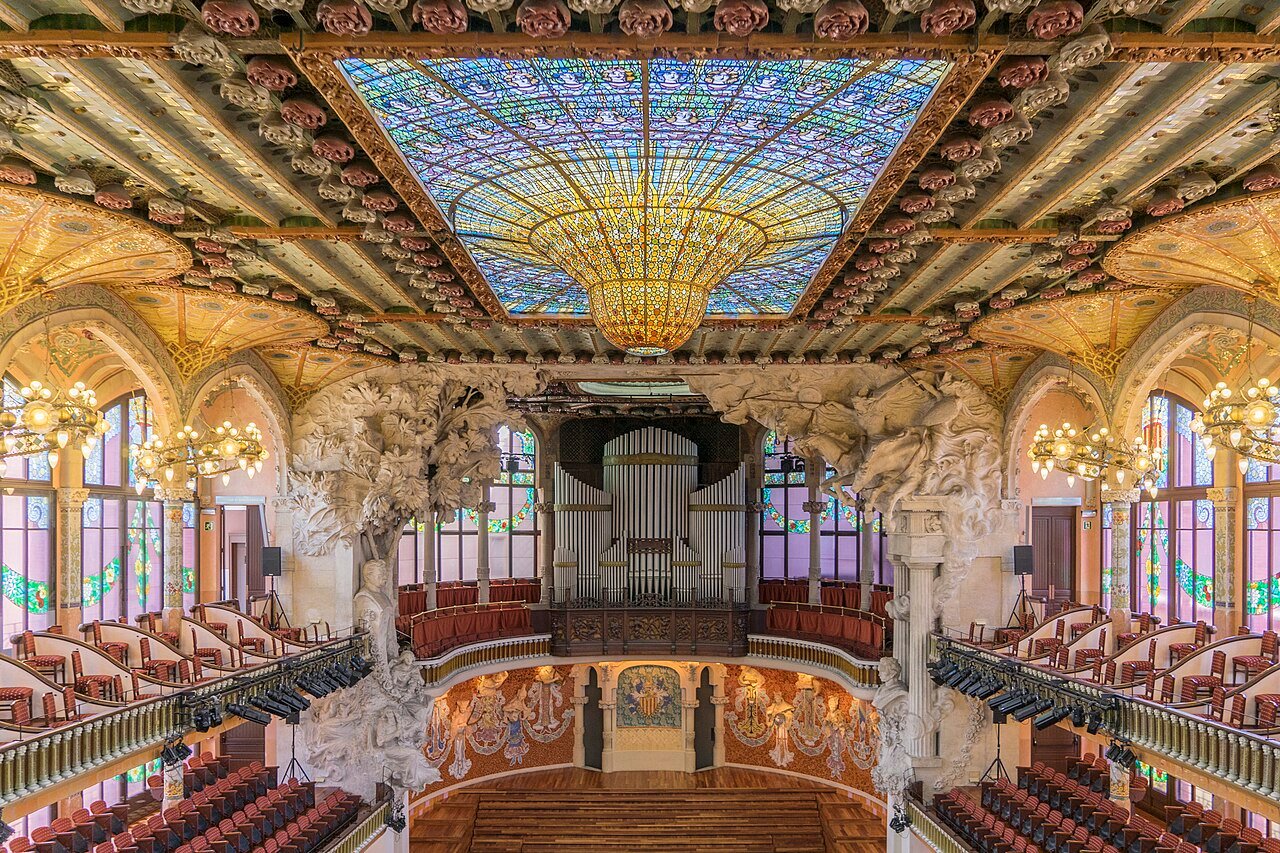
If the Sagrada Família is Barcelona’s most photographed interior, this is its most beautiful one — and many photographers would swap the order. The Palau de la Música Catalana, built by Lluís Domènech i Montaner in 1905–1908 for the Orfeó Català choir, is a concert hall made of glass: a whole wall of stained glass on one side, and overhead, the famous skylight by Antoni Rigalt — a great inverted dome of golden glass that hangs above the stage like a captured sun. Stand at the back of the hall on the tour and the frame composes itself: skylight above, the organ and the muses of the stage wall below, roses rioting along the ceiling beams.
There is exactly one catch, and it decides everything: you cannot wander in. The interior is seen on a guided tour or with a concert ticket, photography is allowed on tours for personal use — no flash — and during a performance the cameras stay away completely. So book the tour, and book a morning one, when daylight pours through the skylight at full strength. Our guide to the Palau de la Música Catalana covers the tours and the building; for the camera, add this: expose for the skylight, not the seats, or the glass will blow out to white.
8. Recinte Modernista de Sant Pau: The Beautiful Hospital
Best for: modernista colour without the Gaudí crowds
The shots: the Administration Pavilion’s sculpted façade; the pavilions across the gardens
When: morning, paired with the Sagrada Família a short stroll away
Cost: timed ticket
A short walk from the Sagrada’s queues stands the other Domènech i Montaner masterpiece — a hospital so beautiful it seems like a category error. The Recinte Modernista de Sant Pau, built between 1901 and 1930 as the Hospital de la Santa Creu i Sant Pau, is a garden city of tiled pavilions: brick, mosaic, stained glass and sculpture everywhere you point a lens, and a fraction of the visitors. Start where everyone should, facing the Administration Pavilion: its façade is a carved picture book — great arched windows, saints in niches, and the city’s coat of arms held up by two angels, all of it crisp in the morning sun.
Then work the grounds. The pavilions line up along garden paths with domes and tiled roofs at every turn, the underground tunnels give you vaulted, lamp-lit symmetry, and the whole site repeats the same trick: walk ten steps and the composition resets. Handheld cameras and phones are fine throughout; tripods aren’t allowed inside the pavilions, so brace against the doorways in the dimmer halls. Pair it with the Sagrada in one morning — the Avinguda de Gaudí, a diagonal avenue built to join them, is a ten-to-fifteen-minute stroll — and you’ll shoot the two greatest modernista interiors in the city before lunch.

9. Arc de Triomf and Parc de la Ciutadella: The Sunrise Avenue
Best for: symmetry — one red arch, two rows of palms
The shot: the arch centred down the Passeig de Lluís Companys
When: sunrise, when the promenade is empty and the brick is glowing
Cost: free
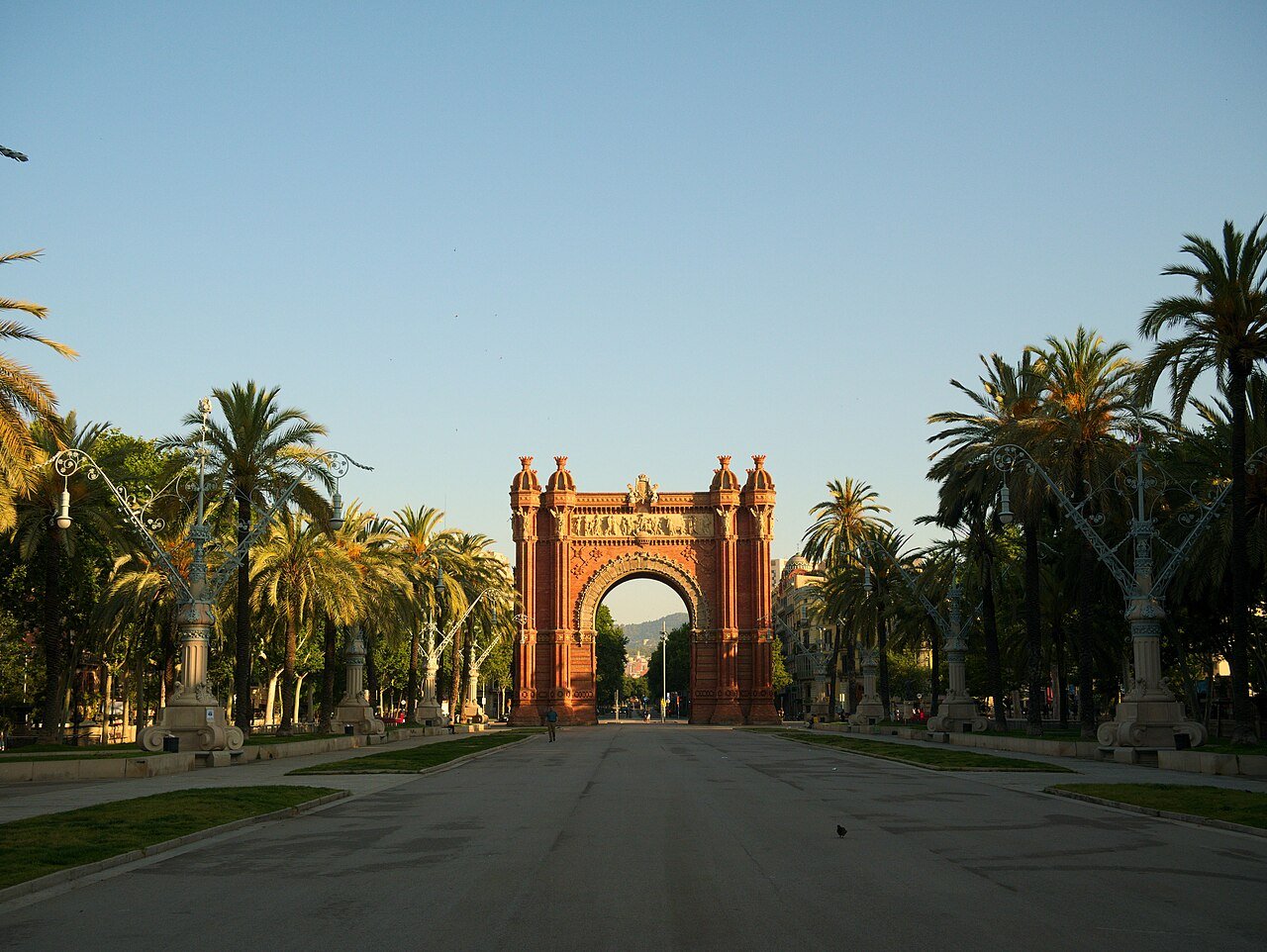
Barcelona’s triumphal arch isn’t stone-grey but warm red brick, built as the gateway to the 1888 Universal Exposition to a design by Josep Vilaseca — and it sits at the head of the city’s most symmetrical photograph: the Passeig de Lluís Companys, a broad promenade of palm trees and ornate lampposts running straight at it. Come at sunrise. The arch faces the morning, the brick lights up like terracotta, the promenade is empty but for runners and dog walkers, and you can stand dead centre and take the shot the avenue was designed for. By eleven it’s a river of people and the symmetry is gone.
Then walk five minutes into the Parc de la Ciutadella, the green lung the exposition left behind, and finish at the Cascada — a monumental fountain of winged horses and gilded chariots that looks like Rome and shoots like a film set. The young Gaudí helped design it as a student, working under Josep Fontserè, which makes it the earliest Gaudí photograph in the city. The park’s lake, glasshouse and tree-lined paths fill out the roll; all of it is free, and all of it is best before the city wakes up properly.
10. Tibidabo: The Whole City, Arranged for You
Best for: the definitive panorama — city, landmarks and sea in layers
The shot: the Sagrada and the Torre Glòries picked out of the grid, from the summit
When: a clear morning after rain, or sunset into the blue hour
Cost: free from the summit terraces; the funicular and rides are paid
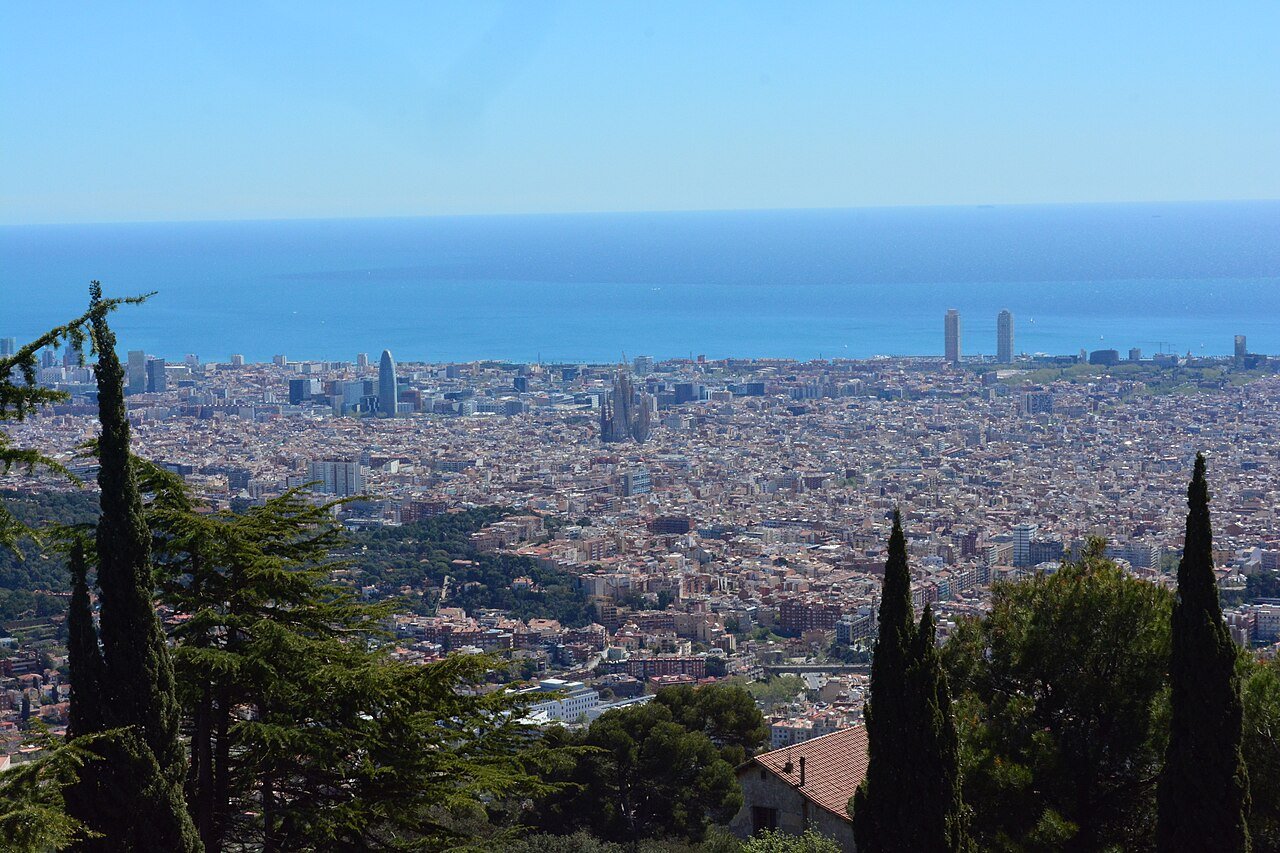
From the top of Tibidabo, 512 metres above the sea, Barcelona stops being a maze and becomes a map. The whole Eixample grid spreads out below you, and the landmarks stand up out of it one by one — the Sagrada Família centre-frame, the Torre Glòries like a bullet, the twin towers on the seafront and the Mediterranean wallpapering the horizon. This guide’s opening photograph was taken from up here, and it’s the frame that explains the city better than any other. Bring the longest lens you have: compressed through a telephoto, the Sagrada rises straight out of the rooftops.
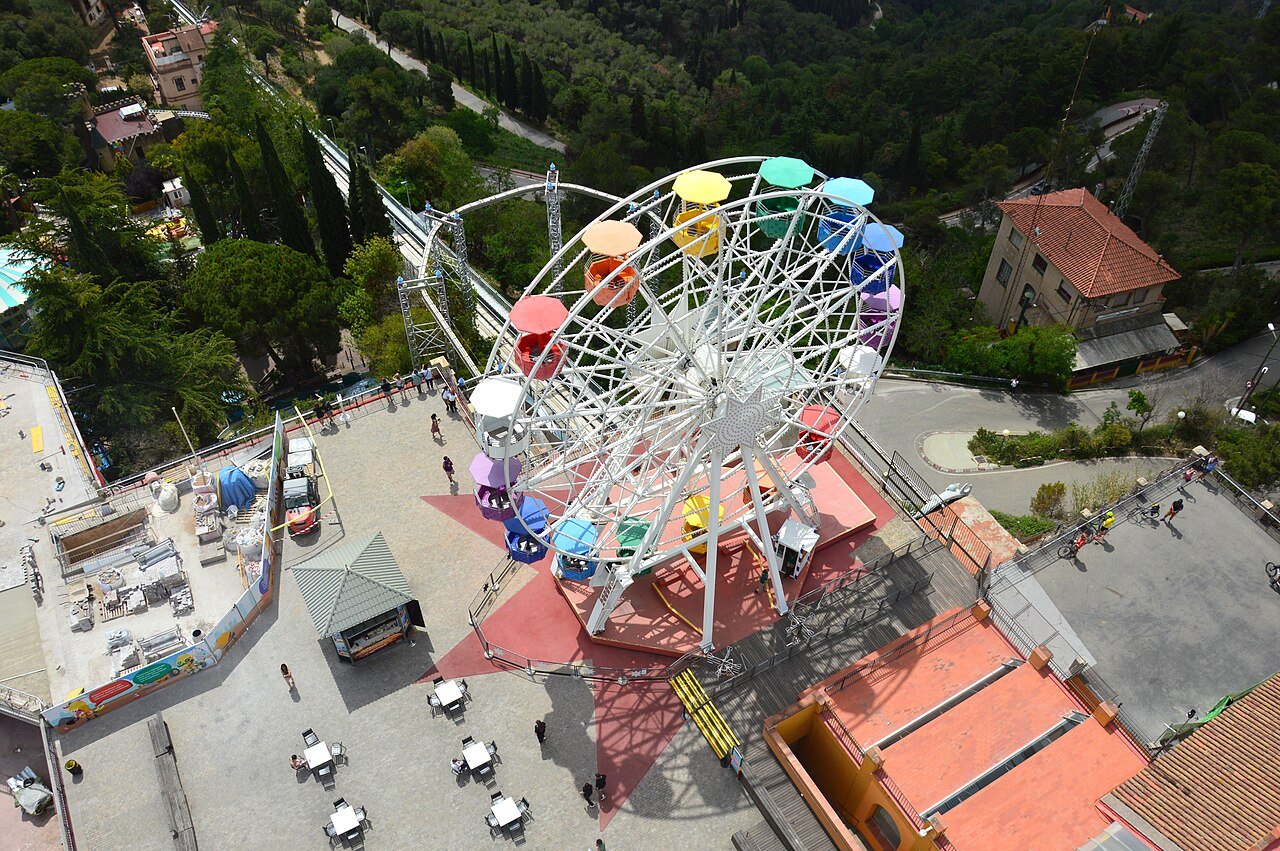
The summit gives you foreground subjects too, which most viewpoints don’t. The Sagrat Cor church crowns the peak, its stone Christ watching over the city; below it, the old-fashioned amusement park offers the Giradabo ferris wheel — shoot it from the Talaia tower above, or frame its coloured cabins against the city at dusk. Clarity is everything at this height: come on a crisp morning after rain, or in winter, when the air is washed clean and the Pyrenees sometimes appear behind you. Our Tibidabo guide covers the funicular, the church and the park.
11. Barceloneta and the W Hotel: The Glass Sail
Best for: sea light, beach life and one modern icon
The shot: the sail-shaped W Barcelona across the sand and the surf
When: golden hour, when the tower turns into a mirror
Cost: free
Every photography walk in Barcelona should end at the sea. From the sand at Barceloneta, the city’s brash modern landmark does all the work: the W Barcelona hotel, Ricardo Bofill’s great glass sail, rises straight out of the water at the end of the beach. It is a mirror with a building behind it — through the day it reflects the sky’s mood back at you, and at golden hour the whole façade catches fire. Walk the shoreline and shoot it long, across the surf line; or shoot it short, with the beach doing Barcelona things in the foreground — volleyball games, swimmers, the lifeguard towers, a century of locals taking the same evening air.
The old fishing quarter behind the beach gives you the human frames: narrow streets, laundry overhead, bars that have poured vermouth through every era of the waterfront. And if the photos you want are of you — with the sail behind you — the Barcelona: Professional Private Photoshoot lets you pick your backdrop: Barceloneta, the Sagrada Família, the Gothic Quarter or Park Güell, in a private 30-minute or 1-hour session with 25 or 50 edited photos delivered in under 48 hours. It’s rated 4.7/5 from 40 reviews, with free cancellation and reserve now, pay later.

Good to Know Before You Set Out
- Light runs the whole day. Sunrise belongs to the streets and the viewpoints — the Gothic Quarter, the Arc de Triomf, the pond at the Sagrada. Mid-morning and late afternoon belong to the interiors, when the Sagrada’s glass is lit from one side or the other. Golden hour belongs to the hills and the beach. Plan the day as a photographer, not a tourist, and the city cooperates.
- Travel light: the tripod rules are real. Tripods are banned inside the Sagrada Família, on the Palau de la Música tours and inside Sant Pau’s pavilions, and Park Güell and the basilica both reserve professional photography for authorised shoots only. A mini-tripod or gorilla pod for the street, a fast lens and steady hands will cover everything in this guide.
- Leave the drone at home. Under Spain’s drone rules (Royal Decree 517/2024, enforced by AESA), flying in urban areas carries strict conditions — safety distances, no flights over crowds, and advance notification to the Ministry of the Interior — and Barcelona also sits in controlled airspace near the airport, with several places in this guide off-limits to drones outright. Check the official ENAIRE Drones map if you’re determined; for a holiday, it isn’t worth the paperwork.
- Book the interiors for the light, early. The Sagrada Família, Park Güell and the Palau all run on timed entry, and the slots that match the best light — the Sagrada’s late afternoon above all — are the first to sell out. Book days ahead in high season, longer for summer weekends.
- Respect the working buildings. The Sagrada is a consecrated basilica with a dress code, the Palau is a working concert hall, and Sant Felip Neri is a memorial. Shoot quietly, skip the flash, and don’t set up in doorways — the photographs are better for it anyway.
- Keep a hand on the strap. In the crowded lanes of the old town, wear the camera across your body and keep hold of it at café tables. Barcelona’s pickpockets are as practised as its photographers.
Travel insurance, sorted
Whether it is a two-week holiday or a longer move, travel insurance is not the most glamorous part of a trip – but it is the one booking you want to have in place before a trip, and while you are already away. Get a quote from SafetyWing
Final Thoughts
Barcelona is a city that was practically designed to be photographed — Gaudí alone accounts for half this list — but the difference between the postcard and the photograph is almost always the hour. Go to the Gothic Quarter at dawn, the Sagrada at the edges of the day, the Bunkers for the last light and the beach for the golden one, and the city will do the rest. Shoot the icons, by all means; just shoot them at their moment. And if you’d rather trade the camera bag for altitude, our hiking guide picks up where spot 10 leaves off — the summit of Tibidabo is a trailhead as well as a viewpoint, and Collserola is full of frames nobody has taken yet.

8 Best Hikes in Barcelona: Collserola Trails and City Hills
Frequently Asked Questions
What is the best place to take photos in Barcelona?
The Sagrada Família — outside from the Plaça de Gaudí, where the façade reflects in the pond on a still morning, and inside for the stained-glass light. For a free panorama, the Bunkers del Carmel (spot 3) beats every paid viewpoint in the city.
Can you take photos inside the Sagrada Família?
Yes — personal photography is welcome throughout the basilica. The conditions: no flash, no tripods and no selfie sticks, and commercial photography needs written permission from the Foundation in advance. Go in the morning for blue-green light or late afternoon for red and orange.
Are tripods allowed at Barcelona’s sights?
Mostly not indoors. The Sagrada Família, the Palau de la Música tours and the pavilions at Sant Pau all prohibit tripods, and professional or commercial shoots need authorisation at Park Güell and the basilica. Outdoors, for personal photography, a small tripod is fine.
When is the best time of day for photography in Barcelona?
Sunrise for empty streets and viewpoints — the Gothic Quarter, the Arc de Triomf and both hilltops. Morning or late afternoon inside the Sagrada Família, depending on which colours you want. Golden hour for the Bunkers, Tibidabo and the Barceloneta seafront.
Can I fly a drone in Barcelona?
For a visitor, effectively no. Spain’s rules put strict conditions on urban flights — safety distances, no flying over crowds and advance notification to the Ministry of the Interior — and Barcelona sits in controlled airspace near the airport. The Sagrada Família bans drones outright. Check the ENAIRE Drones map before even packing one.
Do you need a permit to take photos in Park Güell?
Not for personal photography — your camera is welcome throughout the park, and only the Monumental Zone needs a (timed) entry ticket. Professional and commercial photography needs authorisation, which the park grants only for scientific or training purposes.
Is it worth booking a photoshoot or photo tour in Barcelona?
If you want to be in the photographs, yes. The three options in this guide (spots 2, 6 and 11) put a professional behind the camera at the city’s best backdrops and send you home with edited, high-resolution photos — the one souvenir a selfie can’t match.